
San Marcos Pre-Approved ADU Plans: Are PRADU Plans Worth Using in 2026?
By The Dwelling Index Editorial Team · About our team · Methodology · Editorial standards
· Last verified May 11, 2026 against sanmarcosca.gov PRADU program page, City Development Fee Schedule (eff. 3/3/2025), SMUSD fee page, and Cal. Gov. Code §§ 65852.27, 66311.5, 66317, 66321–66323, 66333 · Next scheduled review: August 2026
Independently verified against the City of San Marcos PRADU program page and fact sheet, City Development Fee Schedule effective March 3, 2025, SMUSD Residential and Commercial Developer Fees page, and current California Government Code. The Dwelling Index is an independent research resource covering ADU financing, costs, and regulations. We are not a builder, lender, or broker.
The Honest Answer in Two Sentences
Yes — the City of San Marcos publishes pre-approved Permit-Ready ADU (PRADU) plans for detached, one-story accessory dwelling units, and the City targets a 30-day approval or denial once it receives a complete application. But “pre-approved” doesn’t mean “plug-and-play”: the City describes its PRADU plans as mostly complete, will not consider alterations to its plan sets, and still requires a building permit, site-specific drawings, deferred submittals, and combined city plan-check and permit fees of $3,750.32 for City-Standard ADUs up to 1,000 sq ft — before school developer fees, utility connection and capacity charges, water and sewer charges, or any CFD/Mello-Roos assessments.
San Marcos PRADU at a Glance
| Question | Bottom line | Source (verified May 11, 2026) |
|---|---|---|
| Does San Marcos offer pre-approved ADU plans? | Yes, for detached, one-story ADUs through the PRADU program. | City of San Marcos PRADU program page |
| Is the permit review really 30 days? | 30 days is the City’s target once it has a complete PRADU application. | City PRADU program page and fact sheet |
| Can I modify the City plan? | No. The City states it will not consider alterations to City-provided plan sets. | City PRADU program page |
| Are the plans actually complete? | The City calls them “mostly complete.” Site-specific work is still required. | City PRADU program page |
| What does the City charge in plan-check + permit fees? | $1,166.08 plan check + $2,584.24 permit = $3,750.32 combined, for City-Standard ADUs up to 1,000 sq ft. School, utility, water/sewer, and CFD fees are separate. | City Development Fee Schedule, effective 3/3/2025 |
| What size avoids state-law impact fees? | Under current state law (Cal. Gov. Code §66311.5), an ADU of 750 sq ft of interior livable space or less is not subject to impact fees from a local agency, special district, or water corporation. | Cal. Gov. Code §66311.5 |
| State-law backup if PRADU doesn’t apply | Cal. Gov. Code §66317 sets a 15-business-day completeness review and a 60-day approval/denial shot clock for ADU applications generally. | Cal. Gov. Code §66317 |
Sources: sanmarcosca.gov PRADU page; City Development Fee Schedule eff. 3/3/2025; Cal. Gov. Code §§ 66311.5, 66317. All verified May 11, 2026.
Address-specific · 60 seconds · no phone call required
See What You Can Build → Get Your Free San Marcos ADU Report
Get Your Free ADU Report →No phone number required. Just a property-specific snapshot.
What we verified
The Dwelling Index is an independent research resource. This guide synthesizes the following primary sources, with verification dates noted inline:
- City of San Marcos PRADU program page — confirms detached one-story plans, “mostly complete” status, no-alterations rule, and 30-day review target.
- City PRADU fact sheet (fall 2024 PDF) — confirms the six-step process and submittal checklist.
- City Development Fee Schedule, effective March 3, 2025 — confirms $1,166.08 plan-check and $2,584.24 permit fees.
- City ADU FAQ (Planning Division) — confirms 4-foot side/rear setbacks, 10-foot eave-to-eave separation, rear-50%-of-lot rule, and parking exemptions.
- SMUSD Residential and Commercial Developer Fees page — confirms $5.17 per sq ft residential rate.
- Cal. Gov. Code §§ 65852.27, 66311.5, 66317, 66321, 66322, 66323, 66333 — state-law rules governing ADU permitting, impact-fee exemptions, shot clocks, and JADU owner-occupancy.
- SnapADU San Marcos guide (April 2026) — provider-published source; code-cycle concerns not confirmed by City as of our verification date.
Items we explicitly could not verify: the exact number and names of plan sets currently posted to the City’s plan folder; whether each plan set is current for the active code cycle; and parcel-specific CFD treatment. We flag these inline.
SnapADU is the firm the City of San Marcos selected to design its PRADU plan library — disclosing both that factual role and our affiliate relationship is required for honest coverage. Full affiliate disclosure.
Does San Marcos Have Pre-Approved ADU Plans?
Yes. The City of San Marcos has a Permit-Ready Accessory Dwelling Unit program — branded PRADU — that offers homeowners free, pre-approved building plans for detached, one-story accessory dwelling units. PRADU is the City’s implementation of California Government Code §65852.27, the statute created by Assembly Bill 1332. AB 1332 required every California local agency to set up a process for pre-approving ADU plans and to ministerially approve applications using a qualifying pre-approved plan within 30 days of receiving a complete submittal.
What that means in practice: the City has done some of the design and code-compliance review work in advance, on a small library of fixed plan sets. You can download a PRADU plan, add the property-specific information the City lists in its checklist, attach the deferred submittals, and submit a building permit application with the goal of a 30-day decision rather than the months-long custom design and review cycle.
Three quiet assumptions that trip people up
- “Pre-approved means I can build it.” It means the plan set has been reviewed. You still need to apply for a building permit, complete the package with site-specific information, pay City fees and outside agency fees, get inspections, and pass a final.
- “Pre-approved means it’s free.” The plan set itself is free to download. The application is not free. The build is not free. The fees described later in this guide are not optional.
- “Pre-approved means I’ll get it permitted in 30 days.” The 30-day clock starts when the City has a complete application. Most applications miss the clock because a deferred submittal, the site plan, the survey, the truss package, or a utility item wasn’t ready.
How San Marcos PRADU Plans Actually Work
The PRADU pathway is a six-step process: download the City materials, complete the plan package with property-specific information, optionally consult with City staff, submit a building permit application, respond to City review, and — once permitted — build and pass inspections. What pre-approval changes is the review stage, not the application or the construction stages.
Step 1 — Download the City PRADU materials
The City posts its PRADU plan sets on its Building Division page. Each plan set is “mostly complete” but requires you to fill in project-specific information. The exact number of plans in the live folder is not consistently reported across sources. SnapADU publishes four San Marcos-tagged floor plan examples; other aggregators have listed three. Confirm plan count and names with the City Building Division. Status not confirmed by City as of May 11, 2026.
Step 2 — Complete the plan package
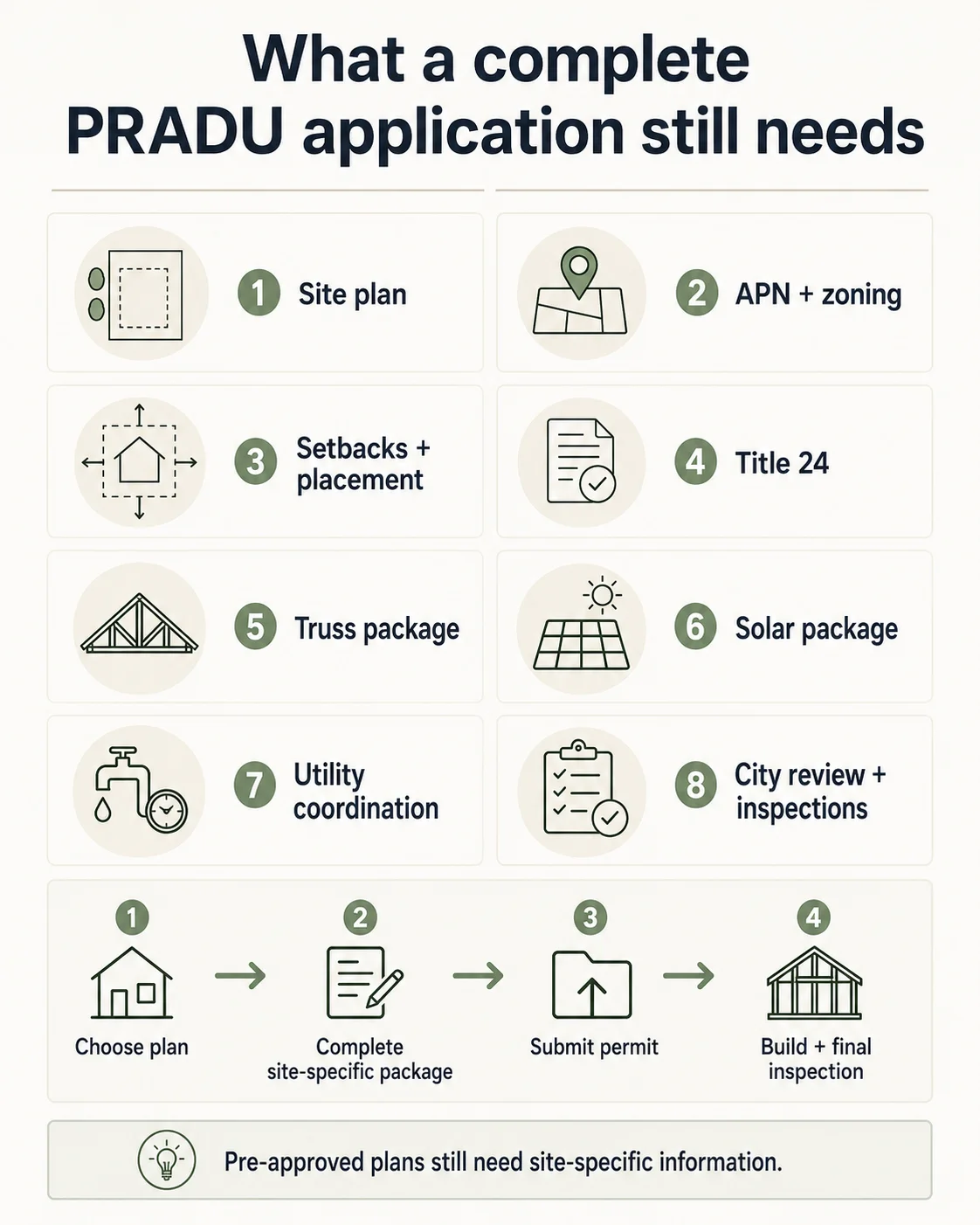
A PRADU plan set is the architectural / structural / energy base. Your submittal still needs to layer on: a detailed site plan; APN and zoning classification; a pervious/impervious surface table; a Stormwater Quality Management Plan (SWQMP) or BMP selection; Title 24 energy calculations; a roof truss package (deferred submittal); a solar PV package (deferred submittal); a fire sprinkler submittal if required; and utility coordination with SDG&E, water/sewer agencies, and SMUSD.
Step 3 — Consult with City staff
The City actively encourages applicants to talk to Planning Division staff about zoning, setbacks, parking, and lot eligibility, and to Building Division staff about submittal requirements. This is the cheapest insurance against a corrections cycle.
Step 4 — Submit your building permit application
San Marcos accepts digital submittals through the City’s permitting portal. A San Marcos building permit can be issued only to the property owner or to a licensed California contractor, per the City PRADU fact sheet.
Step 5 — City review
The City reviews across four departments: Planning, Building, Land Development Engineering, and Fire Prevention. If your application is complete and your plan set is current, the City’s target is 30 days for approval or denial.
Step 6 — Permit, construction, inspections, occupancy
Permit issuance triggers construction. The City of San Marcos publishes a Setback Certification Format that must be presented at foundation inspection for new detached structures. After final inspection, the City issues a certificate of occupancy.
The PRADU Plans (and What We Couldn’t Verify)
The City of San Marcos commissioned its PRADU plan library through a competitive bid process and selected SnapADU, a Greater San Diego design-build firm, from a field of more than two dozen applicants. The exact roster currently posted on the City’s plan folder is best confirmed with the City Building Division.
| Plan | Beds/Baths | Approx. sq ft | Footprint | Status |
|---|---|---|---|---|
| 24 × 20 “Square” | 1 BR / 1 BA | ~498 sq ft | Compact square | Provider-published San Marcos-tagged plan |
| 44 × 17 “Long” | 2 BR / 2 BA | ~748 sq ft | Long and narrow | Provider-published San Marcos-tagged plan |
| 28 × 27 “Square” | 2 BR / 2 BA | ~749 sq ft | Larger square | Provider-published San Marcos-tagged plan |
| 36 × 31 “L-Shape” | 2–3 BR / 2 BA | ~999 sq ft | L-shape | Provider-published San Marcos-tagged plan |
Important: The plans above are SnapADU-published catalog examples tagged “San Marcos.” They are not an official roster of the live City PRADU plan folder. Confirm plan count, names, dimensions, and current code-cycle status with the City Building Division. Status not confirmed by City as of May 11, 2026.
Why the size lanes matter
A plan at under 500 sq ft opens up several side benefits: some sitework requirements relax, the project is unambiguously under the state-law 750-sq-ft impact-fee threshold, and school developer fee implications change at the 500-sq-ft mark. A plan at 749–750 sq ft preserves the state-law impact-fee threshold. A plan at 999 sq ft is at the upper end of what the City typically allows for a two-bedroom-plus detached ADU.
“Configuration” is not the same as “modification”
The City has stated it will not consider alterations to its plan sets. Provider-published guidance describes surface-level configuration options — exterior materials and finishes, opening placement within the approved envelope, kitchen/bath layouts within the footprint — without changing the footprint, structure, roof design, or energy compliance. Whether any specific configuration choice falls inside or outside the City’s no-alterations rule is a determination City staff makes case by case. Ask Building Division if you have any doubt about a specific selection before you finalize drawings.
Can I Change a San Marcos PRADU Plan?
No. The City of San Marcos has stated on its PRADU program page that it will not consider alterations to City-provided plan sets. Any change that affects the footprint, the structural design, the roof design, or the energy compliance of the plan moves your project off the PRADU pathway and onto the standard ADU permit pathway.
The honest framing for the decision:
- Path A — Use the plan exactly as published. You accept the configuration options, you build the plan as-is, and you get the 30-day plan-review benefit if your package is complete. This is the best case for PRADU.
- Path B — Use the plan as inspiration. You like the layout but want to change something. You’re using a standard ADU permit with a builder’s semi-custom plan. You pay for the modification work (provider-published $2,000–$4,000 to redraft) and accept the standard ADU review timeline.
There is no “Path A.5” where you make a small modification and keep the pre-approval.
What about HOA-driven design changes?
This question comes up most from owners in San Elijo Hills, Discovery Hills, Lake San Marcos, and other planned communities. Under California Civil Code §4751 and Assembly Bill 670, an HOA cannot effectively prohibit or unreasonably restrict a compliant ADU. The HOA can impose reasonable design standards. If your HOA requires changes that go beyond the configuration options inside a PRADU plan, you have three realistic options: work with the HOA to accept the PRADU palette; drop the PRADU pathway and use a standard ADU permit with a custom plan; or apply for a variance at the HOA’s Architectural Review Committee.
The HOA cannot stop the ADU. It can, in some cases, prevent you from using the City PRADU plan as-is. Those are different problems.
What Does a Complete PRADU Application Still Need?
A PRADU plan set covers the architectural and structural drawings; the remaining 20–25% of the submittal is the property-specific package — site plan, surveys, calculations, deferred submittals, and utility coordination — and it is the same work any ADU project requires regardless of whether you use PRADU or a custom plan.
Site plan (plot plan)
A drawing of your parcel showing existing and proposed structures, the proposed ADU’s footprint with dimensioned setbacks, the driveway, fences and walls, easements, slopes, meter and panel locations, and stormwater flow paths. Provider-published cost estimate: $1,000–$2,500 from a drafter. Required for any ADU permit.
Vicinity map
A small reference map showing the parcel in the context of surrounding streets. Often produced as part of the site plan deliverable.
APN and zoning reference
The 10-digit Assessor’s Parcel Number and the zoning classification (typical San Marcos single-family zones include R-1, RR, and various Specific Plan Area designations).
Pervious / impervious surface table
A table showing the existing and proposed amounts of pervious and impervious surfaces on the parcel. The change drives the SWQMP/BMP determination.
SWQMP / BMP package
If the project exceeds the City’s land-disturbance threshold or adds enough impervious surface, the application needs a Stormwater Quality Management Plan or selected Best Management Practices for runoff control.
Plan-sheet selections
The PRADU plan set includes optional sheets for various configurations. You mark up the plan set to indicate your selections.
Title 24 energy calculations
California’s Title 24 mandates an energy-compliance package for every new ADU. Provider-published cost estimate: $400–$1,000 from a certified energy consultant.
Roof truss calculations (deferred submittal)
Engineered truss drawings stamped by a California-licensed structural engineer. Provider-published cost estimate: $300–$900. Submitted before framing begins.
Solar PV package (deferred submittal)
Most new detached ADUs in California require solar PV. System size depends on the unit’s energy demand. PV submittal can typically be a deferred item.
Fire sprinklers (situational)
Under current state law (Cal. Gov. Code §66322), fire sprinklers shall not be required in an ADU when they are not required in the primary residence. Consult the Fire Prevention Bureau before assuming either way.
Setback certification
The City of San Marcos publishes a Setback Certification Format that must be presented at foundation inspection for new detached structures.
Building verification survey
Provider-published guidance indicates detached ADUs in San Marcos frequently require a building verification survey. Provider-published estimate: $1,500–$3,500. Confirm with the City Building Division.
Soils investigation report (situational)
Per a May 2025 confirmation from a San Marcos Plans Examiner (cited secondhand from SnapADU), the City no longer routinely requires a soils report for ADUs over 500 sq ft. Required if grading is proposed. Provider-published cost when required: $3,000–$6,000.
School developer fee receipt
Once SMUSD has calculated and collected the school developer fee, the receipt becomes part of the package. Current SMUSD residential rate: $5.17 per square foot (verified May 11, 2026; subject to change).
Indemnification and copyright acknowledgment
Under AB 1332, the City requires applicants using pre-approved plans to sign indemnification language and a copyright acknowledgment. The City provides the language.
Save this list
If you’re working with a builder, ask them to walk it line by line against their bid. If even one item is missing — surveys, truss, solar, sprinkler determination, utility coordination, school fee — your 30-day clock is at risk.
Download the Free San Marcos PRADU Starter Kit →Includes a printable submittal checklist and the 15-question script for your City consultation.
How Long Does PRADU Approval Take, and What Can Delay It?
The City of San Marcos targets approval or denial of a complete PRADU application within 30 days. The 30-day clock starts when the City has a complete application — not when you upload your first draft. The 30-day target is set by California Government Code §65852.27 and applies only when the plan set is current for the active California Building Standards Code rulemaking cycle.
The 2026 code-cycle question
The California Building Standards Code updates on a three-year cycle. The current cycle took effect January 1, 2026. SnapADU, the firm the City selected to design its PRADU plan library, stated publicly in its April 2026 guide that the publicly posted PRADU plan sets for both Chula Vista and San Marcos may require updates to remain compliant under the new code cycle. The City is the authoritative source on permit acceptance and plan validity.
Status not confirmed by City as of May 11, 2026. Ask the City Building Division in writing: “Is Plan Set [name or number] currently approved for the active California Building Standards Code cycle?”
PRADU’s 30 days vs. state law’s 60 days
For comparison, California Government Code §66317 — the general ADU shot clock — requires local agencies to determine the completeness of an ADU application within 15 business days and to approve or deny a complete application within 60 days. PRADU’s 30 days is faster, but it applies only when the plan set is current for the code cycle and the application is complete.
What can delay PRADU review
- An incomplete site plan. The most common single defect.
- Missing deferred submittals. Truss calculations, solar PV package, and fire sprinkler determination when required.
- Title 24 calcs that don’t match the selected plan options.
- Setback or rear-yard placement issues. San Marcos requires detached ADUs in the rear 50% of the lot, with 4-foot side and rear setbacks.
- HOA conflicts surfacing late. The City can hold a file if HOA design review is unresolved.
- CFD/Mello-Roos processing. Provider-published guidance reports the City Council certifies CFD votes four times per year, which can add 3–4 months to the overall timeline for ADUs over 749 sq ft in CFD-affected areas.
- Concurrent new-primary-dwelling permit. The PRADU 30-day benefit does not apply; the application is processed as a standard combined permit.
Honest reframe: a realistic best case for a clean PRADU application on a simple lot is approximately 3–4 months from submittal to permit issuance, plus 4–6 months of construction. Most projects are longer.
What Fees Still Apply (and Where the $3,750.32 Number Comes From)
Using a PRADU plan reduces design fees and design-phase time. It does not reduce city permit fees, school fees, utility connection or capacity charges, water and sewer fees, CFD/Mello-Roos assessments where applicable, or any construction costs.
| Fee or cost line | Amount | Source / verification |
|---|---|---|
| City plan-check fee, City-Standard ADU | $1,166.08 | City Development Fee Schedule, eff. 3/3/2025 |
| City permit fee, City-Standard ADU | $2,584.24 | City Development Fee Schedule, eff. 3/3/2025 |
| Combined City plan/permit fee | $3,750.32 | Calculated from City fee schedule |
| Public Facilities Fee (PFF) / impact fees | State law (Cal. Gov. Code §66311.5) prohibits impact fees on ADUs of 750 sq ft or less of interior livable space. Over 750 sq ft: proportional. | Cal. Gov. Code §66311.5 |
| School developer fee (SMUSD) | $5.17 per sq ft residential rate (verified 5/11/2026; subject to change) | SMUSD Residential and Commercial Developer Fees page |
| CFD / Mello-Roos | Parcel-specific. Provider-published ranges: ~$1,000–$2,000/yr (annual annexation) or ~$100,000–$200,000 one-time in-lieu fee | City ADU FAQ; SnapADU April 2026 (provider-published) |
| Water meter / connection / capacity charges | Project-specific. Not “impact fees” under §66311.5 — may apply even to small ADUs. | Contact the relevant utility directly |
| Sewer connection / capacity charges | Project-specific. | Contact the relevant agency directly |
| SDG&E gas and electric service | Project-specific. Panel upgrades can materially affect budget. | SDG&E Builder Services |
| Setback certification | Project-specific surveyor pricing | City Setback Certification Format |
| Building verification survey | Provider-published estimate $1,500–$3,500 | Provider-published; confirm with City |
| Title 24 energy calculations | Provider-published estimate $400–$1,000 | Energy consultant pricing |
| Truss calculations | Provider-published estimate $300–$900 | Engineering pricing |
| Soils report (when required) | Provider-published estimate $3,000–$6,000 | Engineering pricing |
| Hard construction cost | Provider-published range $250–$600 per sq ft for detached ADUs in San Diego County | San Diego County design-build sources |
Worked example: a 748-sq-ft 2BR PRADU on a flat, non-CFD lot
| Line item | Amount | Source |
|---|---|---|
| City plan-check fee | $1,166.08 | City fee schedule, eff. 3/3/2025 |
| City permit fee | $2,584.24 | City fee schedule, eff. 3/3/2025 |
| Subtotal — City fees only | $3,750.32 | Calculated |
| Impact fees (PFF) | $0 | Cal. Gov. Code §66311.5 protection at ≤750 sq ft interior livable space |
| SMUSD school developer fee (748 sq ft × $5.17) | ~$3,867 | SMUSD residential rate, verified 5/11/2026 |
| Title 24 energy calcs | ~$400–$1,000 | Energy consultant, provider-published range |
| Truss calcs | ~$300–$900 | Engineering pricing |
| Surveys (setback certification + building verification) | ~$1,500–$3,500 | Local surveyor pricing |
| SDG&E coordination + possible separate service | Project-specific | SDG&E Builder Services |
| Water/sewer connection & capacity charges | Project-specific | Vallecitos/Vista Irrigation/Buena Sanitation |
| Subtotal — soft costs + fees (excluding utilities) | ~$10,000–$13,000+ | Sum of above |
| Hard construction at $300–$450/sq ft (mid-range finishes) | ~$224,000–$337,000 | Provider-published San Diego County range |
| Working all-in budget | ~$300,000–$400,000 | Sum, mid-range scenario |
What this example doesn’t include: CFD annexation or in-lieu fees (can add $1,000–$2,000/yr or $100,000–$200,000 one-time), SDG&E panel upgrade if existing capacity is insufficient, soils investigation if grading is proposed, and plan modifications ($2,000–$4,000 to redraft).
Run a Free Feasibility Check → See Whether PRADU Fits Your Lot
Check My Lot →Free address-specific ADU report. No phone number required.
Impact Fees vs. School Fees vs. Utility Connection Charges
These are three different statutory categories with three different rules, and homeowners frequently treat them as one bucket of “fees” — costing themselves thousands of dollars in avoidable surprise.
Impact fees
Charges a local agency, special district, or water corporation imposes on new development to fund public facilities. In San Marcos this is most commonly the Public Facilities Fee (PFF). Under Cal. Gov. Code §66311.5, a local agency shall not impose an impact fee on an ADU of 750 square feet of interior livable space or less. ADUs over 750 sq ft may be charged impact fees proportionally. “Impact fee” under §66311.5 expressly does not include connection fees or capacity charges for water and sewer.
School developer fees
Fees collected by school districts under California Education Code §17620. Separate from impact fees and not covered by the §66311.5 protection. San Marcos Unified School District currently publishes a residential developer fee of $5.17 per square foot (verified May 11, 2026; subject to change). For a 748-sq-ft PRADU, that’s roughly $3,867 to SMUSD.
Utility connection and capacity charges
Cal. Gov. Code §66311.5 specifically excludes connection fees and capacity charges from the definition of “impact fee” — meaning a small ADU can still face these charges even if it’s exempt from PFF. San Marcos is served by different water and sewer agencies depending on parcel location: Vallecitos Water District (central/southern San Marcos), Vista Irrigation District (portions near the Vista border), and Buena Sanitation District (sewer in some areas).
CFD / Mello-Roos assessments
Special taxes voted on by property owners in a Community Facilities District. Distinct from impact fees, school fees, and utility charges. CFD treatment is parcel-specific. The City’s ADU FAQ notes that ADU projects may be subject to CFD fees. Provider-published guidance indicates ADUs over 749 sq ft frequently trigger CFD processing in San Marcos. Confirm directly with the City Finance Department for your APN.
What If My ADU Is Exactly 750 Square Feet?
Under current California state law (Cal. Gov. Code §66311.5), an ADU of 750 square feet or less of interior livable space cannot be charged an impact fee by a local agency, special district, or water corporation. A 750-sq-ft ADU is at the threshold, not over it.
This matters because the City of San Marcos’s ADU FAQ uses the older “smaller than 750 sq ft” phrasing, which would imply a 750-sq-ft ADU is not protected. Current state law supersedes that older wording. Three nuances govern how the rule applies:
- Interior livable space, not gross square footage. Whether the City applies the threshold by interior livable area or by plan-size category is worth confirming with the City Building Division in writing for your specific plan choice.
- The threshold applies to impact fees only. It does not cap school developer fees, utility connection and capacity charges, or CFD/Mello-Roos assessments.
- The conservative design lane is 749 sq ft. Designers, including the SnapADU team that drew the City’s PRADU plans, typically engineer to 748–749 sq ft to lock in the protection without ambiguity. If impact-fee protection is critical to your budget, choose 749 to remove all doubt.
Why 749 vs. 750 Square Feet Matters for Design
There are three practical size lanes for a San Marcos PRADU project:
The under-500 lane (~498 sq ft)
A compact 1BR/1BA plan. Protected from impact fees. Usually avoids the higher tier of the school developer fee schedule (which often steps at 500 sq ft). Typically avoids triggering CFD processing. Best uses: aging-in-place units for a single parent, studio-style guest housing, or a compact long-term rental.
The 749-and-below lane (~748 sq ft) — sweet spot for most homeowners
A 2BR/2BA plan engineered to come in at 748 sq ft. Preserves state-law impact-fee protection under §66311.5 with zero interpretation risk. Opens up multi-generational and 2BR rental use cases without crossing into common CFD-trigger territory on most parcels. The size lane most San Marcos ADU builders quote first.
The 750-and-above lane (~999 sq ft)
At 750 sq ft you’re still protected by state law. At 751 sq ft you’re not. The PRADU library includes a plan in the ~999-sq-ft range. The difference between a 749-sq-ft PRADU and a 999-sq-ft PRADU is 250 square feet plus potential impact fees plus potentially CFD plus a larger construction budget. For most homeowners, the 749 lane is the right answer unless a specific use case demands more.
The CFD / Mello-Roos Question for San Marcos ADUs
The City of San Marcos has Community Facilities Districts that fund local public services through assessments on parcels within the district. The City ADU FAQ notes that ADU projects may be subject to CFD fees. Provider-published guidance from SnapADU (April 2026) reports that parcels in CFD-affected areas typically choose between two pathways: annexing the new ADU into the district and accepting an ongoing annual assessment, or paying a one-time in-lieu fee.
The practical question for a San Marcos ADU: Does my parcel sit within a CFD, and if so, what does the City require when I add an ADU? We cannot tell you from this page. Contact the City’s Finance Department directly with your APN and ask three questions:
- Is my parcel currently within a CFD?
- If yes, does adding an ADU trigger annexation, an in-lieu fee, or both options?
- What is the current schedule for the annual assessment or the in-lieu fee for my parcel, and how long does the certification process take?
The provider-published ranges — approximately $1,000–$2,000 per year for annual annexation or approximately $100,000–$200,000 for the one-time in-lieu fee — come from SnapADU’s published San Marcos guidance. They are not parcel-specific quotes. Confirm in writing with the City.
See What’s Possible at Your Address → Get Your Free ADU Report in 60 Seconds
Check My Lot →Flags whether your address sits in a likely CFD area and which questions to ask the City Finance Department.
Will Your Lot Qualify for a PRADU Plan?
A lot qualifies for a PRADU plan only if the chosen plan can fit the parcel under the City’s zoning, setback, building separation, rear-yard, height, parking, and access rules. Run through the qualification gates below before assuming a PRADU plan will work on your lot.
Zoning
ADUs are permitted in residential single-family and multifamily zoning districts in San Marcos. They are also allowed in Specific Plan Areas with residential use. If you live in a Specific Plan Area, contact the City Planning Division before assuming PRADU rules apply unmodified.
Setbacks
Detached PRADU plans require a minimum of 4 feet from the side and rear property lines. Most PRADU plans are drawn to meet exactly the 4-foot minimums, which means there’s no margin for siting error.
Rear-yard placement
San Marcos requires detached ADUs to be located in the rear 50% of the lot. The ADU cannot be in the front half of the parcel and cannot extend forward of the primary residence.
Building separation
The minimum required separation between the ADU and the primary residence (and any other structure on the lot) is 10 feet, measured eave to eave.
Height
Detached one-story PRADU plans are limited to 16 feet in height. Two-story PRADUs are not part of the current City plan library.
Parking
For a new detached ADU, San Marcos may require one additional on-site parking space. The parking requirement is waived if the parcel is within half a mile of public transit, in an established historic district, or other state-law exemptions apply.
Number of ADUs
State law (Cal. Gov. Code §66323) requires ministerial approval of specified ADU/JADU combinations on single-family lots. Confirm with the Planning Division for your specific parcel before assuming a particular combination is available.
HOA restrictions
If your parcel is in a planned community — San Elijo Hills, Discovery Hills, Lake San Marcos — the HOA cannot effectively prohibit a compliant ADU under Civil Code §4751 and AB 670. Get the HOA’s design approval in writing before you submit to the City.
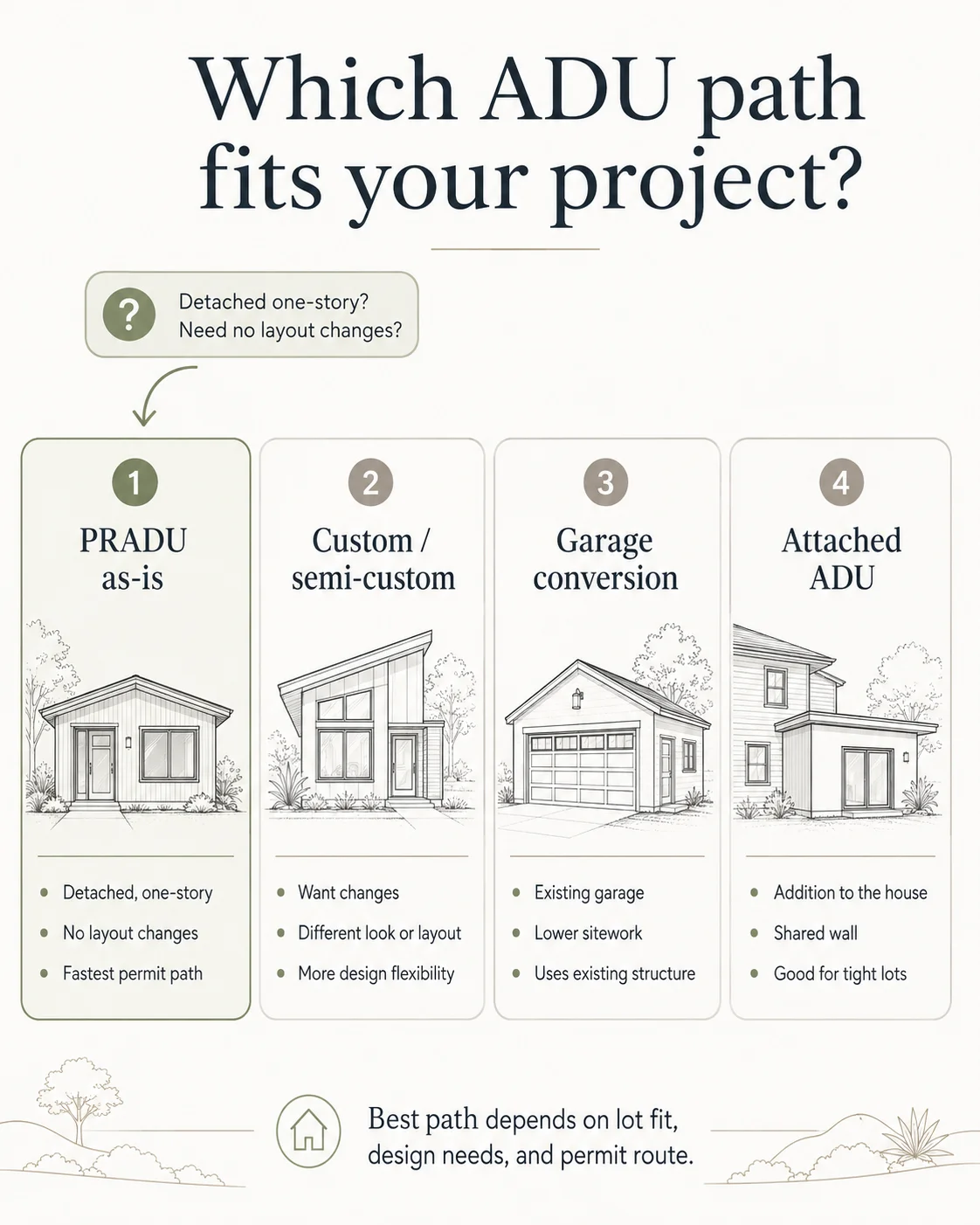
PRADU vs. Custom vs. Garage Conversion vs. Attached vs. Prefab: Which Path Fits You?
The right ADU path depends on whether you can accept a fixed plan, whether your lot has an existing structure you can convert, how much customization you need, and how speed compares to cost in your priorities.
| Path | Plan cost | Flexibility | Best for | Watch out for |
|---|---|---|---|---|
| City PRADU plan, as-is | $0 plan + standard surveys/calcs | Configuration only (finishes, openings within envelope) | Detached one-story project, simple flat lot, no customization | 2026 code-cycle status not confirmed; no-alterations rule |
| SnapADU build-ready plan, semi-custom | Provider-published ~$6,000–$8,000 saved vs. fully custom; modifications à la carte | Moderate (modify a known-good base) | Homeowners who want a change from the PRADU aesthetic | PRADU 30-day benefit forfeited; approval times comparable to custom |
| Fully custom plan | Provider-published $15,000+ in architectural fees | Complete | Challenging lots, view-driven design, complex grading | Longest timeline, highest design cost |
| Garage conversion | Plan/design fees depend on existing structure | Limited to the garage footprint | Existing detached garage, lower total budget | Existing structure can hide problems; not eligible for PRADU |
| Attached ADU | Custom design fees | Constrained by the primary dwelling’s structure | Owner who wants an addition feel and shared utility connections | State-law minimum allows at least 800 sq ft attached ADU with 4-ft setbacks |
| Modular / prefab ADU | Plan bundled with build | Limited to manufacturer’s catalog | Tight construction labor market, predictable cost | Doesn’t use City PRADU plans; site prep still required |
Request a no-obligation San Marcos PRADU fit consultation with SnapADU →
Best fit if you want a detached site-built ADU in Greater San Diego and you’ve already decided PRADU is your starting framework. Not the right first call for garage conversions, attached ADUs, remodel-heavy projects, or projects outside Greater San Diego.
Request a Fit Consultation with SnapADU →How San Marcos PRADU Compares to Neighboring Jurisdictions
San Marcos’s PRADU program is one of ten pre-approved ADU resources listed in the San Diego region in SANDAG’s June 2025 AB 1332 Summary.
| City / agency | Program name | Notes |
|---|---|---|
| San Marcos | PRADU (Permit-Ready ADU) | Detached one-story, ~498–~999 sq ft; 2026 code-cycle status not confirmed by City |
| Carlsbad | ADU Permit Ready Program | Coastal Development Permit required if in coastal zone |
| Encinitas | PRADU “Housing for Generations” | City states saves applicants ~3–6 months and ~$8,000–$16,000 in private design fees |
| Escondido | PAADU (Pre-Approved ADU) | Plans reviewed by City but not site-specific; standard permit still required |
| Chula Vista | Standard ADU Plans | Same 2026 code-cycle context as San Marcos per SnapADU April 2026; designed by SnapADU |
| El Cajon | ADU Loan Program and Standard Plans | Pairs free plans with a city loan program |
| La Mesa | PADU | Sample plans included with City ADU guide |
| Imperial Beach | Pre-Approved Plans | Program listed in SANDAG summary |
| Del Mar | ADU Sample Floor Plans (3D Models) | Sample/inspirational floor plans |
| County of San Diego (unincorporated) | ADU Standard Plans | Plans ~85% complete; accepted by City of San Diego |
| City of San Diego | (No own program) | Per SnapADU April 2026, accepts Chula Vista, County, and Encinitas plans |
Verification: data drawn from each city’s official ADU page, the SANDAG AB 1332 Summary (June 2025), and SnapADU’s San Diego pre-approved ADU plans guide (April 2026), accessed May 11, 2026.
Compare local ADU builders in detail → compare San Marcos ADU builders side by side with verified 2026 project costs.
When PRADU Is the Wrong Choice
PRADU is the wrong choice for any project that needs to alter the plan, doesn’t fit detached one-story constraints, runs into HOA design requirements outside the plan’s approved palette, or sits on a parcel where the public plan set’s current code-cycle status hasn’t been confirmed.
- You want a garage conversion. PRADU plans are for new detached construction.
- You want an attached ADU. Standard permit; state-law size minimums apply.
- You want a two-story ADU. PRADU plans are one-story only.
- You want any layout change. The City’s no-alterations rule rules this out.
- Your HOA requires exterior elements outside the PRADU plan’s palette.
- Your lot can’t accommodate the plan footprint. Setbacks, building separation, easements, or slope can make a plan unbuildable on your lot.
- You need significant grading. A soils report and grading plan move the project off the simple PRADU template even if the plan itself is unchanged.
- You’re combining the ADU with a new primary dwelling. The 30-day PRADU benefit doesn’t apply.
- The plan set’s current code-cycle status is unconfirmed. Until the City confirms the public plan set is current for the active code cycle, the 30-day pathway is theoretical.
None of these is a dealbreaker for building an ADU in San Marcos. They are signals to use a different path.
How to Submit a San Marcos PRADU Permit Package
The submittal flow is: pull the materials, build the package, talk to City staff before you upload, submit through the City portal, respond to the review, and proceed to permit and construction.
- 1
Download the City PRADU materials and select a plan
Open the City PRADU program page, download the plan-set ZIP for the plan you want, and review the configuration options. Common mistake: picking a plan because the renderings look great without first checking whether the plan fits the lot.
- 2
Run a feasibility check on your lot
Walk the lot or pull aerial imagery and confirm the proposed footprint clears the 4-foot side and rear setbacks, sits in the rear 50% of the lot, maintains 10-foot eave-to-eave separation from the primary dwelling, and doesn’t conflict with easements, utility lines, or established trees. Common mistake: assuming a plan fits because the lot looks big, then discovering at the survey that an easement bisects the buildable area.
- 3
Engage a surveyor
Schedule the surveys early. The City’s Setback Certification Format must be presented at foundation inspection for new detached structures. Common mistake: treating the survey as a late-stage formality.
- 4
Engage a Title 24 energy consultant
The PRADU plan set may include base Title 24 calculations, but they need to match your configuration selections. The consultant produces the final forms.
- 5
Engage your truss provider and solar PV designer
Both are deferred submittals, but the lead times are long enough that starting them at submittal prevents them from blocking framing later.
- 6
Confirm CFD treatment with the City Finance Department
Provide your APN and ask the three CFD questions. Get the answer in writing.
- 7
Confirm utility, water/sewer, and school coordination
Contact SDG&E Builder Services for gas and electric coordination, the relevant water and sewer districts for connection and capacity charges, and SMUSD for the developer fee calculation.
- 8
Submit through the City’s online permitting portal
Upload the plan set with your configuration markups, the site plan, the surveys, the Title 24 forms, the truss and solar packages (or deferred submittal forms), the indemnification, and the building permit application. Pay the plan-check fee at submittal.
- 9
Respond to City review
Address any corrections promptly. The 30-day clock effectively pauses while corrections are outstanding. Submit revisions through the same portal.
- 10
Receive permit, pay permit fee, build, inspect, occupy
After permit issuance, schedule construction. Sequence the inspections in the order the City requires. Submit the setback certification before requesting follow-up inspections. After final inspection, the City issues a certificate of occupancy.
The 15-question script that saves projects
Download our free San Marcos PRADU Starter Kit for the printable submittal checklist and the 15 specific questions to ask Building, Planning, and Finance before you commit to a plan.
Download the Free Starter Kit →The 15 Questions to Ask the City or Your Builder Before You Rely on PRADU
A 15-question script for the most common project-killing surprises. Take it to a City consultation and to any builder bid review. Get every answer in writing.
- “Is PRADU Plan Set [name or number] currently approved for the active California Building Standards Code cycle?”— City Building Division
- “How many PRADU plans are currently in the live City folder, and what are their names and current sizes?”— City Building Division
- “Does my proposed configuration (specific window placement, kitchen layout, exterior style) count as an alteration?”— City Building Division — get the answer before finalizing drawings
- “Does the City apply the §66311.5 750-sq-ft impact-fee threshold based on interior livable space or based on plan-size category?”— City Building or Finance Division
- “Does my proposed site plan satisfy the 4-foot side and rear setbacks, the rear-50%-of-lot rule, and the 10-foot eave-to-eave separation?”— City Planning Division
- “Is parking required for my ADU, or do I qualify for an exemption?”— City Planning Division
- “Is my parcel within a CFD/Mello-Roos district? If so, does adding an ADU trigger annexation, an in-lieu fee, or both? What is the current schedule?”— City Finance Department
- “What water and sewer connection and capacity charges apply to my parcel?”— Vallecitos, Vista Irrigation, or Buena Sanitation depending on service area
- “What is the current SMUSD residential developer fee for my project size, and are there any size-based exemptions?”— San Marcos Unified School District
- “Are roof trusses and solar PV required as deferred submittals or before first review?”— City Building Division
- “Are fire sprinklers required for my project, given that state law (Cal. Gov. Code §66322) says they shall not be required in an ADU when not required in the primary residence?”— Fire Prevention Bureau
- “Will the permit applicant be me as the owner, or my licensed California contractor?”— Your builder
- “Does my HOA’s design review require any changes that the City would treat as plan alterations? Does the HOA have the design approval on file?”— Your HOA and the City
- “Is a building verification survey required in addition to the setback certification, and is your bid scope for both?”— Your surveyor and your builder
- “If PRADU doesn’t fit my project after all, what is the fastest standard ADU permit pathway?”— City Building Division
Download our free San Marcos PRADU Starter Kit for the printable versions of this checklist and the 15-question script.
Download the Free Starter Kit →Financing Your San Marcos ADU
Most homeowners finance a San Marcos ADU with one of four pathways: cash, a cash-out refinance, a home equity line of credit (HELOC) or HELOC alternative, or a construction loan that converts to a permanent mortgage at completion. Which pathway is right depends on the homeowner’s equity position, credit profile, current mortgage rate, expected rental income, and tolerance for adjusting the primary mortgage.
This section is educational. We don’t sort by lender payout, and we don’t quote specific rates or APRs — those change frequently and depend on the borrower’s profile.
Cash
If you have the cash on hand, this is the cleanest path. No interest, no closing costs, no underwriting. The trade-off is opportunity cost — capital tied up in the ADU is capital not earning yield elsewhere — and most homeowners don’t have $300,000+ liquid for the all-in San Marcos project budget.
Cash-out refinance
A cash-out refinance replaces your existing mortgage with a new, larger mortgage and pays you the difference at closing. It’s a common ADU financing path because it taps the equity you’ve built without requiring a separate construction loan. The trade-off: you reset your mortgage clock and may move to a different rate. The right question to ask: What does my total interest cost look like over the life of the new loan compared to a HELOC or construction loan that leaves my primary mortgage in place?
HELOC (Home Equity Line of Credit)
A HELOC is a revolving credit line secured by your home’s equity. It leaves your primary mortgage in place and you only pay interest on what you actually use — which makes it attractive for ADU projects that may run over budget or that you want to fund in stages. The trade-off: HELOC rates are typically variable.
Renovation HELOC products
A specialized category of HELOCs that bases the borrowing limit on the after-renovation value of the home rather than the current value. Because a permitted, code-compliant ADU significantly increases home value, this approach can let an owner borrow more than a standard HELOC would allow.
Construction loan and construction-to-permanent (C2P) loan
A construction loan funds the build in draws as construction milestones are met. For homeowners without significant equity but with strong income and credit, this can be the right path. The trade-off: more complex underwriting and typically a higher rate during the construction phase.
Home Equity Investment (HEI) products
Companies offering HEI products provide cash now in exchange for a share of your home’s future appreciation. No monthly payment during the term. The trade-off is that you give up some of the future upside if the home appreciates. State availability varies. Treat these as one option to compare against the others, not a default.
Which lane fits which homeowner
- Strong equity, low current mortgage rate, want to keep the primary mortgage: HELOC or renovation HELOC.
- Strong equity, current rate is at or above market, willing to refinance: Cash-out refinance.
- Limited equity, strong income, willing to take on a new construction loan: Construction-to-permanent.
- Strong equity, want cash now without monthly payments and accept giving up future appreciation: HEI.
Compare ADU financing paths →
Explore San Marcos ADU Financing Options →The Dwelling Index is reader-supported. When you use our links to explore financing options, we may earn a commission at no extra cost to you. Our editorial recommendations are based on independent research and are never influenced by compensation. Educational comparison only; no rate quotes or guarantees of approval.
After You Build: Renting Your San Marcos ADU
The City of San Marcos permits long-term rental of ADUs (30 days or more). Short-term rentals (under 30 days) face significant local restrictions: per the City’s Transient Occupancy Tax page, short-term rentals are not permitted in residential zones unless allowed by a Specific Plan; where permitted, Transient Occupancy Tax applies, and bed-and-breakfast use may require a Conditional Use Permit in certain zones. Verify your zoning and any applicable Specific Plan with the City Planning Division before relying on short-term rental income.
Realistic rental numbers (illustrative)
Per rental comparison data published by SnapADU in March 2026 via Rentometer for the two main San Marcos zip codes:
| Zip code | Median 1BR rent | Median 2BR rent | Median 3BR rent |
|---|---|---|---|
| 92069 | $2,370 | $2,620 | $3,320 |
| 92078 | $2,335 | $2,990 | $3,650 |
These are median asking rents across all rental housing types in the zip code. Run comps for your specific neighborhood with a local real estate agent or property manager before underwriting an investment. Disclaimer: these are illustrative examples, not guarantees of returns.
Selling the ADU separately
Not confirmed available in San Marcos as of May 11, 2026. AB 1033, signed in 2023, permits cities to adopt local rules allowing condominium-style separate sale of ADUs from the primary residence; each city must opt in by ordinance. If separating ownership is part of your long-term plan, monitor City Council action and confirm current municipal code.
Methodology and What We Couldn’t Verify
We built this guide from primary sources first and authoritative third-party sources second. Where the two conflicted, we noted both. Where we couldn’t verify a fact directly, we marked it inline.
Primary sources (verified May 11, 2026):
- City of San Marcos Permit-Ready ADU (PRADU) program page on the City’s Building Division section
- City of San Marcos PRADU fact sheet / fall 2024 PDF
- City of San Marcos Setback Certification Format (Building Documents)
- City of San Marcos Development Fee Schedule, effective March 3, 2025
- City of San Marcos ADU FAQ published by the Planning Division
- City of San Marcos Transient Occupancy Tax page
- City of San Marcos Municipal Code Chapter 20.410.060
- San Marcos Unified School District Residential and Commercial Developer Fees page
- California Government Code §§65852.27, 66311.5, 66313, 66314, 66317, 66321, 66322, 66323, 66333
- California Civil Code §4751
- SDG&E Builder Services ADU Fact Sheet
- SANDAG, AB 1332: Preapproval of ADU Plans, June 2025
Secondary sources (verified May 11, 2026):
- SnapADU, Pre-Approved ADU Plans: Compare Costs & Benefits, published April 2026
- SnapADU, San Marcos: Accessory Dwelling Unit Regulations & Zoning, published April 2026
Items we explicitly could not verify before publication:
- The exact number and names of the PRADU plans currently posted on the City’s plan folder.
- Whether each posted plan set is current for the active California Building Standards Code cycle that took effect January 1, 2026.
- Parcel-specific CFD treatment for any given San Marcos parcel.
- Whether the City applies the §66311.5 750-sq-ft threshold based on interior livable space or based on plan-size category.
- Whether San Marcos has adopted an opt-in ordinance under AB 1033 (separate sale of ADUs).
The Dwelling Index is an independent research resource covering ADU financing, costs, and regulations. We are not the City of San Marcos. We are not a building department, a builder, a lender, a tax advisor, or a lawyer. Use this guide to ask better questions. Confirm the answers with the right people before you commit money.
Frequently Asked Questions
Does San Marcos have pre-approved ADU plans?
Yes. The City of San Marcos publishes free, pre-approved ADU plans through its Permit-Ready ADU (PRADU) program. The plans are designed for detached, one-story accessory dwelling units.
Are San Marcos PRADU plans really free?
The plan sets are free to download from the City’s PRADU program page. The application is not free — combined City plan-check and permit fees total $3,750.32 for a City-Standard ADU up to 1,000 sq ft, before school developer fees, utility connection and capacity charges, water and sewer charges, or any CFD assessments, per the City fee schedule effective March 3, 2025.
How many PRADU plans does San Marcos offer?
Sources disagree as of May 11, 2026. SnapADU publishes four San Marcos-tagged floor plan examples on its catalog. Other plan-library aggregators have listed three. Confirm directly with the City Building Division for the current live folder.
Who designed the San Marcos PRADU plans?
SnapADU, a Greater San Diego design-build firm, was selected by the City through a competitive bid process with more than two dozen applicants. SnapADU also designed the City of Chula Vista’s pre-approved plan library.
Can I really get a 30-day permit with a PRADU plan?
The City’s target is approval or denial within 30 days of receiving a complete application using a qualifying pre-approved plan, per California Government Code §65852.27. The 30-day clock starts when the application is complete, not when you upload your first draft. Plans must be current for the active California Building Standards Code cycle, which updated January 1, 2026.
What happens if my ADU is exactly 750 square feet?
Under current California state law (Cal. Gov. Code §66311.5), an ADU of 750 square feet or less of interior livable space cannot be charged an impact fee. A 750-sq-ft ADU is at the threshold, not over it. The City of San Marcos’s ADU FAQ uses older “smaller than 750” wording; current state law supersedes it. The conservative design lane at 749 sq ft removes any ambiguity.
Does the 750-sq-ft rule use interior livable space or gross plan size?
State law uses interior livable space. Whether the City applies the threshold based on interior livable area or based on plan-size category is a question worth confirming with the City Building Division for your specific plan choice.
Can I modify a San Marcos PRADU plan?
No. The City has stated on its PRADU program page that it will not consider alterations to its plan sets. Any change to the footprint, structure, or roof design moves the project off PRADU and onto a standard ADU permit pathway.
Do I still need a building permit?
Yes. PRADU is a faster plan-review pathway, not a substitute for a building permit. You still apply, you still pay fees, you still respond to plan review, and you still go through inspections.
How much does an ADU actually cost in San Marcos in 2026?
For a 748-sq-ft 2BR PRADU built to mid-range finishes on a flat, accessible lot, a realistic all-in budget in 2026 is approximately $300,000–$400,000, including design, surveys, City permit fees, school and utility fees, and construction at provider-published $250–$600 per sq ft.
Does PRADU avoid CFD / Mello-Roos fees?
Not automatically. The City FAQ states that ADU projects may be subject to CFD fees, and provider-published guidance indicates ADUs over 749 sq ft frequently trigger CFD processing. CFD treatment is parcel-specific. Verify directly with the City Finance Department before assuming.
Can my HOA stop me from using a PRADU plan?
The HOA cannot effectively prohibit or unreasonably restrict a compliant ADU under California Civil Code §4751 and Assembly Bill 670. The HOA can impose reasonable design standards on exterior materials, colors, and architectural details — and reasonable design standards can affect whether a PRADU plan can be used as-is.
Are fire sprinklers required for my PRADU?
Under current state law (Cal. Gov. Code §66322), fire sprinklers shall not be required in an ADU when they are not required in the primary residence. Consult the Fire Prevention Bureau before assuming either way.
Can I rent my San Marcos ADU on Airbnb?
Generally not as a default in residential zones. The City’s TOT page indicates short-term rentals (under 30 days) are not permitted in residential zones unless allowed by a Specific Plan. Long-term rentals (30+ days) are permitted.
Can I sell my San Marcos ADU separately from the main house?
Not confirmed available as of May 11, 2026. AB 1033 allows cities to adopt local rules permitting separate sale of ADUs; each city must opt in by ordinance. Verify current San Marcos Municipal Code and any recent City Council action before relying on separate-sale planning.
What if my property is in the coastal zone?
San Marcos does not have any areas subject to Coastal Development Permit requirements. If you’re near the Carlsbad or Encinitas border, confirm with the Planning Division that your parcel is actually in San Marcos.
Can I build two ADUs on my San Marcos property?
On a single-family lot, state law (Cal. Gov. Code §66323) requires ministerial approval of specified ADU/JADU combinations. The exact combinations available on a given parcel depend on the City’s current interpretation of state law. Confirm with the Planning Division for your specific parcel.
Do I need a parking space for my ADU?
A parking space may be required for a new detached ADU, but several exemptions apply: within half a mile of public transit, in a historic district, ADU created from existing space, or attached ADUs. Confirm with the Planning Division for your address.
Do I need a soils report for a PRADU plan?
Per a May 2025 confirmation from a San Marcos Plans Examiner (cited secondhand from SnapADU’s April 2026 publication), the City no longer routinely requires a soils investigation report for ADUs over 500 sq ft. A soils report is required if grading is proposed or if site conditions warrant one during inspection.
Why are so many PRADU plans 748–749 sq ft?
Because state law (Cal. Gov. Code §66311.5) protects ADUs of 750 sq ft or less from local-agency impact fees. Designers engineer to a conservative 748–749 sq ft to lock in the protection without ambiguity.
Who is allowed to pull the permit?
Per the City PRADU fact sheet, a San Marcos building permit may be issued only to the property owner or to a licensed California contractor.
Can I use San Marcos PRADU plans in another city?
Not automatically. Each city’s pre-approved plan program is specific to that city. Cross-jurisdiction acceptance is the exception, not the rule. Don’t assume cross-acceptance without written confirmation from the receiving city.
What is the difference between PRADU and a JADU in San Marcos?
A PRADU is a new detached ADU built from a City pre-approved plan set. A Junior ADU (JADU) is a small unit of 500 sq ft or less created entirely within the existing walls of a single-family home. JADUs are not part of the PRADU plan library and have their own rules.
Can I build an ADU in my front yard?
Generally no. San Marcos requires detached ADUs to be in the rear 50% of the lot. Verify with Planning for your specific parcel.
What to Do Next
If you’ve made it this far, you have more information about the San Marcos PRADU program than 95% of homeowners who start an ADU project in this city. The cheapest next step is to confirm whether a PRADU plan is likely to fit your lot before you spend a dollar on bids, surveys, or design fees.
See What You Can Build → Get Your Free San Marcos ADU ReportIf PRADU looks like the right path and you want to talk to the team that designed the City’s plans:
Request a No-Obligation PRADU Fit Consultation with SnapADU →If you need to think through how to finance the build first:
Explore Your San Marcos ADU Financing Options →Take it with you:
Download the Free San Marcos PRADU Starter Kit →Educational only; no rate quotes or guarantees of approval.