
San Diego Stacked ADU: 2026 Rules, Costs, and the Bonus Program Decoded
Last updated May 12, 2026 · By The Dwelling Index Editorial Team · 26 sources cited
Bottom Line Up Front
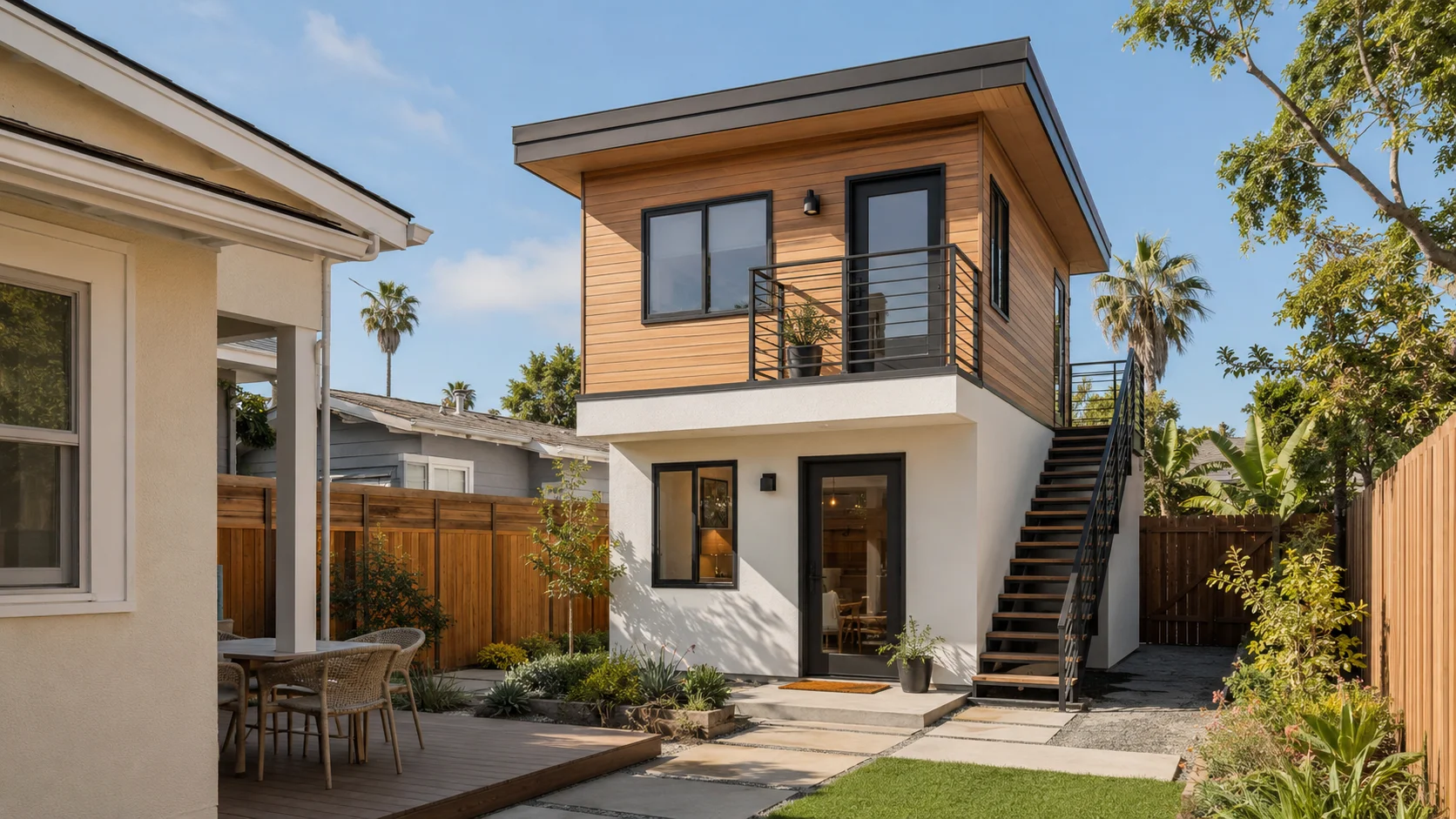
Yes, you can build a San Diego stacked ADU in 2026 — two independent accessory dwelling units in a single two-story structure — but only if your property clears five filters. The City of San Diego allows stacking on (a) lots with an existing multiple-dwelling-unit structure under Government Code §66323 plus local rules, or (b) qualifying single-family lots using the ADU Home Density Bonus Program, which requires deed-restricting at least one unit as affordable. After the August 22, 2025 ordinance changes (Ordinance O-21989), the Bonus Program is prohibited in eight RS zones unless your parcel is in a CTCAC High or Highest Resource Area. The best published stacked-specific cost benchmark — SnapADU’s June 2024 table — runs $525,000 all-in for two 500-sqft units up to $800,000 all-in for two 1,200-sqft units. Treat those as published benchmarks; get a current bid before committing.
→ Run the free 60-second property check to see what your specific parcel allowsNo phone number required. Parcel-specific results.
First-Scroll Verdict Table
Verify your situation at a glance before reading further.
| Your situation | Likely verdict |
|---|---|
| City of San Diego, RS zone NOT on the excluded list (e.g., RS-1-5, RS-1-6, RS-1-7) | Stacked is likely feasible via Bonus Program — price it |
| City of San Diego, excluded RS zone, parcel is CTCAC High or Highest Resource | Stacked-via-Bonus is back on the table — verify the resource-area designation |
| City of San Diego, excluded RS zone, parcel NOT in a CTCAC High/Highest area | Stacked-via-Bonus is off the table after August 2025 |
| City of San Diego, lot has an existing multiple-dwelling-unit structure | Stacked is likely feasible without the affordability tradeoff — verify with DSD |
| Lot inside a Sustainable Development Area | One bonus market-rate ADU per qualifying deed-restricted ADU with no fixed cap |
| Lot in Coastal Overlay Zone | Coastal Development Permit required; the 2025 amendments are not yet effective inside the Coastal Zone |
| Lot in a Very High Fire Hazard Severity Zone | Possible for standard ADUs with 4-ft setbacks; Bonus ADUs require two evacuation routes and no cul-de-sac frontage |
| Unincorporated San Diego County lot | Stacked is not allowed — build side-by-side detached instead |
| Budget is the primary constraint | One detached ADU or a garage conversion almost always beats stacked on cost-per-unit |
| You want one unit for an aging parent | Single-story side-by-side is almost always a better fit |
Free Tool — ~60 Seconds
See What You Can Build at Your Address
Get a parcel-specific report: base zone, CTCAC Resource Area, SDA vs TPA status, Coastal Overlay flag, fire-hazard zone, and Bonus Program availability.
See What You Can Build → Get Your Free ADU Report in 60 Seconds
Why This Page Exists
We’re The Dwelling Index — an independent research resource covering ADU financing, costs, and regulations. We don’t build, we don’t lend, we don’t sell plans. Our job is to assemble what already exists across the City of San Diego Development Services Department, the San Diego Housing Commission, the California Coastal Commission, the CTCAC opportunity-area maps, builder pricing pages, and current rental data into a single decision document — then flag what still requires property-specific review.
The post-August 2025 stacked question is harder than it looks. Builder guides describe “stacked” loosely, and most pages have not updated for the Sustainable Development Area vs Transit Priority Area distinction, the eight excluded RS zones, the new Community Enhancement Fee, the parking and evacuation-route changes, or the Regional Transportation Congestion Improvement Program fees that now apply when you propose more than one ADU. We pulled the August 2025 Information Bulletin 400 directly and built this page against the primary source.
What Is a Stacked ADU in San Diego? (And What It Isn’t)
A stacked ADU in San Diego means two fully independent accessory dwelling units arranged vertically in a single structure — each unit has its own kitchen, bathroom, entrance, and provisions for living, sleeping, eating, cooking, and sanitation. This is different from three configurations that get confused with it.
A two-story ADU is one dwelling unit with internal stairs — same kitchen, same bath, just two floors. It counts as one ADU.
A duplex is two units in a single primary residential building permitted under a different entitlement path. It isn’t an ADU.
An ADU over a garage (sometimes called a carriage house) is one ADU stacked above a garage. Because the garage isn’t a dwelling unit, this counts as one ADU. See our dedicated San Diego ADU Over Garage guide for that configuration.
When we talk about a “San Diego stacked ADU” on this page, we mean two ADUs stacked on top of each other, both independently rentable, both counting toward your lot’s unit count.
Are San Diego Stacked ADUs Legal in 2026?
The Two Legal Pathways in the City of San Diego
San Diego Municipal Code §141.0302 and §141.0306, decoded against City of San Diego Development Services Department Information Bulletin 400 (August 2025 edition), give you two paths to a second detached ADU on the same lot — which is the prerequisite for stacking anything.
Pathway 1: Lots with an existing multiple-dwelling-unit structure. Per IB 400: “A maximum of eight detached ADUs are permitted on a premises with an existing multiple-dwelling unit structure, but the number of detached ADUs shall not exceed the number of existing units on the lot.” Attached ADUs are not permitted on premises with an existing or proposed multiple-dwelling-unit structure. Stacking detached ADUs is one way to fit them on a constrained lot, but the City has not published a stacked-specific rule for this pathway and the configuration should be confirmed with DSD pre-application.
Pathway 2: Single-family lots via the Bonus ADU Program. On a single-dwelling-unit zone, the baseline is one detached or attached ADU, one converted ADU (from existing space inside the primary dwelling or an existing accessory structure), and one JADU — three separate unit types, but the JADU must be inside the existing single-family home or an attached garage. To add a second new detached ADU — which is what makes stacked possible — you use the ADU Home Density Bonus Program in exchange for deed-restricting at least one of the units as affordable to low or moderate-income tenants.
Those are the only two pathways on a single lot in the City of San Diego. If you’re on a single-family lot and won’t deed-restrict a unit, stacked is not available.
Why the County of San Diego Is Different
The County of San Diego interprets multifamily-lot ADUs as freestanding and detached from one another — meaning you cannot stack them or attach them to each other in unincorporated jurisdiction. Single-family County lots get the state-law baseline (one detached ADU plus one JADU) and no stacking entitlement.
If your property is in unincorporated County (Bonsall, Fallbrook, Ramona, Lakeside, Alpine, Jamul, parts of Spring Valley), you have two realistic paths: build side-by-side detached, or pursue a Single Family Dwelling instead of an ADU configuration. See our Best ADU Builders Unincorporated San Diego County guide before you keep reading this page.
The Five Filters
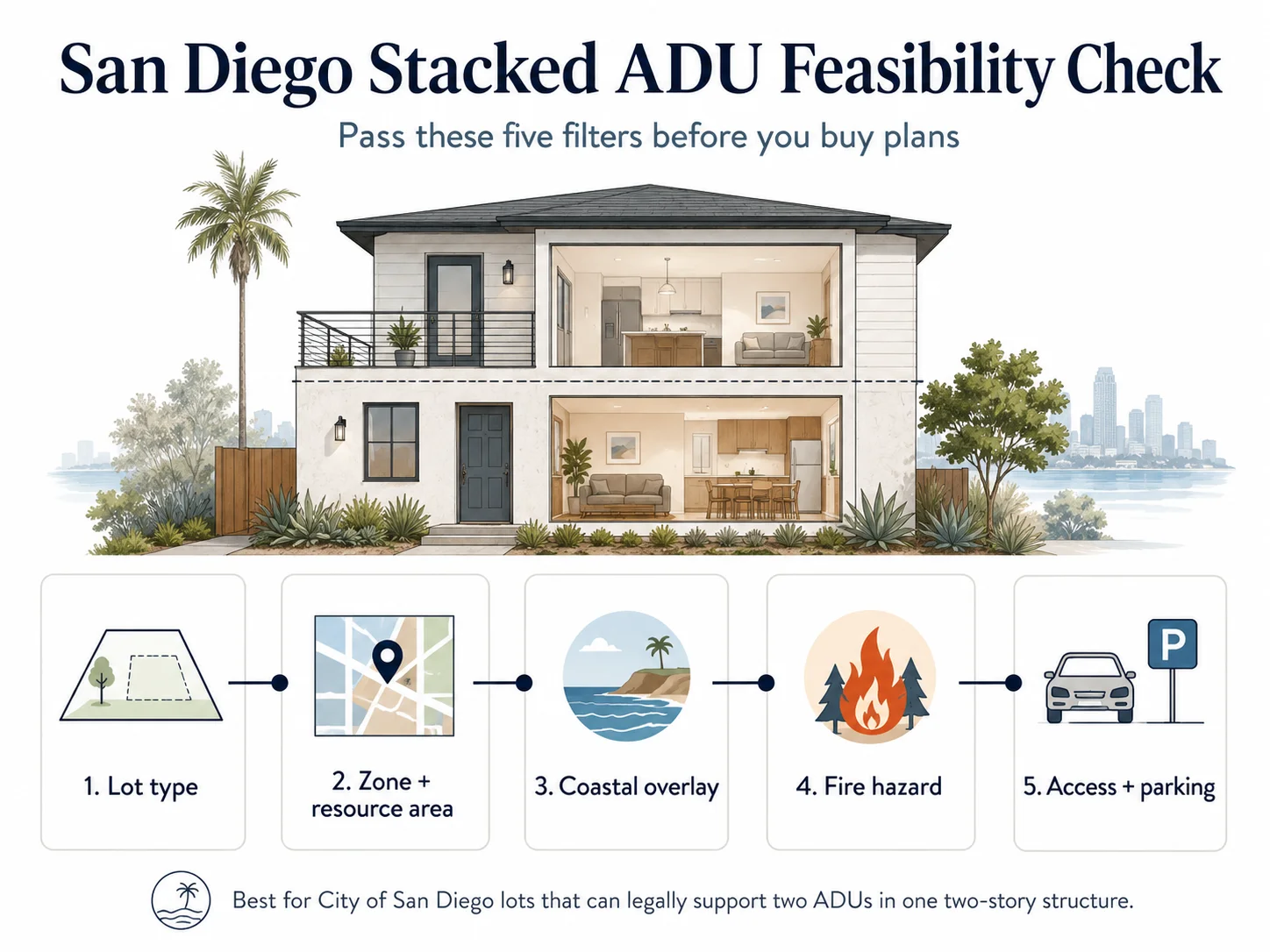
Even inside the City of San Diego, stacked feasibility runs through five filters. We pulled each directly from IB 400 and the City’s regulatory updates page.
- Lot type. Multiple-dwelling-unit lots use the multifamily pathway. Single-family lots use the Bonus Program.
- Base zone. Eight RS zones are excluded from the Bonus Program after the August 22, 2025 effective date.
- CTCAC Resource Area. If you’re in an excluded RS zone, the only re-entry to the Bonus Program is if your parcel is identified as a High or Highest Resource CTCAC Opportunity Area and is residentially designated in the land use plan.
- Coastal Overlay Zone. A Coastal Development Permit is required for new ADUs in the Coastal Overlay. The August 2025 amendments are not yet effective inside the Coastal Zone pending Coastal Commission certification.
- Very High Fire Hazard Severity Zone. Standard ADUs require a 4-foot side and rear setback regardless of structure height. Bonus ADUs require two evacuation routes and cannot front a cul-de-sac or single-ingress lot.
Free Tool — ~60 Seconds
See What You Can Build at Your Address
Get a parcel-specific report: base zone, CTCAC Resource Area, SDA vs TPA status, Coastal Overlay flag, fire-hazard zone, and Bonus Program availability.
See If My Property Qualifies \u2014 Free 60-Second Check \u2192No phone number required. Parcel-specific results in about 60 seconds.
How the San Diego ADU Home Density Bonus Program Works
The Bonus Mechanics (Verified from IB 400)
Per IB 400, the bonus depends on whether the premises is in a Sustainable Development Area:
- Inside a Sustainable Development Area (SDA): For every qualifying on-site deed-restricted ADU, one additional non-deed-restricted bonus ADU is allowed. No fixed numerical cap on the bonus count, though physical site standards and the lot-area total cap still apply.
- Outside an SDA: A maximum of one bonus ADU plus one qualifying on-site deed-restricted ADU is permitted.
Important distinction: Sustainable Development Areas govern the bonus count. Transit Priority Areas govern parking relief. These are two different overlays in San Diego and most builder pages conflate them. Inside a TPA, ADUs are exempt from one off-street parking requirement that otherwise applies to Bonus and Affordable ADUs. Inside an SDA, you get the unlimited 1-for-1 bonus structure.
The Total Unit Cap by Lot Area
Per IB 400, the maximum number of ADUs and JADUs in single-dwelling-unit zones, including Bonus ADUs, is capped by lot area:
| Lot area | Maximum ADUs + JADUs (Bonus Program) |
|---|---|
| 8,000 sq ft or less | 4 |
| 8,001 to 10,000 sq ft | 5 |
| 10,000 sq ft or greater | 6 |
Source: City of San Diego DSD Information Bulletin 400, August 2025 edition. Verified May 12, 2026.
The Covenant Terms
The deed restriction is recorded against the property title and runs with the land. Per current SDHC Bonus Program documentation and corroborated by Casita Coalition, California YIMBY’s analysis of the program, and SnapADU’s guide:
- Low and very-low income units: 10-year affordability covenant.
- Moderate income units: 15-year affordability covenant.
California YIMBY’s analysis of the program reports that essentially every Bonus ADU project applicant to date has chosen moderate-income rents at 110% AMI for 15 years over low-income at 80% AMI for 10 years. The reason is straightforward — at 110% AMI, the affordable-rent ceiling on a 2BR unit can sit close to neighborhood market rents in much of San Diego, making the 15-year window economically attractive.
Rent Ceilings (Pull the Current SDHC Table Before Signing)
The 2026 AMI-based rent ceilings are published annually by SDHC and change with each new HUD AMI release. Before recording any deed restriction, pull the current SDHC AMI Income & Rent Limits table directly. For an illustrative directional reference based on publicly reported 2025 numbers from the Casita Coalition’s documentation of San Diego Bonus projects: a 2-bedroom unit deed-restricted at the moderate-income tier rented around $2,760/month, while a 3-bedroom market-rate unit on the same property rented at $4,000/month. These figures are historic references and should not be used for underwriting — verify the current SDHC table before structuring any deal.
The Affordable-Comparability Requirement
Per IB 400: “The Affordable ADUs shall be comparable in bedroom mix and amenities to the Bonus ADUs in the development.” Builder interpretations — including SnapADU’s published guidance — read the language as requiring the affordable unit to be within roughly 15% of the market-rate unit’s square footage and within one bedroom of the market unit’s bedroom count. Many investors satisfy this trivially by building identical units for both sides, which is precisely the configuration used on SnapADU’s documented Hidalgo Avenue stacked Bonus project.
Application and Ongoing Fees
Per the SDHC Bonus Program process described by SnapADU (verify directly with SDHC before applying):
- SDHC application fee: $600 (at time of application).
- SDHC annual monitoring fee: $150 per affordable unit per year for the covenant term.
- Penalty for violation: historically, violators repay excess rent collected with 10% interest; enforcement was strengthened in the August 2025 amendments.
- Lien position: second lien on single-family zones; first lien on multifamily zones.
The Eight Excluded RS Zones After August 22, 2025
The August 22, 2025 effective date of Ordinance O-21989 prohibits Bonus ADUs in eight low-density RS zones. Per IB 400, the Bonus Program is excluded in RS-1-1, RS-1-2, RS-1-3, RS-1-4, RS-1-8, RS-1-9, RS-1-10, and RS-1-11 zones, except where the premises is identified as a High or Highest Resource CTCAC Opportunity Area and is residentially designated in the applicable land use plan.
Zones NOT on the excluded list: RS-1-5, RS-1-6, RS-1-7, RS-1-12, RS-1-13, RS-1-14, plus multifamily zones (RM, RX, RT) and mixed-use zones with residential allowances.
How to Check Your CTCAC Resource Area Status
If your zone is one of the eight excluded RS zones, the only way back into the Bonus Program is the CTCAC High or Highest Resource Area exception. Here’s how to verify on your specific parcel:
- Open the California Tax Credit Allocation Committee Opportunity Area Map (search “TCAC HCD opportunity area map” — the URL changes annually with each update).
- Enter your address.
- Read the classification: Highest Resource, High Resource, Moderate Resource, Low Resource, or High Segregation and Poverty.
- Confirm the parcel is residentially designated in your community land use plan (your DSD parcel report shows this).
If your parcel reads Highest Resource or High Resource — and is residentially designated — you’re back in the Bonus Program even if your zone is on the excluded list. Resource Area classifications vary block by block — neighbor-to-neighbor on the same street can have different designations — so the only way to know is to check your specific parcel.
What the August 22, 2025 Amendments Actually Changed for Stacked Projects
The Five Amendments at a Glance
| Amendment | What changed | Practical impact on a stacked project |
|---|---|---|
| RS zone exclusion | Eight lowest-density single-family zones excluded from the Bonus Program | If your zone is on the list and your parcel isn’t in a CTCAC High/Highest Resource Area, stacked-via-Bonus is off the table |
| Community Enhancement Fee | New fee on Bonus Program projects calculated on gross floor area of affordable and bonus ADUs | Waived for affordable ADUs deed-restricted to very-low/low income in High/Highest Resource Areas. Verify current fee calculation with DSD at submittal. |
| Two-story cap | Maximum two stories on detached ADUs in single-dwelling-unit zones | A stacked pair is two stories — this aligns. Rules out a 3-story configuration. |
| Fire safety | 4-ft side/rear setbacks for ADUs in High/Very High Fire Hazard Severity Zones regardless of structure height; Bonus projects in those zones require two evacuation routes and cannot front a cul-de-sac or single-ingress lot | Hillside Scripps Ranch, Tierrasanta, Rancho Bernardo, and similar lots need to verify evacuation-route compliance early |
| Parking | One off-street parking space required per affordable and bonus ADU located outside a Transit Priority Area | If your lot isn’t inside a TPA, plan on-site parking for both bonus and affordable units |
Source: City of San Diego DSD Information Bulletin 400 (August 2025 edition) and the City’s Regulatory Updates page. Verified May 12, 2026.
The Coastal Zone Status
The August 2025 amendments are not yet effective inside the Coastal Zone. Per IB 400, the amendments will become effective in the Coastal Overlay Zone when the California Coastal Commission certifies Ordinance numbers O-21618, O-21758, O-21836, and O-21989. Coastal Commission certification of the 2025 amendments was pending as of our verification date. Until certification, the previous rules apply inside the Coastal Zone for these specific amendments — though a Coastal Development Permit is still required for new ADUs in the Coastal Overlay regardless.
What Did NOT Change
The August 2025 amendments did not eliminate the standard ADU pathway. You can still build one detached or attached ADU plus one converted ADU plus one JADU on a single-family lot per state law and local ministerial review. AB 1332 pre-approved plans remain eligible for 30-day review. AB 1033 condo-conversion of ADUs is permitted in the City of San Diego, subject to specific restrictions for deed-restricted units.
Free Resource
Get the Free San Diego Stacked ADU Starter Kit \u2014 We’ll Email You When the Rules Change
We’ll email you when the City of San Diego ADU rules change. No spam. Unsubscribe anytime.
Get the Free Starter Kit →Stacked ADU Cost in San Diego: Published 2024 Benchmarks (Refresh Before Bidding)
Some cost figures below reference SnapADU, who built the documented stacked Bonus ADU on Hidalgo Avenue. We may earn a commission if you contact SnapADU through our links. Independent cost ranges and competitor comparisons are included throughout.
SnapADU’s Published Stacked ADU Cost Table
Source: SnapADU, “The Stacked ADU Guide” (published June 16, 2024; cost table source: Snap ADU updated June 2024). Verified May 12, 2026.
| Configuration | Total sq ft | Vertical Build Cost | All-In Cost | Per Sq Ft |
|---|---|---|---|---|
| Two 1BR/1BA stacked at 500 sqft each | 1,000 sqft | $400,000 | $525,000 | $525/sqft |
| Two 2BR/1BA stacked at 750 sqft each | 1,500 sqft | $500,000 | $650,000 | $433/sqft |
| Two 2BR/2BA stacked at 1,000 sqft each | 2,000 sqft | $600,000 | $750,000 | $375/sqft |
| Two 3BR/2BA stacked at 1,200 sqft each | 2,400 sqft | $650,000 | $800,000 | $333/sqft |
The 85% Rule of Thumb
SnapADU’s published rule: the second unit in a stacked pair costs about 85% of the first. The savings come from shared mobilization, shared foundation, shared exterior envelope (one stucco scope, one roof, one gutter system), and unified main utility laterals. The savings have limits — each unit still needs its own kitchen and at least one bathroom, which are the most expensive trades in any build.
Why the 2024 Benchmark Needs a 2026 Refresh
SnapADU’s broader 2026 ADU cost page lists a single 1,200-sqft 3BR/2BA detached ADU at about $450,000 all-in. If you apply the 85% rule of thumb to a stacked pair of that same plan, you get roughly $450,000 + ($450,000 × 0.85) = approximately $832,500 — meaningfully higher than the 2024 table’s $800,000 entry for the 1,200-sqft × 2 row. Construction prices have moved.
Our recommendation: use the 2024 table as a directional benchmark for orders of magnitude. Get a fresh bid from a San Diego builder before underwriting your specific project. The numbers will likely come in 5%–15% higher than the 2024 published table on a like-for-like basis.
The Stacked-Specific Adders That Differ from a Single ADU
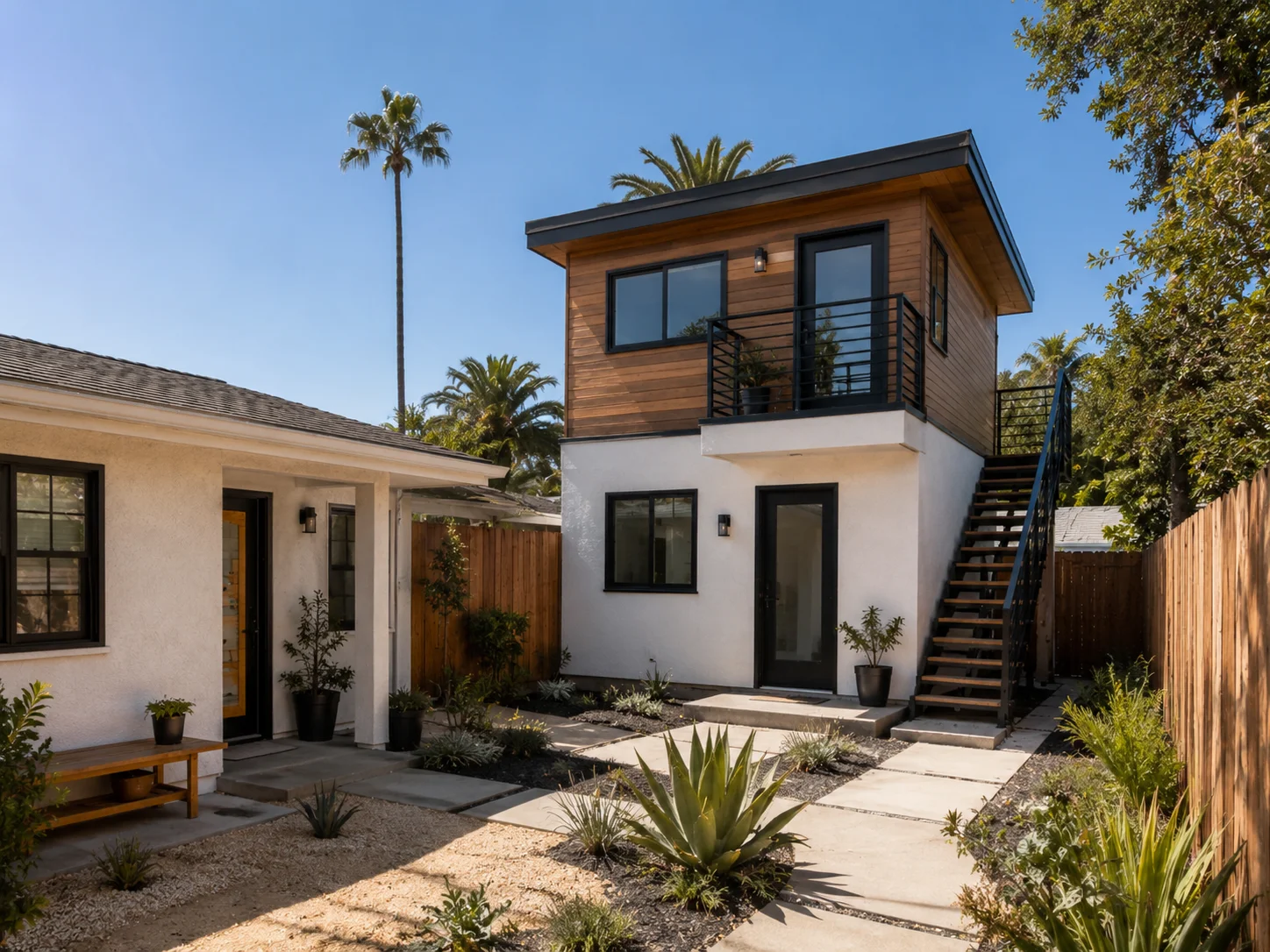
These adders are mostly already absorbed into SnapADU’s all-in benchmarks. We list them so you can compare apples-to-apples when collecting competing bids from other builders who may not have the same systems built into their base pricing.
| # | Adder | Typical cost impact | Why it applies to stacked |
|---|---|---|---|
| 1 | Reinforced two-story foundation | Often $8,000–$15,000 vs slab-only | Vertical load path requires deeper footings |
| 2 | Fire-rated horizontal assembly between units | ~$10,000 per project | Required separation between two independent dwelling units stacked vertically |
| 3 | Exterior stair compliance | Often $8,000–$20,000 | Per IB 400, exterior staircases must conform to base-zone setbacks rather than the reduced ADU setback |
| 4 | Separate electrical/HVAC per unit | Often $4,000–$10,000 | Each unit needs its own panel, wiring, and HVAC |
| 5 | Scaffolding for second-story exterior trades | $3,000–$7,000 | Stucco, siding, paint, gutters on upper floor |
| 6 | Structural engineering premium | $2,000–$5,000 | Lateral and seismic engineering for two-story residential |
| 7 | Interconnected smoke and CO alarms | $1,500–$3,000 | California Residential Code requirements; verify exact code sections with your code consultant |
| 8 | Sprinkler trigger if primary residence has sprinklers | $10,000–$25,000 per unit | Per IB 400: an ADU must have sprinklers if the primary dwelling is sprinklered |
| 9 | Sprinklers automatically required for Bonus and Affordable ADUs | $10,000–$25,000 per unit | Per IB 400: all Affordable and Bonus ADUs must have automatic fire sprinklers |
| 10 | Community Enhancement Fee | Verify current calculation with DSD | Calculated on gross floor area of affordable and bonus ADUs; waived in High/Highest Resource Areas for very-low/low income |
| 11 | RTCIP fees | Verify current schedule with DSD | Per IB 400: projects proposing more than one ADU pay Regional Transportation Congestion Improvement Program fees |
| 12 | SDHC application and monitoring fees (Bonus path) | $600 application + $150/yr × covenant term | Per SnapADU’s published Bonus Program guide; verify directly with SDHC |
| 13 | Tree-planting (Bonus Program only) | $300–$1,500 per project | Per IB 400: Bonus Program developments require one tree on the premises plus two trees per 5,000 sqft of lot area |
| 14 | Resilient channel ceiling assembly (optional but recommended) | ~$12/sqft of footprint; ~$12,000 on a 1,000-sqft footprint | Reduces sound transmission by ~70% per SnapADU. Worth it for tenant retention. |
How Stacked Compares to Alternatives on Cost
| Configuration | All-in cost reference (2,000–2,400 sqft total) | Footprint used |
|---|---|---|
| Stacked (two-story, one structure) | $750K–$800K per 2024 SnapADU table | ~1,200 sqft of yard |
| Side-by-side detached pair | Roughly $580K–$880K | ~2,400 sqft of yard |
| Attached two-unit (shared wall) | Roughly $560K–$830K | ~2,000 sqft of yard |
| Single two-story single-unit ADU | SnapADU 999-sqft 2BR/2BA ~$415K | ~1,200 sqft of yard |
| Garage conversion ADU | Approximately $80,000–$200,000 | Uses existing structure |
Illustrative examples, not guaranteed quotes. Actual project pricing depends on lot conditions, finishes, soils, utility runs, and the construction market at the time of bid. Get site-specific bids before committing capital.
Get a Current Stacked ADU Quote from SnapADU
SnapADU built San Diego's documented first permitted stacked Bonus configuration on Hidalgo Avenue. They serve the City of San Diego and Greater San Diego County. Get a site-specific quote before the 2024 benchmarks diverge further from 2026 costs.
Get a Stacked ADU Quote from SnapADU \u2192Verify current stacked ADU costs directly with a builder before underwriting. Published benchmarks may differ from 2026 actual bids.
Is Stacked Cheaper Than Building Two ADUs Side by Side?
When Stacked Makes Sense
- Your buildable yard area is constrained. Stacked uses roughly 1,200 sqft of footprint to deliver 2,400 sqft of finished living space at the 1,200-sqft × 2 configuration. Side-by-side needs roughly twice that yard.
- You want both units functionally identical. Stacked makes symmetric rental pricing trivial and satisfies the Bonus Program comparability requirement effortlessly.
- Both tenants will be unrelated and rent-paying. Stacked is at its best as a pure rental investment.
When Side-by-Side Wins
- You have 2,400+ sqft of buildable yard meeting setbacks.
- You want maximum tenant privacy. Foot traffic, noise, balcony sightlines, and parking conflicts are all easier to resolve when units are physically separated.
- One unit serves an owner-occupant or family member. Aging-parent housing, adult-child housing, and owner-occupant configurations usually work better side-by-side because the single-story option remains available for accessibility-sensitive tenants.
When a Single Larger ADU Beats Both
- Your goal is one rental unit, not two.
- You don’t want to record an affordability covenant against your property.
- Your budget caps around $400,000–$500,000 (a single 1,000-sqft ADU is typically achievable there; a stacked pair is not).
- You want the simplest possible permitting path.
The Decision Matrix
| Factor | Stacked | Side-by-Side Detached | Attached Two-Unit | Single Larger ADU |
|---|---|---|---|---|
| Yard area required | Lowest (~1,200 sqft) | Highest (~2,400 sqft) | Medium (~2,000 sqft) | Lowest (~1,200 sqft) |
| Construction complexity | High | Medium | Medium-high | Medium |
| Construction cost (2024 reference) | $750K–$800K | $580K–$880K | $560K–$830K | $400K–$500K (one unit) |
| Tenant privacy | Lowest | Highest | Medium | N/A (one unit) |
| Permit complexity | Medium-high | Medium | Medium-high | Lowest |
| Best fit | Pure rental on small lot | Mixed use (rental + family) | Cohesive aesthetic, shared utility runs | Single rental, no covenant |
Modeling the Yield: Stacked ADU Rental Income With the Affordability Covenant
These are illustrative examples, not guarantees of returns. Actual results depend on local market conditions, construction costs, financing terms, vacancy, maintenance, taxes, insurance, and regulatory approvals.
Rent Reference Table for Modeling
| Unit type | Conservative SD average | Documented Bonus Program rent |
|---|---|---|
| Studio / 1BR (500–700 sqft) | $2,000–$2,400 (Apartments.com SD avg) | Verify against current SDHC AMI rent ceilings for the affordable tier |
| 2BR (750–1,000 sqft) | $3,000–$3,200 (Apartments.com SD avg) | $2,760/month documented for a 2BR moderate-tier deed-restricted ADU (Casita Coalition / Atlas West Group, College Area project, 2025) |
| 3BR (1,000–1,200 sqft) | $3,800–$4,400 (Apartments.com / Trulia SD avg) | $4,000/month documented for a 3BR market-rate ADU on a Bonus project (same Atlas West Group project) |
Editorial Yield Model — Three Scenarios
This is our editorial scenario model based on (1) SnapADU’s June 2024 published $800,000 all-in benchmark for a 1,200-sqft × 2 stacked pair, (2) documented Bonus Program rents from publicly reported projects, (3) the lower-end ADU market rent for the market-rate unit, and (4) standard operating expense assumptions.
Inputs (constant across all three scenarios):
- Project cost: $815,000 all-in (Hidalgo-style 1,200-sqft × 2 stacked + SDHC fees + sound assembly + landscaping)
- Operating expense rate: 30% of gross rent (property tax adjustment, insurance, maintenance reserve, 7% vacancy, 8% property management)
- Rent escalation: 3% per year
- Holding period: 10 years
Scenario A — Multifamily lot, two market-rate units (no Bonus Program required)
- Year 1 gross rent: 2 × $4,000/month × 12 = $96,000
- 10-year gross rent (3% escalation): ~$1,101,000
- Operating expenses at 30%: ~$330,000
- Net operating income over 10 years: ~$771,000
- Position vs build cost at year 10: roughly $44,000 short of full cost recovery on operating income alone
Scenario B — Single-family lot, market + Moderate-Income Bonus (15-year moderate covenant)
- Year 1 gross rent: $4,000 market + $2,760 moderate-tier = $6,760/month = $81,120/year
- 10-year gross rent (3% escalation): ~$930,000
- Operating expenses at 30%: ~$279,000
- SDHC fees over 10-year window: ~$2,100
- Net operating income over 10 years: ~$649,000
- Position vs build cost at year 10: roughly $166,000 short of full operating cost recovery
Scenario C — Single-family lot, market + Low-Income Bonus (10-year low-income covenant)
- Year 1 gross rent: $4,000 market + ~$2,400 low-income-tier = $6,400/month = $76,800/year
- 10-year gross rent (3% escalation): ~$881,000
- Operating expenses at 30%: ~$264,000
- Net operating income over 10 years: ~$615,000
- Covenant expires at year 10; both units can convert to market in year 11
Reading the Numbers Honestly
None of these scenarios produce positive operating cash flow that fully pays back the build cost in 10 years on operating income alone. What makes Bonus stacked work for most investors is the combination of the asset itself (appraisal lift at sale), tax treatment (depreciation, expense deduction), AB 1033 condo conversion optionality, and rent growth above 3%. We are not licensed financial advisors. Before recording any deed restriction — which runs with the land for 10 or 15 years — consult a California-licensed CPA, a California real estate attorney, and a local appraiser.
Building a Stacked ADU: Six Construction Differences That Matter
1. The Foundation
Two-story load path requires deeper footings, larger reinforcement, and sometimes engineered piers. Per SnapADU’s stacked guide, “deepened footings to ensure stability and compliance with building codes” are standard for stacked construction. Pull a topographic survey early — soil conditions and slope drive whether a thickened slab works or piers are required.
2. The Fire-Rated Horizontal Assembly Between Units
Per SnapADU’s stacked ADU guide, a fire-rated assembly between stacked units is “typically around $10,000 for a standard fire-rated assembly between units.” The exact code section and rating depends on the current California Building Code edition applicable to your permit cycle — confirm the specific section and rating with your code consultant. The assembly typically involves specific floor/ceiling construction, additional drywall layers, fire-rated insulation, and penetration sealing.
3. The Exterior Stair (Where Most Stacked Designs Get in Trouble)
Per IB 400: “Exterior staircases, decks, and balconies must conform to the base zone setback.” This is different from the reduced 4-foot ADU setback. In most San Diego residential zones, exterior stairs must meet the underlying base-zone side or rear setback, which is often 5 feet or more (verify your zone’s specific base-zone setback).
Three design responses:
- Place the stair on the side of the structure facing the primary residence where the separation is already satisfied.
- Enclose the stair within the unit’s exterior wall, which lets it use the ADU setback rather than the base-zone setback.
- Use an L-shaped or U-shaped plan that tucks the stair into a corner — the configuration SnapADU’s Hidalgo Avenue project used with their 1,200-sqft 3BR/3BA L-shaped plan.
Resolve stair geometry at schematic design or you will be redesigning under deadline pressure.
4. Utility Configuration
Each unit needs independent electrical service and HVAC. Per SnapADU’s stacked guide, “each unit will need its own electrical panel, wiring, and possibly separate metering to ensure proper functionality and compliance with building codes.” Whether each unit needs a separate water meter or sewer connection depends on the design, the utility provider’s policy, and the long-term conveyance plan. SnapADU notes that some utilities can be unified: “Certain utilities, like the main water line and sewer connections, can be installed once for the whole structure, reducing redundancy and cost.” Verify each utility configuration with the relevant utility provider before assuming each unit needs an independent meter.
5. Sprinklers — The Adder That Trips Investors
Per IB 400:
- An ADU is not required to provide automatic fire sprinklers if they are not required for the primary dwelling unit.
- An ADU must provide an automatic fire sprinkler system if it is located on a premises where the primary dwelling unit is protected with sprinklers.
- All Affordable ADUs and Bonus ADUs in the development must include an automatic fire sprinkler system in accordance with the California Building Code.
That third rule matters: if you’re going the Bonus path, plan on sprinklers in both stacked units regardless of the primary residence’s status. Budget $10,000–$25,000 per unit ($20,000–$50,000 for the pair) plus potential water-service upgrades at the meter.
6. Soils Report
A two-story ADU on a sloped, hillside, or geologically unstable lot will typically require a soils (geotechnical) report — usually $2,500–$6,500. A two-story ADU on a flat compacted lot with stable soils sometimes can skip the report at DSD’s discretion, but the threshold is reviewer-dependent. Pre-application with DSD or budget the soils report into your design phase.
See our independent Best ADU Builders San Diego County guide for a bid-comparison checklist with the questions to ask every contractor.
What San Diego Permit Fees and Impact Fees Apply
The Fee Categories From IB 400
| Fee category | Applies to stacked? | What to verify |
|---|---|---|
| Building permit and plan check fees | Yes | City of San Diego Fee Schedule (Information Bulletin 501) |
| General Plan Maintenance Fee | Yes (since August 9, 2022) | Applies to all ADUs and JADUs |
| School fees | Yes for ADUs with 500 sqft or more of interior livable space | School district developer-fee schedule for your address |
| Development Impact Fees (SB 543 / Gov. Code §66311.5) | No fee for ADUs with 750 sqft or less of interior livable space; proportional fees above 750 sqft | DSD at submittal |
| Regional Transportation Congestion Improvement Program (RTCIP) fees | Yes — projects proposing more than one ADU pay RTCIP fees | Current RTCIP fee schedule |
| Community Enhancement Fee | Yes (Bonus Program only) | Calculated on gross floor area of affordable and bonus ADUs. Waived for affordable ADUs deed-restricted to very-low/low income in High/Highest Resource CTCAC Areas. |
| Inclusionary Housing | Triggered when one or more ADU results in 10+ total dwelling units (5+ in Coastal Zone) | Per IB 400; affects larger Bonus projects on multifamily lots |
| SDHC application fee (Bonus path) | $600 one-time | Verify directly with SDHC before applying |
| SDHC annual monitoring fee | $150 per affordable unit per year for the covenant term | Recurring; verify with SDHC |
Per SnapADU’s reporting, average permit fees in the City of San Diego range from approximately $13 to $28 per square foot, while average permit fees in Encinitas are $2 to $4 per square foot. This is one of the largest cross-jurisdiction variances in San Diego County and one reason ADU economics are materially different city by city.
How Long Does a San Diego Stacked ADU Permit Take?
Timeline Components
| Phase | Typical duration | Notes |
|---|---|---|
| Design and construction documents | 2–4 months | Stacked takes longer than single ADU due to structural engineering, fire separation, utility planning |
| Pre-application consultation (optional) | 1–4 weeks | DSD flags major issues before you submit |
| SDHC Bonus Program application (parallel, if applicable) | 4–8 weeks | Per SnapADU’s published process; verify timing with SDHC |
| DSD completeness check (mandated by SB 543) | 15 business days | About 3 weeks |
| First plan review and city comments | 4–8 weeks | Stacked typically receives more comments than single ADU |
| Comment response and resubmittal | 2–4 weeks | Depends on your designer and builder |
| Second review and approval | 2–6 weeks | May iterate |
| SDHC sign-off (Bonus path only) | 1–2 weeks | After deed of trust is recorded |
| Permit issuance and fee payment | 1–2 weeks | School fees, capacity charges, plan check fees paid |
| Total stacked permit timeline (non-Coastal) | ~4–8 months | Excluding construction |
The single highest-leverage thing you can do to speed the permit is hire a designer and builder who have walked a stacked project through DSD before. See our San Diego pre-approved ADU plans guide for the catalog of pre-approved options — most are single-unit, but stacking two of them may still benefit from the 30-day first review while requiring additional custom structural review.
How to Check If Your Property Qualifies for a Stacked ADU
The Six Data Points
- Base zone. Single-family RS code (RS-1-1 through RS-1-14), multifamily (RM, RX, RT), or mixed-use. Determines whether the Bonus Program applies.
- Parcel size and dimensions. Drives the Bonus Program lot-area cap and the buildable envelope.
- Existing main residence square footage and ADU count. Determines how many additional ADUs are allowed.
- CTCAC Resource Area classification. Critical if you’re in an excluded RS zone.
- Coastal Overlay Zone status. Adds Coastal Development Permit review.
- Very High Fire Hazard Severity Zone status. Adds evacuation-route and setback requirements for Bonus projects.
The post-August 2025 rules interact in non-obvious ways across multiple overlay layers. Two neighbors on the same RS-1-7 street can have different Bonus Program eligibility based on what the CTCAC map says about their specific block. The 60-second check runs all the layers automatically.
Free Tool — ~60 Seconds
See What You Can Build at Your Address
Get a parcel-specific report: base zone, CTCAC Resource Area, SDA vs TPA status, Coastal Overlay flag, fire-hazard zone, and Bonus Program availability.
Run My Free 60-Second Eligibility Check \u2192See your parcel's base zone, CTCAC classification, SDA/TPA status, Coastal Overlay, and fire hazard zone.
Real-World Case: SnapADU’s Hidalgo Avenue Stacked Bonus Project
Hidalgo Avenue Specs (Per SnapADU’s Project Documentation)
- Configuration: Two stacked ADUs, identical 3BR/3BA L-shaped plan, 1,200 sqft each (2,400 sqft total finished living area)
- Pathway: Bonus ADU Program with deed-restricted affordable component
- Builder: SnapADU
- Plan: Snap Standard 3BR/3BA 1,200-sqft L-Shaped plan, used identically on both floors
- Owner profile: Hands-off professional investor building on an existing rental property
- Stated rationale: Symmetry between the two rentals for cost-effective build and simple Bonus Program comparability compliance
What the Project Tells Us
- Symmetric plans simplify Bonus comparability. Identical units trivially satisfy the IB 400 requirement that “Affordable ADUs shall be comparable in bedroom mix and amenities to the Bonus ADUs in the development.”
- L-shaped layouts handle exterior stair setback better than rectangles. The L tucks the stair into the corner, easing the base-zone setback compliance without requiring stair enclosure.
- Hands-off investor profiles fit stacked best. Professional rental owners value scale efficiency; owner-occupants typically prefer side-by-side configurations for privacy.
Per SnapADU’s own published guidance, this project was new territory for both the builder and DSD when it was permitted. SnapADU has since documented additional stacked configurations (Cherokee Avenue at 720 sqft, Massasoit at 749 sqft) but the precedent base is small. Verify any builder’s stacked Bonus experience with a city permit number you can look up before signing a contract.
See our independent SnapADU Review, SnapADU Cost, and SnapADU Floor Plans pages for the full vetting we’ve done.
Get a Site-Specific Stacked ADU Quote from SnapADU
SnapADU's service area covers Greater San Diego including the City of San Diego, Oceanside, Carlsbad, Encinitas, Del Mar, Solana Beach, Poway, San Marcos, Escondido, La Mesa, El Cajon, Vista, Chula Vista, Santee, Lemon Grove, Imperial Beach, National City, and unincorporated San Diego County.
Get a Stacked ADU Quote from SnapADU \u2192Consider SnapADU if you want site-built (not prefab) stacked construction and are using the Bonus Program. Look elsewhere if you want prefab, construction-only bidding, or if you're outside their service area.
Who Should Build a Stacked ADU — and Who Shouldn’t
Build Stacked If…
- You want two independently rentable income units
- Your buildable yard area is below 2,400 sqft
- You can absorb a 4–8 month permitting timeline plus 6–9 months of construction
- Your parcel passes the five-condition feasibility test
- You’re modeling long-term rental income with vacancy, maintenance, and management costs included
- You’re comfortable with unrelated tenants in vertical proximity
- You have financing or equity sufficient to bridge from build start to stabilized rent
Don’t Start with Stacked If…
- Your top priority is the lowest dollar-per-unit cost — one detached ADU is almost always cheaper per unit
- Your primary use is aging-parent or accessibility-sensitive housing — side-by-side or single-story is safer
- Your lot is in the Coastal Zone, a Very High Fire Hazard Severity Zone, or has a complex slope and you haven’t done feasibility yet
- Your budget can’t absorb a 15–25% cost overrun on utility laterals, soils issues, or design changes
- You’re relying on unverified rental projections to make the deal work
- You haven’t pulled the current SDHC AMI Income & Rent Limits table
Stacked ADUs are not the cheap ADU path. They’re the density path. The case for stacked is yield and appraisal lift, not cost efficiency on a single rental unit. When stacked fits, the case is strong. When it doesn’t, alternative configurations almost always fit better.
Financing a Stacked ADU in San Diego
This section references financing partners we may earn a commission from. We sort comparison information by neutral documented criteria, never by payout. The Dwelling Index is not a lender or mortgage broker.
The Four Common Financing Paths
| Path | Best fit | Key consideration |
|---|---|---|
| Construction-to-permanent loan | Owners without substantial existing equity building from scratch | Future-value appraisal; rate locks during construction; conversion to permanent mortgage at completion |
| Cash-out refinance + construction draw | Owners with significant equity in their primary residence | May replace a low first-mortgage rate; impact on monthly payment |
| HELOC + savings | Owners who want to preserve a low first-mortgage rate | Variable-rate exposure on the HELOC; HELOC capped by available equity |
| SDHC ADU Finance Program | Income-qualified owners in the City of San Diego | $250,000 cap; 7-year affordability covenant; income verification at closing; one ADU per property funded |
The SDHC ADU Finance Program
Per the San Diego Housing Commission’s ADU Finance Program documentation:
- Construction-to-permanent loan up to $250,000, subject to SDHC and lender underwriting
- Funds the construction of one ADU per property
- Income-qualified homeowners only (SDHC eligibility criteria apply)
- 7-year affordability covenant on the funded ADU
- Minimum credit score 680 per current SDHC program materials
- $2,500 application fee due at construction loan closing per SDHC
For a stacked pair, SDHC funds only one of the two units, so the second unit’s construction cost would need separate financing. If you’re using the Bonus Program for the entitlement and SDHC for the financing on one unit, the covenants run concurrently for the first 7 years (SDHC’s covenant length) and then only the Bonus Program covenant continues for its remaining 3 or 8 years.
Explore ADU Financing Paths Before You Request Bids
Compare cash-out refinance, HELOC, construction-to-permanent loans, and the San Diego Housing Commission’s up-to-$250K ADU Finance Program in our financing guide.
See ADU Financing Options →Path education, not a ranked lender list. We don’t publish rate guarantees or approval promises.
Operating Two Tenants in a Stacked ADU
The Five Operational Realities
- Noise transmission. Stacked configurations have more vertical sound bleed than side-by-side. The resilient channel ceiling assembly reduces transmission by roughly 70% per SnapADU but doesn’t eliminate it. Build tenant communication norms into the lease and screen for lifestyle compatibility.
- Separate utility billing where applicable. With independent meters, tenants pay utility providers directly — no allocation disputes. If utilities are unified, build allocation methodology into the lease.
- SDHC annual income verification on Bonus-path affordable tenants. Tenants must income-qualify annually. Higher-income shifts trigger procedural responses per SDHC’s program rules. Budget the $150/year per-unit monitoring fee for the covenant term.
- Two leases, two security deposits, two move-in/move-out cycles. Standard for small-multi-unit landlords. Vacancy planning is per-unit.
- Tax treatment. Schedule E reporting two units with their own depreciation schedules and expense allocation. Hire a CPA who handles small multi-unit rental properties.
The AB 1033 Long-Term Exit Option
The City of San Diego allows ADUs to be subdivided and sold as condominiums under AB 1033, per IB 400’s Sale or Conveyance section. This unlocks an additional exit strategy for stacked-pair owners — though importantly, per IB 400:
- ADUs that have received financing from the SDHC cannot be subdivided and sold separately during the deed restriction or affordability covenant term.
- Rental ADUs rent-restricted to very-low, low, or moderate-income households cannot be subdivided and sold separately during the affordability term.
- A condominium plan cannot be recorded without each lienholder’s written consent.
- The owner must offer a new ADU condominium for sale for at least 30 days exclusively to buyers intending to use the ADU as their primary residence, with a recorded covenant enforcing the 30-day window.
For long-term planning, AB 1033 is real — but the Bonus Program affordability covenant (10 or 15 years depending on tier) and the SDHC financing covenant (7 years) bind separate-sale optionality during the covenant window. Talk to a California real estate attorney about Davis-Stirling mechanics and how the covenant transfers to a buyer at sale.
What to Verify Before Paying for Stacked ADU Plans
The Pre-Design Verification Checklist
| Verification item | Why it matters | Source or method |
|---|---|---|
| Jurisdiction (City vs County) | County doesn’t allow stacked | City zoning lookup; County PDS parcel report |
| Base zone | Determines Bonus Program availability | City Zoning and Parcel Information Portal (ZAPP) |
| RS-zone exclusion status | Determines whether Bonus Program applies post-August 2025 | DSD Information Bulletin 400 + CTCAC opportunity-area map |
| CTCAC Resource Area | Determines re-entry to Bonus Program if RS zone is excluded | CTCAC opportunity-area map |
| Sustainable Development Area status | Determines whether the 1-for-1 bonus is uncapped | DSD parcel report |
| Transit Priority Area status | Determines whether parking is required on bonus/affordable units | DSD parcel report |
| Existing unit count and ADU history | Determines remaining ADU allowance | DSD parcel permit history |
| Lot area | Determines Bonus Program cap (4/5/6 units) | DSD parcel report |
| Buildable envelope | Determines whether stacked fits with setbacks and exterior stair | Survey and site plan |
| Coastal Overlay status | Adds CDP review | DSD parcel report and California Coastal Commission boundary map |
| Very High Fire Hazard Severity Zone | Adds 4-ft setback and (for Bonus) two-evacuation-route rules | Cal Fire VHFHSZ map |
| Primary residence sprinkler status | Triggers sprinkler adder on standard ADU pathway | DSD building permit history for primary residence |
| Current SDHC AMI rent limits | Drives rental yield model | SDHC Income and Rent Limits page |
| HOA / CC&R restrictions | Davis-Stirling limits prohibition but allows design regulation | Title report and HOA documents |
| Financing path | Determines whether the deal pencils | Lender pre-qualification |
What We Verified for This Guide
- City of San Diego DSD Information Bulletin 400 (August 2025 edition, sandiego.gov) — verified May 12, 2026
- City of San Diego adopted Ordinance O-21989 (2025 ADU and JADU Regulation Amendments) — verified May 12, 2026
- City of San Diego Regulatory Updates page (August 2025 amendments summary) — verified May 12, 2026
- California Coastal Commission ADU amendment certification status — verified May 12, 2026
- California Government Code §66311.5 (SB 543) — verified May 12, 2026
- California Government Code §66323 (multifamily ADU baseline) — verified May 12, 2026
- San Diego Housing Commission ADU Bonus Program and ADU Finance Program documentation — verified May 12, 2026
- SnapADU “The Stacked ADU Guide” (published June 16, 2024; cost table from June 2024) — verified May 12, 2026
- SnapADU “Cost to Build an ADU in San Diego” 2026 page — verified May 12, 2026
- SnapADU Hidalgo Avenue project documentation — verified May 12, 2026
- SnapADU “Guide to the San Diego Bonus ADU Program” (August 2025 update) — verified May 12, 2026
- Casita Coalition / San Diego Union-Tribune Bonus Program project documentation — verified May 12, 2026
- California YIMBY “Not So Gentle Density” analysis of San Diego Bonus Program outcomes — verified May 12, 2026
- Apartment List San Diego MSA Rent Report (May 2026 release) — verified May 12, 2026
- Apartments.com San Diego rent benchmarks — verified May 12, 2026
Last verified: May 12, 2026
Free Resource
Download the Free San Diego Stacked ADU Pre-Design Checklist
We’ll email you when the City of San Diego ADU rules change. No spam. Unsubscribe anytime.
Get the Free Starter Kit →Frequently Asked Questions About San Diego Stacked ADUs
Can you stack ADUs in San Diego?
Yes, in the City of San Diego, on either a lot with an existing multiple-dwelling-unit structure under the multifamily pathway, or a qualifying single-family lot via the ADU Home Density Bonus Program. The County of San Diego does not allow stacked ADUs because County rules require multifamily-lot ADUs to be freestanding and detached from one another.
How tall can a stacked ADU be in San Diego?
Per IB 400, detached ADU structures on lots that permit single-dwelling-unit development must not exceed two stories and must comply with the maximum structure height of the underlying base zone and overlay zone. Base-zone height limits commonly run 24–30 feet depending on zone.
How much does a stacked ADU cost in San Diego?
The best published stacked-specific benchmark is SnapADU’s June 2024 cost table: roughly $525,000 all-in for two 500-sqft units, $650,000 for two 750-sqft units, $750,000 for two 1,000-sqft units, and $800,000 for two 1,200-sqft units. Construction prices have continued to move; get a 2026 bid before underwriting. Add $20,000–$50,000 if sprinklers apply (automatic for Bonus and Affordable ADUs).
Does the affordability covenant ruin the rental math?
It reduces operating income on the deed-restricted unit, but it’s the only legal way to add a second ADU on a qualifying single-family lot. The relevant comparison is “Bonus stacked” versus “build one ADU only,” not “Bonus stacked” versus “two market-rate units” — the latter isn’t legally available on a single-family lot. Most investors who pencil both options find the second-unit appraisal lift plus additional operating income justifies the covenant, but specific yields depend on neighborhood comps, financing terms, and covenant tier.
Can I build a stacked ADU on a single-family lot in an RS-1-1 zone?
Only if your parcel is identified as a High or Highest Resource CTCAC Opportunity Area and is residentially designated in the applicable land use plan, per IB 400. Verify on the CTCAC opportunity-area map.
Are stacked ADUs allowed in the San Diego Coastal Overlay Zone?
A Coastal Development Permit is required for new ADUs in the Coastal Overlay Zone, and the August 22, 2025 amendments are not yet effective inside the Coastal Zone pending Coastal Commission certification. Per IB 400, ADUs in the non-appealable area of the Coastal Overlay may qualify for a City-issued CDP under Process One.
Do stacked ADUs need fire sprinklers in San Diego?
Per IB 400: an ADU does not require sprinklers unless the primary dwelling has them — except for Affordable and Bonus ADUs, which automatically require sprinklers regardless of the primary residence’s status.
Do stacked ADUs require parking in San Diego?
Per IB 400: no parking is required for ADUs outside the Coastal Overlay Zone in most cases. For the Bonus Program: one off-street parking space is required for each Affordable and Bonus ADU located outside a Transit Priority Area.
What is a Sustainable Development Area and how does it differ from a Transit Priority Area?
Sustainable Development Areas (SDAs) govern the Bonus Program’s unit-count structure: inside an SDA, one additional non-deed-restricted bonus ADU is allowed for every qualifying deed-restricted ADU with no fixed cap. Transit Priority Areas (TPAs) govern parking relief: inside a TPA, the one-off-street-parking requirement for affordable and bonus ADUs does not apply.
Does the San Diego Bonus ADU Program still exist after August 2025?
Yes, but it was modified by Ordinance O-21989 effective August 22, 2025 outside the Coastal Zone. The amendments excluded eight RS zones (RS-1-1, -1-2, -1-3, -1-4, -1-8, -1-9, -1-10, -1-11) from the Bonus Program unless the parcel is in a CTCAC High or Highest Resource Area, added the Community Enhancement Fee, capped single-family ADU structures at two stories, added fire-safety requirements for Bonus projects in fire-hazard zones, and added off-street-parking requirements outside Transit Priority Areas.
How long does a San Diego stacked ADU permit take?
Typically 4–8 months from submission to permit issuance for a non-Coastal-Zone stacked project, plus 2–4 months of pre-permit design. SB 543 requires a 15-business-day completeness check, which is not the same as full plan approval.
Can I sell the stacked units separately as condos?
Yes, per IB 400 (Sale or Conveyance section), though deed-restricted Bonus ADUs cannot be subdivided and sold separately during the covenant term and SDHC-financed ADUs cannot be subdivided during the affordability covenant. Talk to a California real estate attorney about the Davis-Stirling Common Interest Development Act mechanics.
Who has actually built a stacked Bonus ADU in San Diego?
SnapADU’s Hidalgo Avenue project is documented by SnapADU as the first permitted Bonus-Program stacked ADU configuration in San Diego. SnapADU has also documented additional stacked configurations including Cherokee Avenue (720 sqft units) and Massasoit (749 sqft units). The base of completed Bonus stacked projects in the city remains small. Verify any builder’s stacked Bonus experience with a city permit number before signing a contract.
What’s the difference between a stacked ADU and a duplex?
A stacked ADU is two accessory dwelling units arranged vertically on a lot with an existing primary residence or multifamily structure — permitted under ADU rules. A duplex is two units in a single primary residential building permitted under a different entitlement path. The rules, fees, and rent ceilings differ.
Is a stacked ADU the same as a two-story ADU?
No. A two-story ADU is one dwelling unit with internal stairs. A stacked ADU is two independent dwelling units stacked vertically, each with its own kitchen, bath, entrance, and utility configuration. Cost, permit complexity, and rental yield are materially different.
Methodology
This guide was built by reviewing the City of San Diego ADU/JADU Information Bulletin 400 (August 2025 edition), the City Council’s July 22, 2025 adoption of Ordinance O-21989 (the 2025 ADU and JADU Regulation Amendments), the San Diego Housing Commission’s ADU Bonus Program and ADU Finance Program documentation, California state law (Government Code §66311.5 / SB 543, §66314, §66323, AB 1033, AB 1332, AB 68, AB 881, SB 13), the California Coastal Commission’s certification status of the August 2025 amendments, the California Tax Credit Allocation Committee opportunity-area maps, SnapADU’s published cost data and Hidalgo Avenue project documentation, Casita Coalition / San Diego Union-Tribune Bonus Program project documentation, California YIMBY’s analysis of the program, and current San Diego rental data from Apartments.com, Apartment List, Trulia, and Rentometer.
Homeowner forum and Reddit discussions were used only to understand common questions and language patterns, not as proof for legal, cost, or financing claims. Every zoning, fee, cost, and rent figure should be re-verified before design or permit spending because ADU rules and construction pricing change.
The Dwelling Index is an independent research resource covering ADU financing, costs, and regulations. We are not a lender, builder, broker, or licensed financial advisor. Content is for informational purposes only and does not constitute financial, legal, tax, construction, or lending advice. Verify all information with qualified local professionals before making decisions.
Last updated: May 12, 2026 · Last verified: May 12, 2026
Refresh cadence: quarterly, or when an ordinance change occurs, whichever is sooner. If you spot stale information, please email corrections per our Corrections page.
Not Sure Where to Start?
See what’s possible at your address — get your free ADU report in 60 seconds.
See What You Can Build → Get Your Free ADU Report