
San Diego ADU Over Garage: 2026 Real Costs, Rules, and Whether Your Garage Can Actually Hold One
Last updated May 12, 2026 · By The Dwelling Index Editorial Team · 26 sources cited
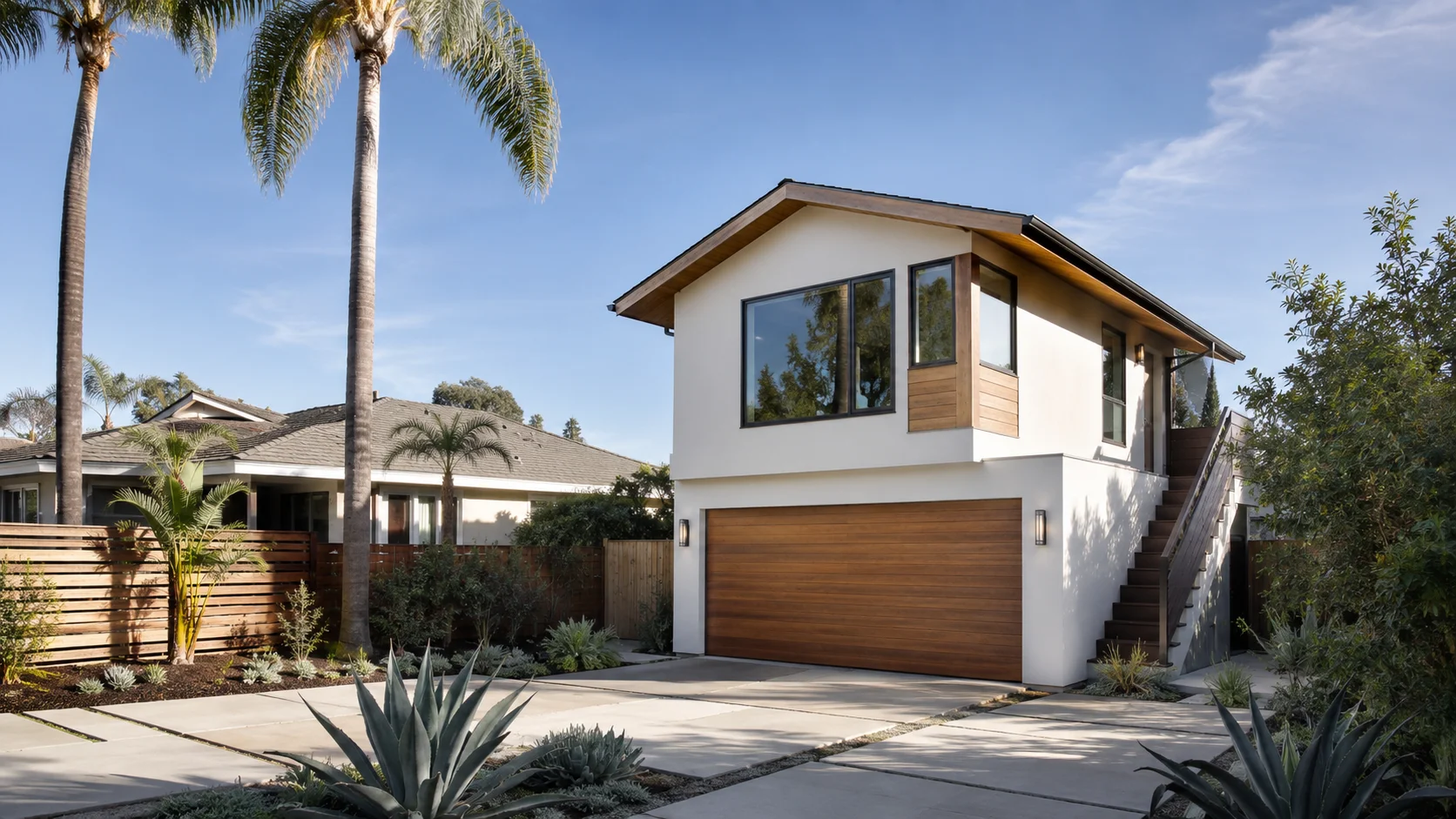
The 60-Second Answer
Yes — building a San Diego ADU over a garage is allowed on most City of San Diego residential lots in 2026, provided the project passes height, setback, overlay, Coastal, fire, structural, and permit review. The City permits ADUs up to 1,200 square feet, and the garage below an above-garage ADU does not count toward that limit (City of San Diego Information Bulletin 400).
A typical 2026 all-in budget for a new-build carriage house runs $350,000 to $500,000+. Building above a structurally sound existing garage typically runs $250,000 to $400,000. The deciding variable is rarely your design — it’s your garage’s condition.
→ Run the free 60-second property check to see what your specific parcel allowsNo phone number required. Parcel-specific results.
San Diego Over-Garage ADU Verdict (First-Scroll Summary)
| Question | Fast answer |
|---|---|
| Is it legal? | Yes on most City of San Diego residential lots in 2026; parcel-specific verification required |
| Maximum ADU size | 1,200 sq ft; the garage below does not count toward this |
| Height (City of San Diego) | Two stories max in single-family zones, subject to base-zone and overlay limits; 21 ft flat roof / 30 ft sloped roof practical envelope (SDMC §141.0307(f)) |
| Setbacks if over 16 ft tall, adjacent to residential | 4 ft side/rear; fire and building code may require additional separation |
| Parking replacement required? | Generally no; exception in Coastal Beach Impact / Parking Impact Overlay Zone outside a Transit Priority Area, with multiple exemptions |
| Realistic 2026 all-in cost (new build, 700 sq ft) | $350K–$500K+ |
| Above structurally sound existing garage | $250K–$400K typical; $180K–$300K in rare minimal-retrofit cases |
| Realistic timeline | 8–14 months concept to tenant |
| Owner-occupancy required? | No for ADUs; still required for Junior ADUs (JADUs) |
| Short-term rentals under 31 days? | Not allowed |
| Primary authorities | SDMC §141.0302; City of SD Information Bulletin 400; Cal. Gov. §§66310–66342 |
Free Tool — ~60 Seconds
See What You Can Build at Your Address
Get a parcel-specific report: base zone, height limit, setback rules, fire-hazard flag, coastal overlay status, and Bonus Program availability.
See What You Can Build → Get Your Free ADU Report in 60 SecondsWho This Guide Is For
This page is written primarily for homeowners in the City of San Diego who are weighing an ADU above an existing or new garage. Rules differ in the unincorporated County of San Diego and in the other San Diego County cities (Oceanside, Carlsbad, Encinitas, Chula Vista, El Cajon, La Mesa, Vista, Escondido, Poway, Santee, Del Mar, Solana Beach, and others). Where county-level rules diverge meaningfully, we say so. For city-specific deep-dives, see our Best ADU Builders San Diego County guide.
We pull from the City of San Diego Information Bulletin 400 (updated January 2026), the San Diego Municipal Code, California Government Code §§66310–66342, the California HCD ADU Handbook 2026, the San Diego Housing Commission’s current ADU Finance Program terms, and 2026 published pricing from San Diego builders who specialize in vertical ADU work. We don’t rank lenders by referral fees. We don’t quote interest rates as guarantees. And we end with one of the most consequential admissions in San Diego ADU planning: above-garage is rarely the cheapest path — but sometimes it’s still the right one.
Can You Actually Build an ADU Over a Garage in San Diego? The 2026 Rules, Decoded
Answer: Yes. SDMC §141.0302 and Information Bulletin 400 allow it. California Government Code §§66310–66342 sets minimum height floors local agencies must allow. Two-story is now the maximum for single-family lots as of August 22, 2025.
The Primary City of San Diego Authority
The single most important authority for any San Diego ADU project is City of San Diego Information Bulletin 400 — the public-facing summary of SDMC §141.0302, the City’s accessory dwelling unit ordinance. Bulletin 400 was last updated in January 2026.
Two San Diego ADU builders — SnapADU and Streamline Design & Permitting — cite SDMC §141.0307(f) (Guest Quarters or Habitable Accessory Buildings) as the operative code section for the over-garage height envelope, publishing 21 feet for flat-roofed structures and 30 feet for sloped-roofed structures as the planning maximums. The City’s Bulletin 400 frames height through base-zone and overlay maximums rather than those specific numbers, so we present the 21’/30’ figures as a builder-applied planning envelope. In practice, the two framings align on most residential parcels.
Where California State Law Sets the Floor
State law overrides any local agency that tries to apply the rules too strictly. The current California ADU statutes are organized at California Government Code §§66310–66342. The legacy citation §65852.2 still appears in older articles, but the substantive provisions have been recodified.
- Cal. Gov. §66317 — 60-day permit clock; the City must approve or deny a complete ADU application within 60 days.
- Cal. Gov. §66321 minimum heights: 16 feet for a detached ADU on a single-family lot; 18 feet within ½ mile of major transit (20 feet if roof pitch aligns with primary dwelling); 25 feet (or local limit) for an attached ADU.
- SB 897 (2022) — concurrent review of demolition and ADU permits; bars local agencies from denying a permit due to non-conforming conditions or unpermitted structures unless they create a public health or safety threat.
- AB 2221 (2022) — caps side and rear setbacks at four feet for an ADU.
- AB 976 (2023) — permanently eliminated owner-occupancy requirements for ADUs. JADUs still require owner-occupancy.
- AB 1033 (2023) — allows separate sale of ADUs as condominiums. City of San Diego adopted effective August 22, 2025 (Ordinance O-21989). Not in effect in the Coastal Overlay Zone until certified by the California Coastal Commission.
- SB 1211 (effective January 2025) — confirms no replacement parking is required when uncovered parking is removed to build an ADU.
- AB 1332 (2023) — requires the City to maintain pre-approved ADU plans and review applications using them within 30 days.
The 2025–2026 San Diego Amendments You Need to Know
- Two-story maximum in single-family zones (effective August 22, 2025). The City limits ADUs in single-family residential zones to two stories. This matches the typical over-garage configuration — but closes the door on three-story carriage-house designs.
- Bonus ADU Program rolled back in eight single-family zones. The City eliminated Bonus eligibility in RS-1-1, RS-1-2, RS-1-3, RS-1-4, RS-1-8, RS-1-9, RS-1-10, and RS-1-11, with a narrow carve-out for properties in CTCAC High or Highest Resource Opportunity Areas.
- Community Enhancement Fee added. Bonus and Affordable ADUs under 750 square feet now pay a Community Enhancement Fee. Rates vary; check Bulletin 501 for current figures.
- Coastal Overlay Zone certification pending. Ordinances O-21618, O-21758, O-21836, O-21989 are pending Coastal Commission certification as of May 2026. Until certified, the prior ADU rules apply inside the Coastal Overlay Zone.
When the Answer Is “No” or “With Restrictions”
- Very High Fire Hazard Severity Zones (VHFHSZ) with single egress. Lots fronting only a cul-de-sac or with a single point of ingress/egress in a VHFHSZ may be ineligible for Bonus ADUs and face stricter fire setback rules.
- Historic district overlays. State law preempts most height limits, but architectural design review in historic districts can still constrain new vertical construction.
- HOA architectural restrictions. Under California Civil Code §4751, an HOA cannot prohibit or unreasonably restrict a state-compliant ADU. But HOAs can impose reasonable architectural standards.
- Steep-slope lots requiring geotechnical reports ($2,500–$4,000 in soils engineering, and potentially deeper foundations).
- VHFHSZ properties regardless of egress. Must observe minimum 4-foot side and rear setbacks regardless of structure height.
Free Tool — ~60 Seconds
See What You Can Build at Your Address
Get a parcel-specific report: base zone, height limit, setback rules, fire-hazard flag, coastal overlay status, and Bonus Program availability.
See What You Can Build \u2192 Free Property Check at Your AddressPulls zone, overlays, fire-hazard status, and height envelope for your specific parcel.
Is Your Garage a Good Candidate for an ADU Above It?
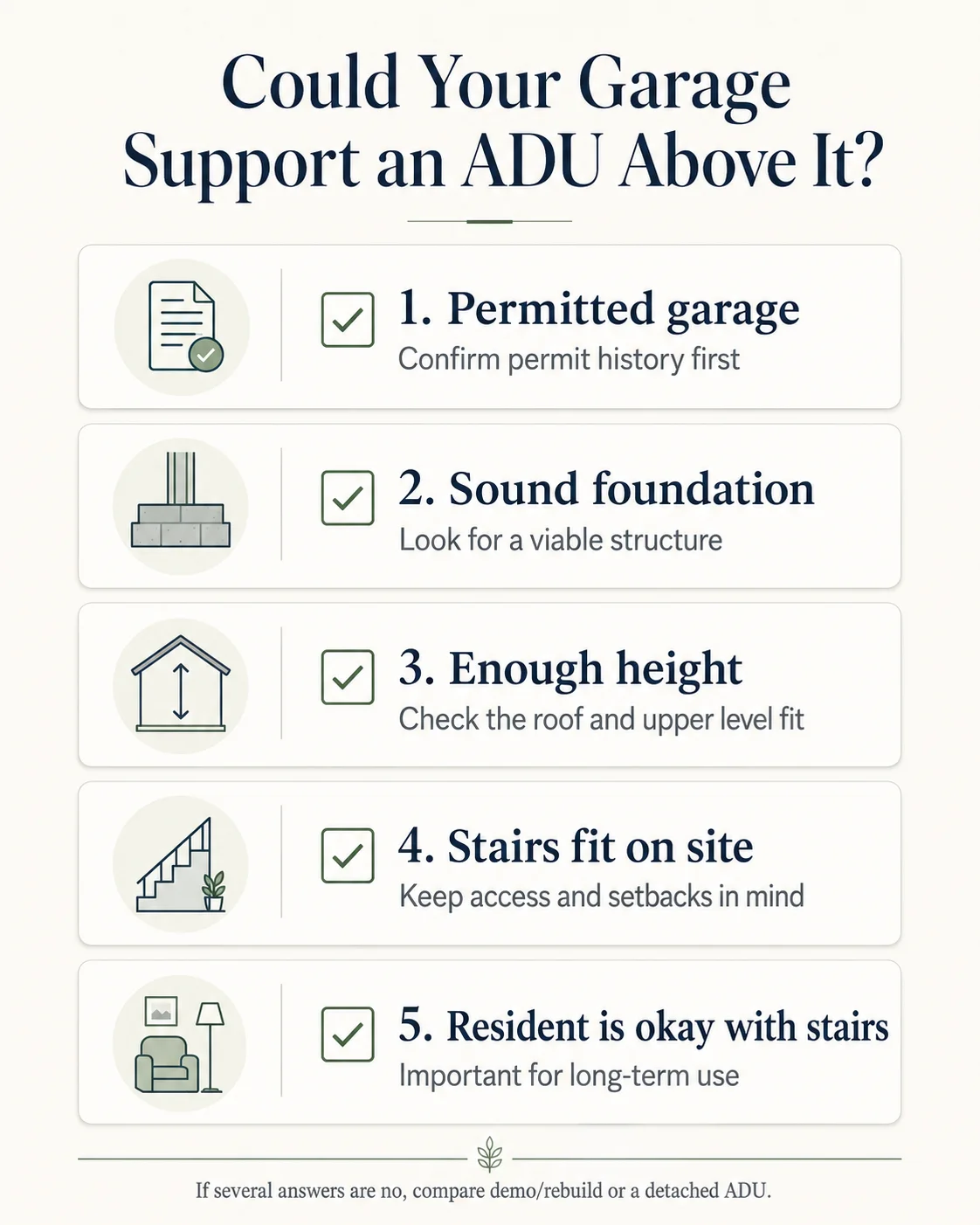
Older San Diego garages often weren’t engineered to carry a second story of habitable space. Whether your project lands in the $250K range or the $400K+ range depends on five questions about your garage’s age, foundation, slab, structural condition, and access. A structural feasibility study costs $2,000–$5,000 and is the single highest-leverage spend in any over-garage project.
The Five-Question Garage Feasibility Diagnostic
This is an editorial triage tool, not a structural engineering standard. Anyone planning to build above an existing garage should commission a structural feasibility opinion from a licensed engineer before signing a full design contract.
Question 1 — What year was the garage built?
Pre-1978 construction triggers asbestos and lead paint risk ($5,000–$15,000 if disturbed). Pre-1990 construction was typically built to footing depths not designed for a second-story dwelling above. Post-2000 was usually built to more conservative footing depths and 2x6 wall framing.
Green flag: post-2000. Yellow: 1978–1999. Red: pre-1978.
Question 2 — What’s the foundation type and depth?
A slab-on-grade with a perimeter footing 18 inches or deeper is the green-flag baseline. A monolithic slab at 12 inches is borderline and almost always requires reinforcement. A floating slab with no perimeter footing cannot carry a second story without a full foundation rebuild. Per Streamline’s 2024–2025 project data, replacing or augmenting a foundation adds $50–$150 per square foot of garage footprint.
Question 3 — Is the slab cracked, settled, or out-of-level?
Hairline cracks (under 1/16 inch) are typically cosmetic. Cracks wider than 1/4 inch, slab settlement, or a slab that visibly slopes more than one inch across the garage all signal structural movement. These don’t automatically disqualify the garage, but they require an engineer’s review.
Question 4 — Are there visible signs of moisture, termite damage, or rot?
Walk the garage with a flashlight before you call any builder. Look at the bottom plate where the wall meets the slab. Tap suspect lumber with a screwdriver — soft wood is rot. Termite damage shows as galleries inside the grain or “mud tubes” running up from the foundation. Either condition usually means the existing framing has to be replaced.
Question 5 — Can a crane and lumber truck reach the garage?
Constructible access matters more than most homeowners realize. A garage at the back of a deep lot, reachable only by a 6-foot side gate, can add $10,000–$25,000 to a build because materials get hand-carried. Tight alleys, low-hanging tree canopies, and side yards under 8 feet wide are red flags.
Scoring the Diagnostic
| Score | Likely Scenario | Typical 2026 all-in cost (700 sq ft) |
|---|---|---|
| 0 red flags, mostly green | Scenario A — Build above sound existing garage (minimal retrofit, rare) | $180K–$300K |
| 1–2 red flags | Scenario B — Build above existing garage with structural retrofit | $250K–$400K |
| 3+ red flags or any foundation red flag | Scenario C — Tear down and rebuild | $350K–$500K+ |
| No existing garage | Scenario D — New-build carriage house | $350K–$500K+ |
When Over-Garage Is the Right Path
- Tight lot (under 6,000 square feet) where you can’t spare yard space for a ground-level detached ADU
- You need to preserve parking, storage, or yard area
- Tenant, adult child, guest suite, or home office — not a mobility-limited resident
- Garage is post-2000 construction, or your budget can absorb a clean tear-down-and-rebuild
- Coastal beach neighborhood where ground-level ADUs would trigger Beach Impact replacement-parking analysis
- Property is not in a VHFHSZ with single egress, not in a historic district with two-story restrictions
When It’s the Wrong Path (Damaging Admission)
Plain version: An ADU over a garage is rarely the cheapest ADU path in San Diego. If your garage foundation is weak, your budget is tight, or the unit is for an aging parent who needs step-free access, a garage conversion or a ground-level detached ADU is almost always the better choice. Conversions run $80,000–$210,000 and finish in 3–6 months. Above-garage builds run $250,000–$500,000+ and finish in 8–14 months.
Over-garage shines when you have a specific reason to build vertically — keeping the garage, keeping the yard, capturing the rental premium for elevated views and complete tenant separation. Without one of those, an over-garage ADU is the most expensive ADU you can build with the longest timeline.
Get a San Diego Above-Garage Feasibility Study → SnapADU
SnapADU has completed more than 100 San Diego ADUs since 2020, including dedicated above-garage and two-story carriage-house projects. Their feasibility process produces a price-locked estimate before permits are submitted under their published Price Lock Guarantee. Useful regardless of who you ultimately choose to build with.
Get a Feasibility Study \u2192 SnapADUSnapADU serves Greater San Diego. Their 2026 published baseline for an over-garage 1BR/1BA build is $270,000 vertical build plus $29,000 standard finish materials (verified March 2026), with plans, permits, and sitework added based on your specific lot.
How Much a San Diego ADU Over Garage Really Costs in 2026
A new-build above-garage carriage house in San Diego runs $350,000 to $500,000+ all-in in 2026. An ADU on top of an existing garage typically runs $250,000 to $400,000 once realistic structural reinforcement is included. The all-in number is shaped less by the ADU’s design and more by the garage’s condition and a $30,000–$50,000 layer of hidden costs that most quotes don’t include.
The Four Cost Scenarios
Sources: SnapADU 2026 published pricing (verified March 2026), Streamline 2024–2025 project data, City of San Diego DSD Information Bulletin 501, Better Place Design & Build 2026 ranges. Last verified May 12, 2026.
| Scenario | Description | Vertical build ($/sq ft) | Structural cost layer | Fire-rated assembly | Typical 700-sq-ft all-in (2026) |
|---|---|---|---|---|---|
| A | Build above structurally sound existing garage (minimal retrofit, rare) | $200–$300 | Minimal | $15–$25/sq ft | $180K–$300K |
| B | Build above existing garage requiring retrofit (typical existing-garage case) | $250–$350 | $50–$150/sq ft added | $15–$25/sq ft | $250K–$400K |
| C | Tear down existing garage, build new garage + ADU above | $300–$350 | Full new foundation included | $15–$25/sq ft | $350K–$500K+ |
| D | New-build carriage house (no existing garage) | $300–$350 | Full new foundation | $15–$25/sq ft | $350K–$500K+ |
Where the Money Actually Goes (Line Items)
Pre-construction (design and engineering):
- Architectural plans: $8,000–$15,000 custom, or $500–$1,500 for stock-plan modifications
- Structural engineering: $3,000–$8,000 — mandatory for above-garage
- Title 24 energy compliance calculations: $1,500–$2,500
- Geological/soils report (hillside lots only): $2,500–$4,000
City permitting fees (2026):
- Building permit: $3,000–$8,000
- Plan check fee: $2,000–$5,000 (~65% of building permit fee)
- School fees (San Diego Unified): $5.38 per square foot of interior livable space for residential developments where payment is received on or after May 11, 2026 (the prior rate of $5.17/sq ft applied before that date). Per SB 543, school fees are not assessed on ADUs/JADUs of 500 sq ft or less.
- Water capacity fee: approximately $1,524 (at 0.5 EDUs)
- Sewer capacity fee: approximately $2,577 (at 0.5 EDUs)
- Impact fees: not imposed on ADUs of 750 sq ft or less of interior livable space (SB 13 framework)
- All-in typical permit cost: $6,500–$21,000
Construction-related upgrades commonly required:
- Electrical panel upgrade to 200-amp service: $3,000–$5,000
- SDG&E coordination and meter installation: $500–$2,500
- Solar PV system (if classified as new construction; not exempt): $8,000–$15,000
The Hidden Costs That Wreck Above-Garage Budgets
These are the line items that turn $250K projects into $400K projects:
- Bathroom directly above the garage adds ~30% to plumbing cost vs. placement above an existing wall — vertical plumbing drops through the garage ceiling require complex routing.
- Interior stairs cost $15,000–$25,000 more than exterior stairs. Exterior stairs need $3,000–$5,000 of weatherproofing, privacy screening, and (in fire zones) ignition-resistant materials.
- Temporary parking and storage during construction: Garage unusable for 4–6 months. Plan $200–$500 per month.
- Existing-garage demolition if footings fail inspection: $10,000–$25,000 to demolish.
- Asbestos or lead paint abatement (pre-1978 garages): $5,000–$15,000.
- Story poles before permit submittal: $1,500–$3,000 to install temporary frames showing actual height and massing. Not a code requirement but defuses neighbor opposition.
- Construction Cost Index inflation: The California Construction Cost Index (CCCI) rose 44% from January 2021 to December 2025. Budget assumptions from older quotes are no longer accurate.
Why “I Got a $250K Quote” Is a Red Flag, Not a Deal
A general contractor quotes $250,000 for “an apartment over your garage.” Six months in, the structural reinforcement isn’t priced, the fire-rated assembly isn’t priced, the school fees aren’t priced, and the temp-parking line item isn’t priced. The project finishes at $400,000 with change orders. A trustworthy bid explicitly itemizes: (1) structural engineering scope, (2) fire-rated horizontal assembly, (3) school fees and capacity fees, (4) stair configuration with cost impact, (5) bathroom placement and plumbing premiums, (6) temporary parking allowance, (7) change-order process and budget contingency.
Free Tool — ~60 Seconds
See What You Can Build at Your Address
Get a parcel-specific report: base zone, height limit, setback rules, fire-hazard flag, coastal overlay status, and Bonus Program availability.
Check Your Garage, Lot, and Budget \u2192 Get Your Free San Diego ADU ReportParcel-specific report. No phone number required.
Should You Build Above the Existing Garage or Demolish and Rebuild?
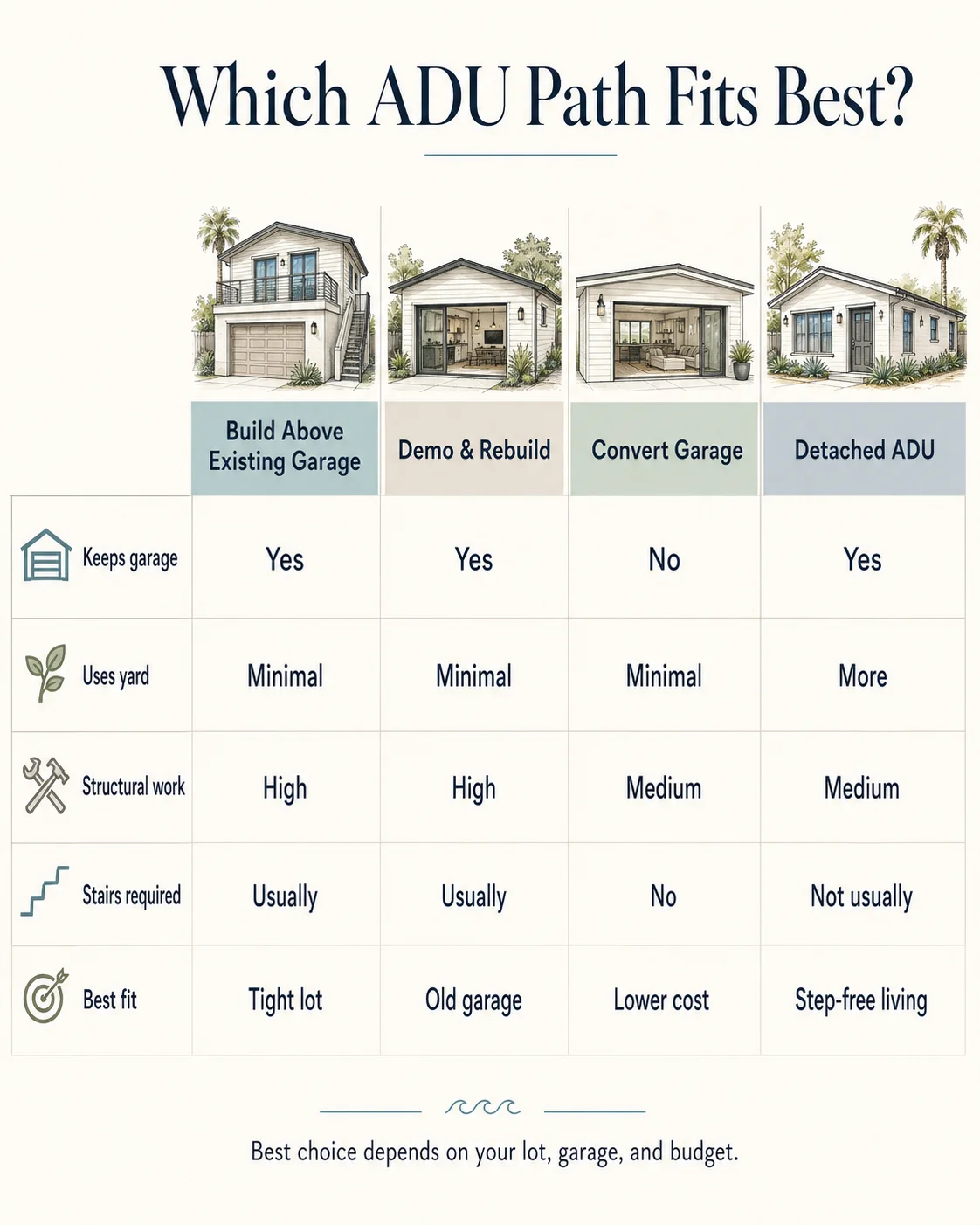
If your garage is newer (post-2000), permitted, and structurally sound, building above the existing garage usually makes sense. If the garage is older than 1990, unpermitted, or structurally compromised, demolishing and rebuilding a carriage-house ADU is cleaner and more predictable. The decision often turns on a $3,000–$5,000 structural engineering report.
| Path | Choose this when… | Avoid this when… | Typical 2026 cost (700 sq ft) | Typical timeline |
|---|---|---|---|---|
| Build above existing garage | Garage is structurally sound, permitted, well-located, and reinforcement cost is meaningfully less than rebuild cost | Old slab, undersized foundation, unpermitted structure, termite/dry rot, or low wall heights | $180K–$400K (Scenarios A or B) | 6–10 months |
| Demolish + rebuild garage + ADU above | Garage is older or compromised; you want predictable engineering | Your budget is tight and a one-story ADU would meet the goal | $350K–$500K+ (Scenario C) | 8–14 months |
| Convert existing garage (no above) | Lowest upfront cost matters more than preserving parking/storage | You need to keep parking; the garage has structural issues | $80K–$210K | 3–6 months |
| Build ground-level detached ADU | You have yard space; aging parent or accessibility user | Lot is too tight; you can’t sacrifice yard area | $300K–$450K+ | 8–14 months |
| JADU inside the main house | Budget is tightest of all; willing to share entry | You want privacy or full rental separation | $50K–$120K | 2–4 months |
The $3,000 Decision
Many San Diego homeowners spend $30,000–$50,000 on architectural plans for an above-garage project, then discover during permitting that the existing garage can’t carry the load. The fix is sequence: commission a structural feasibility study before paying for full architectural plans. It costs $2,000–$5,000 and produces three deliverables: (1) whether the existing garage can be reinforced, (2) range estimate of reinforcement cost, (3) recommended scope. That spend is the highest-leverage investment in the entire project.
Planning a Carriage-House ADU in Greater San Diego? Compare Your Lot with SnapADU \u2192
SnapADU serves Greater San Diego including the City of San Diego, Oceanside, Carlsbad, Encinitas, Del Mar, Solana Beach, Poway, San Marcos, Escondido, La Mesa, El Cajon, Vista, Chula Vista, Rancho Santa Fe, Santee, Lemon Grove, Imperial Beach, and National City, with surrounding and unincorporated County areas subject to confirmation. Their 2026 published baseline for an over-garage 1BR/1BA build is $270,000 vertical build plus $29,000 standard finish materials, with plans, permits, and sitework added based on your specific lot.
Compare Your Lot with SnapADU \u2192Skip this CTA if you're outside Greater San Diego, want a pure garage conversion at the lowest possible cost, or need a fully custom architectural collaboration outside SnapADU's standard library.
San Diego Rules That Decide Your Over-Garage Project
For an above-garage ADU in the City of San Diego, eight rule categories decide your project: size, height, setbacks, parking, fire and life-safety, solar, short-term rental limits, and project classification. Each comes from a specific code section with a state-law backstop in California Government Code §§66310–66342.
Size Rules — and Why the Garage Below Doesn’t Count
The City of San Diego allows ADUs from 150 square feet to 1,200 square feet. The over-garage-specific answer most planners get wrong: when an ADU is proposed on top of a garage, the garage square footage below is not included in the maximum 1,200 square feet of the ADU. The garage may count toward overall gross floor area or FAR for the lot, but it does not eat into your ADU size allowance. If your garage footprint is 400 square feet and your zone allows a 1,200-square-foot ADU, you can build the full 1,200 square feet of living space above that garage.
State law also protects an 800-square-foot ADU path regardless of FAR or lot coverage limits. If the City tries to deny a larger ADU on FAR grounds, you are still guaranteed at least 800 square feet with 4-foot side and rear setbacks.
Height Rules
Bulletin 400 frames the height rule as: detached ADU structures and ADUs attached to existing accessory structures on single-dwelling lots may be two stories, subject to the maximum structure height of the underlying base zone and any applicable overlay zone. Maximum residential base-zone heights in San Diego typically range from 24 to 30 feet.
SnapADU and Streamline cite SDMC §141.0307(f) for a practical envelope of 21 feet for flat-roofed structures and 30 feet for sloped-roofed structures. A useful reference data point: SnapADU’s published designs typically set the second-floor plate height at 19 feet from finished slab, with the slab set 8 inches above grade and 9-foot ceilings — putting the roof peak well inside the 21-foot flat-roof envelope.
Setback Rules for Above-Garage Builds
Tier 1 — Conversions and rebuilds of existing structures.
If you’re converting an existing legal garage into a habitable structure, or demolishing it and rebuilding in the same footprint, the ADU may keep the existing setbacks even if they don’t meet current code. This is one of the most undersold advantages of building on top of an existing garage.
Tier 2 — New floor area added to an existing structure (typical above-garage build).
New floor area must comply with current setback rules. If your ADU exceeds 16 feet in height — essentially every above-garage build — and the side or rear property line abuts a residentially zoned or developed lot, you must observe a 4-foot interior side and rear setback (SDMC §141.0302). Fire and building code requirements can result in additional setbacks beyond the four-foot minimum.
Tier 3 — Very High Fire Hazard Severity Zone.
Properties in a VHFHSZ must observe a minimum 4-foot interior side and rear setback regardless of structure height. The Fire Code Official may require greater setbacks, and properties in Brush Management Zones face additional separation requirements.
Parking Rules — and the Coastal Beach Impact Exception
Outside the Coastal Overlay Zone, no off-street parking is required for an ADU in the City of San Diego. This is by-right state law, and Bulletin 400 confirms it.
Inside the Coastal Overlay Zone, specifically the Beach Impact Area of the Parking Impact Overlay Zone (PIOZ), outside a Transit Priority Area, one off-street parking space may be required for a new detached ADU — unless these Bulletin 400 exemptions apply: ADU/JADU 500 sq ft or less; designated historical resource; ADU attached to primary dwelling or existing accessory structure; residential permit parking district; car-share vehicle within one block; or within a Transit Priority Area.
For an above-garage configuration, the parking question often resolves itself: an over-garage build preserves the garage entirely — so no parking has been removed, and no replacement is triggered. This makes the configuration uniquely useful in beach communities (Mission Beach, Pacific Beach, Ocean Beach, La Jolla Shores) where the Beach Impact Area applies.
Fire Separation, Sprinklers, and Life Safety
The California Building Code requires a one-hour fire-rated horizontal assembly between a private garage and the habitable space above. This typically means 5/8-inch Type X gypsum board on the garage-side ceiling, framing reinforcements, and continuous gypsum at the connection between garage walls and the ADU above. Streamline’s 2024–2025 project data places this fire-rated assembly cost at $15–$25 per square foot of horizontal area.
Sprinklers are a separate question. Bulletin 400 confirms that detached ADUs require sprinklers only when the primary dwelling is sprinkler-protected. Attached ADUs and JADUs always require sprinklers when the primary dwelling has them.
Solar PV Requirements
Newly constructed non-manufactured detached ADUs are subject to the Title 24 solar PV requirement — typically $8,000–$15,000. ADUs created within existing space, or as additions to existing homes, are not subject to the solar PV requirement. Whether your over-garage build qualifies as an exempt addition depends on how DSD classifies the project during plan check. Verify classification before budgeting.
Owner-Occupancy and Short-Term Rental Restrictions
AB 976 (Ting, 2023) permanently eliminated owner-occupancy requirements for ADUs. JADUs still require owner-occupancy of one unit on the parcel.
Per Bulletin 400, ADUs cannot be leased for less than 31 consecutive days, which effectively bars Airbnb, Vrbo, and similar nightly-rental models. This applies regardless of where the ADU sits on the lot. If your investment thesis depends on STR revenue, the math doesn’t work in San Diego for ADUs.
The Parking Question (and Why Above-Garage Is the Coastal Loophole)
Outside the Coastal Overlay Zone, no replacement parking is required when a garage or carport is converted or demolished for an ADU (Cal. Gov. §§66310–66342; SB 1211, effective January 2025). An above-garage configuration preserves the garage and typically avoids the replacement-parking question entirely.
| Question | Over-garage ADU | Garage conversion |
|---|---|---|
| Keeps garage and parking? | Yes | No |
| Beach Impact Area replacement parking required? | Not triggered (parking preserved) | May be required outside TPA |
| Triggers PIOZ analysis in plan check? | Minimal | Yes |
| Useful for coastal lots with scarce on-street parking? | Strong fit | Weak fit |
| Cost impact of parking question | Minimal | Can add $10K–$30K of site work |
How Long Do Permits and Construction Take?
Plan on 8 to 14 months from first sketch to first tenant: 1–2 months for feasibility and design, 3–5 months for permitting in the City of San Diego (4–10 weeks in unincorporated County), 4–6 months for construction.
The Five Permitting Stages
- Pre-screen / intake (2–4 weeks). Application enters the queue, fees are paid, the City verifies required documents.
- First plan check (typically the full 60-day state window). The City reviews plans against the Municipal Code, Building Code, Fire Code, Title 24, and any applicable overlays. Most projects receive plan check comments requiring corrections.
- Corrections and rechecks (3–6 weeks per cycle, usually 2–3 cycles). The designer addresses comments and resubmits. Each resubmittal restarts the review clock.
- Conditional approval. Final plan set is reviewed once more by each applicable department.
- Issuance queue (15–20 days). Fees are calculated and paid, permit released.
Total: typically 3–5 months in 2026, down from 8–10 months at the peak of the City’s 2022 staffing shortage.
How to Cut Your Timeline
- Use a pre-approved plan from the City’s accepted list. Under AB 1332, applications using pre-approved plans must be reviewed within 30 days. Pre-approved plans still require parcel-specific review for site conditions and overlays.
- Submit a complete package the first time. Incomplete documentation is the largest source of delay. A complete submittal includes the site plan with all setbacks, floor and roof plans, elevations and sections, structural plans and calculations, Title 24 documentation, geotechnical report (if hillside), and all required forms.
- Avoid third-party permitting agencies. Projects with in-house design + permitting teams typically finish 4–6 weeks faster than projects using outside expediters.
When the Coastal Overlay Zone Slows You Down
Properties inside the Coastal Overlay Zone may require a Coastal Development Permit (CDP) if the ADU is not completely contained within the existing primary structure, increases habitable area, or converts non-habitable space. The CDP review adds 1–3 months on top of the regular ADU permit timeline.
Until pending ordinances (O-21618, O-21758, O-21836, O-21989) are certified by the Coastal Commission, the prior ADU rules apply inside the Coastal Overlay Zone — which can mean different setback, landscape, parking, and condo-sale rules than for non-coastal properties.
Floor Plans and Design Trade-offs for Above-Garage ADUs
The sweet spot for an above-garage ADU in San Diego is a 500–750 sq ft 1-bedroom plan that fits under the practical height envelope and stays at or under the 750-sq-ft threshold that exempts the project from impact fees.
Why 1BR / 500–750 Sq Ft Is the Sweet Spot
- Impact-fee threshold. Impact fees are not imposed on ADUs of 750 sq ft or less of interior livable space. Staying at or under that threshold preserves $8,000–$15,000 in fees.
- Rental demand. 1BR units are the strongest rental segment in nearly every San Diego submarket.
- Structural fit. A 500–750 sq ft footprint fits comfortably above a 400–550 sq ft 2-car garage without requiring cantilevers or external structural supports that add cost.
Interior vs. Exterior Stairs — and Why Your Choice Changes Your Budget by $20K
Exterior stairs are typically $15,000–$25,000 cheaper to build, but add $3,000–$5,000 in weatherproofing, lighting, privacy screening, and (in fire zones) ignition-resistant materials. They free up 60–80 square feet of upstairs floor area. They also create cleaner unit separation, which helps with rental privacy.
Interior stairs preserve weather protection and architectural unity, but consume usable square footage upstairs and require enclosed framing that adds cost.
Most San Diego carriage houses we see are designed with exterior stairs along a side or rear elevation — the savings outweigh the downsides, and the climate cooperates with outdoor stair use.
Where to Put the Bathroom
Best practice: Place the bathroom along the side wall of the upper floor, aligned with the side wall of the garage below. This lets the plumbing stack drop down through the garage wall and tie into the main house’s plumbing with a short horizontal run.
Avoid: A bathroom placed in the middle of the upper floor, directly above the open garage bay. This forces a long vertical drop through the garage ceiling, additional floor reinforcement around the drain, longer vent runs, and a soffit or exposed plumbing chase. Streamline’s project data places the cost premium for mid-bay bathroom placement at ~30% over side-wall placement — easily $5,000–$10,000 on a single bathroom.
Pre-Approved Plans
Under AB 1332, San Diego maintains a list of accepted pre-approved ADU plans that qualify for the 30-day expedited review. SnapADU publishes its own catalog including an “ADU Over Garage 1BR/1BA” floor plan with explicit pricing ($270,000 vertical build plus $29,000 standard finish materials baseline as of March 2026). Verify with SnapADU and DSD whether any specific plan currently qualifies for the 30-day pre-approved pathway in the City.
Using a pre-approved plan does not guarantee approval — the parcel still requires site-specific review for setbacks, overlays, height, and utilities — but it cuts the first review from 60 days to 30.
What Could an Over-Garage ADU Rent for in San Diego in 2026?
A 1-bedroom carriage house above a garage in San Diego rents for roughly $2,200 to $3,200 per month in 2026, with neighborhood averages running $200 to $500 per month above an equivalent garage conversion. At a $400,000 all-in build and a $2,700 average rent, gross yield is approximately 8% before financing, vacancy, maintenance, and taxes.
These are illustrative examples, not guarantees of returns. Actual results depend on local market conditions, construction costs, financing terms, tenant demand, unit quality, lease restrictions, and regulatory approvals.
| Source | San Diego rent signal (1BR, May 2026) | Use as |
|---|---|---|
| Zumper, San Diego median 1BR | Approximately $2,150 | Conservative comp |
| RentCafe, San Diego 1BR average | Approximately $2,657 (citywide) | Higher market benchmark |
| RentCafe, North Park 1BR | Approximately $2,564 | Mid-city neighborhood comp |
| Better Place Design & Build, Encinitas | $3,882 for a 1,000-sq-ft ADU | Premium coastal comp |
| Streamline carriage-house aggregate data | $24,000–$36,000 annual range for above-garage ADUs | Industry summary |
Source dates: Zumper and RentCafe data captured May 2026; Better Place case studies published 2025; Streamline 2024–2025 aggregate.
The Carriage House Rental Premium
Streamline’s market analysis places the rental premium for a 1-bedroom carriage house at $200 to $500 per month over an equivalent garage conversion. Tenants pay more for three reasons:
- Complete separation from the main residence. An upstairs unit reached only by an exterior stair feels like a true second home.
- Elevated views and natural light from multiple exposures. A second-story unit captures light from at least three sides.
- Yard preservation for the main home. Above-garage builds keep the primary home’s outdoor space intact.
A Worked ROI Example with Honest Assumptions
| All-in build cost (700 sq ft, Scenario C) | $400,000 |
| Monthly market rent (mid-market submarket) | $2,700 |
| Annual gross rent | $32,400 |
| Less: 8% vacancy and management | ($2,592) |
| Less: maintenance reserve (5%) | ($1,620) |
| Less: property tax increase on new sqft (illustrative) | ($2,000 to $4,000) |
| Net operating income (year 1) | $24,200 to $26,200 |
| Simple payback (no appreciation, no leverage) | ~15–17 years |
Property tax: under California’s Proposition 13 framework, the existing assessment on your primary residence is not re-triggered when you add an ADU. Only the newly added square footage is assessed at current market value — typically $2,000–$4,000 in additional annual property tax for a 700-sq-ft San Diego ADU. Investment outcomes are not guaranteed.
Free Download
Get the Free ADU Starter Kit (PDF)
Includes the feasibility worksheet, the bid comparison checklist, and the rent-comp template used in the example above. Free, no payment information, unsubscribe anytime.
Download Free Starter Kit →How San Diego Homeowners Finance Above-Garage ADUs
Most San Diego homeowners use one of four financing paths: cash-out refinance, HELOC, renovation/construction loan, or the San Diego Housing Commission’s ADU Finance Program construction-to-permanent loan up to $250,000.
| Path | Best when… | Watch out for… |
|---|---|---|
| Cash-out refinance | You have at least 30% equity; your current rate is at or above today’s market rate | Closing costs ($5K–$15K); resetting amortization on the full mortgage balance |
| HELOC | Equity is ample; you want flexibility to draw against the project as it progresses | Variable rates; lien position behind your primary mortgage |
| Construction loan / renovation loan | Equity is limited; project will materially increase property value | Tighter underwriting; appraisal contingencies; complex draw schedules |
| SDHC ADU Finance Program | You’re in the City of San Diego; you meet income/credit/LTV criteria; you accept a 7-year affordability restriction | Income limits; deed restriction on rent; cannot rent to family during the restriction period |
The San Diego Housing Commission ADU Finance Program
The SDHC ADU Finance Program is the most distinctive piece of public ADU financing in California. The program offers City of San Diego homeowners a construction-to-permanent loan up to $250,000, with free technical assistance covering design, permitting, and construction.
Current SDHC program terms (verified May 12, 2026):
- City of San Diego location required
- Owner-occupied detached single-family residence
- Eligible household income up to $236,600 / 150% AMI
- Construction-to-permanent loan up to $250,000
- 7-year affordability restriction: rent must be affordable to tenants at up to 80% AMI
- Property owner cannot rent to a family member during the 7-year affordability period
- “Affordable” is defined as 30% or less of the renter’s monthly household income
- Subject to SDHC underwriting, funding, and program availability
CalHFA ADU Grant Program
The CalHFA ADU Grant Program previously offered eligible homeowners up to $40,000 to cover pre-construction costs. Per CalHFA’s official ADU page, the latest round of funding was fully allocated as of December 28, 2023. Treat the program as unavailable unless CalHFA announces a new funding round.
Explore Cash-Out Refi, HELOC, and Construction-Loan Paths for Your ADU
Compare cash-out refinance, HELOC, renovation loans, construction-to-permanent loans, and the San Diego Housing Commission’s up-to-$250K ADU Finance Program in our financing path guide.
See ADU Financing Options →Path education, not a ranked lender list. We don’t publish rate guarantees or approval promises.
Above-Garage ADU vs. The Alternatives (Honest Side-by-Side)
Above-garage is the right configuration when you have a tight lot, want to keep your yard and parking, or own a coastal property in the Beach Impact Area. The right choice depends on what you’re optimizing for — and most over-garage builds are wrong choices for homeowners optimizing primarily for cost.
| Configuration | Typical 2026 cost (700 sq ft) | Timeline | Keeps parking? | Keeps yard? | Best when… |
|---|---|---|---|---|---|
| ADU above garage (new build) | $350K–$500K+ | 8–14 months | Yes | Yes | Small lot, premium rental, coastal Beach Impact |
| ADU above existing garage | $180K–$400K | 6–10 months | Yes | Yes | Garage is structurally sound |
| Garage conversion | $80K–$210K | 3–6 months | No | Yes | Tight budget, unused garage, no coastal parking constraint |
| Detached backyard ADU | $300K–$450K+ | 8–14 months | Yes | Loses yard area | Yard space available, design flexibility, accessibility |
| JADU (inside main house) | $50K–$120K | 2–4 months | Yes | Yes | Lowest cost; willing to share entry; family-only use |
| Two-story stacked ADU (no garage) | $400K–$550K+ | 10–14 months | N/A | Mixed | Bonus ADU plays, multi-tenant builds in TPAs |
Sources: SnapADU 2026 cost pages; Streamline cost decomposition; Realm Home cost guide; Better Place Design & Build configuration ranges. Last verified May 12, 2026.
When NOT to Build Above a Garage
- Aging parents or accessibility users. Stairs are the entire problem.
- Tight budgets where any ADU path is a stretch. A JADU or conversion is cheaper and faster.
- Single-story neighborhoods where neighbor objections are likely. Story poles help, but neighbor opposition can add real delays.
- HOAs with restrictive architectural rules. Civil Code §4751 protects state-compliant ADUs from HOA prohibitions, but reasonable architectural restrictions are still enforceable.
- Compromised existing garage with a tight overall budget. If your garage needs a full rebuild and your budget caps at $300K, you’re in the wrong configuration.
- Properties where the height envelope doesn’t accommodate the design you want. Some sloped lots can’t fit a 21-foot flat-roof ADU above a 9-foot garage even though the underlying zoning says 30 feet.
Free Tool — ~60 Seconds
See What You Can Build at Your Address
Get a parcel-specific report: base zone, height limit, setback rules, fire-hazard flag, coastal overlay status, and Bonus Program availability.
Run Your Free ADU Feasibility Check \u2192 See What You Can Build at Your AddressNo phone number required. Parcel-specific results.
Choosing a Builder for an Above-Garage ADU in San Diego
An above-garage ADU is a vertical, structurally demanding build that has more in common with a custom home than with a backyard cottage. The right builder has completed at least 10 above-garage or two-story ADU projects in San Diego County, runs an in-house design and permitting team, and explicitly itemizes structural reinforcement and fire-rated assembly in the contract.
The 14-Point Bid Comparison Checklist (Above-Garage Specific)
If a bid doesn’t address all 14 of these, you don’t have a complete bid:
- Structural engineering scope — is engineering included or a separate cost?
- Existing-foundation assessment — what’s the scope and who pays if the foundation fails inspection?
- Fire-rated assembly specification — 1-hour rating, materials specified
- Stair configuration and cost — interior, exterior, materials, fall protection
- Bathroom placement — vertical plumbing routing and any premiums noted
- Crane and material access plan — site logistics and any access surcharges
- CSLB license active check — license number, classification, and bond/insurance confirmation
- Bond and insurance limits — current CSLB minimum $25,000 contractor bond, $1M general liability, workers comp
- References for two-story ADUs specifically — ask for three completed above-garage projects you can visit
- Price-locked vs. cost-plus pricing model — price-locked is strongly preferred for vertical work
- Allowance lines for finishes — fixtures, flooring, appliances broken out
- Change-order process — written change-order policy with markup capped (typically 15–20%)
- Permit pull responsibility — does the builder pull permits in their name or yours?
- Warranty terms — minimum 1-year workmanship warranty, 10-year structural warranty preferred
Our Pick for San Diego: SnapADU
Above-garage ADUs are structurally and procedurally demanding enough that we don’t recommend shopping multiple generalist contractors against one specialist for this configuration.
SnapADU has completed more than 100 ADUs in San Diego since 2020, including dedicated above-garage and two-story carriage-house projects. They run an in-house design and permitting team. They publish their plan-specific pricing — their “ADU Over Garage 1BR/1BA” floor plan is $270,000 vertical build plus $29,000 standard finish materials baseline as of March 2026, with plans, permits, and sitework added based on the lot. They offer a published Price Lock Guarantee under which the contract price locks after their Construction Estimate Agreement process.
Dwelling Index earns a referral fee when readers contact SnapADU through our links. Our editorial position is independent of compensation.
When to Look Beyond SnapADU
- Your lot doesn’t fit any of SnapADU’s catalog plans well.
- You want a specific aesthetic outside the standard library (modern minimalist, period revival, mid-century).
- You’re pursuing a Bonus ADU configuration with multiple units.
- You’re in unincorporated County with specific terrain or fire-zone challenges.
For those cases, see our Best ADU Builders San Diego County guide.
See SnapADU’s Above-Garage Pricing & Plans \u2192 Get a Personalized Budget
SnapADU publishes their ADU Over Garage 1BR/1BA baseline pricing publicly. Get a personalized budget for your specific lot and garage condition.
See SnapADU Pricing \u2192The Biggest Reasons a San Diego Over-Garage ADU Fails
The most common failure points are structural infeasibility, height or setback conflicts, Coastal Overlay or VHFHSZ constraints, stair and deck placement issues, utility upgrade costs that weren’t budgeted, unrealistic budgets, accessibility mismatch, and reliance on generic ADU advice instead of parcel-specific San Diego rule verification.
| Failure point | What it means | Safer alternative |
|---|---|---|
| Existing garage cannot support a second story | Reinforcement is too expensive or impossible | Demolish and rebuild (Scenario C) or ground-level detached ADU |
| Height or setback conflict | Two-story massing, stairs, or decks don’t fit the envelope | Smaller unit, different stair location, or garage conversion |
| Coastal Development Permit triggered | Adds 1–3 months and may add parking requirements | Existing-space conversion if possible; smaller scope |
| Very High Fire Hazard Severity Zone | Stricter setbacks, possible single-egress disqualification | Confirm zoning before plans; consider different configuration |
| Aging-parent intended occupant | Stairs make the unit impractical | Ground-level detached ADU or JADU |
| Budget under realistic threshold | Above-garage path is too expensive | Garage conversion, JADU, or phased planning |
| Unpermitted existing garage | Code and permit complications | Pursue permit-history review and legalization strategy first; note AB 2533 applies to unpermitted ADUs/JADUs built before January 1, 2020, not to unpermitted garages |
| Stair/deck encroachment into setback | New extensions don’t inherit existing-structure setbacks | Redesign stair location; relocate to interior of structure |
| HOA architectural restriction | Civil Code §4751 voids prohibitions but reasonable architectural rules still apply | Verify CC&Rs before design; pursue ADU-protection analysis with counsel if needed |
| Utility upgrade not budgeted | Service panel upgrade discovered mid-project | Verify panel and SDG&E coordination before bid signing |
The Single Largest Failure Mode
Homeowners commission architectural plans before they commission a structural feasibility study. The architect produces a beautiful plan that assumes the existing garage can be reinforced. Plan check accepts the design. Then, during framing or excavation, the structural reality reveals itself — and either the plan has to be substantially redrawn (delay, cost) or the project shifts to a full tear-down (more cost, more delay). The fix is sequence: run the structural feasibility study first. The $2,000–$5,000 you spend on the feasibility study is the highest-leverage spend in the entire project.
What to Do Before You Pay for Plans
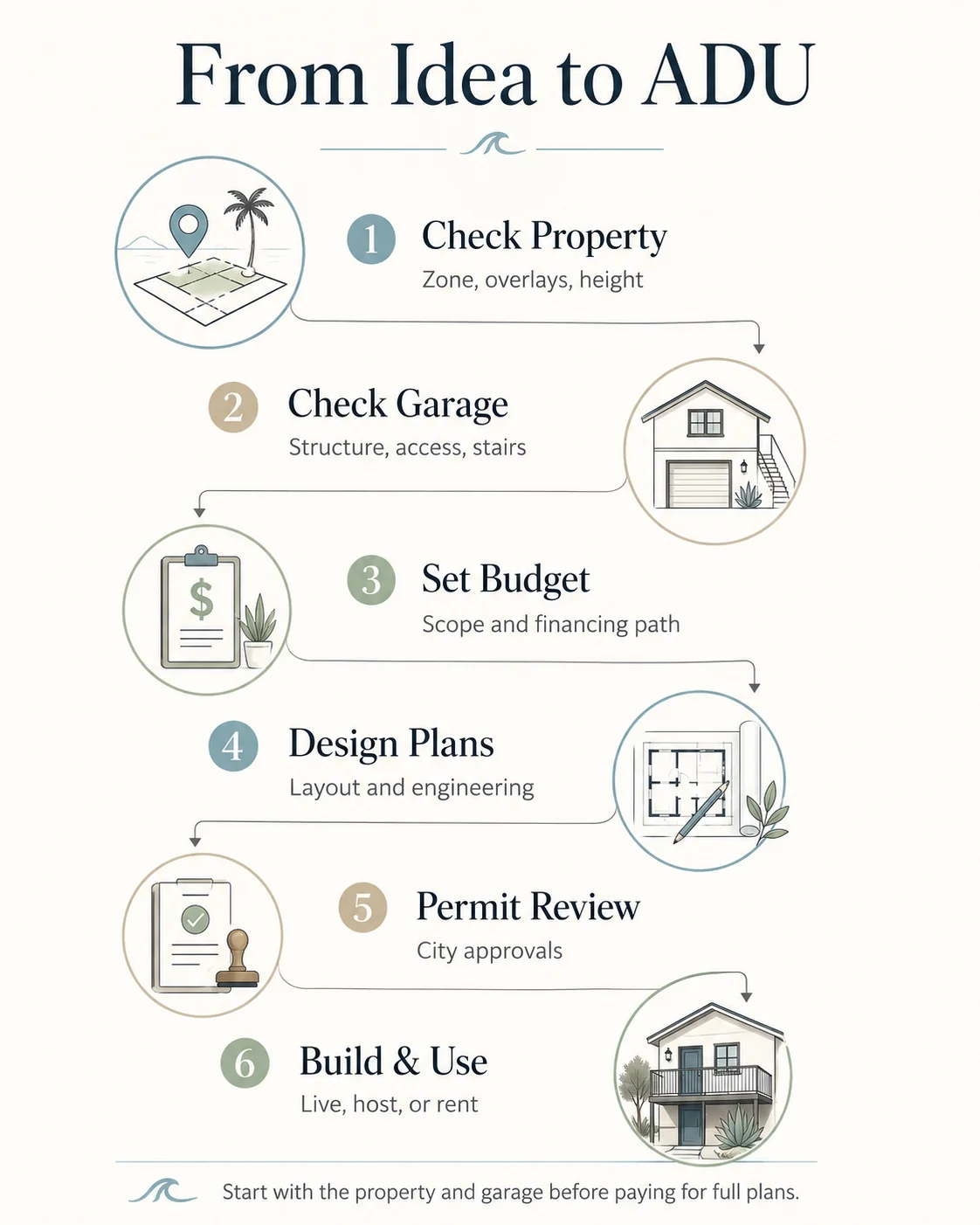
Before paying for full architectural plans, confirm your jurisdiction and overlays, verify your garage was permitted, get a structural feasibility opinion, compare the four main paths against your budget and use case, and confirm your financing path.
The 10-Step Pre-Plan Checklist
- Confirm the address is in the City of San Diego (or identify the correct local jurisdiction). Use the City’s ZAPP portal or a county property summary report.
- Check base zone and overlays: Coastal Overlay, VHFHSZ, historic district, steep slope, brush management, Parking Impact Overlay Zone, Beach Impact Area, Transit Priority Area, Sustainable Development Area.
- Confirm whether the existing garage was permitted. Pull permit history from City records. An unpermitted garage creates code complications that affect cost and timeline.
- Measure the garage footprint and the desired ADU size. Confirm the ADU will fit within the garage’s structural envelope (or plan for an overhang, which adds engineering cost).
- Decide whether preserving the garage is worth the added cost versus a conversion or detached ADU.
- Get a structural feasibility opinion before commissioning full design. $2,000–$5,000 spent here saves $20K+ in re-design later.
- Compare three paths against your priorities: above existing garage, demolish-and-rebuild carriage house, and ground-level detached ADU or conversion.
- Confirm financing before committing to architecture. Have a pre-approval letter, a HELOC commitment, or written confirmation of program eligibility in hand.
- Review HOA CC&Rs, if any, for architectural restrictions. Note that Civil Code §4751 voids any HOA rule that prohibits or unreasonably restricts a state-compliant ADU.
- Submit a complete permit package only after the concept survives feasibility and financing. Incomplete submittals are the largest source of permit delay.
Frequently Asked Questions
Can you build an ADU on top of an existing detached garage in San Diego?
Yes, if the project complies with City ADU rules, base-zone and overlay height limits, setbacks, building and fire code, structural engineering, and permits. The City of San Diego Information Bulletin 400 confirms that ADUs may be attached to or detached from existing structures, and that detached ADU structures and ADUs attached to existing accessory structures on single-dwelling lots may be two stories subject to applicable height rules. California Government Code §§66310–66342 sets minimum height floors every local agency must allow.
How tall can an ADU be above a garage in San Diego?
The City’s Information Bulletin 400 frames the height rule as two stories maximum on single-dwelling lots, subject to the maximum structure height of the underlying base zone and any applicable overlay. SnapADU and Streamline cite SDMC §141.0307(f) — the Habitable Accessory Buildings section — for a practical envelope of 21 feet for flat-roofed structures and 30 feet for sloped-roofed structures. Both framings should align on most residential parcels. Verify with City Development Services Department during plan check.
Does the garage count toward the ADU square-footage limit?
No. When an ADU is proposed on top of a garage or carport, the garage area below is not included in the maximum 1,200 square feet of the ADU. The garage may count toward the overall gross floor area of the site and the lot’s floor area ratio, but it does not eat into your ADU size allowance.
Do you have to replace parking when you build an ADU over your garage?
Generally no. Outside the Coastal Overlay Zone, San Diego does not require any off-street parking for an ADU. Inside the Coastal Overlay Zone, parking may be required in the Beach Impact Area of the Parking Impact Overlay Zone if the property is outside a Transit Priority Area — but multiple exemptions apply. An above-garage configuration preserves the existing garage and therefore doesn’t trigger replacement parking analysis in most cases.
How long does the permit take for an above-garage ADU in San Diego?
Typical 2026 permit timeline is 3–5 months in the City of San Diego. California Government Code §66317 requires the City to approve or deny a complete application within 60 days, but applications cycle through 2–3 review rounds with corrections, so total time exceeds the statutory window. Pre-approved plans qualify for an expedited 30-day first review under AB 1332.
Is an above-garage ADU worth it financially?
It depends on what you’re optimizing for. Above-garage builds run $350,000–$500,000+ all-in for new construction in San Diego in 2026. Typical 1-bedroom market rent is $2,200–$3,200 per month. Simple rent-payback is 12–17 years before financing, taxes, and maintenance — but ADUs typically increase property value. The build pencils best when you’re optimizing for property value plus rental income. Investment outcomes are not guaranteed.
Can you sell an above-garage ADU separately from the main house in San Diego?
In the City of San Diego, yes, outside the Coastal Overlay Zone, per the City’s August 22, 2025 adoption of AB 1033 (Ordinance O-21989). Inside the Coastal Overlay Zone, the AB 1033 provisions are not in effect until the California Coastal Commission certifies the relevant ordinance. The unincorporated County of San Diego adopted AB 1033 on March 4, 2026, with implementation effective April 4, 2026.
Do you need fire sprinklers in an above-garage ADU?
Generally no, unless the primary dwelling is sprinkler-protected. A 1-hour fire-rated horizontal assembly between the garage and the ADU above is required regardless of sprinklers, and adds $15–$25 per square foot of horizontal area.
What’s the difference between an above-garage ADU and a carriage house?
The two terms are used interchangeably in modern San Diego ADU planning. “Carriage house” is the historical term, dating to outbuildings designed to store horse-drawn carriages. In contemporary usage, “carriage house ADU” refers to a configuration where a garage occupies the ground floor and an ADU sits above it.
Can I have both an above-garage ADU and a JADU in the main house?
Yes. California state law allows one ADU plus one JADU on a single-family lot. The above-garage build counts as the ADU; the JADU can be created from existing space inside the main residence. The JADU is limited to 500 square feet and must remain within the existing or proposed primary dwelling footprint. The JADU still requires owner-occupancy of one unit on the parcel.
Do I need owner-occupancy to build an above-garage ADU in San Diego?
No. AB 976 (Ting, 2023) permanently eliminated owner-occupancy requirements for ADUs. JADUs still require owner-occupancy of one unit on the parcel.
Can I use an above-garage ADU as a short-term rental (Airbnb)?
No. San Diego’s ADU rules prohibit leasing an ADU for less than 31 consecutive days, which effectively excludes nightly-rental platforms. This applies regardless of configuration. The City’s separate Short-Term Residential Occupancy ordinance imposes additional licensing and tier restrictions that would also apply if the 31-day rule were ever modified.
Should I use a pre-approved ADU plan for my above-garage build?
Maybe, but with caveats. Pre-approved plans qualify for an expedited 30-day first review under AB 1332. SnapADU publishes its own over-garage 1BR/1BA plan with pricing; confirm with SnapADU and DSD whether any specific plan qualifies for the 30-day pathway in the City. Pre-approved plans cut the first review but still require parcel-specific review for site conditions and overlays.
What happens if my existing garage is unpermitted?
It’s complicated, but solvable. SB 897 prevents local agencies from denying a permit due to nonconforming zoning conditions, building code violations, or unpermitted structures, unless the violations create a public health or safety threat. AB 2533 (2024) provides a legalization pathway for unpermitted ADUs and JADUs built before January 1, 2020 — it does not directly apply to unpermitted garages. For an unpermitted garage you want to use as the base of a new ADU, the practical path is: pull City permit-history records, work with DSD or a local design-build firm on a legalization or code-compliance strategy for the existing garage during the ADU design process, and bring the garage up to code before adding the ADU above.
What We Verified
Sources verified for this guide (Last verified May 12, 2026):
- City of San Diego ADU regulations — Information Bulletin 400, updated January 2026
- San Diego Municipal Code §141.0302 (ADUs), §141.0307(f) (Habitable Accessory Buildings), §131.0422 (residential setbacks), §131.0444 (height/angled envelope plane)
- City of San Diego DSD Information Bulletin 501 — current permit fee schedule
- California Government Code §§66310–66342 — including §66317 (60-day permit clock) and §66321 (state height rules)
- California state ADU legislation — SB 897 (2022), AB 2221 (2022), AB 976 (2023), AB 1033 (2023), AB 1332 (2023), SB 13, SB 1211 (effective January 2025), SB 543 (school-fee framework), AB 2533 (2024)
- California Civil Code §4751 — HOA restrictions on ADUs
- County of San Diego Planning & Development Services — ADU page and the March 4, 2026 AB 1033 adoption (effective April 4, 2026)
- San Diego Housing Commission ADU Finance Program — current published terms (eligible household income up to $236,600 / 150% AMI; loans up to $250,000; 7-year affordability restriction at up to 80% AMI; verified May 12, 2026)
- California Housing Finance Agency ADU Grant Program — funding fully allocated as of December 28, 2023 per CalHFA’s current official page
- San Diego Unified School District developer fees — $5.38/sq ft for residential payments received on or after May 11, 2026; SB 543 framework exempts ADUs/JADUs of 500 sq ft or less
- California Contractors State License Board (CSLB) — current contractor bond requirement of $25,000
- California Department of Housing and Community Development (HCD) ADU Handbook 2026
- California Construction Cost Index (CCCI) — January 2021–December 2025 trajectory (+44%)
- SnapADU published 2026 pricing — including the “ADU Over Garage 1BR/1BA” plan baseline of $270K vertical + $29K finishes (verified March 2026); Price Lock Guarantee language
- Streamline Design & Permitting — 2024–2025 above-garage completed-project data and cost-layer breakdown
- Better Place Design & Build — published 2026 San Diego cost ranges; published North Park and Encinitas case studies
- Realm Home — published 2026 cost ranges for San Diego ADU configurations
- City of San Diego DSD Permit Processing Timeline dashboard — current cycle times
- Zumper and RentCafe — May 2026 San Diego rent comp data
- City of San Diego ZAPP portal — parcel-specific zone and overlay verification
Last verified: May 12, 2026. We recheck this page every 90 days. If you find an error in a code citation, fee, or builder pricing, please reach out via our contact page.
Methodology
This guide was built by separating four kinds of evidence:
Regulatory facts (code sections, statutory citations, City rules) come from the City of San Diego Development Services Department, the San Diego Municipal Code, California Government Code §§66310–66342, California Civil Code §4751, the California HCD ADU Handbook 2026, and the City’s published Information Bulletins 400 and 501. We quote code sparingly and cite each section explicitly.
Cost data comes from builders who publish their pricing publicly — primarily SnapADU and Streamline Design & Permitting — supplemented by Better Place Design & Build’s 2026 published ranges, Realm Home’s cost guide, and the City of San Diego DSD permit fee schedule. We treat builder pricing as published 2026 signals, not guaranteed bids.
Rental data comes from Zumper, RentCafe, and case studies published by San Diego ADU builders. Rent figures are illustrative, not guarantees, and include the standard rental-income disclaimer.
Voice-of-customer signal comes from BiggerPockets San Diego forum threads, Reddit’s r/sandiego, and reviewed homeowner Facebook groups. We use these only to identify objections and natural language — never to establish law, cost, or regulatory claims.
We don’t rank lenders by referral fee. We don’t use fake reviews, fake star ratings, or synthetic testimonials. We don’t fabricate expert credentials. The Dwelling Index is an independent research resource covering ADU financing, costs, and regulations. We are not a lender, broker, contractor, or City of San Diego affiliate.
Related Guides
- Best ADU Builders San Diego County: 2026 Costs & Picks
- San Diego Two-Story ADU 2026: Rules, Costs & Lot Fit
- San Diego Above Garage ADU: 2026 Costs, Rules & Fee Cliff
- ADU Financing: Every Option Explained
- Detached ADU Floor Plans: 15 Layouts
- What Is a JADU? Junior ADUs Explained
- How Much Does an ADU Cost?
- California ADU Laws 2025: What to Know
Not sure where to start?
See what’s possible at your address — get your free ADU report in 60 seconds. Pulls your zone, overlays, fire-hazard status, and height envelope into one readable report.
See What You Can Build → Get Your Free ADU ReportNo phone number required. Parcel-specific results.