
Oceanside ADU Permit Process (2026): 7 Steps, Real Fees, and What the HCD Findings Mean for Your Project
Oceanside ADU permits run 2–4 months of elapsed time — not because the statutory clock is slow, but because correction cycles pause it. This guide covers every step, the real fee numbers from public eTRAKiT records, the Coastal Appeal Jurisdiction rules, and the eleven HCD findings on Oceanside’s 2022 ordinance that every 2026 applicant should understand.
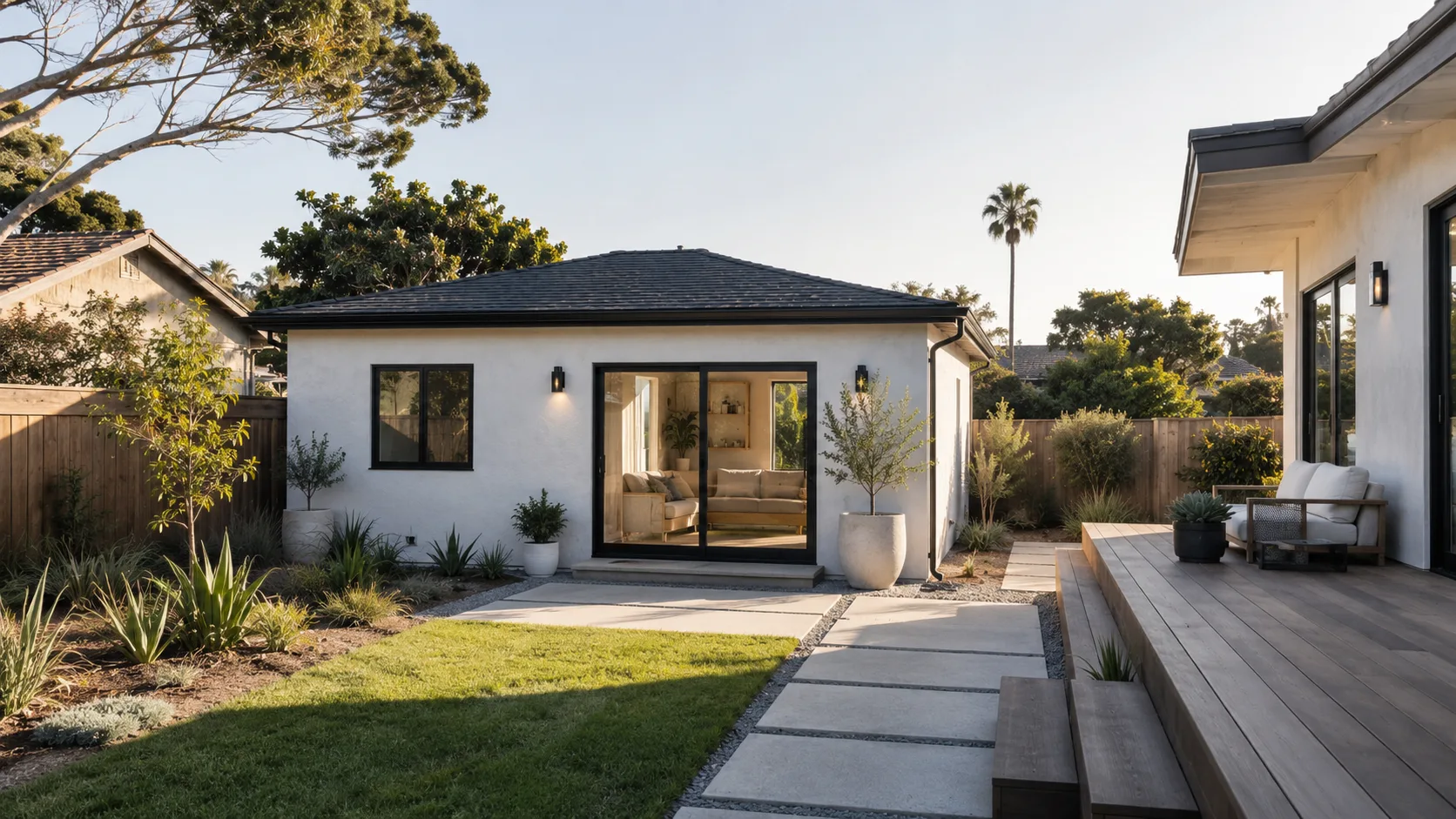
Completed detached ADU in a North County San Diego backyard. Photo for illustrative purposes.
Bottom line up front
Oceanside ADU permits are ministerial — no public hearing, no neighbor approval — but the 60-day statutory clock pauses every time the City issues plan-check comments. The City’s published targets are 14 calendar days for initial ADU plan review and 7 calendar days for resubmittals. Most detached ADUs clear in 2–4 months of elapsed time. City permit fees for a typical detached ADU run $6,879–$7,741 based on public eTRAKiT records; add school fees, state surcharges, and soft costs. Separately, HCD sent Oceanside a formal findings letter on May 20, 2025 identifying eleven provisions of the 2022 ordinance that do not comply with state law — meaning some rules printed in the local ordinance text are unenforceable, and state law controls.
Oceanside ADU permit snapshot — 2026
| Factor | Oceanside rule | Source |
|---|---|---|
| Statutory review clock | 60 days (ministerial — Gov. Code § 66317) | State ADU law |
| Completeness determination | 15 business days (SB 543); auto-complete if missed | SB 543 / Gov. Code § 66317 |
| City plan-review target (ADU) | 14 calendar days initial; 7 days resubmittal | City of Oceanside Plan Check page |
| Typical elapsed time to permit | 2–4 months (correction cycles pause the clock) | eTRAKiT records; SnapADU data |
| City permit fees (detached ADU) | ~$6,879–$7,741 (from eTRAKiT public records) | City of Oceanside eTRAKiT |
| City permit fees (attached/addition) | ~$3,384–$3,859 (from eTRAKiT public records) | City of Oceanside eTRAKiT |
| School fees (>500 sq ft ADU) | $3.48/sq ft (OUSD published schedule) | City of Oceanside ADU fee schedule |
| State SMIP | $13 per $100,000 valuation | California OSHPD |
| State Green Tax | $4 per $100,000 valuation | California |
| Submittal method | Electronic only via eTRAKiT (since Jan 2, 2025) | City of Oceanside Plan Check page |
| Plan review expiration | 2 calendar years from submittal date | City of Oceanside Plan Check page |
See what you can build in Oceanside
See what you can build at your address — free Oceanside ADU report in 60 seconds. Independent feasibility tool. No commitment, no spam.
Get Your Free ADU Report →What is the Oceanside ADU permit process in 2026? (7 steps)
Oceanside ADU permits are ministerial — no discretionary review, no public hearing, no neighbor veto. The City must approve or deny a complete application within 60 days. Here is the step-by-step path from decision to certificate of occupancy.
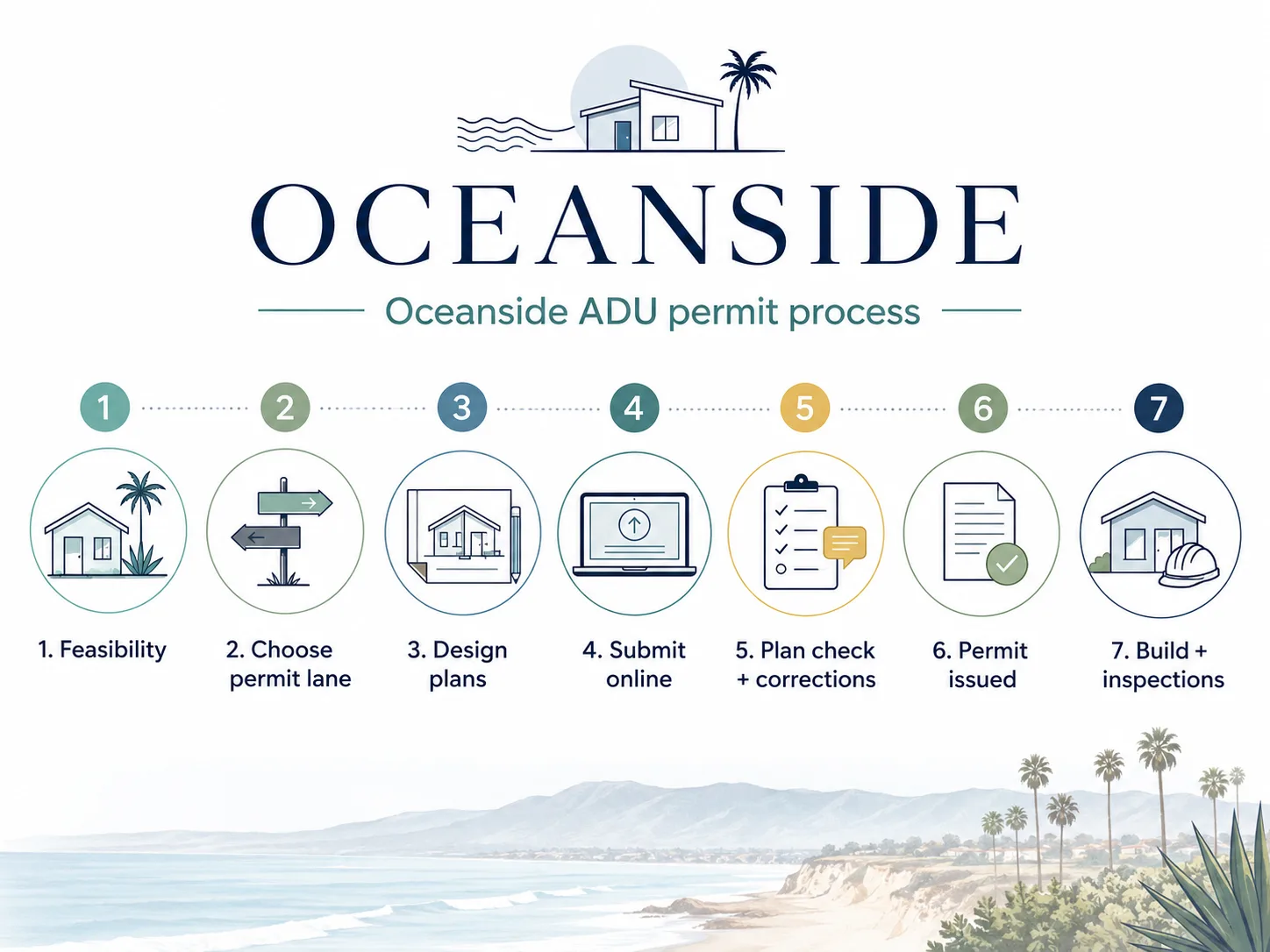
The 7-step Oceanside ADU permit process — from zoning check to certificate of occupancy.
- 1
Confirm your zoning, Coastal Zone status, and ADU lane
Before spending on plans, call Oceanside Planning at (760) 435-3520 or use the City’s parcel lookup to confirm your zoning district, applicable ADU size limits, and whether your parcel is inside the Coastal Zone or the more restrictive Coastal Appeal Jurisdiction. This one call can save thousands in redesign fees.
Also confirm which lane you’re building in: Oceanside’s local ordinance (up to 1,200 sq ft, standard setbacks on larger units) versus the 800 sq ft state-protected lane (4-ft side and rear setbacks, stricter front-setback protection). The two lanes are mutually exclusive for most configurations.
Trip-up: HCD’s May 2025 findings note that Oceanside’s 2022 ordinance applies front-yard setbacks that would block the 800 sq ft state-exemption ADU. State law (§ 66321(b)(3)) prohibits this. If a planner cites a front setback that would prevent your 800 sq ft ADU, you have documented grounds to push back. - 2
Select your ADU type and hire your design team
Oceanside is more homeowner-friendly than many California cities when it comes to who can design your ADU. For a standard single-family residential project, you do not need a licensed architect — an unlicensed residential designer or a design-build firm with in-house drafting can submit plans for projects up to four dwellings on one lot, wood-framed, and not more than two stories plus basement.
You will need a licensed structural engineer for structural calculations on new detached ADUs, additions, second-story construction, and unusual foundations. Most experienced ADU designers have a structural engineer they regularly work with.
Oceanside note: Oceanside’s plan-check page states that residential plans drawn by a licensed design professional must be stamped and wet-signed. Confirm your designer’s licensing status before submitting. - 3
Prepare your submittal package
Oceanside requires a minimum package that includes a completed Building Permit Application, site/plot plan, full architectural drawings, structural calculations, Title 24 energy compliance documentation, and the appropriate recorded covenant form. See the document checklist below for the full list.
Common delay: Incomplete submittals are the #1 reason permits stall at intake. Under SB 543, the City has 15 business days to flag deficiencies — but every round of deficiency notices adds weeks to your elapsed time. Submit complete the first time. - 4
Submit electronically through eTRAKiT
Since January 2, 2025, Oceanside only accepts electronic submittals. Use the eTRAKiT portal or the City’s Building Permit Application form. Paper plans are no longer accepted. Development Services is located at 300 North Coast Highway, but the submittal itself is electronic.
Under SB 543, the City must determine completeness within 15 business days. If the City misses that window, your application is automatically deemed complete as a matter of law — and the 60-day approval clock begins.
- 5
Respond to plan-check corrections
The City’s published targets are 14 calendar days for initial ADU plan review and 7 calendar days for resubmittals. The 60-day statutory clock pauses during each round of comments; it only runs when the ball is in the City’s court. A typical detached ADU on a clean, flat lot may clear in one to two correction rounds. Complex lots, coastal parcels, or flag lots can take three to five.
Key insight: Under SB 543, you now have a statutory right to appeal an incompleteness determination. If you believe the City’s deficiency notice is incorrect, you can challenge it — this is new leverage that didn’t exist before January 1, 2026. - 6
Pull the permit — sign, pay fees, post permit card
Once plan check is approved, sign the permit, pay any remaining fees — including school district fees if your ADU exceeds 500 sq ft ($3.48 per sq ft under the OUSD published schedule), state SMIP ($13 per $100,000 valuation), state Green Tax ($4 per $100,000 valuation), and plan and permit imaging fees.
Post the permit card at the job site before any work begins. Record the ADU or JADU covenant with San Diego County Recorder — the City provides the covenant forms on its ADU page (ADU 2020, JADU 2020, JADU-ADU Combo 2020, Multi-family ADU 2020).
- 7
Complete construction inspections and obtain certificate of occupancy
Schedule all inspections through eTRAKiT or the City’s Web Inspection Scheduling page. Inspections scheduled before 3:30 PM on a business day are performed the following business day. On inspection day, eTRAKiT shows an estimated time of arrival — be present for the window plus up to two additional hours.
Keep a printed set of approved plans (with all stamps and revisions) at the site for every inspection. Inspectors will not inspect to plans they cannot see — this is the most common cause of failed inspections.
Plan review expires two calendar years from the date of submittal. To extend, submit a written request before expiration; one six-month extension may be granted.
What is the Oceanside ADU permit timeline — and what slows it down?
The statutory review window is 60 days from a complete application, but the realistic elapsed time for most detached ADUs is 2–4 months because the clock pauses during every correction cycle. Here is what drives the gap.
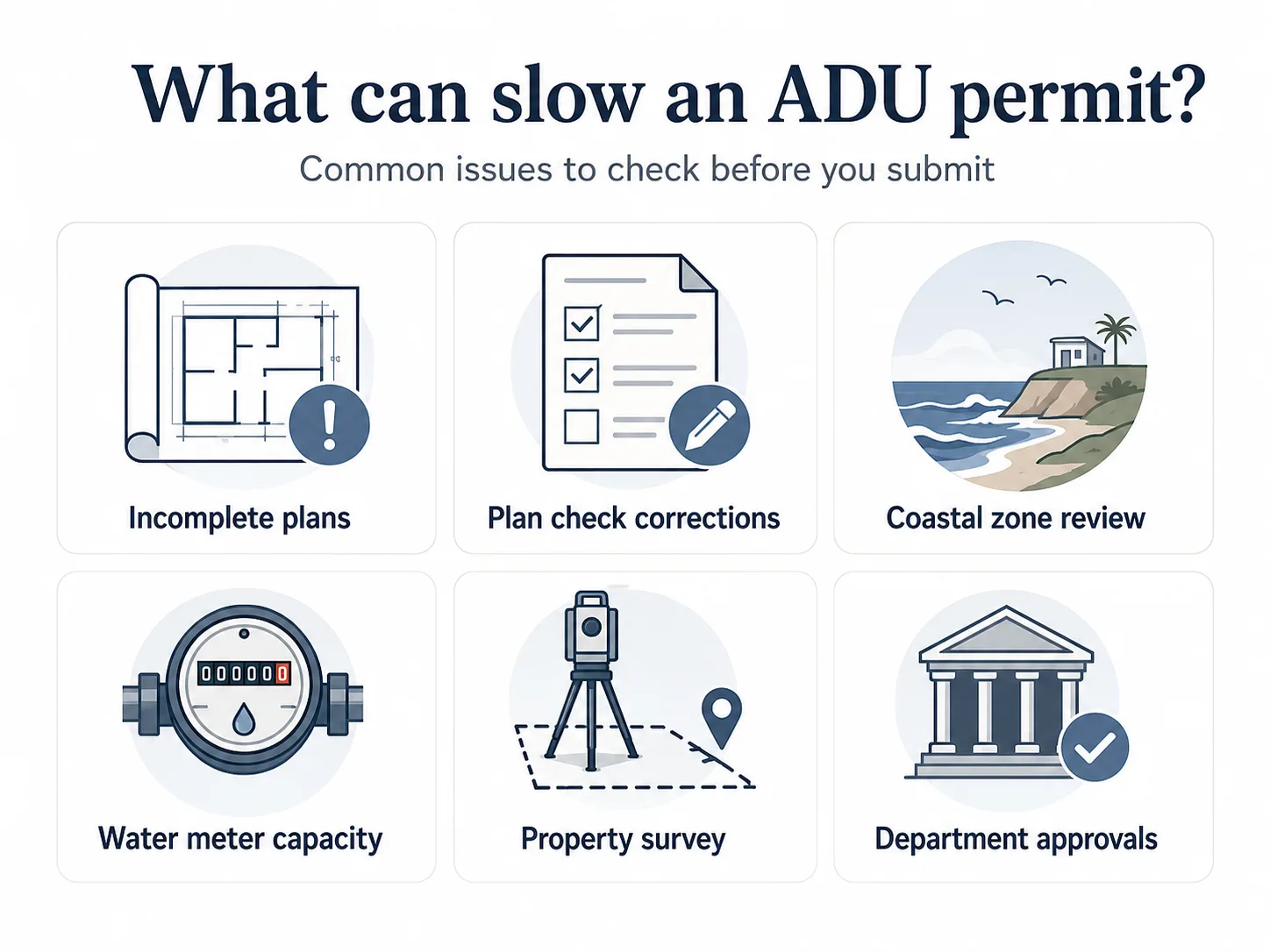
Factors that pause the 60-day clock and extend your total elapsed time.
Incomplete submittal at intake
The City has 15 business days to determine completeness under SB 543. Every deficiency notice resets the completeness window. Submit complete to avoid losing 3–6 weeks before the review clock even starts.
Correction cycles during plan review
The 60-day clock pauses while you respond to corrections. A single correction round typically adds 2–4 weeks. The City has 7 calendar days to review resubmittals; you may have 2–4 rounds on a complex project.
Coastal Appeal Jurisdiction processing
If your parcel is in the Coastal Appeal Jurisdiction, you need a Coastal Development Permit processed concurrently with your building permit. AB 462 (effective October 10, 2025) put this decision on a 60-day clock and eliminated the Coastal Commission appeal — but the concurrent review adds complexity.
Soils report or utility engineering
If the City requires a soils report (case-by-case in the coastal zone) or a water/sewer utility plan, the time to procure those third-party reports is on your timeline, not the City's.
Covenant recording delays
The ADU or JADU covenant must be recorded with San Diego County Recorder before permit issuance. Delays in recording can hold up the permit at issuance, independent of plan check status.
Avoid a preventable correction cycle. See your timeline estimate at your address.
Get Your Free Oceanside ADU Report →How much does an Oceanside ADU permit cost?
Oceanside publishes an ADU fee schedule (effective September 1, 2019) on its ADU page. Public eTRAKiT permit records show the real-world totals. Below are verified numbers from six recent permit records.
| Permit # | ADU type | Permit fee total |
|---|---|---|
| BLDG25-0230 | Detached ADU (new construction) | $7,741 |
| BLDG25-1441 | Detached ADU (new construction) | $7,313 |
| BLDG25-1325 | Detached ADU (new construction) | $6,879 |
| BLDG24-2081 | Attached ADU (addition) | $3,859 |
| BLDG23-1281 | Attached ADU (addition) | $3,384 |
| WTR20-0079 | Water meter (upsize, if required) | Case-by-case |
City permit fees only. Does not include school fees, state surcharges, soils report, surveys, designer fees, or construction. Source: City of Oceanside eTRAKiT public records.
Fee categories explained
| Fee item | Basis | Typical range |
|---|---|---|
| Building Plan Check | Per fee schedule — tied to valuation | Included in totals above |
| Building Inspection | Per fee schedule — tied to valuation | Included in totals above |
| Planning Plan Check | Per fee schedule | Included in totals above |
| Water Plan Check | If water connection/meter change | Variable |
| School district fee | $3.48/sq ft for ADUs >500 sq ft | ~$2,784 for 800 sq ft |
| State SMIP | $13 per $100,000 valuation | ~$26–$46 on $200k–$350k |
| State Green Tax | $4 per $100,000 valuation | ~$8–$14 on $200k–$350k |
| Plan imaging fee | Flat fee per sheet | ~$50–$150 |
| Permit imaging fee | Flat fee | ~$35–$75 |
| Survey (boundary + form-board) | Third-party licensed surveyor | $2,000–$5,500 |
| Soils report (if required) | Third-party geotechnical firm | $3,000–$8,000 |
| Title 24 energy consultant | Third-party consultant | $500–$1,500 |
| Designer / drafting fees | Design firm or architect | $5,000–$20,000+ |
| Water meter upsize (if needed) | City of Oceanside Utilities | $2,000–$3,000 |
Soft-cost total for a typical 800 sq ft detached ADU
Working from the verified fee schedule and eTRAKiT records, the pre-construction soft costs for a detached 800 sq ft Oceanside ADU typically land in the $20,000–$45,000 range — city permit fees, school fees, SMIP/Green Tax, surveys, soils report (if required), designer fees, and Title 24 consultant. Lenders ask for this number. Be ready with it before applying for construction financing.
See every fee category that will apply to your specific lot.
Run Your Free Oceanside ADU Feasibility Check →Does Oceanside have a Coastal Zone, and does it affect your ADU?
Oceanside has both a Coastal Zone and a narrower Coastal Appeal Jurisdiction. The Coastal Zone covers a wider area than just the beach — it includes property from the inland side of Coast Highway to the Pacific and areas adjacent to the San Luis Rey River, Loma Alta Creek, and Buena Vista Lagoon.
Within that Coastal Zone, the Coastal Appeal Jurisdiction is a specific subset where a Coastal Development Permit (CDP) is required for an ADU. Appeal Jurisdiction status varies parcel-by-parcel. Check the City’s Coastal Permit and Appeal Jurisdiction Map or call Planning at (760) 435-3520 to confirm your parcel’s status before spending on plans.
AB 462 (effective October 10, 2025) — what changed
- CDP applications for ADUs must be approved or denied within 60 days of a complete application.
- The CDP is processed concurrently with the ADU permit — not sequentially.
- No public hearing required for ADU CDPs.
- ADU CDP decisions under Gov. Code § 66329(a) are not subject to Coastal Commission appeal under Public Resources Code § 30603 — Oceanside Planning makes the call.
- If your parcel is in the Coastal Appeal Jurisdiction, you may need to provide a mailing list of surrounding owners before the permit issues.
For ADU projects in the Coastal Zone that also involve soils concerns, note that the City may require a soils report case-by-case — but per documented correspondence (December 2023, via SnapADU), the City may waive the requirement along the coastal zone if foundations are designed for 18-inch-deep footings and a 5-inch slab.
Not sure whether your parcel triggers a CDP? Check your address now.
Check My Address →For a full deep-dive on Oceanside Coastal Zone rules, see our Oceanside Coastal Zone ADU guide.
What ADU types does Oceanside allow?
Oceanside allows detached new-construction ADUs, attached ADUs (addition to the primary dwelling), garage and space conversions, and Junior ADUs (JADUs). The right type for your property depends on your lot size, existing structures, budget, and goals.
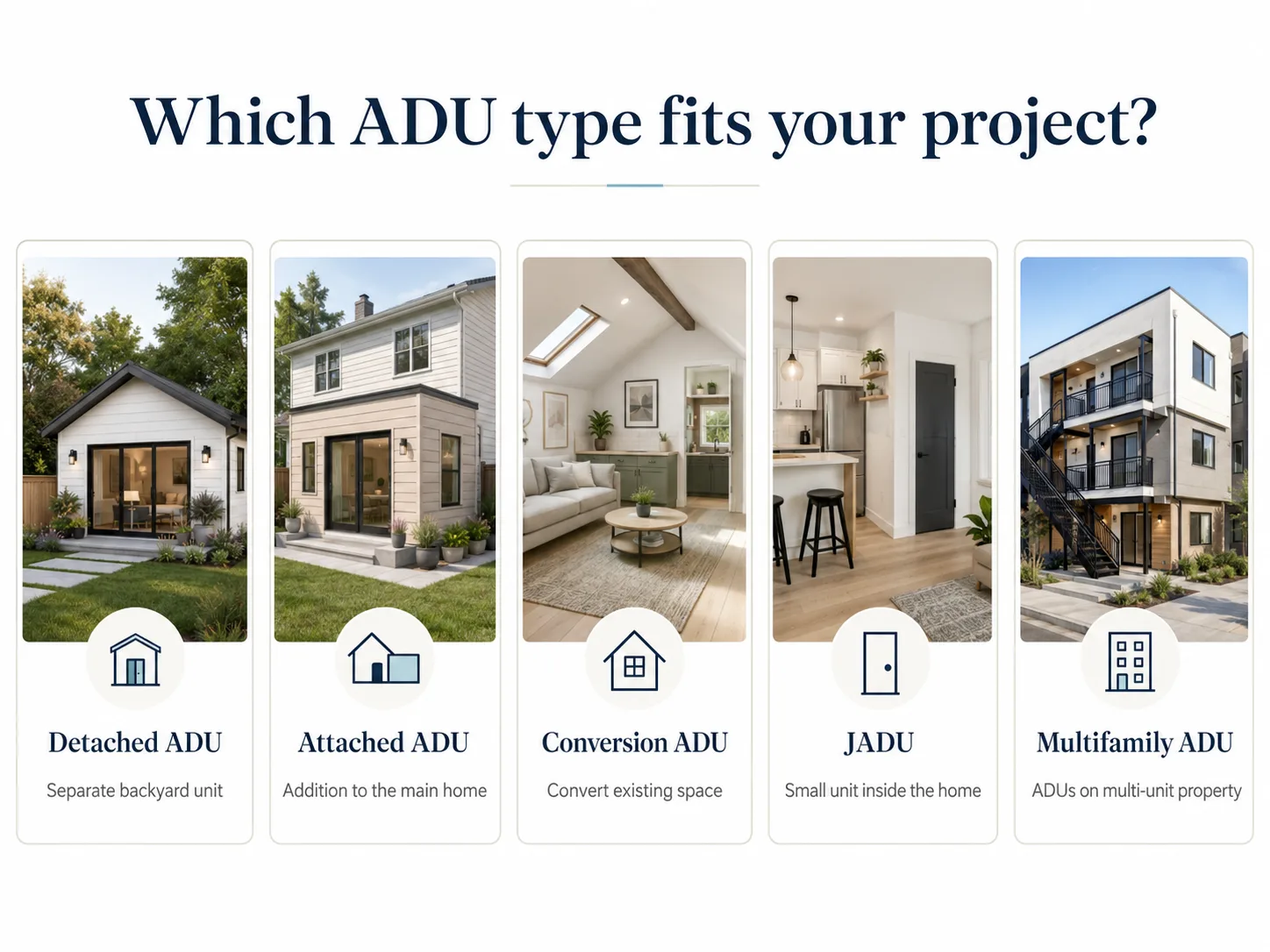
Which ADU type fits your Oceanside lot? Use this comparison to identify your best path.
| ADU type | Max size | Setbacks | Key notes |
|---|---|---|---|
| Detached new construction | 1,200 sq ft (local lane); 800 sq ft (state-protected lane) | 4-ft side/rear (≤850 sq ft studio/1BR or ≤1,000 sq ft 2BR+); zone standard above those thresholds | Most common type; solar required for new detached ADUs |
| Attached (addition to primary) | 1,200 sq ft or 50% of primary, whichever is less | Underlying zone standards apply | Must be architecturally compatible (objective standards only) |
| Garage / space conversion | Existing space; up to 150 sq ft expansion | No setback requirement for existing footprint | No replacement parking required (SB 1211 + local ordinance) |
| Junior ADU (JADU) | 500 sq ft | Within primary residence walls | Efficiency kitchen required; deed restriction required; STR prohibited; owner-occupancy required only if shares sanitation with primary (AB 1154) |
Key Oceanside ADU rules: size, setbacks, parking, and more
Size limits
Oceanside’s local ordinance allows detached ADUs up to 1,200 sq ft. Under the statewide-exemption pathway (Gov. Code § 66323), the size floor is 800 sq ft — the City cannot use its local size limit to block an 800 sq ft ADU. ADUs larger than 850 sq ft (studio/1BR) or 1,000 sq ft (2BR+) must comply with the underlying zone’s standard setbacks and height rules rather than the reduced 4-ft pathway.
Under SB 543 (effective January 1, 2026), all ADU and JADU size limits now refer to interior livable space — garages and mechanical spaces do not count toward the cap.
Setbacks
ADUs using the state-protected lane (≤800 sq ft) must be permitted with minimum 4-ft side and rear setbacks. HCD’s May 2025 findings specifically flagged Oceanside’s front-yard setback rule as non-compliant with § 66321(b)(3): if the front setback would prevent an 800 sq ft ADU, the City cannot apply it. Height in transit-proximate areas (within one-half mile walking distance of a major transit stop or rail station) is 18 ft plus 2 ft for matching roof pitch under state law — higher than Oceanside’s local 16-ft cap that HCD also flagged.
Parking
Oceanside does not require parking for ADUs in most situations. State law (Gov. Code § 66322) exempts ADUs from parking requirements in the following situations:
- Within one-half mile walking distance of public transit.
- Within an established historic district.
- Converted from existing space of a primary residence or accessory structure, or attached to an existing or proposed primary residence.
- On-street parking permits are required but not offered to the ADU occupant.
- A car-share vehicle is located within one block of the ADU.
- Submitted concurrently with a permit for a new primary dwelling on the same lot.
- ADUs of 500 sq ft or smaller (added by AB 1154, effective January 1, 2026).
SB 1211 (effective January 2025) added that when a garage, carport, covered parking structure, or uncovered parking space is demolished or converted for ADU construction, replacement parking is not required. Oceanside’s own ordinance confirms: “Garage conversions that displace the parking for the primary dwelling shall not require replacement parking or a parking space for the ADU.”
Unit count on your lot
Under SB 543 (effective January 1, 2026) and Gov. Code § 66323, every single-family lot in California — including Oceanside — must be allowed to ministerially approve:
- One internal ADU carved from existing space in the primary home or accessory structure.
- One JADU (up to 500 sq ft of interior livable space, with up to 150 sq ft of expansion for access).
- One detached new-construction ADU up to 800 sq ft under the state-protected lane — with 4-ft side and rear setbacks.
HCD’s May 2025 findings specifically flagged that Oceanside’s local ordinance incorrectly limits single-family lots to “one ADU or JADU” — state law requires the combination above. HCD also flagged that Oceanside’s ordinance caps multifamily lots at 2 detached ADUs; state law allows up to 8 detached ADUs (capped at the number of existing units on the lot) under SB 1211.
Owner-occupancy
For a standard ADU: owner-occupancy is not required anywhere in California, including Oceanside. AB 976 (effective January 1, 2024) made this permanent.
For a JADU: under AB 1154 (effective January 1, 2026), owner-occupancy is required only if the JADU shares sanitation facilities with the primary residence. If the JADU has its own independent bathroom, owner-occupancy is not required.
Short-term rental rules
ADUs and JADUs in Oceanside cannot be used as short-term rentals (less than 30 days). The City’s STR ordinance prohibits short-term rental of any ADU, JADU, or primary residence on properties with an ADU or JADU permitted on or after September 9, 2017. Under AB 1154, JADUs statewide carry a 30-day minimum rental term regardless of local rule. Long-term rentals (over 30 days) are allowed.
Oceanside ADU permit document checklist
An Oceanside ADU permit submittal package includes at minimum a completed Building Permit Application, a site/plot plan, full architectural drawings, structural calculations, Title 24 energy compliance documentation, and the appropriate recorded covenant form for your unit type — all submitted electronically through eTRAKiT.
| Document | Required for most? | Notes |
|---|---|---|
| Building Permit Application | Yes | Submitted electronically via eTRAKiT or the online form. |
| Site/plot plan | Yes | Show all structures, setbacks, lot lines, access, parking. Minimum plot plan checklist available from the City. |
| Architectural drawings | Yes | Floor plans, elevations, sections. Must show all building-code compliance. |
| Structural calculations | Most | Required for new detached, additions, second-story, and unusual foundations. Two copies. |
| Title 24 energy documentation | Most | Newly constructed detached ADUs are generally subject to California Energy Code solar requirements. |
| Truss calculations | If applicable | When pre-engineered roof or floor trusses are used. |
| Soils report | Case-by-case | More likely in the coastal zone with expansive soils. |
| Fire details | Sometimes | Required if ADU is within 5–10 feet of primary; sprinklers may be required if the primary requires them. |
| Water/sewer utility plan | Often | Especially for detached units or anywhere a meter upsize is plausible. |
| ADU or JADU covenant (recorded deed restriction) | Yes for JADU; depends for ADU combos | Forms on the City's ADU page: ADU 2020, JADU 2020, JADU-ADU Combo 2020, Multi-family ADU 2020. |
| Coastal mailing list | If in Appeal Jurisdiction | List of surrounding owners; required before the permit issues. |
| HOA / CC&R confirmation | If applicable | Under AB 130, HOA 'reasonable restrictions' cannot include fees or financial requirements (Civil Code § 714.3). |
What changed in 2026 — and why your rights may exceed the local ordinance text
Five California ADU laws passed in 2025 took effect on or before January 1, 2026: AB 1154, SB 9 (2025), SB 543, AB 462, and AB 130 — together they expand homeowner rights, tighten city compliance, and create automatic state-law fallbacks when a local ordinance falls out of compliance.
Separately, on May 20, 2025, HCD sent the City of Oceanside formal findings identifying eleven specific provisions of the 2022 Oceanside ADU ordinance (Ordinance No. 22-OR0114-1) that fail to comply with state law. Under SB 9 (2025), a city has 30 days to respond to such findings; failure to respond renders the ordinance null and void as a matter of law. Where city language conflicts with state law, state law controls.
Ordinance status note: A public notice indicates the City of Oceanside moved to adopt amended ADU regulations (Ordinance No. 26-OR0104-1) during early 2026, with the Local Coastal Program portion subject to California Coastal Commission certification of LCPA25-00002. The City’s published ADU page still references the February 2022 ordinance text at our verification date. Verify the operative ordinance with the City Clerk or the current Oceanside Municipal Code before relying on any local-ordinance text, especially for Coastal Zone parcels.
The 11 HCD findings on Oceanside’s 2022 ordinance — decoded
| HCD finding (May 20, 2025) | What it means for your project |
|---|---|
| 1. Outdated statutory references (city ordinance still cites repealed Gov. Code §§ 65852.2, 65852.22, 65852.26) | The live statute is at Gov. Code §§ 66310–66342. |
| 2. JADU owner-occupancy required by city, but state law has exceptions; AB 1154 now removes owner-occupancy for JADUs with independent sanitation | If your JADU has its own bathroom, the city's blanket owner-occupancy rule does not apply. |
| 3. City limits SFD lots to 'one ADU or JADU' — state law permits the § 66323 combination, now codified by SB 543 | You may be entitled to one detached ADU + one JADU + one converted ADU on a single-family lot. |
| 4. Multifamily lots capped at 2 detached ADUs in city ordinance; state allows up to 8 detached (capped at existing unit count) | Multifamily owners can build significantly more ADUs than the city's ordinance suggests. |
| 5. City ordinance says it will 'act on' applications in 60 days; state law requires 'approve or deny' | A non-action response is not the same as a denial and does not satisfy the statute. |
| 6. City 16-ft height cap is more restrictive than state-allowed heights in certain transit-proximate cases | Within one-half mile of a major transit stop or rail station, the state-allowed height is 18 ft plus 2 ft for matching roof pitch. |
| 7. City requires front-yard setback for all ADUs; state law (§ 66321(b)(3)) precludes front setbacks if they would prevent an 800 sq ft statewide-exemption ADU | Your 800 sq ft exemption ADU cannot be blocked by the city's front-setback rule. |
| 8. City applies lot-coverage maximums to ADUs that exceed 850/1,000 sq ft or 16 ft height; state law precludes design standards on § 66323 ADUs | If your ADU qualifies under § 66323, the city's lot-coverage rule cannot be applied. |
| 9. City off-street parking placement restrictions are tighter than state law allows without specific findings | The city can only restrict parking placement by making specific topographical, fire, or life-safety findings. |
| 10. City does not include the parking exemption for an ADU permit submitted with a primary-dwelling permit under § 66322(a)(6) | If you submit an ADU permit concurrently with a primary dwelling permit, you are exempt from ADU parking. |
| 11. City 'architecturally compatible' design rule is subjective; state law requires objective standards | The city cannot deny based on subjective 'architectural compatibility' — only on objective, pre-published criteria. |
Most Oceanside ADU permits are approved without any conflict, and the city’s planners have been broadly cooperative. But if a planner applies a rule from the local ordinance that HCD has formally flagged as non-compliant, you have documented basis to push back, and you can file a complaint at hcd.ca.gov. We are not your lawyer — if you’re in an active permit dispute, consult a California land-use attorney who handles ADU cases.
Does Oceanside have pre-approved ADU plans?
The City of Oceanside has formally adopted an AB 1332 pre-approved ADU program, with a public program page and an application pathway for designers to submit plans for pre-review. As of our verification date, no vendors have submitted plans to the City’s library — the pre-approved ADU library is empty.
The City’s program page states: “Currently, no vendors have submitted an application for review of a pre-approved ADU plan. Check back at a later time for updates to the Pre-Approved ADU Library.”
Once vendors submit plans and the library opens, AB 1332 requires the City to approve pre-reviewed ADU plan submittals within 30 days — materially compressing the typical plan-check timeline.
The next best alternative is working with a design-build firm that has a library of plans they’ve already permitted in Oceanside multiple times. Those aren’t technically “pre-approved” under AB 1332, but they typically clear plan check in two rounds rather than three to five, because the City planners recognize the plan set.
Can you rent your Oceanside ADU after the permit is final?
ADUs and JADUs in Oceanside can be rented for terms longer than 30 days, but short-term rentals (under 30 days) are prohibited on properties with an ADU or JADU permitted on or after September 9, 2017. The City’s STR ordinance prohibits use of the ADU, the JADU, or the primary residence as a short-term rental on such properties. Under AB 1154, JADUs statewide are now also subject to a 30-day minimum rental term.
This is a meaningful constraint for investors. A detached ADU in Oceanside cannot be operated on Airbnb, Vrbo, or similar platforms — it must be rented under a lease longer than 30 days.
Long-term rental options
- Standard 12-month residential leases.
- Furnished mid-term rentals targeting traveling nurses, military families on PCS, relocating families, and remote-working professionals on multi-month stays.
- Long-term lease to a family member.
- Owner-use as a guest house or aging-in-place unit (no rental at all).
- Sell separately under AB 1033 — not yet available in the City of Oceanside as of our verification date (unincorporated San Diego County adopted AB 1033 effective April 4, 2026; the City of Oceanside has not yet opted in).
For investor-grade rent benchmarks: SnapADU’s Oceanside service page (sourced from Rentometer, March 2026) shows median ADU-comparable rents in Oceanside zip codes ranging roughly $2,050–$4,020 for 1-, 2-, and 3-bedroom units depending on neighborhood and unit size. These are illustrative examples, not guarantees of returns. Actual results depend on local market conditions, construction costs, financing terms, and regulatory approvals.
What happens after your Oceanside ADU permit is issued?
Once the building permit issues, Oceanside ADU construction proceeds through a standard inspection sequence scheduled through eTRAKiT or the City’s Web Inspection Scheduling page. Inspections scheduled before 3:30 PM on a business day are performed the following business day.
Typical inspection sequence
- 1Setbacks and form-board (building verification survey). Before pouring concrete — the surveyor verifies the foundation forms sit inside the approved setbacks.
- 2Foundation. Footings and slab.
- 3Underground utilities. Water, sewer, gas, electrical service.
- 4Framing. Walls, roof, openings.
- 5Rough mechanical, electrical, plumbing. Inside walls before insulation.
- 6Insulation. All insulation installed and accessible.
- 7Drywall. Board in place before taping.
- 8Final. All trades complete, utilities energized, recorded final approval on the permit.
Owner-builder, designer, or design-build: which path fits
For most Oceanside ADU homeowners, the right path is a design-build firm that owns a library of plans they’ve already permitted in Oceanside multiple times — because the time savings on plan-check correction cycles typically outweigh the cost of buying a custom design. Owner-builder is viable for experienced homeowners doing simple conversions. Designer-architect plus general contractor is the right call for complex lots or fully custom aesthetics.
| Path | Best for | Trade-off | Typical plan-check cycles |
|---|---|---|---|
| Owner-builder | Simple conversion, experienced homeowner with time | You own all coordination and correction risk | Variable; often more cycles than professional submittals |
| Designer/architect + general contractor | Custom project, complex lot, specific aesthetics | Coordination gaps between design and build | 2–3 rounds typical |
| Design-build firm with reused plan set | Standard backyard ADU, common configurations | Less DIY control; compare contract terms carefully | Often 1–2 rounds |
| Pre-approved AB 1332 plan (when available) | Future option once Oceanside library populates | Limited customization | Single 30-day review per AB 1332 |
Disclosure: The Dwelling Index is reader-supported. When you use our links to engage a design-build firm, we may earn a commission at no extra cost to you. Our editorial recommendations are based on independent research and are never influenced by compensation.
Want a Greater San Diego ADU design-build team that’s done 100+ ADUs across San Diego County and currently serves Oceanside? See SnapADU’s process and floor plans.
For Greater San Diego — including Oceanside, Carlsbad, Encinitas, Del Mar, Solana Beach, Vista, San Marcos, and unincorporated San Diego County — one of the most established locally-experienced design-build firms is SnapADU. SnapADU has documented 100+ completed ADU projects across Greater San Diego / San Diego County and was originally based in Oceanside, with current ongoing service-area work in the city. They publish their service-area details, plan library, and pricing transparently.
Get a Free Oceanside ADU Estimate from SnapADU →Affiliate link — we may earn a commission at no cost to you. See our disclosure.
Not sure which path fits? Run your address through our feasibility tool.
Run Your Free Oceanside ADU Feasibility Report →How to pay for an Oceanside ADU
The financing path matters because of how it affects your construction timeline and your contractor’s draw schedule. Short version of the 2026 landscape:
- HELOC (Home Equity Line of Credit). A revolving line secured against your home equity. Works well for ADU construction because draws happen as costs come due.
- Cash-out refinance. Convert your existing mortgage into a larger loan and take the difference in cash. Works best when current rates are competitive with your existing rate.
- Construction loan. A short-term loan that converts to a permanent mortgage once construction completes. Lender disburses in draws against milestones — which is why your permit timeline matters.
- Renovation HELOC (RenoFi-style products). Loan based on after-renovation value rather than current equity. Useful when current equity is thin.
- HEI (Home Equity Investment). A lump-sum payout in exchange for a percentage of future home value. No monthly payment.
- CalHFA ADU Grant. The CalHFA ADU Grant Program closed to new applications when the program was fully allocated on December 28, 2023. CalHFA’s published guidance specifically warns that anyone claiming to grant access to CalHFA’s ADU funds is operating a scam.
For broad mortgage and construction-loan options matched to your state and situation, see our ADU financing page for active lenders and the questions to ask before signing anything.
What we verified for this Oceanside ADU permit guide
Source categories verified for this page (as of May 13, 2026):
- City of Oceanside ADU page — Article 30 Section 3006 references, key provisions, 60-day review, fee assessment categories, parking exemptions, multifamily provisions, STR rules.
- City of Oceanside Plan Check page — 14-day ADU initial review target, 7-day resubmittal target, electronic-only submittal effective Jan 2, 2025, plan review expiration of 2 years.
- City of Oceanside Pre-Approved ADU Program page — Library status (no vendors submitted as of verification date), AB 1332 process, 30-day approval window for pre-reviewed plans.
- City of Oceanside Web Inspection Scheduling page — same-business-day cutoff at 3:30 p.m., estimated time of arrival window.
- City of Oceanside ADU Fee Schedule (Effective 9/1/2019) — Building Plan Check, Building Inspection, Planning Plan Check, Water Plan Check, Surcharges, school fees, SMIP, Green Tax, plan imaging, permit imaging.
- Public eTRAKiT permit records — sample BLDG25-0230, BLDG25-1441, BLDG25-1325, BLDG24-2081, BLDG23-1281, WTR20-0079.
- HCD findings letter to City of Oceanside dated May 20, 2025 — Eleven specific provisions of Oceanside ADU Ordinance No. 22-OR0114-1 flagged as non-compliant with state law.
- HCD March 2026 ADU Handbook — School fee 500 sq ft threshold, impact fee 750 sq ft threshold, solar requirements, HOA reasonable-restrictions definition, 2025 legislation set.
- California Government Code §§ 66310–66342 — particularly §§ 66314, 66317, 66321, 66322, 66323, 66326, 66329, 66333.
- 2025 California ADU legislation set: AB 1154 (Chapter 507), SB 9 (Chapter 510), SB 543 (Chapter 520), AB 462 (Chapter 491), AB 130 (Chapter 22), AB 976 (effective January 1, 2024), SB 1211 (effective January 1, 2025), AB 1332 (effective January 1, 2024).
Items still pending direct city verification at our publish date include: whether the City has formally codified Ordinance No. 26-OR0104-1; the current ADU fee schedule beyond the September 1, 2019 version; and whether the City opts into AB 1033. This page is editorial reference content from Dwelling Index, an independent research resource. We are not your lawyer, not your contractor, and not affiliated with the City of Oceanside. We re-verify this page quarterly.
Oceanside ADU permit FAQ
How long does an Oceanside ADU permit really take?
Most Oceanside ADU permits take 2–4 months of total elapsed time from first submittal to permit-in-hand, even though the statutory review window is 60 days. The City's published target for initial ADU plan review is 14 calendar days, with 7 calendar days for resubmittals. The 60-day clock pauses every time the City returns plan-check comments.
How much does an Oceanside ADU permit cost?
Sample public records on the City's eTRAKiT portal show recent detached ADU permit-fee totals around $6,879–$7,741 and attached or addition examples around $3,384–$3,859. Add school district fees ($3.48 per sq ft for ADUs larger than 500 sq ft), state SMIP, state Green Tax, and possible water-meter upsize fees. Construction is separate.
Do garage conversions need replacement parking in Oceanside?
No. Oceanside's ADU ordinance is explicit: 'Garage conversions that displace the parking for the primary dwelling shall not require replacement parking or a parking space for the ADU.' SB 1211 (effective January 2025) added the state-law protection that no replacement parking is required when any garage, carport, or covered parking is demolished or converted for ADU construction.
Can I build a 1,200 sq ft detached ADU in Oceanside?
Yes — Oceanside's local ordinance allows detached ADUs up to 1,200 sq ft, but ADUs larger than 850 sq ft (studio/1BR) or 1,000 sq ft (2BR+) must comply with the underlying zone's standard height, lot coverage, and setbacks. The 1,200 sq ft size lane and the 4-ft setback lane are not stackable.
Does Oceanside have pre-approved ADU plans?
Oceanside has an AB 1332 program page live, but the City states: 'Currently, no vendors have submitted an application for review of a pre-approved ADU plan.' The pre-approved library is empty as of our verification date. When vendors do submit plans, AB 1332 requires the City to approve a pre-reviewed plan submittal within 30 days.
Can I Airbnb my Oceanside ADU?
No. ADUs and JADUs in Oceanside cannot be used as short-term rentals (under 30 days). The City's STR ordinance bars short-term rental of any ADU, JADU, or primary residence on properties with an ADU or JADU permitted on or after September 9, 2017. Long-term rentals (over 30 days) are allowed.
Do I have to live on the property to build an ADU in Oceanside?
For a standard ADU: no. AB 976 (effective January 1, 2024) permanently removed the owner-occupancy requirement for standard ADUs. For a JADU: under AB 1154 (effective January 1, 2026), owner-occupancy is required only if the JADU shares sanitation facilities with the primary residence. JADUs with independent bathrooms have no owner-occupancy requirement.
Do newly built detached ADUs need solar?
Generally yes, under the California Energy Code. The HCD March 2026 ADU Handbook states that newly constructed detached ADUs are generally subject to California Energy Code solar requirements, with specific exceptions. Conversions and additions are treated differently. Verify your specific scope with the City and a Title 24 energy consultant before design.
Can my HOA stop my Oceanside ADU?
In a single-family-zoned district, generally no. Civil Code § 714.3 prevents HOAs from enforcing covenants that effectively prohibit or unreasonably restrict ADUs. Under AB 130 (effective June 30, 2025), 'reasonable restrictions' cannot include any fees or financial requirements. If your HOA is blocking outright or charging ADU-specific review fees, you have grounds to push back, including filing an HCD complaint.
Do I need a Coastal Development Permit for my Oceanside ADU?
Only if your lot is in the Coastal Appeal Jurisdiction. The Coastal Zone covers property from the inland side of Coast Highway to the Pacific and areas adjacent to the San Luis Rey River, Loma Alta Creek, and Buena Vista Lagoon — Appeal Jurisdiction status varies parcel-by-parcel. If a CDP is required, AB 462 (effective October 10, 2025) requires the city to approve or deny within 60 days, processed concurrently with the ADU permit, with no public hearing and no Coastal Commission appeal.
Does Oceanside require a soils report?
Case-by-case. Per documented correspondence with the City's geotechnical consultant (December 2023, via SnapADU), the City may not require a soils report along the coastal zone if foundations are designed for 18-inch-deep footings and a 5-inch slab. Budget $3,000–$8,000 if your designer flags it.
Where do I submit my Oceanside ADU permit application?
Through the eTRAKiT portal (crw.cityofoceanside.com/etrakit3/) or the City's electronic Building Permit Application form. Paper plans have not been accepted since January 2, 2025. Building Division phone: (760) 435-3950. Planning Division phone: (760) 435-3520.
Not sure where to start?
See what’s possible at your address — get your free ADU report in 60 seconds. Independent feasibility tool. No commitment, no spam. Detailed reports available in CA, UT, TX, CO, and NY.
Get Your Free Oceanside ADU Report →