New American Funding ADU Loan Review: Is NAF a Real ADU Loan — and the Right Fit for You?
By The Dwelling Index Editorial Team · · Last verified: May 25, 2026
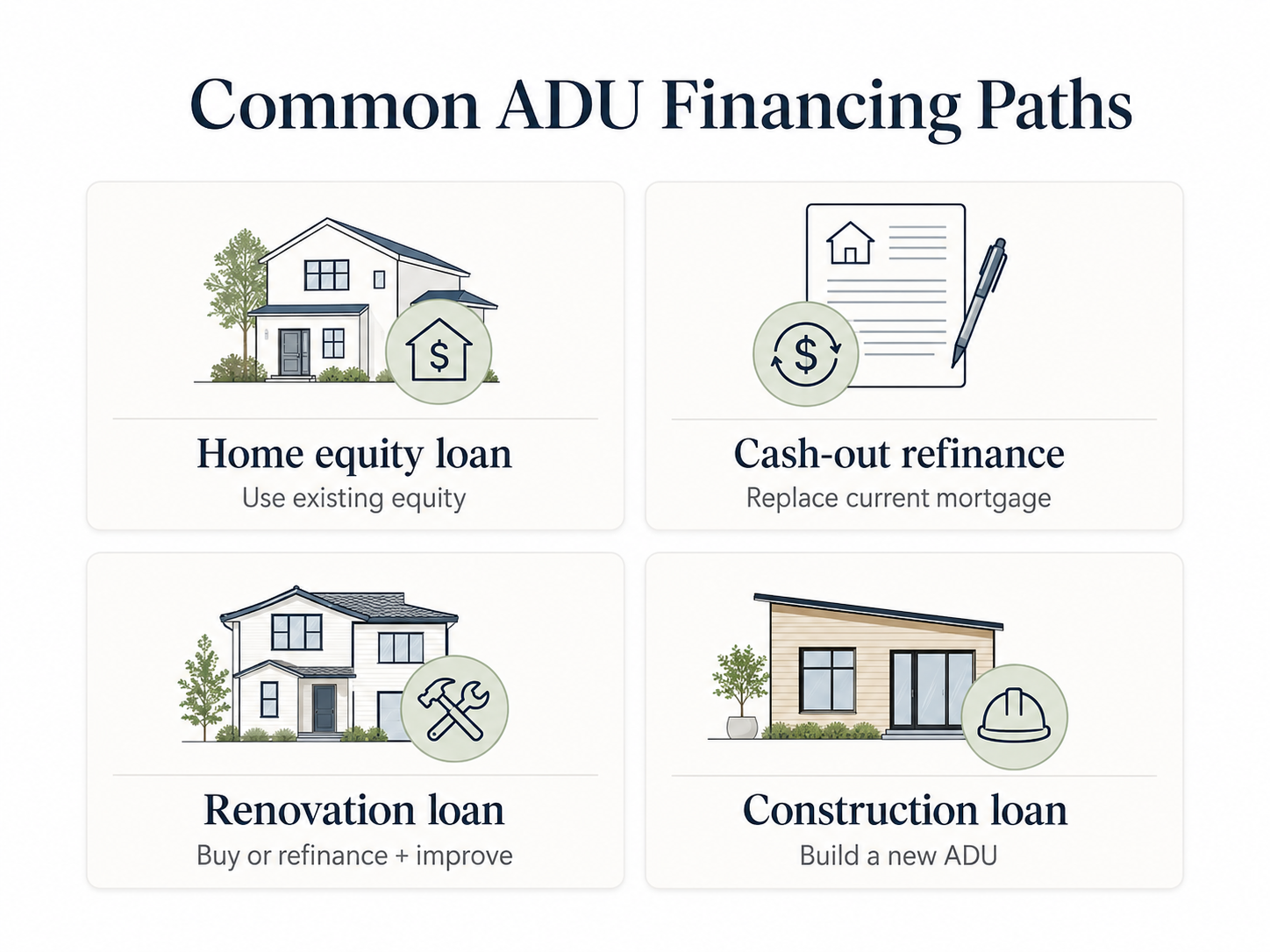
Bottom line up front: Yes — New American Funding (NAF) offers ADU financing, but “ADU loan” is an umbrella term, not one standardized product. On NAF’s public ADU page, it points you toward one of four financing lanes: a construction loan, a home-equity loan (structured as a HELOC), a renovation loan (such as FHA 203(k)), or a cash-out refinance. Those are the four NAF lists by name. NAF is licensed in all 50 states + D.C. + Puerto Rico (NMLS #6606), which is genuinely useful — but its fees run above peer averages and it publishes no ADU-specific rate sheet. The smart move is to confirm your property’s feasibility first, identify your lane, then compare NAF’s written quote against at least one other lender.

Disclosure: The Dwelling Index is reader-supported. When you use our links to explore financing options, request prefab pricing, or purchase floor plans, we may earn a commission at no extra cost to you. Our editorial recommendations are based on independent research and are never influenced by compensation. As of May 25, 2026, this review is editorial only — we earn nothing from New American Funding. Every NAF mention on this page is independent, not sponsored.
New American Funding ADU loan — quick verdict
| Quick verdict | Best fit | Be careful if… |
|---|---|---|
| Worth comparing — not blindly choosing | You have equity, documented income, a permit-feasible ADU plan, and want one lender to quote several lanes side by side | You need future ADU rent to qualify, or your DTI is already tight |
| Legitimate national lender, deep loan menu | You want one point of contact for HELOC, renovation, construction, and refinance options | Your equity is thin or you'd refinance out of a favorable existing rate |
| Fees run above peer averages | You're ready to compare a written Loan Estimate vs. at least one other lender | You accept the first quote without comparing APR and total costs line by line |
| "ADU loan" is a routing label, not a product | You've identified your likely lane before calling (HELOC, 203(k), construction, cash-out) | You need a prefab/manufactured or short-term-rental edge case resolved |
| Licensed in all 50 states + D.C. + Puerto Rico | Your ADU is legal, permit-feasible, and you're ready to apply | Your city permits slowly or your contractor can't meet lender draw requirements |
Editorial conclusion based on verified facts in this review — not a guarantee of approval, rate, or outcome. Sources: NAF ADU Loan page; Bankrate NAF review; FFIEC 2024 data via LendingTree. Verified May 2026.
Free property check
Before you compare any lender — find out what your lot can actually build
Financing can’t fix a property that won’t pass zoning — and most stalled ADU projects die on feasibility, not money. Knowing your buildable square footage and rough cost tells you which financing lane to test first. Free, takes about 60 seconds.
See what I can build — free ADU report →Is New American Funding’s ADU loan actually a separate product?
No — not based on NAF’s own page. On its public ADU page, New American Funding presents the “ADU loan” as an entry point to finance adding or converting space, then lists four possible loan types underneath it: construction loans, home-equity loans, renovation loans, and cash-out refinances. Treat “NAF ADU loan” as a branded label until a loan officer names the exact product, terms, fees, and underwriting rules.
Here’s what most reviews won’t tell you: on NAF’s public page, “ADU loan” isn’t one standardized product — it points to existing financing lanes you’d qualify for anyway. That’s not a knock unique to NAF. It’s common across lenders, because an ADU is really just a construction or renovation project attached to a home you may or may not own outright.
What matters, then, isn’t the label on the button. It’s the structure of the loan underneath it — the rate type, the equity requirement, the appraisal basis, the draw rules, and whether your rental income counts. Two homeowners clicking the same “ADU loan” link at NAF can land in completely different products with completely different costs.
The plain-English translation
A quick decoder, since these terms get used interchangeably:
| What NAF lists | What you’re actually getting | Plain-English definition |
|---|---|---|
| Construction loan | A short-term loan that funds the build in stages, then converts to a permanent mortgage | A one-time-close (OTC) construction loan combines the build loan and the final mortgage into a single closing. Funds release in draws — scheduled payments to your builder as work hits milestones. |
| Home-equity loan | A loan against equity you already have. In practice, NAF's product is a HELOC | A HELOC (Home Equity Line of Credit) is a revolving credit line — borrow, repay, re-borrow up to a limit, usually at a variable rate. Bankrate reports NAF offers a HELOC rather than a fixed home-equity loan, so ask which structure you're being quoted. |
| Renovation loan | A loan that bundles your purchase or refinance with the ADU build cost | Includes FHA 203(k) (government-backed), Fannie Mae HomeStyle, and Freddie Mac CHOICERenovation. These finance against the as-completed value — what the home will be worth after the ADU is built. |
| Cash-out refinance | A new, larger first mortgage that hands you the difference in cash | You replace your existing mortgage entirely. Best when your current rate isn't great; expensive when it is. |
Source: NAF ADU Loan page; Bankrate NAF home-equity review. Verified May 2026.
The New American Funding ADU Loan Reality Matrix
This is the proprietary asset of this review: a single table that maps NAF’s “ADU loan” umbrella to the real product you’d likely be quoted, what publicly supports it, the main friction point, and the exact question to ask. We assembled it from five separate NAF product pages plus HUD, Fannie Mae, and Freddie Mac ADU guidance — the work that would otherwise take five-plus open tabs and a spreadsheet.
| Your situation | Likely NAF lane to ask about | Main friction point | The exact question to ask NAF |
|---|---|---|---|
| Strong equity, want to keep your first mortgage | Home-equity lane (NAF offers a HELOC) | Variable rate after the initial draw; 4.99% origination fee; not offered in HI or NY; LTV caps may not cover full ADU cost | "Is this a HELOC or a fixed second mortgage, what's the origination fee, and what are the draw and advance limits?" |
| Willing to replace your first mortgage | Cash-out refinance | Replacing a low existing rate can cost more over the life of the loan than the ADU returns; FFIEC data shows NAF refi fees run above peer averages | "Show me the no-point and the point-buydown versions, and compare total lifetime cost vs. a second mortgage." |
| Buying or refinancing and adding the ADU | Renovation lane — FHA 203(k), HomeStyle, or CHOICERenovation | Contractor approval, required consultant on Standard 203(k), escrow, inspections, eligible-improvement rules | "Is my ADU scope eligible, and is the loan based on current value or as-completed value?" |
| New detached ADU, ground-up build | Construction / one-time-close construction loan | More documentation, builder controls, draw management, stricter process | "Can this finance a detached ADU, and what contractor, draw, and inspection rules apply?" |
| You need ADU rent to qualify | Product-specific (FHA/GSE rules apply) | Future rent isn't always usable; FHA bans it on cash-out refis; Fannie's 2025 rule applies to an existing ADU; short-term rent may not count | "Will you count ADU rental income, under which agency rule, at what percentage — and do you add a stricter overlay?" |
| Prefab / modular ADU | Depends: construction, renovation, or manufactured-home treatment | Factory-built units can trigger product-specific eligibility issues | "Is this prefab/modular ADU eligible under the exact program you're quoting me?" |
Matrix assembled and verified by Dwelling Index, May 25, 2026, from NAF’s ADU, HELOC, cash-out, and one-time-close construction pages; Bankrate’s NAF review; HUD ML 2023-17; Fannie Mae SEL-2025-08; and Freddie Mac Single-Family ADU guidance. “Likely lane” is editorial guidance, not a guarantee of what any lender will offer you.
Who is New American Funding’s ADU loan most likely to fit?
New American Funding fits borrowers who already look like mainstream mortgage applicants: documented income, decent credit, manageable DTI, real equity (or a viable construction structure), and an ADU that’s legal and permit-feasible. It’s a poorer fit for borrowers with thin equity, high DTI, investor-only plans, short-term-rental income assumptions, or prefab/manufactured edge cases.
NAF’s strength is breadth. NerdWallet’s 2026 review confirms NAF carries a large menu — conventional, FHA, VA, USDA, jumbo, interest-only, non-QM, reverse, construction, FHA 203(k), HELOC, and cash-out refinance — and singles it out for customer service. For a homeowner who wants one point of contact to compare a HELOC against a cash-out refi against a renovation loan, that breadth has real value, and it shows up in NAF’s above-average 2025 J.D. Power servicing score (626 vs. a 596 average).
You may be a stronger fit if…
- ✓You have meaningful equity — home-equity and cash-out lanes live or die on LTV.
- ✓Your DTI works without aggressive future-rent assumptions.
- ✓Your ADU has a clear budget and scope — renovation and construction lanes require documentation.
- ✓Your city allows your ADU type — financing doesn't solve zoning.
- ✓You're ready to compare no-point vs. point-based quotes on paper.
NAF is a weaker fit if…
- ✕You're banking on short-term-rental income that may not be counted.
- ✕Your DTI is already tight.
- ✕Your equity is thin.
- ✕You want a prefab/manufactured ADU with uncertain eligibility.
- ✕Your use case is investment-only (not owner-occupied).
- ✕Your city permits slowly or your contractor can't meet draw requirements.
A damaging admission — because you deserve the honest version
NAF doesn’t publish an ADU-specific rate sheet or fee schedule, and its fees run above its peers. Federal FFIEC data for 2024 shows NAF borrowers paid an average of $8,833 in total loan costs and $4,321 in origination fees — versus peer averages of $7,141 and $3,349. NerdWallet flags the same thing: average origination fees “on the high side.” And its HELOC carries a 4.99% origination fee. That doesn’t make NAF a bad choice — it makes it a lender you must negotiate and compare, not accept at face value.
What are New American Funding ADU loan requirements?
New American Funding’s ADU page lists general guideposts: a minimum credit score around 620+, a debt-to-income (DTI) ratio of 43% or less, and usually 15–20% home equity. These are public signals, not approval guarantees, and the real bar shifts depending on which of the four lanes you’re routed into.
DTI — your total monthly debt payments divided by gross monthly income — quietly sinks the most ADU applications, because a large new loan payment pushes that ratio up fast. Equity matters because home-equity and cash-out lanes are constrained by LTV (how much you owe versus what the home is worth). Credit determines not just approval but pricing.
Requirements by lane
| Requirement | Public NAF ADU signal | Product-specific reality |
|---|---|---|
| Credit score | Generally 620+ | NAF's ADU page notes Fannie Mae began accepting some sub-620 scores (in full-profile context) as of Nov 2025; NerdWallet notes NAF accepts scores as low as 500–580 on some FHA products; jumbo/portfolio can run higher. |
| DTI | Around 43% or less | Some products allow higher DTI with compensating factors (reserves, strong credit). |
| Equity / LTV | Usually 15–20% | HELOC and cash-out lanes depend heavily on LTV; construction loans lean on as-completed value instead. |
| Appraisal | Required in most scenarios | ADU value may hinge on as-is vs. as-completed appraisal — a critical difference for new builds. |
| ADU legality | Must be a functional, legally supportable unit with its own entrance, kitchen, sleeping area, and bathroom | NAF's ADU page specifies these features; local zoning and building approval still govern. Financing follows the permit. |
What these numbers do not mean
- —They do not mean every 620-credit borrower qualifies.
- —They do not mean every ADU type qualifies.
- —They do not mean all (or any) of your future rent can be used.
- —They do not mean the advertised rate is your final APR.
Source: NAF ADU Loan page. Verified May 2026.
Can New American Funding count ADU rental income to help you qualify?
Sometimes — but it’s heavily restricted, and the restrictions are where borrowers get burned. FHA (Mortgagee Letter 2023-17) allows ADU rental income capped at 30% of effective income but bans it entirely on cash-out refinances. Fannie Mae’s 2025 update (SEL-2025-08) is narrower: it applies to rental income from an existing ADU on a one-unit principal residence, capped at 30% of qualifying income, for purchase and limited cash-out refinance only.
This is the single most misunderstood part of ADU financing, and most competing reviews don’t mention it at all. The FHA and Fannie Mae rules are genuinely different, so don’t blend them.
The FHA rule (HUD Mortgagee Letter 2023-17, effective Oct 16, 2023)
FHA defines an ADU as “a single habitable living unit with means of separate ingress and egress.” Under ML 2023-17:
- ✓You can use actual or projected ADU rental income toward your FHA qualifying income.
- ✓For an existing ADU with no rental history, the lender uses 75% of the lesser of the appraiser's market rent (Form 1007/1000) or the lease amount.
- ✓ADU rental income cannot exceed 30% of your total monthly effective income.
- ✓Two months of PITI reserves (principal, interest, taxes, insurance) are required.
- ✓For a new ADU you're building, you may use 50% of projected rent — and the ADU must be built via the FHA Standard 203(k) program.
- ✓Critical exception: ADU rental income is ineligible for cash-out refinance transactions.
Source: HUD ML 2023-17, verified against the primary HUD document, May 25, 2026.
The conventional rule (Fannie Mae SEL-2025-08, Oct 8, 2025 — new in 2025)
This is the freshest development in ADU financing, and it’s why a 2026 review matters — but read the scope carefully:
- ✓Fannie Mae now allows rental income from an existing ADU to count toward conventional qualifying income on a one-unit principal residence with one ADU (attached, detached, or part of a manufactured home).
- ✓The amount used is capped at 30% of total qualifying income.
- ✓Eligible only on purchase and limited cash-out refinance transactions.
- ✓Only one ADU's rent counts, even if multiple ADUs exist.
- ✓Lenders can apply this now via manual underwriting; Desktop Underwriter (DU) version 12.1 automates it in Q1 2026.
- ✓Do not assume projected rent from an ADU you haven't built yet will count under Fannie Mae — its rule centers on an existing ADU.
Source: Fannie Mae Selling Guide Announcement SEL-2025-08, verified May 25, 2026. Freddie Mac has separately allowed certain ADU rental income since mid-2022, subject to its Single-Family Guide and lender overlays.
The question to put to your loan officer, verbatim
“Will you count my ADU rent? If yes — under which program rule (FHA ML 2023-17 for a 203(k) build, or Fannie Mae SEL-2025-08 for an existing ADU), at what percentage, with what documentation? And does New American Funding add an overlay that’s stricter than the agency rule?”
Illustrative rental-income example (not a promise): If your total qualifying income is $7,000/month, the 30% cap means at most $2,100/month of ADU rent can count — even if the unit would rent for more. These are illustrative examples, not guarantees of returns. Actual results depend on local market conditions, construction costs, financing terms, and regulatory approvals.
The Dwelling Index is reader-supported and may earn a commission, at no extra cost to you, when you use the link below to explore financing options. We present financing lanes, never compensation-ranked lenders, and our recommendations are based on independent research. Read our full disclosure.
Compare mortgage-backed paths
You now know which lane you’re in — compare it properly
Whether your path is a HELOC, a cash-out refinance, a renovation loan, or construction financing, lining up more than one quote is how you avoid overpaying — especially given NAF’s above-average fees. Explore current mortgage and refinance financing paths through our research partner. Educational only; no obligation, and you compare your own Loan Estimates.
Explore ADU financing paths →What rates, points, and fees does New American Funding publish for ADU loans?
New American Funding does not publish an ADU-specific rate sheet. Its general mortgage-rate page shows example rates that assume discount points (2.000 points on displayed examples) and states that actual rate, APR, and payment vary by borrower and product. Independent federal data shows NAF’s fees run above peer averages.
| Fee signal | NAF (2024 FFIEC data) | Peer average | What to do |
|---|---|---|---|
| Total loan costs | $8,833 average | $7,141 | Request an itemized Loan Estimate and compare to competing lenders line by line |
| Origination fees | $4,321 average | $3,349 | Ask what's negotiable; fees can be traded against rate in many cases |
| HELOC origination fee | 4.99% of the line amount | Varies widely | Compare HELOC terms separately — no standardized Loan Estimate for HELOCs |
| Discount points | Posted rates assume 2.000 points | Varies | Always request the no-point quote alongside any point-based quote |
FFIEC 2024 data via LendingTree, Mar 31, 2026; HELOC fee per Bankrate NAF review; points per NAF’s mortgage-rates page. Verified May 2026.
How to actually compare quotes: Loan Estimate vs. HELOC disclosures
For a closed-end mortgage, refinance, renovation, or construction loan, federal rules require lenders to give you a standardized Loan Estimate within three business days of your application — use it to compare APR and total fees apples-to-apples. For a HELOC, the CFPB says the Loan Estimate and Closing Disclosure forms do not apply; you’ll get Truth-in-Lending disclosures instead, so compare the margin, draw period, repayment period, fees, and variable-rate terms.
This distinction matters because NAF can route you into either type. If you’re comparing a cash-out refinance, a 203(k), or a construction loan, the Loan Estimate is your scorecard — every lender’s looks the same, so differences jump out. If you’re comparing NAF’s HELOC, there’s no Loan Estimate; you’re comparing the 4.99% origination fee, the variable rate after the initial draw, and the draw/repayment structure against another lender’s HELOC terms.

Compare these fields, every time
| Field | Why it matters for an ADU |
|---|---|
| Loan type | Determines draw structure, lien position, rate risk, and total cost |
| APR and fees | The headline rate can hide points and closing costs |
| Loan amount | A full detached ADU often runs into six figures — beyond small personal/home-improvement loans |
| Disbursement schedule | Staged builds need money released in stages; a HELOC draw structure differs from a construction loan |
| Permit requirements | Some lenders require approved plans/permits before funding |
| Appraisal basis | Current value vs. as-completed value changes what you can borrow |
| Rental income treatment | Income from an existing ADU may or may not count toward qualifying |
| Prepayment terms | Matters if you'll refinance after the ADU is complete |
| Origination fee | NAF's HELOC origination fee is 4.99% — compare to other lenders' structures |
Framework from CFPB “What is a Loan Estimate?”, ADU-specific underwriting factors, and CFPB Loan Estimate guidance. Verified May 2026.
How NAF compares with FHA 203(k), HomeStyle, CHOICERenovation, HELOCs, and ADU-specialty financing
New American Funding can route you into most of the mainstream loan families, so the real comparison isn’t “NAF vs. competitor” — it’s “which loan structure fits my ADU.” Compare by equity requirement, appraisal basis, renovation eligibility, draw controls, rental-income treatment, contractor rules, total cost, and timeline.
| Financing lane | Strong fit | Watch out for | Cost signal* |
|---|---|---|---|
| HELOC / home-equity | Existing owners with equity who want draw flexibility | Variable rate; NAF's 4.99% origination fee; not available in HI/NY; LTV caps may not cover full ADU cost | Fee varies widely by lender |
| Cash-out refinance | Owners willing to replace the first mortgage and current rates are favorable | Costly if you have a great existing rate; resets amortization; FHA bans ADU-rent qualifying here | Commonly ~2%–6% of the new loan amount in closing costs |
| FHA 203(k) | Purchase/refi + eligible renovation; some ADU builds via Standard 203(k) | HUD rules, required consultant on Standard 203(k), escrow, completion timelines | Lower credit thresholds; mortgage insurance applies |
| Fannie Mae HomeStyle | Conventional renovation with ADU eligibility | LTV / as-completed-value rules; ADU property restrictions | Conventional pricing; single close |
| Freddie Mac CHOICERenovation | Renovation including ADU-related work | Product limits, lender overlays, documentation | Conventional pricing; single close |
| Construction / one-time-close | Ground-up detached ADU with plans and approved builder | Draws, inspections, builder approval, stricter process | Single closing avoids a second set of closing costs |
| Renovation-HELOC / ADU-specialty | Borrowers needing as-completed-value lending without replacing the first mortgage | Availability varies by lender and state | Lends against after-renovation value — check availability in your state |
*Cost signals are general market figures, not NAF quotes and not guarantees. Refinance closing costs are commonly quoted as roughly 2%–6% of the new loan amount (per published ranges from LendingTree, Freddie Mac, and Bankrate, 2026). Verify every figure for your project and market.
A real-world tradeoff homeowners get wrong
Someone with a 3% mortgage from 2021 wants a cash-out refinance at today’s rates to fund a $350K ADU. The cash is right there, so it feels obvious. But refinancing your entire balance from 3% to a current rate to access ADU funds can cost far more in added lifetime interest than the ADU returns in rent. In that situation a HELOC or a fixed second mortgage — which leaves your cheap first mortgage untouched — is often the smarter structure. This is an editorial judgment based on loan mechanics, not advice for your specific numbers. Run yours.
15 questions to ask New American Funding before you apply
Don’t ask “do you offer ADU loans?” — the answer is always yes and it tells you nothing. Ask which exact product you’re being quoted, whether your ADU scope is eligible, whether rental income counts, how the appraisal and draws work, and how the APR, points, and fees compare to a written quote from another lender.
- 1What exact loan product are you quoting me?
- 2Is this a HELOC, a fixed home-equity loan, a cash-out refinance, a renovation loan, or a construction loan?
- 3Will the loan be based on current value or as-completed value?
- 4Can this product finance a detached ADU?
- 5Can it finance a garage conversion?
- 6Can it finance a prefab or modular ADU?
- 7Are manufactured / HUD-code units eligible?
- 8Will you count ADU rental income (existing or via 203(k))?
- 9If yes — what percentage, and what documentation?
- 10Are short-term rental (Airbnb-style) projections eligible?
- 11Do you require a licensed or pre-approved contractor?
- 12How do construction draws and inspections work?
- 13What happens if permits delay construction?
- 14Show me the no-point quote and the point-buydown quote side by side.
- 15What origination fee, lender fees, third-party fees, and total closing costs apply — and are they negotiable?
Free resource
Download the free ADU Starter Kit
It includes this full 15-question lender script, the document checklist, and our ADU feasibility checklist — so you walk in comparing loan structure, not lender marketing. No cost, no obligation.
Get the free ADU Starter Kit →Is New American Funding legit? Independent ratings and real complaints
Yes — New American Funding is a legitimate, established lender, not a scam. Founded in 2003, NMLS #6606, licensed nationwide, with NAF’s own site reporting roughly 299 locations. Independent ratings are strong: NerdWallet rates it 4.5/5 for home loans and Trustpilot shows 4.8/Excellent across roughly 2,395 reviews (May 2026). But there are real tradeoffs: below-average J.D. Power origination satisfaction in 2025 and above-average fees.
| Source | Rating / data point | Context | As of |
|---|---|---|---|
| NerdWallet | 4.5/5 (home loans, purchase/overall); 4.0/5 (refinance) | "Great for first-time buyers and customer service"; flags above-average origination fees | 2026 |
| Trustpilot | 4.8 / "Excellent" | ~2,395 total reviews; praise centers on individual loan officers | May 2026 |
| BBB | A+ accredited; LendingTree reports a 4.62/5 customer rating | LendingTree's count: nearly 1,200 reviews (verify the live BBB count at publish) | Mar–May 2026 |
| J.D. Power 2025 (origination) | 726/1,000 — below the 760 average | Covers application through closing | 2025 |
| J.D. Power 2025 (servicing) | 626/1,000 — above the 596 average | Covers loan payment handling after closing | 2025 |
| FFIEC 2024 fees | $8,833 total cost / $4,321 origination | Above peer averages ($7,141 / $3,349) | 2024 data |
We do not reproduce NAF’s self-reported “412,369 reviews / 4.9 stars” as independent proof — those are first-party figures. The data above is third-party. Re-confirm CFPB complaint counts from the live CFPB complaint database at publish. Sources: NerdWallet; Trustpilot; LendingTree (FFIEC data).
What real customers praise
The consistent theme across positive reviews is individual loan officers — responsiveness, clear communication, and hands-on guidance. First-time buyers and borrowers with non-traditional income tend to rate NAF highly precisely because it offers more loan types and more hand-holding than a purely digital lender — which lines up with its above-average J.D. Power servicing score.
What the complaints actually say — don’t skip this
Two patterns recur in critical reviews, and you should weigh them honestly:
Underwriting friction
Negative reviews mention repeated document requests, changing estimates, and slow communication on some refinance files. Frustrating, though not unusual in a tight underwriting environment — and more likely on document-heavy renovation and construction loans, which is exactly what many ADU borrowers need.
Below-average origination experience
NAF’s 2025 J.D. Power origination score (726) sits under the 760 industry average. Its servicing score (626) is above average, so the friction skews toward the application-to-closing phase rather than the years after.
What are the biggest downsides or dealbreakers with New American Funding ADU loans?
The biggest downsides are price opacity and above-average fees. NAF confirms ADU financing availability but publishes no ADU-specific pricing, and federal data shows its total loan costs and origination fees run above peer averages. You have to apply, read the quote, and compare to get the real number.
Rate and points transparency
NAF’s posted rates assume discount points (2.000 on its displayed examples), and actual rate, APR, and payment vary by borrower — with not all applicants qualifying. Since one point equals 1% of the loan amount, a “low” advertised rate can cost thousands up front. Always request the no-point quote alongside any point-based quote.
Construction complexity
NAF’s one-time-close construction process involves project plans and specs, income/debt documentation, builder selection and verification, inspections, staged draws, and conversion to a permanent mortgage at completion. That’s appropriate for a real ground-up build — but far more involved than writing a contractor a check. If your “ADU” is a modest garage conversion, a renovation loan or HELOC is usually simpler.
Common product mismatches
NAF (like most national lenders) is a weaker fit when:
- —you're banking on short-term-rental income that may not be counted,
- —your DTI is already tight,
- —your equity is thin,
- —you want a prefab/manufactured ADU with uncertain eligibility,
- —your use case is investment-only (not owner-occupied), or
- —your city permits slowly or your contractor can't meet lender draw requirements.
Edge cases most reviews completely ignore
Most reviews stop at the product list. These are the details that actually change your decision — verified and decoded.
| Edge case | What’s true | Why it matters |
|---|---|---|
| Zoning won't allow it | California's statewide ADU framework generally protects detached ADUs up to 1,200 sq ft in many scenarios (per HCD's March 2026 handbook), but local objective standards and site constraints still apply. | Financing can't fix a unit you can't permit. Confirm zoning, setbacks, lot coverage, and parking for your address first. |
| Owner-occupancy | Both the FHA and Fannie Mae 2025 ADU-rent rules generally require a one-unit primary residence. | If you move out and rent both units, you may fall outside the favorable loan terms and the rental-income qualifying rules. |
| Property-tax reassessment | NAF's own FAQ says building an ADU will almost certainly increase property taxes because the new structure raises assessed value; the exact treatment depends on local assessment rules. | It's a recurring cost the rent must cover — budget for it, don't treat it as a one-time fee. |
| HELOC disclosure gap | The CFPB says HELOCs don't get a Loan Estimate or Closing Disclosure; you compare Truth-in-Lending terms instead. | You can't comparison-shop a HELOC the same way you shop a refi — know what document to demand. |
| Selling before payoff | A HELOC or home-equity loan is paid from sale proceeds at closing; a cash-out refi transfers as your larger mortgage; a construction loan mid-build complicates a sale. | Most borrowers wait until an OTC construction loan converts to a permanent mortgage before listing. |
| Utility hookups and site work | A detached ADU often needs new utility laterals (sewer, water, power lines connecting to the main), and running them adds to the budget. | Get a site-specific estimate before you size the loan — this alone can move the number significantly. |
California figure: HCD ADU Handbook, March 2026. HELOC disclosure gap: CFPB. Property tax: NAF ADU FAQ, verified May 2026.
Should you apply with New American Funding for your ADU?
Apply or request a quote only after you know which product you’re comparing. NAF is worth including if you want a national lender that can quote several mortgage, refinance, home-equity, renovation, and construction paths against each other. Compare alternatives first if your ADU depends on future rent, involves prefab/manufactured complexity, needs specialty underwriting, or would force you out of a favorable first mortgage.

🟢 Green light — NAF is reasonable to include in your comparison
- ✓You have enough equity.
- ✓You can qualify without leaning on aggressive future-rent assumptions.
- ✓You want one national lender to quote several loan types.
- ✓Your ADU is legal and permit-feasible.
- ✓You're ready to compare APR, points, fees, draw rules, and timelines on paper.
🟡 Yellow light — proceed, but compare a specialist too
- ⚡You need ADU rent to qualify.
- ⚡You're weighing FHA 203(k), HomeStyle, or CHOICERenovation.
- ⚡Your ADU is detached, prefab, manufactured, or modular.
- ⚡Your city has slow permitting, or your contractor hasn't handled lender draws.
🔴 Red light — solve the underlying problem first
- ✕You're relying on unverified short-term-rental income.
- ✕You have no clear ADU budget or scope.
- ✕Your lot may not qualify for an ADU at all.
- ✕You'd replace a great first mortgage without comparing total cost.
- ✕You need a certain approval, rate, or payment — no honest lender can promise that.
What we verified
| Verified item | Source (linked) |
|---|---|
| NAF publicly markets ADU financing and lists four loan types: construction, home-equity (HELOC), renovation, and cash-out refinance | NAF ADU Loan page |
| NAF's published ADU baseline: 620+ credit, ~43% DTI or less, ~15–20% equity; Fannie Mae may accept some sub-620 scores in full-profile context as of Nov 2025 | NAF ADU Loan page |
| NAF is licensed in all 50 states, D.C., and Puerto Rico; NMLS #6606 (formerly Broker Solutions, Inc.) | NAF ADU page + state-licensing page |
| NAF's home-equity product is a HELOC (not a fixed second), not offered in HI or NY, carrying a 4.99% origination fee | Bankrate NAF home-equity review |
| NerdWallet rates NAF 4.5/5 for home loans (purchase/overall), 4.0/5 refinance; 2025 J.D. Power origination 726/1,000 (below 760 avg), servicing 626/1,000 (above 596 avg) | NerdWallet 2026 |
| FFIEC 2024: NAF averaged $8,833 total loan costs and $4,321 origination fees (above peer averages of $7,141 and $3,349) | LendingTree, citing FFIEC, Mar 31, 2026 |
| FHA ML 2023-17: ADU rental income allowed at ≤30% effective income; two months PITI reserves; ineligible on cash-out refis; projected rent on new builds via FHA Standard 203(k) at 50% | HUD ML 2023-17 |
| Fannie Mae SEL-2025-08 (Oct 8, 2025): existing ADU rent on one-unit primary, ≤30% qualifying income, purchase/limited cash-out refi; DU version 12.1, Q1 2026 | Fannie Mae SEL-2025-08 |
| CFPB: HELOCs do not get a Loan Estimate or Closing Disclosure — Truth-in-Lending disclosures apply instead | CFPB |
| California HCD March 2026 handbook: statewide framework generally protects detached ADUs up to 1,200 sq ft | HCD ADU Handbook, March 2026 |
| Trustpilot 4.8/Excellent, ~2,395 reviews; BBB A+ accredited | Trustpilot; BBB |
Last verified: May 25, 2026.
Lending terms, partner status, agency rules, review counts, fees, and local ordinances change. Re-verify dated figures before relying on them.
Methodology: how we reviewed New American Funding for ADU financing
Dwelling Index is an independent research resource covering ADU financing, costs, and regulations. This review was built from official New American Funding pages, primary federal sources, and independent third-party data. We did not assume approval, quote rates as guarantees, or rank lenders by compensation.
What we reviewed: New American Funding’s official ADU Loan page, plus its HELOC/home-equity, cash-out refinance, one-time-close construction, renovation, mortgage-rates, points, and state-licensing pages; HUD FHA Mortgagee Letter 2023-17; Fannie Mae Selling Guide Announcement SEL-2025-08 and ADU product guidance; Freddie Mac Single-Family ADU and CHOICERenovation guidance; CFPB guidance on the Loan Estimate and HELOC disclosures; California HCD ADU Handbook (March 2026); and independent reputation and fee data from NerdWallet, LendingTree (citing FFIEC), Bankrate, J.D. Power (2025), and Trustpilot.
What we did not do: use a New American Funding affiliate link (NAF is not a confirmed Dwelling Index partner as of this date), fabricate reviews or ratings, invent an author or expert reviewer, or present any rate, APR, payment, or approval as a guarantee.
Frequently asked questions
Is New American Funding legit?
New American Funding, LLC (formerly Broker Solutions, Inc.) is a legitimate, established lender — NMLS #6606, founded in 2003, licensed in all 50 states, D.C., and Puerto Rico, with strong independent ratings (NerdWallet 4.5/5 for home loans; 4.8/Excellent on Trustpilot as of May 2026). Legitimacy and fit for your ADU are separate questions. NAF clears the legitimacy bar easily; whether its pricing and products match your situation still requires comparison.
Does New American Funding offer ADU loans in every state?
NAF's ADU page states it is licensed in all 50 states, D.C., and Puerto Rico. That doesn't guarantee every product is available everywhere — Bankrate reports NAF doesn't offer its HELOC in Hawaii or New York. Product availability and lender overlays vary by location; confirm with a loan officer.
Is New American Funding's ADU loan a HELOC?
Sometimes. NAF lists 'home-equity loans' as one ADU option, and Bankrate reports NAF's home-equity product is structured as a HELOC rather than a fixed home-equity loan — alongside construction loans, renovation loans, and cash-out refinances. Ask the loan officer which exact product you're being quoted: a variable-rate HELOC and a fixed home-equity loan are meaningfully different.
What credit score do I need for a New American Funding ADU loan?
NAF's ADU page signals a general minimum around 620+, though it notes Fannie Mae began accepting some sub-620 scores in late 2025 within the full financial profile, and NerdWallet notes NAF accepts lower scores on some FHA products. Product-specific requirements vary, and no score is an approval guarantee. The real bar shifts based on which of the four lanes (construction, HELOC, renovation, or cash-out refi) you end up in.
Can I use ADU rent to qualify for a New American Funding loan?
Sometimes — with major restrictions. FHA (Mortgagee Letter 2023-17) allows ADU rental income capped at 30% of effective monthly income but bans it entirely on cash-out refinances; for a new build, projected rent counts only through the FHA Standard 203(k) program. Fannie Mae (SEL-2025-08, October 2025) allows rental income from an existing ADU on a one-unit primary residence, capped at 30% of qualifying income, for purchase and limited cash-out refinance only. Lender overlays may be stricter than the agency minimum.
Can I use New American Funding for a prefab ADU?
Possibly — but verify directly. Fannie Mae sets distinct standards for ADUs versus manufactured/factory-built units, and NAF publishes no prefab-specific ADU underwriting matrix. Ask whether your exact prefab or modular unit is eligible under the specific program being quoted, what the contractor and inspection rules are, and whether a construction loan or renovation product applies.
Is a cash-out refinance smart for an ADU?
It can be — but only if replacing your first mortgage makes economic sense after comparing rate, APR, points, closing costs (commonly ~2%–6% of the new loan amount), the amortization reset, and alternatives like a HELOC or renovation loan. If you hold a low pandemic-era rate, a cash-out refi is often the costlier path. Run the total lifetime cost comparison before deciding based on access to cash alone.
What's the biggest mistake borrowers make with ADU loans?
Comparing lender names before confirming property feasibility, ADU legality, the actual loan product, total loan cost, and whether rental income will count. The label 'ADU loan' is the least important detail in the entire decision. Start with your lot, then confirm zoning, then match the loan structure to your equity and timeline — then compare lenders.
Keep going
Building an ADU is a sequence of decisions — what you can build, what it’ll cost, and how you’ll pay for it. Once you know your lane, the rest gets a lot less overwhelming.
Know your buildable size before you talk to any lender
Get your free ADU report in 60 seconds — your lot, your ADU type, your likely cost range. That’s the first step, no matter which financing lane you choose.
Get my free ADU report →