
By The Dwelling Index Editorial Team · Published · Updated · Last verified
La Mesa ADU Permit Process: Fees, Timeline, PADU Plans, and Checklist
The La Mesa ADU permit process runs through MaintStar — the City’s online permitting portal — and follows an eight-step path from zoning confirmation to Certificate of Occupancy. Under California Government Code § 66317, La Mesa has 15 business days to determine your application is complete and then 60 days to approve or deny a complete ADU application on a lot with an existing single-family or multifamily dwelling. The 60-day clock runs from the completed application only — not from first submittal. The realistic homeowner experience is 4–8 months from first submittal to permit issuance and 6–12 months from first city call to Certificate of Occupancy.
Verified against the City of La Mesa’s official ADU page and PADU plan inventory, La Mesa Municipal Code 24.05.020 (Ordinance No. 2023-2903), the City’s FY 2024–25 Fee Schedule (Resolution 2025-010), California Government Code §§ 66311.5–66323 as amended by SB 543 (effective 2026), and La Mesa-Spring Valley School District and Grossmont Union High School District public developer-fee pages.
| Your situation | Best permit path | Fastest legal clock | Go to section |
|---|---|---|---|
| Regular lot, want fastest approval | PADU (Plan A–E) | 30 days (AB 1332, qualifying) | PADU plans |
| Sloped, narrow, or custom layout | Custom detached ADU | 60 days (Gov. Code §66317) | 8-step process |
| Existing garage or accessory structure | Garage conversion ADU | 60 days (Gov. Code §66317) | Garage conversion |
| Space inside existing primary dwelling | JADU (up to 500 sq ft) | 60 days (Gov. Code §66317) | JADU path |
Not sure which path fits your lot?
Run the Free La Mesa ADU Permit Readiness Check →
At-a-glance: the questions this page answers
| Question | La Mesa bottom line | Where we go deep |
|---|---|---|
| Where do I apply? | MaintStar portal at h9.maintstar.co/LaMesa/portal/ | “8-step permit process” |
| Is a permit required? | Yes for every ADU, JADU, and conversion under LMMC 24.05.020 | “8-step permit process” |
| Statutory review clock? | 15 business days completeness + 60 days approve/deny (Gov. Code §66317) | “Timeline” |
| Max ADU size? | 1,200 sq ft (LMMC 24.05.020 D8) | “Rules that slow permits” |
| Max JADU size? | 500 sq ft inside the existing primary dwelling | “Garage conversion & JADU” |
| PADU plans available? | Yes — 5 plans (Plan A 224 sf through Plan E 1,199 sf) | “PADU vs. custom design” |
| Setbacks? | 4 ft minimum side and rear for new detached ADUs | “Rules that slow permits” |
| Parking? | Not required as a baseline; no replacement parking for garage conversions | “Rules that slow permits” |
| Impact fees? | None for ADUs of 750 sq ft or less (Gov. Code §66311.5) | “Permit fees & cost” |
| City fee waiver? | $2,000 waiver on City-collected fees (Resolution 2025-010) | “Permit fees & cost” |
| Soils report required? | Yes for projects over 500 sq ft | “8-step permit process” |
| Owner-occupancy required? | No for ADUs (Gov. Code §66315; AB 976) | “Rental & sale rules” |
| Short-term rental? | No — 30-day minimum tenancy required | “Rental & sale rules” |
| AB 1033 separate sale? | Not adopted as of May 2026 | “Rental & sale rules” |
Sources you can verify yourself
| Claim category | Primary source | Where it lives |
|---|---|---|
| ADU permit process and PADU plan inventory | City of La Mesa ADU page and PADU instructions | cityoflamesa.us |
| ADU local standards and JADU rules | La Mesa Municipal Code 24.05.020 (Ordinance No. 2023-2903) | cityoflamesa.us/municipal-code |
| City fee waiver and plan-check fees | FY 2024–25 Fee Schedule (Resolution 2025-010) | cityoflamesa.us |
| Statutory review clock (15 + 60 days) | California Government Code §66317 | leginfo.legislature.ca.gov |
| Impact-fee exemption (≤750 sq ft) | California Government Code §66311.5 (amended by SB 543) | leginfo.legislature.ca.gov |
| Parking and no-replacement rule | California Government Code §66322; SB 1211 (2025) | leginfo.legislature.ca.gov |
| AB 1332 30-day preapproved-plan clock | Assembly Bill 1332 (2023) | leginfo.legislature.ca.gov |
| School district fee rates | La Mesa-Spring Valley and Grossmont Union HSD fiscal services | lmsvschools.org; guhsd.net |
| MaintStar portal | City of La Mesa Permitting Portal | h9.maintstar.co/LaMesa/portal/ |
| JADU owner-occupancy rule (AB 1154) | AB 1154 (signed October 10, 2025) | leginfo.legislature.ca.gov |
How do you get an ADU permit in La Mesa?
La Mesa requires a building permit for every new ADU, every JADU, and every conversion of an existing structure to an ADU. There are no exemptions for small units, family-use structures, or units built by the homeowner directly. The permit process runs through MaintStar end-to-end — from submittal to comments to fee payment to permit issuance.
Step 1 — Confirm your zoning and lot eligibility
Before spending anything on design, confirm three things: (1) your parcel is inside the incorporated city limits of La Mesa (not unincorporated San Diego County, where completely different rules, fees, and processes apply); (2) your zone permits ADUs (La Mesa’s ADU-eligible zones include R1E, R1R, R1S, R1, R1A, R2, R3, and RB); and (3) the primary dwelling is existing and not merely proposed — if the primary is proposed but not yet built, the ADU permit is held until the City acts on the primary permit under LMMC 24.05.020.D8h.
Also check for historic-overlay status (requires architectural compatibility), HOA CC&R restrictions (the City will not enforce them, but non-conforming construction can trigger HOA litigation even after the City issues a permit), and easements or shared driveways that limit where a detached ADU can go.
Step 2 — Choose your permit path
La Mesa offers four distinct permit paths for ADU projects. Each has different document requirements, construction costs, and realistic timelines:
| Path | Best for | Key constraint | Approximate review clock |
|---|---|---|---|
| PADU (Plan A–E) | Regular, flat lots where one of 5 prototype plans fits | Must use PADU plan as-is; site-adaptation documents still required | 30 days (AB 1332, qualifying) after completeness |
| Custom detached ADU | Sloped lots, non-standard layouts, two-story, above-garage | Full architectural + engineer-sealed structural package | 60 days after completeness |
| Garage or accessory conversion | Existing garage or outbuilding to convert | Structural assessment; fire-rated assemblies if within 5 ft of property line | 60 days after completeness |
| JADU (Junior ADU) | Unused space inside existing primary residence | 500 sq ft cap; recorded deed restriction; contained within primary dwelling | 60 days after completeness |
Step 3 — Order your soils report (if applicable)
A soils/geotechnical report is required for ADU projects over 500 sq ft. This means PADU Plans D (990 sq ft) and E (1,199 sq ft) require a soils report; Plans A (224 sq ft), B (400 sq ft), and C (499 sq ft) typically do not — but confirm with the Building Division for your specific project before assuming an exemption. Soils reports typically take 2–4 weeks from engagement to delivery. Order early: the report must accompany the first submittal to pass the 15-business-day completeness check, and missing it on a first submittal is one of the most common completeness failures.
Step 4 — Prepare your construction document package
The required document package depends on your path. Every path shares three universal requirements:
- A project-specific site plan with all property lines, existing structures, the proposed ADU footprint, all setbacks dimensioned, utility routes, drainage, and any easements
- Title 24 energy calculations sized to the actual orientation and envelope of your unit on your lot
- Signed owner disclosure forms
PADU projects add the official PADU construction permitting set (requested by emailing Planning@cityoflamesa.gov) plus supplemental documents. Custom ADUs add full architectural drawings, engineer-sealed structural calculations, foundation plan, and MEP (mechanical, electrical, plumbing) plans. Garage conversions add existing-condition drawings, a structural assessment, and fire-rated assembly details. JADUs add a recorded deed restriction (most often forgotten — allow 2–3 weeks to record before permit issuance).
Step 5 — Submit through MaintStar
Create an account at h9.maintstar.co/LaMesa/portal/ and submit your complete application package digitally. The MaintStar system supports digital application, plan upload, supplemental document upload, reports, comments, corrections, resubmittals, fee payment, and electronic permit issuance. You do not need to visit the Allison Avenue office unless you have a specific reason to. Note your submittal date: the 15-business-day completeness clock begins from this point.
Step 6 — The 15-business-day completeness check
Under California Government Code § 66317, La Mesa has 15 business days to determine whether your application is complete. If something is missing — typically Title 24 calcs, the soils report, or a signed disclosure form — the City returns a completeness letter listing the gaps. The 60-day approval clock does not start until your application is deemed complete. Senate Bill 543 (signed October 2025) reinforced these clocks: if the City fails to issue a completeness determination within 15 business days, the application is deemed complete by operation of law. If it fails to act on a complete application within 60 days, the application is deemed approved subject to statutory conditions.
Step 7 — Respond to plan-check comments and pay fees at issuance
Once your package is complete, plan check begins. La Mesa’s ADU Guidebook describes a process built around no more than two rounds of plan-check comments, with roughly 7–10 calendar days per round on the homeowner/designer side. A genuinely complete first submittal often clears in one round. A package with missing structural calcs or an off-spec site plan can stretch to three or four rounds — which is when “60 days” starts feeling like four months. When all comments are resolved, the City issues an invoice. You pay, the $2,000 City fee waiver is applied, and you receive your building permit card.
Step 8 — Construction inspections and Certificate of Occupancy
Required inspections for a La Mesa ADU typically include foundation, framing, rough mechanical-electrical-plumbing, insulation, drywall, and final. Schedule inspections through the City’s online system as your contractor completes each phase. After the final inspection passes, the Building Division issues the Certificate of Occupancy (C of O) — the legal document that allows the unit to be occupied. Per the City’s published Permits for Homeowners page, a building permit expires if construction does not commence within one year of issuance, if no inspections are received for a six-month period, or if the work exceeds three calendar years from issuance. Do not pull the permit until your contractor is genuinely ready to break ground.
Need help mapping the 8 steps to your specific property?
Run the free La Mesa ADU Permit Readiness Check. See which path fits your lot, which documents you will need, and which delay triggers apply to your address — before you pay anyone for plans.
Check My Property →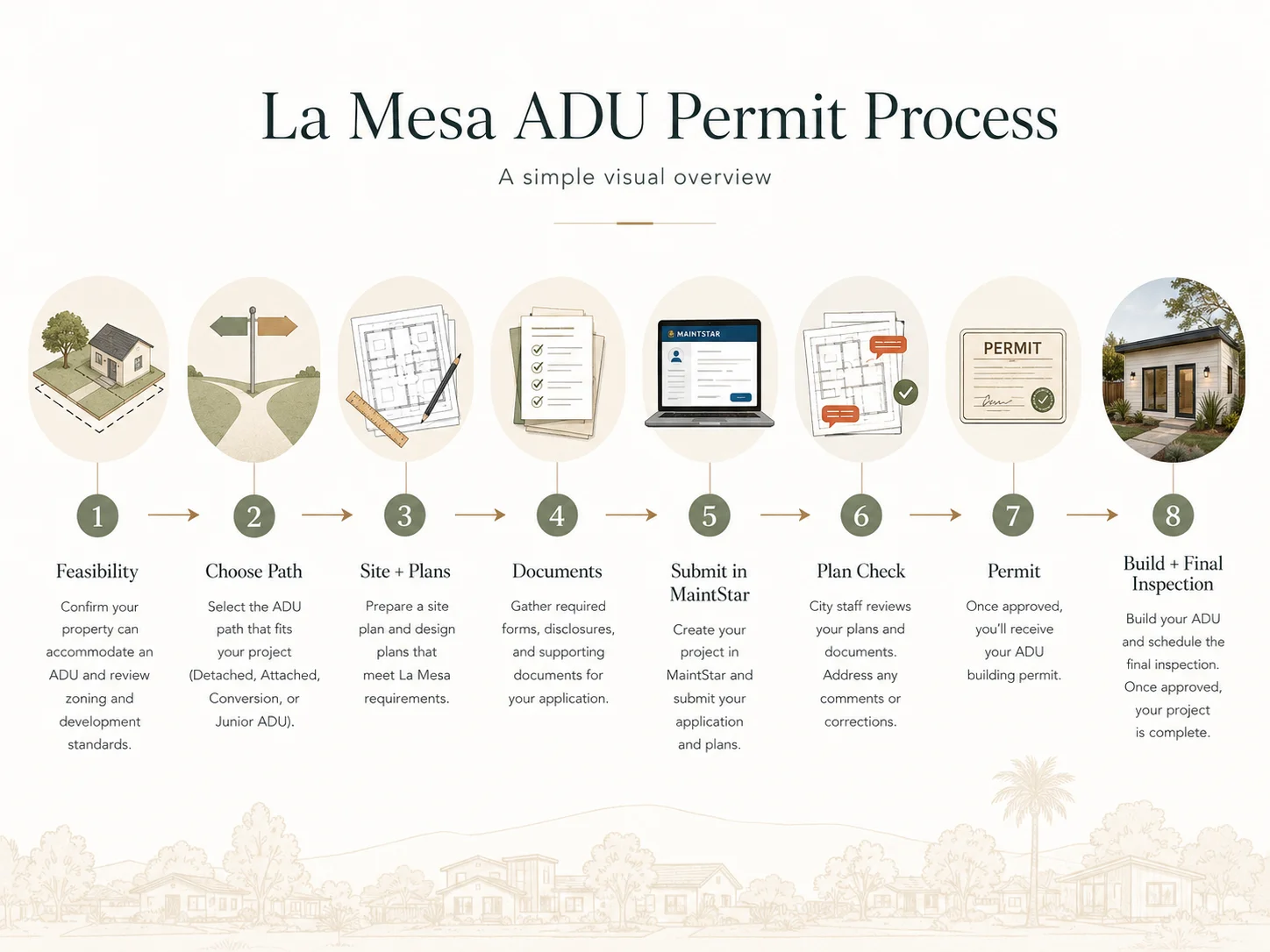
What makes a La Mesa ADU application complete?
The most common reason a La Mesa ADU permit “feels slow” is that the application never completed the 15-business-day check on the first pass. Until the City confirms completeness, the legal review window has not started — meaning homeowners can wait three weeks before the real clock even begins. Our recommendation is to over-prepare the first submittal so the application clears completeness on day one or two, not day fifteen.
La Mesa completeness risk matrix — what kicks an application back, by path
This table identifies the documents that most often cause a La Mesa ADU permit application to fail the first 15-business-day completeness check, organized by permit path. Bring every item on your row to the first submittal.
| Risk | PADU | Custom | Garage conversion | JADU |
|---|---|---|---|---|
| Site plan undimensioned | ✓ high | ✓ high | ✓ high | — |
| Title 24 missing | ✓ critical | ✓ critical | ✓ critical | ✓ critical |
| Soils report missing (project >500 sf) | ✓ critical | ✓ critical | ✓ critical | — |
| Structural calcs not engineer-sealed | — | ✓ critical | ✓ critical | — |
| Recorded deed restriction missing | — | — | — | ✓ critical |
| Existing-condition drawings absent | — | — | ✓ critical | ✓ high |
| Fire-rated wall assemblies not specified (within 5 ft of property line) | ✓ moderate | ✓ moderate | ✓ critical | — |
| Lot coverage exceeded | ✓ moderate | ✓ moderate | — | — |
| Utility routing unclear | ✓ moderate | ✓ moderate | ✓ critical | ✓ moderate |
| Egress window detail (sleeping area) | ✓ moderate | ✓ moderate | ✓ critical | ✓ critical |
Run the free La Mesa ADU Permit Readiness Check
Avoid a kickback at the 15-day completeness check. See exactly which documents your path requires, given your lot and your project type.
Check My Property →
How long does the La Mesa ADU permit process really take?
The “60 days” figure that dominates marketing copy is the maximum legal window the City has to act on a complete application. It is not the homeowner’s total experience.
The legal clocks La Mesa operates under
| Clock | What it governs | Authority |
|---|---|---|
| 15 business days | Completeness review window. La Mesa must tell you whether your application is complete within 15 business days. If it does not, the application is deemed complete. | Cal. Gov. Code §66317; SB 543 (2025) |
| 60 calendar days | Maximum time to approve or deny a complete application on a lot with an existing single-family or multifamily dwelling. If not acted on, the application is deemed approved subject to statutory conditions. | Cal. Gov. Code §66317; LMMC 24.05.020.D8h |
| 30 calendar days | Time to act on a qualifying complete application using a preapproved, locally approved, or identical detached-ADU plan when no further engineering review is required. | AB 1332 (2023); Gov. Code preapproved-plan provisions |
| Indefinite (in practice) | If the lot has a proposed (not yet built) single-family dwelling, the ADU permit application is delayed until the City acts on the primary residence permit. | LMMC 24.05.020.D8h |
The realistic 4–8 month permit timeline
Here is the calendar to plan around — assuming you are working with a designer or builder who knows La Mesa and your lot is reasonably straightforward.
| Stage | Calendar time | What is actually happening |
|---|---|---|
| Pre-application due diligence | 1–4 weeks | Lot assessment, zoning confirmation, PADU vs. custom decision, designer engagement, soils report ordered |
| Application preparation | 2–6 weeks | Site plan, Title 24 calcs, structural calcs (custom only), foundation, MEP, supplemental docs, soils report delivered |
| MaintStar submittal + 15-business-day completeness check | 3 weeks (15 business days) | City reviews for completeness; missing items returned with a letter |
| Plan-check rounds (after completeness confirmed) | 1–3 rounds × 2–3 weeks each | City review; homeowner/designer response; resubmittal |
| Permit issuance | 1–2 weeks | Invoice, payment, $2,000 waiver applied, permit card issued |
| Construction | 3–7 months | Foundation, framing, MEP, finishes, City inspections at each phase |
| Final inspection + Certificate of Occupancy | 1–3 weeks | City sign-off, C of O issued |
| Total: first call → C of O | 6–12 months |
Damaging admission
The biggest delay risk in La Mesa is not the City. It is the gap between “preapproved” and “permit-approved.” Homeowners pick a PADU plan, assume the rest will fall into place, and discover three weeks in that they still need a site plan, a soils report, Title 24 calcs, and (for JADUs) a recorded deed restriction. The PADU plan saves design time — it does not eliminate the project-specific documentation the City needs to verify the prototype fits your lot, your soils, and your utilities.
Avoid the “preapproved is not permit-approved” trap
Run the free La Mesa ADU Permit Readiness Check. See exactly which documents your PADU or custom path will require, and which timeline risks apply to your address.
Check My Property →How much does a La Mesa ADU permit cost in 2026?
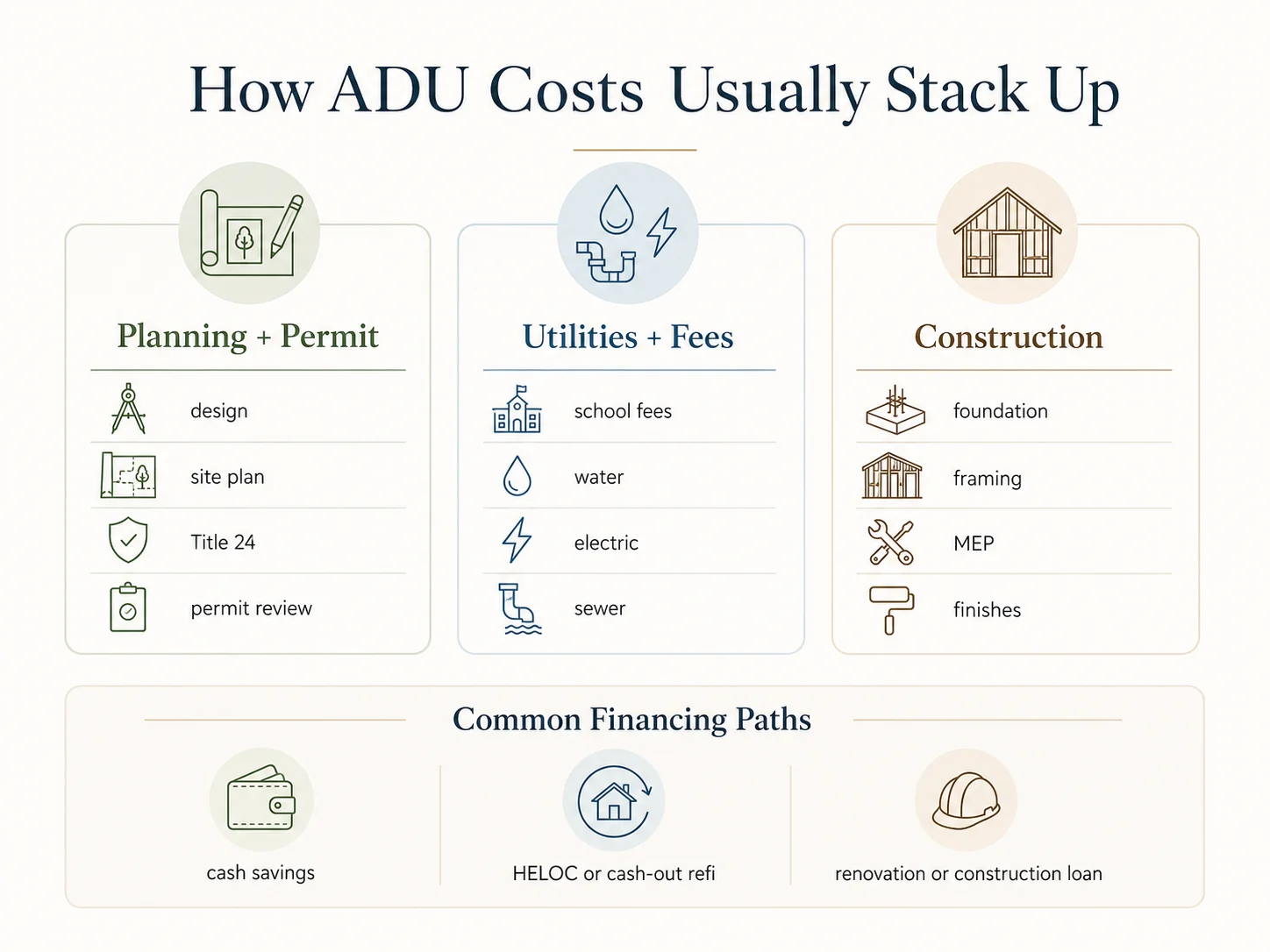
There is a difference between permit fees (what the City charges to review and approve plans) and all-in build cost (what you spend to actually construct the unit). The City fee package is paid at submittal and issuance; school and utility fees are paid before or at final inspection; construction cost is paid to your contractor over the build.
The complete La Mesa ADU fee stack by agency
Every category below applies to a typical detached ADU. JADUs, small conversions, and units 500 sq ft or smaller drop several of these line items.
| Fee category | Charging agency | When paid | $2,000 City waiver covers? | Source |
|---|---|---|---|---|
| Plan check fee | City of La Mesa | At submittal | Yes — counts toward the $2,000 | FY 2024–25 Fee Schedule |
| Building permit fee | City of La Mesa | At issuance | Yes — counts toward the $2,000 | FY 2024–25 Fee Schedule |
| School district fee (LMSVSD) | La Mesa-Spring Valley School District | Before or at final inspection | No — paid directly to district | LMSVSD developer fee resolution |
| School district fee (GUHSD) | Grossmont Union High School District | Before or at final inspection | No — paid directly to district | GUHSD developer fee resolution |
| Water meter/connection fee | Helix Water District | At meter application | No | Helix Water District 2026 Fee Schedule |
| Sewer connection fee | City of La Mesa Engineering | At permit or connection review | No | City Engineering |
| SDG&E electric service connection | SDG&E Builder Services | At service work | No | SDG&E Builder Services ADU fact sheet |
| Impact fees (ADUs >750 sq ft only) | Various agencies | Before or at final inspection | No | Cal. Gov. Code §66311.5 |
How the City calculates permit fees
The City of La Mesa determines building permit fees by applying its published residential valuation rate (Type V Wood Frame: $152.19/sq ft per the FY 2024–25 fee schedule) to the ADU’s square footage, then running the result through the City’s published building-permit-fee formula (a bracket fee plus an incremental rate for each $1,000 of valuation or fraction thereof above the bracket threshold). The City Building Official determines actual valuation, and the contract price may govern if higher than the standard valuation.
The $2,000 waiver is applied at permit issuance. The waiver covers the combined plan-check and building-permit fee up to $2,000. ADUs where the combined City fee is under $2,000 effectively pay $0 in City fees. ADUs where the combined City fee exceeds $2,000 pay the difference. Outside-agency fees are never covered.
School fee thresholds to know
ADUs with 500 sq ft or less of assessable space are exempt from school district impact fees under California Government Code § 66311.5 (as amended by SB 543). Above 500 sq ft, LMSVSD and GUHSD each assess their respective per-square-foot developer fee rates against the assessable square footage above the threshold. Confirm current rates directly with each district before finalizing your budget.
Should you use La Mesa’s preapproved (PADU) plans or custom design?
The five La Mesa PADU plans
| Plan | Sq ft | Bedrooms | Best fit |
|---|---|---|---|
| Plan A | 224 | Studio | Aging-parent suite, minimal rental, sub-500 sq ft strategy with maximum fee protection |
| Plan B | 400 | 1 | Compact rental, first-time ADU builders, projects optimizing for fee thresholds |
| Plan C | 499 | 1 | The deliberate “right under the 500 sq ft threshold” plan — maximum livable footprint while preserving sub-500 sf school-fee treatment and clearing the impact-fee exemption |
| Plan D | 990 | 2 | Family ADU, premium rental, more livable for long-term tenants |
| Plan E | 1,199 | 3 | Maximum allowed detached ADU size under LMMC 24.05.020 D8; best for families needing real bedroom count |
The City of La Mesa publishes these plans on its ADU page. The plan PDFs are downloadable; the construction permitting set must be requested from Planning@cityoflamesa.gov.
What PADU plans actually save
- Design time: Skip 4–8 weeks of architectural development
- Architect fees: Saves $5,000–$25,000 in design fees for the prototype itself (you still pay for site adaptation)
- Fewer plan-check comment rounds: Prototype is City-pre-vetted
- Faster theoretical clock: AB 1332 created a 30-day action rule for qualifying applications using a preapproved plan
What PADU plans do not save
- Site plan: Still need a project-specific scaled site plan
- Title 24: Every ADU needs Title 24 calcs for your actual orientation
- Soils report: Plans D and E require one; ask about A, B, C
- Supplemental documents: City explicitly requires these for every PADU
- City permit fees: PADU plan is free; the permit is not
- School and utility fees: Calculated against your unit’s square footage regardless
The AB 1332 30-day clock — what it really means
Assembly Bill 1332 (signed September 2023) requires cities to maintain at least one preapproved ADU plan and to act on qualifying complete applications using these plans within 30 days. La Mesa publishes five — so it complies with the inventory requirement. The 30-day rule applies to qualifying detached-ADU applications using a preapproved, locally approved, or identical plan; site-specific review (zoning, setbacks, soils, utility) can still be required. Do not assume a PADU application clears in 30 days as a baseline. Confirm with La Mesa Planning when you submit, and submit a complete package the first time.
Not sure whether a PADU plan fits your lot?
Run the free La Mesa ADU Feasibility Check. See PADU plan fit, custom design tradeoffs, and which path makes financial sense for your specific parcel.
Check My Property →Which California ADU law changes affect La Mesa permits in 2026?
2023-signed bills now fully in effect
- AB 976 — Permanent ban on local ADU owner-occupancy requirements
- The state’s prohibition on local owner-occupancy requirements for new ADUs is now permanent. La Mesa cannot require you to live on the property in order to rent your ADU. You can rent both the primary residence and the ADU long-term, simultaneously. The ban does not apply to JADUs (see AB 1154 below for the current JADU rule).
- AB 1033 — Separate condominium-style sale of ADUs (city opt-in)
- AB 1033 allows California cities to adopt local ordinances permitting the separate condominium sale of ADUs from the primary residence. Cities must affirmatively opt in. As of May 2026, publicly tracked opt-in cities include Los Angeles, San Diego (city), San Jose, Berkeley, and Sacramento. La Mesa has not publicly adopted an AB 1033 ordinance as of our verification check. Confirm current status with La Mesa Planning before relying on separate sale as part of your investment plan.
- AB 1332 — Preapproved ADU plans and the 30-day clock
- AB 1332 created the preapproved-plan program and the 30-day action requirement for qualifying complete detached-ADU applications using a preapproved or identical plan. La Mesa publishes five PADU plans (Plans A–E) on its ADU page. See the PADU section above for what the 30-day clock actually covers.
2024-signed bills (effective January 1, 2025)
- SB 1211 — Up to 8 detached ADUs on multifamily lots
- SB 1211 raised the cap on detached ADUs allowed on multifamily lots from 2 to up to 8, capped at the number of existing primary units on the lot. SB 1211 also clarified that uncovered parking spaces removed for an ADU do not have to be replaced — the prior rule applied only to covered parking and garages. This is relevant to investors in La Mesa’s older small-multifamily inventory.
- AB 2533 — Legalization path for pre-2020 unpermitted ADUs
- AB 2533 created a real legalization pathway for unpermitted ADUs and JADUs constructed before January 1, 2020. Under the law (codified at California Government Code § 66311.7 following SB 543’s renumbering), La Mesa cannot deny a legalization permit unless correcting the violation is necessary to address conditions defined as substandard housing under Health & Safety Code § 17920.3 — meaning actual habitability threats, not technical code conformance. Impact fees and connection charges are limited unless new utility infrastructure is required. Homeowners can hire a private contractor to perform a pre-application inspection confidentially.
2025-signed bills (Newsom signing rounds October 2025)
- SB 543 — Permitting timeline enforcement and deemed-approved rules
- Signed October 10, 2025. SB 543 reinforced the 15-business-day completeness check and the 60-day approval clock with sharper enforcement: if the City misses the 15-day window, the application is deemed complete; if it misses 60 days on a complete application, the application is deemed approved subject to statutory conditions. SB 543 also renumbered prior ADU sections — most notably moving the unpermitted-ADU legalization provisions to § 66311.7.
- AB 1154 — JADU owner-occupancy narrowed
- Signed October 10, 2025. AB 1154 narrows the JADU owner-occupancy requirement so that it applies only when the JADU shares sanitation facilities (bathroom) with the primary residence. A JADU with its own independent bathroom no longer triggers the owner-occupancy rule. AB 1154 also confirms that JADUs cannot be used as short-term rentals (less than 30 days). All other JADU rules still apply — 500 sq ft cap, single-family-lot limitation, efficiency kitchen, private exterior entrance, and recorded deed restriction.
- AB 462 — Emergency Certificate of Occupancy
- Signed October 2025. AB 462’s coastal-development-permit provisions do not generally apply to La Mesa because La Mesa is inland. AB 462’s emergency-related certificate-of-occupancy provisions could matter only in the specific qualifying scenario of a disaster-damaged primary dwelling: under narrow conditions (governor’s state-of-emergency declaration, substantial damage to the primary, ADU passed all inspections), a detached ADU may receive a Certificate of Occupancy before the primary dwelling.
- SB 9 — HCD enforcement teeth on local ADU compliance
- SB 9 (2025) invalidates certain local ADU ordinances if local agencies fail to submit ordinances to HCD or respond to HCD findings within statutory timelines. This is a state-level enforcement bill that affects local agencies more than individual homeowners directly, but it tightens the pressure on cities (including La Mesa) to maintain ordinances that genuinely conform to state law.
Which La Mesa rules can slow or stop your permit?
Setbacks (LMMC 24.05.020 and Cal. Gov. Code § 66314)
Minimum side and rear setbacks for a new detached ADU in La Mesa are 4 feet from each property line. Existing structures converted to ADUs are grandfathered into their current setbacks (no setback issue at all). The front setback follows the underlying zone’s residential standard, which means the ADU typically must sit behind the front building line of the primary residence — front-yard ADUs are generally not permitted except in narrow exception cases under state law.
Height limits
La Mesa allows two-story ADUs subject to the underlying zone’s height limits. Recent ADU summaries from local builders cite up to 20 feet in R1E and R2 zones, up to 30 feet in R3 and RB zones, and 16 feet by default for detached ADUs on multifamily lots unless additional setbacks are met. Verify current zone-specific maximums in the LMMC before designing a two-story ADU. Height is measured from average finished grade to the plate line of the roof, not to the peak — a detail that catches designers used to other San Diego cities where height is measured to the ridge.
Lot coverage and the 800 sq ft state-law protection
La Mesa’s local ordinance has lot-coverage standards (commonly cited as 45% on lots under 10,000 sq ft and 40% on lots 10,000 sq ft or larger — verify against the current LMMC for your zone). State law adds a meaningful protection on top: California law protects the ability to permit at least an 800 sq ft ADU when objective local standards would otherwise preclude it. Above 800 sq ft, local lot coverage and other objective standards can matter more. A 990 sq ft Plan D ADU on a coverage-maxed lot may simply not fit.
Building separation
A new detached ADU must maintain at least 6 feet of clear separation from any existing structure on the lot, including the primary residence and any garage or accessory building. This is a code-driven fire-separation rule. Conversions are exempt because the existing separation was approved at the time of original construction.
Parking and the half-mile transit rule
Under California Government Code § 66322, the City cannot require parking for an ADU in several situations, including ADUs within one-half mile walking distance of a public transit stop. La Mesa’s local rule is even more permissive: the City does not require additional parking for ADUs as a baseline matter. Garage-to-ADU conversions do not require replacement parking. Under SB 1211 (effective 2025), the same no-replacement rule now applies to uncovered parking spaces demolished or converted for an ADU. If your designer or builder tells you “we need to add a parking space for the ADU,” that advice is wrong for La Mesa in nearly every case.
Historic-overlay restrictions
If your property sits within a designated La Mesa historic overlay, the ADU must be designed in substantially the same architectural style and finished materials composition as the primary residence or historic structure. Setback, height, and size rules do not change — only the exterior expression. Confirm overlay status with La Mesa Planning before designing. Architectural compatibility statements should be included in the first submittal.
The proposed-primary-dwelling lockstep rule (LMMC 24.05.020.D8h)
This catches new-construction projects. If the ADU is on a lot with a proposed (not yet built) single-family residence, La Mesa’s ADU permit application is held until the City acts on the primary residence permit. The state’s 60-day clock does not start running on the ADU until the primary house is permitted. If you are building both at once, plan for the ADU permit to track behind the house permit, not in parallel.
Edge cases La Mesa homeowners hit
- Sloped or hillside lots in the older La Mesa neighborhoods (Mount Helix, Del Cerro adjacency). Custom foundation engineering required; PADU plans rarely transfer cleanly.
- HOA architectural review running in parallel. The City will not wait for your HOA, but you should — non-conforming construction can trigger HOA litigation even after the City issues a permit.
- Sewer vs. septic. Most La Mesa ADU projects will involve sewer review and fees. Verify sewer or septic status parcel-by-parcel before designing utility plans.
- Easements and shared driveways. Older La Mesa lots sometimes have unrecorded easements or shared driveways that limit where a detached ADU can go.
- Property lines and tight setbacks. If the ADU sits unusually close to a property line, ask Planning whether a Building Location Verification Survey is required for your project.
What happens after you submit through MaintStar?
1. Initial intake and 15-business-day completeness check
City staff verifies that the application contains all required documents. If anything is missing, a completeness letter is returned through MaintStar listing the gaps. If the City does not issue a completeness determination within 15 business days, the application is deemed complete by operation of law (SB 543).
2. Plan check (multidisciplinary)
Complete applications are routed to Building (structural, MEP, energy), Planning (zoning, setbacks, lot coverage, design standards), and Engineering (grading, drainage, right-of-way if applicable). Each department reviews independently.
3. Comment letter
If any department has comments, they are consolidated into a corrections letter and posted to MaintStar. The City’s published process flow assumes no more than two correction rounds for a typical ADU.
4. Resubmittal
Your designer or you (if you are self-permitting) responds to each comment, revises the drawings, and resubmits through MaintStar. The faster you respond, the faster the project moves.
5. Approval and permit issuance
Once all comments are resolved, the City generates a final fee invoice. The $2,000 City fee waiver is applied at this stage. You pay, your permit card is generated, and you can begin construction.
The way to improve outcomes at this stage is to submit a genuinely complete first package so the comment count drops from 2–3 rounds to 1.
What causes La Mesa ADU permits to get delayed?
Missing or inadequate site-specific documents
This is the dominant cause. The most common missing items:
- Title 24 energy calculations (omitted because the designer assumes it is part of the structural set — it is not)
- Soils report (omitted on sub-500 sq ft projects without confirming whether a waiver applies)
- Project-specific information on a PADU plan set (homeowner forgot to fill in the cover sheet)
- Recorded JADU deed restriction (drafted but not recorded)
- Undimensioned site plan (drawings show setbacks but do not call them out numerically)
PADU changes that push the project back into custom review
Homeowners modify a PADU plan to add a window, change a roof line, or adjust the kitchen layout — and the City treats the modified set as a custom design subject to full structural review. The fix is to use the PADU plan as-is and adapt to the lot, not to adapt the plan to your preferences. If you want changes, choose custom design from the start.
Utility and grading issues
- SDG&E queue for new electric service (lead times vary; confirm with Builder Services)
- Helix Water capacity confirmation and meter strategy
- Sewer lateral upgrade requirements
- Grading exceeding 50 cubic yards (typically triggers separate grading permit)
- Right-of-way work for utility trenching
Builder or designer handoff problems
The pattern: homeowner hires a designer, designer submits, City issues comments, designer is busy on three other projects and responds two weeks later, project drifts. The cure is to ask any designer or builder you hire for their average plan-check turnaround time and to commit it in writing.
Avoid the plan-check kickback
Run the free La Mesa ADU Permit Readiness Check. See exactly which documents your specific path requires and which delay triggers apply to your address — before you submit.
Check My Property →Can you convert a garage or build a JADU in La Mesa?
Garage conversion path: what to expect
Garage conversions are popular because they look cheap on paper. The existing shell exists, the foundation is poured, the roof is on. In practice, the cost ranges from genuinely modest to surprisingly expensive depending on the existing structure’s condition. Local builder pricing for a typical 400 sq ft garage conversion in San Diego County generally falls in the $80,000–$200,000 range as a planning band — varying with the structure’s foundation condition, roof condition, fire-separation requirements, utility scope, and finish level. Get multiple itemized quotes before committing.
| Conversion issue | Why it matters |
|---|---|
| Structural assessment | Existing foundation, framing, and roof must support the new occupancy. Older La Mesa garages built in the 1950s–60s often need foundation work. |
| Fire-rated assemblies | Garages within 5 feet of a property line typically require one-hour fire-rated wall assemblies — a significant cost item. |
| Energy compliance (Title 24) | Insulation, windows, HVAC, and water heating must all meet current code. |
| Utilities | Most garages were never served with adequate water, waste, or electrical capacity. Plan for a new sub-panel, water line, and sewer connection. |
| Ceiling height | Garages with sub-7-foot ceilings may need roof structure modification to meet residential code. |
| Egress windows | Every sleeping area requires a code-compliant egress window. |
| Replacement parking | Not required under SB 1211 (2025) and California Government Code §66322. |
JADU path: what to expect
A JADU is a unit up to 500 sq ft contained entirely within the existing or proposed single-family residence. It is the lowest-cost permit path and the lowest-cost build path. As an illustrative planning band only, San Diego County JADU projects often run in the $50,000–$150,000 range, but actual costs depend entirely on existing conditions and finish level. Get multiple quotes.
| JADU requirement | Detail |
|---|---|
| Maximum size | 500 sq ft (LMMC 24.05.020 D9) |
| Location | Must be entirely within the existing or proposed single-family residence |
| Efficiency kitchen | Cooking facility, food prep counter, storage cabinets required (LMMC 24.05.020 D9f) |
| Private exterior entrance | Required — may be shared with the primary but must have private access |
| Bathroom | May share or have its own; owner-occupancy rule now applies only if sharing bathroom with primary (AB 1154) |
| Recorded deed restriction | Required before permit issuance — most often forgotten (LMMC 24.05.020 D9k). Allow 2–3 weeks to record. |
| Short-term rental | Prohibited. JADUs cannot be used as short-term rentals (less than 30 days) under AB 1154. |
| One JADU per lot | One JADU allowed per single-family lot, in addition to one ADU under LMMC 24.05.020 D8 |
Stacking ADU + JADU on the same lot
La Mesa permits one full ADU (up to 1,200 sq ft) plus one JADU (up to 500 sq ft inside the primary residence) on a single-family lot. This combination is allowed by state law and is baseline practice in San Diego County’s ADU-friendly cities. On multifamily lots under SB 1211, up to 8 detached ADUs (capped at the number of existing primary units) are permitted, plus interior conversion ADUs up to 25% of the existing unit count with a minimum of one.
Can you rent, list short-term, or sell a La Mesa ADU separately?
Long-term rental rules
La Mesa allows long-term rental of ADUs without restriction beyond the standard requirement that rentals be for terms longer than 30 days. Owner-occupancy is not required for ADUs permitted after January 1, 2020 (and is now permanently prohibited as a local requirement under AB 976). You can rent both the primary residence and the ADU simultaneously. For JADUs, the owner-occupancy requirement under AB 1154 applies only if the JADU shares a bathroom with the primary residence.
Short-term rental prohibition
California state law and LMMC both require ADU rentals to be for terms longer than 30 days. Listing a permitted ADU on Airbnb, VRBO, or similar short-term-rental platforms violates the terms of the ADU permit and can expose you to permit revocation. AB 1154 (2025) specifically prohibits JADUs from short-term rental.
Selling your ADU separately (AB 1033 status)
Assembly Bill 1033 (signed October 11, 2023) allows California cities to adopt local ordinances permitting the separate condominium-style sale of ADUs from the primary residence. Cities must affirmatively opt in. As of May 2026, publicly tracked opt-in cities include Los Angeles, San Diego (city), San Jose, Berkeley, and Sacramento.
La Mesa has not publicly adopted an AB 1033 ordinance as of our last verification.
If separate sale is part of your investment thesis, confirm with the Planning Division before relying on it.
Rental income context for La Mesa
For homeowners weighing whether the long-term rental math works, comparable apartment rents in La Mesa ZIP codes are useful context (drawn from major rental aggregators in April 2026). These are apartment-building comparables, not ADU rents specifically, and should be treated as a directional planning input only.
| Unit type | ZIP 91941 typical | ZIP 91942 typical |
|---|---|---|
| Studio | $1,700–$2,500 | $1,950–$2,500 |
| 1 BR | $2,000–$2,500 | $2,100–$2,995 |
| 2 BR | $2,750–$3,300 | $2,750–$3,300 |
These are illustrative examples of comparable apartment rents in La Mesa, not guarantees of ADU rental returns. Actual results depend on local market conditions, construction costs, financing terms, regulatory approvals, vacancy, operating costs, and unit-specific factors. The Dwelling Index does not guarantee rental income outcomes.
When should you talk to a designer, builder, or provider?
The most expensive mistake in La Mesa ADU projects is hiring a builder before defining the project. Builders quote what they know how to build. A builder who specializes in detached new construction will sell you a detached new construction ADU regardless of whether a garage conversion would have been the better fit. Define the project first, then shop the project.
12 questions to ask any La Mesa ADU builder before hiring
- 1.How many ADU permits have you successfully cleared in La Mesa specifically (not “San Diego County”)?
- 2.Have you used La Mesa’s PADU plans on a real project? If yes, which plans?
- 3.Who prepares the Title 24 calculations on my project — your in-house team, or an outside consultant I pay separately?
- 4.Who orders and pays for the soils report?
- 5.What is your average plan-check comment response time?
- 6.What is your written timeline guarantee, if any, from contract signing to permit issuance?
- 7.What is your written timeline guarantee, if any, from permit to Certificate of Occupancy?
- 8.What specifically is excluded from your fixed-bid proposal?
- 9.How do you handle change orders (the price formula, not the philosophy)?
- 10.Do you carry the City’s general contractor and workers’ compensation requirements?
- 11.What is your warranty period and what does it cover?
- 12.Can you provide three completed La Mesa references with addresses I can drive by?
When SnapADU is a fit (and when it is not)
For detached, site-built ADUs in Greater San Diego County, SnapADU is one of the design-build firms homeowners most often short-list. SnapADU publicly lists La Mesa as part of its core service area and has documented 100+ completed San Diego County ADU projects since 2020.
SnapADU is a fit when:
- You want a fixed-bid quote with permits, design, and construction in one contract
- Your project is a detached new-construction ADU (not a JADU or interior conversion)
- You value process predictability over absolute lowest price
- You are in their published Greater San Diego service area (La Mesa, El Cajon, Lemon Grove, Santee, Spring Valley, and broader San Diego County)
SnapADU is not a fit when:
- Your project is a JADU or interior conversion (their model is detached)
- You want a modular or prefab solution (they are stick-built)
- You are outside Greater San Diego County
- You want to hire your own architect and bid the construction separately
Compare a Greater San Diego ADU design-build path
See our independent SnapADU review: real 2026 pricing, license verification, BBB and Houzz signals, San Diego service area, plan inventory, and the situations where SnapADU is not the right fit.
Get the free La Mesa ADU Starter Kit
A downloadable PDF that includes the complete permit document checklist from this guide, the source-calculated PADU fee component table, the four-path decision tree, the 4–8 month timeline calendar template, and a worksheet to take to your first conversation with the City or a builder. No spam. Unsubscribe anytime.
Download the Free Starter Kit →Frequently Asked Questions
- Do I need a permit to build an ADU in La Mesa?
- Yes. Every new ADU, JADU, and conversion in La Mesa requires a building permit under LMMC 24.05.020 and the City’s ADU ordinance. Construction without a permit can trigger code enforcement and an order to bring the structure into compliance under the legalization provisions of California Government Code §66311.7.
- Where do I submit a La Mesa ADU permit application?
- Through the City’s online MaintStar Permitting Portal at h9.maintstar.co/LaMesa/portal/. The City accepts ADU and JADU applications online.
- Does La Mesa have preapproved ADU plans?
- Yes. The City of La Mesa publishes five Preapproved ADU (PADU) plans labeled A through E, ranging from a 224 sq ft studio (Plan A) to a 1,199 sq ft three-bedroom (Plan E). Request the construction permitting set by emailing Planning@cityoflamesa.gov.
- Do La Mesa PADU plans guarantee permit approval?
- No. PADU plans guarantee that the prototype has been pre-vetted for code compliance, but homeowners still submit a project-specific site plan, Title 24 energy calculations, supplemental documents, and (for plans over 500 sq ft) a soils report. The full permit package must be complete to clear the City’s 15-business-day completeness check.
- How long does La Mesa have to approve an ADU permit?
- Under California Government Code §66317, La Mesa has 15 business days to determine application completeness and 60 calendar days to approve or deny a complete application on a lot with an existing single-family or multifamily dwelling. Qualifying detached-ADU applications using a preapproved plan may qualify for a 30-day action rule under AB 1332.
- When does the 60-day clock start?
- The 60-calendar-day clock starts when the City stamps the application complete after the 15-business-day completeness review — not when the application is first submitted. If the City does not issue a completeness determination within 15 business days, the application is deemed complete by operation of law (SB 543).
- What happens if La Mesa misses the 60-day deadline?
- Under SB 543 (effective 2026), if the City fails to approve or deny a complete application within 60 days, the application is deemed approved subject to statutory conditions. This is a meaningful state-law enforcement tool, though in practice the goal is a clean approval, not an automatic-approval fight.
- Does La Mesa waive ADU permit fees?
- Yes. The City of La Mesa’s FY 2024–25 Fee Schedule (Resolution 2025-010) waives the first $2,000 of incurred City fees for ADU and JADU building permit applications. The waiver applies only to City-collected fees; school district fees, utility connection charges, and other outside-agency fees are paid separately and are not covered.
- Do I need a soils report for a La Mesa ADU?
- For ADU projects over 500 sq ft, yes — required at application per the City’s PADU instructions. For projects 500 sq ft or smaller, ask the Building Division directly about your specific project.
- Can I build a La Mesa ADU over 500 sq ft?
- Yes. La Mesa allows detached and attached ADUs up to 1,200 sq ft under LMMC 24.05.020 D8. The 500 sq ft threshold is the JADU cap and the soils-report trigger — not a maximum ADU size.
- Can I convert my garage into an ADU in La Mesa?
- Yes. Garage conversions are explicitly permitted under LMMC 24.05.020 D8. Replacement parking is not required (per California Government Code §66322 and SB 1211). The converted structure must meet current building code for fire separation, energy compliance, egress, ceiling height, and utility service.
- Does La Mesa require ADU parking?
- La Mesa does not require additional parking for new ADUs as a baseline matter under its current ADU ordinance, and California state law preempts parking requirements in several situations including ADUs within one-half mile of public transit.
- Can I sell my La Mesa ADU separately from the main house?
- Only if La Mesa adopts an AB 1033 condominium-conversion ordinance. As of May 2026, La Mesa has not publicly adopted such an ordinance — confirm current status with the Planning Division before relying on separate sale as part of your investment plan.
- Can I list my La Mesa ADU on Airbnb?
- No. Both California state law and LMMC require ADU rentals to be for terms longer than 30 days. Short-term rental (less than 30 days) violates the terms of the ADU permit. JADUs are specifically prohibited from short-term rental under AB 1154 (2025).
- How many ADUs can I build on my La Mesa property?
- On a single-family lot: one ADU (up to 1,200 sq ft) plus one JADU (up to 500 sq ft inside the primary residence). On a multifamily lot under SB 1211: up to 8 detached ADUs, capped at the number of existing primary units, plus interior conversion ADUs up to 25% of the existing unit count with a minimum of one.
- Does La Mesa accept digital permit submissions?
- Yes. La Mesa accepts ADU and JADU applications online through the MaintStar Permitting Portal at h9.maintstar.co/LaMesa/portal/.
- What is the La Mesa Building Division phone number?
- La Mesa Building Division: 619-463-6611. Office address: 8130 Allison Avenue, La Mesa, CA 91942. Hours: Monday–Thursday 7:30 a.m. to 5:30 p.m., Friday 7:30 a.m. to 4:30 p.m. (alternate Fridays closed).
Not sure where to start?
See what’s possible at your address — get your free ADU report in 60 seconds.
Check My Property → Get Your Free ADU ReportSources and methodology
How we built this guide
We compiled this guide directly from primary sources: the City of La Mesa’s official ADU page and PADU plan inventory, La Mesa Municipal Code 24.05.020 (Ordinance No. 2023-2903), the City’s FY 2024–25 Fee Schedule (Resolution 2025-010), the California Government Code sections governing ADUs (§§ 66311.5, 66311.7, 66314, 66317, 66322, and 66323), the California HCD ADU Handbook (March 2026 update), the text of every operative 2023–2025 California ADU bill, the La Mesa-Spring Valley School District and Grossmont Union High School District public developer-fee pages, the Helix Water District 2026 Fee Schedule, and the SDG&E Builder Services ADU fact sheet.
What we calculated
The PADU fee component table in this guide is an editorial planning estimator. We applied the City’s published Type V Wood Frame residential valuation rate ($152.19/sq ft per the FY 2024–25 fee schedule) to each PADU plan’s square footage and ran it through the City’s published building-permit-fee formula (a bracket fee plus an incremental rate for each $1,000 of valuation or fraction thereof above the bracket threshold). The City Building Official determines actual valuation, and the contract price may govern if higher than the standard valuation. Outside-agency fees are not included in our estimator.
What still needs direct City confirmation for your specific project
- AB 1033 separate-sale status as of your project date
- AB 1332 30-day-clock applicability to your specific PADU project
- Whether your sub-500-sq-ft project can avoid a soils report
- Historic-overlay coverage of your specific parcel
- Sewer-versus-septic status of your parcel
- Current school-district fee rates as posted by the LMSV and GUHSD fiscal services pages
What we did not rely on
Reddit, Facebook groups, Nextdoor, and AI-generated city summaries were not used as proof of any legal, zoning, fee, or construction claim. Forum content was used only to understand homeowner language and the questions readers actually ask.
Verification cadence
We re-verify La Mesa city fees, PADU plan inventory, LMMC citations, and California state-law applicability quarterly. The “Last verified” stamp at the top of this guide reflects our most recent check. If you spot a date discrepancy or a rule change we have not yet captured, please use our Corrections page so we can update.
Editorial independence
The Dwelling Index is an independent research resource covering ADU financing, costs, and regulations. We are not a lender, broker, or builder. Affiliate relationships are disclosed where they exist; editorial recommendations are based on independent research and are never influenced by compensation. See our full editorial standards, methodology, and partner vetting policy for full detail.
This content is for informational purposes only and does not constitute financial, legal, tax, construction, or lending advice. The Dwelling Index is an independent research resource covering ADU financing, costs, and regulations, not a lender, broker, or builder. La Mesa Municipal Code and California ADU law evolve frequently — confirm current rules with the City of La Mesa Planning Division (619-463-6611) or Building Division before relying on any figure or process step described here. Permit and construction estimates in this guide are planning figures, not quotes. The City Building Official determines actual valuation and fees, and outside-agency charges may apply. Loan availability, rates, terms, and eligibility for any financing path mentioned vary by lender, state, property, and borrower qualification — The Dwelling Index does not guarantee approval, qualification, rates, monthly payments, or construction outcomes. Rental-income examples are illustrative only, not guarantees of returns. Actual results depend on local market conditions, construction costs, financing terms, regulatory approvals, vacancy, and operating costs.