Home Depot ADU Alternatives: What the Listings Really Are — and 7 Better Ways to Build
By The Dwelling Index Editorial Team — an independent research resource covering ADU financing, costs, and regulations.
Last updated: June 1, 2026 · Last verified: June 1, 2026
The short answer
The “ADU” and “tiny home” products on HomeDepot.com are not finished, move-in-ready homes — they’re steel-frame shells and compact prefab units sold by third-party sellers, and a few even advertise “No permit required,” which is misleading for a backyard dwelling. If you’re comparing Home Depot ADU alternatives, here’s the honest takeaway: the sticker price is rarely the project price. A frame kit listed in the low-to-mid five figures typically becomes a $90,000–$200,000+ finished, permitted accessory dwelling unit (ADU — a self-contained second home on your lot) once you add foundation, utilities, plumbing, electrical, finishes, and permits. The best path isn’t the cheapest product; it’s the one with a clear code path, complete installed scope, and local approval. Next step: before you buy anything, check what your specific lot can legally support → get your free ADU report.
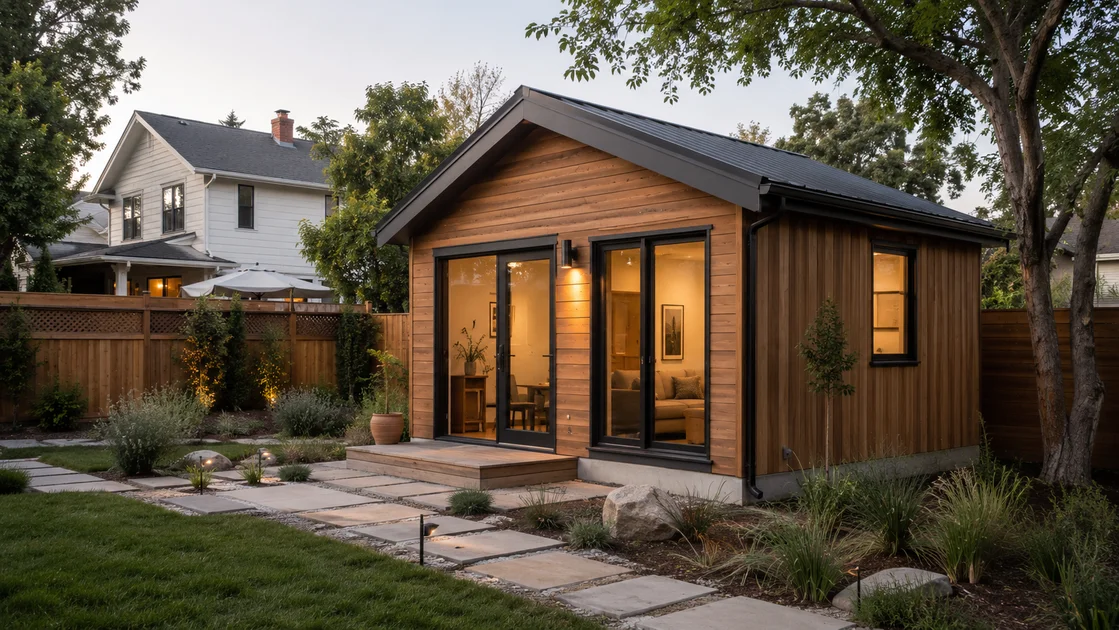
Home Depot ADU options vs. the alternatives — the 60-second version:
| Path | Sticker-price reality | Best next step |
|---|---|---|
| Home Depot steel-frame kit | Cheapest upfront, but usually a shell — not a finished dwelling | Confirm stamped plans, foundation, MEP, and local ADU approval before buying |
| Home Depot “finished-look” prefab listing | More complete-looking, still not automatically legal | Demand the code path, install scope, and permit examples |
| Better-documented panelized/SIP kit | Stronger plan sets; owner still finishes | Compare missing scope and contractor support |
| Foldable or factory-modular unit | Higher price, more process support | Verify delivery, site work, and your city’s approval |
| Garage conversion or local site-built ADU | Often the best legal fit if your lot supports it | Run a lot-specific feasibility check first |
See What You Can Build → Get Your Free ADU Report
Before you order a kit, see what your address can legally support — most decisions hinge on your lot, not the product photo.
Does Home Depot actually sell ADUs?
Home Depot lists products that are marketed as ADUs, tiny homes, and “frame kits,” but Home Depot doesn’t manufacture them — they’re sold by third-party sellers, and many of the marquee models are cold-formed steel frame kits, meaning the structural shell only. A retail listing is a product, not a permit. Whether any of these becomes a legal ADU depends on your local building department, foundation, utilities, inspections, and a certificate of occupancy — not on what the listing title says.
We pulled the live listings inside Home Depot’s “Tiny Home Frame Kits” category to see exactly what’s being sold (verified June 1, 2026). It’s a mix: steel-frame kits, shell packages, and prefab-style listings from a handful of suppliers, with wildly different scopes hiding behind similar-looking photos. The low-priced examples — the ones that pull people in — are frame and shell kits, not finished homes.
“Kit,” “shell,” “prefab,” “turnkey” — what each word actually means
The single most expensive misunderstanding in this category is treating the word “ADU” on a product page as if it means a finished home. It rarely does. Here’s the vocabulary decoded, because the difference between a “frame kit” and a “turnkey unit” can be a six-figure swing in what you still have to pay for.
| Term you’ll see on a listing | What it actually means | What’s still on you |
|---|---|---|
| “Kit” / “building kit” | Pre-cut, pre-drilled parts to assemble a structure | Everything to finish it: foundation, enclosure, all systems, finishes, permits |
| “Steel-frame kit” / “shell” / “frame only” | The skeleton only (structural studs and connectors) | Sheathing, roof, weatherproofing, all mechanical systems, all finishes |
| “Dry-in kit” | Frame plus enclosure so it’s weather-tight | Every interior system and finish |
| “Complete kit” | More materials toward finish — varies a lot by seller | Site work, utilities, permits, labor |
| “Turnkey” (factory) | A move-in-ready unit built in a factory | Foundation, utility hookups, permits, delivery and installation |
| “Expandable” / “foldable” | Ships compact, unfolds on site | Site prep, utilities, permits — and you must check its code rating |
| “Manufactured” / “HUD” | Built to federal HUD code, not local residential code | Siting only where your city allows manufactured homes as ADUs |
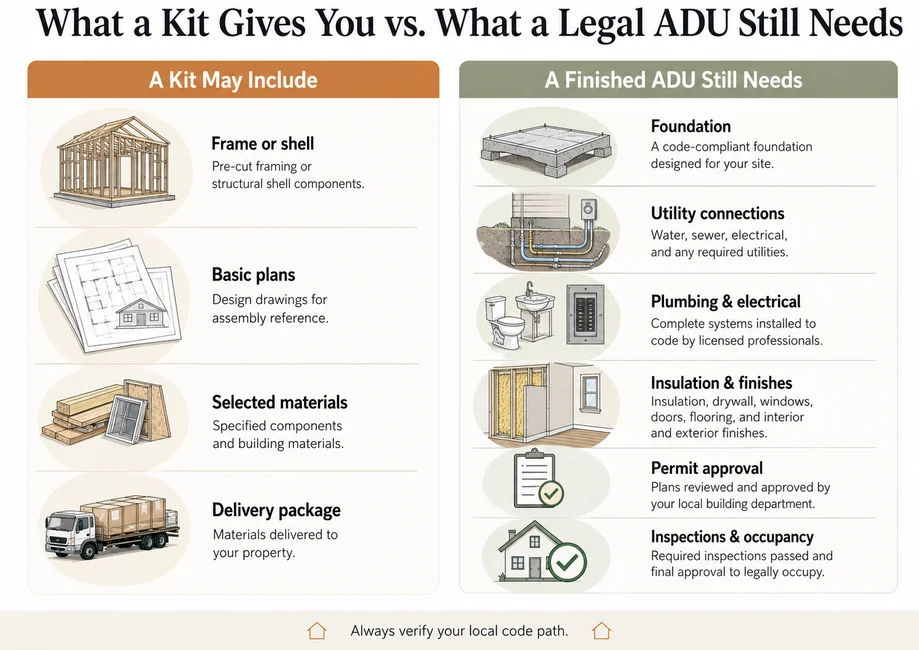
The plain-English rule: a kit gives you a structure; a permit gives you the right to live in it. Those are two different products, and the cheap Home Depot listings mostly sell the first one.
Who’s really behind the Home Depot ADU listings
These products come from third-party suppliers, not Home Depot’s own brand. The names you’ll encounter include PLUS 1 Homes / Well Done 1 Kit Homes (the cold-formed-steel kits, and the seller behind the viral 540-square-foot “Home Depot tiny home”), Bedrock Building Group (steel-frame kits from a 96-square-foot mini up to 1,050+ square feet), WINNDOORS LLS / Prefab1 (the SIP-panel “Modern Prefab ADU” listings), and Ironbridge Modular.
That matters for two reasons. First, the supplier — not Home Depot — controls what’s included, the warranty, and the engineering. Second, Home Depot’s own product pages carry a disclaimer that the description was “AI-generated from the text of manufacturer documentation” and direct you to contact customer service to verify details. When the retailer itself flags that the spec sheet may be imperfect, you can’t treat the listing as the final word on scope or legality.
One more detail we noted across multiple listings: several read “0 in stock.” Availability in this category is genuinely intermittent, and Home Depot states that local prices may vary and inventory can’t be guaranteed. Treat any price you see — including ours — as a snapshot to re-confirm.
How to read a Home Depot ADU listing (a 30-second anatomy)
- The title is bait, not a spec. When one product is called an “ADU, Cabin, Guest House, Airbnb, She-Shed, Home Office” all at once, that’s a seller casting a wide net — and a sign the product has no single legal classification.
- “Internet #” and “Model #” are your research keys. Drop the model number into the manufacturer’s own website. You’ll often find the real scope spelled out more plainly there — and sometimes a different price for the “complete” version versus the frame-only version sold on Home Depot.
- The “AI-generated description” disclaimer is a warning label. Home Depot is telling you the spec text may be imperfect. Confirm every material claim with the seller in writing before you buy.
- The bullets are where scope hides. Hunt for the words that change everything: “frame kit,” “shell,” “steel structure only,” “dry-in,” or “includes kitchen and bathroom.”
- “$X/mo suggested payments” finances the box, not the build. Home Depot’s consumer financing applies to the product only — not your foundation, utilities, or permits.
- “0 in stock” and “local prices may vary” mean volatile. Note the price and date. What you see today may not exist next week.
- “No permit required” or “no foundation required” are claims to verify, never to rely on. Your building department decides. Always.
The habit that protects you: read the bullets and the manufacturer’s page, not the headline.
The sellers say it themselves
We don’t put much weight on anonymous reviews, so here’s the proof in the sellers’ own words. The manufacturer copy for the steel-frame “Wave” model states the kit consists of “ONLY the steel frame structure (shell)” and tells you to take a materials “take-off list” to your local store to buy doors, windows, electrical, plumbing, and finishes separately. The “Rose Cottage” listing says, in writing, that it is for the steel frame kit only. When the people selling the product tell you it’s a shell, believe them — and budget accordingly.
The damaging admission (because we’d want one)
Here’s the part most “alternatives” pages won’t tell you: Home Depot isn’t a bad place to buy a building package, and a steel-frame kit can genuinely be one of the cheapest ways to get a sturdy, engineered structure — the steel is termite-proof, fire-resistant, comes with stamped framing calculations, and a small crew can stand the frame in days. For an experienced DIY owner-builder in a flexible jurisdiction who already has utilities nearby, that can be a smart buy. (If that’s you, our DIY ADU kit guide and backyard ADU kit cost breakdown go deeper.)
The danger isn’t the product. The danger is using a checkout page as a permit decision. The moment you intend to house a person — a parent, an adult child, a renter — you’ve left the world of “shed” and entered the world of “dwelling,” and dwellings get permitted, inspected, and connected to utilities. That’s where the real budget lives, and that’s what the next section makes visible.
What does a Home Depot ADU really cost after the sticker price?
The Home Depot price is almost always the product price, not the finished project price. After you add foundation, delivery, utility connections, plumbing, electrical, HVAC, insulation, drywall, finishes, design and engineering, permits, and labor, a steel-frame kit listed in the low five figures typically becomes a $90,000–$200,000+ finished ADU — and one major kit manufacturer states the total project usually runs “two to three times the kit price.” Your number depends most on three variables: how far utilities have to travel, your finish level, and whether you DIY or hire out (labor is roughly 40% of an ADU budget, per Angi’s 2026 cost data).
The true all-in cost decoder (Home Depot steel-frame kit → finished legal ADU)
| Cost component | Typical range | Why it’s on you (source) |
|---|---|---|
| Steel-frame kit (the “Home Depot price”) | $9,250–$45,000 | The headline number. A 300 sq ft Bedrock frame kit lists at $9,250; the viral ~540 sq ft kit ran ~$43,000–$44,000 (Inman; NY Post, 2023) |
| Delivery + unloading (telehandler/crane often needed) | $1,000–$5,000 | Sellers note the buyer pays unloading; equipment is extra (Well Done 1 Kit Homes) |
| Foundation + sitework (concrete slab) | $7,000–$25,000 | Slab runs ~$4–$8/sq ft (BuildingsGuide, 2026); access and grading add cost |
| Weatherproofing / “dry-in” (sheathing, roof, wrap) | $10,000–$28,000 | A frame is not an enclosure; a “dry-in kit” upgrade exists, or you buy materials |
| Windows + exterior doors | $4,000–$12,000 | You source these from the store per the seller’s take-off list |
| Plumbing + electrical (rough-in + fixtures, combined) | $8,000–$15,000+ | Not in a frame kit (combined figure, Mighty Small Homes) |
| HVAC (a ductless mini-split is typical) | $2,000–$5,000 | Not included (Mighty Small Homes) |
| Insulation + drywall | $4,000–$12,000 | Drywall ~$1.50–$2.50/sq ft installed (Mighty Small Homes) |
| Interior finishes (flooring, cabinets, counters, paint) | $12,000–$35,000 | Biggest swing; a modest kitchen alone ~$10,000–$20,000 (Mighty Small Homes) |
| Utility connections (water/sewer/power to the unit) | $5,000–$15,000+ | The wildcard — distance to existing connections drives this (Mighty Small Homes) |
| Permits + plan check (+ impact/school fees, varies) | $1,350–$9,000 + fees | Permits $1,350–$9,000 (Angi, 2026); fees up to ~$8,000 (Mighty Small Homes) |
| Engineering / full plan set beyond the kit’s prelims | $2,000–$10,000 | Kits include prelim + stamped framing; full architectural/MEP/site is often extra |
| Site prep (grading, tree removal, soil testing) | $2,000–$10,000 | Sloped lots and poor soil add cost (Mighty Small Homes) |
| Labor, if you don’t DIY (GC or subs) | ~40% of the build | Labor ≈ 40% of a typical ADU budget (Angi, 2026) |
Realistic finished totals:
- DIY-heavy, lenient jurisdiction, basic finishes: roughly $90,000–$130,000
- General-contractor-managed, typical jurisdiction, mid finishes: roughly $130,000–$200,000+
The one thing to remember: the kit is usually only a minority of the finished ADU cost — anywhere from roughly 10% to 50%, depending on whether you bought a bare frame, a shell, or a more complete package. The kit maker Mighty Small Homes says it directly on its own site: total project cost “usually lands at two to three times the kit price once foundation, utilities, and finishes are included.” The kit is the skeleton, not the house.
Illustrative example, not a guarantee. Actual results depend on local market conditions, construction costs, financing terms, and regulatory approvals.
Why a $22,999 kit becomes a six-figure project
It’s not a markup or a scam. It’s scope. A kit price typically covers the frame, panels, or selected materials and a set of drawings. A finished ADU additionally needs a foundation engineered for your soil, a water and sewer lateral, an electrical service, a full mechanical fit-out, code-compliant insulation and fire-rated drywall, finishes someone actually wants to live in, and a permit with inspections at the foundation, framing, electrical, plumbing, and final stages. None of that is optional for a legal dwelling, and almost none of it is in the box.
The Home Depot ADU Reality Matrix (2026 prices vs. legal readiness)
We took representative Home Depot listings — verified on June 1, 2026 — and lined up the sticker price against what the buyer still has to verify and the editorial risk of treating each as a finished, legal ADU. Sorted low to high by sticker price.
| Home Depot listing | Sticker price | Size | What it appears to be | Editorial risk if treated as a finished ADU |
|---|---|---|---|---|
| Bedrock studio steel-frame kit (BBG-240102) | $9,250 | 300 sq ft | Frame/shell kit | High — shell only; everything else is on you |
| Pre-Fab Tiny Homes ADU, Diamond pkg | $41,999 | 150 sq ft | Compact prefab/SIP package | High — tiny footprint, high cost per foot; confirm scope + local approval |
| The viral “Home Depot tiny home” (PLUS 1 / Well Done 1) | ~$43,000–$44,000 | ~540 sq ft | Steel-frame kit | High — the famous price is the frame, not the home |
| WINNDOORS LLS (ADU-PF360-20X19-WHT) | $49,999 | 360 sq ft | SIP prefab; listing claims “No permit required” | Very high — see the permit section; do not rely on that claim |
| Modern Prefab ADU (MH-ADU420) — “Best Seller” | $105,000 | 420 sq ft* | Higher-priced prefab | Medium-high — more complete-looking; still needs foundation, utilities, permits |
*The MH-ADU420 listing’s language conflicts between 420 and 490 sq ft; confirm exact size, scope, and price before comparing. Sources: Home Depot product listings (homedepot.com), verified June 1, 2026; Inman and New York Post (2023) for the ~$44,000 viral unit. Several listings showed “0 in stock” on the verification date; prices may vary by location.
What we verified for this section
- Home Depot’s “Tiny Home Frame Kits” category lists multiple third-party brands and product types — steel-frame kits, shell packages, and prefab-style listings. (homedepot.com, verified June 1, 2026)
- Representative prices: Bedrock 300 sq ft kit at $9,250; 150 sq ft prefab at $41,999; WINNDOORS LLS 360 sq ft at $49,999 with a “No permit required” bullet; 420 sq ft “Best Seller” at $105,000. (homedepot.com, June 1, 2026)
- National ADU cost ranges from HomeGuide, Angi (2026), SelfStorage (April 2026), and Mighty Small Homes. (2026)
- Mighty Small Homes states total project cost is typically “two to three times the kit price.” (mightysmallhomes.com, verified June 1, 2026)
Get your realistic all-in number → start your free ADU report
Tell us your address and finish level, and we’ll estimate what your lot can build and the realistic cost range — before you spend a dollar.
Can you legally use a Home Depot tiny home as an ADU?
Sometimes — but not because Home Depot calls it an “ADU,” and almost never with “no permit.” A retail unit can become part of a legal ADU only if your city or county approves the structure, foundation, utilities, energy compliance, and occupancy, which for a backyard dwelling means a building permit and inspections in essentially every U.S. jurisdiction. The product category (frame kit, modular, manufactured, RV-rated) determines which building code applies, and getting that wrong is the most common way buyers end up with a unit they can’t legally occupy.
An ADU is a legal use, not a product label
“Accessory dwelling unit” is a zoning and building designation your local authority grants — it’s an independent living space with its own kitchen and bath on the same lot as a primary home. A “tiny home,” “frame kit,” “prefab unit,” “manufactured home,” or “modular home” may or may not qualify. Industry and municipal guidance is blunt: even a prefabricated structure or a delivered kit typically requires a building permit before it can be used as a dwelling (Studio Home, February 2026; City of Vancouver, WA). The structure being factory-built does not exempt it from local plan review, foundation requirements, or inspections.
The four code paths, decoded
- Site-built / modular (IRC). Built to the International Residential Code. Modular units are factory-built to the IRC and carry a state modular-program approval, then get a local foundation permit. This is the cleanest path to a permitted, financeable, rentable ADU.
- Manufactured / HUD-code. Built to a federal standard overseen by HUD’s Office of Manufactured Housing Programs — a different code from the IRC, with its own construction, installation, and certification-label rules. Many jurisdictions allow them as ADUs; many don’t. Confirm locally.
- Tiny house (IRC Appendix AQ). Some jurisdictions have adopted Appendix AQ, which sets rules for dwellings 400 square feet or less. Where it’s not adopted, a “tiny house” has no clear code home as a permanent dwelling.
- RV / park model (NFPA 1192). Built to a recreational-vehicle standard, not a residential building code. An RV-rated unit generally cannot be permitted as a permanent dwelling. This is the trap hiding inside many cheap “foldable” and “expandable” listings.
A steel-frame kit doesn’t have a code path until you finish it to the IRC and get it inspected. That’s doable — but it’s a construction project, not a purchase.
The “No permit required” problem — and a verified contradiction
Here’s the most important consumer-protection point on this page. At least one Home Depot listing we verified — the WINNDOORS LLS 360-square-foot “Modern Prefab ADU,” priced at $49,999 (model ADU-PF360-20X19-WHT, verified June 1, 2026) — lists as a product bullet: “No permit required, making installation quick and simple,” with the longer description adding “with no permit required in most areas.”
Treat that as a marketing claim, not a legal fact. Your local building department, not a product page, decides whether a structure can be occupied as a dwelling. And the same seller undercuts its own claim: on its 180-square-foot listing, it instructs buyers to download the preliminary plans and “take them to your local authority for approval.” A product can’t simultaneously require “no permit” and require you to take plans to your local authority for approval. When in doubt, the conservative reading — get the permit — is the one that protects your money, your insurance, and your ability to sell or rent.
What the most ADU-friendly state in the country still requires
If “no permit required” were ever going to be true, it would be true in California, which has spent seven years dismantling local barriers to ADUs. It still isn’t. California’s framework is a useful decoder:
- AB 68 (2019) created ministerial approval — non-discretionary approval: the city can’t hold a public hearing or apply subjective judgment, and if your plans meet the objective standards, it must approve them. That’s a streamlined permit, not the absence of one.
- California law requires the agency to approve or deny a complete ADU application within 60 days (Gov. Code §66317), and to tell you within 15 business days whether your application is complete. The 60-day clock traces back to SB 13 (2019).
- Local agencies may set ADU size limits, but they can’t cap them below 850 square feet — or 1,000 sq ft for an ADU with more than one bedroom — and can’t apply standards that block at least an 800-square-foot ADU with four-foot side and rear setbacks (Gov. Code §66321). Many allow up to 1,200 sq ft.
- There’s no owner-occupancy requirement for ADUs (Gov. Code §66315; made permanent by AB 976 in 2024). Under Gov. Code §66311.5, there’s no impact fee on an ADU of 750 sq ft or less of interior livable space.
How ADU rules differ by state
| State | What the law does (2026) | Key authority |
|---|---|---|
| California | Ministerial (no-hearing) approval; 60-day decision; no owner-occupancy; reduced or zero fees for units 750 sq ft or less | Cal. Gov. Code §§66317, 66321, 66311.5, 66315 |
| Washington | Fully planning cities and counties must allow up to two ADUs on residential lots inside urban growth areas; a 3-year property-tax exemption may apply to qualifying remodels including an ADU | HB 1337; Wash. Dept. of Commerce |
| Massachusetts | Protected-use ADUs allowed by right where the state law applies — internal, attached, or detached — but still require a building permit and building-code compliance | Mass. ADU law; Mass.gov |
Most other states leave ADU rules to cities and counties, which is why two neighboring towns can give opposite answers on the same product. There’s no national “ADU rule” — only your jurisdiction’s rule. Confirm your specific city’s code path before you order anything.
What are the 7 best Home Depot ADU alternatives by budget and risk?
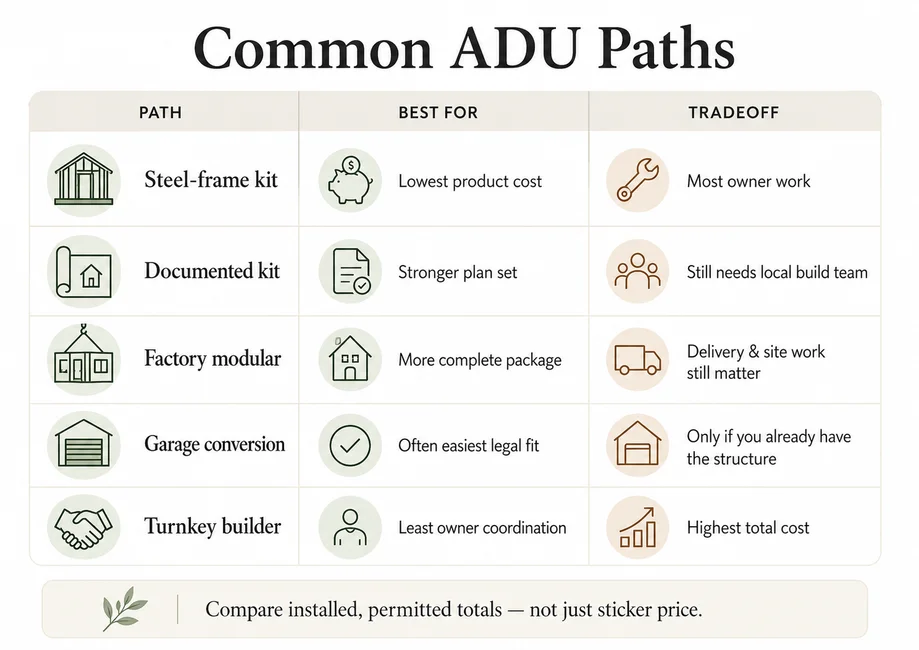
The best alternative depends on the problem you’re solving. If you want the lowest sticker price and can manage permitting, a better-documented kit may beat the Home Depot version. If you want a clearer process, a factory-modular or turnkey provider is safer. If you want the lowest legal risk, a garage conversion or a local site-built ADU often wins outright. Across every path, the rule from the cost section holds: compare installed, permitted totals, not product prices.
| Path | What you actually buy | Unit / sticker price | Realistic all-in (small 1BR) | Permit-friendly as a legal ADU? | Best for |
|---|---|---|---|---|---|
| Home Depot steel-frame kit | Engineered shell only | ~$9,250–$45,000 | $90,000–$200,000+ | Yes — if you finish it to local code | Capable DIY builders who want control on a budget |
| 1. Better-documented kit (Mighty Small Homes; Studio Shed) | Panelized SIP or wood-frame kit + real plan set | ~$26,885–$120,000 kit | ~2–3× the kit price | Yes — with contractor/engineer support | Owner-builders who want stronger documentation |
| 2. Expandable / flat-pack prefab (Home Seller USA; DuraYu) | Mostly-finished foldable box, basic finishes | ~$18,000–$50,000 | $45,000–$120,000 | Varies — verify the code rating | Offices, gyms, guest space; lenient areas |
| 3. Foldable factory studio (BOXABL Casita) | Factory-finished 361 sq ft studio | Est. from $895/mo; “full installation” included | Varies — get a site-specific quote | Often yes in ADU-friendly areas; confirm locally | Fast, modern, compact ADU |
| 4. Factory modular / container (Modular Home Direct) | Pre-assembled modular or container home (more complete) | $56,500–$183,900 | Sticker + foundation/utilities/permits/delivery | Confirm code path + local permit package | Turnkey-leaning, larger or two-bedroom, nationwide |
| 5. Manufactured (HUD) home | Federal HUD-code factory home | Varies; often lowest cost-per-foot | Lower per-foot, siting-limited | Only where local code allows it as an ADU | Budget, where permitted |
| 6. Garage / basement conversion | Convert an existing structure | — | $80,000–$150,000 | Yes — often the easiest approval | Cheapest legal ADU if you have the structure |
| 7. Turnkey regional / local builder (Abodu; local GC) | Full turnkey custom build | Abodu Studio from $278,800 | $200,000–$500,000+ | Yes — the builder pulls permits | Highest quality/resale, hands-off, tricky lots |
Sources: Modular Home Direct (modularhomedirect.com); BOXABL (boxabl.com); Mighty Small Homes (mightysmallhomes.com); Abodu (abodu.com); SelfStorage and Snap ADU for conversion and detached ranges. All verified June 1, 2026.
1. Better-documented kit — the smarter version of what Home Depot sells
Punchline: same DIY model, stronger paperwork.
If you like the idea of a kit, buy one engineered to be permitted. Mighty Small Homes sells American-made structural insulated panel (SIP) kits — a SIP is a foam core sandwiched between two structural boards, giving you framing and insulation in one panel. The company says ADU kits commonly run $40,000–$120,000, with smaller base kits starting around $26,885, and it’s refreshingly honest that the total project “usually lands at two to three times the kit price.” Studio Shed offers the Summit line, with shell-only kits and higher-spec configured models. The trade-off versus a bare steel frame: better drawings and clearer scope, but you still coordinate the foundation, utilities, mechanicals, finishes, and permits locally. (See our steel-frame modular ADU and DIY ADU kit breakdowns for more.)
2. Expandable / flat-pack prefab — cheapest sticker, biggest code caveat
Punchline: great for an office, risky as a dwelling.
These are the foldable steel boxes that ship flat and pop open on site — DuraYu units list around $18,000–$27,000; Home Seller USA offers portable and expandable models. They’re genuinely useful for a backyard office, studio, or gym, and they’re the cheapest way to get enclosed space fast. The catch is the code path: many are built to office or RV-style standards, not the residential IRC, which means they often cannot be permitted as a habitable dwelling. Before you count one as an ADU, get the manufacturer’s written code rating and run it past your building department. (Our expandable prefab ADU guide covers the cost and legal reality in depth.)
Explore expandable prefab options → see Home Seller USA models and pricing
Use the permit-proof checklist below before you request a quote, so you know exactly what to ask about scope and code rating.
3. Foldable factory studio — BOXABL Casita
Punchline: fast and modern, and the old “$50k” number is outdated.
The BOXABL Casita is a 361-square-foot studio that folds for shipping and unfolds on site, with a full kitchen and bath. Watch which number you trust: the viral ~$50,000 figure referred to the factory unit only and is outdated. BOXABL now markets the Casita Studio with estimated payments from $895/month and says “full installation” is included — engineering prints, permits, site prep, grading, foundation, and water/waste/power hookups — while noting that actual price and payment vary by model, location, site work, taxes, delivery, installation, credit approval, and financing terms (boxabl.com, verified June 1, 2026). Get a site-specific quote before you budget, and confirm your city’s approval.
See the BOXABL Casita’s current pricing and availability →
Treat any monthly-payment figure as a starting point, not a project budget, until you have a site-specific quote.
4. Factory modular or container home — Modular Home Direct
Punchline: more finished than a kit; you still own the site work.
Modular Home Direct sells pre-assembled modular, steel-frame, expandable, and container homes nationwide, with published model pricing (verified June 1, 2026): steel-frame units from $56,500 (284 sq ft) and $70,000 (432 sq ft); an expandable 420 sq ft model at $66,500; and container homes from $103,000 (700 sq ft) up to $183,900 (1,280 sq ft). These arrive far more complete than a bare frame, and the company says it helps prepare drawings, engineering, and supporting documents for local permit review. The honest caveat: on some packages labor and assembly aren’t included, so confirm exactly what’s in the price for your model. (More context in our prefab ADU guide.)
Compare ADU Builders
Bring the 12-document checklist below to your inquiry so you can confirm what’s included before you commit.
5. Manufactured (HUD-code) home — where it’s allowed
Punchline: often the lowest cost-per-foot, but siting is the constraint.
A manufactured home is built to the federal HUD code and can be the most affordable per square foot. The deciding factor is local: some jurisdictions (and many California cities under state law) allow manufactured homes as ADUs; others restrict them. Confirm your city’s rules before you fall in love with a price, because a great deal you can’t site is not a deal.
6. Garage or basement conversion — the path everyone overlooks
Punchline: frequently the cheapest legal ADU you can build.
If you have a permitted garage or a suitable basement, converting it typically runs $80,000–$150,000 (SelfStorage, April 2026) and is often the easiest ADU to get approved, because the structure, foundation, and roof already exist and utilities are usually close. In California, AB 68 even eliminated the requirement to replace parking when you convert a garage. If your property supports it, this path beats almost every kit on legal certainty and total cost.
7. Turnkey regional or local builder — Abodu and local GCs
Punchline: the most expensive path, and the least hassle.
A dedicated ADU builder handles design, permits, site work, and construction under one contract. Abodu, for example, builds HCD-state-approved modular ADUs with one-day installs; its Studio (340 sq ft) starts at $278,800 and its One (500 sq ft) at $326,800. Abodu’s pricing page notes customers add roughly $21,700–$52,000 in upgrades and custom site work, plus about $17,000 in permit fees and taxes on average (abodu.com, verified June 1, 2026). A local general contractor building a detached ADU on the West Coast typically runs $375–$600 per square foot, or $300,000–$450,000+ all-in (Snap ADU, March 2026). You pay a premium, but you get the highest resale value, the fewest handoffs, and a builder who owns the permit risk. (For premium options, see our luxury prefab ADU review.)
Which ADU path should you choose for your lot and goal?
Choose the path based on your binding constraint — budget, speed, legal certainty, rental income, family housing, DIY appetite, or financing — not the product photo. The same person can have a different “best” answer depending on whether their priority is the lowest upfront cost or the lowest approval risk. A kit wins on sticker price; a conversion or local builder wins on legal certainty; modular wins on the balance of the two.
| Your situation | Better first path | Why |
|---|---|---|
| Lowest upfront product cost | Steel-frame or panelized kit | Cheapest sticker, but you take on the most responsibility |
| Housing aging parents quickly and safely | Factory modular or local builder | Fewer handoffs, clearer accountability, accessibility control |
| Rental income | A fully permitted ADU with a certificate of occupancy | Rentability depends on legal occupancy, not the product |
| Tight urban lot | Garage conversion or local site-built | Retail units can fail on access, setbacks, or crane delivery |
| National prefab shopper | Modular Home Direct or similar | Compare scope and documentation, then permit locally |
| Want compact and modern | BOXABL or a foldable studio | Verify install, delivery, and your city’s approval |
| Greater San Diego homeowner | A local San Diego ADU specialist | Local process knowledge often beats product price |
| Capable DIY builder, flexible jurisdiction | Steel-frame kit + your own subs | The kit’s strength is engineered structure at low cost |
If you remember one thing from this section: start with feasibility, not checkout. What your lot can permit — setbacks (the minimum distance from property lines), utility distances, and size caps — changes the answer more than any product feature.
What proof should you demand before buying any kit?
Before ordering any Home Depot alternative, ask the seller for the documents your building department, engineer, lender, and insurer will actually need. If the seller can’t produce them, the product may still be usable — but you’re absorbing the permitting and design risk yourself, and you should price that risk in. The single best predictor that a unit can be permitted is whether the seller can show it has been permitted before in a jurisdiction like yours.
The 12-document permit-proof checklist
| Ask the seller for… | Why it matters |
|---|---|
| 1. Stamped structural plans (or an engineer-ready set) | Local plan review usually requires engineered documents |
| 2. The applicable code path (IRC, modular, HUD, RV, Appendix AQ) | Determines whether it can be permitted as a dwelling at all |
| 3. HUD label or state modular approval, if claimed | Manufactured and modular units follow different approval systems |
| 4. Foundation requirements and design | Prevents surprise engineering and sitework costs |
| 5. Utility connection specifications | Water, sewer, and electrical can dominate the budget |
| 6. Mechanical/electrical/plumbing (MEP) scope | Confirms what’s included vs. what you finish |
| 7. Energy-compliance documentation | Required for approval in many jurisdictions |
| 8. Wind, snow, and seismic design specs | Critical for state and city approval |
| 9. Fire-rating and defensible-space details | Especially important in wildfire zones |
| 10. Delivery dimensions and site-access needs | Prevents a unit that can’t physically reach your yard |
| 11. Warranty and return terms | Home Depot’s 90-day return won’t solve a permit denial |
| 12. Local permit examples or approval history | The strongest evidence the product actually works |
Copy-and-paste this email to your building department
“I’m considering using [product/model name] as a detached accessory dwelling unit at [address or parcel number]. The seller describes it as a [frame kit / prefab / modular / tiny home]. Before purchasing, can you confirm what code path would apply, whether this structure type can be permitted as a dwelling on my lot, and what plan documents you require for review?”
The answer is more useful than any product review, because it comes from the department that will actually review your permit.
Download the free ADU Starter Kit → get this 12-document checklist + the cost worksheet
Printable, ready to take to your building department and your contractor.
What are the biggest downsides of Home Depot ADU alternatives?
The biggest downside isn’t that Home Depot’s products are bad — it’s that the buyer can quietly become the developer, permit coordinator, engineer-wrangler, and contractor manager without realizing they signed up for it. A retail checkout page transfers all of that responsibility to you, and a low price can mask a high-effort, high-risk project.
The seven real risks, and what each means in practice
| Risk | What it actually does to your project |
|---|---|
| Permit denial | The unit may not be approvable for dwelling occupancy — leaving you with an expensive shed |
| Missing scope | Foundation, utilities, MEP, finishes, and labor can multiply the kit price 2–3× |
| Size mismatch | The unit may exceed your local detached-ADU size cap |
| Delivery/access failure | Tight lots, slopes, fences, and overhead wires can block installation |
| Financing mismatch | Some lenders don’t treat a retail kit like a standard home improvement |
| Insurance/appraisal uncertainty | An unpermitted or oddly-classified unit can hurt insurability and resale value |
| Warranty handoff | The seller warrants the product, not your whole ADU project |
Who should not buy a Home Depot ADU product first
Don’t order first if you need guaranteed local approval, need a renter-ready unit on a deadline, can’t manage contractors, can’t absorb a cost overrun, or don’t yet know whether your city will accept the structure. In any of those cases, the order is the last step, not the first — and the right first step is a feasibility check that tells you what’s actually buildable.
The good news: none of these risks are mysteries. Every one is knowable before you spend money, with a feasibility check and the 12-document checklist above. Buyers who do that homework are the ones who build excellent, affordable ADUs from kits. Buyers who skip it are the ones writing the angry forum posts.
How do you pay for a legal ADU without falling for sticker-price math?
Treat financing as a path decision, not a lender ranking — and budget for the full, installed project cost, not the kit price. Because a finished ADU usually lands well above any sticker, most owners use one of a few financing lanes: a renovation loan, a cash-out refinance, a home-equity line, or a construction loan. The right lane depends on your equity, your timeline, and your project size.
| Financing lane | Where it can fit (by project size) | What to watch |
|---|---|---|
| Cash / savings | A small kit, design, permits, or early site work | Easy to underestimate the full installed cost |
| HELOC (home-equity line of credit) | Smaller add-ons and conversions for owners with usable equity | Variable terms and underwriting; availability isn’t guaranteed |
| Cash-out refinance | Mid-to-large builds for owners with substantial equity | Refinancing changes your whole mortgage; evaluate the trade-off |
| Renovation or construction loan | A larger, permitted detached ADU | Draw schedules and contractor requirements may apply |
| Personal loan | Small gap funding only | Usually not ideal for full ADU construction |
| Provider financing | Some prefab sellers advertise monthly payments | Confirm the total installed price and the financing terms |
A practical sequence: estimate your full installed budget first (use the cost decoder above), add a 10–15% contingency, then compare financing lanes against that real number. Financing the kit price alone is how projects stall halfway through.
Compare common funding routes and their eligibility limits before contacting a lender.Compare ADU Financing Options
This is independent, educational information — not a loan offer, a rate quote, or a guarantee of approval.
Will a backyard ADU actually pay for itself?
A legal ADU can generate rental income or house family for far less than buying a second property — but the return depends entirely on legal occupancy first. An unpermitted unit is hard to rent, hard to insure, and generally not credited by appraisers, so cutting corners on permits is the fastest way to destroy the ROI you’re chasing.
The sequence that protects your returns is simple: permit, then certificate of occupancy, then rent. Skip the first two and you don’t have a rentable asset — you have a liability that can trigger fines, void insurance, and complicate a future sale. Appraisers and lenders generally credit permitted, finished square footage, not a shed or an unpermitted conversion, so the permit is also what turns your spend into equity.
Three numbers decide whether an ADU pencils out: your all-in build cost (use the cost decoder and add a 10–15% contingency), your local market rent, and your vacancy and management costs. Run those against your financing lane before you commit. Once a unit is built and legal, many small landlords use property-management software to handle tenant screening, leases, and rent collection — tools like Buildium are built for exactly that (an affiliate partner; see our disclosure above) — but that’s a step for after you have an approved, occupiable unit.
These are illustrative examples, not guarantees of returns. Actual results depend on local market conditions, construction costs, financing terms, and regulatory approvals.
What should you do before you order a Home Depot ADU, kit, or alternative?
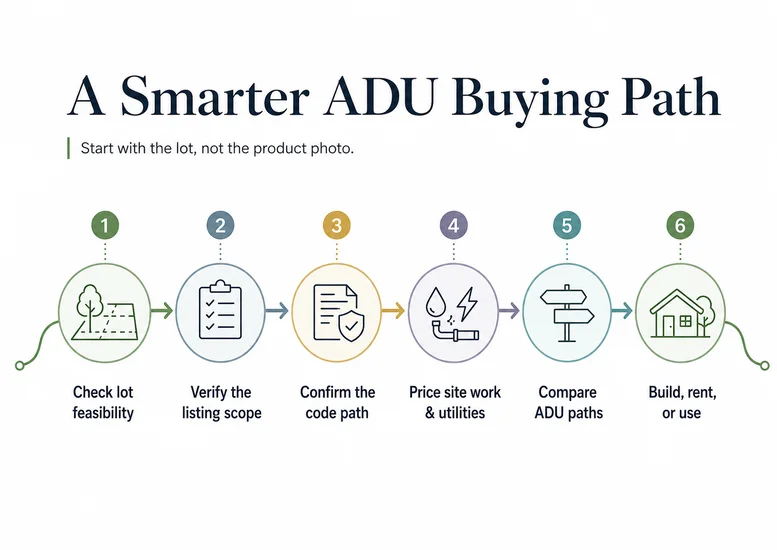
Don’t start with checkout. Start with feasibility, then seller documents, then local confirmation, then a full installed budget — and only then purchase. The order in which you take these steps is the difference between a smooth build and a five-figure lesson.
- Save the evidence. Capture the exact product URL, model number, price, and a screenshot (listings and prices change, and several we checked showed “0 in stock”).
- Identify the category. Frame kit, shell kit, modular, manufactured, tiny house, or turnkey ADU — this sets the code path.
- Demand the 12 documents. Use the permit-proof checklist above.
- Email your building department. Send the copy-and-paste script and get a property-specific answer.
- Price the rest. Have a contractor or engineer estimate foundation, utilities, MEP, and site work for your lot.
- Compare installed totals. Put the kit’s all-in number next to a modular provider, a local builder, and a garage conversion.
- Then order. Place a deposit only after the permit path and full budget are clear.
What we verified for this guide
We verified representative Home Depot listing prices and product claims, official alternative-provider pricing pages, federal manufactured-housing oversight, and current California ADU law. We used homeowner forums only to understand buyer language and concerns — never as proof of laws, costs, or code. Every commercial claim here carries a source and a verification date so you can re-check it before you buy.
What we verified — Last verified: June 1, 2026
- Home Depot listings are third-party-seller products in the “Tiny Home Frame Kits” category, a mix of steel-frame shell kits, shell packages, and prefab listings; one seller’s copy states the kit is “ONLY the steel frame structure (shell).” (homedepot.com)
- Specific prices: Bedrock 300 sq ft steel-frame studio kit, $9,250; Pre-Fab Tiny Homes ADU 150 sq ft, $41,999; WINNDOORS LLS “Modern Prefab ADU” 360 sq ft, $49,999, with a “No permit required” bullet; “Modern Prefab ADU” 420 sq ft “Best Seller,” $105,000 (with conflicting 420/490 sq ft language). The viral ~540 sq ft kit ran ~$43,000–$44,000 in 2023 (Inman; NY Post). (homedepot.com; 2023 press)
- The contradiction: the WINNDOORS LLS / Prefab1 listings claim “no permit required” on one product and tell buyers to take preliminary plans “to your local authority for approval” on another. (homedepot.com)
- Cost data: national ADU ranges and components from HomeGuide, Angi (2026), SelfStorage (April 2026), Snap ADU (March 2026), and Mighty Small Homes — including its “two to three times the kit price” rule. (2026)
- Alternatives pricing: Modular Home Direct, BOXABL, Mighty Small Homes, and Abodu, each from the company’s own site. (2026)
- Law: California ADU rules (AB 68; SB 13; Gov. Code §§66317, 66321, 66311.5, 66315; AB 976) from California code and HCD guidance; HUD’s role from HUD.gov; tiny-house code from ICC’s IRC Appendix AQ. (2025–2026)
- Not legal advice; rules are local. A product listing or national guide can’t confirm what’s legal on your lot — always verify with your city or county.
Methodology
Dwelling Index is an independent research resource covering ADU financing, costs, and regulations. We built this guide by reviewing representative Home Depot “Tiny Home Frame Kit” and prefab listings and their linked manufacturer pages; official pricing pages for Modular Home Direct, BOXABL, Mighty Small Homes, Studio Home, and Abodu; federal manufactured-housing resources from HUD; and current California ADU statutes. We assembled the all-in cost decoder by itemizing the standard components an ADU build requires and pricing each from current 2026 cost sources. We used homeowner forums only to understand buyer concerns and language — not as evidence of laws, prices, code requirements, or product performance. We do not sell ADUs or kits; some links are affiliate links, disclosed above, and our comparisons are sorted by neutral criteria and never influenced by compensation. Prices, availability, and rules were verified on June 1, 2026 and should be re-checked before purchase.
Sources (verified June 1, 2026): Home Depot product listings (homedepot.com); manufacturer pages for PLUS 1 Homes / Well Done 1 Kit Homes, WINNDOORS LLS / Prefab1, and Bedrock Building Group; Inman and New York Post (2023); HomeGuide; Angi (2026); SelfStorage (April 2026); Snap ADU (March 2026); Mighty Small Homes; Studio Home; Modular Home Direct; BOXABL; Abodu; BuildingsGuide (2026); HUD Office of Manufactured Housing Programs (hud.gov); ICC IRC Appendix AQ; California Government Code §§66317, 66321, 66311.5, 66315 and California HCD; Washington State Department of Commerce; and Mass.gov.
Frequently asked questions
Are Home Depot tiny homes legit?
Yes — the products are real, and the steel-frame kits are genuinely engineered structures. The catch is what “legit” means for your project: a real frame kit is not a finished, permitted home. The product is legitimate; treating a checkout page as a permit decision is the mistake. Confirm the code path, the full installed cost, and your local approval before buying.
Does Home Depot sell real ADUs?
Home Depot lists products marketed as ADUs, tiny homes, and frame kits, but it doesn’t manufacture them — they come from third-party sellers, and many are steel-frame shells or compact prefab units. Whether any becomes a permitted ADU depends on local zoning, building permits, foundation, utilities, inspections, and a certificate of occupancy, not on the listing title.
Are Home Depot tiny homes legal to live in?
Only if the finished structure and site are approved for residential occupancy by your local building department. A unit can look like a home and still require permits, inspections, utility connections, and code-compliant construction before anyone can legally live in it.
Do Home Depot ADU kits need permits?
For residential use, assume yes until your city or county says otherwise. Even prefabricated or kit structures typically require a building permit to be used as a dwelling, and a backyard ADU normally involves zoning review, building permits, utility work, and inspections.
Why is a Home Depot ADU kit so much cheaper than a turnkey ADU?
Because the kit price usually covers only the frame, panels, or selected materials plus drawings — not the foundation, utilities, mechanicals, finishes, permits, or labor. One kit manufacturer, Mighty Small Homes, states the total project cost typically runs two to three times the kit price once those items are added.
What do Home Depot tiny home reviews miss?
Reviews tend to focus on delivery, assembly, and product quality — useful, but they don’t prove your unit can be permitted as a dwelling where you live. A five-star review in a rural county tells you little about an approval in a strict suburban jurisdiction. The decisive question isn’t “is the product good?” but “will my city permit this structure on my lot?” — which only your building department can answer.
What is the cheapest Home Depot ADU alternative?
The cheapest upfront alternative is often a documented panelized or steel kit, but the cheapest legal path is frequently a garage or basement conversion — typically $80,000–$150,000 — if your property already has a suitable structure and nearby utilities.
Is one listing’s “No permit required” claim true?
Treat it as marketing, not law. Your local building department decides whether a structure can be occupied as a dwelling, and even the most ADU-friendly state, California, still requires a ministerial building permit and inspections. Notably, the same seller that advertises “no permit required” elsewhere tells buyers to take plans to their local authority for approval.
Is BOXABL a better alternative to a Home Depot ADU?
BOXABL’s foldable Casita may fit some compact-prefab buyers, but it isn’t automatically better for every project. The old ~$50,000 figure was the factory unit only; BOXABL now markets the Casita Studio with estimated payments from $895/month and “full installation” included, and you still need to confirm local approval, delivery, and a site-specific quote.
Can I use a Home Depot kit in California?
Possibly, but California’s ADU-friendly laws don’t make every retail kit automatically approvable. You still need a compliant application, a ministerial building permit, and a structure that meets the applicable code path — and the state protects ADUs in the roughly 800–1,200-square-foot range, with a 150-square-foot minimum and a 60-day review of a complete application.
Not sure where to start?
See what’s possible at your address — get your free ADU report in 60 seconds.
Get my free ADU report →Related guides
- Home Depot ADU: 11 real prices & the true all-in cost
- Prefab ADU guide — brands, costs, and local code paths
- DIY ADU kit guide — what to buy, what to build
- Expandable prefab ADU — the code-rating trap in cheap foldable units
- Backyard ADU kit cost breakdown
- How much an ADU costs in 2026
- Best ADU financing options
- Permit-ready ADU plans — 20+ verified programs