Permit Ready ADU Plans: 20+ Verified Programs and the Catch Most Homeowners Miss
By The Dwelling Index Editorial Team — an independent research resource covering ADU financing, costs, and regulations. We are not a builder, lender, or plan seller.
· Last verified: May 31, 2026
Permit ready ADU plans are pre-drawn building plans published or sold as ready to submit for a permit — but the catch most homeowners miss is that “permit-ready” is not a permit, and it is not the same as “pre-approved” by your own city. A stock plan you buy online (we found complete sets starting around $599) has never been seen by your building department. A city pre-approved plan has — and in California, your city must approve or deny a complete detached-ADU application that uses a current, qualifying pre-approved plan within 30 days under Government Code §65852.27. Either path, you still pull a permit and still supply a site plan, a foundation engineered for your soil, and energy calculations for your climate zone. The fastest first move is to confirm whether your city runs a program and whether your lot even qualifies before you pay anyone. See what’s possible at your address — get your free ADU report.
| What you think you’re getting | “Permit-ready” usually means | What to do next |
|---|---|---|
| “The city already approved my ADU.” | The building design was pre-reviewed for a local program — not your specific project on your lot. | Verify your lot’s eligibility and the site-specific documents still required. |
| “I can skip permits.” | No. You still apply for and pull a building permit. | Get your city’s submittal checklist and prepare a site plan. |
| “It will be cheaper and faster.” | Often — but only if the plan fits your lot with no structural changes. | Compare permit-ready vs. prefab vs. custom before you buy. |
Find programs near you — and check your lot. Most pages on this topic explain only one city. Our Permit-Ready ADU Plan Finder below shows whether your jurisdiction runs a program, how many plans it offers, whether they’re free, and the catch to verify first. Then run a free, address-level feasibility check on your exact parcel. Check my city and lot →
What are permit ready ADU plans?
Permit ready ADU plans are pre-designed plan sets for an Accessory Dwelling Unit (ADU) — a self-contained second home on a single-family or multifamily lot — that have been drawn to a building-code standard so they can move through permitting faster than a custom design. The phrase is used two very different ways: by cities for plans their building department has pre-reviewed, and by plan shops and prefab companies for finished drawings they sell. Neither version is a building permit, and a plan that is “permit-ready” in marketing language can still be rejected on your lot.
The confusion is the whole problem. When the City of Menifee, the City of Poulsbo, or Riverside County calls its program “Permit Ready ADU,” it means a building department reviewed those exact drawings and will fast-track them. When a designer on a marketplace sells you a “permit-ready” set for a few hundred dollars, it means the drawings are complete enough to submit — but your city has never seen them, and they were almost certainly not engineered for your soil, your seismic or wind zone, or your climate zone’s energy code.
Maxable, an ADU planning service, frames the core misconception well: a pre-approved plan is not the same as a pre-permitted one — your planning department still needs to know how the ADU sits on your property, how it connects to utilities, and how it interacts with surrounding structures before any permit is issued (Maxable, verified May 2026).
Permit-ready vs. pre-approved vs. pre-permitted vs. standard — decoded
There is no single national vocabulary, which is exactly why this query is so confusing. Here is what each term actually signals.
| Term you’ll see | Who uses it | Did your city review this design? | The honest meaning |
|---|---|---|---|
| Permit-ready plans (for sale) | Plan shops, prefab companies, designers | No — unless your city separately pre-approved that plan | “Complete enough to submit.” Still needs local engineering and a site plan. |
| Pre-approved / Pre-reviewed plans | Most city & county programs | Yes — the building design was checked for code | Faster review, but you still file a permit and add site-specific work. |
| Standard Plan / Master Plan | LADBS, LA County, Placer Co., Lincoln | Yes — pre-reviewed, often architect-owned | Same idea; the plan is “non-site-specific.” |
| Shelf-Ready / ADU Ready / PRADU | Sacramento County, Sonoma County, Menifee, Encinitas | Yes — branded versions of the same idea | Same idea; programs and contents vary widely. |
| Pre-permitted | (marketing only) | No such walk-in product exists | You always submit a building permit application. Treat this word as a red flag. |
Plain-English definitions used throughout this guide. A DADU is a detached ADU (a standalone backyard cottage). A JADU (junior ADU) is a unit of 500 sq ft or less created within an existing home, usually with owner-occupancy strings. Plan check is the city’s review of your drawings. A site plan (or plot plan) shows where the ADU sits on your lot, with setbacks and utilities. A setback is the required distance from a structure to a property line. Title 24 is California’s building energy-efficiency code; the CF-1R is its compliance form. A utility lateral is the pipe or line connecting your unit to the public water, sewer, or power main. Ministerial approval means the city must approve a compliant application by objective standards, without a discretionary hearing. Impact fees and system development charges (SDCs) are one-time fees on new units that fund infrastructure.
One legal nuance worth knowing: California’s law requires cities to post pre-approved plans and the applicant’s contact information online, but states that posting “is not an endorsement” of the applicant and is not approval of any specific detached-ADU application (Gov. Code §65852.27, verified at leginfo.legislature.ca.gov, May 2026). The plan being listed does not mean your project is approved.
The damaging admission, said up front: “permit-ready” is one of the most overused phrases in the ADU world. A set of drawings can be technically permit-ready and still be useless to you — if your city won’t accept it, or if your lot forces structural changes that throw out the fast-track. The good news is that this is entirely knowable before you spend money, and the rest of this guide shows you exactly how to check.
The 4 ways to get ADU plans — and which one fits you
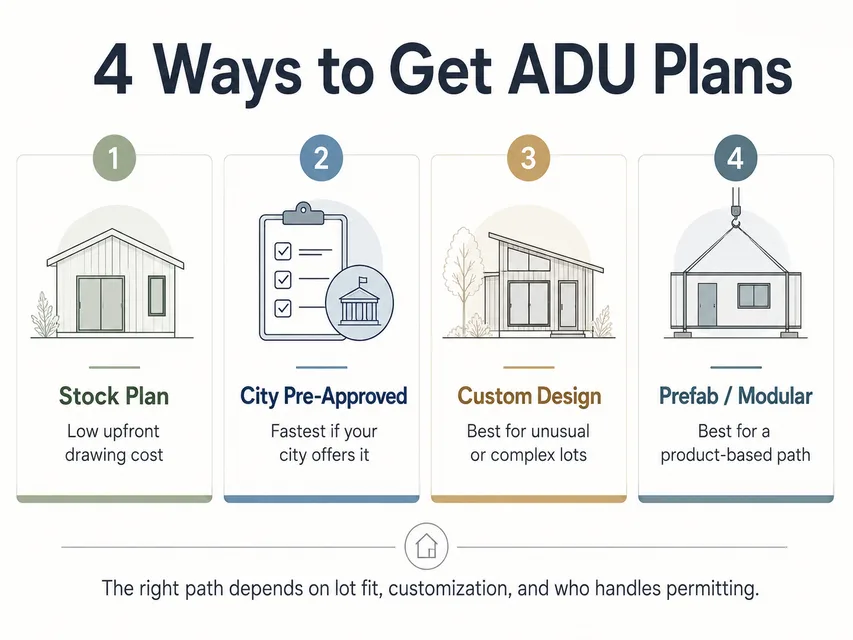
There are four realistic ways to get plans for an ADU: buy a stock “permit-ready” set, use your city’s pre-approved program, hire a designer for a custom set, or buy a prefab/modular unit where the design is bundled. They differ most on three things — how much your lot deviates from a standard rectangle, how much you intend to customize, and who carries liability for pulling the permit. A city pre-approved plan is usually fastest and cheapest where it exists and fits; a custom set is the safest path for complicated lots; prefab folds the design into the product.
The matrix below is sorted by typical upfront plan cost, lowest to highest. Every figure is sourced and dated in the cost section.
| Path | Typical plan cost | Timeline advantage | Customization | Best for |
|---|---|---|---|---|
| A. Buy a stock plan | from ~$599 online | None by itself — your city hasn’t seen it | Anything, but you re-engineer it | DIY-minded owners, standard flat lots, builders |
| B. City pre-approved program | Free to a few thousand (designer license) | Largest — review cut to same-day to 30 days where offered | Finishes & mirroring only, usually | Standard lots in a city that runs a real program |
| C. Custom designer set | ~$5,000–$20,000+ | Moderate; still goes through full plan check | Fully tailored | Sloped, coastal, historic, or unusual lots |
| D. Prefab / modular | Bundled into the unit | Factory build runs parallel to permitting | Within the product line | Owners who want a turnkey product and provider support |
Path A — Buy a stock “permit-ready” plan
Stock plans are the cheapest entry point — we found complete ADU sets starting around $599 on one online plan marketplace (verified May 2026). But a stock set is drawings, not a project. Even a reputable plan still needs a designer to finish a submittable package for your jurisdiction; off-the-shelf plans still require local adaptation, structural work for your soil, and Title 24 for your climate zone (SnapADU, verified May 2026). If you go this route, vet the seller on whether the set includes structural calculations, whether it can be stamped in your state, and what local adaptation it will still need.
Path B — Use your city’s pre-approved program
This is the path most people are actually looking for, and where it exists and fits your lot, it is usually the best value — frequently free, and dramatically faster. The catch is availability and fit, which is what the finder below resolves.
Path C — Hire a custom designer
A full custom permittable set runs roughly $5,000–$20,000 in California, and higher in coastal, hillside, or HOA-restricted situations. It’s the right call when your lot or use case can’t be served by a standard plan — and, as we’ll show, a bad-fit pre-approved plan can actually end up slower than a clean custom design.
Path D — Go prefab or modular
With prefab and modular ADUs, the design is typically bundled into the unit price, so “plans” aren’t a separate line item, and the factory build can run in parallel with your local permitting. Prefab does not eliminate local approvals — you still need a site plan, foundation, and utility connections — but it can compress the overall timeline.
Not sure which path your lot supports? Setbacks, lot size, fire and coastal overlays, and zoning decide whether any plan can be built before you spend a dollar on drawings. See what’s possible at your address → Get your free ADU report
Does your city have a permit-ready / pre-approved ADU plan program?
Whether a program exists depends almost entirely on your state. California requires every city and county to run a pre-approval program under AB 1332 (since January 1, 2025). Arizona, Oregon, and Maine passed laws in 2025; Colorado funds programs through grants; Vermont is piloting a statewide catalog; and Washington, Tennessee, New York, Pennsylvania, and Hawaii introduced bills in early 2026. As of 2026, roughly 40 U.S. jurisdictions run some form of pre-approved building-plan program — and even where one exists, quality ranges from a rich free catalog to a thin PDF. That last point matters: California’s law lets a city “comply” with as little as an online list of green-lit designs, so “a program exists” does not guarantee free, ready-to-use plans.
The table below is our Permit-Ready ADU Plan Finder (v1) — assembled from official city, county, and state sources and verified in May 2026. The Scope column matters more than it looks — the single most common mistake is confusing a city program with its county program, which are often entirely separate (Riverside is a perfect example below). Each row links to its official source.
| Jurisdiction / program | Scope | Plans & sizes (verified) | Free or paid | The catch to surface | Source |
|---|---|---|---|---|---|
| California — AB 1332 statewide rule | All CA cities & counties | Every jurisdiction must run a program; qualifying detached-ADU apps get a 30-day approve-or-deny window | Cities may charge a review fee | “Program exists” can mean just a PDF; the 30-day clock needs a complete application on a current-code-cycle plan | leginfo §65852.27 |
| City of Los Angeles — LADBS Standard Plan | City of LA | One free city-owned plan (YOU-ADU); other Standard Plans are privately owned | YOU-ADU free; private plans purchased from owner | Privately owned plans must be bought from the plan owner; LADBS still reviews zoning + foundation for your lot | dbs.lacity.gov |
| Los Angeles County — Standard Plan Program | Unincorporated LA County | County Catalog (Plans A/B/C; 800–1,200 sq ft) + Private Designer Catalog | County plans free; designer plans paid | Plans “cannot be revised”; Private Designer Catalog needs updates for the Jan 1, 2026 code (“available soon”); still need a plot plan + Title 24 | planning.lacounty.gov |
| Seattle, WA — ADUniverse | City of Seattle | 7 pre-approved detached (DADU) designs | Designer license (one-time, one location) | Average ADU approval time fell from 160 days to 54 days under the program (Pew); site plan + foundation still required | seattle.gov/ADUniverse |
| San José, CA | City of San José | 3 approved plans (476 / 499 / 748 sq ft); more may be pending | Vendor pricing | Same-day permit possible with a complete site-specific package; pending plans aren’t eligible for expedited path; no modifications | sanjoseca.gov |
| Santa Clara County, CA | Unincorporated Santa Clara Co. | County + vendor plans | County free; vendor paid | Owner still supplies site plan, Title 24 (CF-1R), solar PV plans, and a stamped truss design | santaclaracounty.gov |
| Sacramento County, CA — “Shelf Ready” | Unincorporated Sacramento Co. only | 4 models: 460 sq ft (studio/1BR, 2 roof options), 870 sq ft (2BR), 1,000 sq ft (2BR), 1,184 sq ft (3BR) | Free (LEAP grant) | Truss calcs included (no truss changes allowed); still file with local fire jurisdiction; standard fees apply | saccounty.gov |
| Placer County, CA — Master ADU | Unincorporated Placer Co. | Vendor master plans (non-site-specific) | Designer fees may apply | Plans are explicitly non-site-specific; you must handle wind, seismic, and fire-zone design for your site | placer.ca.gov |
| Concord, CA | City of Concord | 6 free plans, ~200–900 sq ft | Free (HCD grant-funded) | Permits possible in 5 working days with a complete package; you still provide a site plan + foundation + utilities | cityofconcord.org |
| Richmond, CA | City of Richmond | Pre-approved detached plans (incl. architectural, structural, MEP, Title 24) | Offered free of charge | Even with Title 24 included, you must supply a cover sheet + site-specific plan + a foundation design | richmondca.gov |
| Citrus Heights, CA | City of Citrus Heights | 3 models (two 1-bed/1-bath, one 2-bed/1-bath) | Free (LEAP grant) | Plans offer accessibility options and a reversed format; site plan required first | citrusheights.net |
| Piedmont, CA | City of Piedmont | City plans: 500 sq ft (studio), 800 sq ft (1BR), 484 sq ft (garage conversion); plus third-party plans | City plans: no ADU permit fees, but very-low-income affordable-rent restriction; third-party plans paid | City-plan rent restriction is a real string; designer plans cost extra | piedmont.ca.gov |
| Colma, CA | Town of Colma | Pre-approved detached plans (site-built or prefab) | Program plans | Not tied to a property; “no customization beyond materials” for the 30-day path | colma.ca.gov |
| City of Riverside, CA | City of Riverside | 4 plans: 746, 800, 1,020, 1,200 sq ft | Program plans | Initial plan review targets 3 business days, subsequent reviews 10 business days; preliminary site plan still required | riversideca.gov |
| Riverside County, CA — TLMA | Unincorporated Riverside Co. | 4 free plans: 499 sq ft (studio), 625 sq ft (1BR), 749 sq ft (2BR), 909 sq ft (2BR/2BA) | Free PDF plans | Separate program from the City; zoning, floodplain, and cultural-resource eligibility apply; complete site plan + cover sheet required | building.rctlma.org |
| Menifee, CA — PRADU | City of Menifee | 8 pre-reviewed plans, reversible/flippable | Program plans | Full plan set required at submittal; standard fees still apply | cityofmenifee.us |
| Lake Elsinore, CA | City of Lake Elsinore | 3 plans: 495 sq ft (new ADU), 735 sq ft (new ADU), 400 sq ft (garage conversion) | Program plans | One of the few libraries with a garage-conversion plan; packet, application, indemnification, and fees required | lake-elsinore.org |
| Poulsbo, WA | City of Poulsbo (Kitsap/KRCC catalog) | Up to 6 KRCC designs, 480–1,000 sq ft (incl. an 800 sq ft two-story and a 672–834 sq ft garage option) | Building & engineering plans free | Other fees still apply; non-standard modifications may disqualify pre-approved status | poulsbo.gov |
| Boise, ID | City of Boise | 8 free plans, 280–695 sq ft (studio–2BR, incl. over-garage) | Free | Custom design can run “upwards of $10,000”; you still owe utilities, impact fees, and a site plan | cityofboise.org |
| Santa Barbara, CA PAUSED | City of Santa Barbara | Program paused — plans shown are reference only | N/A while paused | Plans “are not eligible for permitting due to updates in the 2025 construction codes”; new plans in progress | santabarbaraca.gov |
| Portland, OR | City of Portland | 4 free plans (shared from Eugene), by roof/foundation type | Free | Separate electrical/plumbing/mechanical permits, zoning, utilities, flood, and possible SDCs still apply | portland.gov |
| Eugene, OR | City of Eugene (shared statewide) | Pre-approved plan library; one city plan (“The Joel”) free, most others purchased from design firms | Mixed: one free, most paid | Origin of Oregon’s shared catalog (Portland/Bend/Salem use it); site-specific checks still local | eugene-or.gov |
Beyond this list, Pew’s 2026 national survey counts roughly 40 jurisdictions with pre-approved building-plan programs — including non-ADU and multi-unit catalogs in places like South Bend (IN), Jackson (MI), Hawaii County (HI), and Claremore (OK). We’re adding verified ADU rows quarterly (Renton, Ashland, Bend, Salem, Kirkland, Cupertino, San Diego City & County, and others), each with its own source and verification date.
Use the finder, then keep the tracker. Our Pre-Approved ADU Plan Program Tracker lists program status, plan counts, and free-vs-paid signals across states, and we re-verify it as new cities come online. Download the free Program Tracker →
California — what AB 1332 guarantees (and the loophole)
Under AB 1332, codified at Government Code §65852.27, every California local agency had to develop an ADU plan pre-approval program by January 1, 2025, post the plans online, and approve or deny a complete detached-ADU application built on a qualifying pre-approved plan within 30 days. The California Building Officials association (CALBO) notes the catch in plain terms: a city can satisfy the law with an online database of plans or simply a PDF of designs it has green-lit (CALBO, verified May 2026). So in California the question isn’t “does my city have a program” — by law it does — but “does my city’s program have usable, current plans for my lot.”
Washington, Oregon, Idaho & the rest of the West
Outside California, the strongest programs are concentrated in the Pacific Northwest. Seattle’s ADUniverse program offers seven pre-approved detached designs, and the city’s reports show pre-approved plans cut average ADU approval time from 160 days to 54 days — a 2.6× reduction (The Pew Charitable Trusts, May 2026). Oregon built a shared model: Eugene developed plans and gave them to Portland at no cost, with similar plans in use in Bend and Salem (Portland.gov, verified May 2026). And the trend is moving inland — Boise launched eight free pre-approved plans (280–695 sq ft) in March 2026, with the city noting a custom design can run “upwards of $10,000” (cityofboise.org, verified May 2026).
The 2025–2026 wave: AZ, ME, VT, CO, and bills to watch
A May 2026 report from The Pew Charitable Trusts maps the national picture: California acted first statewide; Arizona, Oregon, and Maine passed pre-approved-plan laws in 2025; Vermont is piloting its “802 Homes Catalog”; and Colorado funds pre-approved plans through “ADU Supportive Jurisdiction” grants (HB24-1152). Pew also reports that Washington (statewide), Tennessee, New York, Pennsylvania, and Hawaii introduced pre-approved-plan bills in early 2026. If you’re outside the West Coast, search your city’s building or planning department site for “ADU,” “pre-approved,” “standard,” or “permit-ready” plans.
No program near you? Here’s what to do instead
If your city has no usable library, you still have three solid paths: a semi-custom designer set for a simple lot, a prefab/modular unit in a prefab-friendly area, or a full custom design for a complex site. One thing you generally cannot do is grab another city’s free plan and assume your city will fast-track it — even where an agency could adopt outside plans, you still need your own jurisdiction to accept it for your address. The smartest first step in any of these cases is the same: confirm what your lot can actually hold.
For more on specific city programs, see: City of San Diego ADU plans, San Diego County pre-approved ADU plans, San José pre-approved ADU plans, Chula Vista pre-approved ADU plans, Encinitas PRADU plans, Carlsbad permit-ready ADU status, and El Cajon pre-approved ADU plans.
Are permit ready ADU plans actually free?
Sometimes. Many city-owned plan sets are genuinely free — Concord, Boise, Citrus Heights, Richmond, and Los Angeles County all publish no-cost plans. But “free plan” means free base drawings, not a free project: private-designer plans carry a license fee, some “free” plans come with strings, and every path still requires a paid site plan, foundation engineering, utility plans, and permit fees. Treat “free” as “free design,” not “free permit.”
Free city plans — and the strings some carry
Where a city owns the plans outright, the design fee disappears. Concord, California offers six free, code-compliant plan sets (about 200–900 sq ft) funded by a state housing grant (cityofconcord.org, verified May 2026). Boise’s eight plans are free; Citrus Heights’ three models came from a state LEAP grant; and Los Angeles County’s County Catalog plans are free to download. But read the fine print: the City of Piedmont waives ADU permit fees if you use a city-designed plan — on the condition that, if you rent the unit, it must be affordable to very-low-income households (piedmont.ca.gov, verified May 2026). A free plan with a multi-year rent restriction is a very different deal than a free plan with no strings.
Paid designer or vendor plans
When the designer owns the plan, you license it. Seattle’s program is explicit: paying the plan fee buys you the right to use that design one time, in one location — industry-standard for any purchased or custom design (Haas Building, verified May 2026). Los Angeles’s LADBS program is mostly privately owned plans: only the city’s own YOU-ADU plan is free, while other Standard Plans must be purchased from the plan owner (dbs.lacity.gov, verified May 2026).
| Cost bucket | Usually free? | What to verify |
|---|---|---|
| Base city-owned plan files | Sometimes | City ownership, current-code status, and any rent/affordability strings |
| Private designer/vendor license | No | Price, scope, copyright, single-use terms |
| Site plan | Usually no | Who prepares it; whether a survey is needed |
| Foundation / soils engineering | Usually no | Soil, slope, seismic, wind, frost, flood |
| Utility / MEP plans | Usually no | Electric load, panel size, gas, sewer/water route |
| Permit & plan-check fees | No | Get a written city fee estimate |
Build your budget before you build. Our free starter kit includes a permit-ready plan cost checklist and a copy-paste city call script. Download the free ADU Starter Kit →
What do permit ready ADU plans really cost — by path?
A stock plan starts around $599 (drawings only); a city pre-approved plan is often free or a one-time designer license; a full custom permittable set runs about $5,000–$20,000 in California; and prefab folds the design into the unit price. A 2026 Pew analysis found pre-approved-plan programs reduce a builder’s overall development cost by about 1%–2% — roughly $5,000–$10,000 on a $500,000 project — primarily by cutting design and approval costs. The figure that surprises people most: the site-specific work that applies to every path usually runs several thousand dollars on its own.
| Path | Typical price | What it includes | What it does not include | Source (verified May 2026) |
|---|---|---|---|---|
| Stock online plan | from ~$599 | Architectural set, sometimes basic structural | Local engineering, Title 24 for your zone, site plan, stamping | Online plan marketplace |
| City pre-approved (city-owned) | Free | Pre-reviewed building design | Site plan, foundation, often solar, fees | Concord, Boise, LA County |
| City pre-approved (designer-owned) | License fee (varies) | Pre-reviewed design, single-use license | Site-specific items, fees | Seattle, LADBS |
| Custom designer set | ~$5,000–$20,000+ | Full tailored permittable set | — (this is the comprehensive set) | SelfStorage, Cad Crowd, SnapADU, GreatBuildz |
| Prefab / modular | Bundled into unit price | Design + factory build | Site work, foundation, utilities, permits | homewip.com |
How much do you actually save with a pre-approved plan? Estimates vary by who’s counting. The neutral, multi-program figure from Pew is about 1%–2% of total project cost ($5,000–$10,000). Builder estimates land in a similar-to-wider band: GatherADU estimates $3,000–$5,000; and one San Diego firm cites $8,000–$25,000 in design-fee savings versus a fully custom design. We present these as attributed estimates, not a promise — your actual savings depend on your city and lot.
Why “free” still isn’t free: a no-cost city plan removes the design-and-review cost. It does not remove site preparation, the foundation engineered for your lot, utility laterals, the permit and plan-check fees, or construction itself — which is where the vast majority of an ADU’s all-in cost lives.
If you’re weighing how to fund construction, see our independent breakdown of ADU loan lanes in Best ADU Financing Options.
What do permit ready ADU plans still NOT include?
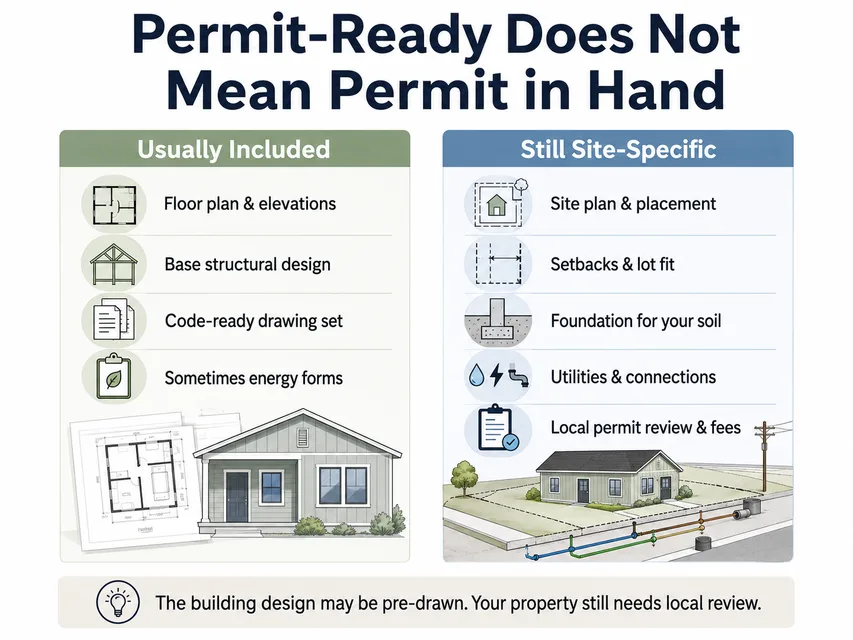
A pre-approved or stock plan covers the ADU building. Your permit package still needs property-specific work: a site plan, a foundation engineered for your soil and seismic zone, Title 24 energy calculations for your climate zone, often solar PV plans, sometimes a stamped truss design and soils report, plus separate electrical/plumbing/mechanical permits, utility connections, and possible impact or system-development fees. Local design firms describe these plans as roughly 80–85% complete — the owner fills in the project-specific remainder. Budget several thousand dollars and a few weeks for that site-specific layer no matter which plan you choose.
Even the most complete city programs are explicit about this. Richmond, California’s pre-approved sets include architectural, structural, MEP, and a Title 24 report — and the city still requires the homeowner to provide a cover sheet, a site-specific plan, and a foundation design (richmondca.gov, verified May 2026). Portland lists zoning, utility connections, flood-hazard checks, separate trade permits, and possible SDCs as remaining items (Portland.gov, verified May 2026). Santa Clara County requires the owner to supply Title 24 (CF-1R) forms, solar PV plans, and a truss design stamped by the manufacturer’s engineer (santaclaracounty.gov, verified May 2026).
| Item | Covered by the pre-approved plan? | Still site-specific (you supply it)? |
|---|---|---|
| Floor plan & elevations | Yes | Sometimes (orientation) |
| Structural base design | Often | Yes — foundation is sized to your lot |
| Title 24 / energy | Often, in California | Sometimes re-run per project |
| Site / plot plan | No | Yes |
| Setbacks & lot coverage | No | Yes |
| Utility connections & panel capacity | No | Yes |
| Sewer / water lateral route | No | Yes |
| Solar PV plans (new detached ADUs in CA) | Sometimes | Often yes |
| Flood / WUI (wildfire) / coastal overlays | No | Yes |
| Soils / geotechnical report | No | Site-dependent |
| Permit & impact fees | No | Yes |
| Builder bid & construction | No | Yes |
From a real homeowner thread: an owner using Riverside’s permit-ready plans reported that after submitting the plans plus a site plan, they still received correction comments asking for complete on-site utility details — meter locations, service points, panel sizes, conduit, wire, and gas (r/AccessoryDwellings, verified May 2026). That is exactly the friction this list exists to prevent: the building plan is done; your lot’s connections are not.
Catch lot problems before you pay. Setbacks, overlays, and utility capacity are what generate those correction letters. Check your lot before you buy plans → Get your free ADU report
How much time do permit ready ADU plans actually save?
The savings are real but conditional, and they come from two places: skipping months of custom design, and a faster, often-discounted plan review. Verified review timelines on pre-approved plans range from same-day issuance in San José, to 5 working days in Concord, to a 3-business-day first review in the City of Riverside, to a 30-day statutory clock in California, to Seattle’s 160-days-to-54-days reduction. None of these clocks shorten construction, site work, or utility upgrades. And every “fast” timeline assumes a complete, accurate package — incomplete site documents drop you back into the standard queue.
| Jurisdiction | Pre-approved review (best case) | For comparison | Source |
|---|---|---|---|
| San José, CA | Same day | Custom design alone ~2–3 months | sanjoseca.gov |
| Concord, CA | 5 working days (60-day legal backstop) | Custom: multiple review rounds | cityofconcord.org |
| City of Riverside, CA | 3 business days initial (10 for re-reviews) | Standard custom review: weeks+ | riversideca.gov |
| California (AB 1332) | 30 days to approve/deny a complete app | Standard ADU clock: 60 days | leginfo §65852.27 |
| Seattle, WA | 160 → 54 days average (2.6× faster) | Pre-program average ~160 days | Pew, May 2026 |
Where the savings come from: fewer custom design hours, less back-and-forth on base building details, a dedicated or expedited review lane, and often a plan-check fee discount. Where they don’t: construction labor, site preparation, foundation work, utility connections, permit fees, change orders, and financing carrying costs. The honest framing: a pre-approved plan can shave weeks-to-months off the front of your timeline, but the build itself — commonly 4–12 months for a detached ADU — is unchanged.
Can you modify a permit-ready ADU plan?
Usually only within the narrow options a program allows — exterior finishes, roof style, color, and mirroring (flipping) the layout are commonly permitted. Moving walls, relocating a bathroom, adding a bedroom, or changing the foundation typically removes the plan’s pre-approved status and sends it through full plan check. Several cities state outright that no structural or layout modifications are allowed. If you want meaningful design changes, a custom or semi-custom plan is often the better path from the start.
The official language is blunt, because it’s where people get burned:
- Concord, CA: the pre-approved design “cannot be revised and must be permitted as designed.” You may mirror it and orient it any direction; changes require a separate, non-expedited permit (cityofconcord.org).
- Richmond, CA: designs “cannot be revised”; orientation and mirroring may be allowed, and any change request needs a written statement and may be denied (richmondca.gov).
- Colma, CA: “no customization beyond materials” for the expedited 30-day review (colma.ca.gov).
- Sacramento County, CA: outside adding a few electrical receptacles/lights, the plans can’t be modified beyond the floor-plan options provided, and the roof trusses can’t be altered at all (saccounty.gov).
- Poulsbo, WA: allows roof style, siding, color, windows, and doors — but other modifications “may disqualify pre-approved status” (poulsbo.gov).
| Change | Risk to your fast-track | Why |
|---|---|---|
| Mirror / flip the plan | Low (if the city allows it) | Usually anticipated by the program |
| Exterior color / material | Low to medium | Depends on objective design standards |
| A roof option already in the set | Low | Part of the plan's published options |
| Move walls or a bathroom | High | Changes architecture, structure, and MEP |
| Add a bedroom or bathroom | High | Changes code and utility assumptions |
| Change the foundation | High | Requires site-specific engineering |
| Use the plan in another city | High | Another jurisdiction may not accept it |
Permit-ready vs. prefab vs. custom: which path fits your lot?
Choose a city permit-ready plan when your local program is active and a plan fits your lot with minimal change; choose prefab/modular when a provider has a real code path and installation support in your area; choose custom when your lot, zoning, utilities, or design needs are too specific for a standard plan. The deciding variable isn’t price — it’s fit. A plan that doesn’t match your lot will cost you the very speed and savings that made it attractive.
| Path | Best for | Speed | Cost certainty | Main risk |
|---|---|---|---|---|
| City permit-ready plan | Simple, standard detached lot | High (if eligible) | Medium | Site-specific surprises |
| Prefab / modular | Standard product + provider support | Medium–high | Medium | Delivery, foundation, local code path |
| Builder plan library | Turnkey design-build | Medium | Medium | Service-area lock-in |
| Custom plan | Complex lot or custom use | Lower | Lower early, better fit later | Design time and cost |
- Housing aging parents: prioritize a no-step entry, an accessible bathroom and circulation, bedroom privacy, and caregiver access. Several programs offer an accessibility-oriented option (Citrus Heights’ plans include wider doorways and hallways; the Kitsap/KRCC plans were designed with 36-inch doors and accessible baths).
- Rental income: prioritize bedroom count, entry/parking separation, durable finishes, and a clear utility-metering strategy. Illustrative example only: in high-demand markets a two-bedroom ADU can command premium rent. These are illustrative examples, not guarantees of returns. Actual results depend on local market conditions, construction costs, financing terms, and regulatory approvals.
- Moving quickly: pick the plan with the fewest site exceptions, not the cheapest file — the package that clears review without correction letters wins.
- Complex lot (slope, coastal, historic, WUI): lean custom; a pre-approved plan will likely fail or require so many changes it loses its advantage.
- Garage conversion: confirm availability — most pre-approved libraries are detached-only (Lake Elsinore’s 400 sq ft conversion plan and Piedmont’s 484 sq ft conversion are exceptions).
The damaging admission for this decision: a bad-fit permit-ready plan can be slower than a clean custom design. If you have to modify the structure, foundation, roofline, or utility assumptions, you forfeit the expedited review — and you may have paid for a plan you now have to substantially redraw.
Exploring a turnkey product instead of assembling a plan + local team? For national modular and prefab model research, see models and request current pricing → Compare ADU Builders. Use this for model and budget research; confirm local permits, foundation, utilities, delivery, installation, and code compliance before you buy. In specific markets, these regional builders may also fit: Greater San Diego → SnapADU; Utah & Southern California → Nest Tiny Homes; California’s Monterey/Central Coast → Framework First.
How do California’s AB 1332 pre-approved ADU rules actually work?
California is unusually important for this query because state law forces the issue. Government Code §65852.27 (added by AB 1332) requires every local agency to run an ADU plan pre-approval program and to approve or deny a complete detached-ADU application that uses a qualifying pre-approved plan from the current code cycle within 30 days. Separately, AB 130 restricts new, more-restrictive residential building standards from October 1, 2025 through June 1, 2031. Neither law means every city gives away free plans, and neither means a given plan works on every lot.
The three conditions people miss
The 30-day clock isn’t automatic. Reading §65852.27 alongside CALBO’s guidance, it applies only when all three hold:
- It’s a detached ADU (the statutory fast-track is detached-specific).
- Your application is complete (including the site-specific items above).
- The plan was pre-approved within the current triennial California Building Standards Code cycle — or is identical to a plan approved during that cycle.
Miss any one, and you’re back on the standard timeline (still typically 60 days, but without the guarantee).
Why code-cycle status matters — the Santa Barbara warning
A pre-approved plan can go stale. The City of Santa Barbara’s program is currently paused: its page states the displayed plans “are not eligible for permitting due to updates in the 2025 construction codes,” with new compliant plans in progress (santabarbaraca.gov, verified May 2026). Los Angeles County’s Private Designer Catalog has the same issue from the other direction — those plans “need to be updated to comply with new building code requirements that went into effect on January 1, 2026” (planning.lacounty.gov, verified May 2026). Always check that a plan is current under today’s code before you pay anyone to adapt or submit it.
Why “posted on the city website” isn’t approval
As noted earlier, §65852.27 requires cities to post pre-approved plans and the applicant’s contact information, but specifies that posting “is not an endorsement” of the applicant and is not an approval of any specific detached-ADU application (leginfo, verified May 2026). The plan being listed gets you a head start — it does not get you a permit.
How to use a permit-ready ADU plan without wasting money
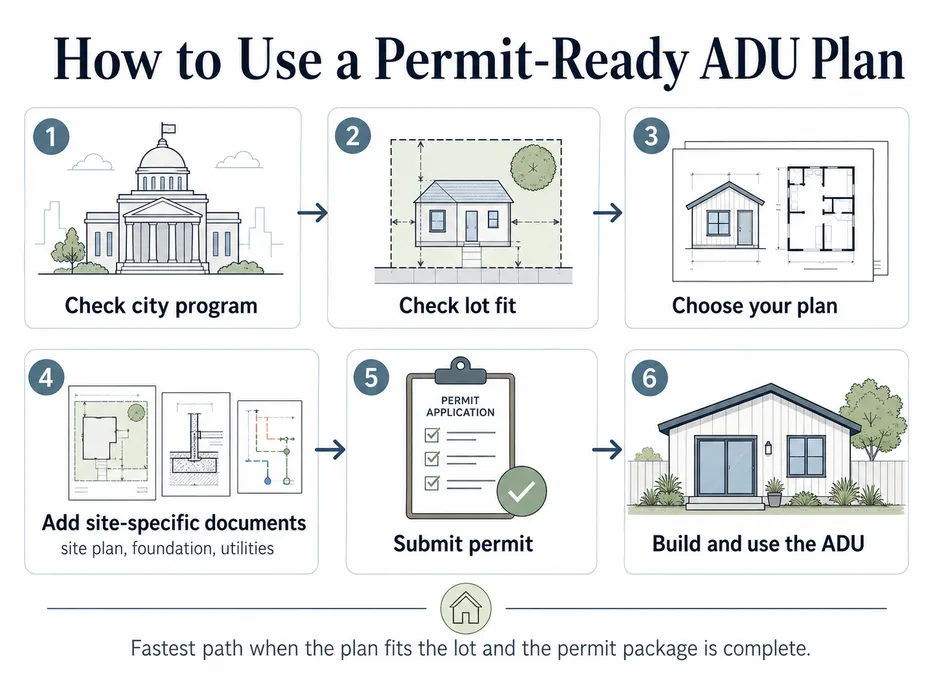
Don’t start by buying a plan. Start by confirming your jurisdiction, your lot’s eligibility, the plan’s current-code status, and the site-specific documents required — then choose your plan path. Ordering it this way prevents the most common and expensive mistake: paying for plans before learning your lot can’t use them.
- Confirm your jurisdiction. Confirm which city or county actually permits your property — city vs. unincorporated county changes everything, and they often run separate programs.
- Search the building/planning department. Search that building/planning department’s site for “ADU,” “pre-approved,” “standard,” or “permit-ready” plans.
- Confirm current code-cycle status. Confirm the plan is active under the current building-code cycle (the Santa Barbara and LA County lesson).
- Verify your lot’s eligibility. Ask whether the plan applies to your zoning, lot type, overlays, and ADU type.
- Get the submittal checklist in writing. Get the city’s submittal checklist in writing.
- Confirm site-specific drawings required. Confirm exactly which site-specific drawings you must supply: site plan, foundation, Title 24, solar, utilities.
- Ask about modifications and strings. Ask whether any modification removes expedited status — and whether a “free” plan carries rent or affordability strings.
- Get a written fee estimate. Get a written fee estimate, including impact/SDC fees if your ADU exceeds 750 sq ft.
- Hire the right professional. Hire the right professional for the remaining items — a designer, civil/structural engineer, or contractor.
- Submit a complete package. Submit only after the package is complete and accurate — this is what unlocks the fast review clocks.
Want the steps as a printable checklist? Our free starter kit includes the verification script and a document checklist. Download the free ADU Starter Kit →
What should you ask your city before choosing a permit-ready plan?
Before paying anyone to adapt or submit a plan, ask your city whether that specific plan is currently accepted, current under code, eligible on your lot, and eligible for expedited review. Five minutes on the phone can save months and thousands of dollars. Cities answer these questions for free; designers and builders may not volunteer the caveats.
Copy-and-paste call script:
“Hi — I’m considering using [plan name] for an ADU at [property address]. Is this plan currently accepted for expedited or pre-approved review? Is it current under the applicable building-code cycle? What site-specific documents will I still need to submit? Are there zoning, flood, fire, coastal, historic, utility, or foundation conditions that could prevent this plan on my lot? And does using it carry any rent or affordability restrictions?”
| Question | Why it matters |
|---|---|
| Is the plan current under today’s code? | Prevents a stale-plan rejection (the Santa Barbara / LA County trap) |
| Is my specific lot eligible? | Overlays and zoning can block the shortcut |
| What documents are still required? | Avoids an incomplete submittal and correction letters |
| Are changes allowed? | Protects your pre-approved/expedited status |
| What fees still apply? | Prevents the “free plan” misunderstanding |
| Are utility upgrades likely? | Utility laterals and panel upgrades can dominate the budget |
| Any rent/affordability strings? | Some "free" city plans require below-market rent |
| What review timeline applies? | Separates the legal clock from the real project timeline |
What if my city doesn’t have permit-ready ADU plans?
If your city has no active library, you have four options: a semi-custom designer set for a simple lot, a prefab or modular unit in a prefab-friendly area, a full custom design for a complex site, or — only if your city explicitly accepts it — a plan from another jurisdiction. The right choice depends on your lot’s complexity and your budget, and the cheapest first step is always to verify what your lot can hold.
| Your situation | Best next step |
|---|---|
| No city library, simple flat lot | Semi-custom detached ADU plan |
| No city library, prefab-friendly area | Compare prefab/modular providers (confirm local code path) |
| Complex site (slope, coastal, septic) | Custom architect/engineer |
| Budget uncertain | Run feasibility + financing first |
| You found another city’s free plan | Ask your city in writing whether it accepts outside pre-approved plans |
Methodology: how we built this permit-ready ADU plan finder
We built this guide official-source-first. Program facts, plan counts, sizes, free-vs-paid signals, and caveats come from city, county, and state pages and primary statutes, each recorded with a verification date. We used homeowner forums only to identify common questions and friction points — never as proof of laws, fees, timelines, or approval rules. Editorial conclusions (which path may fit which buyer) are clearly separated from verified facts, and we recommend confirming all program details with local planning and building staff before spending money.
- Each finder row records scope, program status, plan count/size, free-or-paid signal, the key catch, and the official source, with a verification date.
- Where an official page is incomplete or a program is in flux, we say so rather than guess.
- Cost figures are presented as ranges with attributed sources; estimates are labeled as estimates.
- Partner links are never used as evidence of code or approval, and comparison tables are sorted by neutral criteria (cost, size, timeline), never by compensation.
- We re-verify the top jurisdictions monthly and the full finder quarterly.
What we verified (Last verified: May 31, 2026)
- State law: AB 1332 / Government Code §65852.27 (the 30-day rule) and AB 130 (residential building-standards restriction) — California Legislative Information (leginfo).
- Official program pages: City of Los Angeles (LADBS) and LA County; Seattle (ADUniverse); San José; Santa Clara County; Sacramento County; Placer County; Concord; Richmond; Citrus Heights; Piedmont; Colma; City of Riverside and Riverside County (TLMA); Menifee; Lake Elsinore; Poulsbo (Kitsap/KRCC); Boise; Santa Barbara (paused); Portland; and Eugene.
- National scan & data: The Pew Charitable Trusts (May 2026) — ~40 U.S. jurisdictions, Seattle’s 160→54-day reduction, and the ~1%–2% ($5K–$10K) cost-savings range.
- Cost data: SelfStorage.com, Cad Crowd, GreatBuildz, SnapADU, GatherADU, an online plan marketplace, and homewip.com.
- What we did not verify: whether your individual lot qualifies — that requires an address-level check.
Permit ready ADU plans: FAQ
Are permit ready ADU plans the same as a building permit?
No. A permit-ready or pre-approved plan is a pre-reviewed building design, not a permit. You still submit a building permit application tied to your specific property, including a site plan and site-specific engineering.
Are pre-approved ADU plans free?
Often the city-owned ones are free (Concord, Boise, Citrus Heights, Richmond, and LA County publish free plans), but designer-owned plans carry a license fee, some free plans come with rent restrictions, and every path still requires a paid site plan, foundation engineering, and permit fees.
Do I still need a site plan if I use a pre-approved plan?
Yes. Every program we verified — including comprehensive ones like Richmond, which include Title 24 — still requires the homeowner to provide a site-specific plan and a foundation designed for the lot.
Do I still need an architect or engineer?
Usually yes, for the site-specific layer. You’ll typically need a designer or civil/structural engineer to prepare the site plan, foundation details, and Title 24 calculations, even when the base plan is free.
Can I modify a permit-ready ADU plan?
Usually only finishes, color, roof options, and mirroring. Moving walls, relocating a bathroom, adding a room, or changing the foundation typically removes the plan’s pre-approved status and triggers full plan check; some cities (e.g., Colma, Sacramento County) allow no structural changes at all.
Can I use another city’s pre-approved ADU plan?
Generally not by default. In California an agency may adopt plans pre-approved by another agency, but you still need your own city to accept that plan for your property — so ask in writing first.
How long does permitting take with a pre-approved ADU plan?
It depends on the city and the completeness of your package. Verified best cases range from same-day (San José) to 5 working days (Concord) to a 30-day statutory clock in California; Seattle’s program cut average ADU approval time from 160 to 54 days. Incomplete site documents revert you to the standard timeline.
Do permit-ready plans work for garage conversions?
Sometimes, but most pre-approved libraries are detached-only. Lake Elsinore (400 sq ft) and Piedmont (484 sq ft) offer garage-conversion plans; confirm availability with your city.
Are prefab ADUs “permit ready”?
Prefab and modular units are built to code in a factory, and the design is bundled into the product — but they still require local approvals, a site plan, a foundation, and utility connections, so they are not exempt from permitting.
What happens when building codes change?
A pre-approved plan can become ineligible. Santa Barbara’s program is paused because its plans don’t meet the 2025 codes, and LA County’s private-designer plans are being updated for the January 1, 2026 code. Always confirm a plan is current before you submit.
What does “pre-approved” mean if it’s not approval?
It means the building design was checked for code in advance, giving you a head start. California law specifies that posting a pre-approved plan is not an endorsement and not an approval of your specific project.
What if my city doesn’t have permit-ready ADU plans?
Use a semi-custom or custom designer, compare prefab/modular providers, or — only if your city accepts it — an outside plan. Start by verifying what your lot can hold.
Not sure where to start?
See what’s possible at your address — get your free ADU report in 60 seconds.
Get my free ADU report →Related guides
- ADU floor plan layouts — sizes, layouts, and what fits your lot
- Prefab ADU options — brands, costs, and local code paths
- How much an ADU costs in 2026
- Best ADU financing options — HELOC, cash-out refi, and renovation loans
- ADU fee waiver programs — cities that waive impact fees
- State and city ADU rules — regulations hub