
Lemon Grove ADU Laws 2026: What You Can Build, What It Costs, and How to Get Approved
By The Dwelling Index Editorial Team · Last updated
The bottom line on Lemon Grove ADU laws
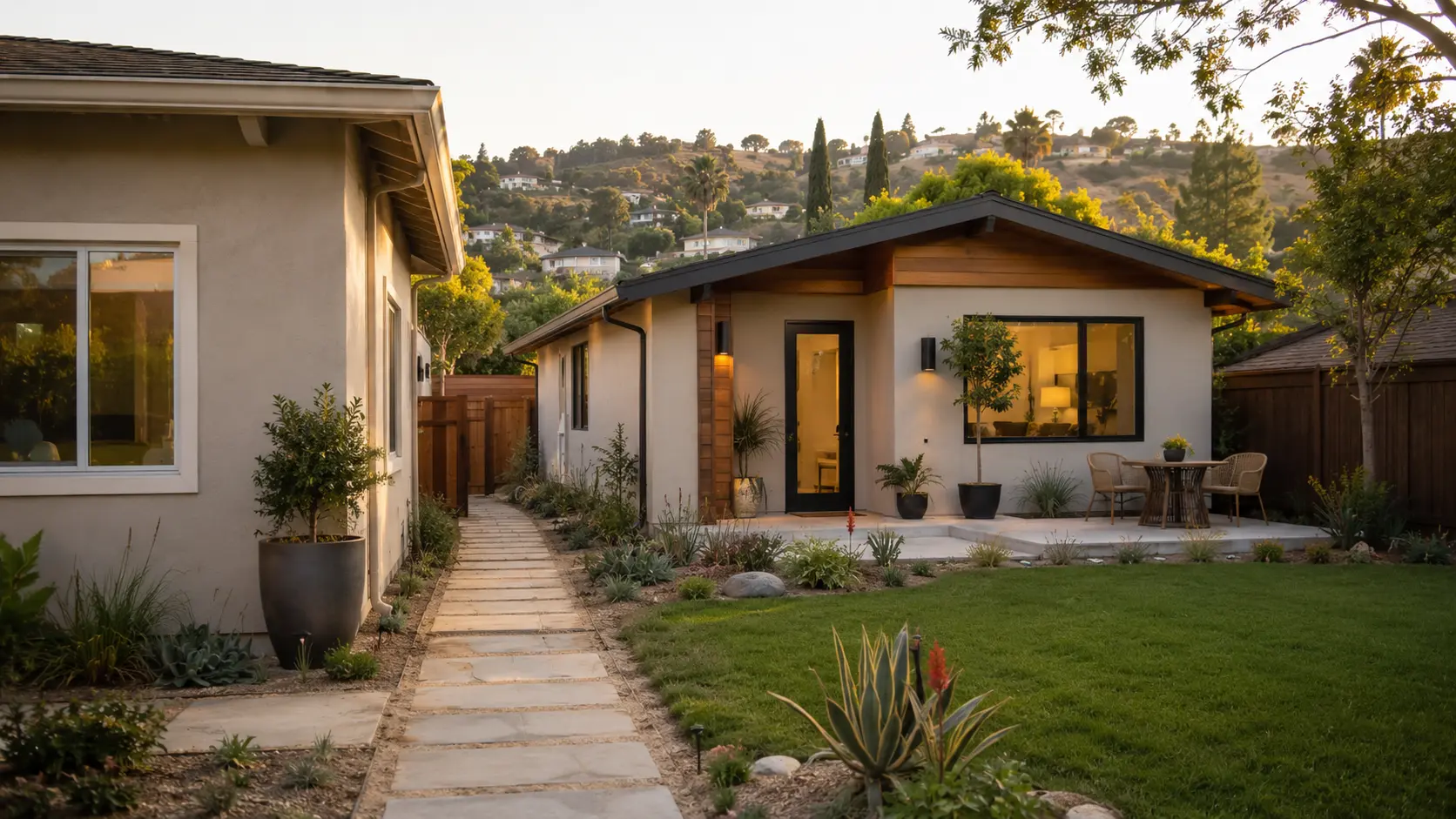
Most Lemon Grove residential or mixed-use lots with an existing or proposed home can legally support an accessory dwelling unit (ADU). On a single-family lot, current state law allows you to stack up to three units in addition to the primary home — one new-construction detached ADU, one converted ADU, and one Junior ADU (JADU) — and HCD’s December 10, 2025 findings letter to the City affirms that a fourth small unit may be combined by reading §66323 together with §66314 in the same application. Multifamily lots can add up to eight detached ADUs plus conversion ADUs equal to 25% of existing units. Lemon Grove’s local ADU handout (LGMC §17.24.060) is stricter than current state law on several points; HCD’s index lists a city response as received, and where the local code and state law conflict, the state-law standard controls for those provisions. Expected all-in cost for a new detached site-built ADU in Lemon Grove in 2026 runs roughly $330,000 to $840,000 for the 750 to 1,200 sq ft size range; garage conversions and JADUs are materially cheaper, often under $200,000. Start by verifying your zoning, your walking distance to the nearest MTS Orange Line trolley station, and which size band you’ll target — those three answers determine almost everything else.
The 60-second answer table
| Question | Lemon Grove answer | Verify before design | Source |
|---|---|---|---|
| Are ADUs allowed? | Yes, on qualifying residential or mixed-use lots with an existing or proposed home | Zoning, primary-dwelling status, utilities | City of Lemon Grove ADU page; Gov. Code §66314 |
| Max detached/attached size? | 1,200 sq ft (and ≤ primary home if over 1,000 sq ft) per local handout | Whether the §66314 attached cap (50% of primary) constrains your design | LGMC §17.24.060; Gov. Code §66314 |
| Max JADU size? | 500 sq ft, inside an existing or proposed single-family home | Whether sanitation is shared with the main house | Gov. Code §66333; AB 1154/SB 543 |
| Setbacks (side/rear)? | 4 ft state-protected minimum for new ADUs; existing-structure conversions keep existing setbacks | Front setback — varies by zone | Gov. Code §66314(d)(7) |
| Height? | 16 ft base; 18 ft within ½-mile walking distance of a major transit stop; +2 ft for matching roof pitch | Walking distance to Lemon Grove Depot (3443 Main St) or Massachusetts Avenue Station | Gov. Code §66321(b)(4); MTS Orange Line route data |
| Parking? | No on-site parking required if within ½-mile of public transit, within one block of car-share, or a garage conversion | Walking distance to public transit | Gov. Code §66322 |
| Owner occupancy? | Not required for ADUs; required for JADUs sharing sanitation (effective Jan 1, 2026) | JADU sanitation configuration | Gov. Code §66333; AB 1154 |
| Impact fees on ≤750 sq ft? | None permitted under state law | Whether a unit at exactly 750 sq ft applies | Gov. Code §66311.5 |
| Permit timeline? | 60-day legal clock from complete application (Gov. Code §66317) / 3–6 months practical | Application completeness; City review cycles run 30 days each | Gov. Code §66317; City of Lemon Grove Building Permit page |
| Short-term rental? | Vacation rentals (≤30 consecutive days) prohibited citywide; hosted home-sharing requires a permit | Long-term plan (over 30 days) vs hosted home-share plan | LGMC Chapter 18.48; City home-sharing page |
See what your Lemon Grove lot can support → Get your free ADU report
Run your address. We’ll show your likely ADU types, transit-corridor walking distance, parking flag, and a fee-trigger band — in about 60 seconds.
What we verified for this page
The Dwelling Index is an independent research resource covering ADU financing, costs, and regulations. For this guide, we pulled the following primary sources between May 12 and May 15, 2026:
- City of Lemon Grove official ADU page — definitions, AB 1332 preapproved-plan program status, AB 2533 unpermitted-unit guidance
- Lemon Grove ADU Development Standards Handout — permitted zones (RL, RLM, RM, RMH, RP, CG), unit allowances, size, setbacks, height, parking, plan checklist
- Lemon Grove Municipal Code Title 17, §17.24.060 — the local ADU ordinance subject to HCD review
- Lemon Grove Building Permit page — in-person, hard-copy submittal process; 30-day per-department review cycle
- Lemon Grove FY2025–26 Master Fee Schedule — valuation table ($160.84/sf for R-3 Type V wood frame), plan-check rate (89.25%), MEP combination fees (10.50% each), RTCIP at $3,047.57 per new residential unit, sanitation connection at $3,509 per EDU
- California Government Code §§66310–66342 (state ADU law), including §66311.5, §66314, §66317, §66321, §66322, §66323, §66326, §66333, §66334, §66342
- HCD letter to City of Lemon Grove dated December 10, 2025 — 16 specific findings of noncompliance; HCD index shows City response received
- Public Resources Code §21155 — definition of “major transit stop”
- MTS Orange Line route data — Lemon Grove Depot (3443 Main St) and Massachusetts Avenue Station
- LGMC Chapter 18.48 and the City Home-Sharing page — citywide vacation rental prohibition; hosted home-sharing rules
- Lemon Grove School District + Grossmont Union High School District developer-fee pages — combined $4.41/sq ft; 500 sq ft exemption
- Triangulated construction-cost data from SnapADU, Better Place Design & Build, and Realm for 2025–2026
Last verified: May 15, 2026 · Next scheduled review: June 15, 2026 (30-day cadence while LGMC §17.24.060 amendments are pending)
Can I build an ADU in Lemon Grove?
Source: City of Lemon Grove ADU page; Lemon Grove ADU Development Standards Handout; Gov. Code §66314 — verified May 15, 2026.
The five Lemon Grove lot scenarios — and which path each one uses
| Property situation | Likely path | What to verify with the City |
|---|---|---|
| Single-family home on an SFR-zoned lot | Detached ADU, attached ADU, conversion ADU, JADU, or combinations | Zoning, setbacks, lot access, utility location |
| Multiple detached single-family homes on one lot | HCD’s letter directs the City to amend the prior restriction; ask Planning how the lot is classified | Which §66323 unit allowances apply per HCD Finding #5 |
| Multifamily building (duplex, triplex, etc.) | Up to 8 detached ADUs (capped at existing unit count) plus conversion ADUs equal to 25% of existing units | Confirm under §66323(a)(4) which detached-unit ceiling applies |
| Existing detached garage or accessory structure | Conversion ADU path — favorable setbacks, no parking trigger | Whether the existing structure has a permitted history |
| Unpermitted unit built before January 1, 2020 | AB 2533 legalization pathway | Confidential third-party inspection before formal application |
What disqualifies a Lemon Grove lot
A vacant lot with no proposed primary residence cannot host an ADU. Lots in non-residential zones outside the handout’s permitted list need a discretionary path. And while Civil Code §4751 (AB 670) prohibits California HOAs from outright banning ADUs, an HOA can still apply reasonable design and aesthetic standards — so an HOA-governed parcel needs a layer of HOA review even after the City approves the permit.
How many ADUs can I build in Lemon Grove?
Source: Gov. Code §66323(a) and §66314; HCD letter to Lemon Grove dated December 10, 2025; LGMC §17.24.060 — verified May 15, 2026.
Single-family lots: the standard three-unit stack
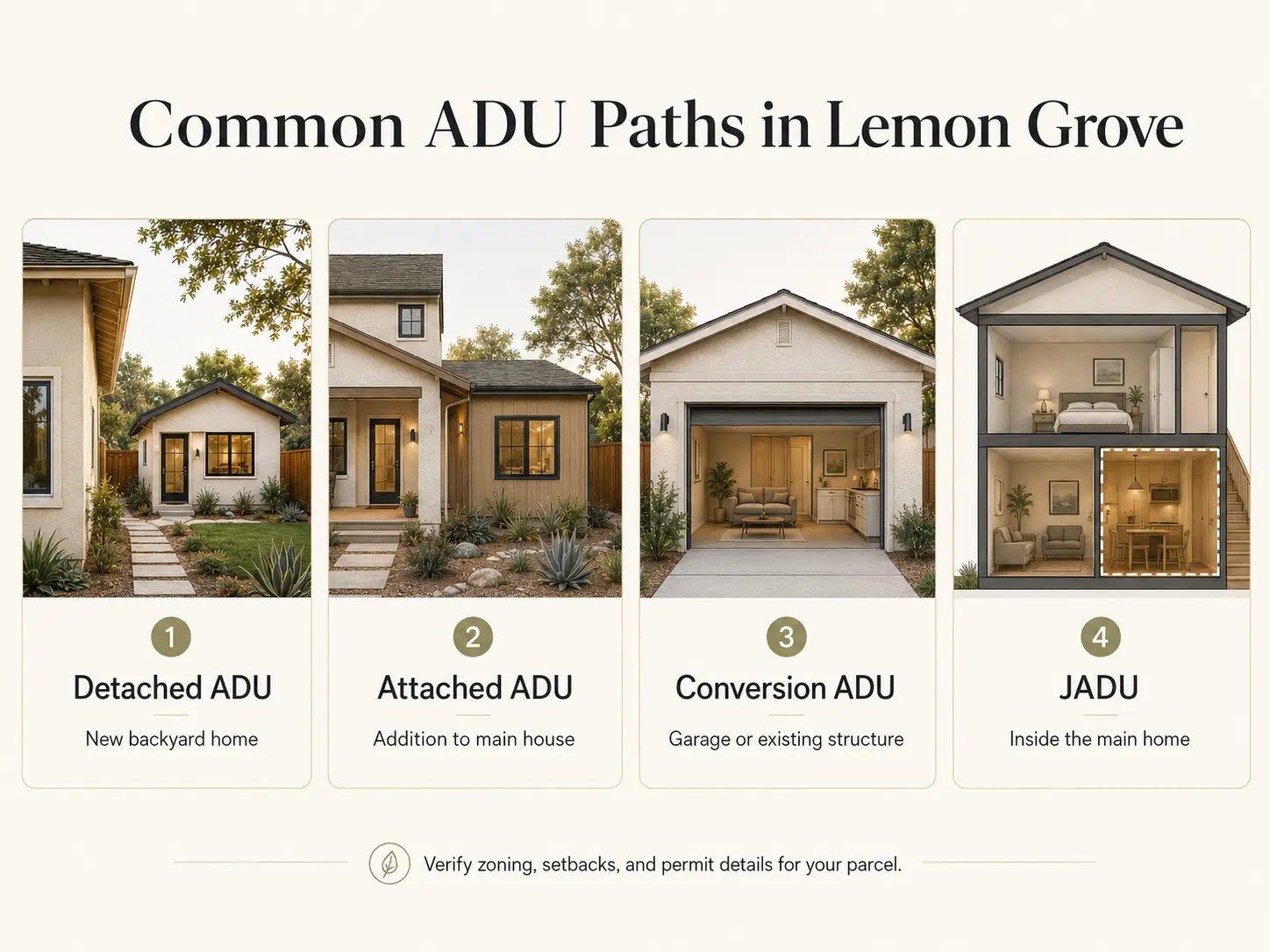
Government Code §66323(a) requires Lemon Grove to ministerially approve a building permit for any combination on a lot with a proposed or existing single-family dwelling including: one ADU and one JADU within the proposed or existing space of the single-family dwelling or an accessory structure, plus one detached, new-construction ADU that doesn’t exceed four-foot side and rear setbacks (up to 800 sq ft, 16 ft tall — and taller near transit).
HCD’s December 10, 2025 letter was specific: the word “any” followed by a list means the combinations stack. A homeowner can create one converted ADU, one detached new-construction ADU, and one JADU — three units in addition to the primary house. Lemon Grove’s local handout still reads “one ADU and one JADU,” which HCD flagged as inconsistent with state law in Finding #4.
The 2026 four-unit configuration
HCD Finding #4 states directly: “the City must amend the Ordinance to allow for at least one unit subject to section 66314 to be combined, in any order, with any unit subject to Government Code section 66323.” In practical terms: a homeowner using the §66323 path (one converted ADU + one detached new-construction ADU under 800 sq ft + one JADU) may also apply for a separate §66314 unit. Most Lemon Grove single-family lots don’t have the buildable footprint for two detached ADUs plus a converted unit plus a JADU — but on larger parcels or corner lots, this is now a legitimate planning option grounded in HCD’s letter.
Multifamily lots: up to eight detached ADUs
The local handout still says multifamily properties allow “up to two detached ADUs per lot.” That language is preempted by current state law. Under Gov. Code §66323(a)(4)(A)(ii) (cited in HCD Finding #6), an existing multifamily property can add up to eight detached ADUs, capped at the number of existing units. A fourplex can add four detached ADUs; a six-unit building can add six. Conversion ADUs equal to 25% of existing units (with a minimum of one) can also be added inside non-habitable space.
| Lot type | Old Lemon Grove handout language | Current state-law allowance (2026) | Source |
|---|---|---|---|
| Single-family with one home | 1 ADU + 1 JADU | 1 detached + 1 converted + 1 JADU under §66323; one §66314 unit may also be combined per HCD Finding #4 | Gov. Code §66323; HCD letter 12/10/25 |
| Single-family with multiple homes on one lot | “Only one ADU per lot” | Ask Planning how the lot is classified; HCD Finding #5 directs the City to amend prior restriction | LGMC §17.24.060; HCD letter Finding #5 |
| Existing multifamily (2+ units) | Up to 2 detached ADUs | Up to 8 detached ADUs (capped at existing unit count) + conversions up to 25% of existing | Gov. Code §66323(a)(4)(A)(ii); HCD letter Finding #6 |
| Proposed new multifamily | Not addressed in handout | Up to 2 detached ADUs | Gov. Code §66323(a)(4)(A)(iii) |
Not sure how many ADUs your specific Lemon Grove parcel allows? → Run your address through the free Lemon Grove ADU Feasibility Snapshot
We pull your zoning, transit walking distance, lot footprint, and current state-law overlay and return your maximum buildable unit count, allowed height, setback path, and likely fee band.
Where Lemon Grove’s local code conflicts with 2026 state law (the HCD letter, decoded)
Source: HCD letter to City of Lemon Grove dated December 10, 2025; HCD ADU Ordinance Review index; Gov. Code §66326 — HCD status checked May 15, 2026.
HCD status as of May 15, 2026
HCD’s public ordinance-review index lists the Lemon Grove ADU findings letter dated December 10, 2025 and shows the jurisdiction response status as “Response received.” Under Gov. Code §66326, the City had 30 days from the letter date to respond — meaning a response was due by January 9, 2026 — and the index confirms a response was filed. We have requested the response through HCD and the City Clerk’s office and will update this page when we have the content.
How preemption actually works
Under Gov. Code §66326, when state law and a local ADU ordinance disagree, the City has two options: amend the ordinance to comply, or adopt the ordinance as-is with formal findings. If neither happens, HCD may notify the California Attorney General. In the meantime, for the specific provisions in conflict, the state-law standard applies. In practical terms: if a Lemon Grove planner says “your ADU is too tall under our 16-foot rule” but your lot is within ½-mile of a major transit stop, you cite §66321(b)(4) and ask for the 18-foot allowance.
The 16-row decoder
| # | LGMC §17.24.060 says | State law (current Gov. Code) requires | What you can do today |
|---|---|---|---|
| 1 | References §§65852.2, 65852.22, 65852.26 (deleted by SB 477) | Sections renumbered to §§66310–66342 | Cite the current sections; the old ones no longer exist |
| 2 | No formal 60-day approval-or-denial procedure | §66317 requires ministerial approval within 60 days of a complete application, or a full set of correction comments | If the City misses the 60-day clock without comments, your application is deemed approved by operation of law |
| 3 | Outdated statutory cross-references throughout | All citations must point to §§66310–66342 | Use the current numbering when filing |
| 4 | Single-family lots limited to "1 ADU + 1 JADU" | §66323(a) allows combinations — 1 converted ADU + 1 detached + 1 JADU; one §66314 unit may also be combined | Apply for the state-protected combination |
| 5 | SFR lots with multiple primary homes capped at "one internal or detached ADU per lot" | §66323(a) refers to "a proposed or existing single-family dwelling," not "only one"; HCD directs amendment | Each SFR on the lot may have its own state-allowed unit allowance — confirm with Planning |
| 6 | Multifamily lots capped at "up to two detached ADUs per lot" | §66323(a)(4)(A)(ii) allows up to 8 detached on existing multifamily lots (capped at existing units) | Apply for up to 8 detached if existing unit count supports it |
| 7 | JADU deed restriction must include owner-occupancy language | §66333(d) limits deed restrictions to sale-restriction + size/attributes | Owner-occupancy may still apply for some JADU configurations, but the deed restriction cannot include it |
| 8 | "Exemption" ADUs capped at 16 ft height | §66321(b)(4) allows 16, 18, or 20 ft depending on transit and roof-pitch conditions | Apply for 18 ft (or 20 ft) if your lot qualifies |
| 9 | Local development standards apply without a §66323 carveout | §66323 units cannot be precluded by underlying zoning standards | Cite §66323 to exempt those units from underlying zoning |
| 10 | Detached ADU height fixed at 16 ft regardless of location | §66321(b)(4) requires 18 ft within ½-mile of a major transit stop, with +2 ft for matching roof pitch | Document transit proximity; request 18 or 20 ft |
| 11 | Front setback "consistent with the underlying zone" | §66321(b)(3) prohibits front-setback rules that would block an 800 sq ft / 4-ft-setback unit | The City must allow an 800 sq ft state-protected unit even where the front-setback rule would otherwise block it |
| 12 | JADU/internal setbacks must match the primary dwelling's underlying zone | §66314(d)(7) caps setbacks at 4 ft for new ADUs and requires zero setback for existing-structure conversions | Use the 4-ft state minimum (or zero for conversions) |
| 13 | Garage-to-JADU conversion triggers replacement parking | §66334(a) prohibits replacement parking for JADUs | No replacement parking required for garage-to-JADU |
| 14 | Parking exception list omits the "joint ADU + new SFR/MFD application" case | §66322(a)(6) requires this exception | Cite §66322(a)(6) in joint applications |
| 15 | Construction of an ADU could trigger fire sprinklers in the primary dwelling | §66314(d)(12) explicitly prohibits this | Adding an ADU never triggers sprinklers in the existing primary home |
| 16 | ADUs must use a "complementary" architectural style and "the same or higher quality" materials | §66314(b)(1) allows only objective standards; "complementary" and "higher quality" are subjective and unenforceable | The City must remove the subjective terms; only objective standards apply |
Not sure which state-law path applies to your lot? → Run your Lemon Grove parcel through the free ADU Feasibility Snapshot
Our address-level check returns your zoning, your walking distance to the Orange Line, the state-law sections that apply to your buildable envelope, and a starting fee-trigger band.
Lemon Grove ADU size, height, setbacks, and parking rules
Source: LGMC §17.24.060; Lemon Grove ADU Development Standards Handout; Gov. Code §66314, §66321, §66322 — verified May 15, 2026.
Size limits by ADU type
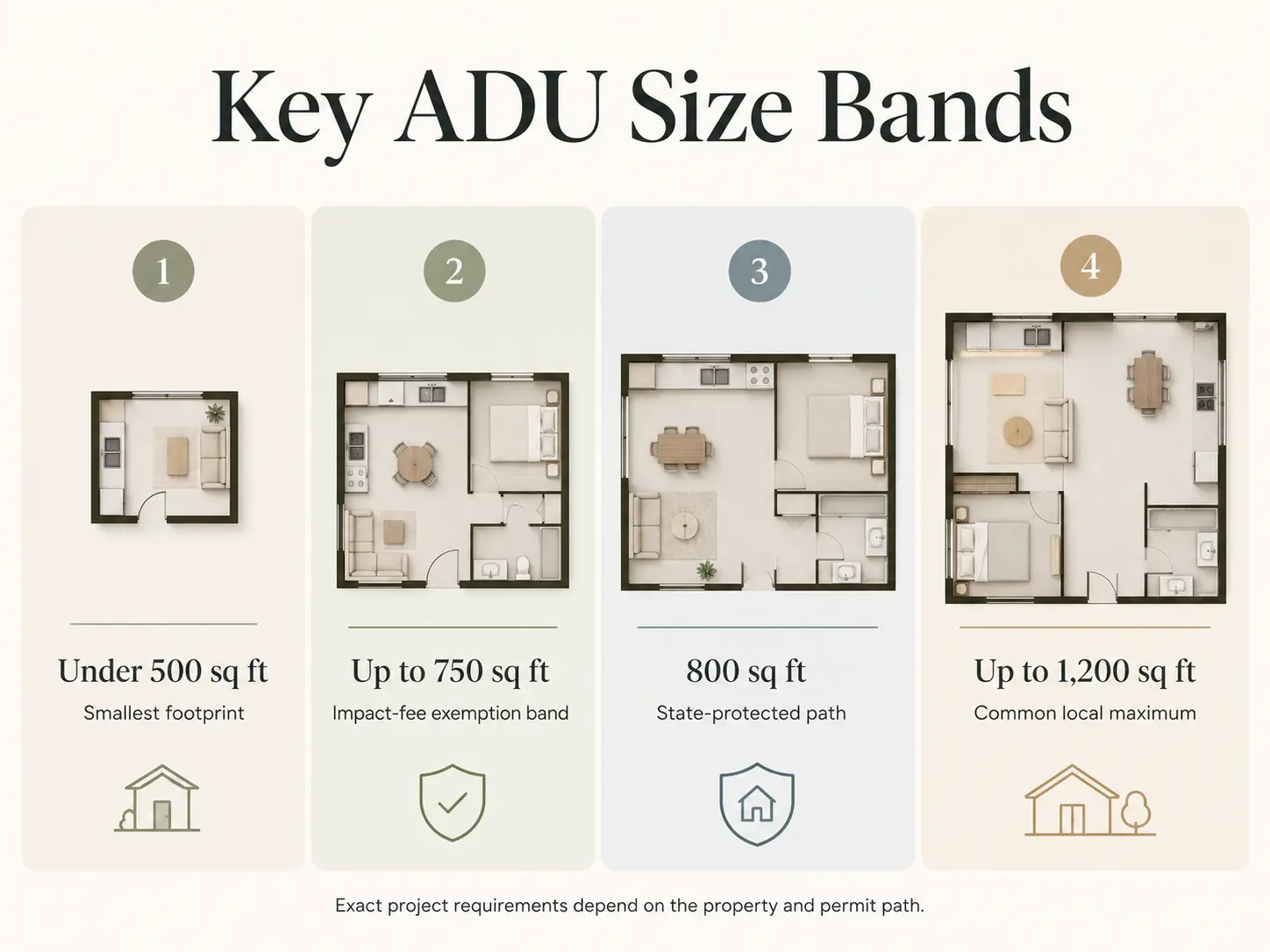
| ADU type | Lemon Grove handout max | State-law floor or protection | Practical takeaway |
|---|---|---|---|
| Detached ADU (new construction) | 1,200 sq ft; cannot exceed primary home if over 1,000 sq ft | §66323(a)(2) protects an 800 sq ft / 4-ft-setback / 16-ft path | If your design fits 800 sq ft, you have the strongest legal protection |
| Attached ADU | 1,200 sq ft; cannot exceed primary home if over 1,000 sq ft | §66314 limits attached ADUs to 50% of the existing primary dwelling | A 2,000 sq ft primary home limits the attached ADU to 1,000 sq ft (the 50% cap) |
| Conversion ADU (within existing structure) | Existing structure footprint | No size maximum for conversion of existing space; +150 sq ft allowed for ingress/egress | A 1,800 sq ft barn can become a 1,800 sq ft conversion ADU |
| JADU | 500 sq ft | Per §66333 — within an existing or proposed single-family residence | Smallest footprint, lowest fees, but owner-occupancy applies if sanitation is shared (AB 1154/SB 543, eff. 1/1/2026) |
Height: the transit bonus changes everything
The base detached ADU height limit in Lemon Grove is 16 ft. Two state-law modifiers expand this:
- 18 ft for a detached ADU on a lot within ½-mile walking distance of a “major transit stop” or “high-quality transit corridor” as defined in Public Resources Code §21155
- +2 ft (so 18 → 20 ft) when the ADU’s roof pitch aligns with the primary dwelling’s roof pitch
This matters in Lemon Grove because the city has two San Diego MTS Orange Line trolley stations within city limits — Lemon Grove Depot at 3443 Main Street and Massachusetts Avenue Station to the west. A meaningful share of Lemon Grove residential parcels falls within the ½-mile walking-distance window.
Setbacks: 4 ft is the state-protected floor
The single most important setback rule for Lemon Grove ADU planning: side and rear setbacks for a new-construction ADU cannot exceed 4 feet, regardless of the underlying zone. This is established by Gov. Code §66314(d)(7) and reinforced in HCD’s Finding #12 against Lemon Grove’s old code.
For conversion ADUs — existing structures being converted to ADU use — no setback is required if the conversion stays within the existing structure’s footprint. Front setbacks are a separate question; Lemon Grove’s handout sets front setbacks “consistent with the underlying zone” (typically 20–25 ft) but §66321(b)(3) prevents this rule from blocking a state-protected 800 sq ft ADU.
Lot coverage and FAR
ADUs up to 800 sq ft are exempt from lot coverage requirements. Lemon Grove’s handout makes this explicit. This means homeowners already at their zoning’s lot coverage cap can still add an 800 sq ft ADU. There is no minimum or maximum lot size for ADUs in Lemon Grove.
Parking — and why most Lemon Grove lots are exempt
Lemon Grove’s handout requires one off-street parking space for an ADU. State law, however, provides multiple exemptions that catch most lots. No parking is required for an ADU under any of these conditions:
- Within ½-mile walking distance of a public transit stop, including the Lemon Grove Depot and Massachusetts Avenue Stations on the MTS Orange Line
- The ADU is part of an existing or proposed primary residence or accessory structure (conversion ADUs)
- The ADU is in a historic district
- On-street parking permits are required in the area but not offered to ADU occupants
- The ADU is within one block of a designated car-share vehicle pickup location
- The ADU permit is filed jointly with a new single-family or multifamily dwelling application (§66322(a)(6) — specifically called out in HCD Finding #14)
For garage-conversion ADUs, no replacement parking is required regardless of zone (Gov. Code §66334(a) for JADUs and §66322 for ADUs generally).
The Lemon Grove transit-corridor advantage
Source: MTS Orange Line route data; Public Resources Code §21155; Gov. Code §66321(b)(4), §66322 — verified May 15, 2026.
For a small (~25,000-population) East County city, Lemon Grove punches above its weight on transit access. Public Resources Code §21155(b) defines a major transit stop as a site containing a rail transit station. Both Lemon Grove Orange Line trolley stations qualify on that basis.
Walking distance is measured along the actual pedestrian route, not as a straight-line radius. Many planners and builders use Google Maps walking directions or a GIS overlay to confirm. Note: the 4-ft side/rear setback rule applies to all new-construction ADUs regardless of transit proximity — that’s a separate state-law protection under §66314(d)(7), not a transit benefit.
How the Lemon Grove ADU permit process actually works
Source: City of Lemon Grove Building Permit page; Gov. Code §66317 — verified May 15, 2026.
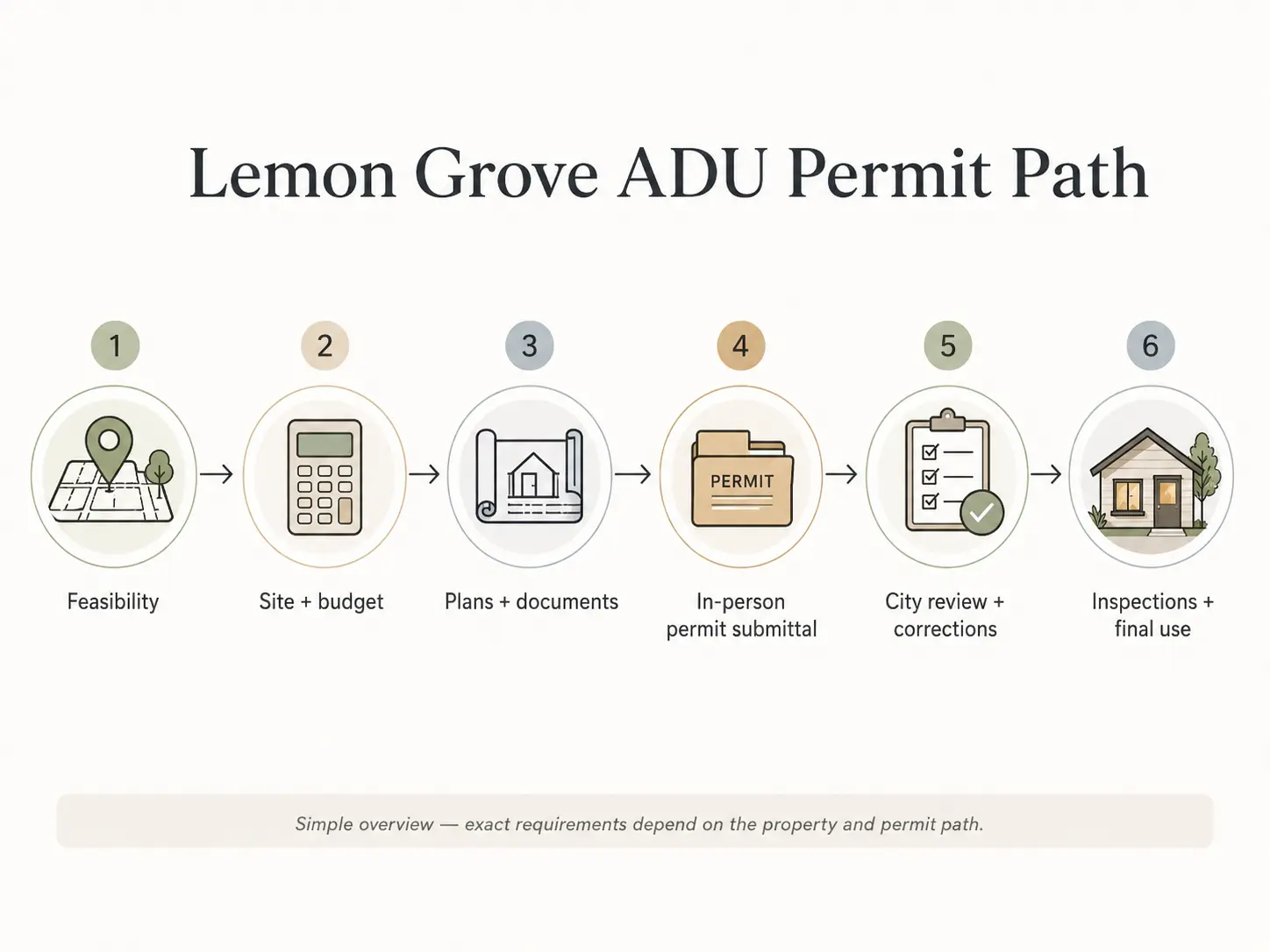
Step 1 — Pre-application Planning check
Before spending money on full design and engineering, walk into the Planning Division counter at 3232 Main Street, Lemon Grove, CA 91945, or call (619) 825-3805. Ask specifically: your zoning classification, whether your parcel is within ½-mile walking distance of the Orange Line for transit-bonus purposes, and which §66323/§66314 path applies to your parcel. The third question is the diagnostic question — if the planner gives you a clean answer, the office is current on the post-HCD landscape.
Step 2 — Design and engineering
ADU projects typically require:
- Architectural plans — site plan, floor plans, elevations (all four sides), sections
- Structural calculations — wet-stamped by a licensed California PE
- Title 24 energy calculations — California’s Building Energy Efficiency Standards
- CalGreen mandatory measures — California Green Building Standards Code compliance
- MEP plans — mechanical, electrical, plumbing
- Soils report — Lemon Grove does not currently mandate one for ADUs, but most engineers will recommend a basic geotechnical investigation
Design fees for an ADU in San Diego County typically run $5,000–$25,000 depending on size, complexity, and whether you use a turnkey design-build firm or contract separately.
Step 3 — The plan submittal package
Applications are accepted only in person at the Building Division counter, with physical (hard-copy) plans. The standard package:
- A completed building permit application
- Four full-size 24"×36" D-sheet plan sets, folded to 9"×24"
- Project valuation (this drives permit and plan-check fees)
- Owner, contractor, architect, and engineer information
- SDG&E work order if utility upgrades are anticipated
- A written authorization letter if anyone other than the owner is submitting
Pro tip: file with a one-page state-law cover memo
Typical citations for a Lemon Grove ADU filing: §66317 for the 60-day ministerial-approval clock, §66321(b)(4) for the height bonus if near transit, §66322 for the parking exemption, §66323 for the unit-combination path, and §66314 for size and setback minimums. This shortcuts confusion at the counter and creates a written record if you later need to escalate.
Step 4 — Plan review
Projects are routed to multiple departments — Building, Engineering, Fire, and Planning — and comments or approvals are provided after all reviewing departments complete review. Each review typically takes 30 days minimum, and the same 30-day review process repeats after resubmittal. Meanwhile, §66317 sets the legal framework: completeness determination within 15 business days of submittal, then 60 days to approve or deny a complete application. Only applicant-requested delays toll the 60-day period.
Step 5 — Permit issuance and fee payment
Once plans are approved, the City issues the building permit. Fees are due at issuance. See the cost section below for the full breakdown.
Step 6 — Construction and inspections
Lemon Grove building inspections are generally performed the next business day if scheduled before the cutoff. Standard ADU inspection sequence:
- Pre-construction / setbacks confirmation
- Foundation and rebar (before pour)
- Underground plumbing and electrical (before backfill)
- Rough framing
- Rough plumbing, electrical, and mechanical
- Insulation
- Drywall (after taping)
- Final
Step 7 — Occupancy and recording
Once all inspections are signed off, the ADU is legally occupiable. Lemon Grove does not issue a separate Certificate of Occupancy — the final-signed inspection card is the C of O. For JADUs, the City may require a deed restriction recorded against the property before permit issuance — but per HCD Finding #7, the deed restriction can include only sale-restriction and size/attributes language, not owner-occupancy.
How long does the full process actually take?
| Project type | Permit phase (legal max) | Permit phase (practical) | Construction phase | Total realistic |
|---|---|---|---|---|
| JADU | 60 days from complete | 2–3 months | 1–3 months | 4–6 months |
| Garage conversion | 60 days from complete | 2–3 months | 2–4 months | 4–7 months |
| Attached ADU | 60 days from complete | 3–4 months | 4–6 months | 7–10 months |
| Detached ADU (site-built) | 60 days from complete | 3–5 months | 4–7 months | 7–12 months |
| Prefab/modular detached | 60 days from complete | 3–4 months | 1–3 months (set-on-site) | 4–7 months |
Source: San Diego County builder data (SnapADU, Better Place Design & Build, Realm), 2025–2026.
Worried you’ll spend $15,000 on plans before discovering your lot doesn’t qualify? → Check your address first with our free Lemon Grove ADU Feasibility Report
We pre-screen the eligibility questions the City asks — zoning, setbacks, transit walking distance, lot coverage — so you walk into the Planning counter already knowing what’s possible.
Does Lemon Grove have preapproved ADU plans?
Source: City of Lemon Grove ADU page; AB 1332 (Gov. Code §65852.27) — verified May 15, 2026.
If preapproved plans are part of your interest, check the City’s ADU page periodically. Until plans are approved, every Lemon Grove project follows the standard plan-submittal and review path. The City’s ADU page invites architects and ADU providers to submit preapproved plan sets for review.
What does a Lemon Grove ADU cost in 2026?
Source: Lemon Grove FY2025–26 Master Fee Schedule; San Diego County construction-cost triangulation; Lemon Grove School District + Grossmont Union High School District developer-fee pages; Gov. Code §66311.5 — verified May 15, 2026.
How Lemon Grove calculates the city portion of permit fees
The FY2025–26 Master Fee Schedule uses building valuation as the basis. For a detached, site-built, R-3 Type V wood-frame ADU, the valuation rate is $160.84 per square foot. The fee math:
- Project valuation = ADU square footage × $160.84
- Building permit fee is read off the City’s valuation-bracket table
- Plan check fee = 89.25% of the building permit fee
- Each combination MEP fee (plumbing, electrical, mechanical) = 10.50% of the building permit fee
- Add energy surcharge, stormwater surcharge (~5%), CalGreen fees
- RTCIP = $3,047.57 per new residential housing unit (subject to §66311.5 ADU exemption)
- City sanitation new system connection = $3,509 per EDU if parcel is in the city sanitation system
Sample fee worksheet — illustrative, not a City quote
| ADU size | Valuation basis ($160.84/sf) | Approx. base City permit + plan-check + MEP | Critical fee trigger |
|---|---|---|---|
| 499 sq ft | $80,259 | ~$2,800 | Below the 500 sq ft school-fee threshold |
| 500 sq ft | $80,420 | ~$2,800 | Lemon Grove SD: school fees exempt at 500 sq ft or less |
| 749 sq ft | $120,469 | ~$3,500 | Under the SB 13 impact-fee exemption ceiling (750 sq ft) |
| 750 sq ft | $120,630 | ~$3,500 | Last size fully impact-fee exempt under §66311.5 |
| 800 sq ft | $128,672 | ~$3,620 | The "state-protected" size — local development standards cannot block an 800 sq ft / 4-ft-setback ADU |
| 1,000 sq ft | $160,840 | ~$4,110 | Proportional impact fees may apply over 750 sq ft |
| 1,200 sq ft | $193,008 | ~$4,620 | Local maximum for detached/attached |
Source: Lemon Grove FY2025–26 Master Fee Schedule; verified May 15, 2026. [NEEDS COUNTER VERIFICATION] — valuation classification, exact stormwater surcharge base, and ADU-specific application of RTCIP and sanitation connection fees should be confirmed with the Building Division at (619) 825-3805.
School fees: the LGSD + GUHSD layer
| District | Published rate (per sq ft of assessable space) | Exemption | Notes |
|---|---|---|---|
| Lemon Grove School District (elementary) | $3.21 | Projects totaling 500 sq ft or less | Fees calculated per sq ft of assessable space as determined by the building department |
| Grossmont Union High School District | $1.20 | Per district policy | High-school-level developer fee |
| Combined published total | $4.41/sq ft | Combined cannot exceed statutory max ($5.17/sq ft as of 2024) | Both districts allocate to avoid exceeding statutory max |
Gov. Code §66311.5 says an ADU with less than 500 sq ft of interior livable space is treated as not increasing assessable space by 500 sq ft — so school fees are effectively zero for sub-500 sq ft ADUs. For ADUs at or over 500 sq ft, verify the exact calculation directly with both districts before finalizing your budget.
Utility and sanitation: what to verify by parcel
| Question | Why it matters | Verification source |
|---|---|---|
| Which water provider serves this parcel? | Helix Water District serves most of Lemon Grove; some parcels are in other districts | Confirm via parcel address |
| Which wastewater/sanitation provider? | Lemon Grove operates a city sanitation system for most parcels | Confirm via parcel address |
| Is a new/separate water connection required? | Detached ADUs typically need new connection; conversions often share | Local water purveyor |
| New system connection (sewer)? | City schedule: $3,509 per EDU for new system connection permit | Lemon Grove FY26 Master Fee Schedule |
| Capacity charge from County Water Authority? | Applies when a new water meter is installed | sdcwa.org |
| §66311.5 conversion-path protection? | Conversion ADUs may avoid certain utility connection or capacity charges | Gov. Code §66311.5 |
The full all-in cost stack by ADU size
| Cost component | 500 sq ft conversion / JADU | 750 sq ft detached new | 1,200 sq ft detached new |
|---|---|---|---|
| Construction (low–high) | $80,000–$150,000 | $280,000–$450,000 | $450,000–$720,000 |
| Construction $/sq ft basis | $160–$300 (conversions cheaper per sq ft) | $375–$600 | $375–$600 |
| Total city/district/utility fee bucket | $3,000–$8,000 | $8,000–$14,000 | $12,000–$21,000 |
| Impact fees | $0 (under 750 sq ft per §66311.5) | $0 (at exactly 750 sq ft) | Proportional, may include ~$3,000+ RTCIP-equivalent |
| School fees (combined LGSD + GUHSD $4.41/sq ft) | $0 (under 500 sq ft) | ~$0–$1,100 (depending on §66311.5 treatment) | ~$3,100 (700 sq ft assessable) |
| Water/sewer capacity (typical) | Often $0 (shared lateral) | $3,500–$8,000 | $3,500–$10,000 |
| Design + engineering | $5,000–$10,000 | $10,000–$18,000 | $15,000–$25,000 |
| Contingency (10–15%) | Included in build range | $30,000 | $50,000 |
| All-in realistic range | $88,000–$170,000 | ~$330,000–$520,000 | ~$540,000–$840,000 |
| All-in midpoint estimate | ~$130,000 | ~$420,000 | ~$680,000 |
Cost methodology: Construction $/sq ft ranges sourced from SnapADU (2025–2026 published SD County data), Better Place Design & Build (San Diego ADU permit cost guide), and Realm Home (San Diego ADU cost analysis). City fees built from Lemon Grove FY2025–26 Master Fee Schedule. School fees use combined LGSD + GUHSD published rates. Each entry verified May 15, 2026.
How prefab and modular compare
A factory-built ADU can compress the construction-phase timeline. USModular publishes a 398 sq ft 1-bedroom ADU base price of $78,000 for delivery to Lemon Grove, including transportation and set/installation on permanent foundation — but that figure assumes backyard access on a level lot with sewer within 100 feet of the house. Realistic finished prefab total: $130,000–$250,000 for a small unit, including site prep, fees, foundation, utility lateral extensions, and finishing work.
The honest truth about cost ranges
The high end of the cost range isn’t just “fancy finishes.” It’s site conditions. A Lemon Grove lot with poor backyard access, a downslope from front to rear, sewer in the front yard 80 feet from the proposed ADU location, an old electrical panel that needs upgrading, and a graded buildable area that requires retaining walls can add $40,000–$80,000 to a “standard” ADU build. None of that shows up in a builder’s per-square-foot quote. Before accepting any builder quote, ask for a scope-of-work line-itemization that explicitly includes site preparation, foundation type, utility lateral extension distance, electrical panel upgrade, grading, retaining walls, and contingency.
Want the full Lemon Grove ADU cost worksheet, including the scope-of-work line-itemization checklist? → Download the free Lemon Grove ADU Starter Kit
Includes the fee-trigger worksheet, the permit-counter question list, and the cost normalization template for comparing builder bids.
Can I rent my Lemon Grove ADU? Long-term, hosted home-sharing, and the vacation rental ban
Source: LGMC Chapter 18.48; City of Lemon Grove Home-Sharing page; AB 1154, SB 543 — verified May 15, 2026.
Long-term rental: the cleanest path
Long-term rental — leases longer than 30 consecutive days — is unrestricted on Lemon Grove ADUs. Current Lemon Grove rental rates (sourced from Apartments.com, Rent.com, and Zillow listings as of May 2026):
| Unit type | Lemon Grove market | Typical ADU size | Approx. monthly rent |
|---|---|---|---|
| Studio | ~$1,237 average per Apartments.com (Jan 2026) | 350–450 sq ft | $1,250–$1,500 |
| 1-bedroom | $1,400–$2,000+ | 500–700 sq ft | $1,700–$2,200 |
| 2-bedroom | $1,799+ (Casa Serena starting) | 800–1,200 sq ft | $2,200–$2,800 |
Source: Apartments.com, Rent.com, Zillow Lemon Grove listings — accessed May 12–14, 2026.
| Scenario | All-in build cost | Estimated monthly rent | Gross annual income | Simple payback (gross, no financing) |
|---|---|---|---|---|
| 500 sq ft JADU/conversion | $130,000 | $1,500 | $18,000 | ~7.2 years |
| 750 sq ft detached new | $420,000 | $2,000 | $24,000 | ~17.5 years |
| 1,200 sq ft detached new | $680,000 | $2,500 | $30,000 | ~22.6 years |
Hosted home-sharing: the specific rules
If you live on the property and rent the ADU to short-term guests, you’re operating a hosted home-share under Lemon Grove’s rules. The operating requirements:
- A $79 home-sharing permit application
- A $49 Lemon Grove business license
- Transient Occupancy Tax (TOT) registration and collection
- Host must reside in the primary residence at least 275 days per year
- Host must be present at least 5 hours in every 24-hour period during a home-share stay
- Minimum stay: 3 days / 2 nights
Unhosted short-term rentals: prohibited
LGMC Chapter 18.48 prohibits unhosted vacation rentals in every zoning district and every dwelling unit type — including ADUs. If you build an ADU expecting to operate it as a stand-alone Airbnb with no host on-site, that’s not allowed in Lemon Grove. Effective January 1, 2026, JADUs cannot be used as short-term rentals at all under AB 1154/SB 543, regardless of host presence.
Garage, guest house, and unpermitted unit conversions
Source: Gov. Code §66322, §66334, §66314(d)(7); AB 2533; H&SC §17920.3 — verified May 15, 2026.
Garage conversions
Converting an existing attached or detached garage to an ADU is typically the lowest-cost path because:
- Often avoids a new foundation if the existing slab/foundation can be verified or upgraded for residential code
- No replacement parking is required under state law
- No setback issue if you stay within the existing structure footprint
- Often lower utility extension cost — utilities are typically already close
- No impact fees if the resulting ADU is ≤750 sq ft (Gov. Code §66311.5)
- No school fees if ≤500 sq ft
Build cost typically runs $80,000–$200,000 depending on insulation upgrades, drywall, plumbing, electrical, windows, and an exterior door.
AB 2533 — legalizing unpermitted ADUs built before 2020
AB 2533 creates a legalization pathway for homeowners with unpermitted ADUs or JADUs built before January 1, 2020. The local agency cannot deny a permit to legalize the unit unless correcting the violation is necessary to address conditions that would render the building substandard under California H&SC §17920.3. Practical implications:
- The City cannot penalize you for having had the unpermitted unit
- Impact fees and connection/capacity charges are generally barred except where required for safety-driven utility upgrades
- A five-year window is available to correct non-health-and-safety violations
- You can obtain a confidential third-party code inspection from a licensed contractor before applying
Financing your Lemon Grove ADU
Source: CalHFA ADU Grant Program page — verified May 15, 2026.
Lane 1 — Home-equity products
If you have meaningful equity in your primary home, you can borrow against it. Options include: HELOC (revolving credit, often interest-only during draw period), home equity loan (fixed-term, fixed-rate second mortgage), and HEI (sell a share of future home appreciation for current cash, no monthly payment). State availability varies for HEI products — verify before applying.
Lane 2 — Cash-out refinance
Replacing your existing first mortgage with a larger loan and taking the difference in cash can fund an ADU. The math depends heavily on the spread between your current rate and the available cash-out rate.
Lane 3 — Construction and renovation loans
Purpose-built for what you’re doing. Construction loans typically fund in draws tied to milestones. Renovation-friendly loans use the after-renovation property value rather than current value to set the borrowing limit.
Lane 4 — Grant programs
The CalHFA ADU Grant Program previously offered up to $40,000 in pre-development cost reimbursement. Funding was fully allocated as of December 2023 and remains paused as of our verification date. Monitor calhfa.ca.gov for future rounds.
Compare ADU financing lanes side-by-side → See your ADU financing options
Disclaimer: This information is educational, not financial advice. Specific loan terms, rates, and approval depend on your credit, income, property, and current market conditions. Confirm program availability and terms with the lender directly.
Which Lemon Grove ADU type fits your goal — and who builds in Lemon Grove
Source: SnapADU Lemon Grove page; published builder service-area data — verified May 15, 2026.
The decision matrix
| Your primary goal | Best first path | Why |
|---|---|---|
| House an aging parent or adult child privately | Detached ADU (new construction) | Maximum privacy and separation |
| Multigenerational with shared meals/care | JADU or attached ADU | Closer integration, lower cost |
| Long-term rental income, maximum cash flow per dollar invested | Garage conversion or 500 sq ft JADU | Lowest cost-per-square-foot, fastest payback |
| Long-term rental with future flexibility | Detached new-construction 1BR or 2BR | Most marketable and flexible |
| Lowest permit friction | Garage or accessory-structure conversion | Favorable setback, parking, utility rules |
| Small lot, tight buildable area | 800 sq ft state-protected detached path | State law protects this configuration |
| Resale appraisal contribution | Detached new-construction at 1,000+ sq ft | Highest contribution |
| Multifamily infill (existing duplex/triplex/+) | §66323(a)(4) detached + conversions | Up to 8 detached, plus conversions |
| Budget-constrained | JADU or partial garage conversion | Smallest fee triggers, lowest code-upgrade cost |
| Fastest construction phase | Prefab/modular | Factory build runs parallel with permit phase |
Builder types in Lemon Grove and how to evaluate them
Local design-build firms offer turnkey service from design through final inspection. Examples in the San Diego County market: SnapADU, Better Place Design & Build, Caliber Construction. Verify CSLB license number, ADU-specific portfolio, and references for completed Lemon Grove or East County projects.
Architect + general contractor (separate) can be lower-cost on paper because you cut out the design-build coordination markup. But you take on coordination yourself.
Prefab/modular providers (USModular and similar) ship a factory-built unit to your lot. Faster construction phase, but base price excludes most site work, fees, and utility extensions. Match the provider’s published service area against your address.
Want to talk to a builder who knows Lemon Grove? → Explore your options with SnapADU
Walk in with the rule knowledge from this page and ask for a fully line-itemized scope-of-work before you commit. Verify current CSLB license number, insurance, and references. If you’d rather compare multiple builders independently, our Lemon Grove builder evaluation checklist (in the Starter Kit) walks you through it.
Also see: Best ADU Builders Lemon Grove 2026
What can go wrong with a Lemon Grove ADU project
Source: HCD letter dated December 10, 2025; LGMC §17.24.060 and Chapter 18.48; Gov. Code §66317, §66311.5 — verified May 15, 2026.
Mistake 1 — Designing from the City handout without checking state law
The City’s ADU Development Standards Handout is informational only; the actual rules live in LGMC §17.24.060, and that ordinance has 16 findings of noncompliance with state law as of December 10, 2025.
Fix: Cross-reference every key design decision (unit count, height, setback, parking, materials) against the HCD decoder above.
Mistake 2 — Confusing the City’s 30-day cycle with the state’s 60-day clock
Lemon Grove’s Building Permit page says each department’s plan review typically takes 30 days minimum. That’s the City’s internal workflow, not the state-law review limit. The state’s 60-day clock under Gov. Code §66317 starts when your application is deemed complete.
Fix: Submit complete enough to start the 60-day clock cleanly. Only applicant-requested delays toll the 60-day period.
Mistake 3 — Missing fee triggers at 500, 750, and 800 sq ft
The four critical size thresholds:
- ≤500 sq ft — exempt from school fees (Lemon Grove SD + GUHSD)
- ≤750 sq ft — exempt from impact fees (Gov. Code §66311.5)
- 800 sq ft with 4-ft setbacks — the state-protected size; local development standards cannot block this
- >1,000 sq ft — cannot exceed primary home size per local rule
Example: Lemon Grove’s RTCIP line item is $3,047.57 per new residential housing unit — that 10-sq-ft difference (750 vs 760 sq ft) can carry real cost.
Fix: Pick your size with the fee triggers explicitly in mind.
Mistake 4 — Front-yard placement assumptions
The local handout allows ADUs in front setbacks “if there is nowhere else to place them on the property.” This is a safety valve, not a default.
Fix: Discuss front-yard placement with Planning before producing final drawings.
Mistake 5 — Planning an unhosted short-term rental
LGMC Chapter 18.48 prohibits unhosted vacation rentals citywide. If your financial model assumes Airbnb-style nightly rental without a host on-site, the model doesn’t work in Lemon Grove.
Fix: Plan for long-term rental (over 30 days) or hosted home-share. Run the ROI numbers off those, not nightly rates.
Mistake 6 — Incomplete hard-copy plan submittals
Lemon Grove doesn’t accept digital submittals. Four full-size 24"×36" D-sheet plan sets, folded 9"×24", on paper. Missing a single required element and your application gets bounced back before the 60-day state clock even starts.
Fix: Use the City’s title-page and site-plan checklist (page 2 of the ADU handout). Print and walk through every item with your designer before submittal.
Mistake 7 — Builder quote mismatch
A $385,000 quote and a $475,000 quote for the same 1,100 sq ft ADU usually aren’t telling you about different finish levels — they’re telling you about different scope assumptions.
Fix: Normalize every quote with the same scope-of-work line-itemization checklist. Plans, engineering, Title 24, fees, school/sewer, utility trenching, electrical panel, grading, fire, finishes, contingency.
Your step-by-step Lemon Grove ADU checklist
- Confirm zoning. Lemon Grove residential zones (RL, RLM, RM, RMH, RP) and CG mixed-use are eligible. Other zones need a discretionary path. Call Planning at (619) 825-3805.
- Confirm existing/proposed primary dwelling. Vacant lots without a proposed primary dwelling cannot host an ADU.
- Choose your ADU type. Detached new-construction, attached, conversion, JADU, multifamily detached, or multifamily conversion. Use the decision matrix above.
- Map setbacks. Side and rear: 4-ft state-protected minimum. Front: 20–25 ft typical, with the no-other-feasible-location exception. Mark the buildable envelope on a scaled site plan.
- Measure walking distance to Lemon Grove Depot (3443 Main St) or Massachusetts Avenue Station on the MTS Orange Line. ½-mile walking distance unlocks the height bonus and parking exemption.
- Pick your target size band. Use the fee-trigger thresholds — 500, 750, 800, or 1,200 sq ft — to optimize.
- Estimate fee triggers. Use our sample fee worksheet as a starting point, then call the Building Division to confirm.
- Check preapproved-plan availability. As of May 2026, Lemon Grove has not yet approved any plans under AB 1332’s preapproved-plan program. Check the City’s ADU page periodically.
- Prepare your title-page checklist. Use page 2 of the City’s ADU handout — detailed scope, ADU/JADU count and type, zoning classification, all structures and square footages, ADU-to-primary-residence percentage, landscape/open-space calculations, proximity map to nearest transit.
- Submit in person. Building Division counter at 3232 Main Street, Lemon Grove. Four full-size D-sheet plan sets, folded. Include a one-page state-law cover memo.
- Track the 60-day state clock and the 30-day department cycle. Note submission date, completeness-notice date (within 15 business days), correction-comment date(s), resubmittal date(s). The legal clock is what matters.
- Schedule construction inspections in sequence. Pre-construction, foundation, underground, rough framing, rough MEP, insulation, drywall, final. Lemon Grove inspections are usually next business day if scheduled before the cutoff.
Call/email script — the six questions to ask Lemon Grove Planning
- Which §66323 or §66314 path are you applying to this parcel? Will you allow a §66314 unit combined with §66323 units per HCD’s December 10, 2025 letter?
- Has Lemon Grove formally amended §17.24.060 or otherwise responded to the HCD findings, and where can I read the City’s response?
- Is this address within ½-mile walking distance of Orange Line public transit (Lemon Grove Depot or Massachusetts Avenue Station) for height bonus and parking-exemption purposes?
- For school fees, will assessable space be calculated on the full ADU area, or only the area above 500 sq ft per §66311.5?
- Does RTCIP apply to this ADU under Gov. Code §66311.5, and at what amount?
- Which water and wastewater providers serve this parcel, and what capacity-charge rule applies to this ADU type?
Not sure where to start? → Get your free Lemon Grove ADU report in 60 seconds
We pre-screen the eligibility questions the City asks — zoning, transit walking distance, setbacks, lot coverage — so you walk into the Planning counter already knowing what’s possible.
Frequently asked questions about Lemon Grove ADU laws
Can I build an ADU in Lemon Grove?
How big can an ADU be in Lemon Grove?
How many ADUs can I build on a single-family lot in Lemon Grove?
What are the setback rules for ADUs in Lemon Grove?
What is the height limit for an ADU in Lemon Grove?
Do I need to provide parking for an ADU in Lemon Grove?
What does a Lemon Grove ADU cost in 2026?
How long does it take to get an ADU permit in Lemon Grove?
Can I rent my Lemon Grove ADU on Airbnb?
Does Lemon Grove have preapproved ADU plans?
Can I legalize an unpermitted ADU in Lemon Grove?
What is the HCD letter to Lemon Grove about?
Does an HOA in Lemon Grove prevent me from building an ADU?
Are impact fees waived for small ADUs in Lemon Grove?
Source methodology and verification standard
Construction cost ranges are triangulated from three San Diego County builder data sources (SnapADU, Better Place Design & Build, Realm Home) and adjusted for the Lemon Grove submarket. Rental rate comparables were pulled from Apartments.com, Rent.com, and Zillow Lemon Grove listings as of May 2026.
Where the local Lemon Grove ordinance and California state law conflict, we report the state-law standard for that specific provision — a homeowner is entitled to the state result on those points. Where we couldn’t independently verify a number, we marked it [NEEDS COUNTER VERIFICATION] and recommend confirming with the Building Division at (619) 825-3805 or the relevant district before signing a builder contract.
We do not invent statistics. We do not paraphrase HCD findings — we cite them directly to the December 10, 2025 letter. We update this page on a 30-day cadence while LGMC §17.24.060 amendments and the City’s HCD response content are pending.
This guide is educational, not legal, tax, lending, construction, or permit-expediting advice. Verify parcel-specific rules with the City of Lemon Grove and qualified professionals before making decisions.
Related guides
- California ADU laws 2026
- San Diego ADU laws 2026
- San Diego County ADU rules
- ADU financing options
- Best ADU builders Lemon Grove
- ADU garage conversion guide
- What is a JADU?
- Prefab ADU cost
- ADU cost calculator
- CalHFA ADU grant status
- ADU rental income & property management
- Multigenerational housing with an ADU
- San Diego ADU permit process
- ADU Starter Kit
Not sure where to start?
See what’s possible at your address — get your free ADU report in 60 seconds.
Get my free ADU report →