Amazon Tiny Home ADU: Can You Actually Use One Legally?
By the Dwelling Index Editorial Team · · Last verified May 31, 2026
The Dwelling Index is reader-supported and an independent research resource covering ADU financing, costs, and regulations. When you use our links to explore financing or request prefab pricing, we may earn a commission at no extra cost to you. Our recommendations come from independent research and are never influenced by compensation. We don’t sell tiny homes, and Amazon product names are referenced editorially for accuracy.
The short answer
Sometimes — but almost never just because a listing says so. If you’ve found a cheap Amazon tiny home ADU and want to drop it in your backyard, it can become a legal ADU (accessory dwelling unit — a complete second home on a lot that already has a house) only when two things are true at once: your property is zoned to allow an ADU, and that specific unit can pass a recognized building-code path with an approved foundation, permanent utilities, inspections, and a certificate of occupancy. Most cheap Amazon expandable or foldable units aren’t built to a U.S. code standard, carry no HUD label and no state modular insignia, and ship without the engineering your building department will ask for. That doesn’t make them useless — it makes them a backyard office or studio, not a legal second home.
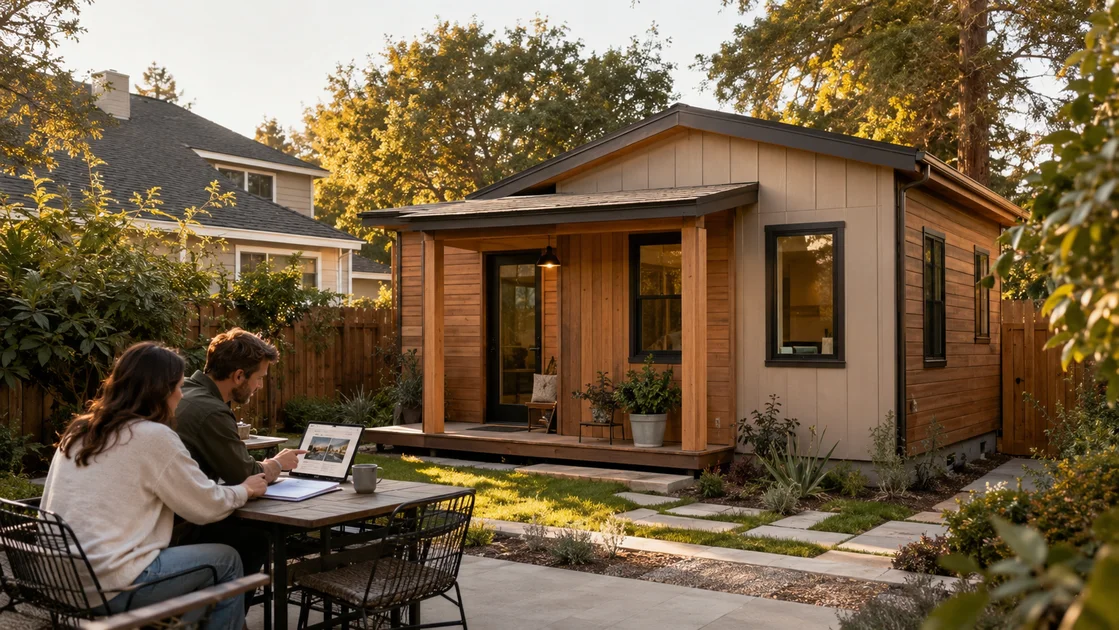
Can this Amazon tiny home become a legal ADU? Start here
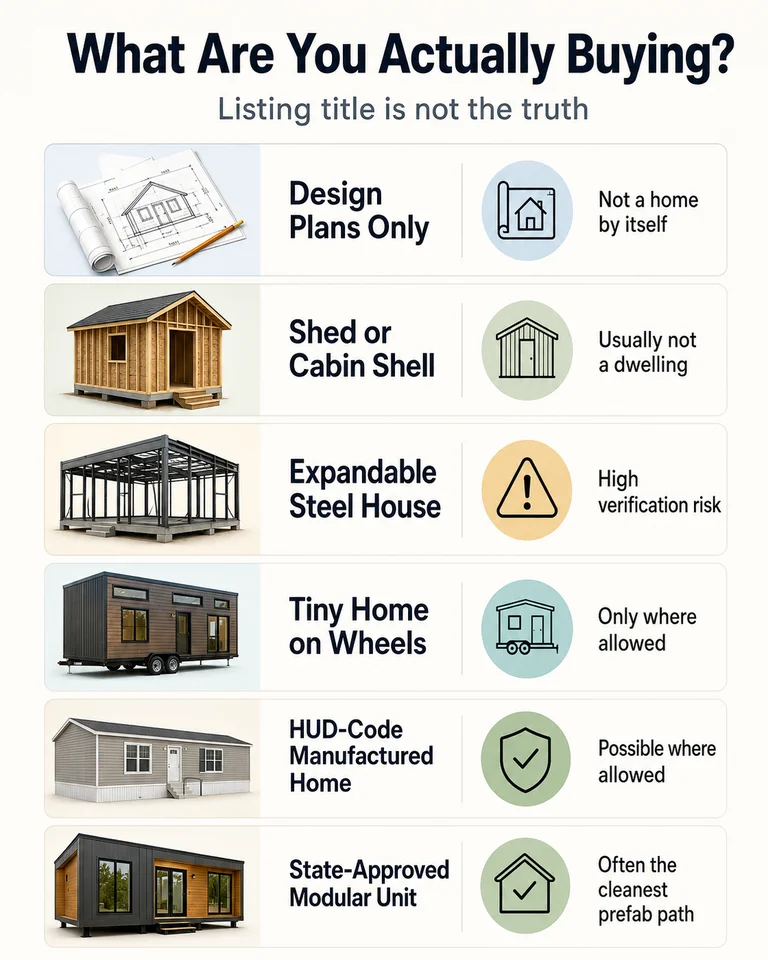
Read this table the way an inspector would: ignore the listing title, and identify what you’re actually looking at. The right-hand column is your fastest route to a real answer.
| If the Amazon listing is really a… | Fast answer | First thing to verify |
|---|---|---|
| Design plans only (drawings, “blueprints,” a PDF) | No — not by itself | Are the plans stamped and engineered for your state and city? |
| Shed or cabin shell (Allwood, Little Cottage Co., Handy Home) | Usually no as a dwelling | Does it meet residential code for insulation, egress, fire, plumbing, and electrical? |
| Expandable / foldable steel house (Chery, DuraYu, OneSpaceHub) | Maybe — high verification risk | Engineering, code path, foundation, utility specs, wind/snow/seismic ratings |
| Tiny home on wheels (THOW) | Only where local law allows movable tiny homes as ADUs | Your city’s movable-tiny-house ordinance, anchoring, utility, occupancy rules |
| HUD-code manufactured home (red HUD label) | Possible where local ADU rules allow it | The HUD certification label and the installation requirements |
| State-approved modular unit (state insignia) | Often the cleanest prefab path | State modular approval, plus a local site permit, foundation, utilities, inspections |
| A listing that says “no permit needed” | Red flag | Confirm with your local building department before buying — the seller doesn’t decide this |
One definition before we go further. An ADU is a complete, independent home on a lot that already has a house — its own kitchen, bathroom, and sleeping area, with a separate entrance. California’s statute is the clearest in the country: it defines an ADU as a residential dwelling unit with “complete independent living facilities,” including “permanent provisions for living, sleeping, eating, cooking, and sanitation” on the same parcel (Cal. Gov. Code §66313; verified May 31, 2026). Most other states use functionally similar language.
Free tool: the Amazon Tiny Home ADU Reality Check
Not sure which category your listing falls into? Our checker flags the likely product class, the red flags to chase down, the documents to demand from the seller, and the exact question to ask your building department — before you buy.
Run the free Reality Check →Most readers don’t actually know whether their lot qualifies for an ADU at all — and that one fact changes everything below.
See what’s possible at your address → get your free ADU reportCan an Amazon tiny home be used as an ADU?
Answer: Yes, sometimes — but only when both the product and the property pass an ADU test. A legal ADU isn’t a cheap backyard structure plus optimism. It requires zoning permission for the unit, a recognized building-code path (site-built, state-approved modular, HUD-code manufactured, or a locally adopted tiny-house pathway), an approved foundation or anchoring, permanent water/sewer/electrical, permits, inspections, and final occupancy approval. A marketplace listing title can’t grant any of those.
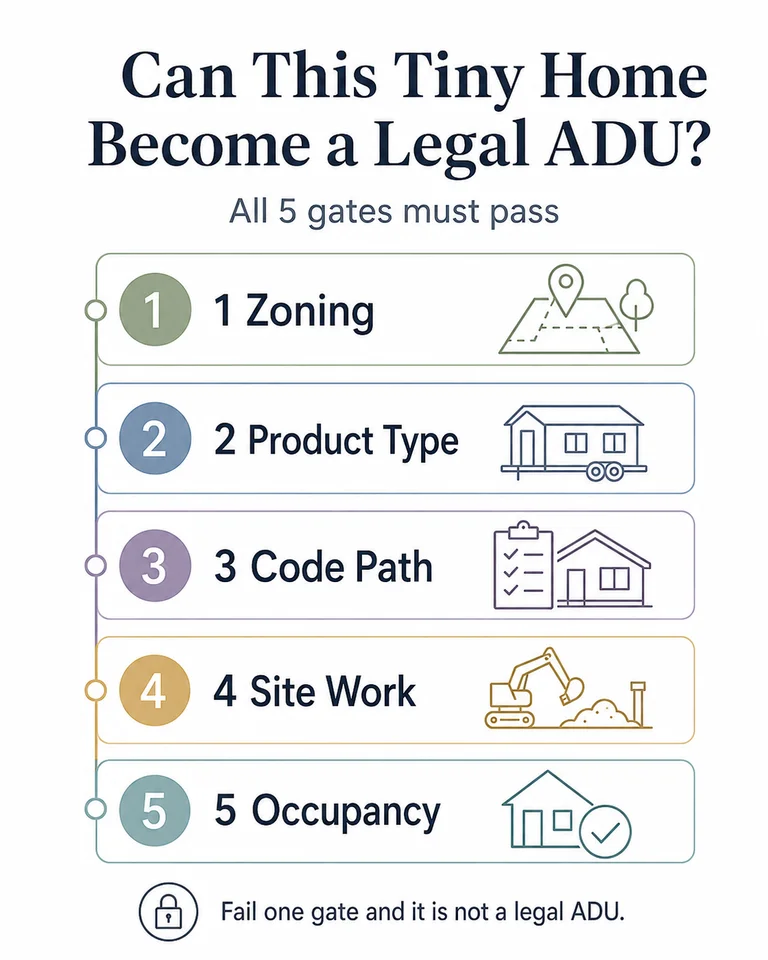
The 5-Gate Test: every gate has to pass
Picture legality as five gates in a row. Fail any one, and the unit is not a legal ADU — no matter how good the price was.
| Gate | The question | You fail if… |
|---|---|---|
| 1. Zoning | Does your property allow an ADU at all? | ADUs aren’t permitted on your lot, your zone excludes them, or a deed/HOA restriction blocks it |
| 2. Product class | Is it a legal dwelling product? | It’s actually plans, a shed, a shell, or a recreational unit |
| 3. Building code | Does it fit an accepted code path? | No HUD label, no state modular approval, no stamped site-built plans, no adopted tiny-house path |
| 4. Site work | Can it sit on an approved foundation with permanent utilities? | There’s no foundation plan and no way to bring water, sewer, and power to code |
| 5. Occupancy | Can it pass inspections and earn a certificate of occupancy? | It can’t be legally lived in or rented |
A certificate of occupancy (often “CO”) is the final document the building department issues confirming a structure is legal to live in. Without it, an ADU isn’t an ADU — it’s an unpermitted structure, and that’s a problem for insurance, financing, resale, and renting.
Do you need a permit for an Amazon tiny home?
Answer: For a habitable ADU, assume yes — you’ll typically need zoning approval, a building permit, plan review, and inspections before anyone can legally live in it. For a small, non-habitable accessory structure like a backyard office, permit rules are lighter and vary by jurisdiction, but electrical work, plumbing, setbacks, easements, and placement rules can still apply. A seller’s “no permit needed” claim is a red flag, not a fact.
Why the federal and state rules back this up
Three layers of rules decide whether a factory-made box is a legal home, and none of them care what an Amazon title says:
- Manufactured homes must be built to the U.S. Department of Housing and Urban Development’s Manufactured Home Construction and Safety Standards (24 CFR Part 3280). Every section built after June 15, 1976 carries a red HUD certification label, and a manufactured home is defined as a dwelling unit of at least 320 square feet on a permanent chassis (HUD.gov; verified May 31, 2026).
- Modular / factory-built homes are built to the state-adopted residential building code and carry a state insignia — for example, a California HCD insignia, an Arizona factory-built building certificate, or a Colorado Division of Housing insignia (Sources: California HCD; Arizona Dept. of Housing; Colorado Division of Housing; verified May 31, 2026).
- Everything else — kits, panelized walls, SIPs, and imported shells — is generally treated as site-built and must pass full local inspection with stamped, engineered plans. Most cheap Amazon units land here, with none of the paperwork the first two categories carry.
Not sure which gate your listing fails? You don’t have to guess.
Get your free ADU report → see what you can build at your addressWhat are you actually buying when Amazon says “tiny home”?
Answer: “Amazon tiny home” isn’t one product category — it’s at least four, ranging from $15 sets of drawings to $125,000 certified ADUs. The same search results page can show plans, sheds, expandable steel shells, container-style units, mobile-tiny-home blueprints, modular units, and HUD-code-style homes side by side. The product title is marketing; the product details and the certification label are the truth.
Here’s the trap in one listing’s worth of reality: a popular Amazon listing titled “460sqft Two Bedroom Tiny Home ADU Design Plans” is not a home. The product description says it includes “a floor plan, elevations, door and window schedule,” calls the layout “open to interpretation,” and pitches itself as “an excellent starting point for your design” — for roughly the price of a paperback (Amazon listing B0DMQRYD51, May 2026). The listing title has “ADU” in it. The product is a PDF.
The 4 tiers of “Amazon tiny home” — decoded
| Tier | Typical price | What it actually is | Certification | Can it be a permitted ADU? | Honest best use |
|---|---|---|---|---|---|
| 1. DIY shed / cabin kits | ~$3,000–$12,000 | A wood panel kit; no plumbing, insulation, or wiring by default (e.g., Allwood Sunray 162 sq ft; Little Cottage Co. 12×24 listed ~$5,859) | None — it’s building material | Rarely as a dwelling | Storage, she-shed, hobby or art studio (no sleeping or cooking) |
| 2. Expandable / foldable steel shells | ~$10,000–$30,000 | An imported steel-frame folding shell, often not wired or plumbed (Chery Industrial, DuraYu, OneSpaceHub, XContainerHouse) | None — no HUD label, no state insignia | Very difficult — must pass full local inspection as site-built; frequently can’t | Backyard office, studio, or gym where local code allows a non-dwelling accessory structure |
| 3. Larger imported “prefab ADU” listings | ~$30,000–$60,000 | A bigger imported shell marketed as an “ADU” (e.g., “White Haven” 360 sq ft 2-bed listed ~$49,999; 2-story units ~$29,000–$48,500) | Usually none or unclear | Difficult unless the seller supplies U.S. code certification and stamped engineering | A dwelling only with a full local code path; otherwise non-dwelling |
| 4. Legitimate U.S. factory-built ADUs | ~$90,000–$180,000+ (unit only) | A true modular home built to state code (e.g., “Modern Prefab ADU” 490 sq ft listed ~$125,000) | A state insignia or HUD label | Yes — if certified and properly installed and permitted | A permitted ADU, legal rental, or in-law unit |
Sources: Fortune (Apr 11, 2024; Oct 17, 2024); NY Post via AOL on OneSpaceHub; AOL Finance on expandable units; eBay XContainerHouse; HUD.gov; California HCD. Prices are recent snapshots — verify before buying.
The Amazon Tiny Home ADU Reality Check Matrix
| Listing (example) | Recent price | Size | What it really is | Cert. | Ships wired & plumbed? | ADU verdict |
|---|---|---|---|---|---|---|
| “460sqft Two Bedroom Tiny Home ADU Design Plans” (Amazon) | ~$15 (May 2026) | 460 sq ft on paper | Design plans only | None | N/A | Not a building — drawings only |
| Chery Industrial 19×20 expandable | ~$16,000–$23,000; one buyer paid $38,999 | ~380 sq ft | Imported expandable steel shell | None | No — listing states “not wired” | Usually can’t be permitted as a dwelling as sold |
| OneSpaceHub roof-deck unit (Amazon) | $19,000 (single-story $16,570; 2-level from $48,500), 2025 | ~20 ft | Imported steel/aluminum shell, ~5,000 lb, no reviews | None | No — buyer supplies power/water | High verification risk |
| DuraYu expandable (marketplace) | $18,180–$27,200 (2026) | 13–19 ft | Imported expandable steel | None | Verify | High verification risk |
| “White Haven” 360 sq ft 2-bed | ~$49,999 (2026) | 360 sq ft | Larger imported shell marketed as an “ADU” | Unclear | Verify | Difficult unless certified |
| “Modern Prefab ADU” 490 sq ft 1-bed | ~$125,000 (2026) | 490 sq ft | Marketed as a modular ADU | Verify insignia | Verify | Possible if state-certified and properly installed |
| Amazon shipping-container home (historical, 2017) | $36,000 + ~$4,500 shipping | Tiny | Steel container, ~7,500 lb | None | Verify | “container” ≠ legal housing |
Prices are recent snapshots; Amazon inventory rotates constantly. Re-check live before purchasing. Sources: Fortune, NY Post, AOL, eBay marketplace. Verified May 31, 2026.
Are Amazon tiny homes legit?
Some are real, functional structures; some are kits or bare shells; and some listings are only design plans. They aren’t inherently a scam, but quality and completeness vary enormously, and many listings carry few or no reviews. The honest rule: a listing is a real product until you assume it’s a permit-ready dwelling — that last leap is where buyers get burned.
Where these units come from — and why “no reviews” is a clue
The viral expandable units are heavy steel structures shipped long distances, sometimes from overseas. One widely covered OneSpaceHub model was described as a roughly 5,000-pound stainless-and-aluminum parcel with no customer reviews (Source: NY Post via AOL; verified May 31, 2026). An eBay version of a similar container house listed at $16,237 shipped from Shandong, China, with no returns (Source: eBay XContainerHouse listing; verified May 31, 2026). Older Amazon shipping-container homes ran about $36,000 plus roughly $4,500 in shipping for a 7,500-pound structure (Source: Fortune, 2017; verified May 31, 2026). None of that makes these products fake — it makes them freight-heavy building materials with thin verification.
What code path makes an Amazon tiny home permit-ready?
Answer: The most useful question isn’t “is this Amazon tiny home legal?” — it’s “what code path does this product use?” A legal ADU has to fit one of a handful of recognized paths: site-built under the residential code, state-approved modular, HUD-code manufactured housing where local rules allow it, or a locally adopted movable-tiny-house category. The label on the unit — or the absence of one — tells you which path is even available before you call your city.
The label test: what’s on (or missing from) the unit
| Label on the unit | What it means | Permit / ADU reality |
|---|---|---|
| Red HUD tag (24 CFR Part 3280; ≥320 sq ft; permanent chassis) | Federal manufactured-home certification | Permittable as a manufactured-home ADU in many states (California allows it) |
| State insignia (e.g., California HCD, Arizona FBB, Colorado DOH) | Factory-built/modular, built to the state-adopted residential code | Permittable as a modular ADU |
| No tag — sold as a kit / panelized / SIP | Treated as site-built; needs full local inspection plus stamped plans | Possible, but you carry the entire code burden |
| No tag — imported expandable shell | Not built to any U.S. adopted code; no engineering package | Usually cannot be permitted as a dwelling; non-dwelling use only |
Sources: HUD.gov (24 CFR Part 3280); California HCD insignia program; Arizona Dept. of Housing; Colorado Division of Housing; ADU Accelerator. Verified May 31, 2026.
The full code-path decision table
| Code path | What to look for | Why it matters |
|---|---|---|
| Site-built / kit under the residential code | Stamped structural plans, engineering, energy documents, local permit drawings | Your city reviews it like a small house, start to finish |
| State-approved modular | A state modular-approval number, installation documents, foundation plan | Factory work may be pre-approved, but the site still needs a local permit |
| HUD-code manufactured home | A red HUD certification label, the installation manual, chassis status | HUD homes follow a federal construction standard and a labeling system |
| Movable tiny house / THOW | A local ordinance that allows movable tiny homes, plus anchoring, utility, and inspection rules | Allowed only in some jurisdictions; many treat wheels as “not a permanent dwelling” |
| Park model / RV-style | RVIA or ANSI A119.5 documentation | Usually not treated as a permanent dwelling ADU unless local rules allow it |
| Container / expandable unit | Engineering, residential-conversion details, energy/fire/egress documentation | “Container” or “expandable” never automatically equals “legal housing” |
Key terms decoded
- THOW = tiny house on wheels. Because it sits on a trailer, many jurisdictions classify it as a recreational vehicle or personal property — which changes permitting, financing, and insurance.
- Park model = a small recreational unit built to the ANSI A119.5 standard, not the residential building code. Fine for an RV park; usually not a permanent ADU.
- Plan check = the building department’s review of your drawings before it issues a permit.
- Utility lateral = the underground pipe or line connecting your unit to the public water, sewer, or power main. Running new laterals is one of the biggest hidden costs.
The tiny-house code most pages get wrong
There is a building code written for small homes — and its name changed, which is exactly where competitors slip. The International Residential Code’s tiny-house provisions appear as Appendix Q in the 2018 IRC, Appendix AQ in the 2021 IRC, and Appendix BB in the 2024 IRC (ICC Digital Codes, 2024 IRC Appendix BB; verified May 31, 2026). The 2024 IRC also added a brand-new Appendix BC for accessory dwelling units — the first time the model code carries an ADU-specific appendix (Source: ICC 2024 IRC; verified May 31, 2026). Both define a “tiny house” as a dwelling 400 square feet or less and relax specific rules for compact stairs, ladders, and loft ceiling heights — while holding firm on egress, minimum 6-foot-8-inch habitable ceiling height, and structural requirements.
Have a unit in your cart but no code documents? That’s the moment to slow down — not speed up.
Get your free ADU report → see what you can build before you commitHow much does an Amazon tiny home ADU really cost?
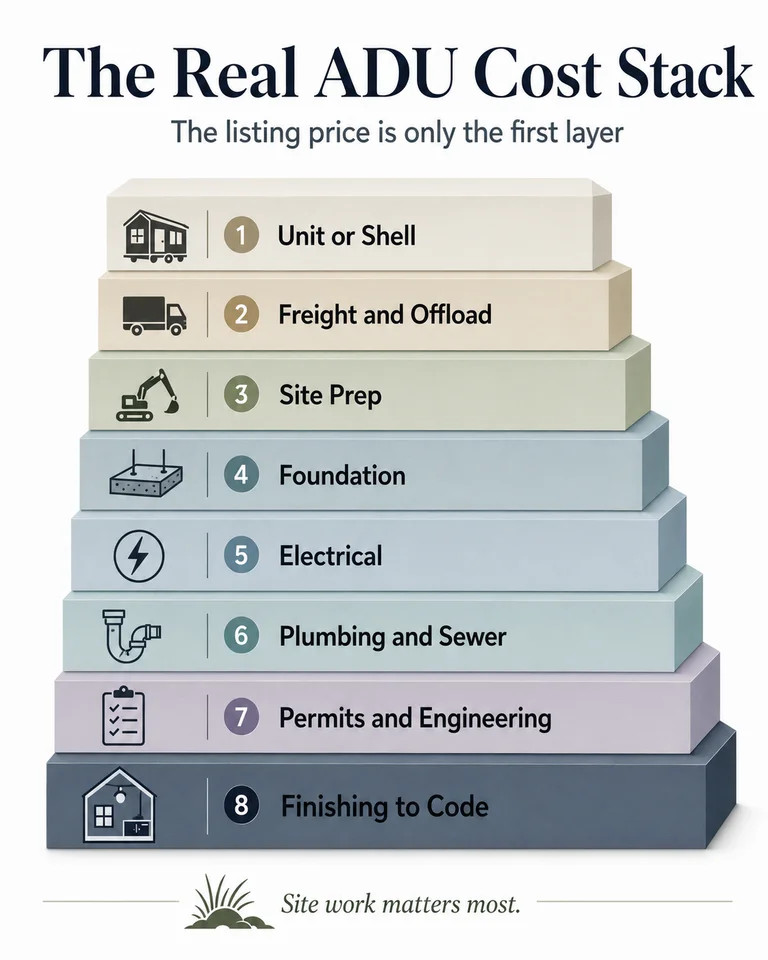
Answer: On a cheap Amazon unit, the listing price usually buys the shell only. Foundation, utility connections, electrical, plumbing, permits, engineering, and finishing typically add $50,000–$130,000+ depending on your site — which frequently makes the unit itself the cheapest line item in the project. A $20,000 expandable house is not a $20,000 ADU; it’s a down payment on a project whose real cost is set by your lot, not by the seller.
The true all-in cost decoder
| Cost layer | Typical range | In the Amazon price? | Source |
|---|---|---|---|
| The unit / shell (expandable tier) | $10,000–$30,000 | Yes — this is what you’re buying | Fortune; NY Post; marketplace listings |
| Freight / offload + crane set | Advertised as “free shipping” often; inland freight, offload, crane commonly run five figures | Partial / No | NY Post; LADU |
| Site prep & grading | $5,000–$40,000 | No | Block Renovation; LADU; BuildX |
| Foundation (pier cheaper for tiny; slab / stem wall higher) | $5,000–$50,000 | No | BuildX; LADU |
| Electrical (unit often not wired) + panel / hookup | $5,000–$25,000+ | No | NY Post unboxing report; Block Renovation |
| Plumbing + water / sewer or septic connection | $10,000–$50,000 | No | BuildX; Block Renovation |
| Permits, plan check & stamped engineering | $3,000–$25,000 | No | BuildX; LADU |
| Insulation / finishing to code (if shell is bare) | Varies by unit | No | Building-code sources |
| Realistic all-in where permittable | Often $50,000–$130,000+ on top of a ~$20,000 unit; highly site-dependent | — | Dwelling Index synthesis from rows above |
Sources: Block Renovation prefab-ADU cost guide (Feb 2026); BuildX hidden-cost breakdown (Mar 2026); LADU prefab cost article (Jan 2026). Verified May 31, 2026.
A worked example (illustrative, not a quote)
The most viral unit, the Chery Industrial 19×20 expandable prefab house, runs about 380 square feet and has been listed anywhere from roughly $16,000 to $23,000 depending on seller — and one widely covered Amazon buyer paid $38,999 for his (NY Post; verified May 31, 2026). The listing’s own fine print warns the unit ships unwired: “Mobile Prefab House is not wired. Please hire an electrician for American standard wiring.”
Take a $20,000 unit. Add a modest pier-and-grade foundation ($10,000), electrical service and sub-panel because the shell ships unwired ($12,000), a water and sewer lateral run a reasonable distance ($20,000), and permits with stamped plans ($8,000). You’re at roughly $70,000 before a single upgrade — and that assumes your city will permit the unit at all. The unit price barely moves the total. The site does.
For scale on the upper end: a Block Renovation analysis found a prefab unit advertised at $150,000 commonly lands at $215,000–$310,000 fully installed (verified May 31, 2026). The lesson is identical for a $20,000 Amazon shell: the advertised price is the beginning of the budget, not the budget.
The honest conclusion — and the way through it
By the time you make a cheap shell genuinely legal — engineering, foundation, utilities, inspections — you can be within reach of a certified unit that’s designed to pass on the first try. The money that scares people isn’t the unit — it’s the site work, and you pay for site work no matter which unit you choose. Foundation, water, sewer, and power cost about the same whether you set a $20,000 import or a $120,000 certified modular on top of them. The real decision was never “cheap unit vs. expensive unit.” It’s “a unit that might clear permitting after costly redesign vs. a unit that arrives with the paperwork your city already accepts.”
Want to know what the site work alone would cost on your lot — before you fall for a sticker price?
Explore your options and project scope → get your free ADU reportMost ADUs are financed through a small set of lanes: a cash-out refinance, a construction loan, a HELOC, or renovation loans sized against your home’s projected after-build value. We cover these as education, not endorsements — no rates, no approval odds.
Compare common funding routes and their eligibility limits before contacting a lender.Compare ADU Financing OptionsEducational resource; not a rate offer, not a guarantee of approval. We may earn a commission if you use our links; our recommendations are never influenced by compensation.
Which Amazon listings should you skip immediately?
Answer: Skip any listing that can’t prove what it is, how it’s permitted, and who is responsible for code documents, site work, utilities, delivery, warranty, and installation. The cheaper the headline price, the harder you should look for what’s missing.
When YouTuber Nathan Graham (“Unspeakable”) spent $38,999 on a 19×20 Chery Industrial expandable unit, it arrived with no assembly instructions, and when he tried to plug in a fridge he discovered the unit had no electrical outlets — the fine print said it ships unwired. His video drew 7.5 million views (NY Post; Dexerto; verified May 31, 2026). Even at nearly $39,000, the “house” wasn’t wired. Another buyer paid about $26,000, drew nine million views, and admitted “I don’t even know where I’m going to put the house” (Source: AOL Finance; verified May 31, 2026). The unit arrives before the plan does.
Red flags that should end your interest
| Red flag | Why it matters |
|---|---|
| Title says "home," but details say "plans," "blueprint," or "printed" | You’re buying drawings, not a dwelling |
| No code documents of any kind | The building department may reject it outright |
| No stamped plans or structural engineering | You may need an expensive redesign before any permit |
| Seller claims "no permit needed" | The local authority decides that, not the seller |
| WhatsApp-only or off-platform-only communication | Much harder to verify accountability or recover money |
| No wind / snow / seismic load ratings | May fail your local structural requirements |
| No insulation or energy documentation | May fail energy code or basic habitability |
| No plumbing or electrical specifications | Utility hookups and inspections become a gamble |
| No foundation or anchoring instructions | The installation may not be approvable |
| No clear warranty or return terms (or "no returns") | Enormous downside if the permit fails |
| One review, no reviews, or unrelated reviews | The social proof you’d normally lean on isn’t there |
Want a fast gut-check on a specific listing before you buy? Our checker flags the likely product class and the red flags to chase down.
Run the free Reality Check →What documents should you ask the seller for before paying a deposit?
Answer: Ask for documents before you ask for a discount. A low price is meaningless if the seller can’t provide the paperwork your building department needs to approve a dwelling. The same request instantly separates a serious manufacturer from a drop-shipper — most red-flag sellers simply go quiet.
The seller document request checklist
| Document to request | Why you need it |
|---|---|
| Full construction drawings | Confirms what is actually being built |
| Stamped structural plans | Required for permit review in most jurisdictions |
| Code-compliance statement | Identifies the path: IRC site-built, state modular, HUD, or other |
| HUD label documentation (if claimed) | Required if it’s sold as HUD-code manufactured housing |
| State modular approval (if claimed) | Confirms the factory-built approval path |
| Installation manual | Shows foundation, anchoring, utility, and assembly requirements |
| Foundation requirements | Needed by your site contractor and for the permit |
| Wind / snow / seismic load ratings | Proves it can meet your local structural loads |
| Energy documentation | Insulation, HVAC, windows, building-envelope compliance |
| Plumbing & electrical diagrams | Required for utility permits and inspections |
| Fire-safety and egress details | Required for a habitable-dwelling review |
| Warranty and return terms | Reduces your downside if the permit is denied |
| Delivery scope | Clarifies curbside drop vs. installed |
| Seller / manufacturer legal identity | Lets you verify who’s actually accountable |
Copy-paste script for the seller’s Q&A box:
“Before I purchase, please send the stamped structural plans, the code-compliance statement (IRC, state modular, or HUD), the installation manual with foundation and anchoring requirements, and the wind/snow/seismic load ratings for this unit. My building department requires these for a habitable dwelling permit. If these aren’t available, please confirm in writing that this product is sold for non-dwelling use only.”
Silence is your answer.
Want this checklist as a printable PDF, plus the building-department script below?
Download the free ADU Starter Kit →Includes the seller script, the red-flag checklist, and the building-department questions below.
How do you ask your building department the right question?
Answer: Don’t ask, “Can I put an Amazon tiny home in my backyard?” — that invites a flat “no” or a useless “it depends.” Ask a permit-specific question that names the product class, size, foundation, utilities, and code documents.
The question that gets you nowhere:
“Can I put this Amazon tiny home in my yard?”
The question that gets you a real answer:
“I’m considering a detached ADU of approximately [sq ft] at [address]. The unit is [modular with a state insignia / a HUD-code manufactured home / a site-built kit / a movable tiny house / an expandable steel structure]. It would sit on a [slab / pier / stem-wall] foundation with permanent water, sewer, electrical, and HVAC. What zoning, building-code, plan-review, and inspection requirements would apply before I purchase it — and does this jurisdiction allow this product class as an ADU?”
The same unit, different answers: why city rules change everything
| Location | Why it changes the answer |
|---|---|
| California (statewide) | Broad ADU rights: state size floor is 850 sq ft (studio/1-bed) or 1,000 sq ft (2+ bedrooms); a separate by-right path protects at least an 800 sq ft ADU with four-foot side/rear setbacks; cities can’t impose minimum-lot-size rules and must use a ministerial (by-right, no public hearing) approval process. Los Angeles allows up to 1,200 sq ft. (Cal. Gov. Code §66321; AB 68; verified May 31, 2026) |
| Los Angeles | LA maintains a specific Movable Tiny House ordinance distinct from ordinary detached ADUs — proof that “tiny home” and “ADU” aren’t interchangeable in every city (Source: LADBS; verify current rules) |
| New York City | The “City of Yes for Housing Opportunity” reforms (approved Dec 2024) opened pathways for ADUs such as backyard cottages, basement apartments, attic conversions, and garage studios, subject to the city’s safety and zoning rules (Source: NYC HPD/DOB; verify current rules) |
| Oregon / Portland | Oregon requires many jurisdictions to permit ADUs in areas zoned for detached single-family homes, while Portland sets detailed standards for detached-ADU height, coverage, and location (Sources: Oregon DLCD; City of Portland; verify current rules) |
| Austin | Austin directs homeowners to verify ADU allowance, secure proper addressing, apply for permits and pay fees, then pass inspections before occupancy (Source: City of Austin Development Services; verify current rules) |
A few California specifics worth knowing:
- You don’t have to live on the property to build a standard ADU — owner-occupancy requirements were eliminated statewide by AB 976 (verified May 31, 2026). A JADU (junior ADU, 500 sq ft or less, built inside the existing house) triggers an owner-occupancy requirement only if it shares a bathroom with the main home, under AB 1154, effective January 1, 2026 (Source: California AB 1154; verified May 31, 2026).
- Fees can be waived. Development impact fees can’t be charged on ADUs with 750 or fewer square feet of interior livable space, and ADUs or JADUs under 500 square feet are exempt from school impact fees (Source: California SB 13 and SB 543; verified May 31, 2026). As of January 1, 2026, those limits count interior livable space (SB 543).
The fastest way to learn your city’s real answer is to start with your address.
Get your free ADU report → see what you can build where you liveWhen is it smarter to buy from a prefab ADU builder than from Amazon?
Answer: Buying direct from a prefab ADU or modular ADU provider tends to win when you need permit support, verified code documents, site planning, installation accountability, clear warranties, and a company that actually serves your area. This isn’t anti-Amazon — it’s about matching the product to the job.
| Factor | Amazon tiny-home listing | Direct prefab / modular ADU provider |
|---|---|---|
| Price visibility | Often attractive but incomplete | Higher upfront, usually clearer scope |
| Code documents | Varies wildly; sometimes none | Usually available on request |
| Permit support | Typically limited or none | Often included or available |
| Service area | Listing may ship broadly | Provider may be geo-restricted |
| Installation | May be curbside, DIY, or third-party | Often coordinated end-to-end |
| Warranty accountability | Varies by seller | Usually clearer |
| Local code fit | You verify it yourself | Provider may know local rules |
| Best for | Research, non-habitable uses, rare verified products | Homeowners serious about legal occupancy |
If you’re exploring a documented unit instead of a marketplace gamble, here are starting points by need. No prefab unit is automatically ADU-approved everywhere — always confirm the model’s specs and your local permitting and delivery availability.
- For broad national modular ADU options with specs you can review, Compare ADU Builders is built for exactly this. Compare ADU Builders
- If what drew you in was the expandable/portable format specifically, confirm warranty, return terms, and what’s included before buying. (portable ADU guide)
- If you loved the compact, foldable idea, BOXABL’s Casita is worth an honest look next to a generic foldable shell — the difference is the engineering and documentation behind it. Check local permitting and delivery availability. → See the BOXABL Casita
If the Amazon listing fails the ADU test, here’s your next move
| Why the listing failed | Your better next step |
|---|---|
| It’s only plans | Ask whether the plans can be stamped locally, or compare permit-ready plan sets |
| It’s a shed or shell | Consider a site-built tiny ADU or a prefab provider with a code path |
| It has no code documents | Skip it, or require a full engineering package in writing |
| It’s on wheels | Check whether your city allows movable tiny homes as ADUs |
| It’s a container/expandable unit | Demand engineering and a local code review before any deposit |
| The site work is too expensive | Compare a garage conversion or an attached ADU (existing utilities can cut costs) |
| Financing is unclear | Start with financing-path education and a real budget before product shopping |
Not ready to choose a path yet? Start with the one fact that decides all of them.
Get your free ADU report → see what you can build at your addressThe honest best uses for a cheap Amazon unit
Answer: Used as a non-dwelling structure — a backyard office, art studio, gym, or hobby room — a $10,000–$30,000 Amazon unit can be a genuinely good buy, as long as you follow your local rules for accessory structures and pull an electrical permit when you add power. These units are often great for the job they’re actually good at, and a poor fit for the job their title implies.
What’s frequently allowed with light friction
- Non-habitable accessory structures. Many jurisdictions don’t require a building permit for a small detached accessory structure — commonly under 120 square feet in many California cities, and up to 200 square feet under some model-code language. Thresholds vary, so verify locally. That’s office, storage, or studio territory.
- No sleeping, no cooking, no full plumbing. The moment you add a kitchen and a place to sleep, you’ve built a dwelling in the eyes of the code, and the full ADU process applies.
What still needs a permit even for non-dwelling use
- Electrical. Running power almost always requires an electrical permit and inspection — and remember, many of these units ship unwired.
- Setbacks and placement. A setback is the minimum distance a structure must sit from your property lines. Even a permit-exempt shed usually has to respect setbacks, easements, and sometimes a maximum-height rule.
- Plumbing. Add a sink or a bathroom and you’ve triggered plumbing permits — and often the dwelling question all over again.
Bought with clear eyes for the right job, a folding steel unit can be a great-value studio. Bought as a legal rental on faith, it can become an expensive lesson. The product didn’t change — the expectation did.
Frequently asked questions about Amazon tiny home ADUs
Are Amazon tiny homes legit?
Some are real, functional structures; some are kits or bare shells; and some listings are only design plans. They’re not inherently a scam, but quality and completeness vary enormously, and many listings have few or no reviews. Verify the product details, the seller’s identity, the code documents, and your local permit path before buying.
Can I put an Amazon tiny home in my backyard?
Only if your property allows the intended use and the specific unit can be legally permitted, installed, inspected, and (for a dwelling) granted a certificate of occupancy under your local rules. A non-dwelling structure like an office is far easier than a habitable ADU.
Do I need a permit for an Amazon tiny home?
For a habitable ADU, assume yes — you’ll typically need zoning approval, a building permit, plan review, and inspections. A seller’s “no permit needed” claim should never be trusted without written confirmation from your local building department.
How much does an Amazon tiny home really cost?
The listing price (often $10,000–$30,000 for an expandable unit) usually covers only the structure. Once you add foundation, utilities, electrical, plumbing, permits, and engineering, the realistic all-in cost for a permitted dwelling commonly runs $50,000–$130,000+ depending on your site — frequently making the unit the cheapest part.
Are Amazon tiny homes safe for full-time living?
A unit is safe for full-time living only if it meets the residential building code adopted where you live — structure, insulation, egress, fire safety, electrical, and plumbing. Many imported shells aren’t designed to a U.S. adopted code, which is why legal full-time occupancy usually requires either a certified unit or substantial code work.
Can you finance an Amazon tiny home ADU?
Financing is harder when a product isn’t treated as real property or can’t be legally permitted as an ADU. Lenders generally finance ADUs that will be permitted dwellings on a permanent foundation. Confirm the code path and full project scope first, then explore lanes such as a cash-out refinance, construction loan, or HELOC.
Can you rent out an Amazon tiny home as an ADU?
Only if it’s legally permitted for occupancy and your local rules allow the rental use. Long-term-rental rules and short-term-rental rules are often separate, and an unpermitted structure generally can’t be legally rented at all.
Is a tiny home on wheels an ADU?
Sometimes — but only in jurisdictions that specifically allow movable tiny homes as ADUs or as a defined local category. Many places treat wheeled units as recreational vehicles rather than permanent dwellings, which changes permitting, financing, and insurance.
Is an Amazon container home a legal ADU?
Not automatically. A container or expandable structure still needs engineering, an approved foundation, permanent utilities, code compliance, permits, inspections, and local occupancy approval. The word “container” never equals “legal housing” on its own.
What should I do before buying?
Classify the product (plans, kit, shell, or dwelling), request the seller’s documents, ask your building department a permit-specific question, estimate your site costs, compare code-compliant alternatives, and only then decide whether the Amazon product is worth pursuing for your goal.
How we researched this, and what we verified
This page was created by the Dwelling Index editorial team, an independent research resource covering ADU financing, costs, and regulations. We reviewed live Amazon and marketplace listings, federal and state building-code and housing-agency sources, city ADU rules, and real homeowner discussions to separate marketplace claims from permit reality. We don’t sell tiny homes, and no manufacturer paid for placement in this guide.
- Marketplace review. We examined live listings documenting how product titles diverge from product details.
- Code-path review. We compared listing types against the recognized paths using primary sources (HUD, state housing agencies, the IRC).
- Local-rule review. We checked official state and city examples to show why the identical unit can be treated differently in different places.
- Voice-of-customer review. We reviewed public unboxing videos and forum discussions only to understand buyer concerns — never as proof of law, cost, or code.
- Editorial conclusion. Our recommendations turn on one test: can a reasonable homeowner verify the product class, the code path, the site cost, and the local permit route before paying a deposit?
What we verified
| Verified item | Source type | Last checked |
|---|---|---|
| Listings mix plans, prefab language, and ADU wording in one search | Amazon / marketplace product pages | May 31, 2026 |
| A top "Tiny Home ADU" listing is design plans, not a structure (B0DMQRYD51) | Amazon product listing | May 31, 2026 |
| Expandable units ship heavy, sometimes from overseas, often unwired | Fortune, NY Post, AOL, eBay | May 31, 2026 |
| Nathan Graham paid $38,999; unit had no outlets / shipped "not wired" | NY Post, Dexerto | May 31, 2026 |
| HUD-code homes require a certification label; ≥320 sq ft; 24 CFR 3280 | HUD.gov | May 31, 2026 |
| IRC tiny-house appendix: Q (2018) → AQ (2021) → BB (2024); 2024 IRC adds ADU Appendix BC | ICC Digital Codes / UpCodes | May 31, 2026 |
| California ADU definition, size floor (850/1,000 sq ft), ministerial approval, owner-occupancy, fees | Cal. Gov. Code §66313 / §66321; AB 68; AB 976; AB 1154; SB 13; SB 543 | May 31, 2026 |
| Modular vs. manufactured certification (state insignia vs. HUD label) | California HCD, Arizona DOH, Colorado DOH | May 31, 2026 |
| Installed-cost ranges (site prep, foundation, utilities, permits) | Block Renovation, BuildX, LADU | May 31, 2026 |
| Amazon prices and inventory are dynamic | Marketplace reality | Re-check each refresh |
Not sure where to start?
See what’s possible at your address — get your free ADU report.
Get my free ADU report →Related guides
- Amazon prefab ADU: real cost & 5 permit checks
- Tiny home ADU guide — legal paths, costs, and codes
- Prefab ADU guide — brands, costs, and code paths
- Modular ADU — how state-certified units work
- Portable ADU — what’s allowed vs. what isn’t
- Container home ADU — code path, costs, and red flags
- DIY ADU kit guide — what to buy, what to build
- ADU kit homes — costs, brands, and permit reality
- Best prefab ADUs under $200K
- Home Depot ADU alternatives — 7 real paths & true costs
- How much does an ADU cost in 2026?