Amazon Prefab ADU: What You’re Really Buying — and Whether It Can Legally Be an ADU
By The Dwelling Index — an independent research resource covering ADU financing, costs, and regulations.
Last updated: June 1, 2026 · Last verified: June 1, 2026
The short answer
An Amazon prefab ADU can become a legal accessory dwelling unit — but only if the specific listing has a recognized U.S. residential code path, your city allows that unit type as a dwelling, and the finished project passes local permits and inspections. Most viral “Amazon houses” are inexpensive steel shells whose listings show no state modular insignia and no HUD certification label, which is why building departments won’t approve them as living space. We’ll say this plainly: this guide may talk you out of buying that Amazon listing. If it does, it likely saved you a five-figure mistake. The better news is that the backyard unit you’re picturing is genuinely achievable — through a path that actually permits, finances, and insures.
The 60-second verdict
Buying an “Amazon prefab ADU” is buying a product, not a permit. Amazon is a storefront; your local building department — the authority having jurisdiction, or AHJ — approves code documents, not listing titles. A legal ADU still needs a recognized code path, zoning approval, a foundation, utility connections, inspections, and often a certificate of occupancy (the document that legally clears a unit for someone to live in it). Treat the Amazon price as one line item in a much larger project budget.
An ADU — accessory dwelling unit — is a self-contained second home on a property that already has (or will have) a primary house: its own kitchen, bathroom, and sleeping area. A DADU (detached ADU) is a freestanding backyard cottage; an AADU (attached ADU) is carved into or onto the existing house; a JADU (junior ADU) is a small unit, typically up to 500 square feet, created within the walls of an existing structure.
Here’s the decision at a glance. Treat every dollar figure as a range to verify for your lot — not a quote.
| Factor | Amazon foldable / container box | Certified modular ADU | Site-built ADU |
|---|---|---|---|
| Typical advertised price | ~$15,000–$50,000 | ~$70,000–$140,000 (unit) | n/a (built on site) |
| Realistic all-in installed cost | often 2–3× the sticker | ~$90,000–$200,000+ | $80,000–$400,000 |
| Can it be permitted as an ADU? | Usually no, as-is | Yes (with local approval) | Yes |
| Code certification | Usually none shown | State modular insignia (IRC) | Built to local IRC on site |
| Financeable with a traditional loan? | Rarely | Often yes (like site-built) | Yes |
| Insurable under homeowners policy? | Difficult | Easier once permitted | Yes |
| Warranty / installation support | Minimal (purchase protection only) | Builder-backed | Contractor-backed |
| Honest best use | Shed, office, studio, guest space | A real budget ADU | A custom ADU |
See what’s possible at your address → Get your free ADU report
Before you trust any listing, check whether your lot and city can support the ADU you want — unit type, size limits, setbacks, and utilities.
Download the free ADU Workbook → the seller-document checklist, two email scripts, and the all-in budget worksheet from this page, in one PDF.
What an “Amazon prefab ADU” actually is
When a homeowner searches “amazon prefab adu,” they picture one thing: a finished little house that shows up on a truck. What the marketplace returns is a jumble of radically different product categories priced from a few dollars to six figures. Telling them apart is the first real skill of buying smart here.
The five categories that confuse ADU shoppers
- Design plans only. A meaningful share of “tiny home ADU” results are plan sets — PDFs or printed drawings, sometimes listed for less than the cost of lunch. They are not a structure, and they are usually not the stamped, locally-approved construction documents your plan check requires.
- Backyard office / studio pods. Many listings are accessory non-dwelling structures — home offices, gyms, garden rooms. These can be genuinely useful, and in many places they’re far easier to permit than a dwelling. But “studio pod” is not “ADU.” A structure without code-compliant sleeping, cooking, and sanitation is not a second home.
- Foldable / expandable steel boxes. These are the viral units — the ones that unfold from a container-sized package in a few hours. They’re real products, mostly shipped from overseas sellers, and they’re the source of most of the confusion and most of the disappointment.
- Larger modular units ($50K–$125K). A growing tier of marketplace listings advertise “Modern Prefab ADU” homes in the 360–490 square foot range, priced from roughly $49,999 to $125,000. Quality and code status vary enormously and are rarely documented in the listing itself.
- Commercial container structures. Search results sometimes surface steel container bars, cafés, and shop fronts built to commercial standards — not residential dwellings at all. Buying one for a backyard ADU would mean a major conversion and a fresh code review, if it’s possible at all.
The takeaway: Amazon search blends product categories that have nothing in common legally, so you cannot shop by headline and photo. You need a document-based screen, which we give you further down.
The viral “Amazon house,” decoded
The unit that launched a thousand videos is the Chery Industrial Expandable Prefab House, a 19-by-20-foot folding steel structure. It sold on Amazon for roughly $17,000–$19,000, and one well-known creator who filmed his unboxing paid closer to $38,000. The reality behind the highlight reel is instructive: he reported the unit arrived with no assembly instructions, said on camera he’d worried it might be a scam before it showed up, and — despite his own garage renovation experience — still needed several days of hands-on work to get the structure standing. More importantly, he encountered legal issues trying to use it as a dwelling. The viral story normalized a product; it did not validate a legal strategy.
The “U.S.-made container” version
Not every Amazon prefab is an overseas dropship. One of the earliest and most cited listings came from MODS International, a Wisconsin-based seller offering a new 320-square-foot shipping-container home for about $36,000 plus a flat $3,754.49 shipping charge, with 4–6 week delivery. It’s insulated and climate-controlled and ships “ready for” sewer, water, and electrical — but it still requires either concrete sonotube footings or a solid slab and all utility connections, and its certification status for residential occupancy still requires local verification.
Is Amazon the warranty provider?
Not in the way that matters here. Amazon may offer purchase protections — such as its A-to-z Guarantee on eligible third-party orders, which can help if an item never arrives or arrives materially different from the listing. But that is a purchase protection, not a construction warranty: it does not make a structure code-compliant, does not cover whether your city will permit it, and does not replace a manufacturer’s product warranty. Product warranty and code documentation are your responsibility to request from the seller directly.
The Amazon myth worth busting
You may have read that “Amazon makes an ADU.” Here’s the nuance: in 2018, Amazon’s Alexa Fund invested in Plant Prefab, a California sustainable homebuilder, and Plant Prefab’s LivingHome AD1 was offered at $99,000 for the unit, with a complete installed cost as low as roughly $160,000 in the Los Angeles area. That’s a legitimate, design-forward, code-built ADU path — but it is sold by Plant Prefab/LivingHomes, not as an item in your Amazon cart. Amazon invested in Plant Prefab; it didn’t build or sell a certified ADU product under its own brand.
The marketplace reality audit
This is a snapshot of what shoppers actually encounter, categorized by what each result appears to be and what it means for ADU legality. Listings change constantly — we re-check them monthly.
| What the listing surfaced | What it appears to sell | Price observed | Code certification in listing? | What you must verify |
|---|---|---|---|---|
| Tiny home ADU design plans | A plan set (drawings), not a structure | Often under $20 | No | Whether stamped, locally-acceptable construction plans are included |
| Chery Industrial Expandable Prefab House (19×20) | A foldable steel shell | ~$15,900–$19,000 (one buyer paid ~$38,000) | No | Code path, foundation, MEP, wind/snow/seismic data, inspections |
| DuraYu expandable units (13–19 ft) | Foldable steel shells | ~$18,180–$27,200 | No | Same as above |
| “Modern Prefab ADU” / “White Haven” (360–490 sq ft) | Larger modular-style units | ~$49,999–$125,000 | Not stated | State insignia, approved plans, local placement permit |
| MODS International container home (320 sq ft) | A U.S.-built container unit | ~$36,000 + $3,754.49 freight | Not stated | Certification, footings/slab, utility connections, local permit |
| Steel container “bar/café/shop” results | Commercial structures | Varies | No (commercial, not residential) | Whether any residential conversion path exists |
The audit does not prove any specific listing is unsafe or illegal. It proves something more important: Amazon search results mix radically different product categories, so you need a document-based verification process before you buy. That process is the seller-document checklist and email scripts below.
Can an Amazon prefab legally be an ADU? The code-path test
This is the single most important section on the page. There’s really one question that decides it: which recognized code path is this unit built under, and can you prove it on paper? It does not matter that the unit came from Amazon, Walmart, Home Depot, or Alibaba. What matters is the construction-and-inspection system behind it.
The recognized code paths, in plain English
- Path 1 — Site-built to the IRC. The unit (or a kit) is assembled on your lot and inspected by your local building department against the International Residential Code. The IRC includes a tiny-house appendix for dwellings 400 square feet or less — published as Appendix Q in the 2018 IRC, renamed Appendix AQ in the 2021 IRC, and carried as Appendix BB in the 2024 IRC — though whether your jurisdiction has adopted it varies. A site-built kit can become a legal ADU, but only with stamped plans, structural calculations, and a full local plan check.
- Path 2 — State-certified modular. The unit is built in a factory to the IRC, but instead of your local inspector watching it go up, a state-approved program inspects it during manufacturing and affixes a permanent insignia certifying it meets code. Washington’s Department of Labor & Industries (L&I) spells it out: a factory-built tiny house requires an L&I insignia, issued only for units built to state-approved plans and inspected during construction — with separate inspections for floor, plumbing, electrical, frame, mechanical, energy code, and final stages. California’s HCD works the same way, issuing a factory-built-housing insignia through its program.
- Path 3 — HUD-code manufactured home. The unit is built to the federal HUD Code (24 CFR Part 3280), sits on a steel chassis, and carries a HUD certification label. HUD’s Office of Manufactured Housing Programs authorizes a certification label for each section of a compliant home. A HUD home can serve as an ADU where local zoning allows it — but many residential zones restrict or exclude HUD-code homes.
- Path 4 — A local movable-tiny-house path. Some cities create their own route for tiny houses on wheels. Los Angeles is the clearest example — but even there, the unit must be third-party certified to recognized standards. A local path is not a loophole around certification.
Why the cheap Amazon box usually fails
- It shows no state modular insignia, because no state-approved program reviewed its plans or inspected its construction.
- It shows no HUD label, because it wasn’t built to or inspected under the HUD Code.
- It is not engineered to your local loads — the wind, snow, and seismic forces your jurisdiction requires — and it ships without the structural calculations a plan check needs.
Even a certified unit isn’t done at delivery
The insignia covers the factory work, not your site. Your local jurisdiction still inspects and permits the foundation, the utility hookups, and the final installation before issuing a certificate of occupancy. Seattle’s building department is explicit that ADUs “are not legal unless they have been established through a permit process” and must meet current residential, building, mechanical, electrical, energy, and land-use codes. Certification gets the unit to your driveway legally; local permitting gets it occupied legally. You need both.
The code-path decoder
| Unit type | State modular insignia? | HUD label? | Engineered to local loads? | Can it be a permitted ADU? |
|---|---|---|---|---|
| Amazon / marketplace foldable box | × Typically none shown | × No | × Not for your site | Usually no — often only a shed/office where allowed |
| Imported steel container shell | × Usually none shown | × No | △ Rarely documented | High risk until certified and locally permitted |
| U.S. container unit (e.g., MODS-type) | △ Varies by build | × No | △ Varies | Maybe — only if certified and locally permitted |
| State-certified modular | ✓ Yes | — (it’s IRC, not HUD) | ✓ Yes | Yes — pending local foundation/utility inspections |
| HUD-code manufactured home | — | ✓ Yes | ✓ (HUD Code) | Sometimes — many zones restrict HUD homes as ADUs |
| Site-built kit (stamped plans) | n/a | n/a | ✓ Yes | Yes — with local plan check and inspections |
| Movable tiny house on wheels (MTH/THOW) | △ Requires ANSI/NFPA cert where allowed | × | △ varies | Only where local rules allow (e.g., Los Angeles) |
A THOW — tiny house on wheels — deserves its own caution. Because it’s on a trailer, many jurisdictions classify it like a recreational vehicle. Seattle treats tiny houses on wheels like camper trailers and prohibits living in them on lots within city limits, while Los Angeles permits a Movable Tiny House as an ADU — but only a certified one. If the Amazon unit you’re eyeing has wheels, your city’s stance may decide the whole question before code even enters the conversation.
See what you can build → get your free ADU report — check which unit types your city will actually review, and which side of the code-path test your lot falls on.
What it really costs after foundation, utilities, and permits
The sticker buys you a box on a truck; everything that turns that box into a legal, livable dwelling is extra — and the “extra” routinely dwarfs the box.
| Cost component | Typical range | Notes |
|---|---|---|
| Unit sticker price | $15,000–$50,000 | Marketplace listings |
| Freight / shipping | $3,000–$4,000+ | MODS quotes a flat $3,754.49; overseas freight varies |
| Foundation & site prep | $10,000–$30,000+ | Slab, piers, footings, grading, anchoring; highly site-specific |
| Utility connections + permits + engineering | $15,000–$25,000+ | Sewer/water/electrical laterals, permit fees, stamped plans; varies by lot |
| Delivery placement / crane | Site-specific | Depends on access and unit weight |
| Installation / contractor labor | Varies | Most buyers need a licensed general contractor, not a DIY weekend |
| Interior completion & appliances | Varies; often excluded | Units commonly omit furniture; finishes vary |
| Contingency | Recommended 10–15% | Budget a real buffer for surprises |
| Realistic installed total | often 2–3× the sticker | The adders above routinely exceed a sub-$25,000 sticker |
These are illustrative examples, not guaranteed project costs. Actual results depend on local market conditions, construction costs, seller scope, site conditions, utility access, and regulatory approvals.
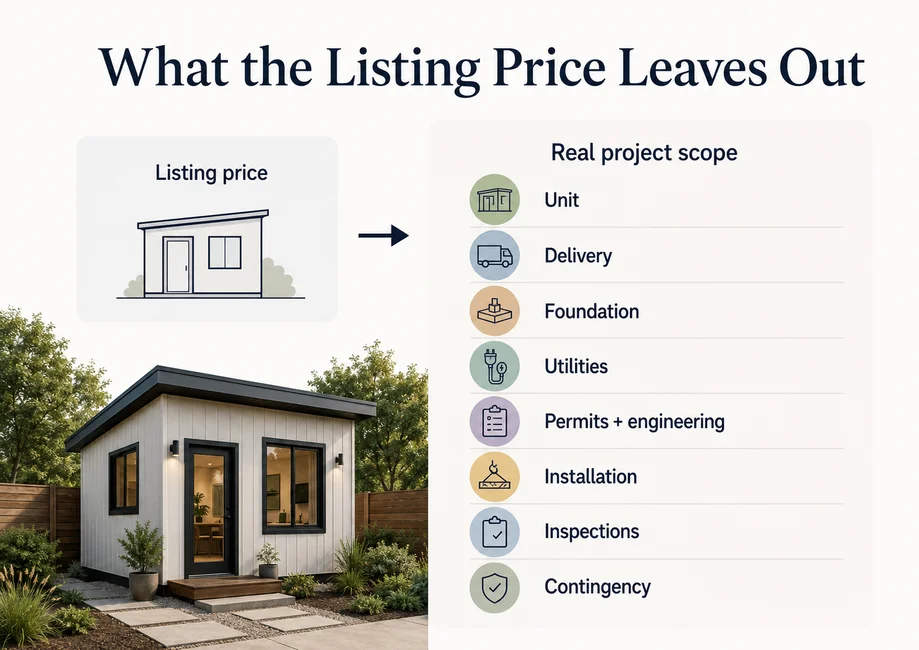
The four ways the Amazon price misleads
- It may be for plans only. A sub-$20 “ADU plan” is not a building.
- It may be a starting price. Some listings explicitly direct you to contact the seller for a configured quote.
- It may exclude delivery and installation. Freight, crane placement, and labor can add many thousands.
- It omits the work that makes occupancy legal. Foundation, utility laterals, permits, and inspections are the difference between a structure and a home — and they’re almost never in the listing price.
Your all-in budget worksheet
Copy this, fill it in for your lot, and don’t sign anything until the bottom line is real. The “Verified?” column matters more than the numbers — an unverified estimate is a guess.
| Line item | Estimate | Verified? |
|---|---|---|
| Listing price | $______ | ☐ |
| Freight | $______ | ☐ |
| Crane / placement | $______ | ☐ |
| Foundation | $______ | ☐ |
| Utility trenching | $______ | ☐ |
| Sewer or septic | $______ | ☐ |
| Water | $______ | ☐ |
| Electrical service | $______ | ☐ |
| HVAC | $______ | ☐ |
| Permits & fees | $______ | ☐ |
| Engineering / stamped plans | $______ | ☐ |
| Contractor labor | $______ | ☐ |
| Interior completion | $______ | ☐ |
| Inspections / corrections | $______ | ☐ |
| Contingency | $______ | ☐ |
| Total installed budget | $______ | ☐ |
Can you connect it to sewer, water, power, and HVAC?
A foldable unit that ships “plumbing-ready” still needs someone to connect it to a sewer or septic system, run a water line, and bring electrical service — and in most places that work must be done by licensed trades and inspected. Washington L&I requires that all plumbing be installed by a licensed plumber and all electrical work by a licensed electrical contractor, with a separate electrical permit to connect the home to power. “Plumbing-ready” is a starting line, not a finish line.
Why utilities so often blow up the budget:
- Sewer or septic capacity. Tying into a municipal sewer means a permitted lateral and, in some cities, a capacity charge. Seattle reports every ADU permit to King County for sewer treatment capacity charges. If you’re on septic, the existing system may need expansion or a second field.
- Water. A new line, meter, and possibly a pressure or capacity upgrade.
- Electrical. The unit may require a panel upgrade or a new service, plus trenching and an inspection.
- HVAC and energy code. Heating, cooling, ventilation, and insulation must meet the local energy code — a frequent sticking point for thin-walled imported shells.
- No off-grid shortcut for dwellings. Where a movable tiny house is allowed as an ADU, utilities are mandatory: Los Angeles requires an MTH to be connected to water, sewer, and electrical, and off-grid setups are not permitted for ADUs.
If there are no mechanical, electrical, and plumbing (MEP) drawings, your contractor and inspector are improvising, which costs time and money and can stall the project.
Can you finance or insure an Amazon prefab ADU?
How you’ll pay for an ADU — and whether you can insure it — depends almost entirely on the code path above. This is one more reason the certification question isn’t academic: it controls your money.
Financing lanes by product type (educational only; not a rate or approval promise):
| What you’re buying | How it’s usually treated | Realistic financing lanes |
|---|---|---|
| Plans only | A digital/printed product | Out of pocket |
| Uncertified foldable / shell | Often personal property, not real estate | Cash, personal loan; traditional mortgage usually unavailable |
| State-certified modular | Real property once on a permanent foundation | HELOC, cash-out refinance, renovation loan, construction-to-permanent |
| HUD-code manufactured home | Real or personal property depending on title/affixation | Manufactured-home loan, or real-property financing once affixed |
| Site-built kit | Real property | HELOC, cash-out refinance, renovation loan, construction-to-permanent |
| Movable tiny house (where allowed) | A DMV-registered vehicle first | Typically specialty/RV-style financing; not a standard mortgage |
A certified modular ADU built to the IRC is generally financed much like a site-built home. Fannie Mae recognizes ADUs that are site-built or factory-built — including modular and HUD-code manufactured homes legally classified as real property — and has expanded its ADU policies in recent underwriting updates.
Insurance reality
DIY and prefab tiny homes typically don’t qualify for standard homeowners insurance; depending on the structure, they may instead qualify for RV or mobile-home coverage, and a permitted ADU on your property may be covered under the “other structures” portion of your existing homeowners policy. Budget for an insurance conversation as its own line item, and don’t assume an uncertified box can be covered at all. Talk to a broker before you buy, not after.
Compare common funding routes and their eligibility limits before contacting a lender.Compare ADU Financing Options
Educational resource; not a rate offer, not a guarantee of approval.
Where are Amazon-style tiny homes legal as ADUs?
| Jurisdiction / authority | What the official source says | Practical takeaway |
|---|---|---|
| Seattle, WA (SDCI) | ADUs are not legal unless established through a permit; foundation tiny houses count as DADUs, but tiny houses on wheels are treated like camper trailers and may not be lived in on lots in city limits. Pre-approved DADU plans can permit in 2–6 weeks. | Wheels are often a dealbreaker; a foundation and a code path are non-negotiable. |
| Los Angeles, CA (LADBS) | LA’s ADU ordinance permits a Movable Tiny House (MTH) as a detached ADU — but it must be DMV-registered, meet ANSI A119.5 or NFPA 1192, be third-party certified, sized 150–430 sq ft, placed in the rear yard with undercarriage skirted, and connected to water, sewer, and electric; only one MTH per lot. (LAMC 12.22A.33, Ordinance 186,481) | A wheeled unit can be an ADU here — but only a certified one. A random Amazon box won’t qualify. |
| Washington State (L&I) | A factory-built tiny house moved to a site requires an L&I insignia, issued only for units built to state-approved plans and inspected during construction; the design must also meet local building-department criteria, and local permits cover foundation, installation, and placement. | State certification and local permitting are both required — neither replaces the other. |
| California (HCD) | HCD regulates the manufacturing of factory-built housing manufactured for sale in California and issues a factory-built-housing insignia through its program. | Factory certification is a real, recognized path — but local site inspection still applies. |
| HUD (federal) | HUD enforces the federal Manufactured Home Construction and Safety Standards (24 CFR Part 3280) and authorizes a certification label for each section of a compliant home. | A HUD-code path is a recognized route — but local zoning decides whether a HUD home can be an ADU. |
The contrast between Seattle and Los Angeles is the whole lesson: the same wheeled unit is prohibited as a residence in Seattle and permitted as an ADU in Los Angeles — and even in Los Angeles, only if it carries third-party certification. Your jurisdiction classifies the unit as a modular dwelling, a manufactured home, a site-built structure, an RV, or an accessory building — and that classification, not the marketing, determines whether it can be your ADU.
What documents to get from the seller before you buy
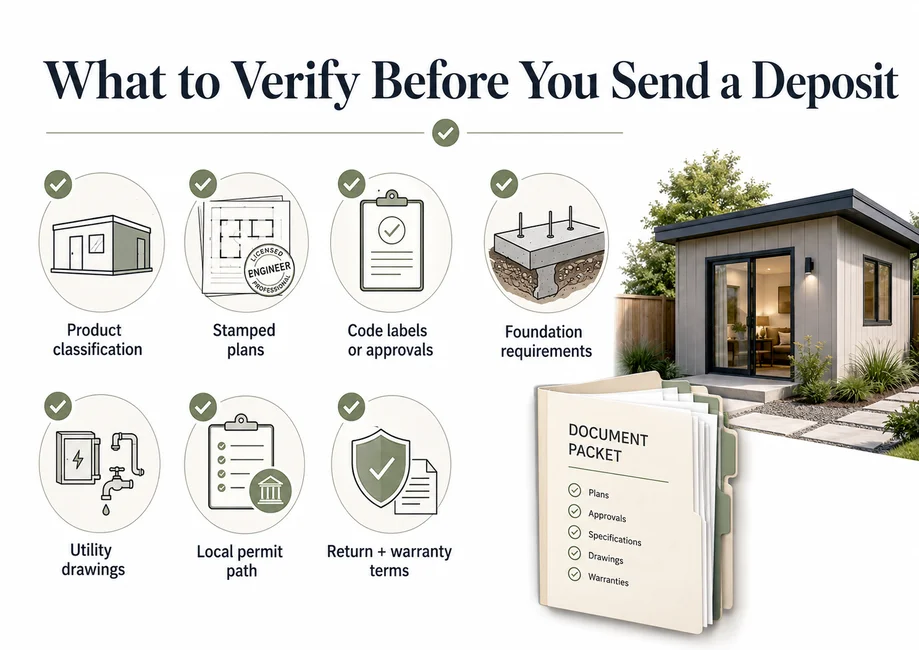
The seller-document checklist
| Document to request | Why your building department needs it | Stop if missing? |
|---|---|---|
| Product classification | Determines whether it’s modular, manufactured, a site-built kit, an RV/THOW, a shed/studio, or commercial | Yes |
| Applicable code path | Shows whether it’s built to the IRC, HUD Code, a state modular program, or none | Yes |
| Stamped structural plans | Required for plan review in most jurisdictions | Usually |
| Structural calculations | Wind, snow, seismic, anchoring, roof and floor loads for your area | Usually |
| Foundation design | Determines whether and how it can be legally anchored | Usually |
| Energy compliance docs | Required for dwellings under most energy codes | Often |
| MEP documentation | Needed for utility permits and inspections | Usually |
| Installation manual | Required by your contractor and inspector | Often |
| State insignia / HUD label / third-party inspection records | Proves factory-built or manufactured status | Yes, for those paths |
| Warranty and return terms | Protects you if the unit can’t be permitted | Critical |
| Full invoice with exclusions | Reveals whether delivery, crane, finishes, utilities, and labor are included | Yes, for budgeting |
Email script: to the seller
Subject: Documents needed before I can use this as a permitted ADU
Hello — I’m considering this product for use as a permitted accessory dwelling unit in [CITY, STATE]. Before I place a deposit, my building department needs to confirm the code path and review documents. Please send:
- Product classification: modular dwelling, HUD manufactured home, site-built kit, park model/RV, movable tiny house, shed/studio, or other.
- The applicable building standard or code the unit is built to.
- Stamped structural plans and calculations, if available.
- Foundation and anchoring requirements.
- Plumbing, electrical, mechanical, and energy documentation.
- Any state approval insignia, HUD label information, or third-party (ANSI/NFPA) certification records.
- A full list of what the listed price includes and excludes.
- Installation requirements and whether a licensed contractor is required.
Thank you.
Email script: to your city or county building department
Subject: Can this product type be reviewed as an ADU?
Hello — I own / am evaluating the property at [ADDRESS or PARCEL, CITY]. I’m considering a small prefab structure sold online and marketed as an ADU/tiny home. Before purchasing, I’d like to confirm whether this product type could be reviewed as an ADU in [CITY].
- The seller describes it as: [PRODUCT TYPE].
- It is: [ON A FOUNDATION / ON WHEELS / FOLDABLE / MODULAR / MANUFACTURED / UNKNOWN].
- Size: [SQUARE FEET].
- Documents available: [LIST].
- Intended use: [LONG-TERM FAMILY HOUSING / RENTAL / GUEST SPACE / OFFICE].
Could your department tell me whether this product type has a possible permit path as an ADU, and what documents would be required before purchase?
Red flags that should stop the purchase
- The seller cannot identify the code path.
- The listing says “ADU” but the documents describe an office, studio, café, commercial pod, greenhouse, or plan set.
- The seller communicates only through informal channels and can’t provide plans or compliance records.
- The price is described as “a starting point.”
- There’s no foundation, utility, wind/snow/seismic, or inspection information.
- The unit is on wheels and your city doesn’t allow movable-tiny-house dwellings.
- The seller can’t explain who installs it.
- There’s no clear return or refund path if your city rejects it.
Download the free Amazon Prefab ADU Workbook → the seller-document checklist, both email scripts, and the budget worksheet from this page, in one printable PDF.
When you should NOT buy the Amazon prefab
| Situation | Decision | Why |
|---|---|---|
| Seller cannot identify the code path | Stop | Your city permits code documents, not marketing language |
| Listing is plans only | Stop (for a “home” purchase) | Plans are not a delivered, buildable unit on their own |
| Product is a commercial café/storefront/container shop | Stop for ADU use unless professionally converted and permitted | A commercial structure isn’t automatically a dwelling |
| Product is on wheels | Stop or Maybe, depending on your city | Seattle prohibits living in a THOW; Los Angeles allows a certified MTH |
| Seller provides valid state modular approval docs | Proceed to city review | A real code path — but local permits still apply |
| HUD-code manufactured home and local zoning allows it | Proceed to city review | The HUD label helps, but placement rules still govern |
| Site-built kit with stamped plans and a local contractor | Maybe | Permitability depends on your local plan check |
| Price excludes foundation/utilities/labor and your budget is tight | Stop or re-budget | The listing price is not the installed ADU cost |
| Your HOA prohibits the structure or use | Stop or seek review | An HOA can block an otherwise-legal project |
The “do not deposit until…” checklist
Do not send a non-refundable deposit until all of the following are true:
- You know the product classification.
- The seller has provided the code-path documents.
- Your city has confirmed the product type has a possible review path.
- You have a sitework estimate.
- You know whether the price includes delivery, installation, foundation, utilities, and finishes.
- You understand the return/refund terms.
- You’ve checked HOA and, if relevant, short-term-rental restrictions.
Safer alternatives if the listing fails the check
Failing the screen isn’t the end of your ADU — it’s a redirect to a path that actually works.
1. Garage conversion
Best when: you have an existing legal garage near utilities, your city allows conversions, and your budget is tighter than detached new construction. Converting existing square footage often avoids the biggest line items — foundation and shell — and many jurisdictions treat conversions favorably. Garage conversions typically run $80,000–$150,000 all-in and are often the easiest ADU approval path.
2. State-certified modular ADU (the prefab speed you actually wanted)
Best when: you love the idea of a factory-built unit but need a real code path. This is the honest version of the Amazon dream — a unit built to the IRC, carrying a state insignia, from a company that can hand your building department actual documents. National provider Modular Home Direct offers factory-direct modular and container homes with nationwide delivery, provides custom blueprints designed to meet your specific city codes, and helps homeowners secure engineering, building permits, and subcontractors — with units including a 432 sq ft one-bed/one-bath model at $70,000 and a 960 sq ft two-bed/three-bath container model at $138,440. The contrast with an anonymous foldable is the entire point: documents, code-matched plans, and installation support instead of a box and a shrug.
3. The foldable done right: BOXABL
Best when: the unfold-from-a-box concept is genuinely what you want, but you need a manufacturer that can produce real documentation. BOXABL’s Casita is a roughly 361-square-foot foldable studio marketed for ADU and compact-living use — a more documentable foldable alternative to anonymous container shells. Two honest cautions: BOXABL is not proof that a foldable unit is automatically permit-ready in every jurisdiction — local foundation, utility, and permit acceptance still control the outcome; and its pricing has shifted repeatedly, so verify the current price and what it includes directly at boxabl.com before you budget.
4. HUD-code manufactured-home ADU
Best when: your local zoning allows manufactured homes as ADUs or secondary dwellings, the HUD label and installation requirements are clear, and the site/foundation/utility permits are feasible. A HUD-code home is a recognized, financeable path — but confirm your zone allows itbefore you commit, since many residential zones restrict HUD homes.
5. Movable tiny house — only where local rules allow
Best when: your city specifically permits movable tiny houses as ADUs, with clear certification, utility, and placement rules. Los Angeles is the model: a certified, DMV-registered MTH connected to utilities can be a legal ADU. But as the jurisdiction table shows, this is the area where cities diverge most — what’s allowed in Los Angeles is prohibited in Seattle. Never assume a wheeled unit is a standard ADU.
6. Backyard office or studio (when you don’t actually need a dwelling)
Best when: the Amazon product is genuinely useful but not legal for sleeping, cooking, and sanitation, and what you really want is a workspace, gym, studio, or guest lounge. Accessory non-dwelling structures are often far easier to permit than ADUs. A great $20,000 office is a great $20,000 office; it’s just not a $20,000 second home.
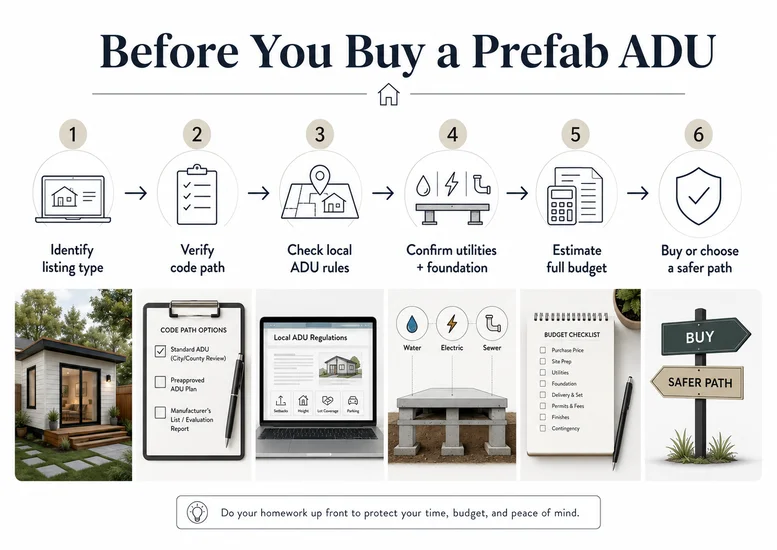
How to verify a specific Amazon listing before you send money
This is the workflow we’d run ourselves. It takes an evening, and it’s the cheapest insurance you’ll ever buy.
- Screenshot the listing. Capture the title, price, seller name, dimensions, claimed square footage, product type, materials, what’s included and excluded, shipping and installation language, warranty and return terms, the review count, and the date. Listings change and disappear; your screenshot is your record.
- Classify the product. Pick one: plans only · shell/kit · backyard office/studio · foldable/expandable structure · container/pod · site-built kit · state modular dwelling · HUD-code manufactured home · movable tiny house/RV/park model · unknown. If you land on “unknown,” that is the answer for now — get documents before going further.
- Request the seller’s documents. Send the seller email script above. A seller who can’t produce a code classification and basic plans has answered your question.
- Ask your city whether the product type has a path. Send the building-department email script above. This single email has saved buyers from five-figure mistakes.
- Build the all-in cost stack. Use the budget worksheet above. If the installed number doubles or triples the sticker — and it usually does on the cheapest units — decide whether the project still makes sense before you buy.
Then decide:
| Result | Next action |
|---|---|
| Seller docs + city path + budget all check out | Move to professional review, contractor selection, and permit planning |
| Seller docs unclear, but city may allow it | Do not deposit; get the missing documents first |
| Seller cannot provide a code path | Avoid as an ADU; consider an alternative path |
| City says no | Pivot: garage conversion, certified modular, manufactured-home ADU, or a non-dwelling studio |
| Budget doubles or triples after sitework | Re-scope before buying |
Download the Workbook → take the checklist and email scripts with you to any seller and building department.
What we verified
The Dwelling Index is an independent research resource covering ADU financing, costs, and regulations. We reviewed public Amazon and retailer listing surfaces, published cost reporting, and primary federal, state, and city guidance to build this page. We used homeowner discussion threads only to understand the questions and language buyers use — never as proof of law, cost, or code.
- Who created this: the Dwelling Index editorial team (no individual byline; no paid expert reviewer was used).
- How we researched it: primary code and agency sources for legal/permit claims; current marketplace listings for product examples and pricing; published cost reporting for ranges; manufacturer and partner sites for provider details.
- Why this page exists: to help homeowners avoid buying an online prefab structure before they know whether it can legally become an ADU.
- Last verified: June 1, 2026. Marketplace prices and listings change frequently; we re-verify them monthly and code/agency sources at least quarterly.
Sources
- Newsweek, “Gen Z man buys $26K Amazon House to turn into Airbnb” (Feb 2024).
- Fortune, “Amazon sells tiny houses… unboxing video” (Apr 2024).
- AOL/Fortune, “Walmart will sell you a tiny house for under $16,000” (2024).
- ArchDaily, “You Can Now Buy a Shipping-Container Tiny House from Amazon (But Should You?).”
- Amazon and Walmart marketplace listings, verified 2026 (DuraYu expandable units; “Modern Prefab ADU”/“White Haven” modular listings; design-plan products).
- USA Today / AOL, “Home Depot is selling modern prefab tiny houses under $50K.”
- Real Simple via Yahoo, “Before Buying a Tiny Home on Amazon, Make Sure You Know the ABCs of ADUs” (Feb 2025).
- Industry references on modular vs. HUD certification (Modular Home Builders Association; Wolf Industries; Lelands Cabins) — secondary corroboration only.
- Washington State Department of Labor & Industries, “Tiny Houses” (verified June 1, 2026). lni.wa.gov/licensing-permits/manufactured-modular-mobile-structures/tiny-homes/
- Seattle Department of Construction & Inspections (SDCI), “Accessory Dwelling Unit” (verified June 1, 2026). seattle.gov/sdci
- California Department of Housing and Community Development (HCD), “Factory-Built Housing” (verified June 1, 2026). hcd.ca.gov/building-standards/fbh
- U.S. Department of Housing and Urban Development (HUD), Office of Manufactured Housing Programs (verified June 1, 2026). hud.gov/hud-partners/manufactured-home
- City of Los Angeles Department of Building and Safety (LADBS), “Accessory Dwelling Unit (ADU)” / Movable Tiny House, LAMC 12.22A.33, Ordinance 186,481 (verified June 1, 2026). dbs.lacity.gov/adu
- International Code Council, IRC tiny-house appendix — Appendix Q (2018), Appendix AQ (2021), Appendix BB (2024). codes.iccsafe.org
- Yahoo Finance, “These 6 alternative housing options…” (Apr 2026); Prefab Review, “Guide to Financing a Prefab Home.”
- Fannie Mae, manufactured-home and ADU financing policy (single-family). singlefamily.fanniemae.com
- Modular Home Direct, models and pricing (verified 2026). modularhomedirect.com
- BOXABL, Casita (verify current pricing). boxabl.com
- Dwell, “Amazon Joins Forces With Plant Prefab” (Sep 2018).
- Amazon A-to-z Guarantee, Amazon Customer Service (purchase protection for eligible third-party orders; not a construction/code warranty).
- FTC Endorsement Guides, 16 CFR Part 255.
Frequently asked questions
Can I really buy an ADU on Amazon?
You can buy plans, kits, shells, pods, tiny homes, or larger prefab units on Amazon — but you can’t buy local permit approval from Amazon. A legal ADU still needs a recognized code path, zoning approval, permits, utilities, inspections, and often a certificate of occupancy. The product is real; the legal status is something only your jurisdiction grants.
Are Amazon prefab homes legit?
Some listings represent real products; others are design plans, commercial structures, or ambiguous marketplace items. “Legit” isn’t the only question. The more useful one is whether the specific product can be documented and permitted as a dwelling on your property — which depends on its code path and your local rules, not the brand of the storefront.
Do Amazon tiny homes come with plumbing and electricity?
Some advertise plumbing and electrical options, but you need written documentation of exactly what’s included, who installs it, whether the work meets local code, and whether utility connections are part of the price. Most jurisdictions require licensed plumbers and electricians and separate permits. Never assume utilities are included based on photos.
Do I need a permit for an Amazon prefab home?
If you want to use it as a dwelling or ADU, assume yes until your local building department tells you otherwise. Even non-dwelling accessory structures may need zoning, building, electrical, plumbing, or site permits depending on the city. The permit isn’t optional paperwork — it’s what makes occupancy legal.
Can an Amazon tiny home on wheels be an ADU?
Only where local rules specifically allow it. Seattle treats tiny houses on wheels like camper trailers and prohibits living in them on lots within city limits, while Los Angeles permits a Movable Tiny House as an ADU if it is DMV-registered, ANSI- or NFPA-certified by a third party, and connected to utilities. Local rules decide.
Is an Amazon prefab ADU cheaper than a regular ADU?
The listing price is often lower than a traditional ADU quote, but the installed legal cost rises quickly once you add foundation, utilities, delivery, installation, permits, inspections, and corrections. For the cheapest foldables, the all-in number frequently lands at two to three times the sticker. Treat the Amazon price as one line item, not the project budget.
Can I finance an Amazon prefab ADU?
Possibly, but it depends heavily on the product type. Uncertified units are often treated as personal property and are hard to finance with a traditional mortgage; certified modular and site-built ADUs are generally financed like other real property, typically via home equity, a cash-out refinance, a renovation loan, or construction-to-permanent financing. We present financing as educational lanes, never as rate or approval promises.
Can I rent out an Amazon prefab ADU?
Only if it becomes a legal dwelling under your local ADU rules and your city, HOA, and rental regulations permit the intended use. Short-term-rental rules are frequently stricter than long-term rules. Any rental-income figures you encounter are illustrative examples, not guarantees of returns — actual results depend on local market conditions, construction costs, financing terms, and regulatory approvals.
What should I ask the seller before buying?
Ask for the product classification, the code path, stamped plans and structural calculations, foundation requirements, MEP and energy documentation, any state insignia or HUD label (or ANSI/NFPA certification for a movable tiny house), the installation manual, a full breakdown of what the price includes and excludes, and the return terms if your city rejects the unit. A seller who can’t answer the first two questions has told you what you need to know.
What happens if my city says no after I buy it?
You may be left with a structure you can’t legally use as a dwelling. You might repurpose it as storage, an office, or guest space, or resell it — but those outcomes depend on local rules, the product’s design, and the seller’s return terms. This is exactly why the city pre-check belongs before the deposit, not after.
Not sure where to start?
See what’s possible at your address — get your free ADU report in 60 seconds.
Get my free ADU report →Related guides
- Home Depot ADU: 11 real prices & the true all-in cost
- Home Depot ADU alternatives: 7 real paths & true costs
- Prefab ADU guide — brands, costs, and local code paths
- DIY ADU kit guide — what to buy, what to build
- Expandable prefab ADU — the code-rating trap in cheap foldable units
- Backyard ADU kit cost breakdown
- Permit-ready ADU plans — 20+ verified programs
- How much an ADU costs in 2026