
Garage Conversion ADU Cost: What Homeowners Actually Pay in 2026
By The Dwelling Index Editorial Team · Last verified: April 2026 · Sources: Angi 2026, CA HCD ADU Handbook, Portland BDS, Seattle SDCI, Austin Development Services, Fannie Mae, Freddie Mac, HUD Mortgagee Letter 2023-17
How much does a garage conversion ADU actually cost? More than the internet wants you to think — and less than you probably fear. Most fully permitted garage conversion ADUs cost between $60,000 and $150,000+ nationally, with attached garages on solid slabs at the low end and older detached garages with foundation, sewer, and electrical issues pushing toward new-build territory. The national garage conversion ADU cost average for a rental-ready unit with kitchen and bathroom lands around $100,000–$130,000 (Angi, 2026).
That's often one of the lower-cost ADU paths when the existing garage is structurally sound — but it is not automatically the budget option. When the structure is weak, you can spend just as much fixing it as you would demolishing and building new. One Portland architecture firm — Propel Studio — publicly recommends against conversion for the majority of inquiries they receive because renovation costs approach new construction while delivering a more compromised result.
This guide breaks down what drives the number up or down, gives you a framework to assess whether your garage is worth converting, shows how local rules change the math, and helps you figure out the smartest next step.
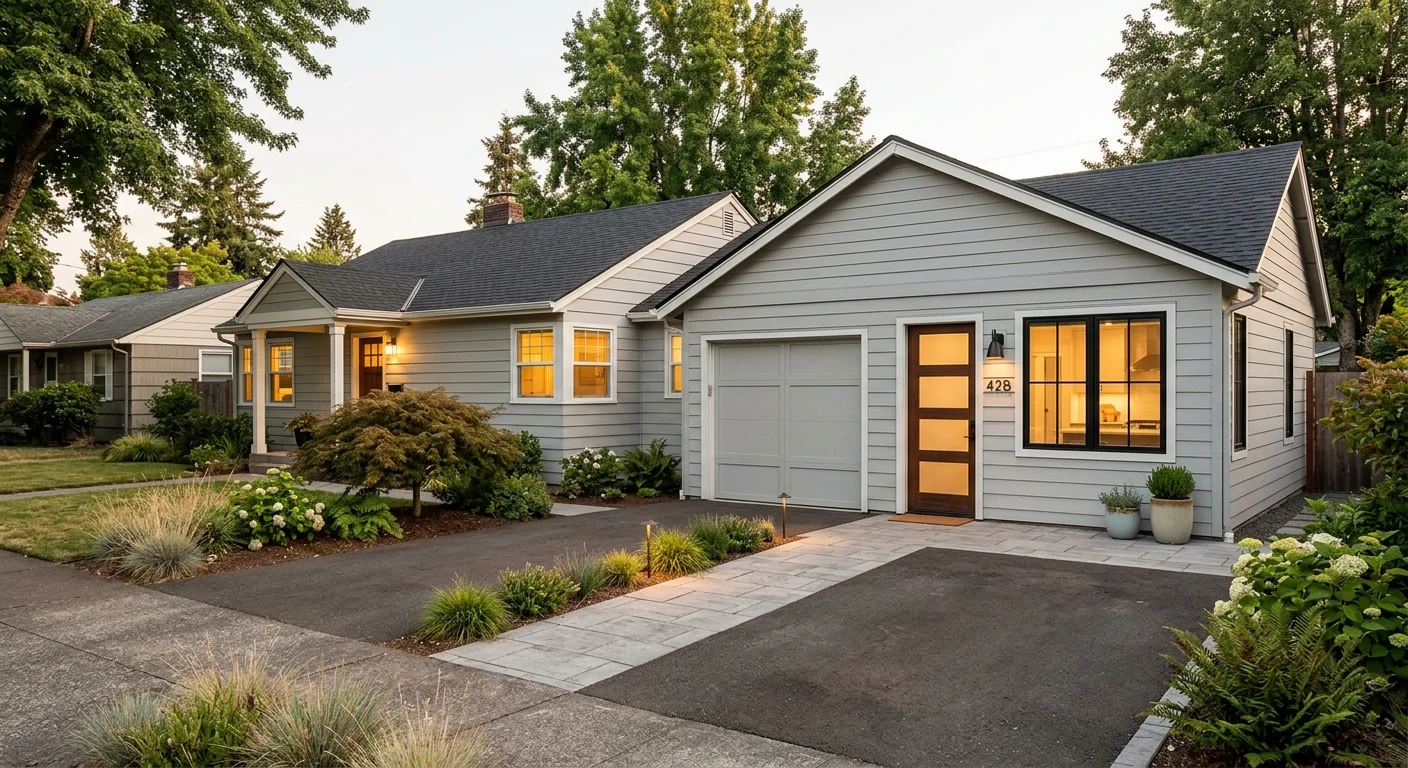
A completed attached garage conversion ADU with a separate entrance and finished exterior — the most cost-effective path when the existing structure is sound.
At a Glance: Garage Conversion vs. Other ADU Paths
Before we go deep on costs, here's the decision most homeowners are actually weighing — which path is smartest for my property?
| Option | Typical All-In Cost | Timeline | Best For | Biggest Risk | When to Skip It |
|---|---|---|---|---|---|
| Attached garage conversion | $50K–$120K | 3–6 months | Budget-conscious homeowners with a sound attached garage | Hidden code/structural issues | Garage is pre-1970 or slab is cracked |
| Detached garage conversion | $75K–$175K | 4–9 months | Homeowners who want a separate rental or family unit | Utility trenching costs, foundation surprises | Garage is far from sewer/water/electric |
| Above-garage ADU | $200K–$350K | 8–14 months | Keeping parking while adding living space above | Structural reinforcement costs are steep | Budget is under $200K |
| Detached new-build ADU | $150K–$400K+ | 9–18 months | Maximum design freedom and rental income potential | Highest upfront cost and longest timeline | Tight lot or tight budget |
| Partial conversion (keep some parking) | $40K–$100K | 3–6 months | Those who need parking and extra living space | May not qualify as a full legal ADU in all jurisdictions | You need a fully self-contained rental unit |
Cost ranges compiled from Angi national data (2026), contractor estimates across multiple U.S. markets, and municipal permit fee schedules. Your local market may differ. See our methodology.
Already know you want to explore this? See what you can build at your address — free ADU feasibility report.
See what you can build at your address — estimated costs for your area, your city's permit process, and eligibility. Free, no obligation.
See What You Can Build — Free ADU Feasibility Report →Available in CA, UT, TX, CO, and NY.
How Much Does a Garage Conversion ADU Actually Cost?
The short answer: Most legal garage conversion ADUs cost between $60,000 and $150,000 nationally, with the majority of completed projects landing in the $80,000 to $130,000 range (Angi, 2026). But that range is nearly useless without context — so here's the context.
Your final number depends on three things more than anything else: your garage's size, its structural condition, and your local labor and permit costs. Everything else — finishes, fixtures, layout — matters, but those three drive the budget.
Cost by Garage Size and Scope
| Garage Type | Typical Sq Ft | Basic Living Space | Full ADU (Kitchen + Bath) | Higher-End / Custom | Most Common Budget Surprise |
|---|---|---|---|---|---|
| One-car garage | 200–300 sf | $25K–$55K | $60K–$100K | $90K–$130K | Too small for a legal ADU in some jurisdictions; may need a second story |
| Two-car garage | 400–500 sf | $40K–$75K | $80K–$150K | $130K–$200K | Slab plumbing adds 2–3 weeks and $8K–$15K |
| Three-car / oversized | 600–900 sf | $55K–$100K | $100K–$200K+ | $175K–$250K+ | Foundation and structural work at this scale can rival new construction |
Ranges reflect national 2025–2026 contractor pricing data from Angi and regional estimates. Attached garages trend toward the lower end. Detached garages trend higher due to trenching, separate meters, and longer utility runs.
Attached vs. Detached: Why It Matters
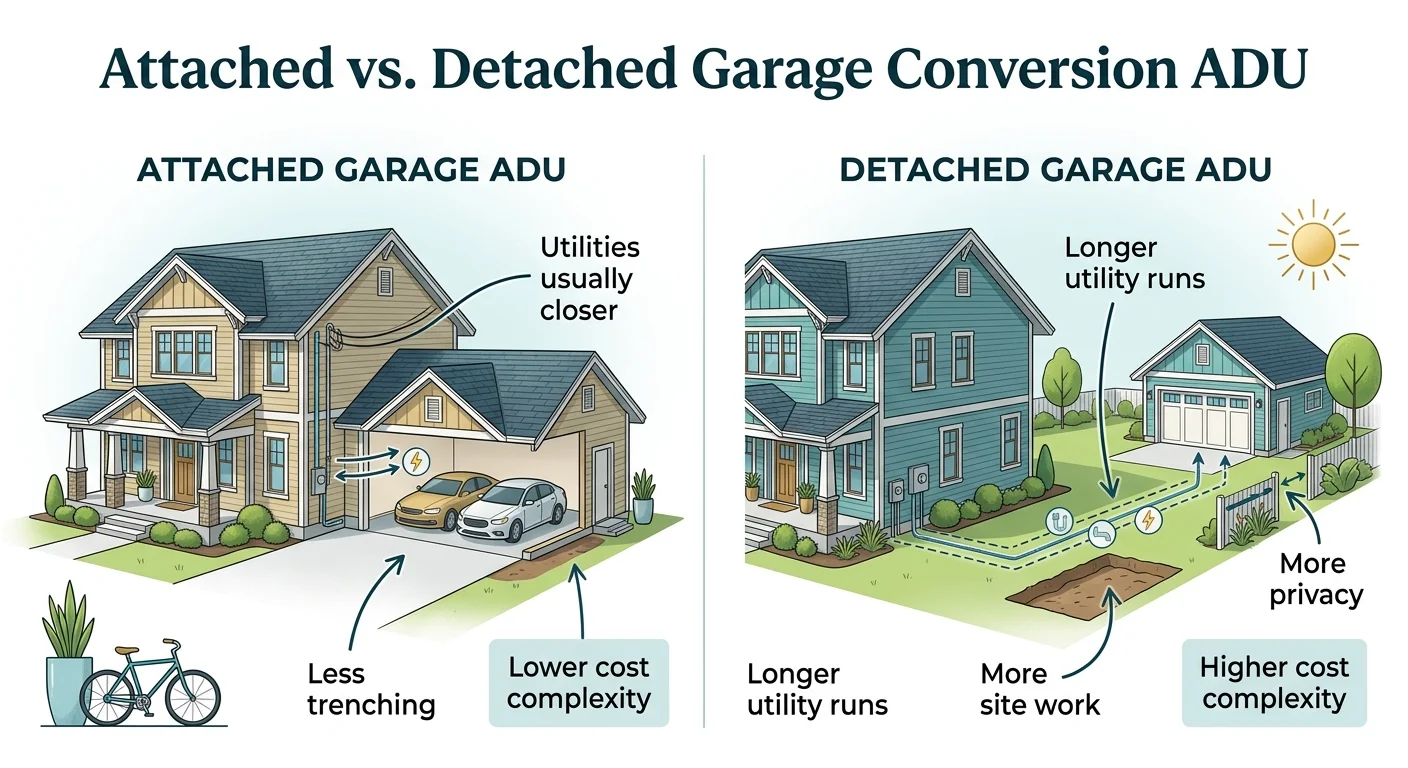
Attached garages cost 15–30% less to convert because utility connections are shorter — the expensive plumbing, electrical, and HVAC runs are already next door.
Attached garages almost always cost less to convert. The reason is straightforward: your home's plumbing, electrical panel, water heater, and HVAC are on the other side of the wall. Running a new sewer line 6 feet through an interior wall is a fundamentally different project than trenching 40 feet across a backyard to reach a detached structure.
On average, expect a detached garage conversion to cost 15–30% more than an equivalent attached conversion, with the premium almost entirely in utility routing and separate metering.
Cost Per Square Foot: Useful but Misleading
You'll see figures ranging from $150 to $400 per square foot quoted across the industry (Angi). The problem with cost-per-square-foot for garage conversions is that the expensive parts — plumbing, electrical panel, HVAC, kitchen, bathroom — cost roughly the same whether your garage is 250 or 500 square feet. A one-car garage conversion doesn't cost half as much as a two-car; it costs about 60–70% as much because the fixed infrastructure costs are almost identical.
Use cost per square foot for rough comparisons. Use line-item budgets for actual planning.
Where the Money Actually Goes: The Line-Item Breakdown
The biggest budget blowups in garage conversions don't come from picking the wrong countertop. They come from infrastructure you can't see until you start. Here's where every dollar typically goes — and which line items are most likely to surprise you.
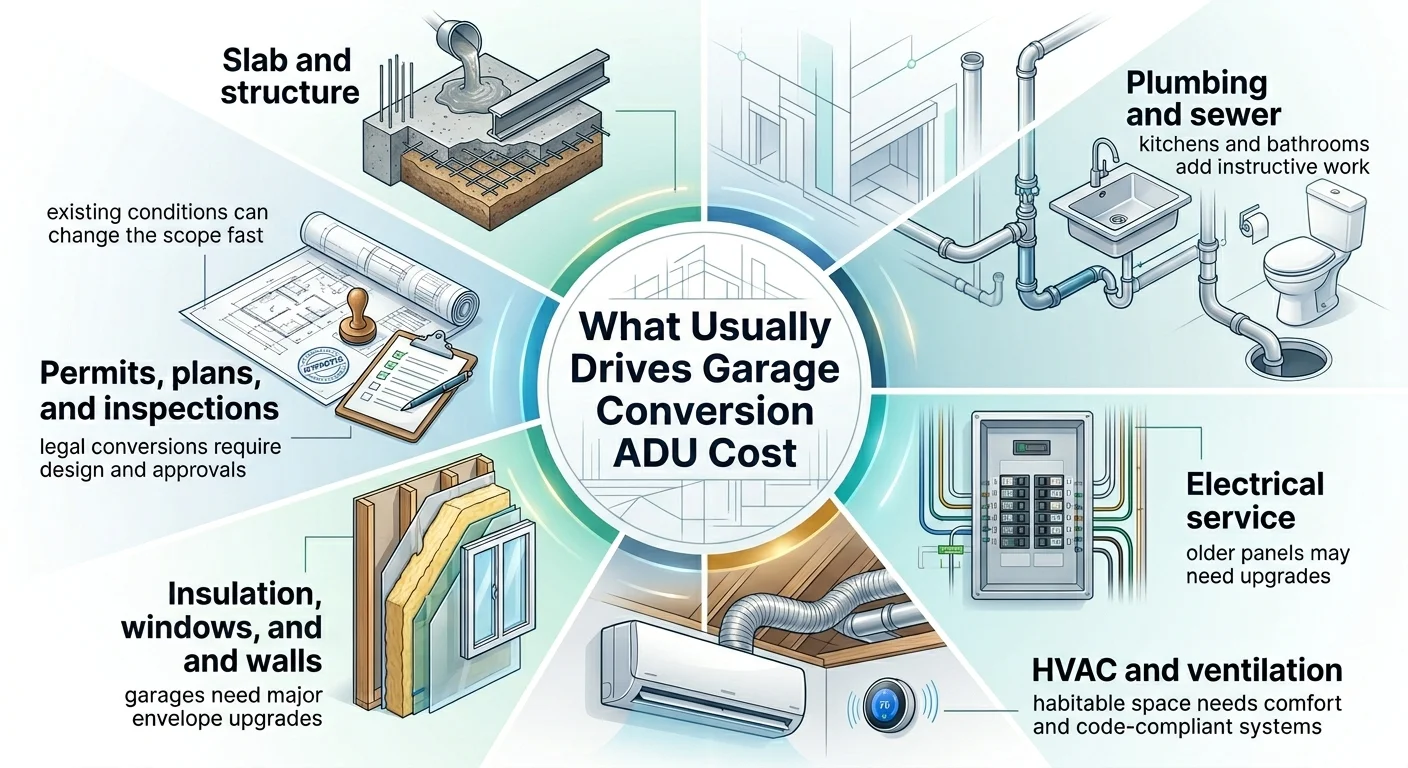
The six cost drivers that most homeowners underestimate — foundation, plumbing/sewer, and electrical are where budgets most commonly blow past estimates.
| Cost Driver | Why It Happens | Budget-Friendly | Typical | Expensive | Discoverable Early? |
|---|---|---|---|---|---|
| Design & architecture | Plans for permit submission | $2K–$4K (pre-approved plans) | $4K–$8K | $8K–$15K (custom/complex) | Yes — get quotes before committing |
| Structural engineering | Required sign-off on load-bearing changes | $500–$1,500 | $1,500–$3,000 | $3K–$6K | Yes — hire early |
| Permits & plan review | City/county fees, trade permits | $1,500–$3K | $3K–$8K | $8K–$15K+ | Yes — check city fee schedule online |
| Foundation / slab work | Leveling, moisture barrier, footings | $0 (solid slab) | $3K–$10K | $15K–$30K+ | Partially — engineer catches most issues |
| Sewer, water & trenching | Routing plumbing to kitchen/bath | $3K–$8K (attached) | $8K–$15K (detached, short run) | $15K–$25K+ (long run / sewer lateral) | Yes — measure utility distance before design |
| Electrical panel & wiring | New subpanel, circuits, lighting | $3K–$6K | $6K–$12K | $12K–$20K (service upgrade + separate meter) | Yes — electrician evaluates existing service |
| HVAC | Heating, cooling, ventilation | $3K–$6K (mini-split) | $5K–$10K | $10K–$15K+ | Yes — mini-splits are standard for garage ADUs |
| Insulation & drywall | Garages have minimal insulation | $3K–$6K | $5K–$12K | $12K–$18K (deep wall cavity + energy code) | Mostly — wall depth determines approach |
| Kitchen installation | Cabinets, counters, appliances, ventilation | $8K–$15K | $15K–$30K | $30K–$50K+ | Yes — design choices you control |
| Bathroom installation | Fixtures, tile, plumbing rough-in | $6K–$12K | $10K–$20K | $20K–$30K+ | Yes — design choices you control |
| Flooring, paint & finishes | Making it feel like a home, not a garage | $3K–$8K | $6K–$15K | $15K–$25K+ | Yes — finish level is your call |
| Garage door wall | Removing door, framing, insulating, finishing | $2K–$4K | $4K–$8K | $8K–$12K (structural header work) | Yes |
| Windows & egress | Code-required natural light and emergency exit | $1,500–$4K | $3K–$8K | $8K–$12K (extensive framing) | Yes — check egress requirements for your city |
| Contingency (10–15%) | The unknowns you don't know yet | 10% of total | 10–15% of total | 15–20% of total | This is the whole point — budget for it |
Line-item ranges based on contractor estimates across U.S. markets, Angi cost data (2026), and municipal fee schedules for the jurisdictions cited in this guide.
Is Your Garage Actually Worth Converting? (The Honest Assessment)
This is the section we wish every garage conversion guide started with. The most expensive mistake isn't picking the wrong tile — it's converting a garage that should have been demolished.
Reusing a structure in poor condition can cost as much as building from scratch. Propel Studio in Portland publicly documents that for the majority of their conversion inquiries, they recommend tearing down and building new — because the renovation costs approach new construction while delivering a more compromised result. Builders across Los Angeles, Denver, and Seattle report the same experience.
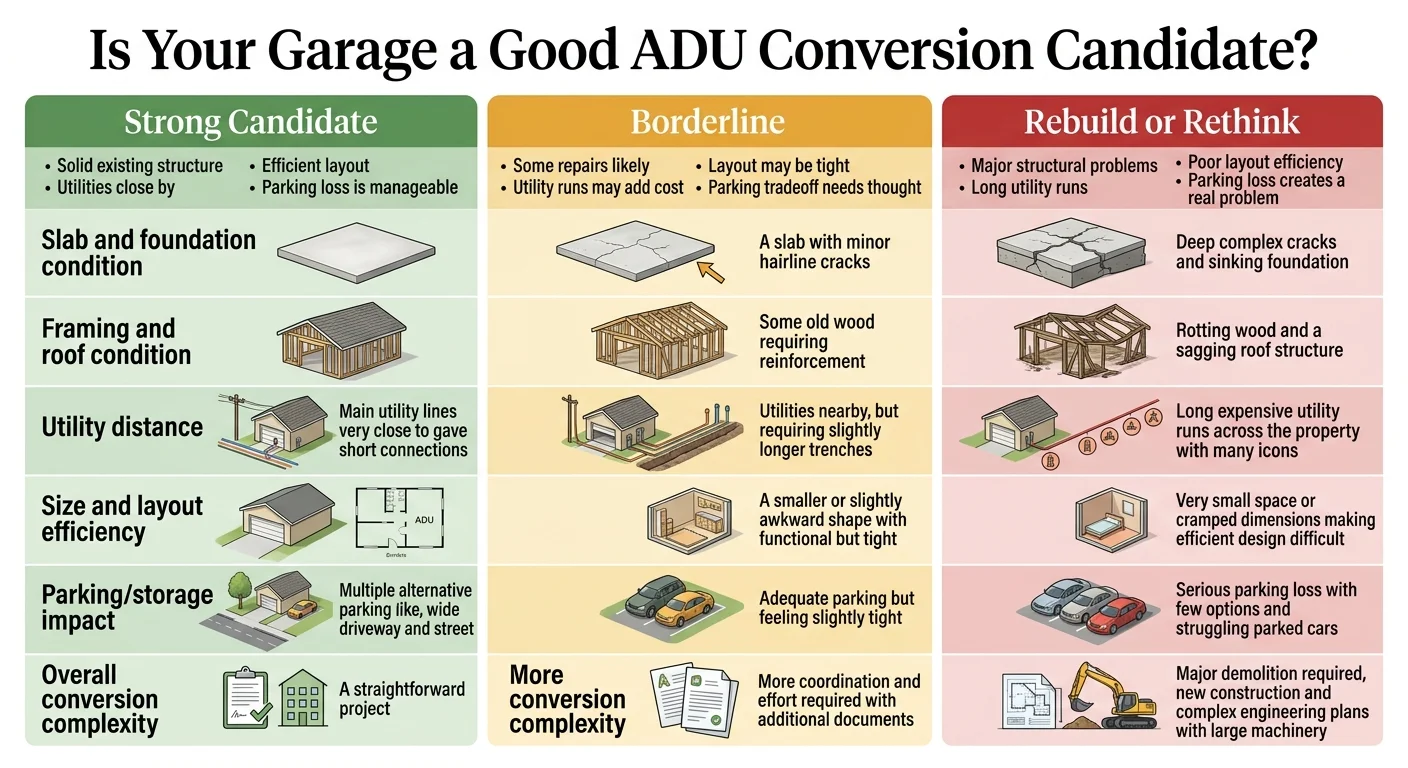
Use this scorecard to self-assess before calling a contractor. Multiple red flags mean a structural engineer assessment ($300–$800) is your most important next step.
The Garage Viability Scorecard
Use this to self-assess before you call a contractor. Score “green” on most criteria, and conversion is likely your smartest path. Multiple “red” flags? Get a structural engineer's assessment ($300–$800) before committing — or explore a different path.
| Factor | Good Candidate (Green) | Borderline (Yellow) | Consider Rebuild (Red) |
|---|---|---|---|
| Foundation / slab | Level, no major cracks, adequate thickness | Minor settling, hairline cracks, may need leveling | Major cracks, sinking, no footings, slab too thin |
| Framing & walls | Sound, no rot or pest damage, adequate stud depth | Some repair needed, may need sistering | Extensive rot, termite damage, undersized studs |
| Roof | Good condition, no leaks, adequate for residential load | Needs repair but structure is sound | Sagging, major leaks, structural failure |
| Ceiling height | 8'+ unfinished (comfortable room after insulation/drywall) | 7'6"–8' unfinished (tight but potentially workable) | Under 7'6" unfinished — may not meet 7' finished minimum after floor build-up, insulation, and drywall |
| Garage age | Built after 1990, to code | 1970s–1990s, needs updating | Pre-1970, unknown construction, no original permits |
| Utility proximity | Attached, or detached within 20' of main utilities | Detached, 20'–50' from main utilities | Detached, 50'+ from sewer/water/electric |
| Size | 400+ sf (two-car or larger) | 300–400 sf (large one-car) | Under 250 sf (standard one-car — very tight for a full ADU) |
| Parking impact | Street parking available, or you have other covered parking | You can manage without it | You need the garage parking and have no alternatives |
Scored mostly green?
You're looking at real savings, a faster timeline, and in many jurisdictions, easier permitting with better setback treatment. This is where garage conversions shine.
Scored mixed?
A $300–$800 structural engineer assessment before committing is the best money you'll spend on this project. It could save you tens of thousands.
Multiple reds?
Consider demolishing and building new within the same footprint. In many states — especially California — this still qualifies as a “conversion” for regulatory purposes, preserving benefits like reduced setbacks and no parking replacement.
Not sure which path fits your property? Get your free ADU report — we'll check eligibility and costs for your specific address.
Get a property-specific report in 60 seconds — free, no commitment.
See What You Can Build →How Local Rules Change Your Cost (Why National Averages Lie)
The rules that govern your project — and therefore your budget — are set by your city and state, not by a national average. A garage conversion in Los Angeles operates under fundamentally different rules than one in Denver, Seattle, Austin, or Portland. Those rules directly affect your bottom line.
Official Local-Rule Examples
| Jurisdiction | Parking Replacement? | Notable Permit / Fee Rules | Key Cost Implication | Verified |
|---|---|---|---|---|
| California (statewide) | No — explicitly prohibited (Cal. Gov. Code §66314(d)(11)) | 60-day approval mandate; impact fees waived for units under 750 sf (Gov. Code §66324(c)(1)) | Most predictable permitting in the country. No parking replacement eliminates a major cost variable. | April 2026 |
| Portland, OR | No — off-street parking not required for residential development | ADU projects require building permits, water service fees; system development charges (SDCs) may apply | SDCs, when applicable, can add meaningfully to project cost. Check SDC applicability with BDS early. | April 2026 |
| Seattle, WA | No — no off-street parking required for ADUs | King County 2026 sewer capacity charge: $77.99/month per residential customer equivalent (reported by Seattle SDCI) | Sewer capacity charges are an unexpected line item many homeowners miss. | April 2026 |
| Austin, TX | Varies by zoning district | ADU must comply with zoning, utility meter, occupancy, and address requirements | Separate metering and addressing requirements add cost and timeline. | April 2026 |
| Denver, CO | Varies by zone district | Multiple permit types required; licensed contractor required (homeowners cannot self-permit ADU work) | Multiple permit types mean more coordination and cost. | April 2026 |
Before You Budget: Ask These 5 Questions
Does my zoning allow a garage conversion ADU?
Do I need to replace parking?
What are the permit and impact fees for my project scope?
Are there system development charges, sewer capacity charges, or utility connection fees?
What's the current plan review timeline?
Those five answers will tell you more about your real cost than any national average ever could.
What About My State's ADU Laws?
ADU legislation is evolving fast. California remains the most permissive state for garage conversion ADUs, with statewide protections codified in Gov. Code §§ 66310–66342. But states including Oregon, Washington, Colorado, Massachusetts, Vermont, Connecticut, Maine, and others have enacted or are actively expanding ADU-friendly legislation. Rules vary significantly not just by state but by city and county within each state.
Always verify current rules with your local jurisdiction — laws change frequently, and a call to your planning department is always the most reliable source. See our ADU laws by state guide →
Want to skip the local-rule guesswork entirely? Get your free ADU feasibility report — we'll check what you can build.
Get a property-specific report in 60 seconds — free, no commitment.
See What You Can Build →The 10-Step Process: From Garage to Legal ADU
Garage conversions move faster than new construction — but “faster” still means months, not weeks. Here's the realistic sequence, what each phase costs, and where delays actually happen.
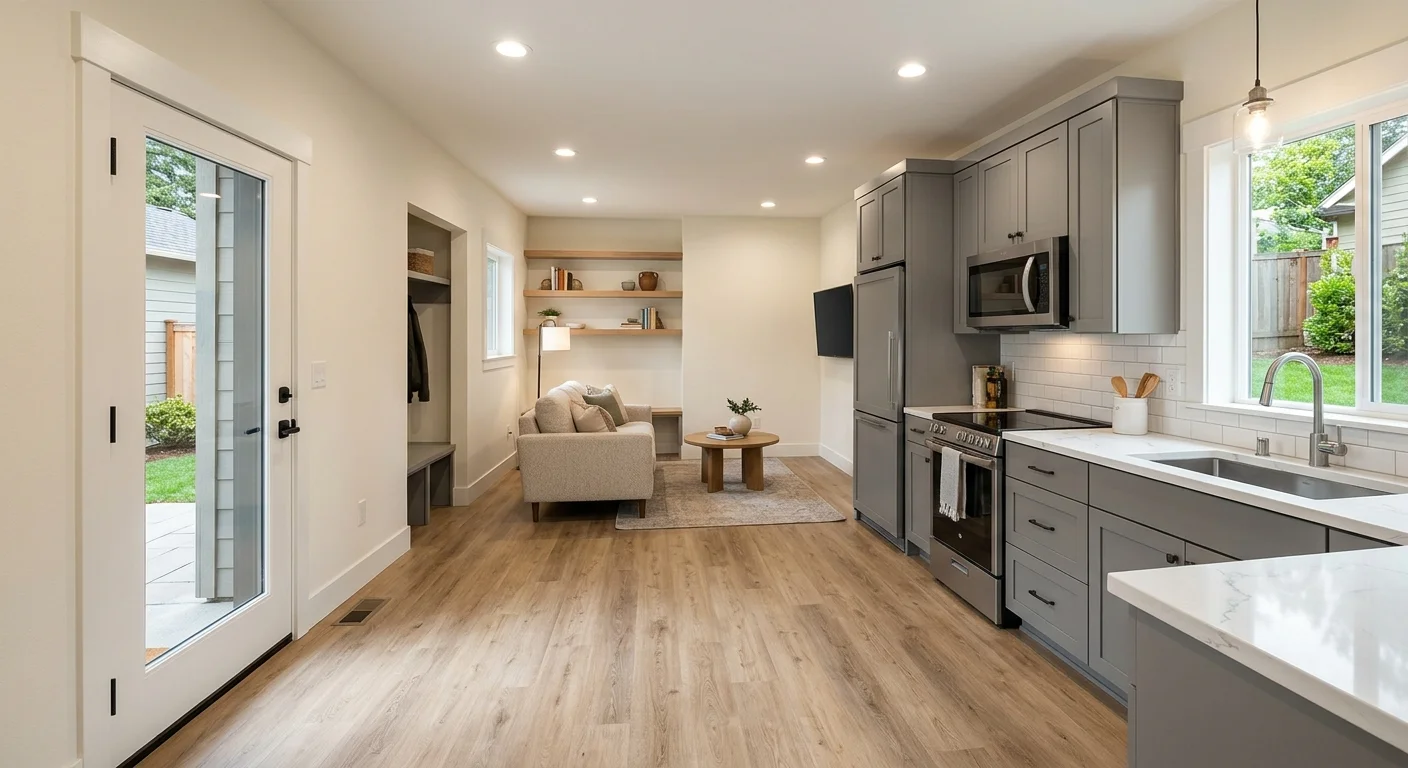
The finished interior of a two-car garage conversion ADU — gray shaker cabinets, quartz countertops, LVP flooring, and a private entrance to the backyard. This is what the 10-step process delivers.
Check Your Local ADU Regulations
FreeStart at your city or county planning department website, or call them directly. Confirm that your property qualifies for a garage conversion ADU under current zoning. Check: maximum ADU size for your lot, setback requirements (existing garages often get favorable setback treatment), owner-occupancy rules, and whether short-term rental is allowed.
Common delay: Discovering a restriction you didn't expect. Better to find out now than after you've paid for plans.
Assess Your Garage's Structural Condition
$300–$800Hire a structural engineer to evaluate your garage's foundation, framing, roof, and overall suitability for residential conversion. This is the most important $300–$800 you'll spend on the entire project. It prevents the most expensive surprise in garage conversions: discovering mid-construction that the foundation needs major work.
What they'll check: Slab thickness, footings, framing adequacy, roof load capacity, and whether the structure was built to code.
Hire a Designer or Architect
$2K–$8KYour designer creates the plans you'll submit for permits — floor plans, elevations, structural details, and mechanical/electrical/plumbing layouts. Some cities offer pre-approved ADU plans that can save time and money. Ask your planning department.
Key decisions: Kitchen and bathroom placement (near existing plumbing saves money), entrance location, window placement for natural light and egress code, and how to handle the garage door wall.
Submit for Permits
$1,500–$15KPermit timelines vary dramatically. California mandates 60-day approval for compliant ADU applications (Gov. Code §§ 66317(a), 66320(a)). Other cities may take 8–16 weeks or longer. You'll typically need a building permit plus trade permits for electrical, plumbing, and mechanical work.
Common delay: Incomplete applications or plan corrections. An experienced ADU designer reduces back-and-forth.
Demo and Site Prep (Weeks 1–2 of Construction)
Remove the garage door, strip interior finishes, and prepare the space. If foundation work is needed, this is when it happens — including saw-cutting the slab for plumbing lines and adding a moisture barrier.
Structural and Framing Work (Weeks 2–4 of Construction)
Foundation reinforcement if the engineer called for it, wall framing upgrades (often “sistering” new studs alongside existing ones for deeper insulation cavities), new window and door openings, and roof modifications if needed.
Rough-In — Plumbing, Electrical, HVAC (Weeks 2–4 of Construction)
New plumbing lines for kitchen and bathroom routed through the slab or walls. A new electrical subpanel (or full panel) installed with new circuits. HVAC — usually a ductless mini-split — roughed in. This is the phase where most of the “hidden” costs materialize.
Insulation, Drywall, and Interior Build-Out (Weeks 3–6 of Construction)
Insulation transforms the space from “garage” to “home.” Garages typically have zero insulation, and modern energy codes require specific R-values for walls, ceiling, and floor. After insulation: drywall, taping, mudding, and painting.
Finishes — Kitchen, Bath, Flooring, Fixtures (Weeks 2–4 of Construction)
Kitchen cabinets, countertops, and appliances. Bathroom tile, fixtures, and shower/tub. Flooring throughout. This is where your finish-level choices show up in the budget — and where you have the most control.
Final Inspection and Certificate of Occupancy
Week 1Your city inspector verifies code compliance. Once you pass, you receive a certificate of occupancy — and your garage ADU is officially a legal dwelling unit. It can be rented, used for family housing, or reflected in your property's assessed value.
Timeline Summary
| Phase | Fast Case | Typical Case | Slow Case | What Causes Delays |
|---|---|---|---|---|
| Design & engineering | 2–4 weeks | 4–8 weeks | 8–12 weeks | Design revisions, complex structural issues |
| Permitting | 3–6 weeks | 6–12 weeks | 12–20+ weeks | City backlog, incomplete applications, corrections |
| Construction | 6–10 weeks | 10–16 weeks | 16–24+ weeks | Foundation work, utility surprises, inspection failures |
| Total | ~3 months | ~5–9 months | ~12+ months | — |
Ready to see what's possible? Get your free ADU feasibility report.
Get a property-specific report in 60 seconds — free, no commitment.
See What You Can Build →Garage Conversion vs. Other ADU Types: The Real Comparison
You've seen the at-a-glance table. Now let's go deeper — because this is where homeowners make decisions they later regret, either by converting a garage that should have been demolished, or by building from scratch when a conversion would have saved $80,000 and four months.
Garage Conversion vs. Detached New-Build ADU
Choose conversion when: Your garage is structurally sound, you don't need more than ~500 square feet, you want the cheapest path, and you can work within the existing footprint.
Choose the other when: Your garage is in poor condition, you want complete design freedom, you need more than 500 square feet, or you want maximum rental potential and privacy.
The cost gap: typically $50,000–$150,000+ cheaper for conversion — but that gap closes fast with major structural work.
Garage Conversion vs. Above-Garage ADU
Choose conversion when: Budget is the priority. Converting the garage space itself costs roughly half what building a second story above it does.
Choose the other when: You need to keep your parking or workshop space, and you have $200K–$350K for the structural reinforcement and second-story construction.
Garage Conversion vs. JADU (Junior ADU)
A JADU is a smaller unit (500 square feet or less in California) contained within the existing home — including within an attached garage. JADUs are simpler, cheaper, and face lower code requirements. But they're also limited: smaller size, shared utilities, and in some states owner-occupancy requirements. If you're converting an attached garage and only need a small unit, a JADU may be the faster, cheaper path.
Which ADU Type by Homeowner Goal
| Your Priority | Best ADU Type | Why |
|---|---|---|
| Cheapest viable path | Garage conversion (if structure is sound) | Reuses existing foundation, walls, roof |
| Keep parking | Above-garage ADU or partial conversion | Preserves vehicle/storage space at higher cost |
| Maximum privacy | Detached new-build or detached garage conversion | Separate structure = separate lives |
| Best resale flexibility | Detached new-build ADU | Fully independent unit with maximum design appeal |
| Fastest timeline | Garage conversion or JADU | Existing structure = less to build |
| Best for aging parents | Attached garage conversion or JADU | Close to main house, step-free entry possible |
| Maximum rental income | Detached new-build (1-bed+) | Larger, more private, commands higher rent |
Will a Garage Conversion ADU Pay Off? (The Honest Math)
There are two ways homeowners think about return on a garage conversion: rental income and property value increase. Both can be strong. Neither is guaranteed. Here's the math with honest assumptions — use these as a starting framework, then run your own numbers for your local market.
Scenario 1: Studio Rental Unit
Two-car attached garage (450 sf) — mid-size metro
- Project cost$95,000
- Monthly rent (illustrative)$1,200–$1,600
- Annual gross rental income$14,400–$19,200
- Simple payback period~5–7 years
- Property value impactPermitted ADU adds habitable sq ft and income potential — reflected in appraisals
Scenario 2: One-Bedroom in a High-Demand Market
Detached two-car garage (500 sf) — high-cost coastal metro
- Project cost$140,000
- Monthly rent (illustrative)$1,800–$2,800
- Annual gross rental income$21,600–$33,600
- Simple payback period~4–6.5 years
Scenario 3: Family Use — Aging Parents
One-car attached garage (280 sf) — studio for an aging parent
- Project cost$70,000
- Assisted living equivalent$2,000–$5,000+/month in many markets
- Non-financial valueIndependence for the parent, proximity for the family, peace of mind
When you build a legal, well-designed ADU on a structurally sound garage, the financial case is strong in most markets. It's one of the few home improvements where you can realistically recoup the investment through income while increasing your property's long-term value.
See the full rental income calculator: How Much Can an ADU Actually Earn? →
How Homeowners Pay for Garage Conversion ADUs
Most homeowners don't fund garage conversions with cash. Here's a neutral overview of the financing paths available — sorted by how commonly they're used for this type of project.
| Financing Path | How It Works | Best Fit For | Requires Contractor/Plans? | Main Consideration |
|---|---|---|---|---|
| HELOC (Home Equity Line of Credit) | Borrow against your home equity as a revolving line | Homeowners with significant equity who want flexible draws | Usually no | Variable rate means payments can change |
| Cash-out refinance | Replace your existing mortgage with a larger one, take the difference as cash | Homeowners who also want to improve their mortgage terms | Usually no | You're resetting your mortgage — closing costs and rate matter |
| Renovation loan (HomeStyle / CHOICERenovation) | Fannie Mae or Freddie Mac-backed loans for renovation projects including ADUs | Homeowners who want ADU cost rolled into a single mortgage | Yes — contractor, plans, and appraisal required | More paperwork, but may allow higher LTV based on projected post-renovation value. Fannie Mae guidelines allow some products to consider projected ADU rental income in qualifying. |
| FHA 203(k) | FHA-backed renovation loan covering attached and detached ADU projects (HUD Mortgagee Letter 2023-17) | Homeowners who qualify for FHA financing | Yes | Subject to FHA loan limits and occupancy requirements |
| Cash or savings | Pay out of pocket | Homeowners who prefer no debt and have liquidity | No | Depletes savings; consider the opportunity cost |
This is educational information about financing paths, not lending advice. We are not a lender or broker. Always consult with a licensed loan officer for your specific situation.
Explore your ADU financing options in detail →
The Biggest Mistakes (and How to Avoid Them)
We've read hundreds of post-project threads on Reddit, Houzz, BiggerPockets, and builder forums. The same regrets surface again and again. Here are the ones that actually cost people real money.
Assuming "Existing Structure" Means "Cheap Project"
Garages weren't designed for habitation. They have thinner walls, no insulation, sloped floors, minimal plumbing, a single electrical circuit, and foundations that may not meet residential code. Upgrading all of that can approach the cost of building new when the structure is in poor condition.
Structural assessment before design. $300–$800. It could save you $30,000+ in surprises.
Budgeting for Finishes but Not Infrastructure
Homeowners research kitchens, flooring, and fixtures — the visible stuff. But the line items that blow up budgets are invisible: slab plumbing, sewer laterals, electrical service upgrades, and foundation work.
Use the line-item table above. Demand a detailed, itemized bid from your contractor — not a single lump sum. If a bid doesn't break out foundation, plumbing, electrical, and HVAC separately, ask for it rewritten.
Ignoring Parking and Storage Tradeoffs
You will lose your garage. That means no covered parking and no garage storage. For many homeowners, that's a non-issue. For others, especially in neighborhoods where buyers expect a garage, it's worth considering before committing.
Be honest about whether you need the parking. If you do, look into partial conversions or above-garage ADUs. If you don't, own the decision — the added living space and income potential outweigh the parking loss in most markets.
Treating Every City the Same
ADU rules are local. Parking replacement, setbacks, permit fees, system development charges, utility capacity fees — all vary by jurisdiction and can swing your budget by thousands or tens of thousands of dollars.
Call your local planning department with the five questions from the local-rules section above. Five minutes on the phone saves weeks of assumptions.
Skipping Early Utility Assessment
The second most common regret after foundation surprises is utility surprises — especially sewer. A detached garage that's 50 feet from your sewer line is a fundamentally different project than one that's 10 feet away.
Have your contractor or a plumber assess utility routing during the assessment phase, not after you've committed to design.
What to Ask a Contractor Before You Sign Anything
By this point, you're getting ready to hire someone. These questions separate experienced garage conversion contractors from general remodelers who'll learn on your dime.
About Their Experience
- 1.How many garage-to-ADU conversions have you completed in my city?
- 2.Can you show me photos and references from completed projects?
- 3.Are you familiar with my city's ADU permit process?
About the Budget
- 1.Will you provide a line-item bid, or is it a lump sum?
- 2.What's your contingency allowance, and what triggers additional costs?
- 3.Are permits and plan review included in your quote?
About the Structure
- 1.Will you arrange a structural engineering assessment before we finalize design?
- 2.What happens if we discover foundation problems during demo?
- 3.How do you handle slab plumbing?
About the Timeline
- 1.What's your realistic timeline, including permit review?
- 2.What are the most common delays on garage conversions?
- 3.Who manages the inspection schedule?
Free Resource
Free 2026 ADU Starter Kit
Covers every ADU type, financing path comparison, and a property assessment worksheet you can print and take to contractors. Delivered to your inbox — no spam, unsubscribe anytime.
Download the Free Starter Kit →Frequently Asked Questions About Garage Conversion ADU Cost
What is the average cost to convert a garage to an ADU?
The national average for a fully permitted garage conversion ADU with a kitchen and bathroom is roughly $100,000–$130,000, based on Angi 2026 data and contractor estimates. The total range runs from about $60,000 for a budget-friendly attached conversion up to $200,000+ for larger or more complex projects.
What is the cost per square foot for a garage conversion ADU?
Generally $150–$400 per square foot, but this metric can be misleading for garage conversions. Fixed infrastructure costs (plumbing, electrical, HVAC, kitchen, bathroom) are roughly the same regardless of size, so smaller garages have a higher cost per square foot.
Is it cheaper to convert an attached or detached garage?
Attached garages are almost always cheaper — typically 15–30% less — because utility connections are shorter and you avoid trenching and separate metering.
Can every garage be converted into an ADU?
No. Your garage must meet local zoning requirements, and the structure must be able to meet residential building code. Common issues include insufficient ceiling height (the IRC requires a minimum 7-foot finished ceiling for habitable space, but your jurisdiction may differ — and a typical garage has very little margin after insulation, drywall, and floor build-up are added), severely damaged foundations, and zoning restrictions.
Do I need a permit to convert a garage into an ADU?
Yes — in every U.S. jurisdiction. This includes trade permits for electrical, plumbing, and mechanical work. Unpermitted conversions create legal liability, insurance issues, and problems when you sell.
Do I have to replace parking if I convert my garage?
Depends on your jurisdiction. California law explicitly prohibits requiring parking replacement for garage conversion ADUs (Gov. Code §66314(d)(11)). Portland does not require off-street parking for residential development. Many other cities have reduced requirements. But some jurisdictions still require replacement. Check locally.
Can I keep part of my garage and still build an ADU?
Yes — this is a partial conversion. The converted portion must still meet building code for habitable space. In some jurisdictions, a partial conversion may be classified as a JADU rather than a full ADU. Confirm with your local planning department.
Can I build an ADU above my garage?
Yes, in many jurisdictions. But above-garage ADUs cost roughly $200,000–$350,000 because they require structural reinforcement to support a second story. It's a good option to preserve parking, but expect roughly double the cost of a standard conversion.
How long does a garage conversion ADU take?
Most projects take 3–9 months from design to certificate of occupancy. Construction alone is typically 2–4 months. The most common delay is the permitting phase.
Does a garage conversion ADU increase home value?
Yes — a permitted ADU adds habitable square footage and income-producing potential, both of which are reflected in appraisals and resale value. Freddie Mac notes that ADUs may increase long-term property value and help homeowners manage housing costs through rental income. The magnitude of the value increase varies by market.
When is teardown better than conversion?
When the structural assessment reveals problems that would cost nearly as much to fix as building new. If renovation costs approach 70–80% of new-construction costs, most builders recommend demolishing and rebuilding within the same footprint for a better result at similar money.
Can rental income help with financing?
Fannie Mae guidelines allow some renovation loan products to consider projected ADU rental income in qualifying. Requirements vary by lender, loan type, and market.
What if I plan to sell within the next year or two?
You may not recoup the full conversion cost in a near-term sale — ADU value takes time to season in appraisals. The investment makes strongest financial sense when you'll benefit from rental income or family use for several years before selling.
How We Built This Guide
Cost data sources: Angi 2026 national data, contractor estimates across multiple U.S. markets, and municipal permit fee schedules for the jurisdictions cited in this guide.
Regulatory sources: California HCD ADU Handbook, Portland BDS, Seattle SDCI, Austin Development Services, Denver CPD.
Financing sources: Fannie Mae Selling Guide — ADU section, HUD Mortgagee Letter 2023-17, Freddie Mac ADU Fact Sheet.
Industry context: Propel Studio — “Top Reasons Not to Do a Garage Conversion ADU” (Portland, OR), Reddit and BiggerPockets forums for real homeowner language and outcomes.
What this guide does not include: Specific lender recommendations, guaranteed cost estimates for any individual property, legal or tax advice, or project-specific engineering assessments.
How often we update: Cost data and regulatory citations are reviewed quarterly. The “last verified” date at the top reflects our most recent review. Editorial methodology → · Affiliate disclosure →
The fastest way to know for sure:
You've read the costs. You've assessed your garage. Now see what's actually possible at your address — free, no obligation.
Free report · 60 seconds · No sales call · No commitment
Get Your Free ADU Feasibility Report →Detailed reports available in CA, UT, TX, CO, and NY.
Free Resource
Free 2026 ADU Starter Kit
Covers every ADU type, financing path comparison, and a property assessment worksheet you can print and take to contractors. Delivered to your inbox — no spam, unsubscribe anytime.
Download the Free Starter Kit →Related Guides
- →How Much Does an ADU Cost? Real 2026 Prices by Type
- →ADU Financing Options 2026: HELOC vs Refi vs Renovation Loan
- →ADU Rental Income: How Much Can You Actually Make? (2026)
- →ADU for Airbnb: Legality, Income & Design Guide (2026)
- →ADU Laws by State: All 50 States & Official Sources (2026)
- →California ADU Laws 2026: Rules, Setbacks, Fees & Permits
- →Modular ADU: Costs, Rules & When Modular Wins (2026)
- →What Is an ADU? Definition, Types, Costs & Rules (2026)
Content is for informational purposes only and does not constitute financial, legal, tax, construction, or lending advice. Cost estimates are national illustrations — verify with local contractors and your city's planning department before making decisions.
Financial projections and rental income estimates are illustrative examples, not guarantees of returns. Actual results depend on local market conditions, construction costs, regulatory approvals, and individual circumstances.
© 2026 The Dwelling Index. Independent ADU research and education for homeowners nationwide. We are not builders, lenders, or brokers. About us · Editorial methodology · Affiliate disclosure · Privacy policy