
Elon Musk Prefab House: Can a Musk/Tesla/Boxabl-Style Unit Be a Legal, Financeable ADU?
Bottom line up front.
There is no true “Elon Musk prefab house” product you can buy and automatically place as an ADU. The most common references are to Tesla's 2017 tiny-house demo and viral claims about Tesla- or Boxabl-linked prefab units — but neither one becomes a permitted, financeable ADU by default. Whether a Tesla/Boxabl-style prefab unit works on your lot depends on local zoning and building rules, unit classification, permanent foundation requirements, and lender underwriting. For ADU buyers, this is a site-code-financing question, not a celebrity-house question. Rules vary by jurisdiction, and nothing here is a guarantee of permits, timelines, or financing outcomes.
Free, about a minute, no commitment. Returns zoning class, buildable size, and preliminary fee eligibility for your address.
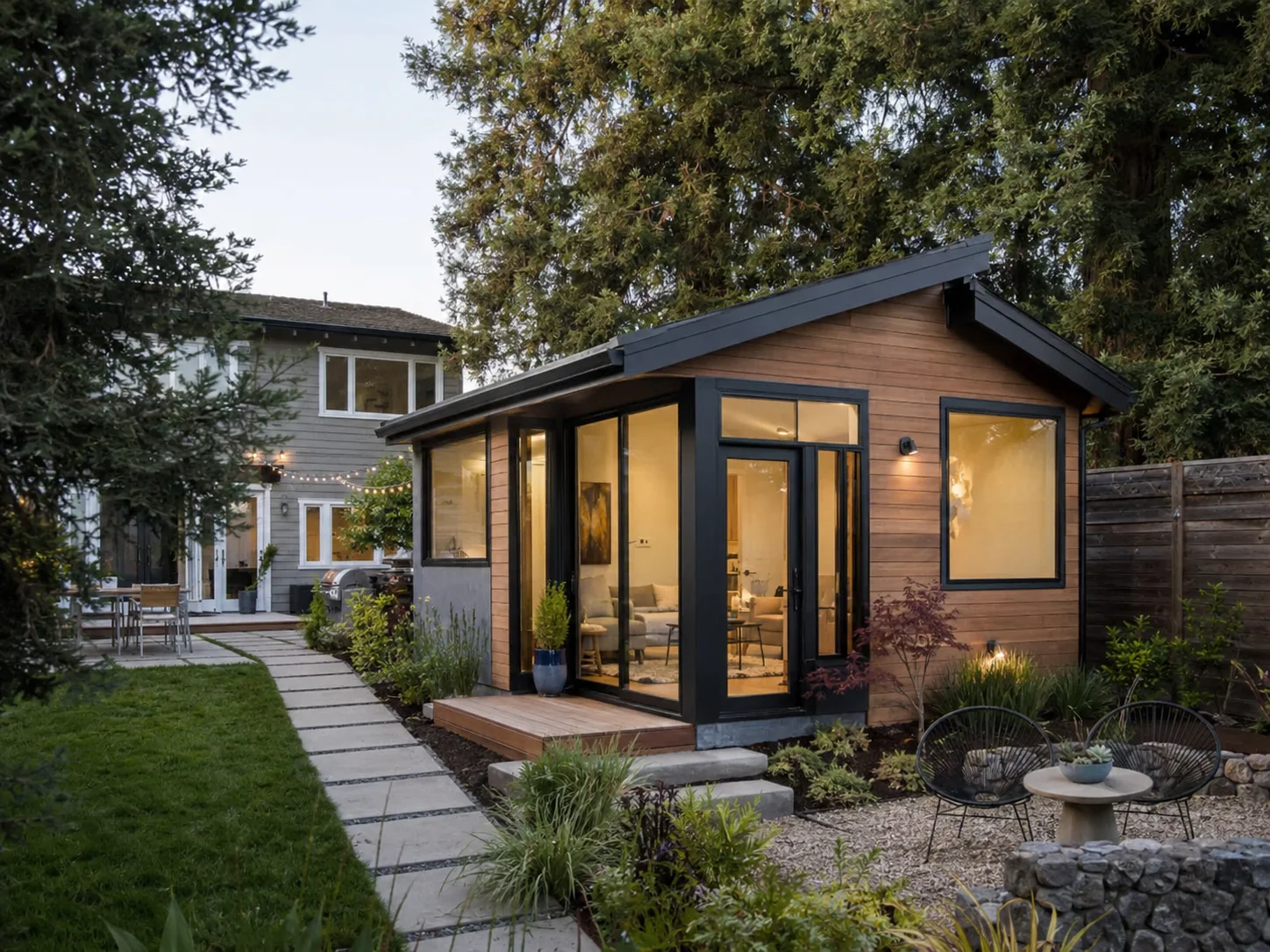
What people mean by “Elon Musk prefab house”
Short answer: the phrase is mostly a mix of rumors, viral posts, and two real things: Tesla's one-off tiny house concept and Boxabl's prefab Casita. Neither is an automatic ADU solution.
A lot of searchers are really asking one of three things:
- Did Elon Musk launch a low-cost prefab house?
- Can I buy the same unit Musk is linked to?
- Can that unit be used as an ADU on my property?
The answer to all three is: not in the simple way social media suggests.
Tesla's 2017 “tiny house” was a demonstration, not a housing product
Tesla's tiny house appeared in 2017 as a mobile demonstration tied to solar and Powerwall energy products. TechCrunch described it as a roadshow-style showcase, not a consumer ADU program you could order as a standard home package. TechCrunch, 2017-08-14
That matters because an ADU is not just a small house. It has to fit your city or county's rules for use, placement, foundation, utilities, and inspection.
PolitiFact also checked viral claims about Musk launching a low-cost house and found no evidence supporting that specific claim. PolitiFact, 2024-11-08
Boxabl Casita is a real prefab unit, but that still doesn't make it an ADU
Boxabl's Casita is a published prefab product with technical specifications. That is useful, because specs are the kind of documents a city reviewer or lender may want to see. Boxabl's Casita Specifications document is dated 5-21-24; check whether Boxabl has published a newer revision on its documents page before submitting anything to your city or lender. Boxabl Casita Specifications, 2024-05-21
But a spec sheet is not a permit. Specs help with completeness for the plan review packet, but cities still require site-specific drawings, engineering, and code compliance determinations. A prefab unit can still fail as an ADU if:
- Your zoning does not allow it on that lot
- It cannot be installed on a compliant permanent foundation
- Utility hookups do not meet local code
- Your lender will not underwrite it as real property
The right way to think about it
The best mental model is this:
Celebrity label + prefab product ≠ legal ADU
What matters is whether the unit clears three gates:
- Unit classification — Is it treated as manufactured, modular, or another type of prefab?
- Local ADU code path — Does your city/county allow it, and what foundation, setback, utility, parking, fire, and inspection rules apply?
- Lender underwriting — Will your lender finance it, and what documentation does the lender require?
That three-part test is the core of this guide.
Can a Musk-style prefab unit be permitted as an ADU?
Short answer: sometimes, but only if it fits your local rules and financing path. “Prefab” does not mean “permit-free,” and it does not mean “ADU-ready.” This is where most people get stuck. They start with the product and skip the process. For ADUs, the process is the product.
Step 1: Classify the unit correctly
Before you compare prices or place an order, find out how the unit is treated in your jurisdiction. Common buckets include:
- Manufactured home
- Modular home
- Other prefab / factory-built structure
That classification affects everything from inspections to foundation requirements to financing. A city may treat one type as acceptable for an ADU and another as incompatible with its code path. Lenders may also treat the same unit differently depending on classification.
Step 2: Confirm the local ADU code path
Every jurisdiction has its own rules. The usual local questions are:
- Is an ADU allowed on this lot?
- What are the setback rules?
- Is a permanent foundation required?
- Are separate water, sewer, and electrical connections required?
- Is parking required or waived?
- Are fire access or egress standards triggered?
- What inspections happen before occupancy?
If you cannot answer those questions in writing, you are not ready to buy.
Step 3: Check lender requirements before you commit
Even if the city allows the unit, the lender may still say no until the structure is documented as real property or meets a specific financing category. In HUD Title I manufactured-home contexts and similar frameworks, installation and foundation compliance are treated very seriously. HUD Title I guidance also indicates an initial lease term of three years when the land or lot is leased in that specific program — a program-specific example of how financing turns on stability and paperwork. That lease-term rule may not apply to conventional ADU mortgages, home-equity loans, or other unit classifications. Confirm the rule with your specific lender. HUD Title I financing guidance
Why permanent foundation rules matter so much
Short answer: for many prefab ADU paths, the foundation is a frequent blocker. It affects permitting, valuation, and financing.
A permanent foundation is not just a slab or some footings. In practice, it usually means an engineered, code-compliant foundation that secures the structure in a way the local authority and lender can accept. A unit that sits on temporary supports, or lacks the right documentation, may be treated as a movable structure rather than a permanent improvement to the property.
What lenders and inspectors usually want
At minimum, many projects need:
- Foundation plans prepared or reviewed by a qualified professional
- Site-specific engineering where required
- Permit drawings
- Utility plans
- Final inspection/approval records
HUD's Permanent Foundations Guide for Manufactured Housing is a key reference point in manufactured-home financing contexts. Even if your ADU is not literally a HUD-code manufactured home, the same underlying logic often shows up in lender underwriting: permanence, compliance, and documentation. HUD USER: Permanent Foundations Guide for Manufactured Housing 1996
Why this is not just a technical detail
If the foundation is wrong, the rest of the project can unravel:
- The city may not issue the permit
- The lender may not fund
- The appraiser may not support the value
- The unit may not qualify for occupancy
That is why homeowners should solve the foundation question before they place an order.
Boxabl Casita as a case study: what you can verify, and what you still cannot assume
Short answer: Boxabl gives you a real product to evaluate, but it does not give you automatic ADU approval.
The value of Boxabl's Casita specs is that they let you review an actual prefab product rather than a vague rumor. The downside is that published specs still do not answer the local code question.
What the specs can help you do
A manufacturer spec package can help you check:
- Dimensions
- Installation assumptions
- Utility interfaces
- What the unit needs from the site
What the specs cannot do by themselves
A spec sheet cannot:
- Override zoning
- Waive a permit
- Force a city to approve a foundation
- Guarantee lender acceptance
A practical rule
If a manufacturer can't give you documents that line up with your city's permit process and your lender's requirements, slow down. Before you buy, ask for:
- The manufacturer's current specs PDF
- Any foundation interface or installation documentation
- Any engineering materials available for the site plan review process
Financing depends on classification and documentation — learn what lenders actually need.
Most prefab ADU projects are financed with a HELOC, cash-out refi, or construction loan. The lender's requirements depend on how the finished project is classified.
Compare ADU Financing Paths →Financing-path education; we don't quote rates as guarantees.
Financing: can you get a loan for a prefab ADU?
Short answer: sometimes yes, but the loan depends on classification, documentation, and how the unit is installed. If the unit is cleanly documented and installed on a compliant permanent foundation, some lenders may be open to financing. If it is not, financing can become difficult fast.
What typically causes financing problems
- Missing foundation certification
- Unclear unit classification
- No site-specific engineering
- Appraiser uncertainty
- Incomplete permit records
Ask the lender these questions before you order anything
- How do you classify this unit for underwriting?
- Do you require a permanent foundation certification?
- What documents do you need before you fund?
- Do you finance this as real property?
- Will you accept this unit type for an ADU?
- What appraisal support will you need?
- Do you need permit approval before closing?
- Are there any restrictions based on the manufacturer or installation method?
If the lender gives vague answers, treat that as a warning sign.
California note: AB 1033 and separate sale
Short answer: in California, ADUs got a new potential ownership pathway under AB 1033, but it is not automatic and not statewide in practice unless the local jurisdiction opts in.
AB 1033 became effective January 1, 2024. ABAG's California ADU State Laws Summary and Checklist (July 2025) explains the separate-conveyance pathway. It created a mechanism for local governments to allow an ADU to be separately conveyed as a condominium. But the key phrase is local governments may allow it. ABAG, 2025-07 ADU State Laws Summary and Checklist
That means:
- The state law exists
- Your local city or county must adopt the enabling ordinance
- You need to verify local adoption status before assuming separate sale is possible
Confirm your city/county's current adoption or ordinance status with planning, assessor, or recorder staff before you plan around separate conveyance, because that status can change.
Cost reality: prefab may save time, but not the expensive parts
Short answer: prefab can reduce some labor and assembly time, but it does not erase the main ADU cost drivers. A lot of people hear “prefab” and think “cheap.” That is rarely the full story.
The costs that still show up
Even with a factory-built unit, you still may pay for:
- Site prep and grading
- Foundation design and construction
- Permits and plan check
- Utility trenching and hookups
- Crane or delivery logistics
- Electrical/plumbing/HVAC tie-ins
- Inspections
In many projects, the real budget surprises are not the unit price. They are the site and code costs.
A useful budget breakdown
Separate your budget into:
- Unit cost
- Site cost
- Code cost (permits, engineering, inspections)
- Financing cost
If a quote only covers the first bucket, it is not a real project budget.
How to verify a Musk-style prefab ADU in 30 to 45 days
Short answer: ask the city, then the engineer, then the lender. In that order.
1) Confirm ADU eligibility on your lot
Ask the city or county:
- Is an ADU allowed here?
- What type of unit is allowed?
- Is a prefab or factory-built unit acceptable?
- What permit path applies?
Get the answer in writing if possible.
2) Confirm the foundation and utility path
Ask a local engineer or architect:
- Can this unit be installed on a compliant permanent foundation?
- What foundation design will the city require?
- What utility details need to be shown on the permit set?
3) Confirm lender requirements
Ask the lender:
- Will you finance this unit type?
- What classification do you use?
- What documents do you need?
- Do you require final permit approval before funding?
4) Only then compare product quotes
Do not compare manufacturer pricing until the local path is clear. Otherwise you may be comparing a real project to a fantasy.
Common mistakes homeowners make
Mistake 1: Treating prefab like a shortcut around permitting
Prefab is still usually a permitted project. It is not a permit-free hack.
Mistake 2: Assuming celebrity association equals compliance
Rumors about Elon Musk, Tesla, or Boxabl do not mean your city will approve a unit as an ADU.
Mistake 3: Ignoring the foundation
This is one of the biggest reasons projects stall. Solve the foundation question before you order.
Mistake 4: Forgetting the lender
A city permit is not the same thing as financing approval.
Mistake 5: Assuming California separate-sale rules apply everywhere
They do not. And even in California, local opt-in matters under AB 1033.
FAQ: Elon Musk prefab house and ADU questions
Is there an Elon Musk prefab house I can buy as an ADU?
No standardized Musk-branded ADU product exists in the normal sense. The common references are Tesla's 2017 tiny-house demo and Boxabl's Casita, but neither is automatically an ADU.
Does Boxabl Casita automatically qualify as an ADU?
No. It still must comply with local zoning, building, foundation, and utility rules. A manufacturer spec sheet cannot override zoning, waive a permit, or guarantee lender acceptance.
Does prefab mean permit-free?
Usually not. Most ADUs still need permits and inspections regardless of whether the unit is factory-built or site-built.
What is the biggest thing that blocks approval?
Foundation, classification, zoning, and utility path issues are often the biggest blockers. Solving the foundation question before placing an order is especially important.
Will lenders finance a prefab ADU?
Sometimes, but it depends on how the unit is classified and what documentation you provide. Lenders want to know what they are financing and what collateral they have.
What documents should I ask for first?
Ask for the manufacturer's current specs, foundation or installation interface documents, and any engineering materials that support permit review.
If I'm in California, can I sell the ADU separately?
Possibly, but only if your local jurisdiction has adopted the AB 1033 enabling ordinance and your project meets the required conditions. Verify local adoption status with your planning department, and ask for the current ordinance status in writing.
Should I contact the city before I order the unit?
Yes. That should be one of your first steps. Confirm ADU eligibility, what type of unit is allowed, what foundation the city requires, and what permit path applies before you commit to any manufacturer.
Download the Free ADU Starter Kit
Site evaluation checklist, permit prep guide, financing comparison, and contractor interview templates — before you call anyone.
Download the Free ADU Starter Kit →