
Boxabl vs Samara: Headline Pricing vs Installed-Cost Drivers & Permit Feasibility
Bottom line up front.
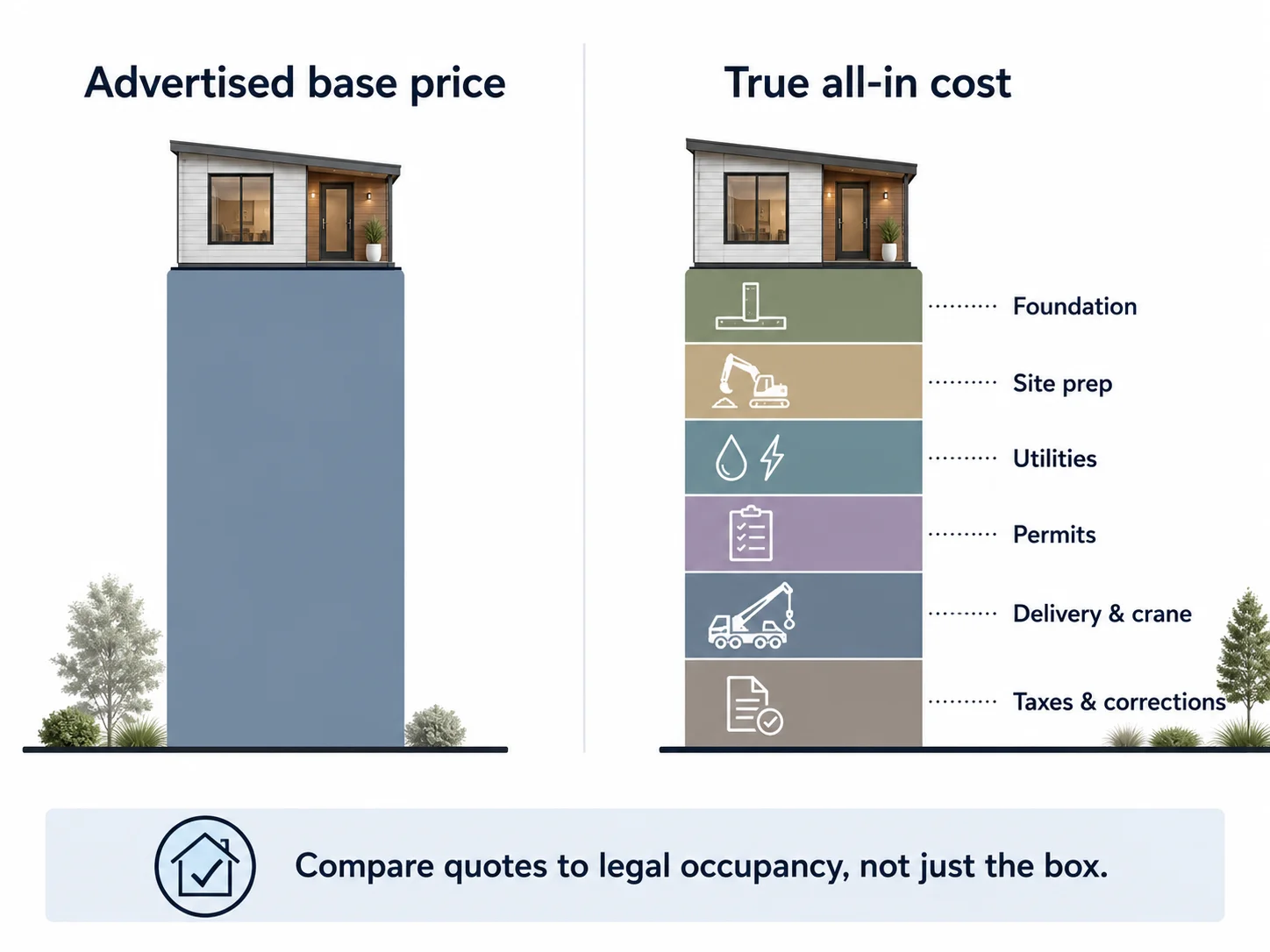
If you're comparing Boxabl vs Samara, the short answer is this: Boxabl has the lower headline unit price, while Samara is built around a more guided, higher-priced backyard ADU process. But the number on the brochure is not the number on your final budget. Shipping, land prep, permits, utilities, and site work can change the real cost a lot, and local zoning/building codes and permit review determine whether the ADU — and the specific site plan, setbacks, utilities, and fire/access approach — can be approved, often with required modifications rather than a universal yes-or-no outcome.
As of June 12, 2026, Boxabl's Casita is advertised at $60,000 for 361 sq. ft., and Boxabl's Apr. 14, 2025 annual report/10-K states that the unit/MSRP excludes shipping, land, permits, and site development. Samara's Backyard models are reported by Time to start around $274,000 for units in the 420–800 sq. ft. range, with a published estimate of about 7 months overall and roughly 6 weeks for installation. If you want the cheapest unit on paper, Boxabl stands out. If you want a more turnkey ADU journey, Samara is positioned that way. Either way, your local rules come first.
Costs, zoning, and financing rules vary by jurisdiction. Always check local zoning and building department guidance and your lender's terms before you commit. Last verified: June 12, 2026.
Free, about a minute, no commitment. Returns zoning class, buildable size, and preliminary fee eligibility for your address.
Boxabl vs Samara: the short comparison
Boxabl is the lower headline-price option, but that price is only for the unit itself. Samara is the higher-priced option with a more packaged process, and its public messaging focuses on a guided path from selection to permitting to installation. For most homeowners, the real question is not “Which box is cheaper?” but “Which one becomes the cheaper installed ADU on my lot?”
Boxabl vs Samara at a glance
| Category | Boxabl | Samara | What it means for you |
|---|---|---|---|
| Headline price | $60,000 | Starts around $274,000 | Boxabl looks cheaper up front, but not after site costs |
| Size | 361 sq. ft. | 420–800 sq. ft. | Samara is larger and may fit different needs |
| Timeline framing | Rapid fold/unfold concept | ~7 months overall, ~6 weeks installation | Samara publishes a more structured process |
| What's excluded | Shipping, land, permits, site development | Public marketing emphasizes a more bundled journey | Big difference in total project management |
Headline price vs installed ADU cost
A headline unit price is the cost of the prefab shell or factory-built unit. An installed ADU cost includes the full project: site prep, foundation, utility hookups, permit fees, engineering, and whatever your parcel needs to pass local review.
That distinction matters because ADU projects are often won or lost in the “invisible” work:
- Utility trenching and connection fees
- Electrical panel or service upgrades
- Grading and drainage
- Foundation or pier work
- Driveway or access changes
- Fire access and egress requirements
- Plan check corrections and revisions
Boxabl's annual report/10-K makes the distinction especially clear. The $60,000 Casita price is the unit/MSRP, not an installed, permitted ADU ready for occupancy, and Boxabl states that it does not include shipping, land, permits, or site development. Samara's higher sticker price is positioned with more front-end coordination, but it does not erase local site conditions or city review.
Why “prefab” does not mean “permit is automatic”
Factory-built does not mean permit-free. Your city or county still decides whether the project fits local zoning and building codes. That commonly includes:
- Setbacks
- Lot coverage
- Parking rules or exceptions
- Utility connection feasibility
- Fire access and separation requirements
- Grading and drainage
- Overlay zones such as coastal, hillside, or historic districts
California's ADU system is a good example of how state rules can limit local denials while local agencies still apply objective standards. That does not mean every parcel gets automatic approval, and it does not override parcel-specific compliance items. The local building department still controls the permit path.
Who Boxabl is best for
Boxabl is best for homeowners who want the lowest headline unit price and are prepared to manage the parts outside the factory scope. That usually means you are comfortable coordinating site work, utility planning, and permitting, or you already have a local contractor who can do it.
Why Boxabl appeals on paper
Boxabl's Casita is marketed as:
- 361 sq. ft.
- 19' × 19' footprint
- $60,000 retail price for the unit
That is a compelling starting point if your goal is to compare factory prices only.
The tradeoff with Boxabl
The published price does not include:
- Shipping
- Land
- Permits
- Site development
Those excluded items are often the most expensive and least predictable part of an ADU. If your lot needs trenching, a panel upgrade, soil work, or access changes, the final number can climb quickly.
Boxabl fit check
Boxabl may make sense if:
- You want the lowest factory price
- Your site is already fairly ready for construction
- You have a contractor for permits and utilities
- You understand the ADU budget is built after the unit price
Boxabl is usually less attractive if:
- Your lot is difficult to access
- Utilities are far from the build area
- Your city requires heavy plan-check coordination
- You need a more guided, bundled process
Who Samara is best for
Samara is best for homeowners who want a more structured ADU journey and are willing to pay more for that packaging. Its public positioning is closer to a one-stop-shop model than a bare unit sale.
Why Samara appeals to homeowners
Time reports that Samara's Backyard models are 420–800 sq. ft., starting around $274,000, with about 7 months overall and about 6 weeks installation. For a homeowner who does not want to stitch together a designer, engineer, permit runner, and installer, Samara's model may feel simpler to manage.
The tradeoff with Samara
The main tradeoff is cost. You are paying more up front for a product that is positioned as more turnkey. But “turnkey” still does not mean “guaranteed.” Local review timelines, utility capacity, and parcel-specific issues can still delay or reshape the project. A higher sticker price does not override local law.
Samara fit check
Samara may make sense if:
- You want a more guided ADU process
- You prefer a larger footprint
- You value a defined installation timeline
- You are comfortable with a higher starting price
Samara is usually less attractive if:
- Your budget is tightly capped
- You only care about lowest unit cost
- Your site needs major utility upgrades anyway
- You want full control over every line item
The real cost comparison: what you must add to both
The only fair way to compare Boxabl vs Samara is to convert both into installed ADU math. That means starting with the unit price and then adding the site-specific costs your lot will require.
Installed ADU cost checklist
Use this checklist before you compare quotes:
- Site prep and grading: clearing, leveling, drainage fixes, access work
- Foundation system: slab, stem wall, piers, or another approved system
- Utility hookups: water, sewer, electric, and any gas service work
- Electrical service upgrade: a bigger panel or utility service may be required
- Trenching and permits: utility trenching can require separate approvals
- Driveway and access changes: fire access, parking, and construction access may affect costs
- Engineering and surveys: site plans, structural documents, geotechnical work
- Permit fees and plan check: city/county fees vary widely
- Energy compliance documents: many jurisdictions require specific energy paperwork
- Contingency: a cushion for surprises is smart on any ADU project
Why the gap can shrink or grow
If your lot is simple and utilities are nearby, Boxabl's lower unit price may keep it ahead even after site work. But if you need major trenching, grading, or utility upgrades, the “cheap” option can stop being cheap fast. Likewise, Samara's higher sticker price can still be the better value if it bundles more coordination and reduces the number of separate vendors you need to manage. The right answer is site-dependent, not brand-dependent.
Permitting: the part that decides everything
Neither Boxabl nor Samara can guarantee approval. In practice, you should assume approval is not guaranteed because ADU projects require local permits and plan review. The permit outcome depends on your local zoning code, building department interpretation, utility capacity, and parcel conditions. That is why ADU shopping should start with a zoning check, not a product brochure.
Simple permit-path decision checklist
Use this as a checklist. Exact sequence varies by jurisdiction:
- Is an ADU allowed on my lot type? Start with your zoning designation.
- What ADU type is allowed? Detached ADU, attached ADU, or JADU.
- Can I meet setbacks and lot coverage limits? Rear and side yard rules matter a lot.
- Do parking rules apply? Some places waive parking in certain cases, but not all.
- Can utilities support the unit? Water, sewer, and electric capacity can be limiting factors.
- Can fire access and egress be met? This can affect placement and design.
- Are there overlay zones or special review areas? Coastal, hillside, historic, or flood zones may add steps.
- Who submits the permit package? Requirements vary by city and by vendor contract.
What “local agency can't deny” really means
People sometimes read state ADU reforms as if they guarantee approval. They do not. In California, for example, state law limits some denial reasons, but cities still apply objective standards. They can still require compliance with setbacks, safety rules, utilities, and other code items. That is why a product can be legal in one city and difficult in another. The manufacturer does not control your jurisdiction.
Size matters more than people think
Boxabl's 361 sq. ft. / 19' × 19' footprint and Samara's 420–800 sq. ft. range can lead to very different outcomes. Bigger units may feel more livable, but they can also create more pressure on setbacks, lot coverage, and sitework.
Boxabl's size profile
- 361 sq. ft.
- 19' × 19'
- May help on tighter lots, depending on setbacks
Samara's size profile
- 420–800 sq. ft.
- More room for larger living spaces
- Raises stakes for code compliance and site planning
A larger footprint can mean more lot coverage, more utility demand, more grading or foundation work, tighter fit within setbacks, and higher fire and access scrutiny. So size is not just about comfort. It affects feasibility and total cost.
Timeline: what “fast” actually means
Samara publishes a more defined schedule, while Boxabl emphasizes the speed of unfolding the unit. But neither timeline removes the need for permits, utility work, and final inspections.
Samara's published timeline
Time has reported Samara's process as roughly 7 months overall with about 6 weeks for installation. That is a helpful benchmark, but it should be treated as a published timeline estimate, not a guarantee. Local review can extend the project.
Boxabl's speed story
Boxabl's fast deployment story is built around its fold/unfold concept. That may reduce on-site assembly time, but it does not eliminate:
- Shipping timing
- Foundation prep
- Utility connections
- Permit delays
- Inspection scheduling
The practical sequence
Most ADU projects still follow the same rough sequence:
- Feasibility check
- Design and engineering
- Permit submission
- Plan check
- Site work and utilities
- Delivery and placement
- Final inspections
- Occupancy approval
A fast factory process does not make the city move faster.
Financing is a separate approval track from the permit.
Whether you choose Boxabl or Samara, your lender will want to know classification, foundation, documentation, and draw schedule. Learn the differences before you sign with any vendor.
Compare ADU Financing Paths →Financing-path education; we don't quote rates as guarantees.
Financing: don't assume the lender sees it the same way you do
ADU financing is often harder than the marketing suggests. Lenders care about collateral, appraisals, draw schedules, and whether the project documents are clear enough for underwriting.
Questions to ask your lender before you sign with any ADU vendor
- Is this construction-to-permanent financing or another structure?
- Do you finance the unit only, or also site work and utilities?
- What documents do you need before approval?
- How will you appraise a prefab or modular ADU?
- What inspection milestones trigger draws?
- Do you accept the vendor's engineering and spec package?
- Who is the borrower, and what collateral do you require?
- What happens if the permit path changes?
Why turnkey support can help
If a company helps with the permit and financing journey, it may reduce coordination stress. That can be valuable. But the lender still decides whether the project is financeable on your terms, not the manufacturer. So treat financing as a separate approval track, not as something bundled into the product brochure.
Risks and common misconceptions
The biggest mistake is comparing the unit price instead of the total installed ADU cost. The second biggest mistake is assuming prefab means easy permitting. Neither is true.
Misconception 1: "$60,000 Boxabl means a $60,000 ADU"
Boxabl's filing says the $60,000 Casita price excludes shipping, land, permits, and site development. That is only the starting point.
Misconception 2: "Turnkey means guaranteed"
Samara may package more steps up front, but local review still controls the outcome. The timeline and permitting process can still shift.
Misconception 3: "Prefab skips the hard parts"
Also no. The hard parts often are not the factory build. They are site conditions, utilities, access, and code compliance.
Deal-breakers that can flip the answer
Any of these can change which product makes sense — or whether either makes sense:
- Utility capacity shortfall
- Severe grading or drainage issues
- Parking or access conflicts
- Fire access limits
- Setback problems
- Overlay zone restrictions
- Costly trenching or panel upgrades
If your lot has one or more of those issues, the better product on paper may not be the better project in real life.
So which should you choose?
Choose Boxabl if your top priority is the lowest headline unit price and you're prepared to handle the rest of the project carefully.
Choose Samara if you want a more guided ADU journey and can accept a higher starting price for more structure.
That said, the smartest answer for most homeowners is often: get a local feasibility check first. A quick zoning review can save you from choosing a product that your lot, utilities, or permit path cannot support.
Quick decision matrix
Pick Boxabl if:
- Your budget is tight
- You want the lowest quoted unit price
- You already have construction help
- Your site is relatively simple
Pick Samara if:
- You want a more guided process
- You value larger floor plans
- You can afford a higher starting price
- You want less coordination between vendors
Pick neither yet if:
- You have not checked local ADU rules
- You do not know your utility situation
- You have no permit strategy
- You are comparing brochures instead of installed budgets
FAQ: Boxabl vs Samara
Is Boxabl really cheaper than Samara?
On headline price, yes. Boxabl's $60,000 Casita is far below Samara's reported starting price of about $274,000. But that does not mean Boxabl is cheaper as a finished ADU. Once you add shipping, site work, permits, and utilities, the final numbers can move a lot.
What is included in Boxabl's $60,000?
Boxabl's annual report/10-K says the unit/MSRP price does not include shipping, land, permits, or site development. That is why it should not be treated as the total project cost.
How big are Boxabl and Samara units?
Boxabl's Casita is 361 sq. ft. Samara's Backyard models are in the 420–800 sq. ft. range.
Which is easier to permit?
Neither is automatically easier. The permit outcome depends on your local zoning and building rules, plus your parcel's setbacks, utilities, access, and any overlays.
How long does Samara take?
Time has described Samara as a roughly 7-month overall process with about 6 weeks installation. That should be treated as a published timeline estimate, not a guarantee.
Can I finance either one?
Possibly, but it depends on the lender. Ask whether the lender finances prefab/modular ADUs, site work, utilities, and permit-related costs. Also confirm how the unit will be classified for underwriting.
Which is better for a small lot?
Usually the smaller footprint helps, but the real answer depends on setbacks, lot coverage, and local code. Boxabl's smaller 361 sq. ft. / 19' x 19' size may fit some tight lots better, but that is not universal.
What should I ask my city before I buy either product?
Ask whether the lot can have an ADU, what type is allowed, what setbacks apply, whether parking is required, and whether utilities and fire access are feasible.
Do these companies guarantee permit approval?
No. No manufacturer can guarantee that, because the local jurisdiction controls approval.
Download the Free ADU Starter Kit
Site evaluation checklist, permit prep guide, financing comparison, and contractor interview templates — before you call anyone.
Download the Free ADU Starter Kit →