
Boxabl vs Abodu: How to Estimate the All-In ADU Cost in 2026
Bottom line up front.
If you're comparing Boxabl vs Abodu, the real question is not which has the lower headline price. It is which product becomes the better-value installed ADU on your specific lot, in your specific city. Boxabl's Casita is publicly listed at $60,000 for 361 sq. ft. Abodu is positioned as a larger, more turnkey prefab product at a higher price point. But the number on the brochure is only the starting point. Shipping, land prep, foundation, permits, utility hookups, engineering, and site work can all add substantially to either total — and local zoning and building rules determine whether the ADU can be approved on your parcel at all.
Costs, zoning, and financing rules vary by jurisdiction. Always check local zoning and building department guidance and your lender's terms before you commit. No manufacturer can guarantee permit approval or specific timelines.
Sources: Boxabl 10-K (Apr. 14, 2025); California HCD ADU Handbook (March 2026); Abodu published materials. Last verified: June 12, 2026.
Free, about a minute, no commitment. Returns zoning class, buildable size, and preliminary fee eligibility for your address.
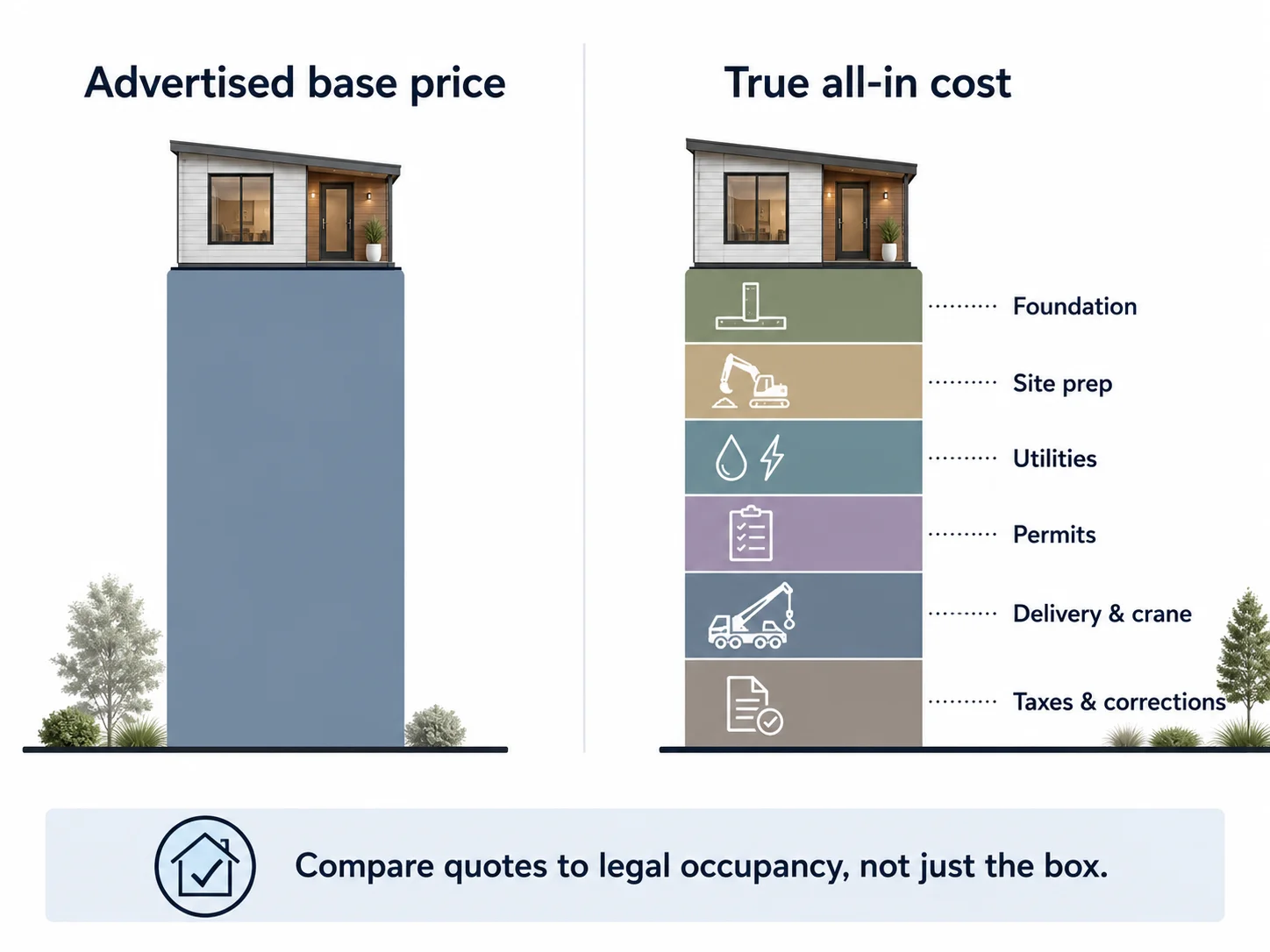
Headline price vs installed ADU cost: the core distinction
Before you compare Boxabl vs Abodu, understand the difference between these two numbers:
- Headline unit price: the cost of the prefab unit itself from the manufacturer
- Installed ADU cost: the full project budget including site prep, foundation, delivery, utility hookups, permits, engineering, and contingency
These can be very different numbers. The ADU projects that surprise homeowners most are almost never the ones where the unit costs more than expected. They're the ones where the site costs, utility work, or permit expenses were significantly higher than the brochure price implied.
What Boxabl's price excludes
Boxabl's annual report/10-K (April 14, 2025) explicitly states that the $60,000 Casita unit/MSRP price does not include:
- Shipping
- Land
- Permits
- Site development
Those excluded items are often the most expensive and least predictable part of any ADU project.
What Abodu's positioning offers
Abodu markets its product as a more turnkey ADU solution with more guidance on the permitting and installation journey. That means a higher starting price, but also more front-end coordination bundled in. However, “more turnkey” does not mean “fixed price regardless of site” or “automatic approval.” Local review still controls the outcome.
Boxabl vs Abodu at a glance
| Category | Boxabl | Abodu |
|---|---|---|
| Headline price | $60,000 (Casita unit) | Higher — more turnkey positioning |
| Unit size | 361 sq. ft. | Larger configurations available |
| Footprint | 19′ × 19′ | Larger footprint depending on model |
| What's excluded | Shipping, land, permits, site development | Site-specific costs still apply |
| Process model | Unit-focused; buyer handles the rest | More guided, more bundled journey |
| Best for | Lowest headline unit price; buyer has construction help | Guided ADU process; willing to pay for coordination |
Who Boxabl is best for
Boxabl is best for homeowners who want the lowest headline unit price and are prepared to manage the remaining project pieces themselves. That usually means you already have a local contractor who can handle site work, utility planning, and permit coordination, or you are comfortable doing that coordination yourself.
Boxabl fit check
Boxabl may make sense if:
- You want the lowest factory unit price
- Your site is relatively ready for construction
- You have a contractor or consultant who can coordinate permits and utilities
- You understand that the ADU budget is largely built after the unit price
- Your lot is not difficult to access and utilities are nearby
Boxabl is usually less attractive if:
- Your lot is difficult to access
- Utilities are far from the build area
- Your city requires heavier plan-check coordination
- You need a more guided, bundled process
- You want a larger floor plan than 361 sq. ft.
Who Abodu is best for
Abodu is best for homeowners who want a more structured ADU journey and are willing to pay more for that packaging. Its public positioning is closer to a one-stop-shop model than a bare unit sale. For homeowners who don't want to manage a designer, engineer, permit runner, and installer separately, Abodu's model can feel simpler.
Abodu fit check
Abodu may make sense if:
- You want a more guided, managed ADU process
- You prefer a larger floor plan
- You value reduced coordination overhead
- You are comfortable with a higher starting price for more structure
Abodu is usually less attractive if:
- Your budget is tightly capped
- You want full control over every subcontractor and line item
- Your lot needs major utility upgrades regardless of vendor
- You only need the smallest possible footprint
The real cost comparison: convert both into installed ADU math
The only fair way to compare Boxabl vs Abodu is to convert both into installed ADU math. That means starting with the unit price and adding the site-specific costs your lot will require.
Installed ADU cost checklist
Use this checklist before you compare any two prefab ADU quotes:
- Site prep and grading: clearing, leveling, drainage fixes, access work
- Foundation system: slab, stem wall, piers, or another approved system
- Utility hookups: water, sewer, electric, and any gas service work
- Electrical service upgrade: a bigger panel or utility service may be required
- Trenching and permits: utility trenching can require separate approvals
- Driveway and access changes: fire access, parking, and construction access may affect costs
- Engineering and surveys: site plans, structural documents, and sometimes geotechnical work
- Permit fees and plan check: city/county fees vary widely
- Energy compliance documents: many jurisdictions require specific energy paperwork
- Contingency: a cushion for surprises is essential on any ADU project
Why the gap between the two can shrink or grow
If your lot is simple and utilities are nearby, Boxabl's lower unit price may keep it ahead even after site work. But if you need major trenching, grading, utility upgrades, or heavily managed permit coordination, the cost gap between a “cheap” unit and a “bundled” solution can narrow fast. Conversely, if Abodu's higher price bundles real coordination value that you don't have to pay for separately, it may be the better total value. The right answer is site-dependent.
Permitting: neither product can guarantee approval
Neither Boxabl nor Abodu can guarantee permit approval. The permit outcome depends on your local zoning code, building department interpretation, utility capacity, and parcel conditions. Factory-built does not mean permit-free.
Your city or county still decides whether the project fits local rules, which commonly include:
- Setbacks and lot coverage limits
- Parking rules or exceptions
- Utility connection feasibility
- Fire access and separation requirements
- Grading and drainage standards
- Overlay zones such as coastal, hillside, or historic districts
Questions to ask your local jurisdiction before ordering either product
- Is an ADU allowed on my lot type and zoning designation?
- What ADU types are allowed: detached, attached, or JADU?
- Can I meet setback and lot coverage limits?
- Do parking rules apply or is there an exemption?
- Can utilities support the unit size and type?
- What fire access and egress standards apply?
- Are there any overlay zones affecting my property?
The budget surprised you. That's normal.
Most homeowners finance prefab ADU projects with a HELOC, cash-out refi, or construction loan. Each has different rate behavior, draw timing, and documentation requirements.
Compare ADU Financing Paths →Financing-path education; we don't quote rates as guarantees.
Size matters: how footprint affects permitting and cost
Boxabl's 361 sq. ft. / 19' × 19' footprint is on the smaller end. Abodu offers larger configurations. That size difference has real consequences beyond just livability:
- Larger footprint may affect lot coverage compliance
- Bigger units demand more utility capacity
- More grading or foundation work may be required for larger footprints
- Tighter fit within setbacks for larger units on smaller lots
- Higher fire and access scrutiny for larger units
For a tight lot, Boxabl's smaller size may help. But the real answer is always: check your local setback rules, lot coverage limits, and utility requirements for your specific parcel.
Risks and common misconceptions
Misconception 1: “$60,000 Boxabl means a $60,000 ADU”
Boxabl's 10-K says the $60,000 Casita price excludes shipping, land, permits, and site development. That is the starting point, not the all-in budget.
Misconception 2: “Turnkey means guaranteed”
Abodu may package more steps up front, but local review still controls the outcome. The timeline and permitting process can still shift due to site conditions, utility capacity, or city review cycles.
Misconception 3: “Prefab skips the hard parts”
The hard parts often are not the factory build. They are site conditions, utilities, access, and code compliance. These apply to both Boxabl and Abodu equally.
Misconception 4: “The cheaper unit is always the cheaper project”
Not necessarily. A lower unit price combined with high site costs can exceed a higher-priced but more fully bundled solution. Compare installed totals, not brochure prices.
Deal-breakers that can flip the decision
Any of these lot conditions can change which product makes sense — or whether either makes sense at all:
- Utility capacity shortfall
- Severe grading or drainage issues
- Parking or access conflicts
- Fire access limits
- Setback problems
- Overlay zone restrictions
- Costly trenching or panel upgrades
So which should you choose?
Choose Boxabl if your top priority is the lowest headline unit price and you're prepared to handle the rest of the project carefully with existing construction help.
Choose Abodu if you want a more guided ADU journey and can accept a higher starting price for more structure and coordination.
For most homeowners, the smartest move is to get a local feasibility check first. A quick zoning and site review can save you from choosing a product that your lot, utilities, or permit path cannot support.
Quick decision matrix
Pick Boxabl if:
- Your budget is tight and unit price is the priority
- You have construction help to manage the rest
- Your site is relatively simple
- You want the smallest footprint
Pick Abodu if:
- You want a more guided process
- You value larger floor plans
- You can afford a higher starting price
- You want less coordination between vendors
Pick neither yet if:
- You haven't checked local ADU rules
- You don't know your utility situation
- You have no permit strategy
- You're still comparing brochures instead of installed budgets
FAQ: Boxabl vs Abodu
Is Boxabl cheaper than Abodu?
On headline unit price, Boxabl is cheaper — its Casita is publicly listed at $60,000 for 361 sq. ft. Abodu is positioned at a higher price point as a more turnkey, larger product. But unit price is only the starting point. Once you add site prep, foundation, utilities, permits, and delivery, the comparison changes significantly depending on your lot and city.
How do I actually compare Boxabl vs Abodu costs?
Compare installed ADU cost, not just unit price. That means getting quotes from both that include site prep, foundation, delivery, utility hookups, permits, engineering, and contingency. If one quote only covers the unit and the other covers the full install, they are not comparable.
Does prefab mean permits are automatic?
No. Both Boxabl and Abodu units still require local permits, inspections, and site-specific engineering. Factory-built does not mean permit-free. Your city or county still applies its own zoning rules, building codes, fire access requirements, and utility standards.
Can I finance either one with a HELOC or construction loan?
Possibly, but it depends on the lender and how the finished project is classified. Ask the lender how it will classify the unit for underwriting and what documentation is required before you commit to either product.
Which is better for a small or tight lot?
Boxabl's 361 sq. ft. / 19' x 19' footprint is smaller than most Abodu configurations, which may help on tight lots. But setbacks, lot coverage rules, and access for delivery are the real constraints — not just raw footprint. Check with your local planning department.
What is the biggest cost surprise people face with either product?
Site work, utility hookups, and foundation costs are frequently larger than expected. Most brochure prices cover only the unit. If your lot needs trenching, grading, retaining walls, service upgrades, or long utility runs, the final installed cost can be significantly higher than the headline price.
Are there timeline guarantees?
No. Permit timelines depend on your local jurisdiction's review cycle, plan-check corrections, and utility coordination. No manufacturer can guarantee how long your city's process will take.
What should I verify with my city before choosing either product?
Verify ADU eligibility on your lot, setback and height rules, foundation requirements, parking requirements or exemptions, utility connection feasibility, fire access standards, and whether any overlay zones apply.
Download the Free ADU Starter Kit
Site evaluation checklist, permit prep guide, financing comparison, and contractor interview templates — before you call anyone.
Download the Free ADU Starter Kit →