
Best ADU Builders Seattle (2026): How to Choose a DADU Contractor Who Knows the Permit Process
Bottom line up front.
If you are searching for the best ADU builders in Seattle in 2026, the most important qualifying criterion is this: does the builder know Seattle's specific DADU permit workflow — Seattle Department of Construction and Inspections (SDCI) routing, sewer treatment capacity acknowledgement requirements, tree protection standards, grading permit thresholds, and pre-approved plan eligibility? Seattle's ADU process is one of the most permissive in the country in terms of what is allowed, but it is also highly technical. Builders who are new to Seattle or primarily experienced in other jurisdictions will encounter delays, additional plan-check cycles, and site-cost surprises that builders with established SDCI relationships manage more efficiently.
No builder can guarantee permit approval or timelines. Seattle's SDCI review times change. Verify current information with SDCI before committing to any timeline or signing a contract.
Source: The Dwelling Index independent research; Seattle SDCI ADU guidance; Washington State Department of Commerce ADU resources. Last verified: June 12, 2026.
Free, about a minute, no commitment. Returns zoning class, buildable size, and preliminary fee eligibility for your address.
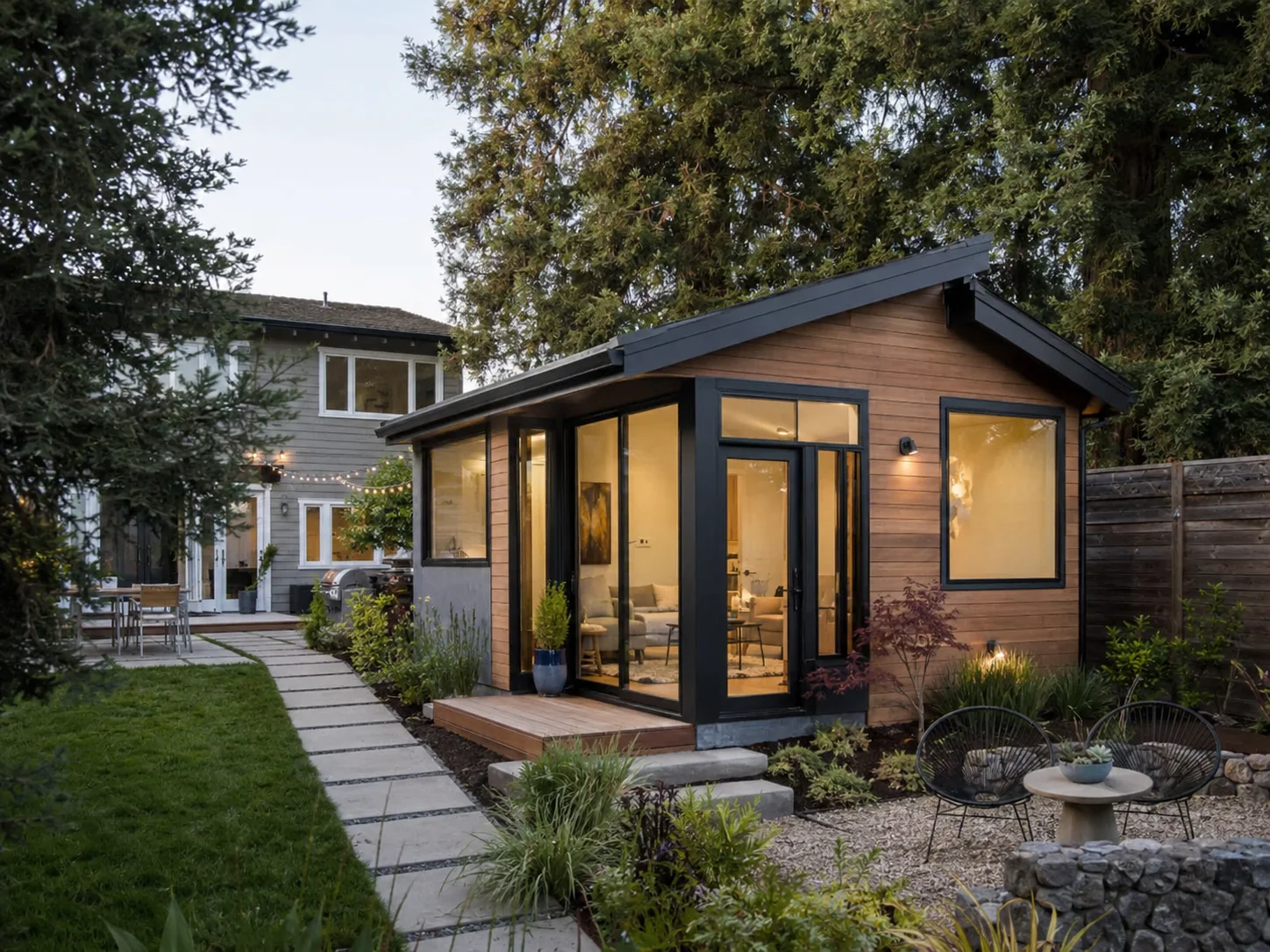
Seattle's ADU rules: what you can build and where
Seattle updated its ADU rules significantly in 2019 and has continued to refine them. Key parameters as of June 2026:
| Parameter | Current standard (verify with SDCI) |
|---|---|
| Number of ADUs allowed | Up to two per single-family lot (one AADU + one DADU, or two DADUs on qualifying lots) |
| DADU max size | 1,000 sq ft or 35% of lot area, whichever is less; rear yard coverage ≤60% |
| DADU height | Typically up to 24 feet with a sloped roof or 18 feet with a flat roof; verify by zone |
| DADU setbacks | 5-foot rear and side setbacks minimum; may vary by lot conditions |
| Pre-approved DADU plans | Available through SDCI; reduces plan-check time for qualifying designs |
| Sewer capacity acknowledgement | Required from Seattle Public Utilities before permit is finaled |
| Owner-occupancy | Not required under current Seattle code or state law |
Always verify current requirements with SDCI. Seattle's land use code is updated periodically.
Seattle's pre-approved DADU plan program
Seattle offers pre-approved DADU plan sets through SDCI that can reduce the plan-review phase. How the program works:
- Pre-reviewed designs. SDCI has reviewed the base design against Seattle's code. The structural system, energy code compliance, and minimum code requirements have been pre-cleared.
- Site-specific review still required. Your specific lot — tree protections, grading, drainage, utility connections, setback compliance — must still be reviewed. The pre-approved plan does not substitute for site review.
- Design constraints. Pre-approved plans have fixed dimensions and design features. If your project requires modifications (different size, different foundation type, different roof shape), the modified design exits the pre-approved pathway and requires full plan review.
- Fees still apply. Pre-approved plans reduce plan-check labor but do not waive permit fees, sewer charges, or utility connection fees.
Ask any builder promoting pre-approved plans whether your specific lot configuration — topography, existing trees, utility locations, easements — is compatible with the pre-approved design before relying on the associated timeline.
Sewer, utilities, and site costs in Seattle DADU projects
Seattle DADU projects routinely encounter utility-related cost variables that are not captured in base construction bids:
- Sewer treatment capacity acknowledgement. Seattle Public Utilities must confirm system capacity. In most areas this is routine, but in areas with combined sewer systems or capacity constraints, additional mitigation work may be required.
- Side sewer condition. Older homes in Seattle may have deteriorated side sewer laterals that must be repaired or replaced as a condition of adding a second dwelling unit. This is an expensive unforeseen cost. Ask builders whether a pre-construction side sewer inspection is part of their scope.
- Electrical panel capacity. A second dwelling unit typically requires additional electrical capacity. Seattle City Light service upgrades can cost $3,000–$10,000+ depending on existing panel size and site conditions.
- Tree protection requirements. Seattle has one of the strictest urban tree protection codes in the region. If your project requires removal of a significant tree, you will need a separate tree removal permit, and replacement or mitigation may be required. This can significantly affect site layout.
- Grading permit threshold. Projects that move more than 50 cubic yards of soil require a separate grading permit. Hillside lots in Seattle commonly exceed this threshold.
Budget in hand — now find the right financing path.
Most Seattle DADU projects are financed with a HELOC, cash-out refinance, or construction loan. Each has different rate behavior, draw timing, and tax treatment.
Compare ADU Financing Paths →Financing-path education; we don't quote rates as guarantees.
Eight questions to ask every Seattle DADU builder
- How many DADUs have you permitted specifically in the City of Seattle? Ask for SDCI permit numbers you can look up in the permit portal.
- Are you familiar with the SDCI pre-approved DADU plan program? Can they explain whether my lot qualifies and what happens if the pre-approved design needs modification?
- Does your quote include a side sewer inspection and potential lateral repair? If not, what is your process when a side sewer issue is discovered after work begins?
- What is your experience with Seattle's tree protection code? Are there significant trees on my lot that could affect project layout or require a separate permit?
- How do you handle the Seattle Public Utilities sewer capacity acknowledgement? Who manages that process and what happens if SPU identifies a capacity constraint?
- Does your quote include a grading permit if required? What is the threshold for your lot?
- What is your Washington contractor registration number? Verify at lni.wa.gov.
- Can you provide three verified references for completed Seattle DADU projects? Ask for SDCI permit numbers or project addresses you can verify independently.
Download the Free ADU Starter Kit
Site evaluation checklist, permit prep guide, financing comparison, and contractor interview templates — before you call anyone.
Download the Free ADU Starter Kit →Frequently asked questions
What is the difference between a DADU and an ADU in Seattle?
In Seattle, an ADU refers broadly to an accessory dwelling unit. A DADU (Detached Accessory Dwelling Unit) is specifically a detached structure separate from the primary home. An AADU (Attached Accessory Dwelling Unit) is an ADU within or attached to the primary structure. Seattle allows up to two ADUs per single-family lot — one AADU and one DADU, or two DADUs on qualifying lots. The Seattle Department of Construction and Inspections (SDCI) permits both types.
What is the maximum size for a pre-approved DADU in Seattle?
Seattle's pre-approved DADU plan program allows designs up to 1,000 square feet with rear yard coverage not exceeding 60%. Pre-approved plans must meet SDCI's published design criteria. If your lot, topography, or design intent falls outside the pre-approved plan parameters, a custom plan review is required, which takes longer than the pre-approved pathway.
What is the sewer treatment capacity acknowledgement in Seattle?
Seattle Public Utilities (SPU) requires a sewer treatment capacity acknowledgement for new ADU permits. This is a formal review to confirm that SPU's system has capacity to serve the additional dwelling unit. In most areas of Seattle the acknowledgement is routine, but in areas with older combined sewer infrastructure or capacity constraints, additional connection or mitigation steps may be required. This step must be completed before the building permit is finaled.
Do Seattle's pre-approved DADU plans guarantee a faster permit?
Pre-approved DADU plans reduce the plan-review phase because the base design has already been reviewed against Seattle's code. However, your project still requires site-specific review — grading, setbacks, tree protections, utility connections, and any site-specific conditions. A pre-approved plan on a straightforward lot will typically move faster than a custom design, but no timeline is guaranteed. Verify current SDCI pre-approved plan wait times directly.
Can I build a tiny house on wheels (THOW) as an ADU in Seattle?
No. Tiny houses on wheels are not permitted as ADUs in the City of Seattle under the Seattle Municipal Code. To be permitted as an ADU, a dwelling unit must be on a permanent foundation and meet applicable building code requirements for permanent structures.
How do I verify a Seattle ADU builder's Washington contractor registration?
All contractors performing construction work in Washington state must be registered with the Washington Department of Labor and Industries (L&I). Verify contractor registration at lni.wa.gov by searching for the business name or contractor registration number. Confirm the registration is active, the bond is current, and workers' compensation coverage is in place. Also verify that the contractor has current general liability insurance and ask for a certificate of insurance naming you as additional insured.
Editorial independence: The Dwelling Index does not accept payment for builder placement. No builder mentioned in this guide has paid for inclusion, ranking, or editorial coverage. All guidance is based on independent research. Regulations change; verify all information with Seattle SDCI before signing a contract.