Tuff Shed ADU: Can You Turn a Tuff Shed Into a Legal ADU?
By The Dwelling Index Editorial Team · · Last verified: June 1, 2026
The Dwelling Index is an independent research resource covering ADU financing, costs, and regulations. We are not a lender, broker, or builder.
The short answer
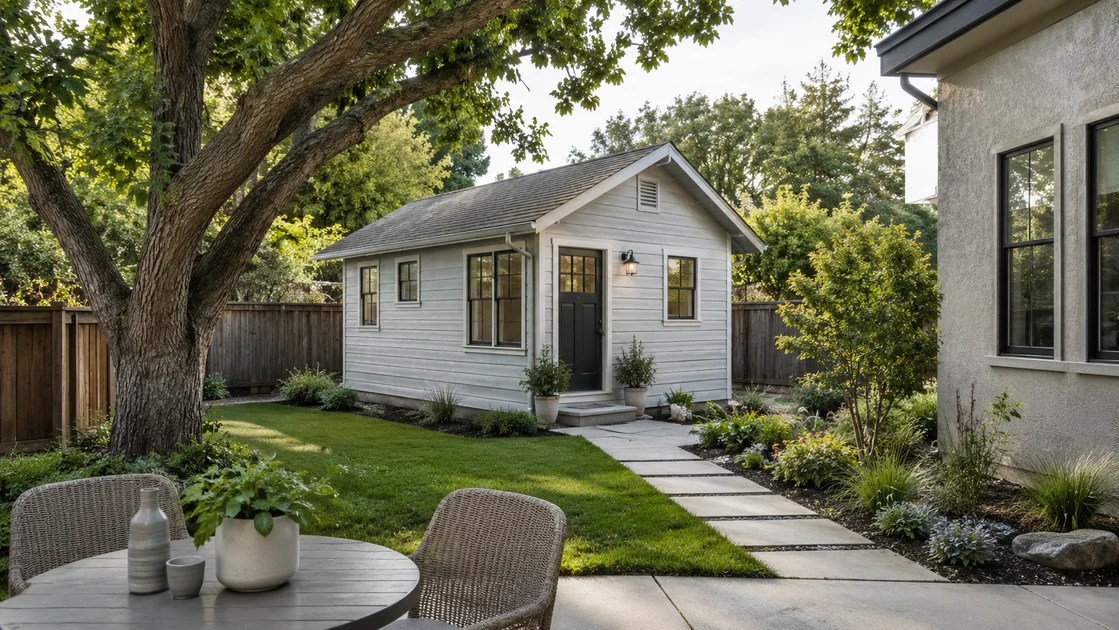
A Tuff Shed ADU is possible, but a Tuff Shed is not a legal accessory dwelling unit (ADU) as sold. Tuff Shed’s own warranty says its buildings aren’t intended for full-time habitation as built. You can turn one into a permitted ADU — people do — but only if your city allows the use and you add a code-compliant foundation, plumbing, electrical, insulation, a kitchen, a bathroom, and pass inspection.
Who this is for: homeowners weighing a cheap shed shell against the real cost of a legal ADU, and anyone who wants to understand the permit path before buying.
What we verified (June 1, 2026)
- Tuff Shed warranty (eff. Jan 11, 2023) and pre-purchase guide — habitability language, price exclusions, permit guidance
- Tuff Shed product pages and case content (Premier PRO Studio pricing, Santa Rosa ADU example)
- California ADU law (Gov. Code §§66310–66342; size limits §66321; approval pathways §66323; SB 477 recodification)
- City ADU rules: Seattle SDCI, Portland.gov, Austin Development Services, City of San Diego, City & County of Denver
- ADU cost benchmarks from HomeGuide, Angi, SelfStorage.com, SnapADU, BuildingAnADU (2026)
- Construction-cost/tariff data from Cushman & Wakefield (Apr 2026); NAHB (2025)
Items marked “verify locally” are typical U.S. ranges — confirm with your local building department and contractors before budgeting.
The Tuff Shed ADU reality check (read this first)
Here’s the single most useful table on this page. It maps what searchers usually assume against what’s actually true. If you only read one thing, read this.
| What people assume | The reality |
|---|---|
| “The shed is cheap, so the ADU will be cheap.” | The shed is only the shell. The legal-dwelling scope — foundation, utilities, kitchen, bath, energy code, permits, inspection — is a separate, larger budget. |
| “Installed means ready to live in.” | “Installed” means assembled and weather-tight. It does not mean approved for occupancy. |
| “I’ll just add plumbing and power later.” | Plumbing, electrical, and mechanical work for a dwelling almost always require permits and inspections — and that work isn’t part of the shell. |
| “Small sheds don’t need permits.” | Storage-shed permit exemptions do not transfer to a structure you intend to live in. A dwelling is reviewed as a dwelling. |
| “Once it looks finished, I can rent it.” | Legal rental requires a legal dwelling plus compliance with local rental and short-term-rental rules. |
| “It’ll be way cheaper than a prefab ADU.” | The shell is cheaper. The finished, permitted unit often lands in the same range as a turnkey prefab once everything is added. |
Sources: Tuff Shed warranty and pre-purchase guide (tuffshed.com, verified June 2026); city ADU bulletins cited throughout. Cost ranges from HomeGuide, Angi, and city fee schedules (2026).
Check your Tuff Shed ADU feasibility before you buy the shell
Before you price a single shed, check whether your property is even a candidate — state and ZIP, intended use, lot type, size, plumbing, kitchen, and panel capacity. We’ll tell you which lane you’re in.
See What You Can Build → Get Your Free ADU ReportBefore you buy the shell, check whether your property is even a candidate.
Can a Tuff Shed legally be used as an ADU?
Answer: Sometimes — but not as sold. A Tuff Shed can become a permitted ADU only if it is designed, engineered, improved, and inspected as a dwelling that meets local zoning and residential building code. Tuff Shed’s published warranty says that, as built, its products aren’t intended for full-time habitation, and most cities define an ADU as an independent unit with permanent provisions for living, sleeping, cooking, and sanitation.
The brand name on the building doesn’t determine legality. Your local building department does. A Tuff Shed is sold and warranted as a shed, studio, garage, or recreational building — a quality shell. Whether that shell can legally become housing depends on the same rules that govern any ADU: zoning, permits, foundation, utilities, energy code, life safety, and a final sign-off.
Shed vs. studio vs. guest suite vs. ADU — the distinction that matters
People use these words interchangeably, and that’s exactly where the trouble starts. Here’s the plain-English hierarchy:
- A shed is an accessory structure meant for storage. Under a certain size, many jurisdictions don’t even require a permit.
- A backyard studio or home office can be finished, insulated, and wired — but it is still not a dwelling. You can work in it; you can’t legally sleep in it or rent it as a residence.
- A guest suite might have a place to sleep, but without a permitted kitchen, bathroom, and independent occupancy approval, it’s still not a legal ADU.
- An ADU (accessory dwelling unit) is a legal residential unit with permanent living, sleeping, cooking, and sanitation facilities, established through a permit. A DADU is a detached ADU. A JADU (junior ADU) is a small unit — capped at 500 square feet of interior livable space in California — carved out within an existing single-family home (California Gov. Code §66313; Seattle SDCI, verified June 2026).
The line you cross to become an ADU isn’t whether the inside looks finished. It’s whether the structure is legally approved for residential occupancy. That’s the whole game.
What Tuff Shed itself says about living in one
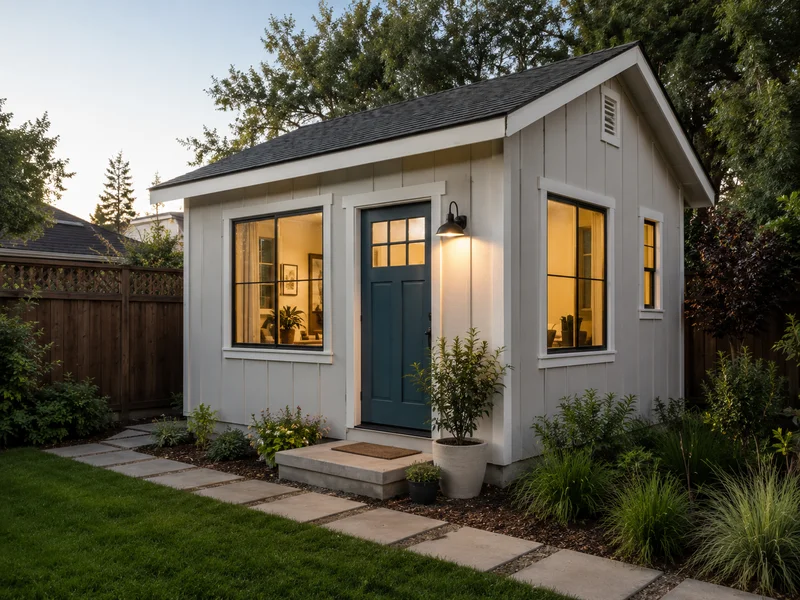
- Habitability. Tuff Shed’s Garden Series and Premier Series warranties both state: “As built, TUFF SHED products are not intended for use as a full-time habitable dwelling” (Tuff Shed warranty, effective January 11, 2023; verified June 2026).
- They sell the shell, not the finish. Tuff Shed has publicly described customers converting its building shells into ADUs complete with electricity and plumbing — but with all of that finishing work completed after installation by additional contractors. The wiring, plumbing, insulation, kitchen, and bath are on you.
- Permits are your responsibility. Tuff Shed’s pre-purchase guide states that permit requirements vary by building type, size, and municipality, and that garages and larger buildings almost always require a building permit (Tuff Shed pre-purchase guide, verified June 2026).
None of this means a Tuff Shed can’t become an ADU. It means the company is telling you, in writing, that the product you buy is a starting point, not a finished home.
When a Tuff Shed actually is a reasonable ADU candidate
A Tuff Shed shell can be a smart foundation for an ADU project when most of these are true:
- Your city allows detached ADUs or the conversion of an accessory structure into one.
- You can obtain code-acceptable, engineered plans for dwelling use.
- You can build or retrofit the correct permanent foundation.
- You can connect legal water, sewer or septic, electrical service, HVAC, and drainage.
- You’re willing to permit the project before any work is covered up.
- You can act as owner-builder where allowed, or hire licensed contractors. (Denver, for example, requires a licensed general contractor to build an ADU.)
Tuff Shed has documented a Santa Rosa, California project where owners first added a 12×20 Premier Pro Studio as an art studio, then added a customized two-story 20×28 Premier PRO Studio Garage that Tuff Shed describes as both a garage and an ADU — with an overhead garage door, residential doors, transom and sliding windows, interior second floor, bathroom, and kitchenette completed after delivery (tuffshed.com, verified June 2026). That’s the path — not a shortcut.
When a Tuff Shed is probably the wrong path
Be honest with yourself if several of these apply:
- You want guaranteed legal housing from a single product purchase.
- You need a rentable unit fast.
- Your lot has tight setbacks, no nearby utilities, or HOA or deed restrictions.
- Your building department won’t accept the structure as a dwelling shell.
- Utility trenching, a sewer tap, a septic system, or a panel upgrade would make the “cheap” path expensive anyway.
Key rule
Legal ADU status is not determined by the brand on the shed. It’s determined by local zoning, building code, permitted dwelling features, inspections, and occupancy approval.
What a Tuff Shed ADU really costs beyond the shed price
Answer: The installed Tuff Shed shell typically costs about $3,000–$12,000, but that is the visible starting price, not the ADU budget. Tuff Shed’s base prices exclude concrete slabs or footings, permits, and engineering fees, and a legal ADU also requires a foundation, utility connections, a kitchen, a bathroom, HVAC, insulation, and inspections. A realistic all-in cost for a small permitted Tuff Shed ADU is roughly $40,000–$120,000+, and more in high-cost coastal markets.
Step 1: The shell price (what you see online)
Tuff Shed sets prices in its online configurator by ZIP, and prices change over time — treat figures below as base-price ranges, and confirm current pricing for your ZIP. A promotion in May 2026 offered 50% off select upgrades at factory-direct locations (excluding paint, siding, metal roof, and custom upgrades) — verify any current offer in the configurator before you count on it.
| Building type (typical) | Approx. size | Approx. installed shell price | What it proves | What it does NOT prove |
|---|---|---|---|---|
| Basic storage shed | 8×10 (80 sq ft) | ~$3,000–$3,500 | Installed shells can look cheap | Not a legal ADU price |
| Mid-size shed | 10×12 (120 sq ft) | ~$4,000–$5,500 | Bigger shells still beat ADU budgets | Not a dwelling |
| Premier PRO Studio | 8×10 to 12×16 | ~$4,000–$8,000 | A modern, ADU-style look exists at a low shell price | No plumbing, kitchen, bath, HVAC, or code compliance |
| Larger ranch/barn/two-story | up to ~1,000 sq ft | varies, often higher | Room for a true one-bedroom footprint | Two-story buildings usually require concrete and permits |
Shell prices: Tuff Shed Premier PRO Studio base price (tuffshed.com, verified June 2026); basic/mid-size ranges corroborated by third-party shed-pricing references (2024–2025). Home Depot and Tuff Shed factory-direct models differ in specs, sizes, upgrades, and warranties. Always confirm live configurator pricing for your ZIP.
Step 2: What the base price specifically does NOT include
Straight from Tuff Shed’s pre-purchase guide (verified June 2026). Base prices include the building and installation but exclude:
- Concrete slabs or footings
- Any required permits
- Any required engineering fees
- Work outside normal installation — hauling away an old structure, site leveling, and similar
And these common extras can stack on top:
- Delivery: $99 for sheds, $375 for garages; crane delivery starts at $1,000
- Site leveling beyond 4 inches
- Generator rental when the site has no power
- Difficult-access fees and a surcharge if there isn’t at least 18 inches of clearance around the structure
- In High Wind Zones or jurisdictions with special building requirements, mandated upgrades are added automatically
Step 3: The hidden ADU scope (where the real money goes)
A storage shed becomes a dwelling only when you add everything a dwelling requires. Converting a shed into habitable space generally runs $5,000 to over $60,000 beyond the shell, depending on size, utilities, and local code. The shell price and permit ranges are verified; trade ranges are typical U.S. figures you should confirm with local contractors.
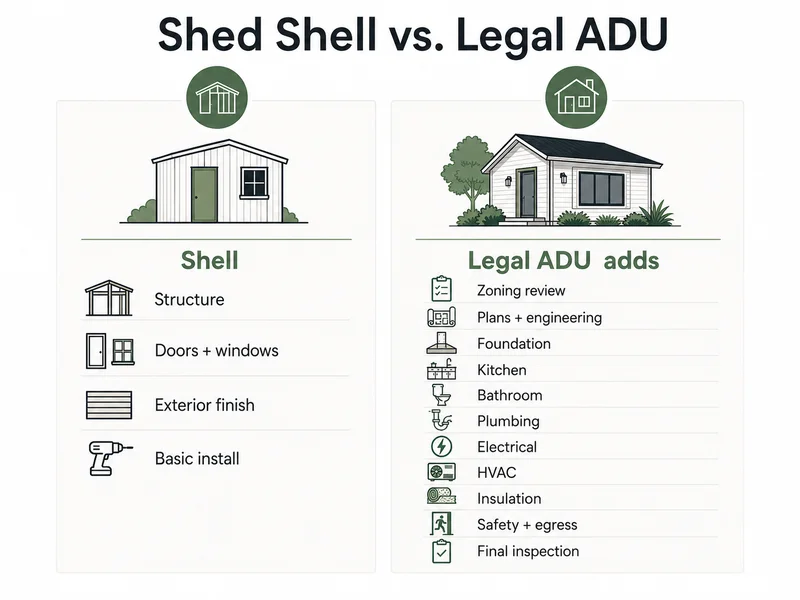
| ADU-making line item | Typical range | Why it matters | Verification |
|---|---|---|---|
| Tuff Shed shell + install | $3,000–$12,000+ | The building you start with | Verified (tuffshed.com) |
| Permanent foundation (slab or engineered piers) | $5,000–$15,000 | Dwellings need a permanent, code-rated foundation, not skids | Verify locally |
| Insulation, drywall, interior finish | Included in conversion total | Required for conditioned, habitable space | Verify locally |
| Electrical (subpanel, wiring, fixtures, trench) | $3,000–$10,000 | Dwelling electrical is permitted and inspected | Verify locally |
| Plumbing (water + sewer/septic tie-in) | $5,000–$20,000+ | Distance to connections is the single biggest swing | Verify locally |
| HVAC (mini-split) | $3,000–$7,000 | Heating, cooling, ventilation, energy compliance | Verify locally |
| Efficiency kitchen | $3,000–$15,000 | ADUs require cooking facilities in most cities | Verify locally |
| Bathroom | $5,000–$15,000 | ADUs require sanitation facilities | Verify locally |
| Egress + energy-code upgrades (e.g., CA Title 24) | $2,000–$8,000 | Safe exits and conditioned-space standards | Verify locally |
| Design, plans, engineering stamp | $2,000–$10,000 | Plan check usually requires engineered drawings | Verify locally |
| Permits and city fees | $1,350–$9,000 | Building permits are required for ADUs | Verified (Angi 2026; city schedules) |
| Delivery | $99–$1,000+ | Standard or crane | Verified (tuffshed.com) |
| Realistic all-in (small permitted unit) | ≈ $40,000–$120,000+ | The number that ends the search | Synthesized, verify locally |
Permit ranges: building permits run $1,350–$9,000 by location (Angi, 2026); SnapADU estimates City of San Diego ADU permit fees alone at roughly $13–$28 per square foot (SnapADU, March 2026). Conversion total: $5,000–$60,000+ (Reerin, 2025). Expensive coastal markets exceed the all-in range shown.
In Los Angeles, plan reviewers have been reported to reject garage-to-ADU conversions valued below roughly $75,000, even though the permit fees themselves are around $1,500 (CALI ADU, 2023). Translation: the city itself assumes a real, legal conversion is a serious construction project, not a weekend upgrade.
Step 4: How that compares to a turnkey prefab or site-built ADU
Here’s why the “Tuff Shed is cheaper” assumption breaks down once you finish the math. National 2026 benchmarks:
- Any ADU: $100–$300 per square foot; a 500-square-foot unit runs $50,000–$150,000; 1,200 square feet runs $120,000–$360,000 (HomeGuide, 2026).
- Prefab ADU: $80–$160 per square foot, about $50,000–$100,000 for 600 square feet (HomeGuide, 2026).
- Detached site-built ADU: $150–$250 per square foot nationally; one Portland dataset put the average at $180,833 for ~676 square feet, or roughly $305 per square foot (BuildingAnADU).
- Garage conversion: often the cheapest path at $80,000–$150,000 (SelfStorage.com, 2026).
- California / coastal: $375–$600 per square foot (SelfStorage.com, 2026); many San Diego projects land around $300,000–$450,000+ all-in (SnapADU, March 2026).
As of April 2026, Cushman & Wakefield estimated that tariffs had pushed construction materials costs up about 6% versus a 2024 baseline, with home builders pegging the typical tariff hit at roughly $10,900 per home (NAHB, 2025). Put a small finished Tuff Shed ADU next to a 600-square-foot prefab and you’ll often find them in the same neighborhood once foundation, utilities, and permits are in.
Worried about the financing gap?
Compare ADU financing paths in plain English — when a cash-out refinance, HELOC, renovation loan, or construction loan may fit an ADU project. No lender rankings, no rate or approval promises.
Compare common funding routes and their eligibility limits before contacting a lender.Compare ADU Financing OptionsFinancing-path education via Mortgage Research Center. Reader-supported: we may earn a commission.
What permits and code upgrades decide whether a shed becomes a dwelling
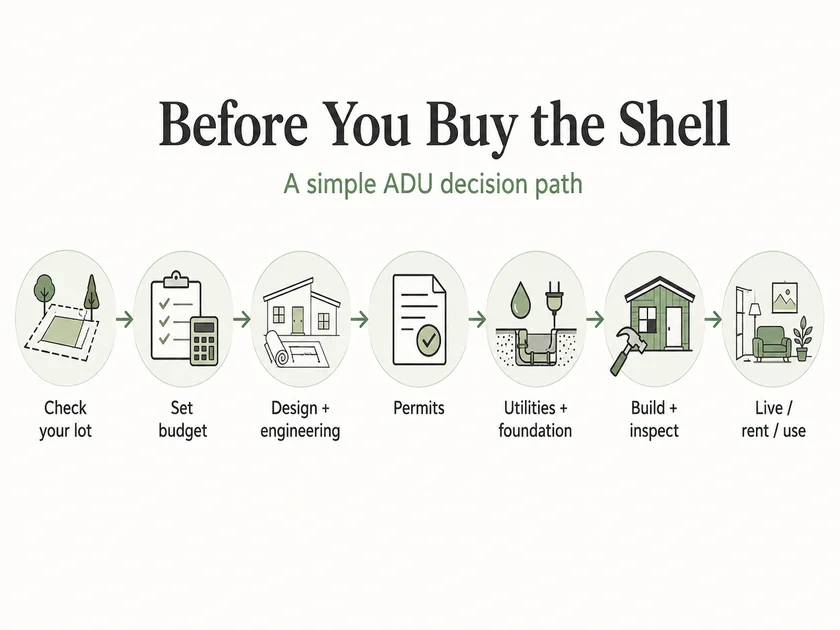
Answer: The dwelling threshold is not whether the building looks finished — it’s whether the structure is legally approved for residential occupancy with the required living, cooking, sleeping, sanitation, utility, energy, and life-safety features. In most cities that means a building permit plus electrical, plumbing, and mechanical trade permits, inspections, and a final sign-off or certificate of occupancy (Portland.gov; Seattle SDCI; Austin Development Services; verified June 2026).
Zoning approval vs. building permit vs. trade permits
- Zoning decides whether an ADU is even allowed on your lot, and where it can sit (setbacks, height, and lot coverage). In California, the governing statute is now Government Code §§66310–66342, the 2024 recodification (HCD ADU Handbook updated 2026).
- A building permit reviews the structure and occupancy — is it safe and legal to live in?
- Trade permits (electrical, plumbing, mechanical) review the systems. Portland requires a building permit to convert space to habitable use, along with electrical, plumbing, and mechanical permits (Portland.gov, verified June 2026).
- A certificate of occupancy (CO) or final inspection is what actually authorizes legal use.
The “small shed permit exemption” trap
A city may exempt a small storage shed from permits — but that exemption is for storage, not occupancy. The moment you intend to live in or rent the structure, it’s reviewed as a dwelling, and the exemption evaporates. San Diego’s ADU bulletin is explicit that ADUs require a building permit (City of San Diego, verified June 2026). Seattle is just as blunt: an ADU is not legal unless it’s established through a permit and meets the city’s residential, building, mechanical, electrical, energy, and land-use codes (Seattle SDCI, verified June 2026).
Foundation and anchoring
For most sheds, Tuff Shed says concrete isn’t required because its floor-joist system provides adequate support. But it specifically notes that concrete is required when the local building department requires it, when the site is below grade, and it’s highly recommended for two-story buildings — and that any required plans and permits must be obtained before concrete is poured (Tuff Shed pre-purchase guide, verified June 2026). For an ADU, a permanent, code-rated foundation is almost always part of the deal. A tiny house on a foundation can be a detached ADU; a tiny house on wheels is generally a camper trailer you can’t legally live in (Seattle SDCI).
Insulation, energy code, and interior finishing
Habitable space must be conditioned and meet residential energy requirements (e.g., California’s Title 24). Tuff Shed advises customers who plan to insulate to tell the company up front, so the building can be designed to perform as an insulated structure — for instance, by adding house wrap so insulation can go in after installation (Tuff Shed pre-installation guidance, verified June 2026). Much easier to spec this before the build than to retrofit.
Plumbing, sewer, and septic
This is usually the biggest single cost variable. The questions that decide your budget: How far is the nearest sewer lateral, and what will the tap and trench cost? If you’re on septic, does the system have spare capacity? A bathroom in a shed is not automatically an approved ADU bathroom — it has to be permitted and inspected.
Electrical service and panel capacity
A circuit that runs a light to a storage shed is nothing like the electrical compliance a dwelling needs. Expect to evaluate panel capacity, possible subpanels, trenching, and inspections. Never cover electrical work before it’s inspected, or you may be opening walls back up.
Certificate of occupancy — the finish line
Austin issues a Certificate of Occupancy only after the ADU passes all final inspections, and that CO is what makes legal use — including renting — possible (Austin Development Services, verified June 2026). Denver issues a CO as the final milestone before an ADU can be lived in, and notably requires a licensed general contractor to build the ADU at all (City & County of Denver, verified June 2026).
The permit-first checklist
Ask — and get answers to — these before you buy:
| Ask before buying | Why it matters |
|---|---|
| Can my lot legally have an ADU? | Zoning comes first; everything else is moot if the answer is no |
| Can an accessory structure be converted here? | Some cities allow conversions; others require new-construction documentation |
| Does my foundation plan meet dwelling standards? | Retrofitting a foundation is expensive |
| Can I get engineered plans? | Plan check usually requires them |
| Where will sewer/septic and water connect? | Plumbing can make or break the budget |
| Is my electrical panel sufficient? | Upgrades change the math |
| Do setbacks, height, and lot coverage check out? | Placement errors create violations |
| Can an owner-builder do the work, or is a licensed contractor required? | Some cities (e.g., Denver) require a licensed GC |
| Are short-term or long-term rentals allowed? | Legal occupancy isn't the same as legal Airbnb |
| Will finishing or altering the building affect the warranty? | Tuff Shed's warranty doesn't cover unauthorized alteration |
You’ve seen the gates — now see which ones apply to your lot before you spend a dollar on the shell.
City examples: how the same Tuff Shed idea changes by location
Answer: A Tuff Shed ADU is fundamentally a local-permit question. The same backyard shell could be a legal detached ADU in one city, a non-habitable home office in another, and a code violation in a third — because ADU legality depends on local zoning, building code, utilities, inspections, and rental rules (city ADU bulletins, verified June 2026).
| Jurisdiction | A rule that matters for a shed-to-ADU project | Source (verified June 2026) |
|---|---|---|
| California (statewide) | Local agencies generally cannot set an ADU maximum below 850 sq ft (one bedroom or fewer) or 1,000 sq ft (more than one bedroom), and must allow at least an 800 sq ft ADU meeting basic setbacks. A conversion within an existing accessory structure may expand only up to 150 sq ft for ingress/egress. Qualifying ADUs get ministerial approval — no public hearing. | Cal. Gov. Code §§66310–66342 (esp. §§66321, 66323); legacy: former §65852.2 / AB 68 |
| Seattle, WA | An ADU isn’t legal without a permit and must meet residential, building, mechanical, electrical, energy, and land-use codes. A structure on a foundation can be a DADU; one on wheels cannot be occupied. | Seattle SDCI |
| Portland, OR | ADUs can be created by converting an accessory structure or building new, but a building permit is required to make space habitable, plus electrical, plumbing, and mechanical permits. | Portland.gov |
| Austin, TX | Owner-occupancy removed in 2015. ADUs built after October 1, 2015 may be used as a short-term rental for no more than 30 days per calendar year, and a Certificate of Occupancy must accompany the STR license. Minimum lot area generally 5,750 sq ft. | Austin Development Services |
| San Diego, CA | ADUs are dwelling units with permanent provisions for living, sleeping, cooking, and sanitation and require a building permit. City ADU permit fees alone estimated at roughly $13–$28 per sq ft. | City of San Diego; SnapADU (Mar 2026) |
| Denver, CO | Denver’s citywide ADU update took effect December 2024 (implementing Colorado’s HB24-1152). ADUs must be permitted, built by a licensed general contractor (homeowners generally can’t pull the ADU permit themselves), and receive a certificate of occupancy before move-in. | City & County of Denver; Colorado Lawyer (2025) |
What we verified for this section
Verified June 1, 2026. California ADU law (Gov. Code §§66310–66342, SB 477 recodification; §66321 size limits; §66323 approval); city requirements from Seattle SDCI, Portland.gov, Austin Development Services, City of San Diego, City & County of Denver; Colorado’s HB24-1152. Cost figures from SnapADU (March 2026) and SelfStorage.com (2026). Homeowner forum posts used only to understand concerns, never as legal proof.
The takeaway: legality and cost are local. A national article that pretends there’s one “Tuff Shed ADU rule” is misleading you.
Tuff Shed vs. prefab ADU vs. site-built ADU: which path fits your situation?
Answer: A Tuff Shed shell fits best when you want a customizable building for storage, an office, a studio, or a carefully vetted conversion, and you’re comfortable acting as the general contractor for the dwelling scope. If your goal is legal housing with fewer surprises, an ADU-first prefab, a modular unit, a garage conversion, or a site-built ADU usually offers a cleaner path because those approaches start with residential occupancy in mind.
Sorted by neutral criteria — cost certainty, risk, timeline, and permit fit. Some links in this section are affiliate links; see our disclosure above. We sort by documented criteria, never by what pays us.
| Path | Best fit | Biggest risk | Cost (small unit) | Permit fit |
|---|---|---|---|---|
| Tuff Shed shell + finish-out | Storage, office, studio, or a vetted DIY/owner-builder conversion | Not a dwelling as sold; you're the GC | Low for the shell (~$3K–$12K), uncertain all-in (~$40K–$120K+) | Must verify locally; you carry the permit |
| ADU-first prefab | Homeowners who want a legal-housing path first | Site work and local approval still apply | ~$50K–$100K for 600 sq ft + site work | Usually designed around ADU use |
| Modular ADU | Faster standardized housing where available | Provider service area, crane/site access | Medium | Depends on state/local approval |
| Site-built ADU | Complex lots, custom design, max value | Cost and timeline (often 8–14 months) | $90K–$400K+ | Strong local-code fit with a good team |
| Garage conversion | An existing structure near utilities | Structural, fire, parking issues | Often $80K–$150K | A common, well-understood ADU pathway |
Cost figures: HomeGuide, Angi, SelfStorage.com, SnapADU (2026). Timelines: industry sources (2026).
Use a Tuff Shed shell if…
- The primary use is storage, an office, a studio, or recreation.
- You understand the legal-dwelling scope is a separate budget and you’ve priced it.
- You’ll verify permits before you order.
- Your city and contractor confirm the structure can be upgraded legally.
Use an ADU-first prefab if…
- Your goal is legal housing, not a hobby shell.
- You want a provider whose plans start from dwelling requirements.
- You want clearer footing for appraisal, financing, and inspections.
Use a site-built ADU if…
- Your lot is constrained or you need a custom footprint.
- Utilities, slope, setbacks, or fire rules are complicated.
Use a garage conversion if…
- You already have a structure with utilities nearby.
- Your city has a clear garage-conversion ADU pathway.
One honest admission
None of these paths is instant or frictionless. Permitting takes time, and site work — foundation, trenching, utility hookups — can change your budget after you’ve already started. The difference is who carries that risk. With a shell, it’s you. With an ADU-first provider, more of it shifts to a team that does this every day. Neither is “bad” — they’re different trades of money, control, and certainty.
Can you rent or Airbnb a Tuff Shed ADU?
Answer: Only if it’s a legal, permitted dwelling and local rental rules allow that use. A finished-looking shed without occupancy approval is not a rentable ADU. Many cities also restrict short-term rentals specifically — Austin, for example, limits ADUs built after October 1, 2015 to no more than 30 days of short-term rental use per calendar year (Austin Development Services, verified June 2026).
Long-term rental vs. guest suite vs. short-term rental
- A family-use ADU (housing a parent or adult child) still has to be a permitted dwelling, but you’re not navigating rental licensing.
- A long-term rental (leases of 30+ days) is the most broadly permitted income path.
- A short-term rental (Airbnb/Vrbo) is the most restricted. You’ll typically need a separate STR license, and your Certificate of Occupancy must be in hand first.
- A home office or studio can’t be rented as a residence at all, because it isn’t a dwelling.
| City | The short-term-rental catch | Occupancy document | Why it matters for a Tuff Shed ADU |
|---|---|---|---|
| Austin, TX | ADUs built after Oct. 1, 2015 are capped at 30 STR days per calendar year | CO required before an STR license | A backyard unit can’t become a full-time Airbnb |
| Denver, CO | Short-term rentals are licensed and tied to the host’s primary residence; long-term rental is broadly allowed | CO required before occupancy | “Finish it and list it” isn’t a legal plan |
| Most cities | STR rules, caps, and licenses vary widely; many cities restrict or license them separately | Final inspection / CO | Confirm your city’s STR rules before counting on nightly income |
Sources: Austin Development Services; Denver short-term-rental rules; verified June 2026.
Occupancy approval comes before rent
You cannot legally rent what the city hasn’t approved for occupancy. The order of operations is: permit → build → inspect → CO → rent. Skipping ahead risks fines and orders to vacate.
Insurance and appraisal reality
- A standard homeowner’s policy typically doesn’t cover a rental unit on the same lot; an ADU used as a rental often needs coverage beyond a standard homeowners policy. An unpermitted “shed rental” can be uninsurable as a dwelling.
- An unpermitted unit can be hard to insure, finance, appraise, or resell, because buyers, lenders, and appraisers want to see permits, inspection records, and a CO. Bringing an unpermitted unit up to code later costs time and money.
These are illustrative examples, not guarantees of returns. Actual results depend on local market conditions, construction costs, financing terms, and regulatory approvals.
Plan the rental side from day one
If you’re building for rental income, treat it as a real estate project from the start — permits, proper insurance, and tools to manage the unit and tenants.
Plan the rental side → Explore landlord & property-management toolsReader-supported: we may earn a commission. Buildium — for landlords managing rental income and tenants.
Should you buy the Tuff Shed first or ask the city first?
Answer: Ask the city first. The cheapest mistake in this entire process is a phone call, an email, or a feasibility review. The expensive mistake is buying a shell that your jurisdiction won’t permit for the way you plan to use it.
We can’t say this strongly enough: the error that turns a $6,000 shed into a $20,000 lawn ornament is buying before checking. Here’s the order that protects you.
The correct order of operations
- Decide the intended use — storage, office, guest space, family housing, long-term rental, or short-term rental. The use determines the rules.
- Check zoning and ADU eligibility for your specific parcel.
- Ask whether an accessory-structure conversion is allowed, or whether you need new-construction documentation.
- Confirm setbacks, height, lot coverage, and fire access.
- Ask what plans and engineering the city requires.
- Verify foundation requirements for dwelling use.
- Verify water, sewer/septic, and electrical paths and their costs.
- Price the full ADU scope with licensed contractors — not just the shell.
- Apply for permits before installation or before any work is covered up.
- Keep your inspection and CO records for insurance, resale, and rental use.
What to ask Tuff Shed before you order
Tuff Shed has in-house engineering and permit techs, standard designs, site-specific engineering plans, and permit services in some areas — but availability and local acceptance still vary, so ask directly:
- Can you provide drawings or specs I can submit for permit review?
- Can this model be designed for insulation and interior finishing?
- What foundation does this model require for my site?
- What does the warranty exclude once I finish or alter the building?
- Are permit services available in my area?
- Can the building be customized to meet my local code requirements?
One warranty detail to weigh
Tuff Shed’s warranty does not cover damage caused by alteration, provides no workmanship warranty on buildings assembled by anyone other than authorized Tuff Shed installers, and does not transfer to subsequent owners (Tuff Shed warranty, verified June 2026). For an ADU conversion — which is, by definition, a lot of alteration — that’s worth understanding going in.
The Tuff Shed ADU pre-purchase checklist
Answer: Don’t place the order until you can answer these questions in writing. Print this. Take it to your building department and your contractor.
- What is the legal use — storage, office, guest space, or ADU?
- Is an ADU allowed on this parcel? Is a detached ADU allowed?
- Is an accessory-structure conversion allowed here?
- What are the size, height, setback, and lot-coverage limits?
- Is the proposed location clear of easements and fire-access conflicts?
- What foundation is required for dwelling use, and can this shell meet structural requirements?
- Can it meet insulation and energy-code (e.g., Title 24) requirements?
- Can it meet emergency egress rules?
- Where will sewer or septic connect? Where will water connect?
- Is the electrical panel sufficient, or do I need an upgrade?
- Can an owner-builder do the work, or is a licensed contractor required?
- Are there HOA or deed restrictions?
- Are long-term or short-term rentals allowed?
- What final inspection or certificate of occupancy is required?
- What Tuff Shed warranty limitations apply after I finish or alter the structure?
Take the checklist with you
We packaged this Tuff Shed ADU permit checklist, the permit questions, and a scope worksheet into a free download you can bring to any consultation — Tuff Shed, your building department, or a licensed contractor.
Download the Free ADU Starter Kit →Includes the Tuff Shed ADU permit checklist, permit questions, and scope worksheet.
Safer alternatives if a Tuff Shed isn’t a fit
Answer: If your goal is legal housing rather than a backyard shell, the safest alternatives are usually the paths your building department already understands well — an ADU-first prefab or modular unit, a garage conversion, a tiny home on a foundation, or a site-built ADU using pre-approved plans where your city offers them.
ADU-first prefab or modular
Prefab and modular ADUs are designed from the start as dwellings, which usually means cleaner footing for plans, financing, appraisal, and inspections. Nationally, prefab runs about $80–$160 per square foot (HomeGuide, 2026). The catch most homeowners hit isn’t price — it’s service area. Here’s a neutral starting map of providers by where they work (always confirm current availability):
| Provider lane | Best for | Service area |
|---|---|---|
| Modular Home Direct | Broad prefab / modular / container-home options | National |
| Home Seller USA | Portable and expandable prefab units | National |
| BOXABL | Compact foldable “Casita”-style units | National (brand-specific) |
| Framework First | Modular ADUs on the California Central Coast | Roughly within ~150 miles of Monterey County (Central Coast / Bay Area-adjacent) |
| SnapADU | Turnkey ADUs in San Diego | Greater San Diego County only |
| Nest Tiny Homes | Tiny-home and ADU builds | Utah and Southern California only |
Organized by service area, not by any commercial arrangement; some links are affiliate links (see our disclosure above). Confirm a provider serves your address and pulls your local permits before relying on it.
See current prefab & modular ADU pricing
Compare ADU-first options designed as legal housing from the start. Start with broad national options or a regional builder if one serves your area.
Compare prefab & modular ADU pricing →Reader-supported: we may earn a commission. Sorted by neutral criteria, never by compensation.
Garage conversion ADU
If you have a garage near existing utilities, a conversion is often the cheapest and most predictable ADU path — frequently $80,000–$150,000 (SelfStorage.com, 2026) — and California removed replacement-parking requirements for garage conversions under its current ADU law. See our garage conversion ADU guide.
Tiny home ADU
A tiny home on a permanent foundation can qualify as a detached ADU in many cities — but a tiny home on wheels is treated as a camper trailer and generally can’t be a legal dwelling (Seattle SDCI). Foundation status is the dividing line. See our tiny home ADU guide.
ADU kit homes
Purpose-built ADU kit homes are designed and engineered for dwelling use, which can shorten plan check compared with adapting a storage shell.
Frequently asked questions
Can you live in a Tuff Shed?
Not legally just because it’s finished inside. Tuff Shed’s warranty says that, as built, its products aren’t intended for full-time habitation. Legal occupancy depends on local permits, code compliance, inspections, and dwelling approval.
Can a Tuff Shed become an ADU?
Possibly, but only through a permitted dwelling process. The structure must satisfy local zoning and residential building, energy, utility, and life-safety rules for an ADU, and the wiring, plumbing, insulation, kitchen, and bath are completed after installation by you, your contractor, or licensed trades.
Do you need a permit for a Tuff Shed?
Often, depending on size, use, and local rules. Tuff Shed states that garages and larger buildings almost always require a building permit, while small storage sheds may not. Any structure intended for occupancy as an ADU is reviewed as a dwelling and requires permits.
Can you put plumbing in a Tuff Shed?
Sometimes, but plumbing turns a simple shed into a permitted utility project. A kitchen or bathroom typically requires permits, inspections, and a sewer/septic and water connection — and the distance to those connections is usually the biggest cost variable.
Can you add electricity to a Tuff Shed?
Usually yes as a project scope, but dwelling or rental use requires permitted, inspected electrical work — not the same as running a single light to a storage shed. Plan for panel capacity, possible subpanels, and trenching.
Is a 120-square-foot Tuff Shed big enough for an ADU?
It depends on local minimums and required facilities. In California, a city generally cannot block an ADU of at least 800 square feet that meets state criteria. But a 120-square-foot shed can still fail local efficiency-unit minimums or be too small to fit a code-compliant kitchen, bathroom, and egress. Confirm your city’s minimum before assuming a small shed qualifies.
Is a Tuff Shed cheaper than a prefab ADU?
The shell is cheaper. The finished, permitted ADU often isn’t. Once you add a foundation, utilities, plans, permits, a kitchen, a bathroom, HVAC, energy-code work, and inspections, a small Tuff Shed ADU commonly lands in the same range as a 600-square-foot prefab unit.
Can I Airbnb a Tuff Shed ADU?
Only if it’s a legal dwelling and your local short-term-rental rules allow it. Austin, for example, limits ADUs built after October 1, 2015 to 30 days of short-term rental per calendar year and requires a Certificate of Occupancy before an STR license.
Does Tuff Shed financing cover a full ADU conversion?
Not necessarily. Tuff Shed offers third-party financing through RTO National — installment loans up to $20,000 with approved credit, plus a no-credit-check rent-to-own option on select models — but that finances the building, not a full legal ADU project with plans, utilities, permits, and interior systems.
Will a Tuff Shed ADU add value or be insurable?
Only if it’s permitted. A permitted, legal ADU can add value and be insured as a dwelling (with landlord coverage if you rent it). An unpermitted “shed dwelling” can be hard to insure, finance, appraise, or resell.
Will finishing the shed void the Tuff Shed warranty?
It can affect coverage. Tuff Shed’s warranty doesn’t cover alteration, provides no workmanship warranty on buildings assembled by anyone other than authorized installers, and doesn’t transfer to later owners. Review the warranty before modifying the structure.
What we verified for this guide
We separated official facts from homeowner anecdotes. Brand, city, state, and construction-cost sources support every legal and cost claim; Reddit and forum posts were used only to understand homeowner language and concerns.
| Category | Source type | Verified |
|---|---|---|
| Tuff Shed habitability / warranty terms | Official Tuff Shed warranty (effective Jan 11, 2023) | June 2026 |
| Tuff Shed price exclusions, permits, financing, concrete | Official Tuff Shed pre-purchase guide | June 2026 |
| Tuff Shed product specs, pricing, and the Santa Rosa ADU example | Official Tuff Shed product and blog pages | June 2026 |
| California ADU law (Gov. Code §§66310–66342; size limits §66321) | HCD documents, legislative text (SB 477), HCD ADU Handbook | June 2026 |
| City ADU rules (Seattle, Portland, Austin, San Diego, Denver) | Official city/state development pages and legal analysis | June 2026 |
| ADU cost benchmarks (per sq ft, prefab, detached, garage) | HomeGuide, Angi, SelfStorage.com, SnapADU, BuildingAnADU (2026) | June 2026 |
| Construction-cost / tariff pressure | Cushman & Wakefield (Apr 2026); NAHB (2025) | June 2026 |
| Homeowner concerns and phrasing | Reddit/forum posts — used for voice only, not as legal proof | June 2026 |
Methodology
The Dwelling Index is an independent research resource covering ADU financing, costs, and regulations. For this guide our editorial team reviewed Tuff Shed’s official warranty, pre-purchase, pre-installation, product, and case-study pages; public Tuff Shed pricing for installed shell examples; ADU rules from California state law and the cities of Seattle, Portland, Austin, San Diego, and Denver; current 2026 ADU cost data from multiple construction sources; and homeowner forum discussions to capture how people describe this problem. We did not use forum posts as proof for legal, zoning, permit, financing, or construction claims. Any local cost, permit timeline, or city-specific interpretation should be verified with your local building department before you act. This guide is for general education and is not legal, financial, or construction advice.
Not sure where to start?
See what’s possible at your address — get your free ADU report in 60 seconds.
Get my free ADU report →Related guides
- Backyard ADU kit: what you’re really buying
- Prefab ADU guide 2026: costs, permits & lot fit
- Costco prefab ADU: what’s sold, real costs & permits
- Amazon prefab ADU: what’s real vs. what’s just a kit
- Best prefab ADU companies 2026: independent comparison
- ADU kit homes: designed for dwelling use from day one
- Tiny home ADU: foundation status is the dividing line
- Garage conversion ADU: financing and permit guide
- California ADU laws 2026: everything you need to know