
Reviewed against California Government Code Chapter 13 (§§ 66310–66342), HCD ADU Handbook (January 2026 Addendum), and official city ADU pages. Last verified March 31, 2026.
California ADU Laws 2026: What You Can Build, What Cities Still Control, and What to Do Next
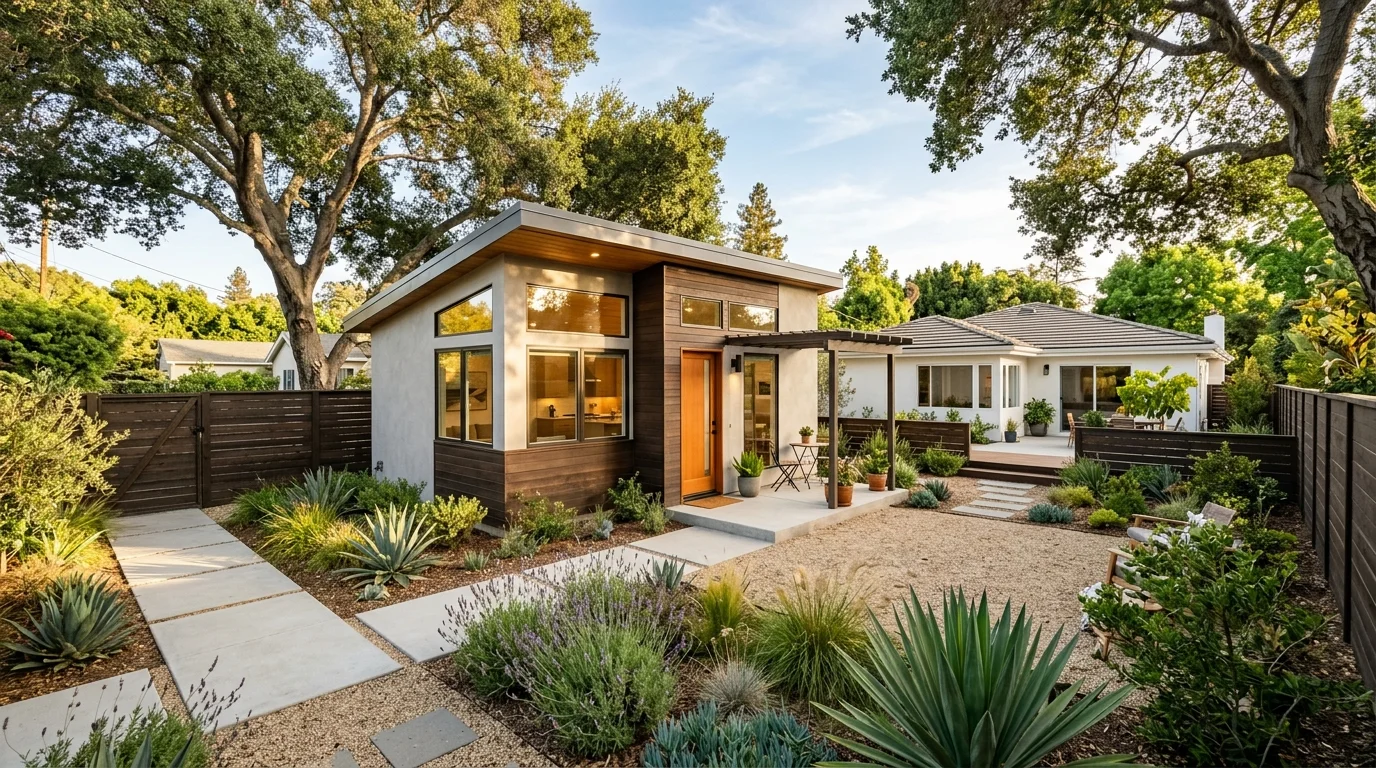
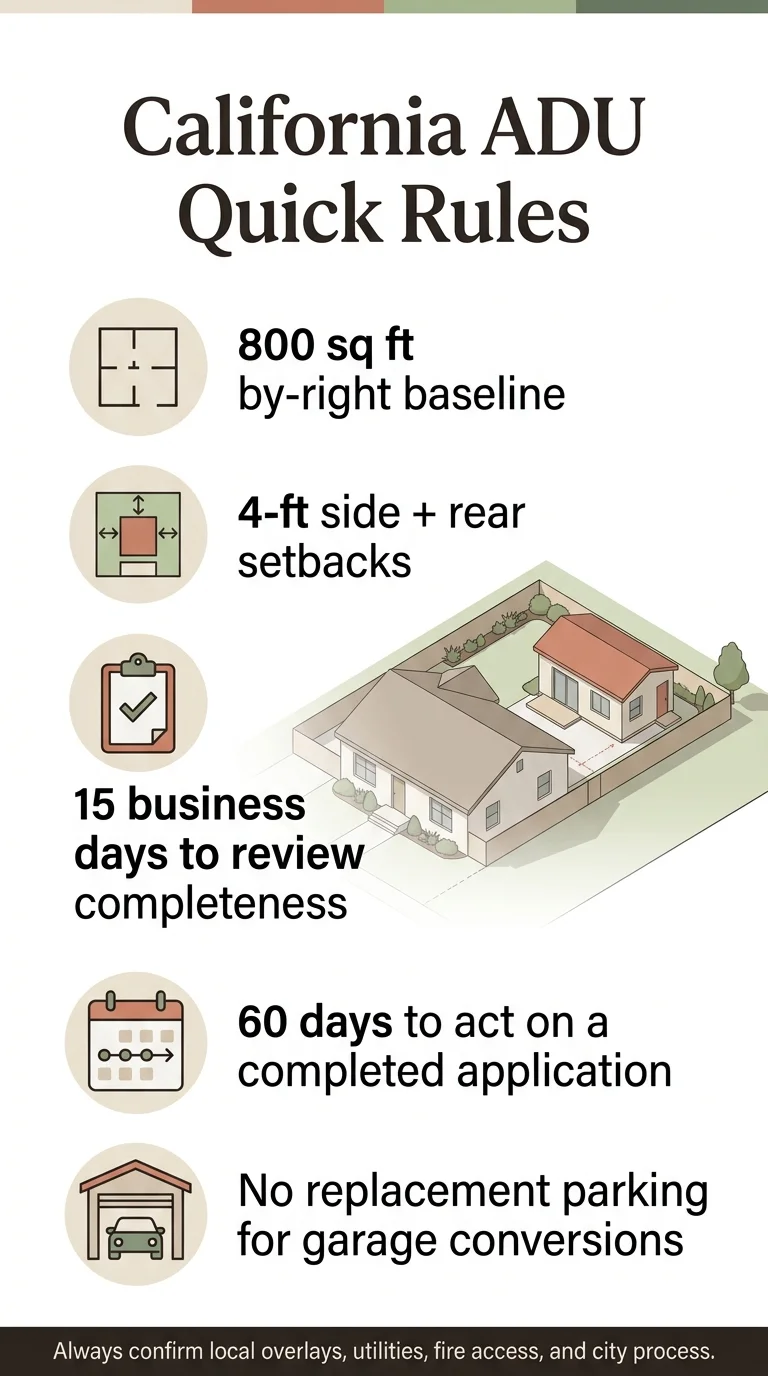
California ADU laws give homeowners on most residential lots strong, state-protected rights to build an accessory dwelling unit — and as of 2026, those protections are the strongest they’ve ever been. On qualifying lots with a proposed or existing dwelling, state law guarantees ministerial review, a 15-business-day completeness check, a 60-day decision clock, and in many single-family scenarios a detached ADU up to 800 square feet of interior livable space with 4-foot side and rear setbacks — regardless of your lot size, FAR limits, or local coverage rules.
But the local layer still matters — coastal rules, utilities, fire access, and city process can all affect your project — and that’s where most people get tripped up. This guide separates the statewide baseline from the local reality, cites every rule to the actual Government Code section, and walks you through how to check what’s possible at your specific address.
Before you go further:
ADU permitting is not instant. The law gives you a 15-business-day completeness clock and a 60-day decision window on a complete application — but real projects routinely take 3–6 months when corrections, utility coordination, coastal review, and site conditions enter the picture. That doesn’t mean the process is broken. It means the legal clock and the real-world workflow are two different things, and smart planning accounts for both.
The encouraging part: thousands of California homeowners permit and build ADUs every year. HCD reports ADU permits statewide grew from 1,336 in 2016 to over 26,000 in 2023 — more than 20% of all new homes permitted in California.
Source: HCD ADU Handbook, January 2026 Addendum.
See what the rules mean for your specific property
Check your address against local zoning, setbacks, and size limits — free, in 60 seconds.
Check My Property →Detailed reports available in CA, UT, TX, CO, and NY.
At a Glance: California ADU Rules Right Now
| What State Law Guarantees | What Your City Can Still Control | What to Do Next |
|---|---|---|
| At least one ADU on most residential lots with a proposed or existing dwelling | Objective design standards (materials, colors, architectural style) | Check your zoning and parcel data |
| Local ordinances cannot set ADU maximums below 850 sq ft (1-bed) or 1,000 sq ft (2+ bed); lot size/FAR/setback rules cannot block at least one 800 sq ft ADU with 4-ft setbacks | Site-specific constraints (utilities, sewer, septic, fire access) | Review your city's ADU checklist or pre-approved plans |
| 4-foot side and rear setbacks for qualifying detached ADUs | Coastal, historic, and fire-zone overlay requirements | Flag any overlays on your lot |
| 60-day permit approval clock (15-day completeness review first) | Permit submission format and local process mechanics | Get written guidance from your planning department |
| No owner-occupancy for ADUs; conditional for JADUs | Short-term rental restrictions (most cities limit ADU rentals to 30+ days) | Run a feasibility check on your specific address |
| No replacement parking for garage conversions | Additional parking only in limited circumstances | Contact planning with the right questions |
| No impact fees on ADUs under 750 sq ft | Proportional fees on larger units | Compare custom plans vs. pre-approved plans |
Sources: Gov. Code §§ 66314, 66317, 66321, 66322, 66323, 66324; HCD ADU Handbook, January 2026 Addendum.
What Do California ADU Laws Actually Allow?
California’s statewide ADU framework is stronger than most homeowners realize. The state doesn’t just permit ADUs — it actively prevents cities from blocking them. State law generally supersedes conflicting local ordinances on ADU matters, though local agencies may be less restrictive, and certain overlays like the Coastal Act still apply.
Gov. Code § 66317(c): “No other local ordinances, policies, or regulations may be applied in the approval or denial of an ADU or JADU permit application.”
Single-Family Lots
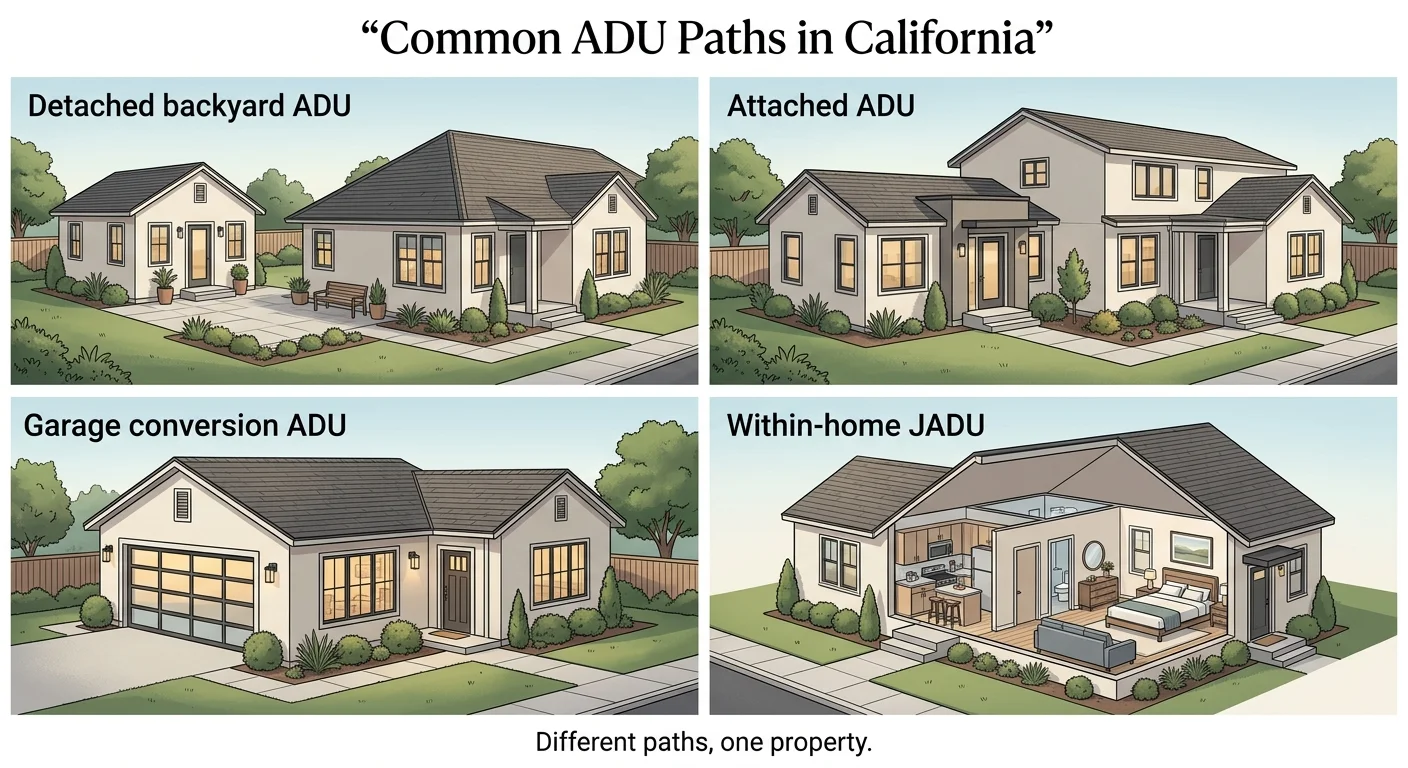
On a lot with a proposed or existing single-family home, California law allows you to build:
One ADU within or converted from existing space
Within the primary dwelling or an accessory structure like a garage, with minimal additional development standards.
Gov. Code § 66323(a)(1)–(2)
One new detached ADU
Up to 800 sq ft of interior livable space with 4-foot side and rear setbacks, by right.
Gov. Code § 66323(a)(2)
One JADU
Up to 500 sq ft of interior livable space, contained entirely within the proposed or existing single-family residence.
Gov. Code § 66333
That’s up to three units on a single-family lot: a conversion ADU, a new detached ADU, and a JADU.
Multifamily Lots (Including Duplexes)
Properties with two or more attached dwelling units — including duplexes — are treated as multifamily for ADU purposes. JADUs are not available on multifamily lots.
Conversion ADUs — at least one, and up to 25% of existing units, by converting non-livable space within existing multifamily structures.
Gov. Code § 66323(a)(3)
Detached ADUs on lots with existing multifamily buildings — up to eight detached ADUs, not exceeding the number of existing units on the property.
Gov. Code § 66323(a)(4), as amended by SB 1211
Detached ADUs on lots with proposed multifamily buildings — up to two.
Gov. Code § 66323(a)(4)
ADU vs. JADU — The Differences That Matter
| Feature | Standard ADU | Junior ADU (JADU) |
|---|---|---|
| Max size | Up to 1,200 sq ft by local ordinance (state minimum floors: 850 sq ft for 1-bed, 1,000 sq ft for 2+ bed) | 500 sq ft of interior livable space |
| Location | Detached, attached, or converted from existing space | Within a proposed or existing single-family residence only (attached garages count) |
| Bathroom | Required (at least 3/4 bath) | May share sanitation facilities with primary dwelling, or have its own |
| Kitchen | Full kitchen required | Efficiency kitchen required |
| Owner occupancy | Not required (AB 976, permanently effective Jan. 1, 2025) | Required only if JADU has shared sanitation facilities with primary dwelling (AB 1154) |
| Separate sale | Possible via local condo-conversion ordinance (§66342) or nonprofit/TIC path (§66341) | Not eligible for separate sale |
| Rental terms | ADUs approved under §66323 must be rented for 30+ days | Must be rented for 30+ days |
Sources: Gov. Code §§ 66313, 66315, 66321, 66323, 66333, 66341, 66342; AB 976, AB 1154.
What “Ministerial Approval” Really Means
This is one of the most important concepts in California ADU law. When the state says ADUs must be approved “ministerially,” it means:
No public hearing
Your neighbors don't get a vote.
No discretionary review
A planner can't deny your project based on personal judgment — only on published, objective standards.
No subjective standards
The city can only apply rules that are "uniformly verifiable by reference to an external and uniform benchmark." (Gov. Code § 66313(i))
If it meets the rules, it must be approved
Period. That's what ministerial means.
If a city is applying subjective criteria — “neighborhood character” concerns, discretionary design review, or a planner’s personal opinion — that’s a violation of state law. And the 2026 updates gave HCD sharper teeth to enforce it.
What Changed in 2026: Five Key Bills
The 2025 legislative session produced ADU bills signed by Governor Newsom that reshape how cities must process and approve ADUs. The theme across all of them: enforcement. Cities that have been dragging their feet or ignoring state law now face real consequences.
| Bill | Effective Date | What Changed | Why It Matters for You | Code Section |
|---|---|---|---|---|
| SB 543 | Jan. 1, 2026 | 15-day completeness review, appeal rights, "interior livable space" size clarification, ADUs/JADUs under 500 sq ft do not increase assessable space for school-fee calculations, JADU ordinances now reviewed by HCD, fire sprinkler parity for JADUs | Faster permits, clearer size rules, lower fees, stronger state oversight | Gov. Code §§ 66317, 66321, 66323, 66333.5 |
| AB 1154 | Jan. 1, 2026 | JADU owner-occupancy only applies when JADU has shared sanitation facilities with primary dwelling | Add separate sanitation to your JADU → no owner-occupancy requirement | Gov. Code § 66333(b) |
| SB 9 (2025) | Jan. 1, 2026 | Local ADU ordinances not submitted to HCD within 60 days of adoption are automatically void; failure to respond to HCD noncompliance findings within 30 days also voids the ordinance | Cities can't ignore state law — their ordinances literally disappear | Gov. Code § 66326(d) |
| AB 462 | Oct. 10, 2025 | Coastal development permits for ADUs must be decided within 60 days; ADUs in declared emergency areas can receive certificate of occupancy before primary dwelling is rebuilt | Coastal homeowners and disaster-affected areas get real timelines | Gov. Code §§ 66328(b), 66329 |
| AB 130 | June 30, 2025 | "Reasonable restrictions" on ADUs by HOAs cannot include fees or other financial requirements | HOAs can set aesthetic standards but cannot charge you for the right to build | Civil Code § 4751 |
The SB 543 Details Worth Knowing
15-business-day completeness review
Your city must review your ADU application and provide a written list of missing items within 15 business days. If they don't respond in time, your application is automatically deemed complete. You also now have a statutory right to appeal a completeness determination to your city's planning commission or governing body.
"Interior livable space" clarification
All state ADU size references — the 800 sq ft by-right baseline, the 850/1,000 sq ft ordinance minimums, the 500 sq ft JADU cap — now explicitly refer to interior livable space, not gross building footprint. This closes a loophole some cities used to measure size more restrictively.
Fee protections extended to JADUs
No impact fees on ADUs ≤750 sq ft or JADUs ≤500 sq ft of interior livable space. ADUs and JADUs under 500 sq ft of interior livable space do not increase assessable space for school-fee calculations.
JADU ordinances now reviewed by HCD
Previously, only ADU ordinances required HCD submission. Now JADU ordinances must be submitted too — and if they're not submitted within 60 days or if HCD finds noncompliance and the city doesn't respond within 30 days, the ordinance is void.
Old Code Numbers vs. New Code Numbers
In 2023, SB 477 moved California’s entire ADU/JADU law from Government Code §§ 65852.2 and 65852.22 into Chapter 13 (§§ 66310–66342). Many city planning pages, older blog posts, and even some current government documents still reference the old numbering. If your city’s ADU page still cites the old “65852.2” numbering, it may not reflect current law. That’s worth flagging when you talk to planning.
| Old Section | New Section | What It Covers |
|---|---|---|
| 65852.2(c) | 66321 | By-right baseline (800 sq ft / 4-ft setbacks) |
| 65852.2(d) | 66322 | Parking standards and exemptions |
| 65852.2(e) | 66323 | State-exempt ADUs (conversions, multifamily) |
| 65852.2(f) | 66324 | Fees, utility connections, and proportionality |
| 65852.2(h) | 66326 | Ordinance submission to HCD |
| 65852.2(l) | 66329 | Coastal Zone provisions |
| 65852.22 | 66333+ | JADU provisions |
Source: SB 477 (Chapter 762, Statutes of 2023); HCD ADU Handbook.
Size, Height, Setbacks, Parking, and Fees: The Rules Most People Get Wrong
This section is where confusion lives — and where your rights are strongest. California law sets hard floors that cities cannot undercut. Get these right and you’ll save yourself months of arguments with planning departments.
Size Rules
The 800-square-foot rule
No city can use zoning restrictions — lot size, lot coverage, floor area ratio, open space, or front setbacks — to prevent you from building at least an 800 sq ft ADU with 4-foot side and rear setbacks. This is your by-right baseline.
Ordinance size limits
If your city adopts an ADU ordinance, it cannot set a maximum below 850 sq ft for a studio or one-bedroom ADU, or 1,000 sq ft for a two-bedroom+ ADU. Many cities allow up to 1,200 sq ft.
Attached ADU limits
For attached ADUs, some cities may limit size to 50% of the primary dwelling's floor area — but they still can't go below the 850/1,000 sq ft minimums.
JADU size
500 sq ft of interior livable space, maximum. Always within a proposed or existing single-family home.
Height Rules
| Scenario | Maximum Height | Source |
|---|---|---|
| Detached ADU | 16 feet | Gov. Code § 66314(b)(1)(B) |
| Detached ADU within ½ mile walking distance of a major transit stop or high-quality transit corridor | 18 feet, plus 2 additional feet to accommodate roof pitch alignment | Gov. Code § 66314(b)(1)(B) |
| Detached ADU on a lot with an existing or proposed multistory, multifamily dwelling | 18 feet | Gov. Code § 66314(b)(1)(B) |
| Attached ADU | 25 feet or the height limit for the primary dwelling, whichever is lower; not more than two stories | Gov. Code § 66314(b)(1)(B) |
Setback Rules
Side and rear setbacks: 4 feet maximum
For qualifying detached ADUs.
Gov. Code § 66321
Conversions: existing setbacks maintained
If you're converting an existing structure (like a garage) into an ADU, the existing setbacks are maintained — even if they're less than 4 feet. You don't have to tear down a legally-built garage because it's closer to the property line than new construction would allow.
Gov. Code § 66323
Front setbacks cannot prevent 800 sq ft
State law says front setback requirements cannot prevent a property from building an 800 sq ft ADU. If your lot is tight, the front setback must give way.
Gov. Code § 66321
No minimum lot size
This is one of the most misunderstood rules. California ADU law does not allow cities to impose minimum lot sizes for ADUs. Your lot does not have to be a certain size to qualify.
Gov. Code § 66321
Parking: Most ADU Projects Don’t Need Extra Spaces
California has stripped away most parking requirements for ADUs:
- No replacement parking required when a garage, carport, or covered parking structure is demolished or converted into an ADU Gov. Code § 66322(a)
- No parking required if the ADU is within a half-mile walking distance of public transit Gov. Code § 66322(a)
- No parking required for conversion ADUs built within existing space Gov. Code § 66322(a)
- No parking required for ADUs in a historic district or near a car-share vehicle Gov. Code § 66322(a)
- If parking is required, it's capped at one space per unit or bedroom, and can be provided as tandem in the existing driveway Gov. Code § 66314(d)
Fees: What Cities Can and Can’t Charge
ADUs ≤750 sq ft
No impact fees
Gov. Code § 66324
JADUs ≤500 sq ft interior livable space
No impact fees, no school-fee assessable space increase
SB 543
ADUs >750 sq ft
Proportional impact fees only (not flat)
Gov. Code § 66324
Utility connections: For conversions within existing space, cities generally cannot require a new or separate utility connection. For new construction ADUs, connection fees must be reasonable and proportional. Gov. Code § 66324
Permit fees — plan check fees, building permit fees, and inspection fees — vary by city. These are not waived by state law, so check with your jurisdiction for current fee schedules before budgeting.
Common Myths vs. Reality
| What You Might Hear | What the Law Actually Says |
|---|---|
| "Your lot is too small for an ADU" | No minimum lot size under state law (Gov. Code § 66321) |
| "You need to replace parking if you convert your garage" | Replacement parking cannot be required (Gov. Code § 66322(a)) |
| "The ADU has to be smaller than the main house" | Not a statewide rule; state law guarantees at least 800 sq ft regardless of primary dwelling size (Gov. Code § 66321) |
| "Your HOA can charge you extra fees" | HOA restrictions cannot include fees or financial requirements (AB 130; Civil Code § 4751) |
| "You have to live on the property" | Not required for standard ADUs (AB 976); JADUs only if they share sanitation facilities (AB 1154) |
| "ADUs aren't allowed in the front yard" | Front setback requirements cannot prevent an 800 sq ft ADU from being built (Gov. Code § 66321) |
| "You need a separate utility meter" | Not always; depends on ADU type and local rules — conversions generally don't require new connections |
See what the rules mean for your specific property
Check your address against local zoning, setbacks, and size limits — free, in 60 seconds.
Check My Property →Detailed reports available in CA, UT, TX, CO, and NY.
How Many ADUs Can You Build on Your Property?
This is one of the most common — and most misunderstood — questions in California ADU law. The answer depends on your property type and what’s already built on it.
| Your Property | What State Law Allows | Key Conditions |
|---|---|---|
| Single-family home | 1 conversion/existing-space ADU + 1 new detached ADU (800 sq ft, 4-ft setbacks) + 1 JADU | JADU must be within the single-family residence; all require building permits |
| Existing multifamily (including duplex) | Conversion ADUs (at least 1, up to 25% of existing units) + detached ADUs (up to 8, not exceeding existing unit count) | No JADUs on multifamily lots; detached ADUs: 850 sq ft (1-bed) / 1,000 sq ft (2+ bed), 16 ft height, 4-ft setbacks |
| Proposed multifamily | Up to 2 detached ADUs + conversion ADUs from non-livable space | No JADUs; similar size/height/setback limits |
| SB 9 lot-split parcel | A city is not required to permit more than 2 total units per SB 9 parcel — and that count includes ADUs and JADUs | SB 9 interactions are not additive the way many blog posts imply; verify with your planning department before assuming you can stack SB 9 + ADU |
Sources: Gov. Code §§ 66317, 66321, 66323, 66333; SB 1211; Gov. Code § 66452.6(a).
What Your City Can Still Control — and Where They Cross the Line
State law is powerful. But it doesn’t erase local government entirely. Understanding what your city legitimately controls versus where they’re overstepping is the single most practical thing you can learn from this page.
What Cities Legitimately Control
- Objective design standards — architectural style, exterior materials, colors, roof pitch, window placement — as long as these are published, objective, and don't effectively block ADU construction
- Site-specific constraints — fire access, utility capacity, sewer/septic requirements, easements, slope/grading, flood zones
- Coastal, historic, and fire-zone overlays — these add requirements but don't eliminate your right to build
- Permit submission format — what documents they require, how you submit, their plan check workflow
- Short-term rental restrictions — most cities require ADU rentals to be 30+ days or longer
- Pre-approved plan programs — many cities now offer these as a faster path to approval
Where Cities Cross the Line
- Requiring minimum lot sizes for ADUs
- Imposing subjective design review or discretionary approval
- Denying an ADU that meets all objective standards
- Requiring parking for garage conversions
- Requiring owner-occupancy for standard ADUs
- Charging impact fees on ADUs under 750 sq ft
- Taking longer than 60 days to approve a complete application
- Not telling you within 15 business days whether your application is complete
This isn’t theoretical
HCD has issued noncompliance findings to cities across the state — including Oakland (December 2025) — for ordinance provisions that conflict with state law. Under the 2026 changes (SB 9 2025), a local ordinance that isn’t submitted to HCD within 60 days of adoption — or that doesn’t respond to HCD noncompliance findings within 30 days — is automatically null and void. State default standards kick in, and HCD can refer the matter to the Attorney General.
Source: Gov. Code § 66326(d); HCD ordinance review letters.
What to Do If Your City Gets It Wrong
- 1
Ask for the code section in writing. Don't accept verbal denials or vague "it's our policy." Get the specific local code they're citing.
- 2
Compare it to Chapter 13. Look up the relevant Government Code section (§§ 66310–66342) and the HCD ADU Handbook. If their rule is stricter than state law on a topic state law controls, the state law applies.
- 3
Check if HCD has flagged their ordinance. HCD publishes ADU ordinance review letters on their website. If your city has been flagged, that's strong evidence in your favor.
- 4
Appeal in writing. SB 543 now gives you a statutory right to appeal completeness determinations to the planning commission or governing body.
- 5
Contact HCD. The Housing Accountability Unit at HCD fields complaints about local ADU ordinances that violate state law. They have real enforcement authority.
See what the rules mean for your specific property
Check your address against local zoning, setbacks, and size limits — free, in 60 seconds.
Check My Property →Detailed reports available in CA, UT, TX, CO, and NY.
City-by-City: How ADU Rules Play Out in California’s Biggest Metros
State law creates the floor. But the practical experience — how fast permits move, what pre-approved plans are available, whether the city has been flagged by HCD, what local overlays apply — varies by jurisdiction. We’ve compiled official ADU resources for the state’s major metros.
If your city isn’t listed, the statewide rules above still apply as your guaranteed baseline.
Los Angeles
Pre-approved plansLA County contains many separate cities, each with their own process; the City of LA has a Standard Plan Program for faster approvals
Best first step: Start with LADBS online intake
San Diego
Pre-approved plansCoastal Overlay Zone applies to many properties — separate rules for coastal vs. non-coastal lots; city allows ADU condo conversions
Best first step: Check whether your lot is in the Coastal Overlay
San José
Pre-approved plansHas adopted AB 1033 ADU condo-conversion rules; ADU Ally program for homeowner support; universal checklist available
Best first step: Use the ADU Universal Checklist
San Francisco
Pre-approved plansComplex lot conditions common (slopes, setbacks, access); local program notice requirements; distinct review process
Best first step: Start at the SF service hub
Sacramento
Pre-approved plansADU Resource Center with free permit-ready ADU plans and dedicated support staff for city residents
Best first step: Download free plans directly from the city
Oakland
HCD flagged Pre-approved plansHCD issued noncompliance findings in Dec 2025 — some local rules may not reflect current state law; legalization/amnesty pathway available
Best first step: Check the legalization pathway for existing unpermitted units
We link directly to official city pages — always confirm current rules with your jurisdiction before starting design work. If you live in an unincorporated area, your county’s planning department handles ADU permits. State law applies identically.
How Long Does an ADU Permit Actually Take?
We’re going to give you the legal timeline and the real-world timeline — because they’re different, and pretending otherwise doesn’t help you plan.
The Legal Clock
15
business days
Your city must determine whether your application is complete and provide a written list of any missing items. Miss this deadline: application automatically deemed complete.
SB 543; Gov. Code § 6631760
calendar days
Once your application is complete and there is an existing dwelling on the lot, the city must approve or deny. Miss this deadline: application is deemed approved.
Gov. Code § 6631730
days (pre-approved plans)
If you use a pre-approved ADU plan that your city has already vetted, the review timeline may be shortened to 30 days.
AB 1332The Real-World Timeline
| Phase | Law Says | In Practice | What Causes Delays | How to Reduce Delay |
|---|---|---|---|---|
| Application completeness | 15 business days | 2–4 weeks | Missing documents, incorrect drawings, no Title 24 energy report | Submit a complete application the first time — use the city's checklist |
| Plan check | 60 days for decision | 4–12 weeks (varies by city) | Corrections needed, utility coordination, staffing shortages | Hire an experienced designer who knows local requirements |
| Corrections & resubmittal | Not separately timed | 2–6 weeks per round | Structural revisions, energy compliance, fire/safety issues | Expect at least one round; respond quickly with accurate revisions |
| Permit issuance | Part of 60-day clock | 1–2 weeks after approval | Fee payment, contractor verification, final paperwork | Have your contractor's license and insurance ready |
| Total | ~75 days minimum | 3–6 months typical; longer in complex cases | City backlogs, multiple correction rounds, utility delays | Work with professionals who have local experience |
Why the gap exists: The 60-day clock applies to a complete application. Most initial submissions come back with a request for corrections or additional information. Each resubmission can restart portions of the review. Cities with heavy ADU volume often have longer queues regardless of what the law says.
Plan for 4–6 months from application to permit issuance. Budget your project timeline and financing accordingly. If your city consistently blows past the statutory deadlines, document everything — you have legal recourse, and HCD can get involved.
Can Your HOA Block Your ADU?
Short answer: No.
An HOA cannot effectively prohibit or unreasonably restrict a compliant ADU or JADU on a single-family lot. HOA restrictions are heavily limited by state law — and those limits got stronger in 2025.
Civil Code § 4751
Any HOA covenant, restriction, or rule that “effectively prohibits or unreasonably restricts the construction or use of an accessory dwelling unit or junior accessory dwelling unit” is void and unenforceable.
AB 130 (effective June 30, 2025)
“Reasonable restrictions” on ADUs cannot include fees or other financial requirements. An HOA can ask for architectural consistency (matching materials, colors, roof style), but it cannot charge you special fees, impose cost-prohibitive requirements, or make the process so burdensome it effectively blocks construction.
What Your HOA Can Legitimately Require
- Architectural consistency with the primary dwelling (materials, colors, exterior style)
- Reasonable aesthetic standards — emphasis on reasonable
- Standards that don't contradict state ADU law
What Your HOA Cannot Do
- Ban ADUs outright
- Charge fees or impose financial requirements related to ADU construction
- Require approval processes that effectively prevent or unreasonably delay construction
- Apply restrictions that conflict with state ADU law
Note: HOAs may still prohibit short-term rentals of 30 days or less under Civil Code § 4741. This applies to the rental use of the unit, not its construction.
If your HOA pushes back: Document everything in writing. Cite Civil Code § 4751 and AB 130 specifically. If the HOA doesn’t back down, you have the right to seek legal counsel and take legal action. The law favors the homeowner here — and HOA boards are increasingly learning that.
Can You Rent, Sell, or Airbnb Your ADU?
Long-Term Rental
Short-Term Rental (Airbnb/VRBO)
Owner Occupancy
| Unit Type | Owner-Occupancy Required? | Details |
|---|---|---|
| Standard ADU | No | AB 976 permanently removed this requirement effective Jan. 1, 2025 |
| JADU with its own sanitation facilities | No | AB 1154 (effective Jan. 1, 2026) removed the requirement when the JADU has separate sanitation |
| JADU sharing sanitation facilities with primary dwelling | Yes | Owner must reside in either the primary dwelling or the JADU |
Selling Your ADU Separately
Separate sale is not automatic. There are two main paths:
Local condo-conversion ordinance (§66342 / AB 1033)
Your city must specifically adopt an ordinance allowing ADUs to be sold as individual condominiums. San José and San Diego have adopted these rules. Most cities have not yet.
Statewide qualified nonprofit/TIC path (§66341)
State law provides a separate pathway involving qualified nonprofit corporations and tenancy-in-common arrangements, though this is more complex.
JADUs cannot be sold separately under either path.
How to Check Whether Your Lot Qualifies
This is where everything above becomes practical. Don’t skip steps — each one prevents expensive mistakes down the road.
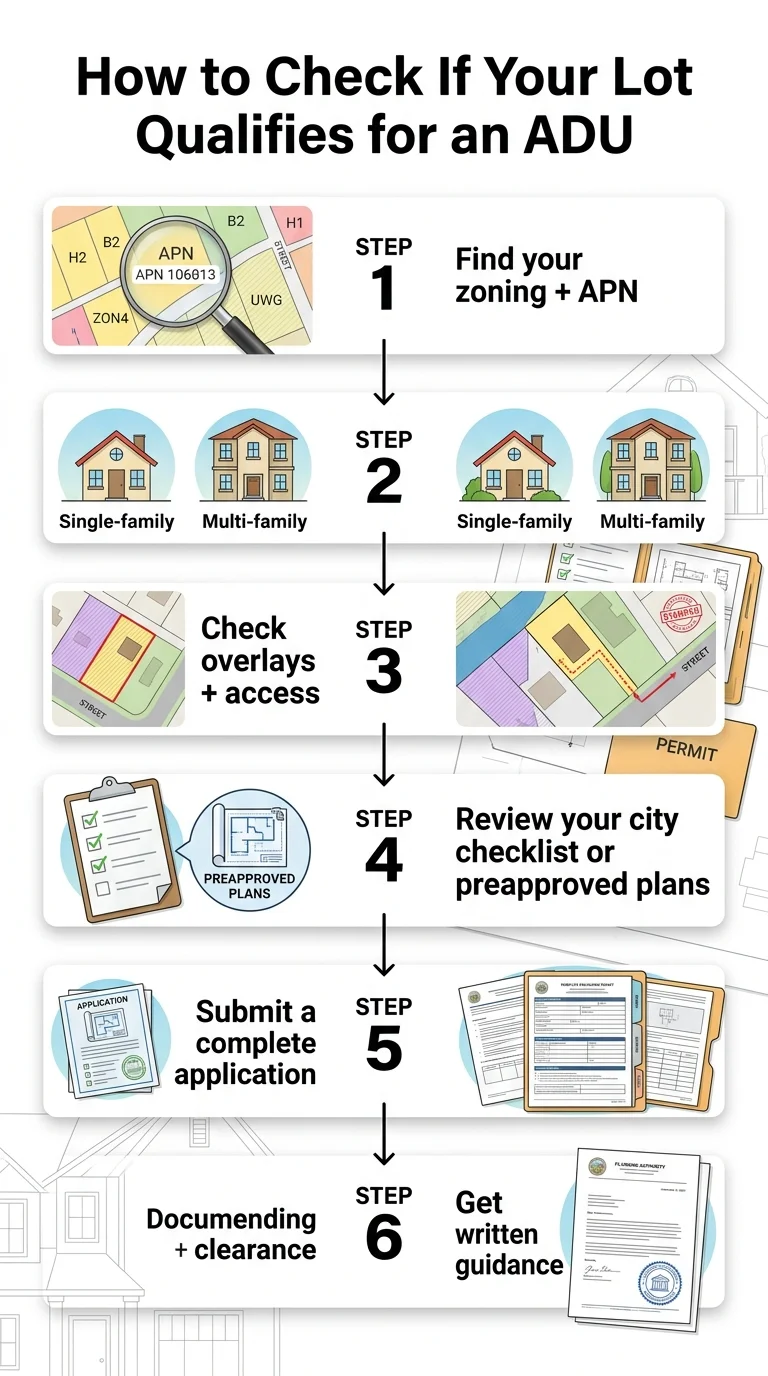
- 1
Find Your Zoning, APN, and Parcel Data
Look up your property on your county assessor's website or your city's GIS/parcel viewer. You need your zoning designation (R-1, R-2, etc.), Assessor's Parcel Number (APN), lot size and dimensions, and existing structure square footage.
- 2
Identify Your Property Type
Are you working with a single-family home, a duplex, or a larger multifamily building? This determines which ADU rules apply. Remember: duplexes are treated as multifamily for ADU purposes.
- 3
Check Your City's ADU Checklist
Most California cities now publish ADU checklists, resource centers, or intake guides. Start there before calling anyone. Sacramento, San José, San Francisco, and Oakland have particularly well-organized resources (see the city matrix above).
- 4
Flag Overlays and Constraints
Check whether your lot has any of these: Coastal Zone overlay, historic district designation, fire hazard severity zone, easements or right-of-way restrictions, septic system (vs. municipal sewer), slope/grading issues, or flood zone designation. None of these necessarily prevent an ADU — but each may add requirements, timelines, or costs.
- 5
Get Written Guidance from Planning
Contact your planning department with your APN and property details. Ask specific questions: "Under state ADU law, what can I build on this parcel?" "Does my property have any overlays?" "Do you have pre-approved ADU plans?" "What is your current average permit timeline?" Get answers in writing or record notes immediately.
- 6
Decide Between Custom Plans and Pre-Approved Plans
Pre-approved plans are faster and often cost less. Custom plans give you more design flexibility. Many cities review pre-approved plans in 30 days instead of 60 and charge lower plan check fees.
See What You Can Build at Your Address
Our free report checks your specific property against local zoning, size limits, and setbacks — and shows estimated costs specific to your situation. Takes about 60 seconds.
Get Your Free ADU Feasibility Report →Detailed reports currently available in CA, UT, TX, CO, and NY.
Garage Conversions, Unpermitted Units, and Edge Cases
Many of the hardest ADU questions aren’t about the basics — they’re about the specific situations. California law is actually generous on most of these.
Garage Conversions
Converting an existing garage into an ADU is one of the most cost-effective paths, and state law protects it:
- No replacement parking required when a garage, carport, or covered parking is converted Gov. Code § 66322(a)
- Existing setbacks are maintained — even if the garage is closer than 4 feet to the property line Gov. Code § 66323
- Existing footprint can be expanded up to 150 sq ft without additional development standards, to accommodate ingress/egress Gov. Code § 66323(b)
- The conversion is treated as a "state-exempt" ADU with minimal development standards Gov. Code § 66323
Legalizing an Unpermitted ADU
If you have an unpermitted unit that was built before January 1, 2020, AB 2533 (effective January 2025) provides a legalization pathway:
- Your city must allow legalization if the unit can meet health and safety standards under Health and Safety Code § 17920.3
- The city cannot require full compliance with every current building code — only correction of substandard conditions
- The city must provide a pre-application inspection pathway
Why legalizing matters: An unpermitted unit creates liability risk, insurance gaps, and resale complications. Legalization protects your investment and makes the unit insurable and legally rentable.
Existing Structures and Nonconforming Conditions
California law is explicit: unrelated zoning or building code violations on your property cannot prevent ADU approval. If your house has an unpermitted room addition or a setback nonconformity that’s unrelated to the ADU, the city cannot use that as a reason to deny your ADU permit — unless it’s a health and safety issue directly connected to the ADU construction. Gov. Code § 66323; SB 897
Coastal Zone Properties
ADUs are allowed in the Coastal Zone, and the Coastal Act still applies. Key points:
- A coastal development permit (CDP) may be required in addition to the standard building permit
- As of AB 462, a local government or the Coastal Commission must approve or deny a completed CDP application for an ADU within 60 days — the same timeline as standard ADU permits
- CDP processing must now run concurrently with the local permit process, not sequentially
Source: Gov. Code § 66329; AB 462.
SB 9 Lot Splits + ADUs
Important: SB 9 interactions are not additive
On a parcel created through an urban lot split, a city is not required to permit more than two total units — and “units” includes ADUs and JADUs. If you’re considering both an SB 9 split and ADU construction, get professional guidance before committing to a strategy. Don’t rely on casual online advice for this one.
The Right Next Step for Your Situation
You’ve made it through the rules. Now let’s turn knowledge into action. Here’s where to focus based on where you are:
"I want rental income from a backyard ADU"
Your fastest path: check if your city has pre-approved ADU plans, verify your lot's setbacks and utility access, and decide between a detached new construction ADU (maximum flexibility and rental appeal) or a garage conversion (lower cost, faster timeline). Most homeowners building for rental income choose a detached one-bedroom or two-bedroom unit in the 500–800 sq ft range — large enough to attract quality tenants, small enough to keep construction costs manageable.
"I need space for aging parents or an adult child"
Consider a JADU if you want to keep them close within your existing home's footprint (lower cost, shared walls), or a detached ADU if privacy matters for everyone involved. Remember: no owner-occupancy for standard ADUs, and JADU occupancy requirements depend only on whether sanitation facilities are shared.
"I have a duplex or multifamily property"
Your unit-count potential is higher than you might think. Multifamily lots can support conversion ADUs (up to 25% of existing units) plus detached ADUs (up to 8 under SB 1211). This is where ADU strategy starts looking like real portfolio development.
"I'm in an HOA, coastal zone, or historic area"
You have additional steps but not a dead end. Your HOA's restrictions are heavily limited by Civil Code § 4751 and AB 130. Coastal zones now have a 60-day CDP timeline. Historic districts may add objective design standards but cannot use subjective review to deny a compliant ADU. Flag the overlays early, get written guidance, and build your team accordingly.
"I think I already have an unpermitted ADU"
AB 2533 is built for your situation. The legalization pathway for pre-2020 unpermitted units is more homeowner-friendly than you'd expect. Start with your city's building department and ask specifically about ADU legalization — many cities now have dedicated processes for exactly this.
Free Resource
Free 2026 ADU Starter Kit
Complete planning checklist: costs, financing, permit timelines by state, and common mistakes. Everything before you talk to a single company or contractor.
Download Free Starter Kit →How California ADU Law Got Here: Key Bills from 2017–2026
California’s ADU revolution didn’t happen overnight. Each legislative session since 2017 has expanded homeowner rights, removed barriers, and tightened enforcement.
| Year | Key Bill(s) | What Changed |
|---|---|---|
| 2017 | SB 1069, AB 2299 | First major reforms: reduced parking, streamlined approvals, limited fees |
| 2020 | AB 68, AB 881, SB 13 | Landmark overhaul: eliminated minimum lot sizes, required ministerial approval within 60 days, waived impact fees for small ADUs, limited HOA restrictions, allowed ADUs on multifamily lots |
| 2022 | SB 897, AB 2221 | Raised height limits, clarified objective standards, addressed nonconforming conditions |
| 2023 | SB 477, AB 1033 | SB 477 reorganized ADU law into Gov. Code Chapter 13; AB 1033 allowed cities to opt in to ADU condo sales |
| 2024 | AB 976, SB 1211, AB 2533, AB 1332 | AB 976 permanently removed ADU owner-occupancy; SB 1211 expanded multifamily ADUs (up to 8); AB 2533 created legalization pathway for pre-2020 unpermitted ADUs; AB 1332 relaxed setbacks and created pre-approved plan framework |
| 2025–2026 | SB 543, AB 1154, SB 9 (2025), AB 462, AB 130, AB 818 | SB 543: 15-day completeness clock, size/fee clarifications; AB 1154: JADU occupancy tied to shared sanitation; SB 9 (2025): non-compliant ordinances auto-void; AB 462: 60-day coastal permits; AB 130: HOA restrictions can't include fees; AB 818: expedited post-disaster permits |
Sources: California Legislature bill texts; HCD ADU Handbook.
Frequently Asked Questions About California ADU Laws
Are ADUs legal everywhere in California?↓
ADUs are allowed on most residential lots statewide. Local agencies must permit ADUs on lots with a proposed or existing dwelling in qualifying residential or mixed-use zones. Certain overlays (coastal, Tahoe/TRPA) add requirements but generally do not prohibit ADUs.
Gov. Code § 66310 et seq.
How many ADUs can I build on a single-family lot?↓
Up to three: one conversion ADU from existing space, one new detached ADU (up to 800 sq ft with 4-ft setbacks), and one JADU within the single-family residence.
Gov. Code §§ 66321, 66323, 66333
How many ADUs are allowed on a multifamily property?↓
Conversion ADUs up to 25% of existing unit count (at least one), plus detached ADUs up to eight (not exceeding existing units). No JADUs on multifamily lots.
Gov. Code § 66323; SB 1211
What is the 800-square-foot ADU rule?↓
No city can use zoning restrictions (lot size, FAR, open space, front setbacks) to prevent you from building an 800 sq ft ADU with 4-foot side and rear setbacks. This is your guaranteed statewide baseline.
Gov. Code § 66321
How tall can an ADU be in California?↓
16 feet for a standard detached ADU, 18 feet if within ½ mile walking distance of a major transit stop or on a multistory multifamily lot, up to 25 feet for attached ADUs (or the primary dwelling's height limit, whichever is lower).
Gov. Code § 66314(b)(1)(B)
Do I need parking for an ADU?↓
Usually not. Parking is waived for garage conversions, units near transit, conversion ADUs, and several other categories. If required, it's capped at one space.
Gov. Code §§ 66314(d), 66322(a)
Are ADUs exempt from impact fees?↓
ADUs ≤750 sq ft and JADUs ≤500 sq ft of interior livable space are exempt from impact fees. Larger ADUs pay proportional fees.
Gov. Code § 66324; SB 543
Do I need a separate utility meter?↓
Not always. Conversion ADUs within existing space generally don't require new utility connections. New detached ADUs may need connections, but fees must be reasonable and proportional. Check with your utility provider and city.
Do I have to live on the property?↓
No for standard ADUs (AB 976, permanently effective Jan. 1, 2025). For JADUs, only if the unit shares sanitation facilities with the primary dwelling (AB 1154).
Can my HOA stop me?↓
An HOA cannot effectively prohibit or unreasonably restrict ADU construction, and "reasonable restrictions" cannot include fees or financial requirements. They can set limited aesthetic standards.
Civil Code § 4751; AB 130
Can a city deny my ADU if it meets state law?↓
A city cannot deny a compliant ADU. Ministerial approval means if you meet all objective standards, the permit must be granted.
Gov. Code § 66317
How long does an ADU permit take in California?↓
Legally: 15-business-day completeness review plus 60-day decision clock. In practice: 3–6 months is typical, sometimes longer in high-volume jurisdictions.
Can I rent out my ADU?↓
Yes. No owner-occupancy required for standard ADUs. ADUs approved under §66323 and all JADUs must be rented for 30+ day terms. Local agencies may require 30+ day terms for all ADUs.
Can I Airbnb my ADU?↓
State law allows local agencies to require 30+ day rental minimums, and most cities do. Check your city's short-term rental ordinance before planning.
Can I sell my ADU separately?↓
Only through specific legal pathways: a local condo-conversion ordinance (§66342/AB 1033) or a statewide qualified nonprofit/TIC arrangement (§66341). Your city must have adopted the relevant rules, and JADUs cannot be sold separately.
What if my property is in the coastal zone?↓
ADUs are allowed. The Coastal Act still applies, and a coastal development permit may be required. AB 462 now requires that CDP applications for ADUs be decided within 60 days, running concurrently with the standard permit process.
Gov. Code § 66329
Can I legalize an unpermitted ADU?↓
If it was built before January 1, 2020, AB 2533 provides a legalization pathway. Your city must allow legalization if the unit can meet health and safety standards under Health and Safety Code § 17920.3.
How does SB 9 interact with ADU law?↓
Carefully. On a parcel created through an SB 9 urban lot split, a city is not required to allow more than two total units — and that count includes ADUs and JADUs. These interactions are not additive. Verify with your planning department.
How Much Does It Cost to Build an ADU in California?
This is a state-law page, so we won’t bury you in cost breakdowns here — but leaving out cost context entirely would send you to another search. Here’s the honest overview:
ADU construction costs in California vary widely by type, region, and finishes. Garage conversions are typically the most affordable path. New detached ADUs cost more but offer the most flexibility and rental appeal.
We maintain a separate, detailed California ADU Cost Guide → with current data, cost-per-square-foot ranges by region, and a breakdown of soft costs vs. hard costs.
About the CalHFA ADU Grant Program
The CalHFA ADU Grant Program offers up to $40,000 toward pre-development and non-recurring closing costs. The most recent funding round was fully allocated on December 28, 2023, but CalHFA indicated in January 2026 that $150M–$200M in additional funding may become available in 2026. Confirm current availability directly with CalHFA before planning around grant funding.
Sources, Methodology, and Verification
Last verified: March 31, 2026
Author: Dwelling Index Editorial Team
This page was reviewed against:
- California Government Code Chapter 13 (§§ 66310–66342)
- California HCD ADU Handbook, including the January 2026 Addendum
- Official city ADU pages for Los Angeles, San Diego, San José, San Francisco, Sacramento, and Oakland
- SB 543 (Ch. 520, Stats. 2025), AB 1154 (Ch. 492, Stats. 2025), SB 9 (2025), AB 462 (Ch. 491, Stats. 2025), AB 130
- California Civil Code §§ 4741, 4751
Update log:
March 2026 — Full review against 2026 law changes, city matrix added, old-to-new code translator added
March 2025 — Previous version published
Editorial methodology: Dwelling Index produces independent editorial content reviewed against primary legal sources. We are not a law firm, builder, or lender. For legal advice specific to your property, consult a licensed attorney. Our recommendations are based on published law and official government resources.
Your next step is simple:
Find out what’s actually buildable at your specific address.
Free report · 60 seconds · No sales call · No commitment
Get Your Free ADU Report →Detailed reports currently available in CA, UT, TX, CO, and NY.
Or if you’re earlier in the planning process:
Download the Free 2026 ADU Starter Kit →Complete planning checklist — zero fluff.
Related Guides
Modular ADU: Real Costs, Rules & When It Wins
Factory-built ADU guide with costs, permits, and lot requirements
Best Prefab ADU Companies (2026)
Full comparison by price, scope, and service area
2 Bedroom Prefab ADU
Real costs, best models, and lot-fit requirements for 2BR ADUs
ADU Financing Options
HELOCs, cash-out refis, and ADU-specific loans explained
How Much Does an ADU Cost?
All ADU types and complete cost breakdown
California ADU Cost Guide
Cost-per-square-foot ranges by region and ADU type
All legal information last verified against California Government Code Chapter 13 (§§ 66310–66342) and HCD ADU Handbook: March 31, 2026. ADU regulations change frequently — confirm with your local planning department before starting your project.