ADU for Airbnb: Is It Legal, Profitable, and Worth Building?
By The Dwelling Index Editorial Team · Last verified: April 2026 · Sources: Municipal STR ordinances, CA HCD ADU Handbook, IRS Topics 414/415, HUD FY2026 FMR, Fannie Mae Selling Guide, Airbnb hosting guidelines
A national decision guide for homeowners considering a backyard ADU, garage conversion, basement unit, or above-garage suite for short-term rental income.
Here is the straight answer: An ADU for Airbnb only makes sense when three things are true — your city allows short-term rental use for that type of unit, your property can meet any owner-occupancy and licensing rules, and the project still works as a long-term or 30+ day rental if short stays don't pan out. Where all three line up, a well-designed ADU can gross $2,000–$5,000+ per month on Airbnb, typically netting 10–40% more than a long-term tenant after real operating costs.
The catch: in many of the most ADU-friendly cities in the country, your brand-new ADU still can't legally operate as a full-time Airbnb. San Francisco, San Diego, and Miami-Dade County all restrict or prohibit it. That's the single most important thing to figure out before you spend a dollar on plans, permits, or a prefab deposit.
Below, we break down the legality by city, the real income numbers, which ADU type performs best for short-term guests, what it actually costs to build and launch, how taxes work, and exactly what to do first. If your city says no to Airbnb, we cover that too — because the project can still make excellent financial sense.
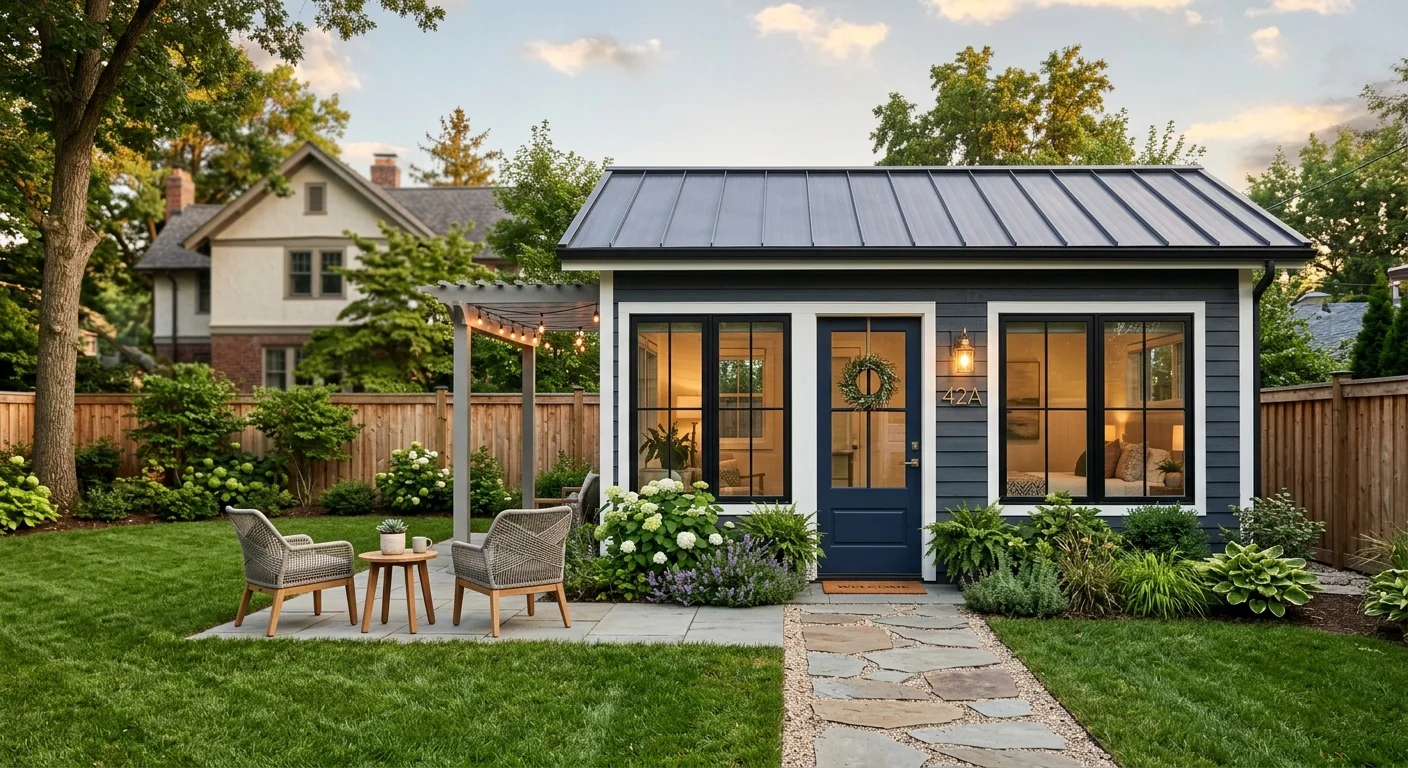
A well-designed detached ADU with a private entrance, outdoor space, and separate walkway commands the highest nightly rates — but only where short-term rental is legally permitted.
Quick Decision: Which Legal Bucket Are You In?
| Your Situation | Verdict | What It Means | Your Next Step |
|---|---|---|---|
| Your city bans ADU short-term rentals or requires 30+ day minimums | Airbnb is off the table | Design for long-term or 30+ day rental instead — still a strong investment | Jump to fallback strategies ↓ |
| Only primary-residence or hosted STR use is allowed | Possible if you live on site | Works if you occupy the property and comply with registration and any night caps | See the city rules table ↓ |
| ADU STR allowed with permit and tax registration | Strongest path forward | Verify the permit process, get proper insurance, and move forward | Jump to income data ↓ |
| HOA or deed restriction blocks short-term rentals | City approval won't save you | Check your CC&Rs before spending anything | Jump to fallback strategies ↓ |
Not sure which bucket you're in? Find out in 60 seconds — free, no obligation.
Get a property-specific report in 60 seconds — free, no commitment.
Check My Property →Can You Legally Use an ADU for Airbnb Where You Live?
This is the first question, not the last one. Whether your ADU can legally operate as an Airbnb depends on your specific city's short-term rental ordinance — not your state's ADU law. A state can make it easy to build an ADU while the city simultaneously makes it illegal to Airbnb that same unit. We see this constantly.
Before you sketch floor plans, compare prefab options, or talk to a lender, you need to know which legal bucket your property falls into. There are four.
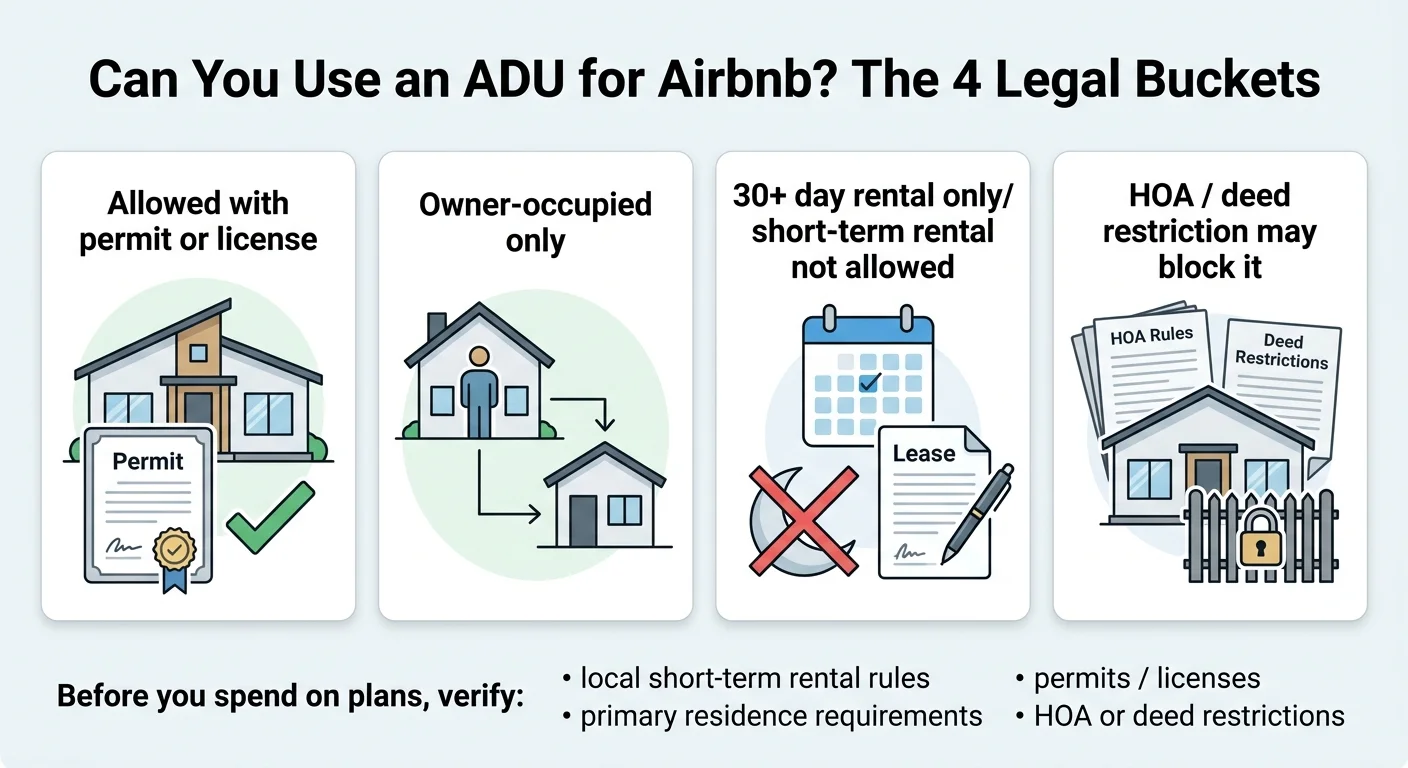
The four legal buckets that determine whether your ADU can operate as an Airbnb — check yours before spending on plans or permits.
The 4 Legal Buckets That Decide Everything
1.Bucket 1: ADU short-term rentals banned or 30+ day minimum required
Your ADU can be rented to a tenant on a standard lease, but listing it on Airbnb for nightly or weekly stays is not legal. Several major cities fall here. San Diego explicitly prohibits ADUs as short-term vacation rentals (San Diego Municipal Code §126.0145, verified March 2026). San Francisco's official ADU guidance states that ADUs and JADUs cannot be used for short-term rentals.
California law (Gov. Code §66315) explicitly allows local agencies to prohibit ADU rentals of less than 30 days. Junior ADUs (JADUs) cannot be used as short-term rentals statewide in California under Gov. Code §66333(g). Miami-Dade County requires standalone ADU rentals for a minimum of one month.
2.Bucket 2: Only owner-occupied or 'hosted' short-term rental allowed
You can Airbnb the ADU, but only if you live on the property — typically in the main house. Some cities require you to be physically present during the guest's stay. Los Angeles allows home-sharing for pre-2017 ADUs if the host lives in either the main house or the ADU; ADUs built on or after January 1, 2017 may only be used for home-sharing if the ADU itself is the host's primary residence. LA also applies a 120-day annual cap unless the host has Extended Home-Sharing Office registration.
Portland requires the STR to be in a primary residence. Denver requires a primary residence for STR licensing. Nashville requires permanent residency for owner-occupied permits. This bucket covers the most cities.
3.Bucket 3: Short-term rental allowed with permit, license, and tax registration
This is the strongest bucket. Your city allows ADU short-term rentals — you just need to register, get the right permits, collect and remit local lodging taxes, and follow any rules about noise, parking, or guest limits. Parts of unincorporated Riverside County, CA allow STRs in ADUs with proper certification. Arizona's statewide preemption statute protects short-term rentals broadly. Jacksonville, FL falls under state preemption. Seattle allows STR in primary or secondary units. Where the city has done the work to create a clear permit path — this bucket is where ADU-as-Airbnb works best.
4.Bucket 4: HOA, CC&Rs, or deed restriction blocks short-term rentals
Even if your city says yes, your homeowners association or property deed can say no. HOA restrictions on short-term rentals are enforceable in most states, even where ADU-friendly laws prevent HOAs from blocking ADU construction. California's ADU laws prevent HOAs from unreasonably restricting ADU development, but STR use is a separate question. If this is your bucket: the city permit won't save you. Check your CC&Rs before spending anything.
How Local Rules Actually Differ: City-by-City Snapshot
This is where it gets real. Two cities in the same state can have completely opposite rules. These were verified from official municipal and state sources:
| City / Area | ADU STR Allowed? | Key Conditions | Stay Rule / Cap | Owner-Occupancy? | Permit Required? | Verified |
|---|---|---|---|---|---|---|
| Los Angeles, CA | Limited | Pre-2017 ADUs: host lives in main house or ADU. Post-2017 ADUs: host must live in ADU itself. | 120-day annual cap (without Extended HSO registration) | Yes — primary residence | Yes — HSO registration + city business tax | Mar 2026 |
| San Francisco, CA | No (for ADUs) | ADUs and JADUs cannot be used for short-term rentals per city ADU guidance. | N/A | N/A | N/A | Mar 2026 |
| San Diego, CA | No (for ADUs) | ADUs cannot be used as short-term vacation rentals. | N/A | N/A | N/A | Mar 2026 |
| Portland, OR | Yes, with conditions | STR allowed in primary residence; ADU can be rented if owner lives on property. | No minimum; local permit rules apply | Yes — primary residence | Yes — STR permit required | Mar 2026 |
| Seattle, WA | Yes | Primary and secondary unit allowed; one may be an ADU/DADU. | No minimum | Yes — must be primary residence | Yes — STR license + business license | Mar 2026 |
| Austin, TX | Limited | ADUs built after Oct 1, 2015: max 30 days of STR use per calendar year total. | 30-day annual use cap (not per stay) | No | Yes — STR license; platform rules effective July 1, 2026 | Mar 2026 |
| Denver, CO | Yes | Primary residence required; STR license required for stays under 29 nights. | License required for stays under 29 nights | Yes — primary residence | Yes — STR license | Mar 2026 |
| Nashville, TN | Limited | New non-owner-occupied permits not issued in AR2A, R, RS, or RM zones; owner-occupied permits require permanent residence. | No minimum (owner-occupied) | Yes — permanent residence for owner-occupied permits | Yes — required | Mar 2026 |
| Miami-Dade County, FL | No (for standalone ADU rental) | ADU may be rented separately for not less than 1 month and not as a vacation rental. | 1-month minimum for standalone ADU rental | N/A for ADU-specific rule | Check county requirements | Mar 2026 |
| Jacksonville, FL | Yes | FL SB 280 preempts many local STR bans; resort/tourist development tax applies. | No state minimum | Generally no | State registration + local requirements | Mar 2026 |
| Draper, UT | No (30+ days) | ADUs must be rented for at least 30 consecutive days. | 30-day minimum | N/A | N/A | Mar 2026 |
Regulations change frequently. Always confirm directly with your city's planning department before making investment decisions. Phoenix, AZ was excluded from this table because the city's own STR registry page and ADU guidance contain conflicting statements about ADU STR eligibility — confirm directly with Phoenix Planning & Development.
How to Check Your Specific City's Rules
Don't rely on blog posts (including this one) for your final legal answer. Here is the exact process:
Search "[your city] short-term rental ordinance"
Look for the .gov municipal code page — not a builder's blog.
Call your city planning department
Ask three questions: "Can an accessory dwelling unit on my property be used as a short-term rental?" "What permits or licenses do I need?" "Are there minimum stay requirements or annual night caps?"
Check your HOA/CC&Rs
Even if the city says yes, your HOA can say no.
Search your neighborhood on Airbnb
If similar standalone units are listed nearby, STRs are likely permitted — but always verify officially.
Ask about the transient occupancy tax (TOT)
If your city collects one, they expect you to register and remit it.
Rules That Derail Projects After People Think They're Clear
"Legal ADU" doesn't always mean "legal STR"
Your city may enthusiastically approve an ADU building permit while separately prohibiting that ADU from being used as a short-term rental. These are two different regulatory systems, and passing one doesn't guarantee the other.
"Guest house" or "converted garage" may not be a legal ADU
If your unit was never formally permitted as an ADU — even if it's been there for years and has a kitchen and bathroom — it may not qualify for STR licensing. Some cities require a certificate of occupancy specifically designating the structure as an ADU before they'll issue an STR permit.
Your Airbnb listing is public record
Cities that enforce STR regulations actively search Airbnb for unpermitted listings. Austin's new platform regulations take effect July 1, 2026, including license display requirements and removal of unlicensed listings at city request. Some cities fine hosts per day of violation.
Insurance gaps are real
Your standard homeowner's insurance policy almost certainly excludes claims arising from short-term rental activity. If a guest is injured and you don't have STR-specific coverage, the claim can be denied.
Neighbor complaints have power
Even in STR-friendly cities, a pattern of noise complaints, parking issues, or trash problems can result in your STR permit being revoked or not renewed. Invest in sound insulation, clear guest rules, and maintaining good neighbor relationships — it's business protection, not just courtesy.
Want to skip the research? We check your local rules, building eligibility, and estimated income automatically.
We check your local STR rules, building eligibility, estimated income for each rental strategy, and available financing options — free.
Get Your Free ADU Feasibility Report →Detailed reports currently available in CA, UT, TX, CO, and NY.
How Much Can You Actually Earn Airbnb-ing an ADU?
The short answer is more than a long-term tenant — but not as much more as you think once you factor in the real costs of running a short-term rental. In strong Airbnb markets, a well-designed ADU can gross $2,000–$6,000+ per month. After Airbnb's fees, cleaning, supplies, vacancy, and the extra insurance you need, the net premium over a long-term tenant typically lands at 10–40% more income for roughly 3–5 times more work.
That's still a meaningful number — potentially hundreds of extra dollars per month that accelerate your payback and build wealth faster. But you need the honest math, not the highlight reel.
Short-Term Rental Market Benchmarks by Metro Area
| Metro Area | Long-Term Rent (Mo.) | STR Gross (Mo.) | STR Net After Expenses | Net STR Premium | Avg Nightly Rate | Avg Occupancy |
|---|---|---|---|---|---|---|
| Los Angeles, CA | $2,200–$3,200 | $3,500–$6,000 | $2,400–$4,200 | +20–45% | $150–$250 | 65–78% |
| Portland, OR | $1,300–$1,800 | $2,000–$3,500 | $1,400–$2,400 | +15–35% | $100–$160 | 60–72% |
| Seattle, WA | $1,500–$2,200 | $2,500–$4,000 | $1,700–$2,800 | +15–30% | $120–$180 | 63–75% |
| Austin, TX | $1,200–$1,700 | $2,000–$3,500 | $1,400–$2,400 | +20–40% | $110–$175 | 62–74% |
| Denver, CO | $1,400–$1,900 | $2,200–$3,800 | $1,500–$2,600 | +15–35% | $115–$170 | 60–72% |
| Nashville, TN | $1,300–$1,800 | $2,500–$4,500 | $1,700–$3,100 | +30–55% | $130–$200 | 65–78% |
| Phoenix, AZ | $1,200–$1,600 | $1,800–$3,200 | $1,200–$2,200 | +15–35% | $100–$150 | 60–72% |
| Jacksonville, FL | $1,000–$1,400 | $1,500–$2,500 | $1,000–$1,700 | +10–30% | $85–$130 | 55–68% |
| Salt Lake City, UT | $1,000–$1,500 | $1,500–$2,500 | $1,000–$1,700 | +10–25% | $90–$140 | 55–68% |
Illustrative ranges from our internal model combining AirDNA market data, HUD FY2026 FMR/SAFMR data, Zillow/Rentometer rental comps, and builder-reported figures. “After Expenses” assumes Airbnb host fees (3%), cleaning ($75–$150/turnover), supplies, higher insurance, vacancy/seasonal gaps, and routine maintenance — but excludes mortgage, property tax, and income tax. These are not guarantees of returns. Last updated April 2026.
What Actually Eats Into Your Airbnb Income
This is the table most “ADU for Airbnb” guides conveniently leave out. The gap between gross Airbnb revenue and what hits your bank account is wider than most people expect.
| Expense | Long-Term Rental | Airbnb Short-Term Rental |
|---|---|---|
| Platform fees | N/A | 3% host fee (or 14–16% host-only option) |
| Cleaning | Tenant handles it | $75–$150 per turnover, 2–4x/week |
| Furnishing | Usually unfurnished | $5,000–$15,000 upfront + replacement |
| Supplies & restocking | None | $50–$100/month (toiletries, coffee, linens) |
| Insurance | Standard landlord policy | STR-specific policy — typically more expensive |
| Utilities | Tenant often pays | Host pays (built into nightly rate) |
| Property management | 8–10% if hired out | 15–25% if hired (STR management is pricier) |
| Vacancy & seasonality | ~5–8% annual vacancy | 20–40% vacancy (seasonal swings) |
| Wear & tear | Normal residential | Accelerated — more turnover, more use |
| Licensing & permits | Basic rental license | STR permit + TOT registration + renewals |
| Total operating cost as % of gross | ~20–30% | ~35–55% |
A Worked Example: When the Numbers Work (and When They Don't)
Scenario A — Portland, 1BR detached ADU (STR wins)
- Build cost: $220,000
- STR gross: $2,800/month
- Operating expenses (45%): $1,260
- Net STR income: $1,540/month ($18,480/year)
- LTR alternative: $1,500/mo → ~$1,150 net
- STR premium: ~$390/month
- Payback from net STR income: ~12 years (vs ~16 from LTR) — plus asset appreciation
Scenario B — Suburban Salt Lake City, 1BR garage conversion (LTR wins)
- Build cost: $130,000
- STR gross: $1,600/month
- Operating expenses (50%): $800
- Net STR income: $800/month ($9,600/year)
- LTR alternative: $1,200/mo → ~$960 net
- STR loses vs. LTR here — with more management hassle
- Design for long-term rental instead. ~13.5 year payback with appreciation
These are illustrative examples, not guarantees of returns. Actual results depend on local market conditions, construction costs, and regulatory approvals.
How to Sanity-Check Airbnb Demand Before You Build
Search Airbnb directly
Look for listings near your address similar to what you'd build — standalone units, backyard cottages, guest houses. Check their calendars. If they're booked 60–70%+ of nights in the next 60 days, there's real demand.
Use a free revenue estimator
Tools like AirDNA's Rentalizer, Rabbu's Airbnb Calculator, or Awning's estimator let you plug in an address and get estimated ADR, occupancy, and revenue. These give you a reasonable starting point.
Cross-reference with long-term rental comps
Search Zillow, Rentometer, and Craigslist for comparable rental units near your address. This gives you your fallback number — what you'd earn if STR doesn't work out or regulations change.
Talk to local hosts
Join local hosting groups on Facebook or check BiggerPockets forums for your metro area. Real hosts sharing real numbers is the best data you'll find. Ask about average occupancy, realistic ADR, biggest ongoing expense, and whether they'd do it again.
Which ADU Type Works Best for Airbnb?
Detached ADUs win on guest appeal almost every time — but they also cost the most and take the longest. The best type for your project depends on your lot, your budget, your city's rules, and whether the project still works if you can't Airbnb it.
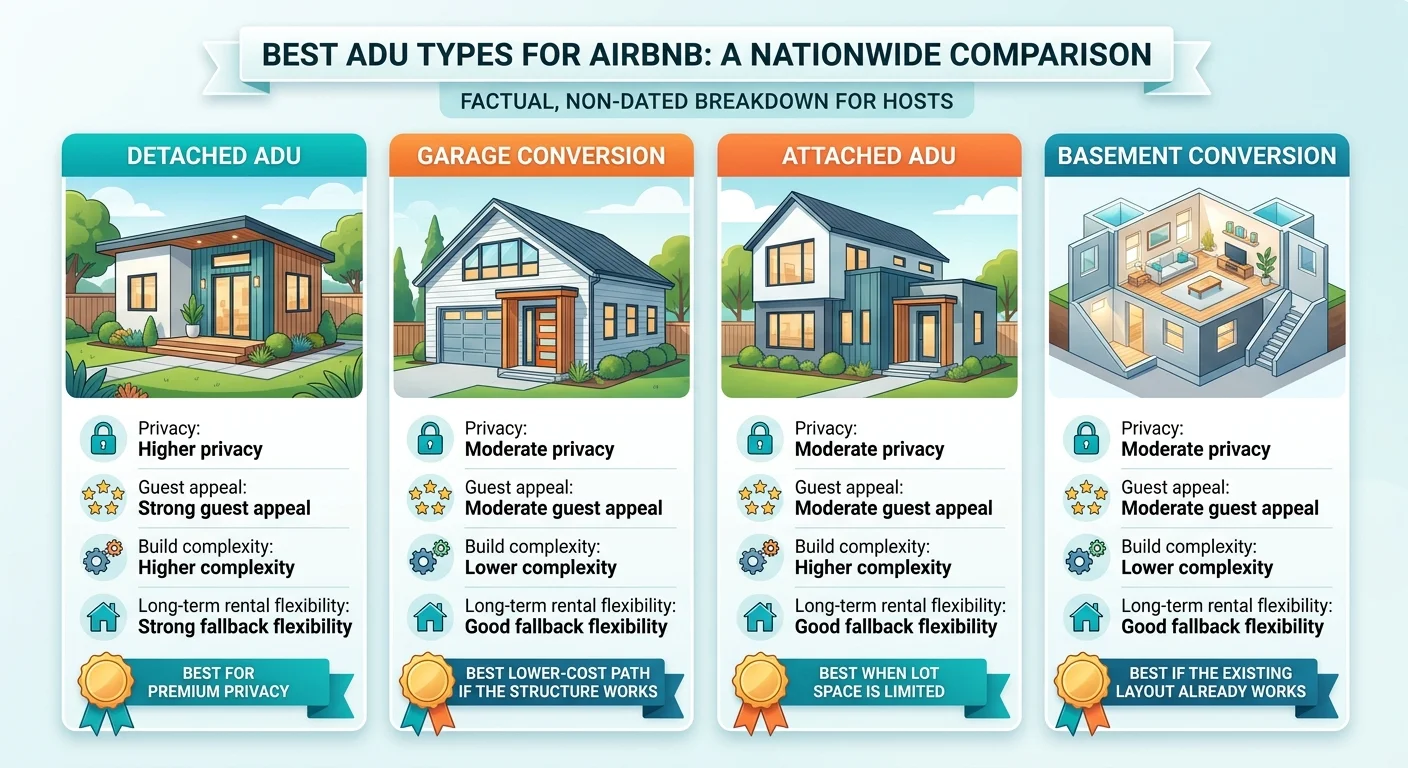
Detached ADUs deliver the best guest experience, but garage and basement conversions can perform nearly as well at a fraction of the cost when the structure and access work.
| ADU Type | Guest Privacy | Typical Cost | Airbnb Fit | LTR Fallback | Biggest Risk |
|---|---|---|---|---|---|
| Detached (new build) | Excellent | $200K–$400K | ★★★★★ | Strong | Highest cost, longest timeline |
| Garage conversion | Good (if separate entry) | $80K–$160K | ★★★★ | Good | Ceiling height, insulation, foundation limits |
| Basement conversion | Moderate | $60K–$130K | ★★★ | Good | Egress windows, moisture, ceiling height |
| Attached ADU | Moderate | $150K–$300K | ★★★ | Strong | Sound transfer, shared-wall privacy |
| Above-garage suite | Good | $150K–$280K | ★★★★ | Good | Stair access limits accessibility |
| Prefab (installed) | Excellent (detached) | $150K–$300K all-in | ★★★★★ | Strong | Site prep surprises, delivery logistics |
Cost ranges reflect national data. California, Bay Area, and NYC metro skew 15–30% higher. Rural and Midwest markets skew lower. Sources: Angi 2026 ADU cost data, builder-reported figures, our internal cost model.
What Airbnb Guests Actually Care About
Privacy is the single biggest differentiator. Airbnb guests choosing a backyard ADU over a hotel room are paying for the experience of a private, self-contained space. That means:
- →Private entrance — not through the main house. Ever. This is non-negotiable for STR.
- →Sound separation — guests hearing your family through the walls destroys reviews.
- →Self-check-in — smart lock or lockbox. Nobody wants to coordinate key handoffs.
- →Parking — dedicated spot, clearly marked.
- →Outdoor space — even a small private patio with two chairs and string lights elevates the listing.
A garage conversion with a separate entrance, good insulation, and a private walkway can perform almost as well as a detached build on Airbnb — at half the cost. The key is the experience of privacy, not the literal building classification.
See detailed layouts and dimensions in our detached ADU floor plans guide →
What Does an Airbnb-Ready ADU Cost to Build?
Plan on $85,000–$415,000 all-in depending on type and location, plus $7,000–$25,000 for Airbnb-specific furnishing and startup. The range is wide because a garage conversion in the Midwest and a custom detached build in the Bay Area are completely different projects at completely different price points.
Build Cost by ADU Type (Airbnb-Ready)
| ADU Type | Base Build Cost | Airbnb Upgrade Premium | All-In Airbnb-Ready Cost |
|---|---|---|---|
| Garage conversion | $80K–$160K | +$5K–$10K | $85K–$170K |
| Basement conversion | $60K–$130K | +$5K–$10K | $65K–$140K |
| Attached ADU | $150K–$300K | +$5K–$12K | $155K–$312K |
| Above-garage suite | $150K–$280K | +$5K–$12K | $155K–$292K |
| Detached ADU (new) | $200K–$400K | +$8K–$15K | $208K–$415K |
| Prefab ADU (installed) | $150K–$300K | +$5K–$10K | $155K–$310K |
The “Airbnb Upgrade Premium” includes better finishes, enhanced soundproofing, smart lock, outdoor lighting, landscaping for guest entrance, and higher-grade fixtures that withstand STR turnover. Ranges are national — California, Bay Area, and NYC metro projects typically add 15–30%. Verify with local contractors.
The Startup Budget Beyond Construction
The ADU is built. Now you need to turn it into a bookable Airbnb listing — and that costs money most people forget to budget for.
| Startup Item | Estimated Cost |
|---|---|
| Furniture, bedding, décor | $5,000–$15,000 |
| Professional listing photos | $200–$500 |
| Smart lock / keyless entry | $150–$300 |
| Smart thermostat | $150–$300 |
| WiFi setup (dedicated router) | $50–$150 |
| Linens, kitchen kit, bathroom supplies | $1,000–$2,500 |
| STR permit, business license, TOT registration | $100–$500 |
| Entrance landscaping / curb appeal | $1,000–$5,000 |
| Welcome guide, house manual, signage | $50–$100 |
| Total STR startup (beyond construction) | $7,700–$24,350 |
The Soft Costs People Underestimate
Design and architectural plans run $5,000–$30,000 depending on whether you use pre-approved city plans (cheaper, faster) or a custom design. Permits and city fees range from $3,000–$15,000, with impact fees adding more for ADUs over 750 sq ft in many jurisdictions. Utility hookups — water, sewer, gas, electric — can add $10,000–$35,000 for a detached new build that needs trenching back to the main house.
Budget a 10–15% contingency on top of everything. ADU projects, like all construction, have surprises. A good contingency keeps a surprise from becoming a crisis.
ADU Cost Guide →
Detailed ranges by state and square footage
ADU Financing Options →
HELOC vs construction loan vs cash-out refi
How to Design an ADU That Gets 5-Star Airbnb Reviews
The difference between a mediocre listing and a Superhost-level performer isn't the size of the ADU — it's the design decisions you make before construction starts. Every feature on this checklist either raises your nightly rate, protects your investment from accelerated wear, or eliminates the guest friction points that generate complaints and lower ratings.
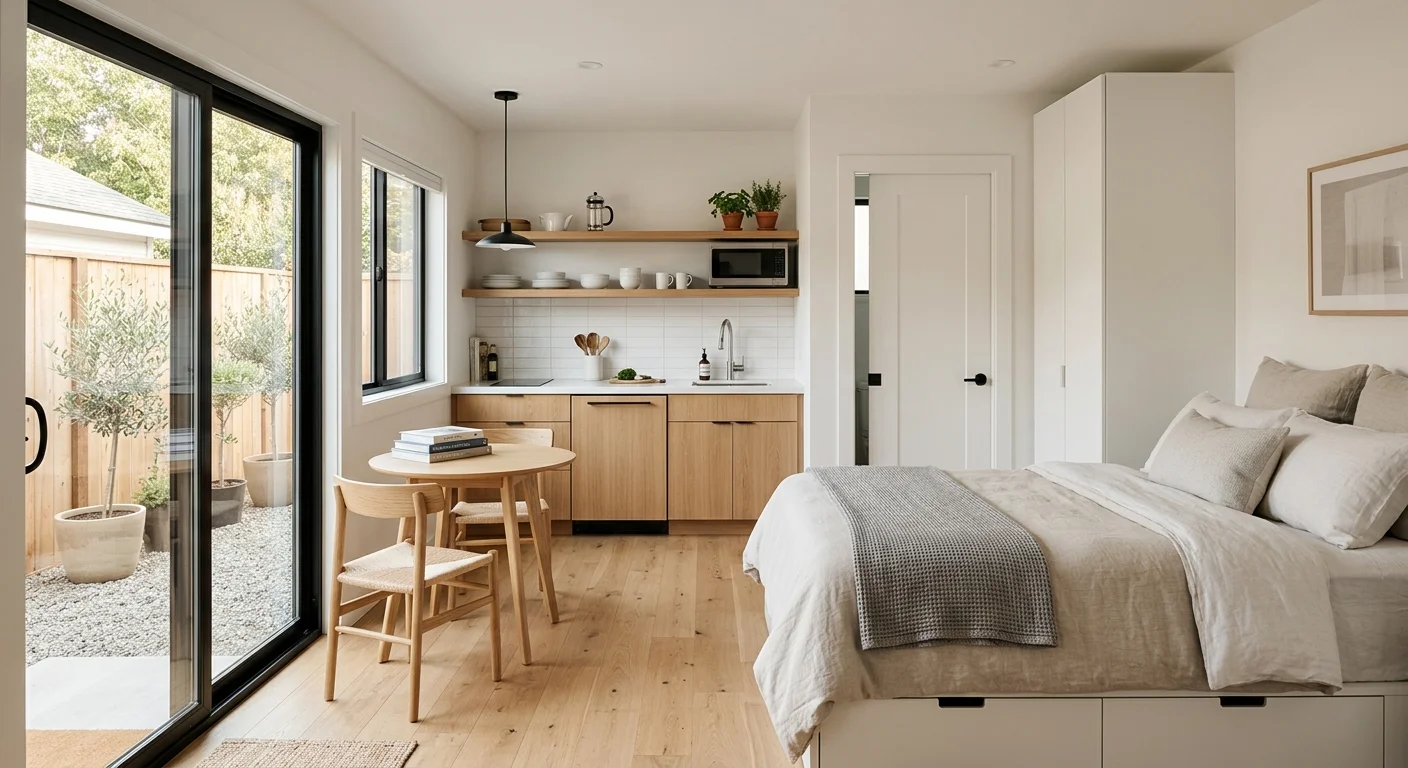
Light finishes, natural materials, a functional kitchenette, and private outdoor access — the design formula that earns 5-star reviews and justifies premium nightly rates.
The Airbnb ADU Design Checklist
Must-Haves (Non-Negotiable for STR)
- ✓Private entrance with clear pathway — guests should never walk through your home
- ✓Full bathroom with strong water pressure and good drainage
- ✓Kitchenette or full kitchen with coffeemaker, microwave, and basic cooking setup
- ✓Quality mattress — budget $800+ because this is the #1 review driver
- ✓Dedicated WiFi (separate router, not shared with main house — guests stream, video call, and work)
- ✓Smart lock or lockbox for self-check-in
- ✓Climate control — a ductless mini-split is ideal (quiet, efficient, guest-controlled)
- ✓Soundproofing between ADU and main house (insulation, resilient channel, solid-core doors)
- ✓Blackout curtains or shades in the sleeping area
- ✓In-unit or easily accessible washer/dryer
Revenue Boosters (These Justify a Higher Nightly Rate)
- +Private outdoor space — even a 6×8 patio with two chairs and string lights
- +Dedicated, clearly marked parking spot
- +Full kitchen (not just kitchenette) — opens you to longer stays and families
- +Smart TV with streaming (Netflix, etc.) — don't make guests log in to their own accounts
- +Work desk with good lighting and an outlet — targets remote workers and business travelers
- +USB charging stations at the bedside and desk
- +Walk-in shower (preferred over tub for short stays — easier to clean, more modern feel)
- +Welcome basket with local snacks or coffee
Investment Protectors (Save You Money Over Time)
- →Luxury vinyl plank (LVP) or tile flooring — never carpet in an STR
- →Quartz or solid-surface countertops (stain-resistant, durable)
- →Commercial-grade faucets and fixtures (higher upfront, dramatically less replacement)
- →Light, neutral color palette (photographs well, appeals broadly, hides minor scuffs)
- →Closed cabinetry over open shelving (less dusting, less visual clutter between guests)
- →Separate utility meter (simplifies expense tracking for taxes)
- →Security camera at entrance only (Airbnb requires disclosure — never inside the unit)
The Best Size for an Airbnb ADU
Studio (400–500 sq ft)
Highest ROI per sq ft
Ideal for solo travelers and couples. Keep build costs down, maximize cash-on-cash return.
1-Bedroom (500–750 sq ft)
The all-around performer
Appeals to couples, small families, and business travelers. Most commonly searched ADU size on Airbnb. Our recommendation for most homeowners.
2-Bedroom (750–1,000 sq ft)
Higher rate, lower per-sq-ft ROI
Best in family vacation markets or areas where groups travel together.
Design for Flexibility — Not Just Airbnb
Tax Rules Every Airbnb ADU Host Needs to Know
Short-term rental income is taxed differently than long-term rental income, and the classification affects which forms you file, what you can deduct, and whether you owe self-employment tax. This is the section most ADU-for-Airbnb guides skip entirely — and it's the one that prevents expensive surprises at tax time.
Schedule E vs Schedule C: Which Form?
Long-term rental (30+ days average stay)
File on: Schedule E — Treated as passive income. No self-employment tax.
Short-term rental with "substantial services" (daily cleaning, concierge, meals)
File on: Schedule C — Treated as active business income. Subject to self-employment tax.
Short-term rental without substantial services (space, cleaning between guests, basic amenities)
File on: Generally Schedule E — The rules have nuance — confirm your specific treatment with a qualified tax professional.
The 14-Day Rule: The Tax Break Most Hosts Don't Know About
IRS Section 280A provides a useful exception: if you rent your property for fewer than 15 days per year, you don't have to report any of the rental income on your tax return. (IRS Topic 415)
This matters for homeowners in markets with high-value events — college football weekends, music festivals, major conventions, or seasonal tourism spikes. You could charge premium rates for a couple of weekends and keep the income tax-free. The tradeoff: you also can't deduct any rental expenses for those days. But if the income is significant and limited to a few weekends, this rule can be genuinely valuable.
Transient Occupancy Tax (TOT): The Tax Most New Hosts Miss
Most cities and counties charge a transient occupancy tax — essentially a hotel tax on short-term stays. Rates typically range from 6% to 15%+ of the booking amount, depending on jurisdiction. Airbnb automatically collects and remits TOT in many (but not all) jurisdictions. You're responsible for checking whether Airbnb handles this in your area or whether you need to collect and remit it yourself. Failure to register and remit TOT can result in penalties and back taxes. Check your city's TOT requirements when you get your STR permit — they usually go hand-in-hand.
Deductions Available to Airbnb ADU Hosts
When your ADU operates as a rental, you can typically deduct expenses directly related to that rental activity: depreciation on the ADU structure and furnishings, insurance premiums, repairs and maintenance, cleaning costs, Airbnb platform fees, supplies and restocking, a portion of property taxes, interest on the construction loan or HELOC used to build it, professional photography, and utility costs. Consult your tax professional for the full list applicable to your situation — these deductions can meaningfully improve your after-tax return.
Setting Up Your ADU on Airbnb: The Launch Playbook
Once you've built the unit, confirmed legality, and gotten your permits — here's how to go from “finished ADU” to “first booking” in 2–4 weeks.
Get your permits and registrations in order
STR permit, business license, TOT registration — whatever your city requires. Do this first because some cities take weeks to process, and you cannot legally list until you have them. Post your registration number on your listing where required.
Get proper insurance
Your standard homeowner's policy almost certainly does not cover short-term rental activity. You need either a standalone STR insurance policy or an endorsement to your existing policy that explicitly covers short-stay guests, their liability, and property damage. Airbnb's AirCover program provides some protection, but it has exclusions and limits — it should not be your only coverage.
Furnish and stock the unit
Use the design checklist above as your shopping list. Prioritize: quality mattress, complete kitchen setup, fresh linens (buy 3 sets minimum — one on the bed, one in the wash, one backup), bathroom essentials, and a well-stocked cleaning supply closet. Buy duplicates of everything guests commonly break or stain. Having backups on hand means faster turnovers and less stress.
Get professional photos
This is one of the highest-ROI investments for any Airbnb listing. Professional hospitality photos cost $200–$500 and can meaningfully increase your booking rate. Shoot in natural daylight, style the space, and get shots of every room plus the entrance and outdoor area. If the listing looks like a hotel, it'll book like one.
Write a compelling listing
Lead with what makes your ADU different from a hotel room: private entrance, backyard setting, neighborhood feel, full kitchen, outdoor space. Be specific about the neighborhood — walkability, nearby restaurants, proximity to attractions or transit. Mention the features guests actually search for: self-check-in, WiFi speed, parking, washer/dryer. Set clear, reasonable house rules.
Set your pricing strategy
Start 10–15% below comparable listings for your first 4–6 weeks to build initial reviews. Getting those first 5–10 five-star reviews is critical — they're worth more than premium pricing in month one. After you've established a rating, raise to market rate. Consider a third-party dynamic pricing tool like PriceLabs, Beyond, or Wheelhouse — many experienced hosts find they outperform Airbnb's built-in Smart Pricing.
Establish your operations system
Before your first guest arrives, lock in: a reliable cleaning service or cleaning schedule (available on short notice for same-day turnovers), communication templates for booking confirmation, check-in instructions, and check-out reminders, a digital house manual (a simple Google Doc or dedicated page works), a maintenance contact list for plumbing, electrical, and locksmith emergencies, and a restocking checklist for between guests.
What High-Performing ADU Hosts Do Differently
The hosts earning the most from their ADUs share a few common habits. They respond to inquiries quickly — Airbnb explicitly says responsiveness, ratings, cancellation history, and hospitality affect search placement and Superhost eligibility. They maintain strong ratings by obsessing over cleanliness and communication. They use professional photos and update them seasonally. They offer a local experience — a curated list of neighborhood restaurants, a welcome note with a personal recommendation, a small touch like local coffee or snacks. The hosts who treat it like a small business — even a very small one — dramatically outperform those who set it and forget it.
Ready to see what you could build and earn at your specific address?
Get a property-specific report in 60 seconds — free, no commitment.
Check My Property →Airbnb vs Long-Term Rental vs 30-Day Furnished Stays: Which Path Wins?
There's no universal winner — but there's almost certainly a right answer for your specific situation. The factors that determine it are your local STR regulations, your market's tourism demand, your tolerance for management, and how much income stability you need.
| Factor | Airbnb (Nightly STR) | 30+ Day Furnished Stays | Long-Term Rental (12+ months) |
|---|---|---|---|
| Revenue potential | Highest | Moderate-high | Most stable |
| Income stability | Variable — seasonal, event-driven | Moderate — fewer gaps than nightly | Very stable — monthly lease |
| Management time | 5–15 hrs/week (or 15–25% mgmt fee) | 2–4 hrs/month | 1–3 hrs/month |
| Turnover cost | $75–$150/cleaning, multiple per week | Minimal — monthly or less | Minimal — annual or less |
| Furnishing required? | Yes — $5K–$15K | Yes — $5K–$15K | Usually no |
| Vacancy risk | 20–40% (seasonal) | 10–20% | 5–8% |
| Regulatory risk | High — STR laws change frequently | Low — usually exempt from STR rules | Very low |
| Flexibility for personal use | High — block dates anytime | Moderate — between tenants | Low — tenant has lease rights |
| Best market fit | Tourist cities, event markets, urban cores | Travel nurse/corporate relo markets | Everywhere — housing demand is universal |
The Hybrid Strategy: Why Many Smart ADU Owners Don't Pick Just One
Here's what experienced ADU landlords actually do: they run Airbnb during peak season and high-value events, then switch to 30+ day furnished rentals during the off-season. This “hybrid” approach captures the upside of premium nightly rates when demand is hot, while avoiding empty-unit months when tourists aren't coming. It also often sidesteps annual night caps in cities that limit STR usage — if your city caps Airbnb at 90 or 120 nights per year, fill the remaining months with a 30-day furnished tenant.
The 30+ day furnished rental market is bigger than most people realize. Traveling nurses (with typical 13-week assignments), corporate relocations, insurance housing, graduate students, and remote workers are all looking for furnished month-to-month accommodations — and they typically pay more than a standard long-term tenant while creating far less turnover than nightly Airbnb guests.
Who Should Choose Each Path
Choose Airbnb if:
- ✓You live in a strong tourism market
- ✓Your city allows STR in ADUs
- ✓You enjoy (or will hire for) hospitality management
- ✓You're comfortable with seasonal income variability
Choose 30+ day furnished if:
- ✓Your city restricts nightly STR but allows 30+ day rentals
- ✓You're near a hospital or corporate center
- ✓You want more income than a standard lease with less hassle than Airbnb
Choose long-term rental if:
- ✓You want maximum stability and minimum management
- ✓Your area doesn't have strong tourism demand
- ✓STR regulations are restrictive or uncertain
- ✓You want truly passive income
Choose the hybrid if:
- ✓Your market has clear seasonal patterns
- ✓You want to use the unit yourself part of the year
- ✓You want to test STR demand before fully committing
Every one of these paths can generate meaningful income. The ADU is the asset — the rental strategy is just how you optimize it for your situation.
The fastest way to know for sure:
Ready to see which path makes the most sense at your address? Get a personalized ADU report with your local rules and estimated income for each rental strategy.
Free report · 60 seconds · No sales call · No commitment
Check My Property → Get Your Free ADU ReportDetailed reports currently available in CA, UT, TX, CO, and NY.
What If Airbnb Isn't Allowed at Your Address?
An Airbnb “no” doesn't make your ADU a bad project — it changes which rental strategy makes the most sense. Many of the best ADU investments in the country are long-term rentals in cities that don't allow short-term stays at all.
Design for long-term rental instead
A 1-bedroom ADU renting for $1,200–$2,500/month (depending on market) with 95% occupancy and minimal management is a legitimate wealth-building tool. FHFA data shows California properties with ADUs saw higher relative growth in median appraised values than those without between 2013 and 2023. The ADU pays you every month and builds equity — whether you Airbnb it or not.
Offer 30+ day furnished stays
Furnished rentals with 30+ day minimum stays typically fall outside short-term rental regulations in most cities — meaning you avoid the STR permit, TOT, and night-cap headaches entirely. Traveling nurses (13-week assignments), corporate relocations, insurance housing, graduate students, visiting professors, and remote workers are all looking for furnished month-to-month accommodations — paying above-market rent for convenience and quality. Platforms like Furnished Finder and Airbnb's own 30+ day monthly stay option reach this audience without nightly turnover overhead.
Live in the ADU and rent the main house
This is the reverse house-hack, and it's more common than you'd think. If your main house commands significantly higher rent than the ADU — which it usually does — living in the smaller unit and renting the larger one can maximize your monthly cash flow. Some homeowners in high-cost markets earn enough from the main house rental to cover their entire mortgage and then some.
Use it for family now, income later
Aging parents, adult children, or a home office today — rental income when circumstances change. ADUs are one of the most flexible investments you can make in your property because their use case can evolve over time.
What to Do Before You Pay for Plans, Permits, or a Prefab Deposit
The sequence matters more than most guides acknowledge. We see homeowners fall in love with a floor plan or put down a prefab deposit before they've confirmed their city allows what they want to do with the unit. That's how expensive mistakes happen. Follow this order.
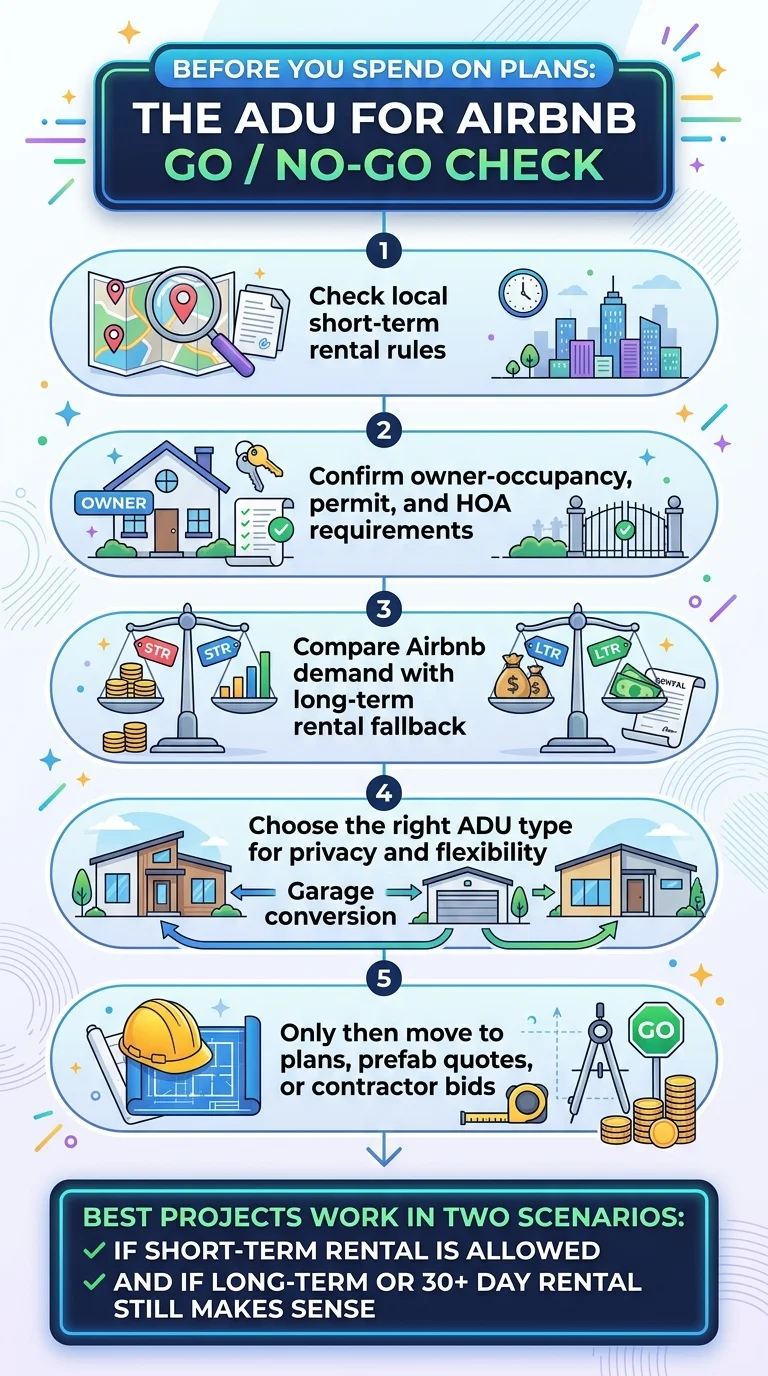
These five steps prevent the most expensive ADU mistakes — confirm legality and economics before you spend on designs or deposits.
Check Your Legal Bucket
Determine whether your address falls into Bucket 1 (STR banned), Bucket 2 (owner-occupied only), Bucket 3 (allowed with permits), or Bucket 4 (HOA blocks it). This single step determines your entire project strategy. Do not skip it. Do not assume.
How: Call your city planning department. Read your municipal STR ordinance. Check your HOA CC&Rs.
Validate Local Demand and Set Your Rental Strategy
Search Airbnb and Vrbo for comparable listings near your address. What are similar units charging? What's their occupancy look like (check calendars)? Use free tools like AirDNA or Rabbu to estimate ADR and occupancy for your area. Also check Zillow and Rentometer for long-term rental comps — you need to know what your fallback income looks like.
If Airbnb demand is strong: design for STR with long-term fallback flexibility. If demand is weak or STR isn't legal: design for long-term rental or 30+ day furnished stays.
Choose the Right ADU Type
Your lot size, existing structures, budget, and local rules determine which ADU type is feasible. A garage conversion is cheapest if you have a suitable garage. A detached build is ideal for privacy but costs the most. Some lots can only support an attached ADU or internal conversion.
Budget the Real All-In Cost
Don't just price the construction. Add design/architectural fees, permits, utility hookups, site prep, furnishing (if STR), and a 10–15% contingency. See our ADU cost guide for detailed ranges by type and state.
Confirm Permits, Licenses, Insurance, and HOA Compliance
Before you commission architectural plans: confirm your city's ADU building permit process and timeline, any STR-specific permits and licenses you'll need, TOT registration requirements, insurance needs (STR-specific if applicable), and that your HOA/CC&Rs don't block your planned use.
Only Then Move to Design, Prefab, or Contractor Quotes
Now — and only now — should you be spending money on architectural plans, prefab deposits, or general contractor bids. You've validated the legal, financial, and market fundamentals. The design phase is where you incorporate everything from the design checklist above to make the unit perform for your chosen rental strategy.
Pre-Plan Verification Summary
| What to Verify | Why It Matters | Where to Check | Red Flag | Green Light |
|---|---|---|---|---|
| STR legality for ADUs | Core project viability | City planning dept, municipal code | "ADUs cannot be used for STR" | "STR permitted with license" |
| HOA/CC&R restrictions | Can override city approval | Your HOA docs, property deed | "No short-term rentals" clause | No STR restriction in CC&Rs |
| Local Airbnb demand | Revenue realism | AirDNA, Rabbu, Airbnb search | <50% occupancy, few comps | 65%+ occupancy, many active listings |
| Fallback rent levels | Downside protection | Zillow, Rentometer, Craigslist | Rent doesn't cover carrying costs | Rent covers 80%+ of monthly costs |
| Lot feasibility | Physical buildability | City setback rules, survey | Setbacks eliminate buildable area | Clear buildable footprint |
| Budget reality | Financial readiness | 3+ contractor bids, our cost guide | All-in cost exceeds available financing | Budget covers build + 15% contingency + furnishing |
| Permit timeline | Project planning | City building dept | 6+ months to permit (plan accordingly) | Pre-approved plans available, 30–60 day permits |
The fastest way to know for sure:
See what you can build and what it could earn — get your free ADU report.
Free report · 60 seconds · No sales call · No commitment
Check My Property → Get Your Free ADU ReportDetailed reports currently available in CA, UT, TX, CO, and NY.
How We Verify ADU Airbnb Rules, Costs, and Recommendations
We know you're making a significant financial decision, and we take the accuracy of this guide seriously.
Our source hierarchy: First, we check official city and county government pages and municipal code text for current regulations. Second, state government resources and statutes. Third, Airbnb's own responsible-hosting pages as supplementary context. Fourth, builder and operator sources for cost data — but never for legal conclusions.
How often we verify: The city rule snapshot table is reviewed regularly and every row includes a verification date. When regulations change between reviews, we update as soon as we can confirm the change through official sources.
How we handle ambiguity: When a city's rules are unclear, conflicting, or in transition, we say so — as we did with Phoenix, AZ, which was excluded from the table due to conflicting official guidance. We never present a guess as a verified rule.
Editorial independence: The Dwelling Index is reader-supported through affiliate relationships with financing partners and prefab companies. Our editorial recommendations are never influenced by compensation. Read our editorial standards → · Read our methodology →
Frequently Asked Questions About Using an ADU for Airbnb
Can you legally use an ADU for Airbnb?
It depends entirely on your city's short-term rental ordinance. Some cities allow it with permits and registration; others ban it outright or require 30+ day minimum rental terms. San Francisco and San Diego prohibit ADU short-term rentals. Junior ADUs (JADUs) cannot be used as STRs statewide in California under Gov. Code §66333(g). Always check your local municipal code and HOA rules before investing.
Can I Airbnb my ADU if I live in the main house?
In many cities, yes — living on site is often a requirement for ADU short-term rental. Cities like Los Angeles, Portland, Seattle, and Denver all require the property to be the owner's primary residence for STR eligibility. This owner-occupied model is the most common legal framework for ADU STR use.
Can I live in the ADU and rent the main house on Airbnb?
It depends on your city's rules. Some cities define 'primary residence' as the main house specifically; others allow the owner to live in either the main house or the ADU. Seattle allows the primary unit to be the ADU or DADU. In Los Angeles, ADUs built after January 1, 2017 may only be used for home-sharing if the ADU itself is the host's primary residence. Check your specific ordinance — the wording matters.
Do ADUs have to be rented for 30 days or more?
In some jurisdictions, yes. California law allows local agencies to require ADU rentals for terms longer than 30 days (Gov. Code §66315), and many cities exercise that option. Miami-Dade County requires a minimum one-month rental term for standalone ADU rentals. Draper, Utah has the same 30-day minimum. But many cities in states like Arizona and Florida have no minimum stay requirement. Your city's ordinance controls.
What type of ADU works best for Airbnb?
A detached 1-bedroom ADU (500–750 sq ft) with a private entrance is the top performer for most markets. It provides the privacy guests expect, appeals to the widest audience, and hits the sweet spot between build cost and rental income. Garage conversions can perform nearly as well at roughly half the cost if the structure and access work.
How much does an Airbnb-ready ADU cost?
$85,000–$415,000 all-in, depending on type and location. Garage conversions are cheapest ($85K–$170K). Detached new builds are most expensive ($208K–$415K). Add $7,000–$25,000 for Airbnb-specific furnishing, smart lock, professional photos, and startup supplies.
How much can you make Airbnb-ing an ADU?
Gross income typically ranges from $1,500–$6,000+/month depending on market, size, and occupancy. After operating expenses, net income is generally 10–40% above what a long-term tenant would pay — in markets where ADU STR is legal and demand is strong. Tourist-heavy markets like Nashville show the highest premium. These are illustrative ranges — your results depend on your specific location and management.
Do I need a permit or license to Airbnb an ADU?
In most cities, yes. You typically need: (1) a building permit for the ADU itself, (2) a separate short-term rental permit or business license, and (3) transient occupancy tax (TOT) registration. Some cities require all three. Requirements and fees vary significantly — check with your city's planning and tax departments.
Can my HOA stop me from Airbnb-ing an ADU?
Potentially. While some state ADU laws prevent HOAs from blocking ADU construction, short-term rental use is a separate matter. Many HOA CC&Rs include provisions restricting or prohibiting short-term rentals. These restrictions are generally enforceable even where the city allows STR. Check your CC&Rs before investing.
Should I design for Airbnb or long-term rental first?
Design for both. A well-built ADU with a real kitchen, adequate storage, and separate entrance works for Airbnb guests and long-term tenants. This flexibility protects your investment if regulations change, if your market shifts, or if you decide to change strategies. Avoid over-specializing for one use case.
Does living on the property hurt Airbnb bookings?
No — it's often a selling point. Many guests prefer knowing the owner is nearby for questions and quick fixes. Airbnb states that responsiveness and hospitality are factors in search placement and Superhost eligibility. The key is visual and acoustic privacy between the main house and ADU, not physical distance.
Can I count Airbnb income when financing an ADU?
Some mortgage programs allow documented ADU rental income to be used for qualification. Fannie Mae's Selling Guide limits rental income from a 1-unit primary residence with an ADU to 30% of total qualifying income when documentation requirements are met. Projected short-term-rental income may not be treated the same as documented long-term rent — confirm program rules with your specific lender.
What if my city bans Airbnb in ADUs?
The project can still work — and often does. Long-term rental income of $1,000–$3,000/month, 30+ day furnished stays targeting traveling nurses or corporate relocations, house-hacking by renting the main house, or family housing are all legitimate use cases. Many of the best ADU investments in the country are long-term rentals in cities that don't allow short-term stays.
Does an ADU add property value even if you don't use it for Airbnb?
Yes. FHFA data shows California properties with ADUs saw higher relative growth in median appraised values than those without between 2013 and 2023. The value increase comes from the additional living space and income potential — not from Airbnb specifically. An ADU is a valuable property asset regardless of how you rent it.
What are the tax implications of an Airbnb ADU?
You must report rental income to the IRS — generally on Schedule E for most rental activities, or Schedule C if you provide substantial services for guest convenience (IRS Topic 414). Your city likely requires transient occupancy tax (TOT), typically ranging from 6–15%. The 14-day rule under IRS Section 280A may exempt you if you rent fewer than 15 days per year (IRS Topic 415). Deductible expenses may include depreciation, insurance, repairs, cleaning, platform fees, supplies, and allocated mortgage interest. Consult a tax professional for your specific situation.
The fastest way to know for sure:
Not sure where to start? See what's possible at your address — get your free ADU report in 60 seconds.
Free report · 60 seconds · No sales call · No commitment
Check My Property → Get Your Free ADU ReportDetailed reports currently available in CA, UT, TX, CO, and NY.
Free Resource
Free 2026 ADU Starter Kit
Our most popular download. Includes the ADU decision flowchart, cost planning worksheet, financing comparison matrix, and state-by-state regulation summary. Delivered to your inbox, no spam, unsubscribe anytime.
Download the Free Starter Kit →Related Guides
- →ADU Rental Income: How Much Can You Actually Make? (2026)
- →ADU Laws by State: All 50 States & Official Sources (2026)
- →California ADU Laws 2026: Rules, Setbacks, Fees & Permits
- →ADU Financing Options 2026: HELOC vs Refi vs Loan
- →How Much Does an ADU Cost? Real 2026 Prices by Type
- →Modular ADU: Costs, Rules & When Modular Wins (2026)
- →What Is an ADU? Definition, Types, Costs & Rules (2026)
Content is for informational purposes only and does not constitute financial, legal, tax, construction, or lending advice. Verify all information with qualified local professionals before making decisions. Regulations change frequently — we update this page regularly, but always confirm with your city's planning department for the most current rules.
Financial projections and rental income estimates in this guide are illustrative examples, not guarantees of returns. Actual results depend on local market conditions, construction costs, regulatory approvals, and individual circumstances.
Affiliate Disclosure · Editorial Methodology · Privacy Policy