
ADU Laws by State: Where You Can Build an ADU in 2026
By The Dwelling Index Editorial Team · Last verified: April 2026 · Sources: State statutes, Mercatus Center ADU Taxonomy (August 2025), California HCD, AARP, state housing agencies
More than 20 states have now enacted statewide ADU legislation — and the number keeps climbing. We mapped ADU laws for all 50 states, and the picture is more promising than most guides make it sound. At least seven states have removed every major regulatory barrier that used to kill ADU projects before they started. If you live in California, Oregon, Washington, or four other states, your city cannot require you to live on-site, cannot demand extra parking, and cannot force you through a public hearing just to add a backyard cottage or garage apartment to your own property.
But here is what most guides leave out: even in the most permissive states, state law sets the floor — not the finish line. Your city's zoning code, your lot shape, your HOA, and your utility access still determine whether a specific ADU is feasible on your property. We built this page to give you both layers: the state-level baseline and a clear path to checking what your city still controls.
Use the tracker below to find where your state stands. Then check what you can actually build at your specific address.
Last verified: April 2026 · Sources: State statutes, Mercatus Center ADU Taxonomy (August 2025), California HCD, AARP, state housing agencies · See full methodology →
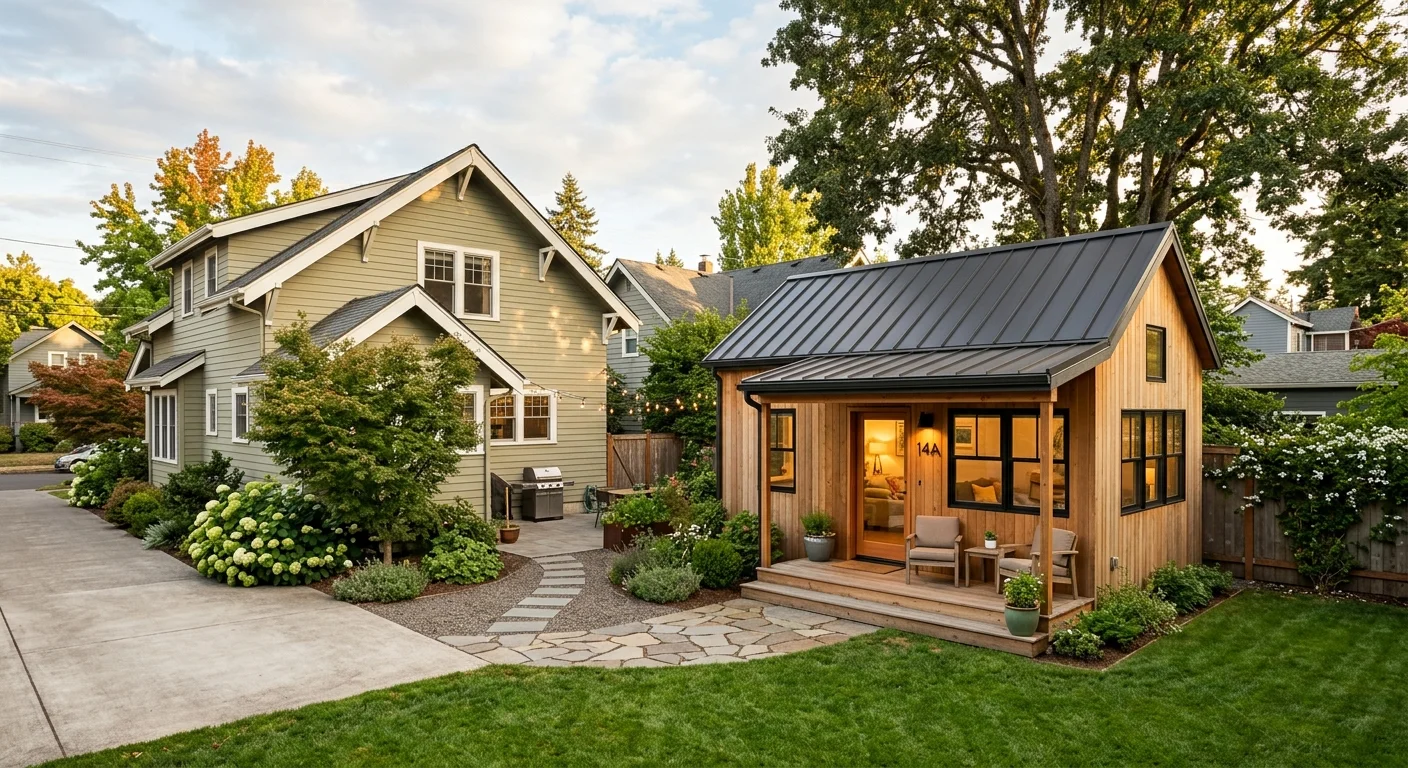
In states with strong statewide frameworks, a detached backyard ADU like this must be approved by right — no public hearing, no neighbor vote, no discretionary review.
The 50-State ADU Comparison
Every state below is classified into one of four tiers based on how easy it is for a typical homeowner to actually get an ADU built. Our classification draws on the framework developed by housing researchers Emily Hamilton and Kol Peterson at the Mercatus Center, who identified three “poison pill” regulations that stop ADU construction even where it is technically legal: owner-occupancy requirements, parking mandates, and discretionary approval processes. States that eliminate all three earn our highest tier.
| Tier | What It Means | States |
|---|---|---|
| 🟢 Strong Statewide | State law removes all three poison pills. By-right approval, no owner-occupancy mandate, no parking mandate, both attached and detached allowed. Cities cannot add these barriers back. | CA, OR, WA, CO, ME, AR, IA |
| 🟡 Partial Statewide | State law exists but leaves one or more barriers in local hands, or the framework is newer with implementation still rolling out. | VT, CT, MA, MT, MN, AZ, HI, NH, RI, MD, NV, UT, NY |
| 🟠 City-by-City | No broad statewide ADU mandate. Whether you can build depends on your local zoning code. Major metros often allow ADUs even without state preemption. | TX, FL, NC, GA, IL, VA, NJ, NM, OH, PA, MI, TN, MO, WI, NE, OK, SD, ND, LA, SC, AK, DE, KS, WY, DC |
| 🔴 Restricted | No statewide law, and most local governments severely restrict or functionally ban ADUs. | AL, IN, KY, MS, WV, ID |
A note on accuracy: ADU legislation is moving faster than at any point in U.S. housing history. We verify every state entry against official statutes, but laws change — confirm with your local planning department before making financial commitments. Each state entry below includes the specific statute or agency source so you can verify independently.
Already know your state allows ADUs? The real question is whether your specific lot qualifies.
Check your address in 60 seconds — free, no commitment.
Check My Property →Detailed reports available in CA, UT, TX, CO, and NY.
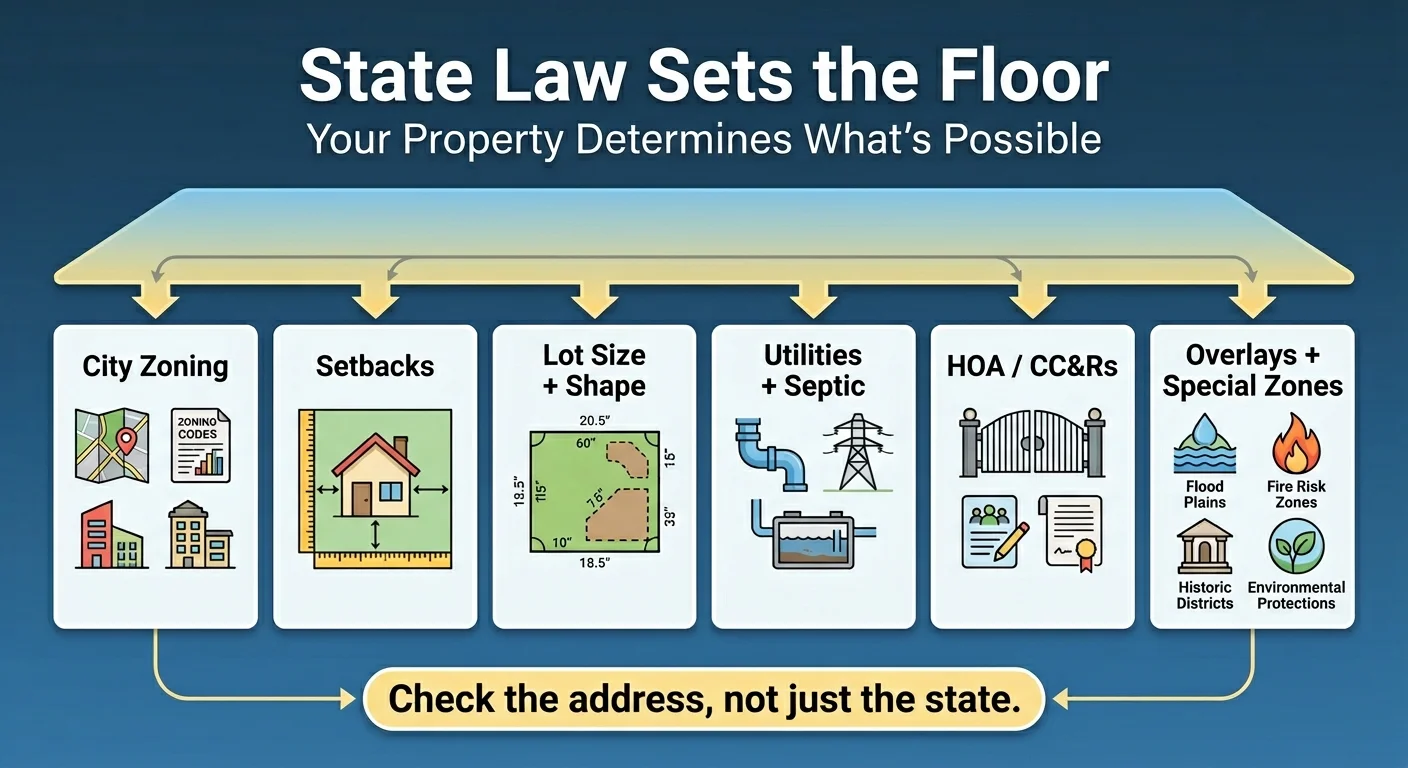
State law sets a legal floor — but city zoning, your lot shape, utilities, and your HOA still determine what is actually buildable. Always check the address, not just the state.
Which States Are Actually ADU-Friendly?
Not all “ADU-legal” states are equal, and the difference matters more than most guides let on. A state with a “strong statewide” framework means your city legally cannot impose the three biggest project-killers. A state with “partial” preemption may still let your city demand that you live on-site, or require extra conditions that add months and fees. And in a “city-by-city” state, your neighbor one town over might be building freely while your municipality says no.
🟢 Strong Statewide Frameworks
These states have done the most to clear the path. If you live here, the state has your back — though you still need to check lot-specific rules like setbacks, utility access, and overlay districts.
California
California is the undisputed national leader. Detached ADUs can be up to 1,200 square feet. Cities must approve or deny complete applications within 60 days (with a 15-day completeness review window under SB 543). Owner-occupancy is banned. Parking is not required near transit. HOAs cannot block ADUs. Under AB 1033, some cities allow ADUs to be sold as separate condominiums. In 2025, the legislature passed SB 543 (tighter permitting timelines and impact fee protections — no fees on ADUs of 750 sq ft or less), AB 1154 (JADU owner-occupancy only applies if the unit shares a bathroom with the primary dwelling), and AB 462 (certificate-of-occupancy and coastal-permit timing changes for ADUs in disaster and coastal areas). These took effect January 1, 2026.
Source: Cal. Gov. Code §§ 66310–66342; California HCD ADU Handbook with 2026 addendum. Verified April 2026.
Oregon
Oregon was the first state to eliminate single-family-only zoning in cities over 25,000 residents. HB 2001 allows duplexes, triplexes, and ADUs by right. No owner-occupancy requirement, no parking mandates. Portland has become a national model — including “3-pack” developments with a primary dwelling, attached ADU, and detached ADU all owned as condos.
Source: ORS 197.312; HB 2001 (2019). Verified April 2026.
Washington
Washington goes further than most: HB 1337 requires urban municipalities to allow at least two ADUs per residential lot. One can be attached, one detached — or any combination. No owner-occupancy requirement. ADUs can be sold separately from the primary residence under certain conditions. Cities cannot set maximum floor areas below 1,000 square feet.
Source: RCW 36.70A.680–696; Washington Dept. of Commerce ADU Guidance. Verified April 2026.
Full Washington ADU laws guide →Colorado
Colorado is one of the most significant newcomers. HB24-1152, which took effect June 30, 2025, requires subject jurisdictions (cities in metropolitan planning areas with 1,000+ population) to allow ADUs of 500–750 square feet by right. HOA restrictions on ADUs are overridden. Colorado also offers ADU financing programs through the Colorado Housing and Finance Authority (CHFA) and local lenders.
Source: C.R.S. 29-35-402–405; Colorado DOLA ADU Compliance Framework. Verified April 2026.
Maine
Maine targets its affordable housing shortage head-on. LD 2003 allows ADUs and duplexes on almost all residential lots. Cities cannot require extra parking beyond what the primary dwelling needs. Minimum ADU size is just 190 square feet, making small conversions viable. Shoreland zones have special requirements but cannot prohibit ADUs outright.
Source: 30-A M.R.S. § 4364-B. Verified April 2026.
Arkansas New — effective Jan. 1, 2026
Arkansas surprised the housing world in 2025. Act 313 (HB 1503), signed in March 2025 and effective January 1, 2026, requires every municipality to allow at least one ADU by right on any lot with a single-family home. Attached, detached, and internal ADUs are all permitted. No extra parking or owner-occupancy requirements. Maximum size is 1,000 square feet or 75% of the primary dwelling, whichever is smaller. Application fees capped at $250. Any conflicting local ordinance is automatically invalid.
Source: Arkansas Act 313 (2025); A.C.A. § 14-17-209. Verified April 2026.
Iowa New — effective July 1, 2025
Iowa joined the strong tier in mid-2025. SF 592, signed by Governor Reynolds on May 1, 2025, requires every city and county to allow at least one attached or detached ADU on any single-family lot. Maximum size is 1,000 square feet or 50% of the primary residence, whichever is larger. No owner-occupancy requirements. No additional parking mandates. ADU permit applications must be approved without discretionary review or hearing. ADUs can be used as rental properties. HOA rules cannot be more restrictive than state law.
Source: Iowa SF 592 (Chapter 38, Acts of the 91st General Assembly). Verified April 2026.
Your state is on the strong list — now check if your specific lot qualifies.
Check your address in 60 seconds — free, no commitment.
Check My Property →Detailed reports available in CA, UT, TX, CO, and NY.
🟡 Partial Statewide Frameworks
These states have passed ADU legislation, but the laws leave one or more critical barriers in local hands — or the framework is newer with implementation still rolling out.
🟡 Vermont
Requires by-right ADU approval statewide under Act 47 (2023), and cities must act within 30 days. However, the statutory baseline ties the ADU right to an owner-occupied lot. Vermont also offers ADU funding through the Vermont Housing Improvement Program (VHIP 2.0), structured as 0% interest forgivable loans — one of the most generous state programs in the country.
Source: 24 V.S.A. § 4412(1)(E); Vermont Housing Finance Agency. Verified April 2026.
🟡 Connecticut
Public Act 21-29 (2021) sets statewide standards, but municipalities can vote to opt out. About 67% of towns opted in. Where the law applies, both attached and detached ADUs are allowed by right. The opt-out mechanism means statewide coverage is not guaranteed.
Source: Conn. Gen. Stat. § 8-2(a); PA 21-29. Verified April 2026.
🟡 Massachusetts
The Affordable Homes Act allows by-right ADUs in single-family zones. Max 900 sq ft or 50% of the primary dwelling. ADUs remain subject to otherwise applicable dimensional and parking requirements, and municipalities may impose additional restrictions. MassHousing ADU Loan Program now available.
Source: M.G.L. c.40A § 1A, § 3; MassHousing. Verified April 2026.
🟡 Montana
Requires ADUs to be allowed as rental housing. Max 1,000 sq ft or 75% of the primary dwelling's floor area, whichever is less.
Source: MCA 76-2-345 (municipal); MCA 76-2-215 (county zoning). Verified April 2026.
🟡 Minnesota
Statewide ADU provisions enacted. Max 800 sq ft. ADUs must include a kitchen, bathroom, and lockable entrance. Cities retain some local design authority.
Source: Minn. Stat. § 462.3571. Verified April 2026.
🟡 Arizona
Requires covered municipalities (pop. 75,000+) to allow at least one attached and one detached ADU as a permitted use, and limits parking and design restrictions cities can impose. Phoenix and Tucson have active ADU programs; suburban cities vary.
Source: A.R.S. § 9-461.18 (municipal); A.R.S. § 11-810.01 (county). Verified April 2026.
🟡 Hawaii
Counties have required ADUs since 1981. Act 39 (2024) expanded the framework: all urban residential-zoned lots must permit at least two ADUs by end of 2026, and CC&Rs cannot block ADU development.
Source: HRS § 46-4; Act 39 (2024). Verified April 2026.
🟡 New Hampshire
Municipalities must allow both attached and detached ADUs where single-family homes are permitted. The 2025 revised law sets a minimum ADU size floor of 750 sq ft that cities cannot restrict below. However, municipalities can still require owner-occupancy of one of the units.
Source: NH RSA 674:71-73; HB 577 (2025). Verified April 2026.
🟡 Rhode Island
Updated 2024 law allows one ADU by right on residential lots of 20,000 sq ft or more within an existing footprint. Sets uniform statewide standards, voids conflicting HOA and deed restrictions, and bans tourist/transient ADU use.
Source: R.I. Gen. Laws § 45-24-73. Verified April 2026.
🟡 Maryland
The Accessory Dwelling Units Act of 2025 (HB 1466), effective October 1, 2025, establishes state policy promoting ADUs and requires all charter counties and Baltimore City to adopt local ADU laws by October 1, 2026. ADUs cannot exceed 75% of the primary dwelling's size. HOA restrictions cannot unreasonably limit ADU development.
Source: Md. Code, Land Use § 1-501 et seq.; HB 1466 (Chapter 197, 2025). Verified April 2026.
🟡 Nevada
AB 396 (2025) requires the most populous counties (100,000+) and cities (60,000+) to adopt ADU ordinances by July 1, 2026. If a qualifying jurisdiction does not comply, ADUs are authorized on any residential parcel without restriction. Reno adopted its ADU ordinance in October 2025.
Source: NRS 278 (as amended by AB 396, Chapter 365, 2025). Verified April 2026.
🟡 Utah
State law allows internal (attached) ADUs by right on single-family lots. Detached ADUs remain under local control. Salt Lake City, Ogden, and other Wasatch Front cities have their own ADU ordinances.
Source: Utah Code § 10-9a-530; OPRO Guidance. Verified April 2026.
🟡 New York
No comprehensive statewide zoning preemption for ADUs, but the Plus One ADU Program offers grants up to $125,000 — one of the most generous programs nationally. Administered through participating municipalities and nonprofit partners. Local zoning still determines what is structurally allowed.
Source: NY Homes and Community Renewal. Verified April 2026.
Found your state? The real question is whether your specific property qualifies.
Our free report checks your specific property against local zoning, size limits, and setbacks — takes about 60 seconds.
Get Your Free ADU Feasibility Report →Detailed reports currently available in CA, UT, TX, CO, and NY.
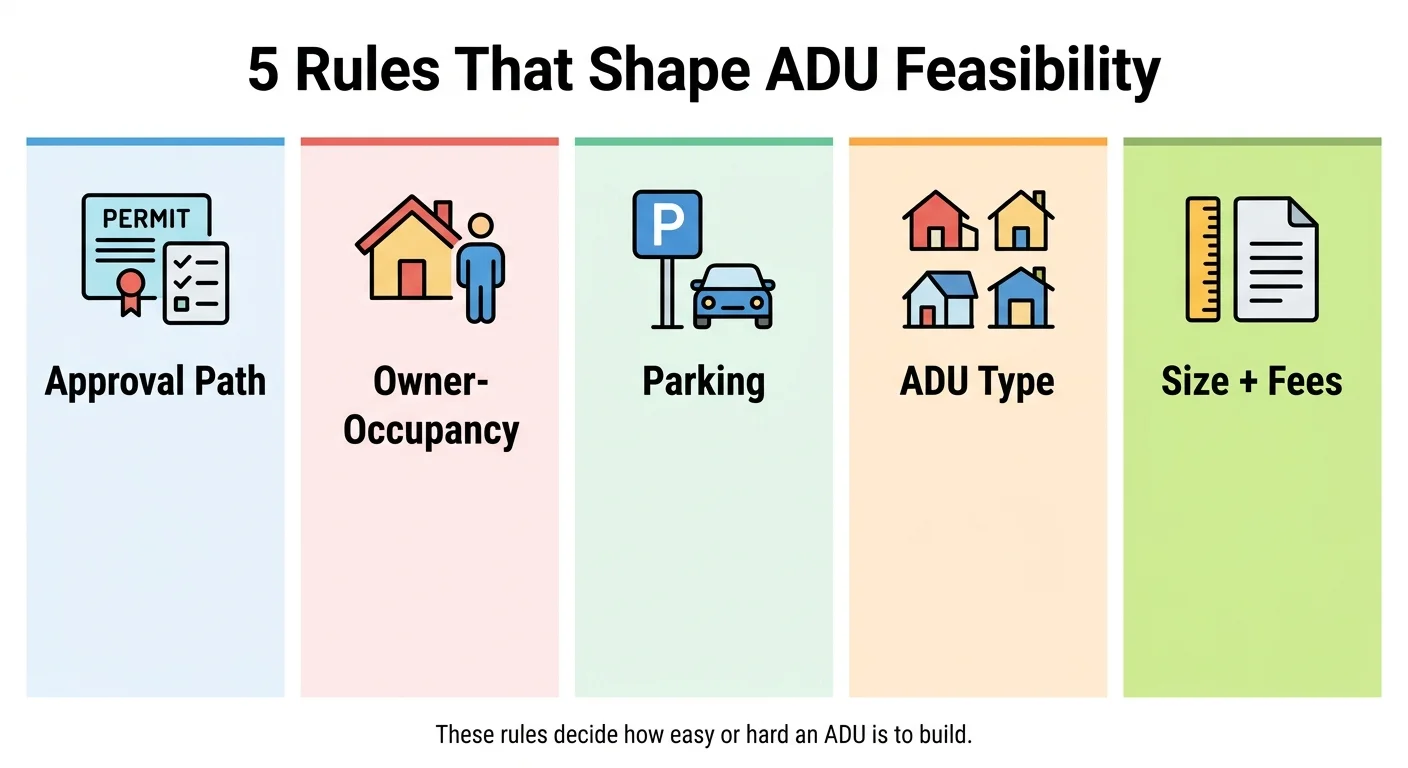
These five rules decide how easy or hard an ADU is to build — and which states have eliminated each barrier.
The Five Rules That Determine Whether Your ADU Gets Built
Before you dive into the full state directory, understand the five regulations that matter most. These are the make-or-break levers that separate a straightforward project from one strangled in red tape.
By-Right vs. Discretionary Approval
"By-right" means your city must approve your ADU through a standard building permit — no public hearing, no neighbor vote, no conditional-use permit. "Discretionary" means a planning commission can deny you, often after a months-long process costing thousands. Research consistently shows that discretionary review is one of the biggest barriers to ADU construction.
Owner-Occupancy Requirements
An owner-occupancy mandate means you must live on-site, either in the main house or the ADU. This kills investment flexibility: if you ever move, you cannot rent both units. It also shrinks your buyer pool. The Federal Housing Administration now allows mortgage borrowers to qualify partly based on ADU rental income — but only if the ADU can be rented without restriction.
Parking Requirements
If your city requires extra off-street parking for an ADU, your backyard may not have room for both the parking and the unit. This is especially fatal for garage conversions — you lose the garage but must somehow replace the parking. Strong states ban parking replacement requirements for garage conversions.
Attached and Detached ADU Types
Some states only allow attached ADUs but not detached backyard cottages. This dramatically limits what you can build — and often makes the ADU less valuable as a rental because it shares walls with the main home. All seven strong statewide states require cities to allow both types.
Size Limits and Impact Fees
Size limits that are too restrictive (under 500 square feet) can make an ADU financially unviable. Impact fees can add significant costs to a project. Strong states cap or eliminate impact fees for smaller ADUs — California, for example, exempts ADUs of 750 square feet or less from impact fees entirely.
ADU Laws in Every State: The A–Z Directory
Every state follows the same template: bottom line, statewide baseline, what to check locally, and the official source. We are not trying to give you a law degree. We are trying to help you answer one question fast: “Is it worth checking my specific address?”
🟢 Strong Statewide (7 states)
Arkansas
🟢 Strong StatewideAct 313 (2025) requires every municipality to allow at least one ADU by right. Attached, detached, and internal units all permitted. No extra parking or owner-occupancy mandates. Max 1,000 sq ft or 75% of primary dwelling. Application fee capped at $250. Effective January 1, 2026.
Check locally: Setbacks, utility/septic capacity.
Source: Act 313 / HB 1503 (2025); A.C.A. § 14-17-209.
Verified: April 2026
California
🟢 Strong StatewideThe most comprehensive ADU framework in the nation. Up to 1,200 sq ft detached; by-right approval; 60-day approval deadline; no owner-occupancy; no parking near transit; HOAs cannot block; separate sale in participating cities (AB 1033). 2025 legislation effective January 1, 2026: SB 543 (tighter permitting timelines, no impact fees on ADUs ≤750 sq ft), AB 1154 (JADU owner-occupancy only if shared bathroom), AB 462 (certificate-of-occupancy and coastal-permit timing for disaster/coastal zones). On multifamily lots: up to 8 detached ADUs on lots with existing multifamily dwellings.
Check locally: Setbacks, height limits, lot coverage.
Source: Cal. Gov. Code §§ 66310–66342; HCD ADU Handbook (2026 addendum).
Verified: April 2026
Colorado
🟢 Strong StatewideHB24-1152 took effect June 30, 2025. Subject jurisdictions must allow 500–750 sq ft ADUs by right. HOA restrictions on ADUs are overridden. Colorado also offers ADU financing programs through the Colorado Housing and Finance Authority (CHFA) and local lenders.
Check locally: Whether your jurisdiction is a "subject jurisdiction" (metropolitan planning area, 1,000+ population).
Source: C.R.S. 29-35-402–405; Colorado DOLA ADU Compliance Framework.
Verified: April 2026
Iowa
🟢 Strong StatewideSF 592 (2025), effective July 1, 2025. Every city and county must allow at least one ADU. Max 1,000 sq ft or 50% of primary residence (whichever is larger). No owner-occupancy. No extra parking. No discretionary review. ADUs can be rented. HOA rules cannot be more restrictive than state law.
Check locally: Deed restrictions, HOA/common-interest community rules.
Source: Iowa SF 592; Iowa Code §§ 331.301(27), 364.3.
Verified: April 2026
Maine
🟢 Strong StatewideLD 2003 allows ADUs and duplexes on most residential lots. Cities cannot require extra parking beyond what the primary dwelling needs. Minimum ADU size is just 190 sq ft, making small conversions viable. Shoreland zones have special requirements but cannot prohibit ADUs outright.
Check locally: Shoreland zone rules, septic capacity.
Source: 30-A M.R.S. § 4364-B.
Verified: April 2026
Oregon
🟢 Strong StatewideHB 2001 eliminated single-family-only zoning in cities over 25,000 residents. ADUs allowed by right — attached, detached, and interior. No owner-occupancy requirement. No parking mandates. Portland has become a national model, including 3-pack developments with a primary dwelling, attached ADU, and detached ADU all owned as condos.
Check locally: City-specific design and setback standards, historic district review.
Source: ORS 197.312; HB 2001 (2019).
Verified: April 2026
Washington
🟢 Strong StatewideHB 1337 requires urban municipalities to allow at least two ADUs per residential lot. One can be attached, one detached — or any combination. No owner-occupancy requirement. ADUs can be sold separately from the primary residence under certain conditions. Cities cannot set maximum floor areas below 1,000 sq ft.
Check locally: City design standards, whether your city is classified as "urban" under the Growth Management Act.
Source: RCW 36.70A.680–696; Washington Dept. of Commerce ADU Guidance.
Verified: April 2026
🟡 Partial Statewide (13 states)
Arizona
🟡 Partial StatewideState law requires covered municipalities (pop. 75,000+) and counties to allow at least one attached and one detached ADU as a permitted use. Phoenix and Tucson have active ADU programs; suburban cities vary.
Check locally: Whether your jurisdiction meets the population threshold, overlay zones, HOA restrictions.
Source: A.R.S. § 9-461.18 (municipal); A.R.S. § 11-810.01 (county).
Verified: April 2026
Connecticut
🟡 Partial StatewidePublic Act 21-29 (2021) sets statewide standards, but municipalities can vote to opt out. About 67% of towns opted in or have their own compliant ordinances. Where the law applies, both attached and detached ADUs are allowed by right with no special permits. The opt-out mechanism means statewide coverage is not guaranteed.
Check locally: Whether your town opted in, local size limits.
Source: Conn. Gen. Stat. § 8-2(a); PA 21-29.
Verified: April 2026
Hawaii
🟡 Partial StatewideCounties have been required to allow ADUs since 1981. Act 39 (2024) significantly expanded the framework: all urban residential-zoned lots must permit at least two ADUs by the end of 2026, and private land-sale covenants (CC&Rs) cannot block ADU development.
Check locally: County ADU ordinance, water/sewer capacity.
Source: HRS § 46-4; Act 39 (2024).
Verified: April 2026
Maryland
🟡 Partial StatewideHB 1466 (2025, effective October 1, 2025) establishes state policy promoting ADUs and requires all charter counties and Baltimore City to adopt local ADU laws by October 1, 2026. ADUs cannot exceed 75% of the primary dwelling's size. HOA restrictions cannot unreasonably limit ADU development. Implementation is actively rolling out.
Check locally: Whether your jurisdiction has adopted its local ADU ordinance yet.
Source: Md. Code, Land Use § 1-501 et seq.; HB 1466 (Chapter 197, 2025).
Verified: April 2026
Massachusetts
🟡 Partial StatewideThe Affordable Homes Act allows by-right ADUs in single-family zones statewide. Max 900 sq ft or 50% of the primary dwelling, whichever is smaller. ADUs remain subject to otherwise applicable dimensional and parking requirements. Municipalities may impose additional restrictions. MassHousing ADU Loan Program now available.
Check locally: Title 5 septic, local parking and size rules.
Source: M.G.L. c.40A § 1A, § 3; MassHousing.
Verified: April 2026
Minnesota
🟡 Partial StatewideStatewide ADU provisions enacted. Max 800 sq ft. ADUs must include a kitchen, bathroom, and lockable entrance. Cities can layer on local rules within the state framework.
Check locally: City-specific design standards.
Source: Minn. Stat. § 462.3571 (verify current enacted status with MN Revisor of Statutes).
Verified: April 2026
Montana
🟡 Partial StatewideADUs must be allowed as rental housing. Max 1,000 sq ft or 75% of primary dwelling's floor area, whichever is less.
Check locally: Local zoning within state framework, well/septic capacity.
Source: MCA 76-2-345 (municipal); MCA 76-2-215 (county zoning).
Verified: April 2026
Nevada
🟡 Partial StatewideAB 396 (2025) requires the most populous counties (100,000+) and cities (60,000+) to adopt ADU ordinances by July 1, 2026. If a qualifying jurisdiction does not comply, ADUs are authorized on any residential parcel without restriction. Reno adopted its ADU ordinance in October 2025.
Check locally: Whether your city/county has adopted its compliant ordinance yet.
Source: AB 396 (Chapter 365, 2025); NRS 278.
Verified: April 2026
New Hampshire
🟡 Partial StatewideMunicipalities must allow both attached and detached ADUs where single-family homes are permitted. The 2025 revised law sets a minimum ADU size floor of 750 sq ft that cities cannot restrict below. However, municipalities can still require owner-occupancy of one of the units.
Check locally: Whether your town requires owner-occupancy, local conditions.
Source: NH RSA 674:71-73; HB 577 (2025).
Verified: April 2026
New York
🟡 Partial StatewideNo comprehensive statewide zoning preemption for ADUs. However, the Plus One ADU Program offers grants up to $125,000 — one of the most generous programs nationally. Administered through participating municipalities and nonprofit partners. Local zoning still determines what is structurally allowed.
Check locally: Local zoning code, Plus One program eligibility.
Source: NY Homes and Community Renewal.
Verified: April 2026
Rhode Island
🟡 Partial StatewideUpdated 2024 law allows one ADU by right on residential lots of 20,000 sq ft or more within an existing footprint. Sets uniform statewide standards, voids conflicting HOA and deed restrictions, and bans tourist/transient ADU use.
Check locally: Whether your lot meets the 20,000 sq ft minimum, local implementation.
Source: R.I. Gen. Laws § 45-24-73.
Verified: April 2026
Utah
🟡 Partial StatewideState law allows internal (attached) ADUs by right on single-family lots. Detached ADUs remain under local control. Salt Lake City, Ogden, and other Wasatch Front cities have their own ADU ordinances.
Check locally: Whether your city allows detached ADUs, local setback rules.
Source: Utah Code § 10-9a-530; OPRO Guidance.
Verified: April 2026
Vermont
🟡 Partial StatewideAct 47 (2023) requires by-right ADU approval statewide. 30-day approval timeline. Max 900 sq ft or 30% of primary dwelling (whichever is greater). State baseline ties the ADU right to an owner-occupied lot. Vermont Housing Improvement Program (VHIP 2.0) offers 0% interest forgivable loans — one of the most generous state programs in the country.
Check locally: Floodplain and fluvial erosion zones.
Source: 24 V.S.A. § 4412(1)(E); Vermont Housing Finance Agency.
Verified: April 2026
🟠 City-by-City (24 states)
Alaska
🟠 City-by-CityNo broad statewide ADU mandate. Anchorage allows ADUs in most residential zones. Other municipalities vary widely.
Check locally: Municipal zoning code, utility/septic capacity.
Source: Local ordinances.
Verified: April 2026
Delaware
🟠 City-by-CityNo broad statewide ADU mandate. Some municipalities in the Wilmington area allow ADUs.
Check locally: County and municipal zoning.
Source: Local ordinances.
Verified: April 2026
Florida
🟠 City-by-CityCurrent state statute (§163.31771) says a local government may adopt an ordinance to allow ADUs in single-family areas — but does not mandate it. Implementation varies widely. Coastal, floodplain, and hurricane zones add complexity.
Check locally: Whether your city has adopted an ADU ordinance, floodplain designation, wind-load requirements.
Source: Fla. Stat. § 163.31771.
Verified: April 2026
Georgia
🟠 City-by-CityNo broad statewide mandate. Atlanta has an active ADU program in most single-family zones. Outside metro Atlanta, policies vary significantly.
Check locally: City zoning map, overlay and historic districts.
Source: Atlanta City Code Ch. 16; local codes.
Verified: April 2026
Illinois
🟠 City-by-CityNo statewide mandate. Chicago launched an ADU pilot program and is expanding it. Many suburbs prohibit ADUs under legacy ordinances.
Check locally: Whether your municipality has an ADU ordinance.
Source: Chicago ADU Ordinance; local codes.
Verified: April 2026
Kansas
🟠 City-by-CityNo broad statewide mandate. Some ADU provisions in Kansas City and Lawrence.
Check locally: City zoning code.
Source: Local ordinances.
Verified: April 2026
Louisiana
🟠 City-by-CityNo statewide mandate. New Orleans allows ADUs in many zones. Most other municipalities are restrictive.
Check locally: City zoning, historic district requirements.
Source: Local ordinances.
Verified: April 2026
Michigan
🟠 City-by-CityNo statewide mandate. Ann Arbor, Detroit, and Grand Rapids have ADU ordinances.
Check locally: Municipal zoning.
Source: Local ordinances.
Verified: April 2026
Missouri
🟠 City-by-CityNo statewide mandate. St. Louis and Kansas City have ADU provisions.
Check locally: City zoning code.
Source: Local ordinances.
Verified: April 2026
Nebraska
🟠 City-by-CityNo statewide mandate. Omaha and Lincoln have ADU provisions.
Check locally: Municipal zoning.
Source: Local ordinances.
Verified: April 2026
New Jersey
🟠 City-by-CityNo broad statewide mandate. Jersey City and some urban areas allow ADUs.
Check locally: Municipal zoning ordinance.
Source: Local ordinances.
Verified: April 2026
New Mexico
🟠 City-by-CityNo statewide mandate. Albuquerque and Santa Fe allow ADUs in certain zones.
Check locally: Municipal zoning, water rights.
Source: Local ordinances.
Verified: April 2026
North Carolina
🟠 City-by-CityNo statewide mandate. Raleigh, Charlotte, Durham, and Asheville have ADU programs.
Check locally: City zoning, whether your city has an ADU ordinance.
Source: Local ordinances.
Verified: April 2026
North Dakota
🟠 City-by-CityNo statewide mandate. Limited ADU activity.
Check locally: Municipal zoning.
Source: Local ordinances.
Verified: April 2026
Ohio
🟠 City-by-CityNo statewide mandate. Columbus, Cleveland, and Cincinnati have ADU provisions.
Check locally: City zoning code.
Source: Local ordinances.
Verified: April 2026
Oklahoma
🟠 City-by-CityNo statewide mandate. Oklahoma City and Tulsa have some ADU provisions.
Check locally: Municipal zoning.
Source: Local ordinances.
Verified: April 2026
Pennsylvania
🟠 City-by-CityNo statewide mandate. Philadelphia allows ADUs in some zones.
Check locally: Municipal zoning ordinance.
Source: Local ordinances.
Verified: April 2026
South Carolina
🟠 City-by-CityNo statewide mandate. Charleston, Greenville, and Columbia have varying ADU provisions.
Check locally: City zoning.
Source: Local ordinances.
Verified: April 2026
South Dakota
🟠 City-by-CityNo statewide mandate. Limited ADU activity.
Check locally: Municipal zoning.
Source: Local ordinances.
Verified: April 2026
Tennessee
🟠 City-by-CityNo statewide mandate. Nashville allows ADUs in some zones.
Check locally: Metropolitan zoning code.
Source: Local ordinances.
Verified: April 2026
Texas
🟠 City-by-CityNo statewide ADU law. Austin is one of the most ADU-friendly cities in the country. Houston's minimal zoning effectively allows ADUs in many areas. But most Texas cities set their own rules, and many restrict ADUs.
Check locally: City zoning code, lot-size requirements, deed restrictions.
Source: Local ordinances.
Verified: April 2026
Virginia
🟠 City-by-CityNo statewide mandate. Arlington, Alexandria, Fairfax County, and Charlottesville allow ADUs.
Check locally: County or city zoning code.
Source: Local ordinances.
Verified: April 2026
Wisconsin
🟠 City-by-CityNo statewide mandate. Madison, Milwaukee, and some cities allow ADUs.
Check locally: Municipal zoning code.
Source: Local ordinances.
Verified: April 2026
Wyoming
🟠 City-by-CityNo statewide mandate. Some ADU provisions in Jackson Hole and Cheyenne areas driven by housing pressure.
Check locally: Municipal zoning.
Source: Local ordinances.
Verified: April 2026
🔴 Restricted (6 states)
Alabama
🔴 RestrictedNo broad statewide ADU mandate identified. Most local governments restrict or functionally prohibit ADUs. Some municipalities in the Birmingham and Huntsville metro areas allow ADUs through conditional-use permits.
Check locally: City zoning code.
Source: Local municipal ordinances.
Verified: April 2026
Idaho
🔴 RestrictedNo broad statewide ADU mandate. Boise has expanded ADU allowances, but most of the state remains restrictive.
Check locally: Municipal zoning code.
Source: Local ordinances.
Verified: April 2026
Indiana
🔴 RestrictedNo broad statewide ADU mandate. Local zoning in most municipalities restricts or effectively prohibits ADUs.
Check locally: City zoning code.
Source: Local ordinances.
Verified: April 2026
Kentucky
🔴 RestrictedNo broad statewide ADU mandate. Louisville and Lexington have some ADU provisions.
Check locally: Local zoning and building code.
Source: Local ordinances.
Verified: April 2026
Mississippi
🔴 RestrictedNo broad statewide ADU mandate identified. Among the most restrictive zoning environments for ADU development.
Check locally: Municipal zoning.
Source: Local ordinances.
Verified: April 2026
West Virginia
🔴 RestrictedNo broad statewide ADU mandate. Most municipalities restrict ADU development.
Check locally: Municipal zoning.
Source: Local ordinances.
Verified: April 2026
Found your state? Now the real question is whether your specific property qualifies. State law sets the floor — your city, lot, and site conditions set the ceiling.
Your next step is simple:
State law confirmed — now check what your specific address can support.
Free report · 60 seconds · No sales call · No commitment
Get Your Free ADU Report →Detailed reports currently available in CA, UT, TX, CO, and NY.
What State Law Still Does Not Tell You
This is where most ADU guides stop — and where most homeowners get blindsided. Even in the strongest ADU states, state law does not override everything. Here is what your state tracker cannot answer:
City zoning and overlay districts
Your city may have historic preservation overlays, coastal zones, wildfire hazard areas, floodplain designations, or other special districts that add requirements even when state law broadly allows ADUs.
Setbacks and lot coverage
State law may guarantee your right to build an ADU, but it does not determine where on your lot it can go. Setback requirements, lot coverage maximums, and floor-area ratios are typically set locally.
Utilities and septic
In suburban and rural areas, utility capacity — especially sewer, water, and electrical — can make or break a project. If your home is on septic, adding a second dwelling may require a Title 5 inspection (Massachusetts), a septic upgrade, or a new drain field.
HOA and deed restrictions
California, Colorado, and Arkansas have banned HOA interference with ADU construction. Iowa prohibits HOA rules from being more restrictive than state law. Maryland prohibits unreasonable restrictions. Most other states have not addressed HOAs. Always check your CC&Rs.
Corner lots, flag lots, and irregular parcels
Unusual lot shapes can create setback conflicts, access issues, or fire-code complications that standard rectangular lots would not face.
Short-term rental rules
Even if your state and city allow the ADU, they may prohibit short-term rentals (Airbnb, VRBO). California JADUs cannot be used as short-term rentals. Rhode Island's updated law bans tourist/transient ADU use. Many cities have separate short-term rental ordinances.
One honest reality: ADU permitting is not instant, even in the friendliest states. Plan review typically takes weeks, not days, and construction costs are higher than they were a few years ago. But here is the bigger picture: more states have passed ADU legislation in the last four years than in the previous four decades combined. The systemic barriers that used to make ADUs nearly impossible — discretionary approvals, parking mandates, owner-occupancy rules — are falling fast. Homeowners who navigate the process are adding real property value and creating housing that generates real monthly income.
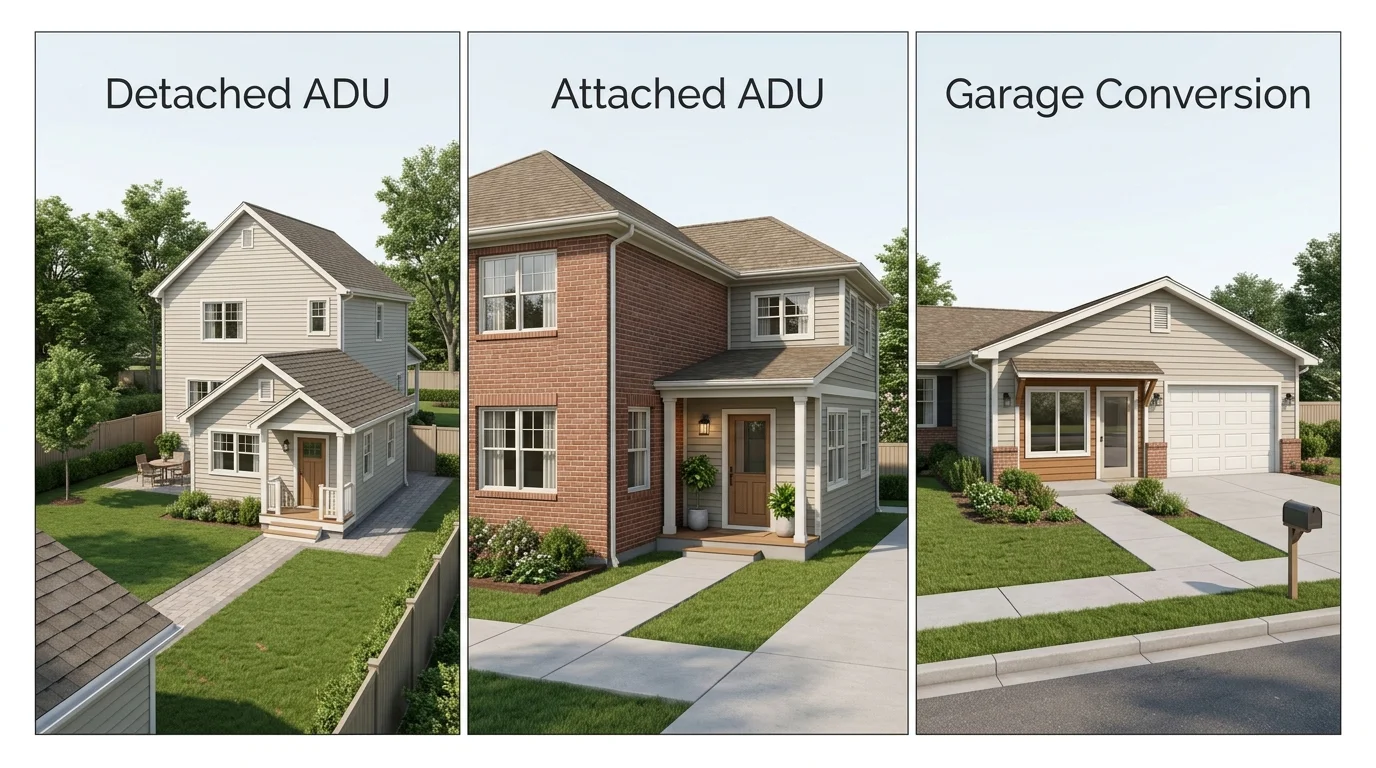
All seven strong statewide framework states require municipalities to allow both attached and detached ADUs — not just one type.
How to Check If You Can Build an ADU — In About 10 Minutes
Here is the fastest path from “I wonder” to “I know.”
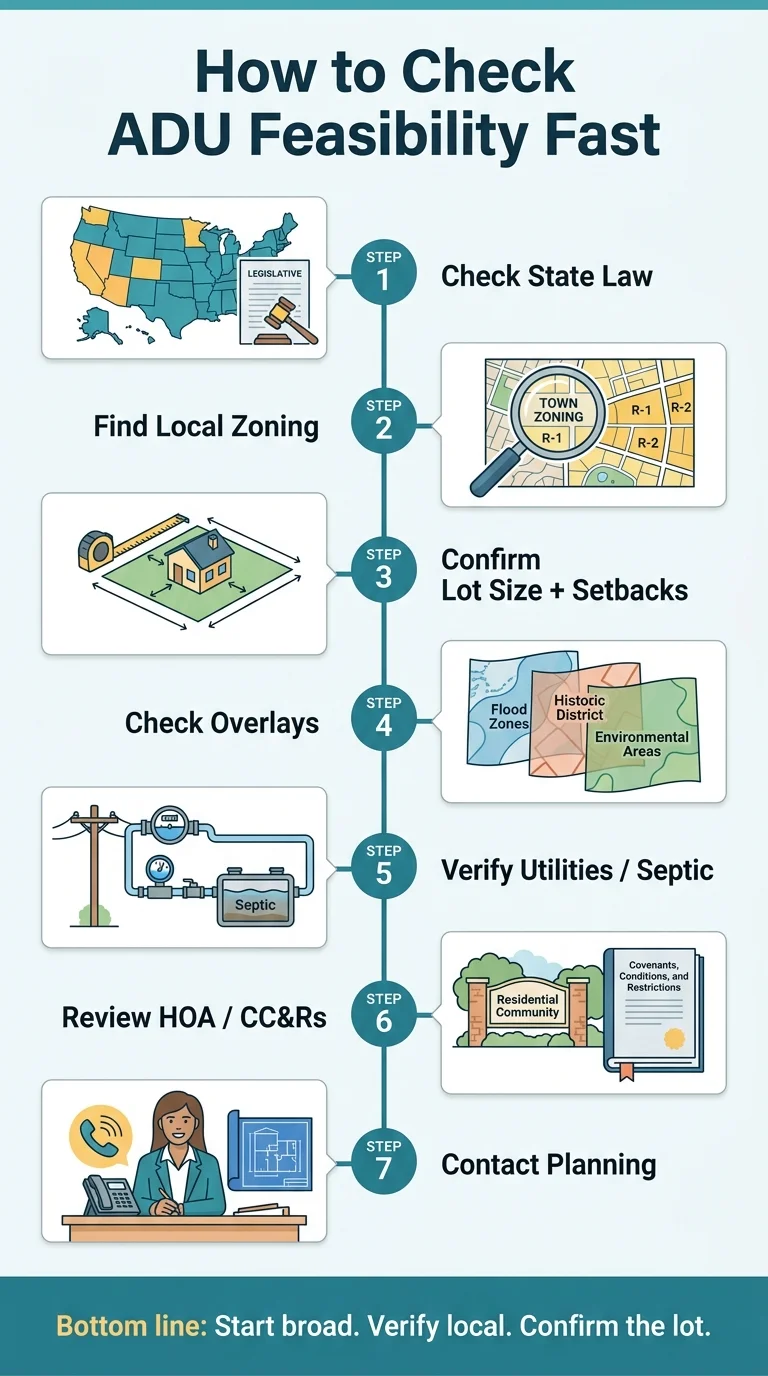
Start broad, verify local, confirm the lot. These 7 steps take about 10 minutes and prevent costly surprises.
Check your state's baseline
Use the directory above. If your state has a strong or partial statewide framework, you have a legal floor that your city cannot easily take away.
Find your city's zoning map
Search "[your city] zoning map" or "[your city] GIS parcel viewer." Find your property and note your zoning classification. Then search "[your city] ADU ordinance."
Confirm lot size, setbacks, and existing structures
Your city's zoning code will specify minimum lot sizes, setback requirements, and maximum lot coverage. These numbers determine where on your lot the ADU can physically go.
Check for overlay districts and special zones
Look for historic districts, floodplain designations, fire hazard zones, or coastal zones. These can add requirements even in states with strong statewide frameworks.
Verify utility and septic capacity
If you are on municipal sewer and water, check whether your city charges utility connection fees for ADUs. If you are on septic, contact your county health department. Septic capacity is a common deal-breaker in suburban and rural areas.
Check HOA and deed restrictions
In California, Colorado, Arkansas, and Iowa, HOAs cannot block ADUs or impose more restrictive rules than state law. In most other states, they can. Review your CC&Rs before spending money on plans.
Contact your city's planning department
A 10-minute call with your parcel number can confirm or flag issues faster than hours of online research. Most planning departments are helpful — they want permitted projects.
Want to skip the manual legwork? Get your property-specific ADU report in 60 seconds.
Check your address in 60 seconds — free, no commitment.
Check My Property →Detailed reports available in CA, UT, TX, CO, and NY.
What If Your State Looks Restrictive?
A “restricted” or “city-by-city” rating does not mean “no ADU.” It means the answer lives at the local level.
Look at your city, not just your state. Texas has no statewide ADU law, but Austin is one of the most ADU-friendly cities in America. Illinois has no statewide framework, but Chicago's ADU program is expanding.
Garage and basement conversions are often easier. In restrictive areas, converting existing space may face fewer barriers than building a new detached structure.
The momentum is on your side. More states passed ADU legislation in the last four years than in the previous four decades. AARP, housing advocacy groups, and both political parties are increasingly supportive. If your state has not acted yet, it may be a matter of time.
What Changed in 2025–2026
ADU legislation is a fast-moving target. Here are the most significant recent changes:
Act 313 created the state's first comprehensive ADU framework, requiring every municipality to allow ADUs by right with no parking or owner-occupancy mandates.
SF 592 made Iowa one of the strongest statewide ADU frameworks in the country — by-right approval, no parking, no owner-occupancy, no discretionary review.
SB 543 tightened permitting timelines. AB 1154 changed JADU owner-occupancy rules. AB 462 addressed coastal and disaster-zone ADU permits.
HB 1466 created a statewide ADU policy framework with mandatory local implementation — the first comprehensive ADU law in Maryland history.
AB 396 requires major cities and counties to adopt ADU ordinances. Non-compliant jurisdictions face automatic ADU authorization.
HB24-1152 went live, creating the state's first comprehensive ADU framework. HOA restrictions on ADUs overridden statewide.
ADU Grants and Incentive Programs by State
Several states offer financial assistance for ADU construction. Always verify current status directly with the program — many have limited funding or eligibility requirements.
| State | Program | Amount | Status (April 2026) |
|---|---|---|---|
| California | CalHFA ADU Grant | Up to $40,000 | Fully allocated as of Dec 2023; not currently accepting applications. Confirm with CalHFA for future rounds. |
| New York | Plus One ADU Program | Up to $125,000 | Active — verify eligibility with NY HCR. |
| Vermont | VHIP 2.0 | 0% interest forgivable loans | Active — verify with VHFA. |
| Colorado | CHFA ADU Financing | Varies by lender | Active through local lenders. |
| Massachusetts | MassHousing ADU Loan | Varies | Active — verify with MassHousing. |
Confirm program status directly with the administering agency before making plans that depend on grant or loan funding. Some city and county governments also offer local ADU incentive programs not listed here.
While state-level funding can significantly reduce costs, most homeowners finance their ADU through home equity, construction loans, or cash-out refinance. If grant funding is unavailable or your project does not qualify, these remain proven paths. Explore ADU financing options →
Free Resource
Free 2026 ADU Starter Kit
State law summaries, cost worksheets, permitting checklists, and financing comparison guides — before you talk to a single contractor. Over 14,000 homeowners have downloaded it this year.
Download Free Starter Kit →Types of ADUs: Quick Reference
The type of ADU your state's law covers — and the type your lot can support — shapes everything. Here's the essential reference:
Detached ADU (Backyard Cottage / DADU)
A standalone structure with its own entrance, kitchen, bathroom, and living space. Highest rental value and property-value impact. Requires the most lot space.
Attached ADU
An addition to your main house with its own entrance and facilities. Often less expensive because you share one wall. Requires structural connection to the primary dwelling.
Garage Conversion
Converting an existing garage into a living unit. Often the lowest-cost path because the structure already exists. Strong states ban parking replacement requirements for garage conversions.
Basement or Attic Conversion (Internal ADU)
Finishing existing interior space into a separate unit. This is the type allowed by-right under Utah's statewide law. Often the fastest path in restrictive areas.
Junior ADU (JADU)
A California-specific designation for a unit of 500 sq ft or less within an existing single-family home. Different rules apply — including potential owner-occupancy requirements (if the JADU shares a bathroom) and a ban on short-term rentals.
All seven “strong statewide” framework states require cities to allow both attached and detached ADUs.
Frequently Asked Questions About ADU Laws by State
Are ADUs legal in every state?
ADUs are possible in all 50 states, but the ease of building varies enormously. More than 20 states have enacted statewide ADU legislation. In states without statewide laws, whether you can build depends on your local zoning code.
Which state is the most ADU-friendly?
California has the most comprehensive and well-established ADU framework, followed closely by Oregon and Washington. Arkansas and Iowa are recent standouts — both passed strong statewide laws in 2025.
Can my city override state ADU law?
In "strong statewide" framework states (CA, OR, WA, CO, ME, AR, IA), no — your city cannot reimpose the barriers that state law removes. In "partial" states, your city may retain control over certain regulations. In "city-by-city" states, your city has full control.
Can my HOA stop me from building an ADU?
In California, Colorado, Arkansas, and Iowa, HOAs cannot prohibit or impose more restrictive rules on ADU construction than state law. Maryland prohibits unreasonable HOA restrictions on ADUs. In most other states, HOA CC&Rs can still restrict or prohibit ADUs.
How big can an ADU be?
Size limits vary by state and city. Common maximums range from 750 to 1,200 square feet. California allows up to 1,200 sq ft for detached ADUs. Vermont caps at 900 sq ft or 30% of the primary home. Iowa caps at 1,000 sq ft or 50% of primary residence, whichever is larger.
Do I need extra parking for an ADU?
In strong statewide framework states, parking mandates are banned or severely limited. In other states, you may need additional spaces. Exemptions commonly apply near transit stops and for garage conversions.
Can I rent out my ADU?
In all states with statewide ADU laws, ADUs can be used as rental housing. Short-term rental rules are set separately and vary by city — always check local ordinances.
Can I sell my ADU separately?
In California (AB 1033) and parts of Washington, ADUs can be sold as separate condominiums. In most places, the ADU must remain part of the same property as the primary dwelling.
How long does ADU permitting take?
In California, cities must act within 60 days (with a 15-day completeness review). Vermont requires action within 30 days. In states without mandated timelines, permitting can vary significantly.
What is a JADU?
A Junior Accessory Dwelling Unit (JADU) is a California-specific designation for a unit of 500 square feet or less within an existing single-family home. JADUs have different rules including a ban on short-term rentals.
What states allow two ADUs on one lot?
Washington requires urban municipalities to allow at least two ADUs per residential lot. Hawaii will require at least two per urban residential lot by the end of 2026.
What should I check before paying for plans?
Follow the seven-step workflow above: state baseline, city zoning, lot dimensions, overlays, utilities, HOA, and a planning department call. Do not pay for drawings until you have confirmed the project is feasible.
Your next step is simple:
Know your state. Know your rights. Now see what's actually buildable at your address.
Free report · 60 seconds · No sales call · No commitment
Get Your Free ADU Report →Detailed reports currently available in CA, UT, TX, CO, and NY.
Editorial Methodology and Sources
Every state entry in this directory is verified against an official state statute, agency handbook, legislative record, or municipal ordinance. We use the framework developed by Emily Hamilton and Kol Peterson at the Mercatus Center at George Mason University — specifically their Taxonomy of State Accessory Dwelling Unit Laws (August 2025) — as the foundation for our tier classifications.
How we classify states:
- Strong Statewide: State law eliminates all three “poison pill” barriers (owner-occupancy, parking mandates, discretionary approval) and requires both attached and detached ADUs.
- Partial Statewide: State law exists but leaves one or more poison pills in local hands, retains an opt-out mechanism, is newly enacted with implementation still rolling out, or provides a funding program without full zoning preemption.
- City-by-City: No broad statewide ADU preemption identified. Policies set by local governments.
- Restricted: No statewide law and most local governments restrict or functionally ban ADUs.
How often we verify: Full review twice per year (January and July). Individual state entries updated within 30 days of significant legislative changes. Each entry includes a verification date.
Why local confirmation is still required: State-level classifications cannot capture lot-specific factors like setbacks, utility capacity, overlay districts, or HOA restrictions. Always confirm with your local planning department before making financial commitments.
Key sources:
- Mercatus Center: A Taxonomy of State Accessory Dwelling Unit Laws 2025 (Hamilton & Peterson, August 2025)
- California HCD: ADU Handbook with 2026 Addendum
- Washington Dept. of Commerce: ADU Guidance
- AARP: ADU Model State Act and Local Ordinance (2021)
- Virginia Housing Commission: Exploring ADU Regulation Discussion Points and State Practices
- Individual state statutes as cited per entry
Your next step is simple:
Not sure where to start? See what is possible at your address — get your free ADU feasibility report in 60 seconds.
Free report · 60 seconds · No sales call · No commitment
Get Your Free ADU Report →Detailed reports currently available in CA, UT, TX, CO, and NY.
Free Resource
Free 2026 ADU Starter Kit
State law summaries, cost worksheets, permitting checklists, and financing comparison guides — before you talk to a single contractor. Over 14,000 homeowners have downloaded it this year.
Download Free Starter Kit →Related Guides
- →California ADU Laws 2026: Rules, Setbacks, Fees & Permits
- →ADU Financing Options 2026: HELOC vs Refi vs Loan
- →ADU Rental Income: How Much Can You Actually Make? (2026)
- →How Much Does an ADU Cost? Real 2026 Prices by Type
- →What Is an ADU? Definition, Types, Costs & Rules (2026)
- →Modular ADU: Costs, Rules & When Modular Wins (2026)
The Dwelling Index is an independent educational resource. We are not a law firm, lender, or builder. Our content is not legal, financial, or construction advice. State ADU laws change frequently — consult qualified professionals and your local planning department before making financial commitments specific to your property and situation.
Affiliate Disclosure · Editorial Methodology · Privacy Policy