
ADU Cost in Oceanside (2026): Real Prices, Permit Fees & Calculator
Real city permit fees from Oceanside’s own eTRAKiT records, the 500/750 sq ft rules that move your budget by thousands, the SDG&E meter most quotes skip, and what a complete Oceanside ADU project actually costs in 2026.
The bottom line, up front
The ADU cost in Oceanside in 2026 lands between $80,000 and $575,000 depending on what you build. A typical detached new-construction ADU at 750–1,000 sq ft runs $300,000 to $500,000 all-in. A garage conversion runs $150,000 to $250,000. A JADU runs $80,000 to $150,000. Where you land depends on five things most quotes don’t lead with: the SDG&E separate-meter requirement, your school district, whether your lot is in the coastal zone, your sewer distance, and the difference between a “vertical build” price and a true all-in project cost.
See exactly what you can build on your Oceanside lot
Free, 60 seconds, no sales call.
Get My Free Oceanside ADU Report →Oceanside ADU cost at a glance (2026)
| ADU path | Typical size | All-in budget (2026) | $/sq ft | The Oceanside catch |
|---|---|---|---|---|
| JADU / interior conversion | ≤ 500 sq ft | $80K–$150K | Varies | Owner-occupancy required; loses interior space |
| Garage conversion | 350–600 sq ft | $150K–$250K | $300–$450 | Old slab, fire separation, utilities can erase savings |
| 500 sq ft detached | 500 sq ft | $250K–$325K | $500–$650 | Smallest ADUs cost the most per sq ft |
| 749–750 sq ft detached | ~750 sq ft | $300K–$400K | $400–$535 | Right at the 750 sq ft local impact-fee line |
| 1,000 sq ft detached | 1,000 sq ft | $400K–$500K | $400–$500 | 4-ft setback still applies (state-exempt size) |
| 1,200 sq ft detached | 1,200 sq ft | $450K–$575K | $375–$480 | Falls back to base-zone setbacks above 1,000 sq ft |
| Attached new build | 600–1,000 sq ft | $250K–$450K | $325–$500 | Local 50% cap; state safe-harbor still applies |
| Prefab / modular turnkey | 400–1,000 sq ft | $180K–$320K | $250–$450 | Unit price ≠ full project cost |
Sources: SnapADU 2026 San Diego County cost methodology; Better Place Design & Build Oceanside per-sq-ft tiers (verified March 2026); City of Oceanside eTRAKiT permit records BLDG25-1441, BLDG25-0230, BLDG25-0149 (pulled May 2026).
What is the ADU cost in Oceanside in 2026?
A detached new-construction ADU in Oceanside costs $375–$600 per square foot all-in in 2026, which translates to roughly $300,000 for a 500 sq ft unit, $350,000 for a 750 sq ft unit, $425,000 for 1,000 sq ft, and $450,000 for 1,200 sq ft at typical builder pricing. Smaller ADUs cost more per square foot because kitchen, bathroom, and utility-connection costs are fixed regardless of unit size. Garage conversions, JADUs, and prefab units come in materially lower when site conditions cooperate.
Cost by square footage — and why smaller is rarely cheaper per foot
| ADU size | Approximate $/sq ft | What’s happening |
|---|---|---|
| 500 sq ft | ~$600/sq ft | Fixed costs (kitchen, bath, utility tie-ins, permits, design) spread over fewer feet |
| 750 sq ft | ~$465/sq ft | More efficient — added square footage adds material, not new systems |
| 1,000 sq ft | ~$425/sq ft | The sweet spot for most rental-driven projects |
| 1,200 sq ft | ~$375/sq ft | Lowest per-foot rate, highest total cost |
That table explains why a 500 sq ft ADU at $300,000 total can pencil less efficiently than a 750 sq ft unit at $350,000 — you paid an extra $50,000 for an extra 250 sq ft of livable space, a better ratio than the original $300,000 you spent on the first 500.
The $375–$600 spread — what actually moves you within it
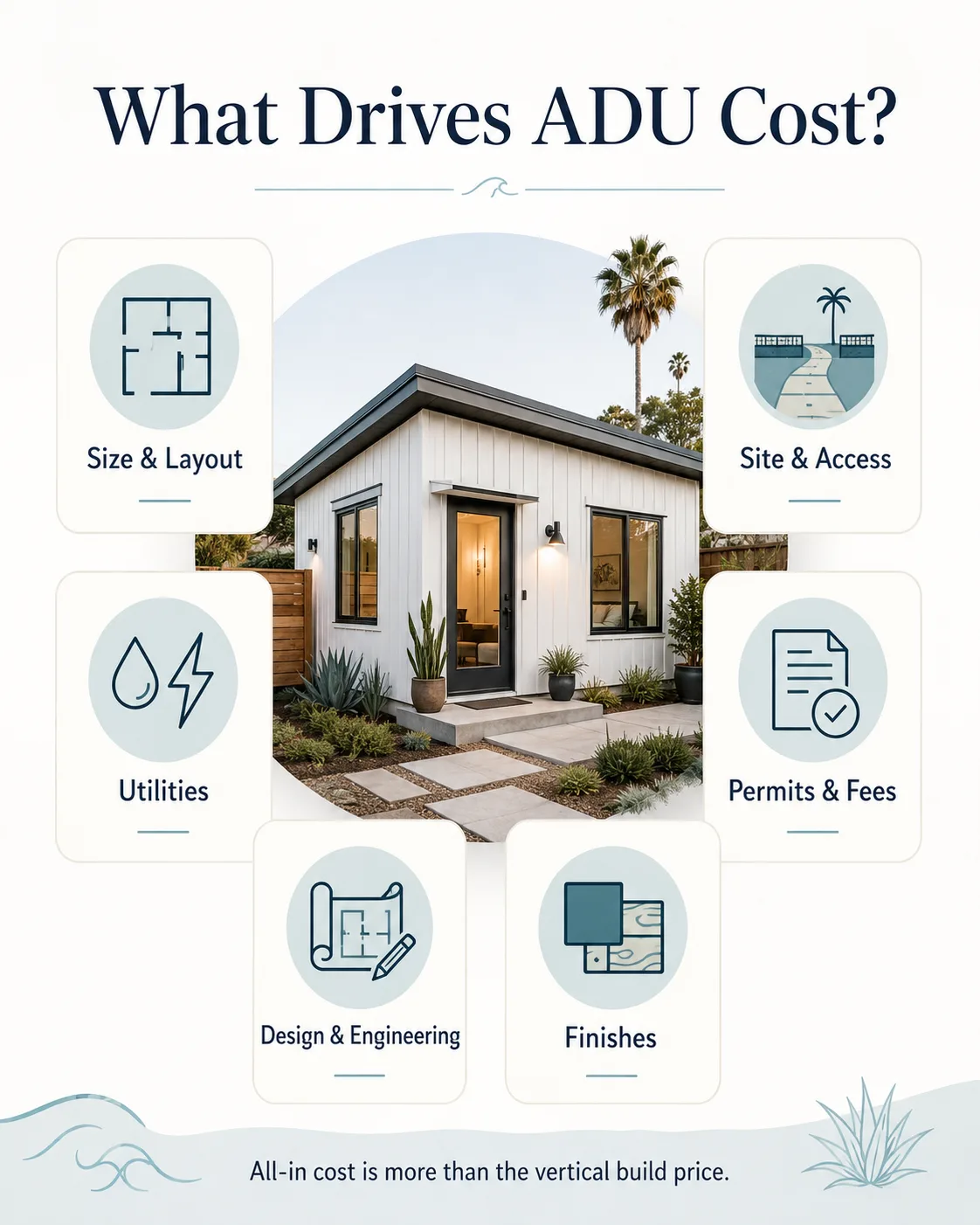
- Lot conditions. A flat lot in San Luis Rey with sewer 30 ft from the house is the baseline. A hillside lot in Fire Mountain with 80 ft of trenching and grading adds $10,000 to $40,000.
- SDG&E separate meter. New detached ADUs in SDG&E territory have generally required a separate electric meter since March 2023. Published builder estimates put installed cost around $12,000–$15,000, before any needed panel upgrade ($3,000–$8,000 more if required).
- Sewer distance. Trenching beyond 100 ft from the main house adds materially to cost.
- Foundation type. Standard slab is the baseline; raised foundations for soil or seismic reasons add cost.
- Two-story. Allowed in Oceanside but subject to base-zone setbacks, not the ADU 4-foot rule, which can force expensive design changes.
- Finish level. Builder-grade vinyl plank and stock cabinets versus quartz and oak shifts a 750 sq ft project by $20,000–$50,000.
- Coastal zone. A lot west of I-5 may require a mailing-list noticing step plus tighter setbacks.
- Construction-cost inflation. SnapADU reports California’s Construction Cost Index rose 44% from January 2021 through December 2025 — meaningful context for anyone working from pre-2024 cost ranges.
Three real Oceanside permits — permit-account fees from city records
Headline cost ranges are useful. Real recorded numbers are better. We pulled three current ADU permits from the City of Oceanside’s eTRAKiT public portal to anchor the permit-fee picture. These are city permit-account fees only — not full construction cost, and not all third-party costs:
| Permit | Project | Permit-account fee | Application → Issuance | Elapsed days |
|---|---|---|---|---|
| BLDG25-1441 | Detached 546 sq ft ADU | $7,181.85 | Jul 15, 2025 → Feb 4, 2026 | ~204 days |
| BLDG25-0230 | Detached 749 sq ft 2BR/2BA ADU | $7,741.48 | Jan 30, 2025 → Oct 6, 2025 | ~249 days |
| BLDG25-0149 | Garage conversion + 223 sq ft addition | $3,174.21 | Jan 22, 2025 → Apr 16, 2026 | ~449 days |
Real city permit-account fees for a typical Oceanside detached ADU cluster in the $7,000–$8,000 range — higher than the $2,160 estimate some statewide ADU summaries publish, and lower than the $15,000–$20,000 some builder marketing suggests. A garage conversion’s city fee can be less than half a new detached build’s fee, because conversion work is assessed under the addition/remodel fee schedule rather than the new single-family dwelling schedule.
The full Oceanside ADU cost stack — line by line
Here’s the stack for a typical 750 sq ft detached new build:
| Cost line | Typical range | Notes |
|---|---|---|
| Vertical build (structure, finishes, systems) | $250,000–$330,000 | ~85% of typical project cost; the number a quote usually shows |
| Design + engineering | $7,500–$15,000 | Architectural, structural, Title 24 energy compliance |
| Permits + plan check (city) | $7,000–$10,000 | Real eTRAKiT 2025 examples support this band |
| Site work | $15,000–$30,000 | Grading, drainage, demo, access |
| SDG&E separate meter | $12,000–$15,000 | Generally required for new detached ADUs since March 2023 |
| Water buy-in fee | $0–$10,000+ | Pro-rated if meter must be upsized |
| School fees (OUSD) | $0–$5,748 | $0 if ≤500 sq ft; $4.79/sq ft above |
| Boundary + verification survey | $1,500–$3,000 | Both required for plan review |
| Coastal mailing list (if applicable) | $200–$500 | Title or survey company prepares it |
| Landscaping / restoration | $3,000–$15,000 | Often excluded from quotes |
| Contingency (10%) | $30,000–$50,000 | Real projects use it |
| Total all-in | $326,200–$483,248 | For a 750 sq ft detached ADU |
When a quote shows you $300,000, ask which of these lines it includes. If you’re getting bids from three builders, the only way to compare them is to ask each one to show this stack.
What does “all-in” ADU cost actually include in Oceanside?
An “all-in” Oceanside ADU cost should cover design, engineering, plan check, permits, school fees, utility upgrades, sitework, vertical construction with finish allowances, inspections, energy compliance, and a contingency. If a quote excludes sewer trenching, the SDG&E meter, panel upgrades, school fees, water buy-in, finish allowances, or contingency, it’s not actually all-in — it’s a vertical-build price wearing an all-in label.
Hard costs
Foundation, framing, roofing, windows, siding, insulation, drywall, cabinets, fixtures, HVAC, plumbing, electrical, and finishes. Makes up roughly 80–90% of total project cost on most Oceanside ADUs.
Soft costs
Design and architectural plans, structural engineering, Title 24 energy documentation, CalGreen compliance, surveying, permit submittal, plan check, and consultant coordination. Typically 10–20% of the budget.
Site & utility costs
Sewer line, water service, SDG&E meter, gas if applicable, trenching, grading, drainage, retaining walls, demolition, and SDG&E coordination work. Variability here is enormous — a flat lot versus a hillside lot can differ by $25,000–$40,000.
Public-agency fees
City building plan check, building permit, planning review, fire review, state surcharges, school district developer fees, and any water buy-in if your meter must be upsized. The City of Oceanside’s published fee schedule is informational — actual fees depend on scope.
| Cost item | In all-in quote? | What to ask |
|---|---|---|
| Design + engineering | Yes | Are plans, structural, and Title 24 included or separate? |
| City plan check + building permit | Yes or itemized | Is the city fee a passthrough or estimated in the contract? |
| School fees (OUSD/VUSD) | Itemized separately | Are school developer fees the owner's responsibility? |
| Water meter upsize | Flagged as possible | If the city requires a water buy-in, who pays it? |
| Sewer trenching | Yes or with allowance | Is there a trenching allowance, and what's the per-foot rate beyond it? |
| Electrical panel upgrade | Yes or with allowance | What if my panel can't handle the new ADU load? |
| SDG&E separate meter | Yes | Is the meter coordination and installation in your scope? |
| Landscaping + restoration | Usually excluded | What's left to do at substantial completion? |
| Appliances | Often excluded | What appliances, if any, are included? |
| Fencing | Almost always excluded | Same for fencing? |
How do Oceanside permit fees and school fees actually change your budget?
The sharpest fee threshold sits at 500 square feet — under that size, your ADU is exempt from school impact fees entirely under state law. The 750 sq ft threshold is the next key line: per California Government Code §66311.5, ADUs with 750 sq ft or less of interior livable space shall not be charged local impact fees; ADUs over 750 sq ft may be charged proportionately.
The 500 sq ft school-fee threshold
Oceanside Unified School District (OUSD) publishes its current residential developer fee at $4.79 per square foot, with residential construction under 500 sq ft exempt from the school fee entirely. Source: oside.us/departments/fiscal-services/developer-fees, verified May 2026.
School fees in OUSD’s boundary
- 499 sq ft ADU: $0 in school fees
- 546 sq ft ADU: ~$2,615
- 749 sq ft ADU: ~$3,588
- 1,000 sq ft ADU: ~$4,790
- 1,200 sq ft ADU: ~$5,748
If your lot is in Vista Unified School District (parts of east Oceanside), verify VUSD’s current developer-fee rate separately — districts publish their own schedules and they update annually.
The 750 sq ft local impact-fee threshold
Per California’s HCD ADU Handbook (updated March 2026) and Government Code §66311.5: ADUs with 750 sq ft or less of interior livable space shall not be charged local impact fees. ADUs over 750 sq ft may be charged proportionately. There’s a real budget reason 749 sq ft shows up so often in builder portfolios — it’s the largest unit you can build before the local impact-fee math turns proportionate.
The SDG&E meter — the line item most quotes miss
Since March 2023, San Diego Gas & Electric has generally required a separate electric meter for new detached ADUs in its service territory. Published builder estimates put installation around $12,000–$15,000, with an additional $3,000–$8,000 if your main panel can’t carry the ADU’s added load. This is one of the most common omissions in builder quotes — ask the question explicitly. Per Government Code §66311.5, conversion ADUs and JADUs are treated differently from new detached ADUs under state utility-connection rules, so the meter requirement on a garage conversion or interior JADU is not automatic.
| Project type | Sample size | City permit-account fee | Per sq ft |
|---|---|---|---|
| Detached new | 546 sq ft | $7,181.85 | $13.15/sq ft |
| Detached new | 749 sq ft | $7,741.48 | $10.34/sq ft |
| Garage conversion + addition | 223 sq ft addition | $3,174.21 | n/a (mixed scope) |
Know your fee triggers before you pay for plans
The 500 and 750 sq ft thresholds, your school district, coastal status, and water-meter upsize likelihood — the Feasibility Engine flags all four for your specific address in 60 seconds.
Run My Free Oceanside ADU Fee Check →What Oceanside rules can change your ADU cost before construction even starts?
Oceanside permits ADUs by-right under California state law, but the city’s local rules tighten as your unit grows past the state-exempt sizes (850 sq ft for studios/1BR, 1,000 sq ft for 2BR+) and as your lot moves closer to the coast. The 4-foot setback that makes most ADU floor plans work only applies up to those state-exempt sizes — above them, your project falls back to your zone’s normal setbacks, which can easily kill a design that worked on paper.
Size limits
Under California Government Code §66311 et seq. and Oceanside’s Article 30, Section 3006 of the Zoning Ordinance, the city allows:
- State-exempt sizes (4-ft setbacks, 16-ft height): 850 sq ft for studio or 1-bedroom; 1,000 sq ft for 2-bedroom or larger.
- Local maximum: 1,200 sq ft detached, subject to standard setbacks, lot coverage, and height of your underlying zone.
- JADU: 500 sq ft maximum, carved out of the existing primary dwelling, must include efficiency kitchen, may share sanitation, requires owner-occupancy under state law (Gov. Code §66333(a)(2)).
- The practical trap: A homeowner draws a 1,100 sq ft ADU using the 4-ft setback, takes it to plan check, and discovers that 1,100 falls above the 1,000 sq ft state-exempt size — which means base-zone setbacks (10–15 ft) now apply. The design no longer fits.
Coastal zone
Oceanside’s coastal zone generally covers the area west of I-5, which includes most of 92054 (Downtown Oceanside, South Oceanside, Buccaneer Beach area). Portions of 92056 and small portions of 92057 also fall within the coastal zone. Coastal-zone ADAs must meet the requirements of Oceanside’s Local Coastal Program (LCP), including a mailing-list noticing requirement. Under California AB 462 (effective October 10, 2025), the city does not charge a separate Coastal Development Permit fee for ADUs — but you’ll spend $200–$500 with a title or survey company for the mailing list. Always verify your parcel’s coastal status using Oceanside’s GIS Map Viewer, not your ZIP code.
STR ban — no Airbnb on post-2017 ADU lots
Oceanside Zoning Ordinance Section 3006(E)(3) prohibits short-term rental use of either the ADU or the primary residence on any property with an ADU/JADU permitted on or after September 9, 2017. AirDNA-style short-term-rental income projections do not apply to new Oceanside ADUs. Build your pro forma on long-term rents only.
Parking
No replacement parking is required when a garage conversion displaces existing parking. This applies even if you tear out a two-car garage. State law and Oceanside’s ordinance align on this point.
How long does an Oceanside ADU permit take — and what does it cost your schedule?
California Government Code §66317 requires Oceanside to issue a ministerial decision on a complete ADU application within 60 days. In practice, the three Oceanside permits we pulled from eTRAKiT took 204, 249, and 449 days from application to issuance. That gap isn’t Oceanside violating state law — it’s because the 60-day clock stops when the city issues plan-check comments and restarts when you resubmit. Plan for 6–12 months of design-plus-permit calendar time on most detached ADUs.
The 60-day ministerial review timeline is real law. But the clock stops during plan-check correction cycles. Most Oceanside ADU projects go through 2–3 correction cycles, each adding 4–12 weeks. The total elapsed calendar time on the three permits we reviewed ranged from 204 days (6.8 months) to 449 days (nearly 15 months).
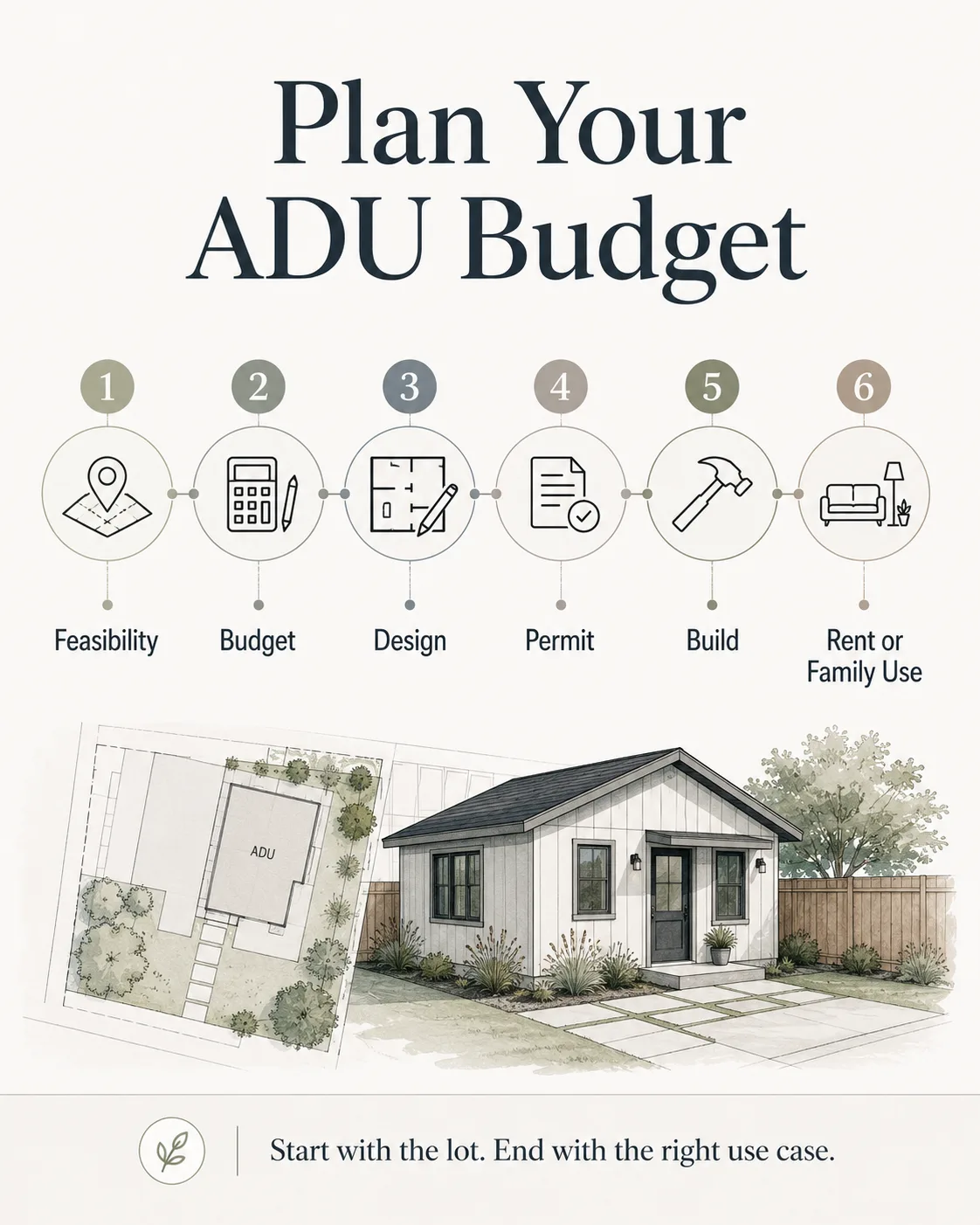
Five steps to keeping your Oceanside ADU on schedule
- 1
Hire your builder or designer before you apply for permits, not after.
Builder coordination during plan check is essential. Homeowners who hire post-approval lose months waiting for availability.
- 2
Use permit-ready plans if available.
While Oceanside’s pre-approved plan program has no active vendors as of May 2026, builders like SnapADU offer permit-ready plan sets that typically clear plan check faster than custom designs.
- 3
Don’t delay resubmittal after plan-check corrections.
The clock restarts on your resubmittal date, not on the correction date. Every week you delay resubmitting is a week added to your total timeline.
- 4
Start the SDG&E meter coordination process early.
SDG&E has its own separate application process for new ADU service. Starting it during permit review rather than after permit issuance can save 2–4 months of post-permit schedule.
- 5
Expect plan-check cycles; budget for them in your timeline.
The builder who promises a 90-day permit isn’t lying about state law — they’re ignoring the correction-cycle reality. Build 6–12 months into your timeline for design plus permit.
See what your specific lot is likely to face on timeline
Get My Free Oceanside ADU Report →How much does each ADU type cost in Oceanside?
If your goal is the cheapest legal ADU on your Oceanside lot, a JADU ($80K–$150K) or a garage conversion ($150K–$250K) are the lowest-cost paths. If your goal is the highest rental income, a detached 2BR or 3BR in the 850–1,000 sq ft range delivers the best long-term rent. The middle path most Oceanside homeowners take is a detached 1BR or 2BR between 600 and 850 sq ft.
Detached new construction
The default option, the most expensive, and the one that produces the most rental value and privacy.
Cost: $375–$600/sq ft all-in, or $300,000–$500,000 for typical 500–1,000 sq ft units.
Pros
- Maximum rental income potential
- Full design flexibility
- True private entrance and yard
- Stronger appraised value impact
Cons
- Highest absolute cost
- Longest timeline (11–19 months)
- SDG&E separate meter required
Oceanside note: At 1,000 sq ft you can still take the 4-foot setback. Above 1,000 sq ft, you fall back to your zone’s setbacks. A 999 sq ft detached ADU is a real planning sweet spot.
Attached new construction
A new structure built sharing at least one wall with your primary home.
Cost: $325–$500/sq ft, or $250,000–$450,000 typical.
Pros
- Cheaper than detached
- Better for tight lots
- Often faster to permit
Cons
- Local 50% of primary dwelling cap
- Less privacy for both occupants
- More construction disruption
Garage conversion
Cost: $150,000–$250,000, or roughly $300–$450/sq ft.
Pros
- No replacement parking required
- Existing slab/walls reduce hard costs 30–50%
- Setbacks waived for existing footprint
- Separate SDG&E meter not automatic
- Lower permit fees (BLDG25-0149: $3,174.21)
Cons
- Must meet current residential code
- Old slabs may not meet current standards
- Often needs new/upgraded electrical service
- Limited size (350–500 sq ft typically)
JADU (Junior ADU)
Cost: $80,000–$150,000.
Pros
- Lowest cost legal ADU pathway
- Fastest timeline (4–8 months)
- Often avoids school fees (under 500 sq ft)
- Can be combined with a detached ADU
Cons
- Owner-occupancy required (Gov. Code §66333)
- Loses 500 sq ft from main home
- Must have separate exterior entrance
- Smaller rental market
Prefab / modular ADU
Cost: $180,000–$320,000 turnkey for most San Diego County deliveries. US Modular publishes a starting example of $78,000 for a 398 sq ft 1BR under stated assumptions, with local fees typically adding 5–15% on top.
The Oceanside ADU type matrix
| Type | All-in cost | Timeline | Best for | Oceanside catch |
|---|---|---|---|---|
| Detached new | $280K–$500K | 11–19 mo | Max rent, multigenerational privacy | 4-ft setback caps at 1,000 sq ft |
| Attached new | $250K–$450K | 10–17 mo | Smaller lots, shared utilities | 50% of primary home cap |
| Garage conversion | $150K–$250K | 6–12 mo | Lowest-cost separate unit | New SDG&E meter not automatic |
| JADU | $80K–$150K | 4–8 mo | Family use, lowest budget | Owner-occupancy required; ≤500 sq ft |
| Prefab | $180K–$320K | 6–10 mo | Speed + price predictability | Site prep still required; access can kill it |
Ready to talk to an Oceanside-experienced builder?
SnapADU is originally based in Oceanside and has focused on designing, permitting, and building ADUs across San Diego County since 2020, with 100+ projects completed. They publish their pricing methodology publicly and work design-build with a fixed-price model before permits are submitted. If you’re outside their Greater San Diego service area, or you’re set on prefab, this isn’t the right path for you.
Request a Free Oceanside ADU Consultation with SnapADU →SnapADU is an affiliate partner. See disclosure above.
Which Oceanside ADU size delivers the best value — 500, 750, or 1,000 sq ft?
For most Oceanside homeowners, the 749–750 sq ft detached ADU is the value sweet spot. It’s just under the state’s 750 sq ft local-impact-fee threshold, comfortably below the 1,000 sq ft state-exempt size for setbacks, livable enough to rent at 1BR or compact 2BR market rates, and large enough that per-square-foot construction costs have dropped to the $400–$465/sq ft band. A 500 sq ft ADU costs less in total but more per square foot. A 1,000 sq ft ADU rents better but costs $75,000–$125,000 more in total.
| Use case | Best size | Why |
|---|---|---|
| Aging parent | 500–750 sq ft | Manageable space, lower budget, easier maintenance |
| Adult child returning home | 500–750 sq ft | Independence without maximum cost |
| Long-term 1BR rental | 600–850 sq ft | Best rent-to-cost ratio in Oceanside |
| Long-term 2BR rental | 850–1,000 sq ft | Higher rent, better tenant retention |
| Multigenerational long-term living | 1,000–1,200 sq ft | Real second home; full kitchen, two bedrooms |
| Home office or studio | JADU or 400–500 sq ft | Smallest legal unit that works |
| Lowest possible budget | JADU or garage conversion | New detached construction won't pencil |
The 750 sq ft rule of thumb
Start by sizing a 749 sq ft 2BR/1BA design and see if the budget works. If the answer is yes, the size and the math align with how Oceanside actually charges fees. If the answer is no, you have a clean signal to look at garage conversion, JADU, or financing-path adjustments.
How do I compare Oceanside ADU builder quotes without getting taken?
Compare Oceanside ADU quotes by scope, not by price. Three quotes with the same number can describe wildly different projects. The only useful comparison shows each builder’s design, engineering, permits, fees, utility assumptions, finish allowances, exclusions, schedule, change-order policy, and warranty side by side. If a quote leaves any of those categories vague, the real cost will appear later as a change order or “exclusion.”
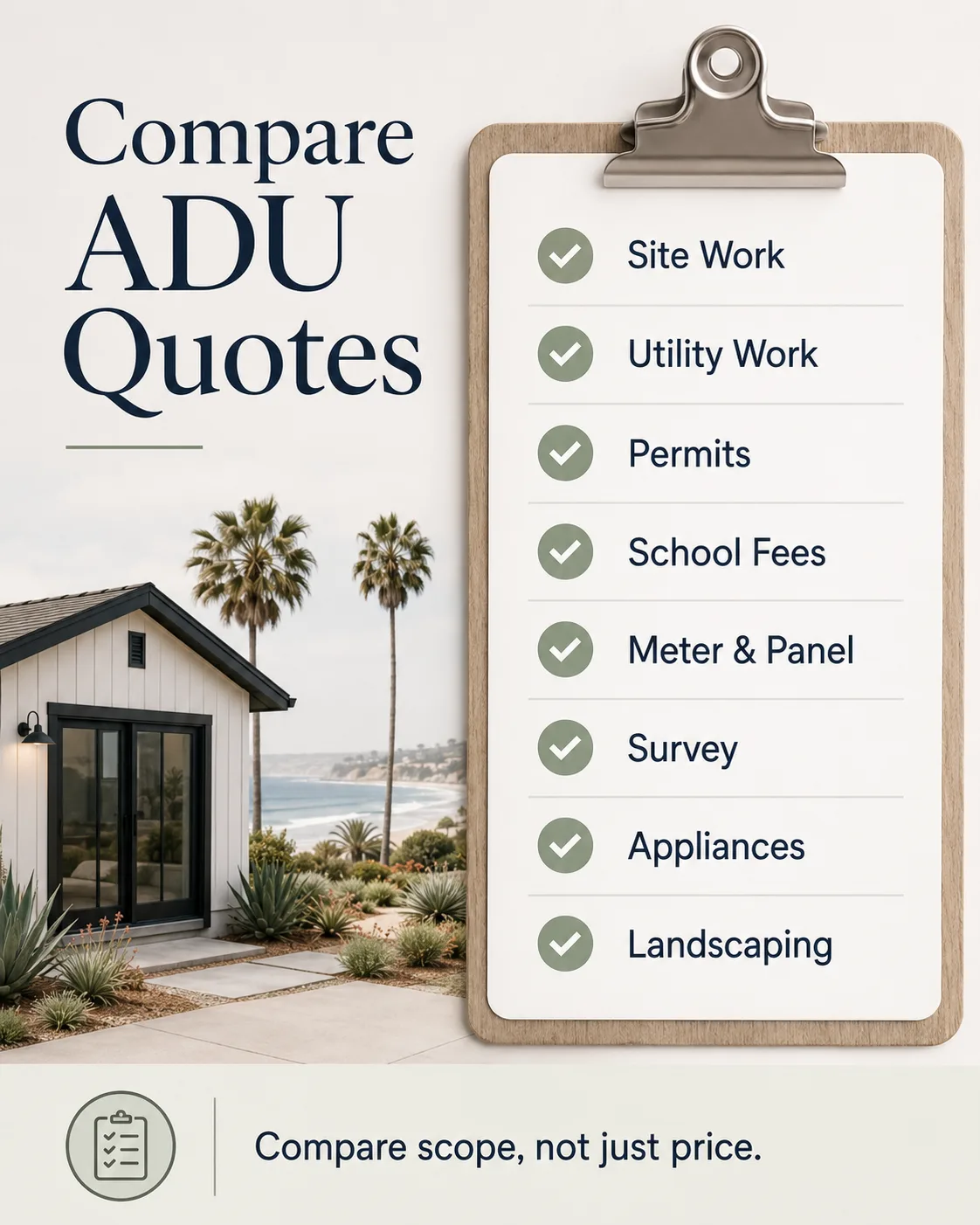
The quote-comparison checklist
| Scope item | Question to ask | Oceanside note |
|---|---|---|
| Design + plans | Are architectural, structural, and Title 24 included or separate? | Custom designs add 30–60 days vs. permit-ready plans |
| Engineering | Is foundation engineering included if my lot needs special design? | Hillside lots may need $3K–$8K additional |
| Permits + plan check | Are city fees a passthrough at cost or estimated in the contract? | Real Oceanside permit fees: $7K–$8K |
| School fees | Who pays OUSD's $4.79/sq ft fee? | $0 if under 500 sq ft; $3,500–$5,748 above |
| SDG&E separate meter | Is meter coordination and installation in your scope? | Adds $12K–$15K if excluded for new detached builds |
| Water buy-in | If the city requires a meter upsize, who pays? | $0–$10,000+ |
| Sewer trenching | What's the allowance, and what's the per-foot rate beyond it? | Long trenching adds $5K–$15K |
| Electrical panel | What happens if my panel needs upgrading? | $3K–$8K if not in scope |
| Coastal CDP | If my lot is coastal, who handles noticing and mailing list? | $200–$500 in soft costs |
| Boundary + verification survey | Are both surveys included? | $1,500–$3,000 — frequently forgotten |
| Sitework | Grading, drainage, demo, retaining walls — all included? | Highly variable |
| Finishes | Are finish allowances real or placeholder? | Allowance line items hide $10K–$30K in upgrades |
| Landscaping | What's left to do at substantial completion? | Usually excluded; budget $3K–$15K separately |
| Timeline | What happens to my schedule when the city issues plan corrections? | Real eTRAKiT data shows 200–450 days |
| Change orders | What triggers an extra-cost change order? | Vague language is the biggest budget risk |
| Warranty | What's covered, for how long, by whom? | Most builders offer 1-year workmanship; CA has 10-year statutory |
| Payment schedule | Show me the draw schedule | Front-loaded draws are a red flag |
Get this checklist as a fillable PDF
The Oceanside ADU Budget Worksheet — every line above as a side-by-side bid comparison template, plus the SDG&E meter prompt and school-fee cheat sheet.
Get the Free Worksheet →Will an Oceanside ADU actually pay for itself with rent?
A typical 1-bedroom Oceanside apartment comparable rents for $2,200–$2,600 per month in 2026; a 2-bedroom rents for $2,700–$3,100. At those rents, a $350,000–$400,000 detached ADU shows a simple payback of roughly 14–17 years on rent alone, before factoring in property-value impact. The honest framing: an Oceanside ADU is a long-horizon equity-and-cashflow asset, not a short-term arbitrage play.
Real Oceanside rent benchmarks (May 2026)
| Unit type | Apartments.com (May 2026) | RentCafe (Apr 2026) | Realistic ADU range |
|---|---|---|---|
| Studio | $1,891 | $1,972 | $1,900–$2,150 |
| 1-bedroom | $2,238 | $2,324 | $2,250–$2,650 |
| 2-bedroom | $2,706 | $2,737 | $2,750–$3,150 |
| 3-bedroom | $3,620 | $3,430 | $3,400–$3,800 |
A coastal-zone ADU in 92054 typically rents at a premium over inland Oceanside. Run rent comps for your specific neighborhood before locking your pro forma.
ROI math — two worked examples
These are illustrative examples, not guarantees of returns. Actual results depend on local market conditions, construction costs, financing terms, and regulatory approvals.
Example A — Inland 2BR detached ADU in San Luis Rey (92057)
- All-in cost: $400,000
- Monthly rent (conservative): $2,800
- Annual gross rent: $33,600
- Vacancy reserve (5%): −$1,680
- Property tax incremental (~1.05% on $400K): −$4,200
- Insurance (incremental): −$900
- Maintenance reserve: −$1,500
- Property management (8%, optional): −$2,688
- Annual net (self-managed): ~$25,320
- Simple payback (self-managed): ~15.8 years
Example B — Coastal 1BR detached ADU in 92054
- All-in cost: $375,000
- Monthly rent (coastal premium): $2,800
- Annual gross rent: $33,600
- Vacancy reserve (5%): −$1,680
- Property tax incremental: −$3,975
- Insurance (incremental): −$900
- Maintenance reserve: −$1,200
- Self-managed
- Annual net: ~$25,845
- Simple payback: ~14.5 years
The honest admission — and what it actually means
An Oceanside ADU is not a 5-year payback investment. The combination of $375–$600/sq ft build costs, long-term-only rentals (no Airbnb arbitrage under Section 3006(E)(3)), and Southern California carrying costs means the payback period on rent alone is measured in 14–17 years.
What an Oceanside ADU does reliably deliver: meaningful long-term rental incomethat offsets your mortgage, a separate dwelling for family use, property-value lift on a $816,000–$873,000 Oceanside median home, and optionality — build for family, rent later, or use at retirement.
See if your specific lot actually pencils
Enter your address. The free Feasibility Engine returns your buildable ADU size, a rough cost picture, and the long-term rent your specific ZIP supports.
Get My Free Oceanside ADU Pro Forma →How are Oceanside homeowners actually paying for ADUs in 2026?
The CalHFA $40,000 ADU grant has been fully allocated since December 28, 2023 with no announced relaunch. The San Diego Housing Commission’s $250,000 ADU Finance Program serves the City of San Diego only — Oceanside homeowners do not qualify, despite being in San Diego County. Oceanside has no city-level ADU grant or financing program as of May 2026. In practice, Oceanside ADUs in 2026 are funded through four paths: HELOC, cash-out refinance, construction-to-permanent loan, or renovation loan.
The SDHC loan does NOT serve Oceanside
The City of San Diego and the County of San Diego are not the same thing for SDHC eligibility. Oceanside (ZIP codes 92054, 92056, 92057, 92058) is in San Diego County but is a separate city. SDHC’s ADU Finance Program is available only to homeowners in City of San Diego (921XX) ZIP codes. Source: sdhc.org/housing-opportunities/adu/, verified May 2026.
CalHFA ADU Grant: paused since December 2023
The CalHFA $40,000 ADU Grant Program has been fully allocated since December 28, 2023 with no confirmed relaunch as of May 2026. If anyone tells you they can “get you the CalHFA grant,” CalHFA itself has issued warnings that those offers are scams. Source: calhfa.ca.gov/adu
The four financing paths Oceanside homeowners are using
HELOC (Home Equity Line of Credit) or Home Equity Loan
A second-position credit line or loan secured by your existing home equity. Best when you have substantial equity in a primary that's appreciated. With Oceanside median home value at $816,000 (Zillow, March 2026) and many longtime homeowners holding mortgages at 3–4% from 2020–2021, a HELOC lets you fund the ADU without disturbing your low-rate first mortgage.
Pros: Doesn't touch your first mortgage. Draw as needed. Interest only on what you use. Lower closing costs than a refi.
Cons: Variable rates on most HELOCs. Combined-LTV limits typically cap total borrowing at 80–90% of home value.
Cash-out refinance
Refinance your existing mortgage to a larger amount and take the difference in cash. Best when current rates are comparable to your existing mortgage rate.
Pros: One mortgage, predictable payment. Lender approval generally less complex than renovation loans.
Cons: Resets your mortgage. If your current rate is far below market, cash-out can be a poor trade.
Construction-to-permanent loan
A single loan that funds construction (interest-only during the build) and converts to a permanent mortgage at completion. May be underwritten partly on after-improved value.
Pros: Useful when you don't have enough existing equity for a HELOC to cover the full build.
Cons: More documentation. Stricter qualification. Higher closing costs than a HELOC.
Renovation loan (Fannie Mae HomeStyle, FHA 203k limited)
Combines purchase or refinance with renovation funds in a single mortgage, based on the after-improved value.
Pros: Funds the entire ADU build in one mortgage. Useful when you don't have substantial equity yet.
Cons: More documentation than a HELOC or cash-out refi. Slower closing. Tighter contractor requirements.
Compare ADU financing paths for your situation
Mortgage Research Center connects homeowners with mortgage and refinance products across major lenders — HELOC, cash-out refi, construction-to-permanent, and renovation loan products in one place.
See ADU Financing Options through MRC →MRC is an affiliate partner. See disclosure above.
Want the editorial breakdown first? Read our full ADU Financing Options guide → No email required.
What’s the cheapest realistic ADU path in Oceanside if my budget is under $250,000?
Under a $250,000 all-in budget, the realistic Oceanside ADU paths are a JADU ($80K–$150K), a garage conversion ($150K–$250K) if the existing structure is workable, or a very compact prefab on a favorable lot. A new detached ADU under $250,000 all-in is rare in Oceanside in 2026 — most “starting at $200K” marketing numbers exclude the full project cost.
Path 1: JADU — typically $80K–$150K
You carve up to 500 sq ft out of your existing home’s interior, add an efficiency kitchen, ensure a separate exterior entrance, and you’re done. You keep your existing utilities. You don’t need a new foundation. The tradeoff: you lose 500 sq ft of your main home, owner-occupancy is required by state law, and the rental market for a JADU sharing the main home’s exterior is materially smaller than a private detached unit. Best for: family use — aging parent, adult child, in-law suite.
Path 2: Garage conversion — typically $150K–$250K
Existing slab, walls, and roof eliminate a third or more of new-construction hard cost. No replacement parking required. Setbacks waived for the existing footprint. Per Government Code §66311.5, conversion ADUs don’t automatically trigger the separate SDG&E meter requirement. The catch: old garages often need new electrical service, fire separation upgrades, and current insulation. A “$120K” garage conversion can land at $220K if the slab needs work and the panel needs an upgrade. Best for: homeowners with a detached or attached garage in good condition.
Path 3: Compact prefab on a favorable lot — typically $180K–$220K
A 400–500 sq ft prefab on a flat lot with sewer within 50 ft and an adequate existing electrical panel can land in the low $200Ks all-in. The catch: prefab doesn’t work on every lot. Tight access, slope, retaining walls, or utility distance can push the all-in cost up to where site-built is competitive. Get a real site evaluation before signing a prefab contract.
When the under-$250K path isn’t realistic
If your lot has any of the following, expect the all-in number to push higher:
- Slope or hillside conditions
- Sewer more than 100 ft from the proposed unit
- An existing main electrical panel under 125 amps
- Coastal zone with restricted access
- Required retaining walls
- Lot fully built out with no obvious detached-unit footprint
What should I verify before paying for ADU plans in Oceanside?
Before paying for ADU plans, verify ten items about your specific property. Plans drawn before this verification are the most common $7,500–$15,000 mistake in the Oceanside ADU process.
| Verify | Why it matters | How to check |
|---|---|---|
| Zoning and lot status | R-1/RS/RE single-family or multifamily — rules differ | Oceanside zoning map viewer or Feasibility Engine |
| Buildable area after setbacks | What you can actually fit | Apply 4-ft setback (≤state-exempt size) or zone setbacks (above) |
| ADU type | Cost differs by $50K–$200K depending on type | Match to lot conditions and your use case |
| Square footage vs. thresholds | School fees + impact fees | OUSD ($4.79/sq ft; under 500 exempt); HCD 750 sq ft threshold |
| School district | Different districts, different rates | Verify OUSD vs Vista USD boundary |
| Sewer + water connection | Long runs change budget by $5K–$15K | Visual inspection + city utility records |
| Existing main electrical panel | Upgrade costs $3K–$8K | Read the panel label; SDG&E meter coordination |
| Coastal-zone + appeal-jurisdiction status | Setback + noticing changes | Oceanside coastal zone GIS layer (parcel-level) |
| HOA restrictions | CC&Rs cannot effectively prohibit ADUs per Civil Code §4751 | Review CC&Rs against §4751 standard |
| Rental intent (long-term only) | Section 3006(E)(3) bans STR on post-9/9/2017 ADU properties | Confirm before building pro forma |
Run all ten checks in 60 seconds
Enter your address. The free Feasibility Engine applies Oceanside’s current rules to your specific parcel, flags coastal-zone status, identifies your school district, and gives you a rough fee picture — before you spend a dollar on plans.
Get My Free Oceanside ADU Report →What we verified for this Oceanside ADU cost guide
| Source category | Specifically verified | Date |
|---|---|---|
| City of Oceanside Planning Division ci.oceanside.ca.us | ADU ordinance Section 3006, size limits, setbacks, parking exemptions, STR restriction 3006(E)(3), impact-fee waiver, water buy-in language | May 2026 |
| City of Oceanside eTRAKiT etrakit.cityofoceanside.com | Real permit-account fees and elapsed timelines: BLDG25-1441 ($7,181.85, ~204 days), BLDG25-0230 ($7,741.48, ~249 days), BLDG25-0149 ($3,174.21, ~449 days) | May 2026 |
| California HCD ADU Handbook hcd.ca.gov | 60-day ministerial review (§66317), 500 sq ft school-fee exemption, 750 sq ft impact-fee treatment under §66311.5, state-exempt size standards | Updated March 2026 |
| California state law law.justia.com + legiscan.com | §66311.5 (impact fees + utility connections), §66317 (60-day clock), §66333 (JADU owner-occupancy), AB 462 (coastal CDP), Civil Code §4751 (HOA limits) | May 2026 |
| Oceanside Unified School District oside.us | Current residential developer fee ($4.79/sq ft) and under-500-sq-ft exemption | May 2026 |
| CalHFA calhfa.ca.gov/adu | ADU Grant Program status (paused since 12/28/2023) | May 2026 |
| San Diego Housing Commission sdhc.org | ADU Finance Program eligibility (City of San Diego ZIP 921XX only — Oceanside not eligible) | May 2026 |
| SDG&E (via builder sources) snapadu.com | Separate-meter requirement effective March 2023 for new detached ADUs; cost range $12K–$15K | May 2026 |
| SnapADU snapadu.com | 2026 San Diego County cost methodology, Oceanside-specific regulatory summary, Construction Cost Index data | March 2026 |
| Better Place Design & Build betterplacedesignbuild.com | Oceanside per-sq-ft cost tiers | March 2026 |
| US Modular usmodularinc.com | Oceanside starting package pricing | May 2026 |
| Apartments.com + RentCafe apartments.com + rentcafe.com | Current Oceanside rent benchmarks | April–May 2026 |
| Redfin + Zillow redfin.com + zillow.com | Oceanside home value and neighborhood pricing | February–March 2026 |
| FHFA fhfa.gov | 2026 conforming loan limit for San Diego County | 2026 |
What Dwelling Index is and isn’t
Dwelling Index is an independent research resource covering ADU financing, costs, and regulations. We are not a builder, a lender, a tax advisor, or a contractor. We earn a commission when readers use our links to explore financing options, request prefab pricing, or connect with builders. Our editorial conclusions are independent of compensation. Read our full editorial standards and affiliate disclosure.
Oceanside ADU cost — frequently asked questions
How much does it cost to build an ADU in Oceanside in 2026?
A detached new-construction ADU in Oceanside costs $300,000 to $500,000 all-in for typical 500 to 1,000 square foot units, or roughly $375 to $600 per square foot. Garage conversions run $150,000 to $250,000. JADUs come in $80,000 to $150,000. Prefab turnkey runs $180,000 to $320,000.
How much does a 500 sq ft ADU cost in Oceanside?
A 500 sq ft detached ADU in Oceanside typically costs $250,000 to $325,000 all-in. The per-square-foot cost runs higher than larger units (around $500–$650/sq ft) because kitchen, bathroom, utility hookup, and permit costs are largely fixed. A 500 sq ft ADU benefits from the under-500 school-fee exemption only if it comes in at 499 sq ft or smaller.
How much does a garage conversion ADU cost in Oceanside?
Garage conversions in Oceanside typically cost $150,000 to $250,000. Real Oceanside permit records show conversion permit-account fees significantly lower than detached new-construction fees ($3,174.21 for a conversion + small addition versus $7,181.85 for a 546 sq ft detached new build). The variable that moves the cost the most is the condition of the existing structure — old slabs, fire separation upgrades, and new electrical service can erase the savings.
Are ADUs under 750 sq ft exempt from impact fees in Oceanside?
Per California Government Code §66311.5, ADUs with 750 sq ft or less of interior livable space shall not be charged local impact fees. Oceanside additionally waives city-controlled development impact fees for ADUs broadly, with school fees as the main exception. School fees are exempt entirely for ADUs under 500 sq ft.
Are school fees owed on an Oceanside ADU?
Yes, on ADUs 500 sq ft and larger in OUSD’s boundary. Oceanside Unified School District currently charges $4.79 per square foot, with residential construction under 500 sq ft exempt. If your property is in Vista Unified School District (which covers parts of east Oceanside), verify VUSD’s current rate separately.
Does Oceanside allow short-term rentals in ADUs?
No. Per Oceanside Zoning Ordinance Section 3006(E)(3), any property with an ADU or JADU permitted on or after September 9, 2017 cannot operate either the ADU or the primary residence as a short-term rental. ADUs must be rented for terms longer than 30 days under state law.
Can I build a 1,200 sq ft ADU in Oceanside?
Yes. Oceanside’s local maximum detached ADU size is 1,200 sq ft, but the project is subject to your underlying zone’s standard setbacks (typically 5–10 feet side, 15–20 feet rear) rather than the 4-foot state-exempt setback. The 4-foot setback applies up to the state-exempt size: 850 sq ft for studio/1BR or 1,000 sq ft for 2BR+.
Does Oceanside have pre-approved ADU plans?
Oceanside has a pre-approved ADU program framework, but as of May 2026 no vendors have submitted plans for inclusion in the program, per the City of Oceanside’s pre-approved ADU page. SnapADU and other builders offer permit-ready plans that aren’t formally city-pre-approved but typically clear plan check faster than custom designs.
How long does an Oceanside ADU permit take?
California state law (Government Code §66317) requires Oceanside to issue a ministerial decision on a complete ADU application within 60 days. In practice, the three Oceanside permits we pulled from eTRAKiT took 204, 249, and 449 days from application to issuance respectively — because the 60-day clock stops when the city issues plan-check comments and restarts when you resubmit. Plan for 6 to 12 months of design-plus-permit calendar time on most detached ADUs.
Do I need to replace parking if I convert a garage to an ADU?
No. Oceanside’s ADU ordinance specifies that garage conversions displacing the parking for the primary dwelling do not require replacement parking. This applies even if you tear out a two-car garage.
What is the cheapest ADU type in Oceanside?
A JADU (Junior ADU) inside your existing home is typically the cheapest legal ADU pathway at $80,000 to $150,000. A garage conversion is the second-cheapest at $150,000 to $250,000 when the existing structure is workable.
Do JADUs require owner-occupancy in Oceanside?
Yes. Under California Government Code §66333(a)(2), local agencies must require owner-occupancy of either the primary dwelling or the JADU for any property with a JADU. Narrow exceptions apply only when the property owner is a governmental agency, land trust, or housing organization. This is a state-law requirement, not just a city rule.
What financing options do Oceanside homeowners use?
Four main paths in 2026: HELOC or home equity loan (best with substantial existing equity), cash-out refinance (one mortgage, but resets your rate), construction-to-permanent loan (may be underwritten partly on after-improved value), or renovation loan such as Fannie Mae HomeStyle (combines purchase or refi with construction). The CalHFA $40,000 grant has been paused since December 2023. The San Diego Housing Commission’s $250,000 ADU Finance Program serves the City of San Diego only and is not available to Oceanside homeowners.
Can I qualify for the San Diego Housing Commission ADU loan if I live in Oceanside?
No. SDHC’s ADU Finance Program is available only to homeowners in the City of San Diego (ZIP codes starting with 921XX). Oceanside ZIP codes are 92054, 92056, 92057, and 92058 — Oceanside is in the County of San Diego but is a separate city, and SDHC’s authority is limited to City of San Diego properties.
Will my Oceanside property taxes go up if I build an ADU?
Yes, but the increase is limited to the assessed value of the new construction, not your entire property. California Proposition 13 protects your existing assessed value. San Diego County effective property tax rates typically run 1.0–1.1% depending on Mello-Roos and special assessments, so a $400,000 ADU adds roughly $4,000–$4,400 to your annual property tax bill. We are not tax advisors; consult one for your specific situation.
Is my Oceanside lot in the coastal zone?
Coastal-zone status has to be checked parcel-by-parcel — ZIP codes are a rough heuristic, not a definitive answer. Most of ZIP 92054 sits inside the coastal zone, along with portions of 92056 and small portions of 92057. ZIP 92058 is mostly inland. The City of Oceanside Land Use & Zoning GIS Map Viewer shows the exact coastal boundary and appeal-jurisdiction overlay for any parcel, and the Feasibility Engine flags coastal status automatically when you enter your address.
What’s the SDG&E meter cost everyone keeps mentioning?
Since March 2023, San Diego Gas & Electric has generally required a separate electric meter for new detached ADUs in its service territory. The meter typically costs $12,000–$15,000 installed per builder-published estimates, with an additional $3,000–$8,000 if your main electrical panel needs upgrading to handle the additional load. Conversion ADUs and JADUs are treated differently under state utility-connection rules — the meter requirement isn’t automatic for those. This line item is among the most commonly omitted in builder quotes for new detached ADUs — always ask whether it’s in scope.
How big can a JADU be in Oceanside?
A Junior ADU (JADU) in Oceanside is capped at 500 square feet maximum. It must be carved out of the existing or proposed primary dwelling, include an efficiency kitchen, can share sanitation with the main home, and must include exterior access. Owner-occupancy is required by California state law.
Final word — pick your path and verify it
Building an ADU in Oceanside is one of the more expensive home-improvement decisions a Southern California homeowner can make. It’s also one of the highest-value if the project fits your lot, your budget fits the project, and your financing fits both. The homeowners who get this right are the ones who verify before they design.
Not sure where to start? See what’s possible at your address — get your free ADU report in 60 seconds.
Run the Feasibility Engine →If we missed a line item that surprised you in your project, our editorial team wants to know — email corrections@dwellingindex.com. We re-verify all cost and fee data quarterly.