
ADU Laws · Texas
Texas ADU Laws (2026): What You Can Actually Build — by City
Texas ADU laws are still local, not statewide — and that one fact is the key to everything on this page. Whether you can build an accessory dwelling unit, how big it can be, and whether you can rent it out depends almost entirely on your city. Austin's HOME amendments allow up to three housing units on many SF-zoned lots. Houston recently increased its second dwelling unit size limit to 1,500 square feet. San Antonio publishes one of the clearest ADU permit paths in the state. Dallas requires city action before most homeowners can build or rent one.
This guide covers every major Texas city with rules sourced directly from official municipal and state legislative records — and nothing that hasn't actually passed into law.
The Dwelling Index Editorial Team
Last verified: April 6, 2026
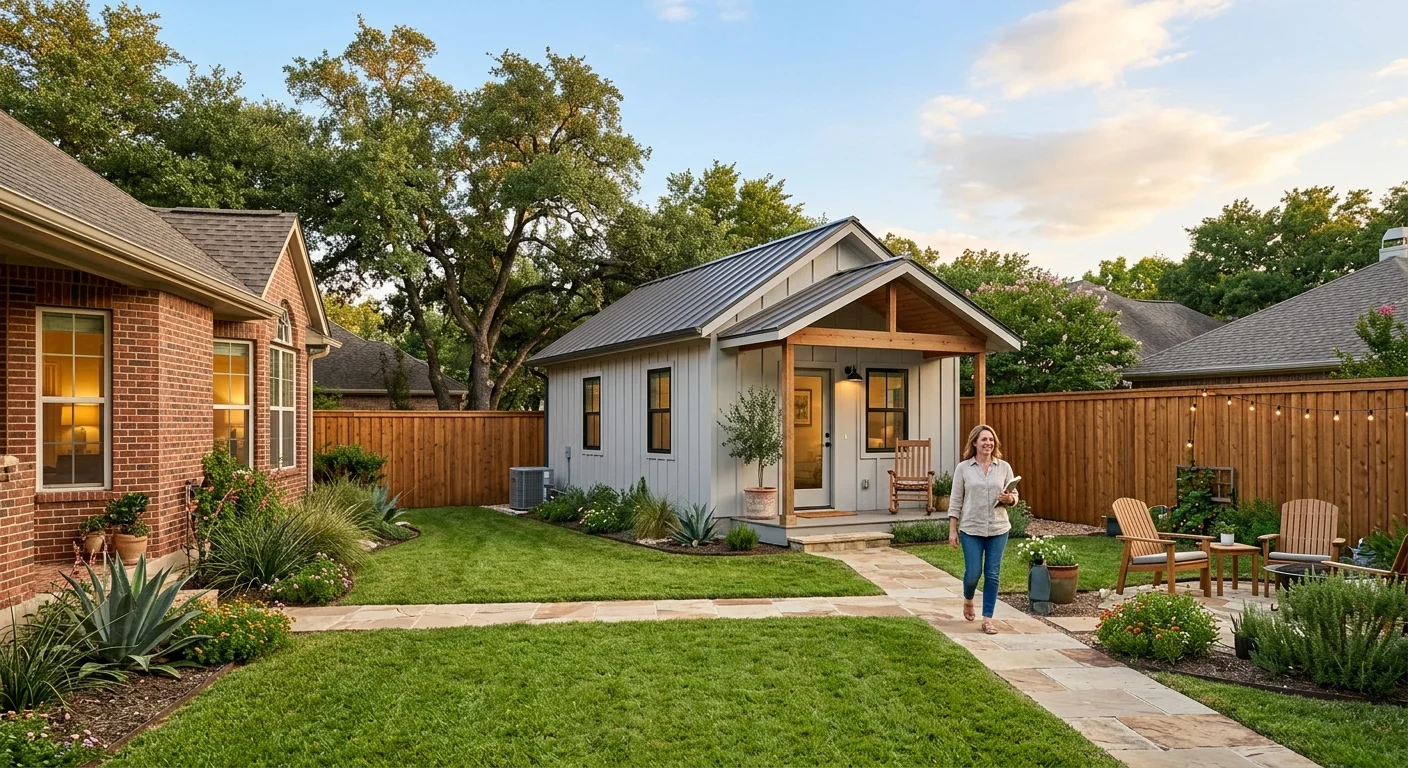
Texas ADU Laws at a Glance
| City | By right? | Max ADU size | Owner-occupancy? | Rental allowed? | Biggest catch |
|---|---|---|---|---|---|
| Austin | Yes (SF-1, SF-2, SF-3) | Varies by zoning district, lot, and project type under HOME standards | No | Yes | STR limited to 30 days/year for ADUs built after Oct 2015 |
| Houston | Yes (SF lots, subject to development rules and deed restrictions) | Up to 1,500 SF | No | Yes | Deed restrictions can override city rules |
| San Antonio | Yes (eligible residential districts) | Up to 800 SF or 50% of main house; 1,600 SF cap | Yes — notarized affidavit required | Yes, with owner on-site | Owner occupancy required |
| Dallas | Not by right | Per overlay/exception | Yes | Only with overlay or BOA approval | City action required before most ADUs can be built or rented |
| Fort Worth | Limited | Per district | Varies | Restricted in SF districts | ADUs in SF districts may not be rented or used as a separate residence |
| Denton | Yes (with conditions) | 800 SF or 75% of primary, whichever is greater | Not required | Yes | Separate water/sewer not allowed |
Each city verified against official sources. See city sections below for full details.
See What You Can Build
Check your address against local ADU rules and get a personalized feasibility report — free, takes 60 seconds.
Are ADUs Legal in Texas?
Yes — but not because Texas passed one clean law that says so. There's no California-style statewide mandate forcing every city to allow ADUs. Texas is local-rule territory. Your city council, not the state legislature, decides whether you can build a backyard home.
That means the difference between cities is massive. In Austin, you can build an ADU, potentially sell it separately through a condominium regime, and rent the other unit. In Dallas, you may need city action through an overlay process or Board of Adjustment before you can legally build or rent one. Same state. Completely different realities.
This matters because most of what you'll find online treats "Texas ADU laws" like a single answer. It's not. The pages that tell you "Texas allows ADUs" without telling you what your city allows are wasting your time — or worse, setting you up to spend money on plans you can't use.
Here's the framework that actually works: your project lives or dies at five levels, and you need to clear all of them.
- 1State law — Texas doesn't block ADUs, but doesn't mandate them either.
- 2City zoning — This is where the real rules live.
- 3Lot requirements — Size, setbacks, coverage limits, utilities.
- 4Deed restrictions and HOA — Private rules that can override everything the city allows.
- 5Intended use — Family housing, long-term rental, and short-term rental are treated differently.
The rest of this guide breaks down each level, starting with the state legislation everyone keeps asking about.
Did Texas Pass a Statewide ADU Law?
No. Not yet. And this is where most of the confusion on the internet comes from. Two bills have made serious runs at creating statewide ADU rules in Texas. Both failed. Understanding what happened — and what didn't happen — will save you from building on bad information.
Watch out for misinformation: Multiple prominent websites still reference SB 1412 (2023) or SB 673 (2025) as if they changed Texas law. They didn't. Both bills failed.
SB 673 (2025): Passed the Senate, Died in the House
SB 673, introduced by Senator Bryan Hughes, would have been the most significant ADU legislation in Texas history. It passed the full Texas Senate and was placed on the House General State Calendar on May 26, 2025. Then the session ended. The bill never received a House floor vote.
Here's what SB 673 would have done if it had passed:
- Required every city and county to allow ADUs on single-family and unzoned lots
- Prohibited local rules banning ADU construction, mandating owner occupancy, or imposing excessive parking or size limits beyond what applies to single-family homes
- Created a 60-day ministerial permit timeline — if the city didn't act, your permit would have been automatically approved
- Allowed lots of 10,000+ square feet to have two ADUs
- Preserved HOA, deed restriction, and historic preservation authority
That last point is important: even SB 673 wouldn't have overridden your HOA.
Source: Texas Legislature Online, SB 673, 89th Legislature Regular Session. Last action: 05/26/2025 — Placed on General State Calendar.
SB 1412 (2023): Also Failed
Before SB 673, there was SB 1412 in the 2023 session. It also aimed to create statewide ADU rules. Texas Legislature records show SB 1412 failed to pass to third reading in the House on May 22, 2023.
Despite this, multiple commercial pages still reference SB 1412 as if it changed Texas law. That's not accurate. The bill didn't pass.
Source: Texas Legislature Online, SB 1412, 88th Legislature Regular Session
What This Means for Your Project Right Now
If you're reading an article that says Texas "passed" or "enacted" statewide ADU legislation — close it. It's wrong. The practical reality as of April 2026:
Your city's rules are the rules. Period. Until something passes at the state level, plan your project based on your actual city code — not proposed legislation.
What Actually Counts as an ADU in Texas?
Before you go any further, make sure you and your city are talking about the same thing. An ADU is a legal dwelling unit — not just a building in your backyard. The distinction matters because it changes your permit path, your cost, and whether your structure is actually recognized as a place someone can live.
In Austin, a structure qualifies as a dwelling unit when it has habitable space, a full bathroom, and a sink or dishwasher outside the bathroom. In Denton, the standard is cooking, sleeping, and sanitary facilities. San Antonio uses similar criteria. The moment your backyard structure has a bathroom and a kitchen, you're in ADU territory — which means full residential permits, inspections, and code compliance.
A shed with electricity is a shed. A shed with a bathroom and kitchenette is a dwelling unit, and it gets treated like one.
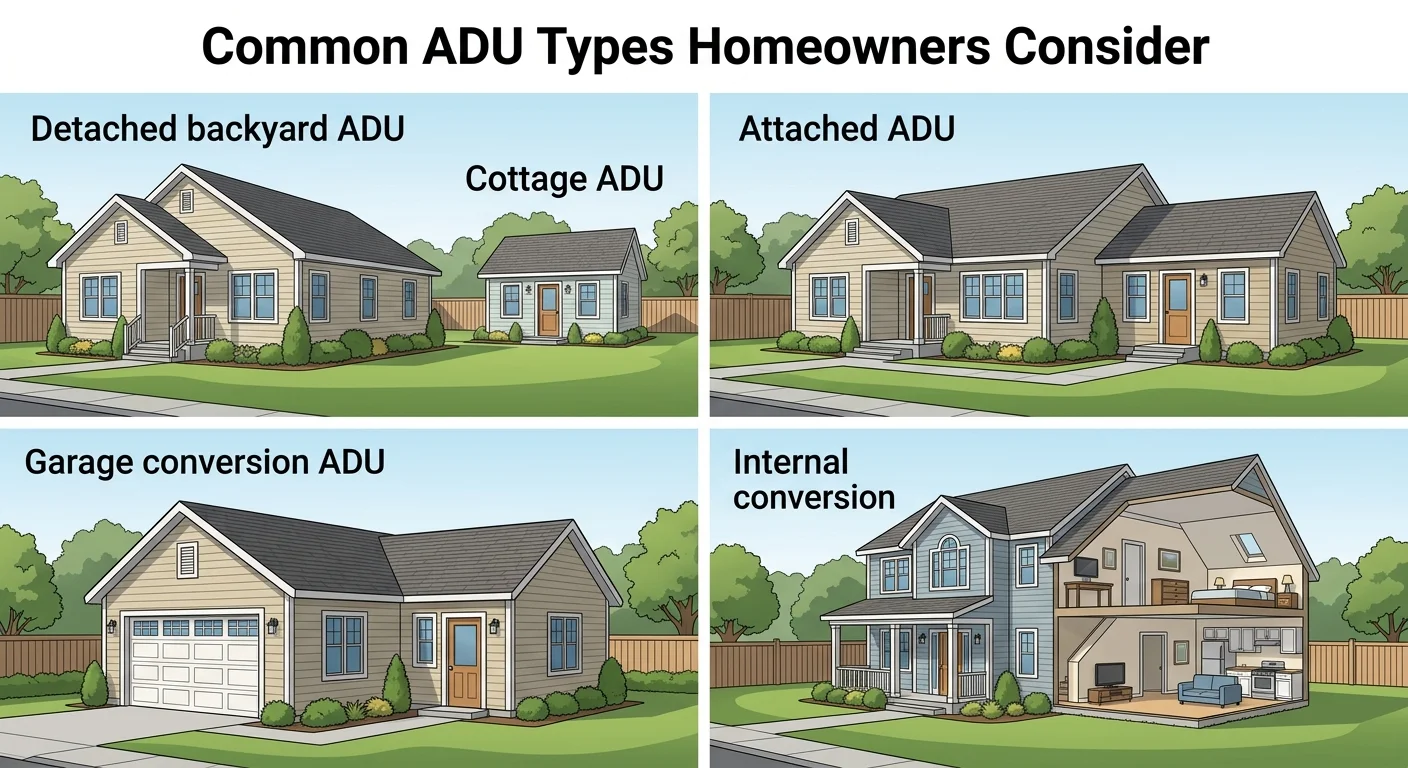
ADU Types in Texas
| Structure | Kitchen & bath? | Typically an ADU? | Approval path |
|---|---|---|---|
| Detached backyard unit (casita, cottage) | Yes | Yes | Full building permit + inspections |
| Attached addition | Yes | Yes | Full building permit + inspections |
| Garage apartment (above or converted) | Yes | Yes | Full building permit + inspections |
| Internal conversion (basement, attic) | Yes | Yes | Building permit, may need change-of-use |
| Backyard office / studio | No kitchen or bath | No | May qualify for accessory structure permit |
| Storage shed | No | No | Permit exemptions vary by city and size |
| Tiny home on wheels | Varies | Usually not — different regulatory path | Verify local RV, manufactured housing, and occupancy rules |
Why this matters for your budget
Knowing the classification upfront protects you from the most expensive surprise in ADU construction: discovering mid-project that your "backyard office with a bathroom" is actually a dwelling unit requiring a different permit, utility hookups, fire separation, and inspections you didn't budget for. If you're planning a structure with both a bathroom and a kitchen — even a small kitchenette — plan it as an ADU from day one.
Which Texas Cities Are Actually ADU-Friendly Right Now?
Below is each major Texas city with the rules that matter — sourced directly from official city pages and municipal codes.
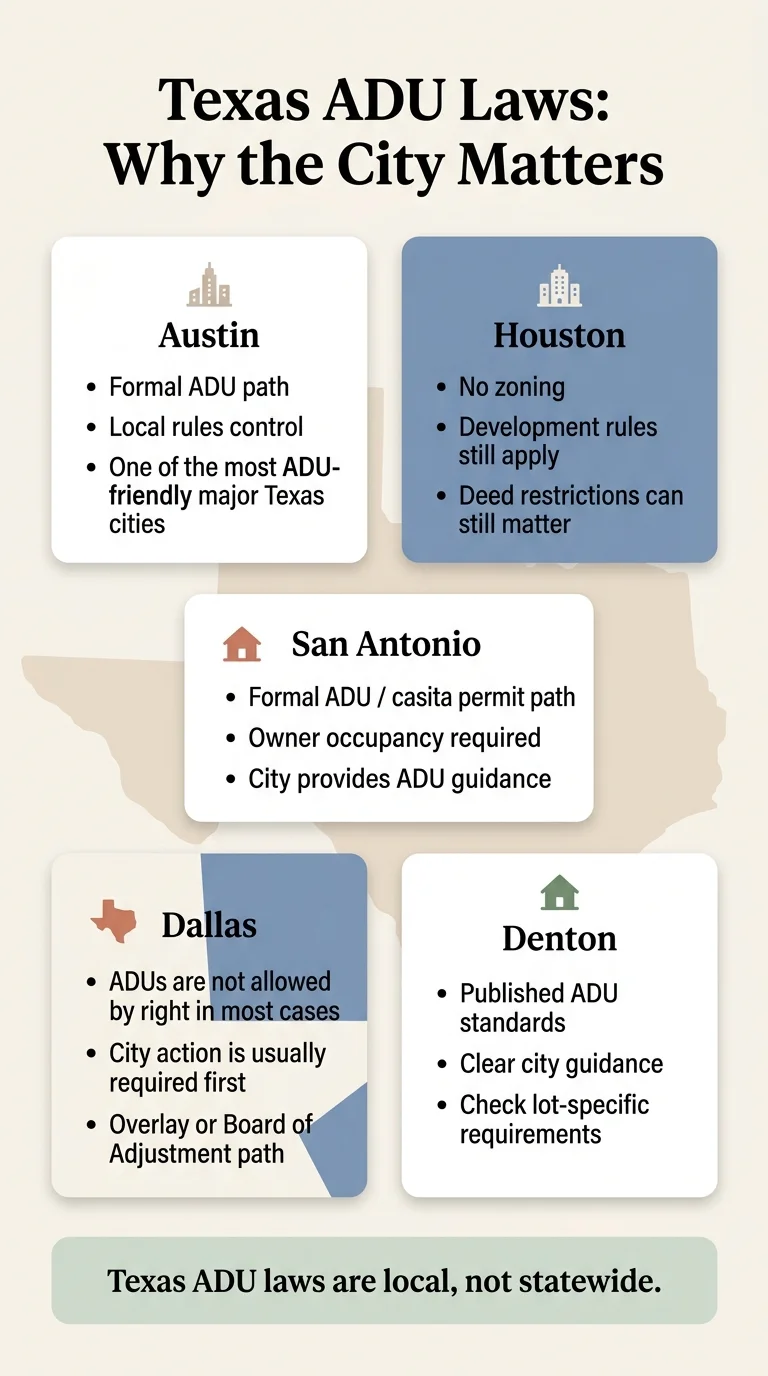
Austin ADU Rules
Austin is the most ADU-friendly major city in Texas by a wide margin — and it's getting friendlier.
Austin allows ADUs on residential property zoned SF-1, SF-2, or SF-3 with a minimum lot size of 5,750 square feet. Under the HOME Initiative amendments, many SF-zoned lots can now support up to three housing units — but the exact path and development standards depend on your specific lot, zoning district, and project type.
Size
Depends on zoning district and project type under HOME amendments. Confirm with Austin Development Services for your specific property.
Setbacks
Zoning no longer requires minimum distance between units. IRC R302.1 fire separation codes still apply.
Owner-occupancy
Not required. You can live elsewhere and rent both units.
Long-term rental
Allowed without restriction.
Short-term rental
Limited to 30 days/year for ADUs built after October 1, 2015. STR License and Certificate of Occupancy required.
Parking
Austin has removed additional off-street parking requirements for ADUs.
Separate sale
Condominium regime is one method of separate ownership. Verify with legal and title review for your specific project.
Permits
Every ADU needs a unique address before permit submission. Start with Address Management Services, then Residential Plan Review.
Who Austin is best for: Homeowners who want maximum flexibility — build it, rent it long-term, house family, or explore separate ownership options. Austin is as close to California-style ADU freedom as Texas gets.
Source: Austin Development Services, Additional Dwelling Units; Austin HOME Amendments. Verified April 2026.
Houston ADU Rules
Houston has no formal zoning, which sounds like a free-for-all — but it's not. Development codes still apply, and deed restrictions are the real wildcard.
Houston doesn't use the term "ADU" in its code. Instead, it regulates "secondary dwelling units" through its Code of Ordinances. Since Houston is famously unzoned, secondary dwelling units aren't restricted to specific zoning districts. You can build one on a single-family residential lot, subject to current development rules and deed restrictions.
Size
Houston's 2023 Livable Places ordinance (effective November 27, 2023) increased the maximum size from 900 to 1,500 square feet.
Parking
Based on unit size. Units ≤1,000 SF: no additional parking (if primary has 2 spaces). 1,001–1,500 SF: one additional space. Over 1,500 SF: two additional spaces.
Deed restrictions
Even though the city allows them, private deed restrictions can prohibit secondary dwelling units. Get a copy before spending money on plans.
Flood zones
Houston's geography means flood zone regulations can affect your project. Structures in regulated flood zones must meet elevation and floodplain requirements.
Owner-occupancy
Not required by the city.
Permits
All secondary dwelling units require building permits. The city offers free ADU|HOU workshops to help homeowners through the process.
Who Houston is best for: Homeowners on lots without restrictive deed covenants who want to take advantage of Houston's more permissive size limits.
Source: Houston Planning & Development, Livable Places. Verified April 2026.
San Antonio ADU Rules
San Antonio publishes one of the clearest and most detailed ADU frameworks in Texas — and actively promotes ADUs through its Casita program.
San Antonio's Unified Development Code (UDC §35-371) permits internal, attached, and detached accessory dwellings by right in multiple residential districts, including R-1 through R-6 and RM-4 through RM-6.
Size
Up to 800 SF or 50% of the main house, whichever is larger — capped at 1,600 SF. All properties can build at least 800 SF.
Bedrooms
No limit on number of bedrooms.
Owner-occupancy
Required. The owner must live in either the main house or the ADU, verified by a notarized affidavit. Must record a covenant with the Bexar County Clerk.
Setbacks
3 feet or more from side and rear property lines. If within 5 feet of the line, the wall must be fire-rated.
Height
Limited to 2 stories and 25 feet for detached ADUs.
Parking
Only ADUs over 800 SF require a dedicated off-street parking space.
Short-term rental
Allowed only as owner-occupied Type 1 STR. Type 2 non-owner-occupied STRs are prohibited in ADUs.
Fee waivers
Available when main home or ADU is rented to households at or below 80% AMI with rent capped at 30% of monthly income — for a 5-year commitment.
Permits
Submit through the BuildSA portal. Initial technical review takes up to 3 business days after fee payment.
Who San Antonio is best for: Homeowners who plan to live on-site and want rental income, or families housing aging parents or adult children. The fee waiver program makes it especially attractive for homeowners willing to provide affordable housing.
Source: City of San Antonio DSD, ADU Permits; San Antonio UDC §35-371. Verified April 2026.
Dallas ADU Rules
Dallas is the hardest major Texas city for ADUs. They're not allowed by right in most single-family zones, and the approval path requires city action before you can build or rent one.
Dallas's official ADU page says ADUs are not allowed by right in most cases. There are two published paths:
Path 1 — ADU Overlay
Your neighborhood can petition for an ADU Overlay district. The overlay requires at least 50 single-family homes in a compact, contiguous area. If 75% or more of homeowners sign in support, the overlay application fee may be waived.
Path 2 — Board of Adjustment
Individual homeowners can apply for a special exception through the Board of Adjustment. This is case-by-case and involves public notice and a hearing.
Design restrictions
ADUs must generally be single-story (unless built above a garage) and located behind the primary structure. Architectural compatibility with the main house is required.
Owner-occupancy
Required.
Dallas is a two-phase process. First, determine whether a legal path exists for your property — check for an existing ADU Overlay, talk to your council member about neighborhood interest, or explore the BOA route. Only after confirming a viable path should you start spending money on design and plans.
Source: Dallas City Hall, Accessory Dwelling Units; Dallas Code §51A-4.510. Verified April 2026.
Fort Worth: A Caution Section
Fort Worth is not in the same category as Austin, Houston, or San Antonio. In single-family residential districts, an ADU is allowed when not rented or used as a separate residence — and prohibited when rented or used as a separate residence.
That's a critical distinction. Fort Worth may allow you to build a secondary dwelling for family use, but renting it out as a separate unit in a single-family district faces significant restrictions.
If you live in Fort Worth and want to explore ADU options, contact Development Services directly to confirm what your specific zoning district allows — especially regarding rental use. Don't assume Fort Worth works like Austin or Houston.
Source: Fort Worth Development Services; Fort Worth congregate living/ADU presentation, April 2024. Verified April 2026.
Denton ADU Rules
Denton shows what a mid-size Texas city with clear, published ADU standards looks like. If your city isn't listed here, Denton's framework gives you an idea of what to look for in your own municipal code.
ADUs per lot
One, with a possible second via Specific Use Permit (no more than 4 total dwelling units on any lot).
Size
Maximum 800 SF, or 75% of the primary dwelling's square footage, whichever is greater.
Setbacks
3-foot minimum from rear and side property lines. Must be out of easements. Detached ADUs must be in side or rear yard.
Parking
No minimum parking requirement — but if you remove existing required parking to build, you must replace those spaces elsewhere on site.
Utilities
ADUs can have separate utility metering but cannot have separate water or sewer service — must connect to the primary home's lines.
Design
Must be architecturally compatible with the primary structure.
Permits
Submit through Denton's eTRAKiT portal.
Owner-occupancy
Not required.
Source: City of Denton, Accessory Dwelling Unit. Verified April 2026.
Not sure what your city allows?
Check your specific address against local ADU rules and get a free personalized feasibility report.
What About Other Texas Cities and Suburbs?
If you live in Plano, Arlington, Frisco, McKinney, Round Rock, Georgetown, Sugar Land, or any other Texas city not listed above — your first step is identical: contact your city's planning and zoning department and ask these five questions.
- 1Does the city allow accessory dwelling units in residential zones? If not, ask whether there's a variance or special exception process.
- 2What are the size, setback, and lot coverage limits? Get the specific numbers for your zoning district, not a general answer.
- 3Is owner-occupancy required? This determines whether an ADU works for investors or only for owner-occupants.
- 4Can the ADU be rented? And if so, are short-term rentals allowed or restricted?
- 5What is the permit process and approximate timeline? Ask whether it's administrative (staff review only) or discretionary (requires a public hearing).
Write down the answers, ask for the specific municipal code sections, and keep that documentation. You'll need it for your architect, your lender, and your insurance company.
Can I Build an ADU on My Property? The Real Qualification Stack
Most ADU projects in Texas don't fail because of the concept. They fail because of a property-level issue that could have been caught in the first week. Here's the qualification stack. You need to clear every level, in order, before spending real money on design or construction.
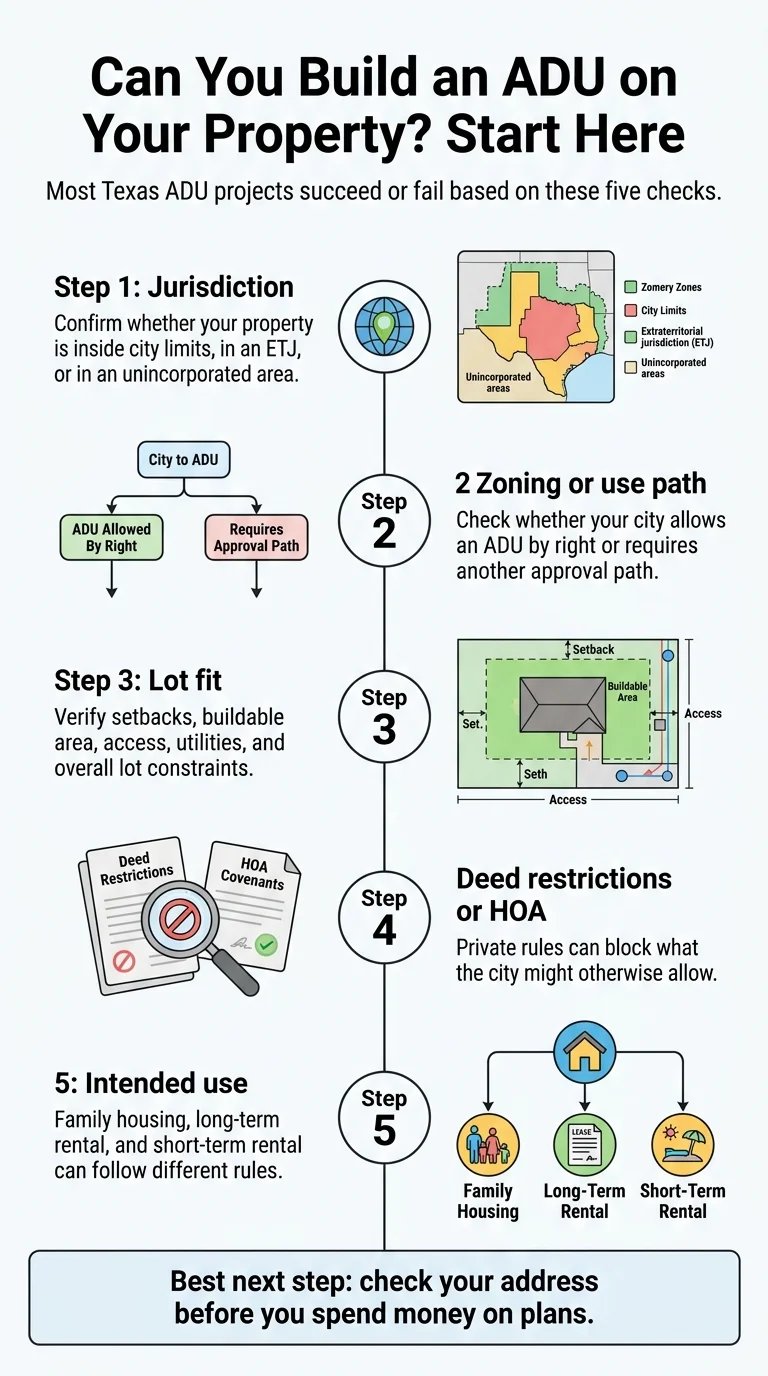
Level 1
Jurisdiction
Are you inside city limits, in an extraterritorial jurisdiction (ETJ), or in unincorporated county territory? This determines whose rules apply. If you're inside city limits, the city's zoning and development code governs your project. If you're in the ETJ — the buffer zone where a nearby city has some regulatory authority — you may be subject to that city's subdivision and development rules. If you're in an unincorporated area, there's likely no ADU-specific code, and you'll follow county requirements and state residential building codes.
Level 2
Zoning or Use Path
Check your lot's zoning designation using your city's online property search tool. In Austin, look for SF-1, SF-2, or SF-3. In San Antonio, look for eligible residential districts listed on the city's ADU page. In Dallas, look for an existing ADU Overlay or investigate the Board of Adjustment path. If your zoning doesn't allow ADUs by right, your options are a variance, special exception, or rezoning request — all of which add time, cost, and uncertainty.
Level 3
Lot Fit
Does your lot physically support an ADU? Check:
- Lot size — Austin requires 5,750 square feet minimum. Other cities have their own thresholds.
- Setbacks — Every city has minimum distances from property lines, easements, and between structures.
- Lot coverage — Most cities limit total impervious surface area as a percentage of the lot.
- Utility access — Water, sewer, and electrical connections must be feasible. In Houston, flood zone status matters. Outside city sewer service areas, septic requirements apply.
Level 4
Deed Restrictions and HOA
This is the level that catches Texas homeowners off guard more than any other. Even if your city allows ADUs, private deed restrictions or your HOA can prohibit them. In Texas, deed restrictions are enforceable private agreements that run with the land. They can:
- Prohibit detached structures entirely
- Prohibit rental of secondary units
- Restrict building footprint or height beyond what the city allows
- Require architectural review board approval
How to check: Request a copy of your deed restrictions from your title company or county clerk. Some deed restrictions expire after 25–30 years. Some renew automatically. Some can be amended with a vote of property owners. Know where you stand before you spend a dollar on plans.
Level 5
Intended Use
Your intended use changes the legal path:
- Family housing: Generally the simplest path. Most ADU-friendly cities allow this.
- Long-term rental: Allowed in most ADU-friendly Texas cities, but may require owner-occupancy (San Antonio) or city action (Dallas).
- Short-term rental / Airbnb: Heavily restricted or prohibited in many cities. Austin limits post-2015 ADUs to 30 days/year. San Antonio allows STR only as owner-occupied Type 1 permits.
- Home office / studio: If it has no kitchen or bathroom, it's not an ADU and may follow a simpler accessory-structure permit path.
The Qualification Checklist
| Question | Why it matters | How to verify | Red flag |
|---|---|---|---|
| What jurisdiction am I in? | Determines whose rules apply | City GIS/property search tool | ETJ areas with unclear ADU authority |
| Is my zoning ADU-eligible? | Determines by-right vs. exception path | City zoning map | Zones that don't permit ADUs by right |
| Does my lot meet size and setback requirements? | Determines physical feasibility | Plat survey + city code | Lot too small, easements eating buildable area |
| What do my deed restrictions say? | Private rules override city permissions | Title company or county clerk | "No secondary dwelling" or "no rental" language |
| Does my HOA have rules about ADUs? | HOA can prohibit what the city allows | HOA CC&Rs and architectural guidelines | Blanket prohibition on detached structures |
| What is my intended use? | Different uses have different legal paths | Match intended use to city's ADU + STR rules | Planning STR in a city that restricts it |
You just walked through a zoning consultant's analysis
If you cleared every level, you've got a real project. If something flagged, you know exactly what to resolve before spending another dollar.
What Usually Kills an ADU Project in Texas
Building an ADU in Texas is harder than it should be. The lack of a statewide law means you're navigating a patchwork of local rules, private restrictions, and infrastructure questions that other states have already simplified.
But Texas homeowners are building ADUs every single day. Austin, Houston, San Antonio, and Denton all have functional permit paths. The homeowners who succeed are the ones who do their homework before writing their first check. Here are the five most common project-killers:
Reading a Proposed Bill as Current Law
Multiple prominent websites still reference SB 1412 (2023) or SB 673 (2025) as if they changed Texas law. They didn't. Both failed. If you're planning based on 'Texas passed a new ADU law,' stop and verify at the Texas Legislature Online site — not a blog post.
Confusing a Shed with a Legal Dwelling
A structure with a bathroom and kitchen is a dwelling unit. It requires a full building permit, residential code compliance, inspections, and a Certificate of Occupancy. Treating it like a backyard shed and skipping the permit process can result in fines, forced removal, or a structure that can't be legally occupied, insured, or financed.
Ignoring Deed Restrictions and HOA Rules
In Texas, private deed restrictions are enforceable and can block your ADU even when the city says yes. Check your deed restrictions before you hire an architect.
Underestimating Utility Costs
Utility hookups — water, sewer, electrical — are where many Texas ADU budgets get stretched. Sewer connections, site work, and infrastructure upgrades can add significantly to your total project cost. Get utility cost estimates early, not after you've committed to a design.
Assuming Your City Works Like Austin
Austin is the exception, not the rule. If you read an article about how easy ADUs are in Texas and it was written about Austin, don't assume the same applies in Dallas, Fort Worth, your suburb, or your HOA-governed neighborhood. Verify everything at the city level.
Every one of these mistakes is avoidable with a few hours of upfront research — or a 60-second feasibility check.
How the Texas ADU Permit Process Works
Even though each city has its own portal and its own quirks, the general process pattern is consistent across Texas.
Step 1
Confirm your city's ADU path
Use the city sections above to determine whether ADUs are by-right in your zone, or if you need a special exception, overlay, or variance.
Step 2
Get a unique address (if required)
Austin requires every ADU to have its own address or building number before you can submit a permit application.
Step 3
Prepare plans and documents
You'll need site plans showing the ADU location, setbacks, utility connections, and total lot coverage. Most cities require construction documents meeting the International Residential Code (IRC). San Antonio additionally requires the owner-occupancy affidavit and recorded covenant.
Step 4
Submit and pay review fees
- Austin: Residential Plan Review through Austin Development Services
- San Antonio: BuildSA Portal
- Houston: Houston Permitting Center
- Dallas: ADU Overlay or Board of Adjustment application through Dallas City Hall Planning
- Denton: eTRAKiT Portal
Step 5
Respond to review comments
Most plans receive comments requiring revisions. This is normal. Respond promptly — delays at this stage are the most common cause of extended timelines.
Step 6
Receive permit and build
Once approved, activate your building permit and begin construction.
Step 7
Inspections and Certificate of Occupancy
Your permit triggers required inspections: foundation, framing, electrical, plumbing, mechanical, and final. After passing all inspections, you receive a Certificate of Occupancy — the document that makes your ADU a legal dwelling unit.
How Hard Is Each City?
| City | Review type | Hearing risk? | Key timing note |
|---|---|---|---|
| Austin | Administrative | No | Review time varies by property and scope |
| San Antonio | Administrative | No | Initial technical review up to 3 business days after fee payment |
| Houston | Administrative | No | Site plan review as part of building permit process |
| Dallas | Public hearing (overlay or BOA) | Yes | Public notice and hearing required — adds months |
| Denton | Administrative | No | Per eTRAKiT portal |
Austin, Houston, San Antonio, and Denton are administrative-review cities. Dallas is the outlier that requires a public hearing process.
Can You Rent Out an ADU in Texas?
Usually yes for long-term rental, if the unit is legally permitted. But there's no single Texas rule — and short-term rental is where things get complicated.
| City | Long-term rental | Short-term rental | Owner-occupancy for rental? |
|---|---|---|---|
| Austin | Yes | 30 days/year max for post-Oct 2015 ADUs; STR license required | Not required |
| Houston | Yes (verify deed restrictions) | Check deed restrictions and city STR rules | Not required by city |
| San Antonio | Yes (with owner on-site) | Type 1 STR only (owner-occupied); Type 2 prohibited in ADUs | Yes — affidavit required |
| Dallas | Only with overlay/BOA approval | Per local STR rules | Yes |
| Fort Worth | Restricted in SF districts | See caution section above | Varies |
| Denton | Yes | Check local rules | Not required per city ADU page |
If rental income is your primary goal, verify three things before spending money:
- 1City rules — Does your city allow ADU rental? Under what conditions?
- 2Deed restrictions — Do they prohibit renting secondary structures?
- 3STR licensing — If you want short-term rental, what license is required and are there caps?
What Changes Outside City Limits?
If your property is in an unincorporated area — outside any city's limits — you might assume it's a free-for-all. It's not quite that simple.
Most rural Texas counties don't have zoning. That means there's typically no ADU-specific code — no one to tell you that you can or can't build a secondary dwelling. But "no ADU code" doesn't mean "no rules."
County rules vary, but outside city limits you may still need to navigate:
- County building permits or approvals for habitable structures. Travis County, for example, routes non-habitable accessory buildings through a different process than habitable structures.
- Septic regulations. Outside city sewer service, you'll need an approved septic system — and adding a second dwelling may require an upgraded or new system.
- Well or water supply. If you're on a well, adding a dwelling increases demand on that system.
- Floodplain rules. County floodplain regulations apply regardless of zoning status.
- Deed restrictions. Yes, even in rural areas.
Contact your county's building department or development services office. Ask whether they issue permits for habitable accessory structures, what code they enforce, and what additional approvals you need for septic, well, and utilities.
Source: Travis County Development Services, Accessory Building Permit
How to Pay for a Texas ADU
A full financing guide lives on its own page — here's the quick overview, because "can I afford this?" is the question right behind "can I legally do this?"
ADU costs vary widely by city, lot conditions, project type, and finish level. Garage conversions are generally the most affordable path; custom site-built detached units are the most expensive; prefab and modular units fall in between.
Option 1
Home Equity Line of Credit (HELOC)
Borrow against existing equity. Works well for homeowners with significant equity already built up. HELOCs typically offer flexible draw periods and interest-only payment options during construction.
Option 2
Home Equity Investment (HEI)
For homeowners who are equity-rich but cash-flow-limited — retirees, fixed-income households, aging-parent situations. Provides a lump sum with no monthly payments in exchange for a share of future home appreciation. State availability varies by provider.
Option 3
Construction Loan
Traditional construction financing for ground-up builds. Typically requires a licensed general contractor and detailed plans. Once construction is complete, many borrowers convert to a standard mortgage.
Option 4
Cash or Savings
No financing costs, but ties up capital. Works best for smaller projects like garage conversions where overall costs are more predictable.
Each path has different qualification requirements, costs, and tradeoffs. For a detailed comparison, see our ADU types guide and full ADU cost breakdown.
What About Property Taxes?
Adding a permitted ADU can increase your property's assessed value and property taxes. Texas has no state property tax — local taxing units set rates, and county appraisal districts value property locally. Check your county appraisal district for the current rules and rates that apply to your parcel.
What Should You Do Next?
The right next step is not "call a builder and hope." It's a structured pre-flight check that takes an afternoon — and saves you from the most expensive mistakes.
If You Live in Austin
You're in the most favorable position in Texas. Check your zoning (SF-1, SF-2, or SF-3), confirm your lot meets current minimums, review deed restrictions, then start with Austin Development Services to get your address assignment and permit application.
If You Live in Houston
Check deed restrictions first — that's your biggest variable. If they're clear, confirm your lot can accommodate the development rules, then move to the Houston Permitting Center.
If You Live in San Antonio
Confirm your zoning district is listed on the city's ADU page. Be prepared for the owner-occupancy affidavit and recorded covenant. Start with the BuildSA portal — and check whether you qualify for the fee waiver program.
If You Live in Dallas
Do not spend money on design until you've confirmed a legal path exists for your property. Check whether your neighborhood has an existing ADU Overlay. If not, explore whether your neighbors would support a petition, or investigate the Board of Adjustment route.
If You Live in Fort Worth
Contact Development Services directly to confirm what your zoning district allows — especially regarding rental use. Published materials indicate ADUs in single-family districts face significant rental restrictions.
If You're Outside City Limits
Contact your county's building department. Ask about habitable structure permits, septic requirements, and any ETJ rules that might apply.
For Everyone
The 60-Second Starting Point
Before you contact a builder, before you hire an architect, before you spend a dollar — check whether your specific property is a good fit. Our feasibility tool checks your address against local ADU rules and gives you a personalized report.
Get Your Free ADU ReportFrequently Asked Questions About Texas ADU Laws
Are ADUs legal in Texas?
Yes, in most major Texas cities. But Texas has no statewide law requiring cities to allow them. Your city's zoning and development code determines whether you can build one.
Does Texas have a statewide ADU law?
No. SB 673 passed the Texas Senate in 2025 but its last action was placement on the House General State Calendar on May 26, 2025 — it never received a House vote. SB 1412 failed in 2023. Local rules remain in full control as of April 2026.
Can I build an ADU in my backyard in Texas?
In ADU-friendly cities like Austin, Houston, San Antonio, and Denton — yes, if your lot meets size, setback, and zoning requirements. In Dallas, you'll need an overlay or Board of Adjustment approval first.
Do I need a permit for an ADU in Texas?
Yes. Every major Texas city requires a building permit for any habitable dwelling unit. ADUs must meet International Residential Code (IRC) standards and pass inspections.
What cities in Texas allow ADUs?
Austin, Houston, San Antonio, and Denton all have functional ADU paths. Dallas allows them only through an overlay petition or Board of Adjustment exception. Fort Worth has significant restrictions on rental use in single-family districts.
How big can an ADU be in Texas?
It varies by city. Houston allows up to 1,500 SF. San Antonio allows up to 800 SF or 50% of the main house (whichever is larger), capped at 1,600 SF. Austin's size depends on zoning district and project type. Denton allows 800 SF or 75% of the primary dwelling, whichever is greater.
Can I rent out an ADU in Texas?
In most ADU-friendly cities, yes for long-term rental. Short-term rental is restricted or prohibited in many cities. San Antonio requires owner-occupancy. Always check your deed restrictions too.
Can I Airbnb an ADU in Texas?
In Austin, post-October 2015 ADUs can only be used for STR 30 days per year maximum. San Antonio allows STR only as owner-occupied Type 1 permits. Other cities have their own STR licensing rules. Verify before planning on short-term rental income.
Does Dallas allow ADUs?
Not by right in most cases. Dallas requires either an ADU Overlay (neighborhood petition) or a Board of Adjustment special exception. It is the most restrictive major Texas city for ADUs.
What are Austin's ADU rules now?
Austin allows ADUs on SF-1, SF-2, and SF-3 zoned lots of at least 5,750 square feet. Under HOME amendments, many lots can support up to 3 housing units. Size, setbacks, and standards depend on zoning district and project type. No owner-occupancy requirement. STR limited to 30 days/year for post-October 2015 ADUs.
Does Houston allow a second dwelling unit?
Yes. Houston has no formal zoning, so secondary dwelling units are allowed on single-family lots subject to development rules. The 2023 Livable Places changes increased the max size to 1,500 SF. The catch: deed restrictions can prohibit them even when the city allows them.
Does San Antonio require owner-occupancy for an ADU?
Yes. Property owners must reside in either the main house or the ADU, verified by a notarized affidavit and recorded covenant with the Bexar County Clerk.
Can I convert my garage into an ADU in Texas?
Yes — garage conversions are one of the most common ADU types in Texas. You'll still need a building permit since you're creating a habitable dwelling unit with kitchen, bathroom, electrical, plumbing, fire separation, and egress requirements.
Can my HOA stop my ADU in Texas?
Yes. HOA covenants and deed restrictions are enforceable private agreements in Texas. They can prohibit ADUs, restrict building height and footprint, or ban rental of secondary structures — even when the city's code allows all of those things.
What if I live outside city limits in Texas?
County rules vary. You may still need county permits, septic approval, and must comply with floodplain and subdivision regulations. Contact your county's building department.
Did SB 673 or SB 1412 change Texas ADU law?
No. Both bills failed. Multiple websites still incorrectly reference these as enacted law. Always verify using the Texas Legislature Online site.
Free Resource
Download the Free 2026 ADU Starter Kit
Everything you need before you build — zoning checklist, permit guide, financing overview, and city-by-city quick reference for Texas.
Get the Free Starter KitSources and Methodology
This guide was compiled from official municipal sources and state legislative records. We verified each city's rules against the most current publicly available documentation from official city and state websites.
Primary Sources
- Texas Legislature Online — SB 673 (89R), SB 1412 (88R)
- Austin Development Services, Additional Dwelling Units
- Austin HOME Amendments
- Houston Planning & Development, Livable Places
- City of San Antonio DSD, ADU Permits
- Dallas City Hall, Accessory Dwelling Units
- City of Denton, Accessory Dwelling Unit
- Travis County Development Services
- Texas Comptroller, Property Tax Basics
Last verified
April 6, 2026
By
The Dwelling Index Editorial Team
Reviewed for
Current official-source accuracy
This guide is educational content from an independent resource. The Dwelling Index is not a lender, broker, or builder. We do not guarantee the accuracy of local regulations, which change frequently. Always verify current rules with your city's planning department before making financial commitments.
Related Guides
Ready to take the next step?
See what's possible at your address — get your free ADU report in 60 seconds.
Get Your Free ADU Report