
New York ADU Laws: What's Actually Legal in 2026 — By City, Town, and Village
By The Dwelling Index Editorial Team · Last verified: April 2026 · Sources: NYS Homes and Community Renewal, NYC Department of Buildings, NYC HPD, NYS Department of Taxation and Finance, and local municipal codes
Bottom line: New York ADU laws are local, not statewide. There is no single law that gives every New York homeowner the right to build an accessory dwelling unit. In 2026, your city, town, or village decides whether you can build an ADU, what type is allowed, how big it can be, and whether you have to live on the property. The state sets building-code baselines and funds the $85 million Plus One grant program — but it does not override local zoning.
The exception: New York City now has a formal ADU framework under the City of Yes initiative. Local Law 127 ADU filings have been accepted in DOB NOW since September 30, 2025. ADUs up to 800 square feet are allowed on eligible one- and two-family properties — though the Regional Plan Association estimated in September 2025 that only about 68,000 of the city's 565,400 one- and two-family lots (roughly 12%) would qualify under the initial rules.
What that means for you: Find your municipality in our verified rules table below, and you'll know in 60 seconds whether an ADU is realistic on your property — and what to do next.
| Where in New York | Can You Build an ADU? | Detached Backyard Unit? | Owner-Occupancy? | Your Next Step |
|---|---|---|---|---|
| NYC (5 boroughs) | Yes — LL127 filings open since Sept. 2025 | Yes, on eligible lots | Yes, at initial occupancy | Check your address at ADU For You |
| Long Island towns | Usually limited to internal accessory apartments | Rarely — most towns restrict to in-home units | Yes, in most towns | Contact your town building department |
| Hudson Valley / Westchester | Varies — several towns allow ADUs, some don't | Some towns allow detached cottages | Varies by municipality | See our municipality table below |
| Upstate (Buffalo, Ithaca, Albany) | Growing — Ithaca, Buffalo, and others now permit ADUs | Ithaca: yes. Others: varies. | Ithaca: no. Albany: yes. | See our municipality table below |
Sources: NYC DOB, individual municipal codes, verified March–April 2026. Always confirm with your local building department before starting a project.
Ready to check your property? See what New York rules allow at your specific address.
Free ADU feasibility report — takes about 60 seconds. Available for New York properties.
See What You Can Build → Get Your Free ADU Report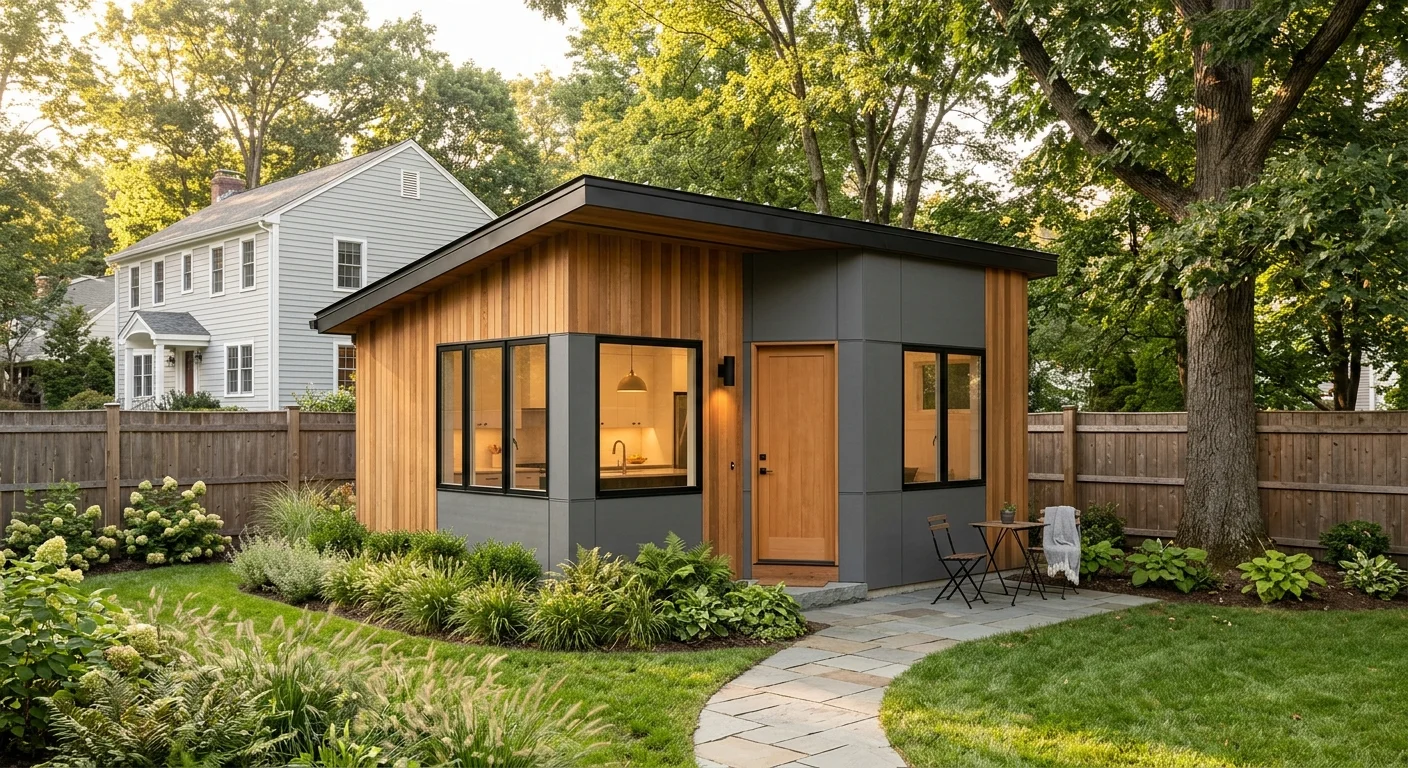
A completed detached ADU in a New York suburban setting — this type of backyard cottage is now permitted in NYC on eligible lots and in municipalities like Ithaca, Albany, Poughkeepsie, Croton-on-Hudson, and Tarrytown.
Why New York ADU Laws Are So Confusing (and How This Page Fixes That)
Here's the problem in one sentence: most ADU guides treat New York like it has one set of rules. It doesn't.
New York's ADU landscape runs on three separate layers, and nearly every other resource online conflates at least two of them. That's why you keep searching and never feel like you got a straight answer.
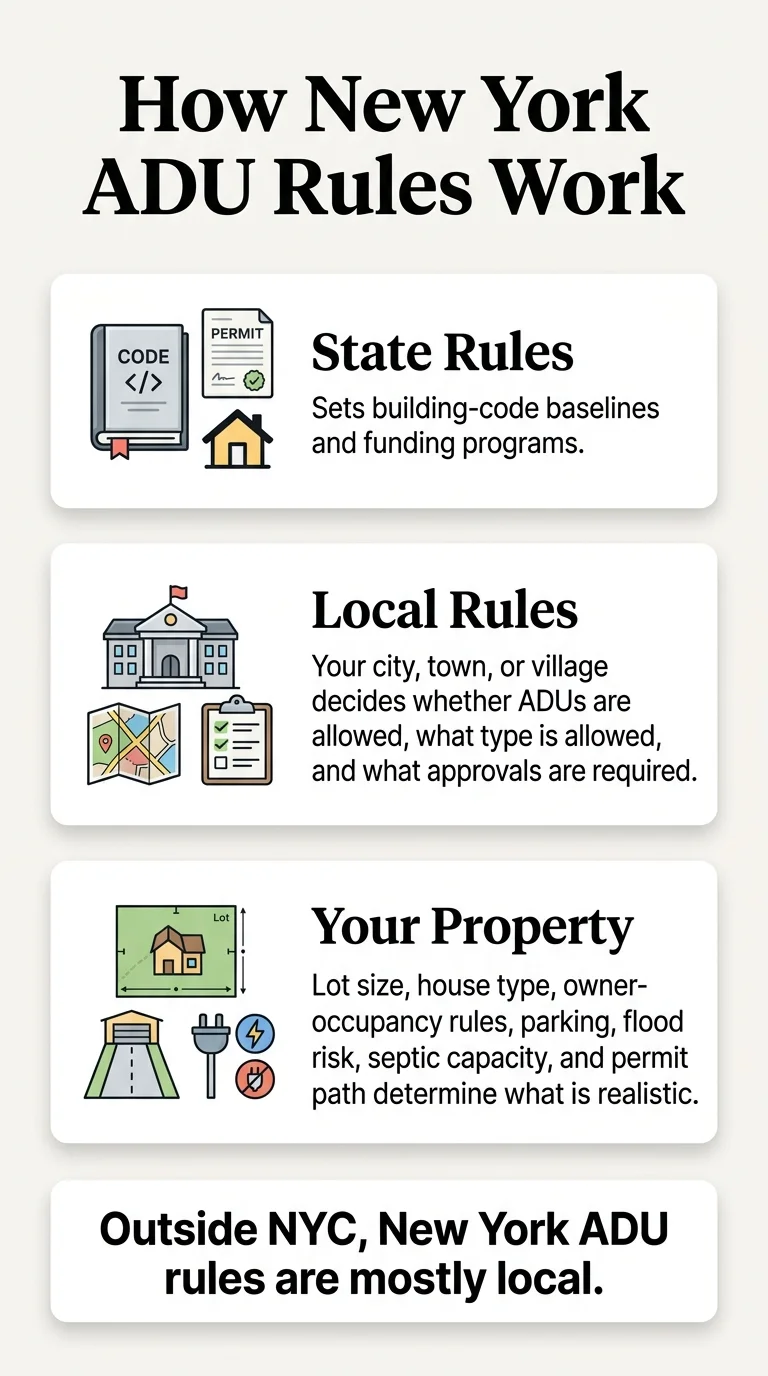
New York ADU rules operate on three layers — state code, local zoning, and your specific property. Most homeowners conflate the first two, which causes most of the confusion.
Layer 1: NYC law — in effect now.
New York City enacted Local Laws 126 and 127 in December 2024 as part of the City of Yes for Housing Opportunity initiative. Both laws took effect June 16, 2025. The city began accepting LL127 ADU filings on September 30, 2025. This is current, enforceable law — not a proposal. Note: Legalization under LL126 and new cellar ADU applications are not currently being accepted until the Housing Maintenance Code amendment and DOB rules are finalized.
Layer 2: Statewide legislation — still pending.
New York still does not have a statewide ADU legalization law. Earlier statewide proposals, including the 2021–2022 session's A4854A / S4547A (the Accessory Homes Act), did not become law. As of April 2026, the active ADU-specific bill we've verified is A6778, the "Accessory Dwelling Unit Incentive Act," introduced March 2025. A6778 is a financing and forgivable-loan bill currently in the Assembly Committee on Housing — not a statewide zoning-override law, and not yet enacted.
Layer 3: Local municipality rules — varies everywhere else.
Outside NYC, every city, town, and village sets its own ADU rules. Some municipalities in Westchester, the Hudson Valley, and upstate New York allow ADUs with varying restrictions. Many Long Island towns limit you to internal accessory apartments only. And plenty of municipalities across the state don't allow them at all.
What Changed in New York ADU Rules in 2025 and 2026
If you read an ADU guide written before mid-2025, it's probably outdated. Here's the current timeline:
NYC City Council adopts City of Yes for Housing Opportunity. Local Laws 126 and 127 are enacted, formally recognizing ADUs in one- and two-family homes for the first time in city zoning code.
NYC Local Laws 126 and 127 take effect. The legal framework for new ADUs is active.
NYC Department of Buildings begins accepting LL127 ADU filings through the DOB NOW: Build portal. Rules for backyard cottages, attic apartments, and garage conversions are finalized. (LL126 legalization and new cellar ADU applications are not yet being accepted.) Source: NYC DOB.
New York State's updated 2025 Uniform Code and Energy Code become mandatory for all new permit applications statewide. Any ADU project filed after this date must comply with the new code baseline.
NYC relaunches ADU For You with an expanded address checker, pre-approved plan library, and budgeting tools. The Plus One ADU program reopens with combined financing support of up to $395,000 for qualifying NYC homeowners. Source: NYC HPD, Smart Cities Dive. Verify current status directly with NYC HPD.
Which ADU Rules Come From New York State — and Which Come From Your Town
This distinction matters more than anything else on this page. Get it wrong, and you'll waste months planning a project your municipality doesn't allow.
| What's Controlled | By the State? | By Your Municipality? | Example |
|---|---|---|---|
| Building code standards | Yes — 2025 Uniform Code | Municipality enforces state code | Fire separation, egress, ceiling height |
| Whether ADUs are allowed at all | No statewide right | Local zoning decides | Ithaca allows as-of-right; some towns ban ADUs entirely |
| Detached vs. internal only | No | Yes | Huntington: internal only. Croton-on-Hudson: detached cottages allowed |
| Maximum size | No statewide cap | Varies widely | NYC: 800 sq ft. Buffalo: 1,000 sq ft. Albany: 800 sq ft |
| Owner-occupancy requirement | No statewide rule | Yes | Ithaca: none. Albany: yes (biennial certification). Huntington: yes (annual renewal) |
| Parking requirements | No | Yes | Tarrytown: 3 total off-street spaces. NYC: none for ADUs |
| Tax exemptions (RPTL §421-p*2) | Optional framework only | Must be adopted locally to apply | Only available where your county, city, town, village, or school district opts in |
| Grant funding (Plus One) | State funds the program | Administered through Local Program Administrators | Available only in participating municipalities |
| Permit and approval path | No statewide path | Ranges from simple to complex | Ithaca: building permit. Brookhaven: special permit + 2-year license |
Source: NYS HCR, NYS Department of Taxation and Finance, individual municipal codes, verified March–April 2026.
Can You Build an ADU on Your Property? The 6-Step Check
Most readers don't need a legal memo. They need a fast yes, maybe, or no. Walk through these six questions in order.
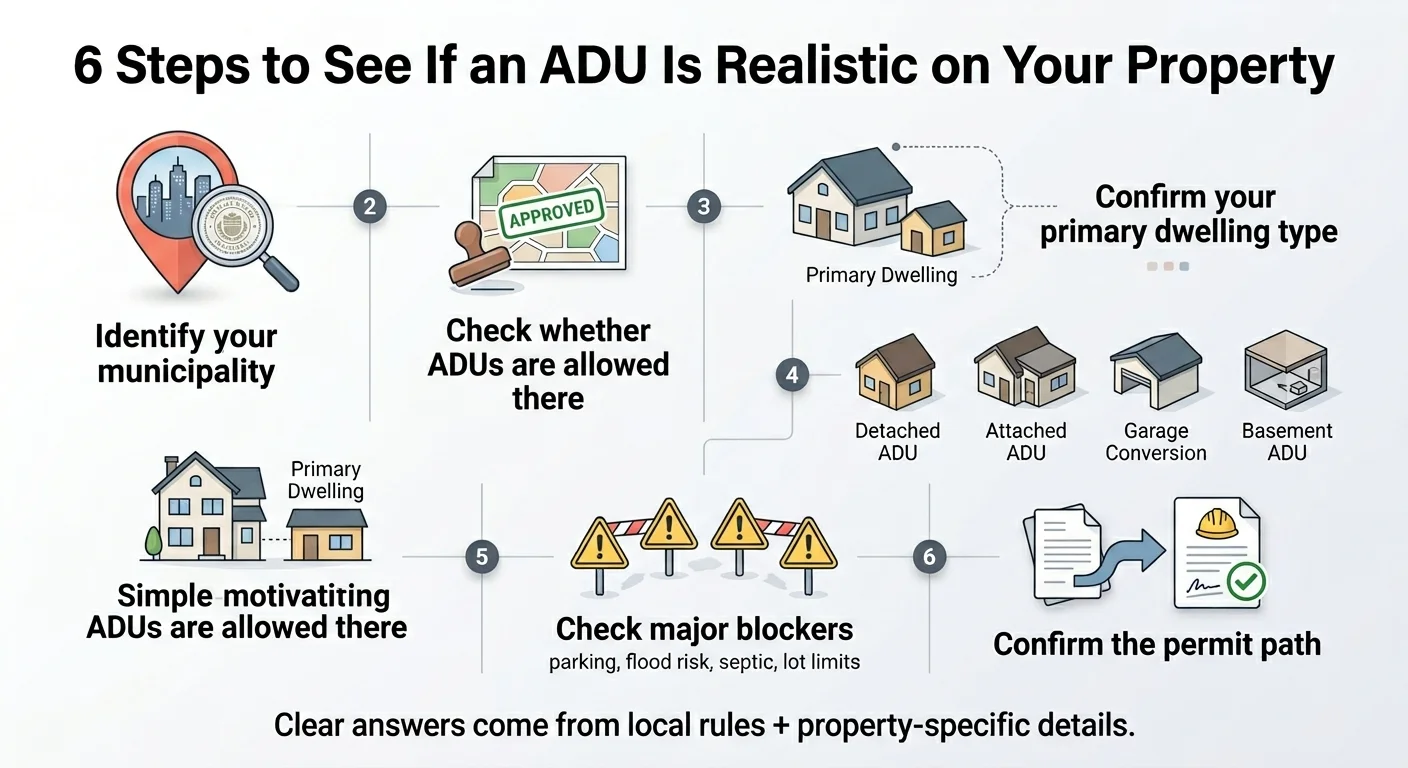
The 6-step property check — the fastest way to go from “I wonder if I can build an ADU” to a concrete yes, maybe, or no.
Identify your municipality.
This is the single most important variable. A property in Ithaca and a property 30 miles away in a rural township can have completely different ADU rules. If you're in NYC, skip to the NYC section below.
Determine if your municipality allows ADUs.
Check our municipality table below, or call your local building or planning department. Ask specifically: "Do you allow accessory dwelling units or accessory apartments? What types?"
Identify your primary dwelling type.
Most ADU rules apply only to single-family homes. Some municipalities (including NYC) extend to two-family homes. Row houses, townhomes, and multi-family buildings are usually excluded.
Determine which ADU type is realistic.
Don't assume you can build a detached backyard cottage. In many New York municipalities — especially on Long Island — the only path is an internal accessory apartment. Check what your municipality actually allows.
Check the blockers.
Even where ADUs are allowed, restrictions can kill a project: flood zone location, historic district, insufficient lot size, septic system capacity, and parking requirements are the most common.
Confirm your permit path.
Some municipalities issue a simple building permit. Others require planning board review, special permits, annual renewal, or owner-occupancy affidavits. Know the friction level before you invest in design.
Ready to check your property? See what you can build at your address — get your free ADU report in 60 seconds.
Free ADU report — municipality rules, property eligibility, and build options for your specific address.
Check My Property →Available in NY and 4 other states.
New York ADU Rules by Municipality: Our Verified Table
This is the core of this page. Instead of bouncing between a dozen municipal websites, use this table to see what's actually allowed where you live.
Municipalities That Currently Allow ADUs
| Municipality | Detached? | Internal / Basement? | Garage Conversion? | Owner-Occupancy? | Max Size | Permit Type | Verified |
|---|---|---|---|---|---|---|---|
| New York City | Yes (eligible lots) | LL126 legalization not yet open | Yes | Yes, at initial occupancy | 800 sq ft | DOB NOW: Build (LL127 filings) | Apr 2026 |
| Ithaca | Yes | Yes | Yes | No — not required | 800 sq ft (detached) | Building permit, as-of-right | Mar 2026 |
| Buffalo | Yes (ancillary dwellings) | Yes | Varies | Varies | 1,000 sq ft | Per Unified Development Ordinance | Mar 2026 |
| Albany | Yes | Yes | Varies | Yes — biennial certification | 800 sq ft | Building permit + registration; no STR | Apr 2026 |
| Croton-on-Hudson | Yes (cottages) | Yes | Varies | Yes | 800 sq ft or 40% of building (min 300 sq ft) | Planning Board + building permit + C of O | Mar 2026 |
| Tarrytown | Yes (R-15+ zones; existing accessory structures in all SF zones) | Yes | Possible (existing structures) | Yes | 1,000 sq ft and 50% of main dwelling | Building permit + owner affidavit; 3 off-street spaces | Mar 2026 |
| Town of Poughkeepsie | Yes (all zoning districts) | Yes | Varies | Yes — primary residence proof | 800 sq ft or 35% of existing floor area; max 2 bedrooms | ADU permit from Zoning Admin + building permit; 1 off-street space | Mar 2026 |
| Huntington (LI) | No | Yes (within single-family dwelling) | No | Yes — annual renewal | Per local code | Permit + annual renewal | Mar 2026 |
| Islip (LI) | No | Yes (within owner-occupied SF residence) | No | Yes | Per local code | Zoning Board of Appeals | Mar 2026 |
| Brookhaven (LI) | No | Yes | No | Yes | Per local code | Special permit + in-person + 2-year license | Mar 2026 |
| Southampton Village (LI) | No (not in accessory structures) | Yes (within principal dwelling) | No | Yes | Min 400 sq ft; max 50% or 800 sq ft; max 2 bedrooms | BZA special permit + C of O; renewal every 3 years or on title transfer | Mar 2026 |
Data sourced from municipal codes, official FAQ pages, and building department resources. Verified March–April 2026. Requirements change — always confirm directly with your local building department.
Don't see your town? Check what's possible at your address — we'll show you what New York rules allow on your specific property.
Free ADU report — municipality rules, property eligibility, and build options for your specific address.
Check My Property →Available in NY and 4 other states.
NYC ADU Laws: The City of Yes Framework Explained
New York City is the largest and clearest ADU framework in the state right now. Here's exactly what the rules allow — and where the limits are.
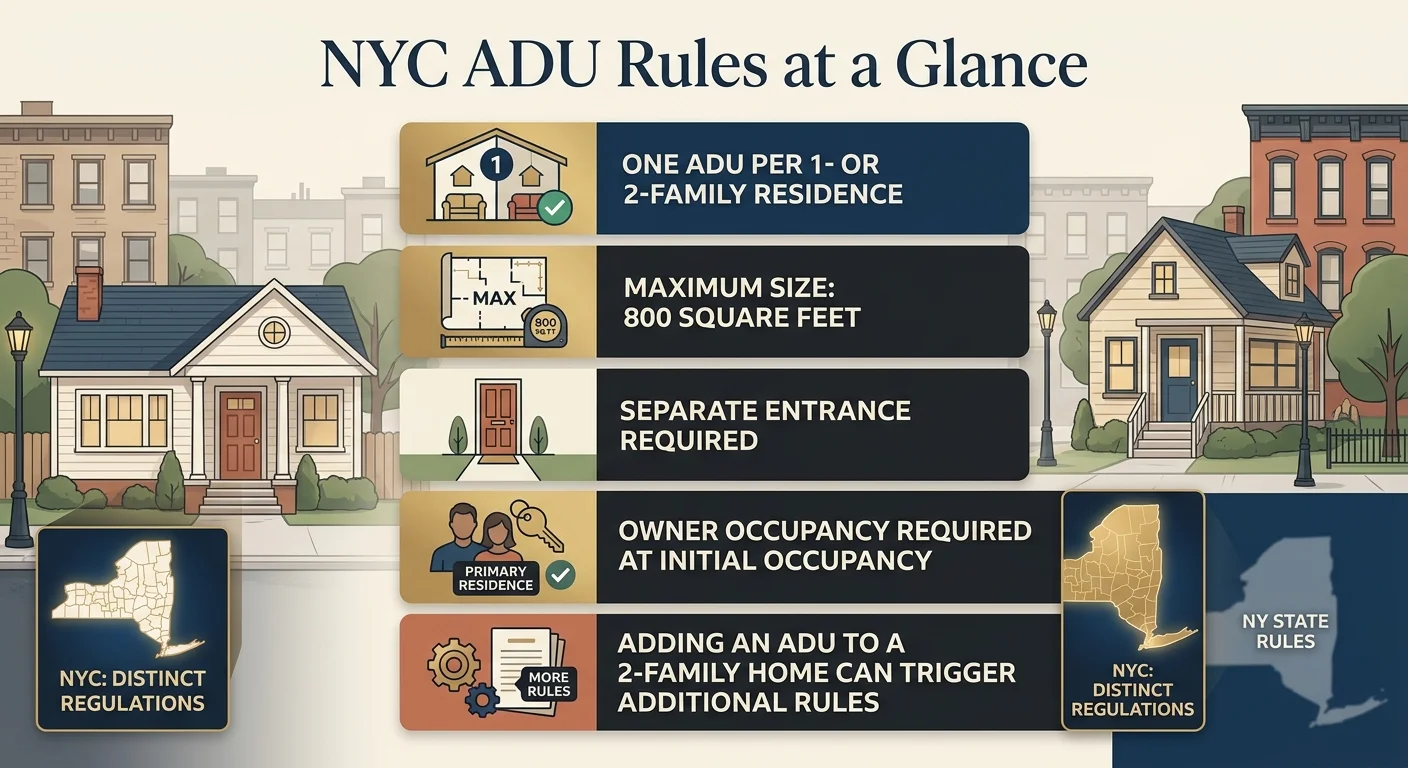
NYC's ADU framework at a glance — 800 sq ft maximum, separate entrance required, owner-occupancy at initial occupancy, and important distinctions for two-family buildings.
What NYC Actually Allows
Under Local Law 127 of 2024 (effective June 16, 2025), one ADU is permitted on a lot with a one- or two-family home. The city calls them “Ancillary Dwelling Units” — different term, same concept.
Basement apartments
LL126 legalization and new cellar ADU applications not yet open
Attic apartments
In one-family homes only
Backyard cottages
Detached rear-yard ADUs on eligible lots
Garage conversions
Allowed even where some backyard ADUs are restricted
Attached additions
Separated by a fire wall from a two-family primary dwelling
Size cap
800 sq ft maximum
Rear yard coverage
Detached: max 33% of required rear yard
Entrance rule
Separate entrance required (exterior or from public corridor)
Source: NYC DOB ADU page · NYC DOB ADU FAQs · verified April 2026
Who Qualifies? The Eligibility Reality
The Regional Plan Association estimated in September 2025 that only about 68,000 of NYC's 565,400 one- and two-family lots — roughly 12% — would qualify under the initial rules.
| Building Type | Total Lots | Estimated Eligible | Percentage |
|---|---|---|---|
| Detached buildings | 185,400 | ~54,000 | 29% |
| Semi-detached buildings | 160,000 | ~14,500 | 9% |
| Attached buildings (row houses, townhomes) | 219,900 | 0 | 0% |
Source: Regional Plan Association analysis, September 2025.
The NYC Permit Process
Check eligibility
Use the ADU For You address checker at housing.hpd.nyc.gov/adu
Pick your ADU type
Basement, attic, backyard cottage, garage conversion, or attached addition
Hire a Registered Design Professional
Or select from the city's Pre-Approved Plan Library for faster approvals and reduced design costs
File through DOB NOW: Build
Create an Alt-CO-GC or New Building-GC job. Select "Yes" under Ancillary Dwelling Unit
DOB plan review
Review for zoning, construction code, fire safety, and occupancy compliance
Construction and inspections
Licensed contractors, required inspections
Certificate of Occupancy
Issued after final inspections
The Two-Family Trap: Watch for the Multiple Dwelling Law
If you add an ADU to a two-family building, the total unit count hits three — which triggers New York State's Multiple Dwelling Law (MDL). That means significantly more stringent building, fire safety, and occupancy requirements.
For one-family buildings adding an ADU, this isn't an issue. The building stays R-3 regardless. But if you own a two-family, factor the fire wall into your budget and feasibility analysis early.
Legalizing an Existing Basement Apartment in NYC
Local Law 126 of 2024 creates a pathway to legalize certain pre-existing basement and cellar apartments — but it's limited and it's not open yet.
Where it applies
Only in designated program areas in the Bronx, Brooklyn, Manhattan, and Queens. Unit must have existed before April 20, 2024. Not in flood risk zones.
The program
Eligible units can receive a 10-year authorization for temporary residence while owner works toward full code compliance through phased safety milestones.
Current status (April 2026)
Legalization applications are NOT yet being accepted. A service notice will be posted before the ATR application launches in DOB NOW.
Wondering what's possible on your NYC property? See what you can build at your address.
Free ADU report — municipality rules, property eligibility, and build options for your specific address.
Check My Property →Available in NY and 4 other states.
Long Island ADU Rules Are Stricter Than Most People Expect
If you live on Long Island and you've been reading about ADUs in the news, we need to reset expectations. Long Island towns generally do not allow the detached backyard cottages you see in articles about California or NYC. The typical Long Island path is an internal accessory apartment — within your existing single-family home — with significant restrictions.
| Rule | Huntington | Islip | Brookhaven | Southampton Village |
|---|---|---|---|---|
| Detached ADU? | No | No | No | No |
| Internal apartment? | Yes | Yes | Yes | Yes |
| Garage conversion? | No | No | No | No |
| Owner-occupancy? | Yes — annual renewal | Yes | Yes | Yes |
| Permit type | Permit + annual renewal | Zoning Board of Appeals | Special permit + in-person + 2-year license | BZA special permit + C of O + 3-year renewal |
| Best fit | In-home apartment for family member | In-home apartment within single-family residence | In-home apartment with significant permit friction | In-home apartment, strict size/structure limits |
That said, if the statewide ADU legislation ever passes, it would require all municipalities to allow at least one ADU per residential lot — including detached units. That would fundamentally change the Long Island landscape. But that bill hasn't passed.
The good news: even an internal accessory apartment can generate meaningful rental income and add real value to your property. Thousands of Long Island homeowners have successfully created legal accessory apartments for aging parents, adult children, or long-term tenants. It's a well-worn path — just a narrower one than what NYC now allows.
Upstate and Hudson Valley: More Flexible, but Not Uniform
Municipalities in the Hudson Valley and upstate New York tend to be more open to ADUs than Long Island — but the rules still vary significantly.
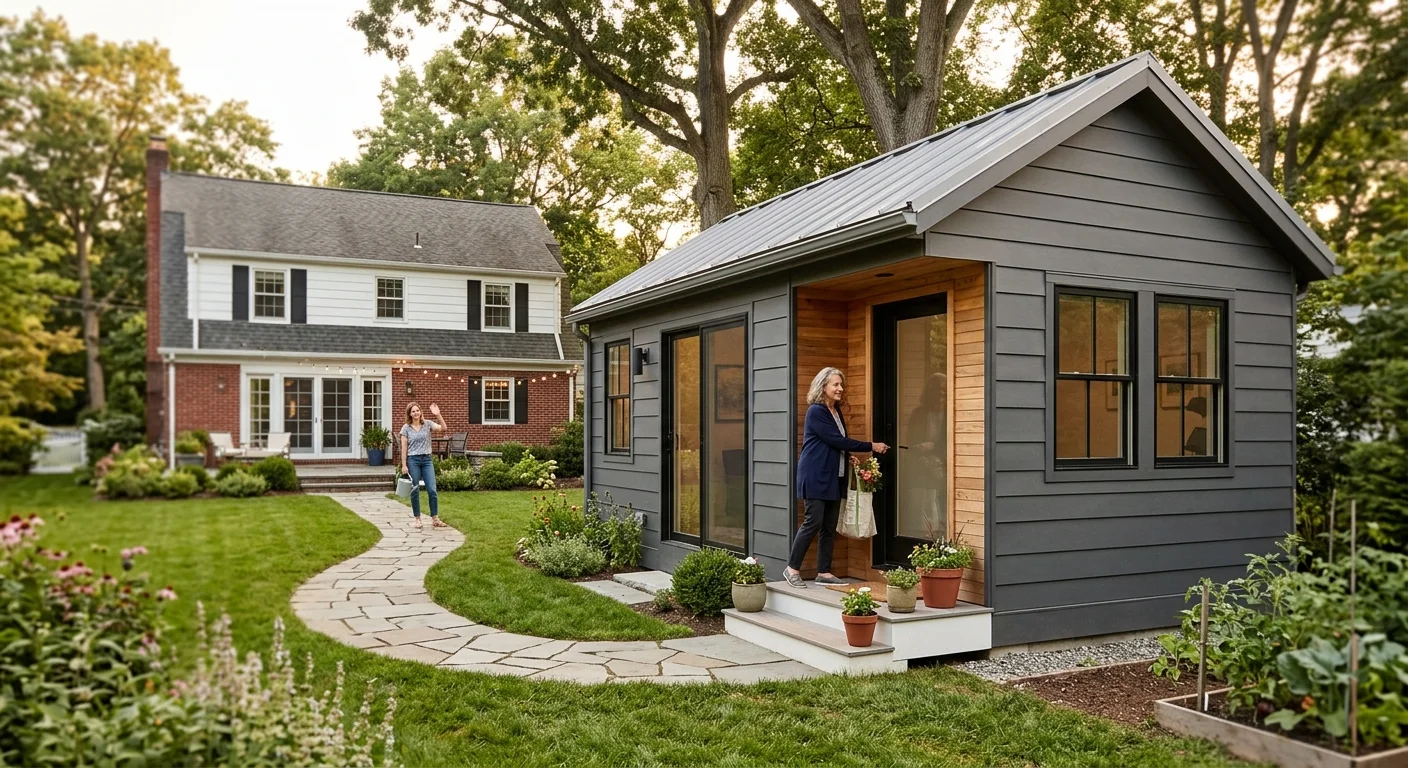
A detached ADU in an upstate New York or Hudson Valley setting — municipalities like Albany, Ithaca, Poughkeepsie, and Croton-on-Hudson now permit this type of backyard cottage for aging-in-place, family housing, or rental income.
Ithaca
The city allows ADUs as-of-right in multiple residential zones, permits detached units up to 800 sq ft, and — importantly — does not require owner-occupancy. That makes Ithaca one of the most permissive ADU municipalities in the entire state.
Official source: City of Ithaca ADU FAQ →Buffalo
Buffalo defines ancillary dwellings in its Unified Development Ordinance with a 1,000-square-foot cap. Detached units are permitted.
Official source: Buffalo Green Code →Albany
Albany now has clear, codified ADU rules: max 800 sq ft, owner must occupy either the primary or accessory unit and certify occupancy biennially, no rentals under 30 consecutive days, and the ADU must be within 150 feet of travel distance from the nearest street frontage. Detached units are allowed.
Official source: Albany Code §375-308 →Croton-on-Hudson
Allows both internal accessory apartments and detached cottages, but routes new ADU projects through Planning Board review. The Plus One ADU Program is active here, with grants up to $125,000 for qualifying homeowners.
Official source: crotononhudson-ny.gov/ADU →Tarrytown
Allows new detached ADUs on larger lots (R-15+ zones) and conversions of existing detached accessory structures in all single-family zones. Max size is 1,000 sq ft and 50% of the main dwelling's floor area. Owner-occupancy required. Minimum 6-month rental term. Three total off-street parking spaces required.
Official source: Tarrytown Code →Town of Poughkeepsie
Allows attached or detached ADUs as an accessory use to a single-family dwelling in all zoning districts. One per lot. Max 800 sq ft or 35% of existing floor area, whichever is less. Max 2 bedrooms. Owner must provide primary-residence proof. One off-street parking space. Private water and sewer connections need certification.
Official source: Poughkeepsie Code §210-58.1 →Do You Have to Live on the Property?
This is one of the most-asked questions about New York ADUs. The answer is local, not statewide.
| Municipality | Owner-Occupancy Required? | Details |
|---|---|---|
| NYC | Yes, at initial occupancy | Owner must live on the lot when the ADU is first occupied |
| Ithaca | No | No owner-occupancy requirement |
| Albany | Yes, biennial certification | Must certify occupancy every two years |
| Huntington | Yes, annual renewal | Must reside in dwelling and re-register annually |
| Croton-on-Hudson | Yes | Primary dwelling or ADU |
| Tarrytown | Yes | Owner must live on the property; 6-month minimum rental |
| Poughkeepsie | Yes | Primary residence proof required |
| Southampton Village | Yes | Renewal every 3 years or upon title transfer |
Can You Rent Out a New York ADU?
Yes — with restrictions. The most important distinction is between long-term and short-term rental.
Long-term rental (30+ days) is generally permitted wherever ADUs are allowed. This is the intended use — providing stable housing.
Short-term rental (under 30 days, including Airbnb-style stays) is restricted or prohibited in most municipalities:
- NYC:Short-term rentals are heavily regulated under Local Law 18. ADUs are intended for long-term housing.
- Albany:No rentals under 30 consecutive days.
- Tarrytown:Minimum 6-month lease required.
- Plus One program:Units built with Plus One support must be used as permanent housing — not short-term rentals. Compliance is monitored through annual certifications and site visits every two years during the regulatory period. (Source: NYS HCR)
What Permits and Approvals Are Required?
The permit process ranges from straightforward to genuinely complex depending on where you are.
| Municipality | Building Permit | Planning Board? | Registration / Renewal? | Owner Affidavit? |
|---|---|---|---|---|
| NYC | Yes (DOB NOW: Build) | No (ministerial review) | No annual renewal | Yes (owner-occupancy) |
| Ithaca | Yes | No (as-of-right) | No | No |
| Albany | Yes | No | Biennial certification | Yes |
| Croton-on-Hudson | Yes | Yes | Notify on ownership change | Yes |
| Tarrytown | Yes | May be required for expanded footprint | Yes | Yes |
| Poughkeepsie | Yes + ADU permit from Zoning Administrator | No | Verify locally | Yes — primary residence |
| Huntington | Yes | Verify locally | Yes — annual | Yes |
| Brookhaven | Yes | Yes — special permit | Yes — 2-year license | Yes |
| Southampton Village | Yes | BZA special permit | 3-year renewal or on transfer | Yes |
How Much Does an ADU Cost in New York?
We're not going to pretend this is simple. New York construction costs run above national averages, and the range is wide. Here are realistic estimates based on current industry reporting.
NYC ADU Cost Estimates
| ADU Type | Estimated Cost Range | Key Cost Drivers |
|---|---|---|
| Basement conversion | $80,000–$250,000+ | Waterproofing, egress, sprinklers, radon mitigation |
| Attic conversion | $100,000–$200,000+ | Structural reinforcement, dormers, HVAC |
| Backyard cottage (new) | $300,000–$400,000+ | Foundation, utilities, site access, full construction |
| Garage conversion | $100,000–$300,000+ | Structural upgrades, insulation, plumbing, fire safety |
Estimates based on industry reporting from Smart Cities Dive and Construction Owners, verified March 2026. These are illustrative ranges — always get specific quotes for your property and scope.
Why NYC Costs Run Higher
NYC construction involves factors that push costs above national averages: sprinkler requirements on most ADU types, fire wall requirements for two-family buildings (concrete/masonry, foundation to roof), limited site access in dense neighborhoods, and flood zone mitigation for subgrade units. These are real cost drivers that you should factor into your budget from day one.
The Math That Makes Homeowners Move Forward Anyway
ADU construction in New York is expensive. That's a fact, not a reason to stop reading. Legal one-bedroom apartments in most NYC neighborhoods command substantial monthly rent. Over 10 to 15 years, the rental income from a well-built ADU can recover the construction cost — and you're also adding a fully permitted dwelling unit to your property's value.
Outside NYC, construction costs are lower and the math can be even more favorable on a percentage basis. Thousands of homeowners across New York have built ADUs — and the ones who planned carefully understood their municipality's rules, their financing options, and their realistic costs before starting.
These are illustrative observations, not guarantees of returns. Actual results depend on local market conditions, construction costs, rental rates, vacancy, maintenance, and regulatory requirements.
Wondering how the numbers work for your property? See what you can build and get a realistic picture of what's possible.
Free ADU report — municipality rules, property eligibility, and build options for your specific address.
Check My Property →Available in NY and 4 other states.
Grants, Financing, and Tax Breaks for New York ADUs
New York has real financial support for ADU construction — but it doesn't override zoning, and it's not a blank check. Here's what's actually available.
The Plus One ADU Program
New York State committed $85 million to the Plus One ADU Program as part of Governor Hochul's five-year Housing Plan.
Outside NYC
- Grants up to $125,000 as a forgivable loan (declining balance over 10 years)
- Homeowners must earn at or below 120% of Area Median Income (AMI)
- ADU must be rented as permanent housing for the regulatory period (not less than 10 years)
- Available in participating municipalities through Local Program Administrators
- Participating areas include Long Island, Westchester County, Ulster County, and Town of Amherst
- $59 million of the $85 million has been awarded across the first two rounds
Source: NYS Homes and Community Renewal · Verified April 2026
In NYC
- Combined financing support up to $395,000 (combined financing, not a simple cash grant)
- Administered by Restored Homes HDFC in partnership with NYC HPD
- Preference for homeowners earning 120% AMI or below
- Property must allow an ADU under current zoning and building code
- Contact: PlusOneADU@hpd.nyc.gov or 212-584-8981 ext. 12
Source: NYC HPD, Smart Cities Dive. Verify current status directly with NYC HPD.
RPTL §421-p*2: The ADU-Specific Property Tax Exemption
New York created an ADU-specific optional property tax exemption under Real Property Tax Law §421-p*2 — “Exemption of Capital Improvements to Residential New Construction Involving the Creation of Accessory Dwelling Units.” This can reduce or eliminate the property tax increase from adding an ADU.
The key word is optional: it only applies where your county, city, town, village, or school district has adopted it locally. It is not automatic and it is not statewide. If property taxes are a concern, ask your local assessor's office whether §421-p*2 has been adopted in your municipality.
Source: NYS Department of Taxation and Finance, Form RP-421-p-adu · NYSenate.gov RPTL index
Other Financing Paths
Most homeowners fund ADUs through one of these paths:
Home equity line of credit (HELOC)
Borrows against existing equity
Cash-out refinance
Replaces your mortgage with a larger one
Construction loan
Short-term financing for the build, converted to permanent financing
Renovation loan (FHA 203(k), Fannie Mae HomeStyle)
Rolls renovation costs into your mortgage
Personal savings or family support
No debt, no interest
Exploring how to pay for your ADU? See current financing paths homeowners are using for ADU projects. Explore ADU financing options →
Common Blockers That Send People Back to Google
These are the issues that make people keep searching. We're covering them here so you don't have to.
"The unit already exists — can I legalize it?"
In NYC, LL126 creates a pathway for certain pre-existing basement and cellar apartments in designated program areas. But legalization applications are not yet being accepted as of April 2026. Outside NYC, most municipalities don't have a formal legalization path. Contact your local building department.
"I have a two-family home — what changes?"
In NYC, adding an ADU triggers the Multiple Dwelling Law unless separated by a fire wall. Outside NYC, most local ADU rules are written for single-family homes. Adding a unit to a two-family may not be permitted.
"Can I put one in a detached garage?"
In NYC, garage conversions are allowed and aren't restricted in the same areas where backyard ADUs are limited. On Long Island, generally no. In some Hudson Valley towns, converting an existing accessory structure may require planning board review. In Tarrytown, conversions of existing detached accessory structures are allowed in all single-family residential zones.
"What if I'm on septic?"
You'll need to demonstrate the system can handle additional load. Poughkeepsie requires private water/sewer certification. Expanding a septic system can add significant cost.
"What if I'm in a flood zone or historic district?"
Subgrade ADUs are prohibited in FEMA Special Flood Hazard Areas, Coastal Flood Risk Areas, and DEP 10-Year Rainfall Flood Risk Areas. Historic districts are excluded in NYC. In other municipalities, historic designation may require additional review.
"What if I don't plan to live there long term?"
Most municipalities require owner-occupancy. If you're planning to sell within a few years, consider whether the investment timeline makes sense. If you're buying a property with an existing 'in-law suite,' verify its legal status before closing — check the NYC BIS system or the DOB NOW Public Portal for NYC properties.
Pending Statewide Legislation: What Could Change
New York still does not have a statewide ADU legalization law. Here's where things stand:
Earlier statewide proposals did not become law.
The most discussed were A4854A / S4547A from the 2021–2022 session — the Accessory Homes Act — which would have required all municipalities to allow at least one ADU per residential lot with ministerial approval. Those bills did not pass, and the session has closed.
The current active ADU-specific bill is A6778.
The “Accessory Dwelling Unit Incentive Act,” introduced March 14, 2025, in the 2025–2026 session. A6778 is a financing and forgivable-loan bill (creating a statewide ADU loan program), not a zoning-override bill. It's currently in the Assembly Committee on Housing.
If a statewide zoning bill were to pass in a future session...
It could fundamentally reshape ADU policy — particularly on Long Island, where local rules currently restrict ADUs to internal apartments. But we're not going to tell you to plan your project around legislation that hasn't been enacted.
Free Resource
Free 2026 ADU Starter Kit
We track ADU legislation in every state — including New York — so you don't have to. Plus: cost worksheets, permit checklists, builder interview questions, and a financing comparison guide.
Get the Free 2026 ADU Starter Kit →How We Verified This Page
This page was built from primary sources — not from other ADU guides and not from AI summaries of other guides.
Sources used: NYC Department of Buildings official ADU pages and rules, NYC DOB ADU FAQs, NYC HPD Plus One program documentation, NYS Homes and Community Renewal program pages, NYS Department of Taxation and Finance (RPTL §421-p*2 forms and instructions), individual municipal codes via eCode360 and official municipal websites, Regional Plan Association analysis, New York State Assembly and Senate bill text, and reporting from Smart Cities Dive and Construction Owners.
What “verified” means: We read the actual municipal code, building department FAQ, or official program page for each municipality listed. We documented the verification date. We linked to the official source.
What it doesn't mean: We are not lawyers. This page is educational content, not legal advice. Municipal rules change. Local interpretation varies. Always confirm directly with your local building department before committing money to a project.
Update cadence: Monthly review for legislative changes and program updates. Full municipality verification quarterly.
Full editorial methodology → · Editorial standards → · Corrections policy →
Frequently Asked Questions About New York ADU Laws
Are ADUs legal in New York?
Yes, but not uniformly. NYC has a formal ADU framework under the City of Yes initiative. Outside NYC, legality depends on your specific municipality. There is no statewide law giving every homeowner the right to build one.
Does New York have a statewide ADU law?
No. Earlier statewide proposals (including the 2021 Accessory Homes Act) did not pass. The active ADU bill as of April 2026 is A6778, a financing program — not a zoning-override law.
Can I build an ADU on my property in New York?
It depends on your municipality, property type, and lot constraints. Use our municipality table above to find your area, then confirm with your local building department.
What cities in New York allow ADUs?
NYC, Ithaca, Buffalo, Albany, Croton-on-Hudson, Tarrytown, Poughkeepsie, and several others allow ADUs with varying restrictions. Many Long Island towns allow internal accessory apartments only.
What is the maximum size for an ADU in New York?
In NYC and Albany: 800 sq ft. In Buffalo: 1,000 sq ft. In Tarrytown: 1,000 sq ft (and 50% of main dwelling). There is no statewide cap — each municipality sets its own.
Do I have to live on the property?
In most municipalities, yes. NYC requires owner-occupancy at initial ADU occupancy. Ithaca is a notable exception — no owner-occupancy requirement.
Can I build a detached ADU in New York?
In NYC, yes, on eligible lots. In Ithaca, Albany, Poughkeepsie, and some Hudson Valley towns, yes. On Long Island, generally no — most towns restrict ADUs to internal apartments.
Can I convert my garage to an ADU?
In NYC, yes — garage conversions are allowed and aren't restricted where backyard ADUs are limited. In Tarrytown, existing accessory structure conversions are allowed in all SF zones. On Long Island, generally no.
Can I legalize a basement apartment in NYC?
Potentially, under LL126. Applies to pre-existing units in designated program areas that existed before April 20, 2024. Legalization applications are not yet being accepted as of April 2026.
Can I rent out an ADU in New York?
Long-term rental (30+ days) is generally permitted. Short-term rental (Airbnb-style) is restricted or prohibited in most municipalities — including NYC under LL18, Albany (30-day minimum), and Tarrytown (6-month minimum).
Can I use an ADU as an Airbnb?
In most municipalities, no. NYC regulates short-term rentals under LL18. Albany requires 30-day minimums. Tarrytown requires 6-month minimums.
Is there an ADU grant in New York?
Yes. The Plus One program provides grants up to $125,000 outside NYC and combined financing support up to $395,000 in NYC. Income limits and a 10-year regulatory commitment apply.
What is the Plus One ADU Program?
An $85 million state program providing grants and financing to homeowners building or improving ADUs. Administered through Local Program Administrators in participating municipalities.
Will an ADU increase my property taxes?
Adding an ADU typically increases assessed value. However, RPTL §421-p*2 provides an ADU-specific optional property tax exemption — but only where your local government has adopted it.
What's the difference between an accessory apartment and an ADU?
Similar concepts. 'Accessory apartment' is the traditional New York term, especially on Long Island. 'ADU' (or 'ancillary dwelling unit' in NYC) is the more current, nationally recognized term. Legal requirements may differ based on which term your local code uses.
What happens if I buy a home with an unpermitted accessory apartment?
You inherit the liability. Verify the legal status of any existing unit before purchasing. For NYC properties, check the BIS system or DOB NOW Public Portal.
The fastest way to know what's possible:
Not sure where to start? See what's possible at your New York address — get your free ADU feasibility report.
Free report · No sales call · No commitment · Available in NY
Get Your Free ADU Feasibility Report →CA, UT, TX, CO, and NY · More states coming soon
Related ADU guides
- →ADU Laws by State: All 50 States with Official Sources (2026)
- →California ADU Laws 2026: Rules, Setbacks, Fees & Permits
- →How Much Does an ADU Cost? All Types, All Sizes (2026)
- →400 Sq Ft ADU Cost (2026): Real Prices by Type & Region
- →300 Sq Ft ADU Cost: Real Prices by Type & Hidden Fees (2026)
- →Garage Conversion ADU Cost: Real 2026 Prices & Hidden Fees
- →ADU Financing Options 2026: HELOC vs Refi vs Renovation Loan
- →ADU Rental Income: How Much Can You Actually Make? (2026)
- →ADU for Airbnb: Legality, Income & Design Guide (2026)
By The Dwelling Index Editorial Team · Last verified: April 2026
This page is for informational purposes only and does not constitute legal advice. Municipal rules change. Always confirm requirements directly with your local building department, planning department, or a licensed attorney before committing resources to any project.
Editorial standards · Methodology · Corrections · Contact · Terms · Privacy · Affiliate disclosure