
Updated April 2026 · Sources cited inline · Vendor pricing cross-checked · City rules verified individually
Modular ADU: Real Costs, Permit Reality, and When It Actually Beats Site-Built
A modular ADU is a factory-built accessory dwelling unit shipped to your property in sections and assembled on a permanent foundation. The unit itself typically runs $80,000–$235,000 depending on size — but total installed cost, once you add foundation, site prep, utility hookups, permits, crane, and finish work, lands between $150,000 and $400,000+ for most projects nationwide. That puts it within striking distance of a comparable stick-built ADU.
So why go modular? Because on the right lot, modular construction delivers faster on-site assembly, tighter quality control, and locked-in structure pricing that protects your budget from the overruns that plague traditional builds. On the wrong lot, those advantages disappear — and you can end up paying more than if you’d built from scratch.
This guide breaks down every real cost, shows where permits get easier or harder by city, and helps you figure out whether modular is the smartest path for your property — or whether you should pivot to something else entirely.
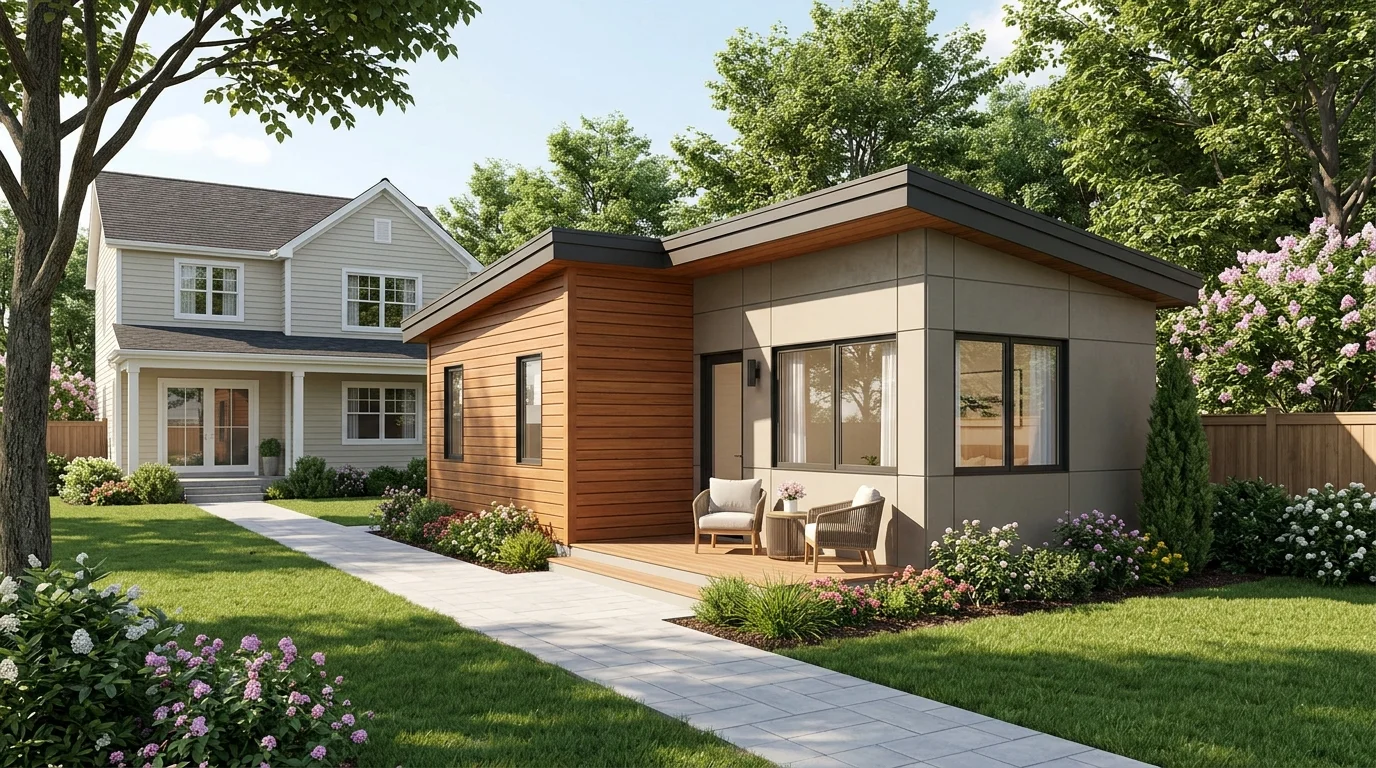
A modular ADU is usually the right move when you have a straightforward lot with good delivery access and care more about schedule predictability than unlimited customization. It’s usually the wrong move when your lot is tight, steep, or heavily constrained — because foundation, utilities, and site work can erase the factory advantage.
Here’s how the main build paths compare at a glance:
| Build Path | Best For | All-In Range (800 sf) | Customization | On-Site Time | Biggest Watch-Out |
|---|---|---|---|---|---|
| Modular (IRC) | Flat lots, good access, budget certainty | $205K–$355K | Limited floor plans | Days to weeks | Crane access, deposit structure |
| Panelized / Kit | Moderate custom, no crane needed | $180K–$340K | Moderate | Weeks | Needs on-site labor |
| Stick-Built | Tricky lots, custom designs | $180K–$400K+ | Unlimited | Months | Weather delays, cost overruns |
| Manufactured (HUD) | Budget-first, simple lots | $120K–$280K | Very limited | Days | Financing limits, appraisal risk |
Cost ranges compiled from Angi (March 2026), HomeGuide, SnapADU project data (March 2026), Olerra Colorado pricing (March 2026), BuildingAnADU.com self-reported costs, and ATL ADU project data. Ranges reflect national variation — high-cost metros trend upper; rural/Midwest markets trend lower. See our methodology →
What Is a Modular ADU?
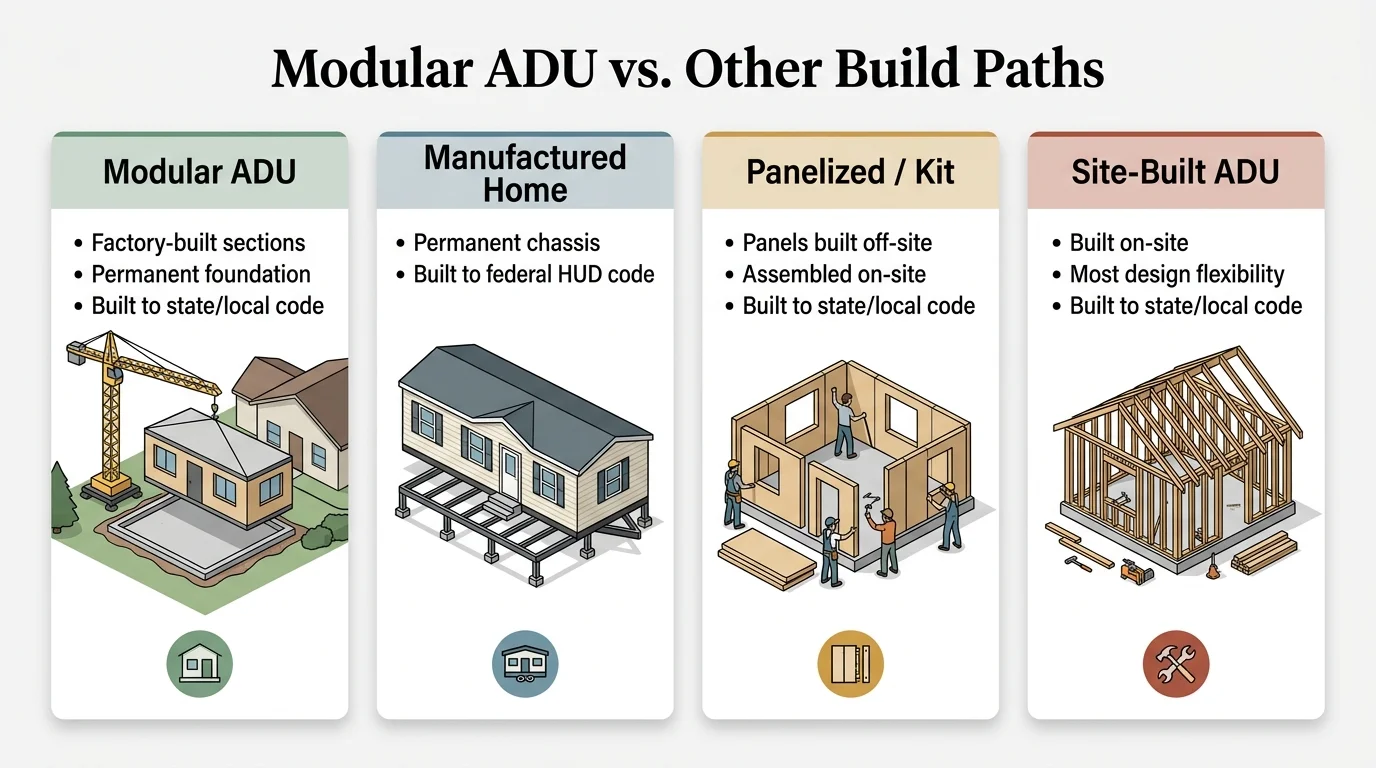
A modular ADU is an accessory dwelling unit built in factory-made sections and assembled on your property on a permanent foundation. Unlike manufactured homes — which are built to a separate federal standard — modular ADUs are reviewed under the same state and local building codes as any traditionally built house. That distinction changes everything about your permits, your financing, and what the unit is worth on paper.
If you’ve been researching for more than ten minutes, you’ve probably noticed the terminology is a mess. “Prefab,” “modular,” “manufactured,” “panelized” — these words get tossed around interchangeably, but they describe different products with different rules. Here’s the breakdown that actually matters.
Modular ADU (State/Local Building Code — IRC)
Built in sections at a factory. Shipped by truck. Assembled on a permanent foundation using a crane. Inspected to the same state and local residential building codes (IRC) as any site-built home. Legally classified as real property. This is the focus of this guide.
Manufactured Home (Federal HUD Code)
Built entirely in a factory to a different standard — the federal HUD code, not your state's building code. Transported on a permanent steel chassis that stays underneath the unit. The code path, financing options, and appraisal treatment differ from modular. Some lenders won't finance them for ADU use. Some cities treat them differently. This is not the same thing as a modular ADU, even though some companies blur the line.
Panelized / Kit ADU
Individual wall, floor, and roof panels are built in a factory, shipped flat, and assembled on-site. More like accelerated stick-building than true modular. No crane needed. More design flexibility. Still requires substantial on-site labor.
Stick-Built (Site-Built) ADU
Everything is constructed on your property from raw materials. Maximum customization. No delivery logistics to manage. Longest on-site timeline, but often the only realistic option for challenging lots.
Why This Distinction Matters
The label determines which building code applies, which permits you need, how lenders evaluate the unit, and what an appraiser says it’s worth. A modular ADU built to IRC standards is generally treated like a site-built home for lending and appraisal purposes under Fannie Mae guidelines. A manufactured home built to HUD code follows a separate framework with narrower options.
If a company calls their product “modular” but it ships on a permanent chassis and is certified under HUD code, you’re looking at a manufactured home. Ask which code the unit is built to before you go further.
Source: HUD User, “Single-Family Site-Built, HUD Code Manufactured, and Factory-Built Homes,” huduser.gov; Fannie Mae Selling Guide, Section B4-1.4, singlefamily.fanniemae.com. Verified April 2026.
Detailed Build Path Comparison
| Factor | Modular (IRC) | Manufactured (HUD) | Panelized/Kit | Stick-Built |
|---|---|---|---|---|
| Building code | State/local (IRC) | Federal HUD | State/local (IRC) | State/local (IRC) |
| Foundation | Permanent (required) | Permanent or piers | Permanent (required) | Permanent (required) |
| Crane needed? | Yes | Usually | No | No |
| Customization | Limited floor plans | Very limited | Moderate | Unlimited |
| On-site time | 1–4 weeks | 1–2 weeks | 6–12 weeks | 3–6+ months |
| Total project timeline | 4–9 months | 3–7 months | 4–8 months | 6–12+ months |
| Financing | Standard options available | More limited | Standard options available | Full range |
| Appraisal | Generally treated like site-built | May be discounted | Generally treated like site-built | Standard baseline |
| Future modifications | Difficult | Very difficult | Moderate | Easy |
How Much Does a Modular ADU Really Cost?
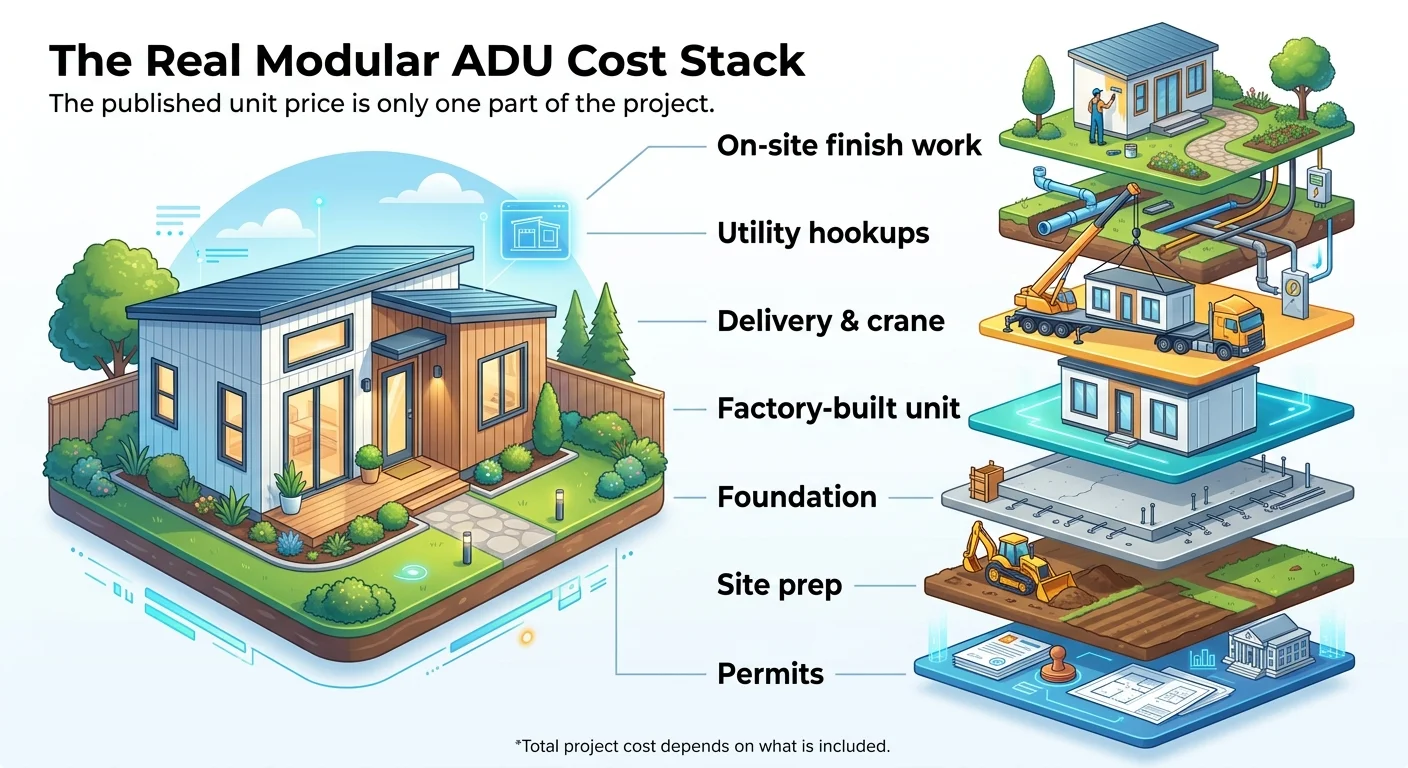
Published unit prices for modular ADUs typically range from $80,000 to $235,000 depending on size and manufacturer. But the unit price is not the project price. Total installed cost — everything you need to go from bare lot to certificate of occupancy — typically lands between $150,000 and $400,000+ once you add foundation, site preparation, utility hookups, crane, delivery, permits, and on-site finish work.
Those site costs commonly add 50% to 120% on top of the unit price. That’s the number most ads leave out.
Why Sticker Prices Are Misleading
When you see a modular company advertising “starting at $120,000,” that’s a real price — for the factory-built structure delivered to your property. But a structure sitting on a flatbed truck is not yet a home.
To become a livable, permitted ADU on your property, that structure needs a foundation poured to local specs, the site graded and prepped, water and sewer lines trenched, electrical service run, a crane to lift and set the modules, final interior connections, and inspections from your local building department.
Each of those adds real cost. And each varies based on your specific property. Understanding the full cost stack upfront is the single most valuable thing you can do before calling a modular company.
What You’ll Actually Pay: Total Installed Costs by Size
| ADU Size | Unit Cost | Site Prep & Foundation | Utilities | Permits & Fees | Delivery & Crane | On-Site Finish | Typical Total |
|---|---|---|---|---|---|---|---|
| 400 sf (studio) | $80K–$130K | $15K–$35K | $10K–$25K | $3K–$15K | $5K–$15K | $5K–$15K | $120K–$235K |
| 600 sf (1 bed/1 bath) | $110K–$170K | $20K–$45K | $12K–$30K | $5K–$18K | $8K–$18K | $8K–$20K | $165K–$300K |
| 800 sf (2 bed/1 bath) | $140K–$200K | $25K–$55K | $15K–$35K | $6K–$20K | $10K–$22K | $10K–$25K | $205K–$355K |
| 1,000 sf (2 bed/2 bath) | $170K–$235K | $30K–$65K | $18K–$40K | $8K–$22K | $12K–$25K | $12K–$30K | $250K–$415K |
| 1,200 sf (3 bed/2 bath) | $200K–$280K | $35K–$75K | $20K–$45K | $10K–$25K | $15K–$30K | $15K–$35K | $295K–$490K |
Sources: Angi ADU cost data (March 2026), HomeGuide national ADU cost guide, SnapADU San Diego builder data (March 2026), Olerra Colorado budget breakdowns (March 2026), BuildingAnADU.com self-reported homeowner costs, ATL ADU Atlanta project costs. Ranges reflect national variation. Coastal/urban markets trend upper; rural/Midwest markets trend lower. Excludes landscaping and furniture. These are illustrative ranges, not project quotes. Your actual cost depends on local labor and material pricing, site conditions, and what your specific provider includes in their scope. Get itemized estimates for your property before committing.
What Every Quote Should Show You
Some companies offer turnkey pricing that covers everything from permits to move-in. Others quote structure-only — and you hire a GC for everything else. The difference can be $50,000–$150,000 on the same project.
| Cost Item | Turnkey Providers | Structure-Only Providers |
|---|---|---|
| Factory-built unit | Included | Included |
| Delivery to site | Included | Sometimes |
| Crane and setting | Included | You arrange |
| Foundation | Included | You arrange |
| Site grading and prep | Included | You arrange |
| Utility trenching and hookups | Included | You arrange |
| Permits and plan review | Included | You arrange |
| Interior finish connections | Included | Sometimes |
Before signing anything, ask for a fully loaded estimate covering every line item from permits through certificate of occupancy. If a company won’t provide one, budget separately for every item they exclude — and get written quotes for each.
Ready to compare real pricing?
See current floor plans, scope details, and verified information from modular and prefab ADU companies serving your area.
We’re reader-supported. When you use our links to request pricing or explore financing, we may earn a commission at no extra cost to you. Our recommendations are based on independent research and are never influenced by compensation. Affiliate disclosure →
Compare Modular ADU Companies →Is a Modular ADU Cheaper and Faster Than Site-Built?
Sometimes yes, sometimes no. That honest answer is exactly why this page exists.
When Modular Wins
Modular construction has the advantage when your lot is flat with clear truck and crane access, you want schedule predictability and less daily disruption, a standard floor plan meets your needs, and you value locked structure pricing. The factory phase runs in parallel with site preparation, compressing your overall timeline.
The ICC (International Code Council) notes that off-site construction can reduce project timelines by 20–50% and costs by up to 20% under favorable conditions.
Source: ICC, “Off-Site Construction Safety Toolkit,” iccsafe.org. Verified April 2026. Note: these numbers describe the factory advantage in isolation, not the total project including permitting, site work, and inspections.
When Site-Built Wins
Site-built pulls ahead when your lot is sloped, narrow, or has limited crane access, when you need a custom footprint, when design-match requirements demand flexibility (HOAs, historic districts, specific roof pitches), when you prefer phased payments tied to construction milestones, and when you may want to expand or modify the unit in the future. For ADUs above 800 square feet, total installed costs frequently land within 10–15% of each other regardless of build method. The modular cost advantage is clearest for smaller, simpler units on straightforward lots.
The Comparison That Matters
| Factor | Modular ADU | Stick-Built ADU |
|---|---|---|
| Cost per sf (total installed) | $250–$450 | $200–$500+ |
| Cost certainty | Higher — unit price locked at contract | Lower — 10–20% overruns common |
| Payment structure | Varies — some require larger earlier payments; others use milestones | Phased draws tied to milestones |
| On-site disruption | Days to weeks | Months |
| Total project timeline | 4–9 months | 6–12+ months |
| Customization | Fixed floor plans + finish choices | Unlimited |
| Lot flexibility | Needs crane access, gentle slope | Works on any buildable lot |
| Future modifications | Difficult | Straightforward |
The bottom line on cost:
Modular is not automatically cheaper. And “installed in one day” is not the same as “done in one day.” But modular offers something valuable that’s harder to quantify: cost certainty on the single largest line item. When your structure price is locked at contract, your budget planning becomes dramatically more reliable — and if you’re modeling rental income against construction costs, that predictability matters.
Not sure what your lot can handle?
Check your address against local zoning rules, setbacks, and size limits — free, in 60 seconds.
Check My Property →Detailed reports available in CA, UT, TX, CO, and NY.
Will Your City Allow a Modular ADU?
Most jurisdictions that allow ADUs will accept modular construction — since modular units are built to the same code as site-built homes. But “allowed” is only the first question. The real questions are: is there a streamlined approval pathway, what are the size and design constraints, and what site-specific complications will your city flag?
The regulatory landscape varies dramatically. Three cities show the full spectrum.
San José, California — The Fast Lane
San José maintains one of the most streamlined preapproved ADU programs in the country, including pathways for state-approved factory-built units. For qualifying preapproved projects with complete site-specific plans, the city says same-day permit issuance may be possible. That's about as fast as ADU permitting gets.
Source: City of San José, "Preapproved ADUs," sanjoseca.gov. Verified April 2026.
Portland, Oregon — Fast With Caveats
Portland offers pre-approved ADU plans, but the city explicitly notes that pre-approved plans don't eliminate zoning review, utility permits, flood zone evaluation, or individual trade permits. The plan may be approved, but your specific lot still faces its own review process.
Source: City of Portland, "New Pre-Approved ADU Plans," portland.gov, April 2024. Verified April 2026.
Truckee, California — Climate Can Narrow the Field
Truckee's extreme snow loads (170–480+ PSF) and wildland-urban interface fire codes dramatically limit which modular units qualify. The town's ADU team has vetted dozens of manufacturers, and only a handful meet their requirements. If you're in a similar climate-challenged area, don't assume a standard modular unit will work.
Source: Town of Truckee, "Modular and Kit ADUs," townoftruckee.gov. Verified April 2026.
5 Checks to Run Before You Pay a Deposit
- 1
Does your city accept factory-built/modular ADUs? Most do, but the required documentation and review pathway vary.
- 2
Is there a preapproved plan or expedited pathway? This can save weeks to months on permitting.
- 3
What's the maximum detached ADU size? This varies by state, city, and sometimes lot size or bedroom count. Your modular unit must fit within the limit.
- 4
Are there design standards? Some cities require specific roof pitches, exterior materials, or architectural compatibility. Standard modular units may not comply.
- 5
Are there site overlays? Flood zones, WUI fire zones, historic districts, coastal zones, and HOAs can all add requirements.
Modular ADU Paths: Selected Markets
This is a starting point for the most active ADU markets — not a comprehensive database. We verify each entry against official city sources. Always confirm directly with your local building department before committing.
| City/Region | Modular Accepted? | Preapproved Path? | Max Detached ADU | Notes | Verified |
|---|---|---|---|---|---|
| San José, CA | Yes | Yes — same-day possible for qualifying plans | 1,200 sf | Site-specific conditions still apply | Apr 2026 |
| Los Angeles, CA | Yes | Yes — Standard Plan program | 1,200 sf | Site-specific zoning and foundation review required | Apr 2026 |
| Portland, OR | Yes | Yes — with caveats | 800 sf (detached) | Separate zoning, utility, flood, and trade permits still required | Apr 2026 |
| Seattle, WA | Yes | Limited | Up to 1,200 sf (varies by bedroom count) | Height and lot coverage limits vary by zone | Apr 2026 |
| Denver, CO | Yes | No formal program | Varies by lot — 650–1,000 sf | ADU rules vary by neighborhood and lot size | Apr 2026 |
| Austin, TX | Yes | No formal program | Varies by zoning district | Size depends on zoning; verify with development services | Apr 2026 |
| Truckee, CA | Yes — limited manufacturers qualify | Town-vetted list | 1,200 sf | Extreme snow loads and WUI narrow eligible units significantly | Apr 2026 |
| Massachusetts (statewide) | Yes | Varies by municipality | Varies | Statewide ADU law passed 2024; local implementation still unfolding | Apr 2026 |
ADU regulations change frequently. If you spot an error or know of a city we should add, let us know →
See what you can build at your address
Our free report checks your property against local zoning, size limits, and setbacks — and shows estimated costs specific to your situation. Takes about 60 seconds.
Get Your Free ADU Property Report →Detailed reports currently available in CA, UT, TX, CO, and NY. More states rolling out soon.
What Site Conditions Make Modular Harder?
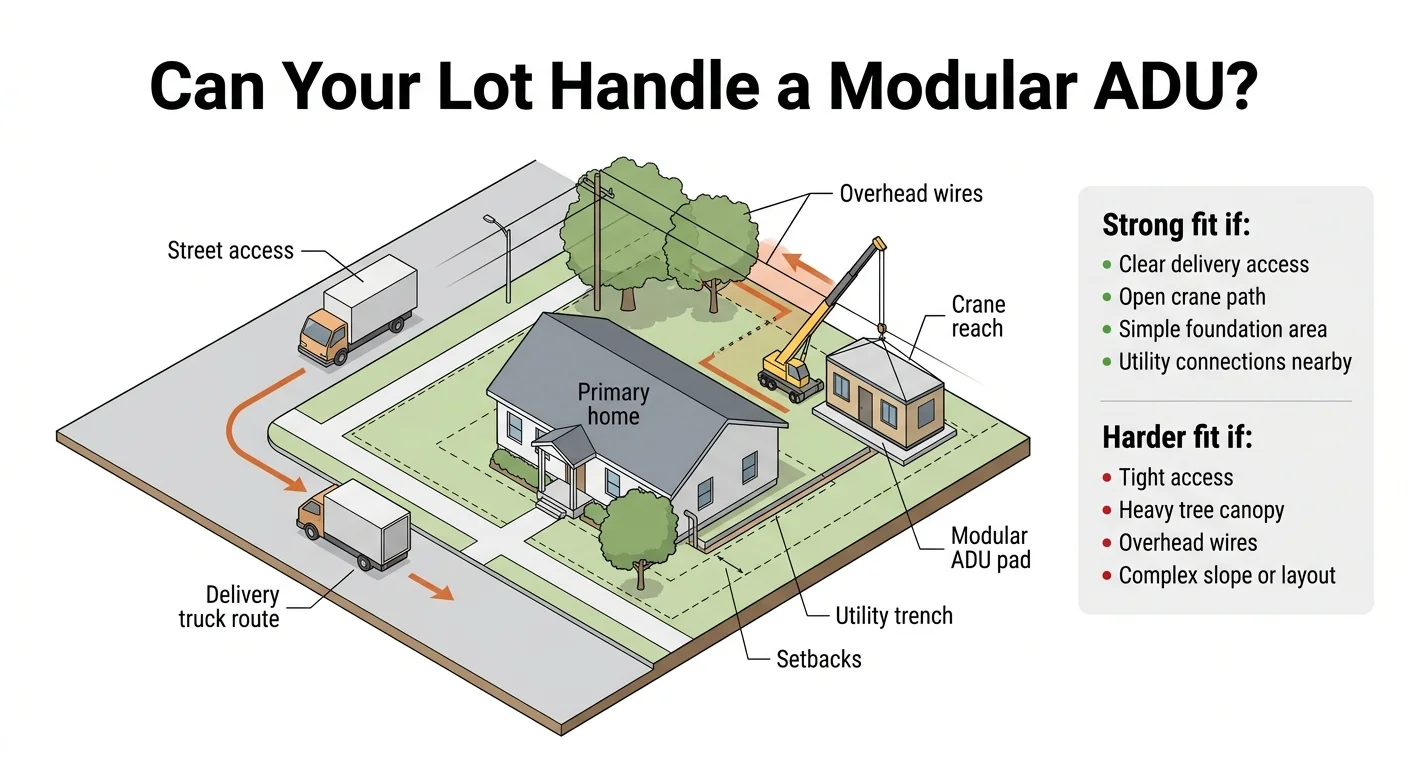
A modular ADU is only as practical as your lot allows. Most problems come from the site, not the factory. Before you commit to a floor plan, run through these requirements that modular companies rarely highlight.
Crane and Delivery Access
A modular ADU arrives on a flatbed truck (typically 8.5 feet wide, 53+ feet long) and gets lifted onto your foundation by a mobile crane. The crane needs room to set up, and the truck needs a clear path. Check: Is your street wide enough? Can a crane reach from the street to the build site (typically 40–100 feet)? Are there overhead obstructions — power lines, mature trees, second-story overhangs — blocking the path? If the answer to any of these is no, you may need temporary power line disconnection (extra cost and utility coordination), tree or fence removal, or a different build method entirely.
Slope and Foundation
Modular units need a level foundation. Significant slope means grading costs escalate quickly. Flat lots are ideal. Gentle slopes are workable. Steep grades almost always favor stick-built or panelized construction, where the structure can be designed around the terrain.
Utility Distance
Every ADU needs water, sewer, electrical, and sometimes gas. The farther the ADU sits from existing utility lines, the more trenching and infrastructure you'll need — $10,000–$45,000 depending on distance and local requirements. Also check whether your electrical panel has capacity for a subpanel, or if a panel upgrade ($2,000–$5,000) is needed.
Climate and Code Overlays
High snow loads, wildland-urban interface fire codes, flood zones, and coastal wind requirements can all narrow which modular units qualify. Standard designs aren't built for extreme conditions, and manufacturers who can meet those specs charge accordingly.
Design Review and HOA Restrictions
If your property is in a historic district, architectural review zone, or HOA with exterior standards, the modular unit must comply with roof pitch, siding, window, and color requirements. Stick-built or panelized gives you the flexibility to match without compromise.
The Quick Lot-Fit Checklist
Before calling any modular company, confirm every item on this list:
Checked every box? Modular is likely a strong fit. Failed two or more? Get a professional site assessment before committing — or compare panelized and stick-built options that work around your lot’s constraints.
Not sure what your lot can handle?
Check your address against local zoning rules, setbacks, and size limits — free, in 60 seconds.
Check My Property →Detailed reports available in CA, UT, TX, CO, and NY.
Financing and Appraising a Modular ADU
How you finance a modular ADU depends on one critical question: is the unit built to state/local building code (IRC), or federal manufactured housing code (HUD)?
Under Fannie Mae’s Selling Guide, modular and factory-built homes constructed to the IRC are generally treated like site-built homes for lending purposes — the same appraisal approach, the same loan products. Manufactured homes built to HUD code follow a separate appraisal and eligibility framework with narrower options.
That said, “generally treated the same” in the guidelines doesn’t mean every lender handles it identically in practice. Lender overlays, product-specific rules, and local appraiser familiarity all factor in. When you shop for financing, confirm that your lender has experience with modular ADU projects specifically.
Source: Fannie Mae Selling Guide, Section B4-1.4 “Factory-Built Housing,” singlefamily.fanniemae.com. Verified April 2026.
Common Financing Paths
| Financing Method | Modular (IRC)? | Manufactured (HUD)? | Notes |
|---|---|---|---|
| HELOC | Yes | Depends on lender | Draw as needed; variable rate |
| Cash-out refinance | Yes | Limited | Lump sum; fixed rate |
| Construction loan | Yes | Limited | Converts to permanent mortgage |
| Home improvement loan | Yes | Yes | Higher rate; typically unsecured |
| ADU-specific products | Yes | Varies | Purpose-built for ADU projects |
We don’t rank or recommend specific lenders. This is financing-path education. Explore current options with lenders experienced in ADU construction.
Watch the Payment Structure
Many modular providers require larger and earlier payments than a typical site-built milestone schedule. Some ask for 50% or more before factory production begins; others — like Olerra in Colorado — use a milestone structure closer to traditional construction draws.
Verify the payment schedule in writing before signing, and compare it to the work actually completed at each stage. If you’re using a construction loan, make sure the draw schedule aligns with the manufacturer’s payment terms.
Source: Olerra, “The Olerra Process,” olerra.com. Verified April 2026.
What Appraisers Look At
For a modular ADU built to IRC code, Fannie Mae’s guidance directs appraisers to analyze the ADU’s contribution to the overall property’s value and marketability — using the same general approach as for any site improvement. In areas where ADU comparable sales are still limited, appraisals can be unpredictable. This is improving as more ADUs are built and sold, but don’t assume dollar-for-dollar cost recovery.
See how homeowners are paying for their ADU projects
We break down every financing path — HELOCs, construction loans, cash-out refinances, and ADU-specific products.
We’re reader-supported. When you use our links to request pricing or explore financing, we may earn a commission at no extra cost to you. Our recommendations are based on independent research and are never influenced by compensation. Affiliate disclosure →
Explore ADU Financing Options →How to Vet a Modular ADU Company
The modular ADU industry is still maturing, and the stakes of choosing wrong are high. In recent years, several well-known companies have shut down or faced serious allegations — including Connect Homes, which filed for liquidation in early 2025, and Multitaskr, whose license was revoked amid accusations of misapplied funds and excessive deposits affecting more than $15 million in customer projects.
A 2025 Dwell investigation documented a troubling pattern: companies that show only renders instead of completed projects, take large deposits before manufacturing begins, and then go dark or fold.
Source: Dwell, “Buying a Prefab ADU Was Supposed to Be Easier Than This,” dwell.com, May 2025; California Contractors State License Board (CSLB) public records. Verified April 2026.
This isn’t meant to scare you off modular. Good companies exist and deliver outstanding results. But you need to separate them from the ones that won’t be around next year.
The 10-Point Vetting Checklist
Before you sign or send a deposit:
- 1
How many ADUs have they completed and are occupied? Ask for addresses you can drive by or visit. Renders are marketing — finished, occupied units are proof.
- 2
How long have they been operating? Newer companies carry more uncertainty. Ask about their track record and the team's construction experience.
- 3
Are they licensed, bonded, and insured in your state? Verify through your state's contractor licensing board. Don't take their word for it.
- 4
What is the payment schedule? Get it in writing. Watch for payment structures that front-load most of the cost before meaningful work is completed. Compare what you're paying at each stage to the work actually done.
- 5
What is the refund policy? If they won't put refund terms in the contract, walk away. This is non-negotiable after recent industry failures.
- 6
Do they have a BBB listing? Check for complaint patterns and resolution history.
- 7
What exactly does the quoted price include? Get a written scope separating structure, delivery, crane, foundation, site prep, utilities, permits, and finish work. Know where their responsibility ends and yours begins.
- 8
Who handles site work, foundation, and permits? Some companies are truly turnkey. Others sell a box and wish you luck. Know which you're buying.
- 9
What warranties do they offer? Structural, mechanical, and finish warranties should be documented with clear terms.
- 10
Can they provide references from homeowners whose ADUs have been occupied for 6+ months? Anyone can provide a reference from someone who just received their unit. You want someone who's lived in it long enough to find the problems.
We’re reader-supported. When you use our links to request pricing or explore financing, we may earn a commission at no extra cost to you. Our recommendations are based on independent research and are never influenced by compensation. Affiliate disclosure →
Comparing Companies Fairly
Always compare total installed cost — not unit price.
| What to Compare | What to Ask |
|---|---|
| Total project cost | "What will I spend from first call to certificate of occupancy?" |
| What's included | "Show me every line item in your quote — and every item that's separate." |
| Payment structure | "What's the deposit? When are additional payments due? What milestones trigger them?" |
| Timeline | "What's your average total project timeline — not factory time, total elapsed time?" |
| Completed projects | "Can I see 3–5 finished, occupied units and speak with those homeowners?" |
| Licensing | "What is your contractor license number and in which states are you licensed?" |
Compare options with confidence
See current pricing, floor plans, and scope details from modular and prefab companies — sorted by what matters, not who pays us more.
See Pricing & Floor Plans →When Should You Choose Modular?
Not every homeowner should go modular. Not every homeowner should avoid it. The right path depends on your lot, your budget, your timeline, and what you need the ADU to do.
Modular Is a Strong Fit When:
- Flat or gently sloped lot with clear crane and truck access
- Building a detached unit (not above a garage)
- A standard floor plan meets your needs
- Want locked-in structure pricing
- Value minimal daily construction disruption
- Building under 800 sf (strongest cost advantage)
- City has preapproved or expedited pathway
Consider Stick-Built Instead When:
- Lot is sloped, narrow, or has restricted access
- Need a custom footprint to maximize buildable area
- HOA/historic district demands design flexibility
- Prefer phased payments tied to milestones
- May want to expand the ADU in the future
- Building above a garage or converting space
- Overhead obstructions block crane operation
Consider Panelized/Kit When:
- Want factory efficiency without crane logistics
- Need more design flexibility than modular
- Faster assembly than full stick-built
- Lot has moderate access challenges ruling out volumetric modular
Use Case Considerations
Aging Parents / Multigenerational Living
Modular works well if accessibility features (zero-step entry, wider doorways, grab bars) are available from the manufacturer. If you need a fully custom accessible layout, stick-built may be the better path.
Long-Term Rental Income
Either method works. What drives rental income is size, layout, finish quality, and location — not how it was built. A well-designed 600 sf modular 1-bed/1-bath generates the same rent as a comparable stick-built unit.
Short-Term Rentals (Airbnb/VRBO)
Check your local STR ordinances first. If they're permitted, modular's faster timeline gets you to revenue sooner.
Home Office or Studio
If you don't need a kitchen or full bathroom, you may not need a permitted ADU — a simpler detached accessory structure might suffice. Check with your building department.
How a Modular ADU Project Works, Step by Step
The modular process is more orderly than a custom site-build — but it’s not instant. Here’s the actual sequence.
- 1
Feasibility and Local Rules (Week 1–2)
Verify setbacks, size limits, zoning, access, and any overlay districts. This costs nothing and can save months.
- 2
Select a Company and Floor Plan (Week 2–4)
Compare companies using the vetting checklist. Choose a floor plan that fits your lot dimensions and setbacks. Review the full scope and payment terms.
- 3
Site Plan and Engineering (Week 4–8)
Produce a site plan showing ADU placement, utility routes, and foundation design. Soil testing may be required.
- 4
Permits and Approvals (Week 6–16)
Submit plans to your building department. Timeline varies dramatically — from same-day in cities with preapproved plans to 4+ months in heavy-review jurisdictions. Clarify upfront whether your company handles permitting or you do.
- 5
Factory Production (Week 8–20, overlaps with Steps 4–6)
Your unit is built while permits process and site work begins. This parallel workflow is the core time advantage. Factory build typically takes 6–12 weeks.
- 6
Site Prep and Foundation (Week 10–14)
Grading, foundation pour, utility rough-in. Plan for 2–4 weeks of on-site activity.
- 7
Delivery, Crane Set, and Assembly (Week 14–16)
Modules arrive, crane lifts them onto the foundation, crew connects sections. Typically 1–3 days. Dramatic but brief.
- 8
On-Site Completion (Week 16–20)
Utility connections, interior finishing between modules, remaining exterior work.
- 9
Final Inspection and Occupancy (Week 18–22)
Building department inspects. You receive your certificate of occupancy. The ADU is officially livable — and if you're planning to rent it, income can start flowing.
Timeline by Phase
| Phase | Duration | Common Delays |
|---|---|---|
| Feasibility | 1–2 weeks | — |
| Company selection | 2–4 weeks | Indecision, poor vetting |
| Site plan and engineering | 2–4 weeks | Soil surprises, complex lots |
| Permitting | 2–16 weeks | City backlog, plan corrections |
| Factory build | 6–12 weeks | Supply chain, manufacturer queue |
| Site prep and foundation | 2–4 weeks | Weather, grading complexity |
| Delivery and crane | 1–3 days | Access issues, weather |
| On-site completion | 2–6 weeks | Utility scheduling, inspection delays |
| Final inspection | 1–3 weeks | Code corrections |
Total: 4–9 months from first call to move-in.
Depending on your city and site conditions. The modular advantage: factory build runs in parallel with permitting and site prep — compressing the total timeline compared to sequential stick-built construction.
Free Resource
Free 2026 ADU Starter Kit
Costs, financing paths, permit timelines by state, and common mistakes. One document, zero fluff. Everything before you talk to a single company.
Download Free Starter Kit →Modular ADU FAQ
What is a modular ADU?↓
A modular ADU is an accessory dwelling unit built in factory sections and assembled on your property on a permanent foundation. It's built to the same state and local building codes (IRC) as any site-built home — making it legally equivalent for permitting, financing, and appraisal purposes.
What is the difference between modular and prefab?↓
"Prefab" is an umbrella term covering any construction done off-site — modular, manufactured, and panelized all fall under it. "Modular" is one specific type of prefab, built to state/local building code and set on a permanent foundation.
What is the difference between modular and manufactured?↓
The building code. Modular is built to your state's IRC. Manufactured is built to federal HUD code on a permanent chassis. This affects permits, financing, appraisals, and legal classification.
Are modular ADUs built to residential code?↓
Yes. Modular ADUs meet the same IRC standards as site-built homes for structural integrity, electrical, plumbing, fire safety, and energy efficiency.
Do modular ADUs need a permanent foundation?↓
Yes. Foundation costs vary by soil, slope, and local code — typically $15,000–$75,000 depending on size and complexity.
Are modular ADUs cheaper than site-built?↓
Not always. Total installed costs are frequently within 10–15% of comparable stick-built ADUs once site work is included. The clearest savings are on smaller units (under 600 sf) on flat, accessible lots.
How long does a modular ADU take?↓
On-site installation: 1–3 days. Total project timeline: 4–9 months including design, permitting, factory build, site work, and inspections.
Will my city allow a modular ADU?↓
Most ADU-friendly cities accept modular construction since it meets the same building codes as site-built. But size limits, design standards, and site overlays vary. Always verify with your local planning department.
Can you build a modular ADU over a garage?↓
Rarely practical with modular construction. Above-garage ADUs require custom structural engineering and non-standard dimensions where stick-built has a significant advantage.
Can a modular ADU be financed?↓
Yes. Modular ADUs built to IRC code can be financed with HELOCs, cash-out refinances, construction loans, and other standard products. Manufactured homes (HUD code) have more limited options.
Do modular ADUs increase property value?↓
A permitted, code-compliant modular ADU is generally treated like a site-built ADU for appraisal purposes. Value increases depend on your local market and the availability of comparable sales. Many homeowners also generate $1,000–$3,000+/month in rental income that delivers ongoing returns beyond the appraisal bump.
Property value projections and rental income examples are illustrative, not guarantees. Results depend on local market conditions, construction quality, and regulatory factors.
What hidden costs should I watch for with a modular ADU?↓
The most commonly overlooked: utility hookups ($10K–$45K), electrical panel upgrades ($2K–$5K), foundation engineering for challenging soil ($3K–$8K), temporary power line disconnection for crane access ($1K–$3K), landscaping restoration ($2K–$10K), and impact fees in jurisdictions that charge them for larger ADUs.
Methodology and Sources
We built this page using national contractor databases (Angi, HomeGuide), builder-published project data (SnapADU, Olerra, ATL ADU, BuildX), self-reported homeowner costs (BuildingAnADU.com), government and regulatory sources (HUD User, HUD, Fannie Mae, ICC, California HCD), municipal ADU program pages (San José, Portland, Truckee, Los Angeles, Seattle, Denver, Austin), and industry reporting (Dwell, GreatBuildz).
Cost ranges represent national variation. We note what’s included and excluded in each source and cross-reference multiple data points before publishing a range. For details on our verification process, see our full methodology →
Municipal data was verified against official city sources as of April 2026. Regulations change frequently — we update this page quarterly and encourage readers to confirm directly with their building department.
If you find outdated information, an error, or a city we should add, contact us →
Author: The Dwelling Index Editorial Team
Published: April 2026 · Last updated: April 2026
Your Property, Your Next Step
You’ve seen the real costs, the permit paths, and the lot requirements. Now the question is whether any of this fits your specific address.
Find out in about 60 seconds. Our free report checks your property against local zoning, size limits, and setbacks — and shows estimated costs and financing options for your situation.
The next step is simple:
Find out what’s actually buildable on your specific property.
Free report · 60 seconds · No sales call · No commitment
Get Your Free ADU Report →Detailed reports currently available in CA, UT, TX, CO, and NY.
Or if you’re earlier in the process:
Download the Free 2026 ADU Starter Kit →Costs, financing, permits, timelines, and common mistakes. One document, zero fluff.
Related Guides
Best Prefab ADU Companies (2026)
Full comparison by price, scope, and service area
2 Bedroom Prefab ADU
Real costs, best models, and lot-fit requirements
Prefab ADU Cost Guide
What prefab ADUs cost from start to finish
How Much Does an ADU Cost?
All ADU types and complete cost breakdown
ADU Cost Per Square Foot
What you're really paying for every square foot
ADU Financing Options
HELOCs, cash-out refis, and ADU-specific loans
All vendor data and regulatory information last verified: April 2026. Regulations change frequently — confirm directly with your local building department before committing.