
How to Build an ADU: 11 Steps From “Can I Do This?” to Move-In Day
The bottom line: Building an ADU follows a predictable sequence — and most homeowners get it wrong by starting with design instead of starting with their property. The right order is: confirm what your lot allows, pick the ADU type that fits, set a realistic all-in budget, then move into design, permits, and construction. Total timeline ranges from roughly 6 months for a straightforward garage conversion to 18+ months for a custom detached build, depending on your city and site. Thousands of homeowners complete this every year. Here’s exactly how to build an ADU, step by step, with real city examples and the process details most guides leave out.
Which ADU Path Fits Your Situation?
| Path | Best For | Typical Timeline | Permit Complexity | Biggest Hidden Cost |
|---|---|---|---|---|
| Garage conversion | Budget-conscious, fastest path | 6–10 months | Low to medium | Structural upgrades if garage wasn't built to residential code |
| Internal / basement | Cold climates, existing space | 6–12 months | Medium | Egress requirements, moisture mitigation |
| Attached addition | Shared utilities, moderate budget | 10–14 months | Medium | Tying into existing foundation and roof |
| Detached new-build | Max privacy, rental income | 12–18+ months | High | Utility trenching, sewer connection fees |
| Prefab / modular | Speed, cost predictability | 6–12 months | Low (if pre-approved) | Site prep, foundation, crane access |
Timelines reflect ranges compiled from published city workflows and builder-reported project data across multiple U.S. markets. Your actual timeline depends on your city’s review speed, site conditions, and project scope.
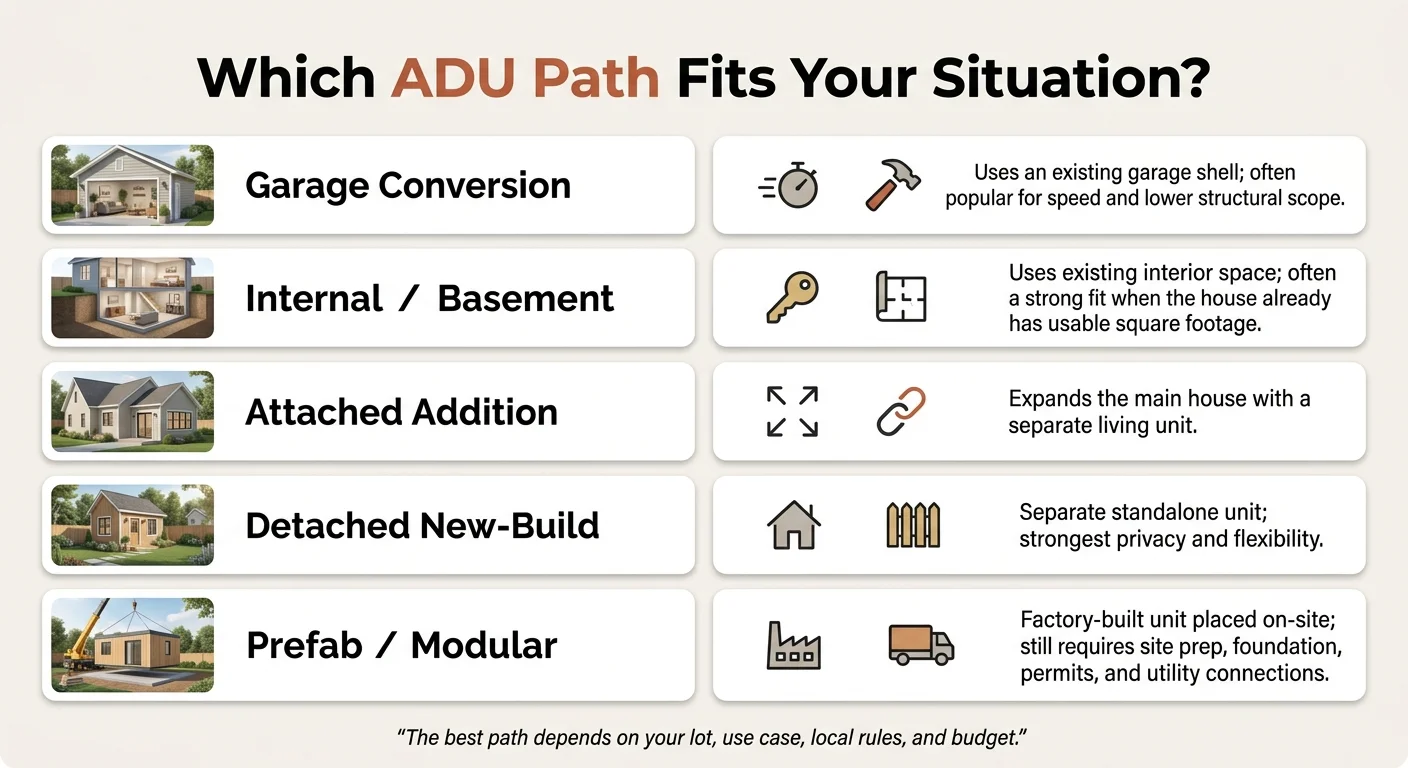
Your path changes your timeline, your budget, and your permitting experience. If you already know which path fits — or want to find out in 60 seconds:
See what you can build at your address — get your free ADU feasibility report.
Get Your Free ADU Feasibility ReportQuick ADU Process Overview: The 11 Steps
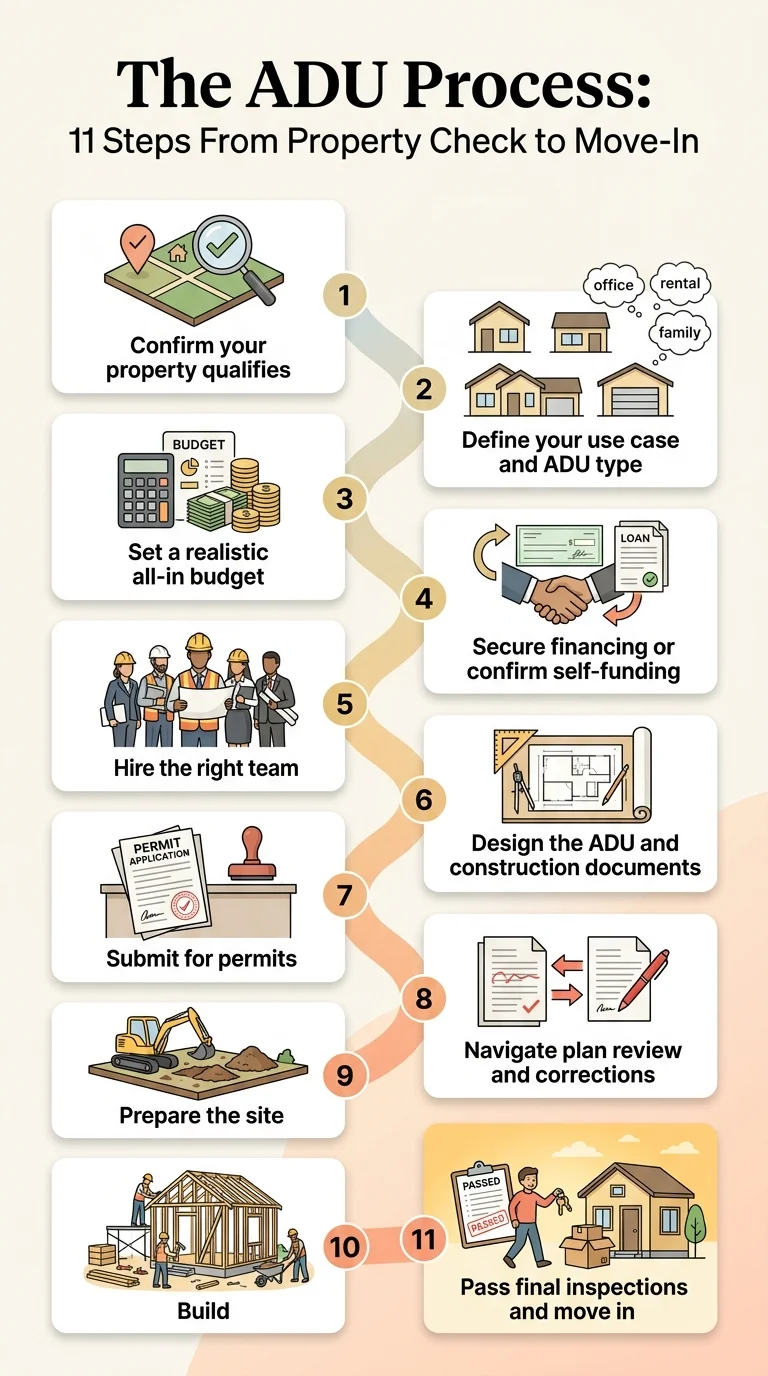
Before we go deep, here’s the full sequence at a glance. Most guides skip to step 5 or 6. That’s why most projects hit avoidable problems. We start where you should actually start — with your property.
- 1Confirm your property qualifies
- 2Define your use case and ADU type
- 3Set a realistic all-in budget
- 4Secure financing (or confirm you can self-fund)
- 5Hire the right team
- 6Design the ADU and prepare construction documents
- 7Submit for permits
- 8Navigate plan review and corrections
- 9Prepare the site
- 10Build
- 11Pass final inspections and move in
Step 1
Confirm Your Property Qualifies
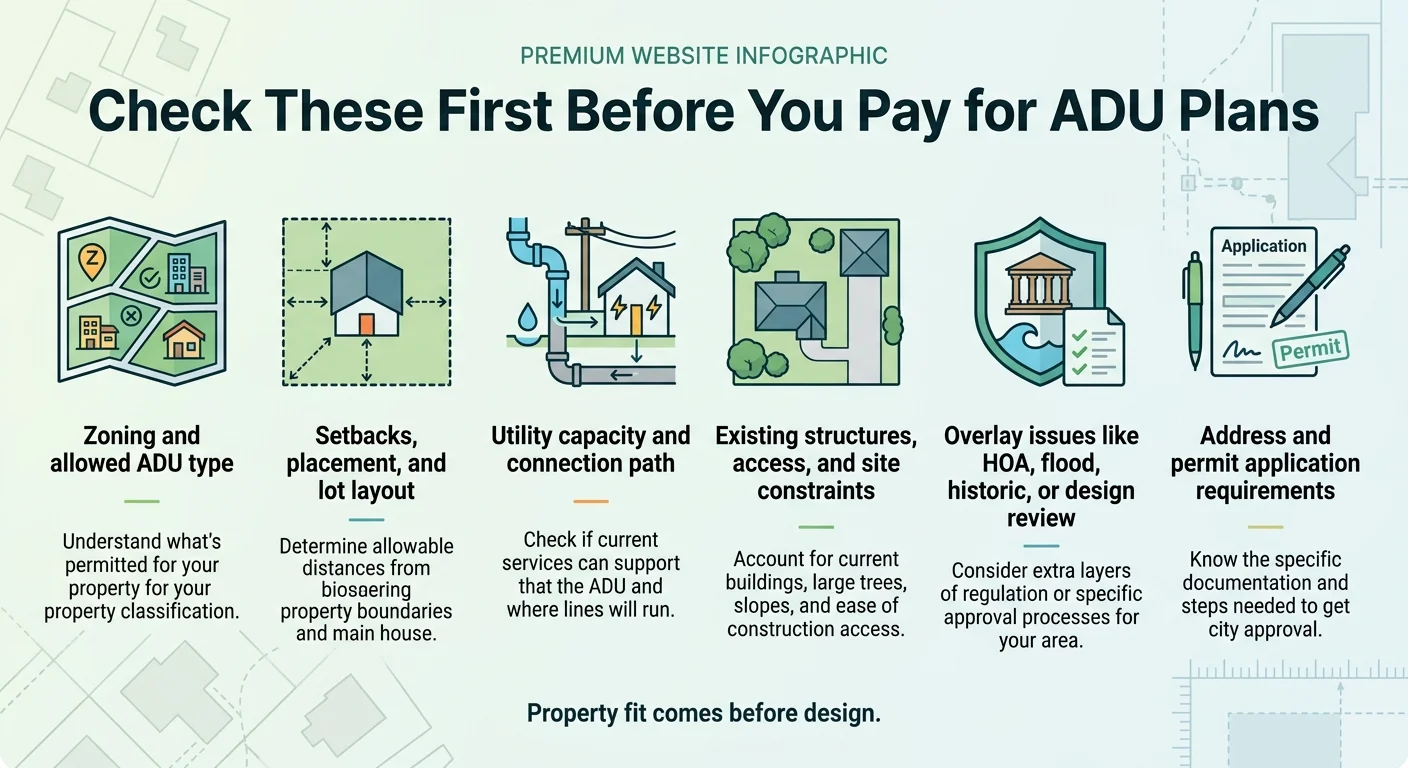
Before you spend a dollar on design or talk to a single contractor, confirm whether your lot can legally and physically support an ADU. Everything else — budget, design, timeline — depends on this answer.
Here’s what “qualifies” actually means:
Zoning.
Is your lot zoned for an ADU? ADU rules vary by state, city, and parcel. State-level reforms have accelerated — a Mercatus Center analysis identified 18 states with broad statewide ADU laws as of mid-2025 — but legality, size limits, setbacks, and review steps still depend heavily on your local code. (Source: Mercatus Center, "A Taxonomy of State ADU Laws," 2025.)
Setbacks, height, and lot coverage.
These vary by jurisdiction. Some cities require 4-foot rear and side setbacks for ADUs; others allow zero setbacks for conversions. Maximum lot coverage rules may limit how much of your lot can be structures. If your main house already uses most of the allowable coverage, a detached ADU might not fit — but a garage conversion or attached unit might.
Utility capacity.
Can your lot handle an additional sewer connection, water service, and electrical load? For some properties — especially those on septic systems or with older electrical panels — this is the real limiting factor.
HOA, historic, coastal, and overlay restrictions.
HOA and CC&R restrictions vary by state. In some states (including California and Washington under certain conditions), private restrictions that effectively prohibit ADUs are limited — but design review and recorded covenants can still apply. Historic districts, coastal zones, and flood plains may add review layers. Verify both state law and your governing documents before relying on a general rule.
Separate address.
Some cities require you to obtain a new address or building number before you can submit your permit application. Austin, TX is one example — the city's ADU workflow requires a unique address before application. (Source: City of Austin Development Services, verified March 2026.)
What to pull before you talk to anyone
- Your property's zoning designation (available on your city's GIS/parcel map)
- A current survey or plot plan showing lot dimensions, existing structures, and setbacks
- Your utility connection type (municipal sewer vs. septic, electrical panel amperage)
- Any deed restrictions, easements, or HOA CC&Rs
The 8 questions to ask your city on the first call
- 1
What ADU types are allowed on my lot?
- 2
What are the setback, height, and size limits?
- 3
Do you have pre-approved or standard ADU plans?
- 4
Is a separate utility connection required, or can I tie into the existing service?
- 5
Are any impact fees, school fees, or connection fees waived for ADUs under a certain size?
- 6
What's the current permit review timeline?
- 7
Do I need a separate address before I apply?
- 8
Are there any overlay zones, historic districts, or special review requirements for my lot?
Write down who you spoke with and the date. Policies change, and you want a record.
The costly mistake at this stage: Hiring a designer before confirming feasibility. We’ve talked with homeowners who spent thousands on plans for an ADU their lot couldn’t support — because they assumed zoning would work without checking. Fifteen minutes with your city’s zoning desk can prevent that entirely.
Skip the guesswork. See what you can build at your address.
Get your free ADU feasibility report in 60 seconds.
Check My PropertyStep 2
Define Your Use Case and ADU Type
The right ADU type isn’t the one you saw on Instagram. It’s the most cost-effective legal option that solves your actual problem.
For a full breakdown of ADU types, definitions, and how they compare, see our complete guide to ADU types. Your use case drives the decision:
Rental income?
Prioritize a separate entrance, full kitchen, and enough bedrooms to maximize rent. Detached units typically command higher rents because of privacy.
Aging parents?
Think single-story, ADA-accessible layout, proximity to the main house. An attached ADU or garage conversion often works best.
Adult child or guest space?
A smaller unit or JADU (Junior ADU — typically under 500 SF, converted from existing space) might be enough.
Home office / studio?
You may not need a full ADU. But if you want the option to rent it later, build to ADU standards now.
Investment / Airbnb?
Check your city's short-term rental rules first. Many cities restrict or prohibit STR in ADUs.
The key insight: Garage conversions and internal ADUs are almost always faster and cheaper because you’re working with an existing structure. Detached new-builds offer maximum flexibility but take the longest and cost the most.
Step 3
Set a Realistic All-In Budget
The most common budgeting mistake is only counting construction cost. Before a single nail is driven, you’ll spend money on design, engineering, permit fees, utility connections, and site preparation.
Preconstruction cost categories
| Category | What’s Included | Where Surprises Hide |
|---|---|---|
| Feasibility | Zoning research, soil report, survey | Survey costs on irregular lots |
| Design & engineering | Architecture, structural, energy calculations | Custom designs cost substantially more than pre-designed plans |
| Permit & review fees | Plan check, building permit, trade permits | Utility connection/capacity fees — the biggest variable |
| Site preparation | Grading, demolition, tree removal, access | Slope work, retaining walls, rock removal |
| Utility connections | Sewer, water, electric, gas trenching | Sewer lateral replacement, panel upgrade, distance to main |
For specific cost benchmarks by ADU type, see our ADU cost guide. Costs vary significantly by market — for reference, Boston publishes rough benchmarks of approximately $75K–$100K for an internal ADU and $250K–$350K for a detached ADU. (Source: Boston.gov ADU FAQ, verified March 2026.)
The number most people miss: Utility connection and capacity fees. If your ADU requires a new sewer lateral, water connection, or electrical panel upgrade, those costs can add five figures to your budget before construction even starts. Portland’s published sample fee calculation for a new detached ADU shows permit and review fees alone above $36,000 — before construction. (Source: Portland.gov, ADU permit fee example, verified March 2026.) Ask about these on your first call to the building department.
Budget a contingency. Construction surprises are not a matter of if, but when. A 10–15% contingency buffer is standard practice.
Here’s the other side of the equation: a well-built ADU adds real, measurable value. Properties with ADUs consistently appraise higher, and rental income from an ADU can meaningfully offset your monthly housing costs or mortgage.
Property value impact and rental income depend on your local market, unit size, and regulatory approvals. These are not guaranteed returns.
Wondering how homeowners pay for this?
Most don't write a single check. See the financing paths homeowners are actually using — from home equity options to renovation-specific loans designed for projects like this.
Explore ADU Financing OptionsStep 4
Secure Financing (or Confirm You Can Self-Fund)
Set your budget ceiling and likely financing path before you make design commitments. Your budget determines your ADU type, size, and finishes — and depending on the financing product, final lender approval may require plans, bids, or a defined project scope.
Official homeowner guidance supports this order. Washington, DC’s homeowner guide places estimating total project cost before finding a lender. Boston advises homeowners to apply for ADU financing once they’ve begun working with their architect or GC and understand design, scope, and estimated cost. (Sources: DC Front Door program; Boston.gov ADU FAQ. Verified March 2026.)
The main financing paths, organized by which situation they fit:
Home equity line of credit (HELOC)
Best if you have strong existing equity in your home and want flexible access to funds.
Explore HELOC optionsHome equity investment (HEI)
Best if you're equity-rich but cash-flow-constrained. These are not loans — they're equity investments with no monthly payments. You repay when you sell or refinance. Limited state availability.
Compare HEI optionsConstruction loan / cash-out refinance
The traditional path for larger projects or investors.
See construction loan optionsSelf-funding
If you're paying cash, you still want a clear budget ceiling before design begins. The discipline is the same.
Your financing path depends on your equity position, cash flow, and risk tolerance. For a deeper comparison of each option, see our ADU financing guide.
Step 5
Hire the Right Team
The order matters here. You need feasibility and budget clarity before you hire anyone — but once you’re ready, the team you assemble will make or break the project.
Who to hire first
Custom or semi-custom ADU
Start with a designer or architect who specializes in ADUs — not general residential remodels. They'll know your city's rules, typical review cycles, and how to design a unit that gets approved without extensive corrections.
Design-build
One firm handles design, permitting, and construction. Fewer handoffs, typically faster. The trade-off is less flexibility to shop construction bids.
Prefab
Your prefab company handles design and manufacturing. You'll still need a local general contractor or the company's install team for foundation, utility connections, and on-site assembly.
7 questions to ask before you sign anything
- 1
How many ADUs have you designed/built in my city specifically?
- 2
What's your average timeline from design start to Certificate of Occupancy?
- 3
What's your average number of permit correction cycles?
- 4
Can I see three recent ADU projects with homeowner contact info?
- 5
How do you handle cost overruns — fixed bid, cost-plus, or something else?
- 6
Who manages the permit process — you, me, or a third party?
- 7
What's included in your quote, and what's explicitly excluded?
Red flag: Any contractor who wants to start construction before permits are issued. Any designer who hasn’t permitted in your jurisdiction. Any prefab company that can’t name a completed project in your state.
Step 6
Design the ADU and Prepare Construction Documents
Design is where your ADU goes from idea to buildable plan. This phase produces the construction documents your city will review — not just a floor plan, but a complete technical package.
Three design approaches
Pre-designed / pre-approved plans
FastestSome cities maintain libraries of pre-approved ADU plans that skip or dramatically shorten design review. San José, for example, can issue same-day permits for complete pre-approved-plan submittals. (Source: City of San José ADU permit page, verified March 2026.) If your city offers them and one fits your lot, this is the fastest path.
Semi-custom
BalancedStart with an existing plan and modify it for your lot, setbacks, and preferences. Typical timeline: 4–8 weeks.
Fully custom
Most flexibleYour architect designs from scratch. Typical timeline: 8–16 weeks.
What goes into a permit-ready plan set
A floor plan alone won’t get you a permit. Depending on your city and project, the full package typically includes:
- Site plan showing ADU placement, setbacks, existing structures, utility routes, and access
- Architectural drawings — floor plans, elevations, sections, details
- Structural engineering — foundation design, framing calculations, load paths
- Energy compliance — Title 24 in California, or your state's equivalent energy code
- MEP plans — mechanical (HVAC), electrical, and plumbing layouts
- Supporting documents — soil report, drainage plan, utility capacity letters as required
DC’s homeowner guide explicitly requires electrical, plumbing, and technical plans in the permit package. Portland requires formal submittal documentation that feeds into their checksheet review system. (Sources: DC Front Door program; Portland.gov residential permitting. Verified March 2026.)
The design decision that saves you months: Finalize your floor plan and finishes before you submit for permits. Structural changes after submission trigger re-review — and re-review means weeks or months of delay. Order cabinets, fixtures, and finishes early.
Step 7
Submit for Permits
Permitting is the step everyone worries about — and the one most guides oversimplify. Here’s what actually happens.
You (or your designer/contractor) submit your complete plan set and permit application to your city’s building department. In some cities, zoning approval is a separate step that happens before or alongside the building permit. In others, it’s one application.
What you’re submitting
- Completed permit application form
- Full construction document package (see Step 6)
- Applicable fees (plan check fees are typically due at submission; building permit fees at issuance)
- Any supplemental documents your city requires — soil reports, utility letters, HOA approval, stormwater plans
What happens after you submit
Completeness check. The city confirms you've submitted everything required. If something's missing, your application goes back and the review clock doesn't start until it's complete. Incomplete applications are one of the most common causes of avoidable delay — multiple cities including Boston and Portland specifically call this out in their homeowner guidance. (Sources: Boston.gov ADU planning guide; Portland.gov ADU permitting. Verified March 2026.)
Plan review. A reviewer checks your documents against zoning rules, building codes, energy standards, and fire safety. They also route your application to other departments — planning, fire, utilities, sanitation, public works — each of which may need to sign off.
First-round comments. You'll receive a list of corrections or clarifications needed. This is completely normal — it does not mean your project was rejected. Most projects go through 1–3 correction cycles.
Step 8
Navigate Plan Review and Corrections
Getting comments back from the city is not a rejection. It’s a conversation. Understanding that changes your entire experience of permitting.
How to minimize correction cycles
- 1
Submit a complete package the first time. This is the single most effective thing you can do for your timeline.
- 2
Work with someone who's permitted in your city before. They know what reviewers look for.
- 3
Respond to comments quickly and thoroughly. Each round that sits on your desk adds that same time to your timeline.
- 4
Don't change the design during review. Moving a wall or adding a bathroom after submitting essentially restarts review.
The interdepartmental clearance maze
Your permit doesn’t just sit with one reviewer. Depending on your city, it may need sign-off from planning, fire, public works, water utility, sewer/sanitation, electric utility, and historic preservation (if applicable). Each works on its own timeline. Your designer or contractor should track all of these in parallel.
Once all comments are resolved, fees are paid, and clearances are obtained, your permit is issued. Some cities have an additional activation step — Austin, for example, requires permit activation before construction can legally begin. (Source: City of Austin Development Services, verified March 2026.)
How Long Does It Take to Build an ADU?
Here’s the part most ADU companies won’t lead with: the process is almost always slower than homeowners initially expect. Even in efficient cities, custom projects routinely take 12–18 months from first research to move-in day.
But here’s what that reality hides: the process is predictable. The steps don’t change. The sequence doesn’t change. What changes is how long each step takes in your specific city, with your specific lot, and your specific team. And it’s getting faster — over the past several years, dozens of states have passed legislation that streamlines permitting, removes barriers, and in many cases sets statutory review timelines.
Permit timelines vary by city — documented examples
| City / State | Documented Review Timeline | Key Process Notes |
|---|---|---|
| Seattle, WA | 2–6 weeks for pre-approved DADU plans | SDCI offers streamlined standard-plan pathSource: Seattle.gov SDCI, verified March 2026 |
| San José, CA | Same-day for complete pre-approved submittals | Longer for custom plansSource: City of San José ADU page, verified March 2026 |
| Washington, DC | ~25 business days (first review, no extra agency review); ~15 business days for subsequent rounds | Zoning-first workflowSource: DC Front Door program, verified March 2026 |
| Boston, MA | ~5 weeks if package is complete | Longer if incompleteSource: Boston.gov ADU FAQ, verified March 2026 |
| Portland, OR | Varies — Development Hub PDX with formal checksheet corrections | Check current review times at portland.govVerified March 2026 |
| Austin, TX | Varies — unique address required before application | Plan review fees → permit activation → inspections → COSource: City of Austin Development Services, verified March 2026 |
| Denver, CO | Varies — city publishes a live review-times dashboard | Check denvergov.org for current timesVerified March 2026 |
| Boise, ID | Pre-approved plans can cut design and permitting to weeks | Less regulation, faster review in most casesVerified March 2026 |
California statewide note: Under Gov. Code §66317, local agencies must approve or deny a completed ADU application within 60 days on lots with an existing dwelling. In practice, review times vary. (Source: California HCD ADU Handbook, January 2026.)
What makes projects faster
- ✓Pre-approved plans
- ✓Design-build firms (one team, fewer handoffs)
- ✓Cities with statutory review timelines
- ✓Ordering finishes early
- ✓Sticking to the approved plan
What makes projects slower
- ✕Custom design with multiple revision cycles
- ✕Cities with permit backlogs
- ✕Complex site conditions
- ✕Failed inspections requiring rework
- ✕Design changes after permit submission
Step 9
Prepare the Site
Once your permit is issued, the real work begins. Site preparation gets the ground ready for construction.
What site prep involves
Clearing: Removing vegetation, old structures, and debris. Tree removal may require a separate permit.
Grading: Leveling the ground for a stable, properly drained building pad. Sloped lots may need retaining walls or significant earthwork.
Utility trenching: Digging for water, sewer, electric, and gas lines from the main connection to the ADU location. Distance matters — longer runs cost more.
Staking: Marking the exact ADU footprint relative to property lines and existing structures.
Garage conversions & internal ADUs
Site prep is minimal — mostly demolition of non-structural elements and potentially reinforcing the existing foundation.
Prefab / modular
You still need a foundation and utility connections before the unit arrives, plus crane access. Tight lots, overhead wires, and narrow gates can complicate delivery.
Step 10
Build
Construction follows a regulated sequence — and understanding it helps you know exactly where your project stands.
| Phase | What Happens | Inspection Required? |
|---|---|---|
| Foundation | Excavation, forms, rebar, concrete pour, curing | Yes — before pouring |
| Framing | Walls, roof structure, window/door openings | Yes — before closing walls |
| Roofing & exterior | Waterproofing, siding, windows, doors installed | Varies by city |
| Rough-in (MEP) | Plumbing, electrical, HVAC rough installation | Yes — before insulation |
| Insulation & drywall | Insulation installed, drywall hung and finished | Yes — insulation inspection |
| Interior finishes | Flooring, cabinets, countertops, fixtures, paint, appliances | No (until final) |
| Exterior finishes | Landscaping, hardscape, final grading | Varies by city |
Each major phase requires a city inspection before work proceeds to the next stage. Failed inspections happen — usually for minor issues — and typically add days if your contractor addresses them promptly.
What trips homeowners up during construction
Subcontractor scheduling. Your GC coordinates multiple trades across multiple active projects. One trade running behind creates a cascade that delays everything after it.
Weather. Rain delays are real, especially during foundation and framing. Plan for them.
Material lead times. Custom windows, specific cabinet lines, specialty tile — these can take weeks to arrive. Order early.
Change orders. Deciding mid-build to move a wall, add a window, or upgrade the kitchen is the single most expensive decision you can make during construction. Structural changes may require re-permitting. Finalize everything before construction starts.
The prefab path looks different
If you’re going prefab or modular, the factory builds your unit while you’re going through permitting and site prep. That parallel process is the key time advantage. Once the foundation is ready and permits are issued, the unit is delivered, set on the foundation, connected to utilities, and finished on-site. On-site time is typically a few weeks after delivery.
Curious what prefab looks like for your property?
Compare top ADU prefab companies — see current pricing and floor plans.
Browse Prefab ADU OptionsStep 11
Pass Final Inspections and Move In
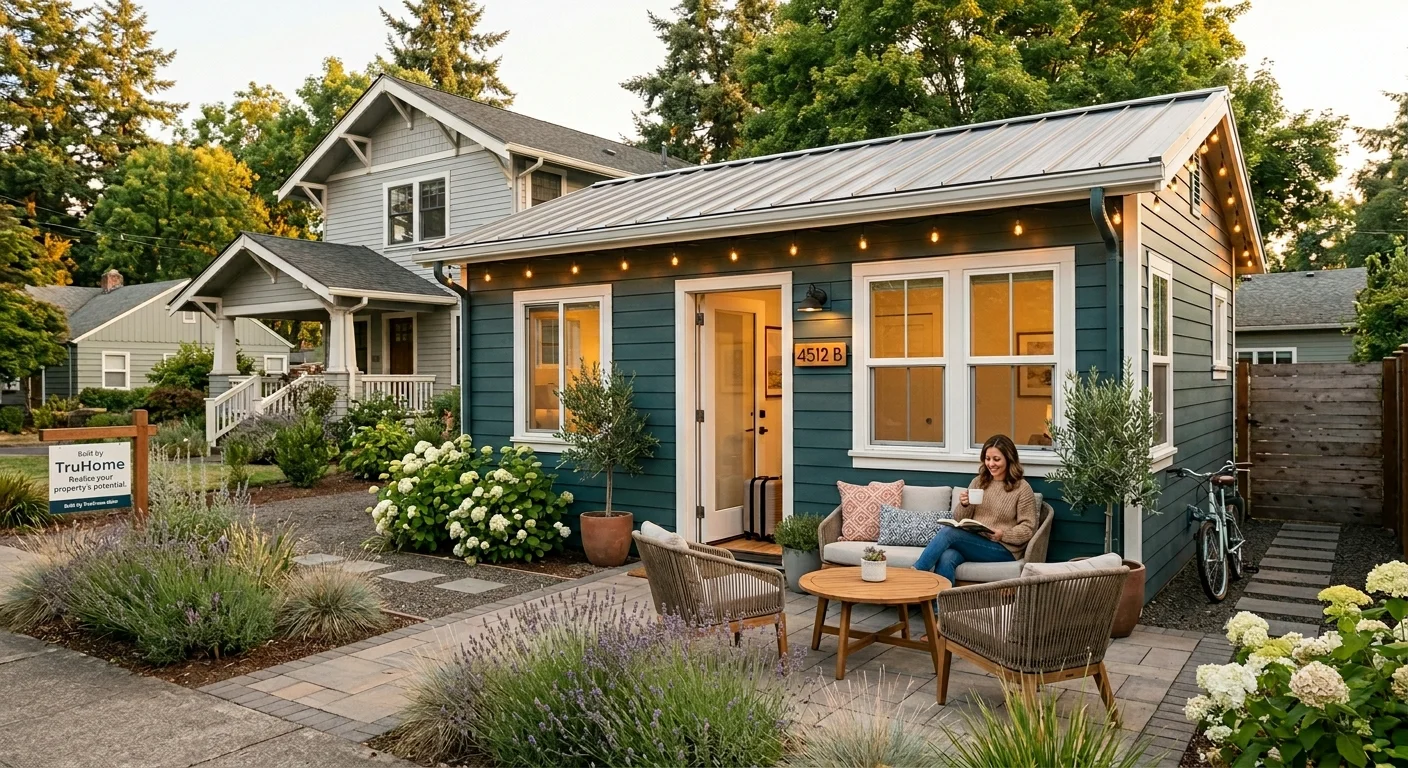
You’re not done when construction is done. You’re done when the city says you’re done.
Final inspection and approval
A city inspector visits the completed ADU to verify everything was built according to approved plans and meets all applicable codes — structural, electrical, plumbing, HVAC, fire safety, and energy compliance. Once you pass, the city issues a Certificate of Occupancy (CO), final permit completion, or the local equivalent.
No one should occupy or rent the unit before this final approval is issued.
Austin issues a CO after final inspections. Portland closes the permit only after the final permit inspection. DC requires final approval before rental licensing. (Sources: City of Austin Development Services; Portland.gov; DC Front Door program. Verified March 2026.)
What happens after final approval
Property taxes. Adding an ADU typically affects your property's assessed value, but the method and amount differ by jurisdiction. Ask your county assessor how new improvements are valued in your area.
Insurance. Notify your homeowner's insurance carrier about the new structure. You may need additional coverage, especially if you're renting the unit.
Rental readiness. If you plan to rent, check your city's rental registration requirements, business license rules (DC requires a business license for rental ADUs), and short-term rental restrictions before listing.
Address and utilities. Your ADU may receive its own address for mail, utility accounts, and tenant identification. Utility accounts may need to be set up separately depending on your city's requirements.
What Slows ADU Projects Down (And How to Prevent It)
Most delays are preventable — if you know where they come from.
| Delay | Why It Happens | How to Prevent It |
|---|---|---|
| Incomplete permit application | Missing documents, wrong forms, incomplete plans | Submit a complete package; work with someone experienced in your city |
| Utility surprises | Sewer lateral needs replacement, panel needs upgrade, connection distance is longer than expected | Confirm utility capacity during feasibility — before design |
| Design changes after submission | Homeowner changes mind, or city requires structural revisions | Finalize design before submitting; build in time for one correction cycle |
| Contractor scheduling gaps | Subcontractors overbooked, one trade delays the next | Use a GC with ADU experience and strong subcontractor relationships |
| Failed inspections | Work doesn't match plans or doesn't meet code | Hire experienced trades; GC should verify before calling for city inspection |
The hidden delay most people don’t see coming: Utility connection work. If your city’s water or sewer department has a backlog for new connections, your project can sit idle for weeks even if everything else is ready. Ask about utility timelines early.
What Changes If You Plan to Rent, Move Family In, or Sell
The build process ends at final approval. But your real-world obligations depend on how you use the unit.
Long-term rental. Most cities allow ADU rentals, but some require a business license, rental registration, or landlord permit. Owner-occupancy requirements have been eliminated or limited in some states. California's Gov. Code §66315 prohibits local agencies from imposing owner-occupancy on most regular ADUs. (Source: California HCD ADU Handbook, January 2026.) Washington's RCW 36.70A.681 prohibits owner-occupancy requirements for ADUs in urban growth areas. (Source: Wash. RCW 36.70A.681, verified March 2026.) But these rules are not universal. Check your city's current requirements.
Short-term rental / Airbnb. Many cities restrict or prohibit short-term rentals in ADUs. Some allow it only if the homeowner lives on-site. Violating STR rules can result in fines and loss of rental privileges. Research this before you build if STR income is part of your plan.
Aging parents or family. No special requirements beyond standard final approval — but consider accessibility features during design (wider doorways, curbless shower, single-story layout). Adding these later costs far more than including them from the start.
Selling the ADU separately. In most jurisdictions, you cannot sell an ADU independently from the main property. California has narrow separate-sale pathways under Gov. Code §§66341–66342 involving qualified-buyer, nonprofit, or TIC arrangements — but these are limited and legally complex. It is not a blanket right to sell every ADU separately. (Source: Cal. Gov. Code §§66341–66342, verified March 2026.)
When to slow down and do the math first: If you plan to sell the property within 12 months, run the resale numbers before building. ADUs are a medium-to-long-term value play. Over that horizon, the combination of property value increase, rental income, and lifestyle flexibility makes the economics compelling for most homeowners — but the payoff compounds with time, not overnight.
What to Do Next, In Order
If you’ve read this far, you’re serious. Here’s your action plan:
Your first 7 days
- Look up your property's zoning designation on your city's GIS map
- Call your city's building/planning department and ask the 8 questions from Step 1
- Pull your lot survey or plot plan (check closing documents or county recorder)
- Decide your primary use case — rental, family, office, investment
- Run your address through a feasibility tool to get an initial picture
Your first 30 days
- Get financing pre-approval or confirm your self-funding budget
- Research whether your city offers pre-approved ADU plans
- Start interviewing designers or design-build firms with ADU experience in your city
- Get a rough site assessment — utility capacity, access, site challenges
- Set your all-in budget ceiling including soft costs and contingency
The rule that saves the most money: Don’t skip steps, and don’t do them out of order. The projects that go sideways are almost always the ones where the homeowner jumped to design before confirming feasibility, or started construction before the budget was locked. The sequence exists for a reason — and following it is free.
Ready to take the first step?
See what’s possible at your address — get your free ADU feasibility report.
Frequently Asked Questions About the ADU Process
Can I build an ADU on my property?
ADU rules vary by state, city, and parcel. State-level reforms are accelerating — at least 18 states had broad statewide ADU laws as of 2025 — but legality depends on your local zoning code, lot size, setbacks, and utility capacity. The fastest way to find out is to check your zoning designation and call your local building department.
What is the first step in building an ADU?
Confirm your property qualifies. Check zoning, setbacks, lot size, and utility capacity before you spend anything on design.
How long does it take to build an ADU?
Roughly 6–18 months total, depending on ADU type, city, and project complexity. Garage conversions and pre-approved-plan paths are fastest. Custom detached new-builds take the longest. See the city-specific timeline examples in this guide.
How much does the ADU permitting process cost?
Permit and review fees vary significantly. Portland's published sample for a new detached ADU shows fees above $36,000 before construction. Simpler projects in smaller cities may cost a fraction of that. Utility connection fees are typically the largest variable — ask your city specifically about sewer, water, and electrical capacity fees.
Do I need an architect for an ADU?
Not always. Pre-designed and pre-approved plans don't require a custom architect. Complex lots, custom designs, and strict-review jurisdictions benefit significantly from professional design help.
Does an ADU need its own address?
In many cities, yes. Some require a separate address before you can apply for a permit. Others assign one at permit issuance. Your ADU will likely need its own address for mail delivery, utility accounts, and rental purposes.
Do I need separate utilities for an ADU?
It depends on your city and ADU type. Many conversions and attached ADUs can share utilities with the main house. Detached ADUs more often require separate connections. Check your city's requirements.
Is a garage conversion faster than a detached ADU?
Usually yes — often by several months. You're working with an existing structure, so foundation and framing are minimal or eliminated, and permitting is often simpler.
Are prefab ADUs easier to permit?
They can be — especially if your city has a pre-approved plan program that includes prefab models. The factory build happens in parallel with permitting, which compresses the overall timeline.
Can I rent my ADU on Airbnb?
Check your city's short-term rental ordinance first. Many cities restrict or prohibit STR in ADUs. Long-term rental is permitted in most jurisdictions.
Can an ADU be sold separately from the main house?
In most jurisdictions, no. California has narrow statutory pathways under Gov. Code §§66341–66342, but these are limited and legally complex. Separate ADU sales remain rare nationally.
What happens if I build without a permit?
Building without permits is a code violation that can result in fines, required demolition, inability to sell or refinance, insurance issues, and personal liability. Unpermitted ADUs also cannot be legally rented.
Does my HOA have to let me build an ADU?
It depends on your state. Some states limit private restrictions that prohibit ADUs, but design review and covenants can still apply. Verify both state law and your HOA's governing documents.
Will an ADU increase my property taxes?
Adding an ADU typically affects assessed value, but the method and amount depend on your jurisdiction. Ask your county assessor specifically how new improvements are valued. In most cases, the rental income or property value increase outweighs the tax increase over time.
How We Built This Guide
This page is built from official city and state permitting documentation, national housing policy sources (HUD, American Planning Association, California HCD), verified local process examples from 10+ major ADU markets, and homeowner discussion forums where real people describe their experience in their own words.
Every regulatory claim cites a specific source with a verification date. We do not accept payment from builders to feature or recommend them. Our revenue comes from affiliate partnerships with financing, prefab, and plan companies — but our editorial recommendations are based on independent research, not compensation. When we link to a partner, we tell you.
If anything in this guide conflicts with what your city tells you, trust your city. Local rules override general guidance, and policies change. Always confirm locally before acting on anything you read here — or anywhere else online.
Author: The Dwelling Index Research Team
Last verified: April 2026
Primary sources: Cal. Gov. Code §§66310–66342; Wash. RCW 36.70A.681; City of Austin Development Services; Portland Development Hub PDX; Seattle SDCI; DC Front Door Program; Boston Planning & Development Agency; California HCD ADU Handbook (January 2026); American Planning Association; HUD USER; Mercatus Center. All verified March–April 2026.
Related Guides
Last verified: April 2026. This guide is for informational purposes only. ADU regulations vary by state, city, and parcel. Always confirm rules with your local planning and building department before acting on any information in this article. The Dwelling Index is an independent educational resource — we are not a lender, contractor, attorney, or financial advisor. Full affiliate disclosure · Editorial methodology