Costco Tiny Home ADU: What’s Real, What’s Just a Shed, and What It Really Costs
By the Dwelling Index Editorial Team — an independent research resource covering ADU financing, costs, and regulations.
· Last verified: June 1, 2026
The short answer
A Costco tiny home ADU is possible — but almost never the way the deal photos make it look. Here’s the straight version: the structures Costco actually sells fall into two camps. The Gorilla and Yardline sheds ($3,299–$14,299 installed, June 2026) are storage buildings, not legal dwellings. The Studio Shed / Studio Home line offered through Costco Next is the only Costco-linked path that can become a real Accessory Dwelling Unit (ADU) — but its studio models (Signature, Portland) have no kitchen, bath, or plumbing as standard, which means they’re backyard offices, not homes. Only the Summit and Aspect lines include a kitchen and bath — and they cost significantly more than what the viral headlines focus on. On every path, foundation, utilities, permits, and site work are extra.
Bottom line: budget $45,000–$100,000+ all-in to turn a Costco studio or shed into a small, legal, livable ADU — and confirm your specific lot qualifies before you buy.
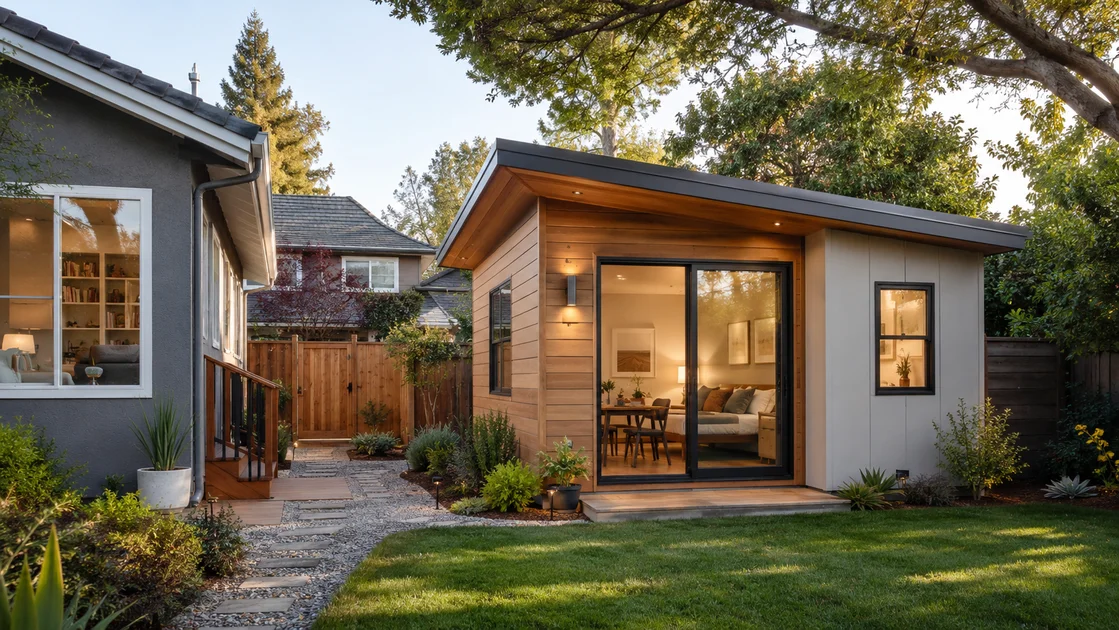
Costco product vs. ADU reality — at a glance
| Costco-linked structure | What it actually is | Legal ADU as sold? |
|---|---|---|
| Gorilla sheds (Prime, Haven, Pinnacle) | Installed storage sheds | No |
| Yardline sheds (Upton, Piermont) | Wood storage-shed kits | No |
| Studio Shed Signature / Portland (via Costco Next) | Backyard studio buildings | No (no kitchen, bath, or plumbing as standard) |
| Studio Shed Summit / Aspect | Prefab ADUs with kitchen + bath | Yes (site work + permits extra) |
| BOXABL Casita, modular ADUs (alternatives) | Self-contained ADU units | Yes (site work + permits extra) |
Prices, availability, and promotions change frequently. Figures verified June 1, 2026 and are decision-grade estimates, not quotes. Confirm current pricing with the retailer and legality with your local building and planning department.
Before you buy anything, see what your lot allows
The single most expensive Costco-ADU mistake is buying first and asking your city later. Setbacks, lot size, and utility distance — not the deal photo — decide whether a backyard ADU is even possible.
See What You Can Build at Your Address → Get Your Free ADU ReportNo obligation, no sales pressure. Enter your address and see your likely maximum legal ADU size and a realistic cost band.
What we verified for this guide (June 1, 2026)
- Costco shed pricing and availability — captured from live Costco.com product and special-event pages (Gorilla Prime / Haven / Pinnacle; Yardline Upton / Piermont).
- Studio Shed / Studio Home model pricing, sizes, and what’s included — captured from studio-home.com product pages.
- BOXABL Casita sizing and advertised pricing — captured from boxabl.com/casita.
- Shed-to-ADU conversion costs — compiled from 2025–2026 contractor and cost-aggregator sources (Angi, RealmHome, Shed Calculator, and others, cited inline).
- ADU legal definition and requirements — from primary sources: Fannie Mae’s ADU guidance, the International Residential Code (IRC), the IBC efficiency-unit standard, and California HCD’s ADU Handbook and statutes.
Verify before you act: member/sign-in prices, any live promotion, and your city’s permit fees and timelines. We re-verify pricing quarterly and code annually.
Is a Costco tiny home actually a legal ADU?
Usually not — at least not automatically. “Tiny home” describes a size and a style; “ADU” describes a legal housing status a city grants only after a structure meets zoning, building-code, utility, and safety requirements. A Costco shed is a structure you own. An ADU is a dwelling your jurisdiction has approved for people to live in. The Studio Shed line is the closest Costco-linked path to a real ADU, but it still has to clear a foundation, utility connections, a kitchen and bath, permits, inspections, and a final occupancy approval.
The confusion is by design. Costco describes Studio Shed on its own listing as a leader in “prefab backyard studios and accessory dwelling units.” Lifestyle headlines call smaller models a “tiny home” and a “guest house of your dreams.” But read those articles closely and the quiet caveat is always there — one popular write-up describes turning a shed into a retreat “with the right decor touches (and, you know, plumbing).” That parenthetical is doing a lot of heavy lifting.
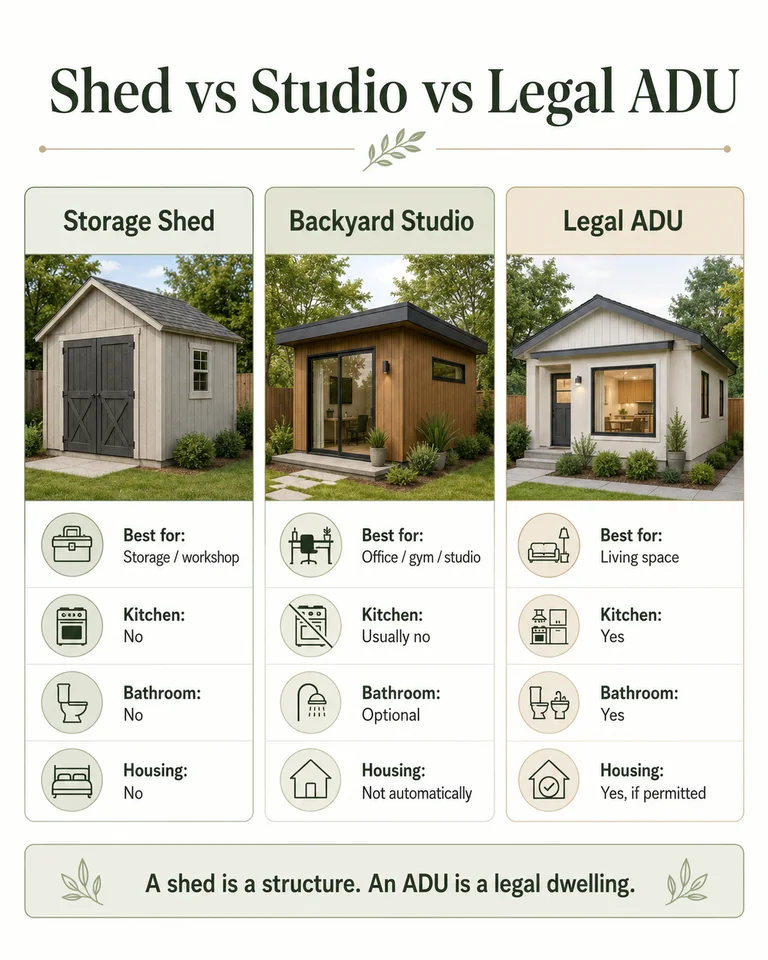
Here’s the cleanest way to think about everything Costco sells in this category. There are three buckets, and only one of them is housing.
- Sheds. Gorilla and Yardline products are storage and workshop buildings. They’re well-built — Gorilla markets its sheds as “built like a house so it lasts like one” — but they ship as storage structures, and Costco’s own product pages put permits and HOA approval on the buyer. A shed is not a dwelling, no matter how good the photos look.
- Studio shells. Studio Shed’s Signature and Portland lines are finished backyard rooms — excellent for an office, gym, art studio, or she-shed. Their interior packages cover insulation, flooring, drywall, and a code-compliant electrical package, but the standard build has no kitchen, no bathroom, and no plumbing. A studio is not a dwelling either.
- ADU-capable structures. Studio Shed’s Summit and Aspect lines are designed as ADUs, with full kitchen and bathroom packages. These can become legal dwellings — but the unit price is only the start of the project, and the small ones aren’t as cheap as the viral headlines suggest.
To anchor this in a national standard, look at how Fannie Mae defines an ADU — it’s the test lenders and appraisers actually apply. An ADU is “a smaller additional living space on the same lot as a single-family home” that must include “space for living, sleeping, cooking and bathrooms independent of the primary residence,” and it “must be accessible without going through the primary residence” (Fannie Mae, ADU guidance, verified June 2026). A Costco storage shed fails that test on day one. A Studio Shed studio (no kitchen, no bath) fails it too. Only a Summit or Aspect, fully built out with a kitchen, bathroom, foundation, utilities, and permits, can clear it.
For the broader picture of when a small structure can legally become a second home, see our tiny home ADU guide; this page stays focused on the Costco-specific question.
Costco “tiny home” product matrix: shed, studio, or possible ADU?
The only Costco-linked product that can realistically become a legal ADU is the Studio Shed / Studio Home line — and even then, only its larger Summit and Aspect models that include a kitchen and bath. Costco’s Gorilla and Yardline sheds run roughly $3,300 to $14,300 installed (Costco.com, verified June 2026) and are storage buildings, not dwellings.
Costco ADU Reality Matrix — verified June 1, 2026
| Costco-linked product / path | Price signal (June 2026) | Size | What it is as sold | ADU reality | Best reader action |
|---|---|---|---|---|---|
| Gorilla Prime Shed | $3,299.99–$5,799.99 installed (special event ends 6/21/26) | 10×8 to 16×10 | Installed storage shed (LP ProStruct flooring, loft) | Not an ADU. Permits/HOA are buyer’s responsibility | Storage, workshop, hobby space |
| Gorilla Haven Shed | $4,399.99–$8,399.99 (event ends 6/21/26) | Larger footprints | Installed storage shed | Not an ADU. More sq ft ≠ legal dwelling | Reference to prevent a costly mistake |
| Gorilla Pinnacle Shed | $6,999.99–$8,999.99 (event ends 6/21/26) | Premium build | Installed premium shed | Not an ADU as sold | Workshop or non-habitable studio |
| Yardline Upton 12′×24′ | $11,499.99–$14,299.99 (DIY or pro-installed) | 288 sq ft | Large wood shed kit (8′ double doors, 4′ loft, five windows, 2×4 framing) | Not an ADU. Costco’s page says consult city/HOA; a permit may be required | Storage, large workshop |
| Yardline Piermont | $5,799.99–$8,799.99 | Mid-size | Wood storage shed | Not an ADU as sold | Storage |
| Studio Shed Signature (via Costco Next + direct) | Models from $14,579; shell-only kits from $12,866 | 80–240 sq ft | Shed-roof backyard studio | Not a dwelling as sold (no kitchen, bath, or plumbing). Foundation, utilities, permit excluded | Office, gym, studio |
| Studio Shed Portland (via Costco Next + direct) | Models from ~$21,720; shell-only kits from ~$19,664 | 96–256 sq ft | Gable-roof studio, higher spec | Not a dwelling as sold. Larger sizes can become an ADU if fully built out and permitted | Studio; confirm full ADU scope before assuming habitability |
| Studio Shed Summit | Shell from ~$38,000 (Summit 308); fully-equipped ADU from ~$83,000 (Summit 308) up to ~$191,523 (Summit 1000, 2BR/2BA) | 252–1,000 sq ft | True prefab ADU with kitchen + bath packages | Yes — designed as an ADU. Site work and permits still extra | Compare against local prefab and site-built quotes |
| Studio Shed Aspect | From ~$85,975 (1-bed/1-bath); larger/fully-equipped configs run higher | 576 sq ft (1BR/1BA) and 864 sq ft (2BR/2BA) | Premium prefab ADU (full kitchen, bath, mini-split, ERV) | Yes. Site work and permits extra | Larger family ADU |
Sources: Costco.com product and Gorilla special-event pages; studio-home.com product and collection pages — all accessed June 2026. Studio Home runs periodic promotions; confirm the live price and what’s included in the configurator. Star ratings shown on Costco’s own product pages are Costco’s, not ours; we don’t publish star ratings we can’t independently verify.
Studio Shed / Studio Home, decoded
Studio Shed (also operating as the Studio Home brand) is offered to Costco members through Costco Next — a program where Costco directs members to a partner brand’s own site. Costco’s listing leans on ADU language, which is fair for the larger models. The catch is the product tiers:
- The Signature and Portland lines are studios — no kitchen, bath, or plumbing as standard. They are not dwellings as sold.
- The Summit and Aspect lines are the actual ADUs — built to include a kitchen and bathroom, and they cost a great deal more.
Every Studio Shed model is quoted two ways. The lower number is the shell — walls, roof, and siding as a flat-packed panelized kit. The higher number adds the Lifestyle interior (insulation, finished flooring, an electrical package with a 125-amp sub-panel, fixtures, trim) and, on Summit and Aspect, the kitchen and bath. None of those numbers include the foundation, utility connections, permits, or site work — Studio Home states this plainly and prepares the permit plan set, while the homeowner delivers the package to the city and pays the municipal permit fees (Studio Home, verified June 2026).
Yardline and Gorilla sheds: the “$5,000 tiny home” you keep seeing
When a viral post shows a “$4,500 Costco tiny home,” it’s almost always a Gorilla or Yardline shed. These are genuinely good outbuildings: the Yardline Upton is a 288-square-foot wood shed priced $11,499.99–$14,299.99 in June 2026, and the Gorilla Prime runs $3,299.99–$5,799.99 installed across four sizes (Costco.com, verified June 2026). What they are not is housing. Costco’s Yardline Upton page tells buyers to consult their city and HOA, and Gorilla’s FAQ directs buyers to check with their local building authority. A shed’s floor is not a dwelling’s foundation, and its shell isn’t insulated, plumbed, or wired to residential code.
There’s also a logistics trap: installed delivery is limited and varies by product and ZIP code. Current Yardline shed pages exclude North Dakota, South Dakota, Montana, Alaska, Hawaii, and Puerto Rico, with additional rural restrictions; Gorilla’s installable footprint is different again. Confirm your ZIP at checkout before you plan around an “installed” price.
Not sure which bucket your product falls into?
Run the Costco ADU Reality Check: tell us the model you’re eyeing, your goal (storage, office, family housing, or rental), and your address, and we’ll show you whether it can become a legal dwelling where you live — plus a realistic cost band.
Run the Reality Check → Get Your Free ADU ReportWhich Costco shed sizes can legally become an ADU?
Size is where most Costco-ADU plans die before permitting even begins. California requires a dwelling to be at least 150 square feet, so the famous 10×12 model (120 square feet) cannot be a legal ADU there at all. Many jurisdictions also apply an “efficiency dwelling unit” standard whose living-room minimum runs 190 to 220 square feet depending on the code edition — which even a 12×16 (192 sq ft) only partly clears, and a 16×16 (256 sq ft) clears before you carve out a kitchen and bath. The smallest Costco footprint that’s a realistic ADU candidate is 16×16, and only when fully built out.
The code in plain English
- The IRC minimum (International Residential Code). Under IRC Section R304, every habitable room must be at least 70 square feet with a minimum horizontal dimension of 7 feet (the older 120-square-foot rule was removed in the 2015 edition). A “dwelling unit” must contain permanent provisions for living, sleeping, eating, cooking, and sanitation (IRC R304). Seventy square feet sounds tiny, but that’s one room — a legal dwelling still has to fit all five functions.
- The efficiency-unit standard (IBC). The efficiency-dwelling-unit rules require a separate living room, a closet, a kitchen with sink, cooking appliance, and refrigeration, and a separate bathroom. The living-room minimum is not universal: the 2018 IBC used 220 square feet; the 2021 IBC uses 190 square feet. The point for a shed buyer is the same: the living room alone has to be 10–20 times the size of a closet, before the kitchen and bath, and the locally adopted code controls.
- California’s floor. California defines the smallest legal dwelling as an efficiency unit of at least 150 square feet under California Health & Safety Code Section 17958.1, and state law bars a city from setting a minimum that would prohibit one. California’s ADU statutes are organized in Government Code Sections 66310–66342; the HCD ADU Handbook was updated in March 2026.
Costco shed footprint vs. legal dwelling minimums
| Costco footprint | Approx. sq ft | Meets CA 150 sq ft minimum? | Clears efficiency-unit living-room min. (190–220 sq ft)? | ADU verdict |
|---|---|---|---|---|
| 8×10 | 80 | No | No | Too small to be a dwelling |
| 8×12 | 96 | No | No | Too small |
| 10×12 (the viral one) | 120 | No (below 150) | No | Cannot be a legal ADU in California |
| 12×16 | 192 | Yes | Partly — clears 190, fails the stricter 220 | California-only, very tight |
| 16×16 | 256 | Yes | Borderline once kitchen/bath/closet are carved out | Smallest realistic ADU candidate |
Not universal — the locally adopted code controls. Footprint is the nominal outside dimension; usable interior is smaller once wall thickness is counted, which makes tight cases worse, not better.
In California, a detached ADU can be up to 1,200 square feet (Government Code Section 66314), and a local maximum can’t be set lower than 850 square feet for a studio/1-bed ADU or lower than 1,000 square feet for an ADU with more than one bedroom (Government Code Section 66321). The foundational California ADU reforms — AB 68, AB 881, and SB 13 — took effect January 1, 2020.
Find your maximum legal size — for your exact address
Code minimums are national; what you can actually build is local. Get a free, property-specific read on the largest ADU your lot allows and a realistic cost band before you commit to a model.
See What You Can Build → Get Your Free ADU ReportWhat does a Costco tiny home ADU really cost after permits, foundation, utilities, and finishes?
The Costco sticker price is the structure price, not the legal-ADU price — expect to spend $45,000 to $100,000+ all-in to turn a Costco shed or studio into a small, permitted, livable ADU. A directly comparable benchmark from the field: a studio shed outfitted with a working bathroom and kitchen runs $45,000–$95,000 all-in in 2026, versus roughly $15,000 for the bare shell (RealmHome, 2026). The structure is one line item among ten.
Real all-in cost to make a Costco structure a legal ADU
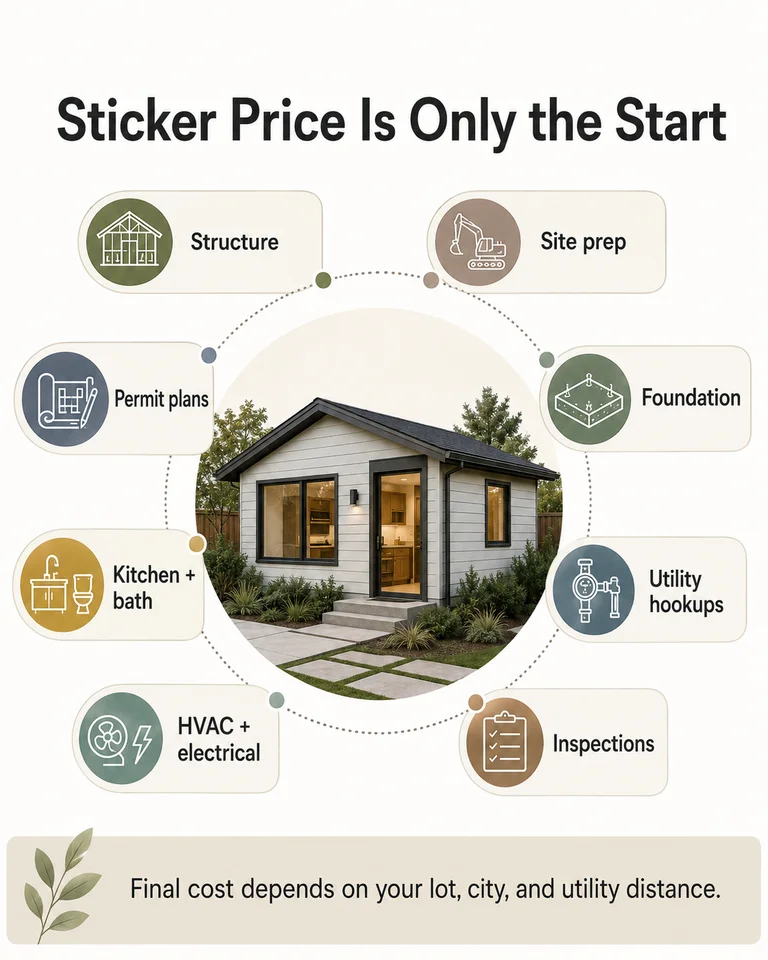
| Cost item | Why it’s required | Typical range (2025–2026) | Source |
|---|---|---|---|
| Permit-ready plans + plan check | Cities require stamped plans for habitable structures (“plan check” is the city’s review of your drawings) | $500–$5,000+ | Shed Calculator (2026) |
| Foundation / slab | A shed floor isn’t a code dwelling foundation | $1,400–$10,000 | Alpine Buildings; RG Pro Builders |
| Utility laterals + trenching (water, sewer/septic, power) | A “lateral” is the pipe or line connecting your unit to the main; distance drives cost | $5,000–$9,000 | RealmHome (2026) |
| Kitchen + bathroom build-out | An ADU legally requires both | $10,000–$25,000 | BetterPlace; RealmHome |
| Electrical sub-panel + code wiring | A kitchen and bath need real power, not an extension cord | $2,000–$4,000 | RealmHome; A+ Construction |
| HVAC (ductless mini-split) | Habitable comfort and code compliance | $4,000–$6,000 | Angi (2026) |
| Insulation / drywall / interior finish (if starting from a shell) | Residential energy and safety code | $5,000–$15,000 | RG Pro Builders |
| Permits, impact & utility-connection fees | “Impact fees” fund local services; capped for small ADUs in some states | $1,000–$9,000 (California ≈ $10–$12/sq ft) | Angi (2026) |
| Design / engineering / site grading | Site-dependent | $2,000–$8,000 | Synthesis of sources above |
Contractor and cost-aggregator estimates; your bids will vary by market, lot, and finish level.
Two realistic all-in scenarios:
- Scenario A — smaller unit, DIY-leaning assembly, easy site: roughly $45,000–$70,000 all-in.
- Scenario B — turnkey studio base, full finishes, average permits and site work: roughly $70,000–$110,000+ all-in.
A larger ADU, a California address, septic, a sloped or rocky lot, or long utility runs push the total higher. The average U.S. ADU costs about $180,000, with most homeowners spending $40,000–$360,000, or $150–$300 per square foot (Angi, 2026).
The damaging admission, said plainly
There is no $15,000 shortcut to a legal backyard apartment. If rock-bottom price is your only goal, a Costco shed will disappoint you the moment the permit office asks where the kitchen and bathroom are. But once you budget realistically — often $45,000 to $100,000 all-in for a small unit — an ADU becomes one of the very few home projects that can actually pay you back, through rental income or added property value. These are illustrative possibilities, not guarantees of returns. Actual results depend on local market conditions, construction costs, financing terms, and regulatory approvals.
Know how you’d pay before you fall in love with a floor plan
Most ADU budgets come together through a renovation loan, a cash-out refinance, a construction loan, or home equity — each with very different trade-offs. There’s no single “best,” and we don’t rank lenders by anything but fit.
Compare common funding routes and their eligibility limits before contacting a lender.Compare ADU Financing OptionsEducational, no-pressure. We may earn a commission if you use our links to explore options, at no cost to you. We don’t lend and aren’t paid to recommend any specific lender.
Can you legally live in a Costco shed or tiny home?
Only if your local jurisdiction approves the structure as legal housing — a shed, finished studio, or “tiny-home-style” building is not automatically a dwelling. To qualify as an ADU, a structure has to satisfy four separate tests at once: dwelling function, building code, zoning, and occupancy. Miss any one and you have a nice building, not a legal home.
Carry one rule through all four: don’t treat the structure as housing until the building and planning department has approved it for that use, in writing.
Costco product vs. ADU legal requirements
| ADU requirement (Fannie Mae / building code) | Gorilla & Yardline sheds | Studio Shed Signature / Portland | Studio Shed Summit / Aspect | What you must verify |
|---|---|---|---|---|
| Independent kitchen | No | No (not standard) | Yes (kitchen package) | Required components; no hotplate/microwave substitute |
| Independent bathroom | No | No (not standard) | Yes (bath package) | Plumbing connection to water/sewer or septic |
| Sleeping/living space meeting size minimums | Varies; many too small | Borderline at largest sizes | Yes | Local minimum (150 sq ft CA; 190–220 efficiency-unit) |
| Permanent foundation | No (shed pad) | No (excluded) | No (excluded) | Foundation/slab quoted separately |
| Independent access + privacy | Yes (separate building) | Yes | Yes | Separate entrance and utilities |
| Permitted + inspected as a dwelling | No | No | No (you permit it) | Plans, plan check, inspections, occupancy approval |
Zoning is the step buyers skip most. Before you buy, get answers on whether a detached ADU is allowed at all; minimum and maximum size; setbacks; lot coverage and FAR (floor area ratio); height; parking; fire access; utility access; owner-occupancy rules; and rental restrictions. Layer your HOA or recorded covenants on top — Costco’s own shed pages warn HOA approval may be required, and an HOA can restrict accessory structures even where the city would permit them.
Even a perfectly built, perfectly zoned ADU isn’t legal to live in until it passes inspections and receives a certificate of occupancy. Renting out or housing family in an unpermitted structure can expose you to code enforcement, void your insurance, and create serious problems when you sell or refinance.
Find out what your city is likely to allow
Local rules vary block by block. Get a free, property-specific feasibility report before you commit to a product.
See What Your City May Allow → Get Your Free ADU ReportThe 7-question Costco ADU Reality Checker
Before buying any Costco shed, Studio Shed, or “tiny home” product for housing, answer these seven questions — if any answer is “I don’t know,” you’re not ready to buy it as a dwelling.
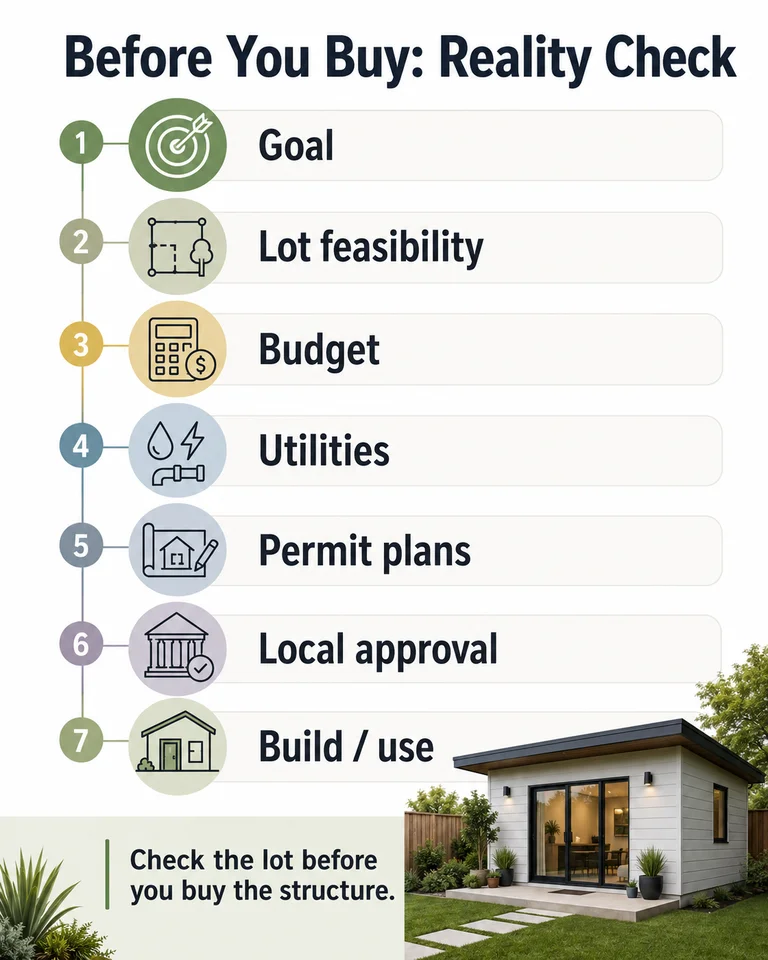
- Which exact product and model are you considering? (Gorilla Prime? Yardline Upton? Studio Shed Signature, Portland, Summit, or Aspect?)
- What’s the intended use — storage, office, guest space, full-time family housing, or rental income? The legal bar rises sharply once people sleep, cook, and bathe there.
- Does your city allow the ADU type you need on your lot, at the size you need?
- Will the seller provide permit-ready plans for your jurisdiction, and at what cost?
- Does the structure include or support a legal kitchen and bathroom — or are you adding both?
- How will foundation, water, sewer or septic, electrical, HVAC, and drainage be handled, and how far is the nearest utility connection?
- Will your HOA, lender, appraiser, and insurer treat it as legal and useful for your goal?
Your answers sort you into one of five outcomes. A general guide can’t tell you whether your lot, in your city, can host the unit you want — that takes your address and your local rules.
Run the Reality Check → Get Your Free ADU ReportWhich Costco option fits your use case?
The right Costco product depends entirely on your goal: a shed or studio is genuinely good value for an office, gym, or hobby space, and usually the wrong shortcut for parent housing or rental income unless you’ve confirmed a real ADU approval path.
A backyard office, gym, or studio
Sweet spot for Costco
This is the sweet spot for a Costco shed or a Studio Shed Signature/Portland studio. You’ll still handle setbacks, electrical, a level foundation, and HOA rules — but you’re not crossing into dwelling territory, so the permitting is lighter and the math stays close to the sticker.
Occasional guest space
Tread carefully
The moment you add sleeping plus plumbing, a city may treat it as habitable space under residential code. A studio without plumbing is fine for daytime use; a place where people sleep and shower starts to look like a dwelling.
Housing a parent or adult child
Start with ADU feasibility, not shed shopping
This use demands safe, durable, year-round housing — a permitted ADU with proper insulation, HVAC, egress, and a real kitchen and bath. A purpose-built ADU is almost always the better foundation here than a converted storage shed.
Rental income
Don’t rely on a shed listing
Legal rental use requires a permitted ADU, safe occupancy, appropriate insurance, and compliance with local landlord and (often) short-term-rental rules. Illustrative considerations only — actual results depend on local market conditions, construction costs, financing terms, and regulatory approvals.
A temporary place to live while you build
High-risk
Temporary-occupancy rules vary widely and are often stricter than buyers expect; some jurisdictions don’t allow it at all. Verify with your building department before you buy anything.
Match the path to your goal
Tell us your goal and your address, and we’ll show you the realistic options for your property.
Find the ADU Path That Fits Your Property → Get Your Free ADU ReportCostco Studio Shed vs. prefab ADU vs. site-built ADU
Studio Shed’s larger Summit and Aspect models are a credible prefab ADU path when the structure, permit package, site work, and local code all line up — but a self-contained prefab like the BOXABL Casita, a modular ADU, or a site-built ADU may serve you better on complex lots, rental projects, or in strict jurisdictions. The headline insight: once you finish a Costco shed into a legal dwelling, you’re often in the same $50,000–$150,000 all-in band as a purpose-built unit — which typically arrives ADU-ready, with fewer surprises.
ADU-ready alternatives, compared
| Option | Size | Kitchen + bath out of the box? | ADU-ready as delivered? | Unit price (2026) | Realistic all-in (before land) |
|---|---|---|---|---|---|
| Costco Studio Shed (studio) | 80–256 sq ft | No | No — you add everything | ~$14,579+ (Signature) to ~$25,000+ (Portland) | ~$45K–$110K+ after conversion |
| Studio Shed Summit (ADU line) | 252–1,000 sq ft | Yes (configurable) | Unit yes; site/permits extra | Shell ~$38K → fully-equipped ~$83K–$191,523 | Six figures for larger units + site work |
| BOXABL Casita | Studio 361 sq ft; 1-bed 722 sq ft | Yes — full kitchen, bath, living, sleeping | Yes (still needs foundation, utilities, permits) | Advertised from $895/month est. (Studio) | ~$90K–$150K+ installed (2026 est.) |
| Compare ADU Builders | Varies | Yes | Yes | Varies | $150–$300/sq ft all-in |
Sources: studio-home.com and boxabl.com/casita (June 2026); independent BOXABL all-in estimates from ThePricer (2026); Angi (2026). Sorted by structure type, not by any commercial relationship.
Studio Shed Summit — the same brand’s actual ADU. The Summit 308 is a 308-square-foot studio ADU with one bath; the Summit 1000 is a 2-bedroom, 2-bathroom unit listing up to about $191,523 fully equipped (Studio Home, June 2026). Summit units with a kitchen and bath typically take about 2–3 weeks to install from installation start, not counting permitting.
BOXABL Casita — a folding, self-contained ADU. BOXABL’s Casita Studio is 19′×19′ / 361 square feet and ships folded, then unfolds on site with a full kitchen, bathroom, living area, and sleeping space; a One Bedroom model is 19′×38′ / 722 square feet (BOXABL, verified June 2026). BOXABL advertises the Studio “from $895/month estimated” with actual price and payment varying by model, location, site work, taxes, delivery, installation, and financing terms. Independent 2026 cost analyses estimate realistic all-in totals of roughly $90,000–$150,000+ installed before land (ThePricer, 2026).
Modular and site-built ADUs run roughly $150–$300 per square foot all-in (Angi, 2026), overlapping heavily with a finished Costco-shed conversion. Compare these side by side in our prefab ADU guide and modular ADU breakdowns.
Want pricing on an ADU-ready unit instead of a conversion project?
If you’d rather start with something built to be a dwelling, explore a self-contained prefab or modular ADU available in your area.
Reader-supported: we may earn a commission if you request pricing, at no extra cost to you. Availability varies — confirm service in your state.
Local builders note: In some markets, a regional ADU builder is the simplest path. Coverage is geographic, so this only helps if you’re in the service area — for example, SnapADU serves Greater San Diego County, Framework First serves California’s Central Coast and Bay-Area-adjacent region within roughly 150 miles of Monterey County, and Nest Tiny Homes serves Utah and Southern California. Outside those footprints, a national modular provider or a local general contractor is the better route.
Permits, zoning, and the state/city reality of tiny-home ADUs
There is no single national rule for Costco tiny homes — ADU legality is decided locally, and the same structure that’s a legal backyard office in one city can be an illegal dwelling in another.
California, as the leading example (not a national rule). California is broadly ADU-friendly, with state law forcing cities to allow ADUs up to at least 800 square feet by-right and capping detached units at 1,200 square feet. (“By-right,” sometimes called ministerial approval, means a qualifying application must be approved without discretionary review or a public hearing.) But the state’s friendliness doesn’t change physics: a 120-square-foot shed is still under the 150-square-foot dwelling minimum. California updates its ADU laws nearly every January, so confirm the current handbook language before relying on specifics (California HCD ADU Handbook, updated March 2026).
Movable tiny houses — city-specific. Some California cities, including Los Angeles and San Diego, have adopted distinct guidance for movable tiny houses. The rules are local and detailed, and they reinforce the core message of this guide: verify at the city level before you buy.
The script for your building department
“I’m considering a [exact product and model]. I want to use it as a [backyard office / full-time family housing / rental ADU]. Does this structure type qualify as an ADU or a habitable accessory structure in this jurisdiction, and what permit path, plans, foundation, utilities, inspections, and occupancy approvals would be required?”
Write down who you spoke with and when. That five-minute call is the cheapest insurance against the most expensive Costco-ADU mistake.
Financing a Costco tiny home ADU without making an expensive mistake
Finance the legal project, not the shed listing — if your goal is a permitted ADU, the real question isn’t “can I buy the structure?” but “will the finished unit be legal, appraisable, and insurable in a way my financing path accepts?” Fannie Mae treats ADUs like any other home improvement and allows them to be financed with standard purchase, refinance, or renovation products, though eligibility depends on the property and unit meeting requirements (Fannie Mae, verified June 2026). We present financing lanes, sorted by fit — never lenders ranked by payout, and never with promised rates.
ADU financing lanes by project type
| Your project | Likely financing lane | What must be true | What disqualifies the lane |
|---|---|---|---|
| Storage shed / non-habitable studio | Cash, personal loan, or store financing | Small scope; not a dwelling | Expecting a mortgage product on a non-dwelling |
| Studio you’ll convert to an ADU | Renovation loan or HELOC | Permitted plans; finished unit appraises as legal ADU | No permit path; structure never legalized |
| Summit/Aspect or prefab ADU | Renovation loan, construction-to-permanent, or cash-out refinance | Real-property classification; lender-acceptable build | Unpermitted unit; ineligible classification |
| Manufactured-home ADU | Manufactured-home financing | Titled as real property; not the primary residence | Manufactured home as the primary dwelling (Fannie ineligible) |
- Cash. Simplest, no interest, no underwriting. Best when you have reserves and want to move fast.
- HELOC (home equity line of credit). A revolving credit line secured by your home’s equity; flexible draws, variable terms.
- Cash-out refinance. Replaces your existing mortgage with a larger one and gives you the difference in cash. Model it carefully against your current rate.
- Renovation loan. Sized to your home’s after-improvement value (for example, Fannie Mae’s HomeStyle Renovation), letting you borrow against what the property will be worth once the ADU exists.
- Construction-to-permanent loan. Funds the build in draws, then converts to a standard mortgage at completion.
- Home equity investment (HEI). A lump sum in exchange for a share of your home’s future value, with no monthly payment. Availability is state-restricted, so confirm it’s offered where you live.
- Manufactured-home financing, where the ADU is a HUD-code unit titled as real property.
Compare your financing paths before you put down a deposit
See which lane fits your equity, your timeline, and how finished your unit will be — without a sales pitch.
Compare common funding routes and their eligibility limits before contacting a lender.Compare ADU Financing OptionsEducational only. The Dwelling Index doesn’t lend and isn’t paid to recommend any specific lender; we may earn a commission if you use our links, at no cost to you.
Your Costco tiny home buyer checklist before you purchase
Don’t buy a Costco shed, studio, or tiny-home-style structure for housing until you have written answers to the questions below — vague verbal assurances are how budgets blow up.
Ask Costco or the vendor
- What exact model is this, and is it sold as a shed, a studio, an ADU, a modular unit, or a manufactured home?
- Does it include permit-ready plans for my jurisdiction, and at what added cost?
- What’s included versus excluded — foundation, utility connections, insulation, drywall, HVAC, electrical, plumbing, kitchen, bathroom, inspections?
- Who is responsible for local permit compliance? (Costco’s shed pages put this on the buyer.)
- Is professional installation included, and is my ZIP in the install footprint?
- What happens if my city won’t approve it for my intended use?
Ask your city or county
- Is this structure type allowed as an ADU on my lot? As a habitable accessory structure?
- What code applies, and what’s the permit path and timeline?
- Are tiny homes on wheels, modular ADUs, or manufactured ADUs allowed here?
- What setbacks, height limits, lot coverage, FAR, and parking rules apply?
- Can I rent it long-term? Short-term?
- What inspections and what occupancy approval are required?
Ask your HOA, lender, insurer, and appraiser
- Will the HOA or any recorded covenant allow it?
- Will my insurance cover it as intended (and as a rental, if applicable)?
- Will a lender and appraiser treat the finished unit as real property that adds value?
- Will building it — or renting it — affect my ability to refinance or sell later?
Take the full checklist with you
We turned this into a free, printable kit — every permit, utility, and budget line item most people miss, plus the exact questions to ask any builder before you sign.
Download the Free ADU Starter Kit →When a Costco shed is the wrong move
A Costco shed is the wrong starting point whenever your real goal is legal housing and the seller can’t show a clear permit path, your city doesn’t allow that structure type, utilities are difficult, your HOA restricts accessory structures, or your budget assumes the sticker price is close to the final ADU cost. Recognizing these red flags early saves the most money.
- You want rental income but haven’t verified ADU legality on your lot.
- You need a parent or adult child to live there full-time, year-round.
- The product is labeled a storage shed (Gorilla, Yardline) and you’re picturing a dwelling.
- Your city requires stamped residential plans and the vendor doesn’t provide them.
- Your lot has tight setbacks, slope, fire-access, flood, or septic constraints.
- Utility trenching could cost more than the structure itself.
- HOA approval is uncertain or restrictive.
- You’re counting on financing or appraisal value without confirming how the finished unit will be classified.
If one of these stops you, here’s where to go next:
- Need the cheapest legitimate shell options? See our ADU kit homes guide.
- Want legal tiny-home guidance, including tiny homes on wheels? See our tiny home ADU guide and portable ADU breakdown.
- Need speed? Compare prefab and modular ADU paths.
- Building for rental income or housing aging parents? Start with the ADU types and tools built for those goals.
Costco tiny home ADU FAQ
Does Costco sell ADUs?
Not directly as turnkey dwellings. Costco routes members to Studio Shed through Costco Next, and Studio Shed markets backyard studios and ADU-related products. But the cheaper, frequently promoted Costco-linked structures are studios and storage sheds, not legal ADUs. The true ADU models (Summit, Aspect) include a kitchen and bath and cost far more.
Is a Costco Studio Shed an ADU?
It depends on the model. The Signature and Portland studio lines are not dwellings as sold — no kitchen, bath, or plumbing as standard. The larger Summit and Aspect models are designed as ADUs, but they still need a foundation, utilities, permits, and inspections before anyone can legally live in them.
Can I live in a Costco shed?
Generally not as sold. A storage shed must be approved as habitable space or an ADU — with a foundation, utilities, kitchen, bathroom, insulation, egress, and occupancy approval — before it’s legal to live in.
Do I need a permit for a Costco tiny home?
Often, yes. Costco’s own shed product pages tell buyers to consult their city and HOA and note a permit may be required. Any habitable structure (an ADU) will require permits, plan review, and inspections.
How much does a Costco tiny home cost?
It depends which product you mean. Gorilla and Yardline sheds run roughly $3,300–$14,300 installed (June 2026). Studio Shed studios start around $14,579 (Signature) and $21,720 (Portland) configured, and true Studio Shed ADU models run from about $38,000 (shell) up to roughly $191,523 fully equipped. As a legal ADU, expect $45,000–$100,000+ all-in once you add foundation, utilities, permits, and finishes.
What’s the cheapest legal ADU path?
There’s no universal cheapest path, because a cheap shed usually isn’t a legal ADU. The lowest-cost legal route depends on your city, lot, utility distance, foundation needs, and whether a kit, modular unit, garage conversion, or site-built ADU fits your property. Run an address-level feasibility check to find yours.
Can I rent out a Costco tiny home?
Only if it’s legally approved for residential use and local rules allow it. Renting an unpermitted structure can void insurance and trigger code enforcement. Any rental-income expectation is illustrative, not a guarantee — actual results depend on local market conditions, construction costs, financing terms, and regulatory approvals.
Can I finance a Costco shed conversion?
Possibly, but financing depends on the project type, your profile, and whether the finished structure is legal, appraisable, and properly classified. Standard, renovation, cash-out refinance, and construction-to-permanent loans are common ADU lanes.
Will a Costco tiny home add property value?
A legal, permitted ADU may add value and can be considered in appraisal and resale. A detached ADU’s finished area is generally reported separately by appraisers. An unpermitted shed conversion can do the opposite — creating risk rather than value.
What’s the difference between a shed, a tiny home, and an ADU?
A shed is an accessory or storage structure. A “tiny home” describes size and style. An ADU is a legal dwelling unit on the same lot as a primary home, with independent living, sleeping, cooking, and bathroom facilities and its own access.
Can a tiny home on wheels be an ADU?
Only where a city specifically allows that path and the local requirements are met. Many jurisdictions don’t recognize a tiny home on wheels as a legal ADU, so verify locally before assuming it counts as housing.
What should I ask my city before buying?
Ask whether your exact structure type can be approved for your intended use, what permit path and plans are required, and whether kitchen, bath, utilities, foundation, setbacks, inspections, and occupancy approval are required. Get the answer in writing.
Methodology
This guide was researched and written by the Dwelling Index Editorial Team. The Dwelling Index is an independent research resource covering ADU financing, costs, and regulations. We are not affiliated with Costco, Studio Shed/Studio Home, Yardline, or Gorilla and earn no commission from those products.
- We compared current product data from Costco.com, Costco Next, Studio Home, and BOXABL against the legal requirements an ADU must meet.
- Product details and pricing came from retailer and manufacturer pages captured on the verification date.
- Conversion and ADU cost ranges came from contractor and cost-aggregator sources (Angi, RealmHome, Shed Calculator, and others), each cited inline.
- The ADU legal definition and code requirements came from primary sources: Fannie Mae’s ADU guidance and Selling Guide, the International Residential Code (Section R304), the IBC’s efficiency-unit standard, and the California HCD’s ADU Handbook and statutes.
Why local departments remain the final word. Zoning, permits, fees, and timelines vary by jurisdiction and change over time. Nothing here is legal, financial, or engineering advice for your specific property. Your local building and planning department is the final authority. We re-verify product pricing quarterly and code and statute references at least annually.
Not sure where to start?
See what’s possible at your address — get your free ADU report.
Get my free ADU report →Related guides
- Tiny home ADU guide — legal paths, costs, and codes
- Prefab ADU guide — brands, costs, and code paths
- Modular ADU — how state-certified units work
- Portable ADU — what’s allowed vs. what isn’t
- ADU kit homes — costs, brands, and permit reality
- Amazon tiny home ADU — real cost & 5-gate legal test
- Home Depot ADU alternatives — 7 real paths & true costs
- How much does an ADU cost in 2026?
- Best prefab ADUs under $200K