
California ADU Grant (2026): Current Status, Local Programs & What to Do Instead
Last verified: April 2, 2026 · Verified against CalHFA.ca.gov, CA HCD, and local program pages · Editorial Methodology
Bottom line
The California ADU grant — the statewide CalHFA program that gave homeowners up to $40,000 for pre-development costs — is not currently open. CalHFA confirmed the latest round of funding was fully allocated on December 28, 2023. No new application round has been announced. But here's what most pages won't tell you upfront: that grant never covered actual construction, and California homeowners are building ADUs every single day without it. Several local city and county programs remain active — and one of them is more generous than the CalHFA grant ever was.
Source: CalHFA ADU Grant Program page, calhfa.ca.gov/adu — verified April 2, 2026
We built this page specifically because the search results are confusing: CalHFA's own page says it's closed, but HCD still lists it alongside local alternatives, and several builder pages still walk through application steps as if there's an open round. There isn't. Below you'll find verified program status, what the grant actually covered, who qualified, every active local alternative, and the financing paths California homeowners are actually using right now.
California homeowners are building ADUs without the CalHFA grant using HELOC, construction loans, and renovation financing
Editorial disclosure: The Dwelling Index is reader-supported. When you use our links to explore financing options, request prefab pricing, or purchase floor plans, we may earn a commission at no extra cost to you. Our editorial recommendations are based on independent research and are never influenced by compensation. Read our full editorial methodology and affiliate disclosure.
California ADU Funding at a Glance
Before we get into the details, here's the snapshot. This is our California ADU Incentive Tracker — a directory we maintain of statewide and local programs with their real, verified status. We built this because the official pages are fragmented and many commercial sites haven't updated since the grant was active.
| Program | Area | Type | Max Help | Status (Apr 2026) | Key Restriction |
|---|---|---|---|---|---|
| CalHFA ADU Grant | Statewide | Grant (no repayment) | Up to $40,000 | ⛔ Fully allocated — no open round | Final 2023 round required ≤80% AMI; owner-occupancy required |
| San Diego Housing Commission ADU Finance Program | City of San Diego | Construction-to-perm loan + free technical assistance | Up to $250,000 | ✅ Active (confirm with SDHC) | Income ≤150% AMI; 7-year affordable-rent covenant |
| Napa County Affordable ADU Forgivable Loan | Napa County | Forgivable loan | $45,000–$105,000 | ✅ Active (confirm with County) | Owner-occupancy; affordable-rent commitment |
| City of Napa Junior Unit Initiative | City of Napa | Financing + technical assistance | Varies | ✅ Active (confirm with City) | Junior ADU or conversion ADU focus |
| Pasadena Second Unit ADU Program | City of Pasadena | Construction financing + project management | Up to $225,000 | ✅ Active (confirm with City) | Pasadena homeowners; application window may be limited |
| Walnut Creek ADU Rebate Program | City of Walnut Creek | Rebate | Up to $15,000 | ⚠️ Backup list (initial rebates claimed Jul 2025; program runs through Aug 31, 2026) | ADU ≤1,000 SF; CO by Sep 30, 2026 |
| San Mateo County One Stop Shop | San Mateo County | Technical assistance (design, permitting, project management) | No-cost support via Hello Housing | ✅ Active (confirm with Hello Housing) | San Mateo County residents |
| Monterey Bay My House My Home | Monterey Bay region | ADU assistance for seniors | Varies | Listed on HCD (confirm with program) | Low-income senior homeowners |
| City of San Jose Pre-Approved ADUs | City of San Jose | Pre-approved plans + expedited permits | Same-day permit possible for qualifying submissions | ✅ Active | San Jose residents using pre-approved plans |
| Impact Fee Exemption (statewide) | All CA cities | Fee waiver (permanent state law) | Saves thousands–tens of thousands | ✅ Active (permanent state law) | ADUs ≤750 SF exempt from impact fees; larger ADUs charged proportionately |
| LA ADU Accelerator | City of Los Angeles | Technical assistance + expedited permits | N/A (not a cash grant) | ⛔ Closed | Was not a construction grant |
| Orange County HFT ADU Loan | Orange County | Affordable ADU loan | Was ~$200,000 | ⛔ Discontinued (May 2025) | Program ended |
| Oakland ADULP | City of Oakland | ADU loan program | Was up to $250,000 | ⛔ Closed (until further notice) | No current application round |
Primary source for local programs: California HCD Funding for ADUs page, hcd.ca.gov/building-standards/adu/funding — verified April 2, 2026
Is the California ADU Grant Still Available in 2026?
No. The statewide CalHFA ADU Grant Program is not accepting applications. All funding has been exhausted, and no new application round has been announced.
Here's the timeline:
| Date | What Happened |
|---|---|
| September 2021 | California allocates $100 million ($81M state general fund + $19M CalHFA contribution) for the ADU Grant Program |
| 2022 | Program launches through CalHFA-approved lenders; grants distributed across 44 of 58 counties |
| March 2023 | Phase 1 funding (~$75M) fully exhausted |
| November 2023 | CalHFA announces Phase 2 with $25M; income eligibility tightened to low-income limits (≤80% AMI by county) |
| December 2023 | Phase 2 opens; applications flood in immediately |
| December 28, 2023 | All funding fully allocated. CalHFA posts scam warning. |
| 2024–present | No new Notice of Funding Availability (NOFA) published. |
Sources: CalHFA.ca.gov/adu, CalHFA lender page, All Home California — verified April 2026
CalHFA reported the program catalyzed about 2,500 ADU projects statewide. As of October 2023, CalHFA said 42% of grants had gone to socially disadvantaged areas. (Source: CalHFA board materials, October 2023)
Why the Search Results Are So Confusing
If you've been searching “California ADU grant” and getting conflicting answers, you're not imagining it. CalHFA's own page says funding was fully allocated in December 2023 and warns about scams. HCD's funding page still lists the program alongside local alternatives, which makes it look current. And several builder pages still tell readers the grant is active and walk through application steps as if there's an open round. There isn't. We built this page specifically to cut through that noise.
Scam Warning — Directly From CalHFA
“If anyone approaches you saying they can help you get an ADU Grant, it is a financial scam. Do not contact them further.”
If someone asks you to pay a fee to “secure” or “apply for” the California ADU grant, walk away. Report them to CalHFA at marketing@calhfa.ca.gov. The program has no open application round, and no third party can change that.
Source: CalHFA.ca.gov/adu — verified April 2, 2026
What Did the $40,000 California ADU Grant Actually Cover?
Here's where most articles get it wrong — and it changes the math more than you'd expect. The CalHFA grant covered pre-development costs and non-recurring closing costs only. That's the expensive paperwork and prep that happens before construction begins. It did not pay for construction materials, labor, or the actual building. (Source: CalHFA ADU Grant Term Sheet, November 2023)
What Was Covered (Pre-Development Costs)
- Architectural designs and engineering plans
- Site preparation
- Permits and plan-review fees
- Soil tests and geotechnical reports
- Property surveys
- Energy reports and Title 24 compliance
- Development impact fees (for ADUs over 750 SF)
- Interest-rate buy-downs on qualifying construction loans
- Non-recurring closing costs through approved lenders
What Was NOT Covered
- Construction materials (lumber, concrete, roofing, electrical, plumbing)
- Labor costs
- Appliances and fixtures
- Landscaping and hardscaping
- Furniture or finishing touches
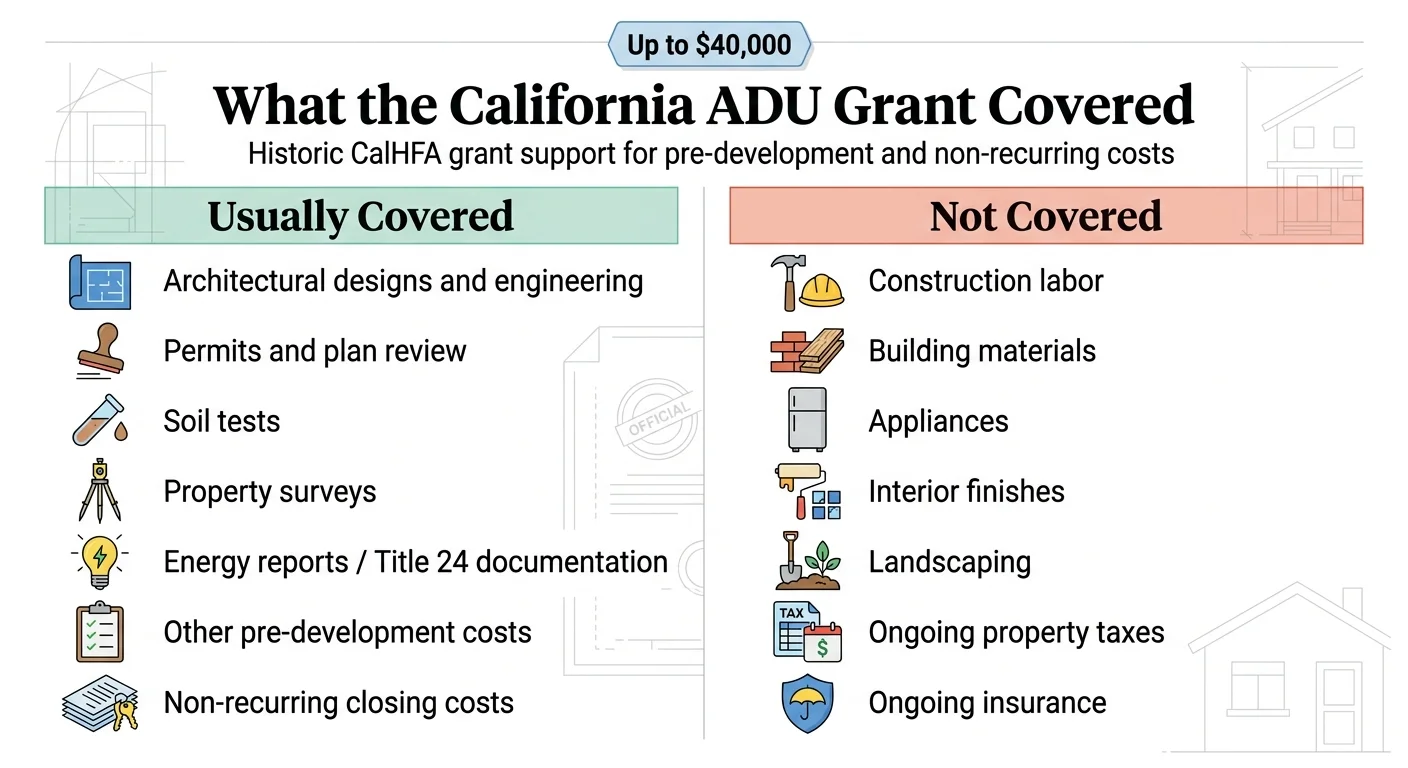
The CalHFA grant covered soft costs only — construction financing was always separate
Putting the Numbers in Perspective
This is the table most people need to see — because the $40,000 sounds like a lot until you see where it fits:
| Cost Category | Typical Range in CA | Grant Coverage |
|---|---|---|
| Architectural plans + engineering | $5,000–$18,000 | ✅ Covered |
| Permits + plan review | $2,000–$15,000 | ✅ Covered |
| Soil test + property survey | $1,500–$4,000 | ✅ Covered |
| Impact fees (ADU >750 SF) | Varies widely by city | ✅ Covered (within $40K cap) |
| Energy report / Title 24 | $500–$2,000 | ✅ Covered |
| Construction (materials + labor) | $150,000–$350,000+ | ❌ Not covered |
| Total ADU project | $165,000–$400,000+ | Grant offset a portion of soft costs only |
The grant was real money — nobody's dismissing $40,000. A homeowner who received the full amount saved meaningfully on the most frustrating early expenses. But the grant was never “California pays for your ADU.” It helped with the soft costs that trip people up before construction starts. That's why losing the grant doesn't mean losing the ability to build. The construction financing — which was always the bigger piece — works exactly the same with or without it.
Cost ranges reflect general California market conditions and vary significantly by city, site conditions, and project scope. These are illustrative ranges based on industry reporting, not guaranteed figures.
Who Qualified for the California ADU Grant?
Ownership & Residency
- You had to own the property (no renters, no LLCs, no corporate entities)
- The property had to be your primary residence
- You signed an owner-occupancy affidavit and agreed to remain living there during construction
- Investment properties were excluded
Property Type
- Single-family homes were the primary focus
- Some duplexes and small multi-family (2–4 units) also qualified
- After completion, the ADU could be used for long-term rental or family housing
- Short-term rentals (Airbnb, VRBO) were explicitly prohibited
Income Limits
The final funding round (Phase 2, December 2023) required household income at or below 80% of Area Median Income (AMI) for your county — CalHFA's low-income limits. Earlier phases used different and in some cases broader income thresholds. AMI varies dramatically across California. For current official figures by county, refer to CalHFA's published income limit tables at calhfa.ca.gov. As a general reference, 80% AMI for a family of four in the December 2023 round ranged from roughly $78,000 in lower-cost counties to over $140,000 in the Bay Area's highest-cost counties.
How the Application Worked
Some pages still frame this as “fill out a form and get $40K.” It wasn't. You needed a construction loan in place first, which is why the grant functioned as a cost offset within a larger financing plan — not standalone free money.
- 1Find a CalHFA-approved lender (required — you couldn't apply directly to CalHFA)
- 2Get qualified for a construction or renovation loan through that lender
- 3Lender submitted the grant application on your behalf with income docs, property info, and preliminary ADU plans
- 4CalHFA reviewed and approved
- 5$40,000 was added to the construction escrow and released for eligible soft costs
- 6It was a reimbursement model — expenses were incurred first, then covered through the escrow
Free Tool
Does your property even qualify for an ADU? See what you can build at your address.
60 seconds. Free. No sales pitch — just clarity on what's possible at your address.
Are There Any California ADU Grants or Programs Still Open?
Yes — but they're local, not statewide, and most come with conditions. The statewide CalHFA grant was unique in its simplicity: a no-repayment grant available across most of the state. What remains is a patchwork of city and county programs, each with different rules. The good news: some of them are actually more generous than the $40,000 statewide grant ever was.
What's Still Active and Worth Investigating
San Diego Housing Commission
Up to $250,000Offers the strongest remaining program: construction-to-permanent loans with below-market terms, plus free technical assistance. The tradeoff is a 7-year affordability covenant — you must rent the ADU at affordable rates and can't rent to family members during that period. For homeowners comfortable with that structure, it's significantly more help than the CalHFA grant provided.
Source: sdhc.org — verified April 2026
Napa County
$45,000–$105,000Offers forgivable loans depending on the ADU type, tied to owner-occupancy and affordable-rent commitments. One of the most generous local programs still operating.
Source: napacounty.gov — verified April 2026
City of Napa
VariesRuns a separate Junior Unit Initiative providing financing and technical help for junior ADUs and conversion projects.
Source: cityofnapa.org — verified April 2026
Pasadena
Up to $225,000Offers construction financing plus project management support through its Second Unit ADU Program.
Source: cityofpasadena.net — verified April 2026
San Jose, Chico, and other cities
Pre-approved plansOffer pre-approved ADU plans that cut weeks off your permit timeline and can save thousands in design costs. San Jose has achieved same-day permit issuance for qualifying complete submissions using pre-approved plans.
Source: sanjoseca.gov, HCD — verified April 2026
Programs That Are Closed, Ended, or Discontinued
LA ADU Accelerator — Closed. Was technical assistance and expedited permitting, not a direct cash grant.
Orange County Housing Finance Trust ADU Loan — Discontinued in May 2025.
Oakland ADULP — Closed until further notice.
Santa Cruz County ADU Forgivable Loan — HCD still lists this program; confirm current availability directly with Santa Cruz County.
Statewide Support Channels (Not Direct Homeowner Grants)
HCD lists several state programs that support ADUs through local agencies:
CalHome Program — State funds to local agencies and nonprofits for ADU construction, rehab, and first-time homebuyer assistance
Local Housing Trust Fund (LHTF) — Matching funds for ADU conversion, repair, and rehabilitation
REAP Grants — Funding for regional entities to support ADU policy and planning
CDBG — Federal community development funds that some jurisdictions direct toward ADU programs
These are worth knowing because they sometimes result in local programs that aren't widely advertised. Check with your city or county housing department — they may have pilot programs or fee-reduction initiatives that haven't hit Google yet.
Source: California HCD Funding for ADUs page, hcd.ca.gov/building-standards/adu/funding — verified April 2026
The Statewide Savings That Apply to Every California Homeowner
Even without a single grant or incentive program, California law provides built-in cost savings:
Impact Fee Exemption (Gov. Code § 66311.5)
ADUs with 750 square feet or less of interior livable space are exempt from impact fees statewide. For larger ADUs, impact fees must be charged proportionately to the primary dwelling. Depending on your city, the under-750-SF exemption alone saves anywhere from a few thousand dollars to tens of thousands.
SB 937 Impact Fee Deferral
Allows impact fee deferral for larger ADUs until final inspection or certificate of occupancy, easing cash flow during construction.
Pre-Approved Plans (Required as of January 1, 2025)
Can cut review to 30 days and save thousands in architectural costs.
60-Day Permit Clock (Gov. Code § 66317)
Local agencies must approve or deny a completed application within 60 days. If a local agency misses the 60-day deadline, the completed application is deemed approved.
Free Tool
Your city might have programs you don't know about. See what applies to your address.
60 seconds. Free. No sales pitch — just clarity on what's possible at your address.
The Grant Is Fully Allocated — Here's How California Homeowners Are Actually Paying for ADUs
Here's the reality: most ADU projects — even when the CalHFA grant was active — required a separate financing plan for construction. The grant covered soft costs. The building itself was always funded through one of these paths. Understanding your financing options is more important than any grant program. This is how ADUs actually get built.
Financing Path Comparison
| Path | How It Works | Best For | Main Tradeoff |
|---|---|---|---|
| HELOC | Borrow against your home's existing equity as a revolving credit line | Homeowners with significant equity who want to keep their current mortgage rate | Variable rate; home is collateral; requires sufficient equity |
| Cash-Out Refinance | Replace your existing mortgage with a larger one; use the difference for construction | Homeowners whose current rate is already near market rates | Resets your entire mortgage; closing costs; may extend loan term |
| Construction Loan | Short-term loan for building; converts to permanent mortgage after completion | Ground-up detached ADU builds with detailed plans and a licensed contractor | Higher rates during construction; requires approved plans and contractor |
| Renovation Loan (FHA 203k, HomeStyle) | Rolls renovation costs into your mortgage based on after-improvement value | Garage conversions, attached additions, or internal ADU projects | Must meet program guidelines; appraisal on projected value |
| Prefab / Modular | Factory-built unit installed on-site; reduces total financing needed | Homeowners wanting lower total project cost and faster timeline | Lot access for delivery; still need foundation and site work |
Which Path Fits Your Situation?
You have equity and you love your current mortgage rate.
A HELOC lets you tap equity without touching your first mortgage. Your existing rate stays locked. Many ADU homeowners start here.
Your current rate is already near today's market.
A cash-out refinance may make sense since you're not sacrificing a meaningful rate advantage. You consolidate into one loan and use the cash difference for construction.
You're building a detached ADU from the ground up.
A construction loan is purpose-built for this. It funds in draws as milestones are hit, then converts to a permanent mortgage. More involved, but more borrowing power.
You're converting a garage or adding an attached ADU.
Renovation loans are designed for exactly this — they underwrite based on your home's projected after-improvement value.
You want to keep total costs as low as possible.
Prefab and modular ADUs reduce total financing needed. A factory-built unit can significantly cut the number you need to borrow, making every path above more accessible.
Compare Lenders
How California homeowners are financing ADUs right now
Explore current ADU financing options from lenders who understand ADU construction.
Affiliate link. Full disclosure.
Is It Still Worth Building an ADU Without the Grant?
For most California homeowners seriously considering an ADU — yes. Here's the honest math.
California homeowners continue building ADUs every day — the financing path, not the grant, is what makes it happen
The grant was a fraction of total project cost.
If your ADU project totals $200,000, the $40,000 grant offset a portion of soft costs. Meaningful, but not make-or-break. The other $160,000+ was always coming from financing.
Construction costs tend to rise.
Building materials, labor, and permit fees in California have trended upward. Waiting a year or more for a grant that may not come could cost you more than it would have saved.
Rental income starts when you finish.
Every month your ADU sits unbuilt is a month of rental income you're not collecting. ADU rents vary significantly by location and size, but in many California markets, a well-built ADU generates meaningful monthly cash flow from day one.
Property value increases upon completion.
ADUs add real appraised value to your property — equity you own immediately. For many homeowners, that equity gain alone dwarfs the grant amount.
These are illustrative considerations, not guarantees of returns. Actual results depend on local market conditions, construction costs, rental demand, and regulatory approvals.
When an ADU Might Not Be the Right Move Right Now
We'd rather give you honest guidance than hype:
If you're planning to sell within a year — The construction timeline may not leave enough time to complete the project and recoup costs at closing.
If your lot requires major grading, septic, or utility infrastructure upgrades — Get a site assessment before committing — unusual site work can push costs well above typical ranges.
For everyone else — building for family housing, long-term rental income, aging-parent accommodations, or property value — the ADU makes financial sense for most California homeowners with or without the grant. The grant made it easier. The paths above make it possible.
California ADU Laws That Save You Money — Even Without a Grant
California's ADU laws are more homeowner-friendly than most people realize. Several provisions save real money, and they're permanent law — not a limited funding round.
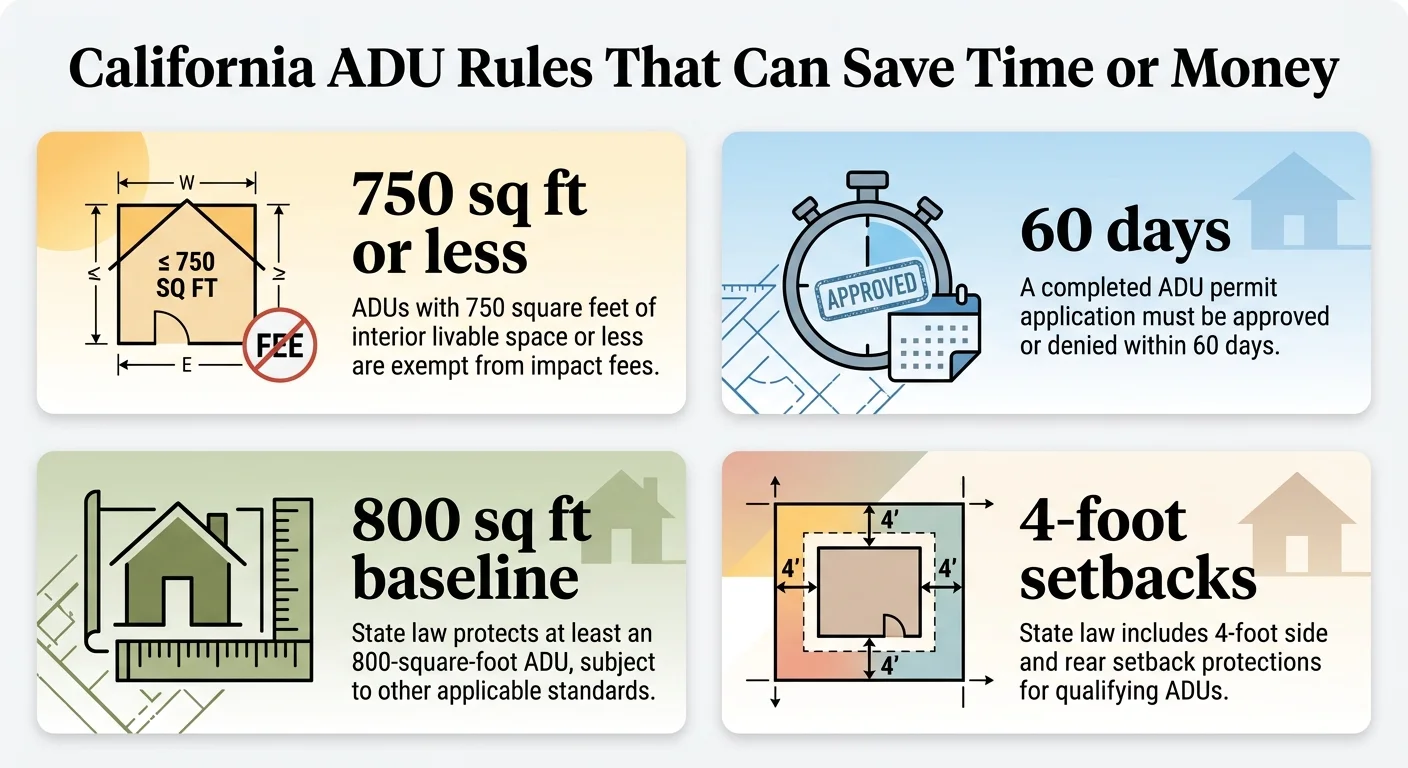
California ADU rules that can save time or money — permanent law, available to all homeowners
No Owner-Occupancy Requirement
Gov. Code § 66315California does not require owner-occupancy for ADUs. You can build an ADU and rent it (or rent your primary home and live in the ADU). Some local incentive programs require owner-occupancy as a condition of their financial assistance, but the state law itself does not.
Impact Fee Exemption for Smaller ADUs
Gov. Code § 66311.5ADUs with 750 square feet or less of interior livable space are exempt from impact fees statewide. For larger ADUs, impact fees must be charged proportionately to the primary dwelling. Building at or under 750 SF is one of the most valuable cost-saving decisions a California homeowner can make.
60-Day Permit Timeline
Gov. Code § 66317Local agencies must determine whether your ADU application is complete within 15 business days and must approve or deny a completed application within 60 days. If the agency misses the deadline, the completed application is deemed approved. Projects using pre-approved plans may see review as short as 30 days.
Baseline Size and Setback Protections
Gov. Code § 66321State law bars local standards that would prevent an ADU with at least 800 square feet of interior livable space and four-foot side and rear setbacks, subject to other applicable development standards. Your city can be more permissive, but it can't be more restrictive than these state minimums.
Protections for Legalizing Existing Units
Gov. Code § 66311.7State law provides added protections for certain unpermitted ADUs and JADUs built before January 1, 2020. A local agency may not deny a permit for code violations unless correction is needed to address substandard conditions, may not penalize the applicant for the unpermitted unit, and may not impose impact, connection, or capacity charges except in specified circumstances.
Pre-Approved Plans (Statewide Requirement)
Effective January 1, 2025Cities are required to offer pre-approved ADU plans. Using a pre-approved plan means faster review, lower design costs, and more predictable permitting. Some cities like San Jose have implemented same-day permit issuance for qualifying submissions.
These provisions are your baseline. A homeowner building a 700 SF ADU using pre-approved plans in a high-fee city could save tens of thousands through these rules alone — savings that are available to everyone, not just grant recipients.
Free Tool
See which laws and programs apply to your specific address and city.
60 seconds. Free. No sales pitch — just clarity on what's possible at your address.
Can Prefab ADUs Close the Gap Without a Grant?
If the grant's absence makes your project feel out of reach, prefab may change the equation. Factory-built and modular ADUs arrive partially or fully assembled, cutting labor costs and construction timelines. For homeowners who needed the $40,000 grant to make the budget work, a lower total project cost might accomplish the same thing — or better.
The math is straightforward: if a site-built quote came in at $250,000 and you were counting on the grant to bring effective cost down to $210,000, a prefab unit at a lower total cost gets you to the same place — or further — without waiting for any government program.
Prefab doesn't eliminate all costs. You still need a foundation, utility connections, permits, and site preparation. But the total financing needed drops meaningfully, which makes every financing path described above more accessible.
We cover prefab options in depth — including pricing, lead times, and California-approved models — in our cheapest prefab ADU guide and best prefab ADU under $100K.
If the CalHFA Grant Comes Back, How Do You Get in Line First?
Both previous funding rounds were exhausted in days to weeks. If CalHFA announces new funding, being prepared in advance will be the difference between funded and frustrated.
Preparation Checklist
Confirm you're an owner-occupant at the property where you'd build
Check whether your income falls within your county's AMI thresholds (use the CalHFA income limits page for current figures)
Connect with a CalHFA-approved lender now — they'll alert you when new funding opens, and the lender relationship is required for application
Get preliminary ADU plans drawn up (or identify a pre-approved plan from your city)
Complete a soil test and property survey if you haven't already
Gather income documentation (pay stubs, last two years of tax returns)
Bookmark CalHFA.ca.gov/adu and check for NOFA announcements
Will the Grant Come Back?
Nobody knows. California's housing crisis is ongoing — nearly 23,000 ADUs were built in 2023, and ADUs now represent roughly one in seven building permits statewide. That housing pressure suggests programs like this may return. But nothing has been announced.
Our Recommendation
Don't wait. Start your ADU planning using the financing and cost-saving paths above. If the grant returns, you'll be perfectly positioned to apply for reimbursement of soft costs you've already incurred. If it doesn't, you haven't lost months waiting for something uncertain.
What Should You Do Next?
The path forward is clearer than it feels right now. Here's the sequence:
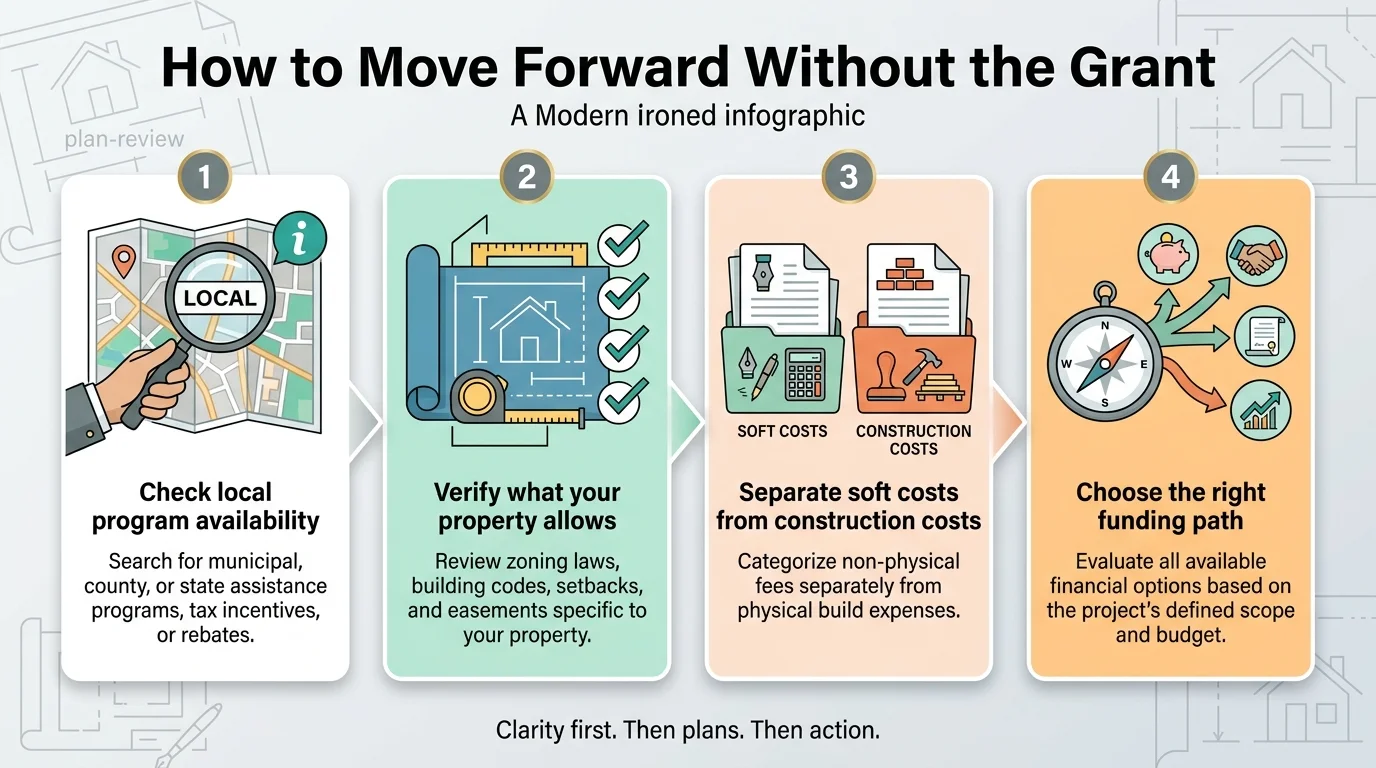
Clarity first. Then plans. Then action.
Check whether your city or county has active ADU help.
Use our tracker table above. If a program is listed as 'Active,' contact them directly to confirm availability.
Verify what your property allows.
Setbacks, zoning, lot coverage, and utility access all matter. Get this answered before spending money on plans.
Separate soft costs from total project cost.
Know what you'll spend on plans, permits, and site prep versus what construction will actually cost. That tells you exactly how much financing you need.
Choose your financing path.
Match the gap to the right option — HELOC, construction loan, renovation loan, cash-out refi, or a combination. Talk to at least two lenders.
Only then pay for final plans or builder quotes.
Too many homeowners spend $15,000+ on architectural plans before confirming financing or lot eligibility. Get the fundamentals in place first.
Free Tool
Not sure where to start? Most homeowners begin here.
60 seconds. Free. No sales pitch — just clarity on what's possible at your address.
Free Download
2026 ADU Starter Kit
Cost worksheets, financing comparison guide, permit checklists, and a timeline planner. Free, instant, yours to keep.
California ADU Grant FAQ
Is the California ADU grant still available in 2026?
No. The CalHFA ADU Grant Program's latest round was fully allocated on December 28, 2023. No new funding round has been announced as of April 2026. If anyone contacts you claiming they can help you access the grant, CalHFA has confirmed this is a scam.
What was the $40,000 California ADU grant?
The CalHFA ADU Grant Program provided up to $40,000 in non-repayable grant funds to eligible California homeowners for pre-development costs associated with building an ADU — architectural designs, permits, soil tests, impact fees, property surveys, and energy reports. It did not cover construction materials, labor, or appliances.
Did the California ADU grant pay for construction?
No. The grant covered only pre-development soft costs and non-recurring closing costs. Construction materials, labor, and hard costs were never eligible. The actual building always required separate financing.
Who qualified for the CalHFA ADU grant?
The final 2023 funding round required California homeownership, owner-occupancy, income at or below 80% of Area Median Income for your county, and a construction loan through a CalHFA-approved lender. Earlier rounds used different income thresholds. Investment properties, LLC-owned homes, and short-term rental plans were excluded.
Are there any California ADU grants still open?
The statewide CalHFA grant is fully allocated. However, local programs exist: San Diego offers up to $250,000 in construction loans, Napa County offers forgivable loans of $45,000–$105,000, Pasadena offers up to $225,000 in construction financing, and several cities provide pre-approved plans and technical assistance. See our tracker table above. Always confirm directly with the program.
How are homeowners financing ADUs without the grant?
The most common paths are HELOCs, cash-out refinancing, construction loans, renovation loans (FHA 203k or Fannie Mae HomeStyle), and ADU-specific products from certain lenders. Prefab and modular ADUs also reduce total financing needed. Most ADU projects — even when the grant was active — required separate construction financing.
Will the CalHFA ADU grant come back?
Unknown. California's housing shortage creates pressure for programs like this to return, but no new funding has been announced as of April 2026. We update this page when the status changes.
Is an ADU under 750 square feet cheaper to permit in California?
Yes, significantly. ADUs with 750 square feet or less of interior livable space are exempt from impact fees statewide under Gov. Code § 66311.5. Depending on your city, this exemption can save thousands to tens of thousands of dollars.
Does California require owner-occupancy for ADUs?
No. California state law does not require owner-occupancy for ADUs (Gov. Code § 66315). Some local incentive programs require it as a condition of financial assistance, but the baseline state law does not.
How do I avoid California ADU grant scams?
Never pay anyone who claims they can help you access the CalHFA ADU grant. The program has no open application round. CalHFA has issued an official scam warning. Report scam contacts to CalHFA at marketing@calhfa.ca.gov.
Is it worth waiting for the grant before starting my ADU?
In most cases, no. The grant covered a portion of pre-development costs within a much larger project budget. Construction costs tend to rise, and every month of delay is a month of potential rental income or family housing you don't have. Start planning now — if the grant returns, you can apply for reimbursement of qualifying soft costs you've already paid.
How much does it cost to build an ADU in California?
Costs vary significantly by type, size, location, and site conditions. General industry-reported ranges: garage conversions ($80,000–$200,000), attached additions ($150,000–$300,000), detached new builds ($200,000–$400,000+), Junior ADUs within existing homes ($30,000–$80,000). Pre-approved plans, impact fee exemptions, and prefab options can reduce these numbers.
Can my city block me from building an ADU?
California state law strictly limits local restrictions on ADUs. Cities must allow at least an 800 SF ADU (Gov. Code § 66321), must act on applications within 60 days (Gov. Code § 66317), and cannot impose owner-occupancy requirements or parking requirements in many situations.
Related Guides
How to Finance an ADU in 2026
HELOC vs. construction loan vs. renovation loan — full comparison with worked examples.
HELOC for ADU: Full Guide
When a HELOC beats a refi or construction loan, how much equity you need.
Cheapest Prefab ADU Options
Real installed prices — 9 manufacturers compared. A lower total cost reduces what you need to finance.
California ADU Laws Guide
State rules for setbacks, permits, owner-occupancy, and more.
This page was researched and written by The Dwelling Index ADU Research Team. We are an independent educational resource — not a builder, lender, or broker. Program statuses were last verified on April 2, 2026. Program availability can change without notice; always confirm directly with the administering agency before making financial decisions. Sources cited: CalHFA.ca.gov, California Department of Housing and Community Development (hcd.ca.gov), San Diego Housing Commission (sdhc.org), Napa County, City of Napa, City of Pasadena, City of San Jose, California Legislative Information (leginfo.legislature.ca.gov). For our complete affiliate relationships and editorial standards, see our Editorial Standards page. Last verified: April 2, 2026.