
300 Sq Ft ADU Cost in 2026: What You'll Actually Pay
By The Dwelling Index Editorial Team · Last verified: April 2026 · Sources: Realm (53 real projects), Better Place Design & Build, Ataman Studio, Angi, BuildingAnADU.com, CA HCD, Orange County CA, NYC HPD, Seattle Building Connections, Mercatus Center
300 sq ft ADU cost usually falls between $110,000 and $180,000 all-in for a straightforward detached project — and that number shocks nearly everyone who hears it for the first time. Garage conversions and JADUs can cut that dramatically. A custom detached build in a high-cost market can exceed it.
| Build Path | All-In Cost Range | Typical $/Sq Ft | Best For |
|---|---|---|---|
| JADU / interior conversion | $30,000 – $75,000 | $100 – $250 | Tightest budgets, existing interior space |
| Garage conversion | $45,000 – $100,000 | $150 – $335 | Existing garage near utilities |
| Prefab / modular (installed) | $70,000 – $140,000 | $235 – $465 | Speed, predictable pricing |
| Attached addition | $75,000 – $145,000 | $250 – $485 | Smaller lots, shared-wall savings |
| Detached new build | $110,000 – $200,000+ | $365 – $665+ | Maximum privacy, rental income |
All-in includes design, permits, site prep, construction, utility hookups, and standard finishes. Sources: Realm (53 real 300 sq ft projects, median $160K), Better Place Design & Build, Ataman Studio, Angi, BuildingAnADU.com, 2025–2026. How we estimated these costs.
The reason that number feels high for something “small” is straightforward: a legal dwelling unit needs a kitchen, a bathroom, a foundation, utility hookups, design plans, and permits — regardless of whether it's 300 or 800 square feet. Those fixed costs don't shrink with your floor plan. They get concentrated into fewer square feet, pushing your cost per square foot higher than almost any other ADU size you could build.
That's the counterintuitive truth most pages on the internet skip. Below, we break down exactly what drives these numbers, compare every build path at this size, expose the hidden costs most quotes leave out, and help you answer the question that actually matters: is 300 sq ft the right build — or would 100–200 more square feet change the math in your favor?
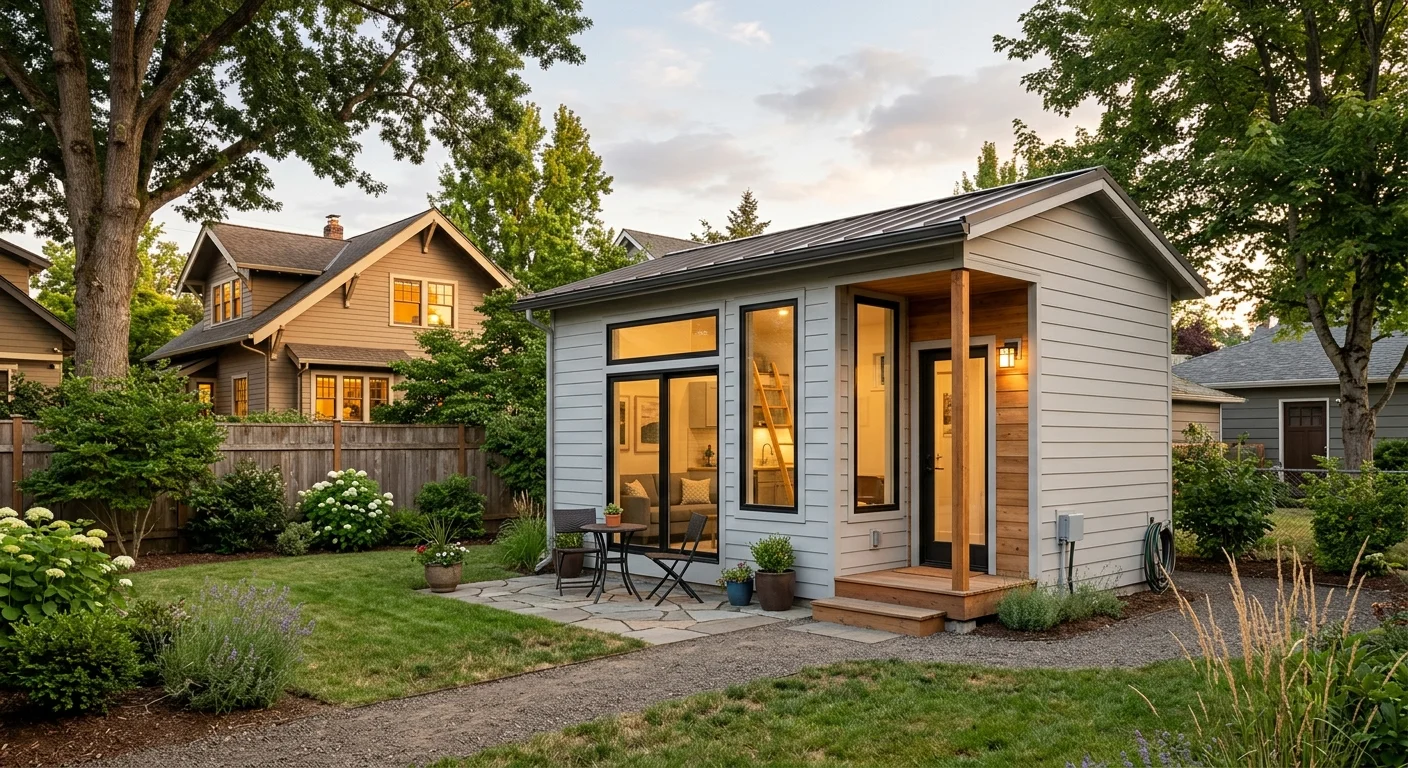
A completed 300 sq ft detached backyard ADU — compact footprint, high livability, full kitchen and bath. This is the premium end of a 300 sq ft detached build in a moderate market.
Why Does a 300 Sq Ft ADU Cost So Much Per Square Foot?
Every ADU — whether 300 or 1,000 square feet — requires the same core components to be a legal, permitted, livable dwelling. Those components cost roughly the same regardless of size. That means 300 sq ft ADUs usually cost more per square foot than larger units — not because anyone is overcharging, but because the economics of building small concentrate fixed expenses into a tiny footprint.
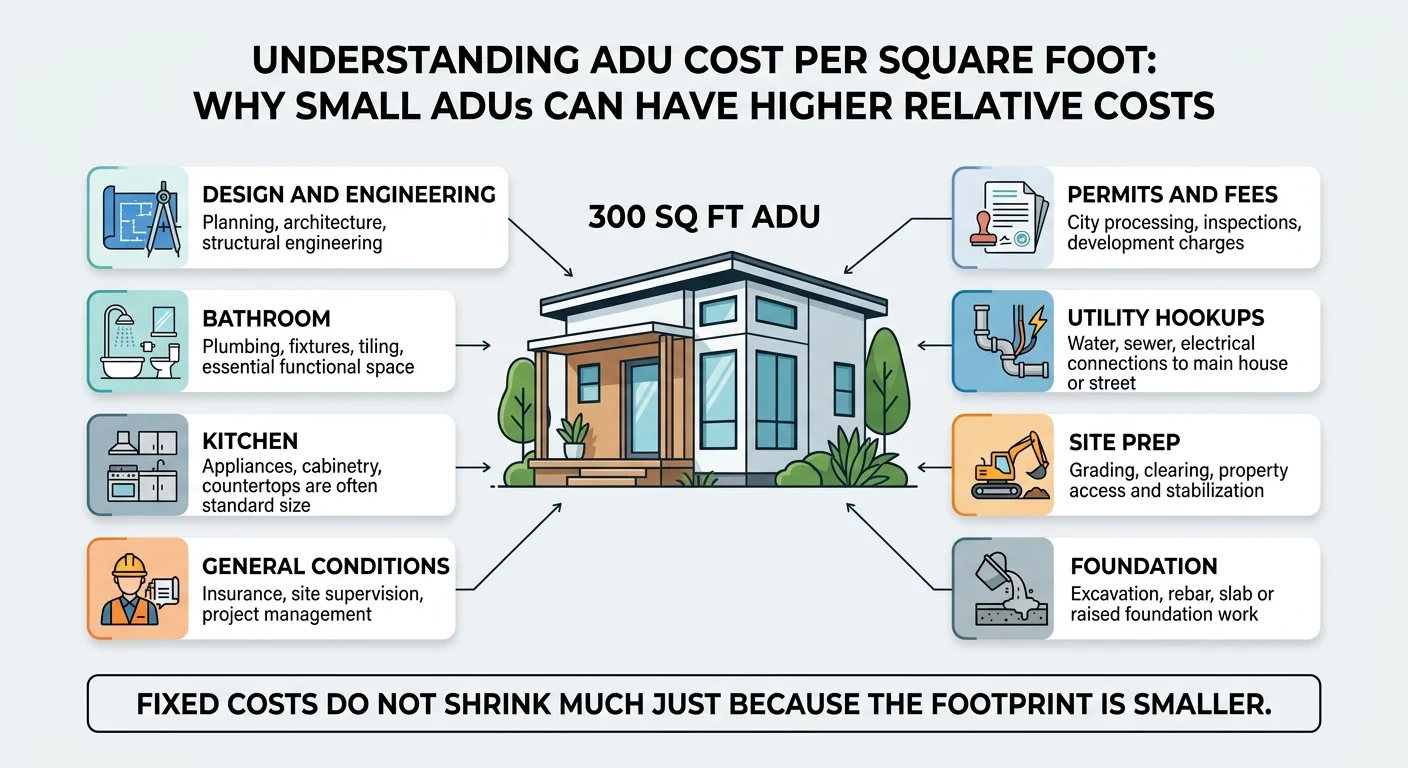
Eight fixed-cost categories — none of them scale down meaningfully just because the footprint is 300 square feet. This is why small ADUs cost more per square foot than larger builds.
| Fixed-Cost Category | Approximate Range | Scales With Size? |
|---|---|---|
| Kitchen (cabinets, counters, appliances, plumbing) | $10,000 – $25,000 | Barely. A 300 sq ft kitchen uses nearly the same components as a 600 sq ft kitchen. |
| Bathroom (shower, toilet, vanity, tile, plumbing) | $8,000 – $18,000 | No. |
| Design & engineering (plans, structural, energy compliance) | $5,000 – $15,000 | Slightly. Drafting a 300 sq ft plan takes almost as long as drafting a 600 sq ft plan. |
| Permits & fees (plan check, building permit, impact fees) | $2,000 – $12,000 | Varies by jurisdiction. Some cities base fees on valuation; some use flat rates. |
| Utility hookups (water, sewer, electrical, possibly gas) | $5,000 – $25,000 | No — driven by distance to main lines, not ADU size. |
| Foundation (for detached builds) | $4,000 – $12,000 | Slightly. Smaller slab uses less concrete but still needs excavation, forms, and inspection. |
| General conditions (dumpster, portable toilet, supervision) | $3,000 – $8,000 | No. |
| Total fixed costs | ~$37,000 – $115,000 | Mostly not. |
Sources: Better Place Design & Build cost tables; BuildingAnADU.com fixed-cost analysis; Angi ADU cost breakdown. Ranges verified April 2026.
The Math That Matters: 300 Sq Ft vs. 800 Sq Ft
| Cost Category | 300 Sq Ft Detached | 800 Sq Ft Detached |
|---|---|---|
| Fixed costs (kitchen, bath, permits, design, hookups, mobilization) | ~$60,000 | ~$65,000 |
| Variable costs (framing, roofing, siding, additional finishes) | ~$35,000 – $55,000 | ~$80,000 – $120,000 |
| Estimated total | ~$95,000 – $115,000 | ~$145,000 – $185,000 |
| Cost per sq ft | ~$315 – $385 | ~$180 – $230 |
Which 300 Sq Ft ADU Path Is Cheapest on Your Lot?
The type of ADU you build matters more than almost anything else for total cost. Here's what to expect from each path at 300 square feet — and when each one wins.
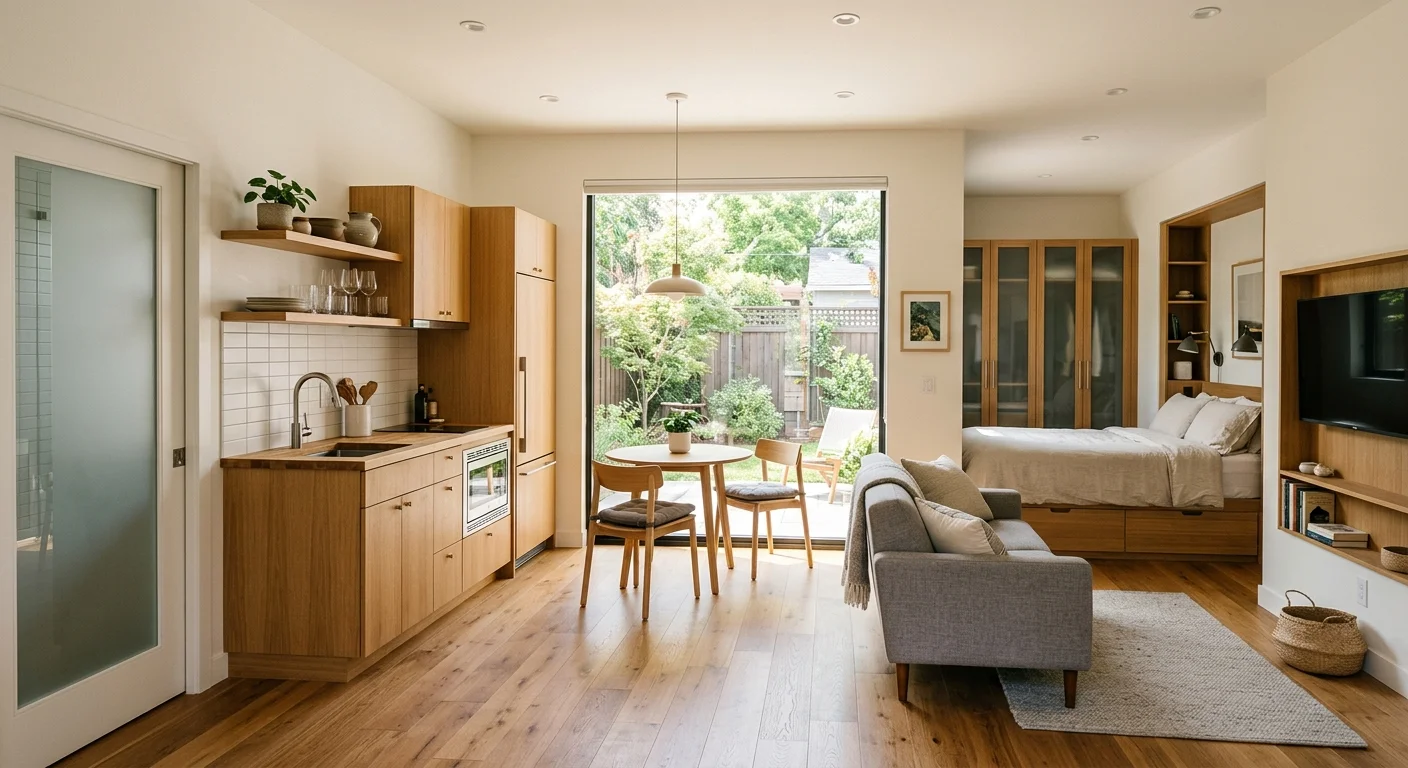
A well-designed 300 sq ft studio interior — kitchen, dining, living, and sleeping zones in a single open-plan space. Every square foot is working.
Garage Conversion
$45,000 – $100,000If you have an existing single-car or oversized one-car garage near your main house, this is usually the most affordable path to a legal 300 sq ft ADU. You're reusing the existing foundation, walls, and roof — so you skip the most expensive fixed costs of new construction.
What's typically involved: insulation, drywall, flooring, kitchen and bathroom installation, electrical and plumbing upgrades, HVAC, egress windows, fire separation from the main house, and finish work. The structure is already standing; you're converting it.
What pushes cost higher: structural reinforcement (older garages may not meet current code for habitation), old or cracked foundations, extensive plumbing rerouting, and jurisdictions that require seismic retrofitting.
Best for: Homeowners with an existing ~300 sq ft garage close to utility lines who don't need the parking.
JADU / Interior Conversion
$30,000 – $75,000A Junior ADU (JADU) is built within the existing walls of your primary home — typically a portion of the house carved off with its own entrance. JADUs are a California-specific legal category defined under state law, allowing units up to 500 sq ft that may share a bathroom with the main house. That shared-bathroom option dramatically reduces plumbing cost. Outside California, similar projects are usually treated as interior conversions under local ADU or building codes.
At 300 sq ft, a JADU or interior conversion is often the cheapest legal ADU path — sometimes radically so. No new foundation, no new utility hookups (or minimal ones), and the structure already passes most code requirements.
Best for: Very tight budgets, homes with underused interior space, and homeowners who want the lowest-cost legal unit possible.
Learn more about JADUs →Prefab / Modular (Installed)
$70,000 – $140,000Prefab ADUs are factory-built and delivered to your site, which means faster construction timelines and more predictable pricing than custom builds. At 300 sq ft, multiple manufacturers offer purpose-built models.
The critical distinction: unit cost vs. installed cost. A 300 sq ft prefab unit might be marketed at $50,000–$80,000. But that's the structure alone. By the time you add site prep, foundation, delivery and crane placement, utility hookup, permits, and any needed landscaping, the installed cost is typically $70,000–$140,000.
Always ask: "What does your price include, and what's my responsibility?" If the answer doesn't cover foundation, hookups, permits, and site prep, you're looking at the unit cost — not the project cost.
Best for: Speed, predictable scope, and homeowners who want a turnkey unit without managing a custom build.
Compare prefab options →Attached Addition
$75,000 – $145,000An attached ADU shares a wall with your main house. This saves some utility hookup cost (shorter runs to existing plumbing and electrical) and eliminates the need for a fully independent foundation — but you'll still need foundation extension, new framing, and code-required fire separation (typically a 1-hour rated wall between the ADU and the main house).
Best for: Smaller lots where detached isn't feasible, or where shared utilities meaningfully reduce hookup costs.
Detached New Construction
$110,000 – $200,000+This is the premium path: a standalone structure with its own foundation, independent utility connections, and maximum privacy for both you and a tenant. It's also the most expensive option at 300 sq ft — because every fixed cost hits at full force and there's no existing structure to leverage.
In high-cost markets like coastal California, metro Portland, Seattle, and NYC suburbs, detached 300 sq ft ADUs routinely reach $160,000–$250,000+. In moderate markets (Denver, Austin, Salt Lake City, Raleigh), $110,000–$165,000 is more typical. In lower-cost areas, $85,000–$130,000 is possible with simple design and standard finishes.
When it's worth it: if you plan to rent the unit long-term, the privacy and separateness of detached construction tend to command higher rents and attract more tenants than a conversion.
Best for: Rental income, aging-in-place with full privacy, or property value maximization.
See ADU cost data for all sizes →What's Included in a 300 Sq Ft ADU Quote — And What's Usually Missing?
Many first quotes are not wrong — they're just incomplete. The gap between the number on the page and the real all-in project cost is where most budget surprises live.
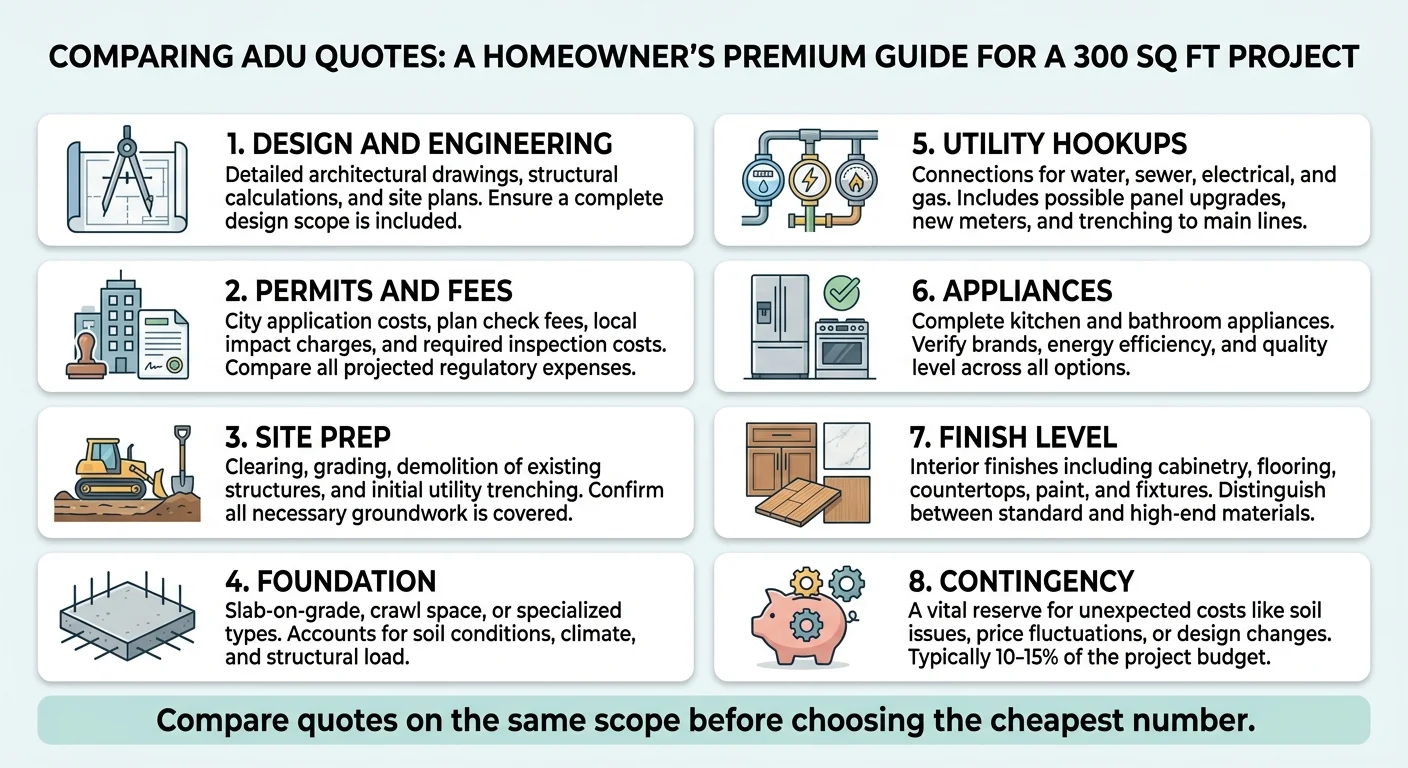
Before comparing quotes, verify these 8 items are consistently covered across all bids — the gap between the cheapest and most expensive quote is almost always about scope, not overpricing.
What a Good “All-In” Quote Covers
Hard costs
Foundation, framing, roofing, siding, insulation, drywall, interior finishes, kitchen and bathroom install, plumbing, electrical, HVAC, doors, windows, paint.
Soft costs
Architectural design, structural engineering, energy compliance (Title 24 in CA, equivalent codes elsewhere), permitting fees, plan-check fees.
Site costs
Grading, excavation, trenching for utility lines, utility hookup and connection fees.
What's Commonly Excluded
| Commonly Excluded Item | Typical Cost | Notes |
|---|---|---|
| Extended utility trenching | $3,000 – $15,000+ | Driven by distance from main lines — longer lots pay more |
| Local impact fees | $0 – $15,000+ | In California, ADUs with 750 sq ft or less of interior livable area are exempt (CA HCD, verified April 2026) |
| School impact fees | $0 – $8,000+ | In California, ADUs with less than 500 sq ft of interior livable space are not subject to school impact fees (CA HCD, verified April 2026) |
| Utility connection/meter fees | $2,000 – $8,000 | Varies by municipality; often charged separately by the utility |
| Surveying | $300 – $800 | Required in some jurisdictions before permit submittal |
| Soil/geotechnical testing | $500 – $3,000 | Required on sloped lots or in areas with expansive soils |
| Landscaping restoration | $1,000 – $5,000 | Construction equipment tears up yards; restoration is on you |
| Appliance package | $2,000 – $6,000 | Some quotes include; some list as "owner-supplied" |
| Contingency (10–15%) | $8,000 – $25,000 | The buffer for unknowns — and unknowns always show up |
Sources: Better Place Design & Build cost guide; Angi ADU cost data; Ataman Studio line-item breakdown. Verified April 2026.
The Costs That Blow Up Small ADU Budgets Fastest
Utility work
If your ADU sits 80 feet from the sewer main instead of 20, you might add $8,000–$15,000 in trenching alone. Electrical panel upgrades (if your main panel can't support the additional load) can add several thousand more. These costs are driven by your lot layout, not your ADU's size.
Site complexity
Sloped lots need retaining walls, poor drainage needs regrading, and difficult access (narrow side yards, no alley) can increase crane and equipment costs for prefab delivery or materials staging. These are among the most common sources of budget overruns per Angi's ADU cost data.
Permit revisions and delays
If your initial plan set gets kicked back by the city with correction requests — which is common, not exceptional — each revision cycle adds weeks and design fees. Pre-approved ADU plans, where available, can cut this dramatically.
See what's actually feasible at your address — size, path, and cost drivers.
Free ADU report — size, path, and key cost drivers in 60 seconds.
Check My Property →Is 300 Square Feet Actually Big Enough?
Three hundred square feet is about the size of a large hotel room, a standard one-car garage, or a generous studio apartment. With a well-designed layout, you can fit everything a person needs for independent daily living — but every inch counts.
What Typically Fits in a 300 Sq Ft ADU
Studio rental
Most studio apartment tenants are accustomed to compact living. A clean, modern 300 sq ft unit with good natural light rents competitively in most urban and suburban markets.
Guest suite or home office
If no one is living there full-time, 300 sq ft is generous — a dedicated workspace with a bathroom, or a comfortable guest room.
Aging-parent suite
For an older parent who values proximity to family but wants their own space, 300 sq ft with a full kitchen and bathroom provides independent living on the same property.
When 300 Sq Ft Gets Tight
If a couple will live there long-term and needs separate working and sleeping areas, 300 sq ft starts to feel compressed. If you want a true one-bedroom with a door (not a studio), you'll be working with a very small bedroom and a very small living area — possible, but tight. And if you plan to furnish for maximum short-term rental appeal, a bit more square footage gives you room for the amenities that drive higher nightly rates.
The practical question is whether those limitations matter for your use case — or whether they're a reasonable tradeoff for a lower total build cost.
See detached ADU floor plan options →
Should You Build 300 Sq Ft — Or Go Bigger?
This is the most consequential section on this page. In many markets, the jump from 300 to 400 or 500 square feet adds far less cost than homeowners expect — because the expensive fixed-cost base is already baked in. The incremental cost is almost entirely variable: more framing, more siding, more flooring, more roof. Those are the cheapest categories per square foot in the entire project.
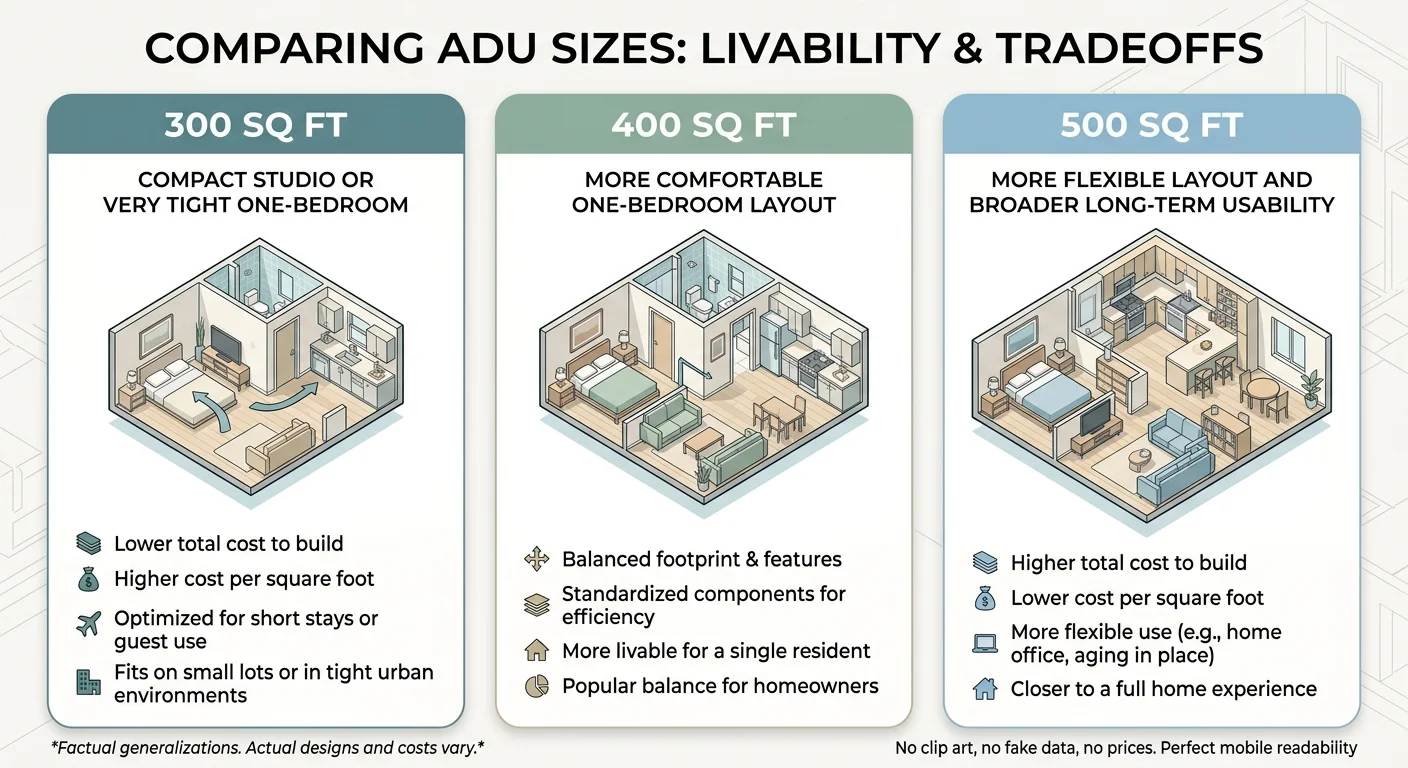
The marginal cost of going from 300 to 400 sq ft is ~$15K–$20K — but you gain a livable one-bedroom layout, lower cost per sq ft, and stronger rental appeal. The $15K–$20K pays for itself within a few years of rental income in most markets.
300 vs. 400 vs. 500 Sq Ft: The Real Comparison
| Factor | 300 Sq Ft | 400 Sq Ft | 500 Sq Ft |
|---|---|---|---|
| Total cost (detached, moderate market) | $110K – $165K | $125K – $185K | $140K – $210K |
| Cost per sq ft | $365 – $550 | $315 – $465 | $280 – $420 |
| Marginal cost of extra space | — | +$15K – $20K for 100 more sq ft | +$30K – $45K for 200 more sq ft |
| Typical layout | Studio or tight 1-bed | Comfortable 1-bedroom | Spacious 1-bed or compact 2-bed |
| Tenant appeal | Good for singles, students, minimalists | Strong — comfortable for most renters | Strongest — widest tenant pool |
| Best for | Budget builds, guest suite, office, JADU | Rental income, aging parent | Maximum rental income, small family |
Sources: Better Place Design & Build size tables; Angi ADU cost data; BuildingAnADU.com fixed-cost analysis. These are illustrative planning ranges, not guarantees.
When 300 Sq Ft Is Still the Right Call
Your lot or setbacks physically limit you to roughly that size
You're converting a ~300 sq ft garage and adding square footage isn't practical
You have a hard budget ceiling under $100K–$120K
The unit is a home office, guest suite, or part-time space — not a full-time residence
You're buying a specific prefab model at that size
Your jurisdiction caps your ADU at this footprint
When You Should Go Bigger
You plan to rent the unit — tenants pay meaningfully more for a one-bedroom than a studio
You're building detached new construction anyway — incremental cost of 100–200 more sq ft is small
An aging parent or family member will live there long-term
Your local zoning allows 400–800 sq ft with no additional setback or coverage penalties
See what you can build → Find out what's feasible at your address — size, build path, and key cost drivers.
Find out what's feasible at your address — size, build path, and key cost drivers. Free, takes about 60 seconds.
Get Your Free ADU Feasibility Report →Available in CA, UT, TX, CO, and NY.
How Can You Lower Your 300 Sq Ft ADU Cost?
Smart decisions before construction starts have a bigger impact on your total cost than any amount of negotiation after the project is underway.
Convert instead of building new
A garage conversion, basement conversion, or JADU eliminates the most expensive line items: new foundation, new framing, new roof, and new utility runs. If you have existing space that works, this is the single biggest cost lever you have.
Choose prefab over custom design
Factory-built units spread design and manufacturing costs across many units. You won't get a bespoke floor plan, but you'll get predictable pricing and faster timelines.
Use pre-approved or standard plans
A growing number of cities offer pre-approved ADU plans that reduce design costs and compress permit review times. See the rules and programs section below for specific examples.
Keep the footprint rectangular
Every corner, bump-out, and non-standard angle adds framing, roofing, and siding cost. A simple rectangle is the most cost-efficient shape to build.
Select mid-range finishes
At 300 sq ft, you don't need imported tile or custom cabinetry. Builder-grade cabinets with upgraded hardware, quartz-look laminate counters, and luxury vinyl plank flooring look great and hold up well — at a fraction of premium pricing.
Minimize utility distance
Place the ADU as close to existing water, sewer, and electrical connections as your setback rules allow. Every additional foot of trenching adds cost.
Handle non-structural finishing work yourself
Painting, basic landscaping, trim installation, and simple flooring are areas where homeowner sweat equity can save real money in labor.
What Rules and Programs Can Change a 300 Sq Ft ADU's Real Cost?
National cost ranges are useful starting points, but local rules move the real number fast. Fee exemptions, pre-approved plan programs, review timelines, and size-based thresholds can make a 300 sq ft project meaningfully easier — or harder — than averages suggest.
California
- •ADUs with 750 sq ft or less of interior livable area are exempt from local impact fees.
- •ADUs with less than 500 sq ft of interior livable space are not subject to school impact fees — a 300 sq ft ADU qualifies for both exemptions.
- •Efficiency units (similar to JADUs) can be as small as 150 sq ft.
- •Cities must act on completed ADU applications within 60 days when an existing dwelling is on the lot.
- •Fire sprinklers are only required for an ADU if they're also required for the primary residence — an ADU cannot, by itself, trigger a sprinkler requirement.
- •Multiple cities offer pre-approved ADU plan libraries that cut design costs and speed permitting.
Source: California Housing and Community Development (HCD) ADU Handbook, verified April 2026.
Orange County, California
- •Offers six pre-approved detached ADU plans ranging from a 393 sq ft studio to 1,200 sq ft.
- •Qualifying plans are eligible for a 15-business-day first plan check and only 25% of the standard plan-check fee — a meaningful time and cost savings.
Source: Orange County, CA Planning Division pre-approved ADU program, verified April 2026.
New York City
- •NYC's ADU for You program offers an eligibility lookup tool and a pre-approved plan library.
- •City guidance indicates timelines can range from roughly two months to two and a half years depending on project scope and permitting path — a wide range that underscores understanding your specific borough early.
Source: NYC HPD ADU for You, verified April 2026.
Seattle, WA
- •Seattle allows ADUs up to 1,000 sq ft in all zones, or up to 1,200 sq ft for ADUs with three or more bedrooms.
- •For 300 sq ft builders, that means substantial room to expand later or build more generously from the start.
Source: Seattle Building Connections, verified April 2026.
The Broader National Picture
- •As of March 2026, Mercatus tracked 18 states with broad statewide ADU legalization laws, but local implementation still varies materially by city and county.
- •ADU legislation is moving fast — what's true today may change by next session. Always verify your specific city's rules, fees, and any pre-approved plan programs before committing to a design.
Source: Mercatus Center ADU policy tracker, March 2026.
See our full ADU laws by state guide (all 50 states, official sources) →
How Long Does a 300 Sq Ft ADU Take From Start to Move-In?
A small footprint doesn't automatically mean a fast project. Timeline is driven more by permitting path, site conditions, and contractor availability than by whether the unit is 300 or 500 square feet.
| Phase | Garage Conversion | JADU / Interior | Prefab / Modular | Detached New Build |
|---|---|---|---|---|
| Design & engineering | 2–4 weeks | 1–3 weeks | 1–2 weeks (standard plans) | 4–8 weeks |
| Permitting | 4–10 weeks | 3–8 weeks | 4–10 weeks | 6–16 weeks |
| Site prep & foundation | 1–2 weeks | Minimal | 1–3 weeks | 2–4 weeks |
| Construction / installation | 4–10 weeks | 3–8 weeks | 1–4 weeks on-site | 8–16 weeks |
| Final inspections & close-out | 1–3 weeks | 1–2 weeks | 1–3 weeks | 2–4 weeks |
| Total | ~3–5 months | ~2–4 months | ~3–6 months | ~6–14 months |
Sources: Ataman Studio (CA 300 sq ft timeline); CA HCD (60-day action on completed apps); Orange County, CA (15-day first plan check for pre-approved plans). Permitting timelines vary significantly by city.
How Do Homeowners Typically Pay for a 300 Sq Ft ADU?
Most people don't write a check for $100K+. Understanding the main financing paths — and which ones fit a compact ADU project — can be the difference between “I'll build someday” and “I'm breaking ground this quarter.”
Cash or savings
The simplest path. No interest costs, no lender approval. Cash works best for garage conversions and JADUs in the $30K–$75K range.
HELOC (home equity line of credit)
If you have significant equity in your home, a HELOC lets you borrow against it with a flexible draw period that matches a construction timeline. One of the most common ADU financing paths.
Cash-out refinance
Replaces your existing mortgage with a larger one and gives you the difference in cash. Makes sense when you can refinance at a competitive rate relative to your current mortgage.
Construction or construction-to-permanent loan
Purpose-built for building projects. These loans disburse funds in stages as construction progresses.
Renovation loan (FHA 203(k) or Fannie Mae HomeStyle)
Can wrap ADU costs into a mortgage refinance. Particularly relevant for garage conversions and attached additions.
The right path depends on your equity position, existing mortgage terms, project scope, and timeline. The most important first step isn't choosing a lender — it's understanding which financing category fits your situation.
Ready to explore your options? See how homeowners typically finance ADU projects — compare financing paths →
HELOC vs. refi vs. construction loan — explained without lender hype, sorted by fit.
What Do Realistic 300 Sq Ft ADU Budgets Look Like?
Ranges are useful for planning. Worked examples are useful for believing the plan. Here are four scenarios with line-item assumptions so you can map your situation to the one that fits.
Scenario A: Garage Conversion — Moderate-Cost Market
Single-car garage, structurally sound, moderate-cost U.S. metro
| Design & engineering (pre-approved plan) | $3,000 |
| Permits & fees | $3,500 |
| Demolition & prep (existing garage interior) | $2,500 |
| Structural reinforcement | $4,000 |
| Framing modifications, insulation, drywall | $12,000 |
| Electrical upgrade & wiring | $5,500 |
| Plumbing (kitchen + bathroom rough & finish) | $9,000 |
| HVAC (mini-split) | $4,500 |
| Kitchen (cabinets, counters, appliances, sink) | $10,000 |
| Bathroom (shower, toilet, vanity, tile) | $7,500 |
| Flooring, trim, paint, doors, windows | $6,000 |
| Contingency (10%) | $6,750 |
| Total (all-in) | ~$74,250 |
Scenario B: Detached New Build — Moderate-Cost Market
Standalone structure, simple site, standard finishes
| Design & engineering (semi-custom plan) | $8,000 |
| Permits & fees | $6,000 |
| Site prep & grading | $3,500 |
| Foundation (slab-on-grade) | $8,000 |
| Utility trenching & hookup (30 ft run) | $10,000 |
| Framing, roofing, siding, windows, doors | $30,000 |
| Insulation & drywall | $5,500 |
| Electrical | $6,000 |
| Plumbing (kitchen + bathroom) | $10,000 |
| HVAC (mini-split) | $4,500 |
| Kitchen (cabinets, counters, appliances) | $12,000 |
| Bathroom (shower, toilet, vanity, tile) | $9,000 |
| Interior finishes (flooring, trim, paint) | $7,000 |
| Landscaping restoration | $2,500 |
| Contingency (10%) | $12,200 |
| Total (all-in) | ~$134,200 |
Scenario C: Detached New Build — High-Cost Coastal (e.g., California)
Custom plan, complex site, Title 24 energy compliance, longer utility runs
| Design & engineering (custom plan, Title 24, structural) | $14,000 |
| Permits & fees (including impact fees where applicable) | $10,000 |
| Site prep, grading, surveying | $6,000 |
| Foundation | $11,000 |
| Utility trenching & hookup (50 ft run) | $18,000 |
| Framing, roofing, siding, windows, doors | $42,000 |
| Insulation & drywall | $7,000 |
| Electrical (including solar-ready where required) | $8,500 |
| Plumbing | $12,000 |
| Fire sprinklers (only if required for primary residence) | $3,500 |
| HVAC | $5,500 |
| Kitchen | $16,000 |
| Bathroom | $12,000 |
| Interior finishes | $9,500 |
| Landscaping restoration | $4,000 |
| Contingency (10%) | $17,900 |
| Total (all-in) | ~$197,000 |
Scenario D: Prefab / Modular Unit — Installed
Factory-built unit, standard site, moderate-cost market
| Prefab unit (300 sq ft, delivered) | $62,000 |
| Foundation (pier or slab) | $7,000 |
| Delivery & crane placement | $5,000 |
| Utility hookup (water, sewer, electrical) | $12,000 |
| Permits & fees | $5,000 |
| Site prep & landscaping | $4,000 |
| Contingency (10%) | $9,500 |
| Total (all-in) | ~$104,500 |
Not sure which scenario fits your property? Get a free property-specific report.
Free ADU report — size, path, and key cost drivers in 60 seconds.
Check My Property →How Do You Sanity-Check a 300 Sq Ft ADU Quote?
You've got a quote — maybe two. The numbers look wildly different. Before you assume the cheaper one is a deal (or the expensive one is a ripoff), run through this checklist. In most cases, the gap is about what's included, not what's overpriced.
The Apples-to-Apples Checklist
For every quote you receive, confirm whether it includes:
Design and engineering
Architectural plans, structural engineering, energy compliance. If not included, budget separately.
Permits and fees
Building permit, plan-check fee, impact fees, utility connection fees. If listed as "by owner," those costs are still real — they're just not in the quote.
Site prep
Grading, excavation, tree removal. Flat, clear lots = lower cost. Sloped, obstructed lots = potentially significant additional work.
Foundation
Included for new builds? Type specified (slab, pier, stem wall)?
Utility hookups
Water, sewer, electrical. Length of trenching specified? Panel upgrades needed?
Appliances
Kitchen and laundry appliances included, or "owner-supplied"?
Finishes
"Builder grade" and "standard" can mean very different things to different contractors. Ask for specifications.
Contingency
Is there a buffer, or is the quote presented as a hard number?
Red Flags
The goal isn't to find the cheapest quote. It's to find the most honest one — and to compare them on the same basis.
Free Resource
Free 2026 ADU Starter Kit
The complete planning checklist, budget worksheet, and current financing options — all in one place. Delivered to your inbox, no spam.
Download the Free Starter Kit →Frequently Asked Questions
How much does a 300 sq ft ADU cost to build?
Most 300 sq ft ADU projects cost $110,000 to $180,000 all-in for new construction. Garage conversions and JADUs are typically $30,000–$100,000. Prefab units installed run $70,000–$140,000. Location, build type, site conditions, and finish level are the main cost drivers. (Sources: Realm project data; Better Place Design & Build; Ataman Studio; Angi. Verified April 2026.)
Is 300 sq ft too small for a one-bedroom ADU?
Not necessarily. A 300 sq ft one-bedroom is tight but feasible — expect a small bedroom (~100 sq ft), compact kitchen, full bathroom, and minimal living area. Most 300 sq ft ADUs work best as studios or open-plan layouts. For a comfortable traditional one-bedroom, 400 sq ft is a better starting point.
Is a garage conversion cheaper than a detached ADU at 300 sq ft?
Significantly. A 300 sq ft garage conversion typically costs $45,000–$100,000 because it reuses the existing foundation, walls, and roof. A comparable detached new build costs $110,000–$200,000+.
Can you fit a full kitchen and bathroom in 300 sq ft?
Yes. A well-designed 300 sq ft ADU includes a full kitchen (compact range, apartment-size fridge, sink, dishwasher, and counter/cabinet space) and a full bathroom (shower, toilet, vanity). Stackable or combo washer/dryers also fit.
Why is a small ADU so expensive per square foot?
Because fixed costs — kitchen, bathroom, permits, design, utility hookups, foundation, and contractor mobilization — don't decrease much when the floor plan shrinks. These costs get spread across fewer square feet, pushing the per-square-foot number higher. A 300 sq ft ADU might cost $350–$550/sq ft while an 800 sq ft ADU costs $180–$250/sq ft.
Are permits cheaper for ADUs under 750 sq ft?
In California, ADUs with 750 sq ft or less of interior livable area are exempt from local impact fees, which can save thousands. Other states and cities have their own fee structures. Check your local planning department. (Source: CA HCD, verified April 2026.)
Are school impact fees waived for small ADUs in California?
California exempts ADUs with less than 500 sq ft of interior livable space from school impact fees. A 300 sq ft ADU qualifies. (Source: CA HCD ADU Handbook, verified April 2026.)
How long does a 300 sq ft ADU take to build?
Garage conversions: 3–5 months. Prefab installations: 3–6 months. Detached new construction: 6–14 months. Permitting is the biggest timeline variable — pre-approved plans speed this up where available.
Is prefab cheaper for a 300 sq ft ADU?
The unit itself is typically $50,000–$80,000 for 300 sq ft. But the installed cost — including foundation, delivery, hookup, permits, and site prep — is usually $70,000–$140,000. Prefab's real advantage at this size is speed and pricing predictability, not always the lowest absolute cost.
Is a JADU cheaper than a detached 300 sq ft ADU?
Much cheaper. A JADU built within the existing walls of your home typically costs $30,000–$75,000. The tradeoff is less privacy and potentially a shared bathroom. JADUs are a California-specific legal category; similar interior conversions exist in other states under different frameworks.
Should I build 300 sq ft or go up to 400 or 500?
If your lot and budget allow it, 400–500 sq ft is usually the better investment. The marginal cost is roughly $15K–$45K more, but you gain a more livable layout, lower cost per square foot, and stronger rental appeal. Build 300 sq ft if your lot restricts you, you're converting a 300 sq ft garage, or your budget has a hard ceiling.
Can you build a 300 sq ft ADU for under $100,000?
Yes — through a garage conversion, JADU, or prefab kit in a moderate-cost market. Detached new construction rarely lands under $100K unless you're in a low-cost area with a simple site. Verify that the number includes permits, utility hookups, and site prep — not just construction.
How Did We Estimate 300 Sq Ft ADU Costs?
Builder and manufacturer pricing. We aggregated published pricing from ADU builders and prefab manufacturers including Ataman Studio, A+ Construction, Better Place Design & Build, Snap ADU, PrefabADU, and others.
Independent editorial datasets. Realm's dataset of 53 real 300 sq ft projects (median: $160,000; average: $218,978) provided the strongest project-level data. BuildingAnADU.com's Portland ADU Tour data offered valuable fixed-cost analysis. Angi and HomeGuide provided national range benchmarks by type.
Official government sources. California HCD's ADU Handbook, Orange County CA's pre-approved ADU program, NYC's ADU for You, Seattle's Building Connections, and Mercatus Center's ADU policy tracker provided regulatory and fee data. All verified April 2026.
Normalization. We segment costs by build type, market tier, and cost component (fixed vs. variable). Where sources report only construction costs, we note that soft costs, permits, and site work are additional. “All-in” on this page means design + permits + site prep + construction + utility hookups + standard finishes.
What we don't claim. This is not a database of verified project invoices. Ranges are broad because real-world variation is broad — two 300 sq ft detached ADUs on the same block can differ by $50K+ depending on site conditions, finishes, and contractor. These are planning tools, not quotes. Always get multiple local quotes for your specific project.
Updates. We verify sources and update data at least quarterly. If you find outdated information, let us know →
Free Resource
Free 2026 ADU Starter Kit
The complete planning checklist, budget worksheet, and current financing options — all in one place. Delivered to your inbox, no spam.
Download the Free Starter Kit →The fastest way to know for sure:
Not sure where to start? See what's possible at your address — get your free ADU report in 60 seconds.
Free report · 60 seconds · No sales call · No commitment
Get Your Free ADU Feasibility Report →Available in CA, UT, TX, CO, and NY.
Related Guides
- →How Much Does an ADU Cost? Real 2026 Prices by Type
- →Garage Conversion ADU Cost: Real 2026 Prices & Hidden Fees
- →ADU Financing Options 2026: HELOC vs Refi vs Renovation Loan
- →ADU Rental Income: How Much Can You Actually Make? (2026)
- →ADU for Airbnb: Legality, Income & Design Guide (2026)
- →ADU Laws by State: All 50 States & Official Sources (2026)
- →California ADU Laws 2026: Rules, Setbacks, Fees & Permits
- →Best Prefab ADU Companies 2026: Reviewed & Compared
Content is for informational purposes only and does not constitute financial, legal, tax, construction, or lending advice. Verify all information with qualified local professionals before making decisions.
© 2026 The Dwelling Index. Independent ADU research and education for homeowners nationwide. Full terms · Privacy · Editorial methodology · Affiliate disclosure