
400 Sq Ft ADU Cost in 2026: Real All-In Prices by Type, Region, and Build Path
By The Dwelling Index Editorial Team · Last verified: April 2026 · Sources: Realm (91 closed projects), CA HCD ADU Handbook, Portland BDS, Seattle SDCI, Fannie Mae, Freddie Mac, FHFA, HUD/FHA, aggregated contractor bid data
A 400 sq ft ADU costs $80,000 to $250,000+ to build in 2026 — and the build path you choose matters more than the square footage. Here's the quick breakdown:
| Build Path | All-In Cost Range | Cost Per Sq Ft | Typical Timeline | Best For |
|---|---|---|---|---|
| Garage conversion | $80,000 – $150,000 | $200 – $375 | 3 – 6 months | Budget-conscious owners with an existing garage |
| Basement / internal conversion | $60,000 – $130,000 | $150 – $325 | 3 – 5 months | Homes with existing unfinished space |
| Attached addition | $100,000 – $175,000 | $250 – $440 | 5 – 9 months | Multigenerational living, shared-wall builds |
| Detached new construction | $150,000 – $250,000+ | $375 – $625+ | 6 – 12 months | Rental income, maximum privacy, property value |
| Prefab / modular (installed) | $90,000 – $200,000 | $225 – $500 | 4 – 7 months | Speed and price predictability |
| JADU (CA only, under 500 sq ft) | $40,000 – $90,000 | $100 – $225 | 2 – 4 months | California homeowners converting interior space |
Ranges reflect aggregated national contractor and project data across cost tiers. High-cost metros (LA, SF, NYC, Seattle, Boston) trend toward the top; lower-cost regions (Southeast, Midwest, Mountain West) trend toward the bottom. Sources and methodology below.
If you've been searching this and every page gives you a different number, you're not crazy. Most cost pages mix up construction-only quotes with all-in budgets, blend California pricing with national averages, or throw out ranges so wide they're useless. We built this page to fix that — real all-in numbers by build path, by region, and by the hidden fees that catch homeowners off guard.
What “all-in” means on this page: Every cost range includes architectural design, engineering, permit and plan-review fees, site preparation, foundation, construction, plumbing, electrical, HVAC, interior finishes, utility hookups, and a 10–15% contingency. They do not include landscaping, fencing, furniture, or major infrastructure upgrades — those are broken out separately in the hidden costs section.
Already know your build path? See what's possible at your specific property.
Zoning, setbacks, and build options for your address — free, takes about 60 seconds. Detailed reports available in CA, UT, TX, CO, and NY.
See What You Can Build → Get Your Free ADU Report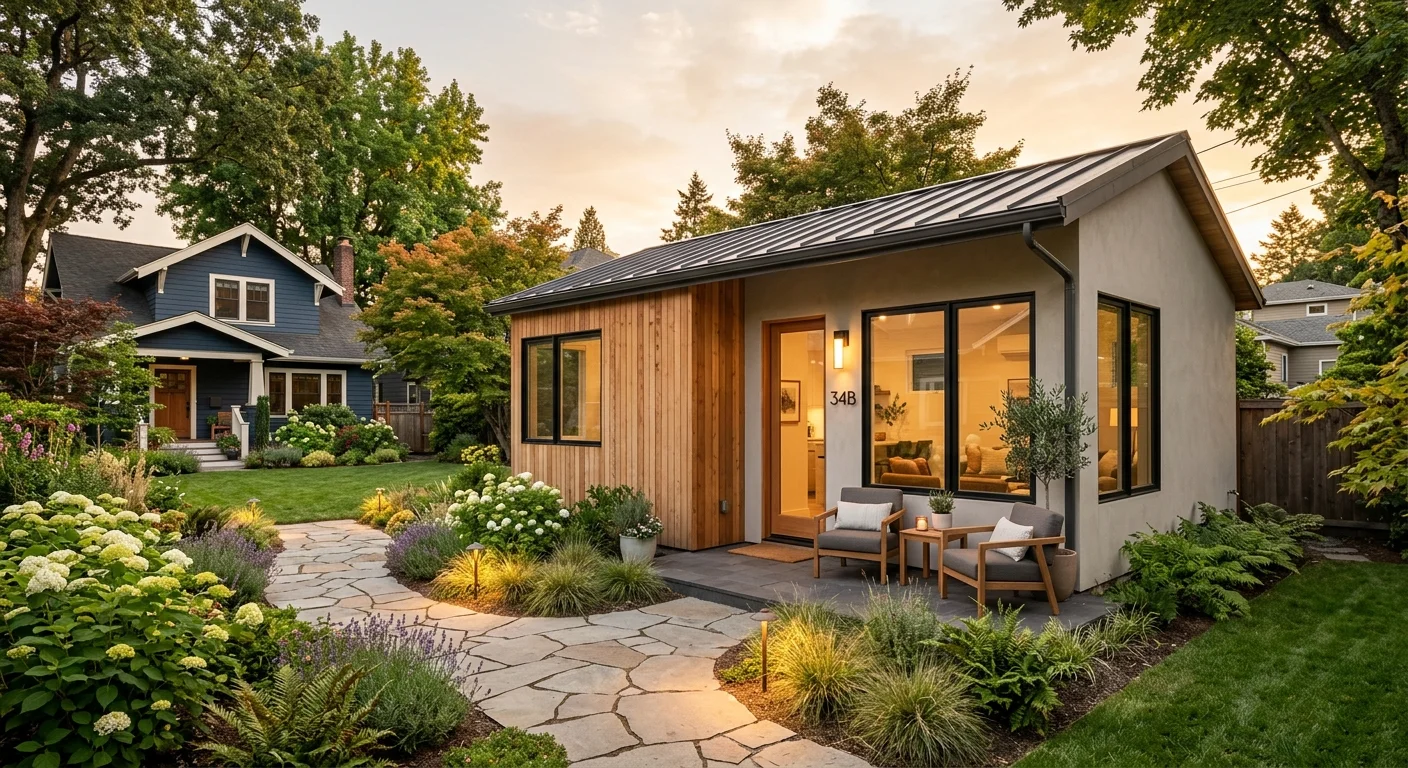
A completed 400 sq ft detached backyard ADU — full kitchen, one-bedroom layout, separate utility connections, and premium landscaping. This is the high end of the detached build range in a moderate-to-high-cost market.
Why is a 400 sq ft ADU so expensive per square foot?
This is the question behind the question — and the answer explains why the numbers above look high for something “small.”
A 400 sq ft ADU costs more per square foot than an 800 sq ft ADU because the most expensive parts of any ADU don't shrink with the building. The kitchen costs $8,000–$25,000 whether it serves 400 sq ft or 1,200 sq ft. The bathroom costs $6,000–$15,000 either way. Permits, design fees, engineering, utility hookups, and the inspection sequence are nearly identical regardless of size.
These fixed costs get spread across fewer square feet in a small ADU, which drives the per-sq-ft number up. The data backs this up — 400 sq ft ADUs routinely cost $300–$500+ per square foot in all-in project budgets, while 800 sq ft units with similar finishes often land at $200–$350.
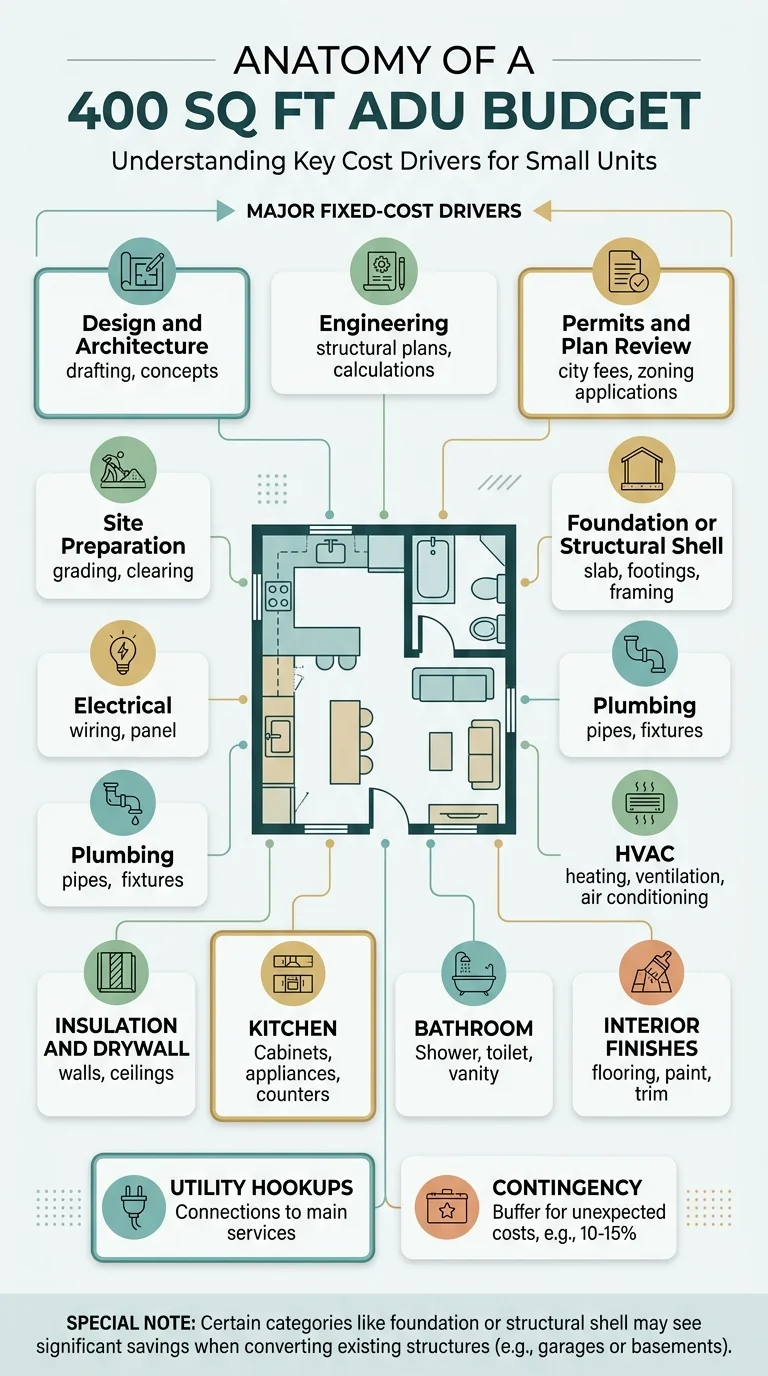
Every cost driver in a 400 sq ft ADU — and none of them scale down much just because the footprint is smaller. The kitchen and bathroom alone can represent 15–25% of the total budget.
That doesn't mean 400 sq ft is the wrong choice. It means the economics of 400 sq ft make the most sense when you're:
Converting an existing structure (where the size is already fixed)
Working with a tight lot or strict setback requirements
Building for a specific use case — home office, guest suite, or compact rental
Optimizing for the lowest possible total project cost, even at a higher per-sq-ft rate
What does a 400 sq ft ADU budget actually look like?
Most quote confusion happens because people compare unlike numbers. One builder quotes construction-only. Another quotes “turnkey” but excludes permits. A prefab company advertises the unit price and buries the site-work costs in footnotes.
Here's what every line item actually looks like when the ADU is 400 sq ft — calibrated to the fixed-cost reality of small builds, not just scaled down from larger projects.
| Budget Category | Typical Range (400 sq ft) | % of Total | Why It Matters at This Size |
|---|---|---|---|
| Design & architecture | $5,000 – $15,000 | 4–8% | Doesn't scale with size — big cost drag on small ADUs |
| Engineering (structural, energy, soils) | $3,000 – $8,000 | 2–4% | Required in most jurisdictions |
| Permits & plan-review fees | $2,000 – $15,000 | 2–8% | Wildly variable by city; some CA cities exceed $10K |
| Site preparation & grading | $2,000 – $10,000 | 1–5% | Flat lot = low end; slope/tree removal = high end |
| Foundation | $5,000 – $18,000 | 4–9% | Slab-on-grade is cheapest; skip entirely if converting |
| Framing & roofing | $15,000 – $30,000 | 10–15% | Simple rectangle = low end; complex design = high end |
| Electrical | $5,000 – $12,000 | 3–6% | Panel upgrade can add $3K–$5K on top |
| Plumbing | $8,000 – $18,000 | 5–9% | Kitchen + bath + water heater; sewer tie-in is biggest variable |
| HVAC | $4,000 – $10,000 | 3–5% | Mini-split is most common and cost-effective at this size |
| Insulation & drywall | $4,000 – $10,000 | 3–5% | Driven by energy-code compliance requirements |
| Interior finishes | $10,000 – $30,000 | 8–15% | Biggest swing factor between 'basic' and 'nice' |
| Kitchen build-out | $8,000 – $25,000 | 5–12% | Most expensive room per sq ft — doesn't shrink with the ADU |
| Bathroom build-out | $6,000 – $15,000 | 4–8% | Same — fixed cost regardless of total ADU size |
| Utility hookups (water, sewer, electric, gas) | $5,000 – $25,000 | 4–12% | Distance to existing mains is the key variable |
| Contingency (10–15%) | $10,000 – $30,000 | 10–15% | Non-negotiable; every project has surprises |
| Total (detached new build) | $92,000 – $271,000 | 100% |
Ranges based on aggregated contractor bid data, published project cost databases, and industry cost references across multiple states and metros. Verified April 2026.
What hidden costs catch ADU owners off guard?
The “hidden” costs aren't actually hidden — they're just not included in most contractor quotes. They live in the gap between what a builder prices and what the project actually requires. Budget an extra 15–25% beyond the base construction estimate for these.
| Cost Item | Who Gets Hit | Typical Range | Red-Flag Signs |
|---|---|---|---|
| Sewer lateral replacement | Older homes, long utility runs | $5,000 – $25,000 | Home built before 1970, cast iron pipes, city requires video inspection |
| Electrical panel upgrade | Homes with 100-amp service | $3,000 – $6,000 | Main panel is 100A (common pre-1990), no room for new circuits |
| Soil / geotechnical issues | Sloped lots, clay soil, high water table | $3,000 – $15,000 | Visible erosion, standing water after rain, hillside property |
| Parking replacement | Garage conversions in some cities | $3,000 – $8,000 | City requires covered or off-street parking replacement |
| Fire sprinkler work | Some jurisdictions | $3,000 – $8,000 | May apply where the primary dwelling already requires sprinklers — an ADU alone does not trigger sprinklers in the main home in California (CA HCD) |
| School district fees | New construction in some states | $2,000 – $8,000 | ADUs under 500 sq ft are generally exempt from school impact fees in California per Education Code § 17620 |
| Impact fees | Varies by city; often waived for small ADUs | $0 – $15,000+ | In California, local impact fees generally cannot be charged on ADUs under 750 sq ft (Gov. Code § 66324(c)(1)). Other states vary. |
| Landscaping restoration | Everyone with a detached build | $3,000 – $15,000 | Construction equipment tears up yards; budget for repair |
| Energy-code compliance | State-dependent | $2,000 – $8,000 | Solar panel mandates, Title 24 (CA), enhanced insulation requirements |
| Structural reinforcement | Garage and basement conversions | $2,000 – $12,000 | Older garage foundation, load-bearing wall modifications |
Fee exemptions and code citations verified against California HCD ADU Handbook (January 2025, with 2026 addendum) and Gov. Code § 66324. Other state rules vary — always verify with your local building department.
Garage conversion vs. detached: which 400 sq ft path is smarter?
This is the decision that determines whether your project costs $90K or $220K. If you have a usable garage, this section might save you six figures.
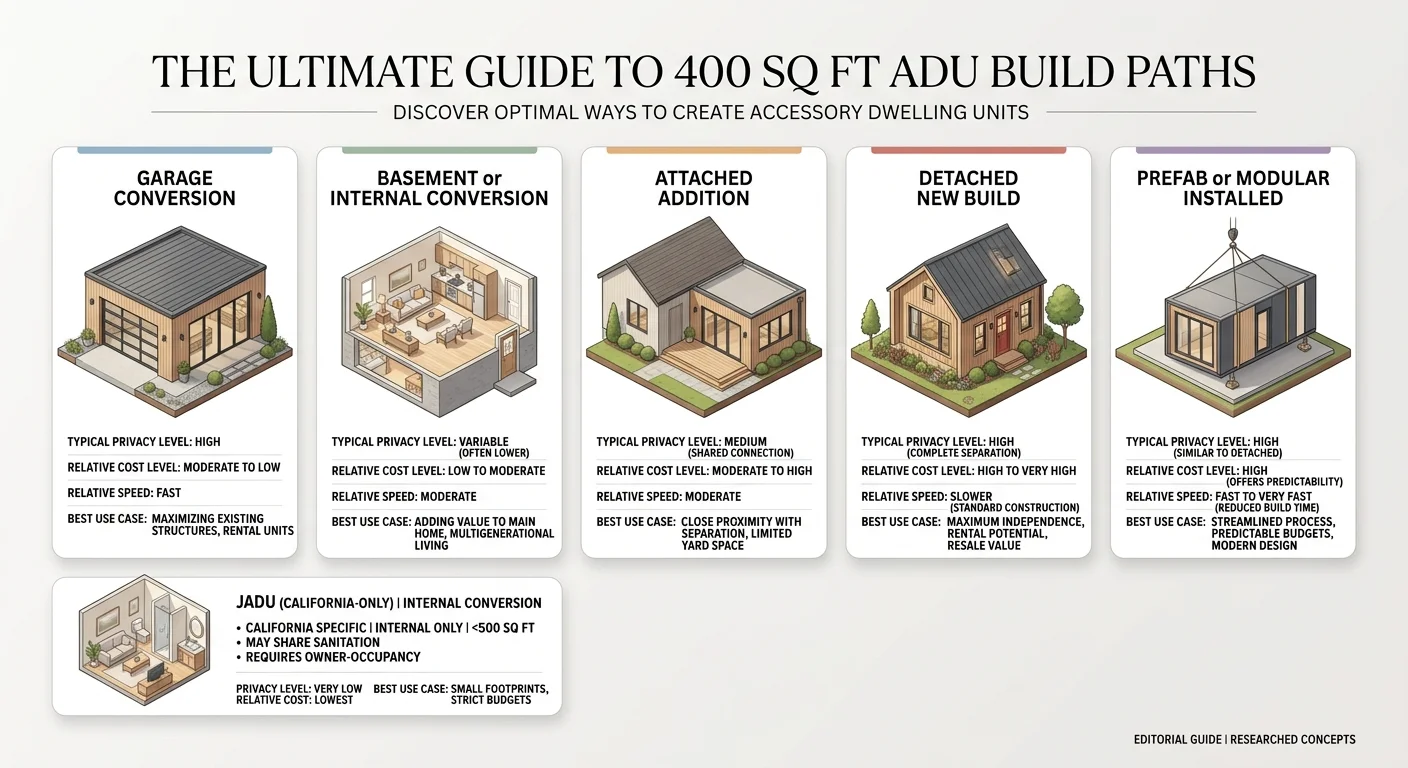
The five main 400 sq ft ADU build paths — compared by privacy, cost, speed, and best use case. The right path depends on what you have to work with and what you're optimizing for.
| Factor | Garage Conversion | Detached New Build |
|---|---|---|
| Typical all-in cost | $80,000 – $150,000 | $150,000 – $250,000+ |
| Timeline | 3 – 6 months | 6 – 12 months |
| Design flexibility | Limited by existing footprint | Full control |
| Privacy | Depends on garage location | Maximum — separate structure |
| Rental income potential | Good for long-term rental | Best for premium rental |
| Property value impact | Moderate increase | Strongest value add |
| Biggest risk | Foundation quality, parking loss | Utility costs, permit timeline |
| Best fit | Budget-first, have unused garage | Income-first, have lot space and budget |
The savings come from reusing the existing foundation, walls, and roof. You'll add insulation, drywall, flooring, a kitchen, a bathroom, windows, and HVAC — but you skip pouring a foundation, framing an entire structure, and running long utility lines from scratch.
The honest tradeoff: You lose your garage. In areas where covered parking is highly valued, some homeowners add a carport to offset the loss. In dense urban areas where parking is already street-level, the trade is straightforward — you're swapping a storage room for a livable income-producing unit.
When detached wins: If rental income is the primary goal, if you want the unit to feel like a completely separate home, or if you're in a market where detached ADUs command premium rents, the higher upfront cost typically pays back faster through better cash flow and stronger property appreciation.
Check whether your property supports a garage conversion — setbacks, parking rules, and structural requirements vary by city.
Free ADU report — zoning, setbacks, and build options for your specific property.
Check My Property →Available in CA, UT, TX, CO, and NY.
What does a 400 sq ft ADU cost in your state?
“National average” is a useful starting point and a terrible planning number. A detached ADU that costs $140K in Nashville might cost $260K+ in San Diego — driven by labor rates, permit fees, material costs, and regulatory complexity.
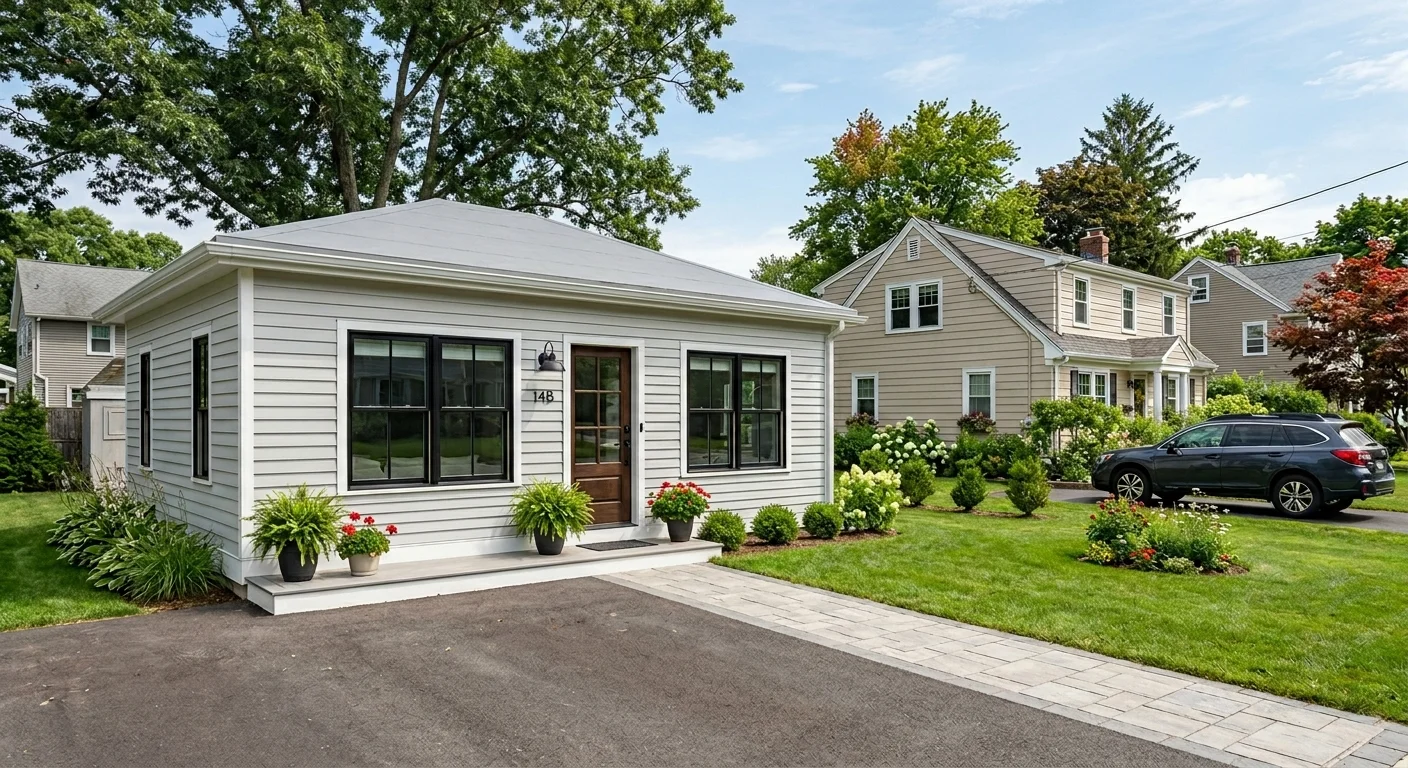
A traditional-style 400 sq ft detached ADU — white Hardie board, black windows, clean landscaping. This style and finish level typically lands in the $100K–$175K range in Midwest or Northeast markets.
| Region / Market | Garage Conversion | Detached New Build | Prefab (Installed) | Key Cost Driver |
|---|---|---|---|---|
| Coastal California (LA, SF, SD) | $120K – $180K | $180K – $280K+ | $140K – $220K | Highest labor + permits, Title 24, seismic |
| Pacific Northwest (Portland, Seattle) | $100K – $160K | $150K – $240K | $120K – $200K | High labor, system development charges |
| Northeast (Boston, NYC metro, NJ, CT) | $110K – $170K | $160K – $260K | $130K – $210K | High labor, older infrastructure, variable permits |
| Mountain West (Denver, SLC, Boise, Phoenix) | $80K – $130K | $120K – $200K | $100K – $170K | Moderate labor, growing ADU adoption |
| Midwest (Chicago, Minneapolis, Columbus, KC) | $70K – $120K | $100K – $180K | $85K – $150K | Lower labor costs, fewer ADU-specific regulations |
| Southeast (Atlanta, Nashville, Charlotte, Raleigh) | $65K – $110K | $90K – $170K | $80K – $145K | Lowest labor, simpler permitting (generally) |
| Texas metros (Austin, Dallas, Houston, SA) | $75K – $125K | $100K – $185K | $85K – $155K | Moderate costs, rapidly evolving ADU regulations |
Regional ranges based on aggregated contractor data, published local fee schedules, and industry cost databases. Ranges reflect standard finishes in 2026; high-end finishes or complex site conditions can push costs above these ranges. Verified April 2026.
See full ADU rules by state — all 50 states with official sources →
Can you actually build a 400 sq ft ADU for under $100,000?
Sometimes, yes — but treat it as a best-case scenario to verify, not the baseline assumption.
Under $100K is realistic when:
- ✓You're converting an existing garage or basement in a moderate-cost market
- ✓The existing structure is in good shape (sound foundation, decent framing)
- ✓Your utility connections are short runs from existing mains
- ✓You choose mid-range or basic finishes
- ✓Your city's permit fees are reasonable (under $5K)
- ✓You don't hit major surprises (sewer, soil, structural)
Under $100K is unlikely when:
- ✗You're building detached new construction (in almost any market)
- ✗You're in a high-cost metro (coastal CA, NYC, Boston, Seattle)
- ✗Your lot has slope, poor soil, or long utility runs
- ✗You want premium finishes
- ✗Your city charges high permit, impact, or connection fees
Three Worked Budget Scenarios
These are planning illustrations — not quotes. Your actual costs depend on your property, local regulations, and builder pricing. Get at least three bids from ADU-experienced contractors in your area.
Scenario 1: Budget Garage Conversion — Moderate-Cost Market
e.g., Nashville, Phoenix — sound existing structure, standard finishes
| Design & engineering | $4,500 |
| Permits & fees | $3,000 |
| Interior demo & prep | $3,500 |
| Insulation, drywall, flooring | $9,000 |
| Kitchen build-out | $12,000 |
| Bathroom build-out | $8,000 |
| Electrical & lighting | $6,000 |
| Plumbing | $7,000 |
| HVAC (mini-split) | $5,000 |
| Utility hookups | $6,000 |
| Windows, doors, exterior | $5,000 |
| Contingency (12%) | $8,300 |
| Total (all-in) | ~$87,300 |
Scenario 2: Typical Detached New Build — Mid-Cost Market
e.g., Denver, Portland — semi-custom design, standard finishes
| Design & architecture | $10,000 |
| Engineering | $5,000 |
| Permits & fees | $6,000 |
| Site prep & grading | $5,000 |
| Foundation (slab) | $12,000 |
| Framing & roofing | $25,000 |
| Electrical | $8,000 |
| Plumbing | $12,000 |
| HVAC | $6,000 |
| Insulation & drywall | $7,000 |
| Kitchen | $15,000 |
| Bathroom | $10,000 |
| Interior finishes | $12,000 |
| Utility hookups | $12,000 |
| Contingency (12%) | $17,000 |
| Total (all-in) | ~$162,000 |
Scenario 3: High-Cost Detached Build — Coastal California
e.g., Los Angeles, San Diego — custom plan, Title 24, solar, complex site
| Design & architecture | $14,000 |
| Engineering (structural + Title 24) | $7,000 |
| Permits & fees | $12,000 |
| Site prep & grading | $8,000 |
| Foundation | $16,000 |
| Framing & roofing | $32,000 |
| Electrical | $10,000 |
| Plumbing | $16,000 |
| HVAC | $7,000 |
| Insulation & drywall | $9,000 |
| Kitchen | $20,000 |
| Bathroom | $13,000 |
| Interior finishes | $18,000 |
| Utility hookups | $20,000 |
| Solar (CA requirement for new construction) | $4,000 |
| Contingency (12%) | $25,000 |
| Total (all-in) | ~$231,000 |
Figuring out how to pay for this? See how homeowners typically finance ADU projects.
Free ADU report — zoning, setbacks, and build options for your specific property.
Check My Property →Available in CA, UT, TX, CO, and NY.
Is 400 sq ft actually big enough?
Short answer: yes — if the layout is smart. 400 sq ft is roughly the size of a standard two-car garage, and it's comparable to a studio apartment in most major cities. Thousands of people live comfortably in this footprint.
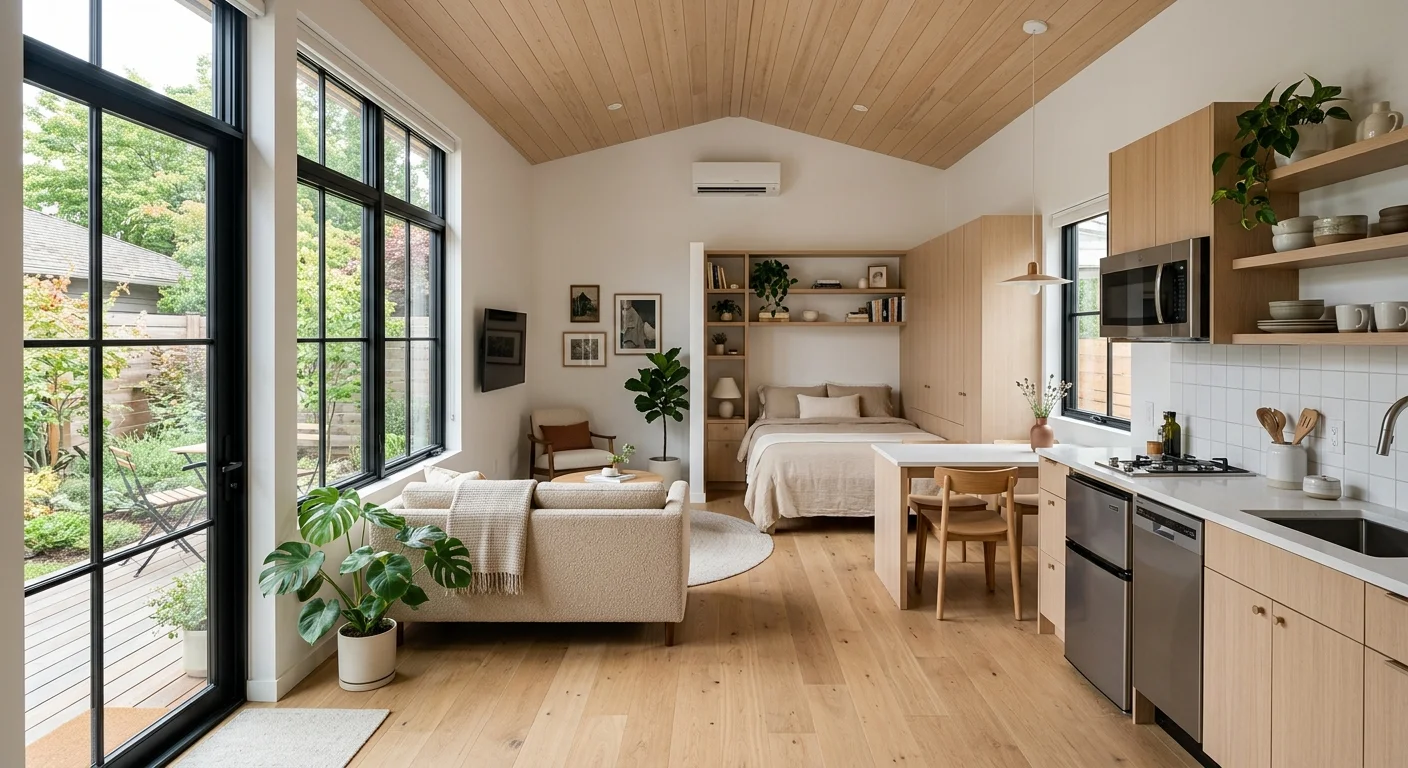
Interior of a well-designed 400 sq ft ADU — vaulted ceiling, floor-to-ceiling windows, full kitchen, and defined sleeping zone. Layout intelligence matters more than square footage when you're building at this size.
Combined living/sleeping area (~250 sq ft), galley or L-shaped kitchen (~60 sq ft), full bathroom (~50 sq ft), entry/utility/closet (~40 sq ft). This feels the most spacious and is the most popular layout for rental ADUs.
Separate bedroom (~110 sq ft for a queen bed), living/kitchen area (~200 sq ft), full bathroom (~50 sq ft), closet and utility space (~40 sq ft). Tighter, but fully functional.
Technically possible with two ~70 sq ft bedrooms, but the living area shrinks to the point where it's impractical for most use cases. Generally not recommended at this size.
Design moves that make 400 sq ft feel bigger
9-to-10-foot ceilings
Large windows or sliding glass doors
Open shelving instead of upper cabinets
Pocket doors instead of swing doors
Built-in storage
Light color palettes
Multifunctional furniture
Will a 400 sq ft ADU pay for itself?
For most homeowners who build in a reasonable rental market, yes — through some combination of rental income, property value, and family flexibility. The timeline depends on what you spent to build it and what rents look like in your area.
Rental income potential by region
| Region | Monthly Rent (400 sq ft, long-term) | Annual Gross |
|---|---|---|
| Coastal CA | $1,500 – $2,500 | $18,000 – $30,000 |
| Pacific NW | $1,200 – $2,000 | $14,400 – $24,000 |
| Northeast metros | $1,300 – $2,200 | $15,600 – $26,400 |
| Mountain West | $1,000 – $1,800 | $12,000 – $21,600 |
| Midwest | $800 – $1,400 | $9,600 – $16,800 |
| Southeast | $800 – $1,500 | $9,600 – $18,000 |
Rent ranges based on comparable studio/1BR rental listings in each market. Actual rents depend on condition, location, and local demand. Verified April 2026.
Simple payback math
Detached build example
A $150K detached ADU generating $1,400/month = $16,800/year gross. After property management, maintenance, insurance, and vacancy (~25% of gross for conservative planning), net annual income is roughly $12,600. Simple payback: about 12 years — plus equity from day one.
Garage conversion example
A $90K garage conversion generating $1,200/month = $14,400/year gross, ~$10,800 net. Simple payback: about 8 years — plus the immediate equity bump.
Property value impact
Value impact is real, but the exact lift is market-specific. In a January 2025 FHFA analysis of California appraisal data, properties with ADUs showed stronger median appraised-value growth than similar properties without ADUs between 2013 and 2023 (FHFA, “Trends in Median Appraised Value for Properties with ADUs in California,” January 2025). Freddie Mac's lending guidelines also recognize that ADUs positively contribute to property valuations.
Beyond rental income
Not every ADU is a rental play. If your ADU houses an aging parent who would otherwise need assisted living ($3,000–$8,000/month in most markets), the financial value is enormous. If it houses an adult child who can save for a down payment instead of paying rent elsewhere, the family return is real even if no rent changes hands.
How do homeowners actually pay for a 400 sq ft ADU?
Most homeowners don't write a check for $150K. They finance the project — and the landscape for ADU financing has improved significantly. Fannie Mae, Freddie Mac, and FHA/HUD all now recognize ADUs in their underwriting guidelines, which has opened up options that didn't exist five years ago.
| Financing Path | Best For | How It Works | Key Consideration |
|---|---|---|---|
| HELOC | Homeowners with significant equity | Draw against home equity as construction progresses | Variable rate; requires existing equity |
| Cash-out refinance | Owners who can improve their rate or consolidate | Replace current mortgage with larger one, pocket the difference | Restarts mortgage term; run the numbers carefully |
| Construction loan | Detached new builds with approved plans | Short-term loan converts to permanent mortgage after build | More documentation; requires approved plans and builder |
| ADU-specific loan | Owners whose current equity is limited | Based on projected after-renovation value, not just current equity | Newer products; availability varies by lender and state |
| Renovation loan | Combined ADU + home improvement projects | Rolls ADU cost into mortgage based on improved value | Works well with established lender programs |
| Cash / staged build | Homeowners who want to avoid debt | Pay as you go | Ties up liquid capital; may slow timeline |
Ready to explore your options? See a full comparison of HELOC, construction loan, cash-out refi, and ADU-specific products — explore ADU financing options →
Can your property actually support a 400 sq ft ADU?
Good budget math doesn't matter if your lot, zoning, or utility situation blocks the project. Before you invest serious time in planning, run through these questions.
Quick eligibility check
| Question | What You're Looking For | Where to Check |
|---|---|---|
| Does your zoning allow ADUs? | Most residential zones do after recent state-level reforms, but some don't | City planning/zoning department or online zoning map |
| Do you have enough buildable space? | 400 sq ft plus required setbacks (typically 4 ft from side/rear lines) | Property survey + local ADU ordinance |
| Is there existing space to convert? | Garage, basement, or attached space ≈ 400 sq ft | Measure your existing structure |
| Can utilities reach the ADU site? | Water, sewer, and electrical within reasonable distance | Utility company site visit or estimate |
| Are you on sewer or septic? | Septic may require capacity assessment or upgrade | County health department |
| Does an HOA restrict ADUs? | Some HOAs still restrict; state laws increasingly override this | HOA CC&Rs + state ADU preemption law |
| Is owner-occupancy required? | Many jurisdictions require the owner to live on the property | Local ADU ordinance |
| Are short-term rentals allowed? | If Airbnb is the goal, check local STR rules separately | City short-term rental ordinance |
This is where most homeowners start. Our free ADU feasibility report checks zoning, setbacks, and build options for your specific address.
Zoning, setbacks, and build options for your address — free, takes about 60 seconds. Detailed reports available in CA, UT, TX, CO, and NY.
See What You Can Build → Get Your Free ADU ReportHow long does a 400 sq ft ADU take to permit and build?
Small ADUs don't skip steps. They move through the same design, plan review, inspection, and certificate-of-occupancy process as larger builds. But they do generally move faster at each stage.
| Phase | Garage Conversion | Detached New Build | Prefab / Modular |
|---|---|---|---|
| Design & engineering | 2 – 4 weeks | 4 – 8 weeks | 1 – 3 weeks (often pre-designed) |
| Plan review & permits | 3 – 8 weeks | 4 – 12 weeks | 3 – 8 weeks |
| Construction | 6 – 12 weeks | 12 – 28 weeks | 8 – 16 weeks (includes factory + install) |
| Final inspections & CO | 1 – 3 weeks | 2 – 4 weeks | 1 – 3 weeks |
| Total | 3 – 6 months | 6 – 12 months | 4 – 7 months |
Timeline ranges based on typical project data across multiple cities. Your specific timeline depends on local plan-review backlogs, weather, and project complexity.
7 ways to reduce your 400 sq ft ADU cost
Practical moves with real impact — not generic “plan ahead” advice.
Convert instead of building new
If you have a usable garage, basement, or attached space, reusing existing structure eliminates the most expensive line items: foundation, framing, roofing. This is consistently the single biggest cost lever.
Use a simple rectangular footprint
Every corner, angle, and bump-out adds framing, roofing, and foundation complexity. A clean rectangle is the most cost-efficient shape for any ADU.
Choose mid-range finishes
Premium finishes (quartz counters, hardwood floors, custom cabinets) look great but don't meaningfully increase rental income in most markets. Mid-range materials (LVP flooring, quartz-look laminate, stock cabinets) are durable, attractive, and meaningfully cheaper.
Use a pre-approved plan where available
Cities with pre-approved ADU plans streamline both design costs and permitting timelines. Check whether your city offers them before commissioning custom architecture.
Get 3+ bids from ADU-experienced contractors
Contractors who specialize in ADUs know the local permitting process, common cost traps, and efficient construction sequencing. A general contractor without ADU experience often costs more in delays and avoidable mistakes.
Install a mini-split instead of ducted HVAC
At 400 sq ft, a ductless mini-split system is more efficient, easier to install, and cheaper than extending or installing ducted heating and cooling. It's the standard choice for ADUs this size.
Time your build for the off-season
In most markets, late fall through early spring is slower for residential construction. Builders are more available and may offer more competitive pricing.
Should you build 400 sq ft — or go bigger?
Let's close the loop on the sizing question.
| Factor | Stay at 400 Sq Ft | Consider 600–800 Sq Ft |
|---|---|---|
| Total project cost | Lower total spend | Higher total, but lower cost per sq ft |
| Monthly rent potential | Studio/1BR rents ($800–$2,200) | 1BR–2BR rents, often meaningfully higher |
| Layout options | Studio or tight 1BR | Comfortable 1BR or spacious 2BR |
| Lot requirements | Fits tighter lots, easier setbacks | May push against lot coverage limits |
| Resale value add | Meaningful | Typically stronger |
| Best use case | Guest suite, compact rental, home office, aging parent | Full rental unit, multigenerational living, long-term family use |
If you're building detached new construction and your lot allows more, at least run the numbers on 600 sq ft before committing. The marginal cost of additional square footage is low once you've paid for the expensive fixed infrastructure — and the income and value gains often more than offset the additional investment.
How we estimated these costs
We believe cost pages should show their work.
Sources used: Aggregated contractor bid data and completed project costs from multiple states and metros; city and county building department fee schedules (verified individually, dates noted where cited); California HCD ADU Handbook (January 2025, with 2026 addendum); Portland Bureau of Development Services ADU fee pages and SDC waiver program documentation; Seattle SDCI ADU permitting guidelines and standard-plan program; Fannie Mae, Freddie Mac, and HUD/FHA ADU underwriting guidelines; FHFA January 2025 California ADU appraisal analysis; industry cost databases and published ADU project studies; Realm's 400 sq ft ADU data (91 closed projects, reported March 2026).
What “all-in” includes on this page: design, engineering, permits, site prep, foundation, construction (framing, roofing, MEP, finishes), utility hookups, and 10–15% contingency.
What “all-in” excludes: landscaping, fencing, furniture, major infrastructure upgrades (full sewer lateral replacement, full panel replacement), and any costs noted as “additional” in the hidden costs section.
How regional adjustments work: We benchmark national cost data against regional labor rate indices, published local permit/fee schedules, and documented project costs in specific metros. Ranges reflect the spread between standard and complex conditions within each region.
How to use this page alongside real quotes: This page gives you the planning range and budget architecture. Real quotes from local builders give you the specific number. If a quote falls well outside these ranges — especially on the low side — use the budget breakdown and hidden costs sections to identify what might be excluded.
How often this page is updated: Cost data is reviewed and verified quarterly. If a significant cost shift occurs between reviews, we update the affected sections and note the change.
Full methodology → · Editorial standards → · Corrections policy →
Frequently asked questions
How much does a 400 sq ft ADU cost all-in?
$80,000–$250,000+, depending on build path (garage conversion vs. detached new construction), region, finish level, and site conditions. The build path is the biggest single cost variable.
What is the cheapest 400 sq ft ADU to build?
A garage or basement conversion in a moderate-cost market with standard finishes. These typically cost $60,000–$150,000 all-in. In California, a JADU (Junior ADU) under 500 sq ft is often the cheapest path at $40,000–$90,000.
Is a garage conversion cheaper than a detached ADU?
Almost always, yes — typically by $40,000–$100,000+ for the same size. You skip foundation, framing, and roofing costs by reusing the existing structure.
Why is a small ADU so expensive per square foot?
Fixed costs — kitchen, bathroom, permits, design, utility hookups — cost roughly the same regardless of ADU size. At 400 sq ft, those costs get spread across fewer square feet, pushing the per-sq-ft number higher.
Can I build a 400 sq ft ADU for under $100,000?
Yes, in some cases — primarily garage or basement conversions in moderate-cost markets with standard finishes. For detached new construction, under $100K is unlikely in most markets in 2026.
Is 400 sq ft enough for a one-bedroom ADU?
Yes. A 400 sq ft one-bedroom includes a separate bedroom (~110 sq ft), living/kitchen area (~200 sq ft), full bathroom (~50 sq ft), and closet/utility space. It's compact but fully functional.
How much do permits cost for a 400 sq ft ADU?
$2,000–$15,000, varying dramatically by city. Some California cities charge $10,000+ in combined permits and plan-review fees. Smaller cities and non-California markets are often $2,000–$5,000.
Do ADUs under 750 sq ft avoid impact fees?
In California, yes — local impact fees generally cannot be charged on ADUs under 750 sq ft per Gov. Code § 66324(c)(1). Other states have varying rules; verify with your local building department.
How long does a 400 sq ft ADU take to build?
3–6 months for a garage conversion, 6–12 months for detached new construction, 4–7 months for prefab. Permitting is typically the biggest timeline variable.
Will a 400 sq ft ADU increase my property value?
Yes. FHFA research (January 2025) found California properties with ADUs showed stronger appraised-value growth than comparable properties without them. Both Fannie Mae and Freddie Mac recognize ADUs in property valuations.
How much rent can a 400 sq ft ADU generate?
$800–$2,500/month depending on your market. Coastal California and Northeast metros command the highest rents. Midwest and Southeast markets are lower but often have lower build costs, so the payback math can still work well.
Is a prefab ADU cheaper for 400 sq ft?
The unit itself is often cheaper ($40,000–$80,000 for 400 sq ft), but the all-in installed cost — including foundation, utility hookups, site prep, delivery, and permits — is typically $90,000–$200,000. Compare all-in costs, not sticker prices.
Can I use a 400 sq ft ADU for my aging parents?
This is one of the most common use cases. Consider adding accessibility features (wider doorways, roll-in shower, no-step entry, grab bars) during construction — they're straightforward to include at the build stage.
Can I Airbnb a 400 sq ft ADU?
Depends on your city's short-term rental regulations. Many cities restrict or require permits for STRs. Check your local short-term rental ordinance separately from ADU zoning rules — they're different regulatory frameworks.
What financing options exist for ADU construction?
HELOC, cash-out refinance, construction loans, ADU-specific loan products, renovation loans, and cash. Fannie Mae, Freddie Mac, and FHA all now recognize ADUs in their underwriting guidelines, expanding the options available to homeowners.
What are the red flags on a low ADU quote?
Ask whether the quote includes: design/engineering fees, permits, utility hookups, site prep, and contingency. If any of those are excluded, the real all-in cost is likely significantly higher than the quoted number.
Should I build 400 sq ft or go bigger?
If you're converting an existing structure, 400 sq ft is great. If you're building detached new construction and your lot allows more, run the numbers on 600 sq ft — the marginal cost is low and the income and value gains are often significant.
Your next step
You now know more about 400 sq ft ADU costs than most homeowners who start this process. The one thing this page can't tell you is what's possible at your specific address — your zoning, your setbacks, your lot, your utility situation. That's the piece that turns general knowledge into an actual plan.
Check What You Can Build → Get Your Free ADU ReportCA, UT, TX, CO, and NY · More states coming soon
Free Resource
Free 2026 ADU Starter Kit
Cost worksheets, permit checklists, builder interview questions, and a financing comparison guide — everything in one place. Delivered to your inbox, no spam.
Get the Free 2026 ADU Starter Kit →The fastest way to know what's possible:
Not sure where to start? See what's possible at your address — get your free ADU feasibility report.
Free report · 60 seconds · No sales call · No commitment
Get Your Free ADU Feasibility Report →CA, UT, TX, CO, and NY · More states coming soon
Related ADU guides
- →How Much Does an ADU Cost? All Types, All Sizes (2026)
- →300 Sq Ft ADU Cost: Real Prices by Type & Hidden Fees (2026)
- →Garage Conversion ADU Cost: Real 2026 Prices & Hidden Fees
- →ADU Financing Options 2026: HELOC vs Refi vs Renovation Loan
- →ADU Rental Income: How Much Can You Actually Make? (2026)
- →ADU for Airbnb: Legality, Income & Design Guide (2026)
- →ADU Laws by State: All 50 States & Official Sources (2026)
- →California ADU Laws 2026: Rules, Setbacks, Fees & Permits
By The Dwelling Index Editorial Team · Last verified: April 2026
Cost data is reviewed and updated quarterly. Sources cited: 12+. Content is for informational purposes only and does not constitute financial, legal, tax, construction, or lending advice. Verify all information with qualified local professionals before making decisions.
Editorial standards · Methodology · Corrections · Contact our research team · Terms · Privacy · Affiliate disclosure