
Updated March 31, 2026 · Vendor prices last checked March 31, 2026 · See source notes below
2 Bedroom Prefab ADU: Real Costs, Best Models, and What Actually Fits Your Lot
A 2 bedroom prefab ADU rarely costs just the advertised starting price. Current builder-published two-bedroom models start from $190,000 plus installation (Samara) up to $426,800 (Abodu Two+) — and real project totals climb from there once site work, permitting, taxes, delivery, and utility connections are added. Foundation alone runs $15,000–$40,000. Utility hookups can add another $10,000–$40,000. Nobody puts that in the headline.
Here’s what the sticker price doesn’t show you: most 2-bedroom prefab models range from 610 to 950+ square feet, need anywhere from 35 to 64 feet of clear yard space depending on the model, and take 5–10 months from contract to move-in. Prefab isn’t automatically cheaper than site-built — but it is faster, more predictable, and causes far less disruption to your daily life. Whether it’s the right path depends on your lot, your budget, and what you need the space for.
We built this page to be the last one you need to read. Below you’ll find a side-by-side comparison of live 2-bedroom prefab models with verified pricing, real cost breakdowns with nothing hidden, lot-fit requirements most companies don’t publish clearly, and an honest look at when prefab is the wrong call.
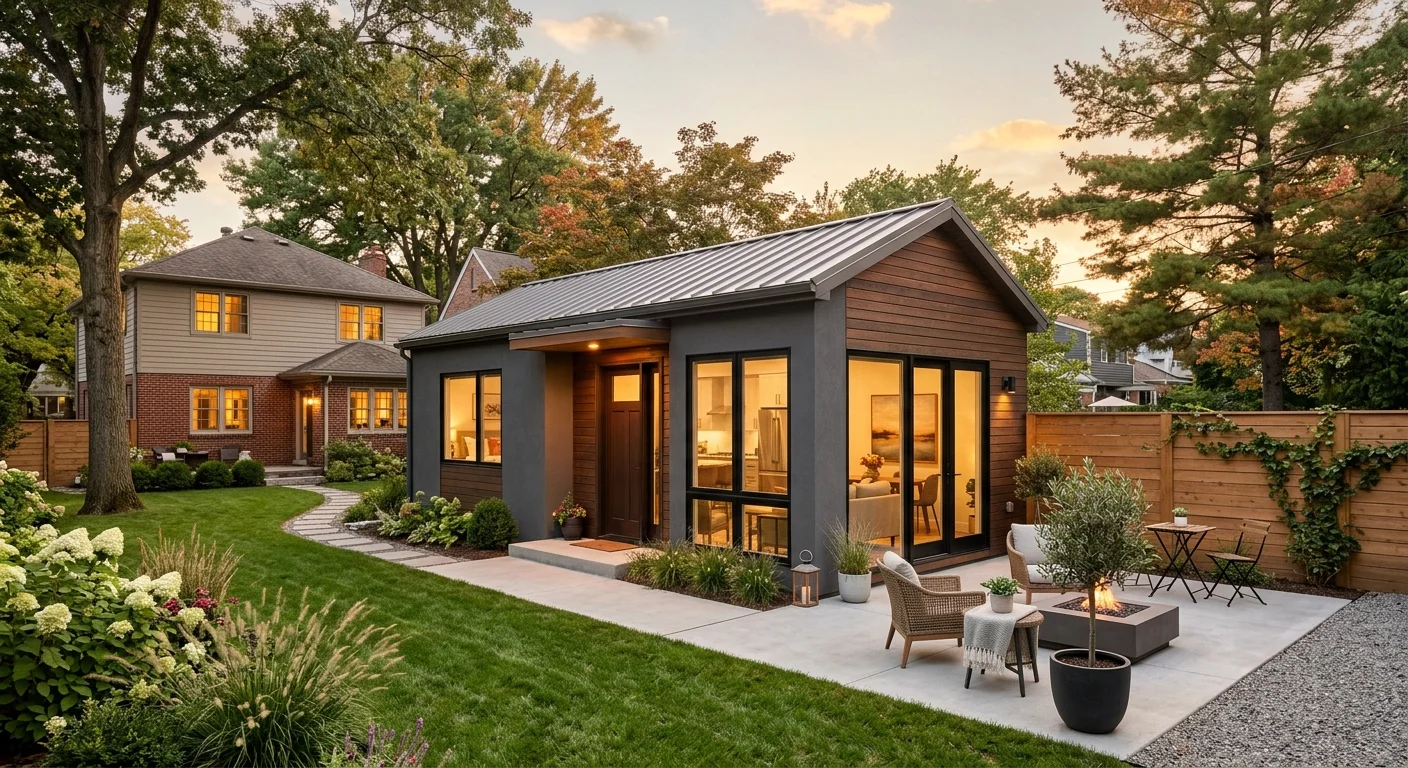
2 Bedroom Prefab ADU Models at a Glance
Here’s a snapshot of every 2-bedroom prefab ADU model we could verify as actively available in 2026. The “installed-cost signal” column reflects what homeowners can expect to pay after foundation, site work, delivery, utilities, permits, and taxes — not just the unit price. How we estimated these numbers →
| Model | Sq Ft | Beds/Baths | Published Starting Price | Installed-Cost Signal | Yard Space Needed | Best For | Main Catch |
|---|---|---|---|---|---|---|---|
| Abodu Two | 610 | 2/1 | $360,800 (avg. $392,500) | ~$410,000–$450,000 | 51'8" × 26'7" | Speed + turnkey experience | CA only; compact layout |
| Abodu Two+ | 800 | 2/2 | $426,800 (avg. $478,800) | ~$480,000–$550,000 | 35'6" × 43'0" | Premium 2/2 on accessible lot | CA only; premium tier |
| Samara Two Bedroom | 690 | 2/1 | $190,000 + installation | ~$300,000–$380,000 | 57' × 25' | Design-forward; solar included | CA only; install cost varies |
| Samara XL 8 | 800 | 2/2 | $249,000 + installation | ~$350,000–$430,000 | 35' × 42' | Full 2/2 with en suite primary | CA only; newer model |
| Samara XL 10 | 950 | 2/2 | $277,000 + installation | ~$400,000–$480,000 | 35' × 48' | Maximum space + premium finishes | CA only; largest footprint |
| ELMNTL Shelter 2BR | 714 | 2/1 | $349,000 (example installed: $449,000+) | ~$449,000–$500,000 | 14' × 51' unit footprint | Sustainable materials; ships nationally | CO-based; local GC needed |
| Villa Homes (2BR models) | 450–1,200 | 2/1 or 2/2 | Contact for current pricing | ~$250,000–$360,000+ | Varies by model | Broadest selection of layouts | CA + CO; site costs vary |
| Studio Home (Summit 1000) | 1,000 | 2/2 | $191,523 (shell: $93,581) | ~$300,000–$400,000 | Varies | Full-service from design to install | Ships from CO; timelines vary |
| LiveLarge L-750 | 750 | 2/2 | $245,000 + installation | ~$300,000–$380,000 | 63'10" × 24' | Triple-pane windows; efficient | CA only |
| LiveLarge L-800 | 800 | 2/2 | $265,000 + installation | ~$320,000–$400,000 | Varies by model | L-shaped with cathedral ceiling | CA only |
| LiveLarge L-1190 | 1,190 | 2/2 + office | $355,000 + installation | ~$420,000–$500,000 | Varies by model | Maximum space per dollar | CA only |
Prices verified against manufacturer websites as of March 31, 2026. Abodu average prices include typical upgrades ($39,700) and taxes/permit fees ($17,000 avg.) as disclosed on their pricing page. Samara and LiveLarge prices exclude installation; installed-cost signal includes our editorial estimate for site work, foundation, delivery, and permitting. See methodology for details.
Notice the pattern?
Published starting prices range from $190,000 to $427,000. But installed costs cluster between $250,000 and $550,000. That gap is the entire story of prefab ADU pricing — and it’s what we’ll unpack next.
How Much Does a 2 Bedroom Prefab ADU Really Cost?
This is the question that sends most people back to search three or four times. Not because the information doesn’t exist — but because every company presents cost differently. Some quote just the unit. Some include delivery but not foundation. Some bundle permits and site work into one “installed” number. Others leave out sales tax, crane fees, and utility trenching entirely.
What “Starting At” Actually Means
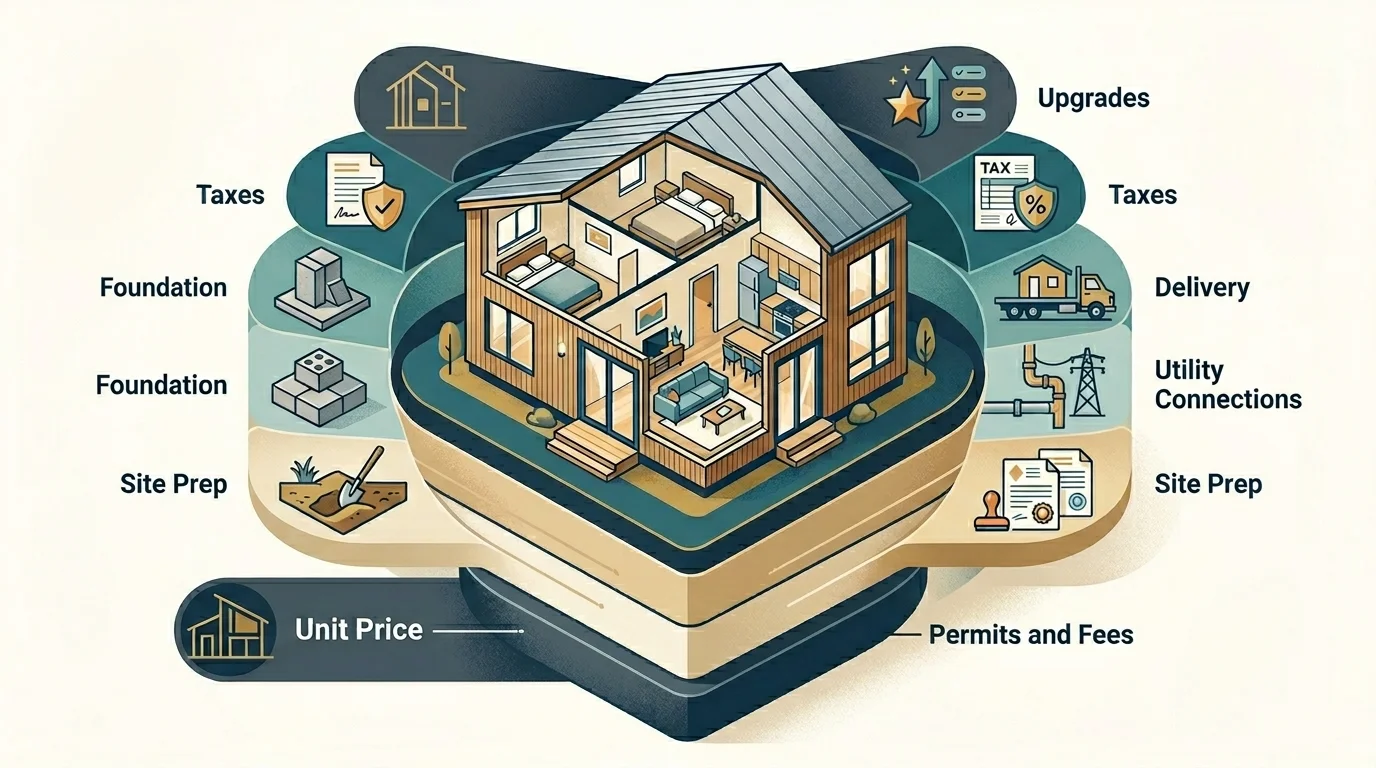
When a prefab company says their 2-bedroom model “starts at $190,000,” they’re telling you the price of the structure — the box. It includes standard finishes, appliances, and fixtures inside that box. It almost never includes:
- Foundation ($15,000–$40,000) — concrete slab, pier, or crawlspace depending on your soil and slope
- Site preparation and grading ($5,000–$30,000) — clearing, leveling, and sometimes demolishing whatever's in the way
- Delivery and transportation ($5,000–$25,000) — distance from factory to your lot, road conditions, escort vehicles
- Crane placement ($3,000–$15,000) — if there's no direct ground-level access to your backyard
- Utility connections ($10,000–$40,000) — water, sewer, electric, and gas trenching from existing lines to the ADU
- Permits and fees ($3,000–$20,000) — plan review, building permits, impact fees, school fees in some jurisdictions
- Sales tax ($8,000–$25,000) — on the unit purchase, which surprises a lot of people
- Finish upgrades ($5,000–$50,000+) — optional, but most homeowners choose at least some
Three Worked Examples From Real Builder Data
The best way to understand prefab ADU pricing is to see how published numbers translate to real project totals. These examples use data the companies themselves disclose:
Example 1: Abodu Two (610 sf, 2BR/1BA)
| Line Item | Amount | Source |
|---|---|---|
| Base unit price | $360,800 | Abodu model page, March 2026 |
| Typical upgrades + custom site work | ~$39,700 | Abodu pricing page (disclosed avg.) |
| Sales tax + permit fees | ~$17,000 | Abodu pricing page (disclosed avg.) |
| Average customer total | ~$392,500 | Abodu pricing page |
Source: abodu.com/models/abodu-two and abodu.com/pricing, verified March 31, 2026
Example 2: ELMNTL Shelter 2BR (714 sf, 2BR/1BA)
| Line Item | Amount | Source |
|---|---|---|
| Dwelling price | $349,000 | ELMNTL ADU page |
| Permitting | ~$25,000 | ELMNTL published example |
| Site work | ~$75,000 | ELMNTL published example |
| Example total (before tax) | $449,000+ | ELMNTL ADU page |
Source: elmntl.io/adu, verified March 31, 2026
Example 3: Samara XL 8 (800 sf, 2BR/2BA)
| Line Item | Amount | Source |
|---|---|---|
| Published unit price | $249,000 | Samara XL 8 page |
| Installation (site work, foundation, delivery, utilities, permits) | Varies by site | Quoted after site assessment |
| Estimated installed total | $350,000–$430,000 | Editorial estimate based on typical CA site costs |
Source: samara.com/backyard/xl-8, verified March 31, 2026
The single most important concept in prefab ADU shopping:
The published starting price tells you where the conversation begins, not where it ends. Every builder structures their pricing differently. The only number that matters is the one on the final contract after your site has been assessed.
The Honest Truth About Prefab Pricing
Once you factor in foundation, delivery, site work, and utility connections, the total installed cost of a prefab ADU is often comparable to a site-built ADU of similar size and finish quality. We’re not saying prefab is a bad deal. We’re saying cost savings alone isn’t usually the reason to go prefab. The real advantages are different — and they’re significant:
- Timeline: 5–10 months vs. 10–16 months for a typical custom build
- Predictability: Fewer surprise change orders when the unit is factory-built to spec
- Disruption: Weeks of on-site work instead of months of construction crews, noise, and dust
- Scope clarity: You know what you're getting before you commit
For many homeowners, those benefits are worth just as much as a cost discount. But if someone tells you prefab will save you 30% — ask them exactly what’s excluded from that number.
Feeling clearer about the budget picture?
The next question is whether a 2-bedroom prefab will physically fit where you need it. Start with your free property report — we’ll check your address against local rules in 60 seconds.
See What You Can Build at Your Address →Free ADU Opportunity Report — no sales call, no commitment.
Will a 2 Bedroom Prefab ADU Fit on Your Lot?
This is the question that kills more prefab projects than cost does — and the one most shoppers don’t think about early enough. A prefab ADU isn’t just a floor plan. It’s a physical object that arrives on the back of a truck, sometimes gets lowered by crane, and has to sit within your city’s setback requirements while still leaving enough room for utility trenching and access.
Building Footprint vs. Yard Space: The Number Most Shoppers Miss
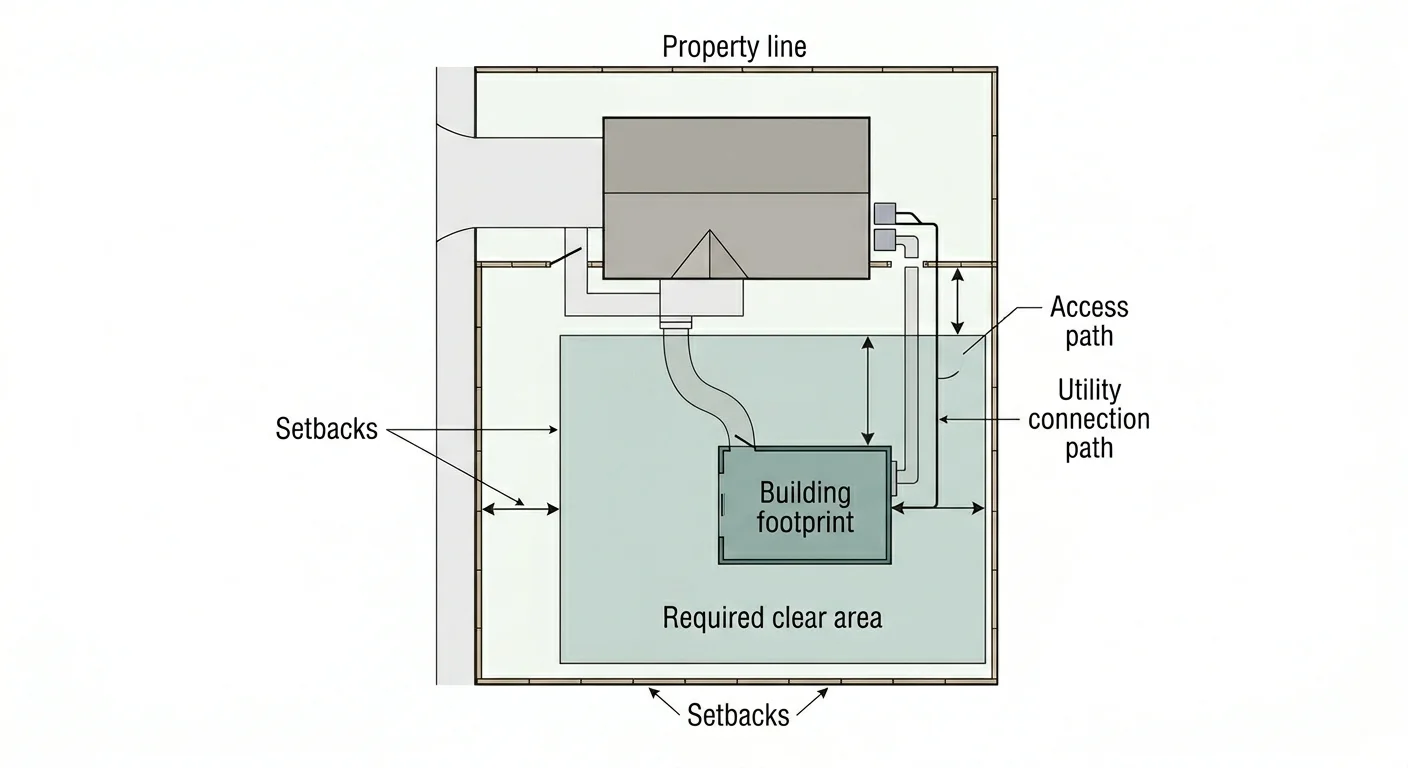
Every prefab unit has two measurements that matter:
- Building dimensions — the actual width and depth of the structure
- Required yard space — the total clear area needed, including room for setbacks, utility access, crane radius, and installation clearance
These are never the same number. Abodu publishes this clearly: their Two model measures 43’8” × 14’7” as a building, but requires 51’8” × 26’7” of clear yard space — nearly 40% more area than the unit footprint alone. (Source: Abodu FAQ, verified March 31, 2026)
Samara’s 690 sq ft Two Bedroom needs approximately 57’ × 25’ of yard space. Their XL 8 requires 35’ × 42’, and the XL 10 requires 35’ × 48’. LiveLarge’s L-750 needs 63’10” × 24’ — a long, narrow footprint that works on specific lot shapes but not others. (Sources: Samara and LiveLarge product pages, verified March 31, 2026)
Lot-Fit Quick Reference
| Model | Building Dimensions | Minimum Yard Space | Best Lot Type | Red-Flag Lot |
|---|---|---|---|---|
| Abodu Two (610 sf) | 43'8" × 14'7" | 51'8" × 26'7" | Flat suburban, wide backyard | Narrow urban, no side access |
| Abodu Two+ (800 sf) | 27'6" × 29' | 35'6" × 43'0" | Deep lot with straight access | Shallow lot, tight alley |
| Samara Two Bedroom (690 sf) | ~50' × 14' | 57' × 25' | Wide, flat, open backyard | Steep slope, tight quarters |
| Samara XL 8 (800 sf) | 25' × 32' | 35' × 42' | Moderate-depth suburban lot | Narrow urban lot |
| Samara XL 10 (950 sf) | 25' × 38' | 35' × 48' | Large suburban lot | Any constrained lot |
| ELMNTL Shelter 2BR (714 sf) | 14' × 51' | Site-specific assessment | Accessible suburban/rural | Narrow city lot, alley-only |
| LiveLarge L-750 (750 sf) | 53'10" × 14' | 63'10" × 24' | Long, wide backyard | Short or square yards |
Sources: Abodu FAQ, Samara product pages, LiveLarge product pages, ELMNTL product page. All verified March 31, 2026.
What to Measure Before You Call Anyone
Before you request a single quote, grab a tape measure or pull up your property survey. You need to know:
- Buildable width and depth — your total yard dimensions minus required setbacks (in California, the protected detached ADU path allows 4-foot side and rear setbacks per Gov. Code §66323, but your city may have different rules)
- Access path — can a flatbed truck reach your backyard? Most trucks need at least 10–12 feet of width
- Overhead clearance — power lines, tree canopy, and neighboring structures that could block crane operation
- Slope — anything beyond a gentle grade adds cost for grading, retaining walls, and foundation engineering
- Distance from existing utilities — the farther your water, sewer, electric, and gas lines are from the ADU site, the more trenching costs
- Any easements — utility or access easements may restrict where you can build
- HOA rules — if applicable, some HOAs restrict ADUs regardless of city zoning
Does Your State and City Allow a 2 Bedroom ADU?
ADU size limits vary dramatically — not just state to state, but city to city. Before you measure your yard, confirm that your jurisdiction allows an ADU large enough for two bedrooms (most models need at least 600 square feet).
A few reference points: California mandates that cities allow detached ADUs of at least 850 square feet, or 1,000 square feet for units with more than one bedroom (Source: HCD ADU Handbook, Gov. Code §66323). Seattle allows ADUs up to 1,000 square feet for units with up to two bedrooms (Source: Seattle Ordinance 127376). Massachusetts requires cities to allow by-right ADUs up to 900 square feet or 50% of the main home’s area, whichever is smaller (Source: Affordable Homes Act, effective February 2025).
But these are state-level floors, not the whole picture. Your specific city may be more permissive — or may layer on additional restrictions around lot coverage, floor area ratio, or height. Always check with your local planning department before committing to a specific model size.
See our full state-by-state ADU law guides →
Not sure what your lot can handle?
We’ll check your address against local size limits, setbacks, and zoning rules — free, in 60 seconds.
Check My Property →Is Prefab Actually Cheaper Than Site-Built for a 2 Bedroom ADU?
This is probably the question that brought you here. We want to answer it straight, even though the answer is more nuanced than “yes, way cheaper.”
For most 2-bedroom ADUs, prefab and site-built end up in a comparable total cost range once all costs are included. But cost isn’t the only factor — and for many homeowners, it’s not even the most important one.
| Factor | Prefab ADU | Site-Built ADU |
|---|---|---|
| Timeline | 5–10 months | 10–16 months |
| Customization | Limited to preset options | Unlimited |
| On-site disruption | Minimal (weeks) | Significant (months) |
| Cost predictability | Higher (factory-controlled) | Lower (weather, labor, materials) |
| Delivery/access risk | Needs truck + crane clearance | Works on any buildable lot |
| Lot flexibility | Flat, accessible lots | Any lot, any shape |
| Permit speed | Faster with pre-approved plans | Standard review timeline |
| Appraisal treatment | Real property on permanent foundation | Real property on permanent foundation |
When Prefab Usually Wins
- ✓Flat, accessible lots with clear backyard entry and no overhead obstructions
- ✓Homeowners who value time — rental income starts months sooner, and months of crew noise don't happen
- ✓Markets with pre-approved plans — California, Colorado, and a growing list of cities
- ✓People who don't need heavy customization — standard layouts work for most 2-bedroom use cases
When Site-Built Usually Wins
- ✗Tight urban lots where crane access is limited or impossible
- ✗Steep or irregular terrain that needs custom foundation engineering
- ✗Projects requiring specific customization — unusual room layouts, matching existing architecture, or ADA-specific modifications beyond standard options
- ✗HOA environments with strict design guidelines that prefab models can't match
When a Different Path Beats Both
Sometimes the answer isn’t prefab or site-built. It’s a different approach entirely:
- Garage conversion — if you have an attached or detached garage you don't need, conversion avoids most of the foundation, delivery, and site access complications. See our garage conversion guide →
- Attached addition — if you want 2 bedrooms connected to the main house, an addition shares walls, foundation, and utilities. See our ADU vs. addition guide →
- 1-bedroom ADU — if you're stretching to fit a 2-bedroom budget and a 1BR meets 80% of your needs, you'll open up more lot options and save meaningfully on total cost. See our detached ADU floor plan guide →
What Size 2 Bedroom Prefab ADU Actually Feels Livable?
“Can you really fit two bedrooms into 600 square feet?” Short answer: technically yes. Practically, it depends on what you need those bedrooms to do.
600–700 sq ft
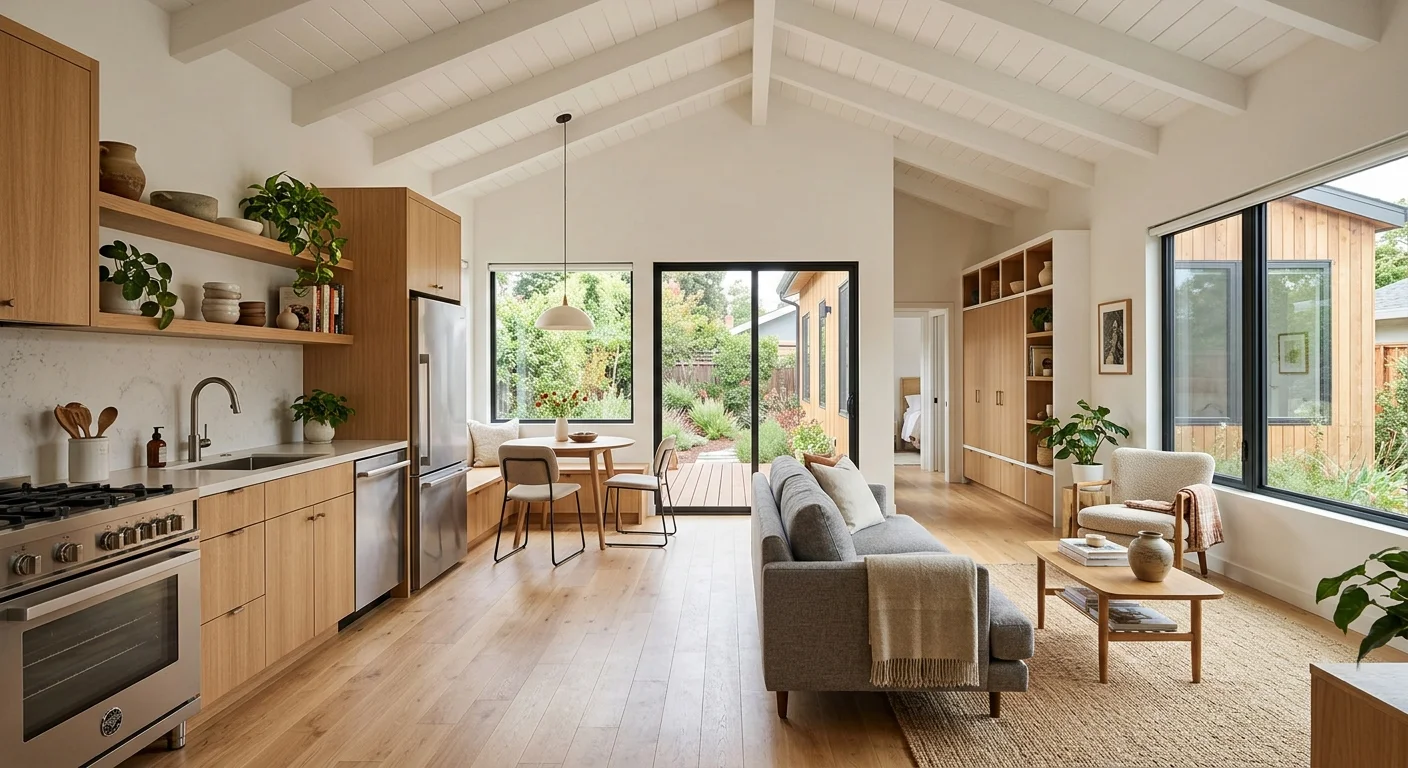
At this size, you’re getting two bedrooms, one bathroom, a small kitchen, and a combined living/dining area. Think “well-designed apartment,” not “spacious home.” Each bedroom fits a queen bed with limited floor space around it. Storage is tight. One bathroom means morning scheduling.
Works for:
A single adult child who needs their own space plus a flex/office room, occasional guest use, or a rental unit where compact efficiency is expected.
Feels cramped when:
Two adults live there full-time, anyone needs significant closet space, or you entertain regularly.
Examples: Abodu Two (610 sf), Samara Two Bedroom (690 sf)
700–850 sq ft
This is where most homeowners find the right balance. At 750+ square feet, you can get two genuine bedrooms — often with one that functions as a primary suite with a private bath. Kitchens have real counter space. Living areas breathe. You can actually have people over without everyone standing in the kitchen.
Works for:
Aging parents who need comfortable daily living, long-term rental tenants (two-bedroom units consistently command higher monthly rents than studios or one-bedrooms in most metro markets), or an adult child with a partner.
Examples: ELMNTL Shelter 2BR (714 sf), LiveLarge L-750 (750 sf), Abodu Two+ (800 sf), Samara XL 8 (800 sf), LiveLarge L-800 (800 sf)
850–1,200 sq ft
At this end, a 2-bedroom prefab ADU feels like a small standalone home. You’re getting two bedrooms with real closets, two full bathrooms, a proper kitchen with an island, separate living and dining zones, and usually in-unit laundry. In California, state law mandates that cities allow ADUs of at least 1,000 square feet when the unit has more than one bedroom (Source: HCD ADU Handbook, Gov. Code §66323).
Works for:
Permanent multigenerational housing, families who want a real second home on the property, high-rent markets where larger units justify the construction cost.
Examples: Samara XL 10 (950 sf), Studio Home Summit 1000 (1,000 sf), Villa Homes larger models (up to 1,200 sf), LiveLarge L-1190 (1,190 sf)
Why Layout Matters More Than Raw Square Footage
A well-designed 700 sq ft ADU with split bedrooms, an open-core kitchen/living area, and strategic window placement will feel bigger and more private than a poorly planned 900 sq ft unit with a long hallway eating up usable space.
When evaluating floor plans, look for:
- Split-bedroom layouts — bedrooms on opposite ends of the unit for privacy
- Open-core living — combined kitchen/living/dining without unnecessary walls
- Built-in storage — closets, cabinets, and laundry nooks designed into the plan, not afterthoughts
- Natural light strategy — large windows, sliding glass doors, and clerestory windows that make compact spaces feel open
- Outdoor connection — a sliding door to a deck or patio extends the living space without adding square footage
Which 2 Bedroom Prefab ADU Companies Deserve a Closer Look?
We’re not giving you a fake “Top 10” ranking. Instead, we’ve organized the field into buckets based on what matters most to different homeowners. Every company below has a live 2-bedroom model we’ve verified as of March 31, 2026.
Best for Turnkey Premium (You Want It Handled)
Abodu
CA OnlyTwo (610 sf, 2/1, from $360,800) and Two+ (800 sf, 2/2, from $426,800). California HCD state-approved plans. One-day unit installation. Pricing guarantee means the company doesn’t profit from cost changes. Average customer pays $392,500 for the Two and $478,800 for the Two+, inclusive of typical upgrades and taxes/permits. Their process is the most “product-like” in the industry — more Apple Store than construction site.
Biggest caution: premium price point, especially the Two+. California only (Bay Area and Greater LA).
See Abodu pricing & floor plans →Samara
CA OnlyTwo Bedroom (690 sf, 2/1, $190,000 + install), XL 8 (800 sf, 2/2, $249,000 + install), XL 10 (950 sf, 2/2, $277,000 + install). Founded by Airbnb co-founder Joe Gebbia. Net-zero-ready with solar included. Fire-resistant design. Handles permitting, site prep, and installation. Cathedral ceilings that make compact spaces feel larger. Three 2-bedroom options covering a wide size range.
Biggest caution: “plus installation” pricing means the published number is the starting point. California only.
See Samara models →Best for Broader Selection and National Reach
Villa Homes
CA + CO1-, 2-, and 3-bedroom models from 450 to 1,200 sq ft, with panelized and ReadyBuilt options. Turnkey package includes permitting, delivery, site work, installation, and utility hookups. Currently serves California and Colorado.
Biggest caution: timelines can be longer than pure modular competitors.
See Villa floor plans →Studio Home
Ships from CO35+ models from 308 to 1,000 sq ft, including 2-bedroom options like the Summit 1000 (from $191,523; shell-only option from $93,581). Full-service from design through installation — they manage every step.
Biggest caution: final pricing depends heavily on your site; shell-only option requires separate contractor for finish work.
See Studio Home models →ELMNTL
US + CanadaShelter 2 Bedroom (714 sf, 14’ × 51’, starting at $349,000 dwelling price). Based in Lyons, Colorado. Ships to US and Canada (excluding Alaska and Hawaii). Built with biodegradable, recyclable materials — no plastic or foam insulation. Published example shows $449,000+ installed including permitting and site work. Under-7-month timeline.
Biggest caution: you’ll need a local GC partner for installation outside Colorado.
See ELMNTL Shelter 2BR →Best for California Value (Space Per Dollar)
LiveLarge Home
CA OnlyMultiple 2BR/2BA models: L-750 ($245,000 + install), L-795 ($245,000 + install), L-800 ($265,000 + install), L-800 P ($345,000 + install), and L-1190 ($355,000 + install). Triple- pane windows and efficient design. Range from 750 to 1,190 square feet.
Biggest caution: California only; installation costs vary significantly by site. Larger models require significant yard space (L-750 needs 63’10” × 24’).
See LiveLarge models →Ready to compare models that fit your lot and budget?
See our full prefab ADU company comparison →How Does Permitting Work When the ADU Is Prefab?
Let’s clear up one of the biggest misconceptions in prefab marketing: a prefab ADU is not a permit bypass. Every prefab ADU on a permanent foundation needs the same building permits as a site-built ADU. Full stop. The structure may be factory-built, but the foundation, utility connections, setback compliance, and safety inspections are still governed by your local building department.
That said, prefab can genuinely speed up the permitting process — here’s how.
What “Pre-Approved Plans” and “State-Approved” Actually Mean
In California, the Department of Housing and Community Development (HCD) certifies certain prefab manufacturers at the state level. Your city still reviews the site plan, foundation design, utility connections, and zoning compliance — but they don’t re-review the structural engineering of the unit itself. California law requires cities to approve or deny a complete ADU application ministerially within 60 days (Source: HCD ADU Handbook, Gov. Code §66321.1).
Several California cities also maintain “standard plan” or “pre-approved plan” programs — libraries of already-reviewed ADU designs that reduce plan-check timelines. LADBS (Los Angeles) offers standard plans, though these still require site-specific zoning and foundation review (Source: LADBS ADU Standard Plans page, dbs.lacity.gov).
Outside California, the landscape varies. Denver legalized ADUs in all residential zones in December 2024 and has a growing pre-approved plan library. Salt Lake City offers pre-approved ADU plans, but applicants still go through site review to obtain a permit (Source: SLC Building Services ADU page, slc.gov). Boise’s pre-approved plan program similarly still requires the city’s standard approval and permit process (Source: City of Boise ADU page, cityofboise.org).
What Your City Actually Cares About
Whether the ADU is prefab or site-built, your local building department evaluates:
- Setbacks — distance from the ADU to your property lines (varies by city and state)
- Height limits — typically 16–25 feet depending on location and configuration
- Lot coverage — total percentage of your lot covered by structures
- Utility capacity — can your existing water, sewer, and electrical infrastructure support another dwelling?
- Fire safety — sprinkler requirements, materials, and emergency vehicle access
- Parking — some cities still require off-street parking for ADUs, though many have eliminated this
- Owner occupancy — California has eliminated owner-occupancy requirements for ADUs (not JADUs with shared sanitation) under AB 976 (Source: HCD ADU Handbook)
Modular vs. Manufactured: Why This Distinction Matters
Modular/prefab ADU
Built to state or local residential building code (same standard as site-built), placed on a permanent foundation, connected to utilities. This is “real property.” It qualifies for standard financing and is what every company in our comparison table produces. Fannie Mae confirms that modular ADUs on permanent foundations are eligible when legally classified as real property (Source: Fannie Mae Selling Guide B2-3-04).
Manufactured home
Built to federal HUD code on a permanent steel chassis (Source: HUD manufactured home resources, hud.gov). Some can function as ADUs, but they may appraise differently and can create financing complications. If you’re building a 2-bedroom ADU for long-term value, make sure you’re getting a modular unit on a permanent foundation.
How Long Does a 2 Bedroom Prefab ADU Take From Contract to Move-In?
Manufacturers love to say “installed in one day.” And that’s true — for the unit placement. The full project is a different story.
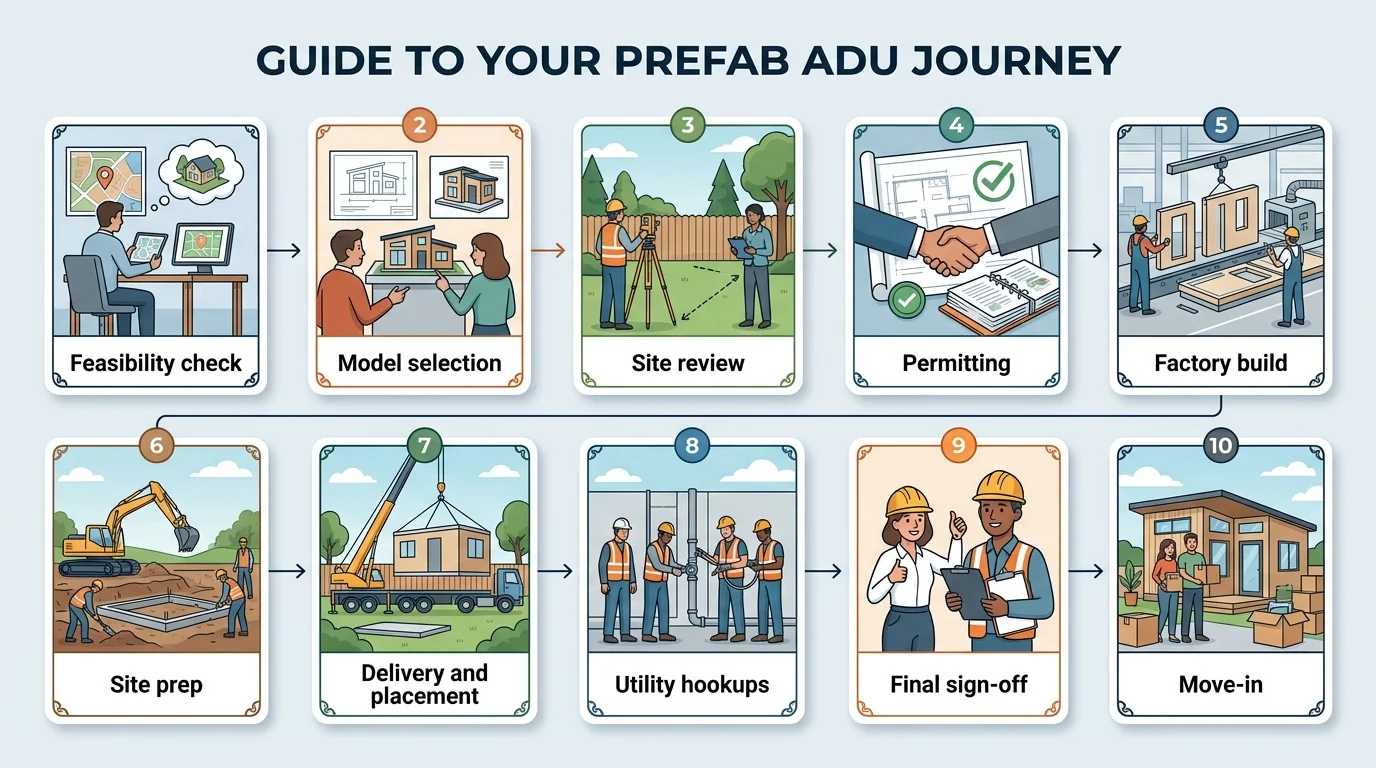
| Stage | Typical Duration | What Happens |
|---|---|---|
| Feasibility + design selection | 2–4 weeks | Site assessment, model selection, preliminary cost estimate |
| Permitting | 4–12 weeks | Plan submission, zoning review, corrections, approval. CA law requires 60-day turnaround on complete applications. |
| Factory fabrication | 6–16 weeks | Your unit is built in the factory while site prep happens in parallel |
| Site preparation | 2–6 weeks | Foundation pour, utility trenching, grading, demolition of obstacles |
| Delivery + unit placement | 1–5 days | The "installed in one day" part |
| Final connections + finishing | 2–6 weeks | Utility hookups, exterior trim, interior touchups, final grading |
| Inspection + certificate of occupancy | 1–4 weeks | City inspections, corrections if needed, final sign-off |
Total realistic timeline: 5–10 months.
ELMNTL publishes an under-7-month path. Abodu says projects can complete in as little as 6 months. But those are best-case scenarios on straightforward lots with cooperative permitting departments. The structural advantage of prefab: most of this happens in parallel. Your unit is being built in a factory while your site is being prepped — that overlap is the real time advantage over site-built.
When Should You Skip Prefab Entirely?
We’d rather help you make the right decision than nudge you toward the wrong product. Prefab is likely not your best path if:
Your lot has no truck or crane access.
If there's no way to get a flatbed truck close to your backyard — narrow streets, tight alleys, low power lines, or a completely enclosed yard — a prefab unit can't get there. Panelized systems can sometimes work, but they require more on-site assembly.
Your site has significant slope.
Steep lots need extensive grading, retaining walls, and custom foundation engineering. These costs can add tens of thousands and erase whatever efficiency prefab offers. A site-built ADU designed around the slope is often smarter.
You need heavy customization.
Prefab models offer limited floor plan modifications. If you need unusual room layouts, specific ADA accommodations beyond standard offerings, or architectural details that match a historic home, site-built gives you unlimited flexibility.
Your budget is under $200,000 total.
At that number, a garage conversion or JADU (Junior ADU within the existing home) is likely your best bet. A 2-bedroom prefab ADU rarely comes in under $250,000 all-in based on current builder pricing.
Your city doesn't allow the size you need.
Some cities cap ADUs below the minimum most 2-bedroom prefab models require. Check your specific city's ordinance — not just your state's general framework — before falling in love with a specific model.
If any of these describe your situation, don’t force prefab. We have guides for garage conversions, site-built ADUs, and state-specific ADU laws that might point you to a better path.
Which Use Case Makes a 2 Bedroom Prefab ADU Worth It?
The “right” ADU depends entirely on why you’re building it. A 2-bedroom prefab makes the most sense in these scenarios:
Aging Parents or Multigenerational Living
A parent or in-law gets their own space — close enough for daily connection, private enough for independence. Two bedrooms means they have a sleeping area plus a room for a visiting caregiver, a grandchild staying over, or simply a sitting room that isn't the bedroom. Families that have done this consistently describe it as one of the best decisions they've made. Separate front doors, separate kitchens, separate daily rhythms — but just steps away when it matters.
What to look for: single-story only (no stairs), wide doorways (32" minimum, 36" preferred), walk-in shower instead of a tub, and a layout where the primary bedroom has a direct path to the bathroom.
Long-Term Rental Income
Two-bedroom rentals command meaningfully higher monthly rent than studios or one-bedrooms in most metro markets. The additional construction cost of going from 1BR to 2BR is often modest relative to the unit price — and the higher rental revenue can significantly improve your payback timeline.
Rental income projections are illustrative, not guarantees. Actual results depend on your local market, property condition, construction costs, and regulatory environment. Research comparable rentals in your neighborhood before building a financial plan around projected income.
Adult Child Who Needs a Landing Pad
An adult child returning home — whether after college, during a career transition, or to save for their own place — needs real space, not a childhood bedroom. Two bedrooms means they have a bedroom plus a home office or guest room. It's a complete, independent living unit that respects everyone's boundaries.
Guest Suite with Year-Round Flexibility
If you host frequently — extended family visits, friends from out of town, occasional short-term rental where your city permits it — a 2-bedroom gives you flexibility that a 1-bedroom doesn't. One room stays set up as a bedroom; the other flexes between guest room, office, and hobby space depending on the week.
The Property Value Angle
A 2-bedroom ADU on a permanent foundation is classified as real property — it's part of your home's appraised value. Both Fannie Mae and the NAHB confirm that modular ADUs on permanent foundations are treated the same as site-built structures for lending and appraisal purposes (Sources: Fannie Mae Selling Guide B2-3-04; NAHB Modular Building Systems Council). The key: make sure the ADU is built to code, on a permanent foundation, with proper permits and inspections. That's what makes it 'real property' in the eyes of every lender and appraiser.
15 Questions to Ask Before Putting Down a Deposit
This checklist could save you from the most common prefab regrets. Print it. Bring it to every conversation.
- 1
What is the all-in installed cost — including foundation, delivery, site prep, utility connections, permits, taxes, and standard finishes? Not the unit price. The total.
- 2
What specific items are excluded from your published price? Get this in writing.
- 3
Do you have pre-approved or state-certified plans for my city? If not, what's the expected permitting timeline?
- 4
How will you access my backyard? Do you need a crane? What does crane service cost? Have you assessed my property for delivery feasibility?
- 5
Who handles the foundation, utility trenching, and site prep — you, a subcontractor you manage, or a contractor I hire separately?
- 6
What is your realistic timeline from signed contract to certificate of occupancy? Not best-case. Realistic.
- 7
Can I visit a completed 2-bedroom unit or a model home? Can I speak with a recent customer who built the same model?
- 8
What warranty do you provide on the structure, roof, finishes, appliances, and systems? How long? What's covered vs. excluded?
- 9
What happens if site conditions surprise us? How are change orders handled? Is there a cap on cost overruns?
- 10
What permits and inspections do you manage versus what falls on me?
- 11
Is this a modular ADU on a permanent foundation (real property) or a manufactured home on a chassis? This affects appraisal, financing, and long-term value.
- 12
What financing partnerships or programs do you work with? Can I use my own lender?
- 13
What's your cancellation policy if the project doesn't move forward? How are deposits handled?
- 14
How many 2-bedroom units have you completed in the last 12 months? In my city/region specifically?
- 15
What customization is available — finishes, fixture placement, window configurations, exterior cladding — and what does each upgrade cost?
Free Resource
Free 2026 ADU Starter Kit
Cost worksheets, permit timelines by state, a contractor vetting checklist, and a financing path guide. Everything before you talk to a single company.
Download Free Starter Kit →How Homeowners Pay for a 2 Bedroom Prefab ADU
Most homeowners don’t write a check for a $300,000+ project. The most common financing paths include:
- Home equity loans or HELOCs — borrow against existing equity, interest-only during construction phases
- Cash-out refinancing — replace your current mortgage with a larger one and take the difference as cash
- Construction-to-permanent loans — cover the build period, then convert to a standard mortgage
- ADU-specific loan products — from lenders who count projected rental income toward qualification
Some manufacturers — like Samara — offer financing through lending partners with terms negotiated for their customers. Several states offer grant or assistance programs, though availability and funding status change frequently.
Exploring how to pay for a 2-bedroom prefab ADU?
Our financing guide covers HELOCs, cash-out refinances, construction loans, and ADU-specific lending products.
If you use our links to explore financing, we may earn a commission at no extra cost to you. Full disclosure →
Explore All ADU Financing Paths →How We Built This Comparison
We believe the reason most people search for “2 bedroom prefab ADU” four or five times is that nobody has normalized the data. Every company presents pricing, specs, and scope differently. Our job is to put it all in one frame so you can actually compare.
How we selected models
We included every prefab or modular manufacturer currently offering a 2-bedroom ADU model with published specs and active ordering as of March 31, 2026. We excluded companies that have announced models but haven't shipped units, and companies where we couldn't verify a current 2-bedroom offering suited for the ADU comparison.
How we normalized cost
For each company, we started with their published base/unit price, then layered in their disclosed exclusions and, where available, their published customer averages. For companies that publish "plus installation" pricing, our installed-cost signal adds estimated ranges for typical California or Colorado site costs based on industry data. Our "installed-cost signal" is an editorial estimate — not a quote. Always request a site-specific proposal.
How often we verify
We check manufacturer websites, pricing pages, and published specs quarterly. Each data point carries a verification date. If a number changes between our checks, we update it on the next cycle.
What we can't account for
Your lot is unique. Soil conditions, slope, access, utility distance, and local permit fees can push costs above or below our estimates. This page gives you the framework to compare. Your site-specific quote gives you the real number.
Our independence
The Dwelling Index is not owned by, affiliated with, or compensated by any builder, manufacturer, or contractor for editorial placement. We earn revenue through affiliate relationships when readers request pricing through our links, and through digital products and email content. Our editorial recommendations are never influenced by compensation.
2 Bedroom Prefab ADU FAQ
How much does a 2 bedroom prefab ADU cost?↓
Published starting prices for 2-bedroom prefab ADU models range from $190,000 (Samara, plus installation) to $426,800 (Abodu Two+). Real installed project totals — including foundation ($15,000–$40,000), site work ($5,000–$30,000), delivery, utility connections ($10,000–$40,000), permits, and taxes — typically range from $250,000 to $550,000 depending on the model, location, and site conditions.
Can I use a 2 bedroom prefab ADU as a rental property?↓
In most jurisdictions, yes. ADUs on permanent foundations are legal long-term rental units in California, Oregon, Washington, Colorado, and a growing number of states. Short-term rental (Airbnb) rules vary significantly by city — some restrict or ban ADU short-term rentals. Always verify your city's specific rules before building a rental strategy.
Can a prefab ADU be customized?↓
To a degree. Most manufacturers let you choose from preset finish packages — flooring, countertops, cabinetry colors, fixture styles. Some allow minor layout modifications like window placement or door swing direction. Major floor plan changes are typically not available. If you need significant customization, site-built is the better route.
What foundation does a prefab ADU need?↓
Most 2-bedroom prefab ADUs sit on a poured concrete slab foundation, though some use pier systems depending on the manufacturer and site conditions. Foundation design must be engineered for your specific soil conditions and local building code. Cost: $15,000–$40,000 depending on size, soil, and slope.
What if my lot is sloped or hard to access?↓
This is where prefab gets complicated. Steep lots need expensive grading and custom foundations. Tight access means crane limitations or inability to deliver a full-size module. Get a professional site assessment before committing to prefab. A site-built ADU may be the better path for your property.
Will a 2 bedroom prefab ADU increase my property value?↓
A properly permitted modular ADU on a permanent foundation is classified as real property and contributes to your home's appraised value. Both Fannie Mae and the NAHB confirm that modular homes on permanent foundations are treated equivalently to site-built structures. The exact value added depends on local comparable sales, market demand, and appraiser methodology — but adding legal, permitted living space to your property is a fundamentally sound long-term investment in most markets.
How long does delivery and installation take?↓
The unit placement itself takes 1–5 days. The full project — from signed contract through feasibility, permitting, fabrication, site prep, delivery, connections, and final inspection — typically takes 5–10 months.
Are prefab ADUs allowed in HOAs?↓
It depends on your HOA's CC&Rs (Covenants, Conditions & Restrictions). Some HOAs prohibit new structures. Others allow ADUs with design requirements. In California, state law limits HOAs' ability to restrict ADUs in some situations, but enforcement varies. Review your CC&Rs and get board approval before investing in design or deposits.
Is prefab cheaper than site-built for a 2 bedroom ADU?↓
For most 2-bedroom ADUs, prefab and site-built end up in a comparable total cost range once all costs are included. The real advantages of prefab are speed (5–10 months vs. 10–16 for site-built), predictability (fewer surprise change orders), and reduced on-site disruption (weeks of work instead of months of crews). Cost savings alone isn't usually the reason to go prefab.
What is the minimum lot size for a 2 bedroom prefab ADU?↓
There is no universal minimum lot size — it depends on your city's setback rules and the specific model's required clear yard space. Most 2-bedroom prefab models need 35 to 64 feet of clear yard space (not just building footprint). Always verify your city's minimum ADU size allowance and setback requirements before choosing a model.
The Bottom Line
A 2 bedroom prefab ADU is one of the most practical ways to add family-size living space to your property — with less disruption, more predictability, and a faster path to move-in than traditional construction. The homeowners who get the best outcomes are the ones who understand the real installed cost (not just the sticker price), verify that their lot can handle prefab delivery, and choose a company that’s transparent about what’s included.
You’ve done the homework. You understand how pricing actually works, what your lot needs, and which companies are worth calling. That puts you ahead of 90% of the homeowners who start this process.
The next step is simple:
Find out what’s actually buildable on your specific property.
Get Your Free ADU Report →Free ADU Opportunity Report · 60 seconds · No sales call
Related Guides
Best Prefab ADU Companies (2026)
All companies, all sizes — our full comparison
Modular ADU: Real Costs, Rules & When It Wins
Factory-built ADU costs, permits, lot requirements, and vetting guide
Prefab ADU Cost Guide
What prefab ADUs cost from start to finish
How Much Does an ADU Cost?
All ADU types and full cost breakdown
ADU Financing Options
HELOCs, cash-out refis, and ADU-specific loans
HELOC for ADU
When a HELOC is the right path — and when it isn't
ADU Cost Per Square Foot
What you're really paying for every square foot
Have a question we didn’t answer? Contact us and we’ll add it. This page is a living resource — we update pricing, models, and regulations quarterly.
All vendor data last verified: March 31, 2026