
Washington ADU Laws (2026): What State Law Allows, What Cities Still Control
By the Dwelling Index Research Team · Last verified April 6, 2026 · Editorial methodology · Affiliate disclosure
Bottom line: On many Washington lots inside urban growth areas, state law now requires cities and counties to allow at least two ADUs on lots zoned for single-family homes that meet the principal unit’s minimum lot-size requirement. Washington ADU laws ban owner-occupancy requirements, prevent local size caps below 1,000 square feet, cap impact fees at 50% of the main home’s fees, and severely limit parking mandates — especially near transit. Cities that missed their periodic-update deadline and still have conflicting rules on the books? State law supersedes those conflicting local provisions automatically (RCW 36.70A.680).
Washington bars cities from prohibiting condo-style separate conveyance solely because the unit began as an ADU — though condo creation and recording requirements still apply.
But state law did not erase every obstacle. Septic limitations, critical areas, older private HOA covenants, short-term rental restrictions, and city-specific permit processes can still reshape or stop a project. The statewide floor is real and strong. It’s just not a blank check.
Sources: RCW 36.70A.680 – RCW 36.70A.681, WAC 365-196-875, WA Dept. of Commerce ADU Guidance
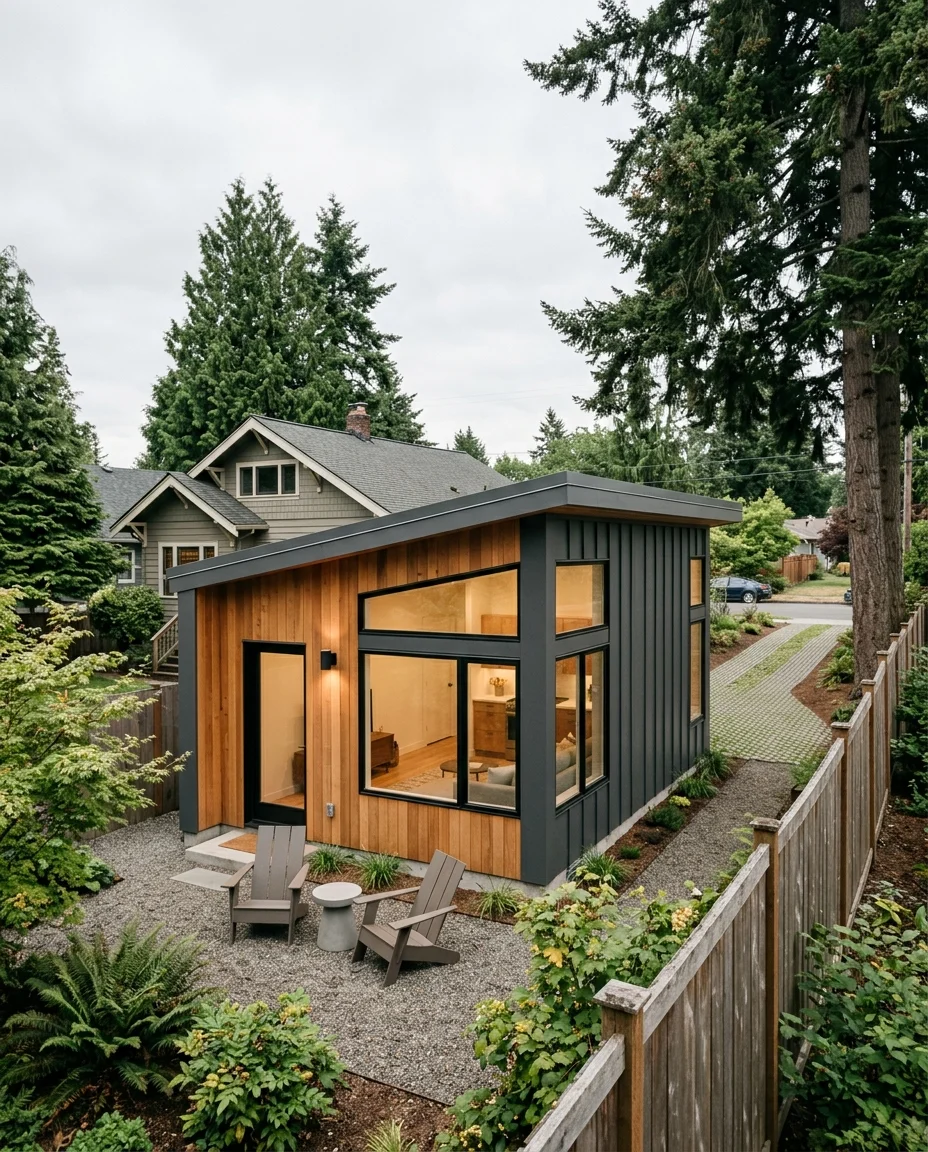
Washington ADU Laws at a Glance
| Question | What state law guarantees | What to verify locally |
|---|---|---|
| Does this apply to my property? | Yes, if inside a GMA urban growth area on a lot zoned for single-family homes meeting the principal unit's minimum lot size | Confirm UGA status and zoning with your city/county |
| How many ADUs? | At least 2 (attached, detached, or combo) | Some cities allow more; lots ≤2,000 SF may be limited to 2 total |
| Owner occupancy required? | No — banned statewide | Some cities require it only for short-term rentals |
| Maximum ADU size? | Cities cannot cap below 1,000 SF | Many cities allow larger |
| Parking? | None required within ½ mile of major transit; limited elsewhere | City-specific transit stop definitions vary |
| Garage conversion? | Must be allowed | Building code upgrades (fire separation, egress) still apply |
| Sell ADU separately? | Cities cannot prohibit condo-style separate sale solely because it was built as an ADU | Condo creation process and unit-lot subdivision details vary by city |
| What can still block a project? | Septic limits, critical areas, building code, environmental rules, older HOA covenants, STR restrictions | Always verify site conditions before paying for plans |
Sources: RCW 36.70A.680, RCW 36.70A.681 | Verified April 6, 2026
Wondering if your property qualifies?
Get Your Free Washington ADU ReportAre ADUs Legal in Washington in 2026?
Yes. On most urban lots in Washington zoned for single-family homes, the answer is clearly and strongly yes.
Washington’s HB 1337, signed into law in 2023, fundamentally rewrote the rules. The bill didn’t just encourage cities to allow ADUs — it required them to, with specific minimums that cities cannot undercut. The statute is codified at RCW 36.70A.680 and RCW 36.70A.681, and it applies to fully planning cities and counties within urban growth areas under Washington’s Growth Management Act.
The legal language matters here because it’s unusually direct. The statute says your city “must allow” at least two ADUs. It says your city “may not require” owner occupancy. It says your city “may not establish a maximum gross floor area requirement” below 1,000 square feet. These aren’t suggestions. They’re mandates.
What “ADU” means under Washington law
An accessory dwelling unit is a self-contained living space — with its own kitchen, bathroom, and sleeping area — located on the same lot as a primary home. Under Washington law (RCW 36.70A.696), that definition covers units on lots with single-family homes, duplexes, triplexes, townhomes, or other housing. ADUs can be:
Attached (AADU): Built within or added onto the main house — a basement apartment, an attic conversion, an addition with a separate entrance.
Detached (DADU): A standalone structure in the backyard — often called a backyard cottage, granny flat, or mother-in-law unit.
Conversion: An existing garage, barn, or outbuilding converted into a livable unit.
State law requires cities to allow all three types. You can mix and match — one attached and one detached, two detached, or two attached, depending on your city’s specific implementation (RCW 36.70A.681(2)(c)).
Why Washington changed the law
Washington needs roughly 1.1 million new homes by 2044, according to the legislature’s own findings in HB 1337. ADUs are one of the fastest, least disruptive ways to add housing — they fit within existing neighborhoods, use existing infrastructure, and don’t require the massive capital or political fights that come with large apartment projects.
The practical effect for homeowners: a legal path to rental income, multigenerational housing, or property value growth that didn’t exist — or barely existed — just a few years ago. After Seattle relaxed its ADU rules in 2019, annual ADU building permits surged dramatically. The statewide law extends that opportunity across Washington.
What if your city’s website still shows the old rules?
This comes up constantly. Some city code pages haven’t been updated, some planning departments haven’t finished their compliance process, and some city staff may not be fully up to speed on the new requirements.
Key legal point: If a jurisdiction has passed its applicable periodic-update deadline under the GMA and hasn’t adopted compliant ADU regulations, state law automatically supersedes, preempts, and invalidates any conflicting local development regulations (RCW 36.70A.680(1)(b)). You’ll still need to work with your city’s permitting process, but the zoning barrier is gone.
If you encounter resistance, reference the specific RCW sections and contact the Washington Department of Commerce, which provides technical assistance to both jurisdictions and homeowners.
Does Washington State ADU Law Apply to My Property?
This is the first question that actually matters — before cost, before floor plans, before calling a builder. Not every lot in Washington is covered by the strong two-ADU baseline.
The quick filter: Is your lot inside a designated urban growth area, in a city or county that fully plans under the GMA, zoned for single-family homes, and meeting the minimum lot size required for the principal unit? If yes, the full HB 1337 protections apply.
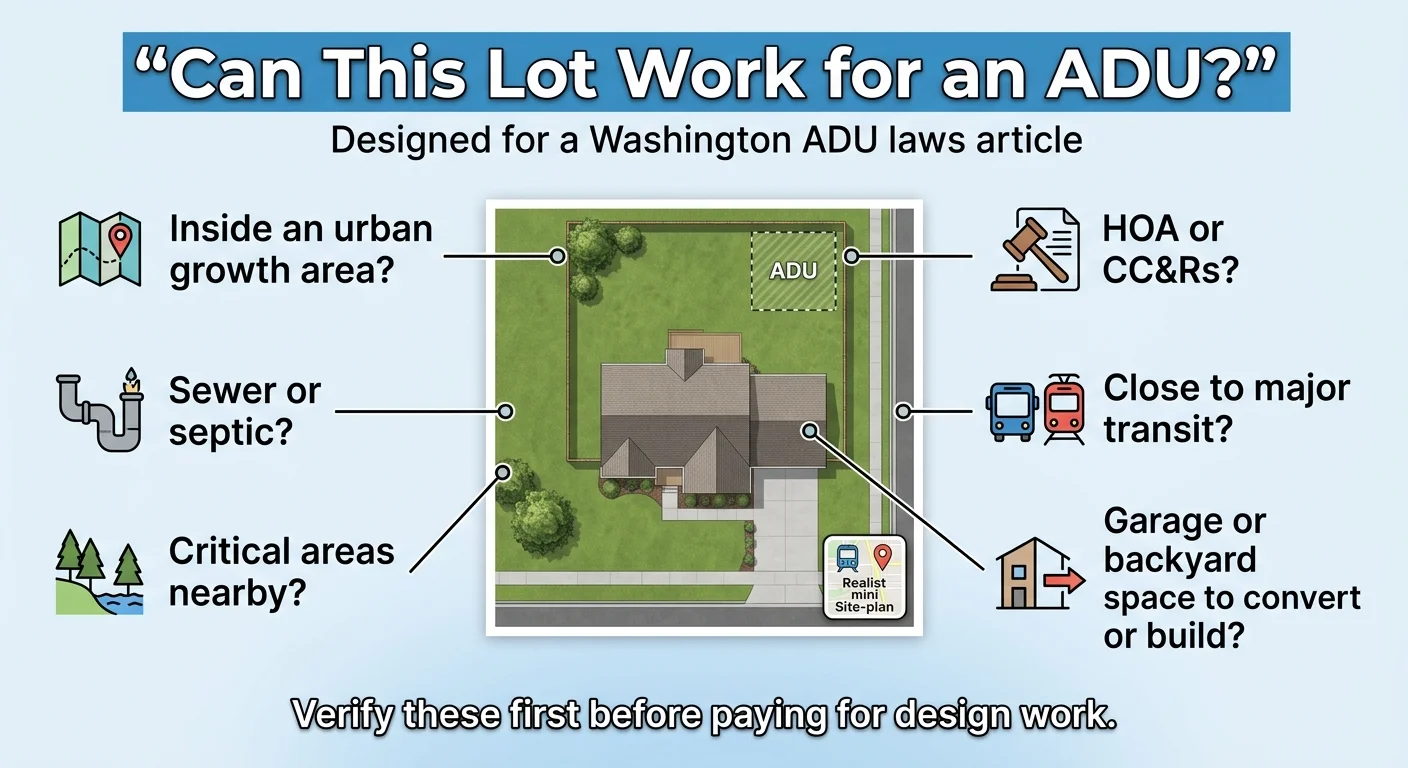
Inside an urban growth area: the full protections apply
The vast majority of Washington’s population lives inside UGAs. All fully planning GMA cities and counties must allow at least two ADUs per residential lot within their urban growth areas, on lots in zoning districts that allow single-family homes and meet the minimum lot-size requirement for the principal unit (RCW 36.70A.681(2)(c)). This covers Seattle, Spokane, Tacoma, Bellevue, Vancouver, Bellingham, Olympia, Kirkland, Renton, Redmond, and most other cities you’ve heard of.
Outside an urban growth area: a new but more limited pathway
Rural properties outside UGAs are not covered by HB 1337’s two-ADU mandate. However, Washington expanded rural ADU options through HB 1345 (Chapter 231, Laws of 2026), signed by the governor and effective June 11, 2026. This law creates a county-opt-in pathway for one detached ADU per parcel in rural areas, subject to conditions including:
- Maximum one ADU per parcel (attached or detached)
- Must comply with water supply requirements (RCW 19.27.097) and the ADU cannot use a water source closed to further appropriation
- Septic/sewage capacity documentation required
- Maximum 1,296 square feet (excluding garage and unfinished space)
- Must share a driveway with the primary home
- Must be sited within 150 feet of the principal dwelling
- County must include enforcement measures and track/report permitted ADUs annually to the Department of Commerce
Important: HB 1345 is a county-opt-in program — your county has to choose to adopt it. Contact your county planning department for current status.
How to check your UGA status
- 1
Call your county or city planning department — Ask: "Is my property inside the designated urban growth area?"
- 2
Check your county's GIS/parcel viewer — Most counties have online mapping tools that show UGA boundaries.
- 3
Review your county's comprehensive plan map — UGA boundaries are delineated in the land use element.
Inside UGA vs. Outside UGA
| Situation | Default rule | ADUs allowed | Biggest limit | Your next step |
|---|---|---|---|---|
| Inside UGA, on sewer | Full HB 1337 protections | 2 | City implementation details | Check city code + run feasibility |
| Inside UGA, on septic | City may restrict or prohibit | 0–2 | Septic capacity and local health dept approval | Verify septic capacity first |
| Inside UGA, critical area (low-density zone) | City may restrict | 0–2 | Environmental review | Get site assessment |
| Outside UGA, county opted into HB 1345 | One detached ADU allowed | 1 | Size, siting, water/septic, driveway | Contact county planning |
| Outside UGA, county hasn't opted in | ADU may not be permitted | 0 | County hasn't adopted rules | Contact county planning |
Want to skip the guesswork? Check whether your lot qualifies.
Get Free Washington ADU ReportWhat Does Washington Law Guarantee on Urban Lots?
The statewide floor is stronger than most homeowners realize. Here’s every major protection, with the actual statute citation so you can verify it yourself.
Two ADUs per lot
RCW 36.70A.681(2)(c)Fully planning GMA cities and counties must allow at least two accessory dwelling units on all lots in UGA zoning districts that allow single-family homes and meet the minimum lot-size requirement for the principal unit. The two units can be configured as one attached and one detached, two attached, or two detached. On lots of 2,000 square feet or less, cities may impose a limit of two ADUs total.
Attached, detached, or both — your choice
RCW 36.70A.681(2)(c)(iv)State law requires cities to allow both attached and detached configurations. Critically, conversion of existing structures — garages, outbuildings, barns — must also be allowed. This is a big deal for homeowners with existing detached garages — garage conversions are typically the fastest and cheapest path to a functioning ADU.
Size: 1,000 square feet minimum must be allowed
RCW 36.70A.681(2)(f)Cities cannot establish a maximum gross floor area for ADUs that is less than 1,000 square feet. Many cities allow larger. This is a floor, not a ceiling.
Height: 24-foot roof minimum must be allowed
RCW 36.70A.681(2)(g)Cities cannot impose roof height limits below 24 feet on ADUs, unless the height limit for the primary home is already lower — in which case the ADU limit matches the primary home's limit. This is enough height for a comfortable two-story design.
Setbacks, yard coverage, and design standards
RCW 36.70A.681(2)(h)Cities cannot impose setback requirements, yard coverage limits, tree retention mandates, aesthetic requirements, entry door location restrictions, or design review standards on ADUs that are more restrictive than those applied to the principal home. Whatever rules apply to your main house apply to your ADU. State law also requires cities to allow detached ADUs to be sited within rear setback areas on lots with alley access (RCW 36.70A.681(2)(i)).
Impact fees: capped at 50%
RCW 36.70A.681(2)(a)Cities cannot charge impact fees on ADUs that exceed 50% of the fees assessed on the principal home. Some cities have gone further and waived ADU impact fees entirely.
Street improvements: cannot be required for ADUs
RCW 36.70A.681(2)(j)Cities cannot require street improvements as a condition of permitting ADUs. This removes a cost and timeline barrier that some cities previously imposed.
Separate sale: condo pathway exists
RCW 36.70A.681(2)(k)Cities and counties may not prohibit the sale or other conveyance of a condominium unit independently of the principal unit solely on the grounds that it was originally built as an ADU. This is a real pathway to separate ownership, but condo creation involves legal documentation, recording with the county, and meeting any local condo-creation requirements.
Owner occupancy: gone
RCW 36.70A.681(2)(b)Cities cannot require the owner to live in the ADU or in any other unit on the same lot. You can build two ADUs, rent all three units, and live somewhere else entirely.
One exception: Cities can still require owner occupancy as a condition for operating a short-term rental from the property (RCW 36.70A.680(5)(a)). Spokane takes exactly this approach.
Parking: severely limited
RCW 36.70A.681(2)(a)- Within ½ mile walking distance of a major transit stop: No off-street parking can be required
- On lots smaller than 6,000 SF (before subdivisions): Maximum one parking space per ADU
- On lots 6,000+ SF (before subdivisions): Maximum two parking spaces per ADU
Additionally, Washington has separate laws that prohibit parking requirements for residences under 1,200 SF in cities over 30,000 population, and that ban parking requirements entirely in station areas near rail and bus rapid transit (RCW 36.70A.620, 36.70A.622). These stack with the ADU-specific parking rules.
Why some sources say ¼ mile and others say ½ mile: The ADU statute (HB 1337) uses ½ mile from a “major transit stop.” Some cities had their own ¼-mile transit parking exemptions under earlier ordinances. The state law provides the ½-mile floor.
HOAs and CC&Rs: partially addressed
RCW 64.38.160For associations created after July 23, 2023 in urban growth areas, new CC&Rs generally cannot impose ADU restrictions that local governments themselves are barred from imposing under RCW 36.70A.681 — with an exception for associations created to protect public health, safety, and ground/surface water quality related to on-site wastewater.
Existing CC&Rs from before July 23, 2023 remain enforceable. If you bought in a subdivision with pre-2023 CC&Rs that prohibit additional dwellings, the state law doesn’t override your private covenant. A building permit from the city doesn’t protect you from a civil action by your HOA.
Myths vs. Reality
| What you’ll read online | What the statute actually says |
|---|---|
| “Washington legalized ADUs everywhere” | Strong baseline in GMA urban growth areas on lots zoned for single-family homes; rural rules are separate and more limited |
| “No parking is ever required” | No parking near major transit (½ mile); limited parking elsewhere; multiple laws stack |
| “HOAs can’t stop you” | Post-July 2023 HOAs in UGAs are limited (with exceptions); older CC&Rs still apply |
| “You can sell the ADU as a separate house” | Cities can’t block condo-style sale solely because it was an ADU; condo creation process still applies |
| “Two ADUs on every lot in Washington” | Two in UGAs on qualifying lots; outside UGAs, up to one under HB 1345 if your county opts in |
| “The law takes effect immediately” | Preemption occurs after a jurisdiction misses its applicable periodic-update deadline |
What Can Cities, Counties, and Site Conditions Still Regulate or Block?
Washington removed many zoning barriers. It did not remove all barriers. Understanding what’s left separates homeowners who waste money on plans for an unbuildable project from homeowners who build successfully.
Septic and sewer — the most common project-killer
State law explicitly allows cities and counties to prohibit ADUs on lots not connected to or served by public sewer (RCW 36.70A.680(5)(d)). Even where ADUs on septic aren’t outright prohibited, your local health department controls whether the existing system can handle additional wastewater.
What to do: Before spending money on ADU design, contact your local health department and ask whether your septic system can support an additional dwelling unit. Get the answer in writing.
Critical areas and environmental restrictions
Cities can prohibit or restrict ADUs in residential zones with a density of one dwelling unit per acre or less that are within designated wetlands, fish and wildlife habitats, floodplains, or geologically hazardous areas (RCW 36.70A.680(5)(e)). The statute also preserves local authority over development restricted due to physical proximity to on-site sewage infrastructure, critical areas, or other unsuitable physical characteristics (RCW 36.70A.680(4)).
Short-term rental restrictions
State law explicitly allows cities to restrict ADU use as short-term rentals (RCW 36.70A.680(5)(a)), and many do. Seattle requires a short-term rental operator license and limits STRs to the operator’s primary residence. Spokane requires owner occupancy on lots with both an ADU and a short-term rental. Bellingham has its own STR regulations.
If your ADU plan depends on Airbnb income, verify your city’s STR rules before designing the unit. Long-term rental use is much more broadly allowed.
Building code, fire, and energy requirements
Washington’s ADU law removes zoning barriers. It does not override the building code, fire code, or energy code. Your ADU must meet the same construction standards as any other dwelling — structural, electrical, plumbing, mechanical, fire separation (especially for attached ADUs), and Washington’s energy code, which requires above-average insulation, air sealing, and in many cases heat pump systems.
Can my HOA stop me from building an ADU?
Post-July 2023 HOAs in UGAs: Generally cannot adopt CC&Rs that impose ADU restrictions local governments themselves are barred from imposing, with an exception for associations created to protect public health, safety, and on-site-wastewater-related water quality (RCW 64.38.160).
Pre-July 2023 HOAs: Can still enforce their existing covenants. A city building permit does not protect you from a covenant enforcement action.
What to do: Read your CC&Rs. If they restrict ADUs or additional dwellings, consult a real estate attorney before investing in design and permits.
What can still reshape or stop a Washington ADU project
| Issue | What state law does | Who controls it | Verify before paying for plans? |
|---|---|---|---|
| Septic capacity | Allows cities to prohibit ADUs on lots without public sewer | Local health department | Yes — first |
| Critical areas | Allows restrictions in low-density zones with environmental designations | City/county critical areas ordinance | Yes |
| Older HOA CC&Rs | Does not override pre-July 2023 private covenants | Your HOA board and courts | Yes |
| Short-term rental rules | Allows cities to restrict ADU use as STRs | City STR ordinance | Yes (if planning Airbnb) |
| Building/energy code | Does not override construction standards | Building official | Solvable with good design |
| Utility capacity | Does not guarantee utility connections | City public works / utility | Verify early |
Washington made ADUs dramatically easier. The law removes major zoning barriers; it doesn’t erase septic, environmental, or private-covenant issues. For the vast majority of homeowners on urban lots served by public sewer, the path is clearer than it’s been in decades.
Check your actual lot constraints before paying for plans.
Get Free Washington ADU ReportHow Do the Rules Work in Seattle, Tacoma, Spokane, Vancouver, Bellingham, and Other Washington Cities?
The statewide floor is real, but the homeowner experience is still city-shaped. Every city below sits on the same HB 1337 baseline, yet they differ on pre-approved plan availability, local permit processes, STR treatment, utility charges, and edge cases like watershed restrictions.
We verified each city’s current rules against their published municipal code or official ADU page. Where a city’s code is still being updated, we note preemption status.
Washington ADU Rules by City (2026)
| City | Compliant? | Max ADUs | Max Size | Owner Occ. | Parking | Pre-Approved Plans | STR Note |
|---|---|---|---|---|---|---|---|
| Seattle | Yes (July 2025) | 2 | 1,000+ SF | No | Limited; none in many areas | Yes | STR license required; primary residence only |
| Tacoma | Yes | 2 | 1,000 SF | No | Not required | Yes | City STR rules apply |
| Spokane | Yes | 2 | 1,000 SF | Only if lot has STR | Varies by zone | No | Owner occ. required if STR on lot |
| Vancouver (WA) | Yes | 2 | 1,000 SF | No | No additional ADU parking | No | Check city STR rules |
| Bellingham | Yes (Jan 2026) | 2 | 1,000 SF | No | Not required | No | City STR regulations apply |
| Olympia | Yes (early adopter) | 2 | 1,000+ SF | No | Reduced | Yes | Check city rules |
| Kirkland | Yes | 2 | 1,000 SF | No | Varies | Yes (DADUs) | Check city rules |
| Bellevue | Yes (June 2025) | 2 | 1,000+ SF | No | Varies | In development | Check city rules |
| Renton | Yes (June 2025) | 2 | 1,000 SF | No | Varies | Yes | Check city rules |
| Snohomish County | Yes | 2 | 1,200 SF | No | Varies | Yes | Check county rules |
| Unincorporated King County | Yes | 2 | Typically 1,000 SF heated | No | Not required | No | Check county rules |
| Whatcom County | Yes | 2 | 1,248 SF | No | Varies | No | Check county rules |
| Clark County | Yes | 2 | 1,000 SF | No | Varies | No | Check county rules |
Each row verified against the jurisdiction’s published code or official ADU page as linked. Last verified: April 6, 2026. Permit fees vary by jurisdiction and project scope.
If your city isn’t listed, the statewide rules still apply in GMA urban growth areas. Contact your city’s planning department or use our feasibility tool to check.
City-by-City Notes
Seattle
Seattle consolidated its ADU standards in mid-2025 to comply with HB 1337 and align with broader middle housing reforms. The city limits the total number of ADU-classified units on a lot to two. Seattle offers pre-approved DADU plan sets through its ADUniverse portal, which can significantly reduce design costs and review time. Note that Seattle's sewer-treatment capacity charges and utility connection requirements can add meaningful cost — confirm current fees with Seattle Public Utilities before finalizing your budget. ADUniverse portal
Tacoma
Tacoma allows two attached and/or detached ADUs on any legally established lot, with a maximum of 1,000 square feet and no off-street parking required. Tacoma offers pre-approved DADU plans with four base models — one of the more homeowner-friendly implementations in the state. pre-approved DADU plans
Spokane
Spokane allows ADUs in residential zones (RA through RHD), permits two per lot in key zones, and caps size at 1,000 square feet. The notable wrinkle: Spokane retains an owner-occupancy requirement specifically when a lot with an ADU is also being used for short-term rental. Long-term rental? No owner occupancy required. SMC 17C.300.100
Vancouver (WA)
Vancouver allows up to two ADUs with no owner-occupancy requirement and no additional on-site parking for the ADU. The city also dropped the 'visual subordination' requirement that previously required ADUs to look architecturally secondary to the main house. cityofvancouver.us
Bellingham
Bellingham adopted HB 1337-compliant regulations effective January 2026. Two ADUs allowed, maximum 1,000 square feet, no owner occupancy, no parking requirement. Bellingham allows separate sale in condominium form while limiting separate-lot subdivision. Properties in the Lake Whatcom watershed face additional stormwater requirements. cob.org
Olympia
Olympia was an early adopter and strongly encourages homeowners to contact planning staff early. The city offers pre-approved ADU plans that can save significant time and money on design and review. olympiawa.gov
Kirkland & Bellevue
Kirkland already offers pre-approved detached ADU plans — one of the first cities in the state to do so. Bellevue adopted middle-housing code changes on June 24, 2025 allowing ADUs and DADUs on residential lots, and is actively developing a pre-approved DADU plans program. bellevuewa.gov
Check what your city and your lot allow.
Get Your Free ADU ReportCan You Build Two ADUs, Convert a Garage, Skip Parking, or Sell Separately?
These are the four questions we hear most from Washington homeowners who know the basics and want to understand the specifics. In most urban cases, the answer to all four is yes — with conditions.
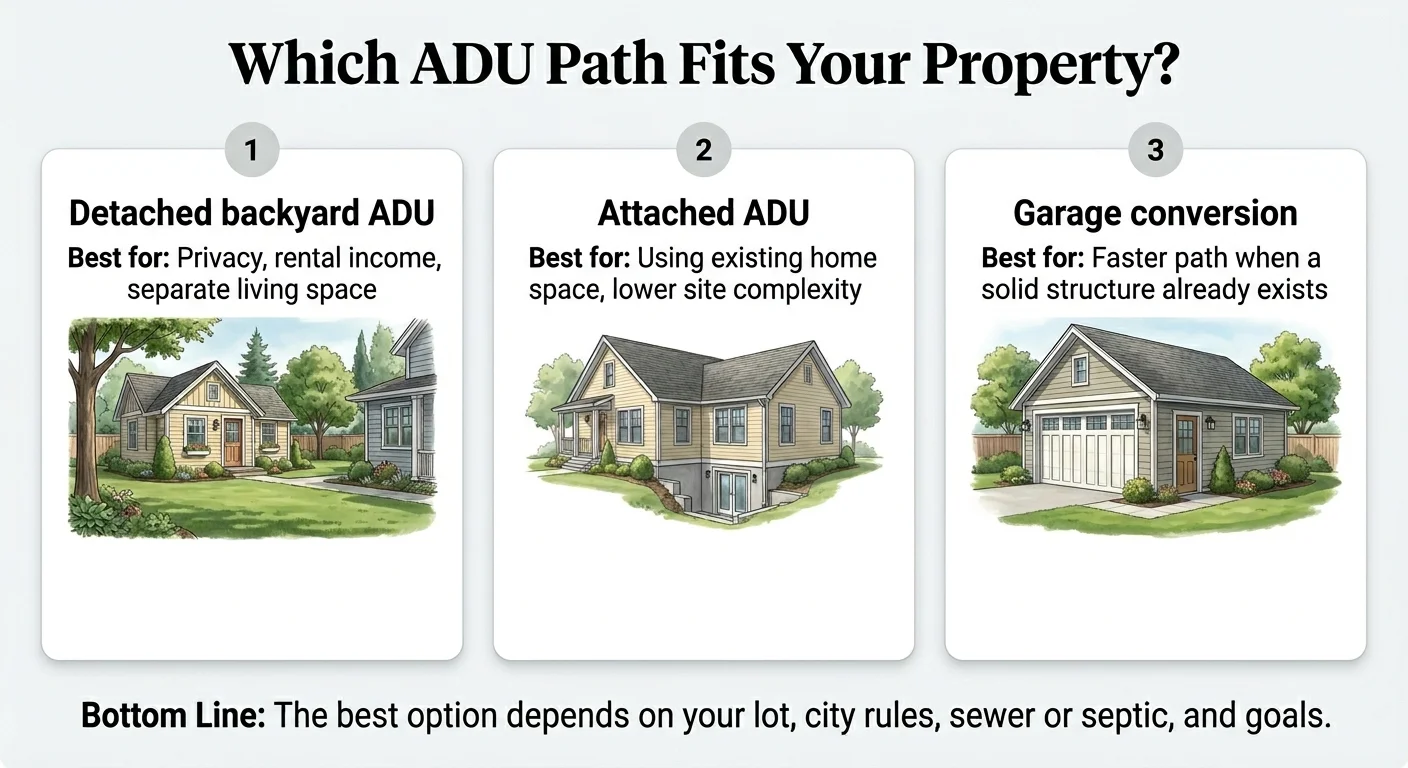
Can I build two detached ADUs on one lot?
In most cases, yes. State law requires cities to allow at least two ADUs in configurations including two detached units (RCW 36.70A.681(2)(c)). Your lot still needs to physically accommodate two structures within setback and lot coverage rules. On smaller lots, one attached plus one detached may be more practical.
Can I convert an existing garage into an ADU?
Yes. State law explicitly requires cities to allow conversion of existing structures, including detached garages (RCW 36.70A.681(2)(c)(iv)). A garage conversion is often the fastest and most budget-friendly path to a functioning ADU — you're starting with a foundation, walls, and a roof. The converted space must meet building code for habitable space: insulation, fire separation, egress windows, electrical, plumbing, and ventilation.
See our garage conversion ADU cost guideDo I have to add parking for the ADU?
If your property is within ½ mile walking distance of a major transit stop, no parking can be required. On lots under 6,000 SF, cities can require at most one space per ADU. On lots 6,000+ SF, at most two spaces per ADU. In practice, many urban Washington homeowners face zero or minimal parking requirements. Check your city's transit map and parking code to confirm.
Can I sell the ADU separately?
Cities cannot prohibit the sale of a condominium unit independently of the principal unit solely because it was originally built as an ADU (RCW 36.70A.681(2)(k)). Some cities also allow unit-lot subdivision. The condo route involves creating a condominium declaration and filing it with the county — a real legal process, but a legitimate pathway to separate homeownership.
Can I use it as an Airbnb or short-term rental?
Maybe. State law allows cities to restrict ADUs from short-term rental use (RCW 36.70A.680(5)(a)), and many do. If your ADU business plan depends on Airbnb income, verify your city's STR ordinance first. Long-term rental use is much more broadly allowed.
What about tiny homes, prefab units, or manufactured homes?
State law doesn't specify construction method — it specifies outcome. If a prefab, modular, or manufactured unit meets the building code requirements that apply to the principal unit, including Washington's energy code, it can qualify as an ADU. Some cities, like Moses Lake, have explicitly allowed tiny homes to serve as ADUs.
See our best prefab ADU companies guideWhat Does the Permit Process Actually Look Like?
Washington law reduced zoning barriers. It did not eliminate the permitting process. You still need plans, applications, reviews, inspections, and a certificate of occupancy. Here’s the typical sequence — timelines and requirements vary by city, so always confirm with your local jurisdiction.
- 1
Confirm jurisdiction, zone, and UGA status
Verify which jurisdiction controls your property (city vs. unincorporated county), your zoning designation, and whether you're inside the urban growth area.
- 2
Check sewer, septic, and critical-area status
This is the step most homeowners skip — and the step that kills the most projects. If you're on septic, contact your local health department. If your lot is in or near a critical area, check the city's critical areas map.
- 3
Choose custom plans vs. pre-approved plans
Several Washington cities offer pre-approved ADU plan sets — including Seattle, Tacoma, Kirkland, Olympia, Renton, Snohomish County, and others. Pre-approved plans can save thousands in design fees and significantly shorten permit review. Seattle's SDCI notes that pre-approved DADU permits can move through review in as little as 2–6 weeks. Custom designs give more flexibility but take longer.
- 4
Submit your permit application
Most cities process ADU permits as Type I — administrative review with no public hearing required. Typical submittals include site plan, floor plans, structural calculations, energy code compliance documentation, and utility connection plan. Incomplete applications are the number-one cause of permit delays. Submit everything the first time.
- 5
Plan review and corrections
Review timelines vary significantly by city and current workload. Expect correction letters. Pre-approved plans dramatically reduce this phase.
- 6
Construction and inspections
Standard milestones: foundation, framing, mechanical/electrical/plumbing rough-in, insulation, and final. Washington's energy code requires above-average insulation and air sealing standards.
- 7
Certificate of occupancy
Pass the final inspection, receive your CO, and the unit is legally habitable.
8 questions to ask before you pay for design work
Is my property inside the UGA? (Contact county planning)
Am I on sewer or septic? (If septic — contact health dept first)
Is my lot in or near a critical area? (Check city GIS maps)
Does my HOA have pre-2023 CC&Rs restricting ADUs? (Read your covenants)
Does my city offer pre-approved ADU plans? (Check city website)
What are my city's current permit fees? (Call planning department)
Is there alley access behind my lot? (This affects DADU siting options)
Am I within ½ mile of a major transit stop? (This affects parking requirements)
If you can answer these eight questions, you’ll know more about your ADU feasibility than 90% of homeowners who start the process.
Already have some answers? See what you can build at your address.
Get Your Free ADU ReportHow to Save Time and Money on a Washington ADU
We won’t pretend ADU construction is cheap. But the biggest savings come from choosing the right path early — not from cutting corners during construction.
Use pre-approved plans where available
Cities offering pre-approved ADU plans are handing you real savings in design costs and weeks of permit review time. Seattle, Tacoma, Kirkland, Olympia, Renton, Snohomish County, and others all have programs. If the plans work for your lot, this is the single highest-leverage move you can make.
Washington pre-approved ADU plans directoryVerify sewer and septic before design
Discovering a septic constraint after you've paid for architectural plans is an expensive lesson. A phone call to the health department costs nothing.
Use the garage conversion path when it fits
Garage conversions start with an existing structure — foundation, walls, roof. The per-square-foot cost is typically significantly lower than new detached construction. If your garage is in decent shape and the location works, this is usually the fastest route.
Garage conversion ADU cost guideWatch for self-certification programs
HB 1353 (2025) introduced detached ADU self-certification provisions that allow certain projects to bypass portions of standard review. Not all cities have implemented this yet — ask your building department.
Tax relief and incentive options
3-year property tax exemption for qualifying improvements
Washington offers a property tax exemption for physical improvements to single-family dwellings, including ADUs, for up to three years after completion. The homeowner must file before the improvement is made, and the improvement must represent 30% or less of the value of the original structure. Contact your county assessor for eligibility details.
Senior/disability property tax exemption
Seniors can receive property tax exemptions for their home and an ADU, for taxes levied for collection in 2025 and after.
Low-income rental ADU tax exemption
Counties with populations of 900,000+ (King County qualifies) and cities within them can offer property tax exemptions for ADUs rented to low-income households. Local legislative authorities must pass a resolution to offer the exemption.
Reduced impact fees statewide
Impact fees capped at ≤50% of principal unit fees. Some cities have waived them entirely.
These provisions have specific eligibility requirements. Confirm directly with the administering agency before relying on any tax provision.
How Washington homeowners typically pay for ADUs
Home equity (HELOC or home equity loan)
For homeowners with significant existing equity who want fast funding. Uses your current home as collateral.
Renovation-focused lending
For homeowners with limited current equity whose property will be worth significantly more after the ADU is built. These products can lend based on after-renovation value — a particularly good fit when the ADU adds substantial value to the property.
Home equity investment (no monthly payments)
For homeowners who are equity-rich but cash-flow constrained — retirees, fixed-income homeowners, aging-parent scenarios. These aren't loans; they're equity investments with no monthly payments. Availability varies by state and provider.
Construction loans
For larger projects, especially new detached ADUs. Typically convert to a permanent mortgage after construction.
We cover each financing path in depth — organized by your financial situation, not by who pays us more.
See ADU Financing OptionsThe Dwelling Index is reader-supported. When you use our links to explore financing options, request prefab pricing, or purchase floor plans, we may earn a commission at no extra cost to you. Our editorial recommendations are based on independent research and are never influenced by compensation. Full disclosure
What Washington ADU Law Means for Common Real-Life Scenarios
Most people searching “Washington ADU laws” aren’t doing academic research. They have a specific situation driving the search. Here’s how the law applies to the most common ones.
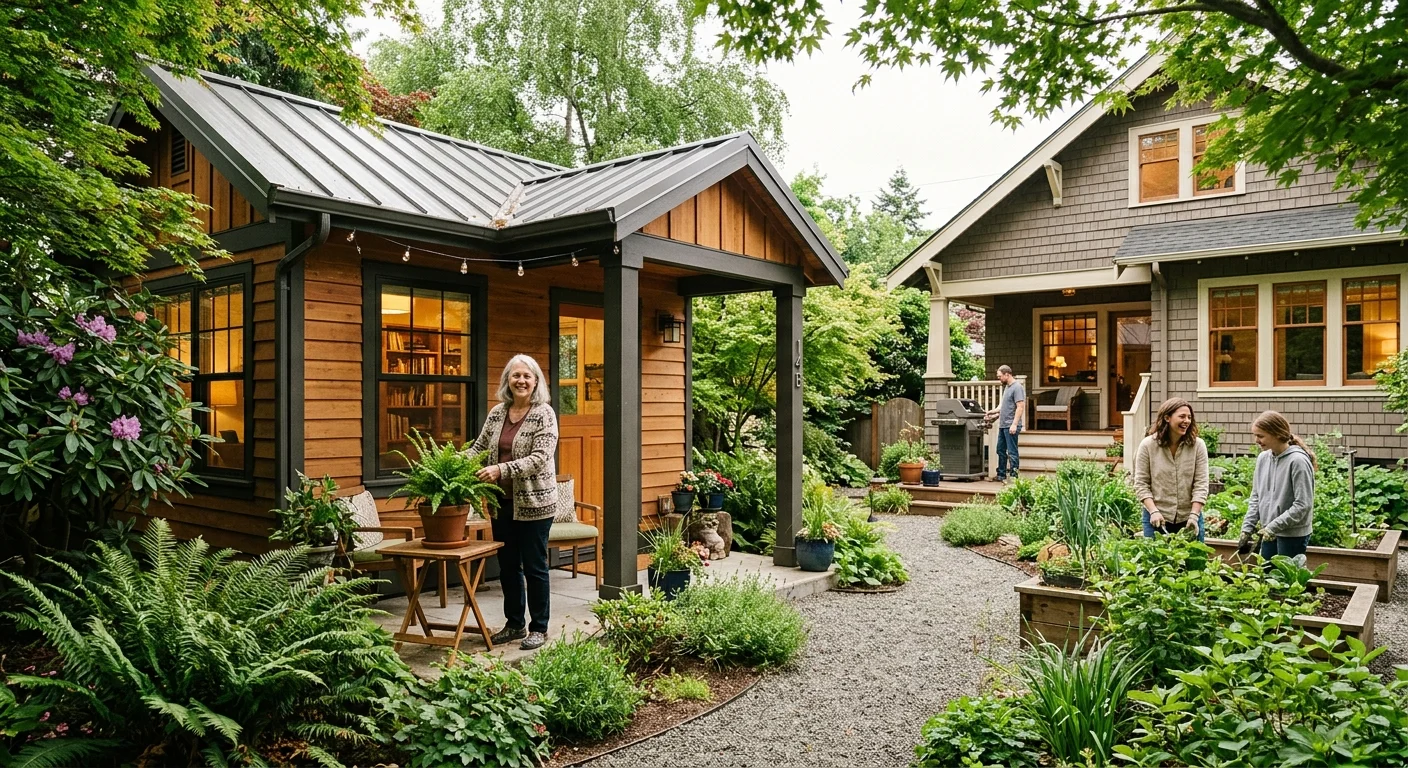
For aging parents or caregivers
A detached ADU gives your parent independence and privacy while keeping them steps away. Washington's elimination of owner-occupancy requirements means your parent can live in the ADU while you live in the main house — no legal complications. The senior property tax exemption can apply. For purpose-built units in the 400–600 SF range, both prefab and custom options are well-suited. This is exactly the kind of project that changes a family's quality of life overnight.
For an adult child or returning family member
Same legal pathway. A basement conversion or attached ADU may be fastest if you have underutilized space. No owner-occupancy requirement means flexibility for everyone.
For long-term rental income
This is where the math gets compelling. With no owner-occupancy requirement, you can build an ADU specifically as an income-producing asset. Rental rates for ADUs vary significantly by city, size, and neighborhood — check current comps in your area. Rental income projections depend on unit size, finish quality, location, and market conditions and are not guarantees of returns.
ADU rental income guide for WashingtonFor a garage conversion on a budget
If you have a detached garage you don't need — or can afford to lose — this is usually the cheapest and fastest ADU path. State law requires cities to allow the conversion.
Garage conversion ADU cost guideFor a rural parcel outside a UGA
Your path is more limited but expanding. If your county has adopted (or plans to adopt) the HB 1345 rural detached ADU provisions after June 11, 2026, you can build one ADU up to 1,296 SF with the conditions described earlier. Contact your county planning department to ask about their timeline and implementation status.
For future resale or separate sale planning
If you're thinking about eventually selling the ADU as a separate unit, plan for it from day one. Build detached with separate utility connections (not sub-metered). Consult a real estate attorney about condo creation or unit-lot subdivision in your jurisdiction. The legal pathway exists — but the details matter.
When Is an ADU Not the Right Move?
We’d rather tell you the truth now than have you waste money finding out later. A few situations honestly don’t work well:
Your site has serious constraints. If your lot has critical area designations, septic problems, severe slope, or limited access, the cost of resolving those issues on top of ADU construction may not pencil out. A feasibility check will tell you this before you spend a dollar on design.
Your HOA has restrictive pre-2023 CC&Rs and won't negotiate. A building permit doesn't shield you from a covenant enforcement action. If your CC&Rs clearly prohibit additional dwellings and your board isn't open to discussion, consult a real estate attorney before going further.
You plan to sell the entire property within 12 months. ADU construction takes time, and the property value increase may not fully materialize until the unit is complete and stabilized. If you need a fast exit, other improvements may offer better ROI on your timeline.
What to consider instead: If a full ADU doesn’t fit your situation right now, an interior renovation (basement or attic improvement that doesn’t create a separate unit) may be simpler. Or start with the feasibility check to understand what’s possible — the answer might be better than you expect.
What Should You Do Next?
You know what Washington law guarantees. You know what cities still control. You know the edge cases. The remaining question is: does your specific property, in your specific city, with your specific site conditions, work?
- 1
Get your free Washington ADU feasibility report
We'll walk you through your jurisdiction, UGA status, sewer/septic, transit proximity, and key constraints, then give you a plain-English summary of what's possible at your address.
Get Your Free ADU Report - 2
Check whether your city offers pre-approved plans
Our Washington pre-approved ADU plans directory has current links for each city program.
See Pre-Approved Plans Directory - 3
When you're ready to think about money, explore financing
Our ADU financing guide breaks down the paths Washington homeowners actually use — organized by your financial situation.
Explore Financing Options
Not sure where to start? See what's possible at your address.
Get your free ADU feasibility report in 60 seconds — no phone call, no sales pitch, just answers.
Get Your Free Washington ADU ReportWant the complete checklist in one place?
Download the free 2026 ADU Starter Kit — everything you need to know before you build, organized by decision stage.
Download Free ADU Starter KitHow We Verified This Page
Source hierarchy: Washington state statutes (RCW) are our primary authority. Washington Administrative Code (WAC) and Department of Commerce guidance are our interpretation layer. Current city municipal codes and official ADU pages are our implementation layer. Builder websites, forums, and news articles inform our understanding of homeowner experience but are never treated as legal authority.
City-by-city verification: Each row in our city matrix was verified against the jurisdiction’s published municipal code or official ADU page as linked in the source column. Where a jurisdiction’s code was still being updated at time of verification, we note preemption status based on the statutory deadline framework.
Update commitment: ADU laws change. We re-verify this page regularly and update the city matrix when jurisdictions adopt new regulations. If you notice something that’s changed, let us know.
Last verified: April 6, 2026 · Primary sources: RCW 36.70A.680, RCW 36.70A.681, RCW 36.70A.696, RCW 64.38.160, WAC 365-196-875, WA Dept. of Commerce ADU Guidance, HB 1345 (Ch. 231, Laws 2026), individual city codes as linked in the matrix
Frequently Asked Questions About Washington ADU Laws
Are ADUs legal everywhere in Washington?
ADUs are broadly legal in Washington's GMA urban growth areas on lots zoned for single-family homes that meet the principal unit's minimum lot-size requirement — which covers the vast majority of the state's population. Outside UGAs, counties may authorize one detached ADU under HB 1345 (effective June 11, 2026) with tighter conditions. Site-specific factors like septic, critical areas, and older HOA covenants can still limit or prevent construction.
How many ADUs can I build on one lot in Washington?
In GMA urban growth areas, at least two — attached, detached, or a combination. On lots of 2,000 square feet or less, cities may limit the total to two ADUs. Outside UGAs, up to one if your county has adopted HB 1345.
Does Washington still require owner occupancy for ADUs?
No. State law prohibits cities from requiring the owner to live in the ADU or any other unit on the same lot. The exception: cities can require owner occupancy as a condition for operating a short-term rental on the property.
What is the maximum size of an ADU in Washington?
Cities cannot cap ADU size below 1,000 gross square feet. Many cities allow larger — Snohomish County allows 1,200 SF, Whatcom County allows up to 1,248 SF.
Can I build an ADU outside an urban growth area?
Potentially. Under HB 1345 (Chapter 231, Laws of 2026, effective June 11, 2026), counties can authorize one detached ADU per parcel in rural areas, subject to conditions including a 1,296 SF size limit, siting within 150 feet of the primary home, shared driveway, and water/septic compliance. Your county must opt in. Contact county planning for status.
Can I build an ADU on septic?
It depends. State law explicitly allows cities to prohibit ADUs on lots without public sewer. Even where not prohibited, your septic system must have capacity. Contact your local health department to verify before investing in plans.
Can my HOA stop me from building an ADU?
Post-July 2023 associations in UGAs generally cannot adopt CC&Rs imposing ADU restrictions that local governments are barred from imposing, with exceptions for associations protecting public health, safety, and on-site-wastewater-related water quality (RCW 64.38.160). Pre-2023 CC&Rs remain enforceable. Read your covenants and consult a real estate attorney if they restrict ADUs.
Can I convert an existing garage into an ADU?
Yes. State law requires cities to allow conversion of existing structures into ADUs (RCW 36.70A.681(2)(c)(iv)). The converted space must meet building code for habitable space.
Do I need to add parking for an ADU?
Within ½ mile of a major transit stop: no. On lots under 6,000 SF: max one space per ADU. On lots 6,000+ SF: max two spaces per ADU. Additional state laws eliminate parking requirements near rail/BRT stations and for small residences in larger cities.
Why do some sources say ¼ mile and others say ½ mile for parking exemptions?
The ADU statute uses ½ mile from a 'major transit stop.' Some cities had existing ¼-mile exemptions under earlier ordinances, and other state laws use different distance thresholds. The ½-mile rule in HB 1337 provides the statewide floor; your city may offer broader exemptions.
Can I sell the ADU separately from the main house?
Cities cannot prohibit the sale or conveyance of a condominium unit independently of the principal unit solely because it was built as an ADU (RCW 36.70A.681(2)(k)). Condo creation and recording requirements still apply. Some cities also allow unit-lot subdivision.
Can I use an ADU as a short-term rental?
State law allows cities to restrict ADU use as STRs, and many do. Seattle requires an STR license and limits STRs to the operator's primary residence. Spokane requires owner occupancy if the lot has an STR. Verify your city's rules first.
Do tiny homes or prefab units count as ADUs in Washington?
They can, if they meet the building code standards applicable to the principal unit. State law doesn't specify construction method. Some cities, like Moses Lake, have explicitly allowed tiny homes as ADUs.
Which Washington cities have pre-approved ADU plans?
As of April 6, 2026: Seattle, Tacoma, Kirkland, Olympia, Renton, Snohomish County, and East Wenatchee. Bellevue is actively developing a program. Pre-approved plans save significant design time and cost.
What if my city's website still says only one ADU or requires owner occupancy?
If your city has passed its periodic-update deadline without adopting HB 1337-compliant regulations, state law automatically supersedes conflicting local rules (RCW 36.70A.680(1)(b)). Reference the RCW and contact the WA Dept. of Commerce if you encounter resistance.
Is there any tax relief for building an ADU in Washington?
Yes. Washington offers a 3-year property tax exemption for qualifying improvements to single-family dwellings (must file before improvement, improvement must be 30% or less of original structure value). Seniors can receive property tax exemptions covering their home and ADU (RCW 84.36.383). Counties with 900,000+ population can offer exemptions for ADUs rented to low-income households (RCW 84.36.400). Confirm eligibility directly with the administering agency.
Related Guides
Last verified: April 6, 2026. This guide is for informational purposes only and does not constitute legal advice. ADU regulations vary by state, city, county, and parcel. Washington’s ADU laws are evolving — always confirm current rules with your local planning and building department, and consult a licensed attorney for questions about HOA covenants, condo creation, or compliance. The Dwelling Index is an independent educational resource — we are not a lender, contractor, builder, or attorney. Full affiliate disclosure · Editorial methodology