
Prefab vs. Site-Built ADU Cost: Which Is Actually Cheaper?
If you're comparing prefab vs. site-built ADU cost, the honest answer is that prefab is not automatically cheaper once you compare total installed cost.
The base price of a prefab unit does look lower than a site-built quote — sometimes dramatically so. But that number is typically missing the foundation, site prep, utility connections, delivery, crane fees, and permits that most prefab companies leave out of their advertised price. Once you compare what actually matters — total installed cost, meaning everything from contract signing to certificate of occupancy — the gap shrinks considerably. On some lots it closes entirely.
So why does anyone go prefab? Because the real advantage often isn't price. It's speed (months faster to move-in), cost predictability (fewer surprise change orders), and less backyard chaos during the build. Site-built wins on customization, lot flexibility, and design control — and for manufactured homes built to HUD code rather than local building code, site-built also has an edge on financing and appraisal treatment.
The right answer depends on your lot, your timeline, and what you're building the ADU for. This page breaks down the real numbers — with current published data from prefab manufacturers — so you can compare apples to apples instead of guessing.
The Dwelling Index is reader-supported. When you use our links to explore financing options or request prefab pricing, we may earn a commission at no extra cost to you. Our editorial recommendations are based on independent research and are never influenced by compensation. Read our full affiliate disclosure →
The All-In Cost Comparison Most Pages Won't Show You
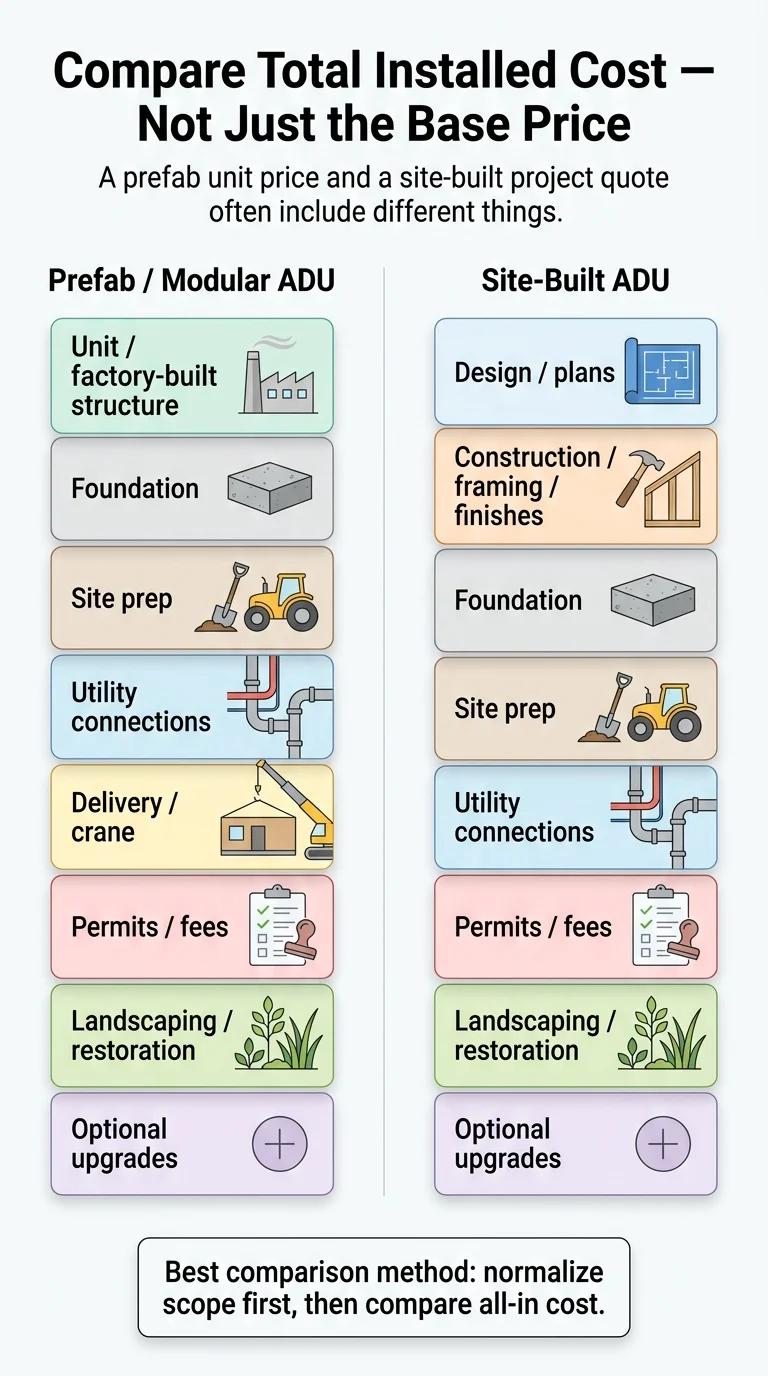
Most cost comparisons fall apart at the starting line because they're comparing different scopes. A prefab "starting at $152,000" quote typically covers the unit itself — the structure that ships from the factory. A site-built "$250,000" bid usually covers design, permits, foundation, framing, finishes, utilities, and landscaping. Comparing those two numbers is like comparing the sticker price of a car to the total cost of owning one.
Here's what the comparison actually looks like when you normalize for scope.
| Cost Category | Prefab / Modular | Site-Built / Stick-Built | Notes |
|---|---|---|---|
| Design & Architecture | $0–$3,000 (built into base) | $8,000–$25,000 | Prefab uses pre-approved or standardized plans |
| Unit / Construction | Varies widely by company and size (see vendor table below) | $120,000–$280,000+ | Biggest line-item difference |
| Foundation | $8,000–$22,000 | $8,000–$22,000 | Nearly identical for both methods |
| Site Prep & Grading | $3,000–$12,000 | $3,000–$12,000 | Nearly identical |
| Utility Connections | $5,000–$18,000 | $5,000–$18,000 | Depends on run distance, panel capacity |
| Transport & Crane | $5,000–$15,000+ | $0 | Prefab-only cost; often excluded from base price |
| Permits & Fees | $2,000–$17,000+ | $2,000–$17,000+ | Same municipality, same fees; Abodu notes ~$17K avg |
| Contingency (10–15%) | Varies | Varies | Site-built tends to have more scope variability |
What this table shows
The shared costs — foundation, site prep, utilities, permits — are roughly the same regardless of build method. The prefab cost advantage lives almost entirely in the unit/construction line item. Once you stack the shared costs on top, the percentage difference between total project costs narrows significantly.Quick Comparison: Prefab vs. Site-Built on Everything That Matters
Cost isn't the only thing that changes between these two methods. Here's the full side-by-side.
| Factor | Prefab / Modular | Site-Built | Edge |
|---|---|---|---|
| Cost predictability | High — fewer change orders | Medium — scope creep is common | Prefab |
| Total project timeline | 4–8 months | 8–14 months | Prefab |
| On-site construction time | 2–6 weeks | 3–6 months | Prefab |
| Backyard disruption | Minimal — most work off-site | Months of noise, dust, crews | Prefab |
| Design customization | Limited — set floor plans | Fully custom — any layout, material, style | Site-Built |
| Lot flexibility | Needs crane access, flat terrain | Works on nearly any buildable lot | Site-Built |
| Material quality | Standardized factory materials | Your choice — standard to high-end | Site-Built |
| Future modifications | Very difficult | Standard renovation applies | Site-Built |
| Property value impact | Depends on code path, design, local comps | Custom integration supports stronger comps | Varies |
| Financing & appraisal | Modular/panelized (local code): same as site-built per Fannie Mae. HUD-code manufactured: different rules. | Full conventional treatment | Depends on code |
| Best for | Speed, simplicity, flat accessible lots, standard layouts | Difficult lots, design-sensitive neighborhoods, larger custom units | — |
Prefab's advantages cluster around speed, simplicity, and predictability. Site-built's advantages cluster around flexibility, adaptability, and control over the final product. Neither method is universally better — your lot and your goals decide.
When Does Prefab Actually Save You Money?
Prefab's cost advantage is real — when the conditions are right. Here's when the math genuinely works in prefab's favor:
Your lot is flat and accessible
Wide driveway or open side yard, no overhead power lines or mature trees in the delivery path, minimal grading needed. This is the scenario where prefab installation costs stay close to the manufacturer's estimates.
You want a standard-size studio or one-bedroom (400–700 SF)
The smaller and simpler the unit, the more prefab's factory efficiency matters relative to total cost. At 400 SF, the fixed site costs are the same for both methods — so the unit price difference has more impact on the final total.
Speed matters more than customization
Aging parent needs housing soon. You're paying rent you could replace with ADU income. You need a home office by fall. Prefab's parallel construction — the unit is being built in a factory while your site is being prepped — can meaningfully shorten your timeline.
You don't want your backyard torn up for months
With prefab, the heavy on-site work (foundation, utilities, crane day, hookup) compresses into a few weeks. Site-built means a construction zone in your backyard for months.
You're comfortable with standard floor plans and finishes
If you don't need a custom layout, vaulted ceilings, or specific architectural details to match your main home, prefab gives you a finished product at a lower design cost.
When those conditions line up, prefab is the faster, calmer, and often less expensive path.
Prefab might be your move? Compare prefab ADU companies — see pricing, floor plans, and what's included.
Affiliate disclosure: Some links connect to companies we partner with. We earn a commission at no cost to you. See our full disclosure →
When Is Site-Built the Better Value — Even If the Quote Is Higher?
There are situations where paying more upfront for site-built construction is the smarter move long-term. These situations are more common than prefab marketing would have you believe.
Your lot is tight, sloped, or has access issues
Narrow side yards, overhead power lines, steep grades, mature trees you can't remove. On these lots, prefab delivery ranges from expensive to impossible. Site-built contractors frame on-site and don't need crane clearance.
Your setbacks or zoning require a specific footprint
Prefab units come in fixed dimensions. If your lot's setback requirements, easements, or unusual shape demand a non-standard footprint, site-built is often the only realistic option.
You want the ADU to match your home's architecture
If you live in a Craftsman bungalow, a mid-century modern, or a neighborhood with design review requirements, a prefab box may look out of place. Site-built lets you match rooflines, siding, window styles, and proportions.
You're building larger than 800 SF or a two-bedroom unit
As ADU size increases, prefab's factory cost advantage shrinks because the fixed site costs become a smaller share of total cost. For larger units, the all-in gap narrows — and the customization flexibility of site-built becomes more valuable per dollar spent.
You plan to use the ADU for long-term rental income
Higher-quality finishes and a custom design can help command better rent and attract quality tenants. Design integration with the main home also tends to support stronger comparable sales data when the property is appraised or sold.
You might expand or modify the ADU later
Factory-built modular units are extremely difficult to renovate or expand. Site-built ADUs can be modified using standard construction methods — add a patio cover, enclose a porch, or reconfigure interior walls.
The 3 Types of "Prefab" — And Why It Matters for Your Wallet
The word "prefab" gets used loosely, but it covers three different construction methods with meaningfully different cost profiles, code requirements, and financing implications. Know which one you're looking at before you sign.
Modular ADUs
Code: International Residential Code (IRC)
Built as complete three-dimensional boxes (or sections) in a factory, then transported and craned onto a prepared foundation. Built under the IRC as administered by the responsible state agency. This is typically the highest-quality prefab option.
Panelized ADUs
Code: Local building codes
Walls, roof sections, and floor components are manufactured as flat panels in a factory, then shipped to your site and assembled by a local crew. Offers more layout flexibility than modular because panels can be configured to fit non-standard footprints.
Manufactured ADUs (HUD Code)
Code: Federal HUD Code (24 CFR Part 3280)
Built on a permanent steel chassis in a factory. Regulated under federal HUD Code — a completely different standard than local building code. This distinction matters significantly for financing and appraisal.
Why the code path matters
Modular homes built under IRC and panelized/sectional housing that conforms to local building codes receive the same treatment as site-built housing by Fannie Mae when classified as real property and permanently attached to the foundation.
Manufactured homes built to HUD Code follow a separate underwriting and appraisal framework. Some lenders won't finance them for ADU purposes at all. Before you commit to any prefab option, ask: Is this unit built to local/state building code or HUD code?
Does It Appraise and Finance the Same?
Modular and panelized ADUs
That conform to applicable building codes and are permanently attached → Fannie Mae treats these the same as site-built (Fannie Mae Selling Guide, Sections B2-3-02 and B4-1.4-02, verified April 2026). Your lender should too, though individual lender overlays vary.
Manufactured ADUs (HUD code)
Different financing pathway with specific requirements including permanent foundation certification. Some lenders exclude these entirely. Manufactured housing (HUD code) follows a separate appraisal and underwriting framework that may limit valuation.
If you plan to refinance after construction, pull equity through a HELOC, or sell the property, how your ADU is appraised matters as much as what you paid to build it. The appraisal value of any ADU depends primarily on local comparable sales, design quality, and integration with the property — not just the build method.
Financing Paths Worth Knowing About
Strong existing home equity
Home Equity Line of Credit (HELOC)
A standard HELOC gives you fast access to funds that work for either build method. Only pay interest on what you draw.
Low current equity but ADU adds significant value
Renovation HELOC (After-Value Lending)
Lends based on after-renovation value — can unlock funding that a standard HELOC can't. Note: not available in all states.
Explore Renovation Financing at RenoFiEquity-rich but cash-flow limited
Home Equity Investment — No Monthly Payments
Common with retirees and aging-parent use cases. You share a portion of future appreciation instead of making monthly payments. Limited state availability — confirm before applying.
Investment / rental-income focus
Construction Loan or Investor Products
Construction loans and investor-focused products designed for income-producing property additions.
We cover every financing path in detail on our ADU financing guide →. The key point: don't let the financing tail wag the build-method dog. Choose the right construction approach for your lot and goals first, then find the financing that fits.
Which Lots Favor Prefab — And Which Favor Site-Built?
Your lot decides more ADU projects than any marketing brochure. Here's a practical screening checklist. These are general heuristics, not universal rules — always confirm specific access, grade, and clearance requirements with your chosen vendor and local installer.
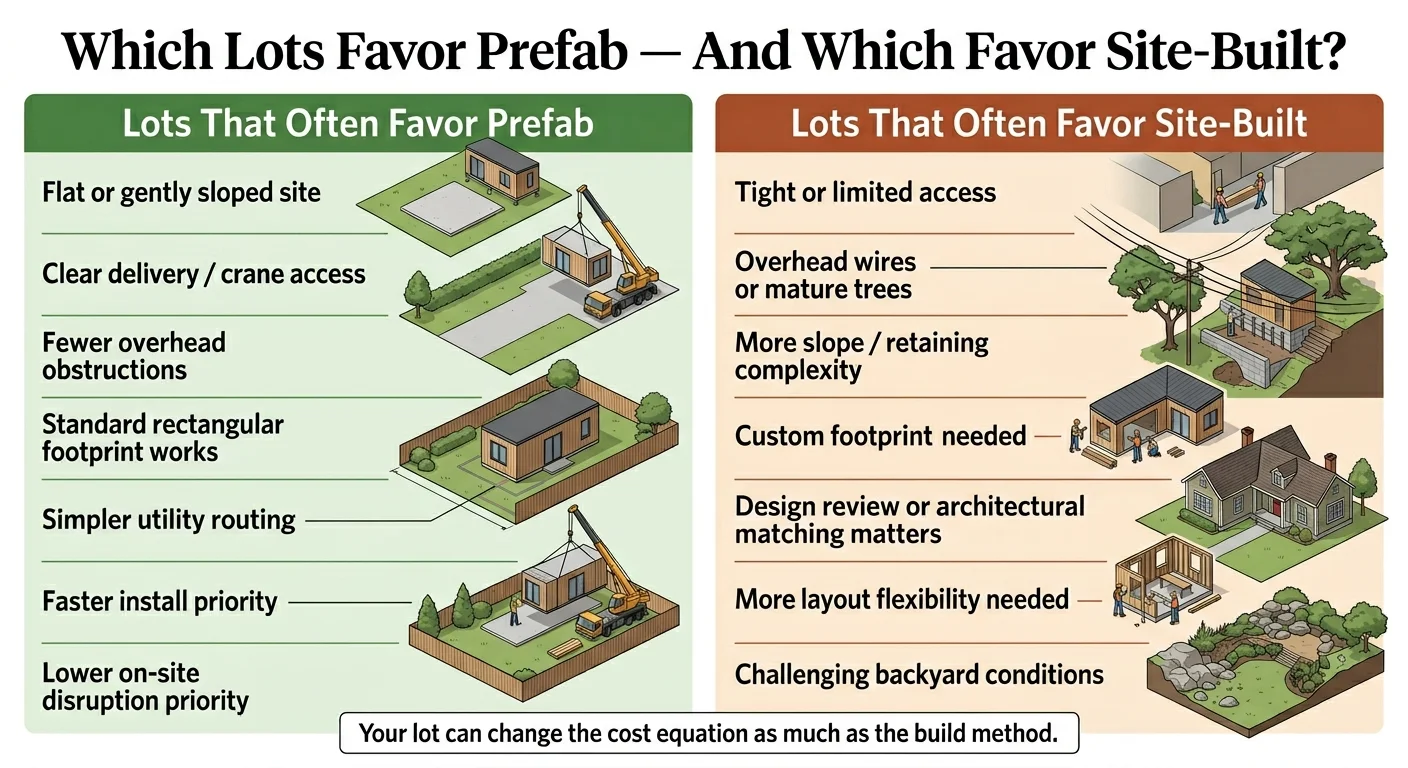
Your lot likely works for prefab if:
- Side yard or driveway has a clear, reasonably wide path to the backyard
- No overhead power lines, large trees, or structures blocking the crane path
- Building area is relatively flat with minimal grading needed
- Connected to municipal sewer (not septic)
- Main electrical panel has capacity or is easily upgradeable
- Utility connections are a reasonable distance from the main house
- No HOA or design review requiring specific architectural matching
Site-built is likely better if:
- Side access is narrow or blocked
- Overhead power lines or mature trees are in the delivery path
- Lot has a significant slope requiring retaining walls or stepped foundation
- You're on septic (may need system upgrade)
- Setbacks require a non-standard footprint (L-shape, narrow, or unusual dimensions)
- HOA or historic district design review requires matching architecture
- The project needs extensive customization that fixed prefab models can't accommodate
If your lot hits two or more items on the second list, prefab may cost as much or more than site-built once you solve the access, grading, and customization challenges. That's the scenario where the base price advantage evaporates.
Not sure what's possible on your specific lot? Our feasibility report checks your lot, zoning, and local rules in about 60 seconds.
See What You Can Build — Get Your Free ADU ReportHow Much Faster Is Prefab in Real Life?
Prefab companies love to say "installed in two weeks." That's technically true — the on-site installation of a modular unit can happen in days. But it's misleading because it skips the months of work that happen before and after crane day.
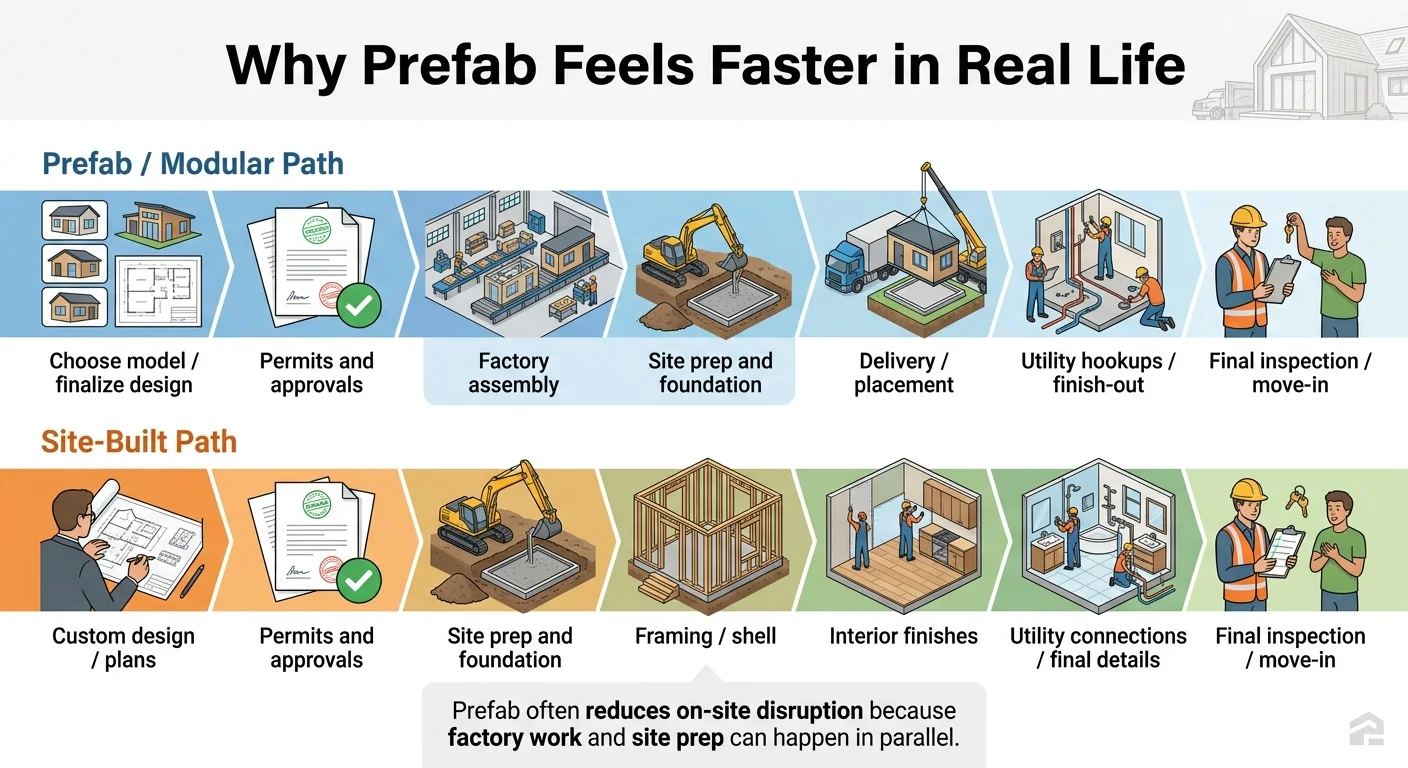
Prefab ADU: Realistic Full Timeline
| Phase | Duration |
|---|---|
| Design selection & contract | 2–4 weeks |
| Permitting | 4–12 weeks |
| Factory manufacturing | 6–16 weeks |
| Site prep & foundation | 2–4 weeks |
| Delivery & installation | 1–2 weeks |
| Utility hookup & inspection | 2–4 weeks |
| Total | 4–8 months |
Site-Built ADU: Realistic Full Timeline
| Phase | Duration |
|---|---|
| Design & engineering | 4–8 weeks |
| Permitting | 6–16 weeks |
| Construction | 12–24 weeks |
| Final inspection & CO | 2–4 weeks |
| Total | 8–14 months |
A note on pre-approved plans: In California, detached ADUs using a plan preapproved by the local agency or another agency within the state are subject to a 30-day approval window, versus the standard 60 days. Check whether your city has a pre-approved plan program and whether your preferred prefab model is on the list. (Source: California HCD ADU Handbook, verified April 2026)
What Prefab Companies Are Actually Charging (Vendor-Verified Data)
Rather than vague national averages, here's what specific prefab companies publicly state about their pricing and scope. This is the comparison data most pages won't publish because it requires checking each manufacturer's current pricing.
Affiliate disclosure: Some companies listed below are affiliate partners. Our editorial placement is based on scope transparency, not compensation. See our full disclosure →
Abodu
CA, and expandingPublished pricing: Studio (340 SF): $278,800 base / ~$300,500 avg with upgrades. 1BR (500 SF): $326,800 base / ~$352,500 avg. 2BR (610 SF): $360,800 base / ~$392,500 avg. 2BR/2BA (800 SF): $426,800 base / ~$478,800 avg.
Included in base
Unit, foundation, permit services, pre-approved plans, delivery & installation, standard utility connections
Key exclusions
Trenching beyond 50 ft, craning beyond 100 ft, demolition, tree removal, unique site engineering, sales tax & permit fees (~$17K avg)
Samara
CaliforniaPublished pricing: Studio (420 SF): from $152,000. 1BR (540 SF): from $170,000. 2BR (690 SF): from $190,000. XL 8 (800 SF): from $249,000. XL 10 (950 SF): from $277,000. All 'plus installation.'
Included in base
Unit and design. Base installation includes permit allowances, standard foundation, utility allowances (100 ft sewer, 75 ft electrical, 50 ft water), crane, traffic control, stairs, solar, final cleaning.
Key exclusions
Costs beyond base installation allowances, complex site conditions
Studio Shed / Studio Home
Ships nationwide (panelized kit)Published pricing: Panelized kit pricing via 3D Design Center. Summit 1000 (1,000 SF): shell from $93,581. Final installed cost varies significantly with interiors and installation.
Included in base
Shell/structure with standard exterior finishes. Interior lifestyle packages available at additional cost.
Key exclusions
Foundation, site prep, utilities, permits, installation labor (available through their ProAssembly network)
Villa Homes
California and ColoradoPublished pricing: Estimate-based → feasibility study → final pricing
Included in base
Turnkey model includes plans, permit research/facilitation, local and state permit fees, site prep, foundation, utility hookups with up to 100 ft of trenching, delivery, installation/finishing
Key exclusions
Complex sites, major utility upgrades, costs beyond standard allowances
Pricing reflects publicly available information as of April 2026. Confirm directly with each company for current pricing and service area. Scope and inclusions change — request a written scope document before signing.
Want to explore prefab options side by side?
See All Prefab ADU Companies — Compare Pricing, Floor Plans & What's IncludedWorked Examples: Three Projects Where the Right Answer Changes
Numbers matter more than theory. Here are three modeled scenarios showing how the "which is cheaper?" answer shifts based on lot conditions and project goals. These are illustrative examples based on published pricing and typical contractor ranges, not quotes for a specific project. Your costs will differ based on your location, lot, and chosen companies.
Scenario A
Flat Suburban Lot, Studio for Aging Parent
The situation: Flat, accessible backyard, wide driveway, no overhead wires, municipal sewer. Need a ~420–450 SF studio for an aging parent, as fast as possible.
A turnkey prefab provider can deliver a finished unit in 4–6 months with predictable pricing and minimal backyard disruption. On an easy lot like this, installation costs stay within standard allowances and the total project cost is likely lower than a comparable site-built project — with months of time saved. For someone who needs housing for a parent soon, that speed advantage is worth real money.
Scenario B
Tight Urban Backyard, 650 SF One-Bedroom Rental
The situation: Narrow 7-foot side access, overhead power lines, small backyard in a city neighborhood. Want a 650 SF one-bedroom unit to rent for income.
Crane delivery may be difficult or impossible with narrow access and overhead wires. Special rigging costs eat into prefab's price advantage. A site-built unit can be designed to maximize the tight lot, match the main home for better rental appeal, and avoids the delivery logistics entirely. A panelized approach could be a middle ground.
Scenario C
Sloped Lot, 800 SF Two-Bedroom for Maximum Rental Income
The situation: Sloped backyard, mature trees, hillside neighborhood. Want an 800 SF two-bedroom ADU that matches a Craftsman-style home and commands top-of-market rent.
The slope drives up any prefab installation with retaining walls and complex crane positioning. Architectural mismatch between a standard prefab box and a Craftsman home would require costly exterior modifications. A custom site-built design integrates naturally with the property, supports stronger comparable sales data at appraisal, and premium finishes help command higher rent.
These are illustrative examples, not guarantees of outcomes. Actual costs depend on your local market, specific lot conditions, construction costs, and regulatory requirements.
The One Mistake That Costs Homeowners the Most Money
The single most expensive mistake in the ADU comparison process is comparing a prefab base price to a site-built all-in quote.
Other common mistakes to avoid:
Not checking lot feasibility before putting money down
Some prefab companies require substantial deposits before manufacturing begins — Abodu's payment schedule starts with 10% of the unit contract at signing, then 40% when manufacturing begins. If your lot turns out to be inaccessible, you may be locked in.
Assuming prefab timeline claims at face value
"Installed in two weeks" and "ready in 10 weeks" are marketing claims about the best-case scenario. Factory backlogs, permitting delays, and site complications routinely extend timelines. Get a contractual completion date, not a marketing estimate.
Not getting everything in writing
What's included? What's excluded? Who handles permits? Who manages site work? What happens if costs exceed the estimate? For both prefab and site-built, the written scope document is your protection.
How to Compare Quotes Apples-to-Apples
Before you decide anything, normalize every quote into the same format. Here's the framework:
The Quote Comparison Worksheet
Ask every prefab company and every site-built contractor to break their pricing into these categories:
| Line Item | Prefab Quote | Site-Built Quote |
|---|---|---|
| Design / architecture | — | — |
| Permits and fees | — | — |
| Foundation | — | — |
| Site prep and grading | — | — |
| Utility connections (sewer, water, electric, gas) | — | — |
| Electrical panel upgrade (if needed) | — | — |
| Unit / construction | — | — |
| Delivery and crane (prefab) | — | — |
| Interior finish package | — | — |
| Exterior finishes | — | — |
| Landscaping restoration | — | — |
| Demolition / removal | — | — |
| Sales tax | — | — |
| Contingency allowance | — | — |
| Total all-in | — | — |
6 Questions to Ask Every Prefab Company
- 1What is included in your base price and what is excluded? Can I see the exclusion list in writing?
- 2Who handles the foundation, site prep, and utility connections — you or a local subcontractor I hire separately?
- 3What are the delivery requirements — access width, crane clearance, overhead wire clearance?
- 4What is your current factory lead time? What happens if it extends?
- 5What deposit is required and what is refundable if the project doesn't proceed?
- 6Is this unit built to local/state building code or HUD code?
5 Questions to Ask Every Site-Built Contractor
- 1Is this a fixed-price bid or an estimate with allowances?
- 2What is your change order policy and pricing?
- 3What is your realistic timeline given current permit review times in my city?
- 4Do you handle design, permits, and construction — or do I need separate contracts?
- 5What warranty do you provide on construction?
Take the worksheet with you
We've built this worksheet into our free 2026 ADU Starter Kit — along with a budget tracker, permitting timeline template, and contractor vetting guide.
Download the Free 2026 ADU Starter KitWhat Matters More Than Cost: Choosing by Use Case
Homeowners don't build ADUs for abstract reasons. You're building for a specific person or purpose — and the right build method changes with the "why."
Aging parent or family member who needs housing soon
Prefab usually wins.
Speed-to-occupancy matters more than custom details, and a standard accessible layout serves the purpose well. A turnkey provider on an accessible lot can have your parent moved in months sooner than a site-built approach.
Long-term rental income (12+ month leases)
Site-built has the edge in most markets.
Custom finishes and a design that matches your home can help attract quality tenants and support higher rent. Rental outcomes depend on your local market and execution quality.
Short-term rental (Airbnb/VRBO where local rules allow)
Either can work well.
A clean, modern prefab unit photographs well. A custom site-built design offers more character. Check local STR regulations before building.
Home office or creative studio
Prefab is often ideal.
Standard layouts work well for workspace use cases, and the speed advantage means you're productive faster.
Guest house or flex space
Either works.
If primarily for occasional guests, prefab's simplicity and speed make sense. If you want a space that could flex between guest use, rental, and family use over the years, site-built's adaptability is worth considering.
Resale and neighborhood fit
Site-built often has an edge.
A custom ADU that looks like it was always part of the property tends to perform well in appraisals and with buyers. In design-sensitive neighborhoods, this can matter more than the cost difference between build methods.
Frequently Asked Questions
Is a prefab ADU actually cheaper than site-built?
Often at the unit-price level, yes. But once you compare total installed cost — including foundation, site prep, utilities, delivery, and permits — the gap narrows significantly. On challenging lots, prefab can end up costing the same or more. Prefab's strongest advantages are cost predictability and speed, not just sticker price.
What does a prefab ADU cost fully installed?
It depends heavily on the company, model, and site conditions. Turnkey providers like Abodu publish average total prices from approximately $300,500 for a 340 SF studio to approximately $478,800 for an 800 SF two-bedroom, plus permit fees and taxes averaging ~$17,000 (Abodu pricing, verified April 2026). Unit-only providers start lower for the kit but require separate installation, foundation, and permitting budgets.
How long does a prefab ADU actually take?
Realistically, 4–8 months from contract signing to move-in. The 'installed in two weeks' figure refers only to on-site assembly. Permitting, factory manufacturing, site preparation, and final inspections add months to the actual timeline.
Do prefab ADUs need permits?
Yes. Every ADU requires building permits from your local jurisdiction regardless of construction method. Prefab units with pre-approved plans may move through plan review faster, but the requirement is the same. Permits ensure proper placement, foundation, utility connections, and code compliance.
Can I finance a prefab ADU with a HELOC?
Yes. HELOC funds can be used for either build method. However, some prefab companies require large upfront deposits before manufacturing — make sure your funding timeline aligns with the payment schedule. Modular and panelized ADUs that conform to applicable building codes are generally treated the same as site-built for lending purposes. Manufactured ADUs built to HUD code may require different loan products.
Does a prefab ADU increase property value the same as site-built?
For modular and panelized ADUs that conform to local building code, Fannie Mae gives the same treatment as site-built housing (Fannie Mae Selling Guide, B2-3-02). Actual property value impact depends on design integration, quality of construction, and local comparable sales — not just the build method. Manufactured homes (HUD code) follow a separate appraisal framework.
What's the difference between modular, panelized, and manufactured ADUs?
Modular ADUs are built as complete sections in a factory under IRC as administered by the state agency, then craned into place. Panelized ADUs arrive as flat wall and roof panels assembled on-site — they must conform to local building codes. Manufactured homes are built on a permanent chassis to federal HUD Code (24 CFR Part 3280) — a different regulatory and financing pathway. The distinction matters for appraisal, financing, and resale.
What if my side yard is too narrow for a crane?
Modular prefab likely isn't feasible for your lot. Panelized prefab (flat panels carried through narrower access) or site-built construction are your alternatives. Some panelized systems can be delivered through relatively narrow access points. Confirm specific requirements with the manufacturer.
Are prefab ADUs allowed everywhere?
ADUs are governed by both state law and local zoning and building rules. Many states have passed ADU-friendly legislation, but your city or county ultimately determines what's allowed on a specific property. Some municipalities have rules about specific construction types. Check with your local planning department before committing.
Is panelized the middle ground between prefab and site-built?
In many ways, yes. Panelized ADUs offer more customization than modular (panels can be configured to fit non-standard footprints), don't typically require crane access, conform to local building code, and still benefit from factory efficiency. The tradeoff is more on-site assembly time than modular, but less than a full site-built project.
Which build method is better for rental income?
It depends on your market and timeline. Site-built ADUs with custom finishes and design integration can support higher monthly rent. But if prefab gets you renting months sooner, those extra months of rental income offset some or all of a rent-per-month difference. Run the numbers for your specific market and timeline.
What hidden costs should I watch for in a prefab quote?
Foundation, site preparation, utility trenching and connections, delivery/transport, crane fees, engineering and soil reports, permit fees, sales tax on the unit, interior/exterior upgrades, and landscaping restoration. The total of these items can add tens of thousands to the advertised base price. Always get a written scope document that lists exactly what's included and excluded.
Do prefab ADUs need a foundation?
Yes. Every permanent ADU requires a foundation. The type (slab, pier, raised) depends on your lot conditions and local code. Foundation cost is typically $8,000–$22,000 and is outside the unit price for many (though not all) prefab companies.
Can I use pre-approved plans to speed up permitting?
In some jurisdictions, yes. In California, detached ADUs using a plan preapproved by the local agency or another agency within the state are subject to a 30-day approval window, versus the standard 60 days for completed applications on lots with an existing dwelling (California HCD ADU Handbook). Check with your local planning department for available options.
Our Methodology and Sources
Cost data
Published prefab manufacturer pricing pages verified April 2026: Abodu, Samara, Studio Shed/Studio Home, and Villa Homes. Site-built ranges reflect general contractor bid data across multiple U.S. markets and published permit fee schedules.
Definitions
"Installed cost" means total project cost from design through certificate of occupancy, including foundation, site prep, utility connections, permits, and the structure itself. "Base price" or "unit price" means the manufacturer's quoted price for the unit, which varies in scope by company.
Regulatory citations
Fannie Mae Selling Guide, Sections B2-3-02 and B4-1.4-02 for financing treatment of factory-built housing. HUD regulations (24 CFR Part 3280) for manufactured housing standards. California HCD ADU Handbook for permitting timeline examples.
Last data verification: April 2026. We update this page quarterly as new pricing becomes available. Affiliate relationships are disclosed near every affiliate link and in our full affiliate disclosure. Editorial recommendations are never ranked or prioritized by compensation.
The Verdict
Prefab ADUs are a great option — for the right lot, the right project, and the right expectations. They are not a universal shortcut to a cheaper ADU. The base price advantage is real but the total installed cost difference depends heavily on your site conditions and the scope included in the quote.
Choose Prefab
- Accessible, flat lot
- Standard layout needed
- Speed and cost predictability matter
- Don't need extensive customization
Choose Site-Built
- Challenging lot conditions
- Custom design to match your home
- Non-standard footprint needed
- Optimizing for long-term flexibility
Choose Either
- After comparing total installed costs
- Using the same line items
- Not after comparing a prefab sticker to a site-built project bid
The right build method is the one that gets you the ADU you actually want, on the lot you actually have, for a price you actually understand. And the best first step is always the same: find out what's possible on your specific property.
© 2026 The Dwelling Index. All rights reserved. Editorial Standards → · Full Affiliate Disclosure → · Privacy Policy →