How Much Does an ADU Cost in 2026? Real Prices by Type and Size
How much does an ADU cost? Most U.S. homeowners spend between $100,000 and $300,000 to build a legal accessory dwelling unit. Garage conversions can come in around $80,000. A new detached unit in a high-cost metro can push past $400,000. The number that matters for your project depends on three things: what type of ADU you build, how big it is, and where you live.
That range is wide on purpose — because an ADU isn't one product. A garage conversion and a detached backyard build are as different as a kitchen remodel and a new house. Once you know your type, size, and region, your range narrows fast.
We built this guide to do what most ADU cost pages don't: give you numbers organized enough to actually budget with, explain why online estimates contradict each other, and show you where the real surprises hide — so you can move forward with confidence instead of sticker shock.
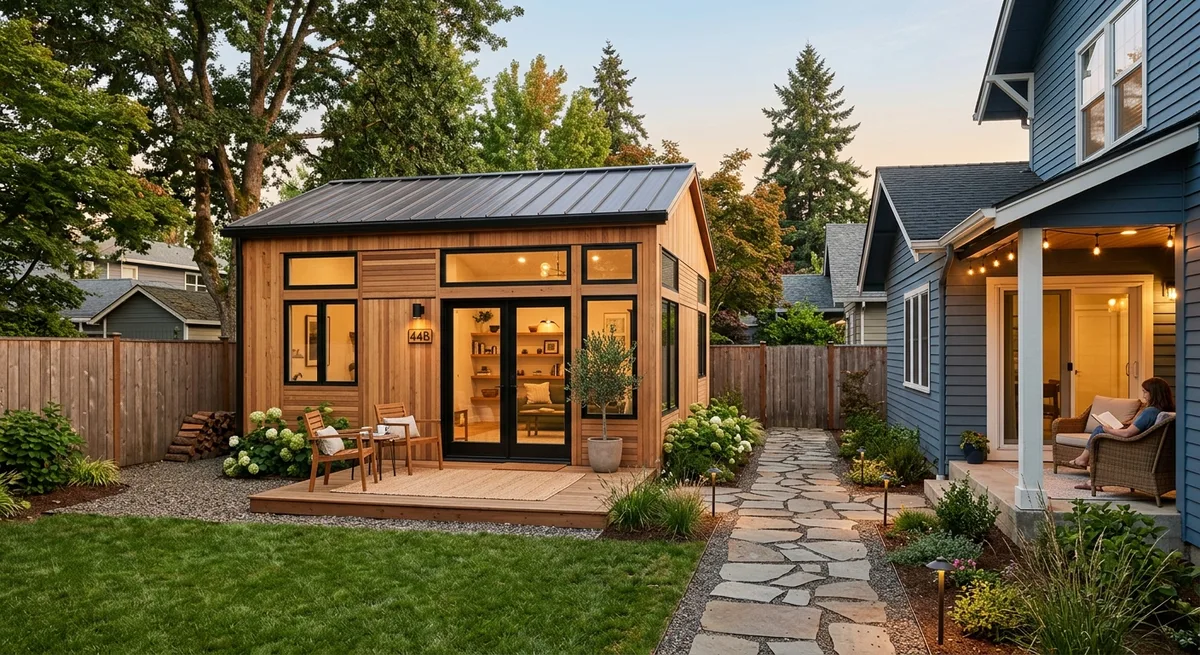
National ADU Cost Overview
Here's the national picture at a glance:
| ADU Type | Typical Total Cost | Cost Per Sq Ft | Timeline |
|---|---|---|---|
| Garage Conversion | $80,000–$175,000 | $150–$300 | 4–7 months |
| Basement Conversion | $50,000–$150,000 | $100–$250 | 4–7 months |
| Attached ADU | $150,000–$300,000 | $200–$400 | 6–12 months |
| Above-Garage ADU | $200,000–$350,000 | $250–$450 | 8–14 months |
| Prefab / Modular ADU | $150,000–$300,000 | $200–$350 | 4–8 months |
| Detached ADU (New Build) | $200,000–$400,000+ | $250–$500+ | 9–18 months |
Why You Keep Seeing Wildly Different ADU Prices Online
If you've spent 20 minutes searching ADU costs, you've probably noticed something frustrating: the numbers don't agree. One site says $30,000. Another says $400,000. A third says "it depends" and never tells you on what.
There's a reason for the chaos, and understanding it will save you from bad decisions.
Different sources quote different things. Some show construction cost only — no permits, no design, no site work, no utilities. Others show all-in cost for one specific metro. Some reference prefab kit prices without the $50,000+ in site prep, foundation, and hookups required to make it livable. And a few are quoting data from 2019 or earlier, before material costs climbed significantly. (For context, the California Construction Cost Index rose 44% from January 2021 to December 2025, per SnapADU's March 2026 pricing data. Other regions saw smaller but still meaningful increases.)
Here's the mental model that cuts through the noise:
Conversion = lowest cost. You're reusing an existing structure. Garage, basement, or interior conversion.
Attached = middle. You share at least one wall and some utilities with the main house.
Detached new build = highest. Everything is new — foundation, framing, roof, utilities, the works.
Prefab can compress timeline and reduce some costs, but site work, permitting, and utility connections still apply.
How Much Does an ADU Cost by Type?
This is the most important section on this page. The type of ADU you build is the single biggest factor in your total cost. Find your type below and you'll have a realistic budget range in 30 seconds.
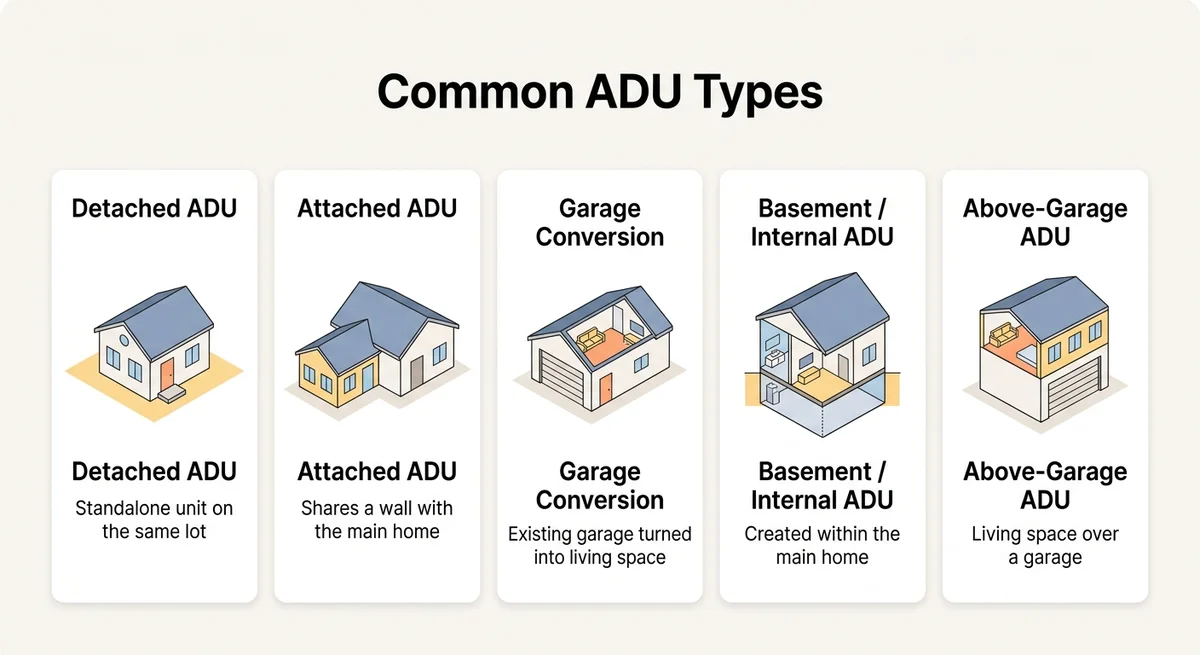
Garage Conversion ADU: $80,000–$175,000
A garage conversion is the most budget-friendly path to a legal ADU for one simple reason: the structure already exists. You've got a foundation, walls, and a roof. What you're paying for is everything that turns a cold garage into a livable home — insulation, drywall, plumbing, electrical, HVAC, a kitchen, a bathroom, flooring, and replacing the garage door with an insulated wall and windows.
One-car garage (250–400 sq ft)
$80,000–$120,000
Source: Angi 2026 data; regional builder estimates
Two-car garage (400–600 sq ft)
$120,000–$175,000
Typical range
When this makes sense: You have a garage you don't use regularly, you want the lowest entry cost, and your local zoning allows the conversion. Some jurisdictions require replacement parking; others don't. Check with your city's planning department before assuming.
Basement Conversion ADU: $50,000–$150,000
If you have an existing basement, converting it into an ADU leverages the most expensive components you've already paid for — foundation and structure.
Key costs: Egress windows (required by building code for bedrooms in most jurisdictions), waterproofing, HVAC, plumbing, insulation, finishing, and a separate entrance.
When costs climb: If you need excavation to deepen the ceiling height, or if waterproofing reveals serious moisture or structural problems. A basement that needs a dig-out can cost $100,000+ more than one that's already at livable height.
When this makes sense: You have an unfinished or underused basement with adequate ceiling height (typically 7 feet minimum per IRC Section R305.1) and your local codes allow basement ADUs.
Attached ADU: $150,000–$300,000
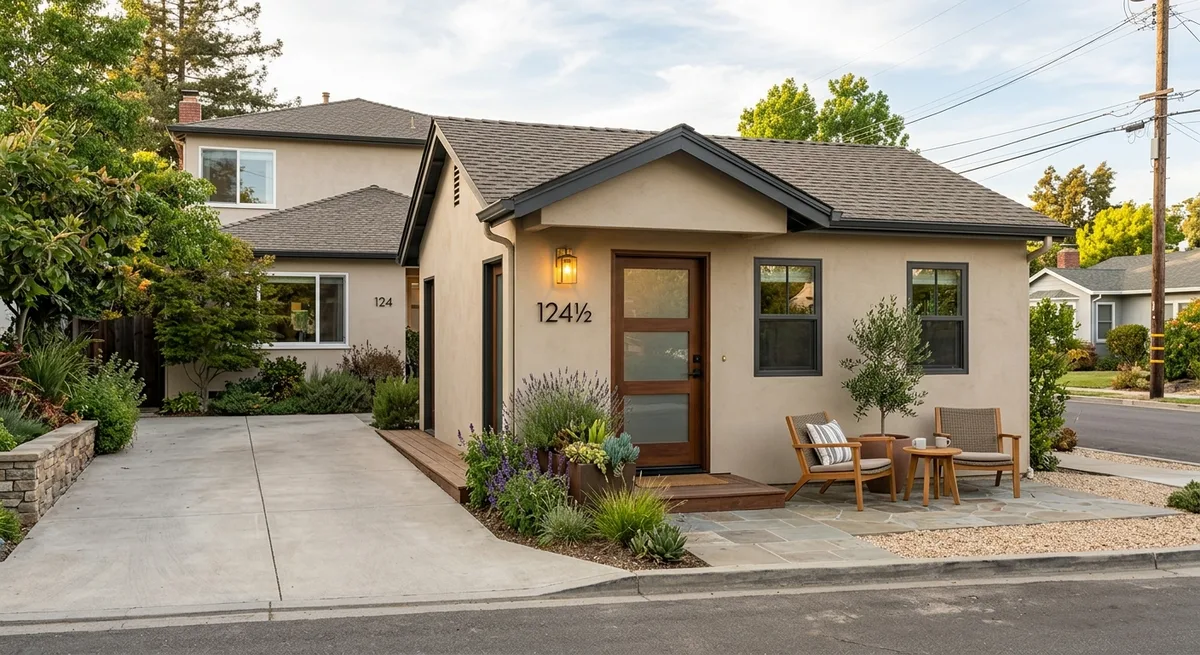
An attached ADU shares at least one wall with your primary home. It's essentially a home addition designed to function as an independent living space with its own entrance, kitchen, and bathroom.
Because it can leverage existing foundation, roofline, and utility connections, attached ADUs generally cost less than a detached unit of the same size — though the savings depend on your specific property and how much existing infrastructure can be reused.
Typical size: 400–800 sq ft.
When this makes sense: You have limited backyard space but room to extend your home's footprint, or you want the efficiency of shared infrastructure without giving up a separate living space.
The trade-off: Less privacy than a detached unit, which can affect rental desirability in some markets.
Above-Garage ADU: $200,000–$350,000
Building a living space above an existing garage requires structural reinforcement (most standard garages aren't built to support a second story), staircase access, and potentially raising the roofline to meet ceiling height codes.
When this makes sense: You want to preserve your parking, don't have yard space for a detached unit, and your garage structure is in good condition.
Prefab / Modular ADU: $150,000–$300,000
Prefab ADUs are factory-built and assembled on site. The unit cost (structure, finishes, fixtures) is generally lower than equivalent custom construction, and the timeline is shorter.
But here's what the ads don't always mention: the prefab unit price is not the all-in price. You still need site preparation, a foundation, utility hookups, permits, and potentially crane access for delivery. Those costs don't go away because the walls were built in a factory. As Maxable (an ADU planning service) has noted, prefab advertising often excludes transportation, site prep, foundation, utilities, and crane costs — and when you add those back in, the all-in price can be comparable to a traditional build. (Source: Maxable, maxablespace.com.)
When prefab makes sense: Your lot has good access, is relatively flat, and your local jurisdiction accepts prefab construction.
When it doesn't: If your lot has a steep slope, irregular shape, or tight access, the site work to accommodate a pre-sized prefab unit can cost more than building custom. Always get quotes for both.
Detached ADU — New Construction: $200,000–$400,000+
A detached ADU is a standalone structure built from the ground up. New foundation, new framing, new roof, new siding, all new utility connections. It's the most expensive option — and it's also the one that commands the highest rents, adds the most flexibility, and provides the most privacy.
600 sq ft, mid-range
$180,000–$280,000
800–1,000 sq ft
$250,000–$350,000
1,000–1,200 sq ft
$300,000–$400,000+
Source: Compiled from Angi 2026 data, DYM Builders national estimates, and regional builder pricing.
When this makes sense: You want maximum rental income, full independence from the main house, multigenerational privacy, or the strongest long-term property value impact.
The biggest cost driver: Everything is new. Foundation, utility trenching, and separate systems are the fixed costs that make even small detached ADUs expensive on a per-square-foot basis.
How Much Does an ADU Cost by Square Footage?
After ADU type, size is the second biggest factor. Here's what to expect at each common size tier:
| Size | Typical Total Cost | Avg Cost Per Sq Ft | Common Layout |
|---|---|---|---|
| 200–400 sq ft | $60,000–$150,000 | $250–$375 | Studio or small 1BR |
| 400–600 sq ft | $100,000–$200,000 | $200–$350 | Comfortable 1BR |
| 600–800 sq ft | $150,000–$275,000 | $200–$325 | 1–2BR, strong rental demand |
| 800–1,000 sq ft | $200,000–$350,000 | $200–$300 | 2BR, best $/sq ft efficiency |
| 1,000–1,200 sq ft | $250,000–$400,000+ | $200–$300 | 2BR+, max allowable in most states |
If budget allows, building toward the upper end of what your lot permits often makes the best financial sense. The marginal cost of adding square footage is lower than the base cost of the kitchen, bath, utilities, and permits you're already paying for — and the additional space translates directly into higher rental income.
ADU Cost by Number of Bedrooms
Many homeowners think in terms of bedrooms rather than square footage. Here's how bedroom count typically maps to cost:
| Layout | Typical Size | Estimated Cost Range | Rental Appeal |
|---|---|---|---|
| Studio | 200–400 sq ft | $60,000–$150,000 | Short-term rental or single occupant |
| 1 Bedroom | 400–600 sq ft | $100,000–$200,000 | Strongest demand in most rental markets |
| 1 Bed + Den/Office | 600–800 sq ft | $150,000–$275,000 | Premium option, appeals to remote workers |
| 2 Bedroom | 800–1,200 sq ft | $200,000–$400,000+ | Highest rental income, families or long-term tenants |
One-bedroom units between 400–600 square feet tend to hit the sweet spot for most homeowners: manageable construction cost, strong rental demand, and enough space to feel like a real home.
ADU Cost Per Square Foot: Useful Shortcut or Misleading Metric?
Cost per square foot is the most commonly searched ADU pricing metric. It's also the most commonly misunderstood.
National range: $150–$400+ per square foot in 2026. Garage conversions sit at the low end. Detached new builds in coastal metros sit at the high end. Some complex or high-end projects exceed $500 per square foot. (Sources: Angi 2026; Casita Coalition estimates $250–$500 per square foot for most projects.)
Cost per square foot also hides important variables: site conditions, design complexity, local labor markets, finish level, and utility distance. Two ADUs of identical size can differ by $100,000+ based on factors that have nothing to do with square footage.
When $/sq ft is useful: Comparing quotes from different contractors for the same project. Sanity-checking whether a bid is in the normal range for your region.
When it isn't: Comparing different ADU types, different sizes, or different locations.
How Much Does an ADU Cost by Region?
Where you live changes everything. A detached ADU that costs $180,000 in a mid-size Southern city can cost $350,000+ in the Bay Area — same size, same finish level, same ADU type. The difference is labor rates, material costs, permit fees, and local code requirements.
| Region | Cost Per Sq Ft | 600 Sq Ft Detached | Key Factors |
|---|---|---|---|
| San Francisco / Bay Area | $350–$600+ | $250,000–$400,000+ | Highest labor costs, strict codes |
| Los Angeles / Southern CA | $250–$450 | $200,000–$350,000 | Solar and fire-safety requirements |
| Seattle / Portland | $250–$400 | $180,000–$300,000 | Strong ADU culture, streamlined permits |
| Northeast (NYC, Boston) | $250–$500 | $200,000–$350,000 | High labor, varying ADU policy |
| Denver / Mountain West | $200–$350 | $150,000–$250,000 | Growing market, new state laws |
| Sacramento / Central CA | $200–$350 | $150,000–$250,000 | Lower than coastal CA |
| Texas (Austin, Houston) | $150–$300 | $120,000–$200,000 | Lower labor/materials |
| Midwest (Chicago, Mpls) | $150–$300 | $120,000–$220,000 | Lower costs, cold-climate foundations |
| Southeast (Atlanta, CLT) | $150–$275 | $100,000–$180,000 | Lowest labor and materials |
| Rural / Lower-Cost Areas | $100–$200 | $80,000–$150,000 | Cheapest builds, may face unclear zoning |
If you're in a high-cost market and the numbers feel steep, remember: high-cost markets also have the highest rental income potential and the strongest ADU property value premiums. A $350,000 ADU in Los Angeles that generates $3,000+/month in rental income tells a very different financial story than the construction cost alone suggests.
Enter your ADU type, size, and region for a personalized range.
Where Every Dollar Goes: The Full ADU Budget Breakdown
Most people think of "ADU cost" as one number. In reality, it's dozens of line items in two categories: soft costs (everything before construction starts) and hard costs (the actual building).
Understanding this breakdown helps you budget accurately and evaluate contractor bids. If a quote seems low, check which of these items are missing.
Soft Costs: 10–20% of Your Total Budget
Architectural design and plans: $5,000–$30,000. Pre-approved or stock plans adapted to your site can bring this to $3,000–$8,000. Custom designs with complex layouts cost more. (Sources: Angi 2026; RenoFi estimates $8,000–$13,000 for custom plans.)
Structural engineering: $2,000–$5,000. Required for most new construction and many conversions.
Permits and review fees: $3,000–$25,000 depending on your city. In California, permits can run $10–$12 per square foot per the Angi 2026 cost guide — a 750 sq ft ADU could cost $7,500–$9,000 in permit fees alone. Smaller cities and lower-cost states may charge as little as $3,000.
Impact and development fees: $0–$15,000+. Fee structures vary widely by jurisdiction. In California, ADUs under 750 sq ft are exempt from impact fees under state law (California Government Code §66341), and larger ADUs can only be charged proportionally. Other states handle impact fees differently — check your local fee schedule early.
Surveys, soil reports, geotechnical studies: $1,500–$5,000. Not always required, but common for detached builds, sloped lots, or areas with known soil issues.
Hard Costs: 80–90% of Your Total Budget
Site preparation (grading, excavation, demolition): $5,000–$20,000. More for sloped lots, tight access, or tree removal.
Foundation: $5,000–$20,000 for a concrete slab. Frost footings in cold climates or hillside lots requiring caissons can push this significantly higher.
Framing and structural: $20,000–$50,000.
Roofing: $5,000–$15,000.
Exterior (siding, windows, doors, trim): $10,000–$30,000.
Plumbing: $5,000–$15,000. Higher if running new lines a long distance from existing connections.
Electrical: $3,000–$10,000. Panel upgrades for the main house may add $2,000–$5,000.
HVAC: $3,000–$10,000. Ductless mini-split systems are the most common choice for ADUs.
Insulation and drywall: $5,000–$15,000.
Interior finishes (flooring, cabinets, countertops, fixtures, paint): $15,000–$50,000. This is where finish level creates the biggest swing — basic versus premium can differ by $20,000+.
Appliances: $3,000–$8,000.
General contractor fee: Typically 10–20% of hard costs for project management, scheduling, and subcontractor coordination. (Source: Angi 2026.)
What a Real ADU Budget Looks Like
Here's a worked example for a 700 sq ft detached ADU with mid-range finishes in a moderate-cost market:
| Line Item | Estimated Cost |
|---|---|
| Design and engineering | $12,000 |
| Permits and fees | $8,000 |
| Surveys and reports | $3,000 |
| Site prep and foundation | $22,000 |
| Framing, roofing, exterior | $55,000 |
| Plumbing, electrical, HVAC | $28,000 |
| Interior finishes and appliances | $40,000 |
| Utility hookups and meter | $12,000 |
| GC fee (~15%) | $24,000 |
| Contingency (~15%) | $30,000 |
| Total | ~$234,000 |
Get this breakdown customized for your ADU type, size, and location.
The Hidden Costs That Surprise Homeowners
This is the section we wish every ADU cost guide led with. These are the costs that don't appear in headline numbers — and they're the reason many projects exceed initial estimates.
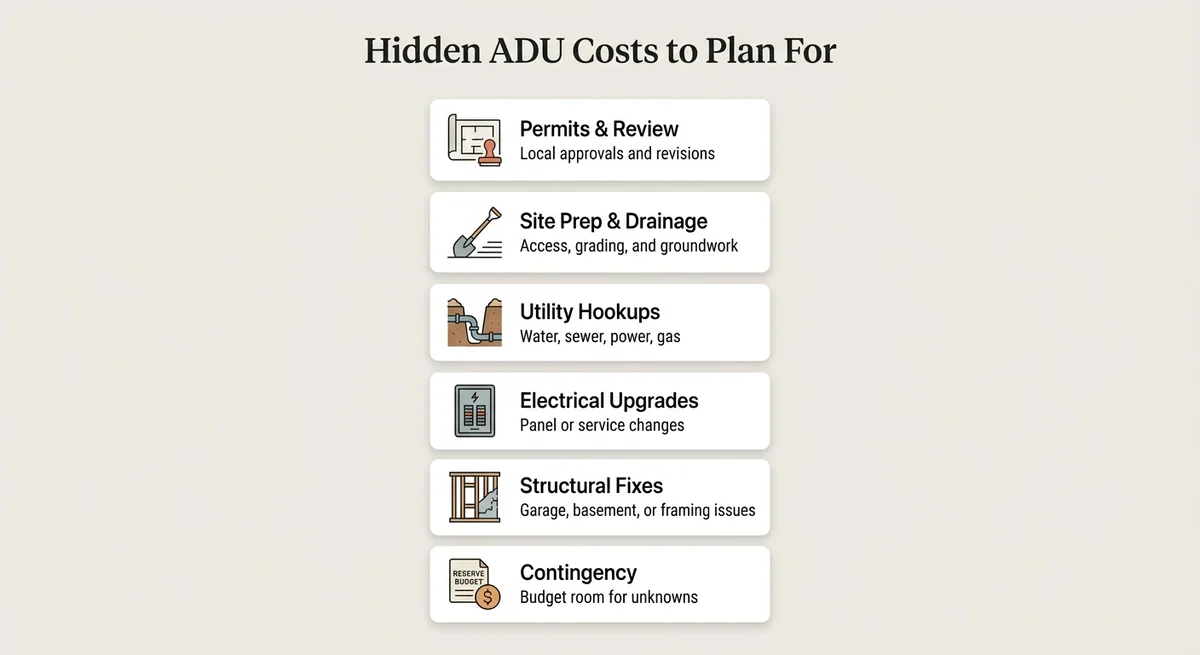
Utility hookups and trenching: $5,000–$30,000
This is the number-one surprise cost, especially for detached units. Running water, sewer, electrical, and gas lines from the main house to a backyard ADU requires trenching — and the farther the ADU sits from existing connections, the more it costs.
Separate utility meters: $2,000–$5,000 each
If you plan to rent the ADU and want tenants to pay their own utilities, you'll need separate meters. This isn't always straightforward — some homeowners report conflicting requirements between their city and utility provider. An alternative: aftermarket sub-meters (app-based devices that track usage) so you can adjust rent accordingly.
Electrical panel upgrade: $2,000–$5,000
Your main house's electrical panel may not have capacity for a second dwelling.
Solar panels (California): $10,000–$25,000
Under California's energy code, newly constructed detached ADUs must meet photovoltaic requirements. Attached ADUs are treated as additions and may not trigger the same requirement. Garage conversions are generally exempt. (Source: California Energy Commission, 2025 Energy Code.) Other states may adopt similar requirements — check your local energy code.
Fire sprinklers
Requirements vary by jurisdiction. In California, local agencies generally cannot require sprinklers for an ADU unless sprinklers are already required for the primary dwelling. Other states and cities have their own rules. Ask your local building department before budgeting.
Sewer and septic surprises: $5,000–$20,000+
If your property is on septic, adding an ADU may require an upgraded or replacement system. Properties on city sewer may still face connection fees or capacity assessments.
Site access and difficult lots: $5,000–$50,000+
Sloped lots need retaining walls, specialized foundations, and sometimes crane access. Tight side yards limit equipment access and increase labor time.
Landscaping restoration: $3,000–$10,000
Construction equipment damages yards. Fencing, patios, and plantings disrupted during the build need repair or replacement.
What Makes One Property a $90,000 Project and Another a $350,000 Project?
You now know the cost ranges. Here's what pushes a project to the low end or the high end — so you can see where yours might land.
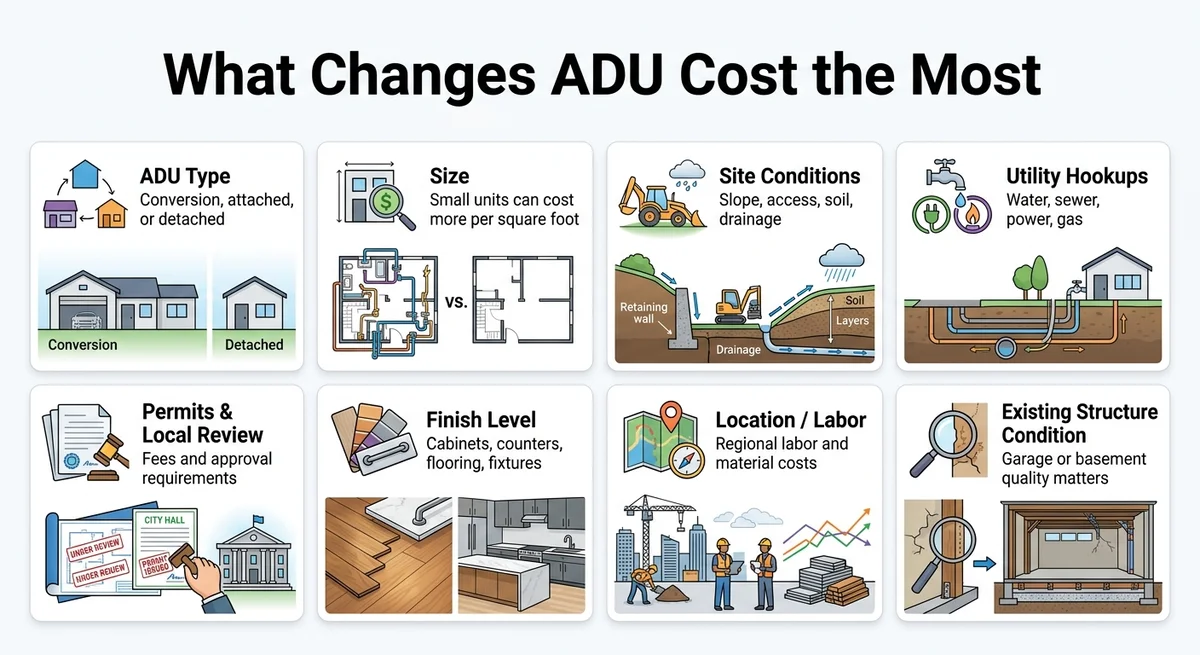
ADU type. A garage conversion reusing existing structure versus a detached new build from the ground up. This is the biggest swing factor.
Location and labor market. A detached ADU in San Francisco ($350–$600/sq ft) versus the same unit in a mid-size Midwest city ($150–$300/sq ft).
Existing utilities versus new connections. An attached ADU that ties into the main house's systems versus a detached unit 80 feet away that needs full utility trenching.
Site conditions. Flat, accessible lot with good soil versus a sloped lot requiring retaining walls and specialized foundations.
Existing structure quality. A solid, code-compliant garage versus one with foundation cracks and an undersized slab.
Finish level. Standard vinyl plank and stock cabinets versus hardwood floors, quartz counters, and custom millwork — a difference of $30,000–$60,000 on the same size unit.
Design complexity. A simple rectangular floor plan versus an L-shape with multiple roof angles and vaulted ceilings. Every corner and angle adds cost.
Pre-approved vs. custom plans. Pre-approved ADU plan sets — now offered by many cities including Los Angeles, Portland, and Sacramento — can save thousands in design fees and compress permitting timelines. (Source: Casita Coalition Preapproved ADU Plan Programs Guidebook, December 2024.)
The Cheapest Way to Build an ADU (Legally)
Not every homeowner has $300,000 to spend. If budget is your primary constraint, here are the paths that keep costs lowest — ranked from least expensive to most:
- 1
Interior conversion ($50,000–$150,000)
Converting a bedroom, attached garage area, or storage space within your existing home. Minimal structural work. Lowest cost, but smallest unit and limited rental income potential. (In California, this may qualify as a JADU under state law.)
- 2
Garage conversion ($80,000–$175,000)
Reuses an existing garage. No new foundation or framing needed. Best cost-to-livable-space ratio for most homeowners.
- 3
Basement conversion ($50,000–$150,000)
If your basement has adequate ceiling height and isn't prone to moisture, this is one of the cheapest paths. But if you need to excavate or waterproof extensively, costs escalate quickly.
- 4
Attached ADU with pre-approved plans ($150,000–$250,000)
Sharing a wall with the main house saves on foundation and utilities. Using pre-approved plans cuts design costs and permitting time.
- 5
Prefab or modular ADU on a straightforward lot ($150,000–$250,000)
If your lot is flat with good access, prefab can deliver real savings and speed. Get quotes for both prefab and custom before assuming either is cheaper.
Other ways to reduce cost without cutting corners
Keep the floor plan rectangular. Every corner, bump-out, and roof angle adds cost. A clean rectangle isn't boring — it's efficient. Good interior design makes a simple layout feel thoughtful.
Choose durable mid-range finishes. Luxury vinyl plank, quartz counters, and porcelain tile look great, last long, and cost significantly less than hardwood, marble, and natural stone. For a rental unit, mid-range finishes are the sweet spot.
Get at least three bids. Provide identical project scope to each contractor. Ask for itemized bids, not lump-sum quotes.
Check for grants and incentives. California's CalHFA ADU Grant Program offers up to $40,000 toward pre-development costs. As of March 2026, the most recent funding round has been fully allocated — monitor calhfa.ca.gov for future rounds. New York's Plus One ADU Program offers capital loans and construction financing grants through NY Homes and Community Renewal. Other states and cities may offer local incentive programs — check with your planning department.
Free 2026 ADU Starter Kit
Budget worksheets, cost comparison templates, contractor bid evaluation checklists, and a step-by-step timeline planner.
Download Free Starter KitLet's Talk About Sticker Shock — and Why the Investment Works
Here's the honest thing most ADU cost guides won't say directly: building an ADU is expensive relative to expectations.
An ADU is a complete home. It has a kitchen, a bathroom, HVAC, electrical, plumbing, and must meet the same building codes as any other legal dwelling. The expensive components — a full kitchen, a code-compliant bathroom, utility systems, permits — don't get cheaper just because the building is 600 square feet instead of 2,000.
That's the real reason a "small backyard cottage" costs $200,000+. It's not that contractors are overcharging. It's that building a small legal home costs nearly as much as building the core of a bigger one.
But here's what balances the equation:
ADUs can meaningfully increase property value. When a property includes an ADU, appraisers are required to describe the unit and analyze its contribution to overall value and marketability (source: Fannie Mae Selling Guide, Section B4-1.3-05). The actual impact depends on your local market, the quality of the ADU, and buyer demand — but in markets with strong rental demand, ADUs are increasingly recognized as a significant value-add by both buyers and appraisers.
Rental income changes the math. Depending on your market, an ADU can generate $1,500–$3,500+ per month in rental income. Over time, that income can recover a substantial portion — or all — of the construction cost. (Rental income projections are estimates based on market data. Actual income depends on local rental demand, ADU size and condition, and market conditions.)
A Financial Framework (Not a Guarantee — a Starting Point)
Say you build a 600 sq ft detached ADU for $220,000 all-in and rent it for $2,200/month.
Annual Gross Income
$26,400
Annual Expenses
$5,000–$7,000
Net Annual Income
~$19,000–$21,000
Simple payback from rental income alone: roughly 10–12 years.
This example is illustrative. Actual returns depend on local market conditions, financing terms, tax implications, and ongoing expenses. Consult a financial advisor and local real estate professional for property-specific analysis.
The flexibility is permanent. An ADU can house aging parents today, generate rental income tomorrow, serve as a home office next year, and increase your property's appeal for decades. That kind of optionality doesn't show up in a simple payback calculation, but it's real — and it's the reason homeowners who build ADUs overwhelmingly say they'd do it again.
How Long Does It Take to Build an ADU?
Cost and timeline go hand in hand — a longer project means more carrying costs, more contractor overhead, and more disruption to your daily life.
| Phase | Typical Duration | Notes |
|---|---|---|
| Design and planning | 1–3 months | Faster with pre-approved plans |
| Permitting | 1–4 months | Varies by city. In CA, state law requires action within 60 days. |
| Site prep and foundation | 2–4 weeks | More for difficult sites |
| Construction | 3–8 months | Conversions fastest; detached new builds longest |
| Inspections and CO | 2–4 weeks | |
| Total: Garage conversion | 5–9 months | |
| Total: Detached new build | 9–18 months |
Prefab and modular ADUs can compress the construction phase to several weeks of on-site work, since the unit is factory-built while permits are being processed. But permitting and site prep timelines remain the same.
Can You Build an ADU on Your Property?
ADU regulations vary not just by state but by city, county, and sometimes neighborhood. A full legal guide for every jurisdiction would fill a book. Here's what you need to know to get started.
A growing number of states have passed ADU-specific legislation that overrides restrictive local zoning. States with established ADU-friendly laws include California (Government Code §66310–66342), Oregon (ORS 197.312), Colorado (HB24-1152, effective 2025), Maine (LD 2003), and Massachusetts (Affordable Homes Act, 2024). Other states including New York, Connecticut, Hawaii, and Washington have varying levels of state-level support — verify current status with your state's housing agency or legislature.
Many other states leave ADU regulation entirely to local governments, which means your city or county may allow them, restrict them, or prohibit them. Some cities in otherwise restrictive states — like Austin in Texas — have progressive ADU ordinances.
The key local questions that determine feasibility:
- Does your zoning allow ADUs?
- What are the setback requirements?
- What's the maximum allowed ADU size?
- Is owner occupancy required? (Rules vary significantly — verify locally.)
- Are there parking requirements?
- What are the utility connection requirements?
- Are there HOA or deed restrictions?
Fannie Mae's current Selling Guide defines ADUs as secondary dwelling units on the same parcel as a primary residence, including over-garage, basement, and manufactured-home configurations — confirming that major mortgage institutions recognize ADUs as legitimate property features. (Source: Fannie Mae Selling Guide, Section B2-3-04.)
ADU vs. Home Addition vs. Buying a Second Property
If you're weighing options, here's how they stack up:
| Option | Typical Cost | Rental Income | Privacy | Flexibility |
|---|---|---|---|---|
| ADU (detached) | $200K–$400K+ | $1,500–$3,500+/mo | High | High |
| ADU (garage conversion) | $80K–$175K | $1,200–$2,500/mo | Moderate | Moderate |
| Home addition | $150K–$500K+ | Usually none | Low (shared) | Low |
| Second property | $200K–$500K+ | Varies | High | High, but separate burden |
ADUs and home additions solve different problems. An ADU is an independent dwelling — it has its own kitchen, bathroom, entrance, and can generate rental income. An addition extends your primary home. Compare them on independence, rental potential, privacy, and total scope — not just a single metric.
Compared to buying a second property, an ADU avoids a second mortgage, second set of property taxes, and the complexity of managing a property across town. You build on land you already own.
Financing an ADU: Common Paths Homeowners Explore
Building an ADU is a significant investment, and most homeowners don't pay cash. Here are the most common financing approaches — framed as education, not recommendations. (The Dwelling Index is not a lender or financial advisor. Consult a qualified financial professional for advice specific to your situation.)
Home equity line of credit (HELOC). Borrows against existing home equity. Flexible draw schedule can align with construction milestones.
Cash-out refinance. Replaces your existing mortgage with a new, larger one and gives you the difference in cash.
Construction loan. Short-term loan specifically for building projects. Often converts to a permanent mortgage upon completion.
ADU-specific financing products. Some lenders now offer loan products designed for ADU construction, with terms structured around the income-producing potential of the unit.
Renovation loans. FHA 203(k), Fannie Mae HomeStyle, and similar programs may cover ADU construction as part of a broader home improvement project.
Fannie Mae currently allows rental income from an existing, occupied ADU on a one-unit principal residence to be considered in certain qualifying scenarios, subject to documentation requirements and a cap of 30% of total qualifying income. (Source: Fannie Mae Selling Guide, Section B3-3.8-01.)
How to Budget and Plan Your ADU Project: Step by Step
If you've read this far, you have a solid understanding of ADU costs. Here's how to turn that knowledge into action:
- 1
Verify your property's eligibility.
Contact your local planning department or use our eligibility tool to confirm zoning, size limits, setbacks, and utility requirements.
- 2
Decide on ADU type.
Based on your property, budget, and goals (rental income? family housing? flexibility?).
- 3
Explore financing early.
Talk to a lender before you hire a designer. Knowing your budget ceiling prevents wasted design fees.
- 4
Choose a design path.
Pre-approved plans (fastest, cheapest), stock plans modified for your site (moderate), or full custom design (most flexible, most expensive).
- 5
Get 3+ contractor bids.
Provide identical scope to each. Demand itemized bids. Compare line-by-line.
- 6
Budget with 15–20% contingency.
This is non-negotiable.
- 7
Submit for permits.
Your designer or contractor typically handles this.
- 8
Build.
Maintain regular communication with your general contractor.
- 9
Final inspection and certificate of occupancy.
Don't skip this — an unpermitted ADU creates legal, insurance, and resale risk.
- 10
Move in, rent out, or enjoy.
Free 2026 ADU Starter Kit
Budget worksheets, cost comparison templates, contractor bid evaluation checklists, and a step-by-step timeline planner.
Download Free Starter KitMethodology: How We Estimate ADU Costs
What we define as an ADU: A self-contained secondary dwelling unit on the same lot as a primary residence, with its own kitchen, bathroom, and sleeping area. This aligns with definitions used by Fannie Mae (Selling Guide B2-3-04), Freddie Mac, and state ADU statutes.
What "all-in cost" means on this page: Our ranges include design, permits, site preparation, construction, utility hookups, and standard finishes. They do not include furniture, landscaping, or financing costs.
Where our ranges come from: We compile data from published national cost guides (Angi 2026, HomeGuide), regional builder pricing (SnapADU March 2026, Better Place Design & Build, Maxable), public ADU cost calculators (ADU Accelerator, Napa Sonoma ADU Center), the Casita Coalition's ADU guidebook, and municipal permit fee schedules. Where ranges differ between sources, we use the overlapping middle range.
Regional cost context: We reference the California Construction Cost Index for West Coast cost trends, but note that other regions experienced different rates of change. National numbers are cross-referenced against multiple regional sources to avoid California-centric bias.
Why our ranges are ranges: No two ADU projects are identical. Site conditions, labor markets, permit fees, design choices, and materials create legitimate variation. We present ranges because false precision would be less useful than an accurate range.
How often we update: This page is reviewed quarterly. Cost data is verified against current published sources. Last full verification: March 2026.
Who produces this content: The Dwelling Index research team. Our editorial process includes cross-referencing multiple data sources, consulting published builder pricing, and reviewing municipal fee schedules. We do not accept payment for placement in our comparison tables or recommendations.
Frequently Asked Questions
How much does it cost to build an ADU?
Most U.S. homeowners spend $100,000–$300,000. Garage conversions can start around $80,000. Detached new builds in high-cost areas can exceed $400,000. The biggest cost factors are ADU type, size, location, and finish level.
How much does an ADU cost per square foot?
Nationally, $150–$400+ per square foot in 2026. Conversions tend toward the low end; detached new builds in coastal metros tend toward the high end. Total project cost is usually more useful for budgeting than per-square-foot numbers alone.
How much does a 500 sq ft ADU cost?
Typically $100,000–$200,000 for a detached unit with mid-range finishes. Conversions of existing space at this size can be $80,000–$130,000.
How much does a 1,000 sq ft ADU cost?
Typically $200,000–$350,000 for detached new construction nationally. In high-cost metros like Los Angeles or San Francisco, expect $300,000–$450,000+.
What is the cheapest type of ADU to build?
Interior conversions and garage conversions are the most affordable, typically $50,000–$175,000. They leverage existing structures, avoiding new foundation, framing, and roofing costs.
Is a garage conversion cheaper than a detached ADU?
Yes — significantly. The basic structure already exists. The savings are real, but if the garage has structural problems, the cost advantage shrinks.
Are prefab ADUs cheaper than custom-built?
The unit itself is generally cheaper. But the all-in cost (including site prep, foundation, utility hookups, and delivery) can be comparable on difficult lots. Get quotes for both before deciding.
What hidden costs should I expect?
The most common surprises are utility hookup costs ($5,000–$30,000), separate meters ($2,000–$5,000 each), electrical panel upgrades ($2,000–$5,000), and site conditions requiring additional work. In California, solar panel and fire-safety requirements add to the cost of new construction. Budget 15–20% contingency above your construction estimate.
Does an ADU increase property value?
ADUs can increase property value, but the effect is market- and property-specific. When an ADU is present, appraisers must describe the unit and analyze its contribution to value and marketability. In markets with strong rental demand, ADUs are increasingly valued by both buyers and appraisers.
Can I build an ADU on my property?
It depends on your local zoning, lot size, setbacks, and state law. States like California, Oregon, Colorado, Maine, and Massachusetts have ADU-friendly legislation. Contact your local planning department to confirm what's allowed at your specific address.
How long does it take to build an ADU?
Total timeline is typically 5–18 months depending on ADU type. Garage conversions are fastest. Detached new construction takes longest. Permitting is usually the biggest variable.
Can rental income from an ADU help with financing?
Fannie Mae currently allows income from an existing, occupied ADU to be considered in certain qualifying scenarios, subject to documentation and income limits. Discuss your specific situation with a lender experienced in ADU financing.
Is it cheaper to build an ADU or a home addition?
ADUs and additions serve different purposes. An ADU is an independent dwelling with rental potential; an addition extends your primary home. Compare them based on your goals — independence, rental income, privacy, and total scope.
What's the cheapest legal way to build an ADU?
Convert existing interior space or a garage. Use pre-approved plans. Stay within your jurisdiction's fee exemption thresholds where applicable. Choose mid-range finishes. Get multiple bids.
Not Sure if Your Property Qualifies for an ADU?
You've done the research. You know the costs, the types, the timelines, and the trade-offs. The only question left is whether your property is the right fit.
We'll show you: whether your property is zoned for an ADU, what types and sizes are likely allowed, an estimated cost range based on your inputs, and what your realistic next steps are.
Download the Free 2026 ADU Starter KitLast updated: March 2026. All cost data verified against published sources listed in Methodology section.
By The Dwelling Index Research Team
Related Guides
ADU Cost Per Square Foot: 2025 Guide
Understand ADU cost per square foot by type with regional price comparisons.
Garage Conversion ADU: Complete Guide
Turn your garage into a legal ADU. Costs, permits, and everything you need to know.
ADU Financing: Every Option Explained
From HELOCs to ADU-specific loans — find the right way to fund your project.