
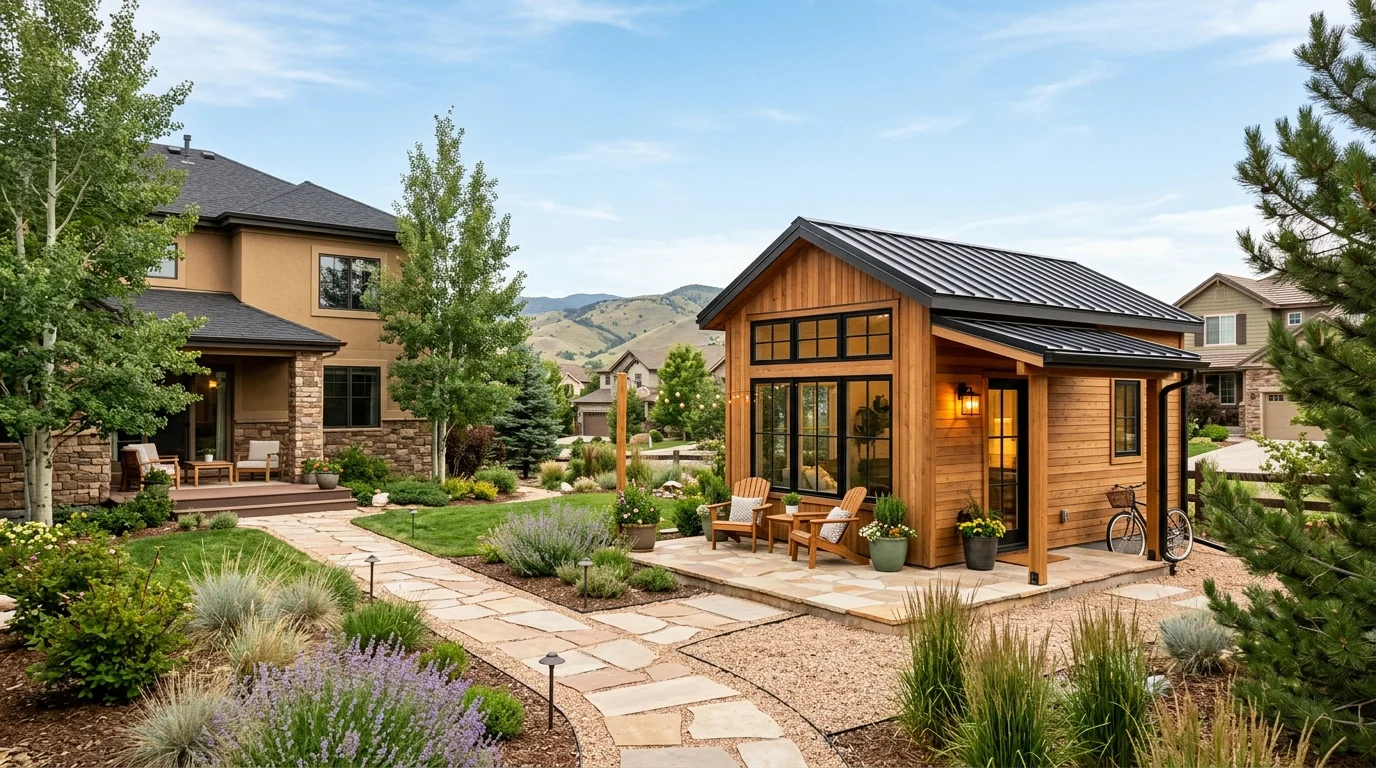
Does Colorado's ADU Law Apply to Your Property?
If you own a single-family home in a city with 1,000+ residents that sits within one of Colorado's five Metropolitan Planning Organizations, and your parcel isn't exempt, then yes — HB 24-1152 applies to you. That covers the vast majority of Colorado's population. But “covers” and “applies cleanly to your specific parcel” are two different things.
What is a “subject jurisdiction”?
Under C.R.S. 29-35-402(21), a subject jurisdiction is either:
A municipality (city or town) with a population of 1,000 or more within a Metropolitan Planning Organization (MPO), or
The portion of a county that is both within an MPO and within a Census Designated Place of 40,000+ residents.
Colorado has five MPOs:
- Denver Regional Council of Governments (DRCOG)
- North Front Range MPO
- Pikes Peak Area Council of Governments
- Pueblo Area Council of Governments
- Grand Valley MPO
If you live anywhere along the Front Range — Denver, Boulder, Fort Collins, Colorado Springs, Aurora, Lakewood, Thornton, Arvada, Westminster, Centennial, Longmont, Pueblo, Grand Junction, and their suburbs — you are almost certainly in a subject jurisdiction. DOLA (the Colorado Department of Local Affairs) publishes an interactive map and a full list on their ADU webpage . Check it before you do anything else.
Source: C.R.S. 29-35-402(21); DOLA Subject Jurisdiction List. Verified April 2026.
What is an exempt parcel?
Even within a subject jurisdiction, certain parcels are exempt from the statewide ADU requirement. Your parcel may be exempt if:
It is not served by a domestic water and sewage treatment system, or is served by a well permit that cannot supply another dwelling unit.
It is an individually designated historic property that is not within a historic district (properties within a historic district are not exempt, though they may face additional design review).
It is in a floodway or FEMA 100-year floodplain.
If any of these apply to your parcel, the statewide mandate does not force your city to approve an ADU on your lot — though your city may still allow one under its own local rules. Fort Collins specifically notes that properties in the Poudre River 100-year floodplain may not add dwelling units.
Source: C.R.S. 29-35-402; Fort Collins ADU page (fcgov.com). Verified April 2026.
What if you're outside an MPO?
Small rural towns and mountain communities outside an MPO are not required to comply with HB 24-1152. However, any Colorado jurisdiction can voluntarily opt in by getting certified as an “ADU Supportive Jurisdiction” through DOLA.
Why would they? Two reasons:
DOLA's ADU Grant Program (ADUG)
Only certified supportive jurisdictions can receive state grant funding for pre-approved ADU plans and fee reductions.
CHFA ADU Finance Programs
Only residents of supportive jurisdictions can access state-backed ADU financing through the Colorado Housing and Finance Authority.
What about unincorporated county land?
Unincorporated areas have different rules depending on whether they meet the Census Designated Place population threshold and sit within an MPO.
Unincorporated El Paso County
Uses the term “Accessory Living Quarters” instead of ADU and has historically required that the occupant be a family member. Whether HB 24-1152 fully overrides this depends on how the county's Census Designated Places intersect with the Pikes Peak MPO boundary. Verify your status directly with the county planning office.
Jefferson County (unincorporated)
Allows ADUs in agricultural, residential, and comparable planned-development districts for lots with single-family detached dwellings. Detached ADUs require a minimum 7,500 sq ft lot. (Source: Jefferson County ADU Regulations. Verified April 2026.)
Condos and townhomes
HB 24-1152 applies to single-unit detached dwellings. If you own a condo or townhome in a common-interest community, the law's protections apply differently. However, SB24-174 (passed in the same 2024 session) prohibits condominium associations from adopting new regulations that ban ADUs if local zoning otherwise allows them. This is a narrower protection — worth discussing with a Colorado real estate attorney if you're in this situation. (Source: SB24-174; C.R.S. § 38-33.3-106.5. Verified April 2026.)
Not sure if your address qualifies?
Check Your Property — Free ADU Feasibility ReportWhat the Law Changed vs. What Your City Still Controls
This is the single most important thing to understand. The phrase “Colorado legalized ADUs” is accurate but incomplete. The state set a strong floor. Cities still control the ceiling — and sometimes the walls. Here's exactly where the line falls.
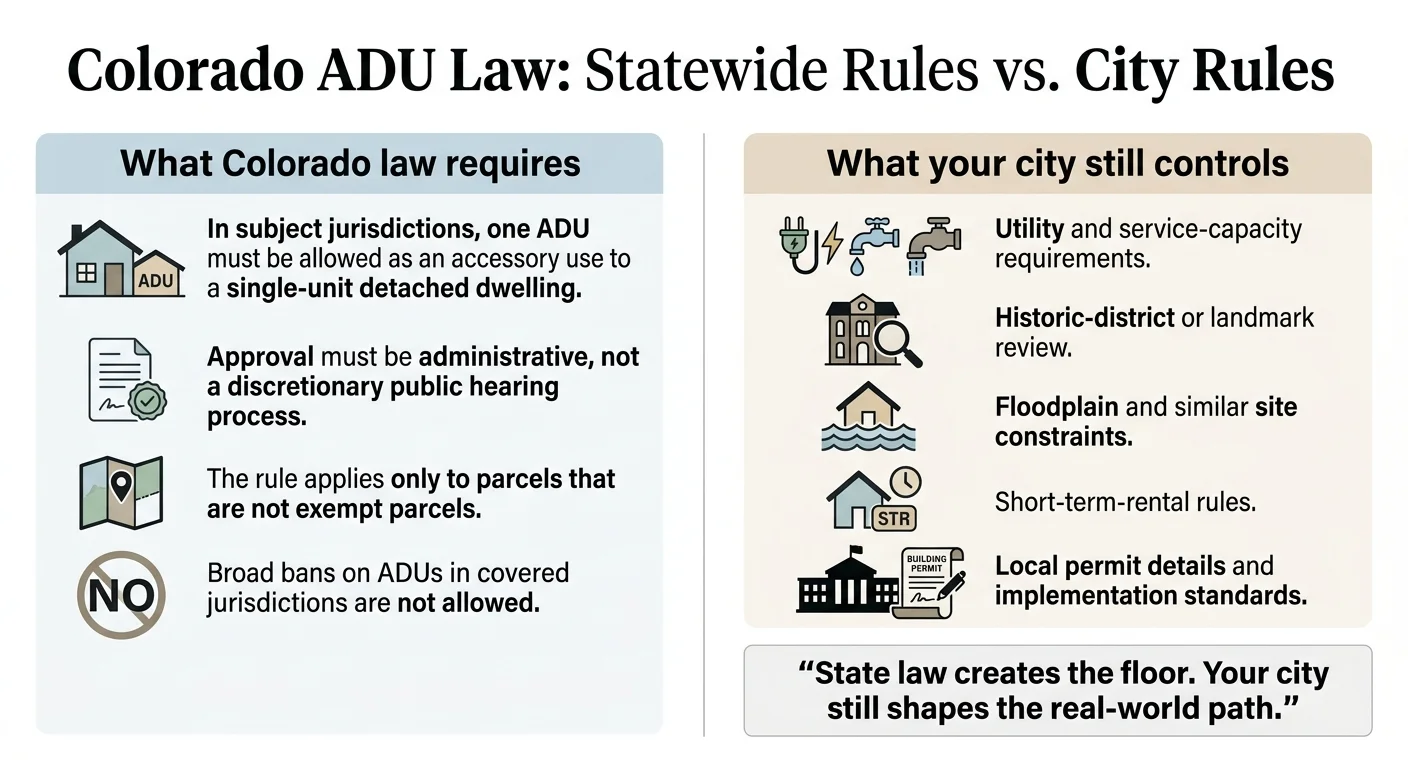
State law creates the floor. Your city still shapes the real-world path.
| Topic | What the State Now Requires | What Your City Still Controls |
|---|---|---|
| Where ADUs must be allowed | One ADU must be permitted as an accessory use to a single-unit detached dwelling in subject jurisdictions, on non-exempt parcels. | Cities can still regulate through overlays: historic districts, wildfire-urban interface (WUI) zones, floodplain. |
| Approval process | Must be administrative — no public hearing, no elected/appointed body decision. | Cities control review timelines and completeness standards. Historic-review procedures and local notice requirements can still apply. |
| Size | Cities cannot ban ADUs between 500–750 sq ft. Cannot require smaller than 500 sq ft or prohibit up to 750 sq ft. | Cities can restrict below 500 sq ft and above 800 sq ft. Many cities allow significantly larger. |
| Setbacks | Side setbacks must be at least as permissive as for the primary dwelling. Rear: same as other accessory buildings or 5 feet, whichever is less restrictive. | Cities enforce existing accessory-building setback rules for rear yards. |
| Parking | Cannot require a new dedicated parking space in most situations. | Can require one space if no on-site parking exists AND on-street parking is prohibited. |
| Owner occupancy | Cannot broadly require owner to live in main house or ADU. | May require owner to reside on parcel when ADU application is submitted. May require owner occupancy for STR license. |
| HOA / PUD restrictions | Blanket ADU bans in subject jurisdictions are void. PUD rules cannot be more restrictive than local ADU law. | HOAs can impose reasonable restrictions on design and aesthetics that don't effectively prohibit construction. |
| Design standards | Cannot apply architectural style, materials, or landscaping more restrictive than for the primary dwelling. Cannot treat factory-built/modular ADUs more restrictively than site-built. | Can enforce standards that match what they require for the main house. Historic districts may require certificate of appropriateness. |
| Short-term rentals | The ADU law does not address STRs directly. | Cities retain full authority over short-term rental licensing — varies enormously. |
| Impact fees | Not addressed — still on the table. | Cities can and do charge development impact fees, utility tap fees, plan review fees. Often the biggest surprise cost. |
| Utilities | Not addressed. | Cities can require documentation of adequate water/sewer/electrical capacity. Some require separate service connections. |
Sources: C.R.S. 29-35-401 through 29-35-405; C.R.S. 24-67-105 (PUD provision); C.R.S. § 38-33.3-106.5 (HOA provision). Verified April 2026.
Colorado ADU Rules by City: The Comparison Table
We verified these rules against each city's official ordinance, planning department page, or published ADU guide. Every row includes the source and the date we last checked. This table covers the largest Front Range jurisdictions.
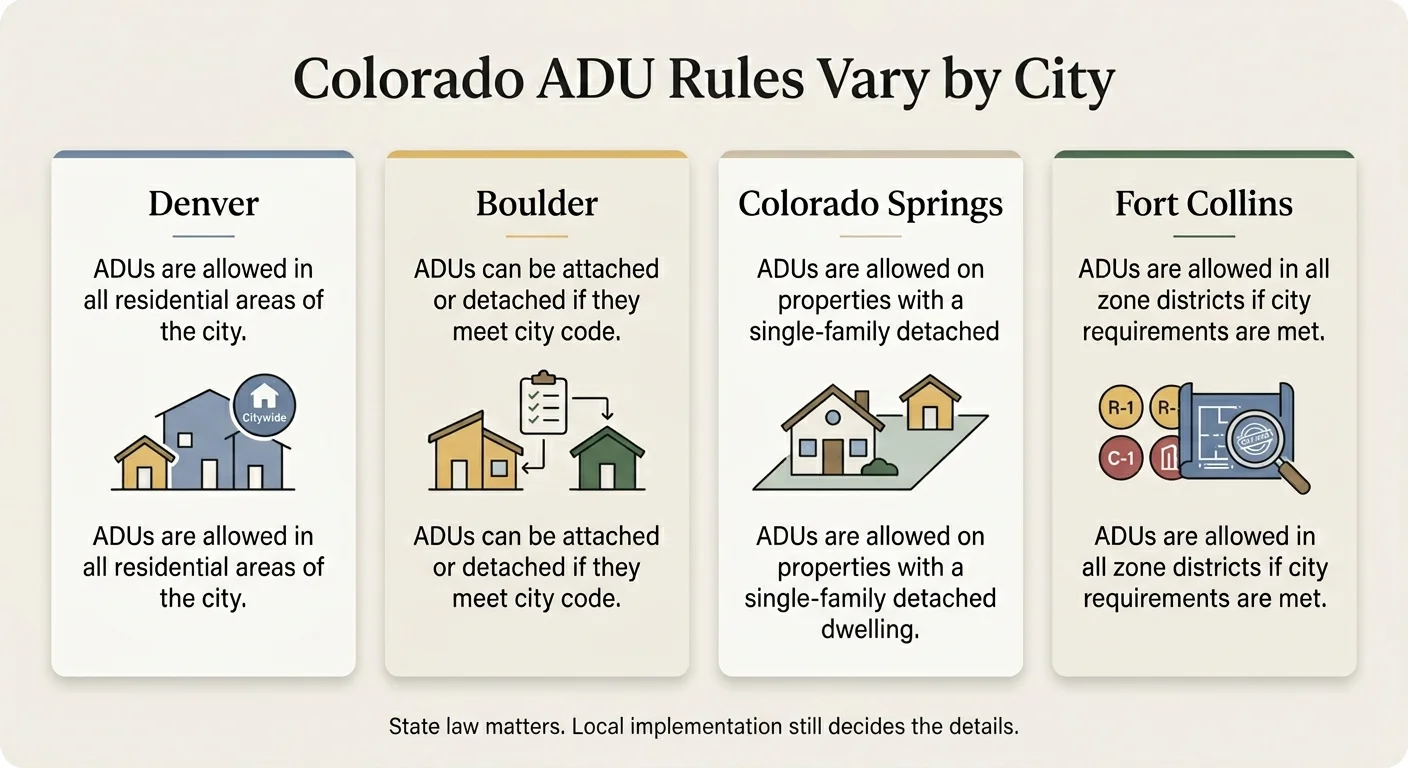
State law matters. Local implementation still decides the details.
| Rule | Denver | Colorado Springs | Boulder | Fort Collins |
|---|---|---|---|---|
| Local ordinance | Citywide ADU text amendment (passed Nov. 18, 2024; effective Dec. 16, 2024) | Ordinance #25-45 (approved Apr. 8, 2025) | Feb. 2025 code update (applies to ADUs proposed on/after Mar. 8, 2025) | Ordinance 009, 2025 (effective Feb. 2025) |
| Where allowed | All zone districts that allow new single-unit dwellings (expanded from 36% to ~70% of land) | Any property with a single-family detached dwelling | Zoning districts listed in ADU guide (Section 9.6.3(n)) | All zone districts where single-family homes are permitted |
| Max size (detached) | Varies by lot size and zone district — verify with Denver zoning code | 1,250 sq ft or 50% of primary home, whichever is less (750 sq ft if primary is under 1,500 sq ft) | Standard: verify current code; Affordable/historic: up to 1,000 sq ft detached, 1,200 sq ft attached | 750 sq ft if primary ≤ 1,667 sq ft; 1,000 sq ft or 45% of primary (whichever is less) if primary > 1,667 sq ft |
| Max height (detached) | 1.5 stories; bulk plane rules apply — verify by zone | 16 ft (1 story); 25 ft if above garage | Varies by zone | May not exceed height of primary building or zone max |
| Rear setback | 5 ft min; must be in rear portion of lot | Front/side match principal building; rear 5 ft | 5–10 ft varies by zone | Varies by zone district; ADUs may not be built in setbacks |
| Parking | Not required for ADU (narrow exceptions) | 1 off-street space per ADU | Per HB 24-1152 minimums | No extra parking beyond what primary dwelling requires |
| Owner occupancy | In single-unit zone districts, owner must reside in main house when applying to build ADU. Required for STR license. | Owner Residency Determination Affidavit required in permit package | Not required (removed Mar. 8, 2025) | Not broadly required; verify with city |
| Short-term rental | STRs must be host's primary residence and be licensed | No — ADU cannot be used as STR | No — unless ADU and STR license established before Feb. 1, 2019 | No — ADUs with building permits on/after Jan. 1, 2024 cannot be used as STRs |
| Prefab / modular | Yes (permanent foundation; no RVs/mobile homes/tiny homes on wheels) | Yes (permanent foundation required; no mobile homes/RVs) | Yes (subject to local building codes + SmartRegs) | Yes |
| Separate sale | Check city code | Generally no. Exception: if a detached ADU meets all applicable UDC provisions, the property may be subdivided. | No | Land not divided into separate lots (condo plat may be possible) |
| Notable restrictions | Licensed contractor required; historic districts/landmarks need certificate of appropriateness; one ADU per primary dwelling | No detached/attached ADUs in Wildland-Urban Interface zones; public notice poster required for 14 days | Detached ADUs require automatic sprinkler system (NFPA 13D or approved alternative); SmartRegs compliance for rentals | Basic Development Review required; BDR flat fee $6,925; total fees may be $20,000–$25,000 range; Poudre River floodplain properties restricted |
| Verified | April 2026 | April 2026 | April 2026 | April 2026 |
| City ADU page | denvergov.org | coloradosprings.gov/adu | bouldercolorado.gov | fcgov.com |
Sources: Denver Community Planning and Development (Citywide ADU text amendment); Colorado Springs Unified Development Code (Ord. #25-45); Boulder Land Use Code Section 9.6.3(n); Fort Collins Ordinance 009, 2025 and city ADU pages. City rules change — verify directly with each city's planning department.
Other Front Range Jurisdictions
Adopted new ADU regulations June 3, 2025 to comply with HB 24-1152. One ADU per lot; 500–800 sq ft baseline; no short-term rentals. Check Longmont's ADU page for current rules.
Official city pageVerified April 2026.
HOAs/PUDs cannot prohibit ADUs as of July 1, 2025. Supports factory-built ADUs. Impact and permit fees waived if increased utility service is not required; use tax and school/fire district fees still apply.
Official city pageVerified April 2026.
ADUs allowed in agricultural, residential, and comparable planned-development districts. Detached ADUs require a minimum 7,500 sq ft lot.
Official city pageVerified April 2026.
Building permit, use tax, plan review fees, recording fees, and possibly plumbing/mechanical/electrical fees apply. Size tied to lot and home dimensions.
Official city pageVerified April 2026.
ADU permit applications accepted. 8–12 week review timeline. Building permit fee, use tax, plan review, and potentially drainage and transportation impact fees apply.
Source: Arapahoe County ADU permit page. Verified April 2026.
Want to know exactly what's allowed on YOUR lot?
Address-level feasibility check: zoning, overlays, lot fit, size limits, and ballpark cost — personalized to your property.
See What You Can Build — Free ADU ReportCan Your HOA Still Stop You From Building an ADU?
In subject and supportive jurisdictions, HOA restrictions that prohibit ADUs in ways Colorado law forbids are void.
Any CC&R provision that outright bans accessory dwelling units on single-family lots has lost its force under state public policy. This is statutory, not a grey area.
HB 24-1152, Section 6 states that provisions in a common-interest community's declaration, bylaws, or rules that restrict or attempt to restrict ADUs as an accessory use to a single-unit detached dwelling are void to the extent they conflict with the statute. And C.R.S. § 38-33.3-106.5 reinforces this with specific language about what HOAs can and cannot do.
What your HOA CAN still do
- Require that your ADU's exterior materials complement the primary home
- Enforce consistent color palettes and roof pitch
- Impose landscaping standards
- Apply the same design standards they'd apply to other accessory buildings
- Require you to submit plans for architectural review
What your HOA CANNOT do
- Outright ban ADUs
- Require the ADU to be identical to the primary home (unreasonably restrictive)
- Impose design standards so onerous they effectively prevent construction
- Apply stricter rules to factory-built/modular ADUs than to site-built ones
Important: Cities don't enforce HOA covenants for you
Colorado Springs explicitly tells homeowners that the city does not enforce HOA restrictions — disputes between homeowners and their HOA may require independent legal advice. That means if your HOA pushes back despite the law being on your side, the city won't fight that battle for you. You may need to push back directly.
What to do if your HOA sends a denial letter
Many HOA boards haven't updated their playbook since HB 24-1152 took effect. If you receive a denial:
Respond in writing — citing HB 24-1152 §6 and C.R.S. § 38-33.3-106.5
Request specific, objective criteria — for any design requirements they impose
Document everything — keep copies of all correspondence
Check DOLA's resources — they've published HOA-specific guidance
Consult a Colorado real estate attorney — if the HOA persists — the law is on your side, but formal challenge may require legal help
Sources: HB 24-1152 §6; C.R.S. § 38-33.3-106.5; SB24-174; Colorado Springs ADU FAQ (coloradosprings.gov/adu). Verified April 2026.
If you've been told “ADUs are banned” by your HOA and you live in a subject jurisdiction — that statement no longer reflects Colorado law. You have more options than you may think.
What Types of ADUs Can You Build in Colorado?
Colorado law defines an ADU as an internal, attached, or detached dwelling unit. Local codes then determine how each type is regulated on the ground — including size limits, setbacks, and permit requirements specific to each type.
Internal ADUs
Lowest costBuilt within your existing home — basement apartments and attic conversions are most common. Even if the space is already finished, you'll typically need a "change of use" permit to formally establish it as a separate dwelling unit. Internal conversions are generally the lowest-cost path because you're working within an existing structure. In Colorado, keep radon mitigation on your radar for any basement ADU — the state has some of the highest radon levels in the country.
Attached ADUs
Share at least one wall with the primary home. Think of a side addition or a bump-out with a separate entrance.
Detached ADUs
Most flexibilityA separate structure on your lot — the backyard cottage, the garden apartment, the purpose-built rental. Most flexibility for privacy and rental use. Also the highest cost because it requires its own foundation, site preparation, utility connections, and permits. Above-garage units are a popular hybrid. Colorado Springs specifically addresses these with a higher height limit (25 ft vs. 16 ft for standard detached units).
Garage conversions
Cost-effectiveConverting an existing garage is one of the most cost-effective paths because the core structure already exists. Different building code requirements apply — contact your local building department to understand what's required for your specific conversion.
Factory-built, modular, and prefab ADUs
State-protectedHB 24-1152 explicitly protects factory-built ADUs. The statute prohibits cities from applying more restrictive design or dimensional standards to factory-built structures than to site-built ones. Two types are recognized in Colorado: HUD-certified manufactured homes and Colorado Division of Housing-certified prefab. Both still require a permanent foundation, utility connections, and local building permits.
What doesn't qualify
Tiny homes on wheels, RVs, and mobile homes are not ADUs under Colorado law. Denver specifically excludes them. Colorado Springs prohibits mobile homes and RVs as ADUs and requires permanent foundations. If you're looking at a unit on wheels, it's a different regulatory path entirely.
Can You Rent Your ADU? Airbnb It? Move Into It?
Long-term rental is generally permitted across Colorado subject jurisdictions. Short-term rental is where the rules diverge sharply — and this is the question that trips up more ADU investors than any other.
Long-term rental is a clear, legal path in every major Front Range city. Short-term rental depends entirely on your municipality.
| Use Case | Denver | Colorado Springs | Boulder | Fort Collins |
|---|---|---|---|---|
| Long-term rental (30+ days) | Yes | Yes | Yes | Yes |
| Short-term rental (Airbnb/VRBO) | Only if STR is host's primary residence, licensed | No — ADU cannot be used as STR | No — unless ADU and STR license established before Feb. 1, 2019 | No — ADUs with permits on/after Jan. 1, 2024 cannot be STRs |
| Owner residency required | Must reside on parcel when applying in single-unit zones; required for STR license | Owner Residency Determination Affidavit in permit package | Not required (as of Mar. 8, 2025) | Verify with city |
| Separate sale / subdivision | Check city code | Generally no (exception if detached ADU meets all UDC provisions) | No | No (condo plat may be possible) |
Sources: Denver STR regulations (denvergov.org); Colorado Springs Ord. #25-45; Boulder Land Use Code; Fort Collins Ordinance 009, 2025 (fcgov.com). Verified April 2026.
Rental income depends on local market conditions, unit quality, and demand. These are not guarantees of returns.
How ADU Permitting Actually Works in Colorado
Under HB 24-1152, the permitting process in subject jurisdictions is administrative. That means no discretionary public hearing before an elected or appointed body. You submit your application, staff reviews it against the code, and if you meet the requirements, you get a permit. (Historic-review procedures and some local notice requirements can still apply.)
Confirm jurisdiction, zoning, and overlays
Use your city's online zoning map. Confirm you're in a subject jurisdiction (DOLA map). Check for overlays — historic district, wildfire-urban interface, floodplain — that add requirements or may make your parcel exempt.
Choose your ADU type
Internal, attached, detached, conversion, or prefab. This decision drives everything: cost, timeline, and which code sections apply. If your city has pre-approved ADU plan sets (some are developing these with DOLA grant funding), that's your fastest and least expensive path.
Get a site plan and preliminary code check
Before you pay for full architectural drawings, get a site plan showing your lot, proposed ADU location, setback lines, utility access, and overlays. Some cities offer pre-application meetings (Colorado Springs does) — take advantage of these. They're free and can save you months.
Check utilities and service capacity
Your city's water, sewer, and electrical utilities need to confirm they can serve the ADU. This is where surprises happen. Boulder may require a separate water tap at significant cost. Fort Collins requires a separate electric meter and service lines for the ADU, and you may need to upgrade the public electrical system. Always get a utility capacity determination before finalizing your design.
Submit your building permit application
Typical submission includes architectural drawings, site plan, structural details, and city-specific forms. For factory-built ADUs, submit the unit's HUD or state certification instead of full architectural plans.
Handle local extras
Historic district? May need a certificate of appropriateness. Colorado Springs? Public notice poster displayed for 14 days. WUI zone? Detached/attached ADUs may be restricted. Fort Collins? Attached new-construction ADUs require fire sprinklers per IRC.
Inspections and certificate of occupancy
Same inspections as any residential construction: foundation, framing, mechanical, electrical, plumbing, insulation, and final. Pass final inspection → certificate of occupancy → move in or rent.
Per-city examples of what's required at submission:
Denver
- Zoning permit
- Building permit
- Sewer-use-and-drainage permit
denvergov.org
Colorado Springs
- Building permit (Pikes Peak Regional Building Dept.)
- Owner Residency Determination Affidavit
- Subdivision and Separate Sale Covenant
coloradosprings.gov/adu
Boulder
- Standard building permit process
- (No separate admin review since Sept. 2023)
bouldercolorado.gov
Fort Collins
- Basic Development Review (BDR)
- Flat fee: $6,925
- City estimates total fees $20,000–$25,000
fcgov.com
See the likely permit path for your lot
Get Your Free ADU ReportWhat Does an ADU Actually Cost in Colorado?
We're not going to sugarcoat this. ADU construction is a significant investment. And the costs that surprise Colorado homeowners most are not the structure itself — they're the site work, utilities, permits, and impact fees that can add six figures to your project. Construction cost and local fee burden vary sharply by city, site conditions, utility requirements, and ADU type.
Here's what we can verify from official city sources:
| City | Known Fee Components | Source |
|---|---|---|
| Fort Collins | Basic Development Review: $6,925 flat; city estimates total fees in $20,000–$25,000 range | fcgov.com |
| Brighton | Impact and permit fees waived if utility service doesn't need to increase; use tax and school/fire district fees still apply | brightonco.gov |
| Colorado Springs | DRE plan review fee + Park Land Dedication + School Land Dedication + Citywide Development Impact fees | coloradosprings.gov/adu |
| Arvada | Building permit fee + use tax + plan review + recording fees + possible plumbing/mechanical/electrical fees | arvadaco.gov |
For a complete breakdown of construction costs by ADU type, including structure, foundation, site prep, and utility estimates based on Colorado builder data, see our Complete ADU Cost Guide.
Colorado ADU Grants and Financing Programs: What's Actually Available
Colorado has committed real money to making ADUs more accessible — but the programs are targeted, and not all of them are available to every homeowner. Here's the verified status.
DOLA ADU Grant Program (ADUG)
This is a grant program for local governments, not individual homeowners. But it directly benefits you because cities use the funds to develop pre-approved ADU plans, provide technical assistance, and waive or reduce fees.
Round 1
Opened Aug. 1, 2025; closed Oct. 3, 2025. Awards announced Nov. 19, 2025 to Grand Junction, Superior, Larimer County, Glenwood Springs, Fruita, Brighton, and Longmont.
Round 2
Opened Feb. 2, 2026; closed Feb. 27, 2026.
Future rounds
Confirm directly with DOLA for upcoming application periods.
Only certified ADU Supportive Jurisdictions are eligible. Source: Governor's Office press release (Nov. 19, 2025); DOLA ADUG program page. Verified April 2026. Confirm directly with DOLA for current round status and funding availability.
CHFA ADU Finance Programs
The Colorado Housing and Finance Authority administers ADU finance programs under contract with OEDIT, funded at $8 million total. These include revolving loans, credit enhancement, and interest-rate buydown programs.
Important context: These programs are designed for eligible lending institutions who then serve low- and moderate-income borrowers and/or tenants in ADU Supportive Jurisdictions. CHFA does not lend directly to homeowners. Availability depends on your jurisdiction's certification status and whether local lenders are participating.
Confirm current program availability and participating lenders directly with CHFA.
City-Specific Programs
Denver ADU Pilot Program
Design and permitting assistance, plus potential grants for homeowners who rent at below-market rates. Active in 2026.
Boulder Affordable ADU Program
Homeowners who agree to rent at 75% of area median income get a larger allowable ADU size.
Grand Junction
ADU incentive program awarded through DOLA's first ADUG round.
Beyond state programs
Most Colorado homeowners finance ADUs through conventional tools — home equity lines of credit, construction loans, or cash-out refinances. The key is working with a lender who understands ADU projects and can factor projected rental income into the underwriting.
For a full breakdown of ADU financing paths and how to evaluate your options, see our ADU Financing Guide.
How to Check Your Lot Before You Spend Money on Plans
The best next step is not “call three builders.” It's a fast, free pre-design eligibility check that takes 10–15 minutes. Do this before you pay for drawings, quotes, or financing applications.
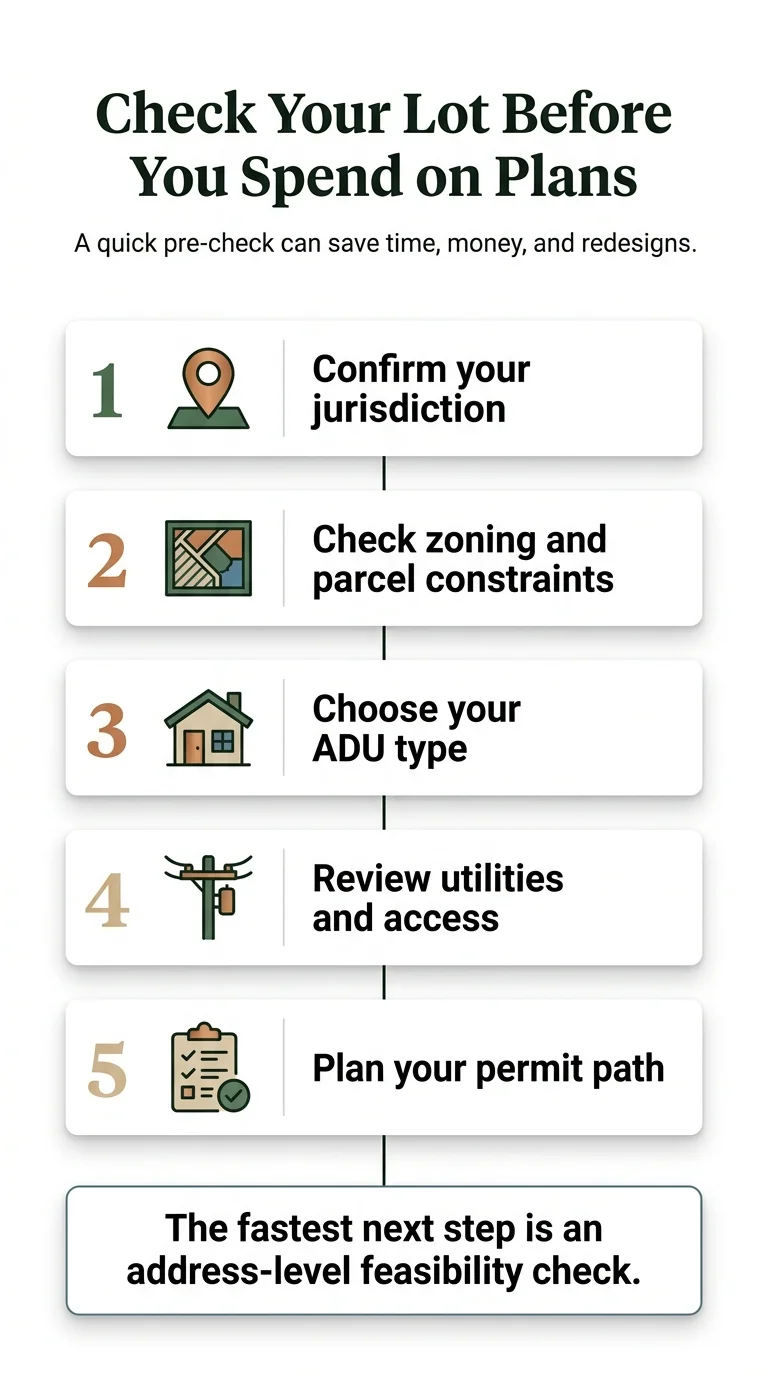
A quick pre-check can save time, money, and redesigns. The fastest next step is an address-level feasibility check.
The 10-Minute Colorado ADU Pre-Check
Is your parcel exempt?
Floodplain, well/septic limitations, or individually designated historic property outside a district?
What's your zoning district?
Look up your property on your city's online zoning map.
Are there overlays?
Historic district, WUI, floodplain, or special designations?
What's your lot size?
This determines your maximum ADU footprint in many cities.
Where are your setback lines?
Rough-measure how much buildable space you have.
Do you have an HOA?
Pull your CC&Rs — remember, bans are void in subject jurisdictions, but design standards may apply.
What's your utility situation?
City water/sewer or well/septic? Alley access for a detached unit?
Documents to Collect Before Your First Builder Conversation
Red Flags That Mean “Pause Before Spending More”
Your parcel is exempt (floodplain, well that can't serve a second unit, individually designated historic property)
Your lot is in a WUI zone and you want a detached unit
Your property is on well/septic and the county requires expensive capacity testing
The only ADU type that pencils is a short-term rental, and your city bans STRs for ADUs
Your HOA has an aggressive architectural review board (legal, but will slow you down)
None of these are permanent dead ends — but each one changes the path, the timeline, or the budget. Better to know now than after you've paid for architectural drawings.
This is the most important step you can take right now.
Everything else — design, financing, builder selection — comes after you know what your property actually allows.
See What You Can Build at Your AddressCommon ADU Deal-Killers in Colorado (and How to Avoid Them)
Even with the strongest statewide ADU law in Colorado's history, projects still fail. Usually not because the law doesn't allow it — but because the homeowner didn't check one of these before investing in plans.
| Issue | Why People Miss It | Where to Verify | What to Do |
|---|---|---|---|
| Exempt parcel | Don't realize floodplain/well/historic property exemptions exist | FEMA maps; city zoning; well permit | Verify exempt-parcel status before designing |
| HOA sends denial | Boards haven't updated CC&Rs for HB 24-1152 | Your CC&Rs + DOLA guidance | Respond citing HB 24-1152 §6 and C.R.S. § 38-33.3-106.5 |
| Detached size exceeds city cap | State protects 500–750 sq ft; city may cap above that | City ADU ordinance | Design within city limits or adjust scope |
| Rear setback eliminates buildable area | 5 ft minimum ≠ unlimited — lot depth and existing structures matter | Property survey + city zoning map | Get a professional site plan before designing |
| WUI zone | CO Springs bans detached/attached ADUs in WUI | City fire department / WUI overlay maps | Consider internal ADU instead |
| Utility capacity | Especially on older systems or well/septic properties | City utility provider or county health dept | Get capacity confirmation before submitting permit |
| Impact fees blow up the budget | Near-zero in one city, five figures in another | City building department fee schedule | Get a written fee estimate before designing |
| No STR allowed | Planned on Airbnb income; city bans it for ADUs | City STR ordinance | Pivot to long-term rental model |
| Licensed contractor required | Denver requires it; not all cities do | City building code / permit requirements | Budget for licensed contractor if required |
| Unpermitted existing unit | Basement apartment never got a permit | City building department | Some cities have legalization pathways — ask |
When an ADU Might Not Be the Right Move
We're going to be honest with you — because the last thing we want is for you to start a project that doesn't make sense for your situation.
Consider pausing if:
You're planning to sell within 12–24 months
You won't recoup construction costs unless you hold the property long enough to benefit from rental income and appreciated value. If you're moving soon, the economics rarely work.
Your only use case is short-term rental, and your city bans ADU STRs
Colorado Springs, Boulder, and Fort Collins all prohibit or severely restrict Airbnb-style use of ADUs. If your investment thesis depends on nightly rates, verify your city's rules first.
There's no viable utility path
Some lots — especially in unincorporated areas — lack the water, sewer, or electrical capacity for a second dwelling. If utility hookup requires major new infrastructure, that changes the math significantly.
When a conversion beats a new build
If your budget is under $150,000, a basement or garage conversion almost always delivers better value than a new detached unit. You skip foundation costs, reduce utility work, and get to livable faster. Don't let 'backyard cottage' marketing bias you away from the most practical option for your property.
For alternative paths, see our ADU Floor Plans and ADU Cost Guide.
Frequently Asked Questions
Are ADUs legal in Colorado?
Yes. HB 24-1152 requires subject jurisdictions to allow one ADU as an accessory use to a single-unit detached dwelling, through an administrative approval process. The law applies on non-exempt parcels in approximately 67 subject jurisdictions as of DOLA's October 2025 compliance report. Rural and mountain communities outside MPOs are not required to comply but can voluntarily opt in. (C.R.S. 29-35-401 through 405)
Does HB 24-1152 apply everywhere in Colorado?
No. It applies to subject jurisdictions — municipalities with 1,000+ residents within an MPO and qualifying unincorporated county areas. It also does not apply to exempt parcels (floodplain, certain well/septic situations, individually designated historic properties outside a district). Check DOLA's published list and verify your parcel's exempt status.
What is a subject jurisdiction?
A city, town, or qualifying portion of a county that falls within one of Colorado's five Metropolitan Planning Organizations and meets the population threshold. (C.R.S. 29-35-402(21))
Do HOAs have to allow ADUs in Colorado?
In subject and supportive jurisdictions, HOA provisions that prohibit ADUs in ways the statute forbids are void. HOAs can impose reasonable restrictions on design and aesthetics but cannot effectively prohibit construction. Cities do not enforce HOA covenants — disputes may require independent legal action. (C.R.S. § 38-33.3-106.5; HB 24-1152 §6)
Does the owner have to live on the property?
State law bars broad owner-occupancy mandates. However, a subject jurisdiction may require the owner to reside on the parcel when the ADU application is submitted. Cities may also require owner occupancy for a short-term rental license or permit. Denver requires this in single-unit zones; Colorado Springs requires an Owner Residency Determination Affidavit.
What size ADU can I build in Colorado?
Subject jurisdictions cannot block ADUs between 500 and 750 square feet. Local governments may allow larger units and may restrict sizes outside that protected band. The ADU generally cannot be larger than the primary dwelling. Specific size limits vary by city and zone district.
How much parking is required for an ADU in Colorado?
In most situations, none. HB 24-1152 eliminated most parking requirements. Cities can require one space only if no on-site parking exists and on-street parking is prohibited. Colorado Springs still requires one off-street space per ADU.
Can I build a detached ADU behind my house?
Yes, in subject jurisdictions on non-exempt parcels. Detached ADUs are one of the three types the law requires cities to allow. Your lot must meet setback, lot coverage, and height requirements per your city's code.
Can I use a prefab or modular ADU in Colorado?
Yes. HB 24-1152 prohibits cities from applying stricter standards to factory-built ADUs than to site-built ones. Both HUD-certified and Colorado Division of Housing-certified units are permitted. They still need a permanent foundation, utility connections, and building permits.
Can I use a tiny home on wheels or RV as an ADU in Colorado?
No. Colorado ADU law requires permanent structures. Denver, Colorado Springs, and most other cities specifically exclude tiny homes on wheels, RVs, and mobile homes.
Can I rent my ADU long-term?
Yes, in virtually all Colorado subject jurisdictions. Long-term rental (30+ days) is permitted across the board.
Can I Airbnb my ADU in Colorado?
It depends on your city. Denver: only if the STR is your primary residence and licensed. Colorado Springs: no. Boulder: no, unless grandfathered before February 1, 2019. Fort Collins: no for ADUs with permits issued on or after January 1, 2024.
Can I sell the ADU separately from my house?
Generally no. Colorado Springs has a narrow exception — if a detached ADU meets all applicable UDC provisions, the property may be subdivided for separate lots and sale. Fort Collins notes the land is not divided but a condo plat may be possible. Most cities do not allow separate sale.
Does a prefab ADU still need a local permit in Colorado?
Yes. State or HUD certification does not replace local permitting. You still need a building permit, plot plan, foundation design, and utility service confirmation from your city.
What if I already have an unpermitted second unit?
Some cities have pathways to legalize existing unpermitted units. Contact your building department directly and be upfront about the situation. Some cities have formal legalization programs.
Are there grants available for ADUs in Colorado?
DOLA's ADU Grant Program (ADUG) provides grants to municipalities — not directly to homeowners — for fee reductions, pre-approved plans, and technical assistance. CHFA administers ADU finance programs for eligible lenders serving low- and moderate-income borrowers in ADU Supportive Jurisdictions. Some cities have additional local programs. Confirm current availability directly with DOLA and CHFA.
How We Verified This Page
Sources used:
- Colorado Revised Statutes: C.R.S. 29-35-401 through 29-35-405; C.R.S. § 38-33.3-106.5; C.R.S. 24-67-105
- HB 24-1152 enrolled bill text via Colorado General Assembly (leg.colorado.gov/bills/hb24-1152)
- DOLA ADU webpage, subject jurisdiction list, ADUG program documents
- CHFA ADU Finance Program page (chfainfo.com)
- Governor's Office compliance announcement (Oct. 2025) and ADUG award announcement (Nov. 2025)
- City sources: Denver CPD (Citywide ADU text amendment), Colorado Springs (Ord. #25-45), Boulder (Section 9.6.3(n)), Fort Collins (Ordinance 009, 2025), Brighton, Jefferson County, Arvada, Arapahoe County, Longmont
Verification schedule:
- Top jurisdictions: re-verified monthly
- Grant/finance program availability: re-verified quarterly
- After any Colorado legislative session: full page review
- Reader-reported corrections: investigated within 72 hours
This page is educational and does not constitute legal advice. Local ADU rules change. Always verify current requirements with your city's planning department.
Your Next Step
You've read the law. You understand the state framework. You know which city rules still matter and where the real deal-killers hide. Now the only question left is: what can you actually build on your specific lot?
See what's possible at your address
A clear picture of what Colorado law allows on your property, what your city requires, and what your next step should be.
Get Your Free ADU ReportGet the Free 2026 Colorado ADU Starter Kit
- HB 24-1152 plain-English summary (printable)
- City-by-city comparison one-pager
- HOA response letter template (with code citations)
- Pre-design permit checklist
- Financing options overview
More from The Dwelling Index
How Much Does an ADU Cost?
Full cost breakdown by type, size, and region — plus what drives the price up or down.
ADU Financing Paths
HELOC, construction loans, HEIs, and more — organized by your situation.
Best Prefab ADU Companies
Compared by price, quality, timeline, and delivery area.
ADU Floor Plans & Design Gallery
1-bedroom, studio, and accessible layouts ready to customize.
ADU for Aging Parents
Best setups, real costs vs assisted living, and financing for retirees.
ADU Laws by State
California, Oregon, Washington, and more — compared in one place.
Texas ADU Laws
Austin, Houston, San Antonio, and Dallas rules — sourced from official city codes.
Ready to find out what you can build?
Your free ADU report covers zoning, lot fit, estimated costs, and next steps — personalized to your Colorado property.
Get Your Free ADU Report in 60 Seconds