Best Prefab ADU Under $150K: Real Models, Real Total Costs (2026)
Looking for the best prefab ADU under $150K? You can get a legal, permitted unit installed on your property at this budget — but only if you pick the right company, the right size, and you budget for the costs that never make it onto the homepage.
We reviewed current pricing from more than a dozen prefab ADU companies, compared base prices against real installed costs, and filtered out the units that look cheap online but blow past $150K the moment you add foundation, utilities, delivery, and permits. A 300–600 sq ft prefab ADU on a flat lot with accessible utilities is the realistic sweet spot for a $150K total budget in 2026. Anything larger, more remote, or more complex pushes the number higher fast.
Below: which companies can actually deliver at this price point, what their advertised numbers really include, and how to tell whether your specific property is one of the cases where $150K is realistic — or where it’s not.
Affiliate Disclosure: The Dwelling Index is reader-supported. When you use our links to request prefab pricing or explore financing, we may earn a commission at no extra cost to you. Our editorial recommendations are based on independent research and are never influenced by compensation. Full affiliate disclosure · Editorial methodology
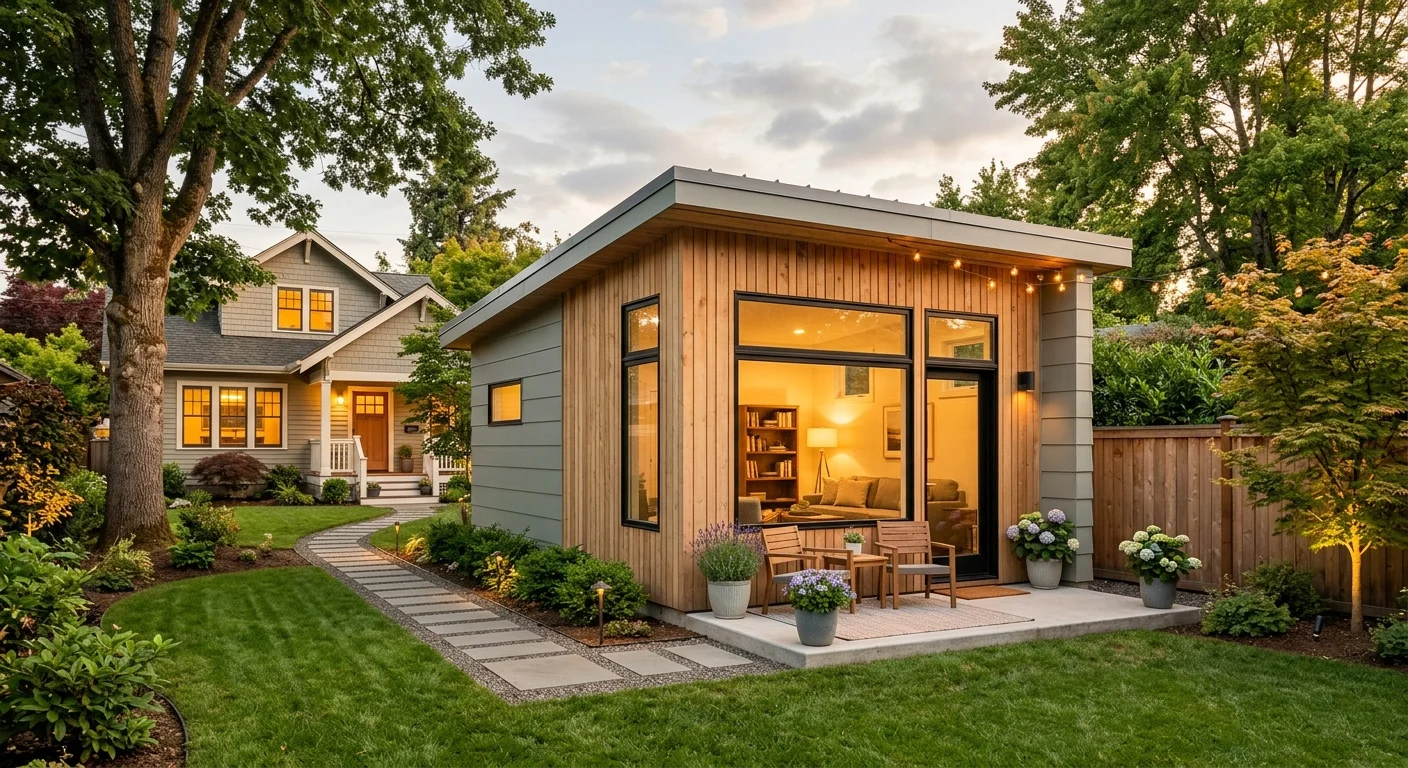
Which Prefab ADUs Can Actually Land Under $150K?
Before we go deeper, here’s the table you came for. We sorted these by estimated real total project cost — not the advertised sticker price — because the sticker price is where the budget starts, not where it ends.
How to read this table: The “Advertised Starting Price” is what the company puts on its website. The “Estimated Total Installed Cost” is our editorial estimate of what the full project is likely to cost on a typical flat suburban lot with standard utility access, including foundation, site prep, delivery, utility connections, and permits. Your actual number will vary based on your specific lot and local costs.
| Company | Model / Size | Sq Ft | Bed / Bath | Build Type | Advertised Starting Price | Est. Total Installed Cost | Delivery Area | Under $150K All-In? |
|---|---|---|---|---|---|---|---|---|
| Craftsman Tiny Homes | Summit 410 | 410 | Studio–1BR / 1BA | Modular | ~$65,500 | $110K–$140K | FL/GA primary | Likelyon easy lots |
| Modular Home Direct | Various models | 284–988 | Studio–3BR / 1–2BA | Steel-frame modular | $56,500–$145,000 | $100K–$190K+ | Nationwide (GC search) | Likelyfor smaller models |
| prefabADU | Micro/Mini kits | 150–649 | Studio–2BR / 1BA | Kit/owner-build | Under $45K–$90K+ | $80K–$140K+ | Primarily CA; ships kits | Likelywith owner labor |
| Studio Home | Summit 308–476 | 308–476 | Studio–1BR / 1BA | Panelized | $98,029–$119,917 | ~$100K–$135K | All 50 states | Tightsmallest models only |
| BOXABL | Casita | 361 | Studio / 1BA | Foldable factory-built | Varies (payment-based pricing) | Unclear — site work extra | Ships from Las Vegas | Unclearverify total scope |
| Craftsman Tiny Homes | Summit 800 | 800 | 2BR / 1BA | Modular | ~$129,900 | $170K–$210K+ | FL/GA primary | Unlikelyfor most lots |
| Samara | Studio | 420 | Studio / 1BA | Turnkey modular | $152,000 + installation | $200K+ | California only | No |
| Abodu | Studio | 340 | Studio / 1BA | Turnkey modular | $262,800 | $262,800+ (turnkey) | California only | No |
| Villa Homes | Various | 250–1,000 | Studio–2BR | Turnkey | Varies | Typically above $150K | CA and CO | No |
Official published starting prices were verified from company websites in April 2026 where available. “Estimated Total Installed Cost” and “Under $150K All-In?” are Dwelling Index editorial estimates based on published scope, excluded-cost analysis, and cited industry references. See methodology
What jumps out immediately: The companies advertising the lowest base prices aren’t necessarily the cheapest once you account for everything. And the brands with the strongest marketing — Abodu, Samara, Villa — make excellent products that are simply not designed for a $150K total budget. Different product for a different buyer.
For budget-focused buyers, the realistic shortlist narrows to a handful of companies where the total installed project can genuinely stay under $150K on a straightforward lot.
Already see a few models that could work? The next question is whether your property can support them.
What Your $150K Budget Actually Has to Cover
Think of a prefab ADU project as having two price tags: the unit itself, and everything required to make it a legal, livable home on your property.
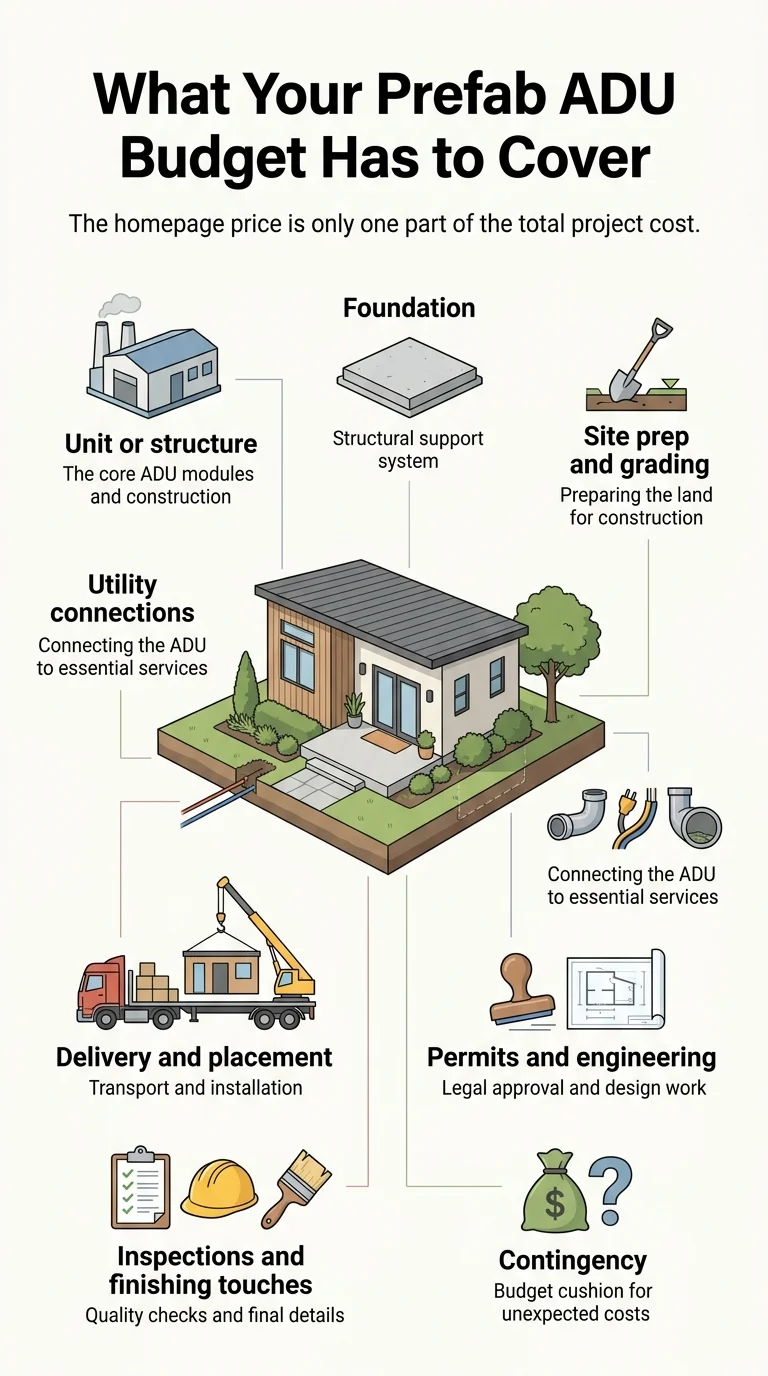
The unit or structure
This is the advertised price. It typically covers the walls, roof, flooring, fixtures, appliances, and basic finishes. For budget-friendly prefab ADUs, expect $45,000–$130,000 depending on size, build type, and finish level.
Foundation
Every permanent ADU needs a foundation, and it's almost never included in the base price. A basic concrete slab runs $8,000–$20,000 depending on your soil conditions and local labor rates.
Site preparation and grading
Clearing the area, leveling the ground, ensuring drainage. On a flat suburban lot, this might be $5,000–$10,000. On a sloped or restricted lot, it can exceed $25,000.
Utility connections
Water, sewer (or septic), electric, and gas lines running from your main house to the ADU location. If utilities are close — say, 30 feet or less — expect $10,000–$15,000. If they're 75+ feet away or you need a panel upgrade or septic expansion, you could be looking at $20,000–$30,000+.
Delivery and crane placement
Most prefab units ship on a truck and need a crane to place on the foundation. Budget $5,000–$15,000, with higher costs for difficult access.
Permits, engineering, and inspections
Permit fees, structural engineering, soils reports, and inspections range from $2,000 in affordable jurisdictions to $12,000+ in expensive ones.
The stuff nobody mentions
Landscaping restoration after heavy equipment drives through your yard. Potential electrical panel upgrade. Possible separate utility metering if your city requires it. Property tax increases. A 10% contingency buffer you'll be glad you kept.
A Real Budget Example
Here’s how a $75,000 base-price prefab ADU actually pencils out on a standard flat lot:
| Line Item | Estimated Cost |
|---|---|
| Prefab unit (400 sq ft, 1BR/1BA) | $75,000 |
| Concrete slab foundation | $12,000 |
| Site prep and grading | $6,000 |
| Utility connections (30 ft run) | $14,000 |
| Delivery and crane | $8,000 |
| Permits and engineering | $5,000 |
| Landscaping, panel upgrade, contingency | $8,000 |
| Total estimated project cost | $128,000 |
That’s a realistic scenario where the budget works. Change one variable — longer utility run, slope, expensive jurisdiction, septic instead of sewer — and you’re at $145,000–$165,000.
The takeaway: A $150K total budget is realistic for a smaller ADU on an easy lot. It’s tight for a mid-size unit. And it’s not realistic for a 2-bedroom turnkey in a high-cost area. Knowing that before you fall in love with a floor plan saves you months of frustration — and thousands of dollars.
Which Companies Are Worth Shortlisting at This Budget?
Not every company selling prefab ADUs for under $150K is selling the same thing. Some offer turnkey installation. Some ship a kit and you hire your own contractor. Some are full modular units craned into place. Some are panels you assemble on-site. The right match depends on how much of the project you want managed for you and what your lot looks like.
Best for the Tightest Budget: Craftsman Tiny Homes — Summit 410
Craftsman is a family-owned builder based in Archer, Florida, specializing in custom tiny homes and ADUs. Their Summit model starts at approximately $65,500 for 410 sq ft, making it one of the most affordable ADU-capable units we’ve found with real construction quality. The 800 sq ft version starts at around $129,900. Craftsman describes the Summit as a modular ADU built indoors, and specifically markets it for ADU and primary-residence use on a permanent foundation.
Why we’d shortlist it: The price leaves meaningful budget headroom for site work and installation. Craftsman has the strongest presence in Florida and Georgia, with an established track record in those markets.
Who it’s best for: Buyers who want a smaller, well-built unit at the lowest realistic entry point. Strong fit for aging-parent housing, backyard guest suites, or a studio rental unit.
The honest caveat: Craftsman is a smaller, regional operation — not a national turnkey machine. You’ll likely need to coordinate your own site work and local GC depending on your location, and you should verify that the unit meets your local jurisdiction’s ADU code requirements before ordering.
Dwelling Index may earn a commission when you request pricing through our links. This does not affect our editorial recommendations. Full disclosure
Best Broad Inventory Under $150K: Modular Home Direct
Modular Home Direct operates out of Salt Lake City and offers a wide range of steel-frame modular and container homes. Their current inventory shows models from approximately 284 sq ft starting around $56,500 up through 988 sq ft models at $145,000 at the factory level. They also run a nationwide general contractor search service to help buyers find local installation partners.
Why we’d shortlist it: The sheer variety. If you want to browse a dozen models across different sizes and price points, all in one place, Modular Home Direct gives you more options under the $150K advertised price than anyone else we found. The factory-direct model also means fewer middleman markups.
Who it’s best for: Buyers who want to compare multiple floor plans and sizes, and who are comfortable coordinating with a local GC for site work and installation. Particularly strong for buyers outside of California who can’t access the turnkey California brands.
The honest caveat: “Starting at $56,500” does not mean your total project will cost $56,500. Foundation, site work, delivery, and all the other line items still apply. And nationwide delivery doesn’t mean uniform local expertise — you’ll need to vet the local GC yourself.
Dwelling Index may earn a commission when you request pricing through our links. This does not affect our editorial recommendations. Full disclosure
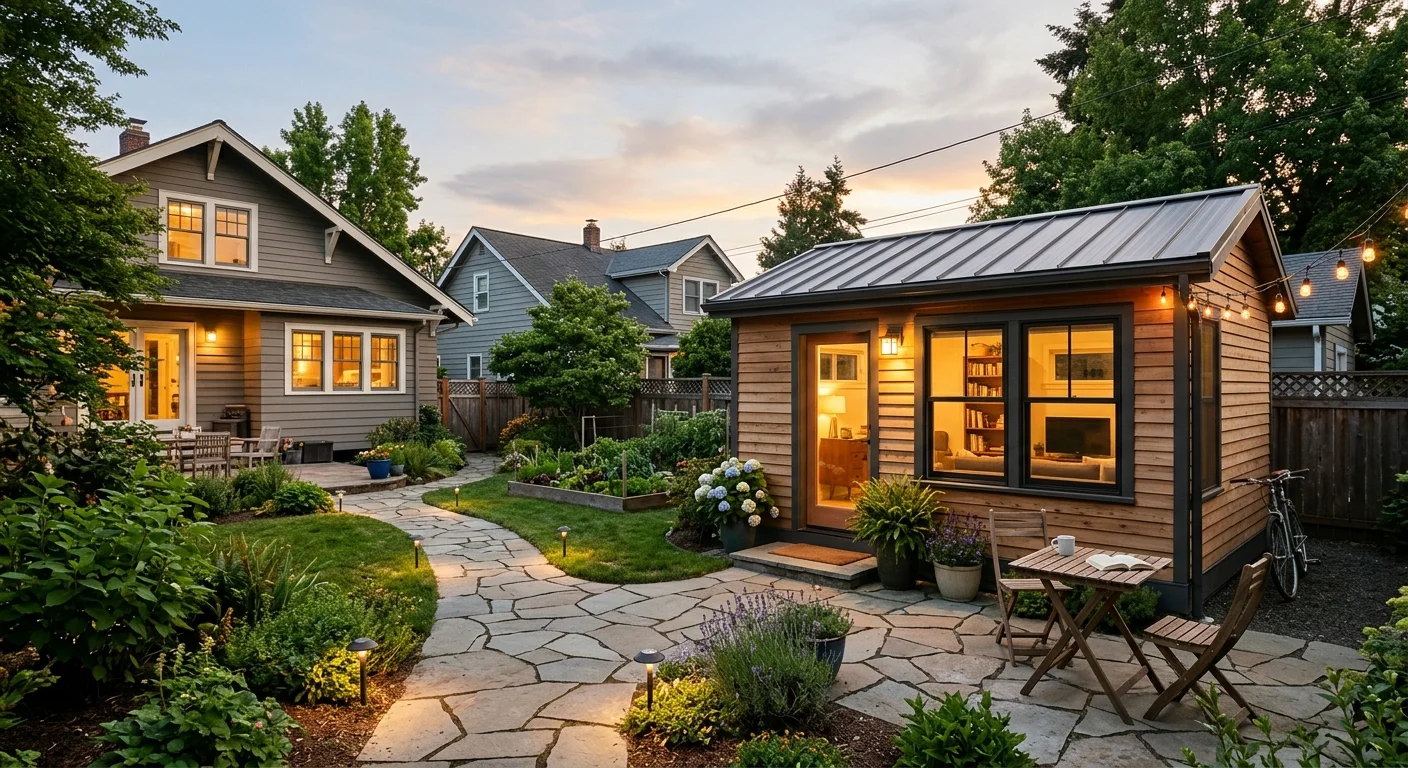
Best for the Owner-Builder: prefabADU Kits
prefabADU, based in the Bay Area, takes a different approach entirely. Instead of delivering a finished module, they sell ADU kits — from plans and materials packages for their Micro (150–250 sq ft) through Suite (400–649 sq ft) and Villa (650–1,200 sq ft) unit lines. Multiple kit options come in under $100K, with some under $45K. The company has completed over 170 units in 14+ years and builds to residential building code (not RV code).
Why we’d shortlist it: If you’re handy or willing to hire your own local labor, a kit ADU is the most affordable path to a legal ADU. The fact that prefabADU builds to residential building code — not RV code — matters for permitting and financing.
Who it’s best for: Owner-builders, handy homeowners, or anyone in a market where local labor is available and affordable. Strongest track record in California where ADU permitting is well-established.
The honest caveat: This is not a “write a check and it shows up ready to live in” product. You’re managing the project. That saves money but costs time and effort.
Best Panelized Option (All 50 States): Studio Home
Formerly Studio Shed, Studio Home offers panelized ADUs through their Summit Series, available in all 50 states. Current starting prices range from $98,029 for their 308 sq ft model to $119,917 for the 476 sq ft model. The company estimates roughly $250/sq ft for a 400 sq ft ADU including product, assembly, site work, and permits — putting a small Summit ADU in the $100,000–$120,000 all-in range on a straightforward lot.
Why we’d shortlist it: Nationwide availability, strong design, and a panelized system that keeps much of the build controlled. Their published $250/sq ft all-in estimate is one of the most transparent in the industry.
Who it’s best for: Buyers in states without access to the California-only turnkey brands who want a polished, modern ADU with a clear process.
The honest caveat: At $250/sq ft all-in, a 400 sq ft ADU lands around $100K, but a 500+ sq ft unit pushes past $125K–$150K+. This works best for studios and small one-bedrooms at the $150K budget.
What About BOXABL?
BOXABL’s Casita is one of the most-searched prefab units on the internet. The 361 sq ft foldable studio ships from Las Vegas and unfolds on-site. BOXABL’s technical plan documentation identifies the Casita as a factory-built ADU with separately permitted foundation work and owner-responsibility for local utility connections.
Our take: We can’t confidently place BOXABL on the “under $150K” shortlist because their current pricing model emphasizes estimated monthly payments rather than a clear total project cost, and the company states that actual price varies by model, location, site work, taxes, delivery, installation, and financing terms. If you’re interested in BOXABL, request a full written scope with all-in costs before comparing it to other options on this list.
Found a model that interests you? Before you request a quote, make sure your lot can actually support it.
What Counts as a Legal ADU — and Why It Matters for Your Budget
This is the filter most “cheap prefab” listicles skip entirely, and it can cost you tens of thousands of dollars or months of wasted effort.
A legal accessory dwelling unit is not just any small structure in your backyard. Fannie Mae’s lending guidelines define an ADU as a unit that includes living, sleeping, cooking, and bathroom facilities independent of the primary residence, and that is accessible without going through the primary residence. It must be on a permanent foundation and classified as real property.
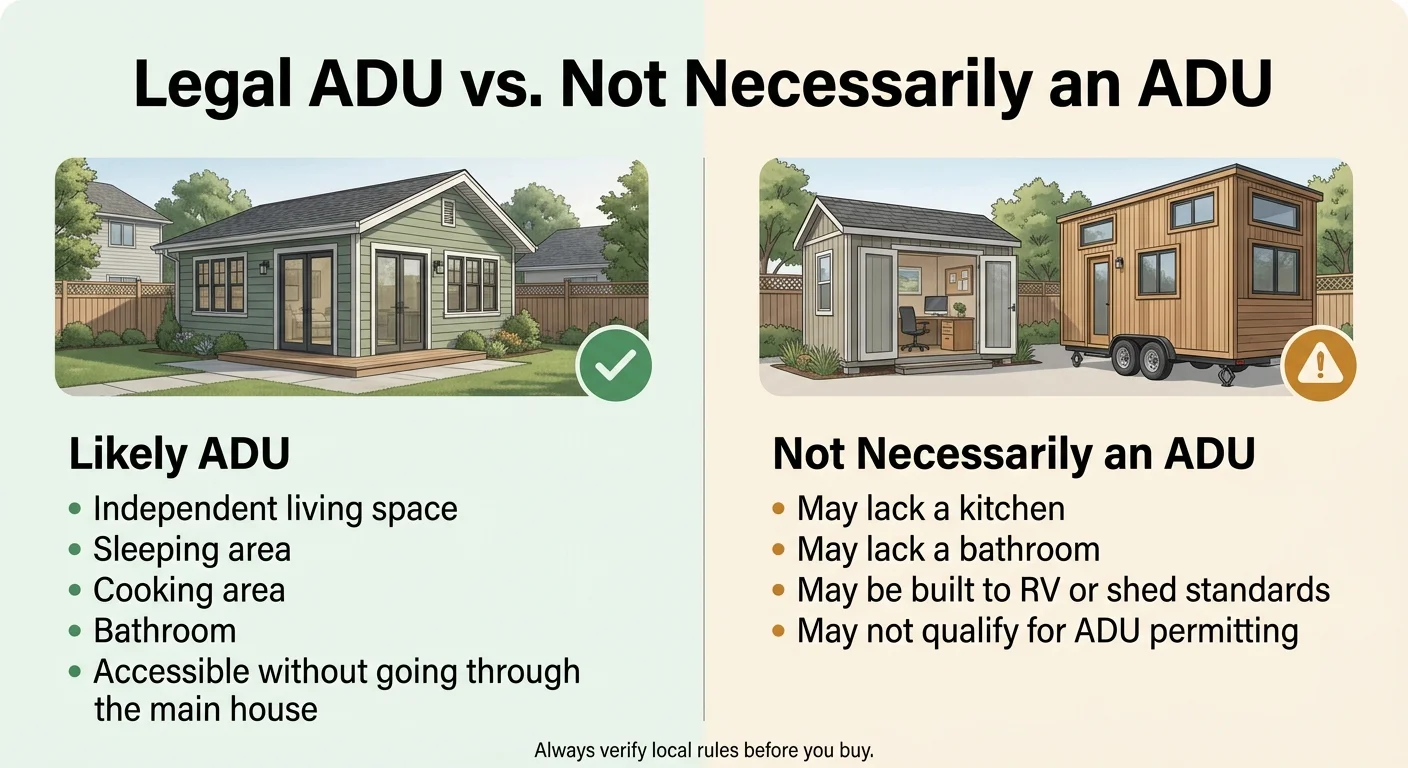
This distinction matters for three critical reasons:
Permits. Your city's planning department will not issue an ADU permit for a structure that doesn't meet their ADU definition. Many so-called "backyard offices" or "she-sheds" are marketed alongside ADUs but lack kitchens, bathrooms, or permanent foundations. They may be perfectly fine products — they're just not ADUs, and they won't get ADU permits.
Financing. If you plan to use a HELOC, home equity investment, or any mortgage product to fund your ADU, the lender will require it to meet ADU guidelines. A structure that doesn't qualify as an ADU won't be included in your home's appraised value, which means the financing math doesn't work.
Resale value. A permitted ADU can increase property value — but the size of that increase varies by market, local demand, housing stock, and how common ADU production is in your area. What's consistent is that an unpermitted structure, or one built to RV code instead of residential building code, adds risk and uncertainty rather than clean, verifiable value.
Quick Filter: ADU-Eligible vs. Often Not
| Likely ADU-Eligible | Often NOT ADU-Eligible (Without Modifications) |
|---|---|
| Modular home on permanent foundation (IRC code) | Tiny home on wheels (RVIA/RV code) |
| Panelized ADU with kitchen + bath | Backyard office/studio without kitchen |
| Manufactured home on permanent foundation (HUD code, where local law allows) | Shipping container without residential conversion permits |
| Kit-built ADU meeting local building code | Prefab "shed" marketed as livable space |
| Factory-built unit with state approval (e.g., HCD in California) | Any unit without a permanent foundation |
Before you fall in love with a price, confirm the unit qualifies as a legal ADU in your jurisdiction. This is the single most important due diligence step.
Popular Prefab Brands That Won’t Hit $150K (And Who They’re Actually For)
We respect these companies. They build excellent products. But if you have a hard $150K ceiling, knowing which brands to cross off your list early saves you weeks of research.
Abodu — Premium turnkey modular ADUs, currently California-only. Their Studio model starts at $262,800. Not a budget play — but a strong product for buyers with a $275K+ budget who want zero hassle.
Samara — High-design California ADU company. Their Studio starts at $152,000 plus installation, and the One Bedroom starts at $170,000 plus installation — making the total project well above $200K for either model. Their larger XL models start at $249,000–$277,000 plus installation. Stunning work. Wrong budget for this page.
Villa Homes — Serves California and Colorado with a turnkey approach that includes financing assistance. Villa's turnkey projects typically sit above this page's $150K budget. Strong value-add for buyers in those states who have the budget for a full-service experience.
If these are the products you actually want, that’s a perfectly valid decision — you just need to adjust the budget. Our broader Best Prefab ADU Companies guide covers these brands in full depth, and our ADU financing paths page walks through how homeowners pay for projects in this range.
When Is a $150K Prefab ADU Realistic — and When Is It Not?
Whether this budget works has less to do with the sticker price and more to do with your specific lot, utility setup, jurisdiction, and scope expectations.
$150K is realistic when:
- ✓You want roughly 300–500 sq ft (studio or small one-bedroom)
- ✓Your lot is flat and accessible
- ✓Utilities are close — within 30–50 feet of the ADU site
- ✓No septic expansion needed (municipal sewer)
- ✓You can accept a semi-turnkey or panelized scope
- ✓Your jurisdiction's permit fees are moderate
$150K becomes shaky when:
- △You want 500–700 sq ft with one or two site complications
- △Utility runs exceed 50 feet
- △You need finish upgrades beyond builder-grade
- △Crane access is tight (narrow side yard, trees)
- △Your city has high permit or impact fees
$150K is usually unrealistic when:
- ✕You want a turnkey 2-bedroom in a high-cost jurisdiction
- ✕Your lot requires major grading or retaining walls
- ✕You need septic expansion (adds $15K–$30K+)
- ✕The only brands you want are premium California-only companies
Budget Realism Matrix
| Small ADU (300–500 sf) | Mid ADU (500–700 sf) | Large ADU (700+ sf / 2BR) | |
|---|---|---|---|
| Easy lot (flat, close utilities, sewer) | ✅ Likely under $150K | ⚠️ Tight but possible | ❌ Unlikely |
| Medium lot (one complication) | ⚠️ Possible with care | ❌ Budget will stretch | ❌ Not realistic |
| Complex lot (slope, long runs, septic) | ⚠️ Maybe with DIY/kit | ❌ Over budget | ❌ Reset expectations |
If you’re in the green zone, this is your moment. The models, the pricing, and the process are there — you just need to confirm your specific property works.
If you’re in the yellow zone, the budget is achievable but there’s no margin for surprises. Get detailed scopes from 2–3 companies before committing.
If you’re in the red zone, the move isn’t to force a $150K number onto a bigger project. It’s to either adjust the budget to $175K–$200K, reduce the scope, or explore alternatives like a garage conversion (which can often come in at $80K–$130K since you’re building within an existing structure).
Where does your property fall? Find out in 60 seconds.
Which Option Fits Your Situation Best?
The “best” prefab ADU under $150K depends entirely on what you need it for.
“I want the cheapest possible legal backyard unit.”
Look at prefabADU kits (if you're handy or can hire local labor) or Craftsman Tiny Homes' Summit 410. Both offer the lowest realistic entry points for a code-compliant ADU. Expect a studio or small one-bedroom with basic finishes.
“I want a rental-ready one-bedroom that will cash-flow.”
A one-bedroom ADU in the 400–500 sq ft range maximizes your rent-to-cost ratio. At this budget, Craftsman Tiny Homes or a smaller Modular Home Direct model are your strongest options. Even modest rental income can offset the monthly cost of the financing you use to build it — and the ADU adds immediate property value on top of the cash flow.
Actual rental income depends on your local market, unit quality, and management. These are illustrative examples, not guarantees of returns.
“I need housing for an aging parent.”
Prioritize single-level, accessible layout, a full bathroom, and proximity to the main house. At this budget, a well-configured 400–500 sq ft unit from Craftsman or Modular Home Direct works. Pay special attention to doorway widths, bathroom layout, and whether the floor plan allows for future grab bar installation. Skip the lofted tiny-home designs — they're not suitable for aging-in-place.
“I want a two-bedroom under $150K.”
We'll be direct: this is very difficult as a total installed project. Two-bedroom base prices exist under $150K — Craftsman's 800 sf Summit at ~$129,900 and several Modular Home Direct models in the $116K–$145K range. But once you add $40K–$60K in site work, you're at $170K–$210K. The realistic path to a 2-bedroom under $150K is either a DIY/kit approach in a low-cost market, or adjusting the budget upward to $175K–$200K.
“I want the least construction disruption possible.”
Fully modular units that arrive assembled and get craned into place cause the least on-site disruption — often just 1–2 weeks of active site work. At a $150K budget, you're looking at a smaller fully modular unit, or accepting the 4–8 week on-site timeline of a panelized build.
Ready to narrow it down? Get matched to the right option for your property.
How to Compare Prefab Quotes Without Getting Fooled
The worst mistake in the prefab ADU market isn’t picking the wrong company. It’s comparing quotes that aren’t measuring the same thing.
Company A quotes $89,000 for a 500 sq ft unit — but that covers only the structure, shipped to your curb. Company B quotes $145,000 — but that includes foundation, installation, utility connections, and permits. Company B is actually cheaper. You’d never know from the headline number.
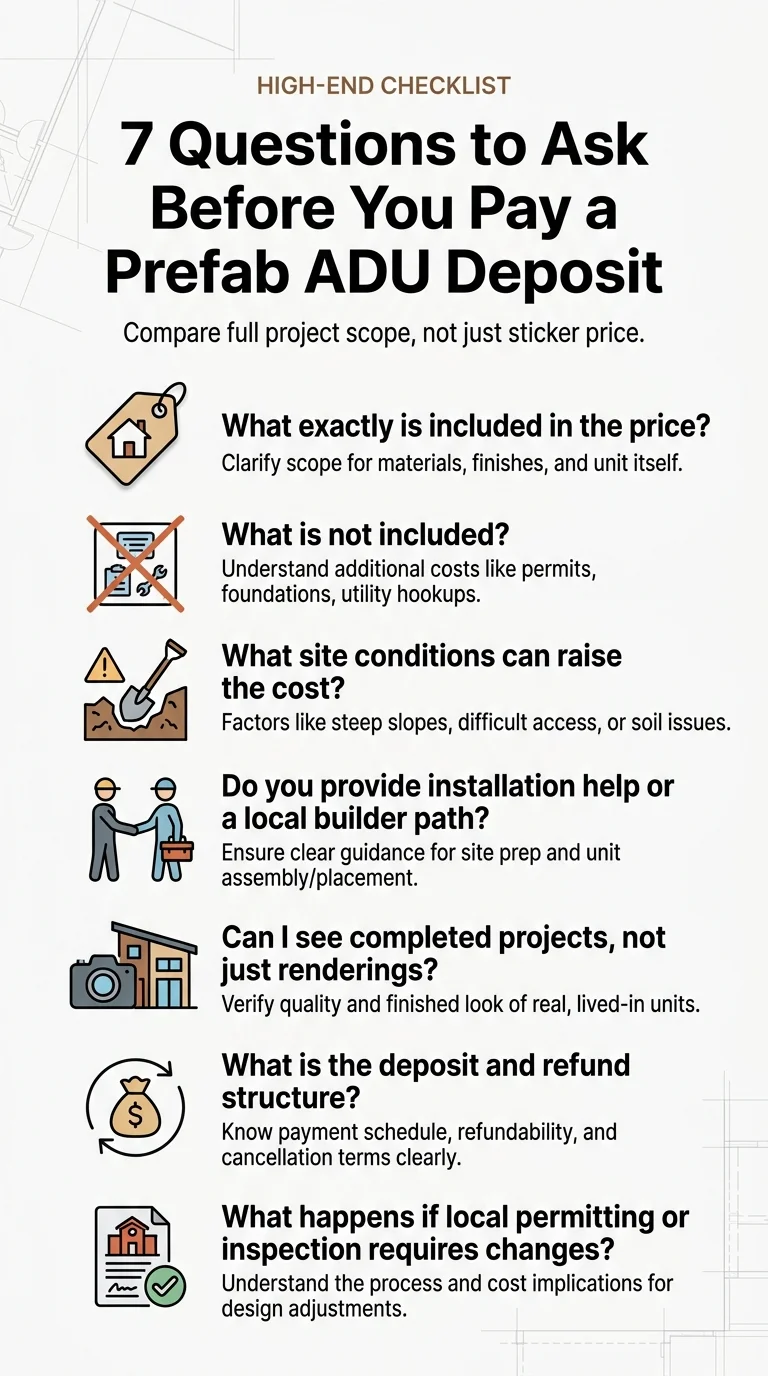
The 10 Questions to Ask Every Prefab ADU Company Before Paying a Deposit
- 1
What exactly is included in your quoted price? Get a line-item breakdown, not a lump sum.
- 2
What is NOT included? Foundation? Utilities? Permits? Engineering? Crane? Explicitly list the exclusions.
- 3
What site conditions could raise the cost? Slope, access restrictions, soil issues, distance to utilities?
- 4
Do you provide installation help or a local GC, or do I hire my own contractor?
- 5
Can I see completed projects — not just renderings? Ideally, visit one in person or see verified customer photos.
- 6
What is your deposit structure? How much up front? What triggers the next payment? What's refundable?
- 7
Can I see completed units — not renderings? Ideally, visit one in person or see verified customer photos.
- 8
What warranty do you provide? Structural warranty? Appliance warranty? What's excluded?
- 9
What happens if the unit doesn't pass local inspection? Who is responsible for bringing it into compliance?
- 10
What is your deposit and refund structure? Know payment schedule, refundability, and cancellation terms clearly.
Print this list. Bring it to every conversation. The companies worth working with will welcome these questions. The ones that dodge them are telling you something.
Protect Yourself: Red Flags in the Prefab ADU Market
The prefab ADU space has real cautionary tales. A 2025 Dwell investigation reported on multiple prefab companies where customers paid deposits for units that were never delivered, or where companies ceased operations mid-project. Protect yourself:
Never pay a large deposit without seeing completed units. Renderings are not evidence.
Check for a BBB listing and verify the company has real completed projects you can reference.
Get the full scope in writing before any money changes hands — not a verbal estimate, a written scope of work with inclusions and exclusions.
Be extra cautious with newer companies that have VC funding but few completed installations. Scaling a prefab company is extremely difficult, and investor pressure to grow fast has contributed to multiple brand failures.
If a company pushes for a fast decision or won't provide references, walk away.
Will a Prefab ADU Actually Work on Your Lot?
Before you spend another hour browsing floor plans, check these five things. They determine whether a prefab ADU is feasible on your specific property — and whether your budget will hold.
Zoning and setback requirements.
Every city defines where an ADU can sit relative to your property lines, main house, and other structures. Setback rules are local — for example, California requires local agencies to allow at least an 800 sq ft detached ADU with four-foot side and rear setbacks (per California Government Code §65852.2). Outside California, verify your local rules directly with your city or county planning department.
Lot access for delivery.
Can a flatbed truck and a crane physically reach your backyard? Narrow side yards, low-hanging power lines, mature trees, and tight alley access can make prefab delivery expensive or impossible. If access is severely restricted, a panelized or kit ADU (which arrives in pieces, not a full module) may be your only prefab option.
Utility distance.
Measure (or estimate) the distance from your main house's utility connections to the planned ADU location. Every additional foot of trenching adds cost.
Slope and soil conditions.
Flat lots are cheapest. Even a moderate slope can require grading, retaining walls, or a more complex foundation — easily adding $10,000–$30,000+ to the project. A soils report ($500–$1,500) tells you what you're working with before you commit.
HOA restrictions.
Some homeowners associations still restrict ADUs. California law prevents HOAs from outright banning ADUs, but HOAs in other states may still have enforceable restrictions. Check your CC&Rs before spending money on plans.
Don’t want to piece this together yourself?
Prefab vs. Stick-Built vs. Garage Conversion: Which Saves the Most Under $150K?
Prefab isn’t your only option for an under-$150K ADU. Here’s how the three main paths compare:
| Prefab ADU | Stick-Built (Custom) ADU | Garage Conversion | |
|---|---|---|---|
| Typical all-in cost | $100K–$180K | $150K–$350K+ | $50K–$150K |
| Timeline | 3–6 months total | 6–12+ months | 3–6 months |
| Customization | Limited floor plans | Full design flexibility | Moderate (within existing footprint) |
| Under $150K? | Yes, for 300–600 sf on easy lots | Difficult in most markets | Yes, especially if garage is in good shape |
| Best for | Buyers who want speed and predictability | Buyers with complex lots or specific design needs | Buyers with an existing garage who want the lowest cost path |
The key insight most people miss: If you have an existing garage in decent structural shape, a garage conversion is almost always the cheapest path to a livable ADU. You’re skipping the foundation, most of the framing, and the roof.
If no garage exists and you’re building new, prefab’s advantage over custom stick-built is primarily speed and cost predictability, not always a lower total price. For smaller units, prefab wins on both cost and timeline. For larger or more complex projects, get bids for both before deciding.
What If Your Budget Is Close But Short?
If your preferred prefab option is realistic but lands slightly above your cash budget, compare financing paths — not lenders — on our ADU financing guide. That page walks through the four main approaches: HELOC for homeowners with existing equity, renovation HELOC for those with limited equity, home equity investment for those who can’t take on monthly payments, and construction loans for larger or investor-focused projects. The right path depends on your equity position and cash flow, not which lender has the best ad.
What If Nothing Here Fits Your Lot, City, or Budget?
This page is specifically built for the $150K total budget. If that’s not where your project lands, here’s where to go:
If you want turnkey California quality, reset the budget to $200K–$350K and read our Best Prefab ADU Companies guide.
If your lot is too complex for prefab, a stick-built ADU or garage conversion may be a better fit.
If you only need a backyard office, studio, or guest space (without a full kitchen or bathroom), you may not need an ADU at all — and you shouldn't pay for one. Smaller accessory structures have simpler permitting and lower costs, but they don't qualify as ADUs for financing, rental, or resale purposes.
How We Chose These Picks
We verified current pricing from official company websites in April 2026. Every price in this article reflects what the company publicly lists — we didn’t use outdated numbers, estimate ranges, or rely on third-party aggregators.
Our “Under $150K Verdict” is editorial. We estimated total installed costs based on: (1) the company's advertised price, (2) what that price includes per the company's own documentation, (3) typical costs for excluded line items on a standard flat suburban lot (based on industry cost data from GreatBuildz, BuildX, and real homeowner reports), and (4) our editorial judgment about how realistic the total project is likely to be.
What we excluded: Companies without verifiable completed projects. Units built to RV code that don't qualify as permanent ADUs. Products that haven't been available for actual purchase. Models where the pricing wasn't publicly available or verifiable.
How we sorted: By estimated total installed cost, not by affiliate commission. We include companies regardless of whether they have an affiliate relationship with us.
How often we refresh: We verify pricing quarterly and update this page whenever a company changes its published pricing, service area, or product lineup.
Frequently Asked Questions
Can you really get a prefab ADU under $150,000?
Yes — with the right company, the right size, and a suitable lot. A 300–600 sq ft prefab ADU on a flat lot with accessible utilities is the realistic sweet spot. The total installed cost (unit + foundation + site work + utilities + permits) can land under $150K for studios and small one-bedrooms on straightforward properties. It becomes much harder for 2-bedrooms, complex lots, or premium turnkey brands.
How much do permits, utilities, and foundation add to a prefab ADU?
On a typical flat lot: foundation ($8K–$20K), utilities ($10K–$30K), permits and engineering ($2K–$12K). Total additional costs beyond the unit price: $30K–$60K+ depending on lot conditions.
What states or cities make an under-$150K ADU more realistic?
States with streamlined ADU permitting, lower labor costs, and lower permit fees make the budget easier to hit. Areas with municipal sewer (vs. septic) also reduce costs. California has among the most streamlined permitting processes but also higher labor and permit costs — so the savings from process efficiency can be offset by regional pricing.
Can I get a 2-bedroom prefab ADU under $150K?
At the base unit price, yes — several companies offer 2-bed models starting at $116K–$145K. As a total installed project, it's very difficult. A 2-bedroom typically runs 700–1,000 sq ft, and the site work costs for a unit that size push most projects to $170K–$210K+. If you need two bedrooms, budget $175K–$200K or explore a kit/owner-builder approach.
Is BOXABL under $150K?
BOXABL's current pricing model focuses on estimated monthly payments rather than a clear total project cost, and the company states that actual price varies by location, site work, taxes, delivery, installation, and financing terms. We can't confirm that a BOXABL project lands under $150K without a full written scope for your specific property.
What should I ask before paying a prefab ADU deposit?
Ask for a complete written scope of work with all inclusions and exclusions, verify the company has completed units (not just renderings), confirm their plans are approved in your jurisdiction, understand the deposit structure and refund terms, and request customer references. See our full 10-question checklist above.
Which prefab ADU companies serve my state?
Abodu and Samara currently serve California only. Villa Homes serves California and Colorado. Studio Home ships to all 50 states. Modular Home Direct provides nationwide delivery with a GC search service. Craftsman Tiny Homes is based in Florida with the strongest presence in FL/GA. prefabADU is based in California and primarily serves CA buyers. Always confirm current service areas directly with the company.
Your Next Step
You’ve seen the real numbers, the honest tradeoffs, and the companies that can actually deliver at this price point. Thousands of homeowners have built ADUs at this budget — on the right lot, with the right company, and with a clear picture of total costs before they committed.
The biggest remaining question is whether your specific property is one of those right lots. And the only way to answer that is to check.
Not sure where to start? See what’s possible at your address.
Related Guides
Last verified: April 2026. Official published starting prices were verified from company websites where available. Estimated total installed costs are Dwelling Index editorial estimates. Confirm all pricing and scope details directly with companies before making any purchase decisions. Rental income estimates, where mentioned, are illustrative examples — not guarantees of returns. Actual results depend on local market conditions, construction costs, and regulatory approvals. The Dwelling Index is an independent educational resource. We are not a lender, broker, builder, or financial advisor. Full affiliate disclosure · Editorial methodology