Best Prefab ADU for Airbnb (2026): Is It Legal Where You Live — and Which Unit Wins?
By The Dwelling Index Editorial Team — The Dwelling Index is an independent research resource covering ADU financing, costs, and regulations.
Last updated: May 29, 2026 · Last verified: May 29, 2026
Best prefab ADU for Airbnb, in one breath: The best prefab ADU for Airbnb is a legal, residential-code modular or panelized one-bedroom unit, roughly 400–650 square feet, on a permanent foundation, with a private entrance, full kitchen, and durable finishes — but only after you confirm that short-term rental of an ADU is allowed at your address. In a large and growing number of markets it isn't. As of January 1, 2026, California law requires ADUs created under its state-mandated pathway to be rented for terms longer than 30 days — which rules out nightly Airbnb for a large share of new California units. Confirm legality before you shop for a model.
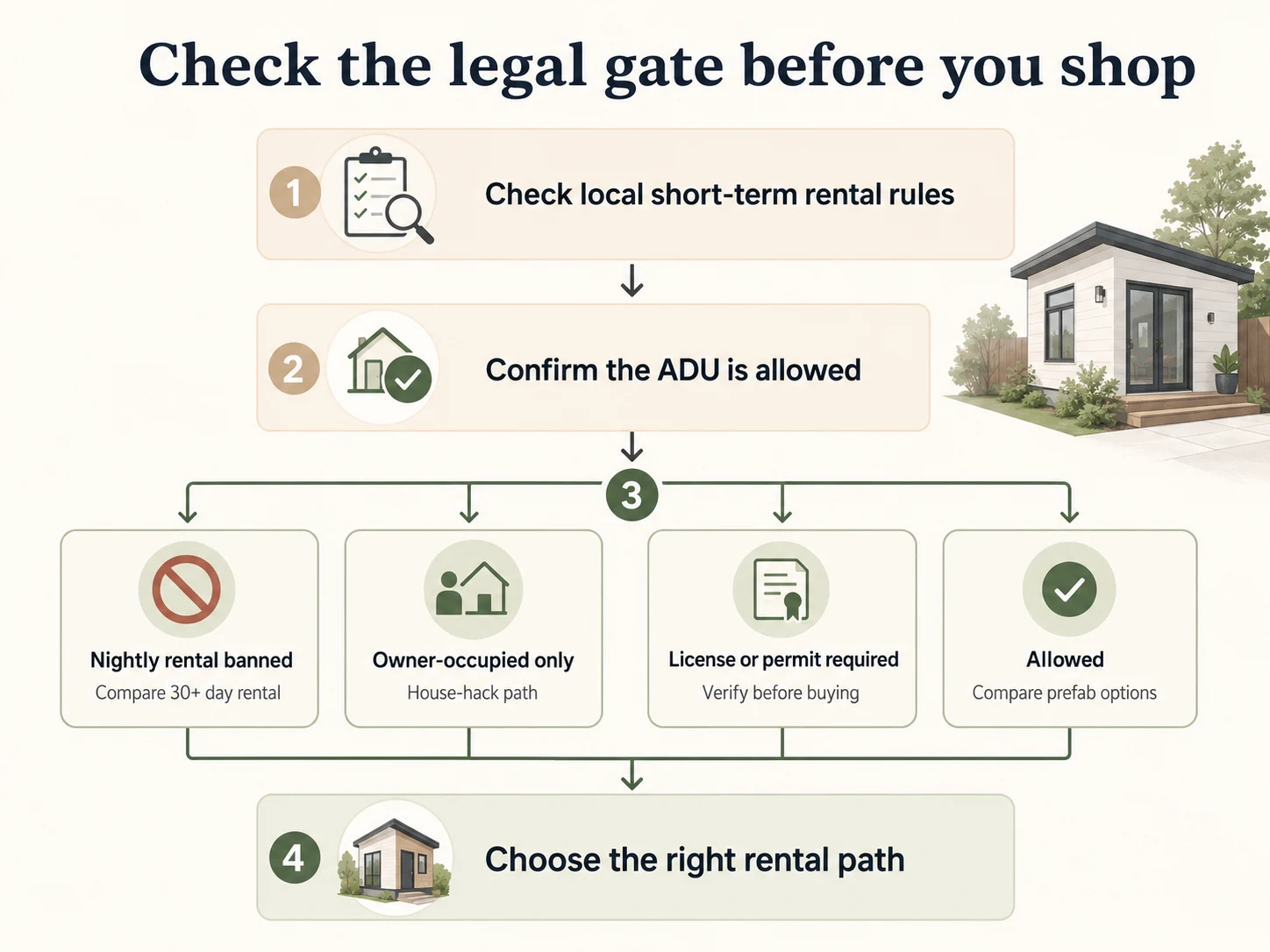
Mini gate — read this before you shop
| If your city's rule is… | Your smartest next move |
|---|---|
| ADU short-term rentals are banned (e.g., San Diego ADUs built after 2017; SF ADUs) | Don't buy for Airbnb. Build for long-term or 30+ day mid-term rental, which is legal far more widely. |
| Allowed only if it's your primary residence / you're on-site (e.g., Los Angeles, Phoenix) | Model it as a house-hack you live in, not an absentee investment. |
| Capped or license-limited (e.g., Austin: 30 days/year for post-2015 ADUs) | Confirm a license is even available before you choose a prefab brand. |
| Allowed with a permit (e.g., Portland, Seattle, with conditions) | Now compare code-compliant prefab paths — and still pencil out a long-term fallback. |
► See what you can legally build — and which rental path actually fits — at your address. Get your free ADU report (about 60 seconds; no promise of approval — you'll see exactly what to verify before spending money on plans, deposits, or prefab quotes).
Disclosure: The Dwelling Index is reader-supported. When you use our links to explore financing options, request prefab pricing, or purchase floor plans, we may earn a commission at no extra cost to you. Our editorial recommendations are based on independent research and are never influenced by compensation.
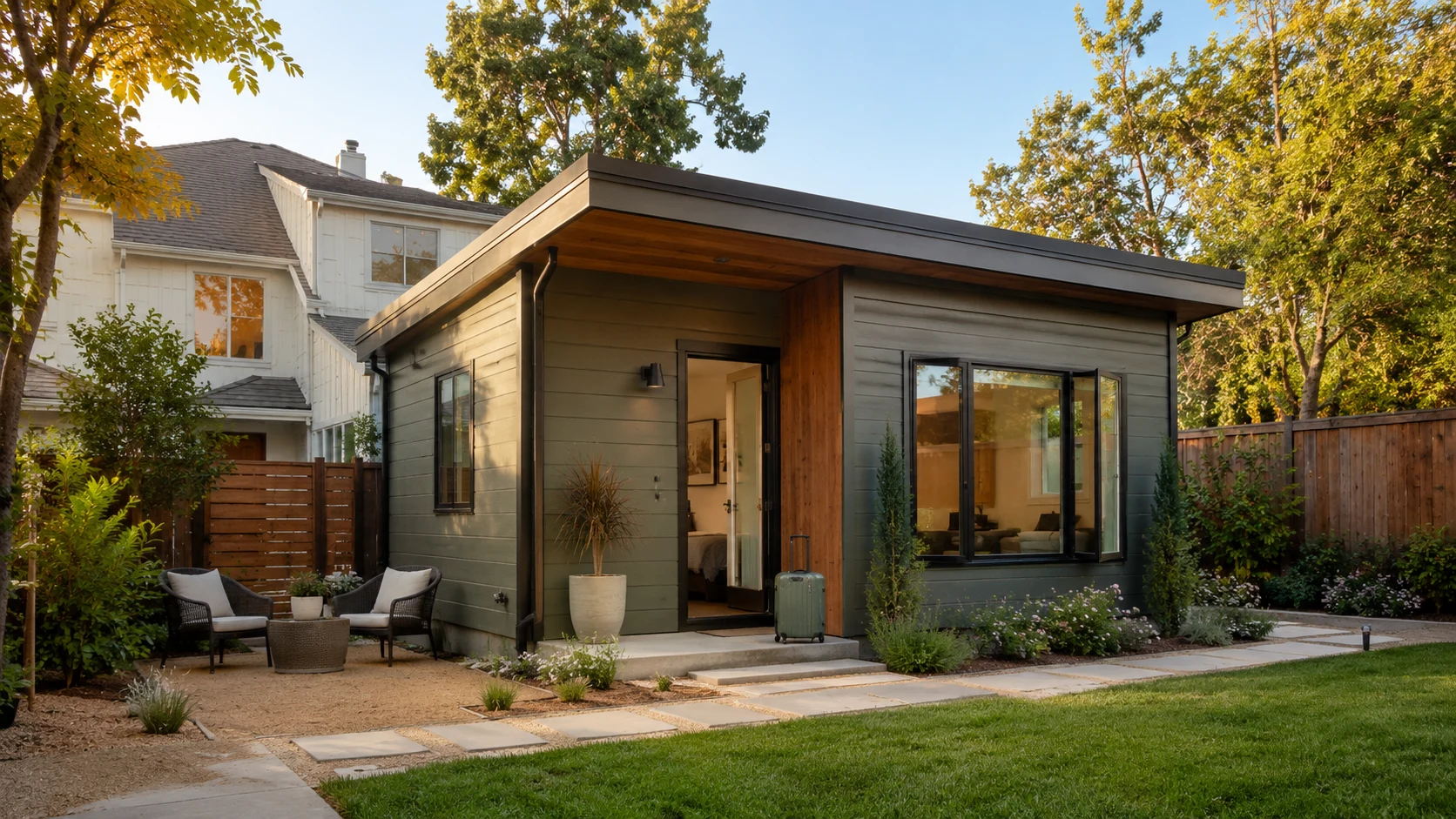
A code-compliant detached modular ADU with private entrance — the starting point for any legal short-term rental path.
Why we wrote this page the way we did
Most “best prefab ADU for Airbnb” articles do the fun part first: glossy renderings, a ranked list of brands, a revenue fantasy. We think that order is backwards, and in several big metros it's financially dangerous.
Here is the uncomfortable truth we will come back to throughout this guide: an ADU is one of the most regulated structures a homeowner can build, and “can I rent it nightly?” is a completely separate legal question from “can I build it?” A prefab unit can be beautiful, fast, and well-priced — and still be illegal to list on Airbnb the day it is craned in. We checked that reality against the actual city and state code, and you'll see it laid out below.
So we built this as a decision workflow, not a brochure: legality gate first, income-path fork second, unit selection third, true cost fourth, return math fifth. If you stripped out every link and button, the legal gate alone could save you a six-figure mistake. That is the bar we set for ourselves.
A quick vocabulary set
The rules hinge on these terms:
- ADU (accessory dwelling unit):
- A self-contained second home on a lot — kitchen, bathroom, sleeping area. Also called a granny flat, in-law suite, or casita.
- DADU (detached ADU):
- A freestanding ADU, the most common prefab type.
- JADU (junior ADU):
- A small unit (≤500 sq ft) carved out of the existing home, sometimes sharing a wall or bathroom.
- STR (short-term rental):
- In most codes, a stay of fewer than 30 consecutive days — the Airbnb/Vrbo use case.
- STRO / ASTR:
- Local names for short-term rental ordinances (San Diego uses “Short-Term Residential Occupancy”; Portland uses “Accessory Short-Term Rental”).
- Mid-term rental (MTR):
- A furnished stay of 30+ days — travel nurses, relocators, insurance displacements. Legal far more widely than nightly STR.
- TOT (transient occupancy tax):
- The local “hotel tax” short-term hosts must collect and remit.
- Ministerial approval:
- A “by-right” permit a city must grant if your plans meet objective standards — no hearing, no discretion.
- Site work / utility lateral:
- The dirt-and-pipe part of the project — foundation, grading, and the trenched lines (sewer, water, electric) connecting the unit to the street or main house. This is where prefab budgets quietly blow up.
Can you legally Airbnb a prefab ADU?
Answer capsule: Only if two separate gates are both green: your jurisdiction must allow the ADU itself, and it must allow that ADU to be used as a short-term rental of under 30 days. Many cities allow the first and prohibit the second. In California, ADUs created under the state-mandated pathway must be rented for terms longer than 30 days as of January 1, 2026 (Cal. Gov. Code § 66323(e)), which legally rules out nightly Airbnb for a large share of new units.
This is the most important section on the page, so we will be precise.
The 30-day line is the whole ballgame
Across most of the country, “short-term rental” is legally defined as a stay under 30 consecutive days. That single threshold decides everything. Rent your unit in 30-day-or-longer blocks and you are usually in the clear — those are leases, not vacation rentals. Rent it by the night, and you are in the part of the code cities fight hardest over, because nightly rentals pull housing out of the long-term supply.
The practical takeaway: whether you can “Airbnb” your unit depends on whether your city lets ADUs go below the 30-day floor. Many don't.
California decoded: the state pathway now blocks nightly rental
California is where most prefab ADU activity and most prefab ADU companies are concentrated, so its rules carry outsized weight here.
Under California Government Code § 66323(e), a local agency shall require that the rental of an ADU created pursuant to that section “be for a term longer than 30 days.” This is not optional guidance — it is a statutory requirement, reaffirmed by SB 543, effective January 1, 2026 (Cal. Gov. Code § 66323, codes.findlaw.com; verified May 29, 2026). In plain English: if your ADU is approved through California's streamlined state pathway, nightly Airbnb is prohibited by state law regardless of what your city ordinance says.
Two related California rules (effective January 1, 2026):
- Junior ADUs (JADUs) are now explicitly barred from short-term rental. SB 543 and AB 1154 amended Gov. Code § 66333(g) so that JADUs may not be used as short-term rentals and must be rented for terms longer than 30 days (California HCD ADU Handbook 2026 update; verified May 29, 2026).
- Owner-occupancy cannot be forced on a standard ADU. Gov. Code § 66315 prohibits local agencies from requiring the owner to live on-site for an ADU. (For JADUs, owner-occupancy can be required only if the JADU shares sanitation facilities with the main house, per SB 543.)
One damaging admission, because you deserve it straight: if you are in California and your plan was a year-round nightly Airbnb in a brand-new backyard prefab, the state law probably already said no before you finished the brochure. Here is the hopeful part — the mid-term (30+ day) market is wide open statewide, it cash-flows, and it is far less work than nightly turnovers. You do not have to abandon the build. Just the assumption.
What still counts as a legal rental
Even where nightly Airbnb is blocked, these are typically fine (always verify locally):
- 30+ day furnished stays (“mid-term”) — legal statewide in California and broadly elsewhere.
- Long-term leases — the simplest, lowest-friction path, and what lenders actually underwrite.
- Family use — aging parents, an adult child, a caregiver.
► Start with your address, not a prefab catalog. Get your free ADU report — it flags the local ADU and short-term-rental questions you need answered before you sign anything.
Where ADU short-term rentals are banned, capped, or allowed: a 2026 rules matrix
Answer capsule: ADU short-term-rental rules are set locally and vary dramatically between cities. Across California and nine major U.S. markets, the verdict ranges from outright prohibition (San Diego ADUs built after 2017; San Francisco ADUs) to strict day caps (Austin: 30 days per calendar year for post-2015 ADUs) to permitted-with-license (Seattle, Portland). No single national rule applies.
Selected markets, verified May 29, 2026 — not a nationwide rule map. Always verify against current local ordinance.
Verification status: Rows marked ✓ Verified were confirmed directly against the named government source as of May 29, 2026. Rows marked ⚠ Confirm before publish are compiled from linked official sources but should be re-confirmed against current city/county code, because short-term-rental ordinances change frequently.
| Market | Airbnb / STR of an ADU | The rule to know (plain English) | Source | Status |
|---|---|---|---|---|
| California (statewide) | 30+ days only for state-pathway ADUs | State-mandated (§ 66323) ADUs must be rented >30 days; JADUs barred from STR (eff. 1/1/2026). Cities may impose the same on local-ordinance ADUs. | Cal. Gov. Code §§ 66323(e), 66333(g); CA HCD | ✓ Verified |
| San Diego, CA | Banned for ADUs built after 2017 | Municipal Code prohibits ADU short-term rental; only companion units permitted before Oct. 15, 2017 may operate as STRO. TOT zone-based (11.75–13.75%) eff. May 1, 2025. | City of San Diego STRO; TOT | ✓ Verified |
| Los Angeles, CA | Only if it's your primary residence (post-2017) | An ADU built on/after Jan. 1, 2017 may be home-shared only if it is the host's primary residence; also subject to the 120-day annual cap and registration. Pre-2017 ADUs have more latitude. | City of L.A. Home-Sharing Guidelines | ✓ Verified |
| San Francisco, CA | Banned in ADUs | ADUs/JADUs “shall not be used for Short-Term Residential Rentals” (Planning Code §§ 207.1, 207.2); ADUs are ineligible for the city's STR program. | SF Planning Code §§ 207.1/207.2; SF Planning ADU fact sheet | ✓ Verified |
| Austin, TX | Capped: 30 days per calendar year | An ADU “constructed after October 1, 2015…may not be used as a short-term rental for more than 30 days in a calendar year.” STR = stays under 30 consecutive days; license required. | City of Austin Development Services | ✓ Verified |
| Portland, OR | Allowed with permit; resident-occupancy rule + SDC trap | Accessory short-term rentals require a permitted resident occupying the dwelling 270 days/year; whole, unoccupied ADU vacation rentals aren't allowed in residential zones. If you took the ADU SDC fee waiver, a recorded 10-year covenant bars STR entirely. | Portland.gov (ASTR; ADU SDC waiver) | ✓ Verified |
| Seattle, WA | Allowed with license + caps | STR regulatory license plus business license tax certificate required; most operators capped at two units; ADUs/DADUs are separate licensable dwellings (RRIO registration may apply). | Seattle.gov (Short-Term Rentals) | ⚠ Confirm before publish |
| Phoenix, AZ | Allowed only if the owner lives on-site | Phoenix requires a permit for all STRs and, for an ADU used as an STR, the property owner must reside on-site. | City of Phoenix STR registry | ⚠ Confirm before publish |
| Nashville, TN | Restricted for DADUs in residential zones | In single-family/residential zones, an owner-occupied STR permit is not permitted in a new or converted DADU; non-owner-occupied STR permits are separately barred in several residential districts. | Metro Nashville DADU permit page | ⚠ Confirm before publish |
| Miami-Dade County, FL | No standalone ADU vacation rental | An ADU/guesthouse may not be used as a vacation rental on its own; the entire property must be the vacation rental. | Miami-Dade County ADU page | ⚠ Confirm before publish |
Legal note: This guide is for educational research only and is not legal advice. ADU and short-term-rental rules change and may depend on zoning, coastal overlays, HOA rules, deed restrictions, permits, and local staff interpretation. Verify with your local planning/building department before buying plans, signing a prefab contract, or listing a unit.
The pattern is unmistakable: the cities most associated with prefab ADUs and Airbnb demand are often the strictest about combining the two. San Diego — home base for several prefab builders — flatly prohibits it for newer units, and operating anyway is a code violation the city's enforcement materials say can carry penalties reaching $1,000 per day. San Francisco bars it outright. Austin caps it at a token 30 days a year. That is not coincidence; it is housing policy. Cities want ADUs in the long-term supply, not the nightly one.
Don't see your city, or unsure which rule applies? Get your free ADU report for an address-specific read on what to verify.
If you can't Airbnb it, here's the income path that still works
Answer capsule: Where nightly Airbnb is prohibited, the legal income alternative is the mid-term rental — a furnished stay of 30 or more days — which is permitted statewide in California and broadly across the U.S. Mid-term rentals turn over less often, require less management, and can still generate strong income; in Southern California, ADU rents commonly run $1,400–$3,500 per month depending on county and size (Dynamic Quality Builders regional data, 2026; verify your local market).
If the gate came back red, don't force the Airbnb use case. Pivot — the build still pays.
Mid-term (30+ day furnished) rental
The sweet spot for most blocked markets. Your audience: traveling nurses and allied-health workers, relocating professionals on temporary assignment, families displaced by insurance claims, visiting faculty, people between homes. The economics are quietly excellent — higher rent than a bare long-term lease, far fewer turnovers than nightly Airbnb (think monthly, not every two nights), lighter wear, and often lighter regulation. A common structure is a master lease with a corporate-housing operator who sublets to 30+ day guests.
Long-term rental
The simplest path: a standard 12-month lease, predictable income, minimal furnishing, and the version lenders actually trust when underwriting your loan. In Southern California that is roughly $1,400–$3,500/month per unit (Dynamic Quality Builders, 2026). One reassuring note: a newly built ADU is generally exempt from California's AB 1482 rent cap for its first 15 years, and single-family and owner-occupied situations have their own exemptions — confirm your specific situation (Berkeley Rent Board, AB 1482 summary; verified May 29, 2026).
Family use
The path nobody monetizes but many quietly value most — aging parents nearby but independent, an adult child saving for a down payment, a live-in caregiver. The unit still adds resale value and optionality.
These are illustrative examples, not guarantees of returns. Actual results depend on local market conditions, construction costs, financing terms, and regulatory approvals.
The build can earn in all three cases. The only thing the legality gate changes is how — not whether.
For readers headed to mid-term or long-term rental, two next problems appear immediately: how to run it, and how to pay for the build. Also consider cross-linking to our prefab ADU rental income guide for the full ROI and HUD rent data analysis.
► Planning to rent it (any term)? Landlord and property-management tools for screening tenants, leases, and rent collection: explore Buildium for managing your rental.
► Explore your financing options. See which funding lane fits your project with Mortgage Research Center. Educational only — no rate quotes, no approval promises, and no assumption that Airbnb income will qualify you.
Disclosure: The Dwelling Index is reader-supported. When you use our links to explore financing options, request prefab pricing, or purchase floor plans, we may earn a commission at no extra cost to you. Our editorial recommendations are based on independent research and are never influenced by compensation.
What type of prefab ADU works best for Airbnb?
Answer capsule: For legal short-term-rental markets, the safest default is a residential-code modular or panelized ADU on a permanent foundation — not a shed conversion, RV, or tiny home on wheels. A permanently founded, code-compliant dwelling is far more likely to clear permitting, qualify for financing and insurance, appraise correctly, and serve as a long-term-rental fallback if STR rules tighten.
“Prefab” is not one thing, and the category matters more than the brand, because category decides whether your unit is even a legal dwelling.
- Modular ADU — built in sections in a factory to the same building code as a site-built home, then craned onto a permanent foundation and finished. The strongest Airbnb-and-fallback path: a real dwelling, durable for guest turnover, appraiser- and lender-friendly.
- Panelized ADU — walls and components built in the factory, assembled on-site by a local crew. Similar code outcome to modular; good where local site work is strong.
- Manufactured / HUD-Code home — built to the federal HUD code rather than local building code. Can work as an ADU where the jurisdiction allows it, but you must confirm it can be permitted as an ADU on your specific lot and placed on an approved foundation.
- Tiny home on wheels (THOW), RV, or park model — highest legal risk. Many jurisdictions do not treat these as ADUs at all, and many short-term-rental ordinances explicitly exclude RVs and similar non-dwelling structures. (San Diego prohibits STR use of vehicles, RVs, and temporary structures outright — City of San Diego STRO FAQ, verified May 29, 2026.)
- Foldable, container, or expandable units — do not dismiss them, but do not assume they are legal ADUs either. They still need a code path, a foundation, utilities, energy-code compliance, inspections, and a certificate of occupancy before a guest sleeps there.
Airbnb fit by build type:
| Build type | Airbnb fit | Permit risk | Best use |
|---|---|---|---|
| Modular ADU | High | Medium-low if the code path is clear | The most Airbnb-ready legal pathway |
| Panelized ADU | High | Medium | Strong where you have a capable local GC |
| Manufactured / HUD-Code ADU | Medium | City-dependent | Budget-conscious projects where allowed |
| Tiny home on wheels / RV | Low | High | Only where a city explicitly permits it as a dwelling |
| Shed / 'office pod' conversion | Low | High | Not recommended for legal Airbnb lodging |
| Foldable / container unit | Medium | High until code path is verified | Compact lots where the jurisdiction approves it |
The throughline: a guest needs to sleep in a legal dwelling. If the structure is not permitted as one, the unit's price, looks, and delivery speed do not matter. For more on the borderline cases, see our tiny home ADU guide.
Disclosure: The Dwelling Index is reader-supported. When you use our links to explore financing options, request prefab pricing, or purchase floor plans, we may earn a commission at no extra cost to you. Our editorial recommendations are based on independent research and are never influenced by compensation.
► Once your local gate is clear, compare prefab paths that match your code path. See current modular ADU options — only request quotes after the legality and ADU gates are green.
What is the best prefab ADU for Airbnb in 2026?
Answer capsule: There is no single national “best” prefab ADU for Airbnb. The right choice depends on your city's short-term-rental rules, your lot, all-in installed cost, and whether the unit still works as a long-term or mid-term rental if Airbnb is later restricted. Premium California turnkey models like the Abodu Studio (340 sq ft) start at $278,800 and the Abodu One (1-bedroom, 500 sq ft) at $326,800 (Abodu, verified May 29, 2026); compact foldable units like the BOXABL Casita (~361 sq ft) are sold as factory units that still require foundation, utilities, permits, and site work before they become a legal rental.
Damaging admission (and the reframe): a gorgeous prefab unit can still be a bad Airbnb investment. If your city blocks ADU short-term rentals, caps rental days, or requires owner occupancy, the “best” unit is the one you don't buy for nightly rental — you build it for mid-term or long-term income instead, where the same unit still cash-flows. The model is not the risk. The use-case assumption is.
We sort by neutral, documented criteria — size, layout, published price, and whether the unit is self-contained — and nothing else.
Best overall category: a 400–650 sq ft one-bedroom on a permanent foundation
For most legal markets, a true one-bedroom beats a micro-studio for rental purposes. It photographs as a real home, sleeps couples comfortably, furnishes cleanly, and — critically — works as a long-term rental if you ever need the fallback. Studios suit budget builds and shorter stays; two-bedrooms raise cost, guest count, parking, and regulatory scrutiny.
Premium California turnkey — Abodu (editorial reference)
Abodu publishes transparent, fixed pricing: the Abodu Studio (340 sq ft) starts at $278,800 and the Abodu One (1-bedroom, 500 sq ft) at $326,800 (abodu.com/models, verified May 29, 2026). Its own pages note customers add roughly $36,700–$46,300 in upgrades and custom site work and pay about $17,000 in sales tax and permit fees on average — a useful, honest reminder that even a “turnkey” headline is not the all-in number. Best modeled for 30+ day or long-term income in California cities that restrict ADU Airbnb use. (We mention Abodu as an independent reference point; it is not a partner of ours.)
National modular / catalog path — Modular Home Direct
For broad national modular and prefab intent, Modular Home Direct offers catalog modular options that can show lower base prices than premium California turnkey builders. Treat catalog pricing as base-unit discovery only — published examples typically exclude delivery, setup, upgrades, taxes, and site work, which is where the real budget lives.
Compact / foldable path — BOXABL Casita
The BOXABL Casita is a compact (~361 sq ft) foldable studio with a full kitchen and bath, built with steel and concrete. BOXABL's site shows Studio, One-Bedroom, and Two-Bedroom configurations; actual price and any financing estimates vary by model, location, site work, taxes, delivery, installation, credit approval, and financing terms — check BOXABL directly for current figures (boxabl.com, verified May 29, 2026). Like every prefab unit, the factory price is not the move-in number — budget separately for foundation, utilities, permits, and delivery.
Geo-matched regional builders
- SnapADU — Greater San Diego / San Diego County. Because San Diego prohibits ADU short-term rental for post-2017 units, route San Diego readers here for long-term or mid-term ADU feasibility, not nightly Airbnb.
- Framework First — California modular ADUs within roughly 150 miles of Monterey County (Central Coast / Bay-Area-adjacent service area).
- Nest Tiny Homes — Utah (Utah County / Salt Lake / Weber) and Southern California (San Diego / Imperial County) ADU and tiny-home intent.
- Home Seller USA — portable and expandable prefab intent.
Prefab Airbnb Fit Scorecard
Disclosure: The Dwelling Index is reader-supported. When you use our links to explore financing options, request prefab pricing, or purchase floor plans, we may earn a commission at no extra cost to you. Our editorial recommendations are based on independent research and are never influenced by compensation.
| Category | Best for | Watch out for | Price signal (2026) |
|---|---|---|---|
| 400–650 sq ft modular 1-bed | Most legal STR markets; strongest fallback | All-in site work + utilities | $200k–$400k all-in (CA) |
| Premium CA turnkey (e.g., Abodu) | High-budget CA homeowners wanting fixed pricing | STR restricted in many CA cities | Studio from $278,800; 1-bed from $326,800 (base) |
| National catalog modular | Budget discovery, broad U.S. intent | Base price excludes site work/delivery | Lower base; confirm all-in |
| Compact foldable (e.g., BOXABL Casita) | Small lots, solo/couple guests | Code path + true installed cost | Factory unit; site work extra |
| Kit / shell unit | Budget owners with a GC | Not turnkey; site work can dominate | Lower kit price ≠ legal rental |
| Tiny home / THOW | Lifestyle/novelty only | Often not a legal ADU | Varies; verify code first |
See our best prefab ADU companies roundup and our 1-bedroom prefab ADU cost breakdown for deeper model comparisons.
► Request prefab pricing only after your legal gate is clear. See current pricing & floor plans — compare providers by code path, scope, and exclusions, not just renderings.
What a prefab ADU for Airbnb really costs (the all-in cost stack)
Answer capsule: The Airbnb-ready cost of a prefab ADU is not the unit price — it is the unit plus foundation, delivery and crane, utility connections, permits, design and engineering, furnishing, short-term-rental licensing, insurance, and operating reserves. In California, complete turnkey ADU projects typically run $150,000–$400,000, and site conditions alone can swing similar projects by tens of thousands of dollars (Abodu; regional builder data, 2026).
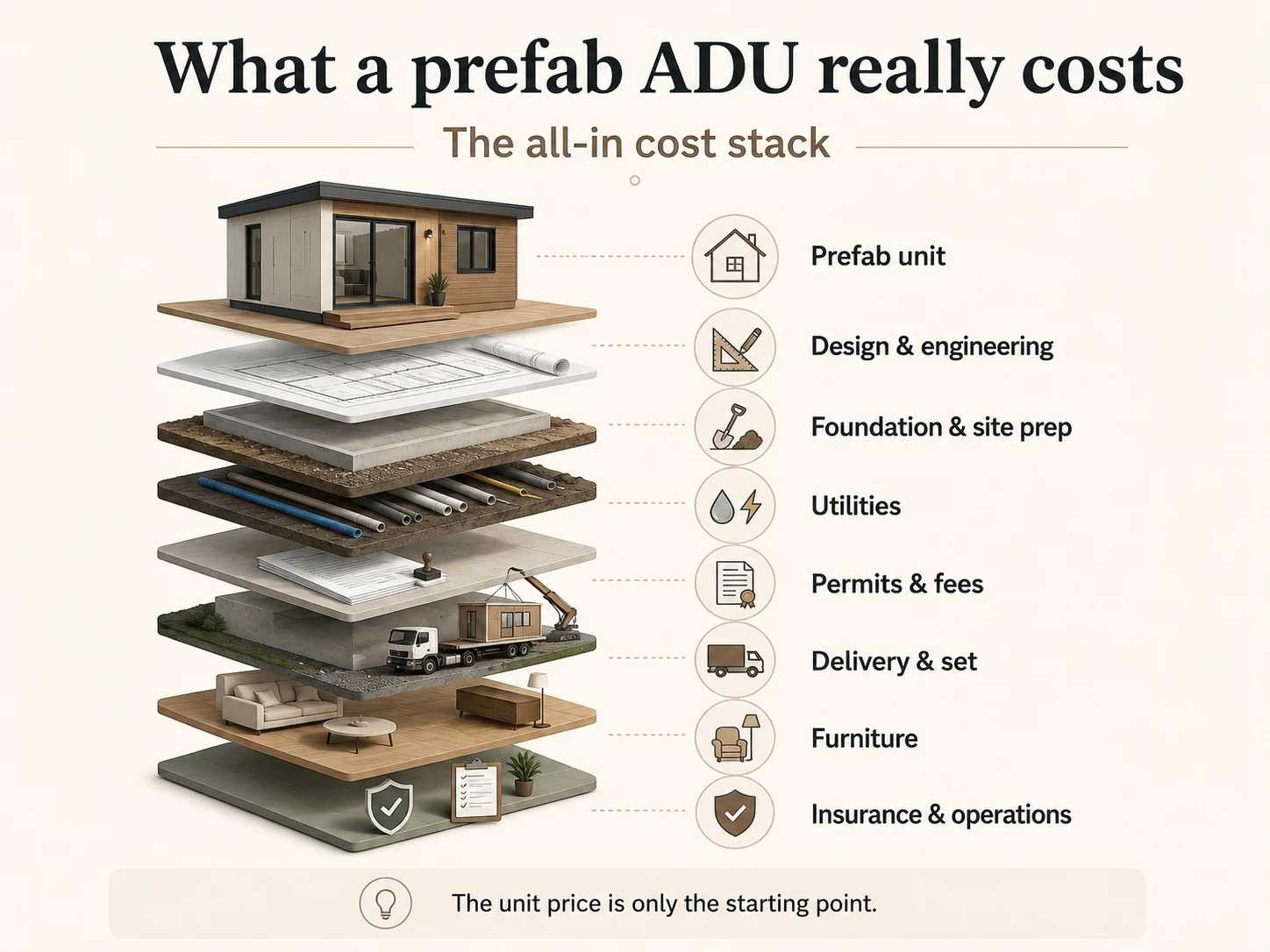
The unit price is only the starting point. Every layer above it must be budgeted before you know your real project cost.
The headline price you see in an ad is the module. The number that determines your return is the project. Here is the full stack.
| Cost layer | Why it matters for Airbnb | Typical figure (2026) | Source |
|---|---|---|---|
| Prefab unit / base module | Starting point only | Studio from ~$278,800 (Abodu); compact foldable factory units lower | Abodu (verified May 29, 2026) |
| Design & engineering | Required before permits | $5,000–$15,000 | Builder cost guides |
| Foundation & site prep | Required for a legal dwelling | $10,000–$30,000+ | Builder cost guides |
| Utilities (water/sewer/electric laterals) | Often the budget breaker | $20,000+, sometimes far more | Builder cost guides |
| Permits, plan check & impact fees | City-specific | ~1–8% of project; ~$17,000 avg fees+tax in CA (Abodu) | City fee schedules; Abodu |
| Delivery, crane & set | Site-access dependent | Location-specific | Builder quotes |
| Furniture & housewares | Needed before you can list | $5,000–$20,000+ | Operating budget |
| STR license + TOT setup | Required where STR is allowed | City-specific (e.g., San Diego TOT 11.75–13.75%) | City of San Diego |
| STR-specific insurance | Standard homeowner policy won't cover STR use | Carrier-specific | Insurance carrier |
| Cleaning, management, maintenance | Higher turnover than long-term | Ongoing % of revenue | Local operators |
| Realistic all-in (CA turnkey) | $150,000–$400,000 — Abodu; regional builder data | ||
Per square foot, expect roughly $100–$300/sq ft for ADUs generally (HomeGuide, 2026) and $200–$400/sq ft for ground-up detached units, which usually total $200,000–$400,000 (SelfStorage 2026 ADU cost guide). On insurance specifically: a standard homeowner's policy typically will not cover short-term-rental use, so plan on a landlord policy, an STR endorsement, or STR-specific coverage, and confirm with your carrier before your first guest.
Why cheap prefab listings mislead Airbnb buyers: a unit-only price is not a legal rental unit; a “backyard office pod” is not a dwelling; a “no permit needed” claim is a red flag, not a feature; the STR license is separate from the building permit; and furnishing plus operations are not optional. The gap between the ad and the all-in is exactly where unprepared buyers lose money. For a full breakdown, see our turnkey prefab ADU costs checklist.
► Want the full cost-stack worksheet? Download the free ADU Starter Kit — it includes the line-by-line worksheet we built from real project budgets.
Will an Airbnb ADU actually pencil out?
Answer capsule: Run the deal on conservative long-term or 30+ day rental assumptions first, and treat nightly Airbnb income as upside only where local rules allow it. This protects the project if short-term-rental rules change, occupancy disappoints, or lenders decline to count projected Airbnb income — which they typically do not for qualification.
A backyard Airbnb can be a strong asset. It can also be a slow-motion mistake if you underwrite it on a best-case revenue projection. Here is the math discipline that keeps you safe.
The simple break-even framework
Net rental income = gross revenue − platform fees − vacancy/turnover gaps − utilities − insurance − taxes (TOT) − management − cleaning − maintenance − reserves − debt service
Break-even (years) = total all-in project cost ÷ annual net income
If your all-in is $300,000 and conservative net income is $24,000/year, that is a roughly 12.5-year simple payback before appreciation and the value the ADU adds to your property — a reasonable long-horizon hold, and a good reason not to bet the project on a fragile nightly-rate assumption.
These are illustrative examples, not guarantees of returns. Actual results depend on local market conditions, construction costs, financing terms, and regulatory approvals.
The sensitivity test (run all of these)
Before you commit a dollar, model the deal under each of these stresses:
- Occupancy 20% below estimate
- Nightly rate 15% below estimate
- Three months of blocked or vacant calendar
- STR license unavailable (forced to 30+ day stays)
- Higher cleaning and management costs
- Fallback case — long-term lease only. If the project survives this case, it is a sound build. If it only works on the nightly best case, it is a speculation a single ordinance change can erase.
How legality reshapes your return (by market)
Your city's rule does not just gate legality — it changes which revenue case you are even allowed to model:
| Market | What you can underwrite |
|---|---|
| San Diego, CA | STR blocked for post-2017 ADUs → model long-term or mid-term only |
| Austin, TX | 30 days/year STR cap → don't underwrite as a full-time Airbnb |
| Los Angeles, CA | STR only if the ADU is your primary residence → not an absentee-investor case |
| Portland, OR | Resident-occupancy ASTR → model as a house-hack, not a vacant nightly rental |
| Seattle, WA | Licensed STR possible → model with license + cap assumptions |
Count what lenders count
Most lenders will not let you qualify on projected Airbnb income, and many will not count projected long-term ADU rent either until it is established. Underwrite the project on your household income and conservative long-term rent, and treat short-term-rental upside as a bonus. The common funding lanes (we present lanes, not lender rankings):
- Construction loan — funds the build in draws, then converts or is refinanced.
- Cash-out refinance — taps existing home equity by replacing your mortgage with a larger one.
- HELOC (home equity line of credit) — a revolving line against your equity; flexible for phased spending.
- Renovation financing — products that lend against a home's after-renovation value; availability varies by state (and excludes Texas), so check availability where you live.
For the full walkthrough, see our how to finance an ADU rental guide.
► Explore your financing options. See which funding lane fits your project with Mortgage Research Center. Educational only — no rate quotes, no approval promises, and no assumption that Airbnb income will qualify you.
What floor plan and features make a prefab ADU better for Airbnb guests?
Answer capsule: For rental use, guest experience and durability matter more than novelty. A well-insulated one-bedroom with a private entrance, real kitchen, sound separation, durable easy-clean surfaces, and a lockable owner storage closet typically outperforms a smaller “wow” unit that photographs well but generates complaints and maintenance.
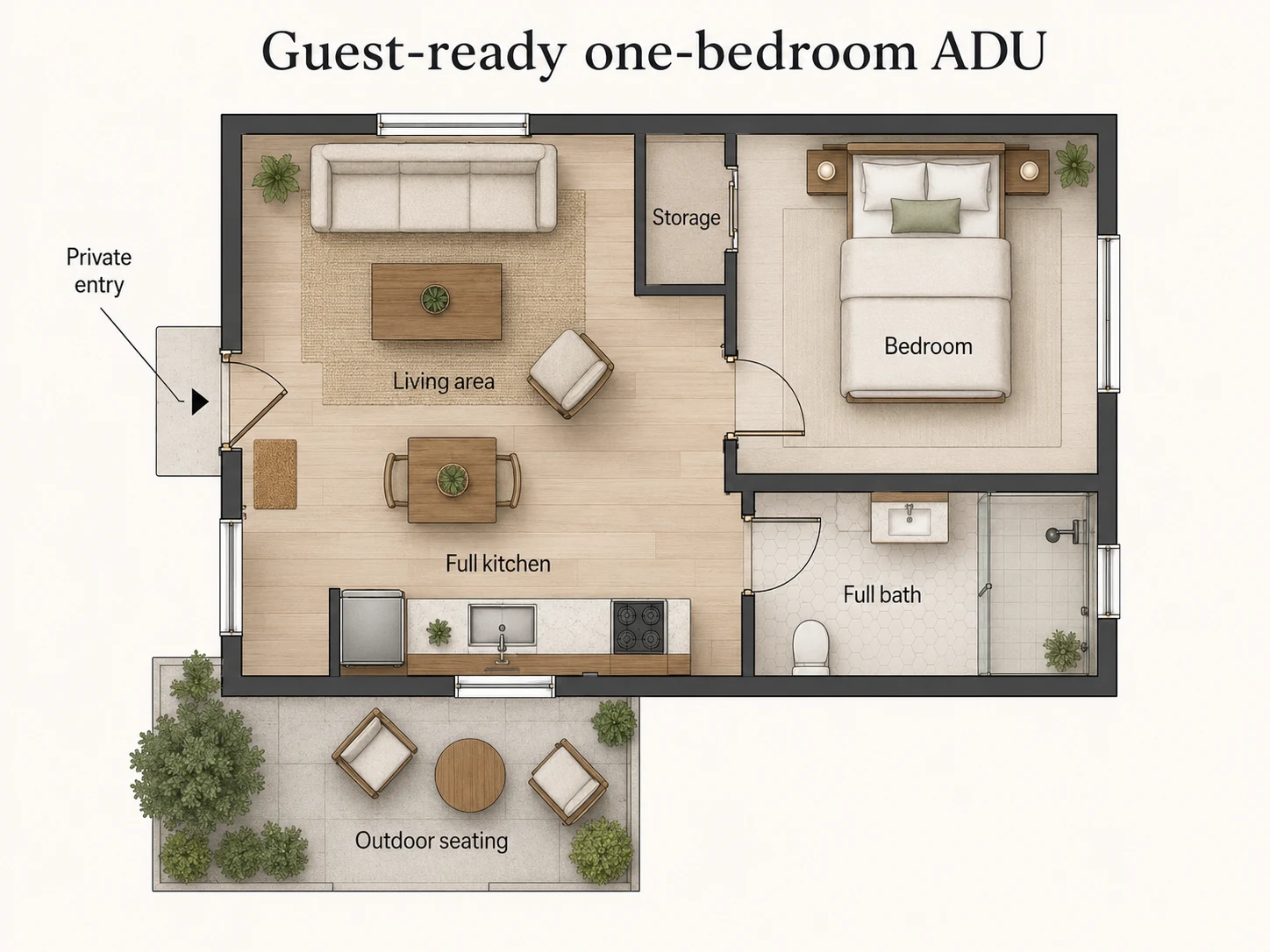
A guest-ready one-bedroom ADU floor plan: private entry, full kitchen, full bath, lockable storage, and outdoor seating.
The unit that wins on a listing is not the flashiest — it is the one guests rate five stars and you can clean in under two hours. Here is the feature set that earns reviews and protects the asset.
| Feature | Why it matters | Most critical for |
|---|---|---|
| Private entrance | Guest autonomy; required feel of a real unit | All rental paths |
| Full bathroom | Non-negotiable for any overnight stay | All paths |
| Full kitchen (not just a microwave) | Higher nightly rate; essential for 30+ day stays | Mid-term especially |
| Dedicated HVAC (mini-split) | Comfort + independent metering | All paths |
| Real sound separation / insulation | The #1 source of complaints and bad reviews | Nightly STR |
| Durable, easy-clean flooring (LVP) | Survives high turnover | Nightly STR |
| Lockable owner storage closet | Linens, supplies, owner items between guests | Nightly + mid-term |
| In-unit laundry or a laundry plan | Booking filter for longer stays | Mid-term / long-term |
| Parking or clear arrival instructions | Reduces friction and neighbor conflict | Nightly STR |
| Blackout shades + good lighting | Sleep quality and photos | All paths |
Studio vs. one-bedroom: studios suit budget builds and shorter solo stays; one-bedrooms win for couples, remote workers, traveling professionals, and longer bookings — and make a far better long-term-rental fallback. Two-bedrooms can shine in tourist markets but escalate cost, guest count, parking demands, and regulatory attention. Every complaint you design out is a review you protect.
How to choose a prefab ADU company for Airbnb
Answer capsule: Don't ask “what's your cheapest unit?” Ask “can this exact unit be permitted as a legal ADU at my address, and what is excluded from the all-in price?” The single most revealing question for any prefab company is what their quote leaves out — foundation, utilities, permits, delivery, and site work are the line items that turn an attractive base price into a six-figure surprise.
A prefab brand controls the box. Your city controls whether the box can earn money. Choose a partner who understands both — and ask for proof, not promises.
Questions to ask — and the evidence to request — before you pay a deposit
| Question | Why it matters | Evidence to request |
|---|---|---|
| Is this permitted as a residential ADU in my jurisdiction? | Screens out 'office pods' sold like housing | A prior permit they pulled in your city |
| Does the quote include foundation, utilities, delivery, and set? | The most common budget blowouts | A written scope sheet with utility allowance |
| Does it include permits, plan check, and impact fees? | 'Turnkey' definitions vary widely | Who is responsible for the permit, in writing |
| Does it include appliances and furniture? | Airbnb needs both | An itemized inclusions list |
| Who manages inspections and the certificate of occupancy? | No CO, no legal rental | Their CO-delivery process |
| What's the warranty? | Guest turnover stresses finishes hard | Written warranty terms |
| What happens if permits are denied? | Defines your refund/change-order risk | The refund/change-order policy |
Red flags to walk away from:
- “No permit needed”
- “Airbnb-ready” with no reference to your local STR rule
- A unit-only price presented as the all-in
- No explanation of foundation or utilities
- No local permit history
- Vague warranty with no written terms
- No certificate-of-occupancy path
► Compare providers by code path, scope, and exclusions. See current pricing & floor plans for builders that serve your area.
The safe order before you buy a prefab ADU for Airbnb
Answer capsule: The sequence that protects your money is: confirm short-term-rental legality first, ADU feasibility second, an address-specific all-in quote third, conservative return math fourth, financing fifth, and a deposit last. Reversing this order — choosing a model before confirming legality — is the most expensive mistake homeowners make.
- Confirm whether ADUs can be used as short-term rentals in your city (and at your specific parcel/zone).
- Confirm your property can have the ADU type you want (lot size, setbacks, height).
- Check HOA covenants and deed restrictions — these can override a permissive city.
- Confirm whether any owner-occupancy rule applies (rare for ADUs; possible for JADUs).
- Choose the code path: modular, panelized, manufactured, or site-built.
- Get a site-specific, all-in quote — not a base-unit price.
- Add furnishing, insurance, STR license, TOT, cleaning, and management to the budget.
- Run long-term, mid-term, and (if legal) Airbnb revenue cases — and stress-test them.
- Confirm financing without relying on speculative Airbnb income.
- Apply for permits; build; pass inspections.
- Obtain the certificate of occupancy.
- Secure the STR license/registration if required.
- List only after the use is lawful.
► Start with your address, not a prefab catalog. Get your free ADU report — it flags the local ADU and short-term-rental questions you need answered before you sign anything.
Frequently asked questions
- What is the best prefab ADU for Airbnb?
- The best prefab ADU for Airbnb is usually a legal, residential-code modular or panelized one-bedroom unit, roughly 400–650 square feet, on a permanent foundation with a private entrance, full kitchen, and durable finishes — but only if your city allows ADUs to be used as short-term rentals. In many markets it doesn't, so confirm legality before choosing a model.
- Can I Airbnb a prefab ADU?
- Sometimes. You need two approvals: the ADU itself must be permitted, and your jurisdiction must allow that ADU to be rented for under 30 days. Some cities allow it with a license, some require the owner on-site, some cap rental days, and some prohibit ADU short-term rentals entirely.
- Can I Airbnb a prefab ADU in California?
- Usually not as a nightly rental. As of January 1, 2026, ADUs created under California's § 66323 state-mandated pathway must be rented for terms longer than 30 days, and JADUs are barred from short-term rental. Renting in 30+ day blocks is permitted statewide; nightly Airbnb depends on local rules and is widely restricted.
- Can I Airbnb an ADU in San Diego?
- No, for ADUs built after 2017. The City of San Diego’s treasurer confirms the Municipal Code prohibits using ADUs for short-term rental, with a narrow exception for companion units permitted before October 15, 2017.
- Can I Airbnb an ADU in Los Angeles?
- Only if the ADU is your own primary residence. An ADU built on or after January 1, 2017 may be home-shared only if it’s the host’s primary residence, and it’s still subject to L.A.’s 120-day annual cap and registration. A separate backyard ADU you don’t live in isn’t eligible.
- Can I Airbnb an ADU in Austin?
- Only minimally. An ADU built after October 1, 2015 may be used as a short-term rental for no more than 30 days per calendar year, and you must hold a short-term rental license. Long-term and 30+ day rentals have no such cap.
- Are prefab ADUs cheaper than site-built for Airbnb?
- Often modestly, and usually faster — factory construction can compress timelines and reduce some labor cost. But the unit price is not the project price; compare all-in installed cost, which in California typically runs $150,000–$400,000 for either method.
- Do prefab ADUs need permits before Airbnb use?
- Yes. A legal dwelling requires a building permit and certificate of occupancy, and where short-term rental is allowed, an STR license is usually a separate approval on top of the building permit.
- What size prefab ADU is best for Airbnb?
- A 400–650 sq ft one-bedroom is the strongest default — it balances guest comfort, construction cost, furnishing simplicity, and long-term-rental fallback value better than a micro-studio or a costlier two-bedroom.
- Can a tiny home on wheels be an Airbnb ADU?
- Only where local rules explicitly allow it. Many jurisdictions don’t treat tiny homes on wheels, RVs, or park models as legal ADUs, and many STR ordinances exclude them outright.
- Can Airbnb income help me qualify for ADU financing?
- Generally no. Most lenders won’t count projected short-term-rental income for qualification. Underwrite the build on household income and conservative long-term rent, and treat Airbnb revenue as upside.
- What if my HOA bans short-term rentals?
- Then the HOA or deed restriction can block STR use even if your city allows it. CC&Rs are enforceable and hard to work around — verify them before buying plans or paying a deposit.
- What if short-term-rental rules change after I build?
- That’s exactly why the unit should also work as a long-term or 30+ day rental. STR rules tighten frequently; a unit that only pencils out as a nightly Airbnb is one ordinance away from a problem.
What we verified
We build this guide as an independent research resource covering ADU financing, costs, and regulations. Here is what we checked and how.
Verified directly against the source (as of May 29, 2026):
- California ADU/JADU short-term-rental and owner-occupancy law (Cal. Gov. Code §§ 66315, 66323, 66333; SB 543; AB 1154; California HCD).
- San Diego ADU short-term-rental prohibition and exception, plus the zone-based TOT rates effective May 1, 2025 (City of San Diego, Office of the City Treasurer).
- Los Angeles Home-Sharing rule for ADUs built on/after January 1, 2017 (City of L.A. Home-Sharing Administrative Guidelines).
- San Francisco ADU/JADU short-term-rental prohibition (SF Planning Code §§ 207.1/207.2; SF Planning ADU fact sheet).
- Austin's post-2015 ADU 30-day/year short-term-rental cap (City of Austin Development Services).
- Portland's accessory short-term-rental resident-occupancy rule and the ADU SDC-waiver STR covenant (Portland.gov).
- Published prefab pricing for Abodu (Studio from $278,800; One from $326,800) from abodu.com/models.
- General ADU/prefab cost ranges (HomeGuide; SelfStorage 2026 ADU cost guide).
Compiled from official sources but flagged for re-confirmation before publishing:
- Seattle, Phoenix, Nashville, and Miami-Dade ADU short-term-rental rules (linked to each government source; re-verify, as these ordinances change often).
Reported, not independently confirmed here:
- Southern California ADU rent range ($1,400–$3,500/month) — sourced to Dynamic Quality Builders regional data, 2026; treat as estimates and verify your local market.
- BOXABL configuration details — sourced to the company's own site; treat pricing as estimates and verify current figures directly.
Not verifiable here:
Your exact address eligibility; any specific provider quote for your site; lender approval; actual Airbnb revenue; and your HOA/deed-restriction status.
Source hierarchy:
Official city/state code for legal claims; company pages for pricing/service-area claims; established cost guides for ranges; homeowner forums for language and objections only, never as proof of law or cost. Editorial conclusions are labeled as conclusions.
Not sure where to start? See what is possible at your address — get your free ADU report in 60 seconds.
Primary CTA — Free Tool
See What You Can Build — and Rent
Check whether ADUs and short-term rentals are both allowed at your exact address — in about 60 seconds. No promise of approval. Just the facts you need before you spend on plans or a deposit.
Get Your Free ADU Report →~60 seconds · No deposit required
Figuring out how to fund the build?
See the financing lanes — construction loan, cash-out refinance, HELOC — explained in plain English.
Explore Financing Options with Mortgage Research Center →Educational only — no rate quotes or approval promises.
Want the full cost-stack worksheet before you compare quotes?
The free ADU Starter Kit includes the line-by-line worksheet we built from real project budgets.
Download the Free ADU Starter Kit →