
How Much Can I Rent My ADU For?
Last verified April 2026 · Sources & methodology · Affiliate disclosure
Short answer: A one-bedroom detached ADU on a long-term lease typically rents for $1,200–$3,500 per month, depending on your market and unit type. In mid-cost metros like Denver or Portland, expect $1,600–$2,400. In high-cost coastal markets like Los Angeles or the Bay Area, $2,500–$3,500+. Short-term strategies can push gross income higher — but only where local rules allow it, and after expenses the gap narrows fast.
Here's what matters more than any national average: your ADU does not rent for whatever your monthly construction payment needs it to rent for. The market sets the price. But there is a reliable method to find that number, and it takes about an hour with free tools.
This page gives you three things: rent ranges by unit size, type, and market so you know your ballpark in seconds; a transparent 5-step pricing method so you can defend your asking rent; and the legality, financing, and break-even math so you know if the strategy works before you list.
Sources: HUD FY 2026 Fair Market Rent data, AirDNA market reports, Zillow rental data, Rentometer, Fannie Mae Selling Guide SEL-2025-08, Freddie Mac ADU Fact Sheet, HUD Mortgagee Letter 2023-17, municipal ordinance citations. Last verified April 2026.
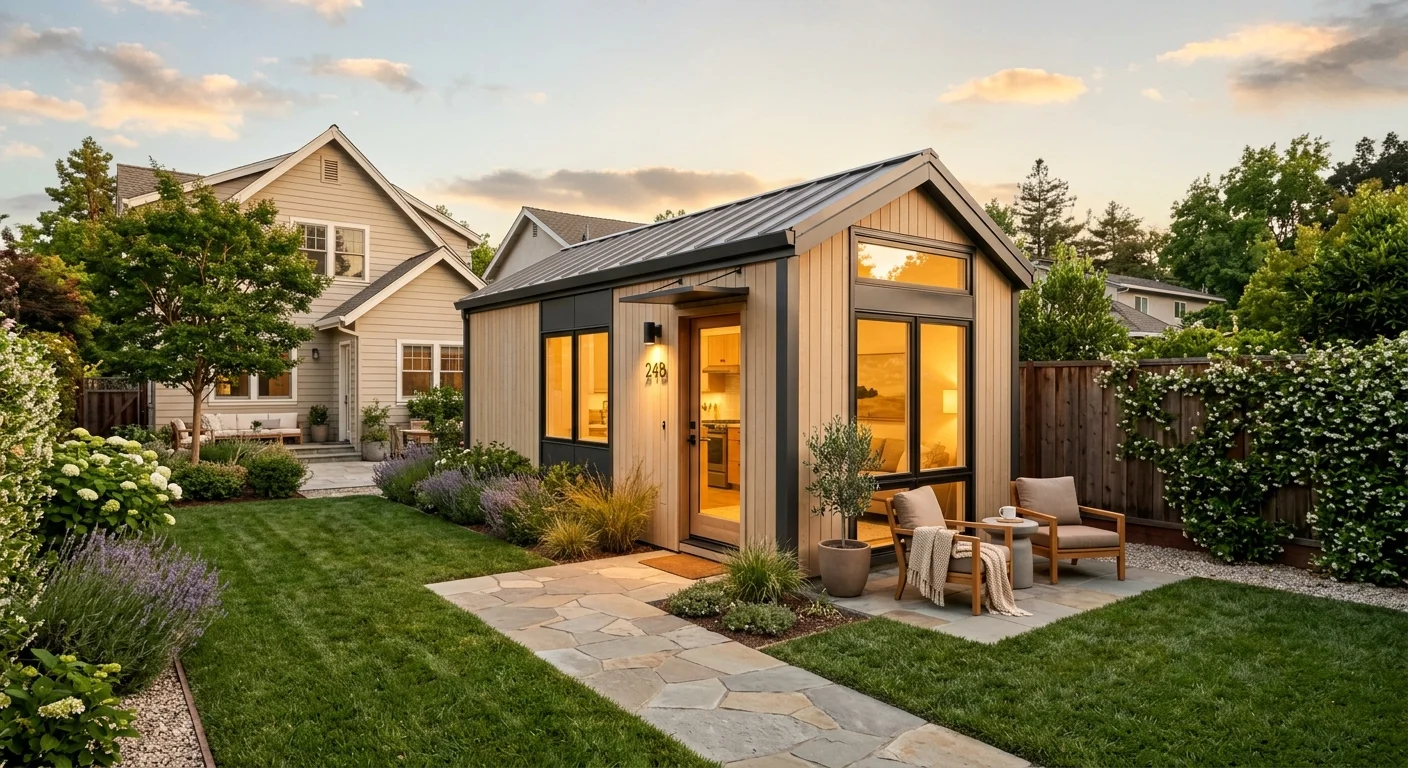
A well-designed detached ADU with private entrance and outdoor space — the features that consistently command the highest rent premiums
How Much Can I Rent My ADU For by Size, Type, and Market?
The first question is always “just give me a number.” Fair enough. But a studio garage conversion in Memphis and a two-bedroom detached ADU in Palo Alto are different products in different universes. The table below reflects rent ranges aggregated from HUD Fair Market Rent data, current Zillow and MLS rental listings, AirDNA market reports, and public owner surveys across three market tiers.
Long-Term Rental (12+ Month Lease)
| ADU Size & Type | Lower-Cost Metro | Mid-Cost Metro | High-Cost Coastal |
|---|---|---|---|
| Studio / under 400 SF (JADU, garage conversion) | $700–$1,100/mo | $1,200–$1,800/mo | $2,000–$2,800/mo |
| 1-Bedroom / 400–650 SF (attached or detached) | $900–$1,400/mo | $1,600–$2,400/mo | $2,500–$3,500/mo |
| 2-Bedroom / 650–1,000 SF (detached) | $1,200–$1,800/mo | $2,000–$3,000/mo | $3,200–$4,500/mo |
| 3-Bedroom / 1,000+ SF (detached) | $1,500–$2,200/mo | $2,400–$3,500/mo | $3,800–$5,000+/mo |
Market tier definitions: Lower-cost — Memphis, Indianapolis, San Antonio, Boise. Mid-cost — Denver, Portland, Austin, Nashville, Raleigh, Salt Lake City, Minneapolis. High-cost coastal — SF Bay Area, Los Angeles, San Diego, Seattle, New York metro.
Methodology: Ranges represent asking rents for ADU-sized units drawn from HUD FY 2026 Fair Market Rent data, cross-referenced with current Zillow rental listings and MLS data in each market tier. Long-term unfurnished leases. Detached ADUs with private entrances typically command the upper end; attached units and JADUs trend lower. These are starting reference points — run the 5-step comp analysis below for your specific address.
What ADUs Are Renting for in Key Markets
National ranges only get you so far. Here's what a one-bedroom detached ADU (roughly 500–650 SF) rents for in specific markets, based on current MLS listings, Zillow rental data, and AirDNA market reports.
| Market | 1-Bed Detached ADU (LTR) | Key Context |
|---|---|---|
| Los Angeles, CA | $2,000–$3,500/mo | Highest ADU permit volume nationally; STR restricted to owner-occupied primary residences (Source: LAHD) |
| SF Bay Area, CA | $2,500–$3,500/mo | Proximity to tech employers drives premiums; units near Stanford command the top of this range |
| San Diego, CA | $2,200–$3,000/mo | Strong LTR demand; ADU short-term rentals banned citywide (Source: SDMC §141.0302) |
| Portland, OR | $1,400–$2,200/mo | ADU-friendly since 2010; long-term ADUs may qualify for SDC waivers |
| Seattle, WA | $1,800–$2,800/mo | DADU-friendly zoning; strong rental demand from tech workforce |
| Denver, CO | $1,600–$2,200/mo | A 550 SF detached ADU in greater Denver averages roughly $1,650/mo as of early 2026 |
| Austin, TX | $1,400–$2,000/mo | No state income tax; verify current ADU STR rules with Austin Development Services |
| Nashville, TN | $1,200–$1,800/mo | Tourism demand boosts mid-term and STR rates in urban core |
| Raleigh-Durham, NC | $1,100–$1,600/mo | University-driven demand creates a consistent tenant pipeline |
| Salt Lake City, UT | $1,200–$1,700/mo | Growing ADU adoption with expanding state-level legislation |
| Phoenix, AZ | $1,200–$1,800/mo | Year-round rental demand; snowbird STR potential in winter months |
| Minneapolis, MN | $1,200–$1,800/mo | ADU-friendly since 2015; one of the earliest Midwest adopters |
| Miami, FL | $1,800–$2,800/mo | Strong STR potential in tourist zones; check local licensing requirements |
Ranges derived from current 1-bedroom rental listings (filtered for units under 700 SF), cross-referenced with HUD FY 2026 FMR data and available AirDNA market reports. LTR = long-term rental (12+ month lease). Ranges represent asking rents. Always confirm with local comps for your specific neighborhood.
Which Rental Strategy Fits Your ADU?
The rent number changes dramatically based on how you rent the unit. Long-term, mid-term, and short-term are three different businesses with different economics, different legal requirements, and different levels of effort. The strategy you pick — or the strategy your city allows — is the single biggest variable after location.
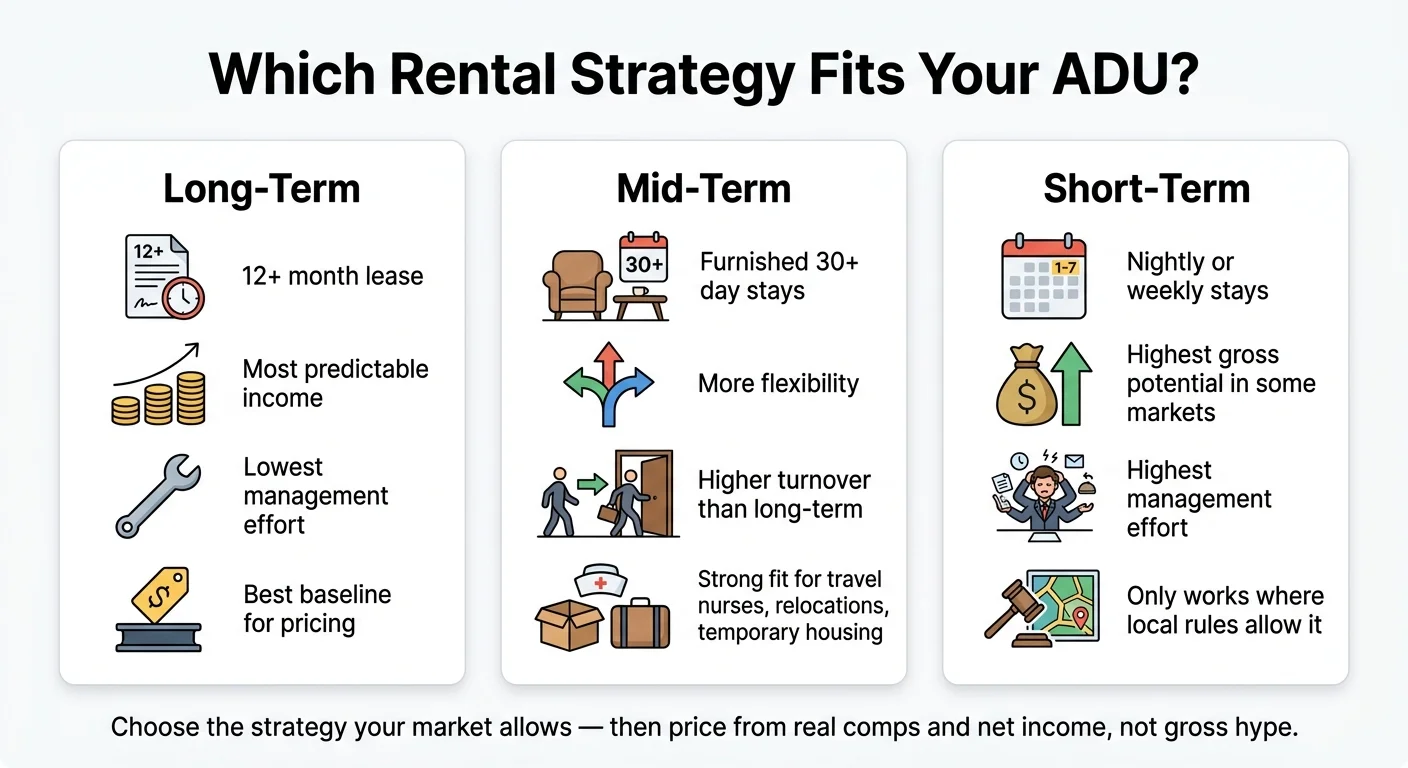
Choose the strategy your market allows — then price from real comps and net income, not gross hype
Long-Term Rental: The Default Baseline
A 12-month lease with a vetted tenant. The simplest path to steady income. Find one good tenant, sign a lease, collect rent monthly, handle occasional maintenance, and move on. Every jurisdiction we've reviewed that permits ADU rentals permits long-term leasing — no minimum-stay restrictions, no licensing, no platform fees.
The tradeoff: You're locked in at one rent level for the lease term, you lose flexibility to use the unit for family or guests, and a bad tenant can be harder to remove than a bad Airbnb review.
Mid-Term / 30+ Day Furnished Rental: The Overlooked Middle
Furnished rentals with 30-to-90-day minimum stays — travel nurses, corporate relocations, visiting professors, insurance displacement tenants, and remote workers. This is the strategy most ADU owners don't consider, and it often hits the sweet spot between income and effort.
Mid-term furnished ADUs typically command 20–40% more than unfurnished long-term rent. A unit that rents for $2,000/month unfurnished might bring $2,500–$2,800/month furnished on rolling 30-day terms. And most STR ordinances define short-term as under 30 days — so 30+ day stays avoid the restrictions that apply in many cities.
The tradeoff: You need to furnish the unit ($5,000–$12,000 upfront), you'll have more turnovers per year, and you need to market on platforms like Furnished Finder or Airbnb (with 30-day minimum set).
Short-Term / Airbnb: Only Where Legal
Nightly and weekly rentals through Airbnb, Vrbo, or direct booking. This is the strategy everyone fantasizes about and the strategy that trips up the most people — many cities either ban or heavily restrict ADU short-term rentals.
If your city allows it, short-term can generate the highest gross income. If your city doesn't, building your financial model around Airbnb numbers is a recipe for a very expensive mistake.
The tradeoff:
Strategy Comparison: Side by Side
| Factor | Long-Term (12+ mo) | Mid-Term (30–90 day) | Short-Term (Airbnb) |
|---|---|---|---|
| Gross monthly income | $1,600–$2,400 | $2,000–$3,200 | $2,800–$5,000+ |
| Vacancy rate | 3–5% | 10–20% | 15–35% |
| Management effort | Low (2–5 hrs/mo) | Medium (5–10 hrs/mo) | High (10–20+ hrs/mo) |
| Furnishing cost | $0 (unfurnished) | $5,000–$12,000 | $8,000–$15,000 |
| Cleaning/turnover | Minimal | $100–$200/turnover | $75–$150/turnover |
| Management fee if outsourced | 6–10% | 10–15% | 20–30% |
| Estimated net monthly income | $1,400–$2,100 | $1,500–$2,500 | $1,600–$3,000 |
| Legal risk | Very low | Low | Moderate to high |
| Best for | Steady income, hands-off | Higher income, some flexibility | Tourism markets, high effort tolerance |
Net income estimates assume a 1-bedroom/600 SF detached ADU in a mid-cost metro. These are illustrative scenarios, not projections.
Short-Term Rental Analysis Tool
Want to see what your ADU could earn as a short-term rental?
AirDNA's Rentalizer analyzes comparable Airbnb and Vrbo listings near any address to project annual revenue, average nightly rate, and occupancy. A widely used revenue projection tool for short-term rental analysis.
Affiliate link. Full disclosure. We may earn a commission at no extra cost to you. Our editorial recommendations are based on independent research.
Check Your ADU's STR Potential on AirDNACan I Airbnb My ADU?
Sometimes yes, sometimes absolutely not. The answer is city-specific, and pricing your ADU using Airbnb comps from a city that bans ADU short-term rentals is one of the most expensive mistakes a homeowner can make.
New ADU owners see $150/night listings on Airbnb and multiply by 30 days to get $4,500/month. But those listings may not be legal ADUs, the occupancy rate isn't 100%, and their own city may prohibit the practice entirely. If you price — or worse, finance — your ADU based on illegal Airbnb comps, you're building your financial model on sand.
City Rules That Change the Math
| City / Jurisdiction | ADU Short-Term Rental Rule | What It Means for You |
|---|---|---|
| San Diego, CA | ADUs may not be rented for fewer than 31 consecutive days | No Airbnb. Price using long-term or 30+ day comps only. (Source: SDMC §141.0302) |
| Los Angeles, CA | Home-sharing allowed only on primary residence; RSO and JCO status affect ADU treatment | You may be able to STR your ADU if you live on-site and comply with the Home-Sharing Ordinance. Verify your property's RSO/JCO status with LAHD before listing. |
| San Francisco, CA | ADUs are not eligible for the Short-Term Rental program | Do not use Airbnb/Vrbo income to price a San Francisco ADU. Long-term or 30+ day only. (Source: SF Planning) |
| Portland, OR | ADUs can be used as accessory STRs with permits; however, if the property received an SDC waiver, no structure may be STR'd for 10 years | If your property took the SDC waiver, model long-term or 30+ day income only. (Source: Portland.gov ADU Zoning) |
| Holladay, UT | 30+ day minimum rental period; owner-occupancy required | No short-term. Mid-term (30+ day) is your ceiling. (Source: Holladay City housing regulations) |
| Ogden, UT | ADU use tied to owner-occupancy and short-term rental rules | Check Ogden City Code 15-35-6 before assuming STR is possible. |
| Denver, CO | STR license required; primary residence only | Possible with a license, but your ADU must be part of your primary residence and you must live there. |
| Austin, TX | Official city sources currently conflict on ADU STR conditions | Verify directly with Austin Development Services before modeling short-term income. Do not assume STR is available. |
Rules current as of April 2026. Municipal short-term rental regulations change frequently — always confirm with your local planning department before listing.
What to Do When STR Is Off the Table
30+ day furnished rentals
Avoid most STR restrictions and capture a significant portion of the short-term upside. Travel nurses, corporate relocations, and insurance displacement tenants are excellent mid-term tenants who pay premium rates and don't require nightly management.
Long-term unfurnished leasing
The most predictable, lowest-effort path. In strong rental markets, a well-designed ADU on a 12-month lease still generates meaningful income and builds equity. Some of the strongest ADU returns come from owners who never listed on Airbnb — they found a great long-term tenant and let the compounding do its work over a decade.
How Do I Set the Right Rent for My ADU?
Most ADU owners either guess their rent, copy a number from a national article, or set it based on what they need it to be to make their loan payment work. All three approaches leave money on the table — or worse, leave the unit sitting vacant.
Here's the 5-step method we recommend. It takes about an hour, uses free tools, and gives you a defensible number you can explain to a lender, a property manager, or yourself.
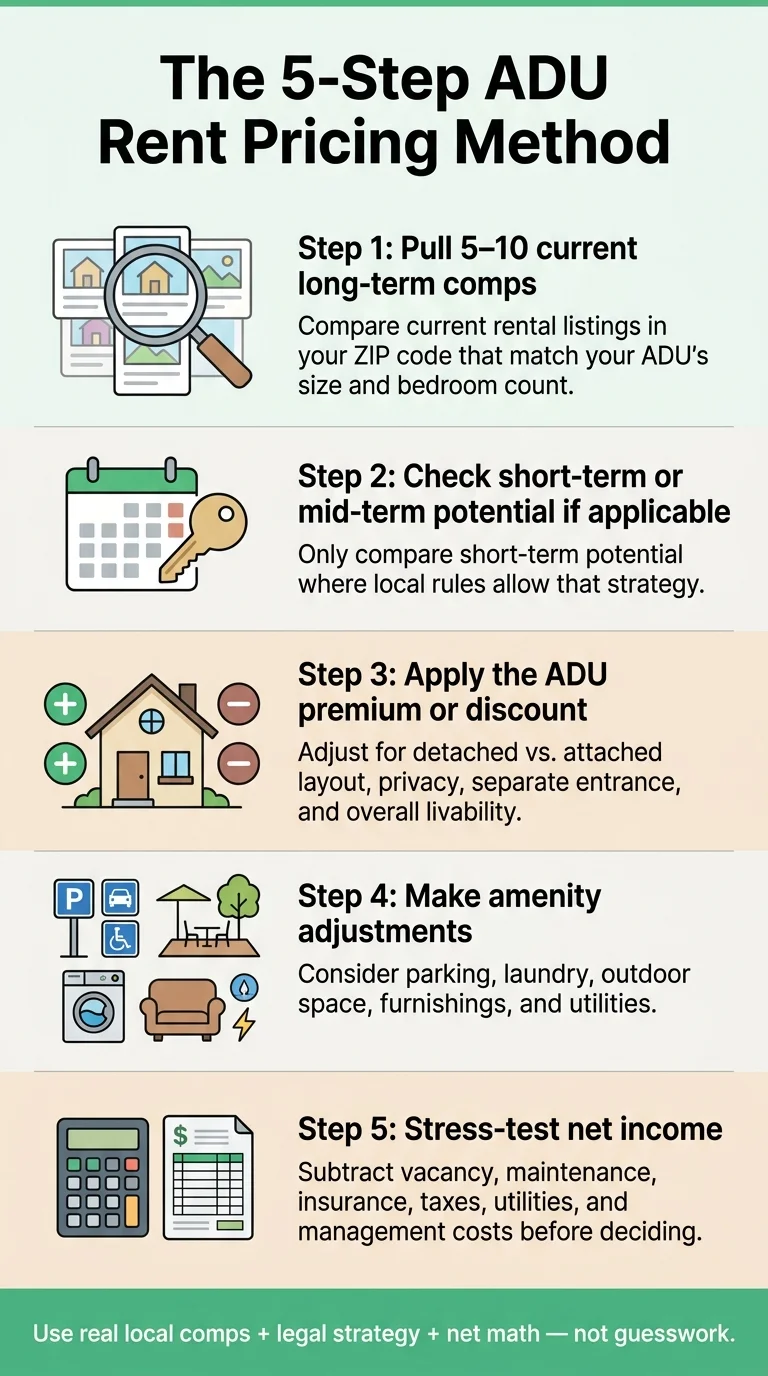
Use real local comps + legal strategy + net math — not guesswork
Pull 5–10 Current Long-Term Comps
Search Zillow, Apartments.com, Craigslist, and Facebook Marketplace for current rental listings in your ZIP code that match your ADU's size and bedroom count. Filter for “guest house,” “ADU,” “casita,” “cottage,” or “in-law suite” if available — but also include regular apartment and small-home listings in the same size range.
Then check Rentometer (rentometer.com). Enter your address and bedroom count — it shows you the median and range for comparable rentals within a defined radius. Rentometer sometimes lags the market by a few months, but gives you a solid reference point.
Check Short-Term Revenue Potential (If Applicable)
If your city allows short-term or mid-term ADU rentals, enter your address into AirDNA's Rentalizer. It analyzes comparable Airbnb and Vrbo listings within a 10-mile radius and projects annual revenue, average daily rate (ADR), and occupancy rate.
Pay attention to the Comp Set Strength score — it tells you how much variance exists in the comparable listings. A low score means the projection is based on widely different properties, so treat it with more skepticism.
Apply the ADU Premium (or Discount)
ADUs are not apartments. Renters value different things in an ADU, and your asking rent should reflect that.
Pushes rent higher
Detached unit with separate entrance (strongest premium)
Private outdoor space, patio, or yard access
In-unit washer/dryer
Dedicated off-street parking
New construction / modern finishes
Pet-friendly policy
Quiet residential neighborhood
Pushes rent lower
Attached to the main house with shared walls
JADU sharing a bathroom with the primary residence
Shared driveway or yard with limited privacy
Basement unit with limited natural light
No parking in a parking-constrained area
Older or below-grade finishes
A detached ADU with a private entrance, parking, and laundry typically commands a 5–15% premium over comparable apartment listings. A JADU with limited privacy may need to price 5–10% below.
Make Amenity Adjustments
Small features create measurable rent differences. These estimates reflect patterns observed across rental listing data and owner reports:
| Amenity | Est. Monthly Rent Impact | Notes |
|---|---|---|
| In-unit washer/dryer | +$50–$150/mo | Consistently among the most valued features in rental listing analysis |
| Dedicated parking spot | +$50–$200/mo | Higher in parking-constrained urban areas |
| Utilities included | +$100–$200/mo | Simplifies the tenant experience; model your actual utility cost carefully |
| Furnished (for mid-term) | +$300–$600/mo | Requires $5K–$12K upfront investment |
| Pet-friendly | +$25–$75/mo + deposit | Dramatically expands your applicant pool |
| EV charging | +$25–$50/mo | Growing demand in mid-cost and high-cost markets |
| Private outdoor space | +$50–$150/mo | Fenced patio or small yard is highly valued |
| Smart home features | +$25–$50/mo | Smart lock, thermostat, and video doorbell are standard for STR |
These estimates are directional, not guaranteed. Rent premiums vary significantly by market.
Stress-Test Your Net Income
This is the step almost everyone skips — and the step that prevents the most financial pain. Gross rent is not what you take home. Before you celebrate the number from Steps 1–4, subtract the real costs of owning and operating a rental unit:
| Expense Category | Typical Annual Cost | Monthly Equivalent |
|---|---|---|
| Property tax increase from ADU | $1,500–$4,500/yr | $125–$375/mo |
| Insurance increase | $500–$1,500/yr | $42–$125/mo |
| Maintenance reserve (1.5% of build cost) | $2,250–$4,500/yr (on $150K–$300K build) | $188–$375/mo |
| Vacancy allowance | 5% LTR / 20% STR | 5–20% of gross rent |
| Property management (if used) | 6–12% of rent (LTR) / 20–30% (STR) | Varies |
| Utilities (if owner-paid) | $1,200–$3,000/yr | $100–$250/mo |
| Licensing, registration, HOA | $0–$1,200/yr | $0–$100/mo |
What If There Are No Exact ADU Comps?
In most markets, there aren't many rental listings that say “ADU” or “backyard cottage.” That's normal. The method above still works. Use apartments and small homes as your baseline, apply the ADU-specific adjustment, and sanity-check against days on market. After you set your price: if your listing gets 15 inquiries in the first 48 hours, you priced too low. If silence for two weeks, you're too high.
Don't use Rent Zestimate as your final answer. Zillow's rental estimate model was trained primarily on standard apartment and home data and is unreliable for ADUs and non-standard units. Use it as a gut check, not a pricing decision.
Free Tool · 60 seconds
Not sure if your lot qualifies — or what size ADU you can build?
Lot fit, setbacks, zoning basics, and rental income estimate — free, no commitment.
What Features Actually Raise or Lower ADU Rent?
Beyond the pricing method above, it helps to understand why certain features matter — because the best time to build for higher rent is during the design phase, not after the drywall is up.
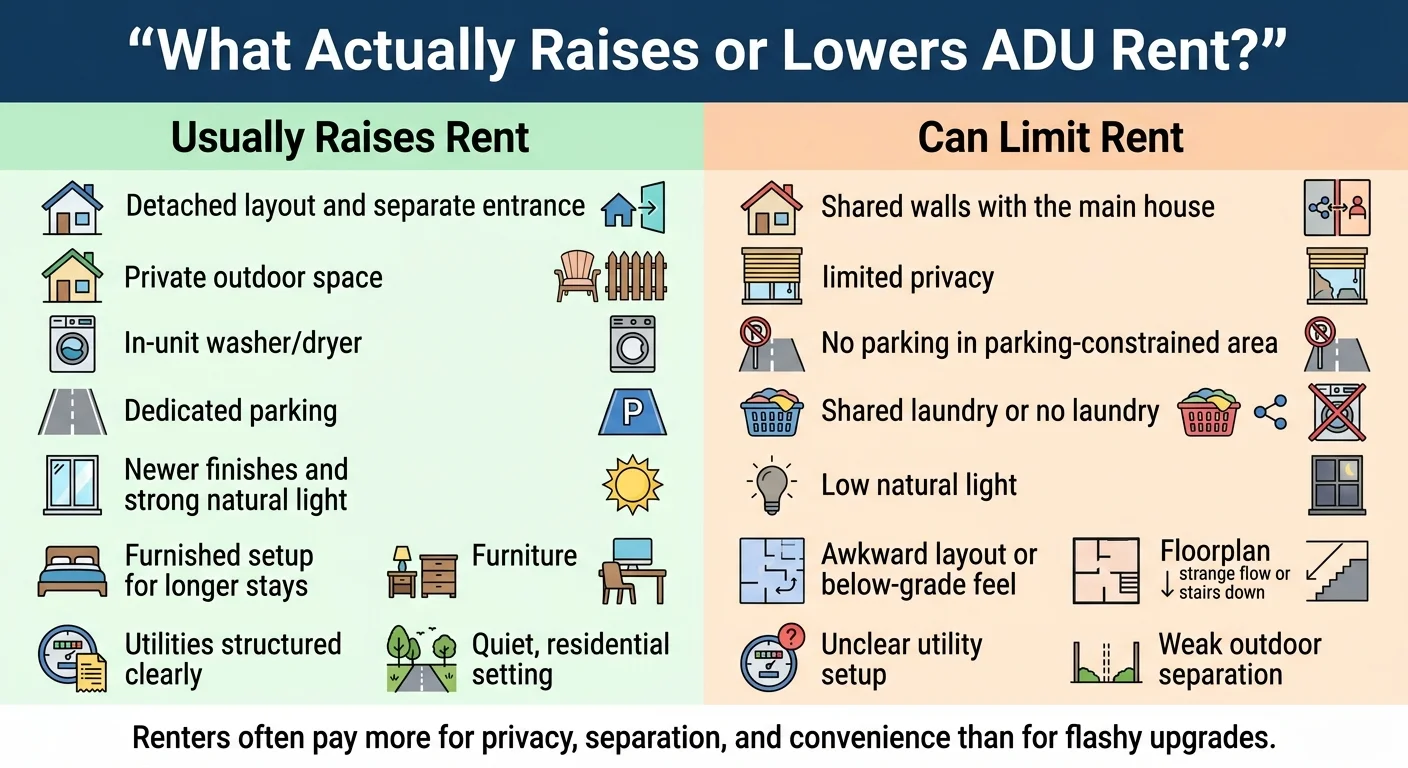
Renters often pay more for privacy, separation, and convenience than for flashy upgrades
Privacy Is the Biggest Rent Driver
Renters choosing an ADU over an apartment are almost always choosing it for privacy. A detached unit with its own entrance, its own outdoor space, and no shared walls commands rent that attached units and JADUs simply can't match. If you're still in the design phase, this is the single highest-ROI decision you can make: go detached if your lot allows it, and give the unit a clearly separate entrance path. The rent premium will pay for the incremental construction cost many times over the life of the unit.
Parking Matters More Than You Think
In urban and near-urban neighborhoods where street parking is competitive, a dedicated off-street parking spot can be the difference between getting the tenant you want and watching your listing sit. In parking-constrained areas, parking consistently adds $100–$200/month in rent and dramatically reduces vacancy time. If you can design the ADU with even a single dedicated spot — a portion of the driveway, a side pad, or a carport — do it.
In-Unit Laundry Pays for Itself
For long-term tenants, in-unit washer/dryer is the amenity that most reliably justifies higher rent and reduces vacancy. A stackable unit costs $800–$1,500 to install and can add $50–$150/month in rent. The payback is often under two years. For mid-term and short-term, it's even more important — travelers expect it, and reviews suffer without it.
New Construction Commands a Premium
Brand-new ADUs rent at a premium over comparable older units because tenants are willing to pay for modern finishes, efficient HVAC, and the assurance that nothing is going to break in the first year. This premium typically ranges from 10–20% over similar-vintage apartments in the same area. But there are diminishing returns above mid-range finishes. Quartz counters, stainless appliances, and LVP flooring justify the upgrade. Italian marble and custom cabinetry usually don't move the rent needle enough to justify the cost in a rental unit.
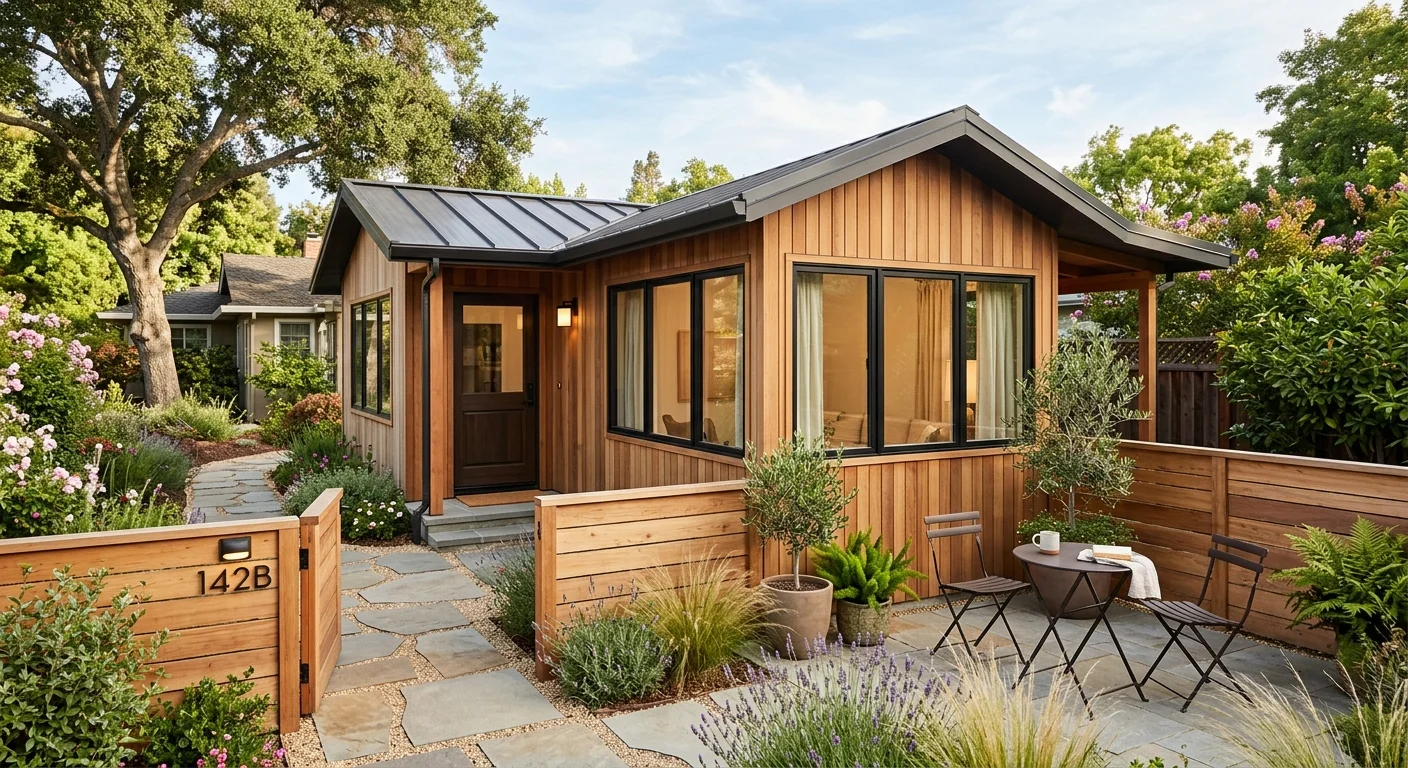
Private entrance, separate gate, and dedicated outdoor space — the combination that consistently commands the highest ADU rent premiums
Will the Rent Actually Cover Your Build?
Let's be straightforward. An ADU is a wealth-building asset, not a get-rich-quick play.
If you're financing a $200,000 build, your monthly construction loan or HELOC payment alone might be $1,200–$1,600. After real expenses — taxes, insurance, maintenance, vacancy — your net cash flow in Year 1 might be modest. Maybe $200–$800/month.
That's the part most blog posts skip. The real wealth-building happens across three channels simultaneously: rental income that grows with the market (median asking rents have risen 3–5% annually nationwide over the past decade), property value appreciation (ADUs consistently add significant value — the Santa Barbara survey showed average rents of $2,280/month on units that cost a fraction of the home's value), and loan paydown (your tenant is effectively paying down principal on an appreciating asset). Over 10–15 years, those three channels compound into a genuinely transformative financial outcome.
Worked Example: $150K Garage Conversion
Unit: Studio / 500 SF garage conversion, mid-cost metro
Long-term rent: $1,500/month
Annual gross: $18,000
Annual expenses: Property tax increase ($1,800) + insurance ($900) + maintenance ($2,250) + vacancy at 5% ($900) = $5,850
Annual net income: $12,150 → $1,013/month
Simple payback on build cost: ~12.3 years from cash flow alone
With estimated property value increase: Effective payback compresses to 6–8 years
Worked Example: $250K Detached New Build
Unit: 1-bed / 650 SF detached, high-cost metro
Long-term rent: $2,800/month
Annual gross: $33,600
Annual expenses: Property tax ($3,600) + insurance ($1,200) + maintenance ($3,750) + vacancy at 5% ($1,680) = $10,230
Annual net income: $23,370 → $1,948/month
Simple payback on build cost: ~10.7 years from cash flow alone
With estimated property value increase: Effective payback compresses to 4–6 years
Worked Example: Same $250K Unit as Mid-Term Furnished Rental
Furnished monthly rent: $3,500/month
Annual gross: $42,000
Annual expenses: Property tax ($3,600) + insurance ($1,200) + maintenance ($3,750) + vacancy at 15% ($6,300) + furnishing amortization ($2,000/yr) + cleaning/turnover ($2,400/yr) = $19,250
Annual net income: $22,750 → $1,896/month
Key insight: Despite higher gross income, the mid-term furnished strategy nets almost identically to long-term after real expenses. The advantage is flexibility and the ability to use the unit for family between tenants — not necessarily higher net income.
These are illustrative scenarios, not projections for your specific property. Actual results depend on local market conditions, construction costs, financing terms, and regulatory requirements.
The Fannie Mae Game-Changer
As of October 2025, Fannie Mae's Selling Guide update (SEL-2025-08) allows projected ADU rental income to count toward mortgage qualification for purchase and limited cash-out refinance on one-unit owner-occupied properties with one ADU. The income is capped at 30% of total qualifying income.
Previously, you needed to qualify for the full construction cost without any credit for the rental income. Now, the income potential is part of the equation. (Source: Fannie Mae Selling Guide Sections B3-3.1-08 and B3-3.2-02, updated October 8, 2025)
ADU Financing Guide
Exploring how to finance your ADU?
Every major option — HELOCs, renovation loans, home equity investments, and construction financing — organized by situation, not by who pays us the most.
Can ADU Rent Help You Qualify for Financing?
Yes — in some scenarios. But not in the simple way most homeowners assume. The three major mortgage programs treat ADU rental income differently:
| Program | Can ADU Rent Count Toward Qualifying? | Key Limitations |
|---|---|---|
| Fannie Mae | Yes — projected rental income for purchase and limited cash-out refi on a one-unit principal residence with one ADU | Capped at 30% of total qualifying income; documentation and appraisal requirements apply |
| Freddie Mac | Yes — qualifying rental income on eligible purchase and no-cash-out scenarios for a one-unit primary residence with an ADU | Documented lease treatment at 75%; ADU rental income capped at 30% of total qualifying income |
| FHA | Yes — actual or projected ADU rental income may be used in eligible scenarios, subject to documentation, 75% calculation, and 30% cap | ADU rental income cannot be used as effective income for cash-out refinances |
Sources: Fannie Mae Selling Guide SEL-2025-08; Freddie Mac ADU Fact Sheet; HUD Mortgagee Letter 2023-17.
Which Financing Path Fits Your Situation?
You have strong existing home equity
A standard HELOC lets you borrow against equity you've already built. Approval can be fast — some lenders close in under a week — and you draw funds as needed during construction.
You have limited current equity but the ADU will add significant value
A renovation-focused HELOC lends based on your home's projected after-renovation value, not just current appraised value. This unlocks substantially more borrowing power. (Note: Not available in all states.)
You're equity-rich but cash-flow constrained
Home equity investments provide a lump sum with no monthly payments — you share a portion of your home's future appreciation instead. Particularly relevant for retirees and fixed-income homeowners. (Note: HEI products have limited state availability.)
You need a construction loan or investor financing
Traditional construction loans, renovation mortgages, and investment property loans serve different needs. A lending marketplace can help you compare options from multiple sources in one application.
The Dwelling Index is not a lender or broker. This is educational content about financing paths. We do not quote rates, guarantee approval, or make lending recommendations. Full disclosure.
How Is ADU Rental Income Taxed?
ADU rental income is taxable — but the tax code gives rental property owners several powerful deductions that can significantly reduce your effective tax burden.
What You Report and Where
Rental income from your ADU is reported on IRS Schedule E (Supplemental Income and Loss). The income is taxed as ordinary income at your marginal rate. But the deductions available to rental property owners often shelter a significant portion of that income.
Deductions Available to ADU Owners
Depreciation is the big one. The IRS allows you to depreciate the cost of the ADU structure (not the land) over 27.5 years using the residential rental property schedule. On a $200,000 ADU, that's roughly $7,270 per year in non-cash deductions — meaning you reduce your taxable rental income by that amount without spending a dollar. On $24,000/year in gross rental income, depreciation alone shelters about 30% of the income from taxes.
Other deductible expenses: mortgage interest on the ADU construction loan, property tax increase attributable to the ADU, insurance premiums, repairs and maintenance, property management fees (if used), utilities paid by the owner, advertising and tenant screening costs, and professional fees.
The Passive Activity Loss Rules
For most ADU owners, rental income is classified as “passive” income. However, if your adjusted gross income is below $150,000 and you “actively participate” in managing the rental (which most ADU owner-landlords do), you can deduct up to $25,000 in passive rental losses against your regular income. This phases out between $100,000 and $150,000 AGI. Between depreciation, interest, and operating expense deductions, many ADU owners show little or no taxable income from their rental in the early years — even while collecting real cash flow every month.
Tax situations vary significantly. This is educational information, not tax advice. Consult a CPA or tax professional for guidance specific to your situation.
Do You Need a Property Manager for Your ADU?
Short answer: probably not, if you're doing long-term rental. Single-unit ADU landlording is among the most manageable property management scenarios in real estate. Your “portfolio” is one unit. Your tenant is in your backyard. The time commitment for a long-term rental is typically 2–5 hours per month: one tenant search per year (or less), automated rent collection, a few maintenance calls per year, and an annual lease renewal conversation.
When Property Management Makes Sense
You're running a short-term or mid-term rental strategy
Guest turnovers, cleaning coordination, listing management, and guest communication add up. A short-term rental manager (typically 20–30% of revenue) handles the operational load.
You live far from the property
If the ADU is on a property you don't occupy — legal in California for standard ADUs since January 1, 2024 (AB 976) — remote management adds complexity that a local PM can solve.
You own multiple rental properties
Once you're managing three or more units, the administrative overhead starts to justify PM costs.
You simply don't want to be a landlord
Valid answer. Some people build ADUs for property value and family flexibility, rent it out for income, and happily pay 8–10% of rent to never take a maintenance call.
| Management Model | Typical Cost | Impact on $2,000/mo Rent |
|---|---|---|
| Self-managed (LTR) | $0 + your time | Keep 100% of rent |
| Property manager (LTR) | 6–12% of rent | Lose $120–$240/mo ($1,440–$2,880/yr) |
| Self-managed (STR) | $0 + significant time | Keep 100% minus platform fees |
| STR manager | 20–30% of revenue | Lose $400–$600/mo on $2,000 gross |
Managing your own ADU rental? These tools help:
TurboTenant
Tenant screening, rent collection, and lease management tools
RentRedi
Mobile-first landlord app for rent collection and maintenance tracking
Buildium
Professional-grade property management software for the investment-minded
Belong
Full-service rental management reimagined for single-unit owners
Affiliate links. We may earn a commission at no extra cost to you. Full disclosure.
What Rules Can Cap or Change the Rent You Charge?
The market is not the only constraint on your ADU rent. Several regulatory factors can limit your pricing freedom or change the economics of your rental strategy.
Are ADUs Subject to Rent Control?
In some cities, yes. In Los Angeles, ADUs may be subject to the Rent Stabilization Ordinance (RSO) or the Just Cause Ordinance (JCO) depending on when the unit was built and the property's RSO status. This can limit annual rent increases and create additional tenant protections that affect your long-term income trajectory.
In most cities outside of California, rent control does not apply to newly constructed ADUs. But check. Oregon has statewide rent increase caps (currently 7% + CPI annually). New York, New Jersey, and several other states have local rent stabilization programs that may affect ADU rentals.
Does Owner Occupancy Matter?
In many jurisdictions, yes — it affects both whether you can rent and how you can rent. California's AB 976 made the no-owner-occupancy rule for standard ADUs effective January 1, 2024. Starting January 1, 2026, AB 1154 clarifies that a JADU requires owner-occupancy only when it shares sanitation facilities with the primary structure. California's HCD handbook also states that JADUs cannot be used as short-term rentals and, if rented, must be rented for terms longer than 30 days.
Sources: California AB 976; California AB 1154; California HCD ADU Handbook.
Shared Utilities: A Pricing and Legal Consideration
If your ADU shares utility meters with the main house, you'll need to decide how to handle the cost. Options: separate meters (cleanest but most expensive — $2,000–$5,000+ for electric alone), aftermarket sub-meters (app-based monitoring so you can show the tenant actual usage), or a flat utility allowance rolled into rent. Rolling utilities into rent is the simplest approach. The risk: if your tenant works from home and runs the AC 24/7, your actual utility cost may exceed what you've built into the rent. Model conservatively.
Who Is the Best Tenant for Your ADU?
The right asking rent depends partly on who you're designing the listing for. Different tenant profiles value different things, and matching your unit's strengths to the right tenant segment can reduce vacancy and justify premium pricing.
Long-Term Tenants
Young professionals, couples, graduate students, retirees downsizing
Affordability vs. apartments
Quiet neighborhood
Parking
Laundry
Storage
Pet-friendliness
Private entrance
Mid-Term Tenants
Travel nurses, corporate relocations, insurance displacement, visiting researchers
Furnished turnkey setup
Flexible lease terms
Proximity to hospitals/employers
Reliable WiFi
In-unit laundry
Will pay 20–40% above long-term rates for convenience, staying 1–3 months
Short-Term Guests
Tourists, business travelers, event attendees
Location
Cleanliness
Design/aesthetics
Reviews
Proximity to attractions/transit
Pay per-night rates but expect hotel-level turnover service
For mid-term furnished rentals: Furnished Finder (popular with travel nurses), Airbnb with 30-day minimums, and local corporate housing networks are the best listing channels. For long-term: Zillow, Apartments.com, and Craigslist still dominate in most markets.
What Mistakes Cause ADU Owners to Overprice or Underprice?
Pricing From Your Monthly Payment
You calculate your construction loan payment at $1,600/month, add $400 for expenses, and decide you need $2,000/month in rent. But the market doesn't care about your loan terms. If comparable units rent for $1,500, your unit rents for approximately $1,500. If the rent doesn't cover the payment, that's a financing structure problem, not a pricing problem. Address it with your lender, not your tenant.
Using Illegal Airbnb Comps
Pulling nightly rates from Airbnb listings in a city that bans ADU short-term rentals, then multiplying by 30, then using that number to justify your build budget. Always confirm legality first.
Treating Rent Zestimate as the Answer
Zillow's rental estimate algorithm was not built for ADUs. Use it as one input among several, not the final word.
Ignoring Attached vs. Detached
A detached ADU with a private entrance is a fundamentally different product than an attached unit sharing a wall with your living room. Pricing them the same ignores the privacy premium that tenants consistently pay for.
Overpricing Because It's "Brand New"
Yes, new construction commands a premium. But it's a 10–20% premium, not a 50% premium. If existing apartments in your area rent for $1,800, your beautiful new ADU rents for $2,000–$2,200 — not $2,700.
Underpricing Because You're Afraid of Vacancy
Some owners price 15–20% below market because they'd rather fill the unit fast than risk a single month of vacancy. One month of vacancy at $2,200 costs you $2,200. Twelve months of underpricing at $1,800 costs you $4,800. Price at market and wait for the right tenant.
What Should I Check Before I List My ADU for Rent?
Before you post your ADU on any platform, run through this list. It's the compressed version of everything above.
Pulled 5–10 current 30+ day rental comps in your ZIP code (Rentometer, Zillow, Apartments.com)
Confirmed your rental strategy is legal in your city (long-term / mid-term / short-term)
Checked for rent control, rent stabilization, or annual increase caps
Applied the detached vs. attached adjustment
Adjusted for amenities: parking, laundry, outdoor space, utilities, furnished
Modeled net income after real expenses (taxes, insurance, maintenance, vacancy)
Confirmed financing break-even works at the net income level
Checked owner-occupancy requirements if applicable
Confirmed final inspection / certificate of occupancy, if required in your jurisdiction
Verified insurance covers rental activity (landlord policy or rider)
Decided on furnished vs. unfurnished
Decided on utilities: separate meter, sub-meter, or included
Drafted listing copy that targets your ideal tenant segment
Saved a fallback pricing plan (what you'll adjust to if no inquiries within 14 days)
Free Tool · 60 seconds
If you haven't built yet — confirm what's possible on your lot before you commit
Lot fit, setbacks, zoning basics, and rental income estimate — free, no commitment.
Frequently Asked Questions
Can you rent out an ADU?
Yes — in most jurisdictions that permit ADUs, you can rent the unit to a tenant. Some cities require owner-occupancy, and nearly all regulate whether short-term or long-term rentals are permitted. Always verify with your local planning department.
How much can a detached ADU rent for?
A detached one-bedroom ADU (500–650 SF) typically rents for $1,600–$3,500/month depending on market, ranging from around $900–$1,400 in lower-cost metros to $2,500–$3,500+ in high-cost coastal markets. Detached units consistently command the highest ADU rents due to the privacy premium.
How much less do attached ADUs usually rent for?
Attached ADUs typically rent for 5–15% less than comparable detached units in the same market because they share walls with the primary residence and often offer less privacy. The discount depends on soundproofing, entrance separation, and outdoor space.
Can I Airbnb my ADU?
It depends entirely on your city's rules. San Diego bans ADU short-term rentals. San Francisco ADUs are ineligible for the STR program. Los Angeles allows home-sharing on primary residences with restrictions. Always check your municipal code before listing on Airbnb or Vrbo.
What if my city requires 30+ day stays?
That's actually a strong position. Mid-term furnished rentals (30–90 days) for travel nurses, corporate relocations, and insurance displacement tenants often net nearly as much as short-term after expenses — with far less management effort.
Are ADUs subject to rent control?
In some cities. In Los Angeles, ADUs may fall under the RSO depending on the property's status and construction date. Oregon has statewide rent increase caps. Most other jurisdictions do not apply rent control to newly constructed ADUs — but verify locally.
Should I include utilities in ADU rent?
It depends on your metering setup. If you have separate meters, let the tenant pay directly. If you share meters, rolling a utility allowance into rent is the simplest approach. Budget conservatively — model for a tenant who works from home.
What if there are no ADU comps in my area?
That's the norm, not the exception. Use comparable apartments and small homes as your baseline, then adjust for ADU-specific factors (privacy, outdoor space, parking, condition). The 5-Step Pricing Method on this page walks through exactly how.
Can ADU rent help me qualify for a mortgage?
Yes — as of October 2025, Fannie Mae allows projected ADU rental income to count toward qualifying income (capped at 30%) on purchases and limited cash-out refinances. Freddie Mac allows documented lease income with a 75% treatment and 30% cap. FHA allows actual or projected income in eligible scenarios but excludes it for cash-out refinances.
Should I price my ADU like an apartment or a house?
Neither, exactly. Use apartment and small-home comps as your baseline, then adjust for ADU-specific premiums and discounts. A detached ADU with a private entrance prices closer to a small home; a JADU sharing facilities prices closer to a studio apartment.
Do furnished ADUs rent for more?
Yes — furnished ADUs targeting mid-term tenants (30+ day stays) typically rent for 20–40% more per month than the same unit unfurnished. The tradeoff: $5,000–$12,000 in upfront furnishing cost and higher turnover.
Is a garage conversion harder to rent?
Not necessarily. A well-executed garage conversion with proper ceiling height, good windows, and a thoughtful layout rents competitively. A poorly executed one with a cramped feeling and limited natural light will discount. The quality of the conversion matters more than the fact that it was once a garage.
Can I live in the ADU and rent the main house?
In many jurisdictions, yes — California state law treats the ADU and primary residence as interchangeable for owner-occupancy purposes. This can be a powerful strategy: rent the larger main house for significantly more income and live in the smaller ADU yourself. Verify with your local code.
How much vacancy should I assume?
For long-term rentals: budget 5% (roughly 2–3 weeks per year including turnover time). For mid-term: 10–20%. For short-term: 15–35% depending on your market's seasonality.
What is the safest starting price for a first listing?
Price at market (the median of your comps after adjustments) and list on multiple platforms simultaneously. If strong interest within the first week, you priced correctly or slightly low. If silence for two weeks, reduce by 5% and reassess. The cost of one week of vacancy at the right price is far less than twelve months at a below-market price.
Your Next Step
If you've read this far, you know more about ADU rental pricing than most homeowners — and most real estate agents, for that matter. The question isn't whether ADUs can generate meaningful rental income. They can, and the data across every market tier confirms it. The question is whether your specific property, in your specific market, with your specific goals makes sense.
That's exactly what the feasibility report answers.
Free Tool · 60 seconds
See what's possible at your address — check zoning, estimate costs, and project rental income for your specific lot. Free, takes 60 seconds.
Lot fit, setbacks, zoning basics, and rental income estimate — free, no commitment.
Free Download
Free 2026 ADU Starter Kit
Build costs by state, financing options compared, a rent pricing worksheet, and a step-by-step permit checklist. Free, no strings.
Related Guides
ADU Financing Options: Every Path Compared
HELOCs, renovation loans, home equity investments, and construction financing — organized by situation.
How Much Does an ADU Cost?
Real all-in cost ranges by ADU type, size, and market — not just the shell.
ADU Laws by State
State-by-state ADU rules, permit requirements, and local ordinance summaries.
Best Prefab ADU Companies
Full market comparison with pricing, code paths, and delivery scope.