
ADU Floor Plans: 32 Layouts That Match Real Lots and Real Uses
Last verified: April 2026 · Sources cited throughout · Editorial standards · Affiliate disclosure
The short answer
Most homeowners should start with a 1-bedroom ADU floor plan in the 500–800 sq ft range. It's large enough for comfortable full-time living or solid rental income, small enough to keep construction costs between $150,000 and $280,000, and it clears impact-fee exemptions in many jurisdictions. A 600 sq ft one-bedroom with an open kitchen-living area, a private bedroom, and a sliding door to a small patio is the layout that works for the widest range of people.
But “most homeowners” isn't everyone — and picking the wrong floor plan is a $200,000 mistake you live with for decades. That's why we built this guide: to help you match a floor plan to your actual lot, budget, use case, and city rules before you spend a dollar.
Below, we break down every major ADU layout by size, bedroom count, use case, build type, and cost. We'll flag the local rules that can derail a plan, show you where to get permit-ready plans, and give you the design principles that separate ADUs people love from the ones they regret.
One thing we'll be upfront about: Choosing a floor plan is the exciting part. The permitting and site-prep process that follows can take 4–12 weeks depending on your city. That's real — and we won't sugarcoat it. But more states passed ADU-friendly legislation in the last three years than in the previous two decades combined. Cities are actively removing barriers, pre-approved plan programs are cutting months off timelines, and homeowners are building ADUs across the country right now.
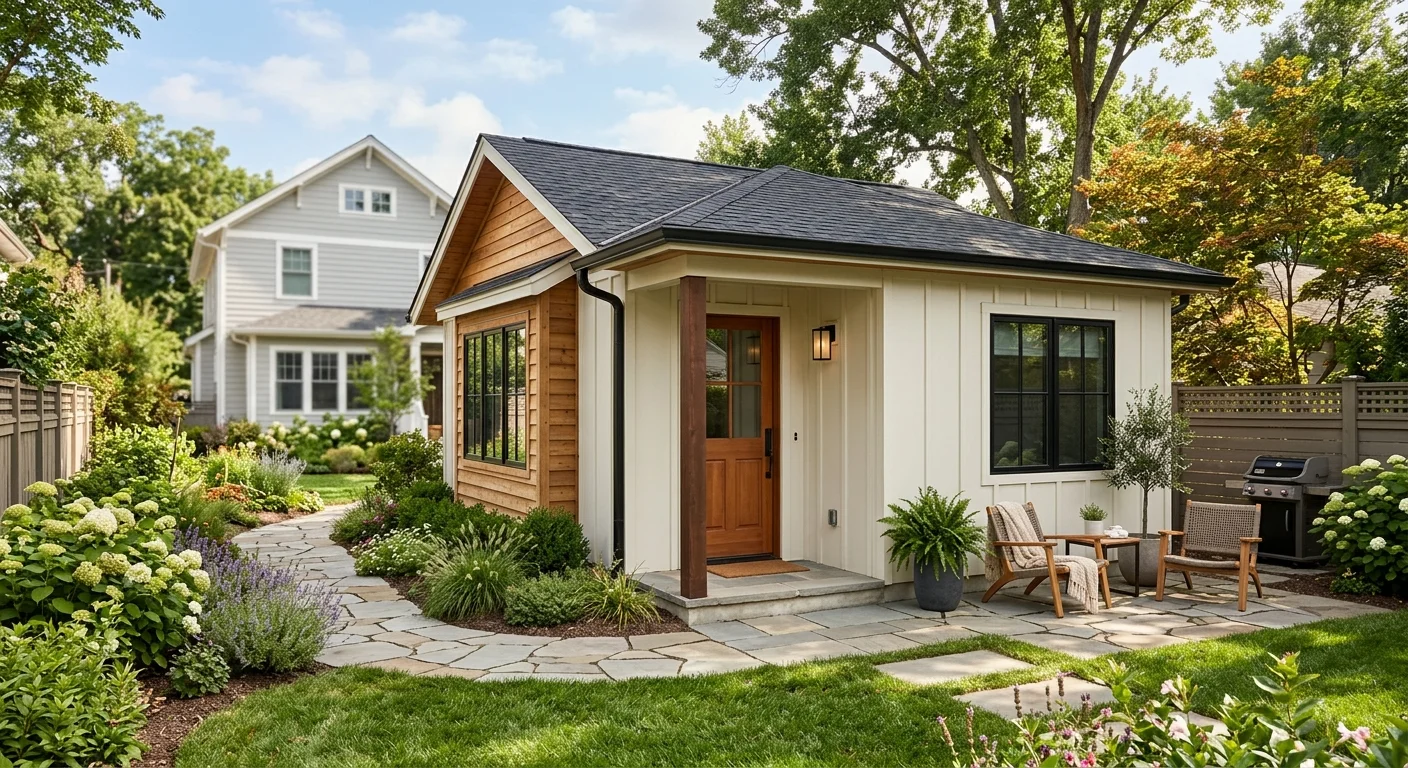
A detached backyard ADU — the most popular build type for homeowners with yard space and standard setbacks
Editorial disclosure: The Dwelling Index is reader-supported. When you use our links to purchase floor plans, explore prefab pricing, or explore financing options, we may earn a commission at no extra cost to you. Our editorial recommendations are based on independent research and are never influenced by compensation. Read our full affiliate disclosure.
Which ADU Floor Plan Is Right for You?
Before scrolling through hundreds of layouts, answer one question: Who will live in this ADU, and for how long? That single answer narrows your options by 80%. We've organized the most common scenarios into a quick-match table. Find your row — that's your starting point.
| Your Goal | Recommended Size | Bedrooms | Est. Build Cost | Layout Priority |
|---|---|---|---|---|
| Rental income (long-term tenant) | 600–800 sq ft | 1 BR | $150K–$280K | Full kitchen, private entrance, in-unit laundry |
| Aging parents / in-law suite | 500–800 sq ft | 1 BR | $125K–$280K | Single-story, wide doors, curbless shower option |
| Adult child returning home | 400–600 sq ft | Studio or 1 BR | $100K–$200K | Compact kitchen, separate entrance, closet space |
| Airbnb / short-term rental | 400–700 sq ft | Studio or 1 BR | $100K–$250K | Modern finishes, outdoor space, full kitchen |
| Home office / creative studio | 200–400 sq ft | Studio | $60K–$150K | Large windows, open plan, minimal kitchen |
| Guest house | 300–500 sq ft | Studio or 1 BR | $80K–$175K | Private entrance, comfortable bathroom |
| Family of 3–4 / multi-gen | 800–1,200 sq ft | 2 BR | $200K–$400K+ | Split bedrooms, full kitchen, separate living |
Cost ranges reflect national averages for new detached construction, $150–$500/sq ft depending on region and finish level. Actual costs vary by location, site conditions, and material choices. These are illustrative estimates, not project quotes.
ADU Floor Plans by Square Footage
Size is the #1 way people search for ADU floor plans — and for good reason. Your square footage determines what fits inside, what it costs to build, and what your city will allow.
The economics you need to know first: Fixed costs like permits, utility hookups, and the kitchen-and-bathroom core don't scale with size. A 400 sq ft ADU might run $300–$400/sq ft, while an 800 sq ft unit drops to $225–$325/sq ft. You're paying roughly the same for one kitchen, one bathroom, one permit set, and one utility connection whether the unit is 400 or 800 sq ft. Additional square footage is the cheap part. That's why most homeowners who build too small wish they'd gone bigger.
200–400 Sq Ft
Micro Studios and Backyard Offices
Best for: Home office, art studio, occasional guest space, or the tightest budgets.
At this size, you're working with a combined living-sleeping area, a kitchenette (two-burner cooktop, under-counter fridge, compact sink), and a bathroom with a shower stall. Think hotel room, not apartment. Typical footprint: 10' × 20' to 16' × 25'. A well-designed 300 sq ft studio can feel surprisingly livable if you commit to an open plan, prioritize natural light, and accept that a Murphy bed or convertible sofa is your sleeping arrangement.
Below 400 sq ft, you won't attract long-term tenants in most markets. The rental income math usually doesn't justify the construction cost unless your primary goal is personal use.
Approx. build cost: $60,000–$150,000 ($300–$500/sq ft)
400–500 Sq Ft
Where Real Living Starts
Best for: Single occupant rental, young adult, Airbnb, budget-conscious aging parent, or anyone who values simplicity.
This is the threshold where an ADU starts functioning as a real home. You can fit a true one-bedroom (or a generous studio with a defined sleeping alcove), a kitchen with full-size appliances, a proper bathroom, and a small closet. Open-concept layout is essential at this size — every square foot of hallway is a square foot you can't live in. The wet-wall trick matters here: align your kitchen sink and bathroom plumbing on the same wall. This saves $3,000–$8,000 in plumbing costs by reducing pipe runs.
Approx. build cost: $100,000–$175,000 ($250–$400/sq ft)
500–650 Sq Ft
The Efficient 1-Bedroom
Best for: Long-term tenants, aging parents who want comfort, adult children who need real independence.
At 500–650 sq ft, a one-bedroom ADU starts to feel genuinely comfortable. You get a private bedroom (not a Murphy bed), a kitchen that can handle real cooking, a living area with room for a couch and coffee table, a full bathroom, and — critically — an in-unit laundry closet. That laundry closet is the amenity that separates 'I can live here' from 'I'm camping.' A large sliding glass door to a small patio extends the perceived space by 30–40% and is the single highest-ROI design decision at this size.
Approx. build cost: $125,000–$230,000 ($250–$375/sq ft)
650–800 Sq Ft
The Sweet Spot
Best for: The widest range of homeowners. Rental income, aging parents, guest suite, Airbnb — this size handles all of them well.
We call this the sweet spot for three reasons: (1) Rental income: a 700 sq ft one-bedroom generates nearly the same rent as a 1,000 sq ft unit in most markets. (2) Cost efficiency: you're past the painful fixed-cost zone but haven't triggered higher per-unit costs. (3) Fee exemptions: in many jurisdictions — including numerous California cities — ADUs under 750 sq ft are exempt from development impact fees, saving $5,000–$15,000. At this size, expect a dedicated bedroom with a real closet, full kitchen with full-size appliances, a living room, full bathroom, in-unit laundry closet, and a coat closet or pantry.
ADUs under 750 sq ft are exempt from impact fees in many CA cities (Gov. Code §65852.2, as amended) — saving $5,000–$15,000. Verify with your local planning department.
Approx. build cost: $150,000–$280,000 ($225–$350/sq ft)
800–1,000 Sq Ft
Roomy 1-Bedrooms and Efficient 2-Bedrooms
Best for: Couples who want elbow room, small families, 2-bedroom rental units, or homeowners planning to eventually move into the ADU.
This is where the one-bedroom-vs-two-bedroom decision gets real. At 800 sq ft, you can build a spacious one-bedroom that feels like a proper apartment — or a tighter two-bedroom that trades living room space for an extra private room. For two-bedroom layouts at this size, split bedrooms (on opposite sides of the living area) maximize privacy.
Above 750 sq ft, you may trigger impact fees in some jurisdictions. In California, ADUs over this threshold are subject to proportional development impact fees. Check your specific city before committing to a plan over 750 sq ft. (Gov. Code §65852.2(f)(3); last verified April 2026.)
Approx. build cost: $200,000–$350,000 ($225–$350/sq ft)
1,000–1,200 Sq Ft
Maximum Build
Best for: Families, premium rental units, or homeowners who plan to downsize into the ADU and rent the main house.
At this size, an ADU functions like a small single-family home. Two bedrooms and two bathrooms is the most common layout. Two-story layouts become genuinely smart here — a 600 sq ft footprint with a second story gives you 1,200 sq ft while consuming half the yard space of a single-story build. Ground floor: living, kitchen, half bath. Upper floor: bedrooms, full bath.
1,200 sq ft is the maximum detached ADU size under California state law (Gov. Code §65852.2). At this scale, construction costs approach $300,000–$400,000+ — run the numbers on realistic rental income before committing.
Approx. build cost: $280,000–$400,000+ ($225–$350/sq ft)
Financial note: All cost ranges are national estimates based on publicly available construction cost data from 2024–2026. Actual costs vary significantly by region, site conditions, material choices, and contractor. These are illustrative ranges, not project bids.
Browse Permit-Ready Plans
Ready to browse plans in the 400–800 sq ft range? Hundreds of ADU layouts, filterable by bedroom count and style.
Filter by size, bedrooms, stories, and style. Immediate download. Built for real permits.
Affiliate link. Full disclosure.
Should You Choose a Studio, 1-Bedroom, or 2-Bedroom?
Bedroom count is the real tradeoff hiding behind most size searches. Here's the decision stripped down.
| Layout | Typical Size | Best For | What You Gain | What You Give Up |
|---|---|---|---|---|
| Studio | 200–500 sq ft | Office, Airbnb, guest, budget | Lower cost, open feel, simpler build | No bedroom privacy, limited tenant appeal |
| 1 Bedroom | 400–800 sq ft | Long-term rental, parents, adult child | Best balance of cost and livability | Can't house a family or two unrelated tenants |
| 2 Bedroom | 700–1,200 sq ft | Families, roommate rental, multi-gen | Higher rent potential, family flexibility | 30–60% more to build, larger footprint |
Our take: One-bedroom layouts account for more than half of all new ADU construction — and for good reason. They hit the sweet spot between livability, rental appeal, and cost. Don't force a second bedroom unless you have a clear occupancy reason. A cramped 2BR that sacrifices living space is worse than a comfortable 1BR with room to breathe. Real homeowners confirm this: the advice for family-member ADUs is consistently — you often don't need three bedrooms, or even two.
Best ADU Floor Plans by Use Case
The fastest shortcut to choosing the right layout: start with use case, not aesthetics. A rental ADU, an aging-parent ADU, and a guest-office ADU might all be 600 sq ft — but they need very different design decisions.
Best Floor Plan for Rental Income
Target: 600–800 sq ft, 1-bedroom, open kitchen-living, in-unit laundry, private entrance
What maximizes long-term rental appeal: a real bedroom with a door and closet (not a studio), a kitchen that can handle daily cooking (full-size fridge, four-burner stove, dishwasher), a bathroom with a tub/shower combo (renters with kids expect this), and dedicated in-unit laundry.
Note: Fannie Mae defines an ADU as a separate living unit with its own kitchen, bathroom, and entrance. A conforming ADU may allow you to count projected rental income on future refinancing. (Source: Fannie Mae Selling Guide B2-3-04; last verified April 2026.)
Best Floor Plan for Aging Parents
Target: 500–800 sq ft, 1-bedroom, single-story, zero-step entry, 36-inch doorways, curbless shower
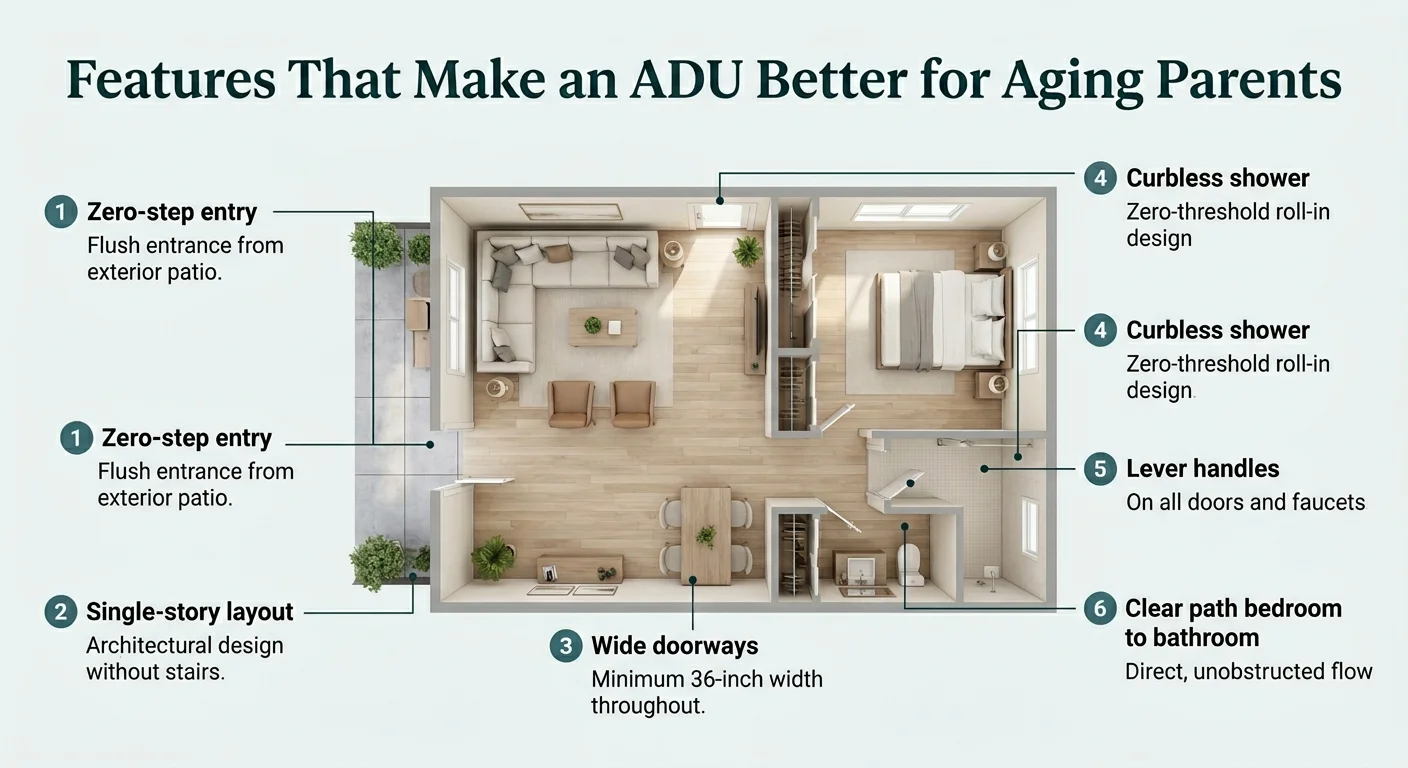
Universal design features that make an ADU work for aging parents today and tomorrow
This is where universal design isn't optional — it's the whole point. The layout must work for someone whose mobility may change over the next 10–15 years. That means: no steps at the entrance (a ramp or flush threshold), a bathroom with grab-bar blocking in the walls (even if you don't install bars now, the blocking lets you add them later without tearing open walls), a bedroom large enough for a hospital bed if ever needed (minimum 10' × 12'), and a kitchen where everything is reachable without a step stool.
Source: AARP Public Policy Institute, “Accessory Dwelling Units: A Step by Step Guide to Design and Development.”
Best Floor Plan for an Adult Child
Target: 400–600 sq ft, studio or compact 1-bedroom, compact but real kitchen, separate entrance
The key difference from a rental layout: this person is family, not a stranger. They want independence but not complete separation. A plan with an entrance that faces the main house's yard (rather than the street) maintains connection without sacrificing privacy. Keep costs low here — this is often a transitional arrangement, not permanent housing. A studio with a well-defined sleeping alcove and a compact kitchen covers the need without overbuilding.
Best Floor Plan for Airbnb / Short-Term Rental
Target: 400–700 sq ft, studio or 1-bedroom, modern finishes, strong indoor-outdoor connection
Short-term guests care about different things than long-term tenants. They want: a visually striking first impression (this is your listing photo), a bathroom that feels like a boutique hotel (walk-in rainfall shower > tub), a kitchen that handles breakfast and simple meals, and an outdoor space where they can sit with coffee in the morning. A studio actually works well for Airbnb — the open, loft-like feel photographs better and feels more like a “getaway.” Invest the savings from one fewer bedroom into better finishes, a nicer bathroom, and good lighting.
Best Floor Plan for a Home Office or Studio
Target: 200–400 sq ft, open studio, minimal kitchen, large windows, possibly a half bath
This is the one scenario where a micro-ADU truly makes sense. You don't need a bedroom, a full kitchen, or even a full bathroom — you need a clean, well-lit, quiet workspace separated from the main house. Prioritize: natural light (large windows on at least two walls), electrical capacity for equipment (more outlets than a standard residential plan), and acoustic separation from the main house. A covered porch outside the entry doubles as an overflow meeting space.
ADU Floor Plans by Build Type
Your floor plan isn't just an interior layout decision — it's a building-type decision. The type of ADU you're building determines which layouts are physically possible.
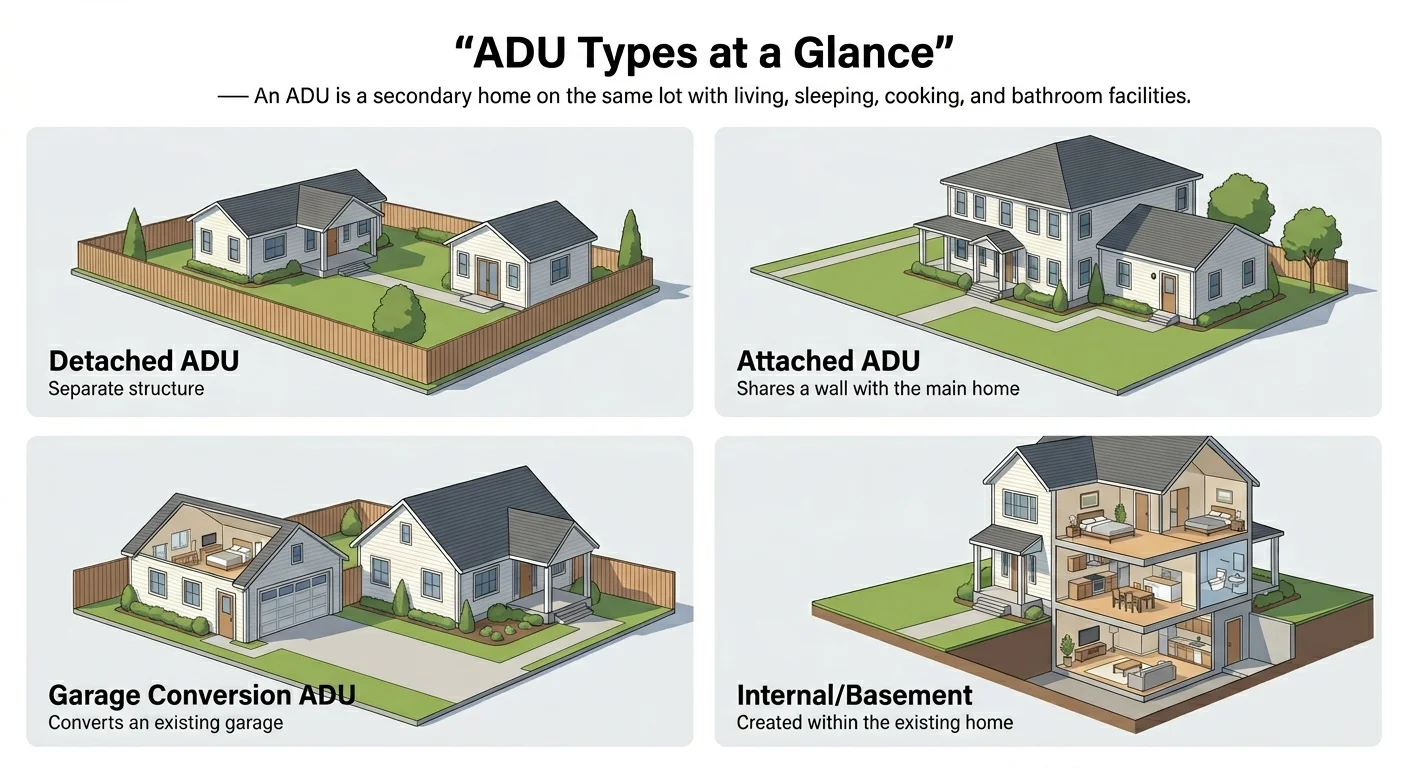
The four main ADU types — each has different floor plan constraints, costs, and ideal use cases
Detached ADU
A standalone structure in your backyard. Maximum design freedom. Most popular for new construction. You choose the shape, orientation, and size (within your city's limits).
Best when: You have yard space, want maximum privacy between the ADU and main house, and your lot clears setback requirements (typically 4 ft from rear and side property lines).
Garage Conversion
Converting an existing garage into living space. Your layout is constrained by existing dimensions — typically 12' × 20' for a single-car (≈240 sq ft), 20' × 20' for a double-car (≈400 sq ft).
Best when: You want the most affordable path. Garage conversions typically run $150–$400/sq ft because the foundation, walls, and roof already exist.
Layout tip: Position the kitchen and bathroom on the wall closest to existing sewer and water lines — in most garages, that's the wall shared with or nearest to the main house. This minimizes the most expensive part of a conversion: new utility runs.
Attached ADU
An addition to your main house with a separate entrance (a connecting interior door is not allowed in most jurisdictions). Shares one or more walls with the primary residence.
Best when: Your lot is too narrow or shallow for a detached structure, or you want to minimize utility connection costs by tapping into existing systems.
Layout tip: Sound insulation is critical. Sharing a wall means shared noise. Budget for proper sound-rated insulation (STC 50+) between the ADU and the main house.
Two-Story ADU
Going vertical doubles your square footage on the same footprint. A 20' × 25' footprint becomes 1,000 sq ft across two floors.
Best when: Your lot is tight on space but your city allows the height. Many jurisdictions allow 16 ft for single-story ADUs and up to 25 ft for two-story.
Layout tip: A staircase consumes 30–50 sq ft per floor — that's 60–100 sq ft of your total that isn't livable space. Factor this into your size calculations.
Above-Garage / Carriage House
Living space above a new or existing garage. Popular in urban areas where yard space is scarce.
Best when: You need parking and living space on the same footprint, or you're replacing an aging garage anyway.
Layout tip: Structural requirements for supporting a living space above a garage are more complex than ground-level construction. Budget 15–25% more than a comparable detached single-story.
How to Know If a Floor Plan Will Actually Work on Your Lot
This is where most ADU floor plan pages fail you. They show pretty layouts but never mention that your city might not allow them. Before you fall in love with any plan, verify these seven things:
Maximum ADU size
Every state and city has limits. California allows up to 1,200 sq ft for detached ADUs (Gov. Code §65852.2). Oregon caps many jurisdictions at 900 sq ft (ORS 197.312). Other states defer to local zoning. Your city's maximum may be lower than your state's.
Setbacks
How far the structure must sit from property lines. Most jurisdictions require 4 ft from rear and side lines for ADUs, but this varies. A 25' × 30' plan doesn't work on a lot that only has 22 ft of usable width after setbacks.
Height limits
Single-story ADUs are typically limited to 16 ft. Two-story limits vary: some cities allow 25 ft, others cap at 20 ft. An above-garage plan that needs 28 ft may be dead on arrival.
Lot coverage
Many cities limit total building coverage (main house + ADU + garage) to 40–60% of the lot. If your main house already covers 45% and your city caps at 50%, your ADU footprint is limited to 5% of the lot.
Parking
Some cities still require an additional parking space for the ADU. HUD's 2026 ordinance analysis found 54% of ADU ordinances still require off-street parking. If you're converting a garage, you may need to replace the lost parking space. (Source: HUD PD&R, January 2026.)
Utility connections
Sewer capacity, electrical panel upgrades, water line extensions — these affect feasibility and cost. A plan that puts the bathroom 60 ft from the sewer main will cost thousands more in trenching than one positioned 15 ft away.
Owner-occupancy rules
HUD's analysis found 60% of ordinances require the property owner to live on-site. This affects whether you can rent both units.
City-Level Rules: A Quick Reference
| City | Max Detached Size | Pre-Approved Plans? | Key Watch-Out |
|---|---|---|---|
| Seattle | 1,000 sq ft (all zones) | Yes — permits in 2–6 weeks | Rear-yard DADUs up to 32 ft height allowed |
| Portland | Smaller than primary dwelling | Yes — city offers pre-approved and Certified House Plans | ADU must be subordinate in size to main home |
| Austin | Varies by zoning district | No statewide pre-approval program | Depends on lot area, zoning, and geographic overlay |
| Denver | Varies (ADUs now allowed citywide) | No | Permit required; rules differ by zone district |
Sources: Seattle SDCI; Portland Bureau of Development Services; City of Austin Development Services; Denver Community Planning & Development — all last verified April 2026. Always confirm directly with your local planning department.
Free Tool
Before spending $500–$2,500 on plans, confirm what's actually buildable at your address.
60 seconds. Free. No sales pitch — just clarity on what's possible at your address.
Pre-Approved, Stock, or Custom Plans: Which Path Saves You Time and Money?
Once you know your target size and type, you need actual construction-ready plans. You have three main paths, and the right one depends on your lot, your timeline, and your budget.
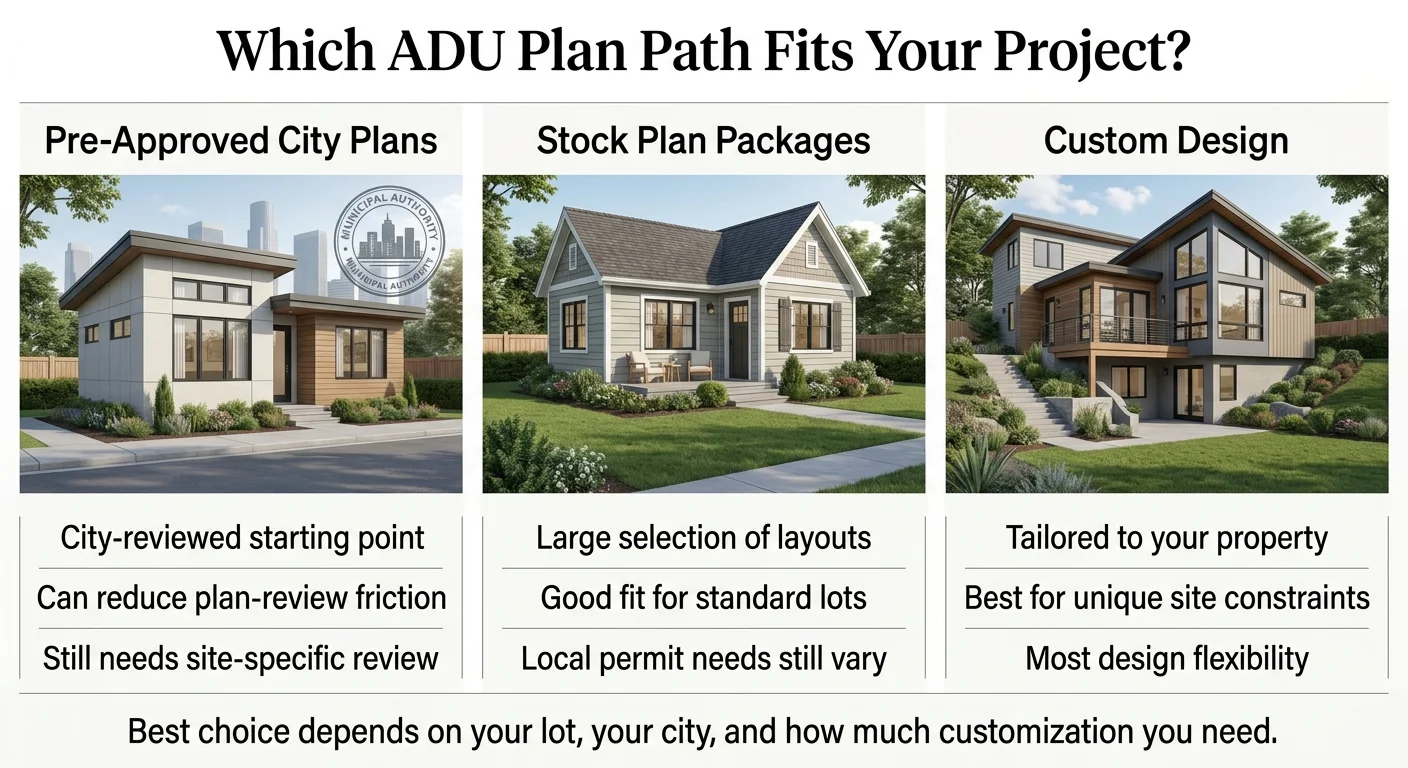
Which plan path fits your project? Best choice depends on your lot, your city, and how much customization you need.
| Plan Type | Cost | Timeline | Best For | Customizable? |
|---|---|---|---|---|
| Pre-approved city plans | Free–$500 | Immediate | Straightforward lots in cities that offer them | Minimal |
| Stock / pre-designed plans | $500–$2,500 | Immediate download | Most homeowners on standard lots | Moderate |
| Custom architectural design | $5,000–$30,000 | 4–12 weeks | Unusual lots, complex sites, specific needs | Fully custom |
When Pre-Approved Plans Are the Smartest Move
A growing number of cities offer free or low-cost pre-approved ADU plans — architect-designed layouts already reviewed and accepted by the local building department. The benefit is speed: because plan review is already done, your permit can process weeks faster. Seattle's standard plan program makes permitting “faster, easier, and more predictable” — permits in 2–6 weeks. Portland offers free pre-approved detached ADU plans. Multiple California cities maintain pre-approved plan libraries.
Our recommendation: If your city offers pre-approved plans, start there. Even if you don't use one as-is, they show you what the city has already said yes to.
When Stock Plans Are Enough
Pre-designed plans from online marketplaces work for the majority of homeowners building on standard lots. You browse, filter by size and bedroom count, download a PDF plan set, and hand it to your builder or submit it to your city for plan review. Architectural Designs maintains one of the largest ADU plan collections online — with plans from over 200 designers, filterable by size, bedrooms, stories, and style. Plans typically include floor plans, elevations, sections, and foundation details. Prices run $500–$2,500 depending on complexity.
When Custom Plans Are Worth the Money
Custom architectural design makes sense when your site has real constraints: irregular lot shape, significant slope, easements, utility access problems, privacy issues with the main house, or specific accessibility needs. Custom plans run $5,000–$15,000 for a standalone design. The time cost: 4–12 weeks to design, plus your city's plan review period (typically 30–60 days for ADUs). If speed matters, stock or pre-approved plans have a major advantage.
Browse Permit-Ready Plans
If your lot is fairly standard, a pre-designed plan is probably all you need. Hundreds of permit-ready plans from 200+ designers.
Filter by size, bedrooms, stories, and style. Immediate download. Built for real permits.
Affiliate link. Full disclosure.
6 Design Principles That Separate Great ADU Layouts from Expensive Regrets
A floor plan is more than a diagram with rooms labeled. After reviewing hundreds of ADU layouts, we've identified six principles that consistently separate the plans homeowners love from the ones they wish they could redo. Use these to evaluate any plan you're considering — whether it's a $50 city template or a $15,000 custom design.
The Wet Wall Rule
Align your kitchen plumbing (sink, dishwasher) and bathroom plumbing (toilet, shower, sink) on the same wall — or on opposite sides of the same wall. This minimizes pipe runs, reduces plumbing costs by $3,000–$8,000, and simplifies inspection. When a plan shows the kitchen on the north wall and the bathroom on the south wall with a living room between them, that's not just a design choice — it's a budget choice.
Kill the Hallways
In an ADU under 800 sq ft, every foot of hallway is a foot you can't furnish or use. A 3-foot-wide, 8-foot-long hallway burns 24 sq ft — that's the difference between a cramped kitchen and a comfortable one. The best small ADU layouts use the living area as the circulation path. Open-concept isn't just an aesthetic preference at this scale — it's a space-efficiency requirement.
Storage Density
The most common regret in small ADUs isn't 'I wish I'd gone bigger.' It's 'I have nowhere to put anything.' Look for: one closet per bedroom, a pantry cabinet in the kitchen, a coat closet near the entry, kitchen cabinets that extend to the ceiling, and a linen closet or bathroom vanity with drawers. If you can't identify at least 40 cubic feet of dedicated storage on the floor plan, the layout will feel cluttered within months of move-in.
Indoor-Outdoor Connection
A large sliding glass door (6 ft minimum, 8 ft is better) opening to a small patio or deck makes the interior feel 30–40% larger than its actual square footage. Even a 4' × 8' covered porch transforms the living experience. Continuous flooring material from the interior through the door to the patio amplifies the effect. Cost: $2,000–$6,000 for the door and a simple patio. Value: the difference between 'this feels tight' and 'this feels like enough.'
Privacy Zoning
Three rules that separate livable layouts from awkward ones: (1) The bedroom should not be visible from the front door. (2) The bathroom door should not open directly into the kitchen. (3) In 2-bedroom plans, split the bedrooms — place them on opposite sides of the living area, not next to each other down a hallway. This matters enormously for rental units with unrelated tenants.
Future Flexibility
Build for your most likely use case today, but don't build in a way that prevents the next use case tomorrow. Practical moves: 36-inch doorways (ADA-friendly, also accommodates furniture moves), lever-style door handles (easier for all ages), a curbless shower option (aging-in-place ready, also modern and attractive), and at least one wall that could be opened or modified later without structural impact. An ADU designed for a 25-year-old renter today should still work for a 75-year-old parent in 15 years. Universal design isn't just kind — it's smart financial planning.
What Makes a Small ADU Feel Bigger Than It Is?
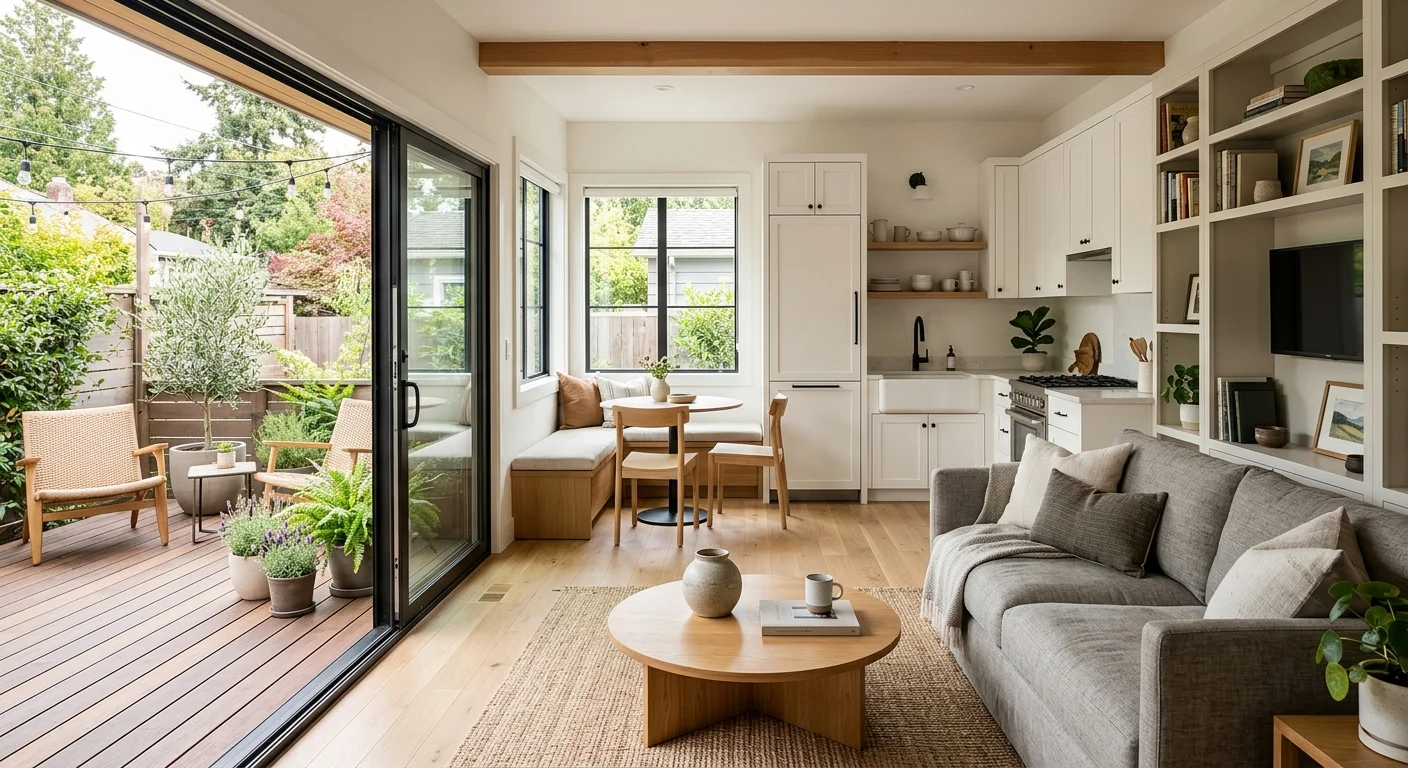
A well-designed open-plan ADU with indoor-outdoor connection — the layout discipline that makes 500 sq ft feel like 700
A great small ADU is almost never the result of more square footage. It's the result of layout discipline. We've seen 500 sq ft units that feel cramped and 400 sq ft units that feel generous. The difference is always design, not size.
Open the main living space
Combine kitchen, dining, and living into one flowing area. Resist the urge to add walls between these zones — in an ADU under 800 sq ft, visual openness is your best friend. A kitchen island or peninsula creates subtle separation without blocking sight lines.
Use pocket doors, not swing doors
A standard swing door needs 10–12 sq ft of clearance to operate. A pocket door needs zero floor space. In a 400 sq ft ADU with three doors, switching to pocket doors recovers 30–36 sq ft of usable floor area. That's the difference between fitting a dining table and not.
Push cabinets to the ceiling
Standard upper cabinets leave 12–18 inches of dead space above them. Cabinets to the ceiling add 25–40% more kitchen storage with zero additional floor footprint. The top shelves hold things you use rarely, but they hold them out of sight.
Connect inside to outside
A sliding glass door to a patio is the cheapest way to make a small ADU feel like a bigger one. The visual extension of the living space into the outdoors tricks the brain into perceiving more room.
Be strategic with windows
Place windows on at least two walls of the main living space. Cross-ventilation and cross-lighting make a room feel airy and open. A single window on one wall creates a 'cave' — even if the room is technically well-lit.
Build in, don't add on
Built-in shelving, window seats with storage underneath, and floating desks use wall space that furniture would waste. Every piece of freestanding furniture in a small ADU competes for floor area. Everything built into walls, nooks, and corners doesn't.
What If You Don't Want to Manage a Custom Build?
Not everyone wants to buy plans and hire a contractor separately. If you'd rather skip the plan-shopping process entirely, two paths get you to a finished ADU with plans included.
Prefab and Modular ADUs (Plans Included)
Prefab manufacturers design the unit, engineer the plans, and deliver a finished or near-finished structure to your property. You're not buying plans — you're buying a home. The trade-off: you're choosing from a catalog, not designing from scratch. But for many homeowners, that's a feature, not a bug. Fewer decisions. Faster timeline. Predictable pricing.
Small ADU Specialist
Craftsman Tiny Homes
Custom ADUs from $65,500 for 410 sq ft (Summit model) and $129,900 for 800 sq ft. Family-owned, built in Archer, Florida. Plans included in the price.
Affiliate link. Full disclosure.
Explore Craftsman ADUsBroader Size Range
Modular Home Direct
Steel-frame modular and container homes, 1–4 bedrooms, factory-direct pricing, nationwide contractor search. Plans included.
Affiliate link. Full disclosure.
See Modular OptionsDesign-Build Firms
A design-build firm handles plans and construction under one contract. You get a single point of accountability, an integrated timeline, and plans designed by the same team that will build the unit. This typically costs $200–$350/sq ft all-in, with plans bundled into the build price. Best for homeowners who want a hands-off experience and are willing to pay a modest premium for coordination.
How Much Does Each Floor Plan Type Cost to Build?
The floor plan you choose doesn't just determine what fits inside — it directly affects construction cost. Simple layouts cost less to build. Complex ones don't. Construction cost is driven by complexity, not just size.
| Layout Characteristic | Cost Tendency | Why |
|---|---|---|
| Simple rectangle | Lower $/sq ft | Less framing, less roofline, less foundation work |
| L-shape or T-shape | Moderate $/sq ft | Additional corners, more complex roof, more flashing |
| Two-story | Higher $/sq ft | Staircase, second-floor structural support, added engineering |
| Above-garage | Highest $/sq ft | Structural reinforcement of existing garage, fire separation requirements |
| Stacked plumbing (wet wall) | Saves $3K–$8K | Shorter pipe runs, simpler inspection |
| Kitchen on one wall | Saves $2K–$5K | Fewer cabinet runs, simpler plumbing |
The Real Cost Picture by Size
| Size Band | Typical Cost/Sq Ft | Total Build Range | Best Value Play |
|---|---|---|---|
| 200–400 sq ft | $300–$500 | $60K–$150K | Only if personal use, not rental |
| 400–600 sq ft | $250–$400 | $100K–$200K | Studio or compact 1BR on a budget |
| 600–800 sq ft | $225–$350 | $150K–$280K | Best cost-per-livable-foot for most owners |
| 800–1,000 sq ft | $225–$350 | $200K–$350K | Roomy 1BR or efficient 2BR |
| 1,000–1,200 sq ft | $225–$350 | $280K–$400K+ | Only if rental market or family need justifies it |
Costs reflect new detached construction, national ranges. Garage conversions typically run 25–40% less. Coastal California, Seattle, and Northeast metros trend toward the high end. Sources: Angi 2026 cost data, UC Berkeley Terner Center, Snap ADU (March 2026). These are planning-stage estimates, not contractor bids.
ADU Financing
Wondering how to pay for this?
Most homeowners use home equity, construction loans, or cash-out refinancing. Every path works differently — the right choice depends on your equity and how much you need to borrow.
Affiliate link. Full disclosure.
ADU Floor Plans by Style: Modern, Craftsman, and Contemporary
Your ADU's exterior style should complement your main house — most cities with design review will require this, and it protects your property value even if they don't. The good news: the floor plan (interior layout) and the exterior style are largely independent decisions. Most pre-designed plans can be adapted to multiple exterior treatments without changing where the walls, doors, and windows go.
Modern / Contemporary ADU Plans
Clean lines, flat or low-slope roof, large windows, minimal ornamentation. These pair well with open-concept interiors and emphasize the indoor-outdoor connection. Often the most cost-effective roofline because flat roofs are simpler to frame than complex pitches. The look that performs best on Airbnb listings.
Craftsman ADU Plans
Covered front porch, pitched roof with exposed rafter tails, wood or wood-look siding, tapered columns. The classic 'backyard cottage' aesthetic. Matches most pre-war homes and many mid-century neighborhoods. The porch adds usable outdoor space while protecting the entrance from weather.
Farmhouse ADU Plans
Board-and-batten or lap siding, standing-seam metal roof, simple rectangular form. A clean aesthetic that's easy to build and maintain. Metal roofs add $1–$3/sq ft over asphalt shingles but last 40–60 years vs. 20–25, making them a strong long-term value choice for ADUs.
Maximum ADU Size by State: A Quick Reference
Before you commit to a 1,200 sq ft dream layout, confirm your state and city actually allow it. Limits vary widely.
| State | Max Detached ADU | Key Law / Code | Notes |
|---|---|---|---|
| California | 1,200 sq ft | Gov. Code §65852.2 | <750 sq ft exempt from impact fees in many cities |
| Oregon | 900 sq ft (varies locally) | ORS 197.312 | Statewide ADU mandate since 2019 |
| Washington | 1,000 sq ft (varies) | HB 1337 (2023) | Cities >25K pop required to allow ADUs |
| Colorado | Varies by city | Local ordinances | Denver: ADUs now allowed citywide |
| Utah | Varies by city | HB 82 (2021), SB 174 | Internal ADUs mandated statewide; detached varies |
| Texas | Varies by city | No statewide ADU law | Austin, Houston, San Antonio most ADU-friendly |
| Connecticut | Varies | PA 21-29 | Statewide mandate to allow ADUs |
| Maine | Varies | LD 2003 (2022) | Statewide ADU allowance |
| Vermont | Varies | Act 47 (2023) | Required allowance on most residential lots |
| Massachusetts | Varies | ADU law (2024) | New statewide ADU right, details still evolving |
| Virginia | Varies | Local ordinances | Several jurisdictions expanding ADU allowances |
This table reflects statewide frameworks. Your city's rules may be more restrictive. “Varies by city” means the state defers to local zoning — check your specific municipality. Last verified: April 2026. Confirm directly with your local planning department before making decisions.
Can You Get Free ADU Floor Plans?
Yes — but understand what “free” actually means.
Genuinely free and useful
A growing number of cities offer free pre-approved ADU floor plans. These are architect-designed, construction-ready templates that have passed plan review. They're real, usable plans — not napkin sketches. Seattle, Portland, Del Mar (CA), and dozens of other jurisdictions maintain free ADU plan libraries. The Del Mar program provides three ADU floor plans (studio at 446 sq ft, 1BR at 793 sq ft, 2BR at 955 sq ft) with downloadable PDF and CAD files.
Free but limited
Free plans are generic. They're designed for 'standard' lots and may not account for your specific site conditions, setback requirements, or utility locations. You'll still need a site plan, structural engineering, and energy calculations (like California's Title 24) — which cost $2,000–$8,000 regardless of whether the floor plan was free.
'Free printable ADU floor plans' from random websites
Mostly useless. These are typically conceptual sketches or apartment layouts mislabeled as ADU plans. They're fine for inspiration but cannot be submitted for permits. Don't waste time here.
How to Choose the Right ADU Floor Plan in 7 Steps
By now you have the knowledge. This section turns it into a decision.
Define who will actually live there
A long-term tenant needs different things than your mother. A home office has different needs than an Airbnb. Name the person (or type of person) and their daily routine.
Choose your build type
Detached, attached, garage conversion, above-garage, or internal. Your lot, budget, and city rules narrow this quickly. If you're not sure what your lot allows, check with your planning department or use a feasibility tool before going further.
Pick a target size band
Use the economics: go as large as your budget allows within the 600–800 sq ft sweet spot, unless your use case clearly demands smaller (office/studio) or larger (family/2BR rental).
Decide on bedroom count
Studios for offices and guests. One-bedroom for most rental and family scenarios. Two-bedroom only when privacy or occupancy clearly demands it.
Check local rules
Maximum size, setbacks, height, lot coverage, parking, owner-occupancy. This step eliminates plans that look great but won't permit. Do this before spending money on plans.
Choose your plan source
Pre-approved city plans if available and your lot is standard. Stock plans from a marketplace for most other situations. Custom design only if your site demands it.
Shortlist 2–3 plans, then verify
Compare your top picks against your lot dimensions, utility access, and city requirements. If anything doesn't fit, you've saved yourself thousands.
Free Tool
You've done the research. Now see what's possible at your address.
60 seconds. Free. No sales pitch — just clarity on what's possible at your address.
Free Download
2026 ADU Starter Kit
Floor plan comparison charts, construction budget worksheet, state-by-state size limits, and a step-by-step permitting checklist. Over 12,000 homeowners have downloaded it.
Frequently Asked Questions About ADU Floor Plans
What is the best floor plan for an ADU?
A 600–800 sq ft, one-bedroom layout with an open kitchen-living area is the most versatile choice. It balances cost, livability, and rental appeal better than any other configuration.
How much does it cost to get ADU plans?
Pre-designed plans: $500–$2,500 for immediate download. Custom architectural plans: $5,000–$30,000. Design-build firms often include plans in their per-square-foot build price. Some cities offer pre-approved plans for free.
What is the most popular ADU size?
Between 500 and 800 square feet. Over half of new ADU construction falls under 800 sq ft. The 600–700 sq ft one-bedroom is the most commonly built configuration nationally.
Can I buy ADU floor plans online?
Yes. Architectural Designs, Houseplans.com, and other marketplaces offer hundreds of ADU-specific plans. These are construction-ready PDFs with floor plans, elevations, sections, and structural details. Prices typically range from $500 to $2,500.
What is the maximum size ADU I can build?
It depends on your state and city. California allows 1,200 sq ft (Gov. Code §65852.2). Oregon caps many areas at 900 sq ft (ORS 197.312). Many states defer to local zoning. Check your city's specific ADU ordinance.
Do I need an architect for an ADU?
Not always. Pre-designed and pre-approved plans handle most standard situations. You need an architect for unusual lots, complex sites, or when your city specifically requires stamped architectural drawings for ADUs.
Are there free ADU floor plans?
Yes. Many cities offer free pre-approved ADU plans — real, permit-ready designs. Seattle, Portland, and numerous California cities maintain these libraries. Search '[your city] pre-approved ADU plans.'
Is a garage conversion cheaper than building detached?
Usually, yes — by 25–40%. The foundation, walls, and roof already exist. You're adding insulation, finishes, plumbing, and HVAC to an existing structure instead of building from scratch.
What's the best ADU floor plan for aging parents?
A single-story, one-bedroom layout between 500–800 sq ft with 36-inch doorways, a curbless shower, lever handles, and a private entrance. Plan for zero-step entry and avoid multi-level designs entirely.
Can I build a 2-bedroom ADU under 800 sq ft?
Technically yes, but the bedrooms will be tight (approximately 100–120 sq ft each) and you'll sacrifice living space. Below 800 sq ft, a well-designed one-bedroom usually provides better overall livability.
How long does it take to permit an ADU floor plan?
Varies widely. With pre-approved plans in cities like Seattle, permits can issue in 2–6 weeks. Custom plans in complex jurisdictions: 3–6 months from submission to approval. The average nationally is 4–12 weeks for plan review once a complete application is submitted.
What's the difference between ADU floor plans and regular house plans?
ADU plans are designed for smaller footprints with ADU-specific requirements: separate entrance, setback compliance, utility independence from the main house, and size-limit compliance. Regular house plans waste space on hallways and formal rooms that don't make sense under 1,200 sq ft.
How We Built This Guide
Selection criteria: Every layout recommendation is based on the combination of use case, size efficiency, construction cost, rental viability, and permitting feasibility. We don't recommend plans we wouldn't suggest to a friend.
Data sources: Construction cost ranges draw from Angi (2026), UC Berkeley Terner Center for Housing Innovation, Snap ADU cost data (March 2026), and publicly available builder pricing. State and local regulations are cited to specific statutes and verified against official government sources. The HUD ordinance analysis referenced is from PD&R Edge, January 2026.
What we verified by hand: City-specific rules for the reference table were confirmed against official planning department websites. Pre-approved plan availability was checked against published city programs. All citations include a “last verified” date.
Affiliate relationships: We earn commissions when you purchase floor plans through Architectural Designs, explore prefab units from our partner companies, or use our financing affiliate links. We select affiliate partners based on relevance and value to readers, not commission rates. Read our full affiliate disclosure.
Update policy: This page is reviewed quarterly. All cost data, regulation citations, and pre-approved plan availability are re-verified at each review. If you spot something outdated, email us at corrections@dwellingindex.com.
Related Guides
How to Finance an ADU in 2026
HELOC vs. construction loan vs. renovation loan — full comparison with worked examples.
Cheapest Prefab ADU Options
Real installed prices — 9 manufacturers compared. Skip the plan-shopping entirely.
California ADU Grant Guide
CalHFA status, local programs still open, and financing alternatives.
California ADU Laws
State rules for setbacks, permits, size limits, and impact fee exemptions.