
ADU vs Tiny Home: Which One Actually Makes Sense for Your Property?
Last verified: April 2026 · Sources cited throughout · Editorial standards · Affiliate disclosure
Editorial disclosure: The Dwelling Index is reader-supported. When you use our links to explore financing options, request prefab pricing, or purchase floor plans, we may earn a commission at no extra cost to you. Our editorial recommendations are based on independent research and are never influenced by compensation. Full disclosure & editorial methodology.
The distinction that costs homeowners real money
An ADU is a legal classification — a permitted secondary dwelling. A tiny home is a size and style category. They overlap, but they're not synonyms. Confusing the two is how homeowners end up with a $55,000 structure they can't legally live in, rent out, or insure.
For most homeowners who want long-term housing, rental income, or property value — the ADU path is the safer default. A tiny home wins when mobility or the lowest possible upfront commitment matters more than permanence, financing flexibility, and resale impact.
The catch? In many cities, the moment you want full-time occupancy, utility hookups, and legal rental status for a tiny home, you end up meeting ADU requirements anyway. Seattle treats tiny homes on wheels like camper trailers — you can't live in one on a residential lot as a permanent dwelling (Seattle SDCI, Accessory Dwelling Units, verified April 2026). Portland classifies them as occupied recreational vehicles, not ADUs (Portland Bureau of Planning, Zoning Code Overview, verified April 2026).
The real question isn't “ADU or tiny home?” It's: what do you actually want this unit to do — and does your city allow it?
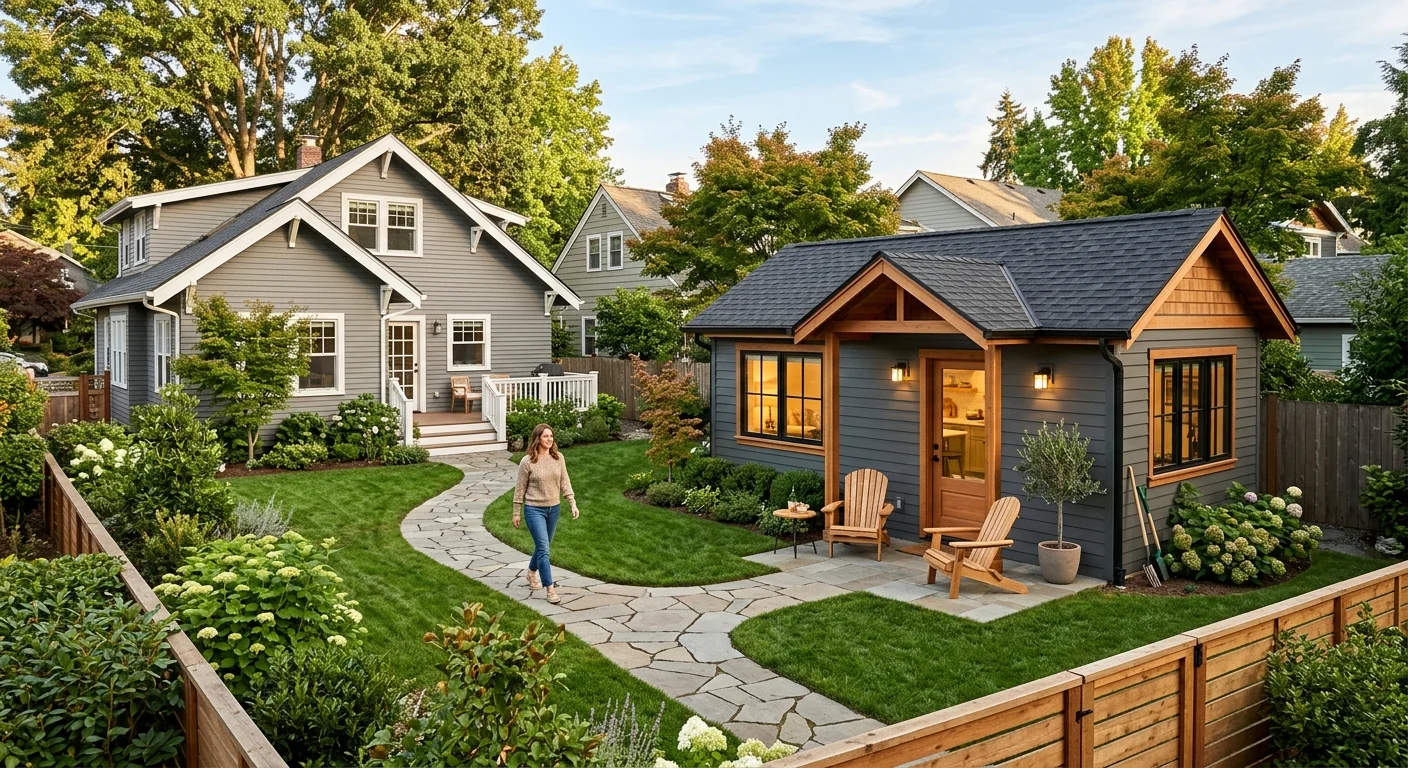
A detached ADU on a standard residential lot — the most common path for homeowners seeking rental income or family housing
The Quick Comparison: ADU vs Tiny Home at a Glance
Bookmark this table — it's the fastest way to see where these two paths diverge.
| Category | ADU | Tiny Home on Wheels | Tiny Home on Foundation |
|---|---|---|---|
| What it is | Permitted secondary dwelling on your property | Compact mobile dwelling, often on a trailer | Compact dwelling on a permanent base |
| Legal status | Permanent real property | Usually classified as RV / personal property | Can qualify as an ADU if permitted |
| Typical size | 400–1,200 sq ft | 100–400 sq ft | 100–400 sq ft |
| Cost range | $100K–$400K+ | $30K–$80K | $50K–$150K |
| Property value impact | Adds to appraised value as real property | Not counted in real-property appraisal | Adds value if permitted as ADU |
| Mortgage financing | Yes — HELOC, cash-out refi, construction loans | No — personal loan or RV loan only | Yes, if classified as ADU |
| Legal to rent long-term | Yes, in most jurisdictions with permit | Varies widely; often restricted | Yes, if permitted as ADU |
| Mobility | Permanent — cannot relocate | Fully mobile | Permanent |
| Insurance | Typically homeowner's policy extension | Specialty or RV insurance required | Covered if permitted as real property |
| Build timeline | 6–14 months including permits | 1–6 months | 2–8 months |
| Biggest trap | Permitting timeline and cost overruns | Can't legally live in or rent it in many cities | Assuming it qualifies without checking local rules |
Sources: HUD/FHA Handbook 4000.1; Fannie Mae Selling Guide B2-3-04; ICC Appendix Q; city-specific sources cited throughout. Ranges represent planning-level estimates — your local costs and rules will vary. Verified April 2026.
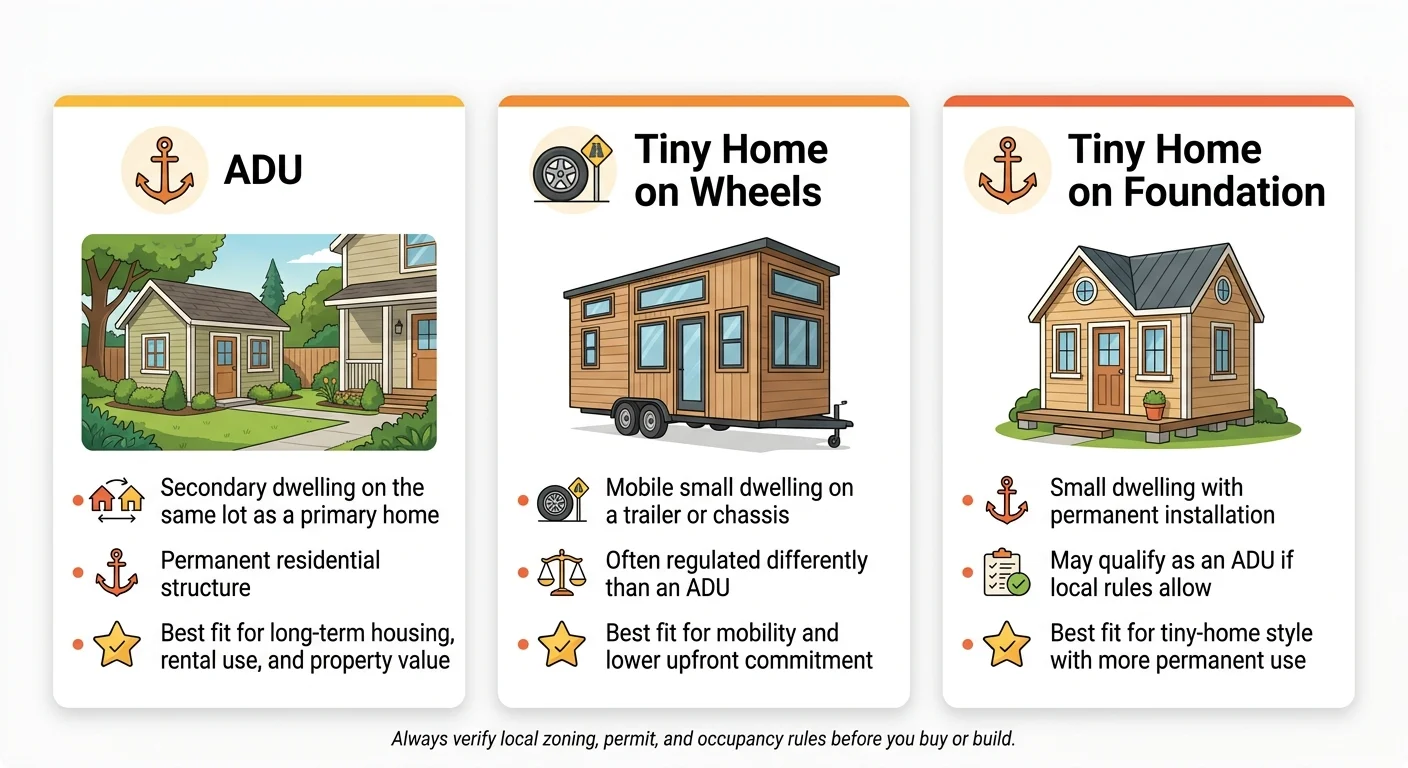
Always verify local zoning, permit, and occupancy rules before you buy or build
Why People Confuse ADUs and Tiny Homes (And Why the Difference Is Worth Real Money)
The confusion is understandable. Both are small. Both go in backyards. Instagram uses the terms interchangeably. But the distinction isn't academic — it's financial.
“Tiny home” describes a product
A size category and a lifestyle label. A compact dwelling — typically under 400 sq ft — that emphasizes efficient design. It can be on wheels, on a foundation, off-grid, or fully connected. The term describes what it looks like and how big it is.
“ADU” describes a legal status
An accessory dwelling unit is a permitted secondary home on a residential property. The term describes what it is allowed to do — be legally occupied, rented, financed, insured, and appraised as part of your real estate.
Here's why that distinction hits your wallet:
Financing
Fannie Mae now allows rental income from an existing ADU to count toward mortgage qualification — capped at 30% of total qualifying income on purchase and limited cash-out refinance transactions (Fannie Mae Selling Guide SEL-2025-08, effective via DU version 12.1, March 2026). A tiny home on wheels? Personal loan territory — shorter terms, no equity building.
Property value
A permitted ADU is treated as real property (Fannie Mae Selling Guide B2-3-04). FHFA's California analysis found properties with ADUs had stronger annualized median appraised-value growth — 9.34% vs 7.65% from 2013 to 2023 (FHFA, April 2026). A tiny home on wheels is personal property, like a vehicle — it generally doesn't count in a real-estate appraisal.
Rental legality
An ADU with required occupancy approval can be legally rented in most jurisdictions. A tiny home on wheels? Many cities prohibit renting one, restrict occupancy to a set number of days, or don't recognize it as a dwelling at all.
Insurance
Your homeowner's policy can typically extend to cover a permitted ADU. A tiny home on wheels typically requires specialty or RV insurance — a separate policy with different terms and limitations.
Can a Tiny Home Be an ADU? (The Answer Changes by City)
This is the question that drives most of the confusion — and the answer is genuinely different depending on where you live.
A tiny home can qualify as an ADU when ALL of these conditions are met:
It's on a permanent foundation (not wheels or a trailer)
It meets your local residential building code (typically the IRC)
It includes a full kitchen, bathroom, and sleeping area
It's connected to water, sewer, and electrical utilities
It's located on the same lot as an existing primary residence
It has received the required permit approvals and certificate of occupancy
Once all six conditions are met, the tiny home becomes a legal ADU — with financing eligibility, property value impact, legal rental status, and standard insurance.
A tiny home on wheels almost never qualifies. In the eyes of most building departments, wheels means RV classification — and an RV is not a dwelling unit. There are narrow local exceptions, but they're the exception, not the rule.
How Real Cities Handle This — Right Now
San Diego
Narrow exceptionMovable tiny houses between 150 and 430 square feet, licensed by the DMV, can qualify as a detached ADU in your backyard — but this counts as your ADU, not in addition to one. The unit must meet specific fire, access, and placement requirements.
Source: City of San Diego Information Bulletin 403, verified April 2026
Seattle
Hard no for THOWTiny houses on wheels are treated as camper trailers and cannot serve as permanent residences on residential lots. If you want a small backyard unit, it needs a permanent foundation and must be permitted as a DADU (detached accessory dwelling unit).
Source: Seattle SDCI, Accessory Dwelling Units page, verified April 2026
Portland
Separate regulatory pathClassifies tiny houses on wheels as occupied recreational vehicles — a separate regulatory path from ADUs, with its own rules and limitations.
Source: Portland Bureau of Planning, Zoning Code Overview, verified April 2026
Austin
Functional definitionDefines ADUs and tiny homes separately. A structure is classified as a dwelling unit when it contains a habitable space, a full bathroom, and a sink or dishwasher outside the bathroom — full dwelling-unit rules apply regardless of what you call it.
Source: City of Austin Development Services, Additional Dwelling Units page, verified April 2026
California (statewide)
Foundation requiredRequires that ADUs meet the California Building Code and be on a permanent foundation. ICC Appendix Q creates provisions for tiny houses, but that appendix is voluntary for local adoption. ADU permits grew from 1,336 in 2016 to over 30,000 in 2024.
Source: California HCD Information Bulletin 2020-06; HCD ADU Handbook Update, verified April 2026
Free Tool · 60 seconds
Check what you can build at your address — free feasibility report in 60 seconds
Check property eligibility, local rules, and ADU size limits — free, no sales call.
ADU vs Tiny Home Cost: Which Is Actually Cheaper?
A tiny home wins on sticker price. But sticker price and total project cost are not the same thing. The number you see on a tiny home listing — $45,000, $65,000, $85,000 — is the unit cost. It does not include transport, foundation or pad preparation, utility connections, local permits and inspections, site grading, or crane/delivery fees. Once you add those, the gap narrows faster than most people expect.
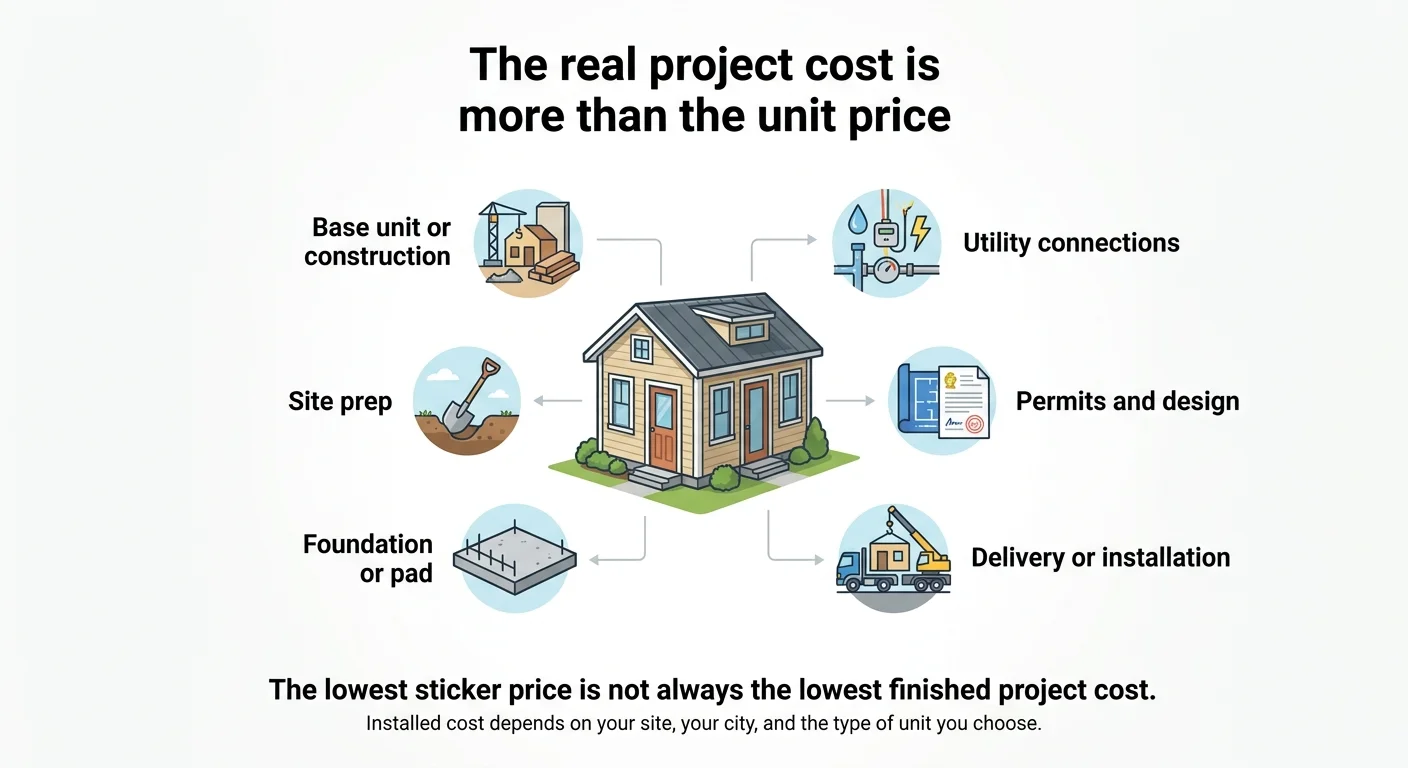
The lowest sticker price is not always the lowest finished project cost. Installed cost depends on your site, your city, and the type of unit you choose.
Dwelling Index Planning Ranges: Real Project Cost by Path
| Build Path | Unit / Base Cost | Site Prep & Foundation | Utilities & Hookups | Permits & Design | Est. Installed Total |
|---|---|---|---|---|---|
| Garage conversion ADU | $20K–$60K | $5K–$15K | $2K–$8K | $3K–$10K | $30K–$93K |
| Junior ADU (JADU) | $15K–$50K | Minimal | $1K–$5K | $2K–$8K | $18K–$63K |
| Detached ADU (site-built) | $120K–$300K | $10K–$40K | $8K–$25K | $5K–$15K | $143K–$380K |
| Prefab/modular ADU | $80K–$200K | $10K–$30K | $8K–$20K | $5K–$12K | $103K–$262K |
| Tiny home on wheels | $30K–$80K | $1K–$5K (pad only) | $2K–$8K (if connecting) | $0–$2K (varies widely) | $33K–$95K |
| Tiny home on foundation | $50K–$120K | $8K–$25K | $5K–$15K | $3K–$10K | $66K–$170K |
These are Dwelling Index planning ranges compiled from published builder pricing, municipal fee schedules, and contractor estimates across multiple markets. Your actual costs will differ based on local labor rates, material costs, site conditions, and municipal fees. Costs in high-cost metros can significantly exceed these ranges. Verified April 2026.
Why the “Cheaper” Option Isn't Always Cheaper Over Time
The five-year picture tells a very different story than the sticker price. Consider two scenarios — a detached ADU at $200,000 installed vs a tiny home on wheels at $60,000 installed:
Detached ADU ($200K)
- Financed through home-equity products with longer terms
- Rental income can count toward mortgage qualification (Fannie Mae, capped at 30%)
- Adds to property's appraised value as real property
- Monthly rental income flows month after month
Tiny Home on Wheels ($60K)
- Typically requires a personal loan with a shorter repayment window
- Generally not counted in a real-property appraisal
- Rental legality varies widely by city
- Doesn't transfer with the real estate when you sell
These are illustrative planning scenarios, not guarantees of returns. Actual results depend on local market conditions, construction costs, rental demand, financing terms, and regulatory approvals.
The Honest Truth: ADUs Aren't a Weekend Project
We'd lose credibility if we pretended the ADU path has no friction.
Permitting takes time
Depending on your city, plan review can range from a few weeks to several months. Add design, engineering, construction, and inspections — a detached ADU project can stretch considerably. If you need space for a family member by Thanksgiving and you haven't started yet, a site-built ADU probably won't get there in time.
But here's what's changed
The permitting landscape is moving fast in homeowners' favor. California now mandates ministerial (non-discretionary) ADU approval within 60 days of a complete application (California Government Code, per the 2026 HCD ADU Handbook). Oregon, Washington, Colorado, and a growing list of states have passed legislation removing barriers and streamlining approvals. And prefab ADUs — which arrive largely pre-built — can significantly compress construction timelines compared to site-built projects.
The homeowners who run into the worst delays are usually the ones who started without understanding their city's specific requirements. That's fixable. A conversation with your local planning department (or a quick feasibility check) sets realistic expectations before you've spent anything.
Which One Is Right for Your Goal?
Stop comparing structures. Start comparing outcomes. The right choice depends entirely on what you need this unit to do.
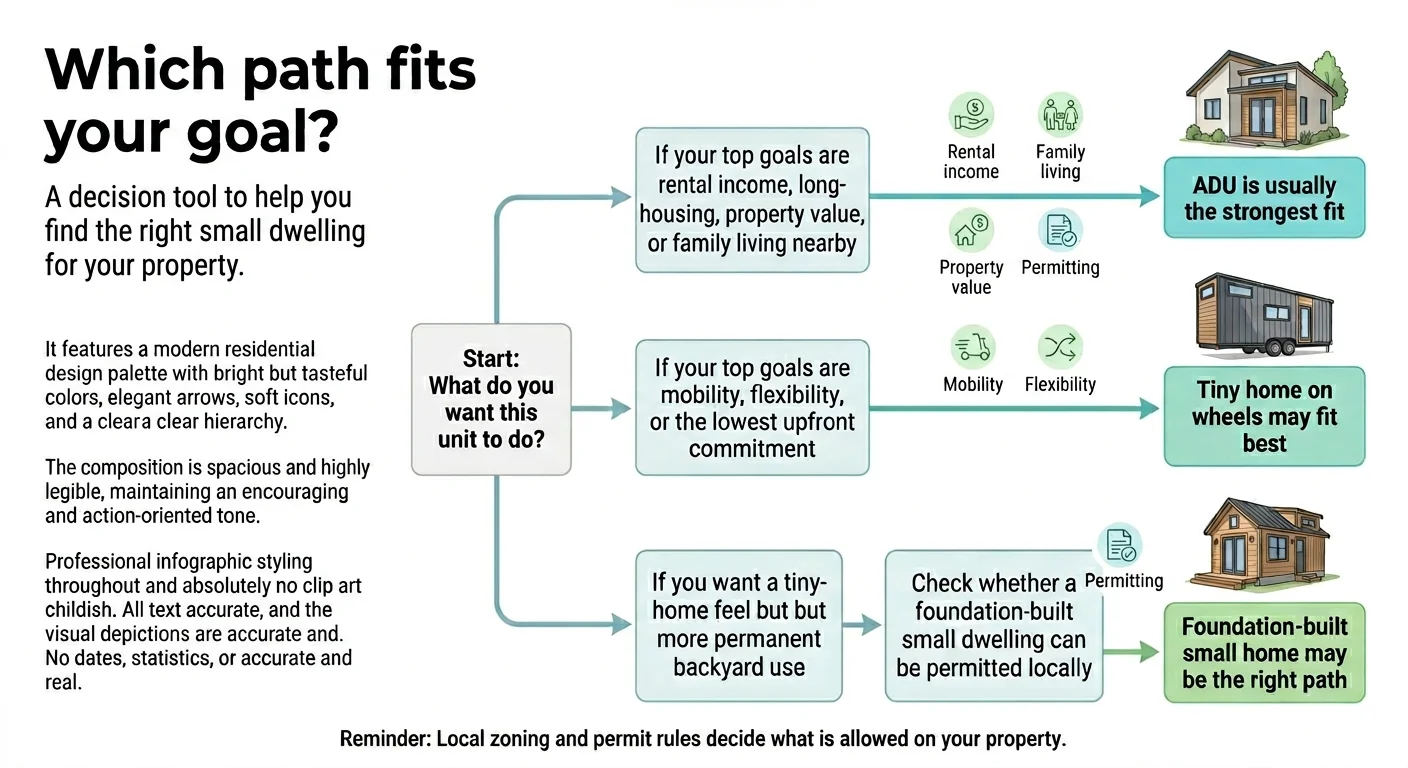
Reminder: Local zoning and permit rules decide what is allowed on your property
Build an ADU if you want to:
Build a tiny home if you want to:
Build a tiny home AS an ADU if you want both:
A foundation-built tiny home — say 300–430 sq ft — that meets local building code and gets permitted as an ADU gives you the compact, efficient design of a tiny home plus:
Legal rental status of an ADU
Property-value impact of a permanent improvement
Eligibility for home-equity financing
Lower cost than a full-size detached ADU
The caveat: not every city has adopted tiny home provisions. Verify that your jurisdiction allows ADUs at the size you're considering before committing.
Free Tool · 60 seconds
Thousands of homeowners are building ADUs right now. See which option fits your property.
Check property eligibility, local rules, and ADU size limits — free, no sales call.
How Do You Pay for an ADU vs a Tiny Home?
The financing gap between these two options is one of the most important — and most overlooked — differences. Because an ADU is classified as real property, it can be financed through the same products used for home improvements and construction. A tiny home on wheels is personal property, which limits you to higher-rate, shorter-term options.
| Financing Path | ADU on Foundation | Tiny Home on Foundation (if ADU-permitted) | Tiny Home on Wheels |
|---|---|---|---|
| HELOC | ✓ Yes | ✓ Yes | ✗ No |
| Cash-out refinance | ✓ Yes | ✓ Yes | ✗ No |
| Construction loan | ✓ Yes | ✓ Yes | ✗ No |
| FHA 203(k) | ✓ Yes | ⚠ Varies | ✗ No |
| Fannie Mae HomeStyle | ✓ Yes | ⚠ Varies | ✗ No |
| Personal loan | ✓ Yes | ✓ Yes | ✓ Yes |
| RV loan | — | — | ✓ Yes |
| Cash | ✓ Yes | ✓ Yes | ✓ Yes |
Financing eligibility depends on lender requirements, property characteristics, borrower creditworthiness, and local regulations. Lending guidelines from Fannie Mae Selling Guide and Freddie Mac Single-Family Guide. Verified April 2026.
ADU Financing Guide
HELOC, construction loans, and more — explained
We break down every ADU financing path in plain English: how each works, who qualifies, and which fits your situation.
Property Value: Where the Two Paths Diverge Most
This is where the math gets clear.
+9.34%
Permitted ADU
Annualized median appraised-value growth in CA
+7.65%
No ADU (comparable properties)
Same period, 2013–2023
Not counted
Tiny home on wheels
Personal property — not in real-estate appraisal
Source: FHFA, “Trends in Median Appraised Value for Properties with ADUs in California,” verified April 2026.
A tiny home on wheels is generally not counted as part of the real-property appraisal. When you sell the house, the tiny home doesn't transfer with the real estate — it's sold separately, like personal property. It's invisible to the buyer's lender.
A foundation-built tiny home permitted as an ADU does contribute to property value — proportional to its size, quality, and rental potential. It won't add as much as a larger ADU, but it's a real-property improvement that benefits you at resale. For homeowners thinking long-term, this is often the deciding factor.
Zoning, Permits, and the Rules That Actually Stop Projects
The biggest obstacles aren't “ADU vs tiny home” in the abstract. They're specific local rules that vary city by city.
12 Questions to Ask Your Planning Department Before You Spend a Dollar
Does my property qualify for an ADU? (Zoning, lot size, existing structures)
Can a tiny home on wheels be used for permanent residential occupancy on my lot?
Can a foundation-built tiny home qualify as an ADU here?
What are the minimum and maximum size limits?
What are the setback and height requirements?
Are impact fees charged — and are they reduced or waived for smaller units?
What utility connections are required? (Water, sewer, electrical, gas)
Is a separate utility meter required, or can the ADU share with the main house?
Are short-term rentals (Airbnb, etc.) allowed for ADUs?
Is owner-occupancy required — must I live in either the main house or the ADU?
Does the city have pre-approved ADU plans? (This can save months and thousands in design fees)
What's the realistic timeline from application to occupancy approval?
The Obstacles That Come Up Most
Foundation vs wheels
This is the single biggest classifier. Wheels typically means RV classification. If permanent housing is the goal, the structure needs a permanent foundation.
Setbacks and lot coverage
Most cities require ADUs to meet setback requirements from property lines. If your yard is small, this can limit certain ADU sizes or placements. Get a site assessment early.
Utility and septic constraints
Connecting to sewer is straightforward in most urban areas but can be a dealbreaker in rural properties on septic — adding a dwelling unit may require upgrading the system.
HOA restrictions
Your city may allow ADUs, but your homeowners association might not. In California, Civil Code §4751 (AB 670) limits HOA ability to unreasonably restrict ADUs, but the specifics matter — review your CC&Rs before assuming you're clear (California Civil Code §4751, verified April 2026).
Owner-occupancy rules
Some cities require the property owner to live in either the main home or the ADU. California law now generally prohibits local owner-occupancy requirements for standard ADUs, with narrow exceptions (California HCD, ADU Handbook Update, incorporating January 1, 2026 law changes, verified April 2026).
ADU vs Tiny Home in California
California accounts for a massive share of the search volume around this topic — and for good reason. The state has been the most aggressive in the country on ADU-friendly legislation.
1,336
ADU permits in 2016
30,000+
ADU permits in 2024
60 days
Mandatory approval window
150 sq ft
Min. ADU allowed
Source: California HCD, ADU Handbook Update, verified April 2026.
Size rules, precisely
California's framework provides that lot-coverage and open-space limitations cannot preclude an ADU of at least 800 sq ft with 4-foot side and rear setbacks. Local maximum-size rules must allow at least 850 sq ft for a one-bedroom ADU or 1,000 sq ft for a unit with more than one bedroom. Local minimums cannot prohibit an efficiency unit as small as 150 sq ft.
California HCD ADU Handbook Update, referencing Government Code §§66310–66342 series, verified April 2026
Can a tiny home be an ADU in California?
Yes — if it's on a permanent foundation, meets the California Building Code, includes full kitchen/bath/sleeping areas, and gets a building permit. Tiny homes on wheels generally do not qualify, though cities like San Diego have created narrow exceptions.
Separate sale — not a blanket right
California allows separate conveyance of ADUs only in limited statutory circumstances, including where a local agency adopts a qualifying ordinance and specific conditions are met. This is not a blanket right to sell an ADU independently.
California HCD ADU Handbook Update, verified April 2026
What most national guides miss
Even within California, rules vary by city and county. Los Angeles has different size limits than San Jose. San Diego allows movable tiny houses as ADUs under specific conditions most other California cities don't. Coastal-zone properties face additional restrictions.
Free Tool · 60 seconds
California homeowner? Check what's possible at your specific address.
Check property eligibility, local rules, and ADU size limits — free, no sales call.
When Neither Option Is the Right Move
We'd rather help you make the right decision than push you toward a project that doesn't fit.
If you're selling within a year
An ADU takes time to design, permit, and build. If you're planning to move soon and the project isn't already underway, the timing likely doesn't work.
If your lot can't support it
Small lots, septic limitations, steep terrain, extensive setback requirements, or high water tables can make construction impractical or prohibitively expensive.
If you actually need an office or studio, not a dwelling
A non-habitable backyard studio (no kitchen, no sleeping area) is often easier to permit, cheaper to build, and doesn't trigger dwelling-unit code requirements.
If your HOA says no and you can't get a variance
Some HOA restrictions are binding. Check your CC&Rs before investing in design or planning.
If the timing, lot, or situation isn't right for an ADU today, it might be right in a year — housing policy is moving in your favor.
7 Mistakes That Cost Homeowners the Most
Every one of these is avoidable.
Assuming 'tiny home' and 'ADU' mean the same thing
One is a legal status, the other is a building type. Confusing them leads to buying a structure your city won't recognize as a dwelling.
Buying a tiny home on wheels and expecting to rent it legally
In many cities, you can't rent a structure classified as an RV for long-term residential use. Check your local rental ordinance first.
Not checking minimum square footage requirements
Many jurisdictions have minimum size requirements that some tiny homes don't meet. A structure that's too small to qualify as a dwelling unit can't be permitted as one.
Comparing sticker price instead of installed project cost
A $55,000 tiny home with $35,000 in site prep, utilities, and permits is a $90,000 project — closer to a garage conversion ADU than the 'cheap tiny home' narrative suggests.
Ignoring the foundation question
Wheels vs foundation determines your legal classification, financing options, insurance, property value impact, and rental legality. This one decision cascades through everything.
Forgetting about HOA restrictions
Your city may say yes. Your HOA may say no. CC&Rs can be harder to change than zoning laws.
Skipping the permit process for a 'simple' tiny home
An unpermitted structure is a liability — no legal occupancy, no rental income, no insurance coverage, potential fines, and a problem at resale you'll have to disclose.
Prefab Options Worth Knowing About
The prefab market for both ADUs and tiny homes has grown significantly. If you're considering this route, verify that the manufacturer designs to residential building code (IRC) if you want ADU eligibility. Get the all-in delivered price — not just the factory price. Ask about permitting assistance in your city. Confirm foundation requirements and utility hookup logistics.
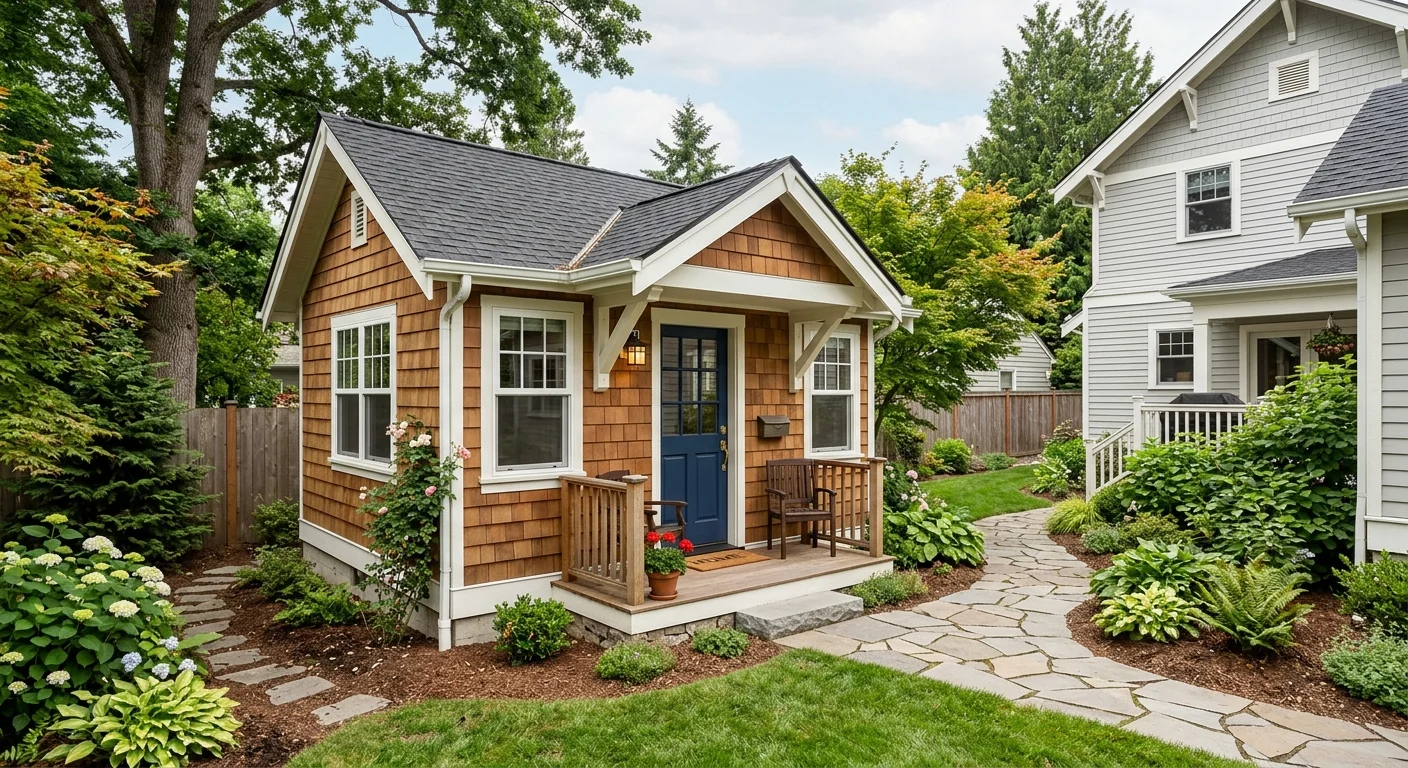
A foundation-built cedar shingle ADU — small enough to feel like a tiny home, permitted to function as a legal dwelling
Some companies listed below are advertising partners. Our mentions are based on documented product specifications and relevance to this page's topic. Rankings and order are based on price range, square footage, build timeline, and customization options — not compensation. Full disclosure.
Small ADU / Tiny Home Builder
Craftsman Tiny Homes
Custom builds from $65,500 (Summit, 410 sq ft) to $129,900 (800 sq ft). Family-owned, builds both tiny homes on wheels and foundation-based ADUs to residential code. Plans included.
Affiliate link. Full disclosure.
See Craftsman BuildsModular & Container Homes
Modular Home Direct
Steel-frame modular and container homes, 1–4 bedrooms, factory-direct pricing, nationwide contractor search. Good for larger configurations and broader size options.
Affiliate link. Full disclosure.
See Modular OptionsFactory-Built Compact Unit
BOXABL Casita
Foldable 361 sq ft unit that ships from Las Vegas. Approved for use in California. Available in studio, one-bed, and two-bed configurations — lead times and availability vary.
Affiliate link. Full disclosure.
Explore BOXABL CasitaFrequently Asked Questions
Is an ADU the same as a tiny home?
No. An ADU is a legal classification — a permitted secondary dwelling on a residential property. A tiny home is a size and style category. Some tiny homes qualify as ADUs when on permanent foundations and properly permitted, but most tiny homes on wheels do not qualify.
Can a tiny house be an ADU?
Yes, but only if the tiny home is on a permanent foundation, meets local residential building code (IRC), includes a kitchen, bathroom, and sleeping area, connects to utilities, and receives permit approval from the city. Tiny homes on wheels are classified as RVs in most jurisdictions and do not qualify.
Are ADUs more expensive than tiny homes?
In upfront construction cost, typically yes. ADUs range from $100K to over $400K vs $30K to $150K for tiny homes. But ADUs qualify for home-equity financing, contribute to property value, and generate rental income, often making them the better financial choice over 5 to 10 years.
Can I rent out a tiny home in my backyard?
It depends on local zoning laws and the tiny home's legal classification. A foundation-built tiny home permitted as an ADU can typically be rented. A tiny home on wheels often cannot be legally rented for long-term use in most cities.
Does a tiny home need a permanent foundation to count as an ADU?
In nearly all jurisdictions, yes. The permanent foundation separates real property (ADU) from personal property (RV). A few cities like San Diego have narrow exceptions, but these are uncommon.
Can an ADU be on wheels?
In most jurisdictions, no. An ADU is defined as a permanent structure on a foundation. A dwelling on wheels is typically classified as an RV. San Diego's movable tiny house path is one of the few limited local exceptions (City of San Diego Information Bulletin 403, verified April 2026).
What is the smallest ADU you can build?
Minimum sizes are set by local ordinance and vary by jurisdiction. In California, local minimums cannot prohibit an efficiency unit as small as 150 square feet. Check your city's specific rules — most allow units smaller than you'd expect.
Which is better for aging parents — an ADU or tiny home?
For most families, an ADU. It provides a private, fully equipped living space with legal occupancy, standard utilities, and proximity to the main home. ADU floor plans of 400 to 1,200 square feet provide more accessibility than most tiny homes under 400 square feet.
Do ADUs add more to property value than tiny homes?
A permitted ADU is treated as real property and contributes to appraised value. FHFA data shows stronger appraised-value growth for California properties with ADUs. Tiny homes on wheels are personal property and generally are not factored into real-property appraisals.
Can tiny homes qualify for the same financing as ADUs?
Only if on permanent foundations classified as real property. ADUs qualify for HELOCs, cash-out refinances, and construction loans. Tiny homes on wheels are limited to personal loans and RV loans with typically higher rates and shorter terms.
What happens if a backyard unit is unpermitted?
An unpermitted unit cannot be legally occupied, rented, or counted toward property value. Freddie Mac guidelines state rental income from an illegal ADU cannot be used for mortgage qualification. You may face fines, required removal, insurance issues, and disclosure obligations at resale.
Can an ADU be sold separately from the main house?
In most states, no. An ADU sells with the main house. California allows separate conveyance only in limited statutory circumstances where specific conditions are met. This is evolving law — check your state's current rules.
What is the difference between a prefab ADU and a tiny home?
A prefab ADU is factory-built to residential building code (IRC) for permanent installation as a legal dwelling unit. A prefab tiny home may or may not meet residential code and may be on wheels or a foundation. The key difference is whether it meets ADU requirements.
Do HOAs stop ADUs or tiny homes?
They can. While state law increasingly limits HOA restrictions on ADUs — California's Civil Code §4751 prohibits HOAs from unreasonably restricting ADU construction — many HOAs still have enforceable restrictions on accessory structures and tiny homes. Review your CC&Rs before investing.
How to Decide in 5 Minutes
You have the full picture. Here's the short version.
Choose an ADU if:
You want rental income from a legal, permitted unit
You're housing a family member who needs a private, full-featured home
You plan to own this property for 3+ years
You want to build property value and equity
You want access to home-equity financing
Legal clarity and insurance simplicity matter to you
Choose a tiny home if:
Lowest upfront cost is the top priority
You want the option to relocate the structure
You're testing small-space living before committing
Mobility or off-grid flexibility matters more than permanence
You don't need it to generate rental income or add property value
Choose a tiny home built as an ADU if:
You want the small, efficient design of a tiny home
But you also want legal rental status, property value impact, and real financing
Your city allows ADUs in the 300–430 sq ft range
You're willing to invest in a permanent foundation and permitting
Choose neither if:
You're selling the property within a year
Your lot can't physically or legally support a second dwelling
You actually need a non-habitable studio, not a dwelling
Your HOA prohibits it and you can't get a variance
What We'd Do Next If This Were Our Property
If you've read this far, you're serious. Here's the most efficient path forward.
Step 1: Find out what your property qualifies for
Zoning, setbacks, lot coverage, and utility access vary by address — not just by city. A feasibility check eliminates the guesswork.
Step 2: Decide on your goal
Rental income? Family housing? Guest suite? Your goal determines the right size, type, and budget.
Step 3: Get real numbers
Not national averages — actual quotes from builders and prefab companies that serve your area, plus permit costs and timelines in your city.
Step 4: Explore financing
If you're going the ADU route, talk to a lender about HELOC, cash-out refi, or construction loan options before committing to a builder. Knowing your budget ceiling prevents scope creep.
Free Tool · 60 seconds
See what you can build at your address — free ADU feasibility report in 60 seconds
Check property eligibility, local rules, and ADU size limits — free, no sales call.
Free Download
2026 ADU Starter Kit
Costs, timelines, financing options, and a state-by-state overview — everything you need to make a confident decision. No spam.
How We Researched This Guide
Legal and zoning information is sourced from official city and state government pages, building department bulletins, and published code. Every city-specific claim cites the official source and includes a verification date.
Financing and lending guidelines reference the Fannie Mae Selling Guide (including SEL-2025-08), Freddie Mac Single-Family Seller/Servicer Guide, and HUD/FHA Handbook 4000.1. We do not quote specific rates, APRs, or payment amounts.
Cost data is compiled from published builder pricing, municipal fee schedules, and contractor estimates across multiple markets. We present planning ranges, not precise projections, because actual costs vary by location, site conditions, and design choices.
What we update: Cost ranges and city-specific rules are verified at minimum twice per year. Major state legislation changes are incorporated within 30 days of enactment.
Important: This guide is educational, not legal or financial advice. Always confirm zoning rules, building requirements, and financing options directly with your local planning department and qualified professionals.
Related Guides
ADU Financing Options 2026
HELOC vs. construction loan vs. renovation loan — full comparison with worked examples.
ADU Floor Plans Guide
32 layouts by size, type, and use case — from studio micro-ADUs to 1,200 sq ft two-bedrooms.
California ADU Grant Guide
CalHFA status, local programs still open, and what to do instead.
Best Prefab ADU Companies
Top manufacturers compared by price, size, customization, and delivery timeline.