
ADU Types: Which One Is Right for Your Property?
By the Dwelling Index Research Team · Updated April 2026 · Editorial methodology · Affiliate disclosure
Bottom line: This guide compares the main ADU types — detached, attached, garage conversion, basement, above-garage, and JADU — so you can choose the right one for your property. Here’s the framework: there are 3 core categories and 6 practical project paths homeowners actually compare. Conversions (garage, basement) are typically cheapest when the existing structure cooperates. Detached ADUs win on privacy and rental potential. Attached ADUs work best when yard space is tight or family needs proximity. But here’s what most guides leave out: your city’s rules can flip the “best” answer completely — and picking by sticker price alone is the most expensive mistake homeowners make. The table below sorts it in 30 seconds.
| Type | Typical Cost | Timeline | Privacy | Best For | Biggest Watchout |
|---|---|---|---|---|---|
| Detached new build | $110K–$350K+ | 6–14 mo | Rental income, max independence | Highest cost; needs yard space and setback clearance | |
| Attached addition | $100K–$250K | 4–10 mo | Family housing, small lots | Shared-wall noise; size often capped at 50% of main home | |
| Garage conversion | $60K–$150K | 3–6 mo | Tight budgets, fast timelines | Lose parking/storage; hidden structural costs | |
| Basement / internal | $40K–$150K | 2–6 mo | Cold climates, existing space | Egress windows, ceiling height, moisture | |
| Above-garage / 2nd-story | $128K–$400K+ | 6–14 mo | Preserving parking + adding a unit | Structural complexity, height limits, stairs | |
| Junior ADU (JADU) | $10K–$100K | 1–4 mo | Lowest budget, simplest path | Max 500 SF, may share bathroom, owner-occupancy often required |
Sources: Angi national contractor estimates (March 2026): detached new construction $110K–$285K, attached $100K–$216K, garage conversion $60K–$150K, above-garage $128K–$225K. Seattle OPCD ADU Annual Report (2022): median $230K detached, $100K attached. Terner Center for Housing Innovation ADU construction cost studies (2023). Higher-end ranges reflect larger/custom units in high-cost metros. Costs vary significantly by region. Last verified: April 2026.
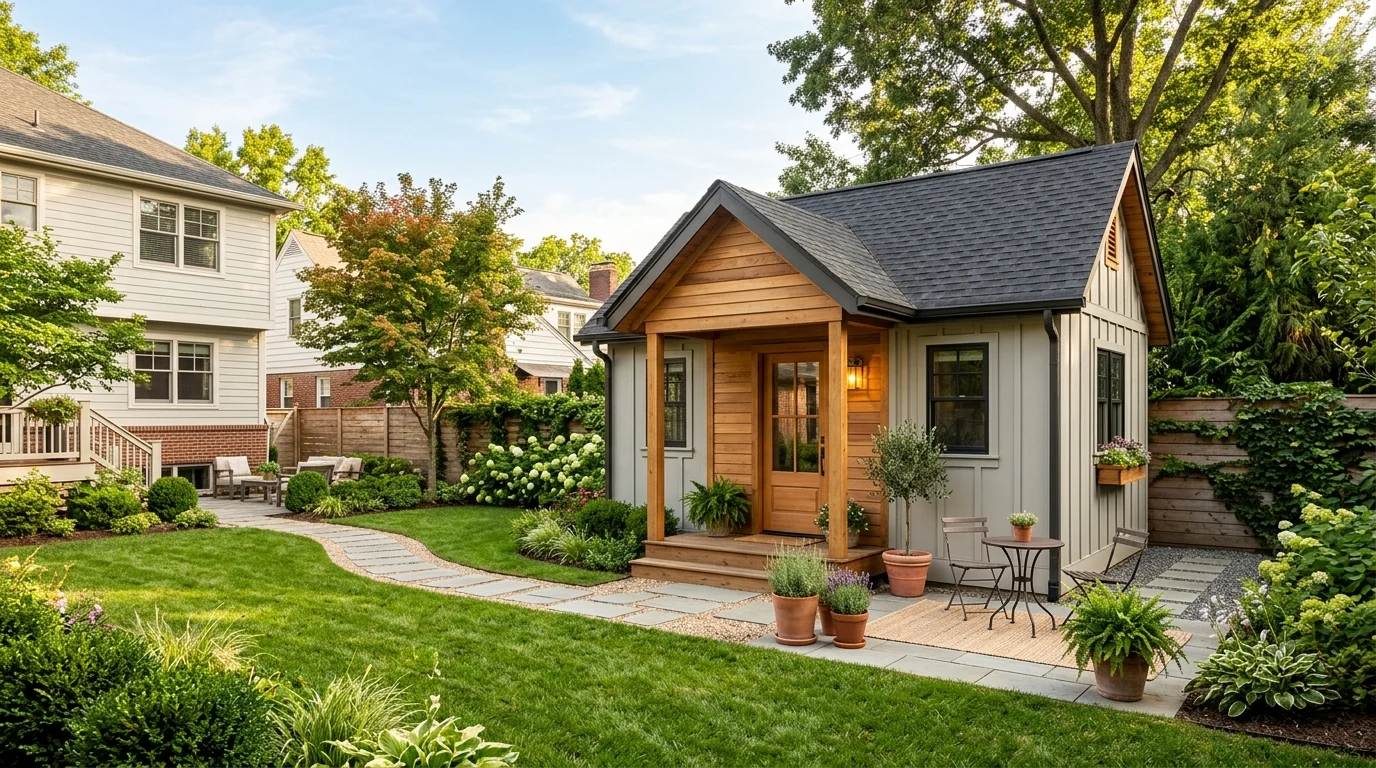
What Are the Main ADU Types?
An ADU (accessory dwelling unit) is a secondary home on the same lot as your primary residence — with its own kitchen, bathroom, entrance, and living space. You’ve probably also heard “granny flat,” “in-law suite,” “backyard cottage,” or “casita.” Same concept, different regional flavor. The type you choose is the single most consequential decision in the entire ADU process, because it determines your budget range, your timeline, your rental potential, and how much of your yard you keep.
Here’s the problem: one site says there are 3 types, another says 4, another says 8. California’s Department of Housing and Community Development uses three broad categories — detached, attached, and converted/internal (Source: CA HCD ADU Handbook, January 2026, verified April 2026). The American Planning Association uses similar language — internal, attached, and detached (Source: APA Accessory Dwelling Units, verified April 2026). Meanwhile, cities like Colorado Springs add “integrated” as a separate form, and North Salt Lake explicitly lists basement, attached, detached, second-story detached, and tiny homes as distinct paths (Sources: Colorado Springs ADU page; North Salt Lake ADU ordinance, verified April 2026).
Nobody’s wrong — they’re just cutting the pie differently. The clearest way to organize it:
3 Core Categories, 6 Project Paths
The 3 core categories are how planning departments classify ADUs — they determine your zoning lane, your setback rules, and your permit pathway:
- 1
Detached — A standalone structure, physically separated from the main home.
- 2
Attached — Connected to the main home, sharing at least one wall.
- 3
Internal / Conversion — Created within existing space (garage, basement, attic, spare room).
The 6 project paths are what homeowners actually compare when making a decision:
| Project Path | Core Category | How It Works |
|---|---|---|
| Detached new build | Detached | New standalone structure in the yard |
| Attached addition | Attached | New construction extending the main home |
| Garage conversion | Conversion (attached or detached) | Existing garage repurposed as living space |
| Basement / internal conversion | Conversion (internal) | Existing interior space repurposed |
| Above-garage / second-story | Attached or Detached (configuration) | Living unit built above a new or existing garage |
| Junior ADU (JADU) | Internal (specific regulatory category) | Small unit carved from existing home, ≤500 SF |
That “garage conversion” row matters: if your garage is attached to your house, the conversion is technically an attached ADU. If your garage is detached, it becomes a detached ADU. Same project, different permit lane. This distinction changes size rules, fire separation requirements, and privacy — and we flag it throughout this guide.
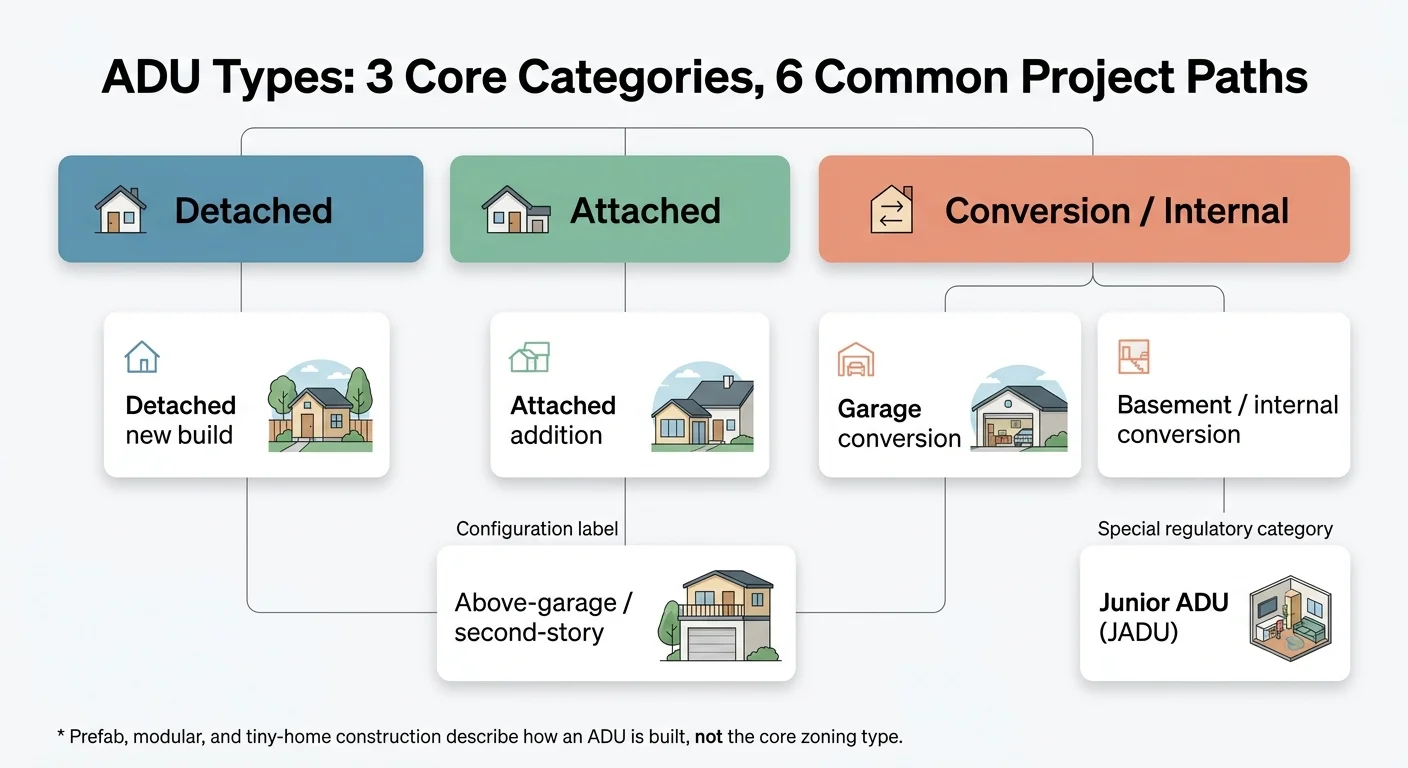
ADU Type vs. Build Method: A Critical Distinction
“Prefab ADU,” “modular ADU,” “manufactured ADU,” and “tiny house ADU” are not separate types — they describe how a unit gets built, not what zoning category it belongs to. A prefab unit delivered to your backyard is, for permitting purposes, a detached ADU. A modular home assembled on your lot is still a detached ADU.
This matters because searching “prefab ADU” or “tiny house ADU” can send you down a build-method rabbit hole when what you actually need first is the type decision. We cover build methods later in this guide, but type comes first.
Which ADU Type Is Right for Your Property?
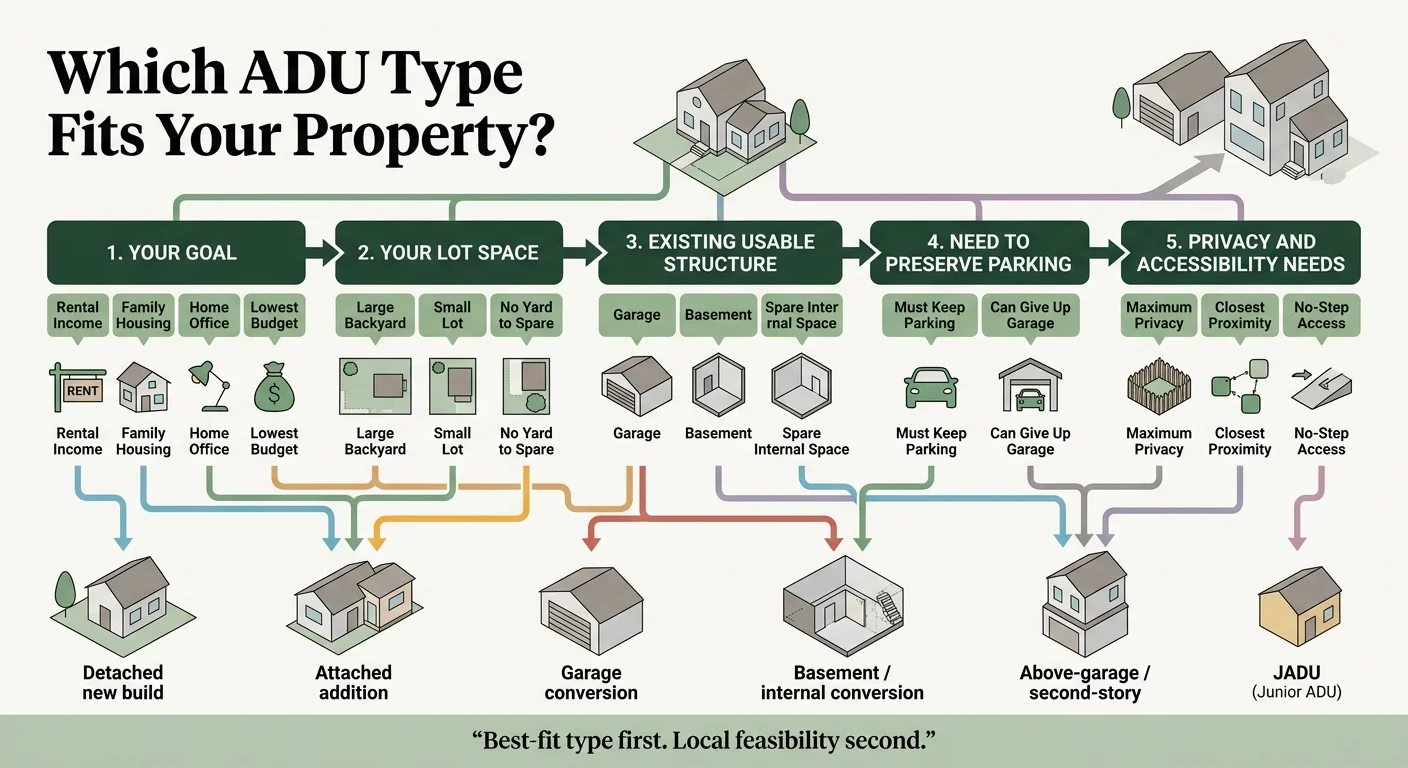
This is the question most guides answer badly — or don’t answer at all. They list what exists and leave you to figure it out. Let’s fix that. The right ADU type isn’t about personal preference. It’s about matching your goals, lot, existing structures, budget, and local rules. Work through these five filters in order, and you’ll land on one or two realistic options fast.
Filter 1: What’s Your Primary Goal?
| Your Goal | Best-Fit Type | Why |
|---|---|---|
| Maximum rental income | Detached new build | Detached units consistently command the highest rents — tenants value full separation, their own entrance, and private outdoor space. |
| Aging parents / multigenerational living | Attached addition or single-story detached | Proximity matters for caregiving. Attached keeps them close; detached offers more independence. Single-story with zero-step access is ideal if mobility is a factor. |
| Adult child returning home | JADU or garage conversion | Fast, affordable, and 'close but separate.' |
| Home office / studio | Garage conversion or JADU | Doesn't need a full kitchen. Conversion keeps costs lowest. |
| Long-term property value | Detached new build | Detached units add net-new livable square footage that appraisers can evaluate independently — the strongest value driver. (Source: Fannie Mae Selling Guide, ADU appraisal requirements, verified April 2026) |
| Fastest path to done | Garage conversion or JADU | Existing structure = fewer permits, shorter build time. |
| Lowest possible budget | JADU ($10K–$100K) or garage conversion ($60K–$150K) | Both leverage existing structures. JADUs are the cheapest legal path to a second unit on your lot. |
Filter 2: What Does Your Lot Actually Allow?
Walk outside and look at your property. What do you have to work with?
Large backyard with setback clearance? → Detached new build is on the table.
Small lot, tight yard? → Attached addition or conversion. You likely can't meet setback requirements for a new detached structure.
Existing detached garage you rarely use? → Garage conversion is your fast track. Existing structures often get setback exemptions that new builds don't.
Unfinished basement with 7+ foot ceilings? → Basement conversion. Especially strong in Midwest and Northeast states where basements are standard.
Attached garage you can sacrifice? → Garage conversion (attached type) or JADU if you want to stay under 500 SF.
Garage you need to keep + room above it? → Above-garage/second-story unit. Keep parking, add a home above.
Spare bedroom or space within the home? → JADU. The lightest-touch option.
Filter 3: What Are Your Hard Budget Constraints?
Be honest here. ADU projects almost always cost more than the initial quote. A realistic budget framework:
- Under $50K→ JADU is likely your only viable path.
- $60K–$150K→ Garage conversion or basement conversion. Internal conversions fit here if the space is already partially finished.
- $150K–$300K→ Attached addition or a standard detached new build.
- $300K+→ Custom detached, above-garage, or two-story detached.
Filter 4: Does Parking Have to Stay?
This is the filter most people forget until it’s too late. If you convert your garage, you lose your covered parking. In some cities, you’re required to replace it elsewhere on the lot. In California, a local agency cannot require replacement off-street parking when a garage, carport, or covered parking structure is converted or demolished to create an ADU — and separate state parking exemptions also apply in other situations including transit-adjacent sites (Source: CA Gov. Code §66313(d); CA HCD ADU Handbook, January 2026, verified April 2026). Other states vary. Check your city before assuming.
If parking must stay: above-garage/second-story or a detached build that doesn’t touch the garage.
Filter 5: What Do Your City’s Rules Actually Allow?
This is the filter that overrides everything else. Cities regulate ADU types differently. Some allow detached only. Some cap attached at 50% of the main home. Some don’t allow above-garage units at all. Some require owner-occupancy for JADUs or all ADU types.
Before you fall in love with a type, confirm your city allows it.
Not sure what your property allows?
Our free ADU Feasibility Tool checks your specific address against local rules and recommends the best-fit ADU type for your lot, budget, and goals.
See What You Can Build — Free ADU ReportDetached vs. Attached vs. Conversion: What Actually Changes?
Before we dive into each type, here’s the head-to-head on the three core categories.
| Factor | Detached | Attached | Conversion |
|---|---|---|---|
| Typical cost | $110K–$350K+ | $100K–$250K | $40K–$150K |
| Timeline | 6–14 months | 4–10 months | 2–6 months |
| Privacy | Best — fully separated | Moderate — shared wall | Varies — can be good (detached garage) or limited (basement) |
| Yard impact | Uses yard space | Extends home footprint | Usually zero yard impact |
| Utility complexity | New connections required (water, sewer, electric) | Can often tie into existing systems | Usually ties into existing systems |
| Permit complexity | Highest — full new construction review | Moderate — addition to existing structure | Often lowest — working within existing footprint |
| Code risk | Predictable (new build to current code) | Moderate (must meet current code at attachment point) | Highest — existing structure may need expensive upgrades |
| Rental appeal | Strongest — tenants prefer standalone | Moderate | Varies — detached garage conversions rent well; basements less so |
| Accessibility | Can design from scratch for single-story, zero-step access | Limited by existing structure | Limited by existing structure |
| Best for | Rental income, multigenerational independence, long-term value | Family proximity on smaller lots | Speed, lowest budget, leveraging existing space |
| Skip this if | Tiny lot, tight budget, need it fast | You need full separation for tenants | Existing structure needs major rehab (cheaper to build new) |
Sources: Angi national contractor estimates (March 2026); Seattle OPCD ADU Annual Report (2022); Terner Center for Housing Innovation. Timelines based on national builder and municipal permit data. Last verified: April 2026.
The biggest takeaway from this table: Conversions are cheaper only when the existing structure cooperates. If your garage needs a new foundation, your basement fails egress requirements, or the ceiling height is 6’4” when code requires 7’0” — the “budget option” becomes the expensive option with an ugly surprise in the middle. The fix is simple: get a structural assessment before committing to a conversion path. That $500–$1,500 upfront can save you tens of thousands.
Is a Detached ADU the Best Choice for Privacy, Rental Income, and Long-Term Value?
A detached ADU is a standalone structure — physically separated from your main home, with its own foundation, walls, roof, entrance, and utility connections. Think backyard cottage, granny flat, or casita. It’s the most independent ADU type and, in most markets, the most valuable.
Why homeowners choose detached: Tenants prefer it. Appraisers evaluate it more favorably. Family members living in it feel genuinely independent. And if ADU separate-sale laws continue expanding, a detached unit is the easiest to sell independently down the road.
The honest tradeoff: Detached ADUs are the most expensive to build and the slowest to complete. You’re building a small house from the ground up — foundation, framing, roofing, all-new utility runs to the street. Seattle’s official 2022 ADU report found that the median reported construction cost for detached ADUs was $230,000, versus $100,000 for attached units (Source: Seattle OPCD ADU Annual Report 2022, verified April 2026). But that higher investment typically produces higher returns in both rental income and property value.
Key Details
- Typical cost: $110K–$285K (Angi, March 2026); custom and high-cost metro projects can exceed $350K.
- Cost per square foot: $200–$500 depending on region and finish level.
- Size limits: Up to 1,200 SF in most states. In California, local rules cannot prevent an ADU of at least 800 SF with 4-foot side and rear setbacks, and local maximum-size rules must allow at least 850 SF (or 1,000 SF if the ADU has more than one bedroom). (Source: CA Gov. Code §§66314–66315; CA HCD ADU Handbook, January 2026, verified April 2026.)
- Setbacks: Typically 4 ft from side and rear property lines for units ≤16 ft tall. Check your city — some are stricter.
- Timeline: 6–14 months (design through occupancy).
- Build methods available: Site-built, prefab, or modular — all three work for detached.
Who Should Choose Detached
- ✓You want maximum rental income.
- ✓You're building for long-term property value.
- ✓Privacy is non-negotiable — for you or the occupant.
- ✓You have the yard space and budget to do it right.
Who Should Skip Detached
- ✕Your lot is too small to meet setback requirements after placing the unit.
- ✕Your budget is under $100K — a conversion will stretch further.
- ✕You need it built within 3–4 months.
When Is an Attached ADU Better Than a Detached ADU?
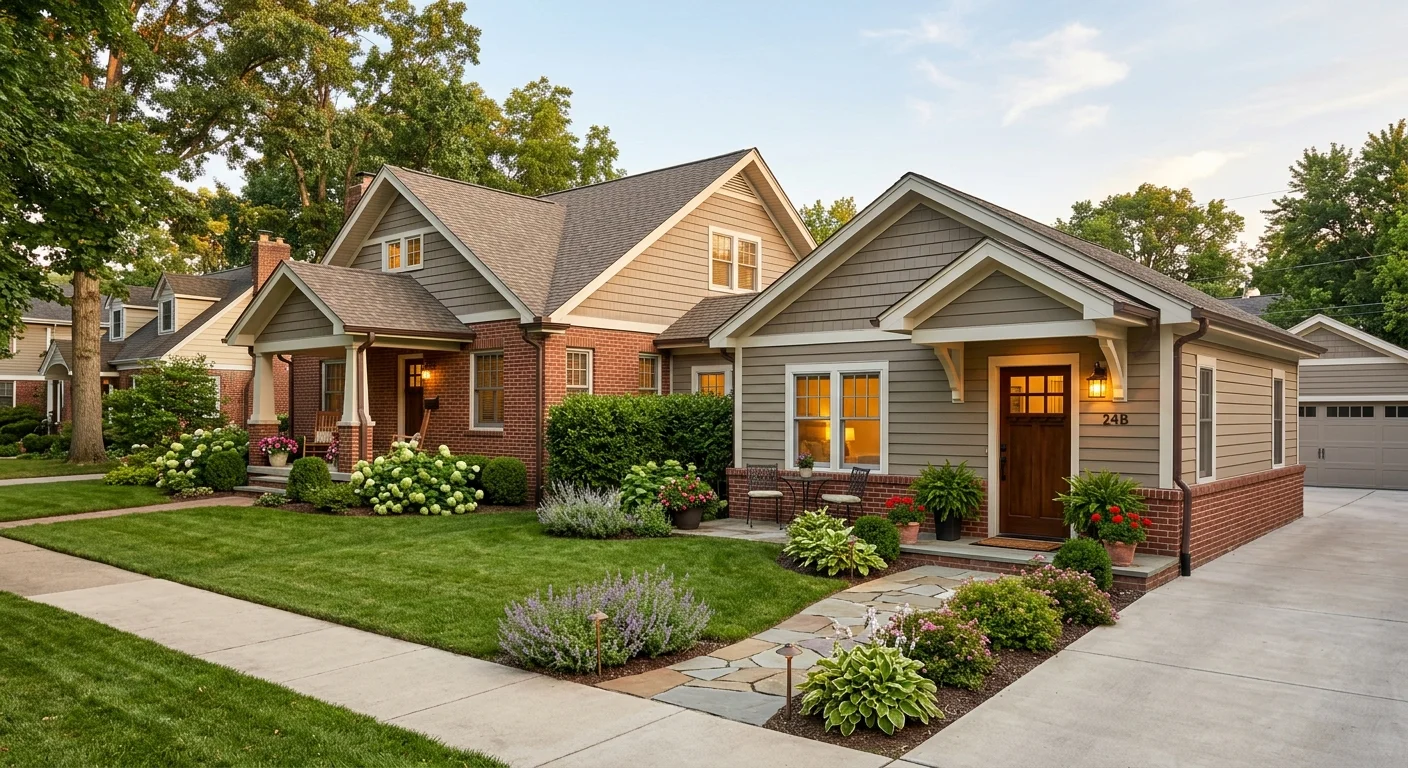
An attached ADU shares at least one wall with your main home. It might be a bump-out addition off the back, a second-story addition over the garage, or a side extension with its own entrance. Structurally, it’s part of your house. Functionally, it’s a separate home.
Why homeowners choose attached: It preserves yard space, often costs less than detached because you’re leveraging existing foundation and utility infrastructure, and keeps the occupant physically close — which is exactly what you want when an aging parent needs nearby support but still wants their own front door.
The honest tradeoff: Shared walls mean shared noise. Without proper sound insulation and fire-rated separation (typically 1-hour minimum, 2-hour in some jurisdictions), you’ll hear each other. And in many cities, attached ADUs are capped at 50% of the main home’s living area — so if your home is 1,200 SF, your attached ADU maxes out at 600 SF.
Key Details
- Typical cost: $100K–$216K (Angi, March 2026); larger or custom additions can push higher.
- Cost per square foot: $150–$400.
- Size limits: Often 50% of the primary home's floor area, or 1,200 SF — whichever is less. Varies by city.
- Setbacks: Usually follows the main home's existing setback envelope, which can be an advantage.
- Timeline: 4–10 months.
- Build methods: Primarily site-built; modular add-ons exist but are less common for attached.
When Attached Beats Detached
- Your lot can't fit a detached structure after setbacks.
- You're housing aging parents who need proximity for safety and caregiving.
- Your budget is $100K–$200K and you want a true self-contained unit (not just a conversion).
- You want to expand the house's footprint rather than build a separate structure in the yard.
Is a Garage Conversion ADU Actually the Cheapest Option?
A garage conversion takes your existing garage — attached or detached — and transforms it into a living space with a kitchen, bathroom, bedroom, and separate entrance. It’s one of the most popular ADU paths in the country because the shell already exists. No new foundation. No new roof. Just upgrade the interior, add plumbing and electrical, insulate, and replace the garage door with a wall and windows.
Why homeowners choose garage conversion: Speed and cost. The foundation and walls are already there. Permitting is often faster because you’re not building new square footage. And in many jurisdictions, existing structures that were built legally can keep their current setbacks — even if those setbacks wouldn’t be allowed for new construction (Source: CA Gov. Code §66314(a); CA HCD ADU Handbook, January 2026, verified April 2026).
The honest tradeoff: Garage conversions have the widest cost variance of any ADU type. A solid, well-built detached garage with a good slab might convert for $60K–$80K. An older garage with a crumbling foundation, no insulation, 6’6” ceilings, and subpanel wiring from 1965 might need $30K–$50K in structural work before you even start the conversion — at which point building new from the same footprint is often smarter.
Attached vs. Detached Garage Conversion: It Matters
Size rules: Attached may be limited to 50% of the primary home. Detached conversions in California have no established upper size limit for conversion of existing space — meaning you could convert a large detached garage into an ADU.
Fire separation requirements: Attached conversions may need 1–2 hour fire-rated separation from the main home.
Privacy: Detached garage conversions feel much more independent.
Key Details
- Typical cost: $60K–$150K for a standard 2-car garage in good condition (Angi, March 2026).
- Cost per square foot: $100–$350.
- Timeline: 3–6 months, often the fastest path to a permitted ADU.
- Parking: You lose it. In California, a local agency cannot require replacement parking when a garage is converted or demolished to create an ADU (Source: CA Gov. Code §66313(d), verified April 2026). Other jurisdictions may require you to add parking elsewhere.
Signs Your Garage Is a Bad Conversion Candidate
Before you commit, check these red flags:
- Ceiling height under 7'6" (finished). Code typically requires at minimum 7'0" finished ceiling height. If your garage framing won't get you there after insulation and drywall, you've got a problem.
- Foundation cracks, settling, or no moisture barrier. Foundation repair can cost $15K–$30K alone.
- No sewer/water access nearby. If the nearest sewer lateral is 50+ feet away, trenching costs escalate fast.
- Structural framing won't support residential loads. Garage walls are often thinner and lack insulation cavity depth.
If more than two of these apply, get a structural engineer’s assessment before proceeding. Demolition and a new build on the same footprint may cost less — and give you a better unit — than fighting a bad existing structure.
Not sure if your garage qualifies?
Our ADU Feasibility Tool checks your address and property against local requirements — no guesswork, no wasted design fees.
Check What You Can BuildWhen Does a Basement or Internal ADU Make the Most Sense?
Basement and internal ADUs convert existing space within your home — a basement, a lower level, an unused section of the main floor — into a self-contained living unit. They’re the least glamorous ADU option, but on the right house, they ’re the fastest and most cost-effective path to a legal rental unit.
Why homeowners choose internal/basement: The space already exists. You’re not building walls, pouring foundations, or running new utility lines to the street. In cold-climate states where basements are standard (Midwest, Northeast, parts of the Mountain West), this is often the most natural ADU path.
The honest tradeoff: Basements need to be livable, not just existing. That means egress windows (large enough for emergency exit), minimum ceiling height (typically 7’0” finished), moisture management, proper ventilation, natural light, and a separate entrance. If your basement is a 6’4” concrete box with moisture seeping through the walls, the upgrade costs can approach new-construction territory.
Key Details
- Typical cost: $40K–$150K depending on how finished the space already is.
- Timeline: 2–6 months.
- Requirements: Separate entrance (can be through the backyard), egress windows in all bedrooms, code-compliant ceiling height, waterproofing, proper HVAC, and sound separation from the main home.
- Best in: States where basements are standard. Less relevant in the South and parts of the West where slab-on-grade construction dominates.
Basement vs. Main-Level Internal Conversion
A basement ADU is below grade and faces specific challenges (moisture, light, egress). A main-level internal conversion — carving out a section of the main floor — avoids the moisture issue but reduces your primary home’s living space. Both are classified as internal/conversion ADUs, but the practical considerations are very different.
Above-Garage and Second-Story ADUs: Keep Your Parking, Add a Home
Above-garage and second-story ADUs are living units built on top of a new or existing garage. The garage stays functional below. The ADU sits above. You hear these called “carriage houses” in some regions — the historical name for exactly this configuration.
Why homeowners choose above-garage: It’s the only way to add a fully separated unit while preserving covered parking. For homeowners who can’t lose their garage but want ADU income, this solves both problems at once.
The honest tradeoff: These are among the most expensive ADU configurations. The existing garage must be structurally capable of supporting a residence above it — or you build a new garage designed for it. Staircase access is required, which means these units are typically not suitable for anyone with mobility limitations.
Key Details
- Typical cost: $128K–$225K for standard configurations (Angi, March 2026); custom and two-story units in high-cost metros can exceed $400K.
- Timeline: 6–14 months.
- Structural requirement: The garage's foundation, walls, and framing must support residential loads above. Many existing garages weren't built for this — a structural engineer's assessment is essential.
- Height limits: Vary by city. Many jurisdictions cap accessory structures at 16–25 ft. Check before designing.
- Accessibility: Stairs are required. Not suitable for aging-parent scenarios where mobility is a concern.
A note on “second-story ADU”: Cities like North Salt Lake explicitly list “second story detached (e.g., above garage)” as a distinct ADU form (Source: North Salt Lake ADU ordinance, verified April 2026). Functionally, these are configurations of the detached or attached categories, not separate root types. But they deserve their own section because the structural, height, and accessibility considerations are genuinely different from single-story ADUs.
What Is a JADU, and When Is It Smarter Than a Full ADU?
A JADU (Junior Accessory Dwelling Unit) is a California-originated category that’s spreading to other states. It’s a small unit — 500 square feet maximum — carved from existing space within a single-family home or attached garage. It must have its own entrance and at least an efficiency kitchen, but it can share a bathroom with the main house.
JADUs are not just “tiny ADUs.” They have distinct rules:
- Maximum 500 SF (no addition of square footage beyond what exists).
- Must be within the existing primary home or attached garage.
- Efficiency kitchen (sink + cooking appliance; doesn't need a full-range stove).
- Bathroom sharing is allowed — it doesn't need its own if there's interior access to the main home's bathroom.
- Owner-occupancy — in California, the owner must reside in either the remaining portion of the primary home or the JADU if the JADU shares sanitation facilities (Source: CA Gov. Code §66333; CA HCD ADU Handbook, January 2026, verified April 2026).
- Separate utility connections are not required. JADUs share the main home's systems.
When JADU Is the Right Answer
- ✓Your budget is genuinely under $50K.
- ✓You have a spare bedroom or attached garage space you're not using.
- ✓You need something fast — JADUs are typically the fastest type to permit.
- ✓You want to house a family member, not maximize rental income.
- ✓You're in California and want both a JADU and a full ADU on the same lot — state law explicitly allows it (CA Gov. Code §66315, verified April 2026).
When JADU Is Too Limited
- ✕You want maximum rental income. At 500 SF max with potential bathroom sharing, JADUs command significantly less rent than full ADUs.
- ✕You plan to rent to non-family tenants long-term. Owner-occupancy requirements and limited separation reduce appeal.
- ✕Your exit plan includes selling the unit separately. JADUs can't be independently sold.
- ✕The marginal cost difference between a JADU and a full garage conversion is small enough to justify the upgrade.
The $20K question: Some homeowners default to a JADU to save money, then realize a garage conversion ADU would have cost only $20K–$40K more while delivering significantly more rental income and a stronger property value boost. Run the numbers on both before defaulting to JADU just because it’s cheaper upfront.
Is a Prefab, Modular, or Tiny House a Different ADU Type?
No. This is one of the most common points of confusion in ADU research. Prefab, modular, manufactured, and site-built describe how a unit is constructed — not what type of ADU it is. A prefab unit delivered to your backyard is, for permitting purposes, a detached ADU. It follows the same zoning and permitting rules as any detached ADU.
Quick Definitions
Site-built (stick-built): Traditional construction on your lot. Maximum customization. Highest labor cost and longest timeline.
Prefab (prefabricated): Entire unit built in a factory, delivered to your lot, placed on a pre-built foundation. Fastest on-site installation (2–4 weeks), but factory production may take 3–6 months.
Modular: Components built in a factory, shipped in sections, assembled on-site. Splits the difference between site-built and prefab.
Manufactured: Factory-built to HUD standards (different from local building code). Not all jurisdictions accept manufactured homes as ADUs — some require units built to IRC or state-specific building standards.
Can a Tiny House Be an ADU?
It depends on the wheels. A tiny home on a permanent foundation that meets local building code can qualify as a detached ADU in many jurisdictions. Colorado Springs, for example, explicitly allows tiny homes as detached ADUs subject to building code and permanent foundation requirements — but excludes mobile homes, RVs, and travel trailers (Source: Colorado Springs ADU page, verified April 2026).
A tiny home on wheels is almost never a legal ADU. Most cities classify wheeled structures as vehicles or RVs, not dwelling units.
Which Types Support Which Build Methods?
| ADU Type | Site-Built | Prefab | Modular |
|---|---|---|---|
| Detached new build | ✅ | ✅ | ✅ |
| Attached addition | ✅ | Rarely | Sometimes |
| Garage conversion | ✅ | ❌ | ❌ |
| Basement / internal | ✅ | ❌ | ❌ |
| Above-garage | ✅ | Sometimes | Sometimes |
| JADU | ✅ | ❌ | ❌ |
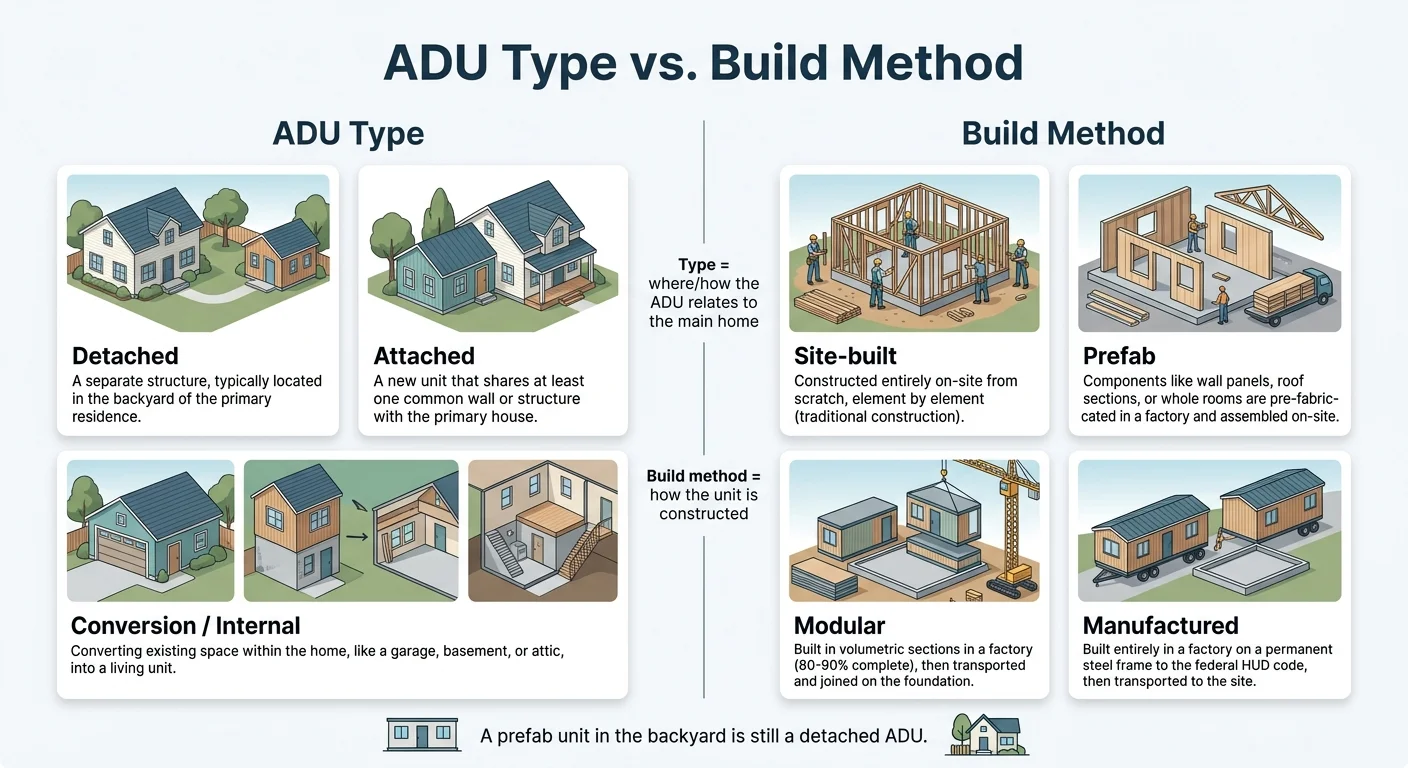
The takeaway: if you’re interested in prefab or modular, you’re almost certainly building a detached ADU. Conversions and attached additions work within existing structures and don’t lend themselves to factory-built solutions.
Exploring prefab options? Compare prefab ADU companies — see pricing and floor plans
How Much Does Each ADU Type Cost?
Cost is the question that makes or breaks the decision. Here’s what current data shows — and where the traps are hiding.
Cost Ranges by Type
| Type | Total Cost Range | Source | What Drives the Range |
|---|---|---|---|
| Detached new build | $110K–$285K | Angi (March 2026) | Size, region, finishes, utility distance |
| Attached addition | $100K–$216K | Angi (March 2026) | Structural integration, fire separation requirements |
| Garage conversion | $60K–$150K | Angi (March 2026) | Garage condition, utility access, slab quality |
| Basement / internal | $40K–$150K | Terner Center (2023), builder estimates | How finished the space already is, egress requirements |
| Above-garage | $128K–$225K | Angi (March 2026) | Structural reinforcement, height, staircase |
| JADU | $10K–$100K | Builder estimates, CA HCD guidance | Scope of renovation from existing space |
Note: Angi ranges represent national estimates for typical projects. Custom builds, high-end finishes, and high-cost metros (particularly coastal California, Seattle, and the Bay Area) can push costs well above these ranges. Seattle’s official 2022 ADU report found a median of $230K for detached and $100K for attached. All sources verified April 2026.
The Hidden Costs That Blow Budgets
Every ADU type has costs that don’t show up in the base construction estimate:
| Hidden Cost | Typical Range | Which Types Get Hit |
|---|---|---|
| Permit + impact fees | $2K–$20K+ | All types. Some cities waive impact fees for smaller ADUs. |
| Utility connections (water, sewer, electric) | $5K–$25K | Primarily detached. Adding a separate meter is an extra cost many homeowners don't expect. |
| Structural upgrades | $5K–$30K+ | Conversions (garage, basement). Old garages may need new foundations. |
| Egress windows / light wells | $2K–$8K per window | Basement conversions. Required in all bedrooms. |
| Fire separation | $3K–$10K | Attached ADUs and attached garage conversions. |
| Architectural + engineering plans | $3K–$15K | All types. Custom designs cost more than pre-approved plans. |
| Landscaping restoration | $2K–$15K | Detached. Your yard will need work after construction. |
| Driveway / parking replacement | $3K–$15K | Garage conversions where replacement parking is required. |
Sources: Angi (March 2026), Terner Center (2023). Ranges are directional estimates. Verified April 2026.
Why Conversions Are Cheaper — Until They Aren’t
Conversions look cheaper because the shell exists. But the shell has to actually work. If your garage needs:
- A new foundation or moisture barrier ($15K–$30K)
- Structural reinforcement to walls ($5K–$15K)
- Complete electrical rewiring ($5K–$10K)
- A sewer lateral run to the main line ($5K–$15K)
…you could be looking at $30K–$70K in structural work before the conversion even starts. At that point, demolishing the garage and building a new detached ADU from the same footprint may cost the same or less — and you get a unit designed from scratch for living, not retrofitted from a parking space.
Get a structural assessment on any existing space before committing to a conversion budget. The $500–$1,500 you spend on an engineer now can save you $30K+ in surprise costs.
These cost ranges are illustrative, not quotes. Actual costs depend on your location, contractor, scope, and market conditions. Get project-specific estimates before committing to a budget.
Figuring out how to pay for your ADU?
Most homeowners finance through home equity, renovation loans, or construction loans — and the right path depends on how much equity you have now versus what the ADU will add. We break down every option in plain English.
Explore ADU Financing OptionsWhich Type Adds the Most Value — and Which Rents Best?
These are two different questions, and conflating them is a mistake.
Property Value Impact
Detached ADUs tend to add the most appraised value because they create net-new livable square footage that appraisers can evaluate independently. Fannie Mae’s appraisal guidelines require the appraiser to describe the ADU and analyze its contribution to value or marketability (Source: Fannie Mae Selling Guide, ADU appraisal requirements, verified April 2026) — and an independent structure with separate access is the clearest value-add in that analysis. FHFA data shows that California properties with ADUs experienced stronger median appraised-value growth than comparable properties without ADUs between 2013 and 2023 (Source: FHFA Working Paper, “Trends in Median Appraised Value for Properties with ADUs in California,” verified April 2026).
Attached ADUs also add value, but the appraisal is different. The unit shares structure with the main home, so it functions more like an addition than a separate property.
Garage conversions add value — but the loss of the garage partially offsets the gain. Garages carry their own appraised value. You’re trading garage value for living-space value (which is higher per square foot), but the net gain is smaller than adding net-new space. JADUs add the least value because the square footage already existed.
In general: Detached adds the most value, followed by attached, then conversions, then JADUs.
Rental Income
Rents vary enormously by market, but the directional hierarchy is consistent: detached commands the most because tenants value full separation, a private entrance, and their own outdoor space. Above-garage and quality detached garage conversions land in the middle. Attached and basement units rent for less due to privacy perception. JADUs command the least due to size and shared-facility constraints.
Rental income and property value outcomes vary by location, market conditions, unit quality, and timing. These are general observations, not guarantees of returns.
The Exit-Plan Question Nobody Asks
Before choosing a type based on value or rent, ask yourself: what’s your 10-year plan for this property?
Planning to hold and rent long-term? Detached maximizes monthly income.
Planning to sell within 5 years? Detached maximizes appraised value. Garage conversions can deliver strong ROI relative to their lower cost.
Housing family and may never rent it? Choose by proximity and accessibility, not rent potential.
Might want to sell the ADU separately someday? Detached is the only realistic option — and only in states where separate sale is legal. (See local rules below.)
What Local Rules Can Change Which ADU Type Is Allowed?
This is the section that 90% of national ADU guides underbuild — and it’s the reason people keep searching after reading them. The “best” ADU type changes when your city changes the rules. Here are the seven local rules that can flip the answer:
Allowed Types
Not every city allows every type. Some permit detached only. Some allow attached and conversion but not new detached. Some explicitly list above-garage as a separate allowable form, while others don't mention it.
Size Limits
Detached ADUs are commonly capped at 800–1,200 SF. Attached ADUs may be limited to 50% of the primary home. JADUs are capped at 500 SF in California. Some cities cap differently by type — always check yours.
Height Limits
This directly affects above-garage and two-story ADUs. Common caps range from 16 ft (one story only) to 25 ft (allowing two stories). California's recent legislation pushed minimum allowed height to 16 ft for single-story and 18 ft for multi-story detached ADUs within one-half mile of major transit.
Setbacks
New detached ADUs typically require 4 ft from side and rear property lines. But existing structures (like a garage being converted) often keep their original setbacks even if those setbacks would violate current code — a meaningful advantage for garage conversions.
Parking Requirements
Converting a garage to an ADU eliminates parking. In California, replacement parking cannot be required when a garage is converted or demolished to create an ADU. Other states and cities vary widely — some require one replacement space, others waive it entirely. Always verify before designing.
Owner-Occupancy Rules
Some cities require the property owner to live in either the primary home or the ADU. In California, local agencies may not impose owner-occupancy requirements on ADUs (though JADU occupancy rules are narrower and depend on the sanitation configuration). (Source: CA Gov. Code §66313(c); CA HCD ADU Handbook, January 2026, verified April 2026.) This rule directly affects rental strategy.
Short-Term Rental Restrictions
Planning to Airbnb your ADU? Many cities restrict or ban short-term rentals in ADUs even when long-term rental is allowed. Check your local STR ordinance before choosing a type based on Airbnb income projections.
How Local Rules Vary: A Sample
| Rule | California (State Law) | Colorado Springs | North Salt Lake, UT | Seattle |
|---|---|---|---|---|
| Types allowed | Detached, attached, converted, JADU | Attached, integrated, detached | Basement, attached, detached, second-story, tiny home | Detached (DADU), attached (AADU) |
| Max size (detached) | Must allow ≥850 SF (≥1,000 SF if >1 BR) | 50% of primary or 1,250 SF, whichever is less | 300–1,200 SF, max 2 bedrooms | 1,000 SF |
| Above-garage allowed | Yes (as detached or attached) | Check zoning | Yes (second-story detached) | Yes |
| Parking | Replacement parking cannot be required for garage conversion/demolition | One off-street space required | One additional off-street space required | No off-street parking required for ADUs |
| Owner-occupancy | No local owner-occupancy for ADUs (JADU rules are narrower) | Check local code | Required | Not required |
| Separate sale possible | Limited — via qualified-buyer pathway or local condo ordinance | Generally no (exceptions may apply) | No | Yes — WA state law allows independent sale or condo conveyance |
Sources: CA Gov. Code §§66310–66342; CA HCD ADU Handbook, January 2026. Colorado Springs ADU page. North Salt Lake ADU ordinance. Seattle ADU Ordinance 127376. Washington State Dept. of Commerce ADU page. All verified April 2026.
The golden rule: confirm your city’s specific rules before committing to any type. State law sets the floor, but cities can add restrictions (and sometimes incentives) that change which path is realistic for your property.
Skip the code hunt.
Our ADU Feasibility Tool checks your address against local rules and tells you what you can actually build — which types, what size, and what to watch for.
Get Your Free ADU ReportThe Biggest Mistakes Homeowners Make When Choosing an ADU Type
These are the patterns that derail ADU projects — and every one of them is avoidable.
Choosing based on sticker price alone. The 'cheapest' type isn't cheapest if the existing structure needs $40K in repairs. Always get a structural assessment before committing to a conversion.
Confusing type with build method. 'Prefab' isn't a type — it's how you build. Decide the type first. Choose the build method second.
Assuming garage conversion is always the budget winner. It is when the garage cooperates. When it doesn't, you're renovating a structure that was never designed for living — and every surprise pushes the budget toward new-construction territory.
Ignoring stairs and accessibility. Above-garage and second-story units require staircase access. If you're building for aging parents or anyone with mobility concerns, single-story is non-negotiable.
Not thinking through parking and yard loss. You can't un-convert a garage. And a detached ADU permanently reduces your usable yard. Walk the site, visualize the footprint, and make sure you're ok with what stays.
Not verifying local rules before designing. Homeowners have spent $5K–$10K on architectural plans for a detached ADU only to discover their city doesn't allow new detached construction on their lot. Check rules first. Design second.
Picking a type without an exit plan. If you might sell the property in 5 years, a JADU adds less resale value than a garage conversion, which adds less than a detached unit. Your ADU type should match your timeline, not just your current needs.
ADU Names Decoded: Every Name Mapped to an Actual Type
One reason ADU research feels overwhelming: the same thing has 15 different names depending on where you live. Here’s the decoder ring.
| Name You’ll Hear | What It Actually Is |
|---|---|
| Granny flat | Usually a detached ADU or garage conversion |
| In-law suite | Any ADU type — context-dependent |
| Backyard cottage | Detached ADU |
| Casita | Detached ADU (Southwest / Spanish-speaking regions) |
| Carriage house | Above-garage ADU |
| Ohana unit | ADU — Hawaii-specific term (Honolulu zoning code, 1981) |
| Laneway house | Detached ADU (Pacific Northwest / Canadian term) |
| DADU | Detached Accessory Dwelling Unit |
| AADU | Attached Accessory Dwelling Unit |
| JADU | Junior Accessory Dwelling Unit (CA-originated) |
| Secondary suite | Any ADU type (Canadian / British term) |
| Mother-in-law apartment | Any ADU type |
| Guest house | Usually detached ADU — but may not legally qualify as an ADU unless it has a kitchen |
| Backyard home | Detached ADU |
| Tiny house (on foundation) | Can be a detached ADU if it meets local building code |
| Tiny house (on wheels) | Almost never a legal ADU — classified as vehicle/RV in most jurisdictions |
When reading local regulations, focus on the legal definitions your city uses, not the casual names. The name doesn’t determine the permit pathway — the structural category does.
What Should You Do Before Deciding on a Type?
You’ve read the comparisons. You have a sense of which type fits. Before you call a builder or an architect, run through this pre-decision checklist:
- 1
Check your city's zoning and allowed ADU types.
Call your local planning department or check their website. Ask specifically: what types are allowed on my lot? What are the size limits? What setbacks apply?
- 2
Walk your property and measure real constraints.
Where would a detached unit fit? What's the distance from property lines? Is the backyard level or sloped? Where do existing utility lines run?
- 3
Inspect any existing structure you're considering converting.
Get a structural engineer to assess your garage or basement. $500–$1,500 upfront beats a $30K surprise mid-project.
- 4
Map utility distances.
How far is the nearest sewer lateral from where the ADU would sit? Water main? Electrical panel? Longer runs = higher costs, especially for detached units.
- 5
Decide your primary use before choosing a type.
Rental income leads you toward detached. Family housing may lead toward attached. Office/studio may lead toward JADU. The use should drive the type, not the other way around.
- 6
Decide whether parking must remain.
If yes, above-garage or a detached build that doesn't touch the garage.
- 7
Run the budget — including hidden costs — before falling in love with a type.
Use the hidden cost table above. Add a 15% contingency. If the number doesn't work, step down to the next type.
- 8
Get your property-specific ADU report.
This is the fastest way to cut through the noise. Our free tool checks your address against local rules, lot constraints, and ADU types to tell you what's actually possible — no phone call, no sales pitch, just answers.
Ready to find your best-fit ADU type?
Get your free ADU feasibility report — see what you can build at your address in 60 seconds.
Frequently Asked Questions About ADU Types
What are the main ADU types?
Three core categories: detached (standalone structure), attached (connected to the main home), and internal/conversion (repurposed existing space like a garage or basement). Within those, homeowners typically compare six practical project paths: detached new build, attached addition, garage conversion, basement/internal conversion, above-garage/second-story, and junior ADU (JADU).
What is the cheapest type of ADU to build?
JADUs are the cheapest — as low as $10K–$50K for a bedroom conversion with efficiency kitchen. Among full ADUs, garage conversions are typically most affordable at $60K–$150K (Angi, March 2026), assuming the existing structure is in good condition.
Which type of ADU adds the most property value?
Detached ADUs tend to add the most. They create net-new livable square footage that appraisers can evaluate independently. FHFA data shows California properties with ADUs experienced stronger median appraised-value growth than comparable properties without them (FHFA, 2023).
Can my ADU be two stories?
Yes, in many jurisdictions — but height limits apply (typically 16–25 ft). Check your city's zoning code. Two-story detached and above-garage configurations are the most common multi-story ADU forms.
Is a garage conversion an attached or detached ADU?
It depends on the garage. Converting an attached garage = attached ADU. Converting a detached garage = detached ADU. The distinction affects size limits, fire separation requirements, and permit pathways.
What is the difference between an ADU and a JADU?
A JADU is smaller (max 500 SF), must be built within the existing home, can share a bathroom with the main house, typically requires owner-occupancy, and has only an efficiency kitchen. A full ADU is completely self-contained with its own kitchen, bathroom, and living space, and can be up to 1,200 SF (varies by jurisdiction).
Is prefab a separate ADU type?
No. Prefab describes how a unit is built (factory-manufactured), not what zoning type it is. A prefab unit placed in your backyard is a detached ADU for permitting purposes.
Are tiny homes legal as ADUs?
Tiny homes on permanent foundations can qualify as detached ADUs in many jurisdictions if they meet local building code. Tiny homes on wheels are almost never legal ADUs — most cities classify them as vehicles. Always check local rules.
Do I need to replace parking if I convert my garage?
In California, replacement parking cannot be required when a garage is converted or demolished to create an ADU (CA Gov. Code §66313(d)). Other jurisdictions vary — some require one replacement space, others don't.
Can I sell an ADU separately from the main house?
In most places, no — the ADU is tied to the primary property. California allows limited separate-sale pathways through a qualified-buyer provision (Gov. Code §66341) or a local condominium ordinance (§66342), and Washington state allows independent sale or condo conveyance. Adoption remains limited. Detached ADUs are the only realistic candidates for separate sale.
Can I have both an ADU and a JADU on my property?
In California, yes — state law explicitly allows one ADU plus one JADU on a single-family lot (Gov. Code §66315). This is one of the most powerful provisions in California's ADU framework. Check whether your state has similar allowances.
Which ADU type is best for aging parents?
If the parent has mobility limitations, a single-story detached ADU or attached addition with zero-step entry is ideal. If mobility is fine and proximity is the priority, an attached ADU keeps them closest. A JADU works for a budget-constrained arrangement.
Which ADU type is best for rental income?
Detached, consistently. Tenants value full separation, a private entrance, and their own outdoor space — and they pay a meaningful premium for it. Above-garage units are a strong second option.
Which ADU type works best on a small lot?
Attached additions and conversions (garage, basement, JADU). These work within the existing building footprint rather than requiring new setback clearance in the yard.
How We Classified ADU Types and Where Our Data Comes From
Our 3-category framework (detached, attached, internal/conversion) is grounded in how planning departments actually classify ADUs. California HCD, the American Planning Association, and most municipal zoning codes use this structure or a close variation of it.
Our 6 project paths layer practical homeowner decisions onto the official categories — because “attached” doesn’t tell you whether you’re building an addition or converting a garage, and the cost, timeline, and permit implications are completely different.
Cost data is compiled from publicly available sources: Angi national contractor estimates (March 2026), the Terner Center for Housing Innovation’s ADU construction cost research (2023), and the Seattle OPCD ADU Annual Report (2022). Where we cite a specific number, the source and verification date are noted in the adjacent table or text.
Local rules are sourced from official city and state government websites and current statute text. Every rule cited in this guide includes its source and the date we last verified it. Local regulations change. Always confirm directly with your city’s planning department before making decisions based on any national guide — including this one.
Our editorial recommendations are independent. We are not a builder, contractor, or lender. Our revenue comes from affiliate partnerships with financing, prefab, and floor plan companies, but our editorial recommendations are based on independent research and are never influenced by compensation. When we link to a partner, we tell you.
Read our full editorial methodologyDownload the Free 2026 ADU Starter Kit
Everything you need to know before you build — zoning checklist, budget worksheet, contractor questions, and your first 30-day action plan.
Download the ADU Starter KitRelated Guides
Last verified: April 2026. This guide is for informational purposes only. ADU regulations vary by state, city, and parcel. Always confirm rules with your local planning and building department before acting on any information in this article. The Dwelling Index is an independent educational resource — we are not a lender, contractor, attorney, or financial advisor. Full affiliate disclosure · Editorial methodology