

The Three ADU Management Paths at a Glance
Here is the short version before we go deep on each path.
DIY Self-Manage
Best for on-site owners who want maximum control and net income.
- Maximum control
- $0/month cost
- Highest involvement
Software-Assisted DIY
Best for owners who want clean systems without paying a manager.
- Owner keeps control
- $0–$62/mo
- Automates rent + screening
Full-Service Management
Best for remote, time-strapped, or multi-unit owners.
- Lowest involvement
- 8–12% of rent
- Manager handles operations
| Factor | DIY Self-Manage | Software-Assisted DIY | Full-Service Management |
|---|---|---|---|
| Best for | On-site owners who want maximum control and net income | On-site owners who want clean systems without paying a manager | Remote owners, time-strapped owners, or those who want minimal tenant contact |
| Monthly cost at $2,000 rent | $0 | $0–$62/mo (varies by platform) | $160–$240/mo (8–12% of rent, plus placement fees) |
| Owner involvement | Highest — you handle everything | Moderate — software automates rent, tracking, screening | Lowest — manager handles most operations |
| Tenant screening | You run it yourself | Software-assisted (built-in screening tools) | Usually included |
| Rent collection | Manual (Venmo, Zelle, checks) | Automated ACH through platform | Handled by manager; features vary by provider |
| Maintenance | You coordinate everything | You coordinate, software tracks it | They handle it |
| Bookkeeping | Spreadsheets or manual | Automated tracking, tax-ready reports | Owner reporting usually included |
Fee ranges are illustrative. Confirm current pricing directly with each provider.
Which ADU Management Path Fits Your Situation?
Choose the path before you choose the tool. A one-unit, owner-occupied ADU almost always fits DIY or software-assisted DIY. Full-service management makes sense when distance, time, or temperament makes tenant contact impractical.
Choose DIY self-management if:
You live on the same property. You are comfortable communicating directly with a tenant. You have time each month for rent, maintenance, and bookkeeping. You want to keep every dollar of net rental income. Many first-time ADU landlords start here, and many never leave.
Choose software-assisted self-management if:
You still want control, but you also want automated rent collection, a paper trail for maintenance requests, built-in tenant screening, and clean records at tax time. This is the sweet spot for owners who plan to keep the rental long-term. Software replaces the mental overhead of remembering what you texted which vendor about which repair.
Choose full-service management if:
You do not live near the ADU. You own multiple rentals and managing one more unit tips the scale. You genuinely do not want to deal with tenant interactions, maintenance calls, or lease enforcement. A service like Belong handles placement, rent collection, maintenance, and compliance — and in some markets offers guaranteed rent.
Do not rent yet if:
The ADU is not permitted. Your insurance does not cover rental use. Your city's rules on short-term rentals, owner-occupancy, or utility metering are still unresolved. Or you have not figured out how utilities, parking, and shared space will work. Listing before those are locked down creates more risk than income.
Still in the planning or building phase?
See What You Can Build — Free ADU Report
We check local zoning, lot eligibility, and estimated costs for your specific property. Get a clear picture before you invest.
Get Your Free ADU ReportWhat Makes ADU Property Management Different From a Normal Rental?
The difference is proximity. When your tenant lives 30 feet from your kitchen window, things that barely matter in a regular rental suddenly matter a lot.
Generic landlord advice assumes physical distance between you and the tenant. ADU management does not have that luxury. Here are the friction points real ADU owners raise repeatedly — in BiggerPockets threads, Reddit's r/AccessoryDwellings, and landlord forums:
"What do you do about utilities?"
One of the most common questions in ADU owner forums. Separate meters, submeters, flat utility allowances, or rolling it into rent — every option has tradeoffs, and the right answer depends on your city's rules and your unit's setup.
"Shared Wi-Fi or separate service line?"
Sharing internet sounds simple until your tenant starts streaming during your Zoom calls. A separate internet line for the tenant eliminates disputes and is usually paid directly by the tenant.
"How do I set boundaries without being weird about it?"
This is the emotional core of the ADU landlord experience. Parking, yard use, guest policies, noise, and even package delivery need to be addressed in the lease — not negotiated awkwardly after move-in.
"Does living on-site change what I can charge?"
Sometimes. Tenants often pay a premium for privacy, a separate entrance, in-unit laundry, dedicated outdoor space, and a sense of independence. They may pay less if the layout feels like a shared property. Design and boundary-setting directly affect rent.
ADU-Specific Issues You Must Decide Before Listing
| Issue | Why it matters for ADUs specifically | In the lease? |
|---|---|---|
| Utilities | Shared meters create billing disputes. Separate meters are not legal everywhere. | Yes |
| Internet | Shared Wi-Fi causes bandwidth and privacy issues. | Yes |
| Parking | Parking access can make or break tenant satisfaction in an ADU. | Yes |
| Shared yard / outdoor space | Ambiguous boundaries lead to resentment on both sides. | Yes |
| Laundry | In-unit washer/dryer can support stronger asking rents — verify with local comps. | Yes |
| Guests and overnight visitors | Proximity makes frequent guests more noticeable. | Yes |
| Quiet hours | Sound travels differently when units are 20 feet apart. | Yes |
| Pets | Pet noise and yard use affect the whole property. | Yes |
| Mail and packages | Separate addresses prevent confusion and missed deliveries. | Recommended |
| Trash and recycling | Who puts the bins out? Where do they go? | Recommended |
| Maintenance access | How and when you enter the ADU for repairs. State notice laws apply. | Yes (legally required) |
| Surveillance / cameras | If you have outdoor cameras, disclose them. Required in many states. | Yes |
| Storage | Define what storage space, if any, the tenant can use. | Yes |
None of this is hard. But all of it needs to be decided before the listing goes live and written into the lease.
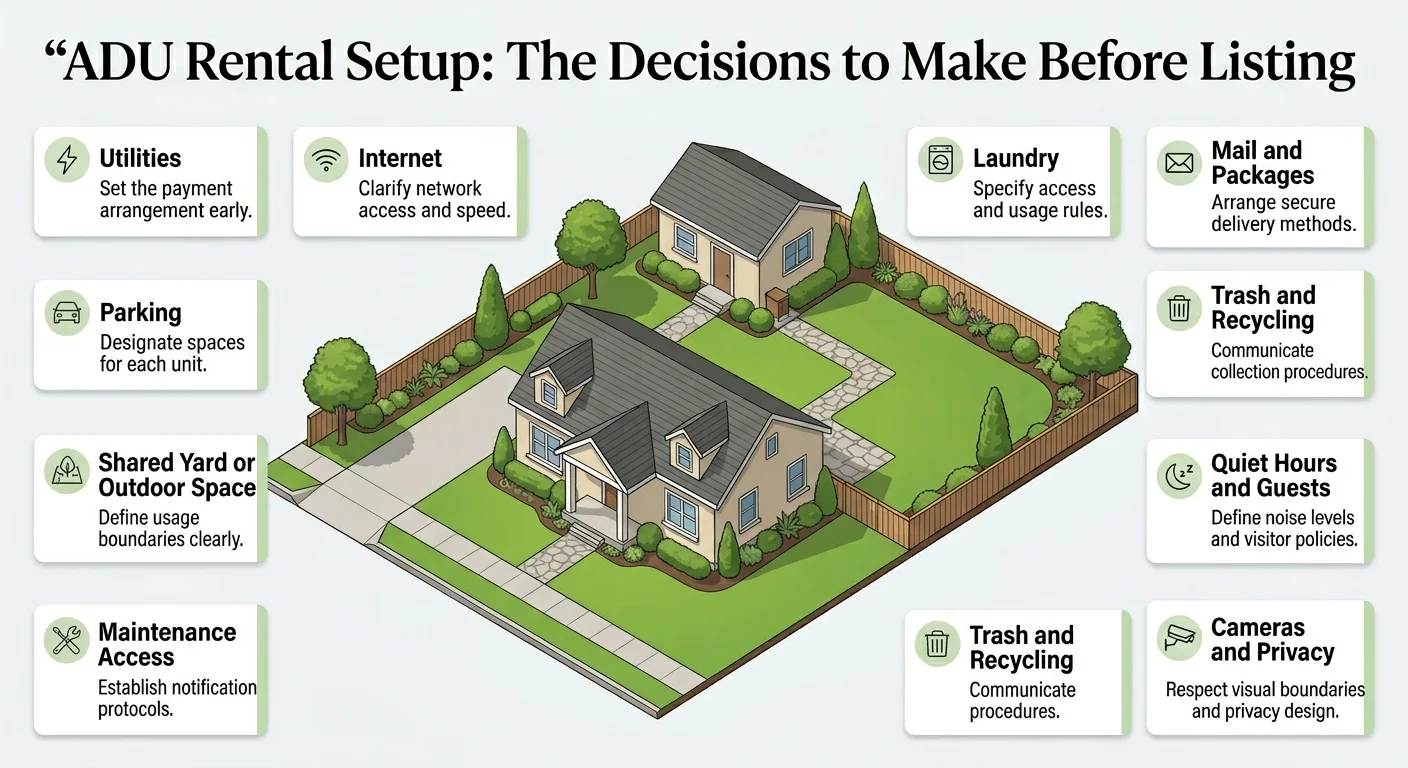
Every issue on this infographic needs a written policy in your lease before the first tenant moves in.
Can You Legally Rent Your ADU?
Before anything else, verify that your unit is legal to rent and that your rental strategy is allowed. Local rules vary far more than national articles imply. We checked official government sources for several cities, and the spread is striking.
How ADU Rental Rules Vary: Real City Examples
| City / County | Long-term rental? | Short-term rental rule | Key local note | Verified |
|---|---|---|---|---|
| Portland, OR | Yes | City flags STR requirements in ADU zoning; SDC waivers require a 10-year covenant not to use the ADU as an STR | Check Portland-specific STR licensing | Apr 2026 |
| Contra Costa County, CA | Yes | An ADU may not be operated as a short-term rental | CA state law (Gov. Code § 66323) requires ADU rentals to be for terms longer than 30 days; § 66315 prohibits local owner-occupancy requirements | Apr 2026 |
| Salt Lake County, UT | Yes, with conditions | Check city-specific STR ordinance | Owner-occupancy affidavit required; business license required before renting; internal ADUs have restrictions on separate utility metering | Apr 2026 |
| Seattle, WA | Yes, if permitted | Must comply with Seattle STR rules; requires business license tax certificate + short-term rental regulatory license | ADUs are not legal unless established through the city permit process (Seattle SDCI) | Apr 2026 |
| Los Angeles, CA | Yes | City's home-sharing program requires the unit to be the host's primary residence; pre-2017 ADUs may have different provisions | CA state law (Gov. Code § 66323) requires 30+ day minimums for qualifying ADUs; § 66315 prohibits local owner-occupancy requirements | Apr 2026 |
| Austin, TX | Yes | ADUs built after Oct 1, 2015 may be used as STR for max 30 days per calendar year; STR license + CO required; platform enforcement begins July 1, 2026 | No owner-occupancy requirement; no additional parking required for ADUs | Apr 2026 |
| Denver, CO | Yes | STRs must be the host's primary residence and require a Denver STR license; STRs in ADUs are generally prohibited except in some PUD zones | In single-unit zone districts, owner must live on-site (primary home or ADU); ADUs must share utility connections with primary home | Apr 2026 |
This table proves a point that generic ADU articles skip: your neighbor in a different city may face completely different rules. The five steps below will protect you. For a deeper dive into your state's rules, see our ADU Laws by State guide.
Confirm the ADU is legally permitted
Confirm the unit has the final approval your jurisdiction requires before occupancy or rental — often a Certificate of Occupancy or final inspection sign-off. Renting an unpermitted unit can create code-enforcement action, insurance claim denials, and lease-enforcement risk. Confirm permit status with your local building department before listing.
Confirm long-term vs. short-term rental rules
Many cities ban or restrict short-term rentals (stays under 30 days) for ADUs specifically — even in cities where the primary home can be listed on Airbnb. In California, current state law requires qualifying ADU and JADU rentals to be for terms longer than 30 days (Cal. Gov. Code § 66323; CA HCD ADU guidance, verified April 2026). Do not assume your ADU follows the same STR rules as your main house.
Confirm owner-occupancy, business license, and HOA constraints
Some jurisdictions require you to live on the property to rent the ADU. Others require a business license or landlord registration. And HOAs may have their own restrictions, even where state law allows ADUs. Check all three layers.
Confirm utility meter and addressing rules
Some cities require separate utility meters for new detached ADUs. Others — like Denver — require ADUs to share utility connections with the primary home. This affects your utility billing strategy and needs to be settled before the first lease is signed.
Save the official source and verification date
Document where you found the rule and when you verified it. Rules change. Having a paper trail protects you if you ever need to prove compliance.
Not sure about your lot or local rules? Our Feasibility Engine checks your specific address against local zoning and ADU regulations.
Get Your Free ADU ReportHow Should You Price an ADU Rental?
Price from local comps, not formulas. The "1% rule" and generic rent calculators were built for apartments, not backyard units. ADU rent is especially sensitive to privacy, parking, laundry, yard separation, and whether the owner lives on-site.
How to run a real ADU comp analysis
- 1Search Zillow, Apartments.com, and Craigslist for "ADU," "guest house," "backyard unit," "granny flat," and "in-law suite" in your ZIP code. Filter by size and bedroom count.
- 2Use Rentometer (rentometer.com) — enter your address and unit size for a quick local rent estimate.
- 3Check Furnished Finder if you are considering mid-term rentals (30+ day stays for travel nurses, corporate relocators, etc.).
- 4Talk to a local property manager — even if you plan to self-manage, a 15-minute call gives you a read on current demand.
What typically raises ADU rent
- Separate entrance and clear visual privacy — consistently the biggest factor
- In-unit washer/dryer — can support stronger asking rents in many markets
- Dedicated parking spot — critical in urban areas
- Private outdoor space (even a small patio)
- Quality finishes — real kitchen, full bathroom, good insulation
- Separate utility meters — tenants prefer knowing their own usage
What typically lowers ADU rent
- –Shared entrance or unclear property boundaries
- –No parking or shared driveway with the main home
- –Shared laundry
- –Noise transfer from the main home
- –The feeling of being observed (poor privacy design)
Long-term vs. mid-term vs. short-term rental strategy
| Factor | Long-term (12+ months) | Mid-term (1–6 months) | Short-term (under 30 days) |
|---|---|---|---|
| Monthly income | Predictable, moderate | Moderate to high | Highest ceiling, least predictable |
| Vacancy risk | Low | Moderate | High (seasonal swings) |
| Owner time | Lower — fewer turnovers | Moderate — periodic turnovers | Highest — frequent turnovers, cleaning, guest communication |
| Furnishing required | No | Usually yes | Yes, plus supplies |
| Legal for ADUs? | Almost always | Usually yes | Banned or restricted in many cities |

A private entrance, covered porch, and defined outdoor area are the features that consistently command the highest ADU rents in long-term rental markets.
How Should You Handle Utilities, Internet, Parking, and Shared Space?
This is where most ADU owners get stuck. Forum threads are full of owners asking the same questions, and most guides give a one-paragraph summary. Here is the real decision matrix.
Utilities: include in rent or bill separately?
| Approach | How it works | Best when | Watch out for |
|---|---|---|---|
| Separate meters | Tenant has their own utility account and pays directly | City allows it; new detached ADU with separate service | Not always legal for attached/internal ADUs (e.g., Denver requires shared utility connections) |
| Submeter | You read the submeter and bill the tenant for usage | Separate meters not feasible; you want usage-based billing | Some cities restrict submetering; check local utility rules |
| Flat utility allowance | You add a fixed amount to the rent to cover estimated utilities | Simplicity; predictable income; no billing disputes | You absorb the risk if tenant uses more than estimated |
| Included in rent | Utilities are rolled into the total rent amount | Studio or small unit with low usage; simplicity is the priority | Tenant has no incentive to conserve; you absorb all cost |
Internet: shared Wi-Fi or separate service?
A separate internet line for the tenant often simplifies both privacy and billing. Shared Wi-Fi sounds convenient until your bandwidth drops during a work call, or your tenant asks for your network password. A separate line — paid directly by the tenant — eliminates those issues. If the ADU is close enough to the main house that running a separate line is impractical, use a dedicated guest network with bandwidth limits — and put the arrangement in the lease.
Parking
Parking ambiguity can create avoidable conflict fast. Decide before listing:
- ·How many spots does the tenant get? (Specify the exact location.)
- ·Where do tenant guests park?
- ·Is the driveway shared? If so, who parks where?
- ·EV charging — available? Who pays for electricity?
Write every answer into the lease.
Shared yard, outdoor space, and access
Draw the line — literally if you can. Use fencing, landscaping, or pathway design to define which outdoor space belongs to the tenant and which is yours. If the ADU has a small patio, designate it. If the backyard is shared, spell out the rules.
Vague boundaries breed resentment. Clear ones build good relationships.
Noise, guests, quiet hours, maintenance access
Quiet hours
10 PM–8 AM is standard. Put it in the lease.
Guests
Set a maximum number of overnight guests and a limit on consecutive nights (e.g., no guest stays longer than 14 consecutive days without approval).
Maintenance access
Your state has notice requirements — typically 24–48 hours written notice for non-emergency entry. Follow the law, even though the unit is in your backyard.
Smoking
If you prohibit smoking on the property, say so explicitly.
Should You Self-Manage Your ADU?
Self-managing a single ADU works for most on-site owners. The workload is lighter than people fear — once your systems are in place. The challenge is not time; it is building those systems before the first tenant moves in.
What self-management actually includes each month
Rent collection
Set up automatic payments (ACH, Zelle, or through software). Do not chase checks.
Maintenance requests
Respond within 24 hours for non-emergencies. Have a plumber, electrician, and general handyperson on speed dial before something breaks.
Communication
Keep it professional and documented. Text or email, not verbal agreements.
Bookkeeping
Track every dollar of income and expense. You will need this for Schedule E at tax time.
Quarterly inspection
Walk the unit, check for maintenance issues, confirm lease compliance. Give proper notice.
Where first-time ADU landlords underestimate the work
- 1
Tenant selection
Screening takes more effort than you expect. Do not skip it because the first applicant seemed nice.
- 2
Lease drafting
A generic lease template is not enough for an ADU. You need ADU-specific clauses (covered below).
- 3
Boundary enforcement
The first time your tenant's guest parks in your spot or leaves trash in the wrong place, you will wish you had put it in writing.
- 4
Tax preparation
Tracking expenses throughout the year is easy. Reconstructing them in April is miserable.
When self-management is the wrong fit
- You live more than 30 minutes from the ADU.
- You travel frequently and cannot respond to maintenance requests within 24 hours.
- You have a low tolerance for tenant interaction.
- You own three or more rental units and your time is better spent elsewhere.
When Does Property Management Software Make Sense?
Software makes sense when you want to keep control but stop relying on memory, text threads, and spreadsheets. For a single ADU, it is the middle path between doing everything manually and paying a percentage of your rent to a manager.
The Dwelling Index is reader-supported. When you use our links to explore property management tools, we may earn a commission at no extra cost to you. Our editorial recommendations are based on independent research and are never influenced by compensation. Full affiliate disclosure · Editorial methodology
What software solves that DIY landlords dislike most
Rent collection
Automated ACH. No more chasing payments.
Tenant screening
Credit, background, and eviction checks built into the application process.
Maintenance tracking
Tenants submit requests through the app. You see a log, not a text thread.
Lease management
Digital signing, storage, and renewal reminders.
Bookkeeping
Automatic income and expense tracking. Export for tax time.
Listing syndication
Post your rental to Zillow, Apartments.com, and other sites with one click.
Property Management Software Compared for ADU Owners
We evaluated these platforms through the lens of a single-ADU or small-portfolio landlord — not a 500-unit property management company.
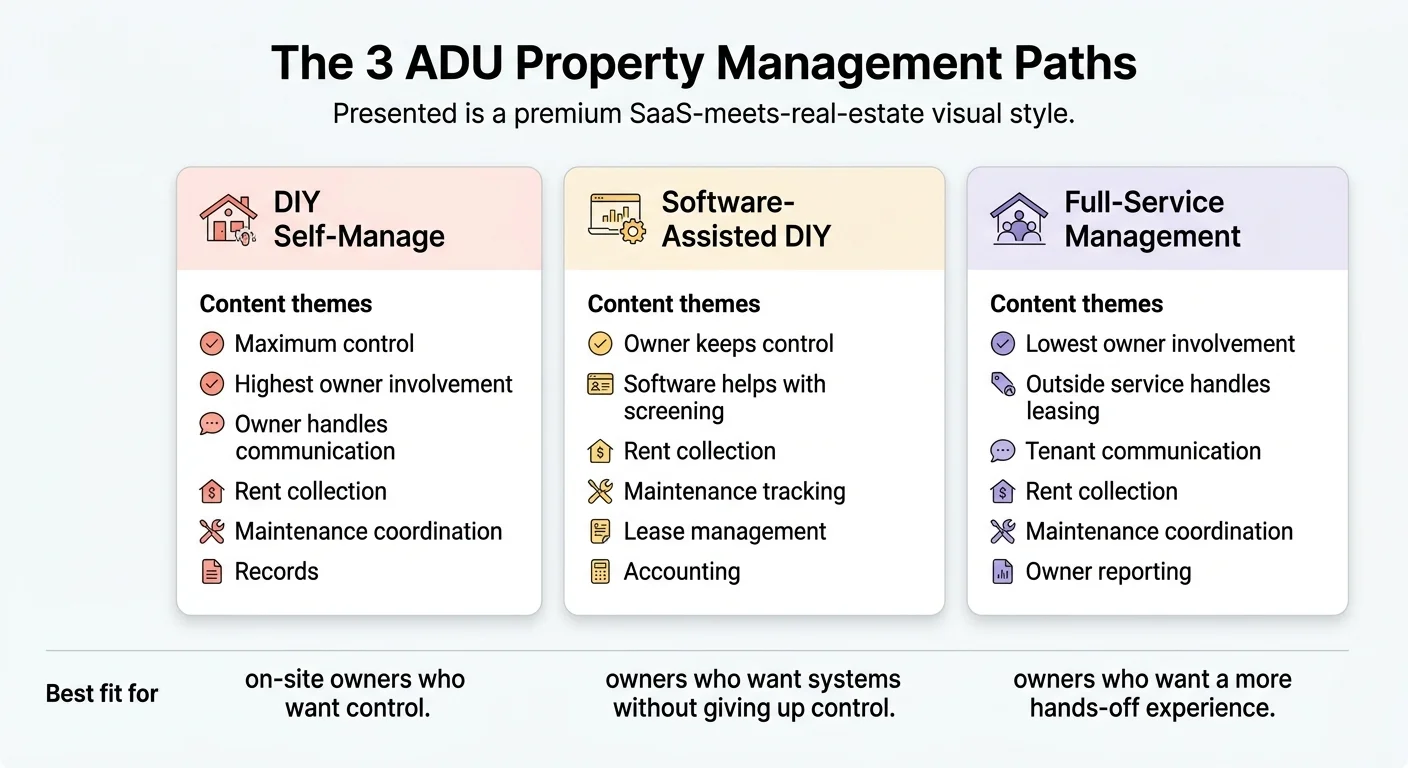
Choosing your management path is more important than choosing the specific tool.
| Platform | Starting price (1 unit) | Rent collection | Tenant screening | Maintenance | Accounting | Listing syndication |
|---|---|---|---|---|---|---|
| Avail (by Realtor.com) | Free ($0/unit) | ACH | Credit + background | Basic request system | Basic income/expense | Realtor.com network |
| Buildium | $62/mo (Essential) | ACH + credit card, auto-deposit | Credit, background, eviction reports | Work orders + vendor management | Full accounting suite + reporting | Syndicated to major rental sites |
| Landlord Studio | Free (up to 3 units) | ACH | TransUnion screening | Basic task tracking | Bank feeds, receipt scanning, reports | Limited |
| RentRedi | ~$12/mo (Grow plan, annual) | ACH + card + cash at retail locations | TransUnion + background | Photo/video request submission | Reports + QuickBooks integration | Zillow + partner sites |
| TenantCloud | $15/mo (annual) | ACH + card | Full screening suite | Requests + vendor marketplace | Financial reports | Multiple listing sites |
| TurboTenant | Free (basic plan) | ACH (free for landlords) | TransUnion screening | Basic request tracking | Basic + QuickBooks export | 20+ listing sites |
Sorted alphabetically. Pricing checked April 2026 — features and fees vary by plan tier. Confirm current rates on each platform's website.
Affiliate disclosure: Some links above are affiliate links. We do not rank tools by compensation — platforms are sorted alphabetically. Our editorial recommendations are independent.
Our take for ADU owners
If you want free and simple:
TurboTenant, Avail, or Landlord Studio. All handle the basics without a monthly fee.
If you want one system that does everything well:
Buildium. The $62/month Essential plan is a real line item for a single unit — but if you plan to grow your portfolio, or if you value having screening, accounting, and maintenance in one platform, it replaces the patchwork of apps and spreadsheets that drives most DIY landlords crazy. Buildium is purpose-built for residential property management at any scale.
If you want the cheapest paid option with strong features:
RentRedi at roughly $12/month (annual plan) is hard to beat for a small portfolio.
Software-assisted path
Want clean systems without the DIY learning curve?
Buildium handles tenant screening, automated rent collection, maintenance tracking, and tax-ready accounting — purpose-built for residential property managers.
Explore BuildiumWhen Is Full-Service Management Worth Paying For?
Full-service management makes sense when your time, distance, or temperament makes the DIY path impractical — and you are willing to pay 8–12% of monthly rent for someone else to handle it. For a single ADU renting at $2,000/month, that is roughly $160–$240/month, plus placement fees and potentially maintenance coordination charges. That is real money. But for the right owner, it is worth every dollar.
What a full-service property manager should handle
Traditional local PM vs. tech-forward management
The property management industry is splitting into two models, and both serve ADU owners differently.
Traditional local PM companies
Relationship-based. You get a local manager who knows your market, handles everything in person, and typically charges 8–12% of rent plus a placement fee. Quality varies enormously — the best are worth it, the worst create more problems than they solve.
Tech-forward services (e.g., Belong)
App-based platform with in-house maintenance teams. Belong markets guaranteed rent — stating that homeowners receive rent on time even if the tenant pays late — plus broad metro coverage across California, Florida, Texas, Washington, Oregon, and other regions. Always confirm coverage and current pricing for your specific market.
When full-service is worth it for one ADU
- You live far from the property and cannot respond to issues quickly
- You own multiple rentals and managing one more unit tips the scale
- You tried self-managing and tenant contact is affecting your quality of life
- You want rent payment guarantees regardless of tenant behavior
- Your time is genuinely worth more than the management fee
When it is probably not worth it
- –You live on the same property and are comfortable with basic landlord tasks
- –The management fee significantly erodes your net income
- –You enjoy the control and do not mind the time investment
- –Your ADU is in a market that full-service companies do not cover yet
Choose Your ADU Management Path
Software-assisted path
Keep control with software
Buildium gives you screening, rent collection, maintenance tracking, and accounting in one platform.
Explore BuildiumFull-service path
Want a more hands-off option?
Belong handles placement, rent collection, and in-house maintenance — and offers guaranteed rent in covered markets.
Check Belong coverageWe do not rank partners by compensation. Choose based on your management path, market, and how hands-on you want to be. Full affiliate disclosure
How Do You Screen Tenants for a Backyard Rental?
Tenant screening matters more in an ADU because the consequences of a bad match are more personal. A difficult tenant in an apartment across town is stressful. A difficult tenant 30 feet from your bedroom is life-altering.
That said — and this is important — screening must be fair, consistent, and compliant with the Fair Housing Act. The Fair Housing Act protects people from discrimination in rental housing based on race, color, national origin, religion, sex (including sexual orientation and gender identity), familial status, or disability (HUD.gov — Fair Housing Act overview, verified April 2026). You screen on documented, consistent criteria applied equally to every applicant.
A fair, consistent screening process
Set your criteria before you receive any applications
Write down your minimum credit score, income requirement (3x monthly rent is standard), and any other objective criteria. Apply the same criteria to every applicant.
Require a completed application from every serious prospect
Include authorization for credit and background checks.
Run credit, background, and eviction checks
Most property management software includes this. If you are self-managing without software, services like TransUnion SmartMove offer standalone screening.
Verify income and employment
Request the two most recent pay stubs and verify employment directly with the employer.
Contact previous landlords
Ask about payment history, lease compliance, and whether they would rent to the person again. Call at least two prior landlords — not just the current one (who may give a good reference to move the tenant along).
Meet the applicant in person
This is standard for ADU rentals. You are not screening for personality — you are confirming the information matches and setting expectations for the shared-property dynamic.
Document your decision
If you reject an applicant, document the objective reason. This protects you if a fair housing complaint is ever filed.
What not to do
- Do not waive screening because someone offers to pay cash upfront.
- Do not use social media as a substitute for a proper background check.
- Do not ask about marital status, children, religion, disability, national origin, or any other protected class.
What Should Your ADU Lease Include?
A standard residential lease is not enough for a same-lot ADU rental. Every operational decision you made about utilities, parking, yard, and shared space needs to be in writing — not assumed. Start with a state-compliant residential lease agreement, then add the following ADU-specific clause topics.
ADU Lease Clause Checklist
| Clause Topic | What to specify | Why it matters for ADUs |
|---|---|---|
| Utilities | Who pays, how billed, which meters, estimated costs if flat-rate | Prevents monthly billing disputes |
| Internet | Separate line or shared; who pays; bandwidth expectations | Shared Wi-Fi is one of the most avoidable ADU conflicts |
| Parking | Exact spot(s), guest parking rules, driveway use | Parking ambiguity is another top source of friction |
| Outdoor space | Defined area for tenant use; shared area rules | Prevents 'creeping' use of your yard |
| Laundry | In-unit, shared, or laundromat; if shared, schedule or access rules | Sets expectations before move-in |
| Guests and visitors | Maximum overnight guests, maximum consecutive nights | Prevents unauthorized long-term occupants |
| Quiet hours | Specific times (e.g., 10 PM–8 AM) | Sound carries differently in close-proximity rentals |
| Pets | Allowed or not; breed/size/number limits; pet deposit; yard rules | Noise and yard impact affect the whole property |
| Smoking | Prohibited on property or restricted to designated area | Smoke travels between close structures |
| Maintenance access | Notice period (per state law), preferred contact method, emergency protocol | Legal requirement + practical necessity |
| Cameras / surveillance | Disclose any exterior cameras on the property | Required in many states; builds trust |
| Trash and recycling | Who takes bins out; collection day; where bins are stored | Small but frequent source of friction |
| Mail and packages | Separate mailbox or address; package delivery location | Prevents lost mail and confusion |
| Renters insurance | Required or recommended; minimum coverage amount | Protects both parties |
| Move-in / move-out | Condition checklist with photos, deposit documentation | Prevents disputes at move-out |
We are building a downloadable ADU lease clause template — check back soon, or grab the 2026 ADU Starter Kit which includes the current version.
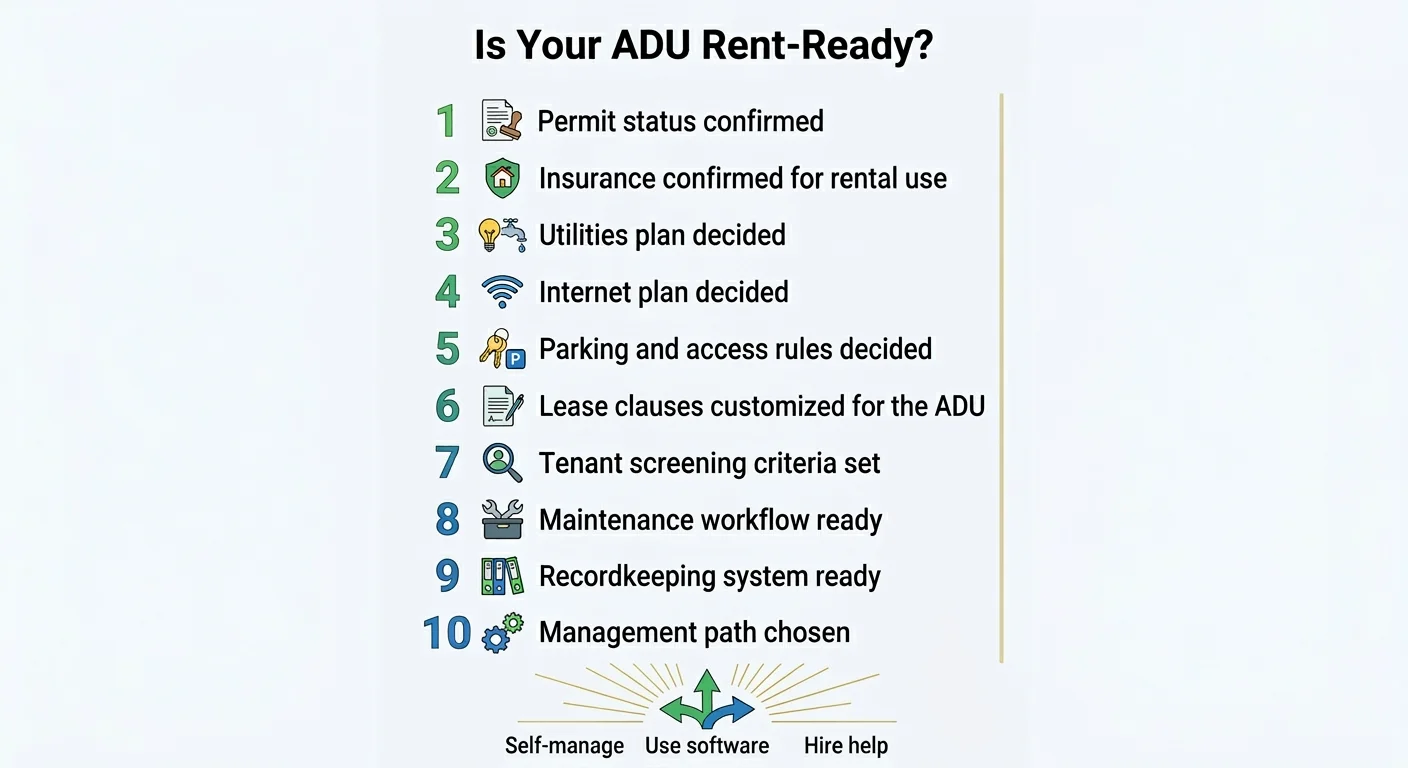
Use this 10-step checklist to confirm your ADU is ready to list — and your systems are in place before the first tenant moves in.
How Do You Handle Maintenance, Bookkeeping, and Taxes?
Set up your maintenance and recordkeeping systems before the first tenant moves in — not during your first emergency.
Maintenance workflow
Build your vendor list now
You need a plumber, electrician, general handyperson, and HVAC technician before something breaks.
Set response time expectations
Non-emergency requests: respond within 24 hours, resolve within a reasonable timeframe. Emergencies (flooding, gas leak, no heat in winter): respond immediately.
Track every request in writing
Property management software makes this automatic. If you are fully DIY, use email threads or a simple tracking spreadsheet — not text messages that disappear.
Build a maintenance reserve
Set aside a portion of each rent payment into a separate account for repairs.
Bookkeeping: what to track
The IRS requires rental income to be reported on your tax return and allows deduction of ordinary and necessary expenses for managing and maintaining rental property. Income and deductions for rental real estate are reported on Schedule E (IRS — Tips on Rental Real Estate; IRS Publication 527, verified April 2026). Clean records make the difference between maximizing deductions and leaving money on the table.
Track monthly:
Key tax deductions for ADU landlords
| Deduction | What you can claim |
|---|---|
| Depreciation | Allocable depreciable basis of ADU ÷ 27.5 years (residential rental property). Example: if your allocable depreciable basis were $200,000, straight-line depreciation would be about $7,273/year. Actual treatment depends on basis allocation, personal use, and your tax facts. |
| Mortgage interest | Portion allocable to ADU (if financed) |
| Property tax | Portion allocable to ADU |
| Insurance | Landlord insurance premium for ADU coverage |
| Repairs | ADU-specific repair costs |
| Management fees | PM company fee or software subscription |
| Advertising | Listing fees, photography |
This is educational information, not tax advice. Consult a tax professional familiar with rental property for your specific situation. Keep records as long as they may become material to the administration of any provision of the tax code (IRS Publication 527).
When Should You Not Rent the ADU Yet?
Sometimes the smartest management decision is: wait. We would rather you pause and get it right than rush to list and create a problem that costs more than a few months of rent.
The unit is not legally permitted
Renting an unpermitted ADU exposes you to code-enforcement action, potential insurance claim denials, and lease-enforcement risk. Confirm permit status with your local building department first.
Your insurance does not cover rental use
Homeowners coverage may not be enough for rental use. Confirm with your insurer whether you need a landlord policy or other rental-appropriate coverage before listing (NAIC — insurance coverage for home-sharing rentals, verified April 2026).
You have not confirmed your city's rules
If you are not sure whether your city allows ADU rentals, requires a business license, imposes owner-occupancy rules, or restricts short-term rentals — do not list until you know. Use the city-rule table above as a starting point.
Utility metering and billing are unresolved
If you are going to argue about the electric bill every month, nobody will be happy. Settle the utility arrangement before the lease is signed.
You are not prepared to be an on-site landlord
Managing a tenant next door requires boundaries, documentation, and a professional mindset. If you are not ready for that, hire help — or wait until you are.
Short-term rental was the only strategy that made the math work — and your city bans it for ADUs
If the income only pencils as an Airbnb and your city prohibits ADU short-term rentals, the math does not work yet. Explore whether mid-term rentals (30+ days) change the equation. For more on ADU financing options that may improve your overall numbers, see our financing guide.
Free resource
Download the Free 2026 ADU Starter Kit
Includes our ADU property management checklist, lease clause template, and tax deduction worksheet.
Download the Free 2026 ADU Starter KitFrequently Asked Questions
Do I need a property manager for one ADU?
Most single-ADU owners living on the same property do not. Self-managing with property management software is usually the most cost-effective path. Consider a manager if you are remote, time-strapped, or own multiple units.
Can I rent my ADU on Airbnb?
It depends entirely on your city. Many cities ban short-term rentals for ADUs even where the primary home can be listed. California state law requires qualifying ADU rentals to be for terms longer than 30 days (Cal. Gov. Code § 66323). Austin limits post-2015 ADUs to 30 STR days per calendar year. Always check your local municipal code before listing.
Should I include utilities in the rent?
If you can get separate meters, that is the cleanest option. If not, a flat utility allowance included in rent simplifies billing and reduces disputes. Avoid shared billing based on usage estimates — it creates monthly friction.
What should an ADU lease include that a normal lease does not?
Shared property boundaries, parking allocation, outdoor space rules, utility billing method, internet arrangement, quiet hours, guest policies, maintenance access protocols, and camera/surveillance disclosure. Standard lease templates miss all of these.
Do I need different insurance to rent the ADU?
Likely yes. Homeowners coverage may not cover rental activity. Confirm with your insurer whether you need a landlord policy or rental-appropriate coverage before listing.
Can ADU tenants have their own utility meters?
It varies by city. Many allow or require separate meters for new detached ADUs. Some — like Denver — require ADUs to share utility connections. Check your local utility company and building department.
Is renting an unpermitted ADU risky?
Yes. You face potential code-enforcement fines, insurance claim denials, and lease-enforcement complications. Confirm permit status before listing.
What records should I keep for ADU rental taxes?
Track all rental income, security deposits, repair costs, insurance premiums, utility payments, software subscriptions, advertising costs, and professional fees. Report income and deductions on IRS Schedule E. Keep records as long as they may be relevant to your tax filings (IRS Publication 527).
Is property management software worth it for just one unit?
Even free options like TurboTenant or Landlord Studio save meaningful time by automating rent collection and organizing documents for tax time. Paid options add screening, accounting, and maintenance tracking that replace a patchwork of apps.
Does Belong operate in my market?
Belong currently covers multiple major metros including markets in California, Florida, Texas, Washington, and Oregon, with coverage expanding. Check belonghome.com directly for your specific city.
Can I live in the ADU and rent out the main house?
In most jurisdictions, yes — as long as the ADU is legally permitted and the rental complies with local rules. The main house typically rents for more, and you save on living expenses by occupying the smaller unit. Verify with your local planning department.
What is the Fair Housing Act and how does it affect ADU screening?
The Fair Housing Act prohibits discrimination based on race, color, national origin, religion, sex (including sexual orientation and gender identity), familial status, or disability in rental housing. You must apply consistent, documented screening criteria to every applicant. 'Good neighbor fit' must never become discriminatory screening.
Disclosures, Methodology, and Sources
Affiliate disclosure
The Dwelling Index is reader-supported. When you use our links to explore property management tools, we may earn a commission at no extra cost to you. Our editorial recommendations are based on independent research and are never influenced by compensation. We do not rank or order tools by who pays more — platforms are sorted by neutral documented criteria. Full affiliate disclosure · Editorial methodology
How we built this page
We reviewed official ADU regulations from multiple cities and counties (linked and dated in the city-rule table above), evaluated six property management software platforms for ADU-specific needs, cross-referenced owner discussions from BiggerPockets, Reddit (r/AccessoryDwellings, r/Landlord), and verified pricing and feature claims against each platform's official website as of April 2026.
Sources cited in this article
- ·HUD — Fair Housing Act overview (hud.gov, verified April 2026)
- ·IRS — Tips on Rental Real Estate Income, Deductions and Recordkeeping (irs.gov, verified April 2026)
- ·IRS Publication 527 — Residential Rental Property (irs.gov, verified April 2026)
- ·California HCD — ADU and JADU guidance; Cal. Gov. Code §§ 66315, 66323, 66333 (hcd.ca.gov, verified April 2026)
- ·Portland, OR — ADU zoning standards (portland.gov/ppd, verified April 2026)
- ·Contra Costa County, CA — ADU and STR regulations (contracosta.ca.gov, verified April 2026)
- ·Salt Lake County, UT — ADU ordinance (saltlakecounty.gov, verified April 2026)
- ·Seattle, WA — SDCI ADU permits (seattle.gov/sdci, verified April 2026)
- ·Austin, TX — STR regulations and ADU info (austintexas.gov, verified April 2026)
- ·Denver, CO — Citywide ADUs and zoning code (denvergov.org, verified April 2026)
- ·NAIC — Insurance coverage for home-sharing rentals (naic.org, verified April 2026)
- ·Buildium — Platform features and pricing (buildium.com, verified April 2026)
- ·Belong — Homeowner services and coverage (belonghome.com, verified April 2026)
Important notes
- ·This page is educational content, not legal, tax, insurance, or property management advice.
- ·Financial projections and rental income estimates are illustrative examples, not guarantees of returns. Actual results depend on local market conditions, construction costs, and regulatory approvals.
- ·Always confirm local rules directly with your city or county planning department.
- ·Verify insurance requirements with a licensed insurance agent.
- ·Consult a CPA or tax professional for rental income tax questions.
Last reviewed and verified: April 2026. We review this page quarterly and update it when rules, pricing, or platform features change. If you spot something outdated, let us know.
Related ADU Guides
How Much Can I Rent My ADU For?
Real rent ranges by size, type, and market — plus a 5-step pricing method.
ADU Financing Options
HELOCs, construction loans, HEIs, and ADU-specific loan programs compared.
ADU Laws by State
State-by-state breakdown of ADU setback rules, size limits, and owner-occupancy requirements.
ADU Rental Income Guide
Rental income projections, tax implications, and strategies to maximize your return.
Not sure where to start?
See What You Can Build. We check local zoning, lot eligibility, and estimated costs for your specific property — free.
Get Your Free ADU Report