
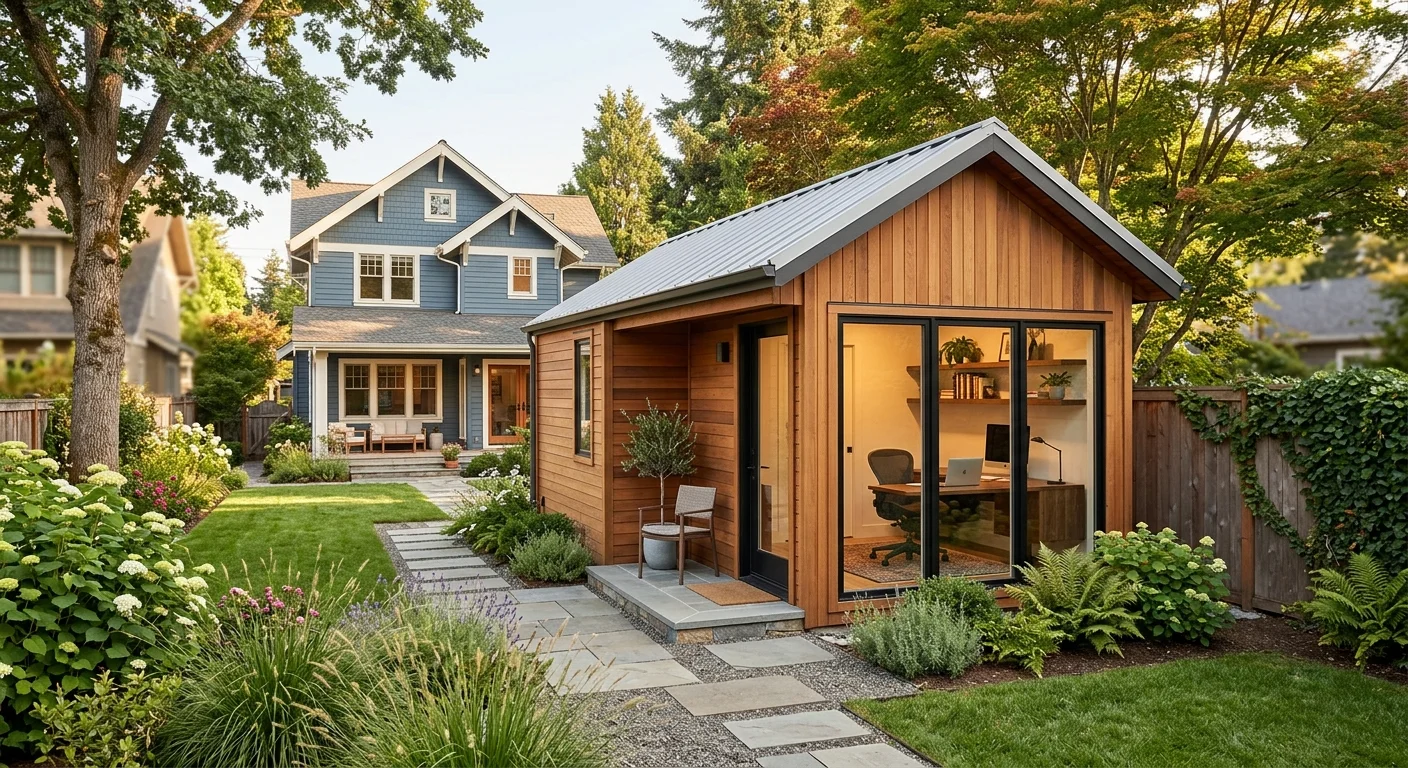
Do You Actually Need a Full ADU for a Home Office?
Usually, no.
If your only goal is a private place to work, a simpler detached structure is often the smarter move. A full ADU becomes the right answer when you want independent living features — a bathroom, kitchenette, sleeping area — or when you want the flexibility to host guests or rent the space later.
We say this knowing it's an unusual thing to read on an ADU site. But the honest answer serves you better than steering everyone toward the biggest project.
If you just need deep-work space and video-call privacy
A well-insulated backyard office or detached studio handles the job. Physical separation from the house, climate control, wired internet, a door that locks. All without the cost or permitting complexity of a dwelling unit. Budget: roughly $5,000 to $25,000 installed. Timeline: days to weeks.
If you want a bathroom and all-day comfort
You're stepping into a more serious build. Adding plumbing almost always triggers a building permit, even if the structure itself would otherwise be exempt. This is the threshold where many homeowners realize they might as well build a small ADU — because once you're pulling permits and trenching for water and sewer, the incremental cost of a kitchenette and sleeping area is modest compared to the flexibility it unlocks.
If you want guest flexibility or future rental potential
Build a true ADU from day one. Retrofitting a backyard office into a permitted dwelling unit later is significantly more expensive than designing for it from the start. The foundation, framing, insulation, and utility rough-ins all need to meet dwelling-unit code — and that's dramatically easier to do during initial construction.
If you don't have usable backyard space
A garage conversion or interior conversion may be the move. You work with existing structure, which keeps costs lower, but you trade some of the physical separation that makes a detached workspace so effective for focus.
The question that clarifies everything:
Will you want this space to serve a second purpose someday — guest room, rental, in-law suite? If even “maybe,” build a permitted ADU from the start.
Not sure what your property allows?
See What You Can Build at Your Address
We check your lot's zoning, setbacks, and local ADU rules in about 60 seconds. Currently available for properties in CA, UT, TX, CO, and NY.
Get Your Free ADU ReportWhat Makes Something a Real ADU Instead of Just a Backyard Office?
A real ADU is not just “a nice backyard building.” This distinction matters more than most people realize — it affects your permits, financing, insurance, appraisal, and tax treatment.
Fannie Mae defines an ADU as a separate living area that includes space for living, sleeping, cooking, and bathroom facilities, with independent access (Fannie Mae Selling Guide B2-3-04). Without those features, you have an accessory structure — a studio, an office, a shed — but not a true ADU.
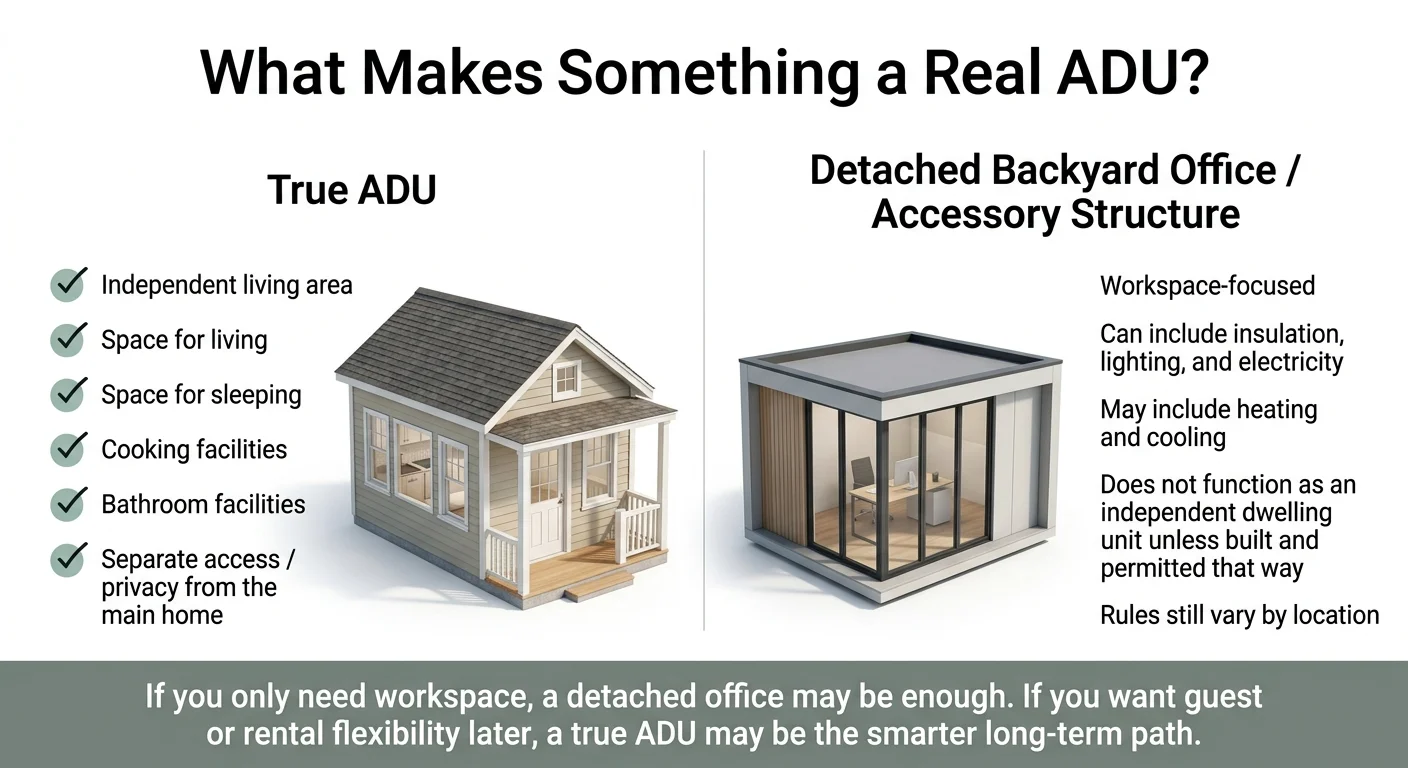
If you only need workspace, a detached office may be enough. If you want guest or rental flexibility later, a true ADU may be the smarter long-term path.
| Feature | True ADU | Detached office / accessory structure |
|---|---|---|
| Kitchen or kitchenette | Required | Not present |
| Bathroom | Required | Optional (adding it usually triggers a permit) |
| Sleeping area | Required | Not applicable |
| Separate entrance | Required | Recommended but not always required |
| Building permit | Always required | Depends on size, utilities, and jurisdiction |
| Recognized by Fannie Mae / Freddie Mac | Yes — documented in appraisal as ADU | Generally not recognized as separate unit |
| Can contribute to appraised value as a dwelling | Yes — value impact varies by market | Minimal to moderate |
| Qualifies for rental income (where zoning allows) | Yes | Generally no |
Source: Fannie Mae Selling Guide B2-3-04, Special Property Eligibility Considerations. Verified April 2026.
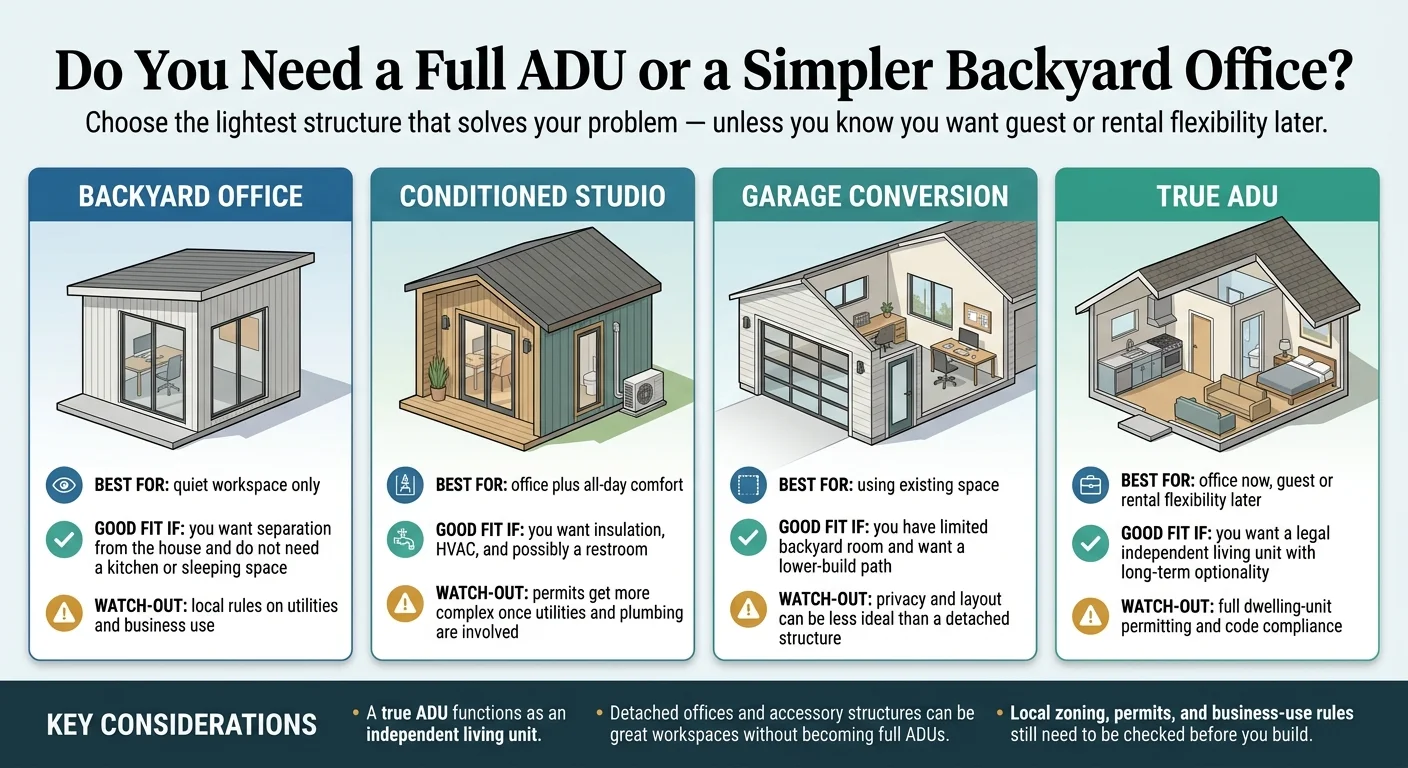
Choose the lightest structure that solves your problem — unless you know you want guest or rental flexibility later.
Why “we'll just add a kitchenette later” is not a minor decision
The moment you add cooking facilities to an accessory structure, most jurisdictions reclassify it as a dwelling unit. That triggers full ADU code compliance — fire separation, egress windows, energy code, and potentially impact fees. A $3,000 kitchenette install can trigger $30,000+ in code-compliance costs if the structure wasn't built to dwelling-unit standards from the start. If there's any chance you'll want kitchen or full-bath facilities in the future, design and permit it as an ADU now.
How Much Does an ADU for Home Office Cost? (2026 Data)
The range is wide because the paths are genuinely different. A basic backyard office and a full detached ADU are not the same project — and lumping them together is how people make expensive mistakes.
| Path | All-in typical range |
|---|---|
| Office shed (non-habitable, no plumbing) | $5,000–$20,000 |
| Prefab office pod (insulated, wired, no plumbing) | $10,000–$40,000 |
| Garage conversion (JADU / office) | $20,000–$65,000 |
| Conditioned studio with half-bath | $35,000–$80,000 |
| Prefab ADU (turnkey, delivered with plumbing) | $65,000–$175,000 |
| Detached ADU (custom new build, kitchen + bath) | $100,000–$250,000+ |
Methodology: Ranges reflect a composite of published manufacturer pricing, builder cost surveys, and permit fee data across multiple U.S. markets. All-in estimates include site preparation, utility connections, permits, and basic finishes. Actual costs vary significantly by region, site conditions, labor rates, and finish quality. These are planning ranges, not quotes. Last updated April 2026.
The Hidden Costs Most Guides Skip
The “base price” of any structure is almost never the final installed price. Here's what catches people:
Site preparation
Grading, clearing, and leveling. Can run $1,000–$5,000+ depending on slope and soil conditions.
Utility trenching
Running electrical, water, and sewer from the house to the new structure. This cost is nearly the same whether you're building 200 SF or 800 SF — which is why building as large as your lot and budget allow often makes the most financial sense.
Electrical panel upgrade
If your main panel is already at capacity, adding a second structure may require a panel upgrade ($2,000–$6,000+). Get a load calculation done early.
Foundation
Even a "simple" prefab office pod needs a proper foundation — concrete slab, piers, or a prepared base. Factor this into every quote.
Impact fees
For a full ADU, cities may charge development impact fees, school fees, or park fees. These range from zero to tens of thousands depending on your jurisdiction.
Permit and plan review fees
Separate from construction costs. These can range from a few hundred dollars to several thousand. Always request the fee schedule from your building department upfront.
The Math That Changes the Conversation: ADU vs. Renting Office Space
Coworking desk
$48,000
over 10 years
You own nothing at the end
Small commercial lease
$180,000
over 10 years
$1,500/month, also gone
Backyard ADU
One-time build
keeps paying you
Add rental income when you're done with the office — $1,500–$3,000+/month
These are illustrative comparisons, not guarantees of returns. Actual results depend on local market conditions, construction costs, financing terms, and regulatory approvals.
Need help thinking through the money side?
We break down every financing path — HELOCs, renovation loans, home equity investments, and construction loans — in plain language.
See how homeowners typically pay for ADUsWhat Permits Do You Need — and When Does a “Simple Office” Stop Being Simple?
There is no single national threshold — which is exactly why people get burned.
The internet is full of confident statements like “anything under 120 square feet doesn't need a permit.” That's true in some places. It's dangerously wrong in others.
The General Pattern (With Major Caveats)
Most U.S. cities and counties follow a rough pattern: smaller non-habitable structures without plumbing may be exempt from a building permit, but zoning rules — setbacks, lot coverage, height limits — almost always still apply even when a building permit doesn't. Once you add plumbing or cross certain size thresholds, the permit path gets real.
Key trigger points to know:
Plumbing of any kind
Almost always triggers a separate plumbing permit — even a single sink or toilet.
Electrical installation
Permanently wired electrical work requires an electrical permit in virtually every jurisdiction.
Permanent HVAC
A mini-split installation typically requires a mechanical permit. Plug-in space heaters do not.
Size thresholds
Varies dramatically — 120 SF, 200 SF, or different numbers by city. Never assume; always verify.
Habitable use
The moment a space is designed for human habitation (sleeping, cooking), most code exemptions disappear.
Zoning rules
Always apply regardless of permit status — setbacks, lot coverage, height. Check these first.
Real Jurisdiction Examples
We've checked these directly. They illustrate how differently cities handle the same basic question.
| Jurisdiction | Permit-exempt threshold | What triggers a permit even below that size? | Business-use note | Verified |
|---|---|---|---|---|
| Portland, OR | Non-habitable detached one-story accessory structures ≤200 SF are exempt from a structural building permit per Oregon Residential Specialty Code R105.2. Structure must not contain kitchen, bedroom, living room, or dining room. | Electrical, mechanical, and plumbing work each require separate trade permits. A zoning permit may still be required. Habitable structures require a building permit regardless of size. | Home occupation permits may apply for client-facing businesses. | April 2026 |
| Clear Creek County, CO | One-story detached accessory structures ≤120 SF for tool/storage shed use are exempt from building permit. | Structures over 120 SF require a building permit. Electrical, plumbing, and mechanical work require separate permits. Setback and zoning rules still apply. | Check county home occupation provisions. | April 2026 |
| Fairfax County, VA | Small accessory structures may be exempt under specific size thresholds per county code. | Electrical and plumbing additions trigger permits. | Fairfax County explicitly states that teleworking is NOT a home-based business. Client-facing businesses need zoning approval. | April 2026 |
Sources: Portland BOD 21-05; Portland.gov Garages/Sheds page; Clear Creek County Resolution #24-016; clearcreekcounty.us; Fairfax County Zoning Ordinance, Home-Based Business provisions. Verified April 2026.
The bottom line: Do not build from a forum answer.
Call your local planning or building department, describe exactly what you want to build, and ask: “What permits or approvals does this require?” Get it in writing if possible. Rules vary not just by state, but by city — and they change.
HOA Restrictions: The Blocker Nobody Mentions Until It's Too Late
Even if your city allows it, your homeowners association may not. Some states — California most notably, under Civil Code § 4751 — have passed laws that limit HOA authority to restrict ADUs. But in most states, if your CC&Rs prohibit detached structures or dwelling units, the HOA can block your project regardless of municipal zoning.
Check three things before you get too far:
Your city or county's zoning and building requirements
Your HOA's CC&Rs and architectural review process
Your state's ADU legislation (which may preempt your HOA in some states)
Not sure what the rules are at your address?
We check zoning, lot size, setbacks, and local ADU regulations for your specific property. Currently available in CA, UT, TX, CO, and NY.
Check What You Can BuildTax Deductions and Property Value: What You Can Actually Claim
Can You Work With Clients in Your ADU? And Can You Deduct It on Your Taxes?
Two separate questions that people mash together. Let's untangle them.
Client Visits and Home Occupation Rules
Working from home and running a client-facing business from home are not the same thing in many jurisdictions.
Teleworking
You sit at a desk, communicate digitally, nobody visits your property for business. Largely unregulated in most places. Fairfax County, Virginia explicitly states that teleworking does not constitute a home-based business.
Client-facing home businesses
Clients physically visit your property. Often requires a home occupation permit. Rules vary on daily visitor counts, nonresident employees, signage, parking, and hours. Therapists, consultants, tutors — check your city's home occupation rules before you build.
Tax Deductions for a Detached Workspace
The IRS allows a home office deduction for a qualifying separate structure used exclusively and regularly for business. This applies to any qualifying detached workspace — ADU or otherwise — that meets the requirements under IRS Publication 587. A separate structure makes the IRS's exclusive-use test easier to satisfy, and if you later convert the space to rental use, you unlock an entirely different category of deductions.
Who qualifies
Self-employed individuals, freelancers, sole proprietors, business owners: yes
W-2 employees working remotely: generally no under current IRS guidance
What you can deduct (if you qualify)
Simplified method: $5 per sq ft, up to 300 SF = max $1,500/year (IRS Rev. Proc. 2013-13)
Regular method (Form 8829): Business-use % of actual expenses including utilities, insurance, maintenance, and depreciation. Typically larger but requires detailed records.
HELOC/home equity loan interest used to build may also be deductible, subject to the $750,000 total mortgage debt limit.
Does an ADU Home Office Add to Your Property Value?
Yes — and potentially by a meaningful amount.
But the data comes with an important caveat: most of the strongest research is from California, and results vary by market.
The Federal Housing Finance Agency (FHFA) published a 2025 analysis of California purchase-loan appraisal data covering 2013–2023. The data showed that properties with ADUs had higher median appraised values and faster annualized appreciation than properties without ADUs over that period. FHFA presents this as descriptive evidence and notes that further analysis is needed to fully isolate the ADU's contribution.
Separately, Freddie Mac data has identified over 1.4 million ADU properties nationwide, with ADU listings growing at an average rate of 8.6% per year between 2009 and 2019 — signaling strong and growing buyer demand.
The key word is “permitted.”
An unpermitted structure can actually complicate a sale, create problems with buyers' lenders, and receive no credit in a formal appraisal. The permit is what turns your construction spending into recognized equity.
The home-office-specific angle
Even if you never rent the ADU, the fact that it could function as a rental or guest suite — that it's a legal, independent dwelling — is what makes it valuable to future buyers. This is why a permitted ADU contributes to your home's appraised value in ways that an unpermitted backyard office generally does not.
Sources: FHFA, “Trends in Median Appraised Value for Properties With Accessory Dwelling Units in California” (2025); Freddie Mac, “Granny Flats, Garage Apartments, In-Law Suites: Identifying Accessory Dwelling Units” (2020). Verified April 2026.
How Much Space Do You Actually Need?
Most people overbuild for office use and underbuild for future flexibility. Here's how to size it right.
| Size band | Best use | Bathroom? | Kitchen? | Future rental-ready? |
|---|---|---|---|---|
| 100–160 SF | Solo focused work — writing, design, coding | No | No | No |
| 180–260 SF | Office with meeting nook or lounge chair | Half-bath recommended | No | No |
| 300–450 SF | Office + bathroom + storage + future guest flex | Yes | Kitchenette possible | Potentially |
| 450–700 SF | Full office suite + guest-ready or rental-ready | Full bath | Yes | Yes |
The sweet spot
For a single remote worker: 150–200 SF. That's enough for a proper desk, a bookshelf, a reading chair, and room to move. About the size of a generous bedroom.
The two-desks question
If both you and a partner work from home, decide: one shared space or two zones? A shared 300+ SF space works if your work styles are compatible. If one is on calls all day and the other needs silence, invest in acoustic separation.
The future-flex principle
If you build with a bathroom and kitchenette — even in a 350 SF space — you have a legitimate guest suite or a potential rental unit. Without those features, it's just an office: useful today, limited tomorrow.
Designing for Productivity (and Resale)
The most productive home-office ADUs share four non-negotiable design features. Everything else is secondary.
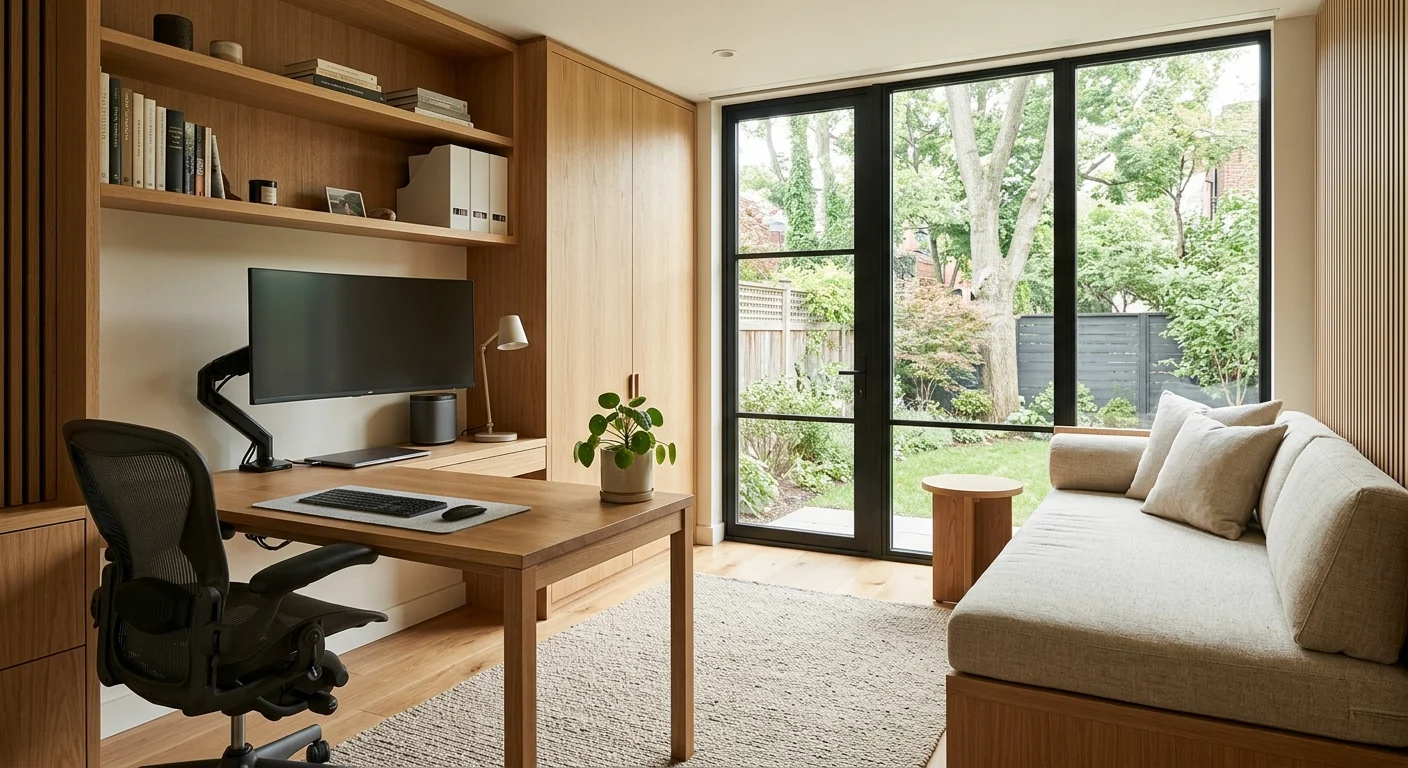
The design elements that make a backyard office truly productive: natural light, acoustic privacy, ergonomic furniture, and a proper desk surface with hardwired connectivity.
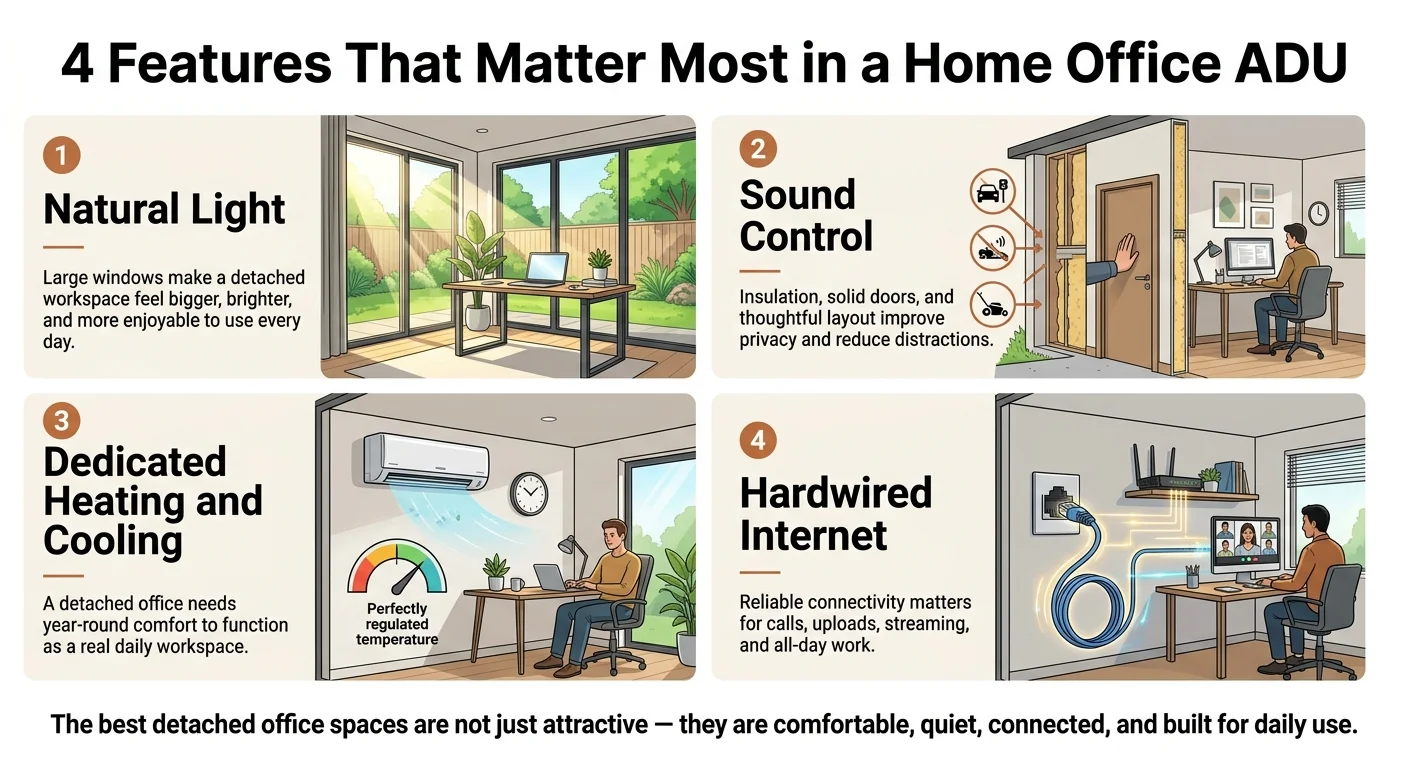
Natural Light
Large windows, a glass door, or a skylight. Position your desk so you face or get sidelight from the window — not backlighting, which makes you a silhouette on video calls.
Soundproofing
Insulated walls, double-pane windows, and a solid-core exterior door are the baseline. For therapists, counselors, podcasters, or anyone needing confidential or quiet conversation, add acoustic panels on at least one interior wall.
Dedicated Climate Control
A ductless mini-split HVAC system is the standard for detached structures. It handles both heating and cooling independently from your home's system. A space heater and window AC unit are fine for occasional use — they're not adequate for 8+ hours of daily work in most climates.
Hardwired Internet
Run Cat6 Ethernet from your home's router to the ADU during construction. WiFi degrades significantly across outdoor distances and through walls. This costs $200–$500 during the build. It costs several times that after walls are closed. For video calls, file transfers, and reliable connectivity, hardwired Ethernet is the standard.
Design for Your Profession
Remote knowledge worker
- Ergonomic desk and monitor arm
- Good video-call lighting (front-facing, not backlit)
- Neutral, professional background
- Acoustic privacy
Therapist or counselor
- Separate entrance so clients don't walk through your house
- Sound-isolated walls
- Small waiting area or covered porch
- ADA-accessible layout considerations
Creative professional
- Open layout with abundant natural light
- Space for equipment and samples
- Adequate electrical circuits (dedicated circuits for equipment)
Consultant who hosts clients
- Professional entrance
- Small seating area
- Bathroom access for visitors (so they don't enter your home)
- Kitchenette for coffee and water
Future-Proof It Now
Run extra electrical circuits and network drops during construction — pennies at build time, expensive later. Rough in plumbing even if you don't install fixtures immediately. Design doorways at least 36 inches wide. Single-story layout. These small decisions protect the space's value and flexibility for years.
Which Small Units and Floor Plans Fit This Use Case Best?
Now we're at the practical question: What does the right option actually look like?
Turnkey Small Units
For homeowners who want a known price, a predictable timeline, and minimal contractor management, prefab and manufactured small units are worth serious consideration.
Table sorted by smallest starting footprint. Pricing reflects manufacturer-published starting prices and does not include site work, utility connections, foundation, or permit fees — total installed cost will be higher. Contact each manufacturer directly for current pricing, availability, and delivery area. Verified April 2026.
| Manufacturer | Size options | Published starting price |
|---|---|---|
| Craftsman Tiny Homes | 410 SF (Summit model), up to 800+ SF custom | From ~$65,500 (Summit 410 SF) |
| Modular Home Direct | Custom designs, 1–4 bedrooms | Factory-direct pricing — request quote |
Affiliate disclosure applies to links above. Prices and availability verified with manufacturers April 2026 — confirm directly for current offers.
Pre-Designed Floor Plans
If you prefer to work with a local builder using engineered plans, these collections have dedicated ADU layouts designed for detached backyard use:
Largest selection — 30,000+ plans including a dedicated ADU collection with studio, one-bedroom, and two-bedroom layouts.
Specializes in modern house plans with clean, contemporary ADU designs.
Range of ADU and guest-house plans across traditional and modern styles.
Affiliate disclosure applies to floor plan links above.
Ready to see options?
Compare turnkey small units and browse ADU floor plans from builders who specialize in this use case.
See Pricing & Floor PlansWhen a Full ADU Is the Wrong Move
We build trust by being direct. A full ADU is not always the right answer — even coming from us. Here are the situations where a different path makes more sense:
You need workspace in weeks, not months
A prefab office pod or well-built insulated shed gets you a functional office fast. A full ADU — even a prefab one — takes months when you factor in permits, site prep, and installation.
You're planning to sell the property in the next year or two
An ADU adds value, but the construction disruption and carrying cost may not pencil out on a short timeline.
Your HOA or lot constraints make a full ADU unrealistic
If your lot can't accommodate the setbacks, lot coverage, or height limits, forcing the issue creates legal risk. A smaller exempt structure may be all your site supports.
Your budget only works if you skip permits
An unpermitted structure creates more problems than it solves — code enforcement risk, insurance gaps, financing complications at refinance or sale, and no appraisal credit. If the budget doesn't stretch to a permitted build, start with a lower-cost path. There's no shame in a $15,000 insulated backyard studio with good lighting, mini-split HVAC, and wired Ethernet. That's a dramatically better office than a spare bedroom — and it's available in weeks.
What Should You Do Next?
If you've read this far, you know your options. Here's the fastest path to a smart decision:
Step 1: Decide your end use
Office only, or office plus future flexibility? This single choice eliminates half the options and focuses your budget.
Step 2: Check how your city classifies the structure
Call your local planning or building department. Describe what you want. Ask what's required. Get specifics.
Step 3: Confirm your lot constraints
Setbacks, lot coverage, height limits, and utility access. These physical realities determine what's buildable.
Step 4: Price three realistic paths
Not the cheapest thing you can imagine and not the most expensive. Three real options from actual builders or manufacturers, with all-in estimates.
Step 5: Get a property-specific feasibility check
We look at your address — zoning, lot size, setbacks, local ADU rules — and show you what's actually possible.
If you've been thinking about this project for a while and just needed someone to lay out the options clearly, this is the part where thinking turns into doing. The best time to build was before your last lease renewal. The second-best time is now.
Start with your property
We'll show you what's buildable at your address and what realistic options look like for your area. Currently available in CA, UT, TX, CO, and NY.
Get Your Free ADU ReportStill early in your research?
Download the 2026 ADU Starter Kit — cost breakdowns by path type, a permit checklist, financing comparison, and a decision worksheet.
Download Free Starter KitMethodology and Sources
This page is built on publicly available official sources, manufacturer-published pricing, and documented permit and zoning requirements from individual jurisdictions. We do not fabricate cost estimates or cite unnamed experts.
Key sources:
- Fannie Mae Selling Guide B2-3-04: Special Property Eligibility Considerations (ADU classification)
- FHFA, "Trends in Median Appraised Value for Properties With ADUs in California" (2025)
- IRS Publication 587: Business Use of Your Home
- IRS Topic 509: Business Use of Home
- Revenue Procedure 2013-13: Simplified Method for Home Office Deduction
- Oregon Residential Specialty Code R105.2; Portland BOD 21-05
- Clear Creek County, CO Resolution #24-016 (building code amendments)
- Fairfax County, VA Zoning Ordinance: Home-Based Business provisions
- California Government Code §§ 66310–66342 (ADU law); California Civil Code § 4751 (HOA preemption)
- Craftsman Tiny Homes published pricing (craftsmantinyhomes.com)
How we maintain accuracy: All jurisdiction-specific claims include the source and verification date. Cost data is updated when manufacturer pricing changes. We recommend readers verify with their local authority — rules evolve.
Frequently Asked Questions
Is an ADU worth it just for a home office?
If you'll work from home long-term and want property-value benefits, tax deductions, and future flexibility, a permitted ADU can be a strong investment. If you only need office space for a year or two, a simpler backyard studio is the more practical choice.
Do I need a kitchen for it to count as an ADU?
In most jurisdictions, yes. An ADU is defined as an independent dwelling unit with facilities for living, sleeping, cooking, and bathroom use. Without cooking facilities, it's typically classified as an accessory structure — which affects permitting, financing, appraisal treatment, and tax implications.
Can I build a backyard office without a permit?
In many places, yes — if it's small enough and simple enough. Many jurisdictions exempt non-habitable accessory structures under certain size thresholds (often 120–200 SF) from building permits, provided they lack plumbing. But zoning rules — setbacks, lot coverage, height — still apply. And electrical or HVAC work may require separate trade permits even if the structure itself is exempt.
Does adding electricity or a mini-split trigger a permit?
Electrical work almost always requires a separate electrical permit. In many jurisdictions, permanently installed HVAC also triggers a mechanical permit. Portable space heaters typically do not, but a permanently installed mini-split usually does. Check with your local building department.
Can clients visit my backyard office?
It depends on your local home occupation rules. Many cities distinguish between teleworking (largely unregulated) and client-facing businesses (which may require a permit with conditions on visitor counts, parking, signage, and hours). Check before you start scheduling appointments.
Can I deduct a detached home office on my taxes?
If you're self-employed and the space is used exclusively and regularly for business, a qualifying separate structure can be eligible for the home office deduction under IRS Publication 587. The simplified method allows up to $1,500 per year. The regular method may yield more but requires detailed records. W-2 employees generally cannot claim this under current IRS guidance. Consult a tax professional.
Is a garage conversion better than building new?
For budget: often yes — existing structure and foundation lower the cost. For separation and focus: a detached structure is typically better. For future flexibility: a detached ADU usually offers more optionality. Both are strong paths depending on your lot and goals.
Can I rent out my ADU home office later?
Only if it's permitted as an ADU and your local zoning allows rental use. This is one of the strongest arguments for building a full ADU from the start — the structure is already code-compliant and legally available for rental whenever you decide.
How big should a backyard office be?
For one desk with comfortable room: 120–180 SF. For two desks with some separation: 250–350 SF. For office plus guest flexibility: 300–500 SF. For a rental-ready ADU with dedicated office space: 450–800 SF.
Will an HOA stop me from building a backyard office or ADU?
In some states like California, state law limits HOA authority over ADUs (Civil Code § 4751). In most other states, CC&R restrictions can block your project. Check your HOA rules, your state's ADU legislation, and whether preemption applies before investing in plans.
What happens to the ADU when I sell the house?
A permitted ADU transfers with the property and is documented in the appraisal — contributing to the home's value. An unpermitted structure can complicate a sale, create problems with buyers' lenders, and may require retroactive permitting or removal.
More from The Dwelling Index
How Much Does an ADU Cost?
Full cost breakdown by type, size, and region — plus what drives the price up or down.
ADU Financing Paths
HELOC, construction loans, HEIs, and more — organized by your situation.
Best Prefab ADU Companies
Compared by price, quality, timeline, and delivery area.
ADU Floor Plans & Design Gallery
1-bedroom, studio, and accessible layouts ready to customize.
ADU for Aging Parents
Best setups, real costs vs assisted living, and financing for families.
Colorado ADU Laws (2026)
What HB 24-1152 actually means for your property and city.
Ready to find out what you can build?
Your free ADU report covers zoning, lot fit, estimated costs, and next steps — personalized to your property.
Get Your Free ADU Feasibility Report© 2026 The Dwelling Index. All rights reserved. This content is for educational purposes only and does not constitute legal, tax, or financial advice. Consult qualified professionals for guidance specific to your situation. Local regulations change frequently — verify all permit, zoning, and tax information with your local authorities before making building decisions.