
The Quick Decision: Best Setup by Situation
| Your parent's situation | Best-fit housing move | Why |
|---|---|---|
| Mostly independent, values privacy | Detached ADU — strong fit | Maximum independence. Strong future rental flexibility. |
| Independent now, may need daily help within 1–3 years | Attached ADU or in-law suite — often smarter | Shared wall means faster check-ins, no outdoor weather exposure. |
| Budget or lot constraints | Garage conversion — fastest, most affordable | Lower cost, fewer permitting hurdles, uses existing structure. |
| Needs heavy daily help but not medical care | House swap (parent in main house, you in ADU) — worth considering | Parent gets the larger, more accessible space. |
| Needs memory care, 24/7 nursing, or complex medical support | Evaluate care-first alternatives — an ADU likely isn't the right path | An ADU doesn't replace trained medical staff or structured programming. |
Last verified: April 3, 2026 · Independent educational resource · We are not a lender, builder, or broker · Editorial methodology
Is an ADU for Aging Parents the Right Move — or Is Another Setup Better?
An ADU is a strong fit when the parent is still mostly independent and the goal is daily proximity with separate living space. It's not the right answer for every family.
When an ADU Is a Strong Yes
Your parent can still handle the basics — cooking, bathing, managing medication with light reminders — but the current living situation has a clear expiration date. Maybe the two-story house has stairs that are becoming dangerous. Maybe they're isolated and you're driving 45 minutes each way to check in. Maybe the house is too expensive to maintain on Social Security alone.
AARP's 2024 Home and Community Preferences Survey found that 75% of adults age 50 and older want to remain in their home or community as they age. Habitat for Humanity and AARP's joint ADU evidence brief found that older adults would consider ADUs specifically to stay close to support while keeping separate space.
When Assisted Living Deserves a Serious Look
If your parent is experiencing moderate-to-severe cognitive decline, has had multiple serious falls requiring hospitalization, or needs medical monitoring that a family member cannot safely provide, a care facility with trained staff may be the more responsible choice.
That doesn't mean you failed. It means the need exceeded what proximity alone can solve. If you're in that space, an ADU may still make sense as a future rental or caregiver suite — but the immediate priority is the right level of care.
What Families Regret Not Deciding Earlier
A recurring pattern in published builder guides and family forum discussions: the families who have the hardest time are the ones who wait until a health crisis forces the decision. When a parent falls or gets a diagnosis and suddenly the ADU needs to be done now, every step gets more stressful, more expensive, and more rushed.
Start the conversation while your parent is still healthy enough to participate in the process. The smoothest ADU projects begin well before the need becomes urgent.
Not sure if an ADU makes sense for your situation?
Get Your Free ADU Feasibility Report
Answer a few questions about your property and your parent's needs. Takes about 60 seconds.
See What You Can BuildWhich Setup Fits Your Parent Best: Attached, Detached, Garage Conversion, or Internal Suite?
This decision shapes everything — cost, timeline, privacy, safety, and future flexibility.
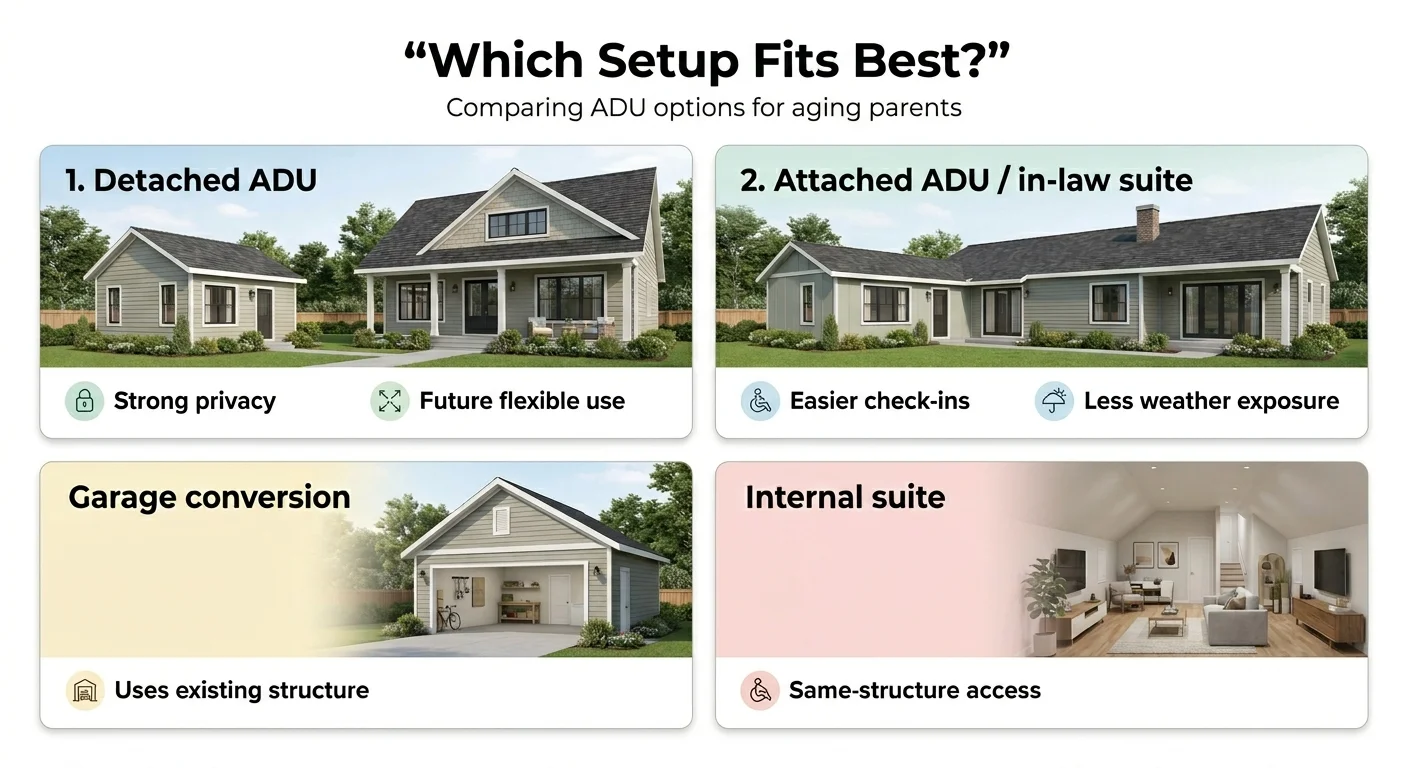
Choosing the right setup is the most important decision in the entire project.
Side-by-Side Comparison
| Factor | Detached ADU | Attached ADU | Garage Conversion | Basement / Internal Suite |
|---|---|---|---|---|
| Best for | High privacy, long-term rental flexibility | Parent who may need increasing daily support | Speed and budget | Cold climates, avoiding outdoor travel |
| Privacy | Highest | High — separate entrance, shared wall | Medium | Lowest |
| Ease of check-ins | Requires walking outside | Quick — through shared wall or hallway | Medium | Easiest |
| Weather / stair risk | Outdoor path required | Minimal | Minimal | None |
| Future rental potential | Strongest | Good with separate entrance | Good with separate entrance | More difficult |
| Typical cost range | $200K–$350K | $150K–$300K | $80K–$180K | $60K–$120K |
| Typical timeline | 8–14 months | 6–12 months | 4–8 months | 3–6 months |
Cost ranges reflect typical industry estimates for new construction ADUs. Actual costs vary significantly by region, site conditions, and local labor markets. See our full ADU cost breakdown
The Breezeway Question
A detached ADU connected to the main house by a covered breezeway sounds like the best of both worlds — privacy plus weather protection. In practice, it depends. A breezeway works well in mild climates where the connection is short, well-lit, level, and fully covered. It becomes problematic in regions with ice, heavy rain, or extreme heat — and for parents with mobility devices, even a slight grade change can create a fall risk. Falls among adults 65 and older are the leading cause of injury-related death, according to CDC data (verified April 2026). Evaluate the breezeway option carefully if your parent uses a walker or wheelchair.
The “House Swap” Configuration Nobody Talks About
About 30% of aging-parent ADU projects involve the adult child moving into the ADU while the parent stays in (or moves into) the main house, according to published case studies from BuildX, a Massachusetts-based ADU builder. Why? Because the main house is often single-story, already somewhat accessible, and larger — which matters if a caregiver or aide will eventually visit. The adult child, who is younger and more mobile, is perfectly comfortable in a smaller backyard unit.
Another common configuration: the younger family lives in the ADU now, with a plan to swap with the parents later as care needs increase. It's a built-in transition plan.
Matching the Setup to Your Parent's Real Life
Your parent still drives, cooks, manages their own medication.
Detached ADU.
Maximum independence. Design for future accessibility (see design section below), but prioritize a comfortable, private living space they'll genuinely want to live in.
You can see changes happening — unsteady on stairs, forgetting things occasionally.
Attached ADU or in-law suite with an interior connection.
You'll want to be able to check in without going outside, especially at night. This is the configuration families most often wish they'd chosen from the start.
Parent needs daily help with meals, medications, some activities.
The house swap may make the most sense.
Parent takes the main house, you take the ADU. Same proximity, more room for an aide to visit.
Budget is tight and your garage is just storage.
Garage conversion.
Lowest-cost path to a legal, heated, plumbed living space on your property.
Parent needs to stay in their own neighborhood.
Build the ADU on their property.
You or a caregiver lives in the ADU; they stay in the main house. This preserves the social connections that matter enormously to quality of life.
How Much Does an ADU for Aging Parents Actually Cost — and When Does It Beat Assisted Living?
You've probably seen numbers ranging from $50,000 to $400,000 and have no idea what to believe. Here's the real comparison, built from one consistent data source.
The 10-Year Side-by-Side
All care-cost figures sourced from the CareScout 2025 Cost of Care Survey (data collected July–November 2025, released March 2026). A 3% annual escalation was applied to project multi-year costs, consistent with CareScout's observed historical trend of 2–5% annual increases. ADU cumulative figures include estimated ongoing costs for maintenance, insurance, and property tax adjustment. All projections are illustrative.
| Timeframe | ADU (one-time build) | Assisted Living | Nursing Home (semi-private) | In-Home Care (20 hrs/wk) |
|---|---|---|---|---|
| Year 1 | $150,000–$300,000 | $74,400 | $114,975 | $36,400 |
| Year 3 cumulative | ~$155,000–$310,000 | ~$229,800 | ~$355,200 | ~$112,500 |
| Year 5 cumulative | ~$160,000–$320,000 | ~$395,700 | ~$611,400 | ~$193,500 |
| Year 10 cumulative | ~$175,000–$350,000 | ~$853,200 | ~$1,318,300 | ~$417,400 |
| Equity built | Property value increase | $0 | $0 | $0 |
| Future rental potential | Yes | No | No | No |
Source notes: Assisted living: CareScout 2025 national median $6,200/month ($74,400/year). Nursing home semi-private: CareScout 2025 national median $315/day ($114,975/year). In-home care: CareScout 2025 non-medical caregiver median $35/hour at 20 hours/week.
The crossover point is unmistakable. By year three, assisted living has cost more than a mid-range ADU build. By year five, the gap is significant. By year ten, a family that chose assisted living has spent $500,000–$700,000 more — with no asset to show for it. That's not a knock on assisted living — when the care level is needed, it's the right choice. But for families where the parent is still independent, the financial case for an ADU is compelling.
A Real-World Example: How the Math Plays Out
A 74-year-old mother owns a $425,000 home outright. Her income is $2,400/month in Social Security. She's healthy now but had a minor fall last year, and the two-story house is getting harder to manage.
Path A — Assisted living
She sells the house. Net proceeds after closing costs: roughly $395,000. Assisted living in her state runs $5,500/month. That $395,000 covers about six years before it's depleted. After that, the family either covers the shortfall or applies for Medicaid — which typically requires spending down nearly all remaining assets. Inheritance to the family: close to zero.
Path B — ADU on her adult child's property
The child builds a 600 SF detached ADU for $185,000. Mom contributes $100,000 from savings; the child finances $85,000 through a HELOC. Mom moves in rent-free. Her monthly expenses drop to roughly $1,200/month, well within her Social Security. Her house either sells (net proceeds cover the remaining ADU cost and generate surplus) or stays in the family as a rental. Five years later, the family has the ADU adding value to the property, potential rental income, and Mom's remaining savings intact.
Path C — No-monthly-payment financing
Instead of selling or tapping savings, Mom uses a Home Equity Investment to access $80,000–$100,000 from her home's equity with no monthly payments. She contributes that to the build. She keeps her home or sells later on her own timeline.
What Actually Drives the Cost
Site work and utilities
The sleeper expense. Running separate sewer, water, and electrical connections to a detached ADU can add $10,000–$30,000 depending on distance and local utility requirements. Attached additions and garage conversions avoid most of this.
Permits, design, and engineering
Typically $5,000–$15,000 depending on your jurisdiction.
Accessibility features
Inexpensive to include during construction and costly to retrofit later. Adding Universal Design features during a new build adds a small percentage to construction cost. Retrofitting those same features into finished walls can cost many times more.
The prefab price anchor
A turnkey prefab ADU from Craftsman Tiny Homes starts at $65,500 for a 410 SF unit and $129,900 for an 800 SF model — before site preparation, foundation, utility connections, delivery, and local permitting (craftsmantinyhomes.com, verified April 2026). Total installed cost for a prefab typically runs $120,000–$250,000 including site work.
Wondering what an ADU project would look like at your address?
Get Your Free ADU Feasibility Report — Costs, Setbacks, OptionsCan Your Property Actually Support the Right Kind of ADU?
This is where national guides become useless — and where most families waste weeks of research. Zoning rules, setback requirements, lot coverage limits, and ADU regulations vary not just by state but by city, and sometimes by neighborhood.
What You Need to Verify Before Spending a Dollar
| Issue | Why it matters | Who to check with |
|---|---|---|
| ADU zoning allowance | Some cities allow ADUs by right; others require conditional permits | Local planning/zoning department |
| Setback requirements | Determines where on your lot the ADU can sit | Planning department + your property survey |
| Maximum ADU size | Varies — 600 SF in some cities, 1,200 SF in others | Local zoning code |
| Height and lot coverage limits | Can restrict ADU type and footprint | Local building code |
| Parking requirements | Many states have eliminated ADU parking mandates; some cities haven't | Local zoning code |
| Owner-occupancy rules | Some cities require the property owner to live on-site | Local zoning code |
| HOA and deed restrictions | Can override city zoning in some states | Your HOA CC&Rs + state law |
| Utility connection requirements | Separate meters or laterals may be required for detached ADUs | Local utility provider + building department |
Over the past five years, dozens of states have passed ADU-friendly legislation. California, Oregon, Washington, Connecticut, Vermont, Montana, and others have removed barriers like parking mandates, lot size minimums, and owner-occupancy requirements at the state level. But city-level implementation still varies. See ADU laws by state
Check What You Can Build at Your Address
Enter your address and get zoning, lot fit, size limits, and ballpark cost — personalized to your property.
Free Property Feasibility ReportHow Do Families Actually Pay for This — Especially on a Fixed Income?
This is where most ADU guides fail families with aging parents. They mention "home equity loan" and move on. The real question — the one keeping adult children up at night — is: how do my retired parents pay for this when their only income is Social Security?
We organize financing into paths by situation, not products ranked by who pays us. Your family's circumstances determine the right path.
Affiliate disclosure: Some financing links below are partnerships. We present financing paths organized by homeowner situation, not ranked by compensation. We never quote specific rates or guarantee qualification. Full disclosure
This is the most common profile. Your parent owns a $350,000–$800,000 home with little or no mortgage, but their income is Social Security and maybe a small pension. They cannot qualify for a traditional HELOC because lenders require income verification.
The no-monthly-payment option: Home Equity Investment (HEI)
Companies like Hometap invest a lump sum — typically up to 25% of the home's current value — in exchange for a share of the home's future value. The HEI has a 10-year term with no monthly or recurring payments and no interest charges (Hometap.com, verified April 2026). No minimum income requirement. Minimum FICO score of 600 according to published third-party reviews (U.S. News, LendEDU, verified March 2026).
The tradeoff: you're sharing future appreciation. If the home increases in value over 10 years, the settlement amount will reflect that growth. Important: Hometap operates in select states — not nationwide. State availability changes, so confirm directly at Hometap.com before treating this as a live option.
Hometap's HEI provides a lump sum with no monthly payments for up to 10 years.
A reverse mortgage (Home Equity Conversion Mortgage / HECM) lets homeowners 62+ borrow against their equity with no required monthly mortgage payments and no minimum income eligibility threshold. However, lenders still perform a financial assessment — reviewing income, assets, debts, property taxes, insurance obligations, and other property charges. HUD-approved counseling is required before application (HUD Handbook 4235.1).
The loan is repaid when the homeowner sells, moves, or passes away. Reverse mortgages come with origination fees, mortgage insurance premiums, and compounding interest that reduces the estate over time. First-year draw limits also mean you may not be able to access the full build cost upfront — coordinating the construction draw schedule with the reverse mortgage requires careful timing between your lender and builder.
If you're building the ADU on your property for your parent, a standard HELOC (home equity line of credit) is often the most straightforward path. You borrow against existing equity, fund the build, and make monthly payments on what you draw. See our guide to the best HELOCs for ADU projects
A renovation HELOC — like those offered through RenoFi — lends based on theafter-renovation value of your home rather than current appraised value. That means you can access financing based on what your home will be worth after the ADU is built. RenoFi states that its ARV HELOC product is available in all states except Texas; confirm current availability directly, as lender programs can change (RenoFi.com, verified April 2026). RenoFi works with third-party lending partners and is not itself a lender.
Explore After-Renovation-Value FinancingRenoFi lends on what your home will be worth after the ADU is built — not just what it's worth today.
If you're unsure which path fits, a lending marketplace lets you compare offers from multiple lenders in one application. This is especially useful for families evaluating a construction loan, cash-out refinance, or a combination of sources. See all ADU financing options compared
What NOT to Do
Don't lock into a financing product before you know the build cost, the lot constraints, and the total project scope. Get the feasibility check and budget estimate nailed down first. Then match the financing path.
What Design Features Actually Matter for Aging in Place?
This section separates a good ADU from a great one. The right design means your parent can live safely and comfortably for a decade or more. The wrong design creates a unit that looks nice in photos but fails within two years.
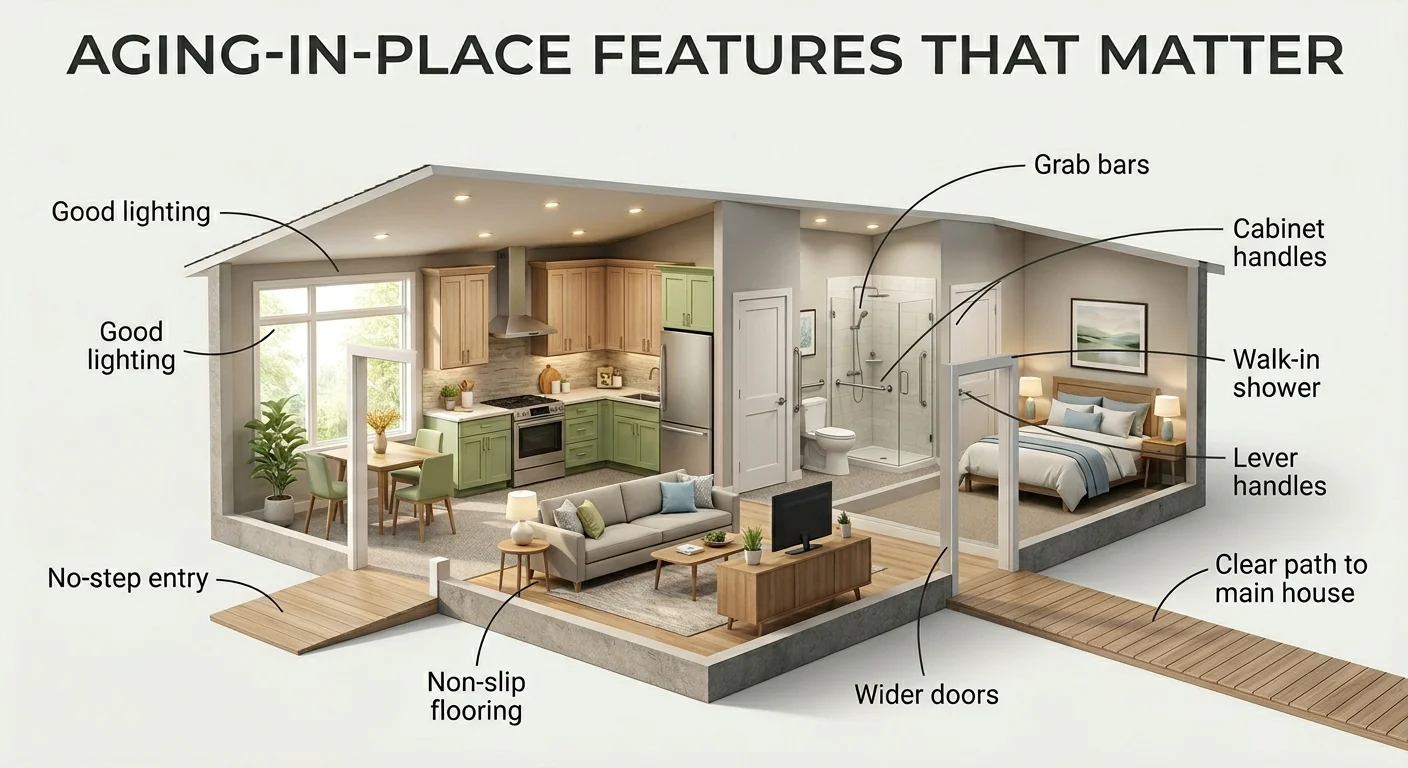
Every feature shown costs dramatically less to include during construction than to retrofit into finished walls.
The Three-Tier Accessibility Framework
We organize aging-in-place features into three tiers: build now, prepare for, and add when needed.
Tier 1 — Build These Into Every Aging-Parent ADU (non-negotiable)
Tier 2 — Prepare During Construction, Activate When Needed
Tier 3 — Add When Mobility Significantly Changes
Build Now vs. Retrofit Later: The Cost Reality
| Feature | During new construction | Retrofit into finished space |
|---|---|---|
| Blocking for grab bars | Minimal — framing stage | Significant — wall demo + repair |
| Wider doorways (36") | Standard framing adjustment | Per-opening reframe cost |
| Zero-threshold shower | Modest upgrade over standard | Major tear-out and replumb |
| Comfort-height toilet | Small upgrade at install | Remove and replace |
| Non-slip flooring | Material specification only | Full floor replacement |
| Smart home / medical alert wiring | Low-voltage rough-in | Fishing wire through finished walls |
The pattern is consistent: everything is dramatically cheaper when the walls are open. If you're spending $150,000+ on an ADU, the marginal cost of future-proofing during construction is one of the best investments you'll make.
What Size ADU Do You Need?
| Living situation | Recommended size | Layout |
|---|---|---|
| One parent, independent | 400–600 SF | Studio or 1-bedroom |
| One parent, may need aide visits | 500–700 SF | 1-bedroom with aide space |
| Two parents, independent | 600–900 SF | 1–2 bedroom |
| Two parents, one needs more care | 700–1,000 SF | 2-bedroom for future caregiver |
Check your local zoning for maximum ADU size limits — they typically range from 800 to 1,200 SF for detached units. Browse aging-in-place ADU floor plans
Design Mistakes to Avoid
Designing for today instead of five years from now
Your parent may walk fine today. In three years, they might need a walker. If the bathroom doorway is 28 inches, you'll be tearing it out. Build for the future during construction when it's cheap.
Prioritizing aesthetics over function
That beautiful raised-lip shower base is a trip hazard. The farmhouse round doorknobs are impossible to turn with arthritic hands. Every fixture in an aging-parent ADU should pass one test: will this still work when my parent is 85?
Forgetting about nighttime
Most falls happen at night on the way to the bathroom. Motion-sensor lighting along the bed-to-toilet path is one of the cheapest and most impactful safety features you can install.
Making the kitchen too tight
Compact kitchens save space, but they need to work with reduced mobility. A galley kitchen requiring a tight turn doesn't work with a walker. L-shaped or U-shaped layouts with clear floor space are safer.
Ignoring the path between buildings
For detached ADUs, the outdoor path needs to be hard-surfaced, well-lit, at least 36 inches wide, and ideally covered. Grade changes need ramps. This detail gets skipped in most plans and becomes the family's biggest daily frustration.
How Long Does It Take — and What Slows Projects Down?
Plan for 9–14 months from first conversation to move-in for a custom build, or 4–8 months for a prefab unit including site prep and permitting.
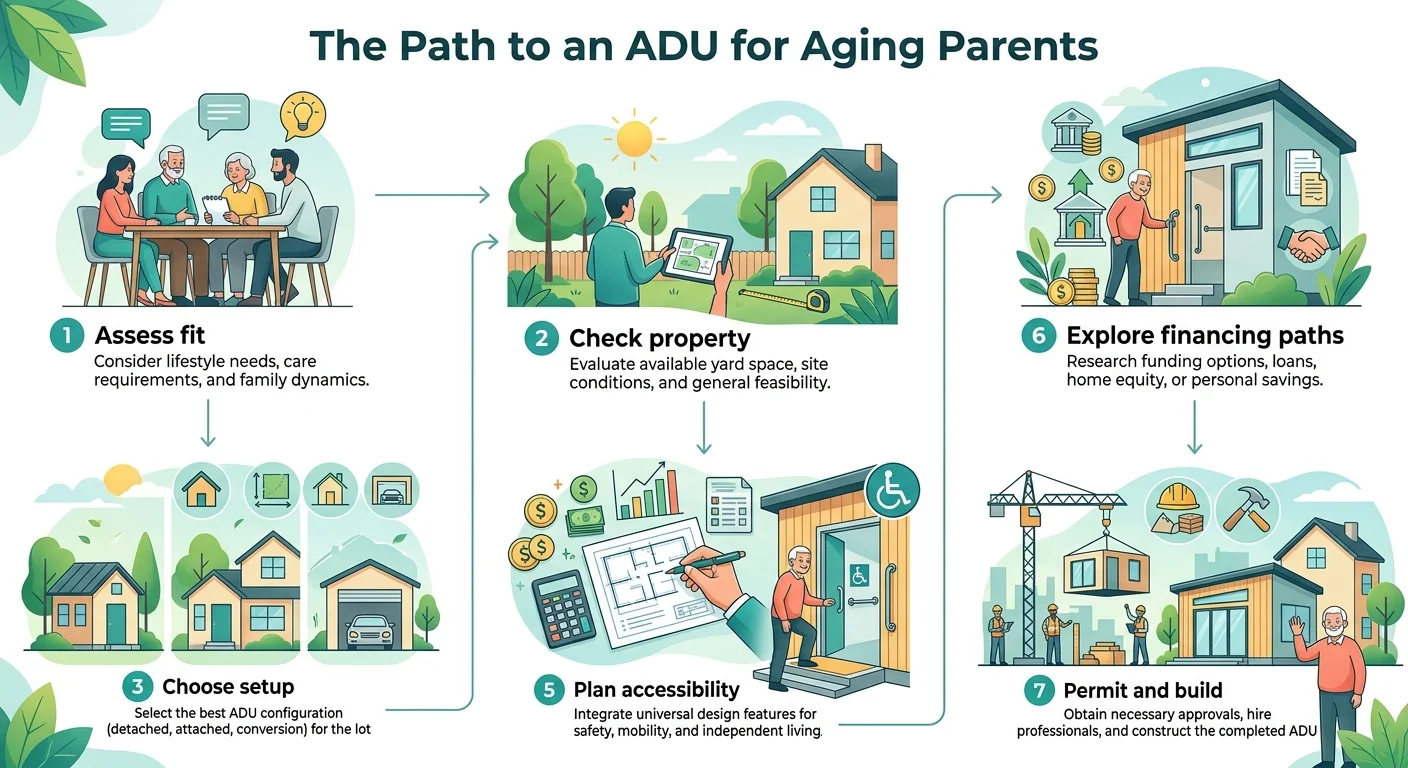
Most delays happen at permitting. An experienced local builder who knows your city's plan-check process is one of the most valuable investments you can make early on.
Typical ADU Timeline
| Phase | Custom Build | Prefab / Modular |
|---|---|---|
| Planning and design | 4–8 weeks | 2–4 weeks |
| Permitting and plan review | 4–12 weeks (city-dependent) | 4–12 weeks (same) |
| Site preparation and foundation | 2–4 weeks | 2–4 weeks |
| Construction or installation | 12–24 weeks | 2–6 weeks |
| Final inspections | 2–4 weeks | 2–4 weeks |
| Total | 6–14 months | 3–8 months |
What Causes Delays
Permitting
The most common bottleneck. Some cities process ADU permits in weeks; others take months. Your builder should know your jurisdiction's typical timeline.
Utility connections
Separate water meters, sewer laterals, or electrical panels require their own permits and inspections — and are often surprises.
Redesigns after plan check
Happen when the city requires changes to setbacks, height, or fire sprinklers that the initial design didn't anticipate. An experienced local ADU builder catches most of these upfront.
When Speed Matters: Prefab ADUs
If your parent's health is declining and the timeline matters, a prefab or modular ADU offers the fastest path. Factory-built means consistent quality, weather-independent construction, and a compressed schedule.
Craftsman Tiny Homes builds custom ADUs designed for the aging-in-place use case — single-story, accessibility-focused, and customizable. Their Summit model starts at 410 SF ($65,500) and 800 SF ($129,900), with options for grab bars, walk-in showers, and wider doorways built in. Family-owned builder based in Archer, Florida — check availability and delivery logistics for your area (craftsmantinyhomes.com, verified April 2026).
Affiliate disclosure: The link below is a partnership. Full disclosure · Prefab pricing covers the unit. Foundation, site prep, utility connections, delivery, and local permits are additional costs. Always get a complete all-in project estimate.
See Turnkey ADU Pricing and Floor Plans
Custom ADUs starting at $65,500. Built for aging in place. See specs and request a quote.
The Family and Legal Conversations to Have Before Building
Building an ADU for an aging parent is 70% family decision and 30% construction. That ratio is consistent across published builder guides — and families who skip straight to floor plans without aligning on money, ownership, and care expectations tend to have the hardest experiences.
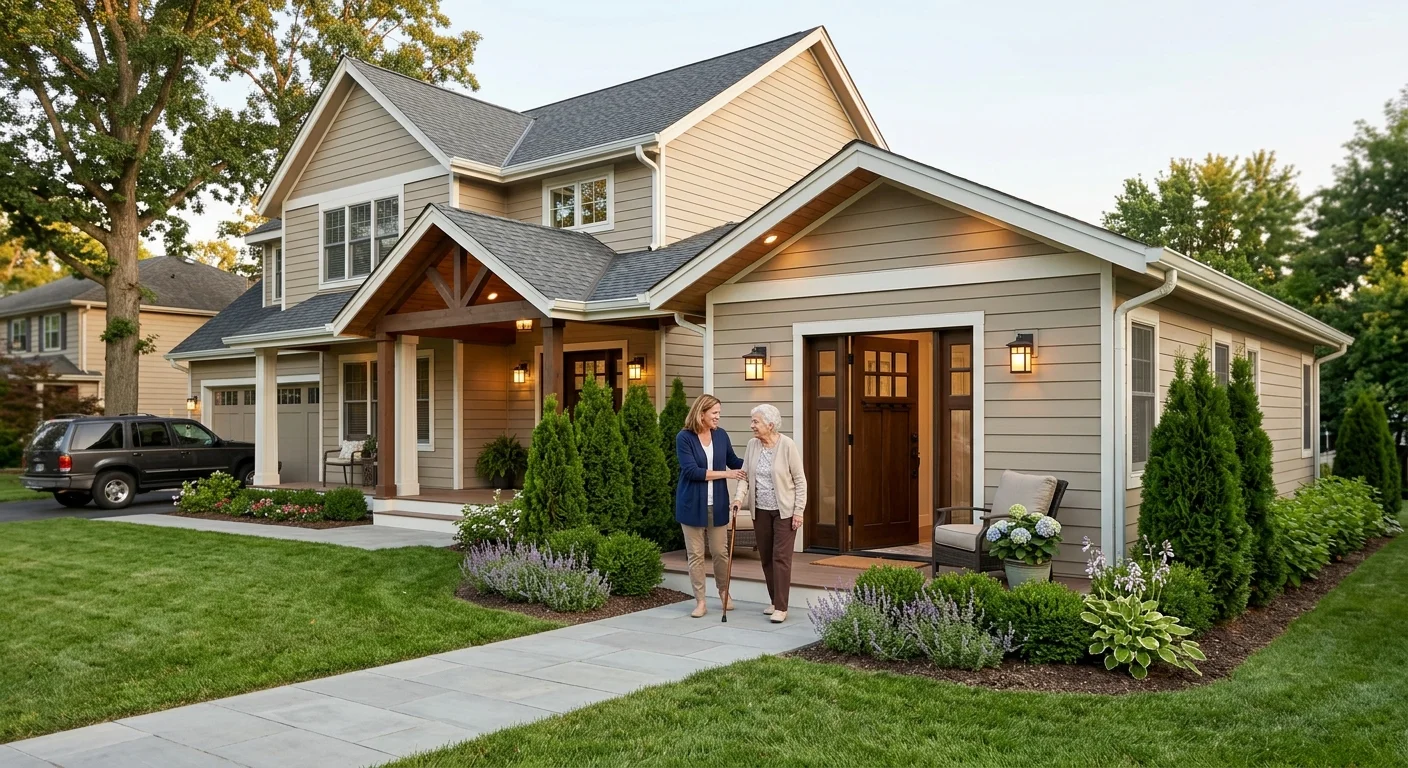
A wide, level, well-lit path between the main house and ADU is one of the most important safety details families overlook.
Five Conversations Before Ground Breaks
Who owns the ADU — and what does that mean for the estate?
If you build on your property, you own it. If your parent funds the build, you have a significant asset paid for by someone else. Document this. A clear written agreement prevents sibling disputes, divorce complications, and inheritance confusion.
Who is paying, and is it a gift or a loan?
If a parent is contributing $150,000+ to a build on their child's property, every family member needs to understand the terms. The IRS has annual gift tax exclusions and lifetime exemption rules that may apply. Consult a tax advisor.
What are the care expectations — really?
An ADU provides proximity, not around-the-clock care. Be explicit: Are you committing to daily check-ins? Meal preparation? What happens when care needs exceed what you can personally provide?
What do siblings think?
If one child hosts the parent and benefits from the ADU's property value, how do other siblings contribute? Address this before construction, not after.
What happens if it doesn't work out?
Have a clear understanding of what happens if your parent transitions to a care facility, if you need to sell, or if the arrangement creates conflict. The ADU's dual purpose — family housing now, rental or guest house later — is one of its strongest features.
Legal Considerations
Lease for life
A legal arrangement giving the parent the right to live in the ADU for the rest of their life while the property remains in the adult child's estate. Have an elder law attorney draft this.
Medicaid look-back
If a parent may eventually need Medicaid-funded nursing care, large financial transfers within the 5-year look-back period could affect eligibility. Get legal advice before moving money.
Power of Attorney
Establish financial and medical POA while your parent has full legal capacity. Don't wait.
Property tax
Tax treatment of ADUs varies by state and county. In some jurisdictions, only the value of new construction is added to the assessment. Verify the expected impact directly with your county assessor before budgeting.
Insurance
The ADU must be added to your homeowner's policy. If a parent or caregiver is injured, liability coverage matters.
What Families Wish They'd Known Sooner
"Being that close is potentially problematic."
Boundaries matter. A separate entrance, a visual privacy plan, and agreed-upon expectations for when family drops by versus when the parent has their own space — these details prevent resentment.
"What if Mom's needs exceed what I can provide?"
Build the ADU with the understanding that it may serve a different purpose someday. Have a plan for that transition.
"My siblings think I'm trying to get the inheritance."
If one child hosts the parent while others contributed nothing to the build cost, tensions are predictable. Some families create shared contribution arrangements. Others use estate equalization. Whatever the solution, discuss it before construction.
We strongly recommend consulting an elder law attorney and a financial advisor before making decisions with long-term estate, tax, or Medicaid implications.
What Happens to the ADU When You Don't Need It Anymore?
Every dollar you put into assisted living is gone the moment you stop paying. An ADU is a permanent asset that keeps working for your family.
Property value
ADUs can meaningfully increase a property's market value. The degree varies by location, quality, and market conditions — California-specific FHFA research has shown stronger appraised-value growth for properties with ADUs, and Fannie Mae recognizes ADU rental income for mortgage qualification purposes (Fannie Mae ADU guidance, verified 2026). Your local appraisal market determines the actual impact.
Rental income
A well-built ADU with a separate entrance can generate meaningful monthly rental income when no longer needed for family use. Exact figures vary significantly by market — verify rates in your area before projecting returns. Even in moderate markets, an ADU can offset or exceed its annual carrying costs through rent.
Future flexibility
Adult children moving home. A dedicated home office. A guest house. A caregiver suite. The ADU adapts to your family's changing needs for decades.
Multigenerational demand is growing
Pew Research Center found that 18% of the U.S. population lived in multigenerational households as of 2021 — and that share has been rising. Buyers increasingly see ADU-equipped properties as premium because they see the same optionality you built.
Rental income and property value outcomes are not guaranteed and depend on local market conditions, regulations, and property characteristics.
Ready to Take the First Step?
Your free ADU feasibility report covers zoning, lot fit, estimated costs, and next steps — personalized to your property.
See What You Can Build at Your AddressWhat to Do Next
You now understand the ADU-for-aging-parents decision better than 95% of families searching right now. Here's the right sequence:
Check your property
Confirm your lot can legally support the ADU type you need.
Get your free feasibility reportDecide the right setup
Use the comparison tables above to match your parent's needs to the best configuration.
Build a realistic all-in budget
Unit cost + site prep + utilities + permits + design + accessibility features + 10–15% contingency.
See our full ADU cost guideMatch the financing path
High equity + no income → HEI or reverse mortgage. Low current equity → renovation HELOC. Strong income + equity → standard HELOC.
Compare ADU financing optionsHave the family conversations
Ownership, funding, care expectations, siblings, legal protections. Harder than choosing a floor plan, and more important.
Connect with the right professionals
An ADU builder who knows your city's permitting process. An elder law attorney if estate or Medicaid considerations apply.
Start with Step 1. Everything else follows.
Not sure where to start?
See what's possible at your address — get your free ADU report in 60 seconds.
Get Free ADU ReportWant the full planning toolkit?
Checklists, budget worksheets, conversation guides, and financing comparisons — everything you need, in one download.
Download Free 2026 ADU Starter KitRelated ADU Guides
How Much Does an ADU Cost?
Full cost breakdown by type, size, and region — plus what drives the price up or down.
ADU Financing Options
HELOCs, HEIs, reverse mortgages, and renovation loans — organized by your situation.
ADU Property Management
When you're ready to rent — self-manage, software, or full-service help.
ADU Laws by State
State-by-state breakdown of setback rules, size limits, and owner-occupancy requirements.
Best Prefab ADU Companies
Compared by price, quality, timeline, and delivery area.
ADU Floor Plans
1-bedroom, studio, and accessible layouts for aging-in-place builds.
Frequently Asked Questions About ADUs for Aging Parents
Is an ADU a better choice than assisted living for aging parents?
For parents who are still mostly independent and value their privacy, an ADU is typically the stronger financial and emotional choice. It's a one-time investment versus ongoing costs that exceed $74,000 per year at the national median (CareScout 2025). However, if your parent needs 24/7 medical supervision or memory care, a staffed facility is the more appropriate option.
Is an attached or detached ADU better for an elderly parent?
It depends on daily support needs and your climate. Detached ADUs offer the most privacy and strongest rental potential. Attached ADUs or in-law suites are safer for parents who may need quick check-ins, nighttime assistance, or who live in regions with ice, heavy rain, or extreme heat.
How much does an ADU for aging parents cost?
Custom-built detached ADUs typically range from $200,000–$350,000. Attached additions: $150,000–$300,000. Garage conversions: $80,000–$180,000. Prefab units start at $65,500 for the unit, with total installed costs typically running $120,000–$250,000 including site work. Costs vary significantly by location and site conditions.
What size ADU works best for one aging parent?
Most aging-parent ADUs are one-bedroom units of 400–600 square feet — a bedroom, full bathroom, kitchen, and living area. If you want space for occasional aide visits, consider 500–700 SF.
How do you finance an ADU if the parent is retired and on a fixed income?
Retired homeowners with significant equity but limited income have several options: a Home Equity Investment (no monthly payments, no income requirements, select states), a reverse mortgage (for homeowners 62+, no required monthly mortgage payments), or family co-financing where the adult child takes the loan. Each path has tradeoffs.
Does an ADU need to be ADA compliant?
Private ADUs on single-family properties generally are not legally required to meet full ADA standards. Building to Universal Design principles (wide doors, zero-step entries, blocking for grab bars, walk-in showers) is strongly recommended and adds minimal cost during construction.
What accessibility features should I include even if my parent doesn't need them yet?
At minimum: blocking in bathroom walls for future grab bars, 36-inch doorways, zero-threshold entry, non-slip flooring, lever handles, and a walk-in shower with bench. These features cost very little during a new build and are expensive to retrofit.
Can I finance an ADU without monthly payments?
Yes. Home Equity Investments provide a lump sum in exchange for a share of the home's future value — no monthly payments during the term. Reverse mortgages offer a similar structure for homeowners 62+. Both have eligibility requirements and tradeoffs.
What happens to the ADU when my parent no longer needs it?
The ADU remains as a permanent property asset. Common next uses: long-term rental, short-term rental (where local rules allow), guest house, home office, or housing for another family member.
Are granny pods and ADUs legal everywhere?
No. Regulations vary by state, city, and sometimes neighborhood. Many states have passed ADU-friendly laws, but local zoning determines what you can build and where.
Will building an ADU raise my property taxes?
Yes, to some degree. Treatment varies by jurisdiction — in some areas only the value of new construction is added; in others, assessment methods differ. Verify with your county assessor before budgeting.
What should siblings talk through before a parent's money is used on someone else's property?
Key questions: Is the contribution a gift, a loan, or an equity stake? How does the arrangement affect inheritance equity? What happens if the hosting child divorces or sells? An elder law attorney can draft an agreement protecting all parties.
How We Built This Guide
This guide draws on data from the CareScout 2025 Cost of Care Survey (released March 2026), AARP's 2024 Home and Community Preferences Survey, the Habitat for Humanity and AARP ADU evidence brief, the CDC's falls data, California's 2025 Building Standards Code, published builder guides and case studies, Pew Research Center's multigenerational household data, and public forum discussions.
National guidance should be verified against your local zoning, building code, and permitting requirements. We update this guide regularly but cannot guarantee real-time accuracy for every jurisdiction. We present financing as education organized by homeowner situation — not as lender rankings. We do not quote rates, APRs, or monthly payments. We are not a lender, broker, builder, or legal advisor.
Not sure where to start?
See what's possible at your address — your free ADU report covers zoning, lot fit, estimated costs, and next steps.
Get Your Free ADU Report in 60 Seconds