
600 Sq Ft ADU Cost: What Homeowners Actually Pay in 2026
The real 600 sq ft ADU cost in 2026 depends mostly on build path, local fees, and site work — and the range is wider than most guides admit. A fully permitted, move-in-ready 600 sq ft ADU typically plans between $60,000 and $300,000+ depending on whether you're converting an existing garage or building a brand-new detached unit from the ground up.
That spread isn't vague — it's honest. Below, we'll show you exactly where your number likely falls. We spent weeks normalizing costs across builder quotes, closed-project databases, and municipal records so you can stop guessing and start planning. If you've gotten a quote that made your stomach drop — or one that seemed suspiciously cheap — this page will tell you whether those numbers are in the right ballpark.
The Dwelling Index is reader-supported. When you use our links to explore financing options, request prefab pricing, or purchase floor plans, we may earn a commission at no extra cost to you. Our editorial recommendations are based on independent research and are never influenced by compensation. Read our full editorial policy →
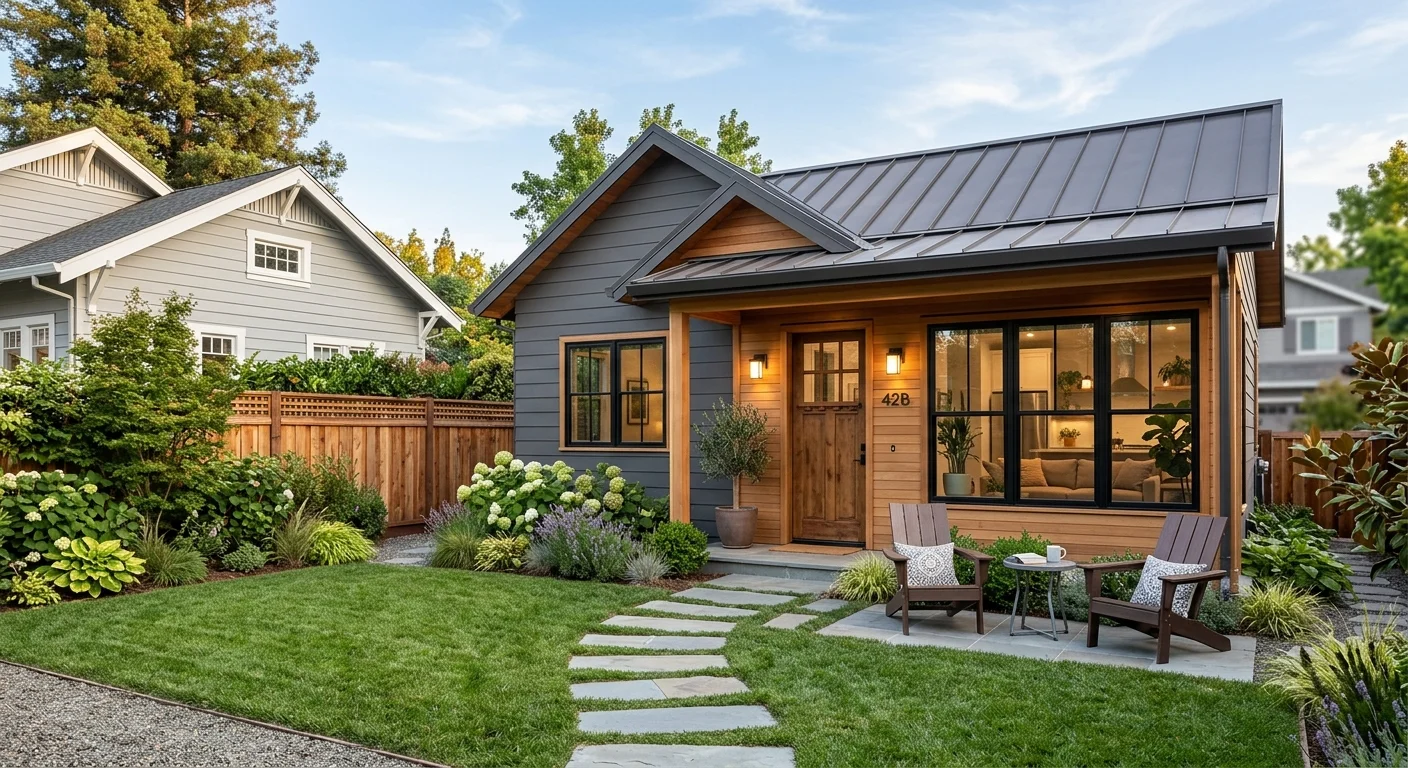
600 Sq Ft ADU Cost at a Glance
| Build Path | Typical All-In Range (2026) | Cost/Sq Ft | Timeline | Best For |
|---|---|---|---|---|
| Garage conversion | $60,000–$150,000 | $100–$250 | 2–6 months | Existing garage shell, budget-focused |
| Basement conversion | $50,000–$100,000 | $85–$170 | 2–4 months | Existing basement with adequate ceiling height |
| Attached addition | $100,000–$215,000 | $165–$360 | 4–8 months | Multigenerational, shared-wall acceptable |
| Prefab / modular (installed) | $110,000–$200,000 | $185–$335 | 3–6 months | Speed, budget certainty |
| Detached site-built | $150,000–$300,000+ | $250–$500+ | 6–14 months | Maximum privacy, highest rental value |
| Above-garage addition | $150,000–$300,000 | $250–$500 | 6–12 months | No yard space sacrificed |
"All-in" includes design, engineering, permits, fees, site prep, foundation, construction, utility hookups, HVAC, interior finishes, and contingency. Does not include furniture, landscaping beyond repair, or ongoing operating costs. Ranges reflect 2026 national data from builder-reported project costs, closed-project databases (including Realm's 600 sq ft analysis), municipal fee records, and industry benchmarks.
Our feasibility report checks your lot, zoning, setbacks, and local rules in about 60 seconds — so you know what's possible before you spend a dollar on design.
See What You Can Build — Get Your Free ADU ReportWhy the internet says a 600 sq ft ADU costs both "$90K" and "$250K"
Short answer: because most pages are not measuring the same thing — and the honest number is usually higher than the one that shows up first.
Angi's size table gives a broad range of $90,000–$180,000 for a 600 sq ft ADU across all types — but explicitly excludes permits and other fees. Meanwhile, Realm analyzed 88 closed ADU projects at 600 sq ft and found a median of $250,000 and an average of $282,663. Neither source is wrong. They're just answering different questions.
The confusion comes down to three things most cost guides don't explain clearly enough:
Hard cost vs. all-in cost
Hard costs are labor and materials for the structure itself. All-in cost adds design and engineering ($6,000–$20,000), permits and plan check ($2,000–$20,000+), site prep and grading ($2,000–$10,000), utility hookups ($5,000–$15,000), and contingency (10–15% of the total). On a 600 sq ft ADU, these 'soft costs' and site costs routinely add $30,000–$70,000 on top of the construction number.
Detached vs. conversion — the comparison most pages skip
A garage conversion at 600 sq ft and a detached new-build at 600 sq ft share almost nothing in common except square footage. The conversion has an existing shell, foundation, and often partial utilities. The new build starts from dirt. Blending these into one 'average' is like averaging the price of a Toyota Camry and a BMW 5 Series and calling it 'what a sedan costs.'
Why cost per square foot misleads at 600 sq ft
Every ADU needs a kitchen, a bathroom, utility connections, a foundation, permits, and design — whether it's 400 sq ft or 1,200 sq ft. These fixed costs get spread across fewer square feet in a smaller unit, which inflates the per-square-foot number. A 600 sq ft ADU will always look more expensive per square foot than an 800 sq ft unit with the same kitchen and bath.
When you see a number for a 600 sq ft ADU, always ask what's included. That single question eliminates 80% of the confusion.
For broader ADU cost context across all sizes, see our complete ADU cost guide → and ADU cost per square foot breakdown →
What does a 600 sq ft ADU actually cost by build path?
The right answer isn't one number. It's a range by build path, with a clear note on what's included — because your build path is the single biggest cost decision you'll make.
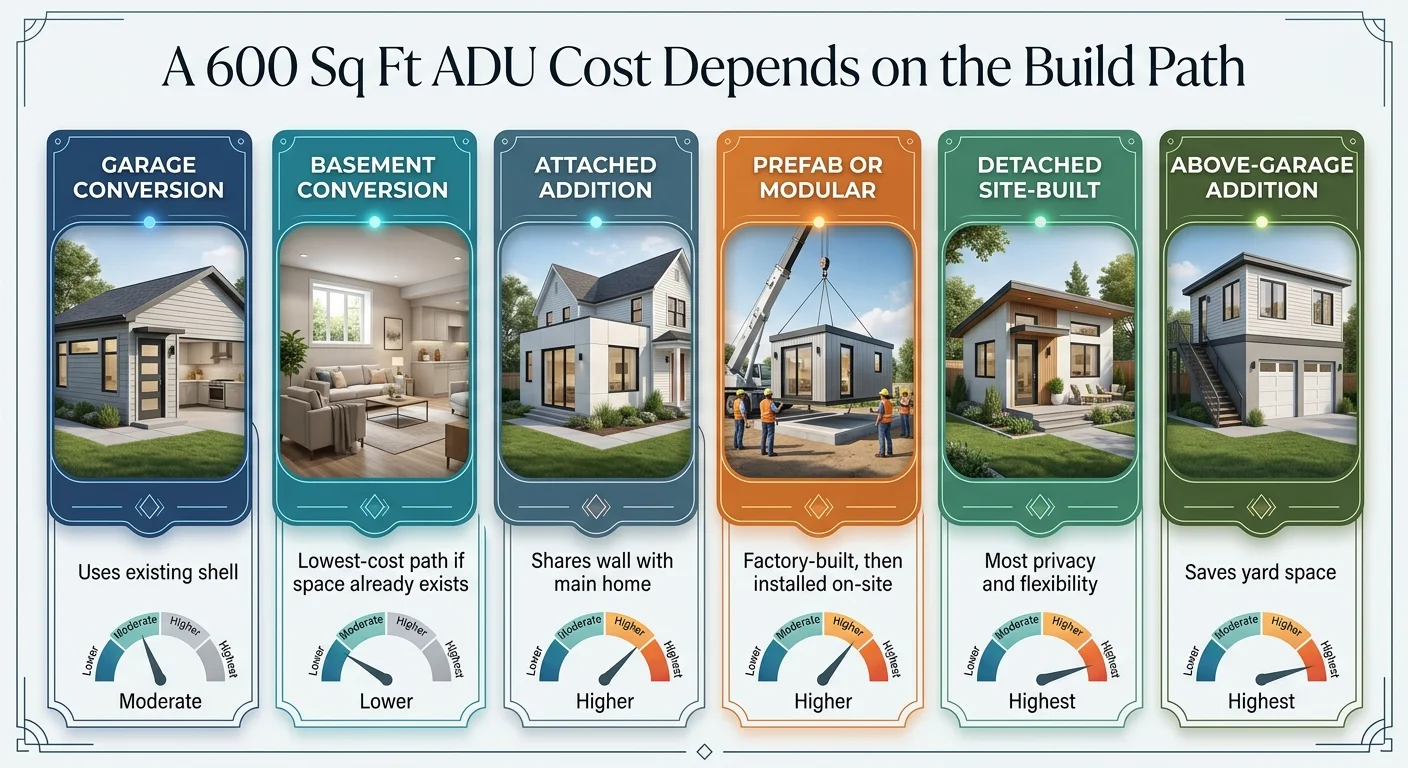
Garage conversion: $60,000–$150,000 all-in
A garage conversion is often the cheapest path to a 600 sq ft ADU because the shell — walls, roof, foundation — already exists. You're adding insulation, drywall, flooring, a kitchen, a bathroom, plumbing, electrical, HVAC, windows, and a separate entrance.
Where the money goes at 600 sq ft:
| Line Item | Typical Range |
|---|---|
| Demo, framing, insulation | $5,000–$15,000 |
| Plumbing (new bath + kitchen) | $6,000–$14,000 |
| Electrical + panel upgrade | $4,000–$10,000 |
| HVAC (mini-split) | $3,000–$6,000 |
| Interior finishes | $10,000–$30,000 |
| Windows, doors, exterior | $3,000–$10,000 |
| Utility hookups / sewer | $5,000–$12,000 |
| Permits + design | $4,000–$15,000 |
| Contingency (10–15%) | $5,000–$15,000 |
When it works
Existing garage shell with sound structure, adequate ceiling height, and a lot that can accommodate required replacement parking.When it doesn't
Structural issues, inadequate ceiling height, or a market where losing covered parking significantly affects resale value.Note: A standard two-car garage is roughly 360–400 sq ft. A full 600 sq ft conversion typically requires a larger-than-standard garage, a three-car garage, or a garage-plus-addition approach.
Basement conversion: $50,000–$100,000 all-in
If you have an unfinished basement with adequate ceiling height, this is the lowest-cost path. The structure exists. The foundation exists. You're finishing the space.
Ceiling height and egress requirements vary by jurisdiction. Under the IRC, habitable spaces generally require a minimum 7-foot ceiling height, and sleeping rooms require emergency escape openings. Check your local requirements early — these two items are where basement conversions either stay affordable or spiral. Moisture mitigation and waterproofing are non-negotiable: budget $3,000–$10,000 depending on existing conditions.
Best for: Homeowners with dry, tall basements who want the most affordable path to a legal ADU. Common in the Midwest and Northeast where basements are standard.
Attached addition: $100,000–$215,000 all-in
An attached ADU shares at least one wall with your existing home. That shared wall means easier (and cheaper) utility connections — you're tapping into existing plumbing, electrical, and HVAC runs rather than trenching new ones across your yard. The tradeoff is less privacy and the complexity of tying new construction into an existing structure. Matching rooflines, siding, and structural loads adds design cost.
Best for: Multigenerational households where the shared wall is a feature, not a bug — especially aging-parent scenarios where proximity to the main home matters.
Prefab / modular: $110,000–$200,000 fully installed
Here's the thing about prefab ADU pricing that trips up almost everyone: the advertised price is for the unit, not the project. A factory-built 600 sq ft ADU might cost $55,000–$100,000 for the structure. But site prep, foundation, utility hookups, delivery, crane set, permits, and finishing connections typically add $40,000–$100,000 on top.
A "$65,000 prefab ADU" is a $65,000 box — not a $65,000 move-in-ready home on your property. Budget the full installed cost before falling in love with a floor plan.
That said, prefab has real advantages: factory construction means tighter quality control, fixed pricing on the structure, faster build timelines, and less disruption to your yard. We cover prefab options in depth on our prefab ADU comparison page →.
Detached site-built: $150,000–$300,000+ all-in
This is full new construction — from bare ground to a finished, standalone home. It's the most expensive path but delivers the most value: maximum privacy, separate entrance, and the strongest rental income potential.
The wide range exists because of regional labor costs, site conditions, and finish level. A detached 600 sq ft ADU in Sacramento with mid-range finishes plans around $150,000–$210,000. The same unit in San Diego runs $225,000–$360,000+. In Denver, the 2026 benchmark for this size is roughly $150,000–$200,000. In a lower-cost Southern or Midwestern market, $100,000–$175,000 is realistic.
| Line Item | Typical Range |
|---|---|
| Design + engineering | $8,000–$18,000 |
| Permits, plan check, fees | $3,000–$20,000 |
| Site prep + grading | $2,000–$10,000 |
| Foundation (slab) | $6,000–$15,000 |
| Framing + roofing | $20,000–$40,000 |
| Plumbing | $6,000–$15,000 |
| Electrical | $4,000–$10,000 |
| HVAC (mini-split) | $3,000–$7,000 |
| Interior finishes | $15,000–$40,000 |
| Exterior finish + siding | $6,000–$15,000 |
| Utility hookups + trenching | $5,000–$15,000 |
| Contingency (10–15%) | $12,000–$30,000 |
| Total | $90,000–$235,000 |
In high-cost markets (coastal California, Pacific Northwest, NYC metro), add 30–80% to these figures.
Above-garage addition: $150,000–$300,000 all-in
Adding a second story above an existing garage sounds efficient — no yard space lost, proximity to utilities. But the structural reality is expensive: most residential garages were not engineered to support a full living unit above. You'll likely need foundation reinforcement, structural steel, seismic upgrading (in applicable zones), and fire-rated assemblies.
Best for: Homeowners with zero yard to spare. Otherwise, a detached build on a pad often costs the same or less with fewer engineering complications.
Which 600 sq ft ADU path fits your situation?
You're not really choosing a price — you're choosing a path. The right one depends on what you already have and what you need.
You have an existing garage you don't use
Start with a conversion estimate. It's the fastest way to go from concept to keys in hand, and typically the most affordable if the structure is sound. A structural assessment before committing to a budget prevents major surprises.
You have a basement with adequate ceiling height
This is your lowest-cost path. Egress and moisture are the two make-or-break factors. If both check out, you're looking at $50,000–$100,000 all-in.
Privacy and rental income are the priority
Detached is the play. Separate entrance, separate utilities, maximum tenant appeal. It costs more upfront — and it earns more back.
Speed and budget certainty matter most
Prefab. You'll know the structure cost before signing anything. Just make sure you're budgeting the full installed cost, not just the factory sticker price.
You're building for aging parents
Attached or small detached. Proximity matters for daily caregiving, but so does privacy. A 600 sq ft 1-bedroom ADU with a full kitchen, accessible bathroom, and a connected walkway hits the sweet spot.
You're trying to stay under a local fee threshold
Read the California fee breakpoints section carefully. At 600 sq ft, you're under California's impact fee threshold but above the school fee exemption line.
Our free ADU feasibility report checks your lot, zoning, and local rules in about 60 seconds — so you know what you can build, how big, and where, before you talk to a single contractor.
See What You Can Build — Get Your Free ADU ReportIs 600 sq ft actually the right size — or should you build bigger?
This is the question nobody else answers well enough, and it might save you — or make you — tens of thousands of dollars.
Here's the counterintuitive economics: because a huge portion of ADU costs are fixed (kitchen, bathroom, utility connections, permits, foundation, design), adding square footage is surprisingly cheap at the margin. Going from 600 to 800 sq ft often adds only $20,000–$40,000 to the total — but gets you a second bedroom, meaningfully more livable space, and significantly stronger rental appeal.
| Size | Est. Total | Est. Cost/Sq Ft | Layout Options |
|---|---|---|---|
| 400 sq ft | $120,000–$170,000 | $300–$425 | Studio or tight 1BR/1BA |
| 500 sq ft | $130,000–$180,000 | $260–$360 | Comfortable 1BR/1BA |
| 600 sq ft | $150,000–$200,000 | $250–$333 | Generous 1BR/1BA or tight 2BR/1BA |
| 750 sq ft | $165,000–$230,000 | $220–$307 | Comfortable 2BR/1BA |
| 800 sq ft | $170,000–$240,000 | $213–$300 | 2BR/1BA with real living room |
| 1,000 sq ft | $190,000–$290,000 | $190–$290 | 2BR/2BA or 3BR/1BA |
The cost per square foot drops noticeably at every size jump. A 600 sq ft ADU often costs 75–85% of what an 800 sq ft unit costs — for only 75% of the space. Before you commit to 600 sq ft, check your local zoning maximum. If you can build bigger and the rental market rewards a second bedroom, building to your maximum allowable size is often the better financial move.
The California fee breakpoints: 499 vs. 600 vs. 750
If you're in California, size thresholds directly affect your permit costs — and 600 sq ft sits in a specific zone worth understanding.
750 sq ft or less → no local impact fees
California Government Code § 66311.5(c) prohibits local governments from imposing impact fees on ADUs of 750 sq ft or less. At 600 sq ft, you're safely under this line — and that can mean thousands of dollars in savings. (Source: California HCD ADU Handbook, March 2026)
Larger than 500 sq ft → school fees may apply
School districts may levy fees on ADUs larger than 500 sq ft; ADUs and JADUs of 500 sq ft or less are not subject to school impact fees. At 600 sq ft, you're above this threshold — typically $2–$5 per square foot ($1,200–$3,000 on a 600 sq ft unit). (Source: California HCD ADU Handbook, March 2026)
The strategic implication
If you're in California and choosing between 600 and 750 sq ft, both stay under the impact fee threshold — but 750 gives you meaningfully more space for a modest cost increase. For most homeowners, 600–750 sq ft is the sweet spot in California.
What about other states?
Portland, OR
Portland offers an SDC (System Development Charge) waiver for ADUs. The owner must sign a covenant agreeing no structure on the property will be used as a short-term rental for 10 years. This waiver can significantly reduce upfront costs.
Source: Portland.gov, verified April 7, 2026
Seattle, WA
Seattle's 2026 SDCI base plan review rate is $292/hour; construction permit fees rose 18% year over year. Seattle is one of the more expensive permitting environments nationally — factor this in early.
Source: Seattle SDCI 2026 fee changes, January 5, 2026
Austin, TX
Austin's policy analysis modeled a 600 sq ft ADU at $340/sq ft and $204,000 in hard construction costs. All-in cost will be higher once design, permits, utility work, and contingency are added.
Source: Austin City Council staff document #453547
Denver, CO
Local 2026 benchmarks place a 400–600 sq ft ADU at roughly $150,000–$200,000 all-in.
Source: Prospect 30 Eight Construction, 2026 ADU cost guide
Not sure what rules apply to your address? Our feasibility report pulls your local zoning, size limits, and setbacks automatically.
Check What You Can Build at Your AddressThe honest truth about building at 600 sq ft
A 600 sq ft ADU is a real construction project with real costs. Even the budget paths — garage and basement conversions — require plumbing, electrical, HVAC, and code-compliant finishes. A new kitchen and bathroom alone can run $15,000–$30,000. Add permits, design, and utility connections and you're past $50,000 on a conversion — and into six figures on a new build.
If a contractor quotes you $60,000 for a detached, fully permitted 600 sq ft ADU in 2026, that's a red flag. The internet is full of unrealistic cost headlines, and the homeowners who get burned are the ones who budgeted against wishful numbers instead of real ones.
Here's the other side of that honesty. Homeowners across the country are building ADUs at this size every day, and the ones who succeed all have one thing in common — they went in with realistic numbers. A 600 sq ft ADU that's properly budgeted, well-designed, and built by a qualified contractor becomes a genuine asset: real monthly rental income, meaningful property value increase, or housing for an aging parent with dignity and independence.
The cost is real. So is the return. The difference is going in clear-eyed about both.
Where does the money actually go? Full 600 sq ft budget anatomy
If you can't see where the money goes, you can't control it. We organized this the way your project will actually unfold — design first, then permits, then site work, then vertical construction, then finishes.
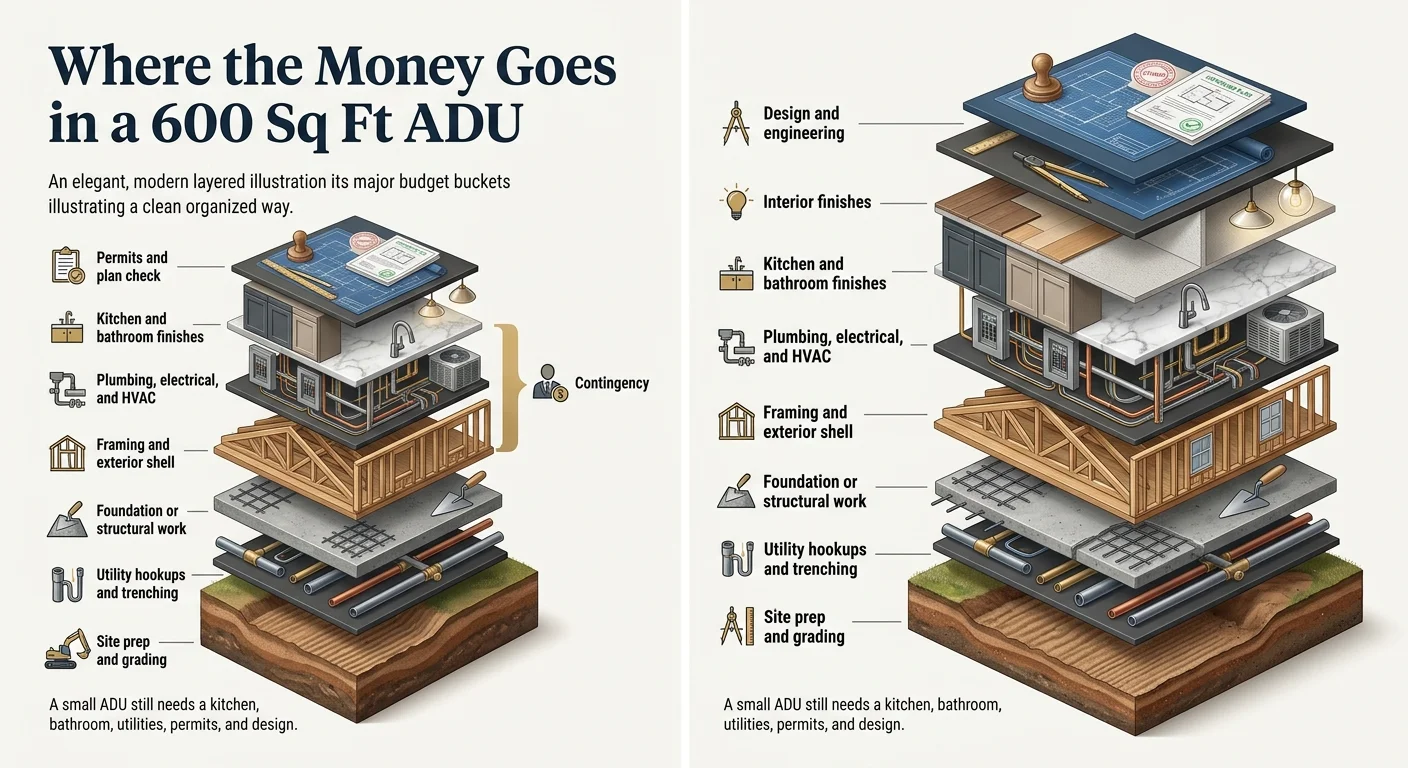
Soft costs (design, permits, and professional fees)
| Item | 600 Sq Ft Range | Notes |
|---|---|---|
| Architectural design | $5,000–$15,000 | Pre-drawn plans: $2,000–$5,000. Custom: $8,000–$15,000+. |
| Structural engineering | $1,500–$4,000 | Required for most new builds and above-garage ADUs. |
| Energy compliance (Title 24 in CA) | $500–$2,000 | Required in California. Other states have equivalents. |
| Survey | $500–$1,500 | Boundary and topographic. Usually required. |
| Permits + plan check | $2,000–$20,000+ | Varies wildly by city. See local modifiers above. |
| Impact / school / connection fees | $0–$15,000+ | Depends on size thresholds, jurisdiction, and waivers. |
| Soft cost subtotal | $10,000–$55,000+ |
Soft costs are the line items that blow budgets — not because they're huge individually, but because homeowners routinely forget to include them.
Site and foundation costs
| Item | 600 Sq Ft Range | Notes |
|---|---|---|
| Site clearing + grading | $1,500–$8,000 | Flat, accessible lots are cheapest. Slopes add $5,000–$20,000+. |
| Foundation (slab-on-grade) | $5,000–$15,000 | Pier/post foundations can be cheaper in some conditions. |
| Utility trenching | $3,000–$12,000 | Distance from main home to ADU pad is the cost driver. |
| Sewer connection | $2,000–$8,000 | Some cities charge connection fees on top of physical work. |
| Water line extension | $1,000–$4,000 | |
| Electrical service / panel upgrade | $1,500–$5,000 | If your main panel is near capacity, budget for an upgrade. |
| Site subtotal | $14,000–$52,000 |
Vertical construction (the structure itself)
| Item | 600 Sq Ft Range | Notes |
|---|---|---|
| Framing + structural | $15,000–$35,000 | Wood frame standard. Steel frame adds 10–15%. |
| Roofing | $4,000–$10,000 | Asphalt shingle cheapest. Standing seam metal at premium end. |
| Exterior finish / siding | $5,000–$15,000 | Vinyl/fiber cement budget. Wood/stucco premium. |
| Windows + exterior doors | $3,000–$10,000 | Energy-rated windows add cost but may be required. |
| Insulation | $2,000–$5,000 | Batt cheapest. Spray foam premium but better performance. |
| Vertical subtotal | $29,000–$75,000 |
Interior finishes and systems
| Item | Basic | Mid-Range | Premium |
|---|---|---|---|
| Kitchen (cabinets + counters + appliances) | $6,000–$12,000 | $12,000–$22,000 | $22,000–$40,000+ |
| Bathroom (fixtures + tile + vanity) | $4,000–$8,000 | $8,000–$15,000 | $15,000–$25,000+ |
| Flooring | $2,000–$4,000 | $4,000–$8,000 | $8,000–$15,000 |
| Drywall + paint | $3,000–$6,000 | $4,000–$8,000 | $6,000–$12,000 |
| HVAC (mini-split) | $3,000–$5,000 | $5,000–$8,000 | $8,000–$14,000 |
| Plumbing (rough + finish) | $5,000–$10,000 | $8,000–$15,000 | $12,000–$22,000 |
| Electrical (rough + finish) | $3,000–$7,000 | $5,000–$10,000 | $8,000–$15,000 |
| Interior doors + trim | $1,000–$3,000 | $2,000–$5,000 | $4,000–$10,000 |
| Finish subtotal | $27,000–$55,000 | $48,000–$91,000 | $83,000–$153,000 |
Three real budget examples at 600 sq ft
Numbers are useful. Worked examples are better. Here are three realistic scenarios.
Example 1: Garage conversion in a moderate market — ~$85,000
A homeowner in a mid-cost metro converts a structurally sound large garage (~600 sq ft) into a 1BR/1BA rental unit with value-grade finishes.
| Item | Cost |
|---|---|
| Demo + framing + insulation | $8,000 |
| Plumbing (new bath + kitchen) | $10,000 |
| Electrical + minor panel work | $6,000 |
| HVAC (mini-split) | $4,000 |
| Interior finishes (budget) | $18,000 |
| Windows, exterior door, siding patch | $5,000 |
| Utility hookups | $8,000 |
| Design (pre-drawn plan) | $3,000 |
| Permits + fees | $6,000 |
| Contingency (12%) | $8,200 |
| Landscaping repair | $2,000 |
| Total | ~$78,200 |
Rounded to ~$85,000 accounting for typical add-ons and minor scope adjustments.
Example 2: Mid-range detached build in a moderate market — ~$185,000
New detached 1BR/1BA ADU, mid-range finishes, flat lot with good utility access. Think Sacramento, Denver, or Raleigh.
| Item | Cost |
|---|---|
| Design + engineering | $12,000 |
| Permits + plan check + fees | $10,000 |
| Site prep + grading | $4,000 |
| Foundation (slab) | $10,000 |
| Framing + roof + exterior | $40,000 |
| Plumbing (rough + finish) | $12,000 |
| Electrical (rough + finish) | $8,000 |
| HVAC | $5,500 |
| Interior finishes (mid) | $35,000 |
| Utility hookups + trenching | $12,000 |
| Contingency (12%) | $17,700 |
| Landscaping repair | $3,000 |
| Total | ~$169,200 |
Rounded to ~$185,000 with typical scope adjustments. In a high-cost market like LA or San Diego, this same project plans at $230,000–$320,000+.
Example 3: Prefab ADU, fully installed — ~$155,000
Factory-built 600 sq ft 1BR/1BA unit, delivered and installed on a flat lot with standard utility runs.
| Item | Cost |
|---|---|
| Prefab unit (factory price) | $80,000 |
| Delivery + crane set | $8,000 |
| Foundation + site prep | $20,000 |
| Utility hookups + connections | $14,000 |
| Permits + fees | $8,000 |
| Finish connections + touch-up | $5,000 |
| Landscaping | $4,000 |
| Contingency (10%) | $14,000 |
| Total | ~$153,000 |
These are illustrative examples based on 2026 market data, not guaranteed project costs. Actual results depend on your local market, site conditions, builder selection, and design choices.
Can 600 sq ft actually work as a home?
Yes — and it works surprisingly well when the floor plan is thoughtful.
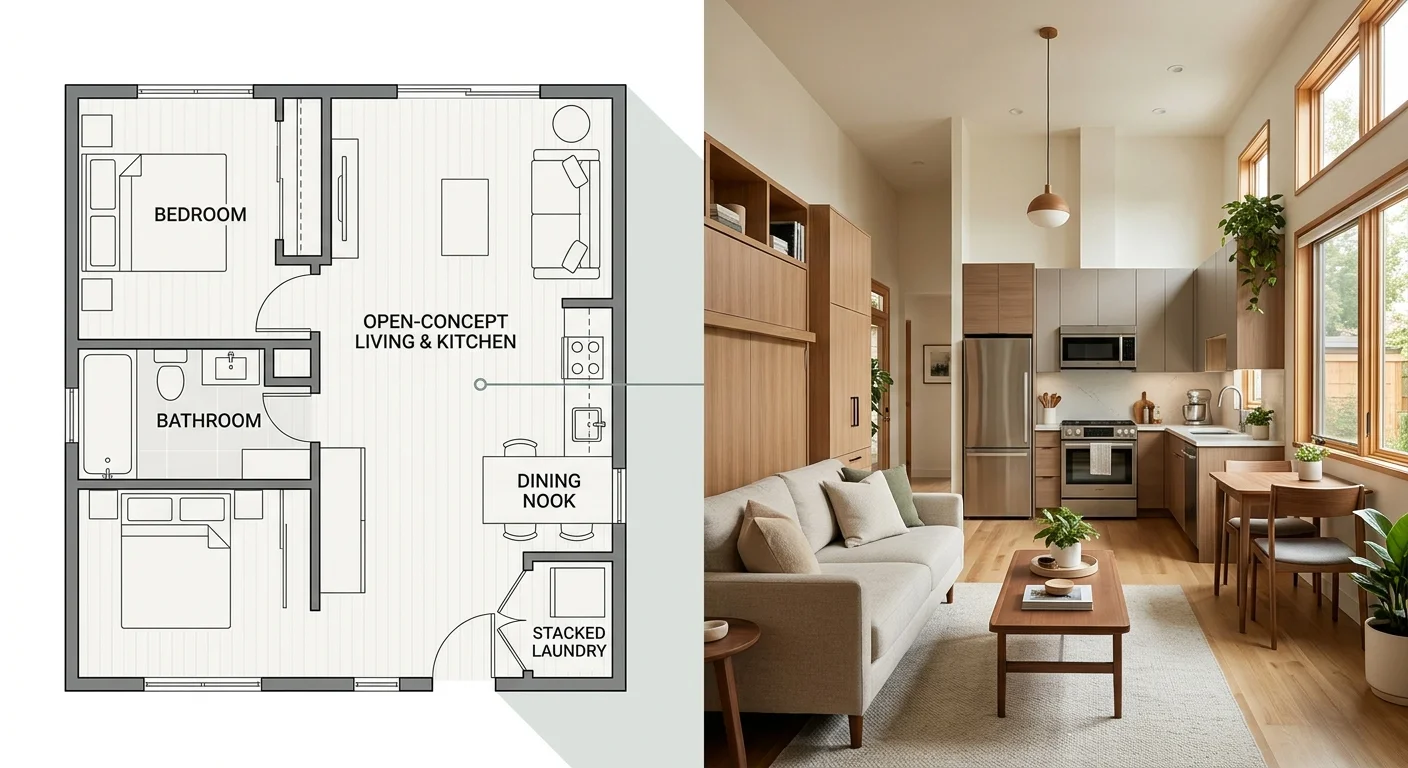
A 600 sq ft ADU comfortably fits a one-bedroom, one-bathroom layout with a full kitchen, a real living area, a bedroom that fits a queen bed with nightstands, in-unit laundry (stacked washer/dryer), and reasonable storage. It's roughly the size of a generous one-bedroom apartment.
Can you fit two bedrooms? Technically yes, but it gets tight. A 2BR/1BA at 600 sq ft means smaller bedrooms (roughly 100–110 sq ft each), a compact living area, and limited storage. It works for roommates, a parent with one child, or a short-term rental. For a comfortable 2BR with a real living room, 750–800 sq ft is meaningfully better.
Long-term rental
1BR/1BA is the most common configuration and commands strong rents in most markets — demand for well-designed 1BR units is enormous.
Aging parents
1BR/1BA with accessible features (wider doorways, grab bars, curbless shower, single-floor living). Room for everything a parent needs with real independence.
Adult child
Studio or 1BR layout. Provides independence without a market-rate lease.
Home office / guest house
Dual-purpose — office by day, guest suite when visitors come. The full kitchen and bath make extended stays comfortable.
Short-term rental / Airbnb
1BR or studio layout can perform well on STR platforms, particularly in high-demand travel markets.
How long does a 600 sq ft ADU take from start to move-in?
Most homeowners underestimate ADU timelines by 3–6 months. The construction phase gets all the attention, but design and permitting often take just as long — and sometimes longer.
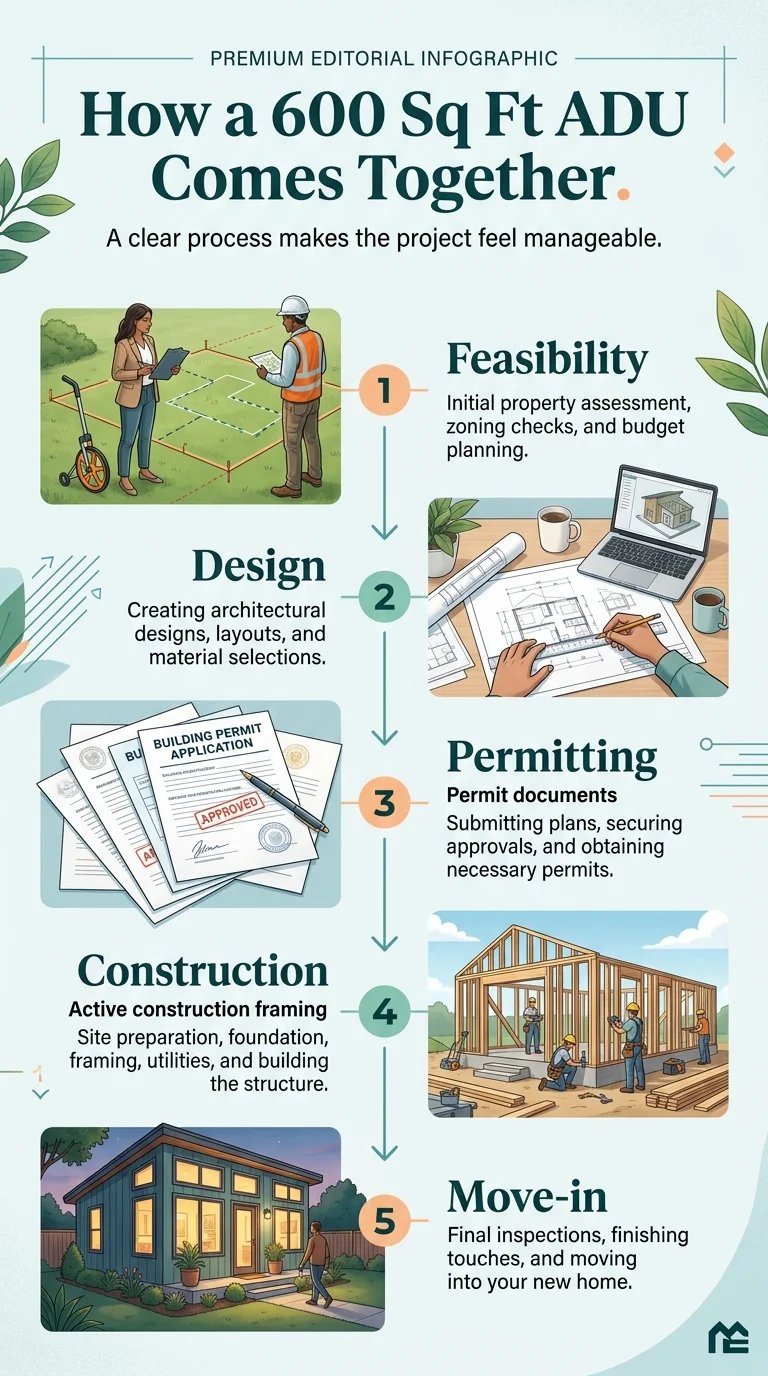
| Phase | Typical Duration | What Happens |
|---|---|---|
| Feasibility + design | 4–8 weeks | Site assessment, architectural plans, engineering, energy compliance. |
| Permitting + plan review | 4–16 weeks | Varies widely by city. Some offer expedited ADU review. Others don't. |
| Site prep + foundation | 2–4 weeks | Grading, utility trenching, foundation pour and cure. |
| Framing + rough systems | 4–8 weeks | Structure, rough plumbing, electrical, HVAC. |
| Finishes + inspections | 4–8 weeks | Drywall, flooring, kitchen, bath, final inspections. |
| Total (detached new build) | 6–14 months | |
| Total (garage/basement conversion) | 2–6 months | Shorter because no foundation or major structural work. |
| Total (prefab, from order) | 3–6 months | Factory lead time + site prep + installation + inspections. |
The permitting bottleneck is real. In some cities, plan review alone takes 8–12 weeks, and each round of corrections can add weeks. An ADU-specialist builder who knows your city's review process can navigate this significantly faster than a general contractor without ADU experience.
Will a 600 sq ft ADU pay off?
For most homeowners building in the right market with realistic numbers, the answer is yes — but the financial case depends on your goal.
If your goal is rental income
A 600 sq ft 1BR ADU rents for $1,200–$3,500/month depending on market, location, and finishes. In a strong rental market with rents toward the higher end, the math works well against a $150,000–$200,000 all-in cost. In a weaker rental market, the payback stretches — which is why knowing your local rental comps matters before you commit.
If your goal is property value
Freddie Mac has noted that ADUs may have the potential to increase long-term property value and resale value. The exact amount depends on your local market, comparable sales, and appraiser experience with ADU properties.
If your goal is family housing
This is often the most compelling case financially. Providing independent housing for an aging parent or adult child — with real privacy, a full kitchen, and their own entrance — avoids costs that can run thousands per month in other housing arrangements, while keeping family close.
When a 600 sq ft ADU may NOT be the right move:
- You plan to sell the property within 1–2 years (construction timeline risk may outweigh value add)
- Your local rental market doesn't support rents that justify your all-in cost
- Your lot has severe access, slope, or utility challenges that push costs to the extreme high end
These are illustrative examples, not guarantees of returns. Actual results depend on local market conditions, construction costs, financing terms, and regulatory approvals.
How homeowners typically pay for a 600 sq ft ADU
Among homeowners who used a mortgage product to finance their ADU, 56% chose a home equity line of credit (HELOC) or home equity loan, according to the Urban Institute's 2024 ADU financing study. That makes HELOC the dominant financing path — but it's not the only one, and it's not always the best fit.
The right financing depends on your equity position, cash flow, and how comfortable you are with monthly payments during construction.
Dwelling Index is an independent educational resource. We are not a lender or broker. When you use our links to explore financing options, we may earn a commission at no extra cost to you. See our full disclosure →
Strong existing home equity
Home Equity Line of Credit (HELOC)
A standard HELOC lets you borrow against equity you've already built. Funding can be fast, and you only pay interest on what you draw. This is the most common path for homeowners whose homes have appreciated significantly.
Low current equity / recent purchase
Renovation HELOC (After-Value Lending)
A renovation-focused HELOC lends against your home's projected after-renovation value — not just its current value. This means the ADU itself helps you qualify for the financing to build it. Not available in all states — check availability for your location.
Explore Renovation Financing at RenoFiEquity-rich but cash-flow tight
Home Equity Investment (HEI) — No Monthly Payments
A home equity investment gives you a lump sum in exchange for a share of your home's future appreciation — with no monthly payments. Built for homeowners who have significant equity but can't take on additional monthly debt. HEI products have limited state availability — verify before applying.
Investment / larger project
Construction Loan or Cash-Out Refinance
Construction loans and investor-focused products can finance ADUs intended primarily for rental income. These typically have different qualification criteria than homeowner-occupied products.
The financing question is the one that stalls most ADU projects. Don't let it stall yours. Most 600 sq ft ADU projects fall in the $100K–$200K range — well within reach for homeowners with existing equity.
See How Homeowners Pay for This — Explore ADU Financing OptionsWhat blows a 600 sq ft ADU budget — and how to prevent it
The five most common budget killers, in order of how often they surprise homeowners:
Utility trenching and sewer work nobody mentioned
Extending water, sewer, electrical, and gas lines from your main home to a detached ADU pad requires trenching — and the cost depends entirely on distance, soil conditions, and obstacles. Budget $8,000–$15,000 for a typical run. If your ADU pad is far from the main home or the sewer line, this can double.
Electrical panel upgrades
If your main home's electrical panel is near capacity (common in older homes), you'll need an upgrade before you can run a new circuit to the ADU. Panel upgrades run $2,000–$5,000 and are non-negotiable — the city won't issue a permit without adequate electrical service.
Site access problems
If there's no way to get equipment, materials, or a prefab unit into your backyard without craning over the house or hand-carrying everything through a narrow side yard, labor costs rise substantially. This is one of the first things a good builder evaluates — and one of the last things homeowners think about.
"Cheap" conversions that aren't
A garage conversion sounds affordable until a structural assessment reveals a cracked foundation, inadequate ceiling height, or framing that can't support residential loads. A structural assessment before committing to a conversion budget is always a smart investment.
Finish creep
You budgeted for laminate counters and chose quartz. You planned for LVP flooring and fell in love with hardwood. Individually, each upgrade is $2,000–$5,000. Collectively, they can add $15,000–$30,000. Decide your finish level at the design stage and hold the line.
How to protect your budget: the 12-item quote checklist
Every serious quote for a 600 sq ft ADU should specify these 12 items explicitly:
Take the checklist with you
We built a printable version of this checklist — plus a budget worksheet and permitting timeline template — into our free 2026 ADU Starter Kit.
Download the Free 2026 ADU Starter KitFrequently asked questions about 600 sq ft ADU cost
How much does a 600 square foot ADU cost?
A 600 sq ft ADU costs $50,000–$300,000+ depending on type and location. Conversions (garage, basement) run $50,000–$150,000. Attached additions cost $100,000–$215,000. Detached new builds cost $150,000–$300,000+. Prefab units cost $110,000–$200,000 fully installed. The wide range reflects different build paths, not uncertainty — once you know your path and market, the range narrows significantly.
How much does it cost to build a 600 sq ft, 1-bedroom ADU?
A 1-bedroom ADU at 600 sq ft typically plans at $150,000–$200,000 all-in for a detached new build in a moderate-cost market, or $110,000–$155,000 for a prefab unit fully installed. Conversions can run $50,000–$125,000 depending on the existing structure and your market.
Is 600 square feet big enough for a two-bedroom ADU?
It can work, but it's tight. A 2BR/1BA at 600 sq ft means bedrooms around 100–110 sq ft each with a compact living area. It works for roommates or a parent with one child. For a comfortable 2BR with a real living room, 750–800 sq ft is meaningfully better.
Can two people live comfortably in 600 sq ft?
Yes. A 600 sq ft 1BR/1BA provides roughly the same space as a generous one-bedroom apartment. Couples and individuals live comfortably at this size. The key is thoughtful design — good storage, an open floor plan, and in-unit laundry make 600 sq ft feel much larger than it sounds.
How long does it take to build a 600 sq ft ADU?
Garage or basement conversion: 2–6 months. Prefab (from order to move-in): 3–6 months. Detached site-built: 6–14 months including design and permitting. Permitting alone can take 4–16 weeks depending on your city.
Are 600 sq ft ADUs exempt from impact fees?
In California, yes — ADUs of 750 sq ft or less are exempt from local impact fees under Government Code § 66311.5(c). However, at 600 sq ft you are above the 500 sq ft school fee threshold, so school fees may apply. Other states have varying rules — check with your local planning department.
What is the cost per square foot for a 600 sq ft ADU?
For new detached construction, $250–$500+ per square foot depending on market and finish level. For conversions, $85–$250 per square foot. Cost per square foot is higher on smaller ADUs because fixed costs (kitchen, bath, utilities, permits) are spread over fewer square feet.
Is a garage conversion cheaper than building a detached 600 sq ft ADU?
Almost always, yes — typically by $50,000–$150,000+ depending on the condition of the existing garage and your market. The existing shell, foundation, and (sometimes) partial utilities mean you're starting well below the cost of building from scratch.
Is prefab cheaper for a 600 sq ft ADU?
The unit itself is cheaper than site-built construction. But the total installed cost — including foundation, site prep, delivery, utility connections, and permits — narrows the gap significantly. Prefab's strongest advantages are budget certainty and speed, not necessarily the lowest total price.
Can I build a 600 sq ft ADU for under $100,000?
Possible through garage or basement conversion in a moderate-to-low-cost market with value-grade finishes. Very unlikely for a detached new build in 2026. Any contractor promising a fully permitted detached 600 sq ft ADU for under $100K deserves serious scrutiny.
Should I build 600, 750, or 800 sq ft?
Check your local zoning maximum first. If you can build bigger, the marginal cost of going from 600 to 800 sq ft is modest relative to the added rental value and livability of a second bedroom. In California, both 600 and 750 stay under the impact fee threshold — so 750 is often the smarter choice.
Does building a 600 sq ft ADU increase my property taxes?
Yes — the ADU adds assessed value to your property. In California, new construction adds assessable value for the newly built improvement; it does not trigger a full reassessment of your existing home under Proposition 13. Outside California, tax treatment varies by state and locality — confirm with your local assessor or a tax professional.
Our methodology and sources
We believe the best way to earn trust is to show our work.
Builder-reported costs
ADU-specialist contractors across multiple markets, including GreatBuildz (Los Angeles), Snap ADU (San Diego), Good Life Construction (Sacramento), Prospect 30 Eight (Denver), and Little Home Builder (Colorado).
Closed-project databases
Realm's analysis of 88 closed ADU projects at 600 sq ft (median: $250,000, average: $282,663).
Municipal documents
Austin's official 600 sq ft ADU hard-cost scenario ($340/sq ft, document #453547), Seattle's 2026 SDCI fee schedule (January 5, 2026), Portland's SDC waiver program documentation, and California's HCD ADU Handbook (March 2026 edition).
National research
Urban Institute's 2024 ADU financing study; industry benchmarks from Angi, HomeGuide, RenoFi.
Legal sources
California Government Code §§ 66311.5 and 66321; California State Board of Equalization new-construction assessment guidance; local ordinance documentation for Portland, Seattle, Austin, and Denver.
Last verified: April 7, 2026 · What "all-in" means: Design, engineering, permits, fees, site prep, foundation, construction, utility hookups, HVAC, finishes, and contingency. Does not include furniture, landscaping beyond repair, or ongoing operating costs.
Not sure where to start?
See what's possible at your address — get your free ADU report in 60 seconds.
See What You Can Build — Get Your Free ADU Report© 2026 The Dwelling Index. All rights reserved. Editorial Standards → · Full Affiliate Disclosure → · Privacy Policy →