
500 Sq Ft ADU Cost: What Homeowners Actually Pay in 2026
500 sq ft ADU cost typically ranges from about $50,000 for a straightforward garage conversion to $250,000+ for a detached new build in a high-cost market — and the reason every website seems to give you a different number is that they're each measuring something different.
One site quotes construction cost only. Another quotes the sticker price of a prefab unit before you add the foundation, delivery, utility hookups, and permits. A third uses California data from 2020. Meanwhile, you just need a number you can actually plan around.
That's what this page delivers. We break down the real all-in cost of a 500 sq ft ADU — one of the smallest sizes that still works as a true one-bedroom — by build type, by region, and by where the money actually goes.
Here's the honest part most sites skip: a 500 sq ft ADU costs more per square foot than a bigger unit. Kitchens, bathrooms, utility hookups, permits, and design fees don't shrink just because the unit does. But the total out-of-pocket is still lower — and for most homeowners, that's the number that matters.
We built this guide from public builder pricing, municipal fee schedules, research data from the Terner Center for Housing Innovation and the UC Berkeley Center for Community Innovation, and real project examples across multiple regions. Every range is an illustrative planning estimate — your actual cost depends on your property, your city's rules, and the bids you collect. See our full methodology.
Last verified: April 2026 · 14 sources cited · Editorial methodology → · Affiliate disclosure →
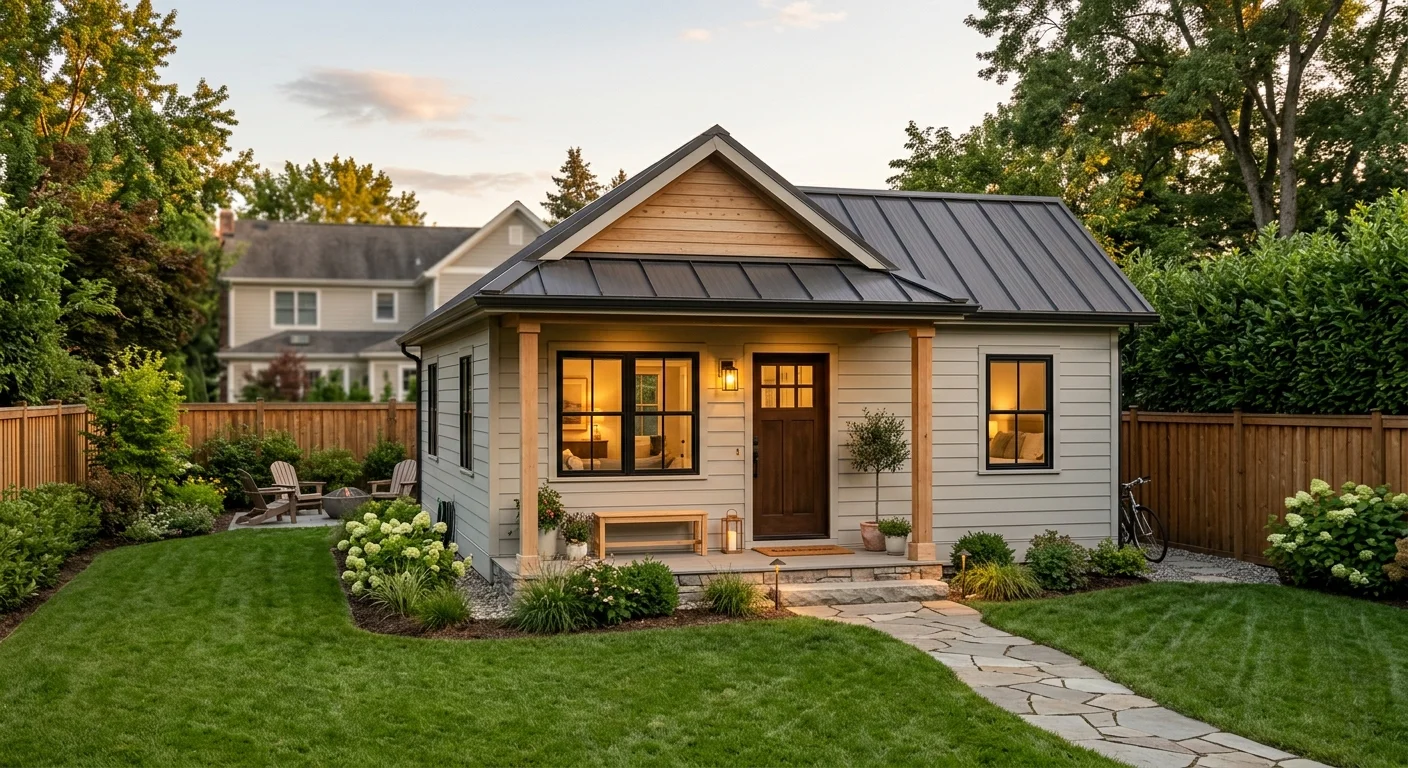
500 Sq Ft ADU Cost at a Glance
Before we break anything down, here's the table that should have been on page one of every ADU cost article you've read so far.
| Build Type | Typical All-In Cost (2026) | Cost/SF | Timeline | Biggest Budget Risk |
|---|---|---|---|---|
| Garage Conversion | $50,000 – $120,000 | $100 – $240/SF | 2 – 5 months | Foundation or ceiling-height surprises that erase the savings |
| Basement / Internal Conversion | $50,000 – $130,000 | $100 – $260/SF | 2 – 6 months | Egress, waterproofing, and code compliance costs |
| Attached Addition | $90,000 – $180,000 | $180 – $360/SF | 4 – 8 months | Structural tie-in to your main house |
| Prefab / Modular (Installed) | $100,000 – $180,000 | $200 – $360/SF | 3 – 6 months | The gap between unit price and installed price |
| Detached New Build (Site-Built) | $130,000 – $250,000+ | $260 – $500+/SF | 6 – 12 months | Utility runs, site work, and permit timelines |
Ranges reflect standard-to-mid finishes in 2026. High-cost metros (LA, SF, San Diego, Seattle, NYC metro) skew toward the upper end. Lower-cost regions (TX, FL, GA, NC, UT) skew lower. Dwelling Index analysis, April 2026 — built from Terner Center research data, HomeGuide contractor surveys, regional builder pricing, and published municipal fee schedules.
Why do other pages show different numbers? Because different sites quote different scopes — and almost nobody tells you which one they're using. We quote the all-in planning range: design, permits, site prep, construction, utilities, and a reasonable contingency.
Ready to skip the averages and get a number for your property?
See What You Can Build — Get Your Free ADU ReportWhy the Internet Can't Agree on This Number
You've probably noticed: one page says a 500 sq ft ADU costs $50,000. Another says $225,000. Both cite "real data." Neither helps you plan.
Here's what's happening. The numbers online come from at least four different scopes — and almost nobody labels which one they're using.
Scope 1: Construction cost only
Just labor and materials for the physical structure. Excludes design, engineering, permits, site prep, utility connections, and contingency. When you see figures like "$100–$150 per square foot," this is usually what they mean. It typically represents about half to two-thirds of your total out-of-pocket.
Scope 2: Unit price (prefab/modular)
The sticker on a factory-built unit. Sounds great until you realize foundation, delivery, crane, site prep, utility hookups, permits, and finishing typically add 30–60% to the advertised price.
Scope 3: Soft + hard costs but not site/utility
Some guides include design and permits but leave out the site-specific costs — grading, utility trenching, electrical panel upgrades, sewer connections — that can add $15,000–$40,000+ to a detached build.
Scope 4: True all-in / turnkey cost
Everything from the first architect call to the final inspection. This is the number you actually write checks for — and it's the number we use throughout this guide.
Once you understand which scope you're reading, the internet suddenly makes a lot more sense. A garage conversion at Scope 1 really can be $50K. A detached new build at Scope 4 in San Diego really can clear $250K+. They're just measuring different things.
Which 500 Sq Ft ADU Path Fits Your Situation?
A 500 sq ft ADU is not one product — it's at least five different projects that happen to share a square footage. The first step to getting a useful cost number is figuring out which path matches your property and goals.
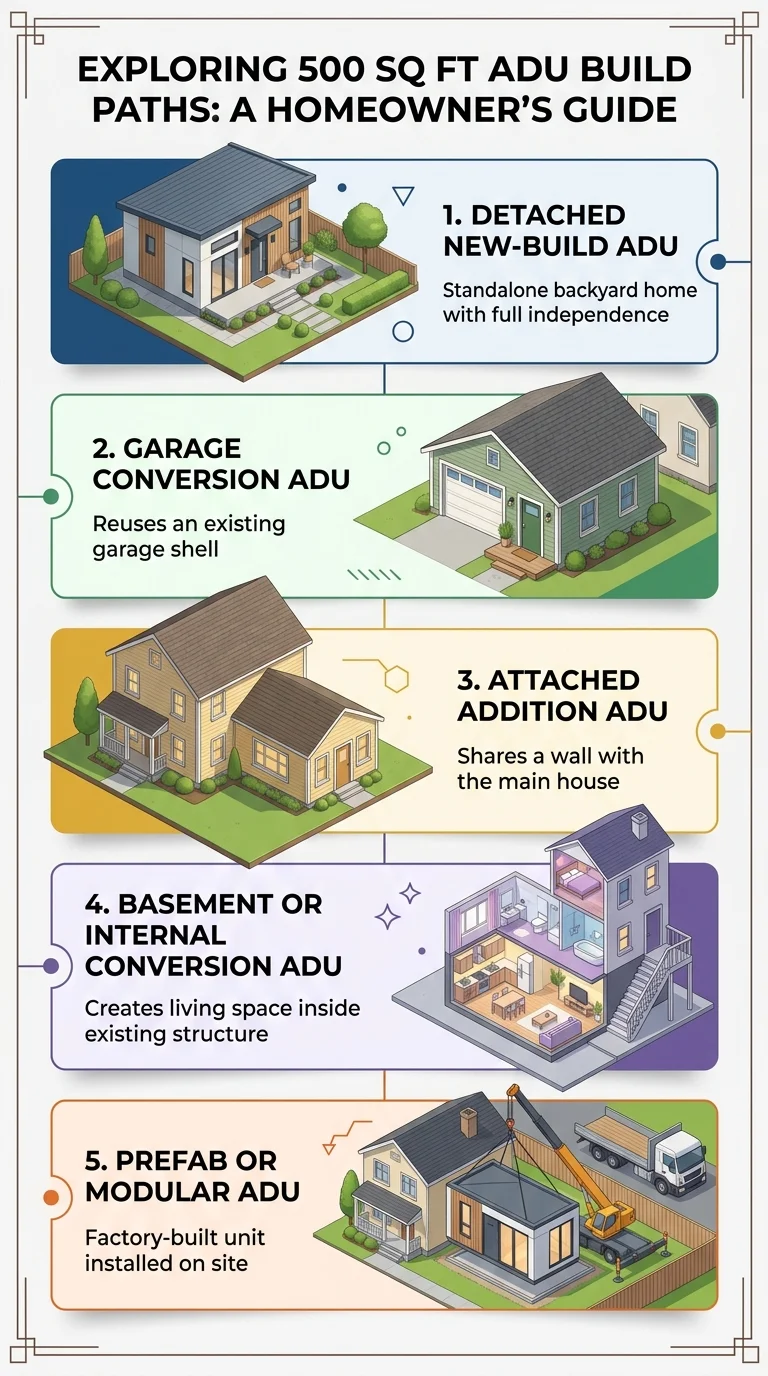
| Your Situation | Best 500 SF Path | Budget Lane | Verify First |
|---|---|---|---|
| You have a 2-car garage you rarely use | Garage conversion | $50K – $120K | Foundation condition, ceiling height, ventilation |
| You have an unfinished basement with exterior access | Basement conversion | $50K – $130K | Egress window requirements, waterproofing, ceiling height |
| You want a rental unit with full separation | Detached new build | $130K – $250K+ | Setbacks, utility distance, site access for equipment |
| You want speed and a fixed price | Prefab / modular | $100K – $180K installed | Delivery access, crane clearance, foundation type |
| Your main house has room to expand | Attached addition | $90K – $180K | Structural load, fire-rated wall, separate entrance |
If you have a structure to convert
Your budget can be dramatically lower — but only if the existing space meets code or can be brought into compliance without gutting it. A garage with a cracked foundation or a basement with insufficient ceiling height can eat the savings fast.
If you're building from scratch
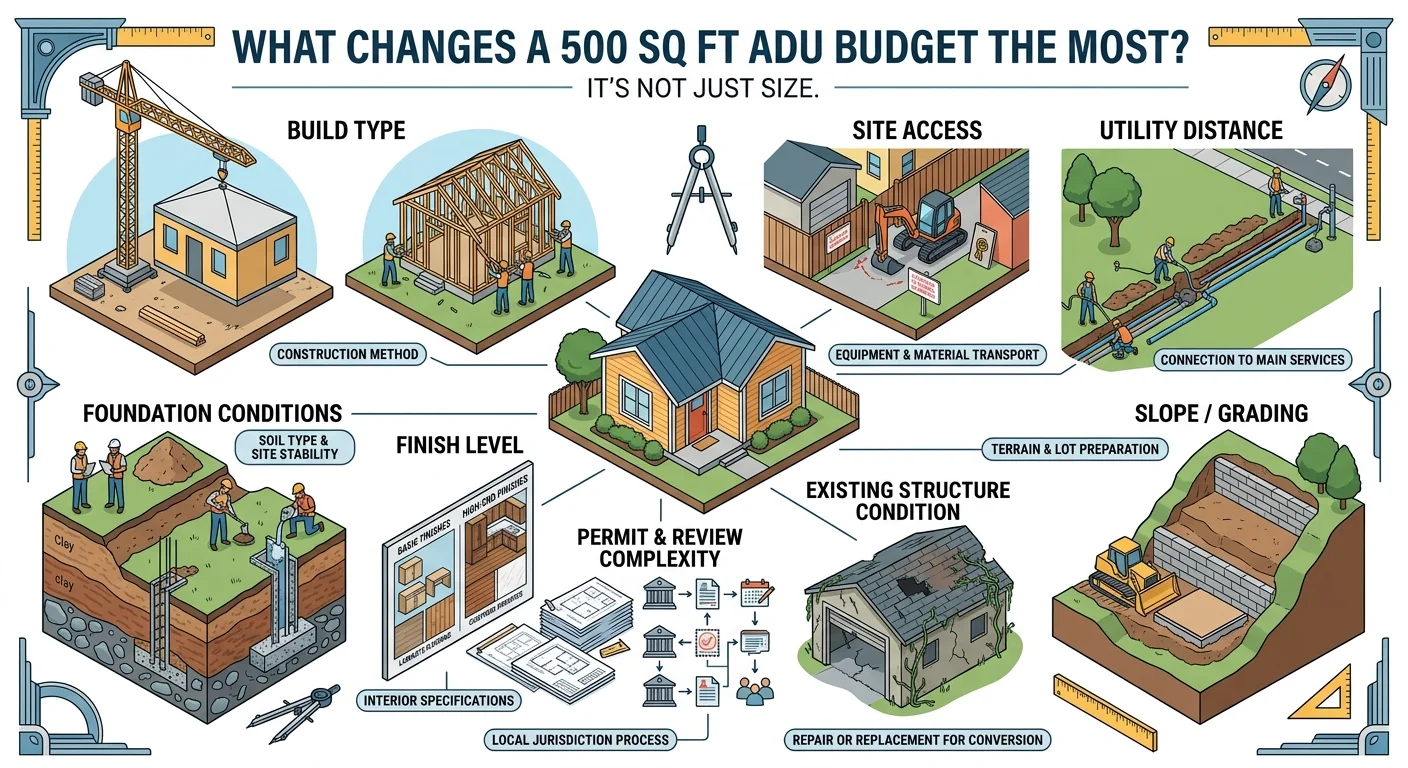
The biggest variable isn't the structure itself — it's everything around it. How far are the sewer and water lines? Does the electrical panel need an upgrade? Is the site flat and accessible? Those site-specific costs are where "average" ranges fall apart.
Not sure which path fits your property? Our feasibility report checks your lot, local rules, and site conditions.
See What You Can Build — Get Your Free ADU ReportWhy 500 Sq Ft Isn't the Cheap Shortcut You'd Expect
Here's the honest part that most cost guides skip — or bury under 3,000 words of filler.
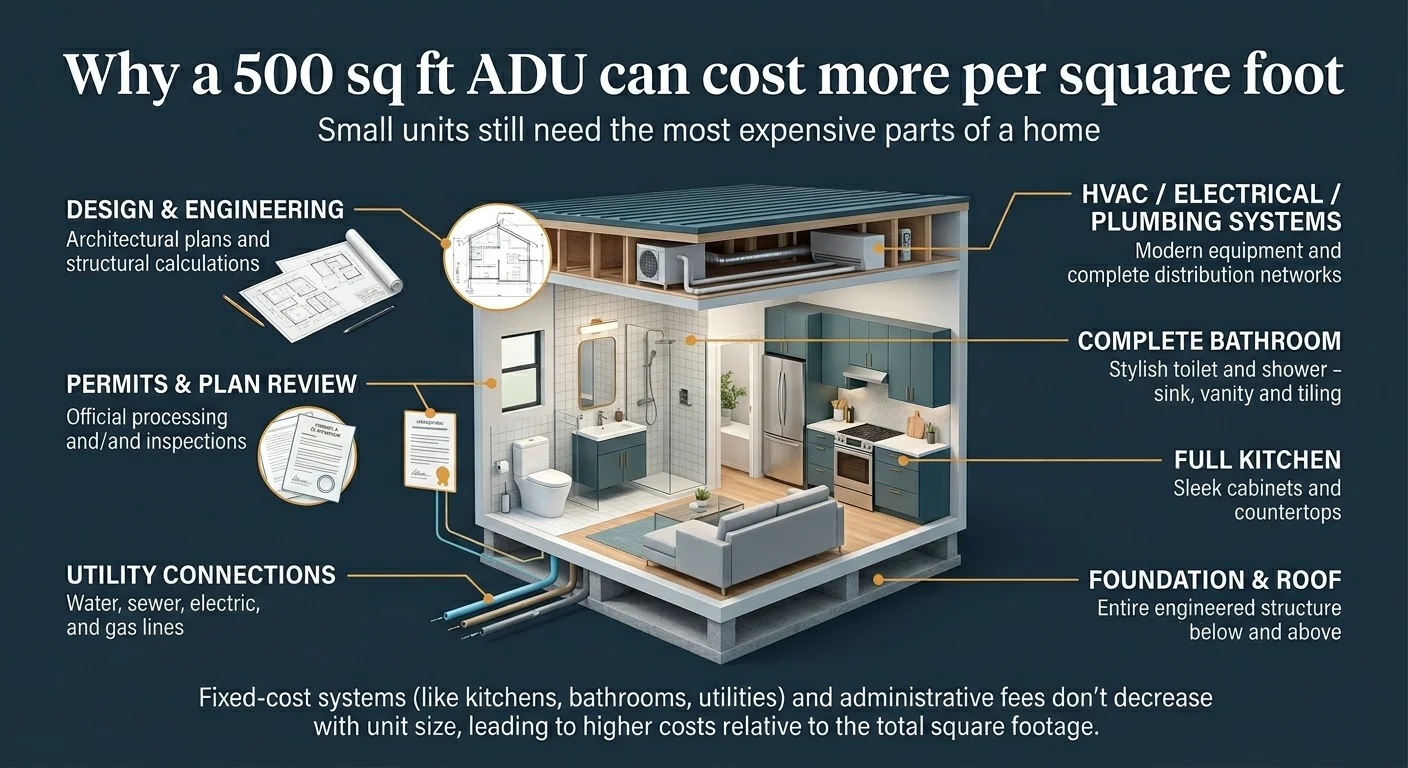
A 500 sq ft ADU costs more per square foot than a larger one. In most markets, noticeably more. Every ADU — regardless of size — needs a full kitchen, a full bathroom, a code-compliant electrical panel, plumbing rough-in, HVAC, a foundation, a roof, architectural plans, structural engineering, energy compliance, permits, inspections, and utility connections. These fixed costs are roughly the same whether you're building 500 sq ft or 1,000 sq ft.
What changes with size is mostly wall framing, flooring, drywall, and some additional materials — the cheapest parts of any build per square foot. So when you spread those expensive fixed costs over 500 sq ft instead of 1,000 sq ft, your per-square-foot number goes up. As the Terner Center for Housing Innovation notes, even very small ADUs carry substantial fixed development costs that don't scale down with size.
| ADU Size | Typical All-In Cost (Detached, Mid-Cost) | Typical Cost per SF |
|---|---|---|
| 400 sq ft (studio) | $110,000 – $200,000 | $275 – $500/SF |
| 500 sq ft (1-bed) | $130,000 – $250,000 | $260 – $500/SF |
| 600 sq ft (1-bed+) | $145,000 – $270,000 | $240 – $450/SF |
| 750 sq ft (large 1-bed / small 2-bed) | $165,000 – $310,000 | $220 – $415/SF |
| 800–1,000 sq ft (2-bed) | $190,000 – $370,000 | $200 – $370/SF |
Dwelling Index planning estimates, April 2026. Detached, site-built, standard finishes. Regional variation is significant — see cost by region below.
The takeaway: A 500 sq ft ADU is not half the price of a 1,000 sq ft ADU. It's more like 65–75% of the price. That's still a meaningful savings — just not the dramatic shortcut some articles promise. And in some jurisdictions, staying at or under certain size thresholds can trigger favorable fee rules that save you thousands.
What Homeowners Actually Pay by Build Type
Each build type below leads with the bottom line, then explains what drives the cost and where to watch for surprises.
Garage Conversion: $50,000 – $120,000
Usually the lowest-cost legal path to a 500 sq ft ADU — when the existing structure cooperates. You're reusing the foundation, walls, and roof, which eliminates the most expensive phases of new construction.
What's typically included
Architectural plans and engineering, permits, insulation, drywall, flooring, new windows, full bathroom, kitchen, HVAC, electrical rewiring, plumbing, and basic finishes.
What pushes cost higher
Foundation reinforcement ($8K–$20K). Ceiling height below IRC 7-foot minimum. Sewer/water extensions. Replacing the garage door wall with proper exterior wall and windows.
What people miss: You lose your garage. In some markets, that can reduce main-home resale value. And if your garage is under 400 sq ft, you may not reach 500 sq ft without an addition — which changes the cost math entirely.
Basement or Internal Conversion: $50,000 – $130,000
If you have an unfinished basement or a large underused interior space with exterior access, conversion can be cost-effective. The structure already exists — you're finishing it.
What pushes the cost higher: Egress requirements (a code-compliant window or door to the outside is non-negotiable for habitable space). Waterproofing. Low ceiling heights that require excavation — underpinning a foundation is expensive, often $20,000+. Adding a separate entrance if one doesn't exist.
Best for: Markets where basements are common (Northeast, Midwest, Pacific Northwest) and the space already has reasonable ceiling height and some exterior access.
Attached Addition: $90,000 – $180,000
An attached ADU shares at least one wall with your main house, saving on exterior materials, foundation, and often utility runs. It typically requires a separate entrance and a fire-rated wall between the units.
What pushes the cost higher: Structural modifications to the main house. Fire-rated wall assembly between the ADU and primary dwelling. Disruption to daily life during construction.
Best for: Properties where setback or lot-size rules make a detached unit difficult, but there's room to extend to the side or rear.
Prefab / Modular ADU: $100,000 – $180,000 Installed
Prefab ADUs are factory-built and delivered to your site. The appeal is speed and price certainty — you know the unit cost before construction begins.
Here's where people get surprised: the unit price and installed price are very different numbers.
A manufacturer might quote $65,000–$90,000 for the 500 sq ft structure. But you still need:
That gap is the single most important thing to understand about prefab ADU pricing. It doesn't mean prefab is a bad deal — it often delivers excellent value, especially for speed and predictability. It means you should always compare installed prices, not brochure prices.
The Dwelling Index is reader-supported. When you use our links to explore prefab pricing, financing options, or floor plans, we may earn a commission at no extra cost to you. Our editorial recommendations are based on independent research and are never influenced by compensation. Full disclosure & editorial methodology →
Want to compare prefab options at this size? We maintain a full prefab ADU comparison with installed pricing → that includes companies serving 500 sq ft units nationwide.
Detached New Build (Site-Built): $130,000 – $250,000+
This is the build type most people picture when they search "500 sq ft ADU cost" — a standalone backyard cottage with its own entrance, kitchen, bath, and utility connections. It's also the most expensive path, because everything is new: foundation, framing, roof, exterior, all mechanical systems, and full utility runs.
What pushes cost higher
Long utility runs, sloped lots requiring retaining walls, limited site access, high-cost labor markets, premium finishes, two-story designs.
Why it's worth the premium
Highest rental rates, most property value, maximum privacy, greatest flexibility for future use. Best path for long-term rental income or lasting property value.
Is 500 Sq Ft Big Enough for What You Need?
Nobody wants to spend six figures on a space that feels cramped. So let's be direct about what works and what doesn't at this size.
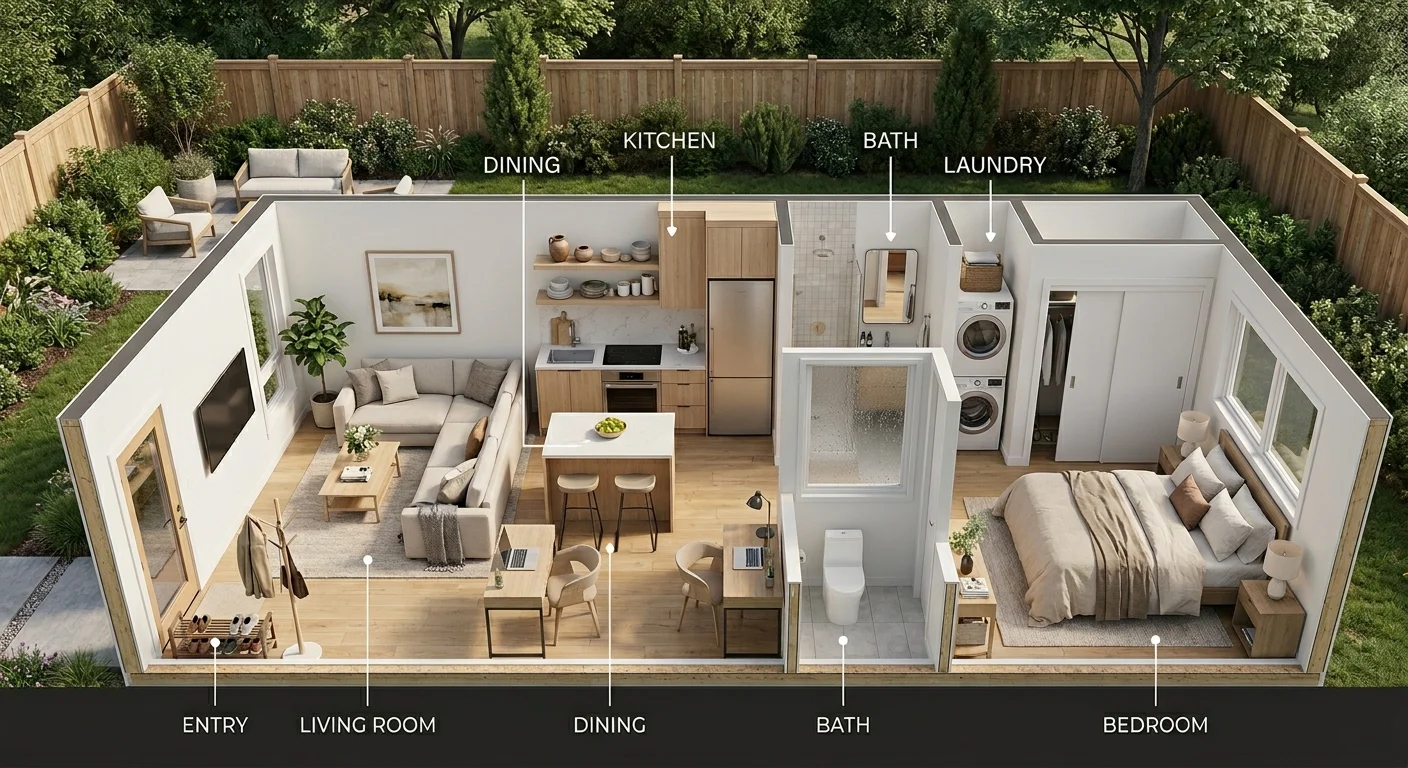
500 sq ft is enough for:
- A true one-bedroom apartment
- A rental unit that commands real rent
- An aging-parent or in-law suite
- A home office with a guest component
- Short-term rental / Airbnb
500 sq ft gets tight for:
- Two adults living full-time (studio-level togetherness)
- A two-bedroom layout (both rooms will be quite small)
- A couple with a child long-term
| Use Case | Does 500 SF Work? | Better Size If Not | Notes |
|---|---|---|---|
| Long-term rental (1 person or couple) | Strong fit | — | One-bedroom layout maximizes rental appeal |
| Aging parent / in-law suite | Strong fit | — | Full independence with separate bedroom |
| Adult child / boomerang kid | Workable | 600 SF for a real home-office setup | Comfortable for one person |
| Short-term rental / Airbnb | Strong fit | — | One-bedrooms command higher nightly rates than studios |
| Home office + guest suite | Good dual use | — | Flex layout: office by day, guest by night |
| Couple + child | Tight | 650 – 750 SF | Possible short-term, not comfortable long-term |
| Two-bedroom layout | Very tight | 650+ SF | Both rooms will feel undersized |
Wondering what you could rent a 500 sq ft ADU for in your area? Our feasibility report includes estimated rental ranges for your zip code.
See What You Can Build — Get Your Free ADU Report500 Sq Ft ADU Cost by Region and Market Tier
The same 500 sq ft detached ADU that costs $140K in central Texas can cost $250K+ in coastal California. Labor rates, permit fees, code requirements, and material costs vary dramatically.
| Region | Detached 500 SF (All-In) | Garage Conversion 500 SF | Prefab 500 SF (Installed) | Key Cost Driver |
|---|---|---|---|---|
| High-Cost West Coast (CA, Seattle, Portland) | $175,000 – $250,000+ | $80,000 – $120,000 | $130,000 – $180,000 | High labor rates, energy code compliance (Title 24 in CA), impact fees, long permit review |
| Mountain West (CO, UT, AZ, NV) | $130,000 – $200,000 | $60,000 – $100,000 | $110,000 – $160,000 | Growing demand, moderate-to-high labor rates |
| Southeast (TX, FL, GA, NC, TN) | $100,000 – $165,000 | $50,000 – $90,000 | $90,000 – $140,000 | Lower labor costs, fewer regulatory hurdles (hurricane zones add wind-load costs) |
| Midwest (OH, MN, IL, MI, WI) | $100,000 – $170,000 | $50,000 – $95,000 | $95,000 – $145,000 | Shorter build seasons, moderate labor costs |
| Northeast (NY, NJ, MA, CT, PA) | $150,000 – $230,000 | $70,000 – $115,000 | $120,000 – $175,000 | High labor rates, dense lots, complex zoning |
Dwelling Index planning estimates, April 2026. Built from Terner Center regional research data, HomeGuide contractor surveys, published prefab manufacturer pricing, and municipal fee schedules from representative cities. Hurricane, wildfire, snow-load, and seismic zones can add $10,000–$30,000+ in code-required upgrades.
A note on California specifically. California dominates ADU search results because the state has built more ADUs than anywhere else, driven by legislation (now codified at Government Code §§ 66310–66342). That means California has the most real cost data — and the highest costs. If you're not in California, many of the numbers you've seen online are probably too high for your market. If you are in California, the lower end of national ranges is probably too optimistic.
See what a 500 sq ft ADU would realistically cost on your property — your lot, your rules, your region.
See What You Can Build — Get Your Free ADU ReportWhere the Money Actually Goes: A 500 Sq Ft Budget Breakdown
One of the most useful things we can give you is visibility into how the money stacks up inside that total number. This is what separates a confident homeowner from one who gets blindsided — and it's how you spot bids that are missing line items.
Worked Example: Detached 500 Sq Ft ADU, Mid-Cost Region
Assumptions: flat lot, utility distance under 40 ft, standard finishes, no unusual site conditions. Illustrative example — not a quote.
| Budget Category | % of Total | Estimated Range | What It Covers |
|---|---|---|---|
| Construction (labor + materials) | 55 – 65% | $85,000 – $150,000 | Framing, roofing, siding, plumbing, electrical, HVAC, insulation, drywall, flooring, paint, kitchen, bathroom, fixtures, appliances |
| Site Prep & Foundation | 8 – 12% | $12,000 – $25,000 | Grading, excavation, concrete foundation, utility trenching |
| Design & Engineering | 6 – 10% | $8,000 – $20,000 | Architectural plans, structural engineering, energy compliance, survey |
| Permits & Fees | 5 – 10% | $5,000 – $18,000 | Building permit, plan check, impact fees if applicable |
| Utility Connections | 4 – 7% | $5,000 – $18,000 | Sewer lateral, water line, electrical service, gas (if applicable) |
| Contingency | 10 – 15% | $12,000 – $25,000 | Soil surprises, plan revisions, material price changes, scope adjustments |
Worked Example: Garage Conversion, 500 Sq Ft
| Budget Category | % of Total | Estimated Range | What It Covers |
|---|---|---|---|
| Construction & Finishing | 55 – 65% | $30,000 – $70,000 | Insulation, drywall, flooring, windows, garage door wall replacement, kitchen, bathroom, HVAC, electrical, plumbing |
| Foundation / Structural Fixes | 0 – 15% | $0 – $15,000 | Foundation repair if needed, structural reinforcement |
| Design & Engineering | 8 – 12% | $5,000 – $12,000 | Architectural plans, structural assessment, energy compliance |
| Permits & Fees | 5 – 10% | $3,000 – $10,000 | Building permit, plan check (often lower for conversions) |
| Utility Extensions | 5 – 10% | $3,000 – $10,000 | Extending plumbing and electrical from main house to garage |
| Contingency | 10% | $5,000 – $10,000 | Surprises behind the existing walls |
The biggest difference between these two budgets? Site prep and utility connections. In a garage conversion, you're steps from the main house's systems. In a detached build, you might be trenching 50+ feet to reach sewer and water — and that distance adds up fast.
500 vs. Other Sizes: When to Go Bigger (and When Not To)
One of the smartest things you can do before committing to a size is understand the cost curve — because the jump from 500 to 750 sq ft is often smaller than people assume.
| Size | Typical Layout | Total Cost (Detached, Mid-Cost) | Per-SF Cost | Key Threshold |
|---|---|---|---|---|
| 400 sq ft | Studio | $110,000 – $200,000 | $275 – $500/SF | Smallest ADU in many codes |
| 500 sq ft | 1-bedroom | $130,000 – $250,000 | $260 – $500/SF | Common 1-bed threshold; CA JADU max size (within existing home) |
| 600 sq ft | Spacious 1-bed | $145,000 – $270,000 | $240 – $450/SF | Comfortable 1-bed with dedicated dining |
| 750 sq ft | Large 1-bed or compact 2-bed | $165,000 – $310,000 | $220 – $415/SF | CA impact fee exemption threshold |
| 800–1,000 sq ft | 2-bedroom | $190,000 – $370,000 | $200 – $370/SF | Max size in many cities |
Notice the pattern: going from 500 to 750 sq ft might add roughly $35,000–$60,000 in total cost but gives you 50% more space and substantially better per-SF economics. That's why many ADU professionals recommend building to the maximum your lot and budget allow — extra square footage is the cheapest square footage you'll add.
When 500 sq ft wins
- Budget ceiling is firm and under $200K
- Lot can't accommodate a larger footprint
- Want to stay under a fee or size threshold
- One-bedroom meets your needs
- Building a JADU within your existing home (CA: 500 SF max)
When 600–800 sq ft is smarter
- Can absorb the additional $35K–$75K
- Need a 2-bedroom layout
- Lot and setbacks allow it
- Building for maximum rental income or resale value
How Local Rules Change the Math
This is a national guide, but ADU costs are local. We have state-specific ADU law guides for the deep dives — here we'll focus on the categories of local rules that can meaningfully change your 500 sq ft ADU budget.
Rules that can swing your budget by $10,000 or more:
Setback requirements
How far from property lines your ADU must sit. Tight setbacks can force expensive design compromises or rule out detached builds entirely.
Owner-occupancy rules
Some cities require the property owner to live on-site. This affects rental strategy. In California, owner occupancy is generally not required for ADUs but may apply to JADUs that share sanitation facilities with the main home (Gov. Code §§ 66315, 66333 et seq.).
Impact fees vs. utility connection/capacity charges
These are two different things. Impact fees (parks, schools, infrastructure) may be waived for smaller ADUs in some jurisdictions. Utility connection and capacity charges are typically separate and may still apply. Always check both.
Permit review timelines
A 4-week approval costs you 4 weeks of carrying costs. A 16-week review costs 16 weeks — and the difference is real money. Some cities offer expedited paths for ADUs using pre-approved plans.
HOA restrictions
In California, Civil Code §§ 714.3 and 4751 limit HOA ability to prohibit ADUs and JADUs, but enforcement is still evolving. Outside California, HOA rules vary widely.
The action step: Before you finalize anything, call your local planning department. Ask about ADU-specific permit fees, review timelines, utility connection requirements, and any size-based thresholds. Fifteen minutes on the phone can save you months and thousands of dollars.
Need the full picture for your state? See ADU laws by state →
How Long Does a 500 Sq Ft ADU Take to Build?
Time is part of cost — every month of construction is a month of carrying costs on your financing, a month of living next to a job site, and a month of delayed rental income. Here's a realistic timeline by phase.
| Phase | Typical Range | Fast Path | What Causes Delays |
|---|---|---|---|
| Feasibility & scope | 2 – 4 weeks | 1 week with a knowledgeable ADU advisor | Unclear property info, slow city pre-consultations |
| Design & engineering | 4 – 8 weeks | 2 – 4 weeks with stock or pre-approved plans | Custom design, multiple revision rounds |
| Permit review | 4 – 16 weeks | 2 – 6 weeks (pre-approved plans in streamlined cities) | City backlog, plan corrections, special reviews |
| Construction | 8 – 20 weeks | 8 – 12 weeks (garage conversion or prefab installation) | Weather, material delays, subcontractor scheduling, inspections |
| Total | 4 – 12 months | 3 – 5 months (conversion or prefab) | — |
How prefab changes the timeline — and how it doesn't. A factory-built unit can be manufactured while you're in the permit process, so you can overlap those phases and shave 2–4 months off the total. But you still need a foundation, site prep, and utility connections before the unit arrives — and you still need permits. Prefab is faster, not instant.
Will a 500 Sq Ft ADU Pay Off?
The answer depends on why you're building it. Here are three ways to think about it.
As a Long-Term Rental
A 500 sq ft one-bedroom ADU can generate meaningful rental income. Market rents for one-bedroom units vary dramatically by location — anywhere from around $1,000/month in lower-cost areas to $2,000+ in metro and coastal markets. In many mid-cost markets, homeowners see the ADU covering its financing costs within the first few years — and generating net positive cash flow after that.
As Family Housing
This isn't a spreadsheet calculation — it's a quality-of-life calculation. Having an aging parent 30 feet away instead of 30 miles away. Giving an adult child independence without losing connection. For many families, this is the real payoff.
Property Value Impact
ADUs generally add to property value, though the amount depends on your market and local appraisal practices. In ADU-heavy markets like California, Oregon, and Washington, appraisers are increasingly experienced at valuing ADUs as income-producing improvements.
These are illustrative examples, not guarantees of returns. Actual results depend on local market conditions, construction costs, rental demand, and regulatory approvals.
How Homeowners Typically Pay for a 500 Sq Ft ADU
Most homeowners don't pay cash for an ADU. Understanding your financing path is as important as understanding the construction cost — because the financing you choose affects your total budget, timeline, and monthly cash flow.
The Dwelling Index is reader-supported. When you use our links to explore financing options, we may earn a commission at no extra cost to you. Our editorial recommendations are based on independent research and are never influenced by compensation. Full disclosure →
Strong existing equity
Home Equity Line of Credit (HELOC)
The most common ADU financing method. You borrow against equity you've already built. Funds are available as a revolving line you draw from during construction. Works well when you have substantial equity and want flexible access to funds.
Low current equity / recent purchase
Renovation HELOC (After-Value Lending)
Some lenders let you borrow based on your home's projected value after the ADU is built — not just today's value. This can unlock financing for homeowners who bought recently or haven't accumulated much equity yet. Not available in all states.
Explore Renovation Financing at RenoFiEquity-rich but cash-flow constrained
Home Equity Investment (HEI) — No Monthly Payments
Not a loan — it's an investment in your home's future value. No monthly payments. You repay when you sell or at the end of a set term. Can work well for retirees or those on fixed income. HEI providers have limited state availability — check before counting on this option.
Larger or investor-focused projects
Construction Loan or Cash-Out Refinance
Works for larger or more complex ADU builds and for investor-focused projects. Lenders structure these specifically around construction timelines.
The cost is only half the equation. Figuring out how to pay for it is the other half — and most homeowners have more options than they realize.
Compare ADU Financing PathsWhen a 500 Sq Ft ADU Isn't the Right Move
We'd rather you build the right thing than build the wrong thing at the wrong size. Here are the situations where 500 sq ft may not be your best path.
You need more than a compact one-bedroom
If you're housing a couple with a child, two adults who need separate bedrooms, or anyone who needs accessible design with wider clearances, 600–800 sq ft will serve you much better. The extra $40K–$80K buys dramatically more livability.
Your site conditions erase the size savings
If your lot is sloped, access is limited, and utility runs are long, the site-specific costs can be nearly the same whether you build 500 or 800 sq ft. In that case, building larger gives you more value for a similar site-cost investment.
You plan to sell within a year or two
ADU construction takes time, and the property-value increase may not fully materialize in the very short term. Weigh the ROI carefully if you're not planning to hold for at least a few years.
You're chasing a fee threshold that may not apply in your city
Size-based fee exemptions vary by jurisdiction. Verify the actual dollar difference before making design decisions based on assumed savings.
If any of these sound like you, check out our ADU cost overview for a broader look at sizing options, or our garage conversion cost guide if you're considering a conversion path.
12 Questions to Answer Before You Request Quotes
Show up to your first contractor conversation with these answered and you'll get better bids, fewer surprises, and a clearer path forward.
What type of 500 sq ft ADU are you pricing?
Detached, garage conversion, basement, attached, or prefab? Each is a fundamentally different project.
What is the intended use?
Rental income, aging parent, adult child, home office, guest suite? This affects design priorities and sometimes regulatory requirements.
How far are the sewer, water, and electrical connections?
The single biggest site-specific variable. Walk the distance yourself and note any obstacles.
Is the site flat, sloped, or constrained?
Grading, retaining walls, and limited equipment access all add cost.
What is the lot access like for construction equipment?
Can a truck and small excavator reach the build site? If not, manual labor costs increase significantly.
What finish level are you assuming?
Basic vs. mid-range vs. premium can swing the budget 20–40%.
Are you reusing an existing structure?
If so, what's the foundation condition, ceiling height, and structural integrity?
What permit path applies in your city?
Standard review, expedited, pre-approved plans, or JADU? This affects both cost and timeline.
Are there HOA, historic district, or design-review requirements?
These add time and sometimes cost.
What contingency are you carrying?
If the answer is zero, add 10–15% to your budget. Surprises in construction aren't a possibility — they're a statistical certainty.
What items are excluded from the quotes you've received?
Always ask: does this bid include permits, design, engineering, utility connections, site work, landscaping restoration, and contingency?
What financing path fits this budget?
Cash, HELOC, renovation HELOC, HEI, or construction loan? Know before you commit to a scope. See our financing guide →
Want most of these questions answered for your specific property before you even call a contractor? That's exactly what our free feasibility report is built for.
See What You Can Build — Get Your Free ADU ReportPrefer to take it all with you?
Download the free 2026 ADU Starter Kit — cost worksheets, financing checklists, timeline templates, and the 12-question prep sheet from this guide.
Download the Free 2026 ADU Starter KitNot Sure Where to Start?
You've read the numbers. You understand the trade-offs. Now there's only one question left: what's actually possible on your property?
Your lot, your setbacks, your local rules, your utility situation — those are what turn a national average into a real project. And that's exactly what our free feasibility report is built to answer.
Thousands of homeowners have used it to go from "researching" to "here's my plan." It takes about 60 seconds.
How We Built These Estimates
Cost data is only useful if you know where it came from and what it includes. Here's our methodology.
Standardized scope
Every range in this guide assumes: 500 sq ft, one bedroom, one bathroom, full kitchen, code-compliant, move-in ready. Includes design, permits, construction, utility connections, and reasonable contingency. Excludes land cost and financing costs.
Source types
- Terner Center for Housing Innovation (UC Berkeley) ADU cost studies
- UC Berkeley Center for Community Innovation California ADU Owner Survey
- Published pricing from regional ADU builders and prefab manufacturers
- Municipal fee schedules from representative cities
- HomeGuide, Angi, and similar industry contractor data
- Legal/regulatory sources: California Government Code §§ 66310–66342; California HCD ADU Handbook; IRC Section R305.1; California Civil Code §§ 714.3 and 4751
What this page is NOT
- A quote or estimate for your specific project
- A substitute for bids from licensed local contractors
- A comparison or ranking of lenders, builders, or service providers
- Legal, financial, or tax advice
Verification policy: We review and update this guide quarterly. Current version last verified April 2026.
Frequently Asked Questions
What is the average cost to build a 500 sq ft ADU?
For a detached, move-in-ready 500 sq ft ADU in a mid-cost U.S. market, plan for roughly $150,000–$200,000 all-in. Garage conversions can run significantly less ($50K–$120K), and high-cost coastal markets can run significantly more ($200K–$250K+). The "average" depends heavily on build type, region, and site conditions.
Is a 500 sq ft ADU big enough for a one-bedroom?
Yes — 500 sq ft is one of the smallest sizes that comfortably supports a true one-bedroom layout with a separate bedroom, full kitchen, full bathroom, and living area. It's the threshold many ADU designers recommend as the minimum for a rental-grade one-bedroom unit.
What is the cheapest type of 500 sq ft ADU?
Garage conversions are typically the lowest-cost path, ranging from $50,000–$120,000 all-in, because you're reusing an existing foundation, walls, and roof. Basement conversions can be similarly affordable. The cheapest option for your property depends on what existing structures you have to work with.
Why does a 500 sq ft ADU cost so much per square foot?
Because the most expensive components — kitchen, bathroom, utility hookups, permits, design, and engineering — cost nearly the same whether you build 500 or 1,000 sq ft. Those fixed costs get spread over fewer square feet in a smaller unit, pushing the per-SF number higher. The total cost is still lower than a bigger unit.
Can I build a 500 sq ft ADU for under $100,000?
Possible with a garage or basement conversion in a lower-cost market where the existing structure is in good condition and utility connections are close. For a detached new build, budgets under $100K are very difficult to achieve in 2026 without compromising on code compliance or quality. Be cautious of any contractor quoting dramatically below market rates.
Does a 500 sq ft ADU avoid impact fees?
In California, ADUs of 750 sq ft or less are generally exempt from local impact fees (Gov. Code § 66310 et seq.). However, utility connection fees and capacity charges are separate and may still apply. Other states and cities have their own fee structures — always check with your local planning department and utility providers.
How much does a prefab 500 sq ft ADU cost?
The unit itself typically costs $60,000–$100,000 from the manufacturer. The installed cost — including foundation, site prep, delivery, utility connections, and permits — typically ranges from $100,000–$180,000. Always compare installed prices, not sticker prices.
How long does a 500 sq ft ADU take to build?
Most projects take 4–12 months from first design meeting to final inspection. Garage conversions and prefab installations tend to be faster (3–6 months). Detached site-built ADUs in cities with longer permit review tend to take 6–12 months.
Will a 500 sq ft ADU increase my property value?
In most cases, yes. ADUs generally add to property value, and the effect is strongest in markets where ADUs are common and appraisers have experience valuing them. The increase depends on your local market, rental demand, and appraisal practices.
Can I finance a 500 sq ft ADU with home equity?
Yes — a HELOC is the most common way homeowners finance ADU construction. If you have limited current equity, a renovation-based HELOC that lends on projected after-renovation value may be an option. Other paths include home equity investments (no monthly payments), construction loans, and cash-out refinances.
Is a 500 sq ft ADU better than a Junior ADU (JADU)?
They serve different needs. In California, a JADU must be 500 sq ft or less and contained entirely within an existing single-family residence including attached garages — a detached structure doesn't qualify (Gov. Code § 66333 et seq.). A standard 500 sq ft ADU can be detached and fully independent, and commands higher rent. Choose based on your goals, your property, and your existing structures.
What is the difference between impact fees and utility connection fees?
Impact fees are charged by cities for infrastructure like parks, schools, and roads — and may be waived for smaller ADUs in some jurisdictions. Utility connection or capacity charges are separate fees charged by utility providers for new service connections. Even if you're exempt from impact fees, utility charges may still apply. Always verify both with your city and local utilities.
The Dwelling Index is an independent national ADU resource — not a builder, lender, or broker. When you use our links to explore financing options, request prefab pricing, or purchase floor plans, we may earn a commission at no extra cost to you. Our editorial recommendations are based on independent research and are never influenced by compensation. Read our full editorial policy and affiliate disclosure →