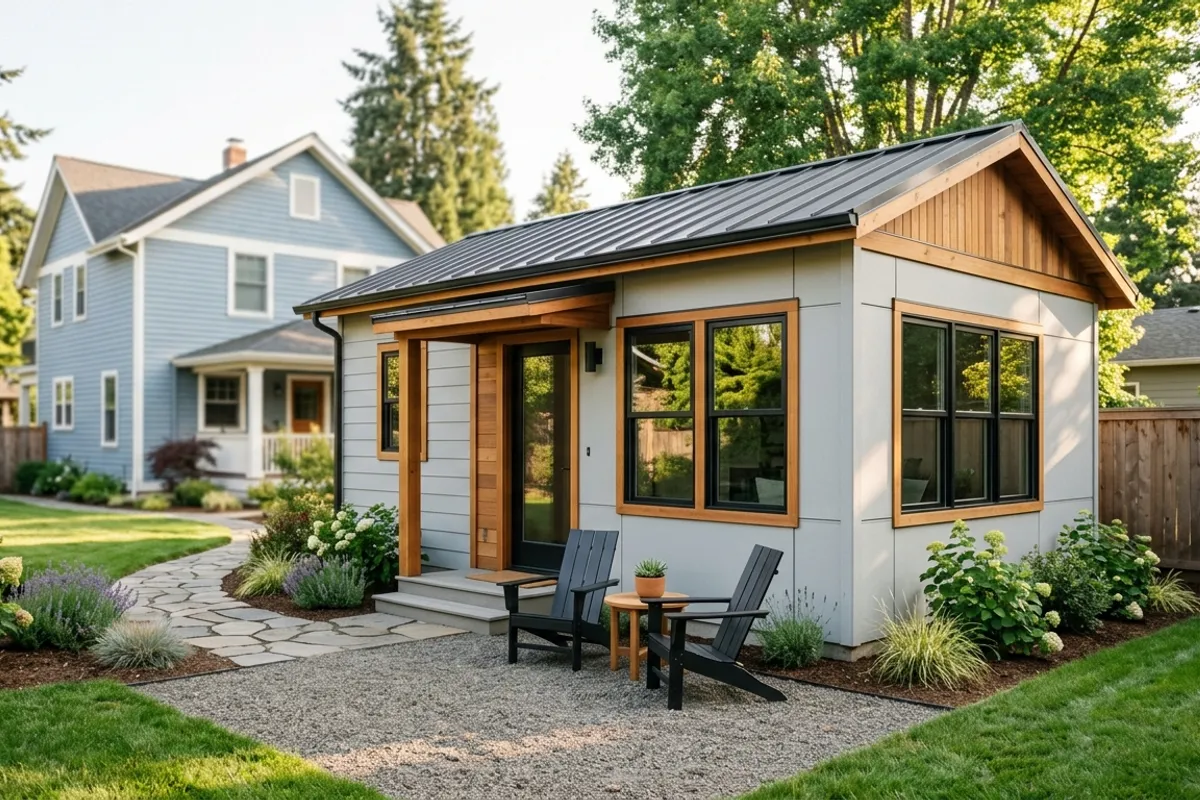
If you’re converting a garage, expect $150–$300 per square foot all-in. An attached ADU typically lands between $200 and $400/sqft. A detached new build — the backyard cottage most people picture — runs $250 to $500+ per sqft, with coastal California and the Northeast pushing the top of that range.
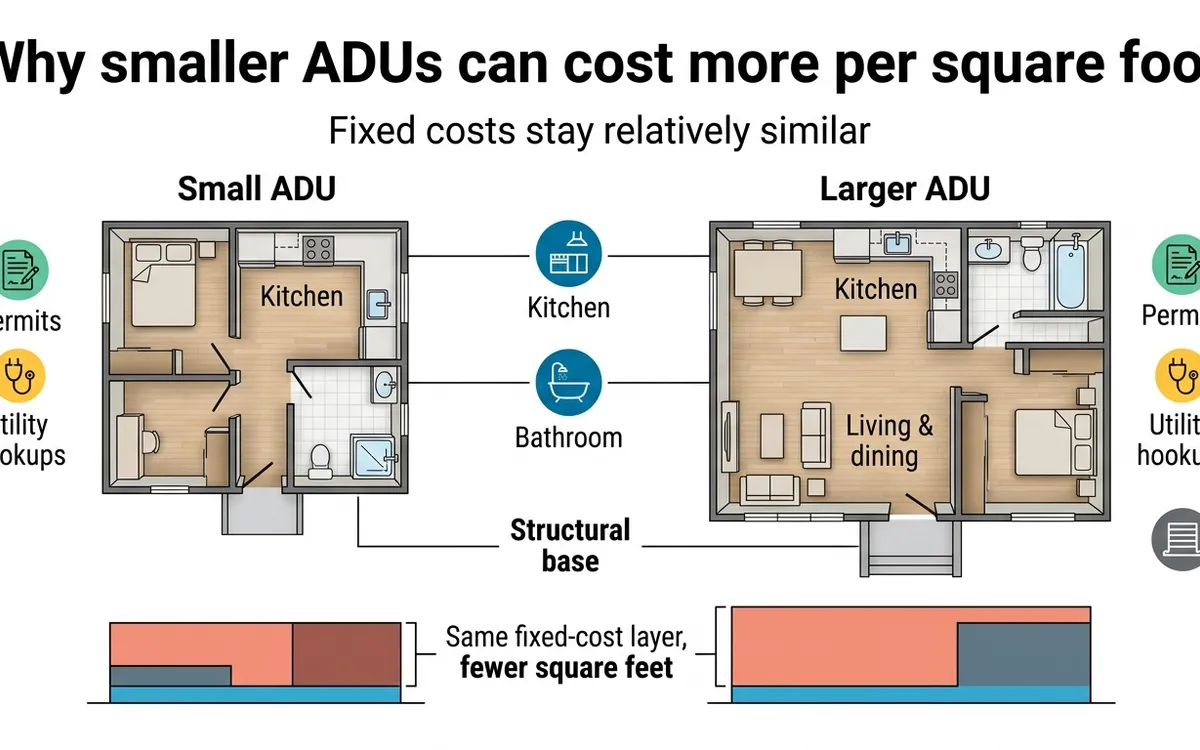
But here’s what most ADU cost pages won’t tell you: cost per square foot is one of the most misunderstood numbers in home construction. A 400-square-foot ADU almost always costs more per square foot than a 1,200-square-foot one — not because someone’s overcharging you, but because every ADU needs a kitchen, a bathroom, a foundation, and utility hookups whether it’s tiny or spacious. Those fixed costs get spread across fewer square feet in a small unit, and the math makes it look expensive.
We built this page to do what most cost guides don’t: show you where your project actually falls in the range, explain why quotes contradict each other, and give you a framework to evaluate bids without getting taken for a ride.
| ADU Type | Cost Per Sq Ft (2026) | Typical Total Cost |
|---|---|---|
| Garage Conversion | $150–$300 | $80K–$175K |
| Basement Conversion | $100–$250 | $50K–$150K |
| Attached ADU | $200–$400 | $150K–$300K |
| Above-Garage ADU | $250–$450 | $200K–$350K |
| Prefab / Modular ADU | $200–$350 | $150K–$300K |
| Detached New Build | $250–$500+ | $200K–$400K+ |
Ranges reflect all-in costs including design, permits, site work, utility connections, and mid-range finishes. Sources: Angi (March 2026), SnapADU (March 2026), HomeGuide (March 2026), Terner Center, and municipal fee schedules.
Why ADU Cost Per Square Foot Misleads — And How to Use It Right
Here’s a number that should bother you: a 400-square-foot ADU often costs $300–$500 per square foot, while a 1,200-square-foot ADU on the same lot might come in at $175–$275 per square foot.
Same builder. Same materials. Same city. Wildly different cost per square foot.
That’s not a scam. It’s the single most important thing to understand about ADU pricing, and almost nobody explains it well.
The Fixed-Cost Trap
Every ADU — regardless of size — requires a handful of expensive components that don’t shrink when the unit gets smaller:
- A full kitchen: $15,000–$40,000 depending on finishes
- At least one full bathroom: $10,000–$25,000
- A foundation or structural base: $10,000–$30,000 for new construction
- Utility connections (water, sewer, electrical, gas): $5,000–$30,000
- Permits, plan check, and design fees: $8,000–$30,000
- Contractor mobilization (dumpsters, supervision, insurance, temp facilities): $5,000–$15,000
Component ranges based on Angi national data (published March 2026) and SnapADU project data (updated March 2026).
Add those up and you’re looking at roughly $50,000–$170,000 in costs that are essentially the same whether you’re building 400 square feet or 1,200 square feet.
$80,000 fixed costs ÷ 400 sqft
$200/sqft
before a single wall is framed
$80,000 fixed costs ÷ 1,200 sqft
$67/sqft
same fixed costs, more floor area
That difference — roughly $130 per square foot — has nothing to do with your builder’s markup. It’s just math.
Why Two Builders Can Quote Different $/Sqft for the Same Plan
If Builder A quotes you $325/sqft and Builder B quotes $275/sqft, the difference probably isn’t skill or greed. It’s scope.
Builder A might be quoting all-in cost: design, engineering, permits, site prep, foundation, the build itself, utility hookups, appliances, landscaping restoration, and cleanup. Builder B might be quoting construction-only: the vertical build from foundation up, with everything else billed separately or left to you.
Both numbers are “accurate.” Neither is wrong. But they describe completely different things.
Throughout this guide:
When we say “cost per square foot,” we mean all-in cost — everything from design through move-in, including permits, site work, and mid-range finishes. When a builder or prefab company quotes you something lower, the first question is always: what’s not in that number?
So How Should You Use Cost Per Square Foot?
It’s a useful comparison tool — just not a magic one. Use it to:
Use it to:
- Compare ADU types (garage vs. detached)
- Compare quotes with identical scope
- Estimate total cost ($/sqft × sqft)
- Benchmark your market against regional averages
Don’t use it to:
- Compare a 400-sqft to a 1,000-sqft ADU
- Compare all-in to construction-only quotes
- Assume a lower $/sqft always means a better deal
ADU Cost Per Square Foot by Type (2026)
The type of ADU you build is the single biggest factor in your cost per square foot. Find your type below and you’ll have a realistic budget range in 30 seconds.
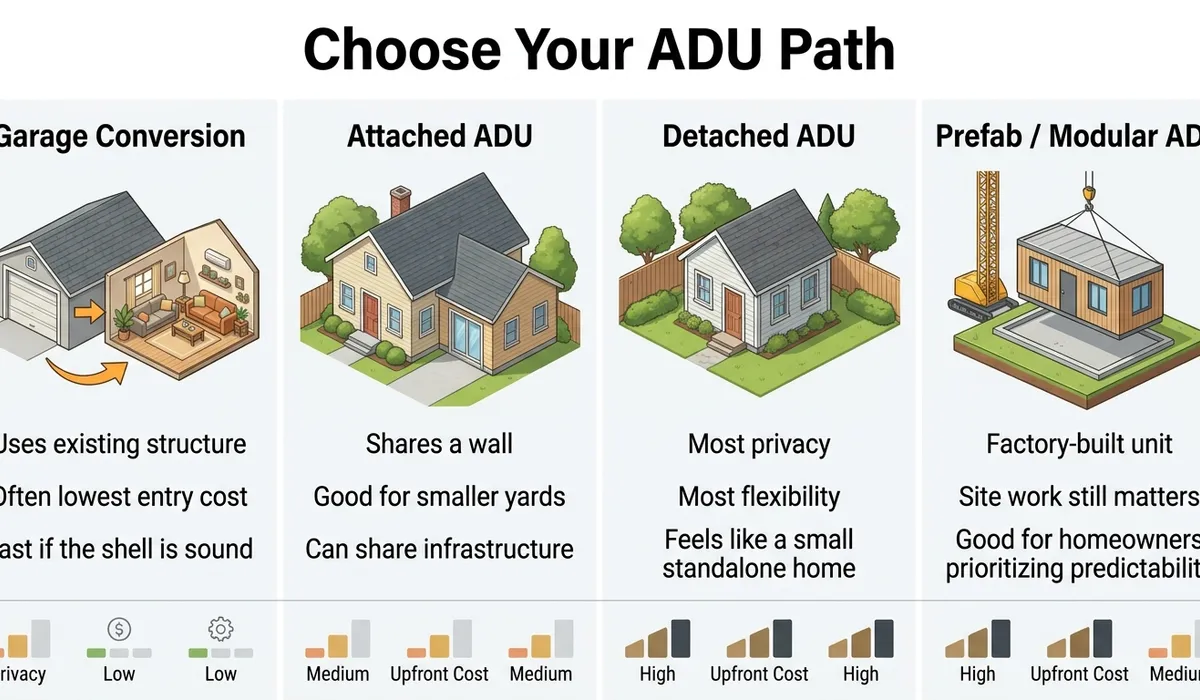
| ADU Type | $/Sqft Range | Typical Total |
|---|---|---|
| Garage Conversion | $150–$300 | $80K–$175K |
| Basement Conversion | $100–$250 | $50K–$150K |
| Attached ADU | $200–$400 | $150K–$300K |
| Above-Garage | $250–$450 | $200K–$350K |
| Prefab / Modular | $200–$350 | $150K–$300K |
| Detached New Build | $250–$500+ | $200K–$400K+ |
Sources: Angi (March 2026), SnapADU (March 2026), HomeGuide (March 2026), regional builder data. All-in including design, permits, site work, and mid-range finishes.
Garage Conversion: $150–$300/sqft
A garage conversion is the most budget-friendly path to a legal ADU because the expensive structure already exists. You’ve got a foundation, walls, and a roof. What you’re paying for is everything that makes it livable — insulation, drywall, plumbing, electrical, HVAC, a kitchen, a bathroom, flooring, and replacing the garage door with an insulated wall and windows.
Basement Conversion: $100–$250/sqft
If you have an existing basement with adequate ceiling height (typically 7 feet minimum per IRC Section R305.1), this is often the lowest cost per square foot of any ADU type. The foundation and structure already exist — you’re paying for egress windows, waterproofing, HVAC, plumbing, insulation, finishing, and a separate entrance.
Attached ADU: $200–$400/sqft
An attached ADU shares at least one wall with your primary home — essentially a home addition designed to function as an independent living space with its own entrance, kitchen, and bathroom. Because it can leverage existing foundation, roofline, and utility connections, costs typically run 5–15% less than a detached unit of the same size and finish level.
Trade-off: Lower privacy means potentially lower rental desirability in some markets. For family housing rather than rental income, this trade-off often doesn’t matter.
Above-Garage ADU: $250–$450/sqft
Building a living space above an existing garage requires structural reinforcement (most standard garages aren’t engineered for a second story), staircase access, and potentially raising the roofline to meet ceiling height codes.
Prefab / Modular ADU: $200–$350/sqft (All-In)
Prefab companies often advertise unit prices of $80,000–$150,000, which works out to $130–$250/sqft for the unit itself. That number is real — but it’s not the whole story.
Once you add site preparation, foundation, utility connections, permits, transportation, crane placement, and installation, the all-in cost typically lands at $150,000–$300,000, or roughly $200–$350 per square foot — closer to (and sometimes matching) custom-built pricing.
Prefab’s real advantage isn’t always price — it’s speed and predictability. Factory construction means fewer weather delays, tighter quality control, and a compressed timeline of 4–8 months vs. 9–18 months for a custom detached build. See our full prefab ADU cost guide for a detailed breakdown.
Detached New Build: $250–$500+/sqft
The classic backyard cottage. Everything is new — foundation, framing, roof, plumbing, electrical, HVAC, and all finishes. This is functionally building a small house, and it’s priced accordingly.
Why the range is so wide: A simple 800-sqft rectangular build on a flat lot with easy utility access in a moderate-cost market might come in around $250/sqft. A custom-designed 600-sqft unit on a sloped lot in coastal California with premium finishes could hit $500+/sqft. Site conditions, labor markets, and finish choices create enormous variance.
Free Property Report
See What You Can Build → Get Your Free ADU Report
Our free feasibility report shows what’s buildable at your address — local size limits, setback rules, and estimated costs — in about 60 seconds.
Check Your PropertyWhat’s the Cheapest ADU to Build?
This depends less on a universal answer and more on what you already have.
Cheapest if you have a usable garage
Garage conversion. A solid two-car garage in decent condition is the fastest, lowest-cost path to a legal ADU. Expect $80,000–$175,000 all-in.
Cheapest if you have an existing basement with 7+ foot ceilings
Basement conversion. If the space is already dry and tall enough, you're skipping the most expensive components of any build. This can come in under $100,000 in moderate-cost markets.
Cheapest if you need a separate structure
Prefab on a simple, flat lot with nearby utility connections. The factory-built unit compresses your timeline and reduces on-site labor — though site work costs can still add up on complex lots.
Cheapest per square foot (regardless of type)
Build to the maximum size your lot and zoning allow. Data from Portland shows over 40% of ADUs are 700+ square feet, because homeowners figure out that the marginal cost of additional square footage is low compared to the fixed costs they're already paying.
ADU Cost Per Square Foot by Size
The table below shows how cost per square foot shifts as ADU size increases — and why those shifts happen.
| ADU Size | Typical $/Sqft (All-In) | Typical Total Cost |
|---|---|---|
| 400 sqft | $300–$500+ | $120K–$200K |
| 500 sqft | $275–$425 | $138K–$213K |
| 600 sqft | $250–$375 | $150K–$225K |
| 750 sqft | $225–$350 | $169K–$263K |
| 800 sqft | $200–$325 | $160K–$260K |
| 1,000 sqft | $185–$300 | $185K–$300K |
| 1,200 sqft | $165–$275 | $198K–$330K |
Ranges assume mid-range finishes, moderate-cost market, and standard site conditions. High-cost coastal markets will push above these ranges. Sources: Angi (March 2026), SnapADU (March 2026), Terner Center, regional builder data.
The 750-Square-Foot Threshold
In California, ADUs less than 750 square feet are exempt from impact fees charged by local agencies, special districts, and water corporations (Gov. Code §66324, as codified under the state’s current ADU statute at §§66310–66342, renumbered by SB 477 effective March 25, 2024; California HCD ADU Handbook, 2025 edition with 2026 addendum).
If your ideal ADU is in the 700–800 sqft range, it’s worth checking whether staying just under 750 sqft saves you meaningful fees in your jurisdiction. The City of Woodland, for example, publishes fee schedules that show a clear cost difference at this threshold (verified March 2026).
Should You Build Bigger to Lower Your Cost Per Square Foot?
From a purely per-sqft standpoint, yes — bigger is almost always cheaper per foot. Each additional square foot beyond the kitchen-and-bathroom core adds mostly framing, drywall, and flooring at roughly $80–$150/sqft incremental cost, well below the blended average.
Build bigger if:
- • You’re renting the ADU out (larger unit = higher rent AND lower $/sqft — you win twice)
- • You want a 2-bedroom layout for family use
- • Your lot and zoning allow it
Build smaller if:
- • Your total budget is the hard constraint
- • You’re building for a single occupant
- • Local zoning caps your size anyway
ADU Cost Per Square Foot by State and Metro
Where you live changes everything. A detached ADU that costs $250/sqft in suburban Texas might cost $450/sqft in San Diego — even with an identical floor plan.
| Region | Detached $/Sqft | Garage Conv. $/Sqft |
|---|---|---|
| California — Coastal (LA, SF, SD, San Jose) | $350–$500+ | $225–$375 |
| California — Inland (Sacramento, Central Valley) | $250–$400 | $175–$300 |
| Pacific Northwest (Portland, Seattle) | $275–$425 | $175–$300 |
| Mountain West (Denver, SLC, Boise) | $225–$350 | $150–$275 |
| Texas (Austin, Houston, Dallas) | $175–$300 | $125–$225 |
| Southeast (Atlanta, Charlotte, Nashville, FL metros) | $150–$275 | $100–$200 |
| Northeast (NYC metro, Boston, DC metro) | $300–$475 | $200–$375 |
| Midwest (Minneapolis, Chicago, Columbus) | $175–$300 | $125–$250 |
Starting ranges based on Angi (March 2026), Terner Center for Housing Innovation, SnapADU (March 2026) for San Diego-specific data, and municipal permit fee data verified March 2026.
Why California ADUs Cost More Per Square Foot
California dominates ADU construction — and ADU cost conversations — for good reason. The state has some of the most progressive ADU-friendly legislation in the country (California’s current ADU statute is codified at Gov. Code §§66310–66342, renumbered by SB 477 effective March 25, 2024), but construction costs are also among the highest.
- Solar PV requirements. Under California's Title 24 energy code, newly constructed detached ADUs generally must include a solar photovoltaic system unless an exception applies — such as when the calculated minimum system size falls below 1.8 kW, which often exempts units under roughly 600–700 sqft depending on climate zone. Attached ADUs and conversions of existing space are not subject to the solar PV requirement. (California Energy Commission, 2025 ADU FAQs, verified March 2026)
- Fire sprinkler rules. Fire sprinklers are not required for an ADU if sprinklers are not required for the primary residence. ADU construction cannot trigger a sprinkler requirement in the existing primary dwelling. (Gov. Code §66323(d)–(e); California HCD ADU Handbook, 2025 edition) However, if your primary residence already has sprinklers, the ADU will need them too.
- Permit fees up to $13–$28 per square foot. In cities like San Diego (SnapADU, updated March 2026), though many other cities charge significantly less.
- Labor costs 20–40% above the national average. California's labor market is among the most expensive in the country.
- 44% construction cost increase since 2021. The California Construction Cost Index (CCCI) rose 44% from January 2021 to December 2025 — meaning an ADU that cost $300,000 in 2021 now requires roughly $430,000 (SnapADU, citing CCCI data, updated March 2026).
The upside: California also has some of the strongest rental markets in the country, with ADU rents commonly ranging from $1,500 to $3,500+ per month depending on location and size. The higher build cost often pencils out when rental income is part of the equation.
States Where Regulatory Barriers Are Dropping
Several states have passed legislation that reduces the regulatory barriers and soft costs of ADU construction:
Oregon (ORS 197.312)
Requires cities and counties in urban growth boundaries to allow at least one ADU for each detached single-family dwelling in qualifying residential zones.
Washington (RCW 36.70A.681)
Requires cities and counties in urban growth areas to allow at least two ADUs on lots zoned for single-family residential use.
California — Pre-Approved Plans
Multiple cities offer pre-approved ADU plan programs that can streamline plan-check review and speed permit issuance. LADBS (Los Angeles), San Jose, and San Diego all maintain pre-approved plan libraries (verified March 2026).
Minnesota, Vermont, and Connecticut
Have passed statewide ADU-friendly laws that are reducing permitting barriers.
How Finish Level Changes Your Cost Per Square Foot
The numbers above assume mid-range finishes. Here’s how finish choices shift the per-sqft math:
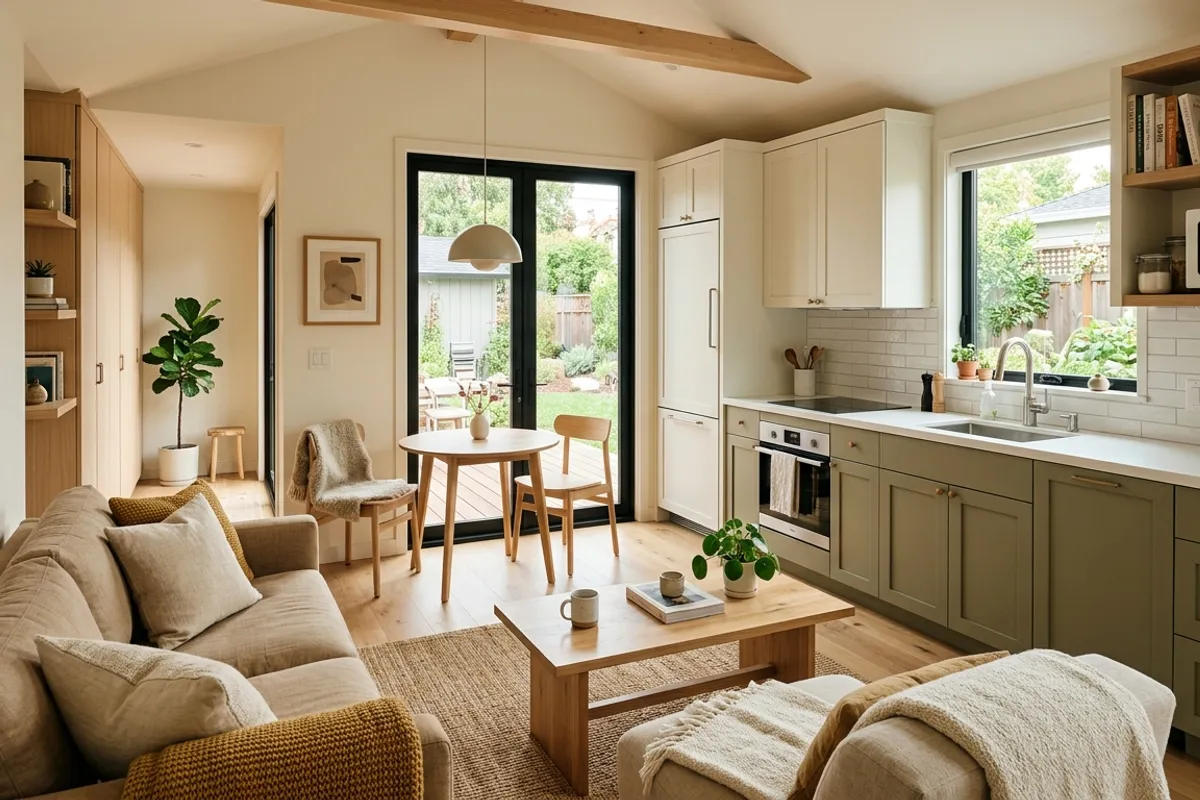
Mid-range finishes (quartz counters, LVP flooring, soft-close cabinets) hit the sweet spot for rental income without overspending on aesthetics tenants won’t pay extra for.
| Finish Level | Impact on $/Sqft | What You Get |
|---|---|---|
| Basic / Builder Grade | Baseline | Laminate countertops, vinyl flooring, stock cabinets, builder-grade fixtures and appliances |
| Mid-Range (recommended for rentals) | +$25–$75/sqft | Quartz counters, luxury vinyl plank flooring, soft-close cabinets, stainless mid-tier appliances |
| Premium / Custom | +$75–$150+/sqft | Stone counters, hardwood floors, custom cabinetry, premium appliances, smart home features |
The Rental-Optimized Finish Level
If you’re building for rental income, mid-range finishes hit the sweet spot. Luxury vinyl plank flooring looks like hardwood, costs half as much, and survives tenant turnover without refinishing. Quartz counters resist staining better than marble and cost less. Solid mid-tier appliances last longer than builder grade without the premium of commercial-grade equipment.
The goal is a unit that looks and feels quality — attracting good tenants and commanding strong rent — without over-investing in finishes that don’t move the rental rate needle.
What’s Actually Included in Cost Per Square Foot?
This section prevents the most common budgeting mistake: assuming a builder’s quoted $/sqft covers everything.
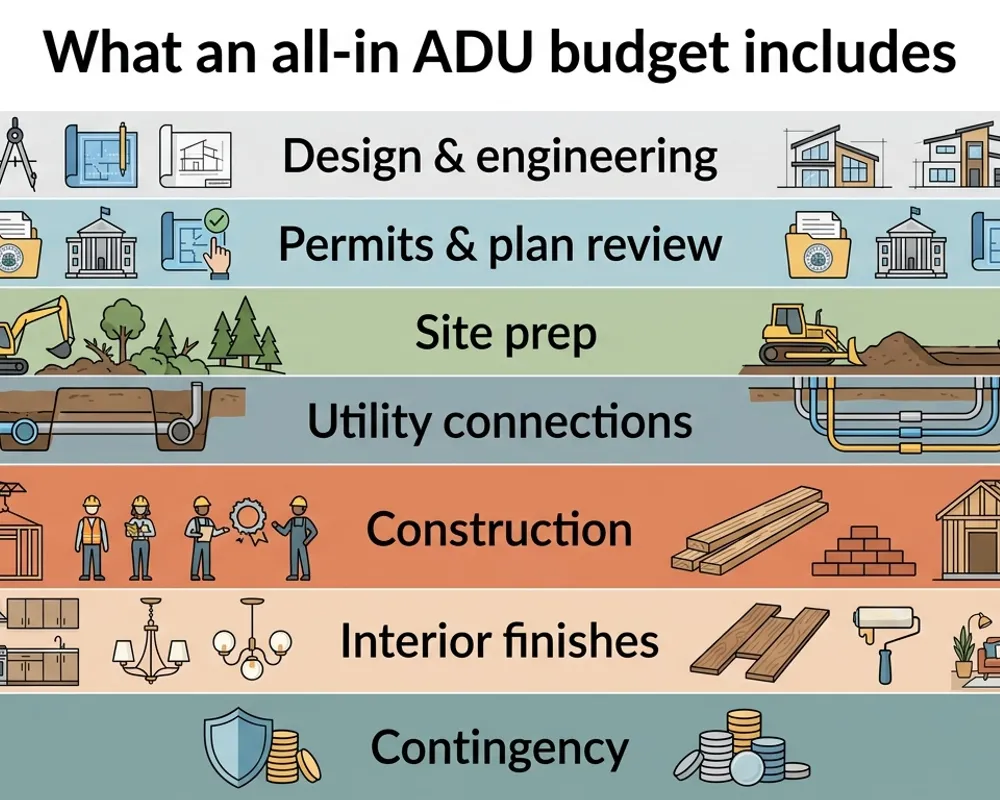
An all-in ADU budget includes seven cost layers — not just the construction phase that builders most often quote.
| Cost Item | Usually All-In | Sometimes | Often Excluded — Ask |
|---|---|---|---|
| Architectural design | |||
| Structural engineering | |||
| Permit fees | |||
| Plan check fees | |||
| Impact fees | |||
| Foundation / slab | |||
| Framing, roofing, siding | |||
| Electrical | |||
| Plumbing | |||
| HVAC | |||
| Interior finishes | |||
| Appliances | |||
| Utility connections | |||
| Utility trenching | |||
| Electrical panel upgrade | |||
| Sewer lateral repair | |||
| Site grading / excavation | |||
| Landscaping restoration | |||
| Replacement parking | |||
| Fencing | |||
| Construction cleanup | |||
| Contingency buffer |
The Seven Questions to Ask Every Builder Before Comparing Quotes
- 1
Does your quote include design, engineering, and permit fees?
- 2
Does it include all utility connections and any necessary panel or service upgrades?
- 3
Does it include site preparation — grading, excavation, tree removal?
- 4
Does it include appliances?
- 5
Does it include landscaping restoration and cleanup?
- 6
What finish level is this based on? Can I see a spec sheet?
- 7
Is there a contingency line item, and what percentage?
If a builder can’t answer these clearly, that’s a red flag — not necessarily of dishonesty, but of a scope that isn’t nailed down. And loose scope is how $200K budgets become $280K invoices.
How to Estimate Your Real All-In ADU Budget
Here’s a step-by-step framework to move from internet ranges to a budget you can actually take to a builder.
Choose Your ADU Type
Based on your property and goals, identify the most likely type. This sets your baseline $/sqft range from the type comparison table above.
Choose Your Size
Pick the size that fits your zoning allowance and intended use. A studio or 1BR for rental income typically falls in the 400–700 sqft range. A 2BR for family use or maximum rental income typically runs 750–1,200 sqft.
Adjust for Your Market
Find your region in the state/metro table above and adjust your $/sqft baseline accordingly.
Choose Your Finish Level
Basic, mid-range, or premium. See the finish level section above for the per-sqft impact of each.
Add Site Complexity
Flat lot with easy access and close utility connections? Use the low-to-middle of the range. Slope, difficult access, long utility runs, or environmental overlay requirements? Use the middle-to-high end.
Add Contingency
Add 10–15% to your total estimate. This is not padding — it's realistic planning.
Worked Examples
Example 1: 500 sqft garage conversion in suburban Denver
| Type baseline | $150–$300/sqft |
| Market adjustment (Mountain West moderate) | $175–$275/sqft |
| Finish level (mid-range) | $200–$300/sqft |
| Site (existing garage, good condition, easy access) | Low-to-middle |
| Estimated range | $100,000–$150,000 |
| $/sqft | $200–$300 |
| With 10% contingency | $110,000–$165,000 |
Example 2: 750 sqft attached ADU near Sacramento, CA
| Type baseline | $200–$400/sqft |
| Market adjustment (California inland) | $250–$375/sqft |
| Finish level (mid-range) | $275–$400/sqft |
| Site (flat lot, existing utility access nearby) | Middle of range |
| Estimated range | $206,000–$300,000 |
| $/sqft | $275–$400 |
| With 10% contingency | $227,000–$330,000 |
Example 3: 1,000 sqft detached new build in San Diego
| Type baseline | $250–$500+/sqft |
| Market adjustment (CA coastal) | $350–$500/sqft |
| Finish level (mid-range) | $375–$475/sqft |
| Site (moderate slope, utility run of 50+ feet) | Upper-middle |
| Estimated range | $375,000–$475,000 |
| $/sqft | $375–$475 |
| With 15% contingency | $430,000–$545,000 |
These are illustrative estimates based on the methodology described in this guide, not quotes. Actual costs depend on specific site conditions, local regulations, builder pricing, and material choices. Get 3+ bids from local ADU-experienced contractors for your property.
Free Property Report
See What You Can Build → Get Your Free ADU Report
Our free feasibility report shows what’s buildable at your address — local size limits, setback rules, and estimated costs — in about 60 seconds.
Check Your PropertyIs Your Quote Fair? How to Evaluate ADU Bids
You’ve got a quote (or three). Here’s how to tell whether you’re looking at a fair price, a red flag, or just a scope mismatch.
The 5-Point Quote Check
- 1Match the type. A $375/sqft quote for a detached new build in California is perfectly normal. A $375/sqft quote for a garage conversion in Texas is high. Compare to the type-specific ranges above.
- 2Adjust for size. Under 500 sqft? Higher $/sqft is expected — it's the fixed-cost trap. Over 800 sqft? You should see per-sqft pricing at or below your market's midpoint.
- 3Adjust for region. A quote 10–20% above the regional range isn't necessarily unfair — it might reflect complex site conditions or premium scope. A quote 30%+ above the range deserves detailed questioning.
- 4Verify the scope. Use the seven questions above. A 'cheap' bid missing $30,000 in utility work and permits isn't cheap — it's incomplete.
- 5Compare at least 3 bids. If all three experienced ADU contractors are quoting $300–$350/sqft for your project, the price is the price. If one quote is dramatically lower, ask what's missing from their scope.
Red Flags
- No line-item breakdown — just a single number
- $/sqft quoted without specifying what's included
- Verbal-only bid with no written scope of work
- No permit cost estimate or 'we'll figure that out later'
- Dramatically below every other bid
- No ADU-specific experience or references
Green Flags
- Detailed line-item budget with soft costs, hard costs, and site work separated
- Specific permit fee estimates for your jurisdiction
- A contingency line item at 10–15%
- A fixed-price or guaranteed-maximum-price contract
- ADU-specific references you can actually call
- A clear timeline with permit milestones
How to Lower Your ADU Cost Per Square Foot
There are real ways to reduce your $/sqft — and there are “savings” that cost you more in the end. Here’s what actually works.
Build to the Maximum Allowable Size
The economics of ADU construction strongly favor larger units. The marginal cost of going from 600 sqft to 800 sqft is far less than the first 600 sqft, and a larger unit commands higher rent if you're building for income.
Convert Instead of Building New
If you have a usable garage or basement, conversion pricing is typically 30–50% less per square foot than a detached new build. The structure, foundation, and envelope already exist.
Choose a Simple, Rectangular Floor Plan
Every corner, angle change, and roof complication adds cost. A straightforward rectangular footprint with a clean roofline is the most cost-efficient shape to build. Simple doesn't mean boring — good design makes a simple layout feel like more than the sum of its parts.
Use Pre-Approved Plans Where Available
A growing number of cities offer pre-approved or permit-ready ADU plans that have already passed plan-check review. LADBS (Los Angeles), San Jose, and San Diego all maintain pre-approved plan libraries (verified March 2026). Check whether your city offers something similar — it can be one of the most efficient ways to reduce soft costs.
Stack Wet Walls
Keeping the kitchen and bathroom plumbing on the same wall (or back-to-back) shortens plumbing runs and reduces both material and labor costs. This is one of the most effective space-planning moves for ADU cost efficiency.
Compare Bids on Scope — Not Just $/Sqft
The lowest price per square foot is not always the lowest project cost. A $275/sqft bid missing $40,000 in site work and utility upgrades costs more than a $325/sqft all-in bid. Compare total scope, timeline, and what's included before comparing headline numbers.
When Does an ADU Make Financial Sense at These Prices?
At $200,000–$400,000+, building an ADU is a significant investment. Here’s an honest look at when it makes sense — and when the timing might not be right.
The Honest Picture
ADUs are different from almost any other home improvement: they create a new, independent income-producing asset on land you already own. In most markets, the cost to build an ADU per square foot is meaningfully less than the cost to buy an equivalent amount of finished living space nearby. That gap between build cost and market value is where the financial case lives.
In San Diego neighborhoods where the median home value runs $700–$800+ per square foot, building an ADU at $400/sqft creates significant equity the day construction finishes — plus the rental income it generates every month after. Similar dynamics play out in Portland, Seattle, Austin, and dozens of other markets. (Maxable, accessed March 2026; Freddie Mac ADU fact sheet, February 2026)
These are illustrative examples, not guarantees of returns. Actual results depend on local market conditions, construction costs, rental regulations, operating expenses, and appraisal treatment.
If Your Goal Is Housing for Family
The financial math becomes secondary. Housing an aging parent close by, giving an adult child a stable place to live, or creating a home office that's truly separate from the house — these have value that doesn't show up on a spreadsheet. ADUs are often the most practical path to multigenerational living that preserves both togetherness and independence.
If Your Goal Is Long-Term Rental Income
In many major metros, well-built ADUs generate $1,500–$3,000+ per month in rental income. At even moderate rent levels, the unit can meaningfully offset or fully cover its own financing costs, creating positive cash flow within the first few years — and the underlying property appreciates over time.
If Your Goal Is Resale Value
ADUs generally add to property value, though the amount depends on local market conditions, whether the ADU is permitted, and how appraisers treat ADUs in your area. Freddie Mac's February 2026 guidance recognizes ADUs in residential appraisals — a meaningful shift toward institutional recognition of ADU value.
When the Timing Might Not Be Right
We’d rather be straight with you than oversell it. Consider waiting or adjusting your approach if:
You plan to sell within 12 months
The construction timeline alone makes it hard to complete the project and recoup the investment that quickly. If you're on a longer horizon — even 2–3 years — the math changes substantially.
Your lot requires exceptionally heavy site work
Deep slope, poor soil, long utility runs, or environmental overlays can push per-sqft costs well above your market's typical range. A different ADU type or a larger unit may make the economics work better.
Local rental rates are very low relative to construction costs
In markets where a 1BR rents for under $1,000/month, the rental payback period stretches — though the project may still make sense for family housing, long-term value, or a future market shift.
None of those are permanent deal-breakers. They’re timing and approach questions. Our ADU vs. home addition comparison and ADU rental income calculator can help you evaluate your specific situation.
How Homeowners Typically Pay for an ADU
Building an ADU isn’t like buying a house — you can’t just get a standard 30-year mortgage. But there are well-established financing paths, and most homeowners use one of these.
| Financing Path | Best Fit |
|---|---|
| Cash / savings | Homeowners with available liquidity |
| HELOC / Home equity loan | Homeowners with significant existing equity |
| Cash-out refinance | Homeowners whose current mortgage rate is near market rates |
| Construction / renovation loan | Homeowners with lower existing equity |
| Family capital / partnership | Homeowners with family willing to invest |
For a deeper look at each path — see our complete ADU financing guide.
ADU Financing Guide
Explore Your ADU Financing Options
See how homeowners in your situation typically fund their ADU projects — with clear explanations of each path, not a sales pitch.
Disclosure: When you use links on this page to explore financing options, we may earn a commission at no extra cost to you. Our editorial recommendations are never influenced by compensation. Full disclosure →
See Financing PathsOur Methodology: Where These Numbers Come From
We take data accuracy seriously — especially on a page where the numbers directly affect people’s financial decisions.
Data Sources
Primary / official sources:
- California HCD ADU Handbook (2025 edition with 2026 addendum)
- California Energy Commission 2025 ADU FAQs
- California Gov. Code §§66310–66342 (ADU statute, renumbered by SB 477, effective March 25, 2024)
- Oregon ORS 197.312; Washington RCW 36.70A.681
- LADBS standard plans database
- San Jose Pre-Approved ADU program
- City of San Diego accepted standard plans
- City of Woodland fee schedule
- Municipal permit fee data (verified individually by city)
- Freddie Mac ADU fact sheet (February 2026)
Secondary / directional sources:
- Angi ADU cost data (published March 2026)
- SnapADU cost data and CCCI analysis (updated March 2026)
- HomeGuide ADU cost data (originally published November 2023; accessed March 2026)
- Maxable ADU cost analysis (accessed March 2026)
- Terner Center for Housing Innovation at UC Berkeley
How We Normalize
Because different sources report costs differently, we normalize all figures to an all-in basis that includes design, engineering, permits, site work, utility connections, construction, and mid-range finishes. When a source reports construction-only figures, we note that and do not present them as all-in costs.
What We Don’t Do
- We don't present builder-marketing numbers as market data
- We don't quote specific lender rates, APRs, or monthly payments
- We don't rank financing providers by compensation
- We don't present outdated data without noting the publication date and access date
- We don't guarantee specific financial outcomes from ADU construction
Frequently Asked Questions
How much does an ADU cost per square foot in 2026?
Nationally, ADU cost per square foot ranges from $150 to $500+ depending on type, size, location, and finish level. Garage conversions typically fall in the $150–$300/sqft range, while detached new builds in high-cost markets can exceed $500/sqft. These are all-in figures including design, permits, site work, and mid-range finishes.
Why is my small ADU so expensive per square foot?
Because of fixed costs. Every ADU needs a kitchen, bathroom, foundation, utility connections, permits, and design work — regardless of size. Those costs are roughly the same whether you're building 400 sqft or 1,200 sqft. In a small unit, they represent a much larger share of the total, driving up the per-sqft number.
Is $300 per square foot a good price for an ADU?
It depends entirely on the type, size, and market. For a garage conversion in Texas, $300/sqft is on the high side. For a detached new build in coastal California, $300/sqft would be a bargain. Always benchmark against your specific ADU type and regional averages — and verify what's included in the quote.
How much does a garage conversion ADU cost per square foot?
Garage conversions typically run $150–$300 per square foot all-in, making them the most affordable ADU type on a per-sqft basis. Total project costs generally range from $80,000 to $175,000 depending on size, condition of the existing garage, and local market.
How much does a detached ADU cost per square foot?
Detached new-build ADUs typically cost $250–$500+ per square foot all-in. The wide range reflects differences in market (California coastal vs. Southeast), site conditions, unit size, and finish level. Most homeowners building a mid-range detached ADU spend $200,000–$400,000+ total.
How much does a 500 sq ft ADU cost?
A 500-sqft ADU typically costs $138,000–$213,000 all-in at $275–$425 per square foot, depending on type, region, and finishes. Garage conversions at this size are at the lower end; detached new builds in high-cost markets are at the upper end.
How much does a 1,000 sq ft ADU cost?
A 1,000-sqft ADU typically costs $185,000–$300,000 all-in at $185–$300 per square foot. The per-sqft cost drops meaningfully at this size because fixed costs are spread over a larger footprint. In high-cost coastal markets, expect $300,000–$475,000+.
Does building a bigger ADU lower the cost per square foot?
Yes. Cost per square foot consistently decreases as size increases because fixed costs (kitchen, bathroom, foundation, permits, utility connections) are spread across more square footage. However, total project cost still increases with size.
Are permits included in ADU cost per square foot?
In all-in quotes, yes. In construction-only quotes, usually not. Permit costs vary enormously by jurisdiction — from $1,500 in some cities to $15,000+ in others, and as high as $25,000+ in parts of Los Angeles (SnapADU, updated March 2026). Always ask whether the quoted $/sqft includes permit fees, plan check fees, and impact fees.
Do ADUs under 750 square feet avoid impact fees?
In California, ADUs of less than 750 square feet are exempt from impact fees charged by local agencies, special districts, and water corporations (Gov. Code §66324). ADUs of 750 square feet or larger may be charged proportional impact fees. Other states may have different thresholds or may not impose impact fees on ADUs at all — check your jurisdiction.
Is a prefab ADU cheaper per square foot than custom-built?
The unit itself often is — prefab units typically price at $130–$250/sqft for the structure. But the all-in cost (including site prep, foundation, utility hookups, permits, transportation, and installation) usually lands at $200–$350/sqft, which is comparable to custom construction in many markets. Prefab's real advantage is often speed and price predictability rather than a dramatically lower per-sqft cost.
What costs surprise homeowners most often?
Based on builder reports and homeowner forums, the biggest surprises are: utility trenching costs when the ADU is far from the house, electrical panel upgrades on older homes, sewer lateral repairs discovered during connection work, and site grading costs on sloped lots. Budget a 10–15% contingency.
Does an ADU increase property value?
In most markets, yes — though the amount varies by location, whether the unit is permitted, and how local appraisers treat ADUs. Freddie Mac's February 2026 ADU guidance recognizes ADUs in residential appraisals, reflecting growing institutional acceptance. In high-demand rental markets, the value add can be substantial.
How long does it take to build an ADU?
Timelines vary by type: garage conversions take 4–7 months, attached ADUs 6–12 months, prefab units 4–8 months, and detached new builds 9–18 months. These ranges include design, permitting, and construction. Permitting timelines vary significantly by city — from 2–4 weeks in streamlined jurisdictions to 6+ months in others.
Should I compare builders by cost per square foot alone?
No. Cost per square foot is useful for comparing quotes only when the scope is identical. A builder quoting $275/sqft construction-only is not cheaper than one quoting $350/sqft all-in. Always compare total scope, timeline, and what's included before comparing headline numbers.
Is ADU cost per square foot different by state?
Significantly. Coastal California markets can run $350–$500+/sqft for detached builds, while Southeast markets may come in at $150–$275/sqft for the same type of project. The differences are driven by local labor costs, material costs, permit and impact fees, energy code requirements, and overall construction market conditions.
What to Do Next
You’ve got realistic numbers by type, size, and region. You understand why per-square-foot pricing works the way it does. You know what questions to ask a builder and how to tell a fair quote from a bad one.
If you’re like most homeowners at this stage, the question has shifted from “how much does it cost?” to “can I actually do this on my property?” — That’s the right next question, and it’s a quick one to answer.
Free Property Report
See What You Can Build → Get Your Free ADU Report
Our free feasibility report shows what’s buildable at your address — local size limits, setback rules, and estimated costs — in about 60 seconds.
Check Your PropertyFree Download
Not ready to build yet? Start learning.
Download the free 2026 ADU Starter Kit — cost worksheets, permit checklists, a step-by-step planning timeline, and the questions to ask every builder. No spam, unsubscribe anytime.
Download the Free 2026 ADU Starter KitAbout this page: This guide is maintained by The Dwelling Index research team and reviewed by Jake Torres, Licensed General Contractor (CA #1087452). Our cost data is aggregated from national platforms, regional builders with published pricing, municipal fee schedules, government sources, and research institutions. We are an independent educational resource — not a builder, lender, or broker. When you use links on this page to explore financing or request pricing, we may earn a commission at no extra cost to you. This never influences our editorial recommendations. Full affiliate disclosure → · Editorial standards → · Methodology →
Last verified: March 2026.
Related ADU Cost Guides
How Much Does an ADU Cost in 2026?
Complete overview of ADU costs by type, size, and hidden expenses.
Prefab ADU Cost: Real All-In Prices
Prefab unit prices vs. installed all-in cost — brand-by-brand breakdown.
Garage Conversion ADU Guide
Everything you need to know about converting a garage to a legal ADU.
ADU Financing Options
HELOC, construction loans, cash-out refi, and more — clearly explained.