Prefab ADU Cost: Real Installed Prices, Hidden Fees, and When Prefab Actually Makes Sense
Most prefab ADU companies will show you a price that starts with a number you like. Something in the $60,000–$150,000 range, usually next to a beautiful rendering of a sun-drenched backyard cottage.
That number is real. It's also incomplete.
Here's the bottom line on prefab ADU cost: the unit itself typically runs $50,000–$250,000 depending on size, brand, and finish level. But the unit price is only part of your total project. Once you add foundation work, site preparation, utility connections, permits, delivery, crane placement, and a contractor to tie it all together, most homeowners pay $100,000–$350,000+ all-in for a completed, permitted, move-in-ready prefab ADU.
That gap — between the advertised price and the real installed price — is the single biggest source of confusion, frustration, and blown budgets in the prefab ADU market. And it's the reason we built this page.
Below, we break down every cost line by line, show current published pricing from named companies, compare prefab against site-built and garage conversions honestly, and give you a framework to estimate your actual total before you sign anything.
One thing we won't do: pretend prefab is always the cheapest path. Sometimes it is. Sometimes a local contractor builds for less. We'll show you when each option wins — and when it doesn't.
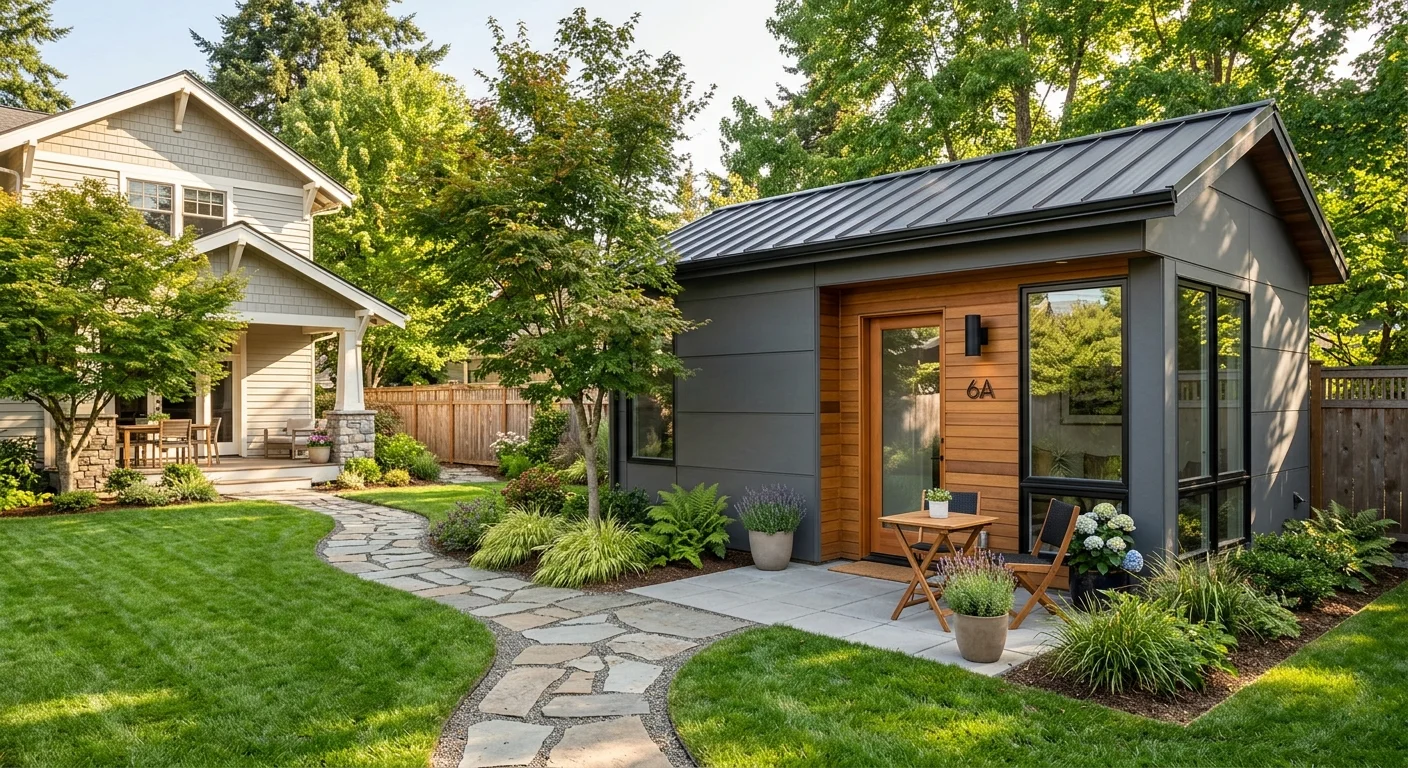
A modern prefab ADU installed and landscaped — representing a $150,000–$280,000 all-in project depending on site conditions and location.
Prefab ADU Cost at a Glance: What You'll Actually Pay
Before we get into the details, here's the picture in one table. This is the comparison most prefab companies don't want you to see — advertised price next to real installed price, side by side.
| ADU Type | Advertised / Base Price | Typical Installed Total | Timeline | Best For | Watch Out For |
|---|---|---|---|---|---|
| Studio prefab (300–400 sq ft) | $50,000–$100,000 | $90,000–$180,000 | 3–5 months | Rental income, home office, guest suite | High cost per sq ft; kitchen/bath are fixed costs regardless of size |
| 1-bedroom prefab (400–600 sq ft)Most Popular | $75,000–$150,000 | $120,000–$250,000 | 3–6 months | Aging parents, long-term rental, adult child | Utility hookups and permits can match a larger unit's costs |
| 2-bedroom prefab (600–800 sq ft) | $100,000–$200,000 | $150,000–$320,000 | 4–7 months | Family housing, premium rental | Delivery and crane access; confirm your lot can handle the module size |
| Large / luxury prefab (800–1,200 sq ft) | $150,000–$300,000+ | $200,000–$450,000+ | 5–9 months | Full-time residence, high-end rental | At this size, stick-built is often price-competitive |
| Site-built detached ADU (comparable) | N/A (custom bid) | $150,000–$400,000+ | 8–14 months | Custom design, difficult lots, maximum resale value | Change orders, weather delays, longer disruption |
| Garage conversion | N/A | $50,000–$180,000 | 2–6 months | Lowest total cost if structure is sound | Loses parking; not always the best layout for living |
Sources: Compiled from current published manufacturer pricing (Abodu, Villa Homes, Studio Shed, Mighty Small Homes), Angi 2026 cost data, Snap ADU 2026 project data, HomeGuide 2026 cost data, and Maxable cost analyses. Ranges reflect national variation — costs trend higher in California, the Pacific Northwest, and the Northeast. Last verified March 30, 2026.
What Does a Prefab ADU Cost, Really?
The Two-Number Problem
Every prefab ADU has two prices, and the industry only advertises one of them.
Number one is the unit price — what the manufacturer charges for the structure itself. This is the number on the website, the number in the brochure, the number that makes you think "I can actually do this."
Number two is the installed price — what it actually costs to have a permitted, connected, livable ADU sitting in your backyard. This number includes everything the manufacturer's price doesn't: the foundation the unit sits on, the trenches dug for water and sewer lines, the electrical panel upgrade your house probably needs, the permit fees your city charges, the crane that lifts a multi-ton module over your fence, and the contractor who connects it all.
On many projects, the site-specific costs (foundation, utilities, permits, delivery, installation) can rival or even exceed the unit price itself. On a $150,000 prefab unit, total installed costs in the $220,000–$300,000+ range are common depending on site conditions.
This isn't a scam. It's how prefab works. Manufacturers build structures — they don't pour your foundation or dig your utility trenches, because every site is different. But if you budget for number one and get surprised by number two, the experience feels like a bait-and-switch.
Our job on this page is to make sure that doesn't happen to you.
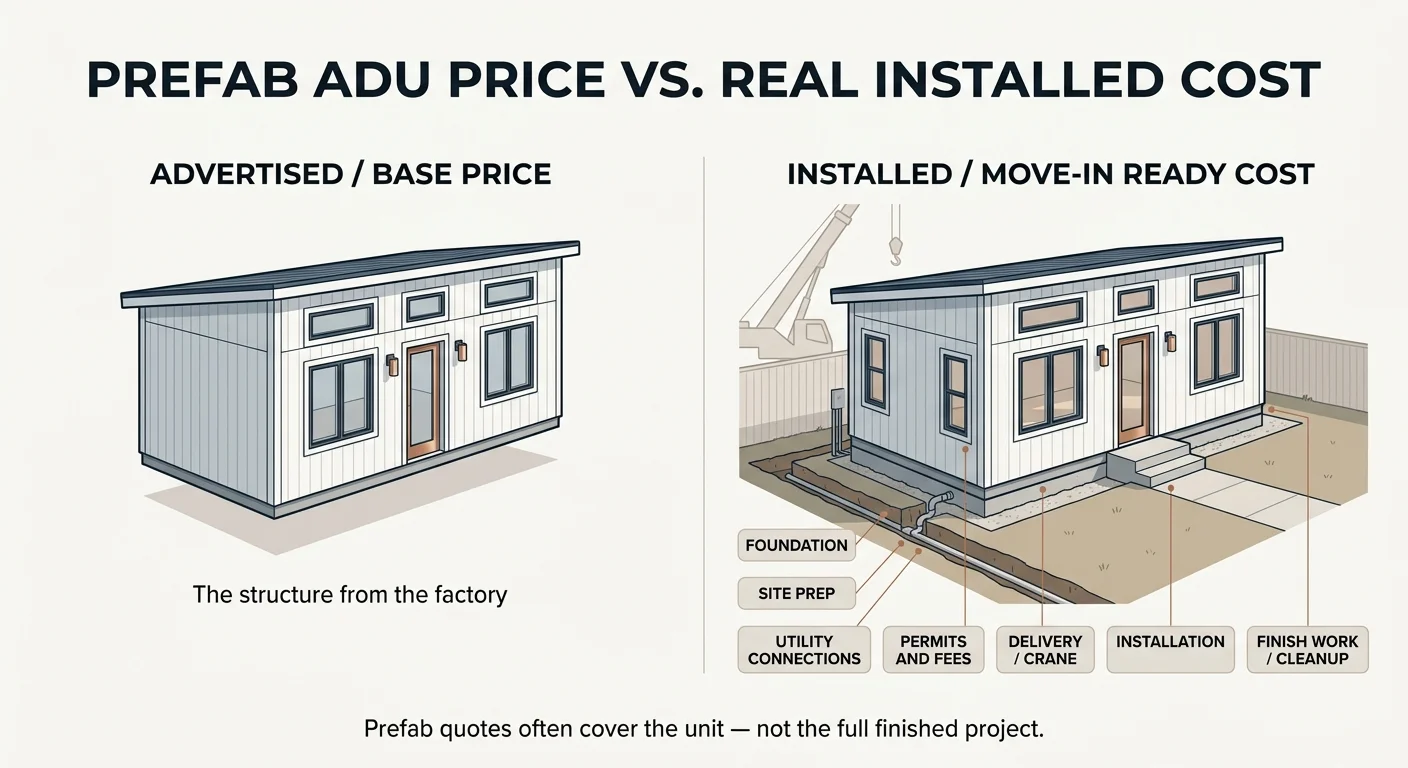
Prefab quotes often cover the unit — not the full finished project.
The Honest Truth: Prefab Isn't Always Cheaper
We need to tell you something that most prefab content won't.
For many projects, the total installed cost of a prefab ADU ends up in a similar range as a comparable stick-built ADU.
Site preparation costs the same regardless of how the structure is built. Foundations cost the same. Permits cost the same. Utility trenching costs the same. The unit itself can be less expensive than custom construction — but the unit is only one piece of the total project.
Industry experience backs this up. Snap ADU, which has completed over 100 projects in San Diego, notes they are "continually surprised that there is not a big cost difference once you do the required permitting, site work, utilities & finish work for a prefab ADU." (Source: Snap ADU blog, "Prefab ADU Guide," updated January 2026.)
So why would you choose prefab?
Because prefab doesn't win on sticker price. It wins on speed, predictability, and peace of mind.
A prefab ADU can cut your total timeline from 8–14 months down to 3–7 months. Manufacturing happens in a climate-controlled factory while your site work begins simultaneously — parallel tracks instead of sequential. You get a fixed-price contract from many manufacturers, which means fewer change orders and budget surprises. And your backyard is a construction zone for weeks instead of months.
For most homeowners juggling jobs, kids, pets, and life — that matters a lot. It often matters more than saving a few thousand dollars on paper.
Thinking about a prefab ADU?
Not sure where to start with financing?
Our financing guide walks you through every option — HELOCs, construction loans, specialized ADU lenders — so you can figure out what fits your situation before you talk to a single salesperson.
Start Planning Your ADUEvery Cost in a Prefab ADU Project, Line by Line
Here's where most "prefab ADU cost" articles lose you — they give a range and move on. We're going to walk through every line item in a typical prefab ADU project so you know exactly where your money goes.
1. The Unit Itself
$50,000–$250,000This is what the manufacturer charges for the physical structure: walls, roof, windows, doors, insulation, interior framing, and usually basic finishes like flooring, cabinets, countertops, and fixtures. Some manufacturers include appliances; others charge extra.
What varies this number most: size, finish level, and brand positioning. A small kit from Mighty Small Homes starts around $40,000–$60,000 for the panel package. A turnkey 800 sq ft modular from Abodu starts at $392,800 — but that price includes design, permitting, manufacturing, and installation. (Source: Abodu models page, verified March 30, 2026.)
2. Foundation
$8,000–$40,000Every prefab ADU needs a foundation built to the manufacturer's specifications before the unit arrives. The most common and cost-effective option is a slab-on-grade concrete foundation. Crawl spaces and pier systems are also used, especially on sloped sites. Soil conditions are the wildcard here. Sandy, well-drained soil on a flat lot? You're on the lower end. Clay soil, a high water table, or any slope? Expect engineering requirements that push the price up.
3. Site Preparation
$3,000–$30,000This covers grading, excavation, tree removal, demolition of existing structures, and soil testing. Think of it as everything that has to happen to your yard before a foundation can be poured.
Flat lot, clear backyard, easy access: $3,000–$8,000. Sloped lot, existing structures to remove, mature trees in the footprint: $15,000–$30,000+.
4. Utility Connections
$10,000–$35,000Water, sewer, electrical, and gas (if applicable) must be extended from your main house to the ADU. This involves trenching — digging a channel across your yard for pipes and conduit — and connecting to your existing systems. Two things drive this cost: distance and capacity. If your ADU sits 30 feet from the house, the runs are short and affordable. At 80–100 feet, costs climb. And if your existing electrical panel can't handle the additional load (common in older homes), a panel upgrade — typically $3,000–$8,000 — may be required.
5. Permits and Fees
$2,000–$15,000Building permits, plan review fees, impact fees, utility connection fees, and inspection fees. This varies enormously by city.
Some perspective: Snap ADU reports that average permit fees in Encinitas run $2–$4 per square foot, while fees in the city of San Diego range from $13–$28 per square foot. (Source: Snap ADU permit fee data, verified March 2026.) That's a 5x–7x difference based purely on which side of a city line you're on.
California-specific note: Under current state law, ADUs under 750 sq ft are generally exempt from local impact fees. Larger ADUs may be charged proportionally. (Source: California Gov. Code §§ 66310–66342; HCD ADU Handbook.) Many prefab manufacturers offer models with pre-approved plans in certain cities, which can streamline the permitting process and reduce review times.
6. Delivery and Placement
$5,000–$25,000Getting the unit from the factory to your backyard. Modular units ship on flatbed trucks and are placed by crane. Panelized and kit ADUs ship as components and are assembled on-site.
Factors that affect this: distance from the factory, unit size, local regulations (some states require police escorts for wide loads), and site access. If a crane can't reach over your house or fence, if there are power lines in the way, or if your street is too narrow for a flatbed — assess access early.
7. Installation Contractor
$10,000–$50,000Even with a factory-built unit, you need a licensed general contractor on-site to set the unit on the foundation, connect all utilities, handle any finish work, and coordinate city inspections. Some manufacturers include this in their price (Abodu, for example, includes full project management). Many do not. If you're hiring your own contractor, get a clear scope of work in writing. "Installation" can mean very different things to different people.
8. Finishes, Upgrades, and Site Restoration
$2,000–$30,000+Standard manufacturer finishes are included in the base price. Upgraded countertops, hardwood flooring, premium appliances, or a better HVAC system will add to the unit cost. After construction: driveway repair, walkways, fencing, landscaping, and any exterior work to make the ADU feel like part of your property. Budget $2,000–$15,000 for this depending on scope.
9. Contingency
10–15% of Total BudgetThings come up. They always do. A responsible budget includes 10–15% of total project cost as a contingency cushion. If your estimated total is $200,000, set aside $20,000–$30,000 for the unexpected. If you don't use it, congratulations — you've got landscaping money.
What Prefab Quotes Usually Include vs. Exclude
This table is worth saving and bringing to every conversation with a prefab company.
| Cost Item | Usually Included? | Often Excluded? | Question to Ask Before Signing |
|---|---|---|---|
| Structural shell (walls, roof, framing) | Yes | "Is this built to local code (IRC) or HUD Code?" | |
| Insulation | Yes | "What R-value? Does it meet local energy code?" | |
| Windows and exterior doors | Yes | "Are these standard or can I upgrade?" | |
| Interior finishes (floors, cabinets, counters) | Usually standard grade | Upgrades extra | "What's included in standard? What does an upgrade cost?" |
| Appliances | Sometimes | Sometimes extra | "Are appliances included? Which ones?" |
| Foundation | Almost never | Yes | "Do you provide foundation specs? Do you handle the pour?" |
| Site preparation and grading | Almost never | Yes | "Who handles site prep — you or me?" |
| Utility trenching and hookups | Almost never | Yes | "Do you connect utilities or do I hire separately?" |
| Electrical panel upgrade | No | Yes | "Will you assess whether my panel needs an upgrade?" |
| Permits and plan review fees | Some include | Often extra | "Are all permit fees included — building, school, impact?" |
| Delivery and transport | Sometimes | Sometimes extra | "Is delivery included? What about crane rental?" |
| Crane placement | Usually extra | Yes | "Will my lot need a crane? What's the typical cost?" |
| Installation contractor | Some include | Often extra | "Is on-site installation in your price, or do I hire a GC?" |
| Engineering and structural calcs | Sometimes | Sometimes extra | "Are structural engineering and energy calcs included?" |
| Sales tax | Rarely mentioned | Yes | "Is sales tax on the unit included in the quoted price?" |
| Landscaping and site restoration | No | Yes | "What condition will you leave my yard in?" |
Why Prefab Quotes Jump After the First Call
You've seen the brochure price. You've had the introductory call. Then the site assessment happens, and the number climbs. Here's why — and how to see it coming.
Sloped Lots and Difficult Access
A flat, open backyard with street-level access is the dream scenario. A sloped lot adds retaining walls, specialized foundations, and sometimes significant grading. Narrow side yards, low-hanging power lines, mature trees, and fences between you and the street can complicate or prevent crane access entirely. Some lots simply can't accommodate modular delivery, which may mean prefab isn't the right path for that property.
Long Utility Runs
If your ADU sits 80+ feet from the main house, every foot of trenching for water, sewer, and electrical adds cost. Rocky or root-filled soil makes trenching harder and more expensive.
Electrical Panel Upgrades
Older homes — and even some newer ones — don't have the electrical capacity to support an ADU without upgrading the main panel. This is often discovered during the planning phase when an electrician does a load calculation.
Local Fees You Didn't Know About
Impact fees, school fees, park fees, sewer capacity charges. These vary by jurisdiction and are often not included in manufacturer quotes.
Upgrade Creep
You start with standard finishes. Then you see the quartz countertop upgrade. The better flooring. Before you know it, the finish package has grown significantly. This isn't a hidden cost — it's a human nature cost. Set a finish budget before you start shopping.
Easy Lot vs. Hard Lot: A Worked Example
To make this concrete, here's what the same 600 sq ft 1-bedroom prefab ADU might cost on two different properties.
Easy Lot
Flat backyard, 30 ft from house, good soil, street-level crane access, modern electrical panel
| Prefab unit (1BR, standard finishes) | $110,000 |
| Foundation (slab-on-grade) | $12,000 |
| Site prep and grading | $4,000 |
| Utility connections (short runs) | $12,000 |
| Permits and fees | $5,000 |
| Delivery and crane | $8,000 |
| Installation contractor | $15,000 |
| Contingency (10%) | $16,600 |
| Total | ~$182,600 |
Hard Lot
Moderate slope, 80 ft from house, clay soil, tight rear access, older electrical panel
| Prefab unit (same 1BR, standard finishes) | $110,000 |
| Foundation (engineered for slope) | $28,000 |
| Site prep, grading, retaining wall | $18,000 |
| Utility connections (long runs + panel upgrade) | $28,000 |
| Permits and fees (higher-fee jurisdiction) | $10,000 |
| Delivery and crane (specialized access) | $16,000 |
| Installation contractor | $22,000 |
| Contingency (15%) | $34,800 |
| Total | ~$266,800 |
Now you know the real numbers
The next question is how to pay for it.
We break down every financing path for ADU projects: HELOCs, construction loans, cash-out refinancing, and specialized ADU lenders — all in plain English, no sales pitch.
See How Homeowners Finance Their ADUsPrefab ADU Cost by Size
The kitchen and the bathroom are the most expensive rooms in any dwelling — and they don't shrink just because the ADU does. That's why a 400 sq ft studio costs almost as much per room as an 800 sq ft two-bedroom. The fixed costs (kitchen, bath, plumbing, electrical, permits) stay roughly constant. Additional square footage is relatively cheap by comparison.
This creates a counterintuitive but important dynamic: the economic sweet spot for most homeowners is 600–800 sq ft. You get meaningfully more space without proportionally more cost, and the rental income potential from a one- or two-bedroom unit is significantly higher than a studio.
Studio
Best for home offices, guest suites, and short-term rental in markets where studios command reasonable rates. Limited long-term rental appeal in most markets. Think of this as the entry point, not necessarily the best value.
1-Bedroom
Sweet SpotThe workhorse. Strong rental appeal in most markets. Comfortable for aging parents or a returning adult child. Big enough to feel like a real home, small enough to keep costs manageable. This is where most first-time ADU builders land — and for good reason.
2-Bedroom
Premium rental income potential. Real long-term livability. At this size, confirm that your lot can accommodate the module dimensions and that delivery access works — larger modules require more complex logistics.
Large (800–1,200 sq ft)
At this size, the cost advantage of prefab narrows considerably. A stick-built ADU of the same size and quality may cost similarly, with more design flexibility. Prefab still wins on timeline and predictability, but do your comparison honestly before committing.
Prefab ADU Cost Per Square Foot: Useful but Easy to Misuse
You'll see per-square-foot numbers everywhere: "$80–$160 per sq ft for prefab" or "$150–$400 per sq ft for site-built." These numbers are real, but they're dangerously easy to miscompare.
The problem: per-square-foot figures for prefab usually reflect only the unit cost. Per-square-foot figures for site-built usually reflect the total project cost. Comparing them directly makes prefab look much cheaper — until you add the same site work costs to the prefab number.
Apples to apples: when you calculate prefab cost per square foot using the total installed cost (not just the unit), the numbers converge. A fully installed 600 sq ft prefab ADU at $180,000 total works out to $300/sq ft — which is right in the range of many site-built ADUs.
Per-square-foot pricing is useful for one thing: comparing two prefab options of similar size to see which manufacturer offers better value at the unit level. Beyond that, use total installed cost for any real comparison.
What Do Prefab Companies Actually Charge? A Brand-by-Brand Pricing Audit
Prefab ADU pricing is fragmented. Some companies publish full pricing on their websites. Others require a consultation. A few bundle everything into one turnkey price, while most quote the unit separately from site work.
We've compiled current publicly available pricing from prefab ADU brands below. These are not negotiated quotes — they're published starting points. Use them for directional comparison, not as final budgets.
| Brand | Model / Size | Published Starting Price | What's Included | Excluded Items | Service Area | Verified |
|---|---|---|---|---|---|---|
| Abodu | Studio, 340 sq ft | $228,800 | Design, permits, manufacturing, installation | Taxes, permit/school fees (~$17K avg), upgrades/custom site work (~$46K avg) | California | Mar 30, 2026 |
| Abodu | Two+, 800 sq ft, 2BR/2BA | $392,800 | Same as above | Same as above | California | Mar 30, 2026 |
| Studio Shed / Studio Home | Summit 1000, 1,000 sq ft (shell) | ~$93,500 (shell-only kit) | Panelized shell kit, design | Foundation, installation labor, interior build-out, permits, utilities | National (ships kits) | Mar 30, 2026 |
| Mighty Small Homes | Multiple models, 400–1,000+ sq ft | $40,000–$120,000 (SIP panel kit) | SIP panel kit, plans, assembly guide | Foundation, installation labor, permits, utilities, shipping | National (ships kits) | Mar 30, 2026 |
| Villa Homes | Multiple sizes, 500–1,200 sq ft | Not publicly listed — estimate required | Design, permits, manufacturing, installation, utility hookups | Varies by project | California | Mar 30, 2026 |
| Boxabl | Casita Studio, 361 sq ft | ~$60,000 (unit); ~$150,000 (with shipping + installation) | Factory-built unit, appliances, HVAC | Foundation, site prep, utility hookups, permits, local fees | National | Mar 30, 2026 |
Sources: Abodu models page (abodu.com/models); Studio Home Summit Series page (studio-home.com); Mighty Small Homes ADU cost page (mightysmallhomes.com); Villa Homes pricing page (villahomes.com/pricing); Boxabl Casita page (boxabl.com/casita) and third-party pricing analysis. All prices verified on the dates shown. Contact companies directly for current pricing — these change.
The lesson: never compare base prices across companies without understanding what's included.
A company that looks expensive might actually be offering better total value because they handle more of the project.
Three questions to ask every company before comparing:
- "Does your quoted price include foundation, installation, and utility connections?"
- "What is the typical total project cost for a customer in my area?"
- "What is NOT included?"
If a company won't answer these questions clearly, that tells you something.
How to Compare Prefab ADU Quotes Apples to Apples
You've gotten two or three quotes. One says $89,000. Another says $280,000. A third says $195,000. Are you comparing the same thing? Almost certainly not.
Prefab companies scope their quotes differently. One includes foundation and permits. Another covers only the unit and delivery. A third bundles everything but utility hookups. Without normalizing these quotes to the same scope, you're comparing apples to oranges to grapefruits.
The 12 Line Items Every Quote Should Address
Before you make a real comparison, every quote needs to show a number — or explicitly say "not included" — for each of these:
Red Flags in Prefab Quotes
Can You Actually Build a Prefab ADU for Under $100,000?
This question appears in Google's follow-up suggestions for a reason. People want to know if the low-end numbers are real.
The unit itself?
Yes. Several companies offer units or kits under $100,000 — especially for smaller studios and kit-based systems. Mighty Small Homes offers SIP kits starting around $40,000. Boxabl markets the Casita unit starting around $60,000. Studio Shed's Summit series shell kits start under $100,000 for smaller models.
A completed, permitted, move-in-ready ADU?
In most markets, that's very difficult to achieve. Once you add foundation ($8,000–$25,000), site prep ($3,000–$15,000), utility connections ($10,000–$25,000), permits ($2,000–$10,000), delivery ($3,000–$10,000), and a contractor for installation ($10,000–$30,000), you're well past $100,000 even with a lower-cost unit.
The exceptions: A garage conversion in a low-cost market with minimal structural work can sometimes come in under $100,000. A very small DIY kit ADU (under 300 sq ft) on a flat lot with short utility runs and low permit fees might land close — if you do significant labor yourself. But these are edge cases.
Our guidance: if a legal, livable backyard ADU is the goal, plan for at least $100,000–$150,000 for a studio and $150,000–$250,000 for a one-bedroom. If someone quotes you a completed ADU for $50,000, ask very specific questions about what's included — and what isn't.
Prefab vs. Site-Built vs. Garage Conversion: The Honest Comparison
You're not just choosing a prefab company — you're choosing a construction path. Each has real trade-offs.
| Factor | Prefab (Modular/Panelized) | Site-Built (Custom) | Garage Conversion |
|---|---|---|---|
| Typical total cost | $100K–$350K+ | $150K–$400K+ | $50K–$180K |
| Timeline | 3–7 months | 8–14 months | 2–6 months |
| Cost predictability | High (fixed-price contracts common) | Lower (change orders and overruns more likely) | Moderate |
| Design flexibility | Limited to available models | Fully customizable | Limited by existing structure |
| Lot flexibility | Requires delivery access and crane clearance | Works on almost any buildable lot | Must have an existing garage |
| Site disruption | Minimal (weeks on-site) | Significant (months on-site) | Minimal to moderate |
| Quality control | Factory-controlled, consistent | Varies by contractor | Varies by contractor |
| Financing and appraisal | Standard for modular on permanent foundations | Standard construction loan process | Generally straightforward |
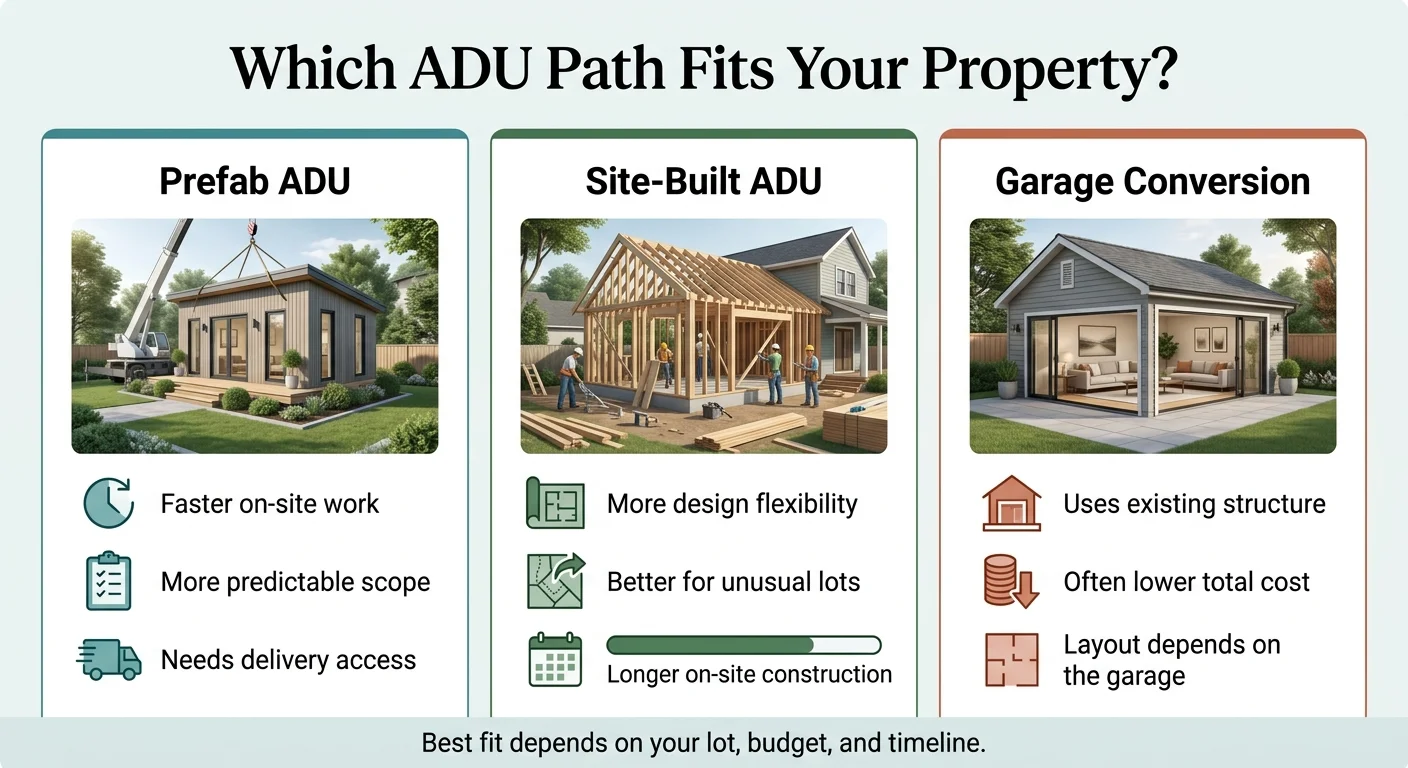
Best fit depends on your lot, budget, and timeline.
When Prefab Wins
- You value speed and want the project done in months, not a year
- You want cost predictability with fewer surprises
- You have a straightforward lot with good delivery access
- You prefer minimal on-site disruption
When Site-Built Wins
- You have an unusual lot (steep slope, very tight access, irregular shape)
- You want full design control to match your existing home
- You're building large (800+ sq ft) where the cost gap narrows
- You plan to stay long-term and want maximum design flexibility
When Garage Conversion Wins
- Budget is the primary constraint
- You have a suitable garage you don't need for parking
- You want the fastest path to a finished unit
Not sure which path is right for your situation?
Start with the numbers.
Our ADU financing guide covers every option from HELOCs to construction loans to specialized ADU lenders — so you can figure out what's realistic before you talk to a builder.
Explore ADU Financing OptionsHow Prefab ADU Costs Vary by Region
We're a national resource, not a California-only site. But we'd be dishonest if we didn't acknowledge that most of the prefab ADU market — and most of the data — still centers on California. That's changing as more states pass ADU-friendly legislation, but the data skew is real.
California
The Most Expensive and Most Developed Market
California combines the highest labor costs, the highest permit fees, and the most active prefab ADU market in the country. The Bay Area and Los Angeles are the most expensive submarkets. The Central Valley and smaller cities run 20–30% lower. California also has the most permissive ADU laws in the country. HOAs generally cannot prohibit or unreasonably restrict ADUs, and owner-occupancy requirements for ADUs were removed effective January 1, 2024. (Source: California HCD ADU Handbook.) On grants: CalHFA's ADU Grant Program historically provided up to $40,000 toward eligible predevelopment costs. However, the most recent funding round was fully allocated as of December 28, 2023. Confirm directly with CalHFA before including any grant in your budget.
Pacific Northwest
Oregon, Washington
Both states have strong ADU-friendly policies. Oregon has been particularly progressive — Portland eliminated single-family-only zoning citywide. Labor costs are high but below California levels. Several national prefab companies serve this market.
Northeast
Massachusetts, Connecticut, Maine
Higher labor and material costs. Growing ADU adoption — Massachusetts allows ADUs by right statewide, and Maine's LD 2003 permits one ADU on any lot with a single-family dwelling where housing is allowed. (Sources: Massachusetts Zoning Act §3; Maine Title 30-A, §4364-B.) Fewer prefab companies have a strong presence here, which can increase shipping costs.
South and Southwest
Texas, Arizona
Lower labor and material costs. Texas has no statewide ADU law, so rules are entirely local — Austin and Houston are more ADU-friendly than many smaller cities. Several kit and panelized companies serve this region well.
Mountain West
Utah, Colorado, Idaho
Growing ADU interest driven by housing costs in cities like Salt Lake City, Denver, and Boise. Utah passed ADU-enabling legislation, though city-level implementation varies. Shipping from West Coast manufacturers can add to prefab pricing.
Midwest
General
Lowest labor and material costs nationally. ADU adoption is growing but slower than coastal markets. Fewer local prefab options, which can increase shipping costs. Kit companies tend to serve this region most cost-effectively.
These are illustrative regional ranges based on published data and industry reports. Actual costs depend on your specific city, lot conditions, and chosen manufacturer.
How Long Does a Prefab ADU Take from Deposit to Move-In?
| Phase | Typical Duration | Notes |
|---|---|---|
| Feasibility and design | 2–4 weeks | Site assessment, model selection, design decisions |
| Permitting | 2–12 weeks | Varies enormously by city; pre-approved plans can cut this significantly |
| Manufacturing | 4–12 weeks | Happening in the factory while site work begins |
| Site work (foundation, utilities, grading) | 3–6 weeks | Runs parallel with manufacturing |
| Delivery and placement | 1–3 days | Crane placement typically takes one day |
| Connections and finish work | 2–6 weeks | Utility hookups, final interior work, inspections |
| Final inspection and certificate of occupancy | 1–4 weeks | City schedules its final inspection |
| Total | 3–8 months | vs. 8–14 months for site-built |
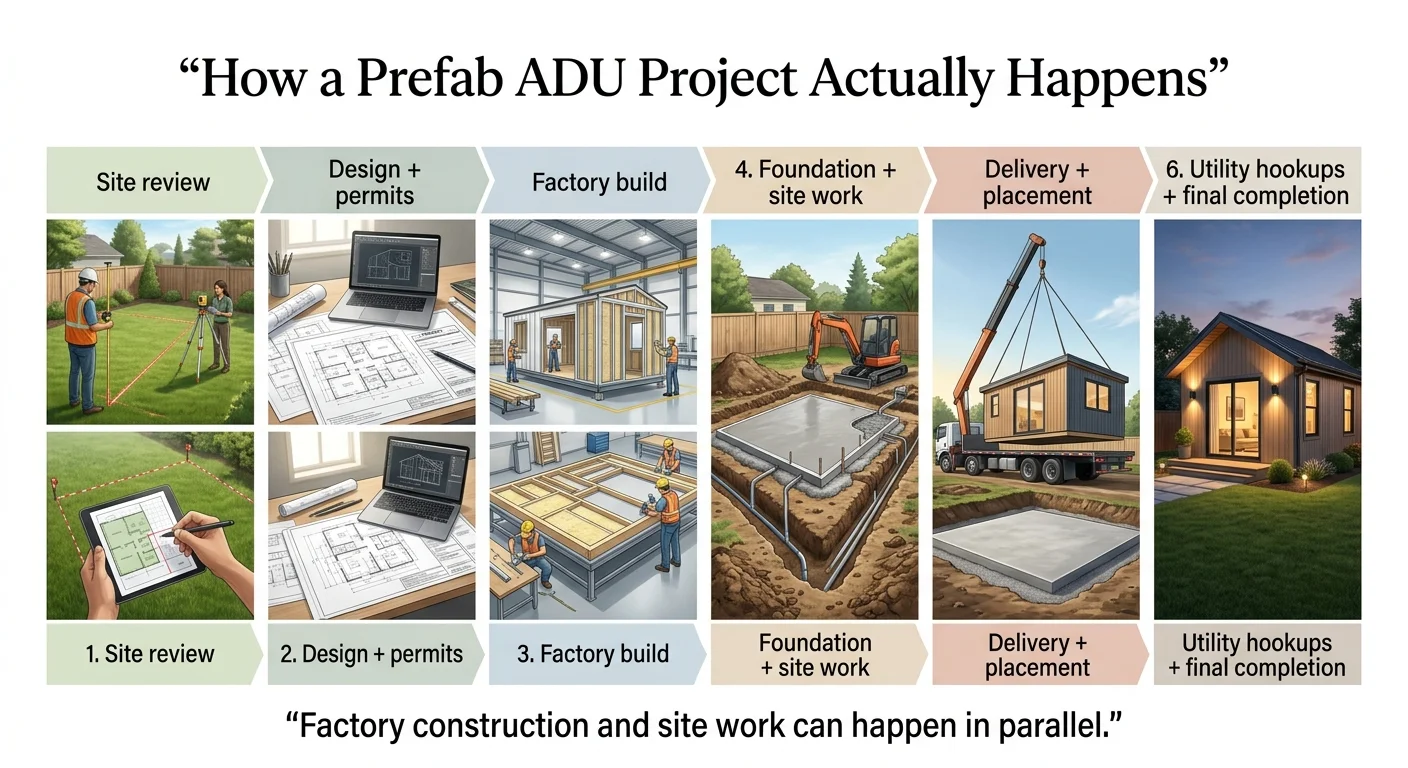
Factory construction and site work can happen in parallel.
What Kind of "Prefab" Are We Actually Talking About?
Not all factory-built housing is the same. The distinctions matter for permits, financing, and how your unit will be valued.
Modular ADU
Most CommonBuilt in large sections in a factory, transported by truck, placed by crane onto a permanent foundation. Built to the same local building codes (IRC — International Residential Code) as site-built homes. Appraised as real property. This is what most people mean by "prefab ADU."
Panelized ADU
Wall panels, floor sections, and roof trusses are built in a factory, shipped flat, and assembled on-site. Faster than stick-built because components arrive pre-cut. Also built to local building codes.
Kit ADU
Plans and materials shipped for assembly by the homeowner or their contractor. Most affordable upfront, but requires the most on-site labor. Quality depends heavily on the builder.
Manufactured Home (HUD Code)
Important DistinctionBuilt entirely in a factory to a separate federal standard (HUD Code), not local building codes. Often placed on non-permanent foundations. Many cities do not permit HUD-code manufactured homes as ADUs. Financing and appraisal treatment also differ significantly. (Source: HUD, "Single-Family Site-Built, HUD Code Manufactured, and Factory-Built Homes.") If a company describes their product as a "prefab ADU" but it's built to HUD Code rather than local IRC standards, you may face permitting rejection, financing difficulties, and lower appraisal values.
How Homeowners Typically Pay for a Prefab ADU
An ADU is a significant investment. Few homeowners pay cash. Here are the most common financing paths.
This is financing education, not financial advice. Terms, availability, and qualification requirements vary by lender. The Dwelling Index is an independent educational resource, not a lender or broker.
Does a Prefab ADU Increase Your Property Value?
You're spending six figures. The natural question: does this pay you back?
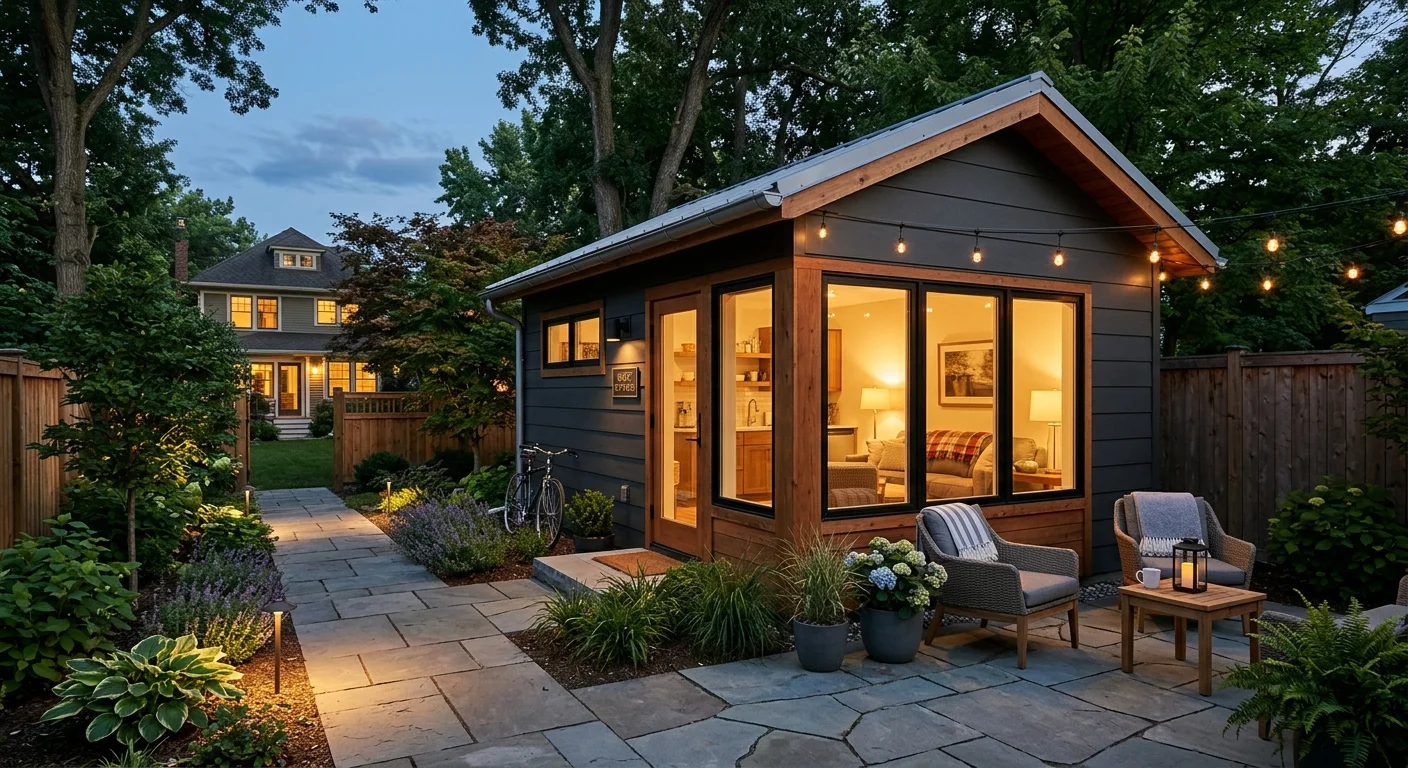
A completed prefab ADU — illustrating the rental appeal and livability that justify the investment.
Property value
ADUs generally increase property value, with the strongest gains in metropolitan areas with high housing demand. The extent of the increase depends heavily on your local real estate market, the quality of the build, and whether the unit generates rental income.
Rental income
In many markets, a one-bedroom ADU can generate meaningful monthly rental income. Exact amounts vary widely by location, size, and local demand — running comparable rental searches in your area is the best way to estimate potential revenue for your specific property.
Prefab and appraisal
Modular ADUs built to local building codes (IRC) on permanent foundations generally appraise comparably to site-built structures. If resale value is a concern, ask your lender whether they have experience appraising prefab ADUs in your area.
The non-financial value
Many homeowners build ADUs for reasons that don't show up on a spreadsheet — housing aging parents nearby, giving a returning adult child independence, creating a dedicated workspace, or simply building optionality into their property. The financial math matters, but it's not the whole story.
Any rental income or property value projections are illustrative. Actual results depend on local market conditions, rental regulations, and property management costs.
Free Download
Planning your ADU project? Get the free toolkit.
Download the 2026 ADU Starter Kit — includes a cost worksheet, a quote comparison checklist, permitting overview by state, and a financing path guide. Everything in one place.
Download the Free Starter KitFrequently Asked Questions
How much does a prefabricated ADU cost?
The unit itself typically costs $50,000–$250,000 depending on size (300–1,200 sq ft), finish level, and manufacturer. The total installed cost — including foundation, site prep, permits, utility connections, delivery, and installation — typically runs $100,000–$350,000+. Always ask for an all-in estimate, not just the unit price.
How much does it cost to build an ADU?
Total ADU costs range from around $50,000 (garage conversion in a low-cost market) to $450,000+ (large custom detached unit in a high-cost market). Most new detached ADU projects land in the $150,000–$300,000 range, whether prefab or site-built. Sources: Angi 2026 cost data; HomeGuide 2026 cost data.
Is a prefab ADU cheaper than building one from scratch?
The unit itself is often less expensive than custom construction of similar size. But total project costs — foundation, site work, permits, utilities — are similar regardless of construction method. The real advantage of prefab is faster timelines, more predictable pricing, and less disruption to your daily life.
What hidden costs do prefab ADU quotes leave out?
The most commonly excluded items are: foundation ($8,000–$40,000), utility connections ($10,000–$35,000), site preparation ($3,000–$30,000), permits and fees ($2,000–$15,000), crane placement ($5,000–$15,000), and electrical panel upgrades ($3,000–$8,000). Together, these can add substantially to the quoted unit price.
What is the cheapest type of ADU to build?
Garage conversions are typically the least expensive ($50,000–$180,000) since the structure already exists. For new construction, small prefab kits on flat lots with short utility runs offer the lowest total costs.
Can you build a prefab ADU for under $100,000?
The unit or kit? Yes — several start under $100,000. A fully permitted, move-in-ready ADU including all site work? In most markets, that's very difficult. Realistic budget floors are $100,000–$150,000 for a studio and $150,000–$250,000 for a one-bedroom.
How much does prefab ADU cost per square foot?
Unit-only cost: typically $80–$250 per sq ft. Total installed cost: typically $150–$450 per sq ft. The distinction is critical — always clarify which number someone is quoting.
Do prefab ADUs still need permits?
Yes. In virtually every U.S. jurisdiction, a prefab ADU must be permitted, inspected, and receive a certificate of occupancy. Some manufacturers offer models with pre-approved plans that can speed up the process.
How long does it take to build a prefab ADU?
Typical total timeline from contract to move-in: 3–8 months. Manufacturing (4–12 weeks) runs in parallel with on-site foundation and utility work. Compare to 8–14 months for site-built.
Is modular the same as manufactured?
No. Modular ADUs are built to local building codes (IRC) and placed on permanent foundations. Manufactured homes follow HUD Code — a separate federal standard — and are often placed on non-permanent foundations. Many cities allow modular ADUs but not HUD-code manufactured homes. Financing and appraisal treatment also differ. Source: HUD.
How much does it cost to build an ADU above a garage?
Building a livable ADU above an existing garage typically costs $200–$500+ per square foot, including structural reinforcement of the existing garage, a new staircase, plumbing, electrical, HVAC, and full interior finishing. For a 500–600 sq ft above-garage unit, expect $120,000–$300,000 depending on your market and the condition of the existing structure.
How much does an attached ADU cost?
An attached ADU — a home addition with a separate entrance, kitchen, and bath — typically costs $125–$300+ per square foot, or $75,000–$250,000+ for a 600 sq ft unit. Attached ADUs are often less expensive than detached because they share a wall with the main house and have shorter utility runs.
Are prefab ADUs good for rental income?
In many markets, yes. Rental income depends on your local market, unit size and quality, and local regulations. Some jurisdictions restrict short-term rentals in ADUs, and owner-occupancy requirements may still apply in certain areas (though California eliminated this requirement effective January 1, 2024). Check your local rules.
What does "turnkey" mean when a prefab company uses it?
It should mean everything from design to certificate of occupancy is handled — unit, foundation, site prep, permits, utilities, delivery, installation, and inspections. But companies define "turnkey" differently. Always get a written scope listing every included and excluded item before treating any quote as turnkey.
How We Researched These Costs
This page draws on pricing data from multiple source types:
How we handle uncertainty: cost ranges are deliberately wide because ADU costs vary significantly by location, lot conditions, and manufacturer. When sources conflict, we cite the broader range and note it.
What we update: pricing tables and brand data are reviewed quarterly. The last full data review was completed on March 30, 2026.
Our editorial standard: if you removed every link and CTA from this page, we believe it would still be the most useful prefab ADU cost resource available. That's the bar we hold ourselves to.
Not sure where to start? That's normal.
Start with the financing. Figure out what you can realistically spend, and the rest of the decisions get easier from there.
Start Planning Your ADUWant everything in one place?
The free 2026 ADU Starter Kit has the cost worksheet, the quote comparison checklist, and the financing comparison guide — all printable, all free.
Download the Free Starter KitRelated Guides
Last verified: March 30, 2026 · Editorial Standards · Affiliate Disclosure