Best Prefab ADU Companies in 2026
The best prefab ADU companies are not the same for every homeowner — the right choice depends on your lot, your state, and how turnkey you want the process to be.
Here’s where we landed after months of research: for a turnkey prefab ADU in California with fixed pricing and fast installation, Abodu and Cover lead the pack. For homeowners outside California who need something that ships nationwide, Studio Home (formerly Studio Shed) is the most proven panelized option with 18 years and 6,000+ projects behind it. And if you want a design-forward unit with transparent model-based pricing, Samara now offers five models from $152,000 plus installation.
But here’s what you need to know before you get excited about any price tag: the number on a prefab ADU website is almost never the final number. Published base prices range from $40,000 for a kit to $440,000+ for a premium turnkey unit. The real installed cost — once you add foundation, permits, site prep, utility hookups, and delivery — typically lands between $150,000 and $500,000 depending on size, finish level, and location.
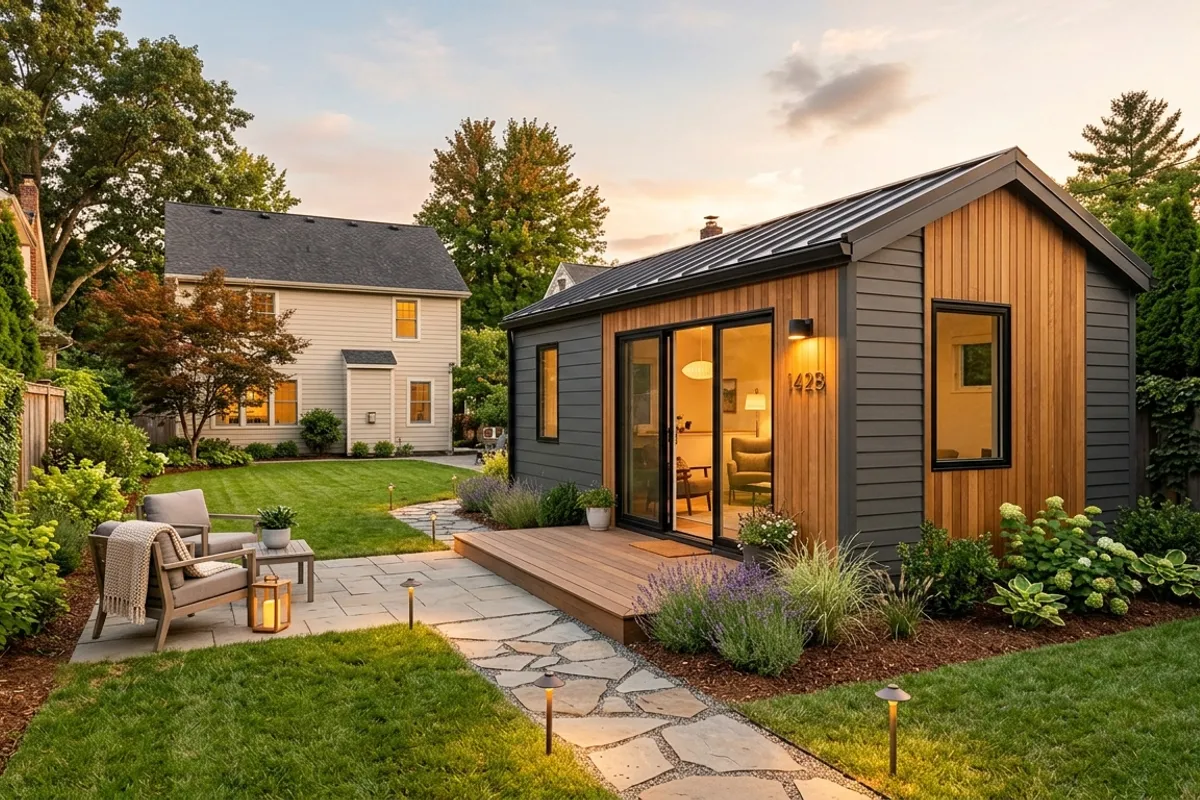
Best Prefab ADU Companies Compared
This table shows the companies we evaluated side by side. Pricing reflects data verified in March 2026 from official company sources. “All-in estimate” includes approximate site prep, foundation, permits, and utility hookups for a typical flat, accessible lot. Your actual cost will vary — always get a written, line-item quote.
Some companies in this table are advertising partners. Rankings are based on independent editorial criteria — not compensation. See how we rank →
| Company | Published Price | Est. All-In | Sizes | Build Type | Service Area | Best For |
|---|---|---|---|---|---|---|
| Abodu | $278K–$439K base | $300K–$500K+ | 340–1,200 sf | Full modular (HCD approved) | California | Fixed-price turnkey |
| Cover | Custom quote | $250K–$500K+ | 250–1,200 sf | Panelized steel (no crane) | Southern California | Custom design, tight access |
| Samara | $152K–$277K + install | $220K–$400K+ | 420–950 sf | Full modular | California | Design-forward, transparent pricing |
| Villa Homes | Varies by model | $200K–$400K+ | 450–1,200 sf | Panelized + modular | CA, CO | Variety, larger units |
| Studio Home | ~$40K+ (product + plans) | $150K–$300K+ | 200–1,000+ sf | Panelized kit | Nationwide (50 states) | National reach, budget flexible |
| Dvele | $200–$275/sf factory | $250K–$500K+ | 400–1,200 sf | Full modular | CA + neighboring states | Net-zero, smart home |
| prefabADU | $30K–$80K (kit) | $80K–$180K | 150–1,200 sf | DIY kit | CA (Bay Area) | Owner-builders, lowest cost |
| Mighty Small Homes | Shell kit from ~$40K+ | $120K–$250K+ | 300–800+ sf | SIP kit/shell | Ships from KY, broad reach | Budget SIP shell path |
| Deltec | Shell from ~$25K–$46K | $150K–$350K+ | 326–517 sf (cottages) | Panelized round | Nationwide | Storm-resistant, unique design |
Prices from official company websites and published materials as of March 2026. “All-in” estimates are editorial approximations for typical flat-lot projects — not quotes. Verify all pricing directly with each company.
How Much Does a Prefab ADU Really Cost?
Before you fall in love with a floor plan, you need to know this: the price on a prefab ADU website is almost always the starting point, not the finish line.
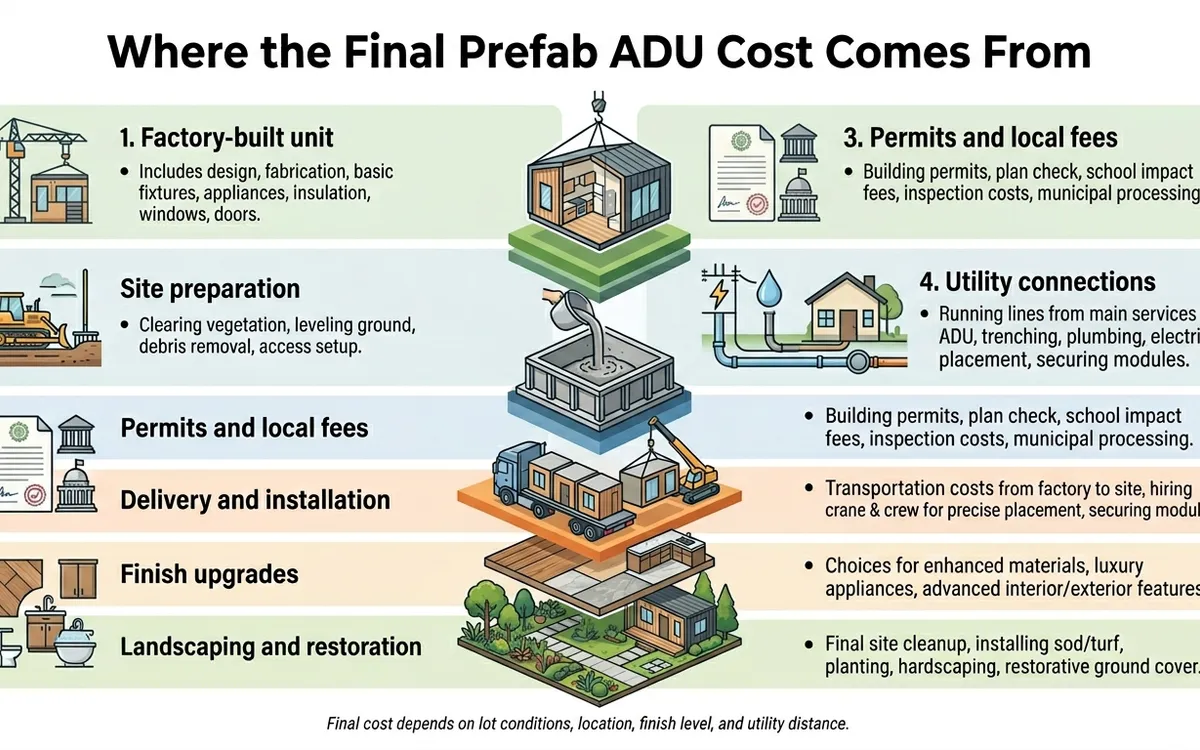
Every homeowner forum thread about prefab ADUs says some version of the same thing: “I thought it would be $150K and it ended up being $300K.” That’s not because anyone lied. It’s because the base price covers the unit — and a unit sitting in a factory is not the same as a finished home in your backyard. Here’s where the gap comes from:
| Cost Component | Typical Range | Notes |
|---|---|---|
| Prefab unit (base/kit price) | $25,000–$440,000+ | Varies dramatically by company, size, and finish level |
| Site preparation | $5,000–$30,000 | Grading, demolition, tree removal, soil testing |
| Foundation | $8,000–$25,000 | Slab most common; pier foundations cost more |
| Utility hookups | $10,000–$30,000 | Water, sewer, electric, gas — distance from main house matters |
| Permits & fees | $3,000–$15,000+ | Ranges dramatically by city — some CA cities charge $13–$28/sf |
| Delivery & crane | $5,000–$15,000 | Full modular units need crane; kits ship on flatbeds |
| Finish upgrades | $0–$50,000+ | Cabinetry, appliances, flooring above base spec |
| Landscaping & restoration | $2,000–$15,000 | Pathway, grading restoration, fencing |
| Typical all-in range | $120,000–$500,000+ | Size, location, build type, and finish level drive the final number |
Sources: Abodu published pricing (March 2026), Samara published pricing (March 2026), SnapADU 2026 cost data, Angi 2026 national averages, HomeGuide 2026 estimates. Always get line-item estimates for your specific property.
Even at real all-in cost, a prefab ADU remains one of the strongest property investments a homeowner can make. A well-located ADU can generate meaningful monthly rental income and add substantial equity to your home. We cover the financial picture below — but the math works for most homeowners who plan carefully.
See what’s buildable at your address — local size limits, setback rules, and estimated costs in 60 seconds. No sales call. No commitment.
Which of the Best Prefab ADU Companies Fits Your Situation?
Most prefab ADU guides rank companies like a horse race — “best overall,” “runner-up,” “honorable mention.” But a prefab ADU that’s perfect for a flat lot in San Jose is the wrong choice for a sloped backyard in Denver with a narrow gate. We ranked by best fit, not best overall.
Best fixed-price turnkey prefab ADU: Abodu
If you want one company handling everything — design, permits, foundation, installation — with a fixed price guaranteed before you start, Abodu is the most streamlined option in California. Six HCD state-approved designs from 340 to 1,200 sf. Base prices start at $278,800 for the studio, with average customer costs running $300K–$500K depending on model and site. One-day crane installation.
Watch out for: California only. Premium pricing. Full modular units require crane access. The Dwell House collaboration starts at $439,000 base.
Best for custom design without a crane: Cover
Cover builds custom architect-grade ADUs using steel-framed panels manufactured in their Gardena, CA factory. Panels ship on standard trucks — no crane needed — making Cover a strong option for lots with tight access, overhead wires, or narrow gates. Turnkey from design through installation, with 6–8 weeks of on-site work and as little as 4 months total.
Watch out for: Southern California only. Premium custom pricing. Quotes are custom, so less upfront price predictability.
Best transparent pricing with design-forward models: Samara
Samara publishes clear model-based pricing — a rarity in this space. Five models: Studio (420 sf, from $152K), One Bedroom (540 sf, from $170K), Two Bedroom (690 sf, from $190K), XL 8 (800 sf, from $249K), and XL 10 (950 sf, from $277K). All prices are plus installation. California only. Turnkey service from permitting through move-in.
Watch out for: California only. “Plus installation” means the published price is not the all-in number — always get total project cost in writing.
Best nationwide option (ships to all 50 states): Studio Home
Formerly Studio Shed, Studio Home has been building prefab structures since 2006 — longer than most companies on this list have existed. Their Summit Series ADU ships as a panelized kit from Colorado to all 50 states. Product and permit plans start around $40,000, with total all-in costs around $250/sf for a fully installed 400 sf ADU. 6,000+ projects completed.
Watch out for: This is a kit, not turnkey. You’re responsible for the GC, site prep, foundation, and utility hookups. The all-in number depends heavily on your local labor market.
Best for owner-builders on a tight budget: prefabADU
Based in the Bay Area with 16+ years in the business and 170+ completed units, prefabADU gives you plans, materials, and an in-depth installation guide — you build it yourself or hire your own crew. Kit prices start as low as $30K for micro units. If you have construction skills or a trusted contractor, this is the most affordable path to a code-compliant ADU.
Watch out for: This is genuinely DIY. You are the general contractor. Bay Area focused.
Best alternative when prefab doesn’t fit your property
If your lot has a steep slope, extremely narrow access (under 8 feet), overhead power line conflicts, or you need a highly customized layout — prefab may not be the right path. Consider city pre-approved ADU plans paired with a local general contractor, a garage conversion, or a fully custom stick-built ADU.
Prefab ADU Company Reviews: The Details
We used the same evaluation structure for every company so you can compare fairly. Each review covers what’s included, what’s not, who it fits, and where buyers get surprised.
Last verified: March 2026. We check company websites and published pricing quarterly. Always confirm details directly with the company before signing anything.
Abodu
Best Fixed-Price TurnkeyFounded 2018, Redwood City, CA | Full modular, HCD state-approved | Service area: California
Models & Pricing: Six designs from 340 to 1,200 sf. Current base prices: Studio (340 sf) from $278,800; One (500 sf) from $326,800; Two (610 sf) from $360,800; Two+ (800 sf) from $426,800; Dwell House (540 sf) from $439,000. Average customer costs with upgrades run $300,500 to $498,500 depending on model, plus an average of ~$17K in permit fees and taxes.
What’s included: Unit, delivery, installation, foundation, standard utility connections (up to 50 ft trenching), craning (up to 100 ft), permitting services, project management, all appliances and finishes.
What’s not included: Utility trenching beyond 50 ft, craning beyond 100 ft, structure demolition, tree removal, unique site engineering, sales tax, and permit fees.
Why it made the list: Abodu’s fixed-price model is the most transparent in the industry. The price on the contract is the price you pay — no surprise change orders. One-day crane installation means minimal on-site disruption. HCD state-approved plans streamline permitting across California.
Who should skip it: Anyone outside California. Anyone who needs extensive design customization beyond the six available models.
Cover
Best Custom No-Crane OptionFounded 2014, Gardena, CA | Steel-framed panelized (no crane required) | Service area: Southern California (San Luis Obispo to San Diego)
Sizes & Pricing: 250–1,200 sf, fully custom layouts. Custom quotes; expect premium pricing commensurate with architect-grade custom design.
What’s included: Custom architecture and design, engineering, permitting, factory manufacturing, delivery on standard trucks, and full installation — all handled by one in-house team.
Why it made the list: Cover’s steel-panel system ships on standard trucks and assembles without a crane. That’s a genuine advantage for lots with tight access, overhead obstructions, or narrow gates. On-site work typically takes 6–8 weeks, with total project timelines as short as 4 months depending on permitting. A decade of operations in LA provides a deep local track record.
Who should skip it: Anyone outside Southern California. Anyone seeking a quick, standard product at a lower price point — Cover is custom and premium.
Samara
Best Transparent PricingSan Francisco, CA | Full modular | Service area: California
Models: Five options with published starting prices: Studio 420 sf ($152K), One Bedroom 540 sf ($170K), Two Bedroom 690 sf ($190K), XL 8 800 sf ($249K), XL 10 950 sf ($277K). All prices are “plus installation,” meaning foundation, site work, utilities, and permits are additional.
What’s included: Turnkey service covering design, engineering, permitting, factory fabrication, delivery, and installation.
Why it made the list: Samara publishes model-specific starting prices — something most competitors still avoid. The design quality is exceptional: curated materials, thoughtful layouts, and the kind of natural light that makes a 420 sf unit feel significantly larger. Strong customer reviews and financing options available.
Who should skip it: Anyone outside California. Anyone whose budget can’t accommodate installation costs on top of published unit prices.
Villa Homes
Best for Larger Units & VarietyFounded 2018 | Panelized and modular options | Service area: California, Colorado
Sizes: 450–1,200+ sf with 1–3 bedroom configurations. Pricing varies by model and configuration.
What’s included: Varies by model tier. Villa handles feasibility, design, permitting, manufacturing, and installation as a turnkey provider.
Why it made the list: Broadest model selection of any company we reviewed. One of the few actively serving Colorado in addition to California. Good fit for homeowners who want a larger 2–3 bedroom unit with full-service support. Note: Villa describes its homeowner ADU products as HUD-approved — confirm the specific code path and how it affects your financing and appraisal.
Who should skip it: Anyone outside CA/CO. Anyone looking for the most affordable entry point.
Studio Home
Best Nationwide OptionFounded 2006, Louisville, CO (formerly Studio Shed) | Panelized kit | Service area: All 50 US states
Pricing: ADU product and permit plans starting around $40,000. Total all-in cost approximately $250/sf for a fully installed 400 sf ADU including assembly, site work, and permits. Larger models cost more total but typically less per square foot.
What’s included: Pre-engineered panelized kit, permit-ready plan set, high-end materials (Marvin windows, James Hardie siding, Zip System panels). Design support through their 3D Design Center.
What’s not included: Foundation, site prep, utility hookups, local GC labor, permit fees. This is a kit — you handle the rest locally.
Why it made the list: 18+ years in business. 6,000+ completed projects. Ships nationwide. The most established panelized ADU option for homeowners outside California. Flat-packed design means no crane needed — components fit through standard gates and assemble on-site.
Who should skip it: Anyone wanting fully turnkey service without hiring a local GC.
Dvele
Best Net-Zero & Smart Home ADUFounded 2017 | Full modular | Service area: California plus select neighboring states
Pricing: Factory production typically $200–$275/sf, plus $15K–$100K in soft costs (design, engineering, permitting), plus separate site costs. Total timeline: 6–12 months. Requires a local general contractor for site work.
Why it made the list: Dvele builds ADUs engineered for 100-year lifespan with integrated smart home systems and net-zero energy performance. If sustainability and technology are top priorities, Dvele is the category leader.
Who should skip it: Anyone prioritizing speed or lowest cost. Anyone far from California where delivery costs become prohibitive.
prefabADU
Best for Owner-BuildersBay Area, CA — 16+ years, 170+ completed units | DIY kit | Service area: California (Bay Area focused)
Pricing: $30K–$80K for the kit. All-in with owner labor and contractor support: approximately $80K–$180K depending on size and scope.
Why it made the list: The most affordable code-compliant ADU path if you’re willing to do the work. Plans, materials, and detailed installation guide included. Sizes from micro units (150 sf) to full villas (1,200 sf).
Who should skip it: Anyone who doesn’t want to manage their own construction project.
Why Boxabl Is Not in Our Main Ranking (Yet)
Boxabl’s Casita — a 361 sf foldable unit priced around $60K–$80K — generates enormous interest. The concept is compelling: mass-produced, affordable housing that unfolds on-site.
We chose not to rank Boxabl because the total installed cost picture isn’t clear enough for a fair comparison. Availability has been limited by long waitlists and unpredictable delivery timelines. When the total-cost and availability picture firms up, we’ll add Boxabl to the main table. In the meantime, get a detailed written total-cost estimate before committing a deposit.
Which Companies Actually Serve Your State?
This is the question that trips up the most people. Many of the most polished prefab ADU brands are California-only. If you’re in Texas, Florida, Colorado, or the Northeast, your options narrow fast.
| Company | California | Pacific NW | Colorado | TX / SE / NE | Nationwide |
|---|---|---|---|---|---|
| Abodu | |||||
| Cover | SoCal only | ||||
| Samara | |||||
| Villa Homes | |||||
| Studio Home | (HQ) | (all 50 states) | |||
| Dvele | Select | Select nearby states | |||
| prefabADU | Bay Area | ||||
| Mighty Small Homes | Ships from KY | ||||
| Deltec |
Verified March 2026 from company websites and sales contacts. Coverage areas change — always confirm directly.
If you’re outside California, your strongest current options are Studio Home (most established, ships to all 50 states), Deltec (panelized, ships nationally, excellent storm resistance), and Mighty Small Homes (SIP shell kits that ship broadly from Kentucky). If none of those fit, look for a local modular home builder with ADU experience, or explore city pre-approved ADU plans paired with a local general contractor.
Will a Prefab ADU Work on Your Lot?
Your lot decides more than your taste does. A beautiful 800 sf modular unit is worthless if the delivery truck can’t reach your backyard. Run through this checklist before shortlisting any company.
Access width
Is there at least 10–12 feet of clear path from the street to the build site? Full modular units require this. If your access is tighter — even down to 5–6 feet — panelized options (Cover, Studio Home, prefabADU) can work because components ship smaller.
Overhead clearance
Power lines, mature trees, or structures directly over the build area? A crane needs vertical clearance. Overhead obstructions can add thousands in relocation costs or rule out crane-set modular entirely.
Grade and slope
Most prefab companies design for flat or gently sloped lots. Significant grade changes require retaining walls or specialized foundations that add cost and complexity.
Setbacks
In California, local agencies may not require side and rear setbacks of more than four feet for detached ADUs (Cal. Gov. Code § 66314(d)(7)). Other states vary significantly. Verify with your local planning department.
Utility distance
Every foot of trenching between your main house and the ADU site adds cost. Electrical panel upgrades can add $2,000–$5,000+.
Zoning
ADU regulations vary sharply by state and city. Some jurisdictions have streamlined permitting; others still make it difficult. Always verify with your local planning department before selecting a model.
HOA restrictions
In California, HOA provisions that effectively prohibit or unreasonably restrict qualifying ADUs or JADUs are void under state law (Cal. Civ. Code § 4751). Outside California, HOA rules generally stand. Check your CC&Rs.
Red flags that mean prefab probably isn’t right
If your property has alley-only access under 8 feet wide, a steep hillside, mature trees blocking the entire build envelope, or a utility easement running through the ADU footprint — a full modular prefab is likely the wrong approach. Consider panelized construction (smaller components, no crane), a garage conversion, or a custom stick-built ADU instead.
Not sure if your lot qualifies?
Get your free ADU feasibility report — local size limits, setback rules, and estimated costs in about 60 seconds.
Check My Property →Is Prefab Better Than Stick-Built for Your Property?
The honest answer: it depends on your lot and your priorities.
| Factor | Prefab ADU | Custom Stick-Built ADU |
|---|---|---|
| Total cost | $150K–$500K+ | $150K–$450K+ |
| Total timeline | 4–12 months | 6–14 months |
| On-site construction | Days to 8 weeks | 3–6 months |
| Design customization | Limited to moderate | Full customization |
| Lot flexibility | Needs access + clearance | Adapts to any lot |
| Quality consistency | Factory-controlled | Varies by contractor |
| Neighbor disruption | Minimal | Significant |
When prefab wins
Flat lot, accessible backyard, standard setbacks. You want speed and minimal disruption. You’re comfortable choosing from pre-designed layouts. You value factory-controlled quality and fixed pricing.
When stick-built wins
Complex lot (steep slope, irregular shape, narrow access). You need a custom floor plan to maximize a tricky footprint. You want the ADU to match existing architecture perfectly. You have a trusted local contractor with ADU experience.
The cost surprise most people don’t expect: For standard lots, prefab can offer real savings through factory efficiency and reduced on-site labor. But for challenging lots, the site prep costs to accommodate a prefab unit — crane pads, tree removal, utility rerouting, retaining walls — can actually make prefab more expensive than building in place. Get quotes for both before committing.
Modular, Panelized, Manufactured, Kit — What’s the Difference?
These terms get used interchangeably in marketing, but they mean different things for your permits, financing, and appraisal.
| Build Type | How It’s Built | Crane? | Code Path | Financing Notes |
|---|---|---|---|---|
| Full modular | Entire unit built in factory, craned into place | Yes | State/local residential code (IRC) | Treated like site-built per Fannie Mae when permanently affixed |
| Panelized | Walls, roof, floors built as panels, assembled on-site | No | Local residential code (IRC) | Treated like site-built per Fannie Mae |
| Kit | Materials and plans shipped; more assembly on-site | No | Local residential code (IRC) | Treated like site-built |
| Manufactured (HUD) | Entirely factory-built on permanent chassis | No | Federal HUD code (24 CFR Part 3280) | Different appraisal and financing pathway |
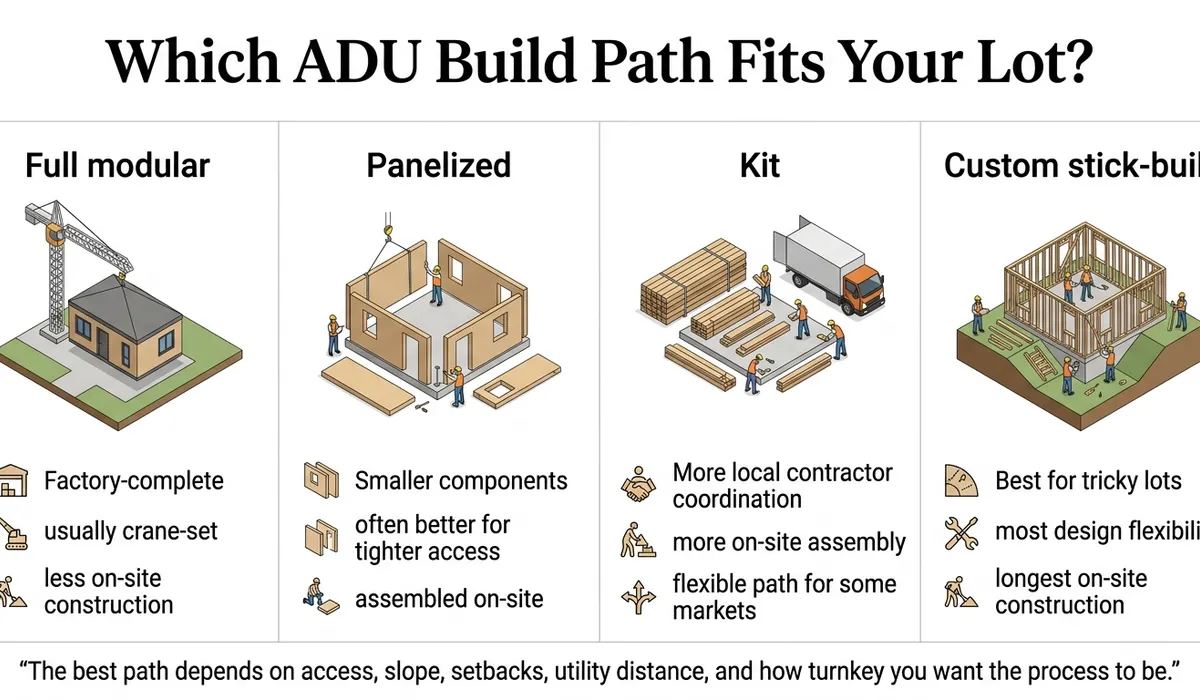
Why this matters for your mortgage and home value: Fannie Mae’s Selling Guide states that modular, prefabricated, panelized, and sectional homes can receive site-built treatment when they are real property, permanently affixed to a foundation, and code-compliant. HUD-code manufactured homes follow a separate financing and appraisal pathway.
Ask before signing: Which building code does your product comply with — IRC, HCD state-approved, or HUD? The answer affects your permit process, appraisal, and financing options.
How Do Homeowners Pay for Prefab ADUs?
Most homeowners don’t have $200K+ in savings. Here are the most common financing paths — presented as education, not recommendations for specific lenders.
HELOC (Home Equity Line of Credit)
Uses existing home equity. Flexible draw schedule. Works well if you have significant equity built up.
Cash-Out Refinance
Replaces your current mortgage with a larger one, giving you a lump sum for the ADU project.
Construction Loan
Short-term loan for building projects, often converting to a permanent mortgage after completion.
ADU-Specific Loan Products
Some lenders offer products that factor in the after-renovation value of your property — meaning you can borrow based on what your home will be worth with the ADU.
CalHFA ADU Grant (California)
This program previously offered up to $40,000 for qualifying homeowners. However, program funds were fully reserved as of late 2023 (per CalHFA and California HCD’s ADU Handbook). Future funding rounds have not been confirmed as of this writing. Check directly with CalHFA for the most current program status before factoring any grant into your budget.
Questions to ask a lender before signing a prefab contract:
- Will this specific ADU product (modular, panelized, manufactured) qualify for your loan?
- How do you handle draw schedules for factory-built units where most work happens off-site?
- Will the finished ADU appraise as a permanent structure for refinancing purposes?
We are an independent educational resource — not a lender, broker, or financial advisor. Consult a qualified financial professional for advice specific to your situation.
Exploring how to pay for your ADU?
Our financing guide covers every option: HELOCs, cash-out refinances, construction loans, and ADU-specific products.
If you use our links to explore financing, we may earn a commission at no extra cost to you. Full disclosure →
Read the ADU Financing Guide →Does a Prefab ADU Pay for Itself?
This is the question behind the question. Most homeowners aren’t just buying an ADU — they’re investing in one.
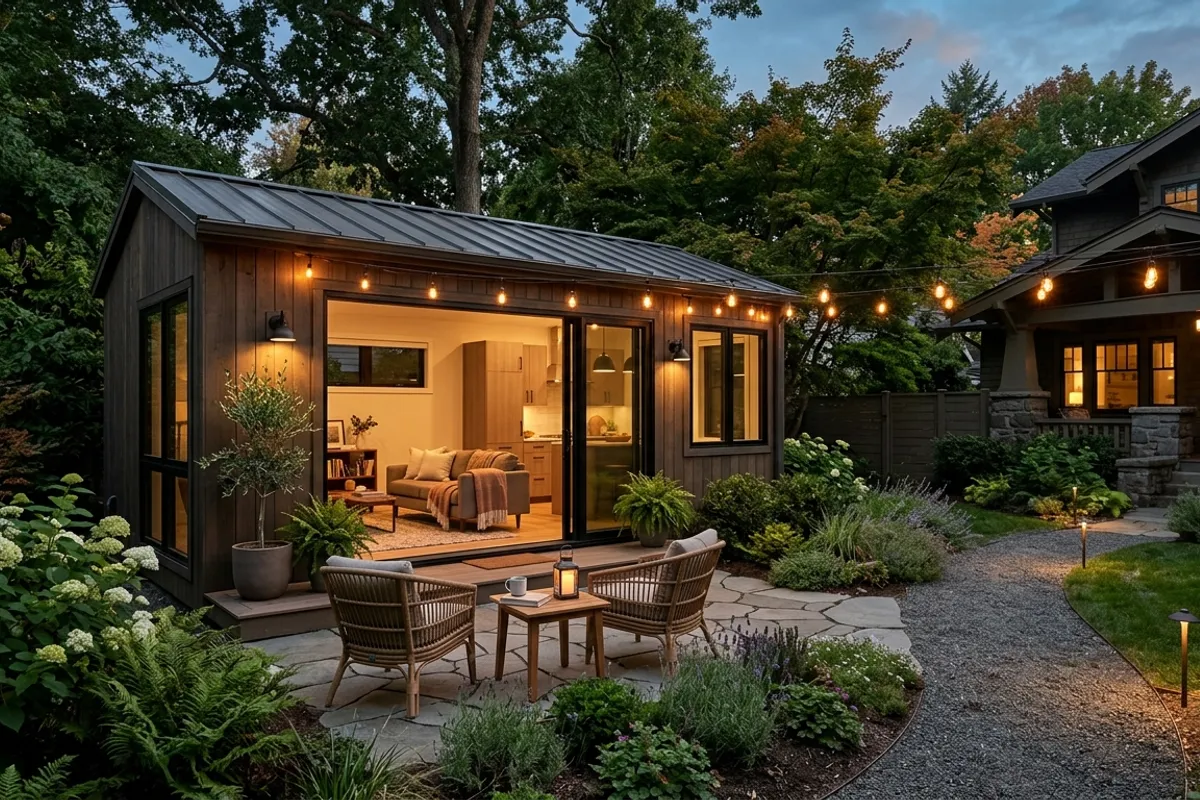
The financial case for an ADU rests on two pillars: rental income and property value increase. In strong rental markets, a well-located 1–2 bedroom ADU can generate $1,500–$3,000+ per month in long-term rental income. And multiple real estate analyses have found that homes with ADUs sell at a meaningful premium over comparable properties without them.
Here’s a simple way to think about it: if your all-in ADU cost is $250,000 and you rent it for $2,000/month ($24,000/year gross), the simple cash-on-cash payback is roughly 10 years before accounting for property appreciation, tax benefits, or rent increases. In high-demand markets, the numbers can look substantially better.
These are illustrative examples only — not projections or guarantees. Rental income depends on local market conditions, rental demand, zoning restrictions on short-term rentals, and management costs. Consult with a local real estate professional and financial advisor for estimates specific to your property.
Beyond the spreadsheet
The homeowners who are happiest with their ADU investment usually cite reasons that don’t fit neatly into a calculator: an aging parent who can live close by with independence and dignity. An adult child saving for a down payment instead of paying market rent to a stranger. A home office that genuinely separates work from life. The financial case is strong in most markets. But the lifestyle case is often what tips the scale.
See what’s buildable at your address — local size limits, setback rules, and estimated costs in 60 seconds. No sales call. No commitment.
How to Compare Prefab ADU Quotes Without Getting Burned
Skepticism is healthy in this market. Here’s how to protect yourself.
10 Questions to Ask Before You Sign
- 1
What is the total cost from contract to certificate of occupancy — every line item?
- 2
What is specifically excluded from your quote?
- 3
What site assumptions are baked into this price (access, grade, utility distance, soil)?
- 4
If site conditions differ from assumptions — who pays the difference?
- 5
What is the refund/cancellation policy, and when does it change?
- 6
Can I see 3–5 completed installations in my area (photos, not renders)?
- 7
How many units have you permitted and installed in my specific city/county?
- 8
Which building code does your product comply with — IRC, HCD, or HUD?
- 9
What is the realistic total timeline from signed contract to certificate of occupancy?
- 10
Who handles permit applications, inspections, and utility coordination?
Red Flags That Should Eliminate a Company
Render-only portfolio. If they can only show computer-generated images — not photos of completed, occupied installations — proceed with extreme caution.
Vague service area. If they can’t name specific cities where they’ve permitted and installed, they may be overpromising geographic reach.
Giant upfront deposit with unclear refund terms. A reasonable deposit protects both parties. A non-refundable 30%+ deposit before permits are submitted protects only the company.
No local references. Ask for 2–3 recent customer contacts in your area. If they can’t provide them, that’s a signal.
Free 2026 ADU Starter Kit
Cost worksheets, permit timelines by state, a contractor vetting checklist, and a financing path guide. Everything before you talk to a single company.
Download Free Starter Kit →When Prefab Is the Wrong Move
We’d rather lose you to the right solution than gain you with the wrong one.
Your lot has severe access constraints. If there’s no way to get equipment into your backyard — and even panelized options can’t navigate the path — a skilled local contractor can frame an ADU in tight spaces that no factory-built unit can reach.
You need a truly custom design. If the ADU needs to match historic architecture, wrap around an existing structure, or fit an irregular footprint, custom stick-built gives you design freedom that prefab can’t match.
You’re outside every vendor’s real service footprint. If no reputable prefab company actually serves your area, find a local GC with ADU experience and use city pre-approved plans. The build process takes longer, but you’ll have local accountability.
You want the lowest possible cost and have strong local contractor options. In some markets, a local contractor using pre-approved plans can build a comparable unit for less than prefab once delivery and coordination costs are factored in.
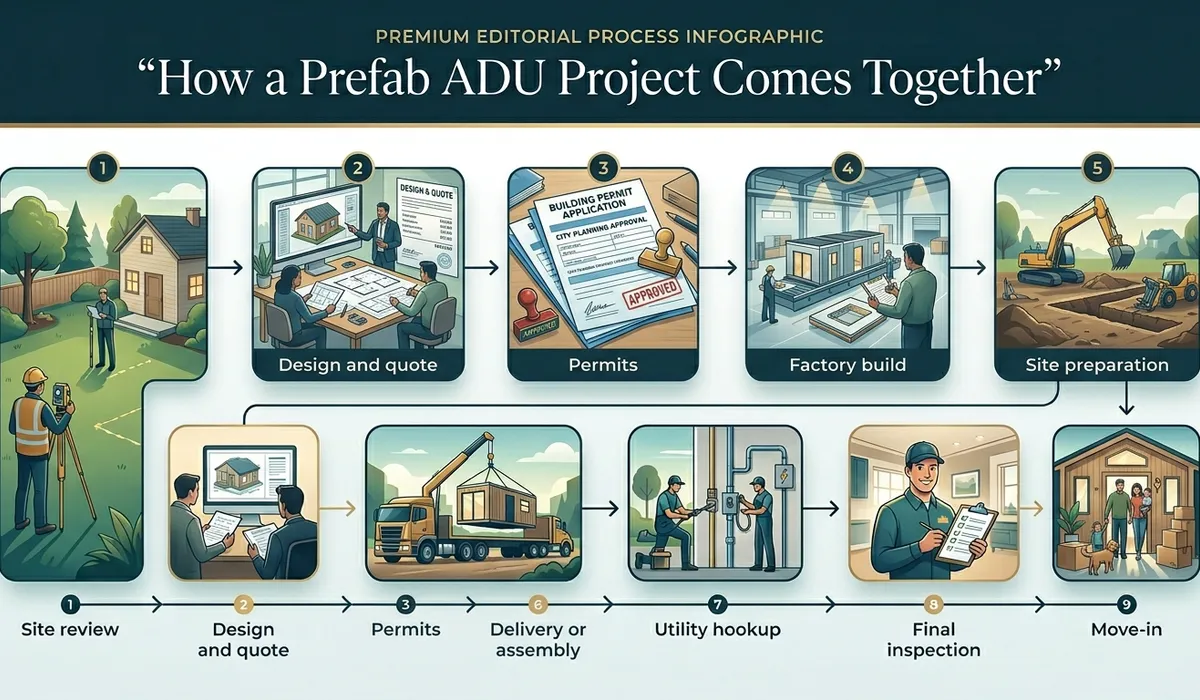
How Long Does a Prefab ADU Actually Take?
| Phase | Typical Duration | What Happens |
|---|---|---|
| Design & selection | 2–6 weeks | Choose company, model, finishes, sign contract |
| Permitting | 4–16 weeks | Plan review by your city — almost always the longest phase |
| Factory build | 6–16 weeks | Unit built off-site (can overlap with permitting and site prep) |
| Site preparation | 2–4 weeks | Grading, foundation, utility trenching |
| Delivery & installation | 1 day – 8 weeks | Crane set (modular) or on-site assembly (panelized/kit) |
| Utility hookup & finish | 2–6 weeks | Electrical, plumbing, final connections |
| Final inspection | 1–3 weeks | City inspection for certificate of occupancy |
| Total | 4–12 months | Permitting drives the timeline more than construction |
The overlap advantage
Here’s where prefab genuinely shines: while your unit is being built in the factory, site prep and foundation work happen simultaneously on your lot. In a stick-built project, everything happens sequentially. This parallel-path approach is why prefab total timelines can be shorter even when permitting takes just as long.
In California, state law requires cities to approve or deny ADU applications within 60 days of a complete submission (Cal. Gov. Code § 66317(a)). In states without mandated review periods, permitting can take 3–6+ months.
Frequently Asked Questions
How much does a prefab ADU actually cost?+
Are prefab ADUs cheaper than stick-built?+
Do prefab ADUs require a crane?+
Which prefab ADU companies are available nationwide?+
How long does a prefab ADU take?+
Can you finance a prefab ADU?+
What if my backyard access is only 5 feet wide?+
Is Boxabl a good ADU option?+
Do I need a permit for a prefab ADU?+
How We Ranked These Companies
We rank by best fit, not by who pays us the most.
| Criterion | Why It Matters | How We Verified |
|---|---|---|
| Pricing transparency | You need real numbers before committing | Checked published pricing against company websites |
| Service area clarity | A company outside your area is irrelevant | Verified via company sites and sales inquiries |
| Turnkey scope | “Turnkey” means different things to different companies | Reviewed inclusions/exclusions in published materials |
| Lot-fit flexibility | Not every prefab works on every lot | Assessed build type, delivery needs, customization options |
| Completed project evidence | Renders ≠ real installations | Looked for documented, photographed completed projects |
| Code compliance | Determines financing, appraisal, and permitting pathway | Verified which code standard each company builds to |
| Track record | Years in business and units completed | Checked company history and public records |
What we excluded and why: We removed companies from the ranked comparison where we couldn’t verify current operational status, consumer availability, or enough apples-to-apples data on total installed cost. That includes Boxabl (data insufficient), Connect Homes (operational concerns reported in 2025), and Plant Prefab (no longer accepting new consumer projects as of May 2023, per their website).
Update policy: Quarterly review. Row-level verification dates in every vendor card.
Full editorial standards and methodology →
What Your Property Could Become
Here’s what we see across ADU projects nationwide: the homeowner who adds a well-planned prefab ADU doesn’t just gain square footage. They gain options they didn’t have before.
A property with a second income stream. A family that can keep three generations close without losing anyone’s independence. A backyard that went from “that space we never use” to the smartest investment they ever made.
The industry is still maturing. Not every company delivers on its promises. Not every lot is a fit. The companies that are genuinely great at this are the first to tell you that. But the homeowners who approach this with clear eyes — who understand real costs, verify service areas, check lot compatibility, and compare quotes line by line — consistently end up saying the same thing:
“Why didn’t I do this two years ago?”
You’ve done the research. You know the real numbers. You know which companies serve your state and which don’t. The next step is the simplest one.
Last updated: March 31, 2026. Reviewed and updated quarterly. Report outdated information →
The Dwelling Index is an independent educational resource. We are not builders, lenders, or brokers. Full editorial standards →