ADU Financing for Retirees & Seniors
The Dwelling Index is an independent research resource covering ADU financing, costs, and regulations. We are not a lender, broker, or builder. This guide is educational and is not financial, tax, legal, Medicaid, or estate-planning advice.
Bottom line up front
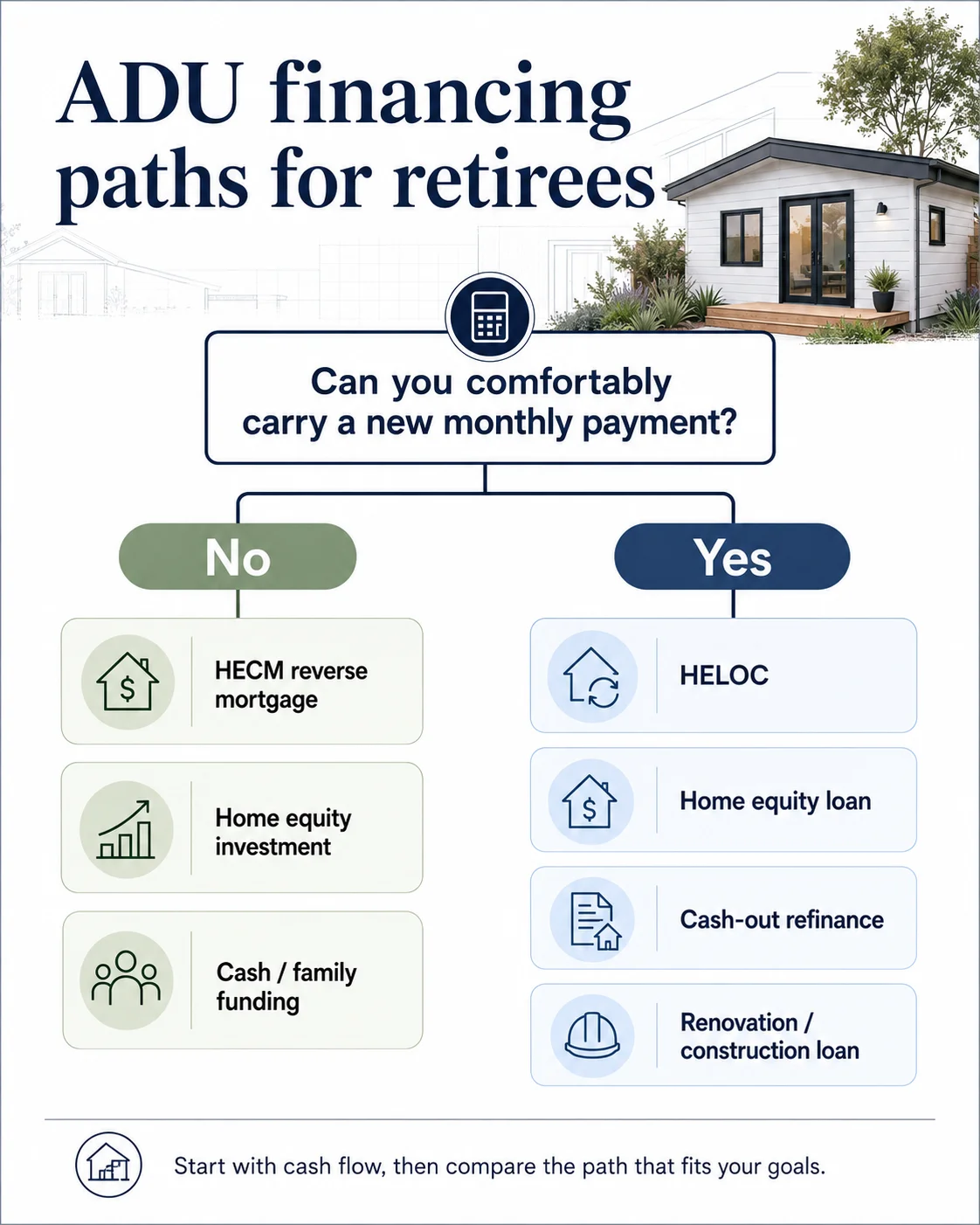
ADU financing for retirees comes down to one question: can you comfortably carry a new monthly payment? That single answer points you to the right path more reliably than your age, your equity, or your credit score.
If you’re 62 or older with significant equity and the answer is no, a HECM reverse mortgage can fund a build with no required monthly mortgage payment — but your loan balance grows and your heirs inherit less. If you can carry a payment, a HELOC, home equity loan, or renovation loan usually preserves more of your long-term wealth. If you’re counting on the ADU’s rent to help you qualify, know this up front: FHA, Fannie Mae, and Freddie Mac will each let so much rent count in specific transactions — and none of them allow it on a standard cash-out refinance.
One key number: an ADU typically costs $100–$300 per square foot — roughly $60,000 for a modest garage conversion to $400,000+ for a detached build in a high-cost coastal metro (HomeGuide; SelfStorage.com, 2026). Do this first: confirm your lot can legally support an ADU before you borrow against your home. Feasibility first, financing second.
Applies to: homeowners roughly 60+ (and adult children planning on a parent’s behalf). Last verified May 24, 2026.

We wrote this guide because nearly every “how to finance an ADU” page treats a 70-year-old on Social Security exactly like a 35-year-old with a paycheck. They are not the same borrower. A retiree is usually house-rich and cash-constrained — sitting on real equity but living on a fixed income — and the questions that actually keep them up at night (“Will this loan outlive me? Will my kids inherit debt? Will the rent count if I have no job?”) go almost entirely unanswered elsewhere.
This guide is deliberately built around those questions: what the rules actually say, where the traps are, and what to verify before you sign anything. We are not a lender, a broker, or a builder. We don’t have a product to sell you. That’s the whole point.
ADU Financing for Retirees: The Safety Matrix
There are seven realistic ways a retiree finances an ADU, and they split cleanly into two camps: paths that add a monthly payment and paths that don’t. For a fixed-income homeowner, monthly-payment tolerance is the master filter — equity, age, estate goals, and rental plans refine the choice from there. The matrix below pairs each path with its payment exposure, its best-fit retiree, its specific retiree risk, whether ADU rent can help you qualify, and the first professional to call.
| Financing path | Monthly payment? | Best-fit retiree | Main retiree risk | Can ADU rent help you qualify? | First professional to call |
|---|---|---|---|---|---|
| HECM reverse mortgage | No required mortgage payment (taxes, insurance, upkeep & occupancy still required) | 62+, strong equity, low or zero payment tolerance, plans to stay long-term | Loan balance grows; less equity for heirs; foreclosure risk if you fail to pay taxes/insurance or stop occupying the home | Yes — FHA permits ADU rent in the HECM financial assessment (ML 2023-17) | HUD-approved HECM counselor |
| HELOC | Yes — often variable | Retiree with reliable income (pension, Social Security, IRA draws) and strong equity who wants to keep a low first-mortgage rate | Payment shock if rates rise; payment jumps when the draw period ends; home is collateral | Indirectly (strengthens overall income picture) | Loan officer / your bank |
| Home equity loan | Yes — usually fixed | Retiree who wants a predictable lump sum and fixed payment | Payments start even if the build is delayed | Indirectly | Loan officer |
| Cash-out refinance | Yes — replaces your first mortgage | Retiree with a small, high-rate, or nearly paid-off mortgage | Can replace a low-rate first mortgage just to access cash; agency cash-out rules limit ADU rent | Generally no when relying on ADU rent (see rules below) | Loan officer / mortgage broker |
| Renovation / construction loan (HomeStyle, CHOICERenovation, 203(k)) | Yes | Retiree with enough income but not enough accessible equity today | More paperwork, permits, contractor oversight, inspections, draws | Yes, in defined cases | Renovation-loan specialist |
| Home equity investment (HEI) | No monthly payment | Equity-rich retiree who can’t qualify for debt and has a clear exit plan | Complex contract; may share your ADU-created value; forced sale/refi at term; limited states | No | Fee-only financial advisor + attorney |
| Cash / documented family funding | Usually none | Retiree with savings or willing family, where liquidity isn’t at risk | Drains reserves; gift/loan disputes; Medicaid look-back issues | N/A | CPA / elder-law attorney |
Terms, defined once.
A HECM (Home Equity Conversion Mortgage) is the only reverse mortgage insured by the federal government, available through FHA-approved lenders to homeowners 62+. A HELOC is a revolving line of credit secured by your home that you draw from as needed. A home equity loan is a fixed-rate, lump-sum second mortgage. A cash-out refinance replaces your existing mortgage with a larger one and hands you the difference in cash. A renovation loan qualifies against the home’s after-completion value and releases funds in inspected draws. A home equity investment (HEI) gives you a lump sum today in exchange for a share of your home’s future value — no monthly payment, but the company participates in your appreciation at settlement.
🟢 The cheapest mistake to avoid is financing a project your lot can’t legally support. See what you can build at your address — get your free ADU report. Feasibility first, financing second.
See What You Can Build → Get Your Free ADU ReportWhat is the safest way for a retiree to finance an ADU?
The safest path depends on your monthly-payment tolerance first, then your age, equity, current mortgage rate, the ADU’s purpose, and your estate concerns — there is no single answer that fits every retiree. For a 62+ homeowner who cannot absorb a new payment, a HECM evaluated with a HUD-approved counselor is often the realistic option. For a retiree who can comfortably handle a payment and wants to preserve long-term equity, a HELOC or home equity loan is usually simpler and less costly over time. Start with the constraint, not the product.
Most retirees who get into trouble do it by starting with whatever loan a salesperson is pushing, then bending their life to fit it. Reverse that. Here’s the sequence we’d use:
If you cannot add a monthly payment
Your realistic shortlist is short: a HECM reverse mortgage, a local deferred or forgivable program (rare, income-limited, usually tied to renting the unit affordably), documented family money, or cash. Every other path adds a payment you’ll service from a fixed income for years. We go deeper on these in our guide to ADU financing without monthly payments.
If you can handle a payment but want to protect a low first-mortgage rate
A HELOC or home equity loan sits behind your existing mortgage, so you keep the rate you locked in. A cash-out refinance would replace that whole first mortgage — a poor trade if your current rate is low.
If you need the ADU’s rent to make the numbers work
Verify before you build that the unit will be legal, rentable, appraisable, and eligible under your lender’s rental-income rules. An illegal or restricted ADU produces rent you can’t use to qualify and can’t always count on keeping.
If family is helping pay
Document everything. An undocumented “gift” that’s really a loan — or a loan that’s really a gift — can create tax problems for you and Medicaid look-back problems later.
If you’re not sure the ADU is even buildable
Stop here and confirm it. Zoning, setbacks, lot size, fire access, and utility capacity decide whether the project is legal at all — and that answer changes which financing makes sense.
A damaging admission, because you deserve the truth: no ADU financing path is automatically “safe” for a retiree. The wrong one can trade an ADU dream for payment stress, lost equity, family conflict, or — in the worst HECM case — foreclosure risk if property charges go unpaid. The good news: the right path, matched to your actual constraint and stress-tested before you sign, lets a great many retirees build successfully every year. The difference is almost always the quality of the decision made before the first application.
Sources: HUD HECM program rules; FHA Mortgagee Letter 2023-17; CFPB reverse-mortgage and home-equity-contract guidance. Verified May 24, 2026.
Which ADU financing option fits your retirement constraint?
Match the path to your binding constraint — payment tolerance, mortgage rate, equity level, family use, or rental dependence — rather than to the product with the best marketing. A retiree avoiding a payment compares HECM, deferred local programs, and cash/family funding. A retiree who can carry a payment compares HELOC, home equity loan, cash-out refinance, and renovation financing. A retiree counting on rent must first confirm the unit will be legal and eligible for rental-income underwriting.
| Your situation | Start by comparing | Skip / be cautious with | Why |
|---|---|---|---|
| 62+ and cannot add a monthly payment | HECM, deferred local program, cash/family | HELOC, home equity loan, cash-out, construction | Only the first group avoids a required mortgage payment |
| Have equity and can handle a payment | HELOC, home equity loan, renovation loan | HEI (usually more expensive than it looks) | Debt is typically cheaper than sharing appreciation if you can service it |
| Have a low-rate first mortgage you want to keep | HELOC, home equity loan | Cash-out refinance | Cash-out replaces your whole first mortgage |
| Low current equity, decent income | Renovation/construction loan (qualifies on after-build value) | HELOC/home equity loan (need existing equity) | Renovation loans underwrite the completed value |
| Need the ADU rent to qualify | Agency purchase / eligible-refi paths | Standard cash-out refinance | Agency rules allow rent only in specific transactions |
| Home is paid off | HECM, HELOC, home equity loan — widest menu | — | No first lien to protect or replace |
| Medicaid / long-term-care concern in the picture | Talk to elder-law before choosing anything | Large gifts or transfers without advice | Look-back and estate-recovery rules can apply |
Your free Retiree ADU Financing Path Finder
We built a short, plain-English path finder for exactly this decision. You answer a handful of questions — your age, your state, your home value and mortgage balance, whether you can carry a payment, what the ADU is for, and whether heirs or Medicaid are a concern — and it returns your two most realistic financing lanes, the single risk to verify before you commit, and which professional to call first. It runs your numbers, not a generic average — which is the whole point.
🟢 Find your retiree ADU financing path. Answer a few quick questions and get your free ADU report with your two likely lanes and what to verify before you apply.
Get Your Free ADU Report →Can retirees use a reverse mortgage (HECM) to build an ADU?
Yes — a homeowner 62 or older can take a HECM on their own primary residence and use the proceeds to help fund an ADU, but treat it as a reverse-mortgage decision, not an “ADU loan.” A HECM converts home equity into cash (lump sum, line of credit, or term payments) with no required monthly mortgage payment for as long as you live in the home as your principal residence and keep up property taxes, insurance, and maintenance. The 2026 HECM maximum claim amount is $1,249,125 — note this is the maximum value used in the HECM calculation, not a promise of how much cash any borrower can access.
This is the path retirees ask about most, and the one the internet explains worst. Let’s be precise.
Why a HECM appeals to retirees building an ADU
It removes the single biggest obstacle a fixed-income homeowner faces: the monthly payment. A retiree with a $700,000 home and a modest Social Security check often can’t get approved for a six-figure loan that carries a required payment — but a HECM has no required monthly mortgage payment and doesn’t qualify on employment income the way a traditional mortgage does. For a homeowner who wants to build a unit for income or for an adult child, that’s the relief that makes the project possible.
The HECM eligibility gates
You must be 62 or older, the home must be your principal residence, you need significant equity, and you must complete HUD-approved counseling before proceeding. FHA also runs a financial assessment to confirm you can keep paying property taxes, homeowner’s insurance, and upkeep — so it isn’t a no-questions-asked product. Under FHA Mortgagee Letter 2023-17 and HUD Handbook 4000.1 policy, a single-family one-unit property with a single ADU remains a one-unit property and is eligible, provided the ADU is subordinate to the main home and meets local zoning and safety codes.
The nuance almost every page gets wrong
A HECM does not “fund construction” the way a renovation loan does, releasing inspected draws against a build. It gives you a lump sum or line of credit drawn against the equity you already have — and you use that cash to build. Two practical consequences for retirees:
- You generally need the equity now. If your home’s value won’t support a draw large enough to build, the HECM alone won’t get the unit built. Some homeowners pair a HECM with other funds.
- The ADU’s eventual occupant can’t be the borrower on someone else’s land. An adult child can’t take a HECM to build a unit on a parent’s property — the 62+ homeowner takes the HECM on their own home and uses the proceeds to build (HousingWire, 2024). If you’re planning for a parent, the parent is the borrower.
Can ADU rent help in a HECM financial assessment?
Yes. FHA Mortgagee Letter 2023-17 updated the HECM financial assessment to permit ADU rental income in a borrower’s effective income. In practice, lenders may count up to 75% of the lesser of market rent (per the appraiser’s Form 1007/1000) or a lease amount when there’s a rental history — subject to caps on how much qualifying income can come from rent. Ask your lender exactly how they apply it; ADU market-rent reporting is permitted but not automatic.
What happens to my spouse if they’re not on the HECM?
This is the HECM question that quietly hurts couples, so handle it before closing, not after. If one spouse isn’t a co-borrower, confirm whether they qualify as an eligible non-borrowing spouse. A qualifying non-borrowing spouse may be able to remain in the home after the borrowing spouse dies or moves into a care facility for more than 12 consecutive months — but only if specific HUD criteria are met and maintained (the CFPB flags this as a major reverse-mortgage pitfall). If you’re married and only one of you will be on the loan, make this a written checklist item with your lender and counselor.
The honest negatives — read this twice
This is the decision point, so we won’t soften it:
- The balance grows, not shrinks. Interest and the FHA mortgage insurance premium accrue against your equity. The longer you hold it, the less equity remains.
- Your heirs inherit less — or must refinance. When you sell, move out, or pass away, the loan becomes due. Heirs who want to keep the home typically must refinance or pay the balance. It’s a non-recourse loan, so heirs won’t owe more than the home’s value — but the equity cushion shrinks over time.
- Foreclosure is possible if you stop paying property charges. The CFPB is explicit: fall behind on property taxes or homeowner’s insurance and a reverse mortgage can be foreclosed. “No payment” applies to the mortgage — not to taxes, insurance, and upkeep.
- It’s slow and paperwork-heavy, with a significant upfront mortgage insurance premium and a counseling requirement.
Who HECM fits best: homeowners 62+ with substantial equity who plan to stay long-term and want ADU rent to supplement retirement, or multigenerational families housing a parent. Who it fits worst: anyone likely to move within five to seven years, anyone whose heirs intend to keep the home without refinancing, and anyone who can’t reliably cover taxes and insurance.
What a HECM solves: monthly-payment pressure. What a HECM does not solve: property taxes, insurance, maintenance, occupancy rules, non-borrowing-spouse protection, family agreements, or whether your lot can legally support an ADU.
Sources: HUD HECM program page; FHA Mortgagee Letter 2023-17 (HECM financial assessment + one-unit-with-ADU property treatment); HUD 2026 loan-limit announcement ($1,249,125, effective Jan 1, 2026); CFPB reverse-mortgage property-charge and non-borrowing-spouse guidance; HousingWire (Jul 2024). Verified May 24, 2026.
Is a HELOC or home equity loan better for a retiree building an ADU?
A HELOC or home equity loan fits retirees who have strong equity and enough reliable income — pension, Social Security, annuity, or regular retirement-account withdrawals — to comfortably carry a new payment. The advantage over a HECM or HEI is that you keep your existing first mortgage and retain all of the ADU-created upside. The risk is payment stress: a HELOC usually carries a variable rate that can rise, and both products use your home as collateral.
This is the workhorse path for retirees who still have income coming in. The choice between the two comes down to how you want to borrow and how much rate risk you can stomach.
| Feature | HELOC | Home equity loan |
|---|---|---|
| How you receive funds | Revolving line; draw as construction bills arrive | Lump sum on day one |
| Rate | Usually variable | Usually fixed |
| Payment predictability | Changes with rates and balance | Same every month |
| Construction fit | Excellent — you pay interest only on what you’ve drawn | Good if you know the total cost up front |
| Main retiree risk | Payment shock if rates rise; payment jumps when the draw period ends | Payments start immediately, even if the build stalls |
| Best use | Phased build, uncertain final cost | Fixed-scope build, fixed budget |
| Warning sign | You’re relying on rates staying low to afford it | You’re borrowing the full sum months before you’ll spend it |
A practical retiree note on HELOCs: the draw period (often about 10 years, when you can borrow and make interest-mostly payments) is followed by a repayment period when payments step up substantially as principal comes due (CFPB). If you’ll be on a tighter fixed income a decade from now, model that step-up before you open the line.
The retiree payment stress test
Before you sign for any payment-based path, run your plan through the five pressures most likely to hit a fixed income. If two or more land in the right-hand column, look hard at the no-payment paths instead.
| Pressure | Comfortable | Warning sign |
|---|---|---|
| Income covering the payment | Pension/Social Security/annuity covers it with margin | You’d lean on IRA draws in a down market to make it |
| HELOC draw-period end | You can cover the higher repayment-period payment | The step-up would strain the budget |
| Taxes & insurance after the ADU | Reassessment/insurance bump already budgeted | You haven’t priced the increase |
| Vacancy buffer (if renting) | You can cover the payment through 2–3 vacant months | The payment only works with the unit always rented |
| ADU completion delay | You can carry the loan if the build runs late | A delayed rent start would break the budget |
🟦 Comparing the payment-based paths? (Affiliate disclosure applies.) You can explore mortgage-backed ADU financing options — HELOCs, home equity loans, cash-out refinances, and renovation loans — through our financing partner, Mortgage Research Center. We present these as education, not a lender ranking; approval, terms, and payment always depend on the lender’s underwriting of your situation.
Explore Mortgage-Backed ADU Financing OptionsSources: CFPB HELOC draw/repayment guidance; lender-neutral product mechanics. Verified May 24, 2026.
Should a retiree use a cash-out refinance to pay for an ADU?
A cash-out refinance can make sense when your existing mortgage is small, high-rate, or nearly paid off — and it’s usually a costly mistake when you hold a large, low-rate first mortgage. Because a cash-out refinance replaces your entire first mortgage with a bigger one, you’d give up your current rate on the whole balance just to extract cash for the ADU. For retirees who locked in low rates years ago, that trade rarely pencils.
There’s one retiree-specific trap almost no general guide flags clearly:
The cash-out / ADU-rent trap
If your plan is “build the ADU, rent it, then refinance using the rent to qualify,” the agency rules work against you on cash-out. FHA explicitly bars ADU rental income on cash-out refinances (ML 2023-17). Fannie Mae allows ADU rent only on purchase and limited cash-out — not standard cash-out. Freddie Mac allows it only on purchase and no-cash-out refinances. Confirm the exact transaction type with your loan officer before you build a plan around the rent.
A simple decision test before you refinance:
| Check | Cash-out may fit if… | Cash-out is likely a mistake if… |
|---|---|---|
| Current first-mortgage rate | Higher than today’s market | Lower than today’s market |
| Mortgage balance | Small or nearly paid off | Large |
| New blended payment | You can carry it on fixed income | It strains the budget |
| Rental-income dependence | You don’t need rent to qualify | You’re counting on rent (cash-out rules limit it) |
Sources: FHA Mortgagee Letter 2023-17 (cash-out ADU-rent ineligibility); Fannie Mae Selling Guide B3-3.8-01 (purchase/limited cash-out only); Freddie Mac ADU rental-income guidance (purchase/no-cash-out). Verified May 24, 2026.
Can renovation or construction loans work for retired homeowners?
Renovation and construction loans can be a strong fit when an ADU should add value but you don’t have enough accessible equity today, because these loans qualify against the home’s after-completion value rather than its current value. The tradeoff is complexity: expect plans, permits, approved contractors, inspections, draw schedules, and stricter income qualification than a simple HELOC. For a retiree, the contractor-oversight and draw structure is a feature, not a bug — it protects you from paying for unfinished work.
The three main agency programs each behave a little differently:
| Program | What it’s for | Key retiree-relevant detail |
|---|---|---|
| Fannie Mae HomeStyle Renovation | Buy or refinance and renovate, including adding or renovating an ADU | Renovation work must be completed within Fannie’s defined timeframe; qualifies on as-completed value |
| Freddie Mac CHOICERenovation | Constructing a new ADU or renovating an existing one; can refinance temporary ADU construction funding into a no-cash-out loan | Freddie’s ADU rules address legal / legal-nonconforming status, appraisal, rent analysis, and landlord education |
| FHA 203(k) | Rehab including adding an ADU attached to the existing structure, or renovating an existing attached or unattached ADU | Used with ML 2023-17’s rent rules; 203(k) is how FHA lets you count 50% of proposed rent on a new attached unit |
Why construction oversight matters more in retirement. A 35-year-old can absorb a blown construction budget by working another two years. A retiree often can’t. The draw-and-inspection structure — funds release only as verified work is completed — is exactly the discipline that protects a fixed-income homeowner from a contractor who wants everything up front. We consider that protection one of the underrated reasons these loans suit retirees with the income to qualify.
Fannie Mae confirms its Selling Guide products can be used to buy a home with an ADU, renovate an existing ADU, or add an ADU to an existing home — so “I have no ADU yet” is not, by itself, a disqualifier on the renovation path.
🟦 Renovation and construction loans reward homework. (Affiliate disclosure applies.) You can compare mortgage-backed renovation paths through Mortgage Research Center before you commit to a contractor schedule — useful for lining up the loan and the build timeline together.
Compare Renovation & Construction Loan PathsSources: Fannie Mae Accessory Dwelling Units product page and Selling Guide; Freddie Mac ADU fact sheet / CHOICERenovation; FHA Mortgagee Letter 2023-17 (203(k) eligible improvements + 50% proposed-rent rule). Verified May 24, 2026.
Can ADU rental income help a retired homeowner qualify for financing?
Sometimes — and this is the most important “yes, but” on the page for a fixed-income retiree, because it’s the rule that can turn a “you don’t earn enough” denial into an approval. As of 2023–2025, FHA, Fannie Mae, and Freddie Mac all permit ADU rental income to count toward qualifying income in specific situations, with caps and conditions. The catch retirees miss: the rules are narrow and documentation-heavy, and the ADU generally has to physically exist (you can use estimated market rent, but not for a unit that isn’t built).
Here’s the cross-agency comparison assembled from the primary sources:
| Program | ADU must exist? | How much rent counts | Cap on qualifying income from rent | Allowed transactions | Cannot use rent when… |
|---|---|---|---|---|---|
| FHA (ML 2023-17) | Existing ADU: yes. New attached ADU via 203(k): counts estimated rent | 75% of lesser of market rent or lease (existing); 50% of estimated (new via 203(k)) | 30% of total monthly income | Purchase, rate-and-term refi, 203(k); also HECM financial assessment | Cash-out refinance (explicitly ineligible) |
| Fannie Mae (SEL-2025-08, eff. Oct 8, 2025) | Yes — existing ADU on a one-unit principal residence; market rent via Form 1007 (no landlord history required) | Per standard rental-income rules | 30% of total qualifying income | Purchase and limited cash-out refinance only | Standard cash-out; rent from more than one ADU (only one counts) |
| Freddie Mac | Yes — existing ADU on a 1-unit primary residence; Form 1007 may stand in for a lease on a purchase | Lease-documented rent not to exceed 75% of the lease amount | 30% of total income used to qualify | Purchase and no-cash-out refinance | Illegal ADU; or appraisal/rent comps can’t support it |
Plain-English decoding of the table above
Fannie Mae’s October 2025 change is new and retiree-relevant. Effective October 8, 2025 (SEL-2025-08), Fannie allowed rental income from an existing ADU to count toward qualifying on a one-unit principal residence — capped at 30% of total qualifying income, limited to purchase and limited cash-out refinance, and from only one ADU even if multiple exist. Crucially for a retiree with no landlord history, the appraiser’s Form 1007 market-rent estimate can document the income — you don’t need an existing tenant or prior rental track record. The system change rolls into Desktop Underwriter version 12.1 in Q1 2026; lenders could apply it immediately on manually underwritten loans from October 8, 2025. For a retiree whose only weakness is low fixed income, this opened a second agency door beyond FHA.
Freddie Mac’s rules are similar but not identical. Freddie allows ADU rent on a 1-unit primary residence for purchase and no-cash-out refinances, counts up to 75% of the lease amount, caps qualifying ADU rent at 30% of total income, and requires a full appraisal (no automated appraisal waiver) with a rental analysis supporting market rent — including comparable rentals, at least one of which is itself a property with an ADU. Landlord education is required on purchases unless you have at least a year of landlord experience.
FHA’s rule extends to reverse mortgages. ML 2023-17 specifically updated the HECM financial assessment to allow ADU rent — which is why a HECM borrower can sometimes use projected rent to strengthen their file.
An illegal or restricted ADU helps you with nothing. If the unit isn’t legal, can’t be permitted, or can’t be appraised with comparable rents, none of these rules apply — a lender can’t count rent that doesn’t legally exist. This is the deepest reason to confirm buildability before you finance. See our companion guide on whether ADU rental income can help you qualify for worked examples.
🟢 Counting on the rent? Confirm the unit can legally be built and rented first. Check your ADU feasibility and get your free ADU report before you build a financing plan around income you can’t yet count.
Check ADU Feasibility → Get Your Free ReportSources: FHA Mortgagee Letter 2023-17 (hud.gov; NRMLA); Fannie Mae SEL-2025-08 and Selling Guide B3-3.8-01 / B3-3.1-08 / B2-3-04; Freddie Mac ADU fact sheet and Single-Family ADU guidance (Guide §5306.1). Verified May 24, 2026.
Are home equity investments a good ADU financing option for retirees?
A home equity investment (HEI) can look appealing because it requires no monthly payment, but retirees should treat it as a complex home-equity contract — not a simple loan substitute — and approach it with extra caution. With an HEI, a company gives you a lump sum today in exchange for a share of your home’s future value, settled when you sell, refinance, or hit the end of a term (commonly 10–30 years). The CFPB has flagged that these contracts can be expensive, hard to understand, and may force a sale if you can’t repay at term. We cover the mechanics in depth on our home equity investment for ADUs page.
We’re deliberately not placing an affiliate link in this section. On a national page aimed at a financially vulnerable audience, we’d rather give you neutral, complete information than a routed link.
Why ADUs create a special HEI problem
Some HEI contracts treat home improvements differently from market appreciation. If you use an HEI to build an ADU, you need to know — in writing, before signing — whether the value your ADU creates gets shared with the investor or stays entirely yours. Ask for that clause explicitly.
State availability is limited and changes
HEI providers operate in a subset of states, and the lists move. As of recent provider disclosures, Hometap’s published footprint spans states including AZ, CA, FL, IN, MI, MN, MO, NV, NJ, NY, OH, OR, PA, SC, UT, and VA; Point and Unlock publish their own current state lists and eligibility minimums. Verify your state on the provider’s own page on the day you apply — don’t rely on any third-party summary, including this one.
Why this matters more for seniors
Reverse mortgages carry mandatory HUD counseling; HEIs generally don’t. That gap is exactly why consumer-protection advocates watch HEIs marketed to equity-rich, fixed-income seniors. If you’re considering one, treat the absence of required counseling as a reason to add your own — a fee-only advisor and an attorney — not as a convenience.
Before signing any HEI: get the contract language on improvements, ADU value, rental use, trigger events, and repayment in front of a fee-only financial advisor and an attorney. If anyone pressures you to sign quickly, that pressure is itself the warning sign.
Sources: CFPB Issue Spotlight on home equity contracts; provider state-availability disclosures (verify live). Verified May 24, 2026.
What tax, Social Security, Medicaid, and estate issues should retirees check first?
ADU rental income isn’t just “extra cash” — for a retiree it touches taxes, Social Security treatment, Medicaid/long-term-care eligibility, and what your heirs inherit, and the wrong sequence of moves can cost more than the ADU earns. Run these checks before you choose financing, because they can change which path is even advisable. Rental income is generally reported on Schedule E (IRS Publication 527), and ordinary rent typically does not count as Social Security earnings — but the details have teeth.
| Issue | The rule, in plain English | Why it can change your financing decision |
|---|---|---|
| Income taxes | Residential rental income and expenses go on Schedule E; you may deduct expenses and depreciation (IRS Pub. 527) | Depreciation has a tail — it can be “recaptured” and taxed when you sell, so model the after-tax rent, not the gross |
| Social Security | Ordinary rent from rooms/apartments generally is not counted as Social Security earnings unless you provide significant personal services for the tenant’s convenience (SSA Handbook §1216) | A standard ADU rental usually won’t reduce or complicate benefits — but hotel-style services can flip it to self-employment |
| Medicaid | States must seek estate recovery for certain benefits for recipients age 55+ (nursing-facility, home- and community-based, and related services); rules are state-administered and vary widely (Medicaid.gov) | Rental income can affect income-based eligibility, and the home’s value can be exposed to recovery — talk to elder-law before building or transferring anything |
| Heirs & spouse | A HECM reduces what heirs inherit; family money needs documentation; a non-borrowing spouse needs HECM protection confirmed | Determines whether a no-payment path quietly costs your family later |
The Medicaid point is the one that quietly hurts families, so we’ll say it plainly: if you or a spouse may need Medicaid or long-term care, talk to an elder-law attorney before funding the ADU, taking a reverse mortgage, or transferring any property interest. Don’t act on a forum post; this is genuinely individual.
Sources: IRS Publication 527 (residential rental property / Schedule E); SSA Handbook §1216 (rental income treatment); Medicaid.gov (estate recovery, age-55+ provisions). Verified May 24, 2026.
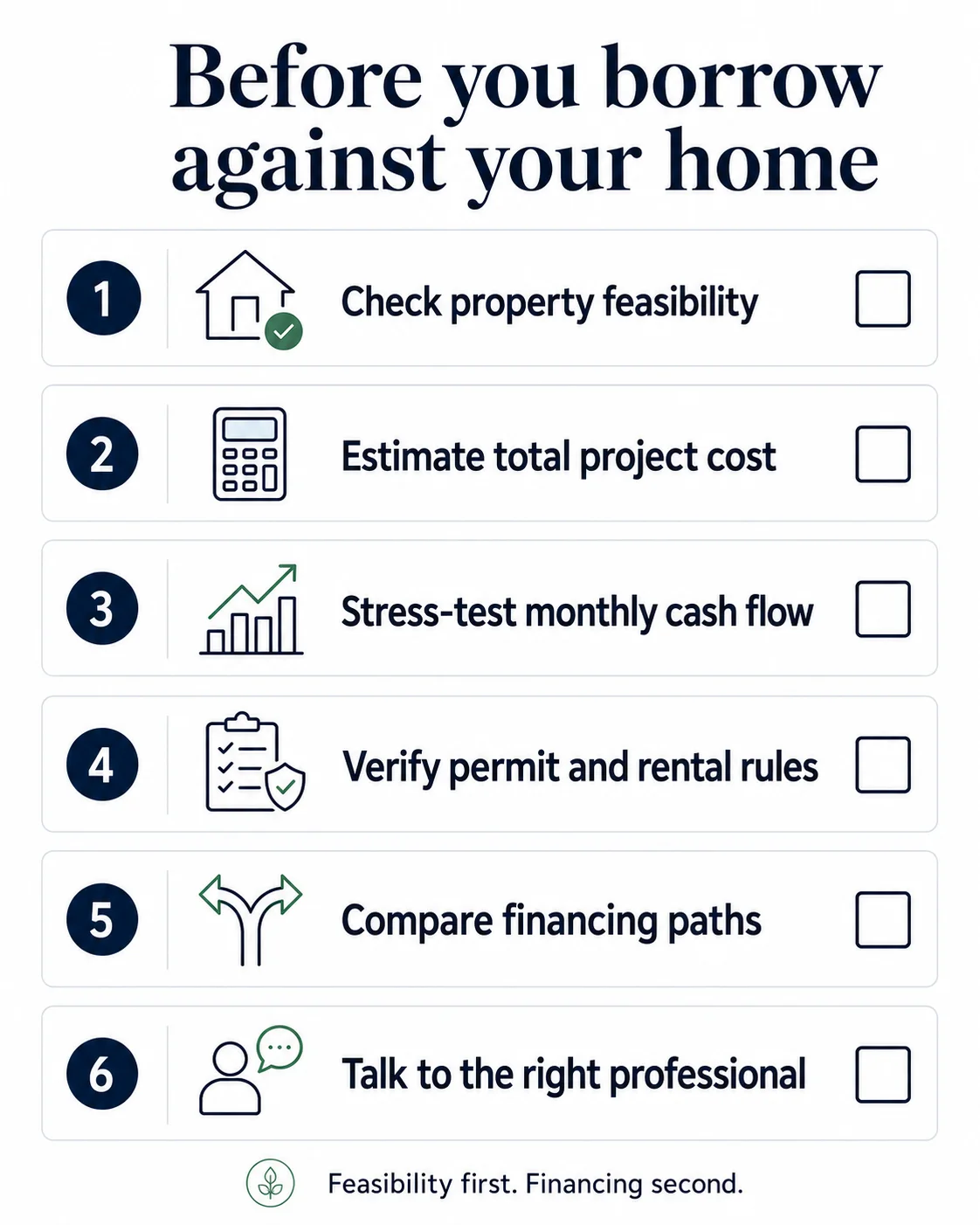
What should retirees verify before borrowing against their home?
Before you apply for any financing, verify that the ADU is legal, buildable, insurable, rentable (if rent matters), and survivable if costs rise or rent arrives late — because the worst retiree ADU mistake is borrowing first and discovering the dealbreaker second. Zoning, setbacks, utility capacity, appraisal support, and insurance can each independently kill or reshape a project. Checking costs a few hours; skipping can cost the house.
Because local rules are address-specific, this is a checklist to run for your property — not a set of national rules. The fastest way to clear most of it at once is an address-level feasibility check.
| What to verify | Why it matters for a retiree | Who confirms it |
|---|---|---|
| ADU is allowed at your address | If it’s not permitted, no financing helps | City/county planning; our feasibility check |
| Type allowed (detached / attached / garage conversion / JADU) | Type drives cost and which loan fits | Local planning department |
| Size, setbacks, parking limits | Caps what you can build and rent | Local zoning code |
| Long-term rental allowed | Determines if rent can support the loan | Local ordinance |
| Short-term rental allowed or banned | Many cities restrict STRs | Local ordinance |
| Utility connection cost | New gas, sewer, water, or electrical extensions can add roughly $5,000–$30,000 depending on distance and complexity — and it’s rarely in a builder’s base quote | Builder + utility |
| Fire / access requirements | High-fire zones add cost and design rules | Fire authority |
| Property-tax reassessment risk | A new unit can raise your assessment | County assessor (rules vary by state) |
| Insurance increase | Adds to monthly carrying cost | Your insurer |
| HOA restrictions | Some HOAs limit or ban ADUs | Your HOA |
| Contractor license, bond, insurance | Protects a fixed income from a bad build | State license board |
| Payment stress test at higher rates / vacancy | Confirms you can survive a bad year | You + a planner |
| HECM counseling (if applicable) | Required, and clarifying | HUD-approved counselor |
| CPA review (if renting) | Tax and depreciation planning | CPA |
| Elder-law review (if Medicaid/transfers) | Protects benefits and estate | Elder-law attorney |
A few definitions for that checklist: a setback is the minimum distance your ADU must sit from property lines; site work is everything that prepares the ground (grading, foundation, utility trenching) and is the line item most likely to blow a budget on a tricky lot; a JADU (junior ADU) is a small unit, typically up to 500 square feet, created within the existing walls of the main house. Ministerial approval — the standard in ADU-friendly states like California — means a city must approve a compliant application without a discretionary hearing, which shortens timelines but doesn’t remove the building-code review.
🟢 Start with buildability, not borrowing. A safer loan decision begins with knowing what your property can actually support. Check your ADU feasibility and get your free ADU report before you borrow. (For costs by ADU type, see how much an ADU costs.)
Check ADU Feasibility → Get Your Free ADU ReportSources: state and local ADU ordinances (verify by jurisdiction); county assessor reassessment rules (state-specific); SelfStorage.com 2026 ADU cost compilation (utility extension range). Verified May 24, 2026.
What if the ADU is for family, a caregiver, or rental income?
The ADU’s purpose changes the financing math: a family or caregiver unit must work with no rent at all, while a rental unit can support the loan — but only if local rules allow the rental use you’re planning and the budget survives vacancy, repairs, taxes, and insurance. Decide the purpose first, because it determines whether you can lean on rental income to qualify or must carry the financing entirely on your own resources.
| ADU purpose | Rent assumed? | How it changes underwriting | Strongest financing lanes | First professional to call |
|---|---|---|---|---|
| Adult child / family member | Usually no | No rental income to qualify with — loan stands on your income and equity | HECM, family funding, HELOC/home equity loan (if income supports it) | Loan officer / CPA |
| Caregiver / aging-in-place | No | Frame as cost avoidance vs. assisted living, not income | HECM, cash/family, home equity loan | HUD counselor / elder-law |
| Rental income | Yes | Agency rent rules apply; must be legal & appraisable | Purchase/eligible-refi paths, renovation loans | Loan officer + CPA |
| Mixed: family now, rental later | Eventually | Build to the stricter (rental) standard now | Renovation loan, HELOC | Loan officer + planner |

A note on the caregiver case: assisted living commonly runs into the thousands of dollars per month nationally (A Place for Mom, 2026), so a one-time ADU build can pencil even with no rent when it keeps a parent close and out of paid care. We cover the family angle — including the Medicaid and SSI rules that can quietly cost a parent’s benefits — in our guide to financing an ADU for aging parents.
For the mixed-use plan, build to the stricter of the two rule sets so you don’t disqualify a future rental by building only to “family” standards now.
How should a retiree choose the next step?
Use a four-step sequence — verify buildability, eliminate unsafe paths, gather documents, then talk to the right professional — and resist starting with whichever lender quotes fastest. Retirees who start with the path that survives their income, family goals, local rules, and a bad-year stress test almost always end up calmer and better-funded than those who start with a sales pitch.
- 1
Confirm what you can build
Address-level feasibility first. This single step reshapes every financing decision downstream.
- 2
Eliminate unsafe financing paths
Use the matrix and the path finder to cross off anything that fails your payment tolerance, your estate goals, or your rental dependence.
- 3
Gather the right documents
Home value/equity, current mortgage statement, income (Social Security/pension/IRA), credit, and — if renting — any lease or market-rent data.
- 4
Talk to the right professional
A HUD counselor for HECM, a loan officer for HELOC/refi, a renovation specialist for construction loans, and a CPA or elder-law attorney where taxes or benefits are in play.
🟢 Primary next step — see what’s possible at your address and get your free ADU report. Feasibility before financing, every time.
See What You Can Build → Get Your Free ADU Report in 60 Seconds🟦 Comparing payment-based loans? Explore mortgage-backed ADU financing options through Mortgage Research Center. (Affiliate disclosure applies; education, not a lender ranking.)
Explore Mortgage-Backed ADU Financing📩 Want it all in one place? Download the free ADU Starter Kit — the retiree pre-borrowing checklist, the lender questions to ask, and a pre-construction planning worksheet.
Download the Free ADU Starter KitNot sure where to start? See what’s possible at your address — get your free ADU report in 60 seconds.
What we verified for this guide
We built this page from official housing, lending, tax, consumer-protection, and benefit sources first, then used homeowner-forum research only to understand the questions and language retirees actually use — never as proof for any rule. Re-verify dated and state-specific items before acting.
| Topic | Source type | Last verified | Refresh cadence |
|---|---|---|---|
| HECM eligibility, obligations, foreclosure & non-borrowing-spouse risk | HUD, FTC, CFPB | May 24, 2026 | Quarterly |
| 2026 HECM maximum claim amount ($1,249,125) | HUD loan-limit announcement | May 24, 2026 | Annual (Dec/Jan) |
| FHA ADU rental-income rules (75% / 50% / 30% cap / cash-out ineligible / HECM) | FHA Mortgagee Letter 2023-17 (hud.gov, NRMLA) | May 24, 2026 | Quarterly |
| Fannie Mae ADU rental-income rule (existing ADU, 30% cap, SEL-2025-08, DU 12.1) | Fannie Mae Selling Guide B3-3.8-01 | May 24, 2026 | Quarterly |
| Freddie Mac ADU rental-income rules (purchase/no-cash-out, 75%, 30%, appraisal comps) | Freddie Mac ADU fact sheet / Guide §5306.1 | May 24, 2026 | Quarterly |
| Home equity investment (HEI) risks & state availability | CFPB; provider pages | May 24, 2026 | Monthly/quarterly |
| Rental tax reporting (Schedule E) | IRS Publication 527 | May 24, 2026 | Annual |
| Social Security rental-income treatment | SSA Handbook §1216 | May 24, 2026 | Annual |
| Medicaid estate recovery (age 55+) | Medicaid.gov | May 24, 2026 | Annual / state-specific |
| ADU & utility cost ranges | HomeGuide; SelfStorage.com (2026) | May 24, 2026 | Quarterly |
Methodology
The Dwelling Index is an independent research resource covering ADU financing, costs, and regulations. We created this guide to help retired homeowners compare financing paths before they borrow against their home. We prioritized official government, GSE (Fannie Mae/Freddie Mac), and consumer-protection sources for every rule, and used competitor and forum research only to understand intent, language, and objections.
We separated verified facts from editorial conclusions. Program requirements, tax treatment, Social Security treatment, HECM rules, and ADU rental-income rules are sourced to official or primary sources. Conclusions such as “safer for retirees who cannot add a payment” are editorial judgments based on those verified facts — not promises of approval or specific outcomes. We do not rank lenders, we do not accept payment to influence recommendations, and we disclose our affiliate relationships openly.
By the Dwelling Index Editorial Team. The Dwelling Index is an independent research resource covering ADU financing, costs, and regulations.
Frequently asked questions
- Can a retired person get financing for an ADU?
- Yes. Retired homeowners can use home equity (HELOC or home equity loan), a HECM reverse mortgage, renovation/construction financing, a cash-out refinance, cash, or documented family funding — depending on equity, income, age, credit, the property, and local ADU eligibility. The safest path depends largely on whether the retiree can comfortably carry a monthly payment.
- Can I use a reverse mortgage to build an ADU?
- Possibly. A homeowner 62 or older can take a HECM on their own principal residence and use the proceeds toward an ADU, provided they meet HECM requirements and keep up property taxes, insurance, maintenance, and occupancy. The 2026 HECM maximum claim amount is $1,249,125 (the value used in the calculation, not guaranteed proceeds). Complete HUD-approved counseling before deciding.
- What happens to my spouse if they're not on the reverse mortgage?
- If a spouse isn't a co-borrower, confirm before closing whether they qualify as an eligible non-borrowing spouse. A qualifying non-borrowing spouse may be able to remain in the home after the borrowing spouse dies or moves into a care facility for more than 12 consecutive months — but only if specific HUD criteria are met and maintained. The CFPB flags this as a major reverse-mortgage pitfall, so make it a written checklist item with your lender and counselor.
- Is a HECM better than a HELOC for retirees?
- Not automatically. A HECM removes monthly-payment pressure but reduces home equity over time and leaves less for heirs. A HELOC preserves more long-term upside but adds payment risk and uses your home as collateral. The better fit depends on income, equity, age, mortgage balance, heirs, and your tolerance for changing payments.
- Can ADU rent help me qualify for financing?
- Sometimes. FHA (ML 2023-17), Fannie Mae (SEL-2025-08), and Freddie Mac all allow ADU rental income in specific situations. FHA counts up to 75% of market/lease rent on an existing ADU (50% of estimated rent for a new attached unit via 203(k)), capped at 30% of total monthly income, and it's ineligible on an FHA cash-out refinance. Fannie Mae allows rent from an existing ADU on a one-unit principal residence (purchase or limited cash-out only), capped at 30% of qualifying income. Freddie Mac allows it on purchase and no-cash-out refinances, counts up to 75% of the lease amount, and caps it at 30%.
- Does ADU rent count against Social Security?
- Generally no. The SSA treats ordinary rent from rooms or apartments as investment income, not Social Security earnings — unless you provide significant personal services for the tenant's convenience. Tax reporting is separate, so confirm with a CPA how ADU rental income affects your return.
- Will an ADU affect Medicaid?
- It can, depending on your state, household, ownership, rental income, transfers, and long-term-care situation. Medicaid estate recovery is state-administered and can apply to certain benefits for people age 55 and older. If Medicaid or long-term care may be in your future, talk to an elder-law attorney before funding the ADU or transferring any property interest.
- Should retirees use retirement accounts to build an ADU?
- Treat this as a last-resort question for a CPA or fiduciary financial planner, not a default path. Retirement-account withdrawals or loans can trigger taxes, penalties, lost investment growth, and liquidity problems that outweigh the ADU's benefit.
- What's the biggest ADU financing mistake retirees make?
- Borrowing before verifying buildability, total cost, payment stress, taxes, insurance, rental rules, and family or estate impact. The right order is feasibility first, financing second.
Related guides
- ADU financing without monthly payments — deeper look at HECM, HEI, and deferred programs
- Financing an ADU for aging parents — when the adult child is paying, not the parent
- Can ADU rental income help you qualify? — worked examples across all three agencies
- Home equity investment for ADUs — HEI mechanics, provider comparison, retiree risks
- How much does an ADU cost? — costs by type, region, and build path
- ADU financing overview — all financing paths for all homeowner types