Prefab ADU Permit Process: How Approval Works Before You Buy
By the Dwelling Index Editorial Team · Last updated: · Last verified: · Reviewed against HUD manufactured-housing programs, California Gov. Code § 66317, SB 543, AB 1332, AB 462, and official municipal permit pages · Editorial standards · Affiliate disclosure · ~35 min read
The Dwelling Index is an independent research resource covering ADU financing, costs, and regulations. We are not a lender, broker, appraiser, builder, or zoning authority, and nothing here is financial, legal, tax, or construction advice.
A note on independence: The Dwelling Index is reader-supported and we may earn a commission when you use some of our links (see the disclosure before the financing section). Our editorial recommendations are based on independent research and are never influenced by compensation.
Prefab ADU permit reality in 30 seconds
Marketing language and permit reality are not the same thing. “Permit-ready,” “modular,” “pre-approved,” and “installed in days” each describe one slice of the project — none of them mean your city has approved an ADU on your specific lot. Use this table to translate the pitch before you read the fine print.
| What the seller says | What it usually means | What you still have to verify locally |
|---|---|---|
| “Permit-ready” | The company may have engineered plans or a stock design | A complete local application: site plan, zoning/ADU review, foundation, utility connections, trade permits, inspections, and occupancy approval |
| “Modular / factory-built” | Built to the building code in factory modules, state-inspected at the plant | Local installation, foundation, utilities, setbacks, and final inspection still apply |
| “HUD manufactured” | Built to the federal HUD code on a permanent chassis | Whether your jurisdiction allows a manufactured home as an ADU, plus permanent-foundation, installation, and utility approvals |
| “Pre-approved plan” | A city already reviewed part of the structural/life-safety plan | Zoning, setbacks, utilities, hazard overlays, fees, and trade permits are still on you |
| “Tiny home” | Could mean foundation-built, a kit, a park model, or a unit on wheels | Many cities will not permit a tiny home on wheels or RV as a legal dwelling ADU |
| “Installed in days” | The physical set (crane day) can be fast | Plan review, site work, utilities, inspections, and occupancy can still take weeks to months |
Sources: U.S. HUD manufactured-housing labels; City of San Diego ADU/JADU; City of Seattle SDCI; City and County of Denver ADU permits. All verified May 2026.
A few definitions before we go further, because the whole process hinges on them. An ADU (accessory dwelling unit) is a second, smaller, self-contained home on a lot that already has a primary residence. A JADU (junior ADU) is a smaller unit (typically up to 500 sq ft) carved out of the existing house. A DADU is simply a detached ADU. Setbacks are the minimum distances a structure must sit from property lines. FAR (floor-area ratio) and lot coverage cap how much building your lot can hold. Plan check (or plan review) is the city’s line-by-line review of your drawings. A utility lateral is the pipe or line connecting your unit to the public sewer, water, or power. Site work is everything done on your ground — grading, foundation, trenching. Ministerial approval means the city must approve a compliant application by objective standards, without a discretionary hearing.
Do prefab ADUs need a permit?
Yes. A prefab ADU almost always needs local permits before it can be legally installed and occupied. Factory construction can shrink on-site build time, but it does not remove zoning review, building-permit review, foundation approval, utility permits, mechanical/electrical/plumbing (MEP) permits, inspections, or the final certificate of occupancy. A prefab unit is not approved because it exists; it is approved when the local jurisdiction accepts the unit’s documents, approves the site plan, issues the permits, inspects the installation, and grants occupancy.
We say “almost always” deliberately. The only common prefab products that don’t go through a dwelling permit are the ones that also can’t legally be lived in as an ADU — recreational vehicles, park models, and units on wheels titled like RVs. The City of San Diego’s accessory-unit bulletin states that a building permit is required for ADUs and JADUs, with no exemptions (City of San Diego, Information Bulletin 400, verified May 2026). Boston requires a long-form building permit for an ADU, listing the supporting documents — contractor agreement, proof of workers’ compensation, and site, plot, and floor plans — before work can begin (City of Boston, verified May 2026).
Why “prefab” does not mean “permit-free”
The confusion is understandable. A modular factory does handle a lot: it builds the walls, runs much of the wiring and plumbing, and gets the box inspected before it ships. But the factory is solving a different question than your city. The factory answers “was this unit built to an accepted construction standard?” Your local building department answers “can this unit legally be installed and occupied on this specific parcel?” Those are separate approvals, controlled by different authorities, and you need both. The factory’s work never speaks to your setbacks, your soil, your sewer capacity, your fire-separation distance, or your zoning.
The permits and approvals a prefab ADU usually triggers
Here is the typical stack. The exact mix depends on your jurisdiction and whether your unit is fully modular (more done in the factory) or a kit (more done on site).
| Approval | What it checks | Applies to prefab? |
|---|---|---|
| Zoning / ADU eligibility | Whether the lot can legally have an ADU at all | Yes |
| Building permit | Code compliance for the structure and its installation | Yes |
| Foundation permit / review | Footings, slab, piers, anchoring, and soils | Yes |
| Electrical permit | Service, panel, wiring, fixtures | Usually |
| Plumbing permit | Water, sewer, drainage, fixtures | Usually |
| Mechanical permit | HVAC, ventilation, exhaust | Usually |
| Utility approval | Meter, sewer lateral, water, electrical service | Often |
| Fire / flood / coastal / septic review | Special site hazards and constraints | Sometimes |
| Inspections | Field verification during and after installation | Yes |
| Certificate of occupancy / use | Legal occupancy or use of the finished unit | Often |
The takeaway for a buyer: the “prefab” decision changes how much of this happens in a factory versus on your lot. It does not change whether it happens.
First, what kind of prefab is it? This one fact decides everything
“Prefab” is an umbrella over several legally distinct products — modular/factory-built, HUD-code manufactured, panelized, kit, park model, and tiny-home-on-wheels — and each one creates a different permit path. A modular unit is built to the same building code as a site-built home and usually has the cleanest ADU path. A tiny home on wheels is usually titled like a recreational vehicle and, in most jurisdictions, cannot become a permanent ADU through the standard dwelling-permit path. The single most expensive mistake in this process is buying for the sticker price without first confirming the class.
| Prefab class | Built to which code | Who inspects the build | Certification it carries | Can it be a permanent ADU? | What your local department still permits & inspects |
|---|---|---|---|---|---|
| Modular / factory-built | State-adopted building code (IBC/IRC) — the same code as site-built | A state modular program or a state-approved third-party agency, at the factory | State “insignia” / approval label (e.g., HCD insignia in CA; Dept. of State insignia in NY) | Yes — usually the cleanest path; once set on a permanent foundation it becomes real property like a site-built home | Zoning/ADU approval, foundation, utility connections, setbacks, set/crane day, and the final inspection + certificate of occupancy |
| HUD-code manufactured | Federal HUD Code (24 CFR Part 3280); permanent steel chassis | Federal HUD process at the factory; an installer working to approved installation rules on site | Red HUD certification label (outside) + a data plate (inside) | Sometimes — allowed as an ADU in many places, often with limits (size caps, permanent foundation, appearance rules); some jurisdictions restrict it | Zoning eligibility, permanent foundation, installation permit, utilities, final inspection / CoO |
| Panelized / SIPs | State building code, but assembled and inspected on site | Your local building department, on site (treated like site-built) | Usually none from a state program; components may carry product listings | Yes — but expect a full local inspection cycle; the prefab speed edge shrinks | Full local permit + phased inspections (foundation, framing, MEP, insulation, final), zoning, utilities, CoO |
| Kit home | State building code; assembled on site from a shipped package | Your local building department, on site | None from a state program; engineering varies by kit | Yes — but it permits like a small custom build; plan review can be heavy if engineering is thin | Full plan review + complete inspection sequence, zoning, utilities, CoO |
| Tiny home on a foundation | State building code (and often the IRC Appendix for tiny houses) | Local building department, on site | None from a state program | Yes — treated like a very small site-built ADU | Full local permit, foundation, utilities, inspections, CoO |
| Park model / tiny home on wheels (THOW) | ANSI A119.5 (Park Model RV, ≤400 sq ft gross trailer area) or no building code | Not building-code-inspected as a dwelling; titled/registered like an RV | RV / Park Model title — not a HUD label or state insignia | Rarely — most cities won’t permit an RV/THOW as a permanent ADU through the standard path; a few have movable-tiny-home ordinances (the exception) | If a special local ordinance allows it, that pathway; otherwise it cannot be permitted as a permanent dwelling |
Sources: U.S. HUD — manufactured-home labels & data plate and HUD Office of Manufactured Housing Programs; California HCD; New York Dept. of State — factory-manufactured/modular; RVIA — standards & Park Model RVs; City of Concord, CA. Rules vary by jurisdiction — confirm locally. All verified May 2026.
Three things to underline from that table.
First, a state insignia is a factory pass, not an occupancy permit. It tells your city the box meets the building code; it says nothing about your foundation, utilities, or setbacks. Concord, California’s guidance makes the distinction cleanly: manufactured homes carry a HUD label, factory-built/modular homes carry an HCD insignia, and either way the city still requires a building permit before installation (City of Concord, verified May 2026).
Second, the manufactured-home path is real but conditional. Under California’s ADU law a manufactured home on a permanent foundation can serve as an ADU, but local rules govern the details. San Bernardino County’s February 2026 manufactured-home guide allows a manufactured home as an ADU if it is under 1,200 sq ft and smaller than the main house, and requires permits and approvals before setup or any site disturbance (San Bernardino County Land Use Services, verified May 2026). Size caps and foundation rules differ city to city.
Third, the wheels are the dividing line. If a unit is built to the federal HUD code or a state building code and lands on a permanent foundation, you have a path. If it’s titled as an RV or Park Model, you usually don’t — regardless of how “home-like” it looks. The exception is a city with a specific movable-tiny-home ordinance, and that special pathway has to be confirmed in writing before you buy.
For a deeper dive on your exact product, see our guides on the manufactured-home ADU path, steel-frame modular ADUs and the HUD-vs-IRC fork, portable and expandable units, and container-home ADUs.
What the factory handles vs. what your city handles
The factory inspection and state insignia (or HUD label) cover the unit itself; your local building department covers the site, the installation, and legal occupancy. California’s housing agency states the rule plainly: factory-built housing is inspected at the factory before the insignia is applied, and installation of that housing is then subject to inspection by the local building department (California HCD, verified May 2026). Treating the factory certification as “approval” is the single most common — and most expensive — prefab permitting misconception.
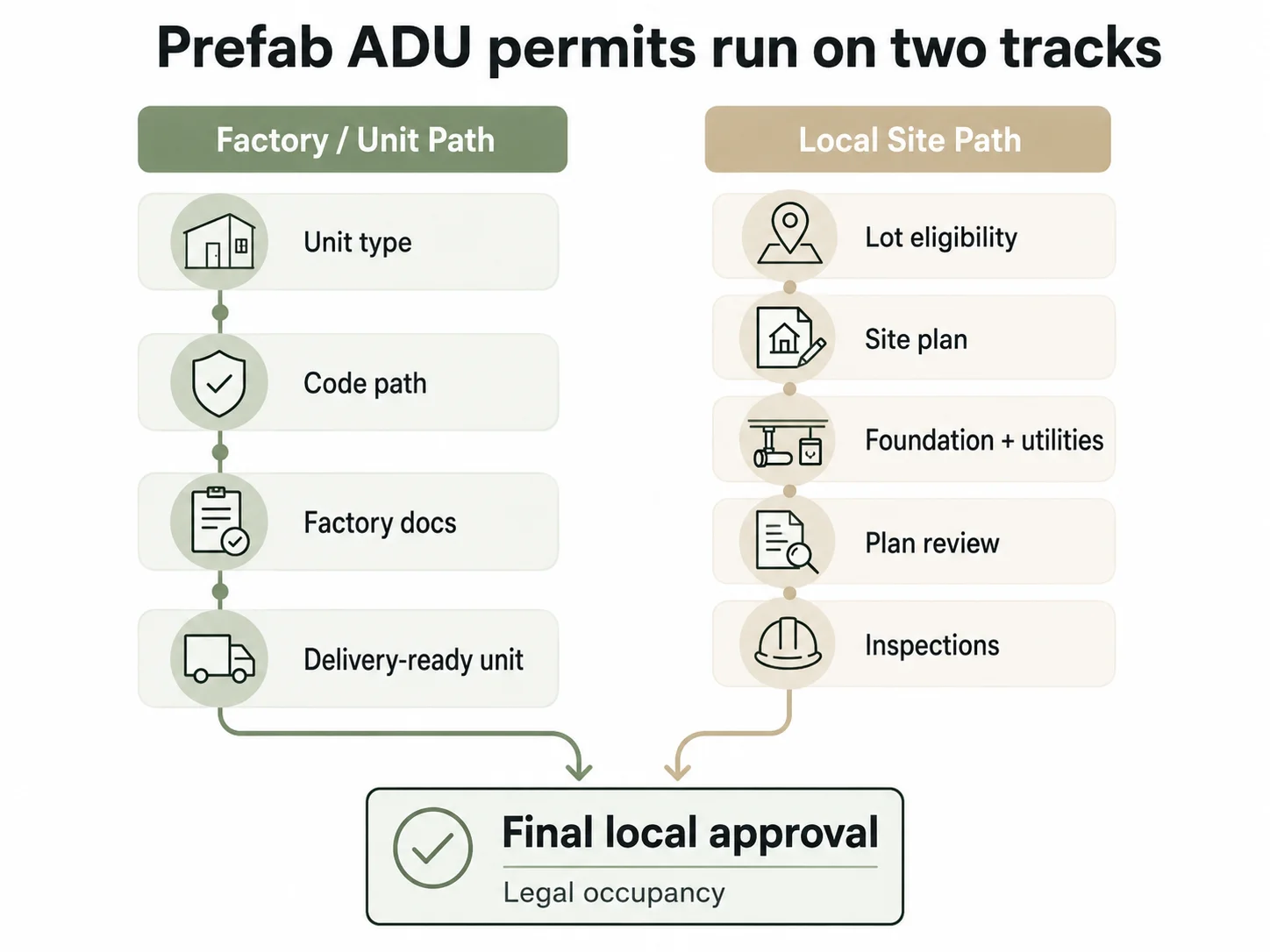
| The factory / state covers (in the plant) | Your city or county covers (on your lot) |
|---|---|
| Structural framing built to code | Whether your lot may legally have an ADU (zoning) |
| In-plant electrical, plumbing, mechanical rough-in | Site plan, setbacks, height, lot coverage / FAR |
| Insulation and energy compliance of the box | Foundation design and inspection (soils, anchoring) |
| The state insignia or red HUD label | Utility connections — sewer lateral, water, power |
| A factory quality-assurance record | Fire-separation, flood, coastal, or wildfire (WUI) review |
| The set/crane day and tie-in inspection | |
| Final inspection + certificate of occupancy — the only approval that lets you legally move in |
What a “state insignia” actually means, in plain English
A modular insignia is a numbered label affixed to the unit at the factory once a state’s modular program (or a state-approved third-party agency) has inspected it and confirmed it meets that state’s building code. New York’s regulation requires the insignia to be attached before the unit leaves the factory (New York Dept. of State, verified May 2026). The label is the state vouching for the box. It does not replace your local site permits — site-related work (foundation, utilities, set, inspections) falls under your local building department.
HUD-code installation: who’s actually licensed
For HUD-code manufactured homes, installation must follow the manufacturer’s approved installation instructions plus the rules of either HUD’s installation program (in HUD-administered states) or your state’s own installation program. HUD licenses installers only in HUD-administered states; other states run their own qualifying-installer and inspection programs (HUD Office of Manufactured Housing Programs, verified May 2026). Don’t assume a single national “HUD installer” rule — confirm whether your state runs its own program.
Whether your state runs a “modular program” — and why it matters
Most states run some form of modular (industrialized-building) program that inspects factory-built homes and issues an insignia; a few participate in reciprocity compacts that let a unit certified in one state be accepted in another with less duplicate review. Before you buy, confirm your state’s administrator, the accepted inspection agency, and the insignia rules with your state building agency or the Modular Building Institute’s state-administrator directory (verified May 2026). In a state with a clear modular program, the factory-to-state piece is well-defined and fast — which is exactly why your local site track becomes the variable that controls your calendar.
What is the 7-step prefab ADU permit process?
The typical prefab ADU permit process is seven steps: confirm lot eligibility, confirm the unit’s legal code path, assemble the permit packet, submit the application, respond to plan-check corrections, complete inspections, and obtain final occupancy. The defining feature versus site-built is parallelism — the factory can build the unit while your contractor preps the lot — but the two tracks must converge on set day and again at the final inspection.
Why prefab can be faster: the two tracks run at the same time — the factory builds the box while your lot gets prepped. Site-built can’t parallelize like that. Why it isn’t automatically faster: if your site track is heavy (complex foundation, long utility runs, a steep grade, a coastal/historic/wildfire overlay), the local work can erase the factory savings. The factory builds fast; your jurisdiction may not.
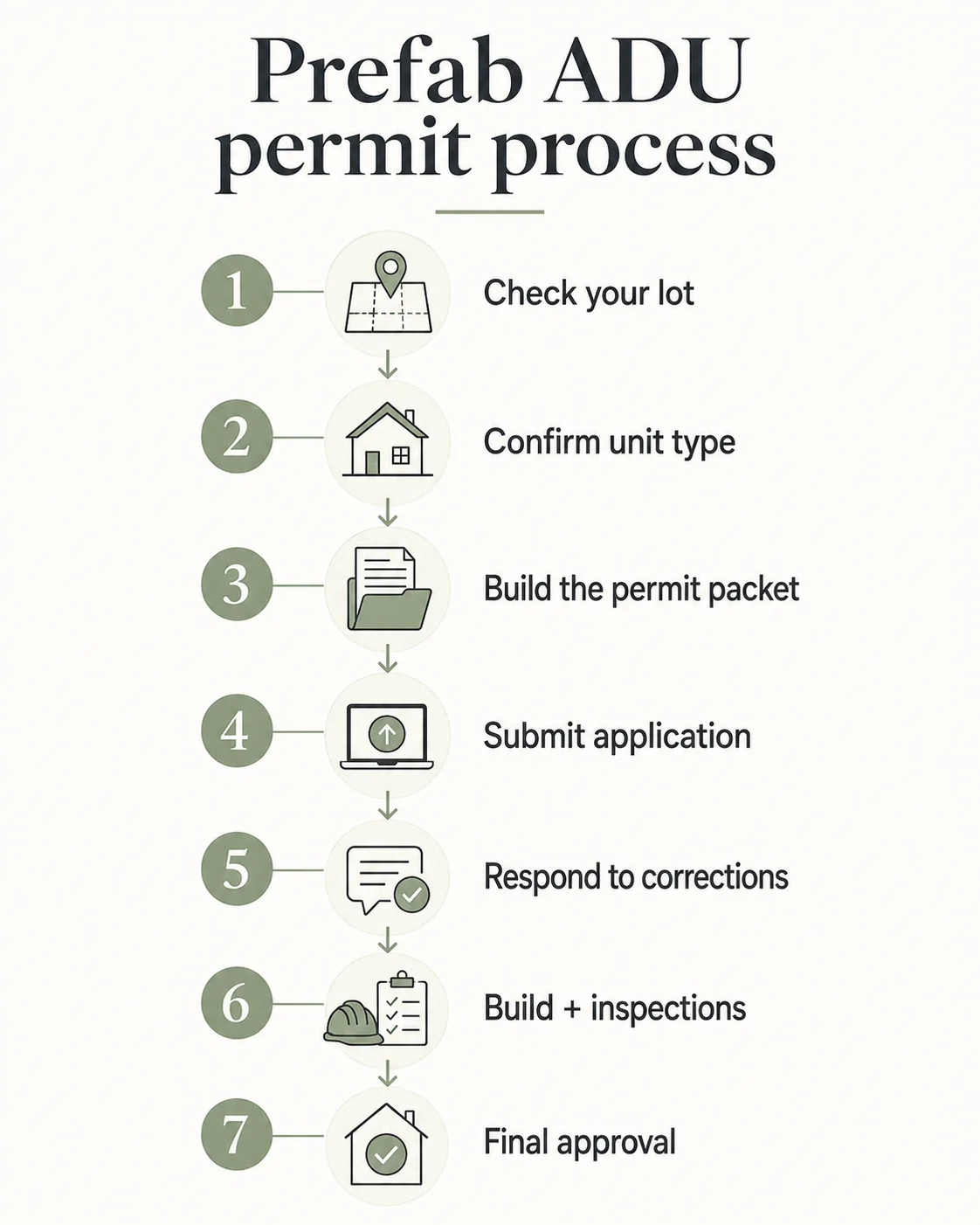
Step 1 — Confirm your lot can legally have an ADU
Before you fall in love with a model, confirm the parcel. Check the zoning district, lot size, how many ADUs are allowed, whether detached units are permitted, setbacks, height limit, floor-area/lot-coverage caps, parking rules, any owner-occupancy requirement, HOA or deed restrictions, and hazard overlays (fire/WUI, flood, coastal, steep slope, septic). Austin’s published ADU process literally begins with verifying zoning eligibility and minimum lot area before anything else (verified May 2026). Skip this and you can buy a perfect unit for a lot that can’t hold it.
Step 2 — Confirm the prefab unit’s legal code path
Pin down the class from our matrix above and get it in writing. Ask the seller: Is this modular, manufactured (HUD), panelized, kit, park model, or RV? What building code or federal/state program applies? Does it carry a HUD label, a state insignia, or stamped engineering? Has this exact model been permitted as an ADU in your state and city before? The answers determine your entire permit path.
Step 3 — Build the permit packet
Your jurisdiction reviews documents, not photos. A complete packet usually includes the permit application, a site plan or survey, floor plans, elevations, foundation plans, structural calculations, energy documentation, a utility plan, drainage/grading plans if required, fire/flood/coastal/septic documents if applicable, the manufacturer’s installation manual, the unit’s certification documents (HUD label/data plate or state insignia), and contractor/license documentation where required.
Step 4 — Submit the application and pay plan-review fees
Submitting starts the official clock — but only if the application is complete. Austin’s process, for example, runs from eligibility verification to requesting a new address/building number, applying for the building permit, paying plan-review fees, the review itself, permit-fee payment, construction inspections, and finally the certificate of occupancy (City of Austin, verified May 2026). Most cities now take digital submittals; a few still want paper.
Step 5 — Respond to plan-check corrections
Almost every project gets a correction list. Common ones: the site plan doesn’t match the survey, foundation details are incomplete, energy forms are missing, the utility service is unclear, fire separation is too tight, or the product classification isn’t documented. How fast you respond is often the single biggest lever on your total timeline.
Step 6 — Build and install with inspections
Even a fully modular unit gets local field inspections: foundation, utility trenches, rough MEP where applicable, the set/anchoring inspection on crane day, energy/insulation if relevant, and a final building inspection. The factory’s in-plant inspection does not substitute for these.
Step 7 — Get final occupancy or use approval
This is the only approval that lets you legally occupy the unit. Miami-Dade requires a Certificate of Use (and an annual renewal) for an ADU; Boston notes work can’t even start until the building-permit card is issued (Miami-Dade County; City of Boston, both verified May 2026). No certificate, no legal move-in, no legal rental.
| Step | Who owns it | Key documents | Most common failure point |
|---|---|---|---|
| 1. Lot eligibility | Homeowner / designer | Parcel data, zoning, survey | Lot can't fit an ADU |
| 2. Unit classification | Seller / designer | HUD label, state insignia, stamped plans | Product type not accepted |
| 3. Permit packet | Designer / engineer | Survey, plans, foundation, utilities | Missing hazard or utility info |
| 4. Application | Owner / contractor | Permit forms, plans, fees | Incomplete submittal stalls the clock |
| 5. Plan review | City / county | Correction responses | Slow or unresolved comments |
| 6. Inspections | Contractor / city | Inspection cards, field docs | Work differs from approved plans |
| 7. Final approval | City / county | Final inspection, CoO / CU | Occupancy not granted |
The seven steps are the same whether you manage them yourself or hand them off. If you’d rather have one team own plan review, corrections, and inspections end to end, that’s a legitimate way to de-risk the process.
How long do prefab ADU permits take?
There is no single national prefab ADU permit timeline. Fast pre-approved-plan paths can run in weeks; an ordinary custom prefab permit can take months if the application is incomplete, the city issues corrections, utilities need upgrades, or the product class is unclear. The clock that matters starts when the city accepts a complete application — not when you order the unit, not when the factory starts building, and not when the seller calls a design “permit-ready.”
Two timelines are at play, and people conflate them. Factory production and the crane set can genuinely be fast. Plan review, site work, utility connections, inspections, and occupancy approval are a separate calendar. A unit “installed in days” can still be months from legal occupancy.
| Place | Published timeline signal | What it actually means | Primary source |
|---|---|---|---|
| California (statewide) | Approve or deny a complete ADU application within 60 days (ministerial) | The clock depends on completeness; factory build status is irrelevant to it | Gov. Code § 66317 |
| San Diego, CA | 30-day review for applications using pre-approved ADU plans | Applies to pre-approved plans only; local code, site compliance, and licensing still required | City of San Diego |
| Seattle, WA | Pre-approved DADU plans permit “in most cases” within 2–6 weeks | Limited to eligible zones; site-specific items still apply | City of Seattle |
| Boston, MA | Review may take up to 5 weeks or longer if zoning relief is needed or documents are wrong | Complete, correct documents are the lever | City of Boston |
All sources verified May 2026.
For modular specifically, builders commonly report roughly 4–9 months from permit submission to occupancy, versus roughly 9–18 months for site-built, crediting the parallel tracks. Treat those as vendor-reported ranges, not promises — they assume a cooperative jurisdiction and a straightforward lot.
In California, the statutory framework now sets explicit clocks. Under SB 543 (effective January 1, 2026) a local agency has 15 business days to deem an ADU application complete, then must approve or deny within 60 days. AB 1332 (effective January 1, 2025) requires cities to run a pre-approved-plan program, and a detached ADU application that uses a locally pre-approved plan gets a 30-day review. And AB 462, which took effect October 10, 2025, requires the local government (or, where applicable, the California Coastal Commission) to approve or deny a completed ADU coastal development permit application within 60 days, running concurrently with the ADU application (Burke, Williams & Sorensen — 2025 ADU legislative update; California HCD, both verified May 2026). Most states do not impose clocks like these — which is exactly why “how long” is a local question.
The permit clock usually starts when the city accepts a complete application — not when you order the prefab unit, not when the factory starts building, and not when the seller says the design is “permit-ready.”
Do pre-approved ADU plans make prefab permits faster?
Sometimes — but only for part of the process. Pre-approved ADU plans can reduce design and structural/life-safety review friction, but they generally do not waive zoning, site-plan review, utility approvals, flood/fire/coastal/septic checks, trade permits, fees, or inspections. Portland states this directly: its pre-approved plans can reduce life-safety and structural review when used as designed, while zoning, utilities, flood hazards, trade permits, and system-development charges still apply (City of Portland, verified May 2026).
| City / program | What’s pre-approved | What still remains | Primary source |
|---|---|---|---|
| San Diego | Pre-approved ADU plans; 30-day review for applications using them | Local SDMC regulations, setbacks, fire/coastal, site issues | City of San Diego |
| Seattle (ADUniverse) | Pre-approved DADU plan set | Permit process; limited to NR-1/NR-2/NR-3 zones, no environmentally critical areas, <750 sq ft total ground disturbance | City of Seattle |
| Portland | Reduces some life-safety/structural review when used as-is | Zoning, utilities, flood hazards, trade permits, SDCs | City of Portland |
| Eugene, OR | Plans already cleared building-permit review | Site work, local permitting, SDCs | City of Eugene |
| Miami-Dade, FL | Pre-approved ADU Blueprint designs | Site plan, Certificate of Use, special lot conditions | Miami-Dade County |
All sources verified May 2026.
What do the permits and fees cost?
Permit fees are local and stack from four predictable buckets: plan check, building-permit issuance, impact/connection fees, and the physical utility hookups. Two levers move the total more than anything else: staying under the size thresholds that waive impact fees, and using pre-approved plans, which often reduce plan-check fees.
In California, impact fees cannot be charged on an ADU of 750 sq ft or less, or a JADU of 500 sq ft or less; connection and capacity fees are treated separately (this protection originated with SB 13 and is maintained in current law; California HCD, verified May 2026). Separately, an ADU or JADU with less than 500 sq ft of interior livable space is treated as not increasing assessable space for school-fee purposes under California Education Code § 17620 — so school fees don’t apply to those smaller units (verified May 2026). Those thresholds are stable. The dollar amounts below are not — confirm your own city’s current fee schedule before you budget.
| Fee bucket | What it pays for | Third-party estimate (jurisdiction-specific) |
|---|---|---|
| Plan check / plan review | City reviews your drawings for code compliance | San Diego County estimate: $1,565 + $0.331/sq ft |
| Building-permit issuance | Permission to build/install | Varies widely by city |
| Impact / connection / capacity fees | Schools, sewer/water capacity, traffic | The biggest swing — but waived in California for ADUs ≤750 sq ft; connection/capacity fees are separate |
| Utility hookups (physical) | New meters, sewer lateral, trenching | Commonly $4,000–$8,000 when new connections are required |
| Illustrative all-in permit estimate | Plan check + issuance + utilities (excludes construction) | San Diego estimate: ~$6,500 (400 sq ft) → ~$21,000 (1,200 sq ft) |
Dollar figures are third-party permit-service estimates from SnapADU’s ADU permit-fee analysis (verified May 2026); they are estimates for specific California jurisdictions, not official city fee schedules. The California legal thresholds are sourced to HCD and Education Code § 17620.
For all-in prices by size and type, see our prefab ADU cost guide.
What documents should you get from the prefab company before paying a deposit?
Before you wire a nonrefundable deposit, ask the prefab seller for the exact documents your city will need to review the unit — a brochure, a rendering, or a marketing floor plan is not a permit packet. The right list lets your designer or contractor confirm, in advance, that the product can clear local review on your lot.
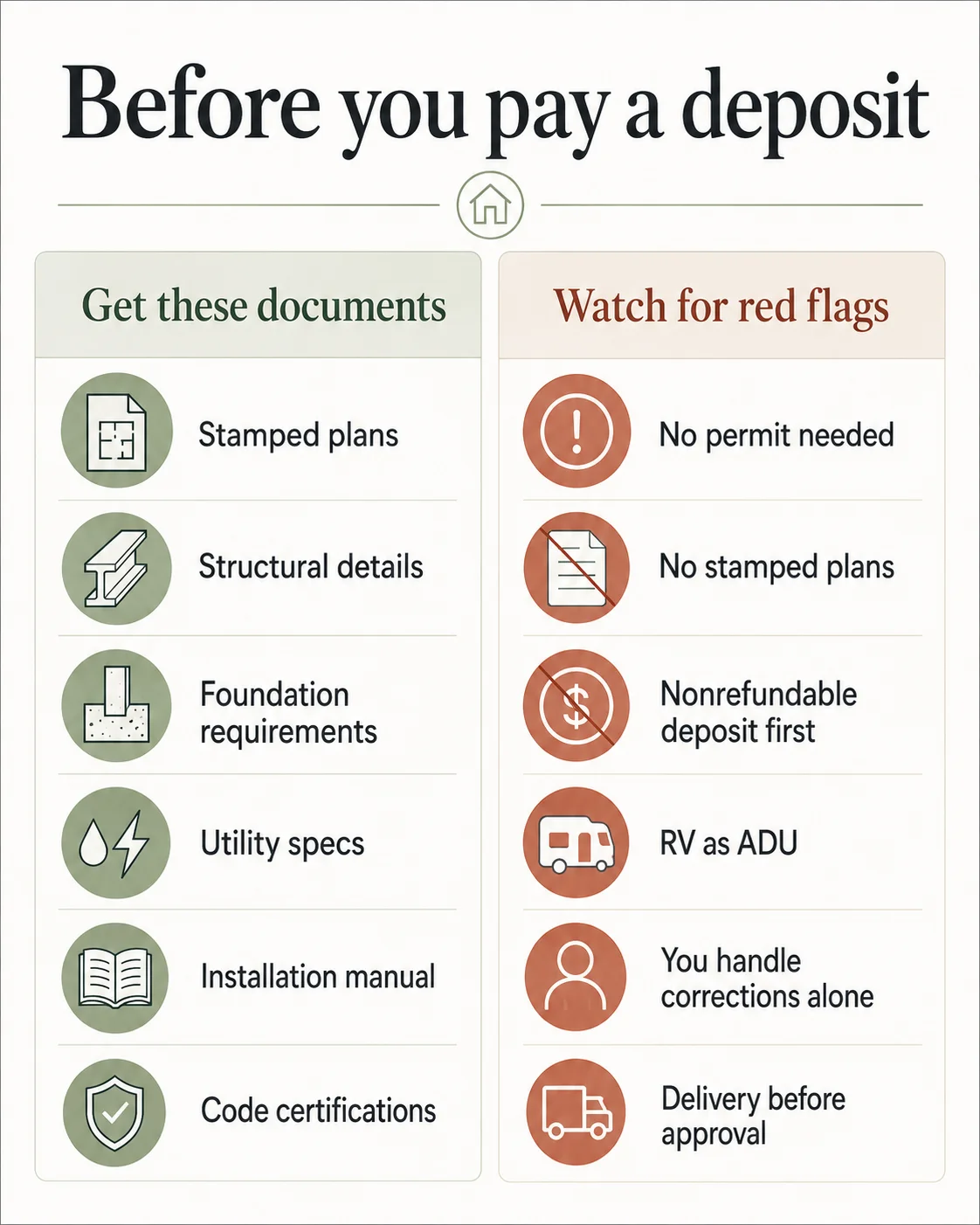
| Document to request | Why it matters |
|---|---|
| Product classification, in writing | Determines the modular / manufactured / kit / RV / tiny-home path |
| Stamped architectural plans | Required for plan review |
| Structural calculations | Needed for foundation, loads, anchoring |
| Foundation requirements | Confirms whether the unit fits your site and soils |
| Energy-compliance documents | Often required for a residential permit |
| Installation manual | Needed for inspections and to scope the contractor's work |
| Utility specifications | Water, sewer, electrical, gas, HVAC connection requirements |
| Fire-rating details | Needed near property lines or other structures |
| HUD label / data plate (if manufactured) | Confirms federal manufactured-home documentation |
| State insignia / factory-built docs (if modular) | Confirms the factory-built code path |
| Prior permit examples | Useful context — but not proof your city will approve yours |
| Correction responsibility, in writing | Determines who pays when the city asks for revisions |
Red flags to watch for
If you hear any of these, slow down and verify in writing before money changes hands:
- “No permit needed.”
- “It’s under 120 (or 200) square feet, so it’s exempt” — even though it has sleeping, cooking, or bathroom functions.
- “The city always approves these.”
- “We don’t provide stamped plans.”
- “You can figure out permits after delivery.”
- “It’s technically an RV, but you can live in it as an ADU.”
- “The deposit is nonrefundable even if the city rejects the permit.”
That last one is the trap that turns a hopeful project into a lawsuit. The fix is upstream: confirm feasibility, then sign with contingency language (more on that below), then release larger payments on milestones.
Who pulls the permit — you, your contractor, or the prefab manufacturer?
The prefab seller usually supplies the plans, but the local permit is typically submitted by the property owner, a contractor, or a designer — and some cities require a licensed contractor. Denver, for instance, requires ADUs to be built by a licensed contractor and does not allow homeowners to apply for the ADU permit themselves (City and County of Denver, verified May 2026). Portland likewise points applicants to licensed professionals and to separate trade permits for electrical, plumbing, and mechanical work (City of Portland, verified May 2026).
| Role | Usually responsible for |
|---|---|
| Homeowner | Choosing the product, authorizing the application, paying fees |
| Prefab seller / manufacturer | Product plans, specifications, factory documentation, the unit itself |
| Designer / architect / engineer | The local plan set, site plan, foundation design, correction responses |
| General contractor | Permit application (where allowed), site work, installation, inspections |
| City / county | Plan review, inspections, and final occupancy approval |
Which prefab types are easiest or hardest to permit?
The easiest prefab ADUs to permit are those with a clear residential code path and a complete permit packet; the hardest are movable, RV-like, imported, or “backyard room” products sold without city-ready plans. Permittability is less about price and more about whether the product fits a recognized dwelling-code path.
- Lowest-friction: a modular/factory-built ADU with state-recognized documentation; a panelized or kit ADU with complete stamped plans; or a city pre-approved plan used exactly as allowed.
- Higher-friction: a HUD manufactured home used as an ADU where local rules are unclear; an imported expandable unit without an accepted plan set; or a “tiny home” whose classification nobody has nailed down.
- Highest-risk: a tiny home on wheels, an RV, a park model, or a shed-like “guest house” with no residential-dwelling documentation. Seattle states that tiny houses on wheels and RVs cannot be lived in as ADUs (City of Seattle, verified May 2026). Denver excludes mobile homes, tiny homes on wheels, RVs, and travel trailers from ADU use (City and County of Denver, verified May 2026). Miami-Dade states an RV cannot be an ADU (Miami-Dade County, verified May 2026). When three large, geographically diverse jurisdictions all draw the same line, treat it as the national default and get written confirmation before buying anything on wheels.
What can make a prefab ADU fail permitting even if the unit is code-compliant?
A prefab unit can be code-compliant as a product and still fail as a project — most failures come from the site, the zoning, the utilities, a hazard overlay, or missing documentation, not from the unit itself. This is the honest, uncomfortable part of prefab: a beautiful, factory-inspected unit gives a false sense of security. The unit passing inspection at the plant tells you nothing about whether it can legally land on your lot.
That’s our one hard admission on this page, and we’d rather you hear it from us than from a stop-work notice: prefab does not eliminate local approval, and the “fast” promise is conditional on a cooperative lot and a cooperative city. The good news is that the common blockers are knowable in advance, and most are checkable before you spend a dollar.
| Blocker | Why it stops the project |
|---|---|
| Setbacks | The unit can't fit inside the legal building envelope |
| Height limit | A loft or roof design exceeds the local cap |
| Lot coverage / FAR | The ADU pushes total floor area or coverage past the limit |
| Fire separation | The unit sits too close to the house or a property line |
| Flood zone | Elevation and flood-resistant construction requirements |
| Coastal zone | An extra permit (a coastal development permit) and review time |
| Wildfire / WUI | Fire-resistance and emergency-access requirements |
| Septic | The existing system may not have capacity for another unit |
| Sewer / water | A lateral or meter upgrade may be required |
| Electrical service | The panel or service may need an upgrade |
| Crane / delivery access | The unit physically can't reach the site |
| HOA / deed restrictions | May impose rules even where state law expands ADU rights — check both |
| Short-term rental rules | A legal ADU is not automatically a legal Airbnb |
| Product classification | An RV, park model, or undocumented 'tiny home' may not qualify at all |
Should you buy the prefab unit before or after permit approval?
Don’t buy the unit just because the model is advertised as “permit-ready.” The safer sequence is to verify feasibility first, sign a contract with permit-contingency protections, then release larger payments only as the permit path clears. A “permit-ready” model is a starting point for your application, not a guarantee your city will approve it on your lot.
A safer order of operations:
- Identify your preferred prefab model.
- Request the permit documents listed above.
- Check your lot’s eligibility (zoning, setbacks, hazards, utilities).
- Confirm the product classification with your city or a local permit professional.
- Get a written scope for who handles permit corrections — and who pays.
- Sign only with refund and contingency language.
- Submit the permit.
- Release manufacturing and delivery payments on milestones, not all at once.
Contract clauses worth discussing with your attorney or contractor before you sign:
| Clause | Why it protects you |
|---|---|
| Permit contingency | Protects the buyer if the city rejects the product or path |
| Correction responsibility | Clarifies who fixes — and funds — plan-check comments |
| Refundable deposit window | Limits risk before feasibility is confirmed |
| Delivery-delay terms | Prevents the unit arriving before the site is ready |
| Storage-cost responsibility | Avoids surprise charges if the set is delayed |
| Code-change clause | Allocates risk if requirements change mid-project |
| Site-work exclusion list | Makes hidden site costs visible upfront |
| Utility-upgrade exclusion | Prevents 'that wasn't included' surprises |
| Inspection-failure remedy | Defines the fix timeline and who bears the cost |
This framework is general information, not legal advice; review any contract with a qualified professional.
How does the prefab ADU permit process change by state or city?
A permissive state ADU law can make ADUs broadly legal, but the local building department still controls the permit packet, site review, inspections, and occupancy — a “yes” at the state level is not a “yes” for every prefab product on every lot.
California
California’s ADU law requires local agencies to ministerially approve or deny a complete application within 60 days (Gov. Code § 66317, verified May 2026). The 2025–2026 reforms tightened the machinery: SB 543 adds a 15-business-day completeness check and codifies the 60-day clock; AB 1332 requires cities to run a pre-approved-plan program, with 30-day review for a detached ADU using a pre-approved or identical plan; and AB 462, effective October 10, 2025, extends a concurrent 60-day clock to coastal development permits (Burke, Williams & Sorensen, verified May 2026). None of this waives the local building permit, site review, or inspections.
Washington
Washington’s HB 1337 (2023, codified at RCW 36.70A.680, .681, and .696) requires many Growth Management Act jurisdictions to allow up to two ADUs on residential lots inside urban growth areas (Washington Dept. of Commerce, verified May 2026). State permissiveness doesn’t erase the permit packet — Seattle is explicit that ADUs must be established through the permit process, and that tiny homes on wheels and RVs can’t be lived in as ADUs (City of Seattle, verified May 2026).
Oregon
Oregon shows why “pre-approved” never means “no permit.” Portland, Eugene, and Bend all offer pre-approved or pre-reviewed ADU plans, yet Portland still requires building and trade permits, with pre-approved plans reducing only certain structural/life-safety review when used as designed (City of Portland; City of Eugene; City of Bend, all verified May 2026). System-development charges and site review still apply.
Colorado
Colorado HB24-1152 requires subject jurisdictions to allow one ADU as an accessory use to a single-unit detached dwelling on or after June 30, 2025 (Colorado General Assembly, verified May 2026). Denver’s rules exclude mobile homes, tiny homes on wheels, RVs, and travel trailers from ADU use, and require a licensed contractor (City and County of Denver, verified May 2026).
Texas
Texas is intensely local. Austin publishes a defined ADU process — zoning eligibility, address assignment, building permit, fees, inspections, and certificate of occupancy (City of Austin, verified May 2026). Dallas is far more restrictive: ADUs are not by-right in most cases and may require an overlay or a Board of Adjustment special exception before a permit path opens (City of Dallas, verified May 2026). Same state, very different answers.
Florida
As of this verification, Florida has no single statewide ADU-approval law overriding local rules. A 2026 housing bill, SB 48, did not become law — the Florida Senate bill page lists its last action as March 13, 2026, “Died in Messages” (The Florida Senate, verified May 2026) — so Florida ADU rules remain local. Miami-Dade allows ADUs and guesthouses in eligible single-family contexts and requires a building permit and a Certificate of Use (renewed annually whether the unit is rented or not), and states an RV cannot be an ADU; in RU-1 districts it sets a minimum 7,500 sq ft lot and a 400–800 sq ft ADU size (Miami-Dade County, verified May 2026).
Massachusetts
Boston requires a long-form building permit for an ADU and notes that review can take up to five weeks or longer if zoning relief is needed or documents are submitted incorrectly — a useful reminder that complete, correct paperwork is the real timeline lever (City of Boston, verified May 2026).
The throughline across all seven: state law sets the floor for whether ADUs are allowed; your city sets the process you actually have to clear. Always confirm both for your address.
Prefab ADU permit checklist
Use this checklist before you pay a prefab deposit, submit plans, or schedule delivery — the goal is to confirm the product, the lot, the plans, the utilities, and the local approval path all line up.
1. Property eligibility
- Zoning district confirmed
- ADU allowed on the parcel (and how many)
- Detached / attached / JADU rules confirmed
- Setbacks confirmed
- Height confirmed
- Lot coverage / FAR confirmed
- Parking confirmed
- Owner-occupancy rule confirmed
- HOA / deed restrictions confirmed
- Fire / flood / coastal / septic / slope overlays confirmed
2. Prefab product classification
- Modular / factory-built
- HUD manufactured
- Panelized
- Kit
- Tiny home on a foundation
- Tiny home on wheels (usually cannot be a permanent ADU)
- Park model / RV (usually cannot be a permanent ADU)
- Imported expandable unit
- Unknown — requires city confirmation before purchase
3. Seller documents
- Stamped plans
- Structural calculations
- Foundation specs
- Utility specs
- Energy docs
- Installation manual
- Fire-rating details
- Certification labels / insignia / data plate (if applicable)
- Prior permit examples
- Written correction responsibility
4. Permit packet
- Application form
- Site plan / survey
- Floor plans
- Elevations
- Structural / foundation details
- MEP plans
- Energy documentation
- Drainage / grading (if required)
- Utility plan
- Contractor / license documents
- Fees
5. Contract protections
- Permit contingency
- Refund window
- Correction responsibility
- Delivery timing
- Storage responsibility
- Change-order process
- Utility / site-work exclusions
What we verified for this guide
We verified official state, city, county, and federal HUD sources, plus current competitor pages, on May 31, 2026. Local permit rules change often, so treat this page as a researched starting point — not a substitute for parcel-specific review by your city or a qualified professional.
| Verified item | Source category | Last verified | Refresh trigger |
|---|---|---|---|
| Prefab ADUs require local permits | City/county building & planning pages | May 31, 2026 | Quarterly |
| Modular vs. manufactured vs. park-model code paths | U.S. HUD; CA HCD; NY Dept. of State; ANSI/RVIA | May 31, 2026 | Annual |
| Factory-cert vs. local-occupancy split | CA HCD; City of Concord | May 31, 2026 | Annual |
| HUD installer program (HUD- vs. state-administered) | U.S. HUD Office of Manufactured Housing | May 31, 2026 | Annual |
| California 15-day / 60-day / 30-day clocks; AB 462 (Oct 10, 2025) | SB 543, AB 1332, AB 462; HCD; law-firm advisory | May 31, 2026 | Each legislative session |
| California impact-fee waiver (≤750 sq ft) & school-fee treatment (<500 sq ft) | HCD; Education Code § 17620 | May 31, 2026 | Each legislative session |
| Example permit-fee dollar figures (CA) | Third-party permit-service estimates (SnapADU) — not official schedules | May 31, 2026 | Quarterly |
| San Diego 30-day pre-approved review; building permit required | City of San Diego (IB 400; ADU program) | May 31, 2026 | Monthly |
| Seattle pre-approved DADU timeline + zone limits | City of Seattle (SDCI) | May 31, 2026 | Monthly |
| Portland pre-approved plan limits | City of Portland | May 31, 2026 | Quarterly |
| Austin ADU process | City of Austin | May 31, 2026 | Quarterly |
| Dallas not-by-right ADU path | City of Dallas | May 31, 2026 | Quarterly |
| Miami-Dade Certificate of Use; RU-1 lot/size rules | Miami-Dade County | May 31, 2026 | Quarterly |
| Denver ADU/tiny-home + licensed-contractor rules | City and County of Denver | May 31, 2026 | Quarterly |
| Washington HB 1337 (RCW 36.70A.680/.681/.696) | Washington Dept. of Commerce | May 31, 2026 | Each legislative session |
| Colorado HB24-1152 (after June 30, 2025) | Colorado General Assembly | May 31, 2026 | Each legislative session |
| Florida SB 48 status (“Died in Messages,” Mar 13, 2026) | Florida Senate | May 31, 2026 | Each legislative session |
| San Bernardino County manufactured-home-as-ADU rules | San Bernardino County Land Use Services | May 31, 2026 | Quarterly |
What still varies and should be re-checked for your situation: your city’s current fee schedule (the dollar figures above are third-party estimates for specific California jurisdictions, not national prices); whether your state runs its own modular and installer programs; and any state legislation that changes after this verification date.
Methodology and editorial notes
The Dwelling Index is an independent research resource covering ADU financing, costs, and regulations. For this guide we reviewed official city and county permit pages, state ADU statutes, U.S. HUD manufactured-housing documentation, and current prefab/ADU-permit pages, then assembled the comparison tables and frameworks above. We used homeowner forum and community language to understand real confusion and objections — but never as a source for legal, cost, financing, zoning, or code claims. Local rules change frequently, so every jurisdictional claim carries a verification date and links to its primary source, and should be rechecked on update. This content is for informational purposes only and is not legal, financial, tax, or construction advice; verify everything with your city and a qualified professional before deciding.
Author: the Dwelling Index Editorial Team. We do not use fabricated expert reviewers, credentials, ratings, or testimonials.
Frequently asked questions
- Do prefab ADUs need permits?
- Yes. A prefab ADU still needs local permits for zoning, the building structure, site work, utilities, inspections, and legal occupancy. Factory construction reduces on-site build time but does not waive local approval.
- Does modular factory approval mean my city has approved it?
- No. A modular unit's state insignia or factory documentation proves the unit meets a construction standard. Your city separately reviews and approves whether that unit can be installed and occupied on your specific lot.
- Is a pre-approved ADU plan the same as a prefab ADU?
- No. A pre-approved plan is a plan-review shortcut a city offers; a prefab ADU is a construction and delivery method. A project can use both, but they are not the same thing, and a pre-approved plan does not pre-approve your lot.
- How long does prefab ADU permitting take?
- It depends on the jurisdiction, the completeness of your plans, the product type, and site constraints. Some pre-approved paths advertise 2–6 weeks or a 30-day review; custom or correction-heavy projects can take several months. California requires a decision within 60 days of a complete application.
- Can a tiny home on wheels be a legal ADU?
- Usually no. Cities including Seattle, Denver, and Miami-Dade explicitly state that tiny homes on wheels, RVs, or travel trailers cannot be used as ADUs. A few places have movable-tiny-home ordinances, so get written confirmation from your city before buying.
- Can a manufactured (HUD) home be an ADU?
- Sometimes. Many jurisdictions allow a HUD-code manufactured home as an ADU if it's placed on a permanent foundation, often with size and appearance conditions. Confirm your city's rules, because they vary.
- What is a modular "insignia"?
- It's a numbered label affixed to a modular unit at the factory once a state program (or a state-approved third party) has inspected it and confirmed it meets the state building code. It certifies the unit — it does not replace your local site permits or occupancy approval.
- Does a modular ADU need a foundation?
- Yes. A permanent ADU — modular, manufactured, or otherwise — needs a code-compliant permanent foundation, which your local building department permits and inspects.
- How much do prefab ADU permits cost?
- Permit fees are local and stack from plan check, permit issuance, impact/connection fees, and utility hookups. As a third-party estimate of scale, all-in permit costs ran roughly $6,500 to $21,000 by size in specific California jurisdictions; these are estimates, not official schedules, so confirm your own city's current fees.
- Who pulls the permit — me, my contractor, or the prefab company?
- It varies by city and project. Often a licensed contractor, designer, or architect submits the package; some cities — Denver, for example — require a licensed contractor and don't allow homeowners to self-permit an ADU.
- Can I start factory construction before my local permit is approved?
- Sometimes a manufacturer will allow it, but it's risky. If plan review requires changes, you may face redesign, delay, storage, or cancellation costs. Treat it as a contract-and-feasibility decision.
- Can I rent out a prefab ADU after approval?
- Maybe. Legal occupancy is separate from rental permission. Check local long-term rental, short-term rental, owner-occupancy, registration, and certificate-of-use rules before assuming you can rent it.
- What happens if I install a prefab ADU without permits?
- You can face stop-work orders, fines, removal orders, utility disconnection, trouble selling or refinancing, and an inability to legally occupy or rent the unit. Enforcement varies, but the financial and legal exposure is real.